INTRODUCTION
The chub mackerel (Scomber japonicus), which is distributed in China, Korea, Japan and the Russian Far East region of the north-western Pacific, is a marine migratory pelagic species, and is one of the main economic species in the North Pacific. In the East China Sea, the chub mackerel has become one of the most important fishing target species with the decline of traditional demersal economic species. In recent years the catch of chub mackerel increased year on year, and it is reported that it may have reached about 28 × 104t in the western East China Sea (Yan et al., Reference Yan, Li, Ling, Ye and Zhang2010), and almost all the individuals caught are younger than two years.
With the increased intensity of exploitation more attention has been paid to the status, rational exploitation and management of the chub mackerel resource. Chen et al. (1998) estimated the stock size of chub mackerel in the East China Sea using virtual population analysis (VPA), and indicated that catches were approaching the stock size. Although Chen et al. (Reference Chen, Hu and Yan1998) only included the catches from three provinces and one city in the East China Sea, which may mean that the estimated abundances and catches were lower than the actual levels, the changes of size composition, catch and abundance indicated that chub mackerel in the East China Sea has already been over-exploited. Cheng & Lin (Reference Cheng and Lin2004) analysed the biological characteristics and resource status of chub mackerel using historical data, and pointed out that chub mackerel size had reduced appreciably. Wang et al. (Reference Wang, Yan, Cheng and Li2007) and Yan et al. (Reference Yan, Li, Ling, Ye and Zhang2010) used length data to analyse the exploitation levels of chub mackerel, and gave suggestions, such as postponing the fishing season and prohibiting the use of larvae to ensure sustainable utilization of the resource. These authors evaluated the resource status of chub mackerel using different methods based on different data, and reached a similar conclusion: that the chub mackerel resource in the East China Sea is threatened by the high fishing intensity.
The fishery stock assessment models are mostly time-based (or age-based) because the life histories of aquatic biology are recorded by time-series. The time-based (or age-based) models can usually give more accurate results since they rely on life history characteristics. But in many real fisheries, age determinations of aquatic biology are usually difficult and the costs are high, which means that age data are usually unavailable (Li & Liu, Reference Li and Liu2007). Therefore, some researchers select length data as input in stock assessments instead of using age data. Specific to chub mackerel, length data were used in many researches, like the works of Wang et al. (Reference Wang, Yan, Cheng and Li2007) and Yan et al. (Reference Yan, Li, Ling, Ye and Zhang2010) mentioned above. Additionally, there are very limited alternative data that can be used in fisheries stock assessments in China, as in many other developing countries. With no age composition information, no survey information, no accurate long time-series catch data, the length data may be the only reliable data source. Length data are relatively easy to collect and the costs are low, so they provide valuable information for data-limited fisheries. If age-based analyses can be carried out based on length data, it will be possible obtain relatively accurate stock assessment results from low-cost input data, which will be a great improvement for the stock assessment method in a data-limited situation. In this paper, we built a relationship between age and fork length of chub mackerel, and carried out age-based stock assessment. The fork length data were measured based on 5386 chub mackerel sampled from the middle East China Sea during 2009 and 2010. The maximum sustainable yield (MSY) was estimated, the spawner–recruitment relationship was built, and the biomass, spawning biomass, catches and the length composition of catch were also predicted for fishing at the current intensity.
MATERIALS AND METHODS
Data collection
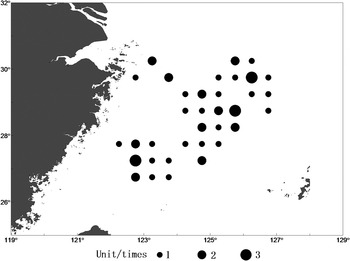
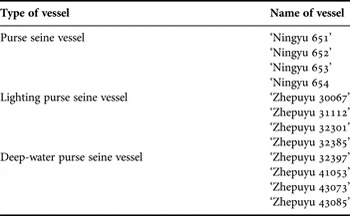
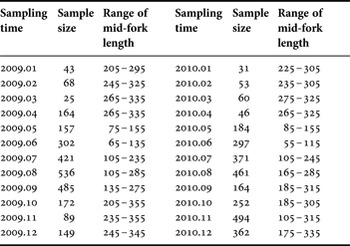
Chub mackerel were collected every half month during 2009 and 2010 in the central East China Sea (Figure 1) from 12 sampling vessels, including lighting purse seine vessels, purse seine vessels and deep-water purse seine vessels from the Ningbo Haiyu marine fishery company and the Putuo district of Zhoushan (Table 1). During these two years, 5386 individuals were collected, including 1565 larvae and 3821 adult fish. Table 2 shows the sample sizes of chub mackerel for each month. The larvae were defined with a maximum immature fork length of 220 mm. The fork length and body weight of sampled chub mackerel were recorded, and a length–frequency matrix was built.
Survey and sample areas of chub mackerel (Scomber japonicus) in the central East China Sea during 2009 and 2010.

List of sampling vessels.

The sample size of chub mackerel (Scomber japonicus) for each month.

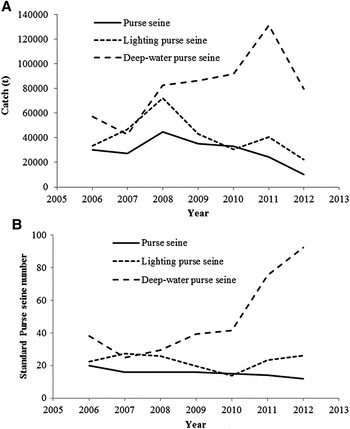
Statistics of catch and vessel number from 2006 to 2012 for the above three types of fishing vessels were obtained from the fisheries management department (Figure 2). Fishing efforts were measured in terms of vessel number. The purse seine was regarded as the standard vessel, and the catch per unit effort (CPUE) of other types of vessel were standardized using the effectiveness-ratio method.
Annual statistical data of chub mackerel (Scomber japonicus) from 2006 to 2012: (A) catch of purse seine, lighting purse seine and deep-water purse seine vessels; (B) vessel numbers of purse seine, lighting purse seine and deep-water purse seine vessels.

Methods
Age composition was prejudged using Bhattacharya's method in FiSAT II based on length–frequency data. Because of the difference of growth rates, any one age will correspond to different lengths, which we assumed followed a normal distribution,  $N\lpar \bar L_t\comma \; \sigma _t^2 \rpar $, where
 $\bar L_t$ is the average length of age t, and σt2 is the variance of lengths at age t. Then the individuals in the catch sample could be separated into different age groups. A revised age–fork length key for chub mackerel reported by Liu et al. (Reference Liu, Yan, Hu and Cheng2005) was used to build the relationship between age and fork length. The catch composition by weight for all ages could be calculated by multiplying the average weight with the corresponding number in each age group. Therefore, the ratios of the catch weight for all age groups could be calculated, which was applied to the total catches of the above three types of vessels in the central East China Sea from 2006 to 2012, and then the total catches were separated by ages. If the catch number of each age was required, we divided the catch weight at each age by the average weight. Chub mackerel that were larger than 220 mm were treated as spawners, and those individuals smaller than 220 mm were recruitment.
We estimated the maximum sustainable yield (MSY)of chub mackerel and built the spawner–recruitment relationship. We used the catch-at-age model to estimate abundance, and predict the change trend of the chub mackerel biomass under the current fishing intensity.
A Schafer model with observation error was used when estimating MSY:
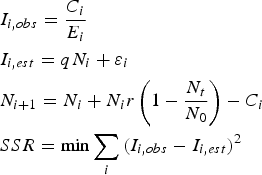 $$\eqalign{& I_{i\comma obs}=\displaystyle{{C_i } \over {E_i }} \cr & I_{i\comma est}=qN_i+\varepsilon _i \cr & N_{i+1}=N_i+N_i r \left(1 - \displaystyle{{N_t } \over {N_0 }} \right)- C_i \cr & SSR=\min \sum\limits_i {\lpar I_{i\comma obs} - I_{i\comma est} \rpar ^2 } } \eqno \lpar 1\rpar$$
where I i,obs and I i,est are the observed and estimated CPUEs in year I, C is catch, E is fishing effort and N is abundance, ɛ is the error, which follows a normal distribution, q represents catchability, r is population intrinsic growth rate and both of these were assumed constant.
The spawner–recruitment relationship was built based on the Ricker model:
 $$R_{i+1}=\alpha S_t e^{ - \beta S_t } \eqno \lpar 2\rpar$$
where R is recruitment and S is spawner; α and β are two parameters.
A catch-at-age model was used to predict the abundance and catches:
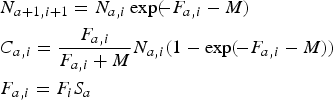 $$\eqalign{& N_{a+1\comma i+1}=N_{a\comma i} \exp \lpar \!\!- F_{a\comma i} - M\rpar \cr & C_{a\comma i}=\displaystyle{{F_{a\comma i} } \over {F_{a\comma i}+M}}N_{a\comma i} \lpar 1 - \exp \lpar \!- F_{a\comma i} - M\rpar \rpar \cr & F_{a\comma i}=F_i S_a } \eqno \lpar 3\rpar$$
where F a,i represents the coefficient of fishing mortality of age a in year I, M is the coefficient of natural mortality, which is constant for age and year. The total mortality (Z) was estimated using the length-based catch curve method and M was assumed equal to 0.51, which was estimated by Chen (Reference Chen, Hu and Yan1998) through Pauly's method (Pauly, Reference Pauly1980). The estimated Z was 1.21, so that F (Z-M) = 0.7. S a is the selectivity of age a, which followed a logistic distribution:
 $$S_t=1/\lpar 1+e^{ - S_1 \lpar a - S_2 \rpar } \rpar \eqno \lpar 4\rpar$$
where S 1 and S 2 are two parameters determined to be S 1 = 2.62, S 2 = 0.16 based on historical data and catch age-ratios. The fork length composition in catch, biomass, spawning biomass and catch were predicted assuming current fishing intensity.
RESULTS
Length and age composition
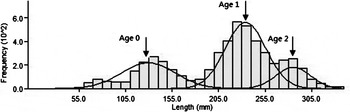
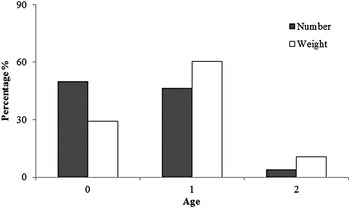
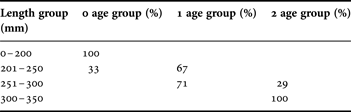
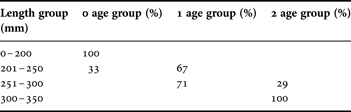
The length composition of sampled chub mackerel is shown in Figure 3, from which we initially determined that there are three age groups. Based on the revised age–fork length key reported by Liu et al. (Reference Liu, Yan, Hu and Cheng2005) (Table 3), we estimated the age composition of the sampled chub mackerel. Figure 4 shows that the sampled chub mackerel were dominated by age 0 and age 1, together accounting for 96% and 89% by number and weight, respectively (Figure 4). The average lengths for the three ages were about 168 mm, 233 mm and 298 mm, and the average weights were 75 g, 168 g and 359 g, respectively. The percentages of catch number of different ages were 49.9%, 46.3%, and 3.8%, and the percentages of catch weight of different ages were 29.1%, 60.3% and 10.6% (Figure 4).
Age compositions of sampled chub mackerel (Scomber japonicus) in the central East China Sea.

The percentages of catch number and weight for different ages of chub mackerel (Scomber japonicus) in the central East China Sea.

Age–fork length key of chub mackerel (Scomber japonicus) populations (based on Liu et al. (Reference Liu, Yan, Hu and Cheng2005)).
Surplus production
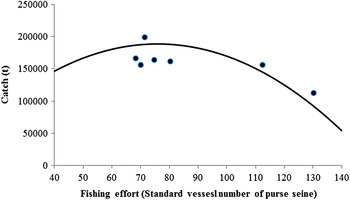
The estimated production curve is shown in Figure 5, from which we can see that the estimated MSY is about 18.8 × 10⁴t. This result is smaller than other reports (Song et al., Reference Song, Chen, Ding, Miao, Li, Shui, Huang and Shang1995; Li et al., Reference Li, Chen and Guan2010; Yan et al., Reference Yan, Zhang, Li and Li2012). Figure 5 shows that the chub mackerel resource is overexploited, and the fishing effort should be decreased. We selected the purse seine as the standard vessel, and standardized the other types of vessels accordingly. The E MSY is about 72, which means the equivalent of a total of 72 purse seine vessels (equivalent to F MSY = 0.4) should be allowed to catch chub mackerel in the central East China Sea.
The surplus production curve of chub mackerel (Scomber japonicus) in the central East China Sea.

Spawner–recruitment relationship
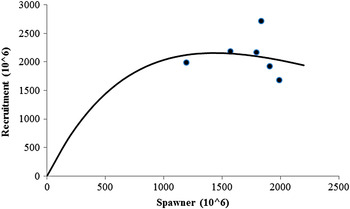
The minimum fork length for sexual maturity is about 220 mm (unpublished data). Therefore, we treated individuals shorter than 220 mm as recruitment, and those longer than 220 mm as spawners. The spawner–recruitment relationship is shown in Figure 6. We can see that the recruitment of chub mackerel has fallen below the optimum level. So, if the fishing intensity is not reduced, recruitment will continue to decrease, and the chub mackerel resources will be overfished.
The spawner–recruitment relationship of chub mackerel (Scomber japonicus) in the central East China Sea.

Prediction of population dynamics
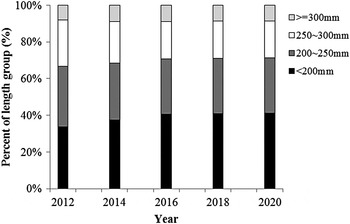
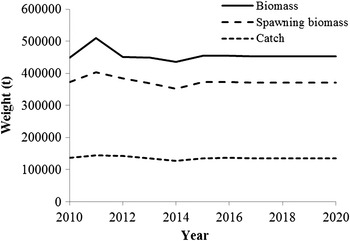
The fork length composition in the catch, the biomass, the spawning biomass and the catch itself at current fishing intensity were predicted. If the chub mackerel resource in the central East China Sea is going to be exploited at current fishing mortality (F = 0.7), the proportion of small individuals will increase. More than 40% in the catch will be individuals shorter than 200 mm, and only about 8% will be longer than 300 mm (Figure 7). The biomass will decrease to about 45.3 × 10⁴t after about 8 y, then remain stable (Figure 8). The spawning biomass will be stable at about 37.1 × 10⁴t, and the annual catch will be 13.5 × 10⁴t.
The predicted fork length composition of chub mackerel (Scomber japonicus) in the central East China Sea when fishing at the current intensity.

The predicted biomass, spawning biomass and catch of chub mackerel (Scomber japonicus) in the central East China Sea when fishing at the current intensity.

DISCUSSION
The chub mackerel resource was first commercially exploited in the 1960s in the East China Sea. After the 1970s the exploitation level increased rapidly, and in recent years the maximum catch has reached ~20 × 104t (Zheng et al., Reference Zheng, Wang, Li, Qin and Ye2012). Much research has been done into the resource status and the optimum catch (Ding et al., Reference Ding, Yu and Yan1987; Chen et al., Reference Chen, Hu and Yan1998; Wang et al., Reference Wang, Yan, Cheng and Li2007; Yan et al., Reference Yan, Li, Ling, Ye and Zhang2010). Although the estimated biomass and suggested catch may be different due to the difference of data sources, the researchers gave a similar conclusion, i.e. there are indications that chub mackerel may be overexploited and there is little potential for further utilization. Our research results also confirmed this, since the chub mackerel in the catch samples were mainly age 0 and age 1, and no fish older than 2 y appeared.
The age composition of the sampled chub mackerel is shown in Figure 4. The result for three age groups (age 0, age 1 and age 2) was consistent with our experience-based judgement. Almost half of the sampled chub mackerel were age 0 (up to 49.9%), and those of age 1 and age 2 account for 46.3% and 3.8%, respectively. Compared with historical reports, the percentage of fish of age 0 increased (by 18%), but the percentages of age 1 and age 2 decreased (by 3.6% and 14.4%, respectively) and no fish of age 3 appeared.
The purse seine was first developed in the 1970s, and became the major fishing gear for catching pelagic fish in the 1980s. In China in recent years, purse seine vessels have declined because of low economic returns, and now only 12 vessels remain. The spawning migration shoals following the Taiwan warm current from south to north is the main target for the purse seine fleet (Xu et al., Reference Xu, Zhang and Sun2000; Xu, Reference Xu2002), but the catch fluctuates from year to year (Ding, Reference Ding1994; Cui & Chen, Reference Cui and Chen2005; Liu et al., Reference Liu, Yan, Hu and Cheng2005). Lighting purse seine fishing also spread in the 1970s, and the number of vessels rapidly increased. During the 1990s the catch from lighting purse seine fishing continuously increased, remained stable between 1997 and 2002, and then decreased after 2002 (Zhang et al., Reference Zhang, Pan, Yao and Zhou2006). The traditional lighting purse seines were more suitable for fishing in coastal and inshore areas, but in recent years larger nets were developed for fishing in offshore and deep-water fishing grounds. Now the number of lighting purse seine vessels is large, and catches exceed the maximum allowable level, which has resulted in great fluctuations in the catch and a decrease of CPUE (Zheng, Reference Zheng2008). The deep-water purse seine is a new fishing gear which appeared in 2005 and developed rapidly in 2006 (Zhang, Reference Zhang, Zhou and Chen2007). The deep-water purse seine boats focus on large pelagic species inhabiting the offshore area. Due to late development it is difficult for some deep-water purse seines to further improve their economic returns, the main difficulties being the lack of fishing techniques and some necessary test instruments. Additionally, inaccurate fishing season information and poorly-defined fishing grounds are also impediments to catch improvement (Zhang, Reference Zhang, Zhou and Chen2007).
Our results indicate that the chub mackerel resource in the central East China Sea has been overexploited, and the fishing effort should be reduced. We envisage that it will not take long for the chub mackerel resource to recover to a sustainable level as the chub mackerel is a short-lived species. At present, the fishing effort is equal to about 130 standard purse seine vessels, and includes 12 purse seine vessels, 134 lighting purse seine vessels and 146 deep-water purse seine vessels. Based on our research results, in order to protect the chub mackerel resource, it is better to limit the above three types of vessels to under the equivalent of 72 standard purse seine vessels, which is equal to F = 0.4. Additionally, extending the fishing close season for all kinds of purse seines, and increasing the mesh sizes to protect larvae, are also practicable measures to promote the rebuilding of the chub mackerel resource.
Fish length is one of the most common forms of fisheries data (Hilborn & Walters, Reference Hilborn and Walters1992), especially in some developing countries, where age-based data are unavailable. Length data can be related to age through standard fisheries growth equations (von Bertalanffy, Reference von Bertalanffy1938; Quinn & Deriso, Reference Quinn II and Deriso1999), and then can be used to extrapolate age structure (Kimura, Reference Kimura1977). In age-structured models, length–frequency data are employed as the primary source of catch composition information. However, we must draw attention to the fact that this relationship has many associated assumptions (Knight, Reference Knight1968; Roff, Reference Roff1980), and must be validated before it can be employed in stock assessment (Beamish & McFarlane, Reference Beamish and McFarlane1983; Campana et al., Reference Campana, Annand and McMillan1995; Campana, Reference Campana2001). Although length–frequency data are much easier to collect, they are susceptible to several errors during the harvesting and sampling process. When systematic errors exist in length–frequency data, such as showing bias towards large/small fish (Heery & Berkson, Reference Heery and Berkson2009), they cannot be used for the extrapolation of age structure. Therefore, the sample of length–frequency should be representative and without error.
Many methods can be used to convert length compositions to age structures, such as Bhattacharya's method in FiSAT II and the age–length key, the two methods used in this paper. Bhattacharya's method is an indirect method to determine the age composition of fish, which completely depends on length–frequency data. Therefore, it depends on the researcher's subjective judgement, i.e. visual identification of frequencies belonging to different age groups is required. Additionally, Drevs & Raid (Reference Drevs and Raid2010) reported that Bhattacharya's analysis of length–frequencies cannot give satisfactory results with respect to estimation of the entire age composition of catches, and length–frequency analysis may be only viable for younger groups. For this reason, we only used this method to prejudge the age composition of sampled chub mackerel, but used the age–fork length key to convert length composition to age composition. The age–length key is a method that can usually be used to estimate age composition from length data (Terceiro, Reference Terceiro2011; Berg & Kristensen, Reference Berg and Kristensen2012). The relationship between age and length can be built by measuring the hard parts of the fish, such as the otolith, the dorsal spine section or the scales; this is considered to be a good method.
Sometimes length and weight are the only biological data for some aquatic species, especially in the data-limited situations in some developing countries. Although length data are easy to collect, their application is limited. Usually the stock assessments such as catch-at-age analysis cannot be carried out based on length-based data because the length-based biological parameters are difficult to determine. This means that the status assessment or the prediction of the fisheries resource for management purposes cannot be carried out. Therefore, we suggest length–frequency data should be converted to age composition whenever possible for in-depth stock assessment and resource management.
We built the spawner–recruitment relationship, and predicted the population dynamics of chub mackerel in the future if fishing continues at the current intensity. The conclusion of overexploitation is foreseeable because of the reduced size of the fish and the very truncated age structure. However, we must note that the spawner–recruitment relationship built here is approximate and simplified. Firstly, chub mackerel is a pelagic species, whose recruitment is affected by environmental factors, such as sea surface temperature. Secondly, the data used in this research are relatively limited. Therefore, uncertainties inevitably exist in the spawer–recruitment relationship. It also should be noted that there are uncertainties in the age–length relationship due to limited age and length samples. The data used to build the age–length key came from a limited number of years, and the relationship between age and length may vary among years because of environmental changes and fishing effects. Additionally, the application of an age–length key from eight years ago makes implicit assumptions of constant or randomly-varied recruitment and non-seasonal growth in the past few years. All these uncertainties may affect the accuracy of the predicted results. However, we believe that the results and conclusions have some significance for guiding resource evaluation and protection. In the next step of this work we will improve the accuracy of the spawner–recruitment relationship by using more years of data and adding environmental data.
FINANCIAL SUPPORT
This work was supported by the National Natural Science Foundation of China (grant numbers 31270527 and 40801225); the Natural Science Foundation of Zhejiang Province (grant number LY13D010005); and the Funds from Zhejiang Ocean and Fisheries Bureau (grant number 2008130).