Introduction
Schistosomiasis remains a major public health concern in tropical and subtropical areas. A major tropical disease, it is infecting over 207 million people in 76 countries, with a further 779 million at risk of infection around the world (Steinmann et al., Reference Steinmann, Keiser, Bos, Tanner and Utzinger2006). In China, schisosomiasis japonica remains endemic in lake regions of five provinces along the middle and lower reaches of the Yangtze River, and certain mountainous areas of Sichuan and Yunnan (Ross et al., Reference Ross, Sleigh, Li, Davis, Williams, Jiang, Feng and McManus2001; Chen et al., Reference Chen, Wang, Cai, Zhou, Zheng, Guo, Wu, Engels and Chen2005), with an estimated number of infections around 0.67 million (Zhou et al., Reference Zhou, Guo, Wu, Jiang, Zheng, Dang, Wang, Xu, Zhu, Wu, Li, Xu, Chen, Wang, Zhu, Qiu, Dong, Zhao, Zhang, Zhao, Xia, Wang, Zhang, Lin, Chen and Hao2007). Praziquantel (PZQ) is currently the drug of choice for the treatment of human schistosomiasis (World Health Organization, 1993). However, in recent years resistance of Schistosoma to PZQ has been found in laboratory studies (Fallon & Doenhoff, Reference Fallon and Doenhoff1994) and in Africa (Gryseels et al., Reference Gryseels, Stelma, Talla, van Dam, Polman, Sow, Diaw, Sturrock, Doehring-Schwerdtfeger, Kardorff, Decam, Niang and Deelder1994; Fallon et al., Reference Fallon, Sturrock, Capron, Niang and Doenhoff1995; Stelma et al., Reference Stelma, Talla, Sow, Kongs, Niang, Polman, Deelder and Gryseels1995; Ismail et al., Reference Ismail, Farghaly, Bruce, Tao and Bennett1996; Guisse et al., Reference Guisse, Polman, Stelma, Mbaye, Talla, Niang, Deelder, Ndir and Gryseels1997). Differences in in vitro responses to PZQ at egg, miracidial, cercarial and adult stages of Schistosoma mansoni have been reported between PZQ-susceptible and PZQ-resistant isolates (Liang et al., Reference Liang, Coles, Doenhoff and Southgate2001, Reference Liang, Coles, Dai, Zhu and Doenhoff2002). However, the mechanisms of action of PZQ against Schistosoma and resistance of Schistosoma to PZQ are still far from understood (Day et al., Reference Day, Bennett and Pax1992). In the present study, the susceptibility to PZQ of male and female cercariae of PZQ-susceptible and PZQ-resistant isolates of S. mansoni was compared, which could be used to develop further field-applicable tests to detect resistance to the drug.
Materials and methods
Schistosome isolates
Two isolates of S. mansoni were used for the study. One was Kenya-field, a PZQ-susceptible isolate from infected snails collected from the endemic field of S. mansoni in Kenya in 1994 (Fallon et al., Reference Fallon, Mubarak, Fookes, Niang, Butterworth, Sturrock and Doenhoff1997). On days 58 to 60 post-infection 200 mg/kg PZQ (total dose: 3 × 200 mg/kg) was administered by oral gavage of an aqueous suspension to mice infected with the isolate, and the percentage reduction in worm burden in the isolates was 99.0% (Liang et al., Reference Liang, Coles, Doenhoff and Southgate2001).
The other isolate was a laboratory-selected PZQ-resistant isolate, originated by passaging a hybrid mixture of equal numbers of cercariae of Puerto Rican, Brazilian, Egyptian and Kenyan lines. For the selection of PZQ resistance, the mice infected with the mixture of isolates of S. mansoni were treated at 4–5 weeks post-infection with subcurative doses of PZQ and the treatment was repeated for seven subsequent passages over 6 years. A PZQ-resistant schistosome isolate resulting from this selection procedure turned out to be less sensitive to PZQ, as described by Fallon & Doenhoff (Reference Fallon and Doenhoff1994). For the resistant isolate, when 200 mg/kg PZQ (total dose: 3 × 200 mg/kg) was administered to infected mice on days 58 to 60 post-infection the percentage of reduction in worm burden in the isolates was 59.6% (Liang et al., Reference Liang, Coles, Doenhoff and Southgate2001). Further details of the selection of the isolates are available upon request. Schistosoma mansoni isolates were routinely maintained by laboratory passage in Biomphalaria glabrata snails and albino outbred CD1 mice by standard techniques (Standen, Reference Standen1949). Mice were infected with 200 cercariae using the Standen's modifying paddling method (Christensen et al., Reference Christensen, Frandsen and Nansen1979; Frandsen, Reference Frandsen1981).
Praziquantel
PZQ was purchased from Sigma-Aldrich (Chemie GmbH, Steinheim, Germany) and stored in a freezer at − 20°C. Stock solutions of PZQ at concentrations of 10− 3, 10− 4, 10− 5 and 10− 6 mol/l were made by dissolving PZQ in 1% dimethyl sulphoxide (DMSO) and stored in a refrigerator at 4°C.
Infecting snails with a single miracidium
One hundred B. glabrata snails for each isolate were placed in 24-well flat-bottom microplates and a single miracidium added to each well in 3 ml tap water at a temperature of 28°C. Infection was undertaken under tungsten light for 2 h. On day 40 post-infection, single-sex cercariae were obtained by individually placing snails in 3 ml tap water in each well of the microplates for cercarial shedding, and single cercariae were isolated by successive dilution steps in water drops using a micropipette with an elongated tip.
Identification of sex of S. mansoni cercariae using PCR
To determine the gender of cercariae, a set of primers against the repetitive W1 region of the S. mansoni genome (Webster et al., Reference Webster, Mansour and Bieber1989) was designed according to Gasser (Reference Gasser1992) and the primers were synthesized by Sigma-Genosys Ltd. (Cambridgeshire, UK). The W1 repeated sequences, which were isolated and characterized from the female worm W chromosome (Webster et al., Reference Webster, Mansour and Bieber1989), were shown to be female-specific in every stage of the life cycle of S. mansoni (Gasser et al., Reference Gasser1992). This polymerase chain reaction (PCR) technique allowed the precise sex determination of phenotypically sexually indistinguishable larvae.
A single cercaria was transferred into a PCR reaction tube with a Taq PCR Master Mix (Qiagen China, Shanghai, China) and the W1-specific primers; applications were performed with a direct PCR protocol without DNA extraction (Grevelding et al., Reference Grevelding, Kampkotter and Kunz1997). Amplification of one W1 repeat unit resulted in a 473-bp product. Due to the repetitive nature of the target DNA, the resulting PCR bands were presented as multiple repeat units, as expected.
Cercarial test
A batch of 100–200 freshly released cercariae, including three kinds of cercariae for each isolate, i.e. male cercariae, female cercariae and a mixed population with equal number of male and female cercariae, was transferred to a glass Petri dish and kept at a constant temperature by the circulation of 28°C water under the dish. Observations of changes in patterns of behaviour (swimming, contraction and tail shedding) were recorded under a dissecting microscope for five time points of 20, 40, 60, 80 and 100 min after treatment with four different concentrations of PZQ (10− 4, 10− 5, 6 × 10− 7 and 4 × 10− 7 mol/l). Tail-loss cercariae were counted. All tests were repeated five times.
Data analysis
All data were organized in Microsoft Excel and subjected to statistical analyses with the statistical software SPSS (Statistical Package for the Social Sciences) v. 11.0 (SPSS Inc., Chicago, Illinois, USA). Dunnet's t-test was used to test for significance of differences between groups. A P value < 0.05 was considered significant.
Results
From the continuous passage of a hybrid mixture of schistosome lines of Puerto Rican, Brazilian, Egyptian and Kenyan isolates with a subcurative dose of PZQ administered to infected mice for over 6 years, a PZQ-resistant isolate was successfully established in our laboratory. With this PZQ-resistant isolate, it is possible to study details of the development of PZQ resistance. In this study, we compared PZQ sensitivity between the PZQ-sensitive and PZQ-resistant isolates.
When exposed to PZQ in water, schistosome cercariae start a process of separation of their tails from their bodies (Andrews, Reference Andrews1978a, Reference Andrewsb; Coles, Reference Coles1979; Combes, Reference Combes1982; Xiao et al., Reference Xiao, Catto and Webster1985, Reference Xiao, Xue, Yue, Qiu and Mei1987a, Reference Xiao, Yue, Mei and Zhangb; Xia & Combes, Reference Xia and Combes1987). The tail-shedding rate of cercariae is used here as a measurement of PZQ sensitivity.
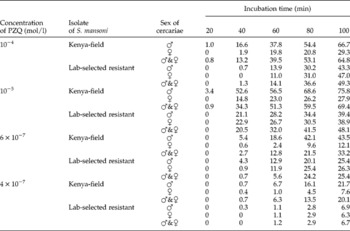
Schistosome cercariae were exposed to four different concentrations of PZQ (10− 4, 10− 5, 6 × 10− 7 and 4 × 10− 7 mol/l) and the tail-shedding rate was recorded at five different incubation times up to 100 min at 20-min intervals. The result is indicated in table 1. The PZQ-resistant isolate always showed a lower tail-shedding rate at all different concentrations of PZQ across all different time points. From the level of PZQ resistance, it is suggested that this isolate is even more resistant than the reported PZQ-resistant isolate described by Fallon & Doenhoff (Reference Fallon and Doenhoff1994).
Comparison of the tail-shedding rates (%) between male and female cercariae of PZQ-resistant and PZQ-susceptible isolates of S. mansoni when exposed to different concentrations of PZQ for up to 100 min incubation.

We further divided the PZQ-sensitive and PZQ-resistant isolates into male and female groups. Miracidia were collected by hatching eggs from faeces of infected mice. Single-sex cercarial lines were made by infecting a single B. glabrata snail with a single miracidium. Sex of single-sex cercarial lines were identified by a direct W1-specific PCR.
When cercariae from the PZQ-susceptible isolate of S. mansoni were exposed to 10− 4, 10− 5, 6 × 10− 7 and 4 × 10− 7 mol/l for 100 min, the tail-shedding rates of male cercariae were 66.7, 75.8, 43.5 and 21.7%, respectively. The corresponding tail-shedding rates of female cercariae were 29.3, 27.9, 12.1 and 7.6%. The tail-shedding rates of male cercariae were significantly higher than those of the females at all four concentrations (t = − 4.816, P = 0.017; t = − 4.021, P = 0.028; t = − 5.377, P = 0.013; t = − 5.442, P = 0.012) (table 1).
When PZQ-resistant cercariae were exposed to the same concentrations of PZQ for the same time, the tail-shedding rates of male cercariae were 43.3, 39.4, 25.4 and 6.9%, respectively, while the tail-shedding rates of female cercariae were 47.0, 38.9, 26.3 and 6.3%. There were no differences of the tail-shedding rates between male and female cercariae (t = − 0.444, P = 0.687; t = − 0.798, P = 0.483; t = − 1.313, P = 0.281; t = − 1.601, P = 0.208) (table 1).
The tail-shedding rates of male cercariae from the PZQ-susceptible isolate were all higher than those from the PZQ-resistant isolate. For example, when cercariae were exposed to 10− 4, 10− 5, 6 × 10− 7 and 4 × 10− 7 mol/l PZQ for 80 min, the tail-shedding rates of male cercariae of the PZQ-susceptible isolate were 54.4, 68.6, 42.1 and 16.1%, respectively, while those of male cercariae of the PZQ-resistant isolate were 30.2, 34.4, 20.1 and 2.8%. The tail-shedding rates in the PZQ-susceptible isolate were all higher than those in the PZQ-resistant isolate (t = − 5.936, P = 0.010; t = − 4.834, P = 0.017; t = − 5.978, P = 0.009; t = − 5.178, P = 0.015) (table 1).
Discussion
In the present study, we used cercarial tail loss as a measurement of PZQ sensitivity. The exact mechanism of PZQ in inducing tail loss of cercariae is not fully understood. It is believed that the process is related to a special structure between the body and tail of cercariae. The posterior end of the body of cercariae is tapered into a collar-like folding over the narrow connecting piece between the body and tail. This connecting piece is delicate and may be broken easily (Sobhon & Upatham, Reference Sobhon, Upatham, Sobhon and Upatham1990). When cercariae were exposed to PZQ in water, the separation of tails from their bodies occurred (Andrews, Reference Andrews1978a, Reference Andrewsb; Coles, Reference Coles1979; Combes, Reference Combes1982; Xiao et al., Reference Xiao, Catto and Webster1985, Reference Xiao, Xue, Yue, Qiu and Mei1987a, Reference Xiao, Yue, Mei and Zhangb; Xia & Combes, Reference Xia and Combes1987). The tail shedding of cercariae induced by PZQ is different from that caused by physical stress with repeated passage through a needle (Colley & Wikel, Reference Colley and Wikel1974) or that caused by centrifuging following incubation in a residual volume of water (Ramalho-Pinto et al., Reference Ramalho-Pinto, Gazzinelli, Howells, Mota-Santos, Figueiredo and Pellegrino1974; Howells et al., Reference Howells, Gerken, Ramalho-Pinto, Kawazoe, Gazzinelli and Pellegrino1975). The tail shedding of cercariae induced by PZQ is very fast because it occurs before the acetabular gland contents are secreted. No effect of 5-hydroxy-tryptamine, atropine or dipterex on tail shedding induced by PZQ indicates that this tail loss is not associated with the effect of neurohormones (Xiao et al., Reference Xiao, Xue, Yue, Qiu and Mei1987a, Reference Xiao, Yue, Mei and Zhangb). As supported by scanning electronic microscopic observation (Xiao et al., Reference Xiao, Xue, Yue, Qiu and Mei1987a) the cercarial tail loss in response to PZQ could be caused by an uncoordinated contraction of the body and tail muscles. Whatever the exact mechanism is, the tail loss is a reliable measurement of PZQ sensitivity of schistosome cercariae.
There are differences in the susceptibility to PZQ among different schistosome species. Early experiments demonstrated that there were significant differences in the survival rates of adult schistosomes among S. mansoni, S. japonicum and S. mekongi following exposure to the same concentration of PZQ (Sobhon & Upatham, Reference Sobhon, Upatham, Sobhon and Upatham1990). Clinical data have shown that the normal cure rate of a single dose of 40 mg/kg of PZQ, as recommended by WHO for the treatment of S. mansoni in both adults and children, is usually 60–90% (Davis, Reference Davis, Jordon, Webbe and Sturrock1993; World Health Organization, 1993; Kumar & Gryseels, Reference Kumar and Gryseels1994), while the cure rate for S. japonicum exceeds 90%. Comparison of the in vitro responses to PZQ of eggs, miracidia and cercariae between S. japonicum and S. mansoni demonstrated that eggs, miracidia and cercariae of S. japonicum are more sensitive to PZQ than those of S. mansoni (Liang et al., Reference Liang, Coles, Doenhoff and Southgate2001, Reference Liang, Coles, Dai, Zhu and Doenhoff2002). The differences observed in the susceptibility to PZQ among schistosome species could be a biological characteristic associated with species. This provides important information for schistosomiasis treatment; that is, the dose of PZQ should be optimized according to the infecting schistosome species.
Within the same species, there are also different PZQ responses between male and female worms. Male worms are more sensitive than females (Gönnert & Andrews, Reference Gönnert and Andrews1977; Becker et al., Reference Becker, Mehlhorn, Andrews, Thomas and Eckert1980; Xiao et al., Reference Xiao, Wang, Jiao, Yu and Yuan1981; Sobhon & Upatham, Reference Sobhon, Upatham, Sobhon and Upatham1990). Our early reports of in vitro tests also indicated that male adult worms were more sensitive than females (Liang et al., Reference Liang, Coles, Doenhoff and Southgate2001, Reference Liang, Coles, Dai, Zhu and Doenhoff2002). In in vivo trials, all reported that the ratio of male to female worms was changed after treatment with PZQ, although the sex of worms that were more sensitive to PZQ remained controversial. In primate chemotherapy for schistosomiasis, it was reported that the female worms of S. haematobium were more susceptible than the males (Webbe et al., Reference Webbe, James, Nelson and Sturrock1981), and it was shown that more male worms of S. mansoni than female worms survived treatment (Delgado et al., Reference Delgado, Suarez, Cesari and Incani1992; Fallon et al., Reference Fallon, Sturrock, Capron, Niang and Doenhoff1995). In mice, however, it was shown that more female worms of S. japonicum and S. mansoni survived after treatment with PZQ than males (Davis, Reference Davis1978; Andrews & Thomas, Reference Andrews and Thomas1983; Huang et al., Reference Huang, Liu and Kou1983). More detailed analysis of the tegument of adult worms of S. mansoni treated with PZQ in vivo using scanning electronic microscopy revealed more severe damage on male worms than on the females (Liang et al., Reference Liang, Coles, Dai, Zhu and Doenhoff2002).
There were differences in the susceptibility to PZQ in the same-sex worms between PZQ-susceptible and PZQ-resistant isolates. Data from chemotherapy for mice in our previous study showed that more female worms survived from the treatment in PZQ-susceptible isolates than the males; however, more male worms survived in PZQ-resistant isolates than the females (Liang et al., Reference Liang, Coles, Doenhoff and Southgate2001). The present study showed that in the PZQ-susceptible isolate of S. mansoni, there is a significant difference in susceptibility between male and female cercariae, and male cercariae were more susceptible, with a high tail-shedding rate in a given concentration of PZQ solution. On the other hand, in PZQ-resistant isolates, there was no significant difference in susceptibility between male and female cercariae. It is believed that the resistance of S. mansoni to PZQ could be induced by the decrease of the susceptibility of male worms to PZQ. The reasons for these differences are still not clear. Based on differences of the response of cercariae, it seems likely that the difference in response of male cercariae is due to a difference in a calcium channel, which is believed to be the mechanism of action of PZQ (Fetterer et al., 1980; Andrews, Reference Andrews1985; Aragon et al., Reference Aragon, Imani, Blackburn, Cupit, Melman, Goronga, Webb, Loker and Cunningham2009).
Acknowledgements
This study received financial support from the National Science and Technology Pillar Programme of China (No. 2009BAI78B00-06), the National Natural Science Foundation of China (No. 30471516) and the Jiangsu Province's Outstanding Medical Academic Leader Programme. The experiments in this study were in compliance with the current laws and regulations in China. No competing interests are declared.