BACKGROUND
In 1245, King Henry iii embarked on the rebuilding of Edward the Confessor’s abbey church of St Peter at Westminster, a monumental undertaking that was to occupy the remainder of Henry’s life, and was far from finished at the time of his death in 1272. Certain stages in the work are datable through historical sources and provide benchmarks defining the rate of progress.
Work began immediately on the eastern arm and proceeded apace. The chapter house was nearing completion in 1253 and, by implication, the south transept and half of the east cloister walk must also have been rebuilt by this time. In 1251, Henry ordered construction to begin on the great sacristy, which was attached to the west side of the north transept, and three years later he ordered the roof to be built forthwith. Hence, it seems certain that at least the shell of the entire eastern arm and transepts had been completed c 1260, although they were probably not yet decorated or furnished. Internal completion was the principal task of the 1260s, and the liturgical heart of Westminster Abbey – the sanctuary and shrine of Edward the Confessor – was doubtless the primary focus.
The floor of the sanctuary, in front of the high altar, is decorated with a large, square pavement sumptuously executed in Cosmatesque mosaic.Footnote 1 The matrix is Purbeck marble, into which was inlaid a series of three inscriptions in latten letters. One of those inscriptions refers to ‘King Henry’ and gives the date of the pavement as ‘1268’. East of the high altar lies the apsidal chapel of St Edward. Its pavement is also of Cosmatesque mosaic, but is radically different in style and technique of construction from the sanctuary pavement. It is neither inscribed nor precisely datable.
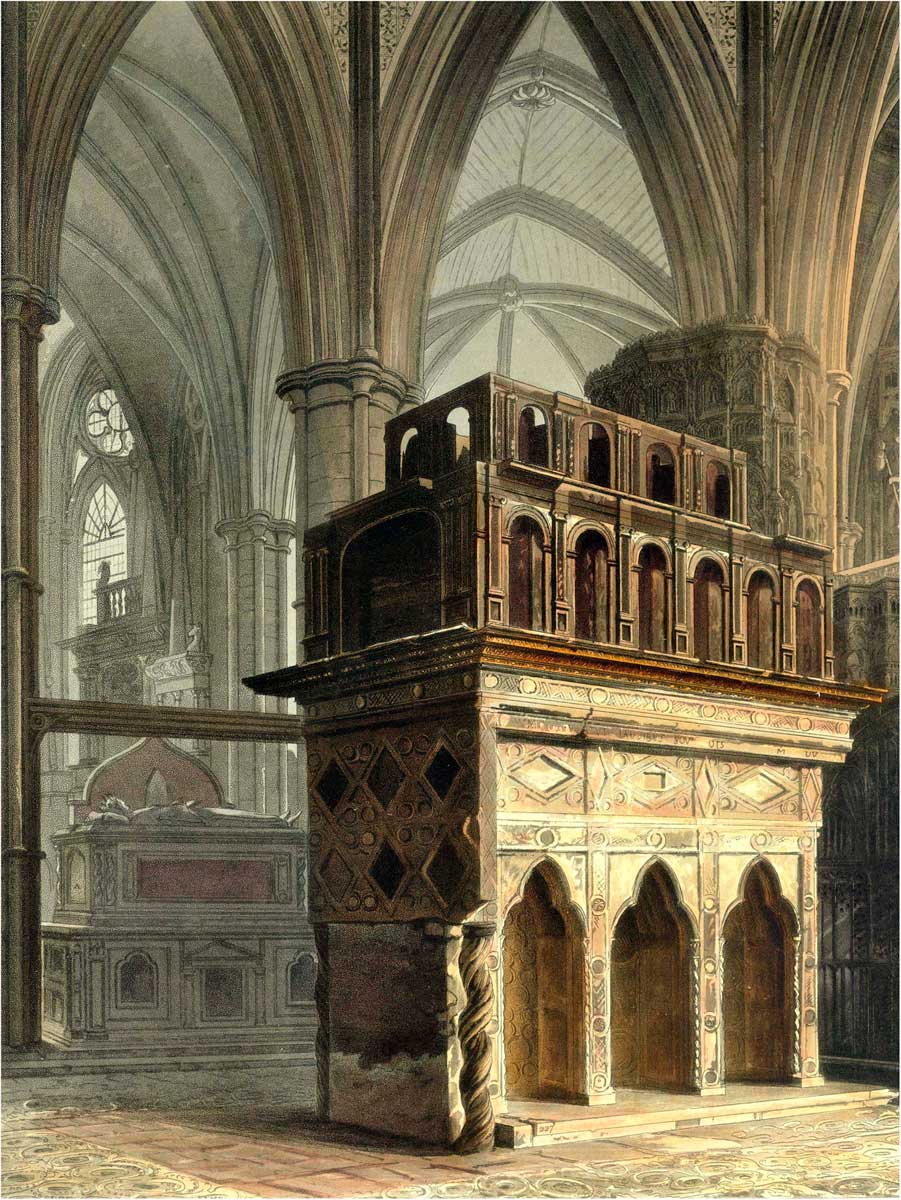
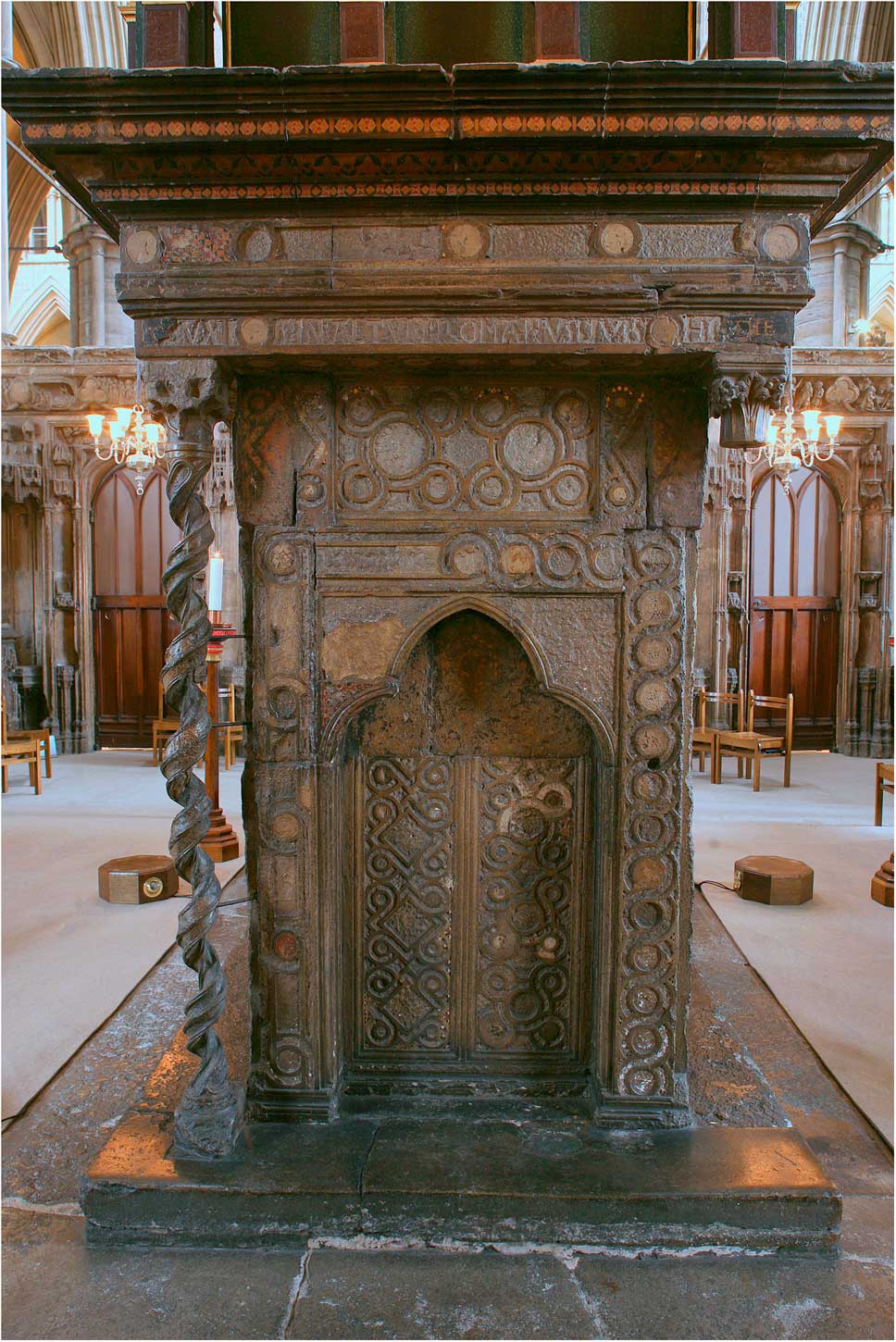
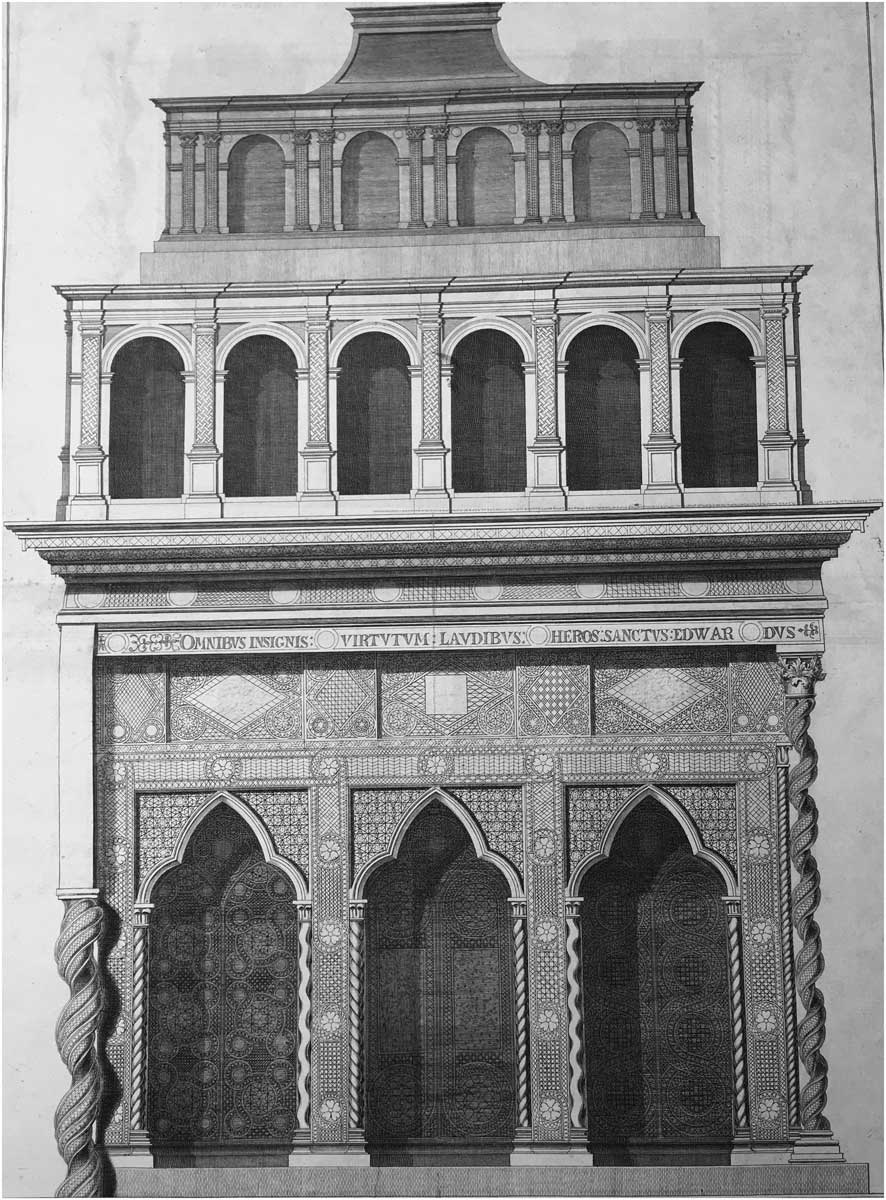
At the centre of the chapel stands the rectangular Purbeck marble shrine pedestal that still houses the coffin of Edward the Confessor (fig 1). The pedestal, too, was once embellished with mosaic and the 6.5cm high frieze that runs around all four sides comprised multiple rectangular panels, separated by roundels, the panels incorporating an inscription inlaid in yellow glass, set against a background of blue glass (fig 2). By 1269, the eastern arm of the rebuilt abbey was sufficiently complete for it to be dedicated and, at the same time, Henry iii caused the body of St Edward to be translated from its temporary shrine to the sumptuous new Cosmatesque one that he had commissioned for the saint’s chapel.
St Edward’s Chapel, by A C Pugin, from Ackermann Reference Ackermann1812, 207. Photograph: courtesy of the Dean and Chapter of Westminster

East end of the shrine of Edward the Confessor. Photograph: © C Wilson

The shrine pedestal was dismantled at the Dissolution (1540), but the components were retained and were reassembled in 1557–8 by Abbot John Feckenham when the Benedictine community was briefly reinstated under Queen Mary.Footnote 2 The mosaic decoration of the shrine was evidently in very poor condition and Feckenham had all the open matrices filled with plaster, on to which faux mosaic was painted. He also caused the entire inscription band to be plastered over and a wholly new text painted on it. However, in 1741, some of the painted plaster was picked away, revealing the matrices for the glass letters of several words on the east end of the pedestal.
THE SHRINE INSCRIPTION
Since 2012 one of the present authors of this paper, Warwick Rodwell, and David S Neal, FSA, have been engaged in a detailed study of all the Cosmati mosaics in Westminster Abbey, and a monograph is in preparation.Footnote 3 Study of the frieze around the shrine leaves no room for doubt that it is an original feature, and that the matrices for the glass inscription are integral with the roundels and other detailing of the frieze. They were not cut in situ at a later date, as suggested by some scholars.
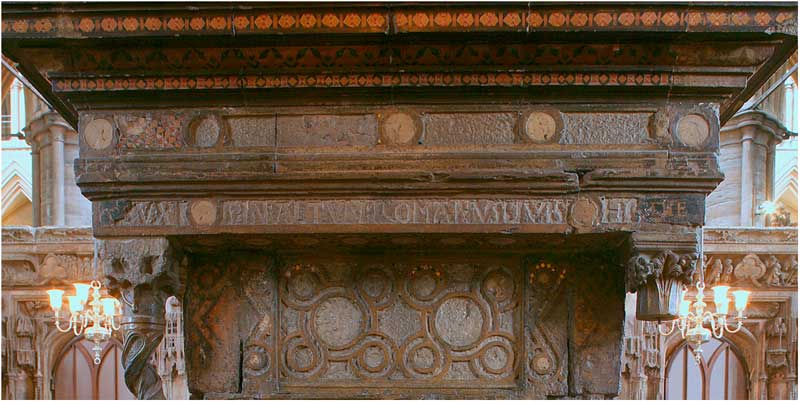
David Neal has accurately recorded the matrices in the frieze and all visible traces of primary lettering in them. The inscription began on the west face and ran anticlockwise around the monument. Owing to the loss of Feckenham’s plaster infill on the east face, most of the letters are discernible, thereby firmly anchoring six words in the middle part of the inscription: ‘DVXIT : IN : ACTVM : ROMANVS CIVIS : HO[MO]’ (fig 3). If we assume that in the remainder of the inscription no contractions or space-fillers were employed, and stops were inserted between each word (except where that coincides with the end of a panel), then it is possible to suggest with a reasonable degree of confidence how the original text was disposed around the monument.
Remains of the inscription on the east end of the Shrine of Edward the Confessor. Photograph: © C Wilson

Evidence for the original inscription
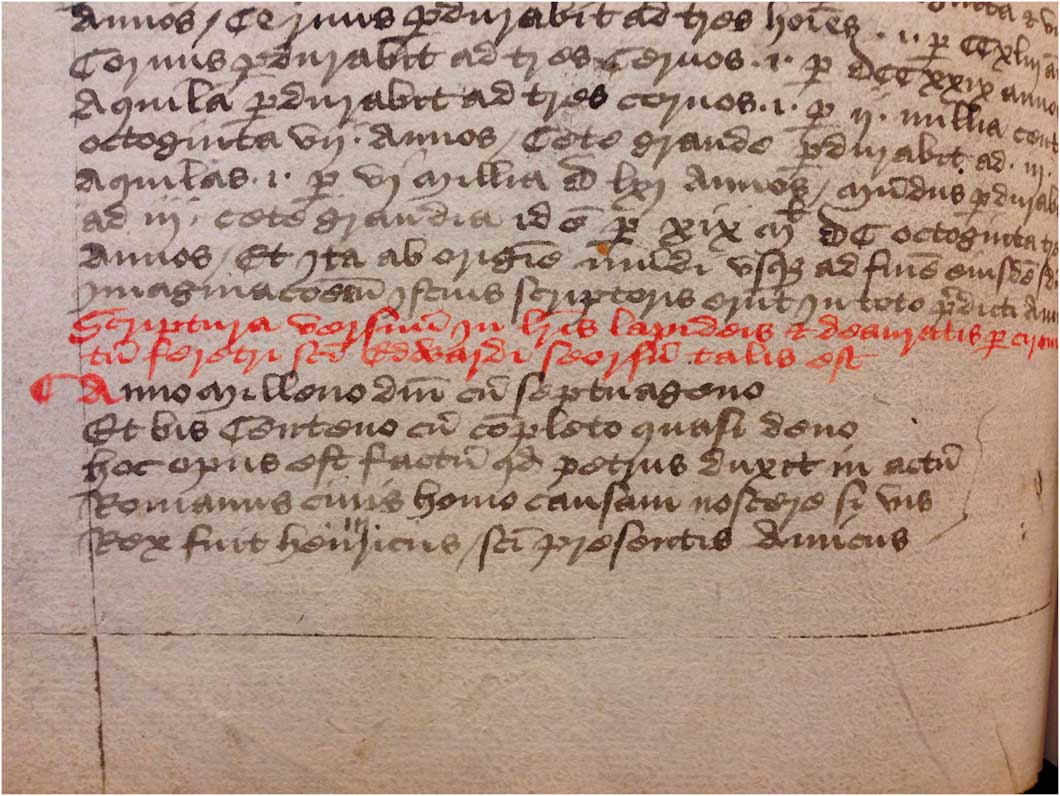
In 1450 Richard Sporley, a Westminster monk, included a transcription of the inscription in his Historia ecclesie Westmonasterii, largely a compilation of extracts from another history of the abbey, De Fundatione ecclesie Westmonasteriensis, which had recently been produced by his brother monk, John Flete (fig 4).Footnote 4 The inscription as Sporley recorded it reads (with our expansions italicised):
Anno milleno domini cum septuageno
Et bis Centeno cum completo quasi deno
hoc opus est factum quod petrus duxit in actum
Romanus civis homo causam noscere si vis
Rex fuit henricus \iij/sancti presentis Amicus
The inscription on the shrine of Edward the Confessor, as recorded by Richard Sporley. Photograph: © British Library Board, Cotton ms Claudius A VIII, fol 59v

In English, this translates as follows:
In the thousandth year of Our Lord, with seventy
And two hundred, with ten virtually complete
This work was made which Peter, a Roman citizen, took the lead in making
If you wish to know the instigator
It was King Henry \III/, beloved of this present saint
This version of the inscription clearly records the name of a craftsman, Petrus, and the date, which must mean 1279. Attempts to contort the sense of the Latin to make this fit the more expected date of 1269 are unsatisfactory.Footnote 5 As David Carpenter has acknowledged, to get to this reading of the text ‘requires the cum to be employed in an apparently unique fashion, one different from that found both in the first line of the inscription and in many other dating verses of this type’.Footnote 6 Over the past three centuries scholars have spilled much ink in discussing both the identity of Petrus and the seemingly irreconcilable date. The date cannot refer to the construction of the shrine itself since there is no doubt whatsoever that the body of the Confessor was translated from a temporary shrine into this new shrine in 1269, in the presence of Henry iii.Footnote 7
When we compare Sporley’s manuscript with the surviving evidence on the shrine, we immediately find discrepancies. The extant document is evidently not a primary transcript made on site, as will become clear. It is, of course, a copy that was incorporated in Sporley’s text. Second, the inscription on the shrine runs around the four sides, but in Sporley’s manuscript it is set out in rhythmical form in five lines, with no indication as to where the physical breaks on the shrine itself occurred. Third, Sporley employs several textual contractions; in one instance, where the matrix is still visible on the shrine, that contraction is not present (as will be set out below). He also employs a mixture of upper- and lower-case letters, whereas the original inscription is entirely in upper case. Fourth, Sporley does not provide any indication of the true number of characters contained in the inscription. In particular, we should note:
-
i. He inserted a mark in the left-hand margin to indicate that he was introducing a quote. This nondescript mark has been interpreted by Robinson and Binski as a cross (+) at the beginning of the inscription. That is clearly not the case and it cannot be counted as a character.
-
ii. In line 1 he shows domini in contracted form. In line 2, cum and completo are both contracted (the latter to copleto). Line 3 has factum and actum as contractions. The latter word, however, survives on the east face of the shrine, where it is written in full, and not contracted. Finally, in line 5 sancti is contracted. Most previous commentators have not followed Sporley’s contractions, but have expanded the text.
-
iii. Sporley does not give any punctuation marks, but these were undoubtedly present, as they were on the sanctuary pavement. Indeed, four marks are visible on the shrine: they comprise colons of diamond-shaped stops between individual words on the east face, except between Romanvs and civis, which are run together. Almost certainly, the inscription was designed to have pairs of stops between every word, irrespective of any decorative roundel that might intervene.
Sporley’s text provides the sole record for the dating clause, and his transcription has been published on several occasions in varying formats and with differing punctuation. Each of these publications misrepresents Sporley’s original text. Moreover, there were several opportunities for error in what Sporley himself recorded. Was the inscription damaged by the time that Sporley saw it? Did he write it down incorrectly? Or did an error creep in while transcribing his field notes (in whatever form he took them) into the draft document, or between the draft version and the final manuscript? A damaged inscription by 1450 is not unlikely. When Sporley saw it, the shrine pedestal was almost two centuries old, and we know that 100 years later the majority of the mosaic inlay had been lost, causing Feckenham to infill the empty matrices with plaster and over-paint them with faux mosaic.
All the above would materially affect the layout of the inscription around the sides of the shrine and the number of characters involved. Additionally, the inscription did not run in a continuous band around the frieze, but was interrupted by a series of roundels that formed part of the architectural schema. Moreover, at the two western angles there were small rectangular projections (‘ears’) to the entablature, around which the inscription also ran.Footnote 8 Consequently, the text was broken into eighteen separate sections, several of which were very short and could only accommodate three or four letters. Inevitably, some words were interrupted by roundels and others by the external angles of the monument. That this must have resulted in fragmented words is shown by the surviving duxit, the first word on the east end of the shrine: here, the two final letters are separated by a roundel. The preceding word, which falls on the south side, was Petrus and that too must have been interrupted by a roundel between the second and third letters since there was certainly insufficient space to accommodate the full name in the last section of the frieze on this side. Similarly, the first word on the north side, causam, had necessarily to be interrupted by a roundel. Consequently, punctuation between words was vital for the inscription to be intelligible.
RECENT ARGUMENTS OVER THE DATING OF THE SHRINE
The evidence from Sporley is a problem that has been recognised (or dismissed) for many years. Some authors have simply written it off as a scribal error without detailed examination. For them, the straightforward (and sometimes unacknowledged) substitution of sexageno for septuageno resolves the issue.Footnote 9 The difference is only three letters, and either word could be accommodated comfortably within the available space. But this substitution raises other issues (discussed below). As Paul Binski quite rightly argues, ‘the burden of proof is strictly upon those who wish to dispose of Sporley’s evidence’.Footnote 10
Other authorities have suggested that Edward the Confessor’s body was translated into an unfinished shrine, the completion of which took another ten years.Footnote 11 But there is no other evidence for this, and it seems implausible that such a significant event as the translation of the Confessor’s body (and the formal dedication of the abbey) would be conducted with the shrine unfinished, especially without attracting comment. It is worth repeating that the only concrete evidence for this argument lies in Sporley’s text.Footnote 12
A third option has been proposed by David Carpenter, in his rebuttal of the arguments in favour of a later dating of the shrine by Binski. Carpenter accepted that the chapel and the pavement were essentially complete by 1269, but proposed that the base of the shrine itself may not have been.Footnote 13 He suggested that it may have taken some time for this to be finished, at which point the glass inscription was added to the shrine. In effect, Carpenter argued that the mosaicist was ‘signing off’ the completion of the whole chapel project more than ten years after it had begun. This is not an acknowledged medieval practice, and lacks conviction as an explanation. In addition, although some ornamentation may have been added later (‘nondum tamen completo parato’, see note 12), the shrine pedestal itself must have been made in a workshop as a series of panels, already infilled with mosaic. These panels would have been brought into the abbey and assembled, a task that would have taken a few weeks.
It seems to us inherently unlikely that a date bearing no relevance to the construction of the shrine per se should have been added a decade after the translation took place. We therefore considered that reassessment of the supposed 1279 date was long overdue. We argue that the solution to this discrepancy in dates is actually a relatively simple one, and that we can in fact return confidently to a completion date of 1269.
RICHARD SPORLEY’S VERSION OF THE INSCRIPTION
Richard Sporley entered Westminster as a novice in 1428, and was ordained priest on 15 March 1432.Footnote 14 He served as the abbey’s granator in the mid-1440s, and again from 1453. In the years before his death in 1491 he apparently composed a derivative and brief set of annals of the kings of England.Footnote 15 He is not known to have been holding any official position in 1450, when he put together his history of the abbey. His text was derived almost entirely from the work of the monk John Flete, who was then the abbey’s treasurer and monk bailiff. Flete himself had composed his history only seven years before, so Sporley was copying from a current work. The impetus for Sporley to produce such a compilation may have been a fire in the monks’ dormitory in 1447, the subsequent rebuilding of which seems to have been the catalyst for the abbey to create a new library.Footnote 16 Although Sporley’s text was almost entirely derived from Flete’s, he did add a few elements of his own. Most significant among these was an explanation of the obscure inscription to be found on the Cosmati pavement in front of the high altar, and a copy of the inscription on the Confessor’s shrine behind it.
Richard Sporley’s manuscript now forms part of a composite volume, assembled possibly as late as the early seventeenth century. By the late 1630s, the manuscript had entered the collections of Sir Robert Cotton, but its precise whereabouts before this date are unknown.Footnote 17 It was evidently known to the herald Francis Thynne in the 1580s, for he included a transcription of Sporley’s version of the shrine inscription (with wording suggesting that he also knew Sporley’s explanation of the Cosmati pavement inscription) in his ‘Treatise of the Treasurers of England’, one of the additional sections included in the continuation of Ralph Holinshed’s chronicle, published by John Hooker in 1587.Footnote 18 He again used Sporley’s text extensively in his manuscript version of the lives of the medieval treasurers, compiled for Lord Burghley in 1593, where he again included a transcript of the inscription.Footnote 19 Unfortunately, Thynne does not say where he consulted the manuscript.Footnote 20
Once Sporley’s manuscript had joined Cotton’s illustrious collection, its contents became more widely appreciated. William Dugdale used it extensively in his Monasticon some thirty years later.Footnote 21 By 1682, Henry Keepe could include the text of the shrine inscription in his first guidebook to the abbey, stating that this was supposedly the inscription on the shrine ‘heretofore’.Footnote 22 Subsequent guides to, and studies of, the monuments of the abbey followed Keepe, and the tradition of the inscription’s wording became, as it were, enshrined.Footnote 23 It would appear that very few of the letters of the inscription were actually visible by this point. John Dart states that ‘the old [inscription], which was embos’d on it, was worn away’. He thought it had been put onto the shrine in the reign of Richard ii. George Vertue, giving an account of the shrine to the Society of Antiquaries in 1741, set out the inscription as given by Keepe, and followed Dart in claiming that it had been put onto the shrine in the late fourteenth century, but he at least seems to have actually examined the shrine (fig 5).Footnote 24 He claimed that although part of the inscription (the five words ‘Petrus duxit in actum,/Romanus civis’) had still been visible in April 1741, in June of that year even they had been ‘erased, picked out, and taken away’. It is, of course, notable that five of the words he records are still visible, which would seem to offer some corroboration to his version.Footnote 25
‘Mausoleum sive Feretrum S ti Eduardi Confessoris Regis Angliae’, engraved by George Vertue from a drawing by J Talman, 1724. Photograph: courtesy of the Dean and Chapter of Westminster

The dating provided by Sporley’s version of the inscription was clearly starting to cause problems to those with a more intimate knowledge of the history of the abbey. In his own history, Reverend Richard Widmore, librarian there from 1732–64, simply amended the text of the inscription to overcome these difficulties.Footnote 26 In his version, septuageno silently becomes sexageno, and the problem is spirited away.Footnote 27
However, it is notable that, apart from Thynne’s use of Sporley’s manuscript, there was no mention of the inscription itself before Sporley’s manuscript was brought to public attention on entering Cotton’s library. Crucially, it was not recorded in the work of William Camden,Footnote 28 John WeeverFootnote 29 or John Mostyn (who largely followed Camden),Footnote 30 all of whom would certainly have noted such an important feature of such an important monument had it been visible. It seems that there is no evidence that more than a few letters of the inscription were legible at any point after the sixteenth century and, quite possibly, long before then.
The compilation of Richard Sporley’s text
Although Flete noted the construction in 1268 of the Cosmati pavement in front of the high altar, and the translation of the Confessor’s body the following year, Sporley evidently felt that he had not covered these momentous events in sufficient detail. He also recognised that Flete had not mentioned at all the building of the new shrine.Footnote 31 He, therefore, sought to remedy this. At the point where Flete’s narrative covers the verses written in predicto pavimento circulariter, Sporley elaborates with a prolonged excursus on the meaning of these obscure verses. He then adds the inscription, scriptura versum in literis lapideis et deauratis per circuitum feretri sancti Edwardi seorsum talis est. It seems very likely that only remnants of this inscription were visible, even in Sporley’s day. In compiling this excursus, he would inevitably have needed to check from other sources the historical details of the translation of the saint’s body, an event almost two centuries old. This would have included consulting the current shrine-keeper himself, who had important historical works at his disposal.
The most significant historical work in the abbey at the time – in fact, the most significant chronicle produced at the abbey before Flete – was the Flores Historiarum.Footnote 32 This work was actually begun by Matthew Paris at St Albans in the mid-thirteenth century. The original manuscript was acquired by the abbey in about 1265, and was continued by a succession of monks, many anonymous, intermittently down to 1367, thereby qualifying it as an abbey chronicle.Footnote 33 John Flete had himself used it extensively (and possibly annotated the shrine-keeper’s copy of it).Footnote 34
The text of the Flores Historiarum survives in a number of manuscripts. Luard, in his Victorian edition, notices twenty such manuscripts. While many of them were clearly made to be passed on to other institutions, the abbey certainly retained more than one copy. BL, Cotton ms Otho C II, although badly burnt in the Cotton fire, is a Westminster manuscript of the Flores of the late fourteenth or early fifteenth century, probably from the abbey library.Footnote 35
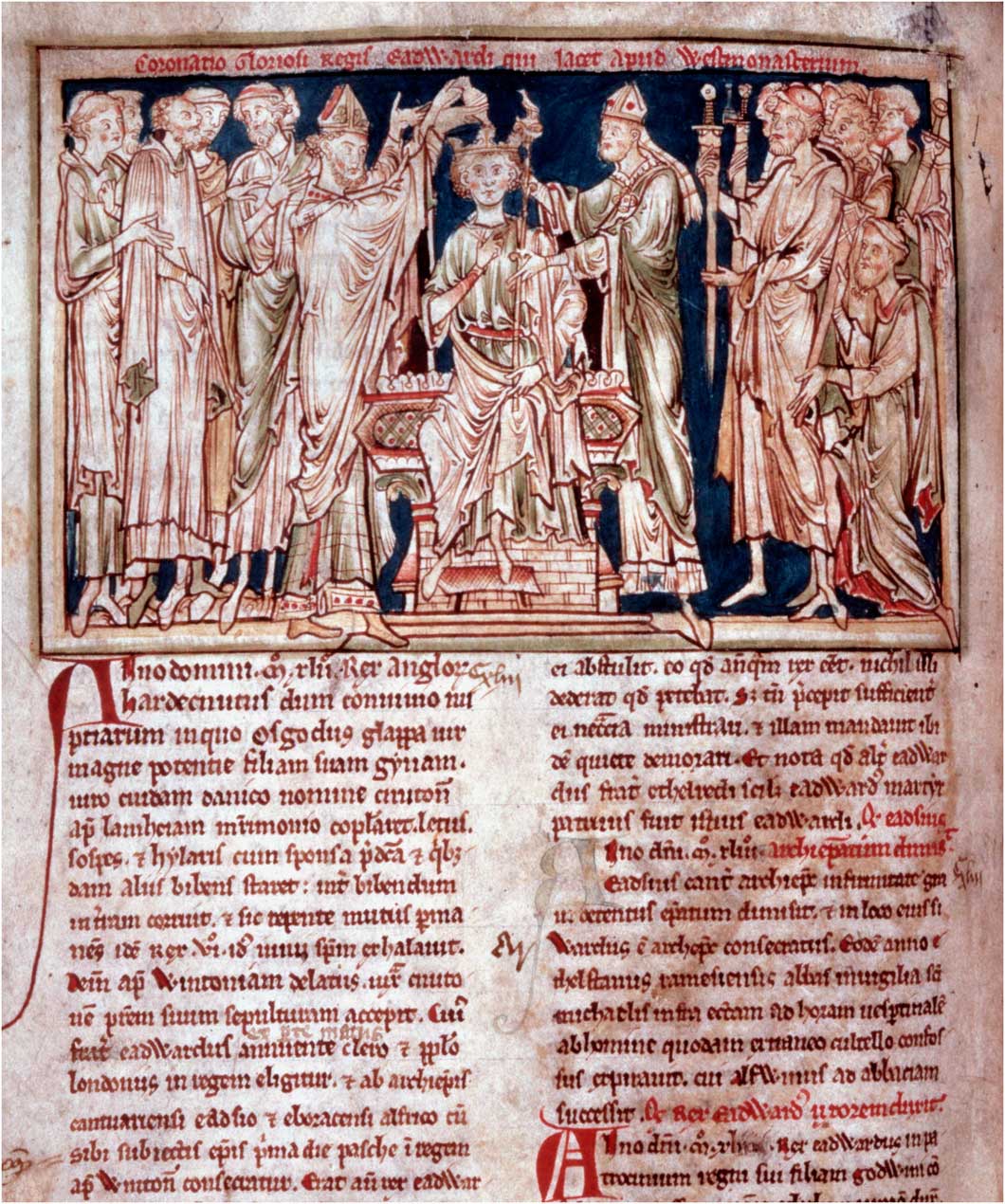
In 1467, a copy of the Flores was passed on by the shrine-keeper, Thomas Arundel, to his successor, Richard Teddington, a precise contemporary of Sporley, along with the relics, jewels, vestments and altar cloths, and chests to keep them in.Footnote 36 It was not the only book deemed to be necessary for the role: as well as liturgical works, he handed over ‘ij bokes of cronyclis on called polycronicon & ye other callyd flores historiarum’. The collection also included a decorated chasuble given by John Flete. Clearly, these two historical works were seen to be central to the history of the abbey, and especially the shrine, although it is not entirely clear what use the shrine-keeper would have made of them.Footnote 37 But sufficient importance must have been afforded the volumes for the prime manuscript version of the text to be placed among the relics and regalia at the shrine itself.Footnote 38 This copy survives, inscribed by Teddington (fig 6).Footnote 39
The coronation of Edward the Confessor, from the Flores Historiarum. Photograph: courtesy of Chetham’s Library, Manchester (ms Lat 6712, fol 115v)

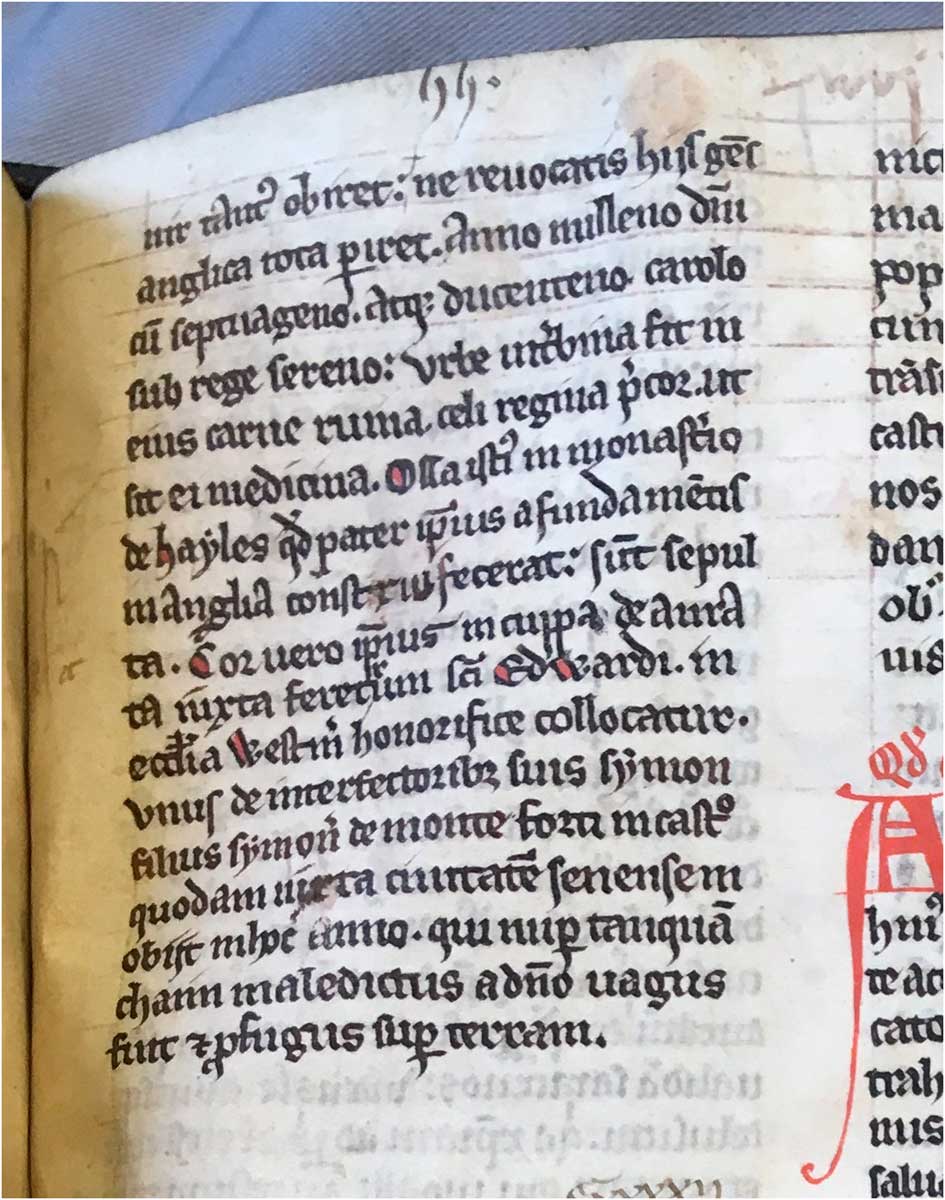
Whether it was Sporley or John Estney, the shrine-keeper in 1450 (and later abbot), who checked the Flores for details of the Confessor’s translation to the new shrine in the time of Abbot Ware, it seems possible that this was the point when an error was made.Footnote 40 On the folio immediately after the fairly brief entry relating to the translation of the body of the Confessor to his new shrine (in novo feretro; fol 242r in Chetham’s Library ms 6712), the author of the Flores discusses the murder of Henry of Almain in 1270 at Viterbo by Simon and Guy de Montfort.Footnote 41 There, the chronicler writes, he was initially buried, with verses around his tomb. These twelve lines of verse are recorded. The ninth (and tenth) line of this inscription reads: anno milleno Domini cum septuageno/atque ducento, clearly meaning 1270, which is, of course, the right date for this inscription. The full line anno milleno Domini cum septuageno precisely replicates the line Sporley gives as the opening line for the shrine inscription. In Chetham’s Library ms 6712, the most likely manuscript that Sporley would have consulted, this crucial line comes very near the top of fol 243r, the folio immediately after the shrine entry (fig 7). It begins one and a half lines into the new folio, after the words vir tantus obiret, ne revocatis his gens anglica tota periret, but stands out with a capital ‘A’ that certainly captures the eye.
Continuation of Henry of Almain’s inscription, as recorded in the abbey’s Flores Historiarum. Photograph: courtesy of Chetham’s Library, Manchester (ms Lat 6712, fol 243r)

The chances of these two inscriptions bearing exactly the same wording, in what is, after all, a fairly contorted way of expressing the date, seems extremely unlikely. One possibility is that, in turning the pages to check what the Flores said, either Sporley or Estney, the shrine-keeper, skipped a page, read a line from Almain’s inscription and interposed it onto his version of the Confessor’s.Footnote 42 This misreading may have been compounded by the lines following the verse inscription on Almain’s tomb, describing how his bones were subsequently transferred for burial in Hayles, but that cor vero ipsius in cuppa deaurata juxta feretrum sancti Edwardi in ecclesia Westmonasterii honorifice collocatur.
Of course, arguments from scribal error of this kind are always problematic, and usually impossible to prove. But it seems entirely plausible that, either accidentally or deliberately, a line from the inscription on Henry of Almain’s tomb may have been transposed onto Sporley’s version of the inscription around the Confessor’s shrine. If this was the case, it argues strongly that this section of the inscription at least must not have been visible in 1450. Given such possible scribal error, we must conclude that Sporley’s version of the inscription is, at the very least, unreliable. It cannot stand as a trustworthy piece of evidence for switching the expected date of the completion of the shrine from 1269 to 1279. And as this is the only evidence for the later date, it can be argued that the earlier date should stand.
Which leaves two unanswered questions: why would Sporley, who clearly knew of the date of the Confessor’s translation, have made such a mistake? And, if we accept that the first line of the inscription as recorded by Sporley is unsafe, what might the original inscription have been?
Most of Sporley’s additions to his selections from Flete are fairly minor.Footnote 43 His expansion on the meaning of the Cosmati inscription and the details of the shrine inscription represent the longest variation from the original text. Presumably, this is evidence of the importance that Sporley placed upon this information. It is curious, therefore, that he should make such a blatant error. If the inscription had been visible in the mid-fifteenth century, the mistake would surely have been spotted by anyone reading the manuscript. It may be that the contorted form of dating also confused Sporley himself, leading him, along with some later authorities, to believe that, in fact, 1269 was meant by the form of words as he gave them. In which case, it is also possible that it was a deliberate insertion, with the sense of the words misunderstood. It is conceivable that, since few letters of the inscription were still visible on the shrine, Sporley’s version was an attempt to fill in the blanks, drawing on one of the texts he consulted.
The inscription’s original opening line?
The inscription’s original opening line must have been similar to the transposed line. It must, for example, have supplied the opening of the dating clause; it must have been of an appropriate length to fit the relevant space on the shrine; and it must have conformed to the rhyme pattern of the rest of the inscription; that is, having an internal rhyme within the line.Footnote 44 In recognising these parameters, several authorities have suggested that Sporley’s text has simply confused the word septuageno for its direct equivalent sexageno.Footnote 45 Although this idea is initially appealing, there are arguments against it. The word sexageno is two letters shorter than septuageno, but, as we have seen, given the doubt about what line fillers or other symbols were used, and what contractions were adopted, it is difficult to make strong arguments on this basis.Footnote 46 The substitution would, of course, retain the internal rhyme used through the other lines, but here we encounter a problem also thrown up by Sporley’s original septuageno. Unlike the Henry of Almain inscription, the shrine inscription’s rhyming structure has rhymes only within individual lines.Footnote 47 The Henry of Almain inscription is formed of rhyming couplets, and is, therefore, more obviously poetic in form. The introduction of the milleno/septuageno (or sexageno) rhyme clashes with that of the second line, centeno/deno, in a way that subsequent lines do not pick up. This might appear both jarring and implausible.
It is possible, however, to suggest an alternative. This provides precisely the same sense, with a more sophisticated rhyme that does not jar on the second line. In this version, sexagesimo is substituted for sexageno (or septuageno), and millesimo for milleno. Both meaning and rhyme pattern are retained, without causing a clash with line 2. Although the length of the text is expanded, it was common practice for the words anno and domini on medieval funerary inscriptions to be contracted, and if that were the case here the available space would have been ample for the slightly longer inscription. The inscription would, therefore, read (not allowing for possible contractions):
ANNO MILLESIMO DOMINI CUM SEXAGESIMO
ET BIS CENTENO CUM COMPLETO QUASI DENO
HOC OPUS EST FACTUM QUOD PETRUS DUXIT IN ACTUM
ROMANUS CIVIS HOMO CAUSAM NOSCERE SI VIS
REX FUIT HENRICUS SANCTI PRESENTIS AMICUS
In translation, this would read almost the same as the previous version of the inscription, except with one key change on the first line:
In the thousandth year of Our Lord, with sixty
And two hundred, with ten virtually complete
This work was made which Peter, a Roman citizen, took the lead in making
If you wish to know the instigator
It was King Henry \III/, beloved of this present saint
The proposed inscription can be fitted comfortably into the eighteen available matrices around the perimeter of the shrine, with the following layout. Changes of angle in the frieze are indicated with a slash (/), and the positions of decorative roundels interrupting the text are represented by emboldened pairs of brackets (( )). Only a single contraction is necessary – which we suggest might be dm for domini – to accommodate the inscription within the matrices on the west side of the shrine.
West
ANNO : ( ) MILLESIMO : DM : CVM : SEXAGESIMO : ( ) ET : BIS :
South
CENT / ENO / ( ) : CVM : COMPLETO : QV ( ) ASI : DENO : HOC : OPVS : ( ) EST : FACTVM : QVOD : PE ( ) TRVS /
East
DVXI ( ) T : IN : ACTVM : ROMANVS CIVIS : ( ) HOMO /
North
CAVS ( ) AM : NOSCERE : SI : VIS ( ) : REX : FVIT : HENRICVS ( ) : SANCTI : PRESENTIS : ( ) / AMI / CVS
This alternative reading for the opening line cannot be more than speculation. But some support for it may be found in Sporley’s own manuscript. In his excursus on the meaning of the inscription on the Cosmati pavement, Sporley interprets the dating verse (Christi milleno bis centeno duodeno cum sexageno) with the words anno domini millesimo ducentisimo sexagesimo octavo, using precisely the words we are envisaging for the shrine inscription.Footnote 48 This passage comes on the page immediately before his section on the shrine inscription.Footnote 49 Whether or not this is a curious and unconscious echo of the latter, it is certainly evidence of the use of those words as direct counterparts of the words milleno and sexageno. It seems at least plausible that this represents the original form of the inscription around the shrine of the Confessor.
ACKNOWLEDGEMENTS
The authors would like to express their thanks to David Neal, FSA, who has drawn the inscription panels and elucidated how the lettering was fitted into the matrices; to David Carpenter, who kindly read an earlier draft of this paper and made helpful suggestions; and to Fergus Wilde at Chetham’s Library for permission to reproduce images from the Flores manuscript held there.
ABBREVIATIONS AND BIBLIOGRAPHY
Abbreviations
- BL
-
British Library, London
- TCD
-
Trinity College, Dublin
- TNA
-
The National Archives, Kew
- WAL
-
Westminster Abbey Library, London
- WAM
-
Westminster Abbey Muniments, London