Research on the political economy of international trade has always emphasized the role of business in shaping protectionist policies (Grossman and Helpman Reference Grossman and Helpman1994; Manger and Shadlen Reference Manger, Shadlen and Martin2015; Ballard-Rosa, Carnegie and Gaikwad Reference Ballard-Rosa, Carnegie and Gaikwad2018). We contribute to this literature by examining how firm-level asset specificity influences their success in petitioning for antidumping trade protection. For firms with capital fixed in specific assets like factories and buildings (‘immobile firms’), the costs of reorganizing production are comparatively high. This makes them more vulnerable to international competition, and more likely to successfully petition for trade protection. We also provide a link between the protection afforded to individual firms and groups of firms by showing that the protection gained by companies with specific assets diffuses to other firms producing the same product (‘same-good producers’). These results suggest that policy makers are more responsive to the preferences of companies with specific assets. For this reason, immobile firms can play a part in shaping their own level of trade protection. Since protection diffuses, this has consequences well beyond their own purview.
To test this claim, we marshal evidence on the role of antidumping duties (ADDs) in shielding individual companies from international competition. ADDs are temporary tariffs that importing countries impose on foreign products that are intended to protect domestic producers from predatory pricing. However, they also constitute a potent political weapon that governments employ as a protectionist measure favoring targeted domestic actors. ADDs are imposed with a high level of discretion and granularity by domestic authorities and trade jurisdictions after domestic companies file complaints that foreign competitors are charging predatory prices. Importantly, this institutional setup allows us to investigate why some firms successfully acquire trade protection, while others do not. By mapping decisions regarding ADDs onto the characteristics of complainant firms in nineteen World Trade Organization (WTO) jurisdictions, we construct a uniquely granular dataset that allows us to investigate ADD protection at the firm level. To empirically model the spatial dynamics of firm-level protection, we utilize spatial autoregressive (SAR) models, which enable us to estimate how protection afforded to one company affects the likelihood that same-good producers will also receive protection.
Our letter thereby provides new insights on the firm-level determinants of successful petitions for protectionist policies. While there has been an impressive growth in research examining the role of firms in the politics of trade in recent years (for example, Alt et al. Reference Alt1999; Bombardini Reference Bombardini2008; Kim Reference Kim2017; Osgood et al. Reference Osgood2017; Ballard-Rosa, Carnegie and Gaikwad Reference Ballard-Rosa, Carnegie and Gaikwad2018), we shed new light on the broader literature on the determinants of firm-level political influence and the political economy of trade (Rodrik Reference Rodrik1995). These issues have become even more pertinent with the recent application of ‘new-new trade theory’ to trade protection (for example, Bombardini Reference Bombardini2008; Kim Reference Kim2017), which has documented extensive firm-level heterogeneities and other incongruences with established industry-level theories. This suggests that firms may be more important in shaping protectionist policies than industry-level factors (Kim Reference Kim2017). By investigating how asset specificity – which previously was thought to matter mainly at the industry level (Hiscox Reference Hiscox2002) – shapes antidumping protection, we show how firms are key players in shaping contemporary protectionism and trade policy.
Asset Specificity and Firm-Level Trade Protection
Different actors bear the costs of trade liberalization, depending on whether the factors of production are assumed to be immobile (the Ricardo-Viner model) or not (the Heckscher-Ohlin model). By implication, the costs of international trade increase with the degree of an actor's asset immobility (Hiscox Reference Hiscox2002). While this insight has normally been applied at the industry level (Hiscox Reference Hiscox2002), it also holds for immobile firms, as liquidating capital that is fixed in specific assets is costly. Thus firms faced with international competition must pay significant costs if they cannot easily reorganize their production (Alt et al. Reference Alt1999).
To see how asset specificity might be relevant at the firm level, consider a policy maker who seeks to protect vulnerable firms. Different firms petition for protection, but the policy maker must learn which firms are truly threatened by foreign competition. Looking at firm characteristics – including their level of asset specificity – may serve as a signal of the costs a firm incurs from international trade. Since protectionist measures are costly, however, policy makers will attempt to apply them where the return is highest. For firms with specific assets, filing complaints against companies that are known to engage in predatory pricing campaigns might signal to policy makers that the return on protection is relatively high. In these situations, the deadweight loss to protection is small. However, for firms with highly mobile assets, filing legitimate complaints might not matter for the policy maker: if the firm can relocate its production at a relatively low cost, there is less reason to provide them with protection. The implication is that firms with more liquid assets are less likely to get protection even if their complaints are legitimate.Footnote 1
There are at least two reasons in addition to vulnerability why asset specificity might translate into greater trade protection. First, if governments' prime concern is re-election, trade policy will tend to be more restrictive, since the median voter is generally endowed with immobile assets (Mukherjee, Smith and Li Reference Mukherjee, Smith and Li2009). This mechanism is likely to be important at the company level, which would make policy makers more responsive to firms with specific assets, because jobs in those companies are more vulnerable. Secondly, as immobile firms are easier to tax (Genschel and Schwarz Reference Genschel and Schwarz2011), policy makers who are motivated by fiscal concerns may want to shield firms with specific assets, since they can gain a significant tax premium from keeping them operational and profitable.
Asset Specificity and the Competition for Protection
Granting trade protection is costly. This forces policy makers to balance producer interests with those of consumers (Rodrik Reference Rodrik1995). When a company is successful in having duties placed on its international competitors, it drains from society's pool of protective measures. Because of this competitive dynamic, ADDs should diffuse from firms with specific assets, affecting the protection afforded to entire producer groups. This could make ADDs a local public good: when policy makers have agreed that trade in a product is harmful, it becomes easier for all producers of that product to gain protection. However, when one firm is protected, it could leave less protection available for other same-good producers, inducing a common pool problem in which all firms – even same-good producers – compete for protection.
If protection takes the form of a local public good, competition for protection means that ADDs will be concentrated among certain products. This implies that ADD protection initially offered to the immobile firm will diffuse to other (comparatively less mobile) firms producing the same good. This would imply the positive diffusion of ADDs from immobile firms to other same-good producers. However, same-good producers might also compete among themselves for protection. In that case, we would expect relatively immobile firms to win the competition. This would imply negative diffusion among same-good producers. Importantly, both of these dynamics can operate simultaneously. That is, we cannot rule out the possibility that protection will be concentrated on certain products, and – at the same time – that firms producing highly protected goods will compete to distribute that protection among them.
Context, Methods and Data
Antidumping investigations are typically initiated when a domestic firm files a complaint against a foreign competitor. Domestic authorities have a high degree of discretion in decisions on ADDs, and can impose duties with an extremely high level of granularity, singling out the company mentioned in the complaint as well as specific products it exports. While this provides an ideal setting for investigating which firms are successful in gaining protection, ADDs also constitute important trade barriers in their own right: they increase the market power of domestic companies to such a degree that they are among the costliest trade protection measures (Blonigen and Prusa Reference Blonigen, Prusa, Choi and Harrigan2003, 271) and have been linked to large suppressions of international trade (Bown and Crowley Reference Bown and Crowley2007). These features make ADDs ideal targets for companies that seek to use political means to shield themselves from international competition. Therefore, ADDs are also ideal for researchers seeking to elucidate effective firm-level strategies for obtaining political protection. In Appendix A, we describe in more detail how ADDs are imposed.
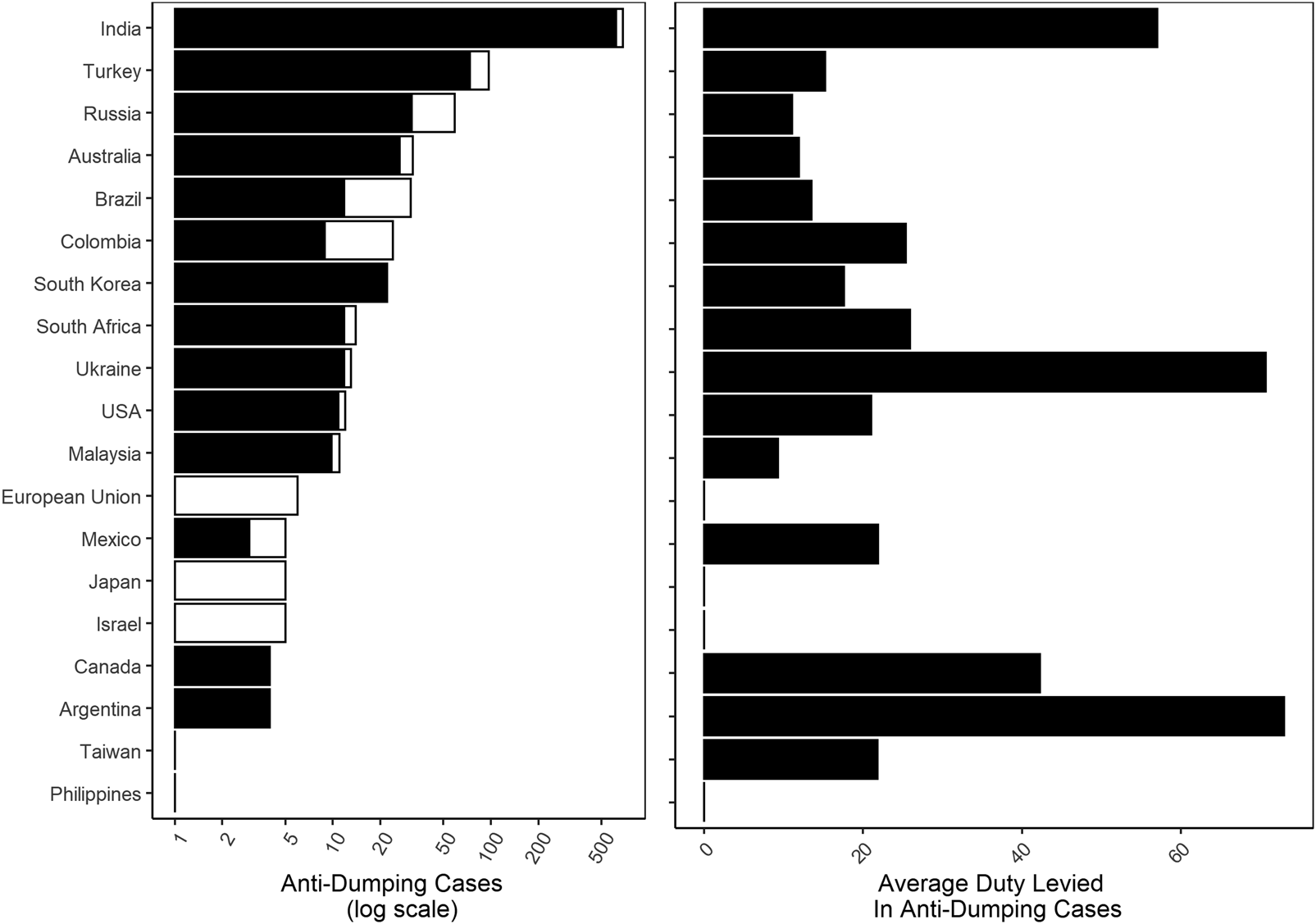
We use the Global Antidumping Database (Bown Reference Bown2016) to measure ADDs in two ways. First, we construct a binary indicator that takes a value of 1 if the policy maker decides that the foreign competitor has dumped its prices, and 0 otherwise. Secondly, to gauge the extent of protection, we use the percent of the sales price that is added as duty. If no duties are imposed, this variable is coded 0. Both measures are shown in Figure 1.
Anti-dumping cases and their success around the world
Note: left: total number of anti-dumping cases (white), and how many of them were successful (black). Right: duty size (average percent of original sales price).

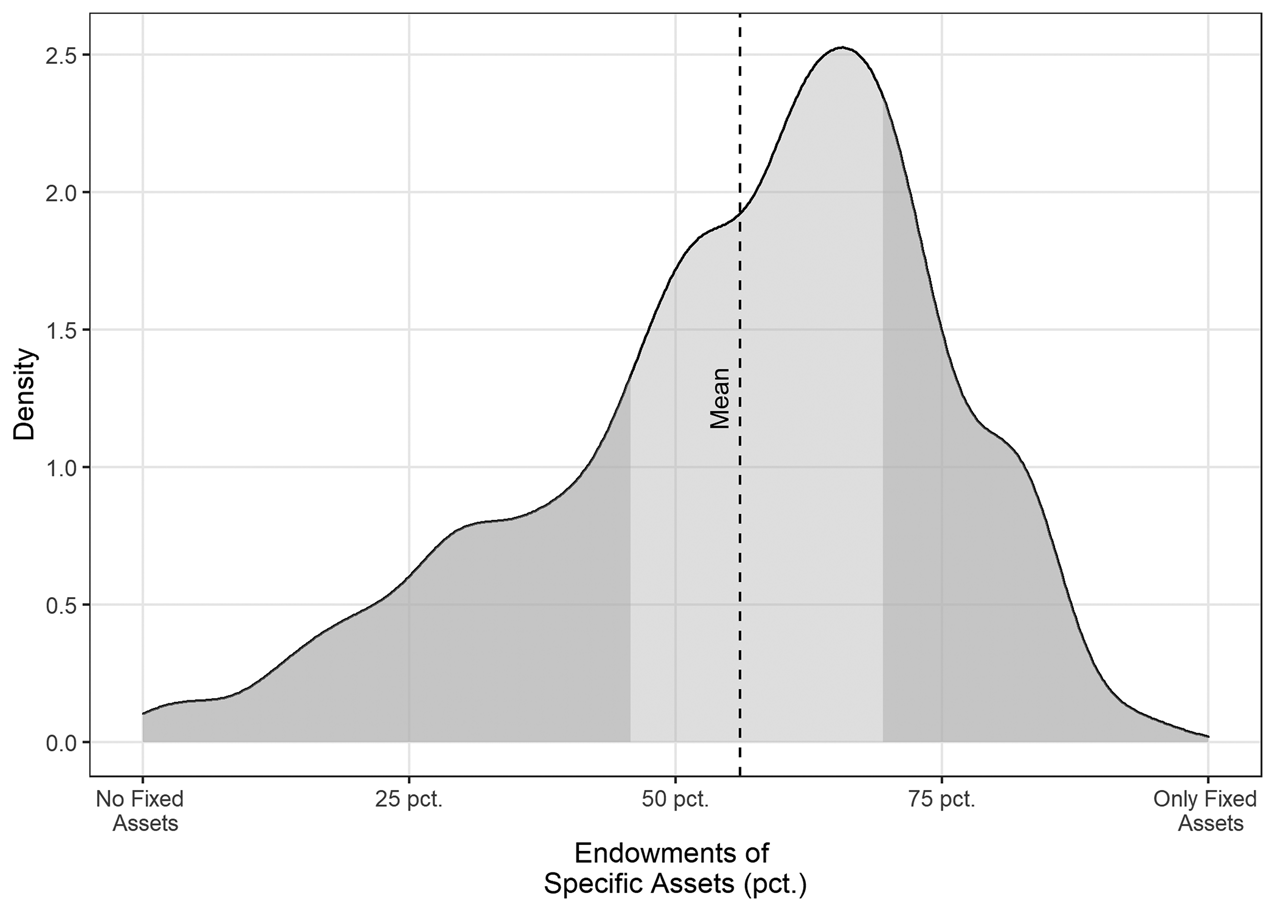
Bown (Reference Bown2016) is an extremely detailed data source that reports the names of the complainant firms. We match these companies with the Orbis database of firm finances. This allows us to measure asset specificity as US$ invested in fixed assets as a proportion of the firm's total assets. The distribution is shown in Figure 2. This measure captures the basic intuition in our argument: as the ratio of fixed assets – defined as investments in property, plants and equipment – to total assets increases, so do the costs of relocating production (Alt et al. Reference Alt1999).
Distribution of asset specificity
Note: dark areas below the 25th and above 75th percentiles.

We also construct a measure of how often foreign firms engage in broad campaigns of predatory pricing, using the average number of complaints filed against each foreign firm in our sample. A foreign firm that engages in predatory pricing campaigns will be subject to more independent complaints from domestic firms, which we take as an indicator of foreign firms’ predatory behavior. We use this to test the theoretical implication that domestic firms can file complaints about clearly predatory foreign firms to signal the need for protection to policy makers.
As controls, we include year fixed effects and firm-level data on total assets, revenue, total capital and taxes paid (all logged). Our data include all covariates for 1,030 firm-complaint observations from nineteen WTO jurisdictions. The data and controls variables are described in further detail in Appendix B.
Estimating Competition for Protection
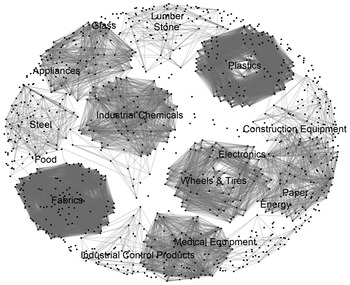
To capture the diffusion of ADD protection, we construct a 1,030 × 1,030 (N × N) connectivity matrix in which two firms are connected if they (a) have filed separate antidumping petitions (b) to have the same product (ten-digit HS codes) protected against (c) different foreign companies and (d) have done so in the same year and home country. This creates the network of domestic competitors seeking ADDs placed on the same good, which is depicted in Figure 3.
A network of firms seeking protection for the same product

We use the connectivity matrix to include a spatial lag of the dependent variable in a series of SAR models. This allows us to estimate how the protection afforded to one company impacts the likelihood that other companies are protected too. In particular, we investigate how ADDs diffuse among firms that are active on the same domestic market but have different foreign competitors. We can tease out two separate quantities of interest: (a) the direct impact of asset immobility on the company's own trade protection and (b) the additional indirect effect of asset specificity because the immobile company's own success changes the likelihood that same-good producers are successful in petitioning for ADDs (LeSage and Pace Reference LeSage, Pace, Fischer and Nijkamp2014).
Because the complainants seek protection for the same good – but do so separately and against different foreign firms – they are almost certainly competitors on the domestic market. This leads us to what may be the most important implication of this measurement strategy: if one firm gains protection from foreign competition but other competing firms do not, this will markedly change domestic competitive dynamics.
Figure 3 clearly shows the dense clustering of firms in their pursuit of ADDs. Producers of the same products tend to seek protection separately and do so recurrently. For most companies, domestic competitors seek protection as well. Because of the sheer density of the network of protection-seeking firms, ADDs shielding firms with specific assets may have vast consequences. Descriptives and diagnostics on the spatial lag parameter are available in Appendix C.
Results
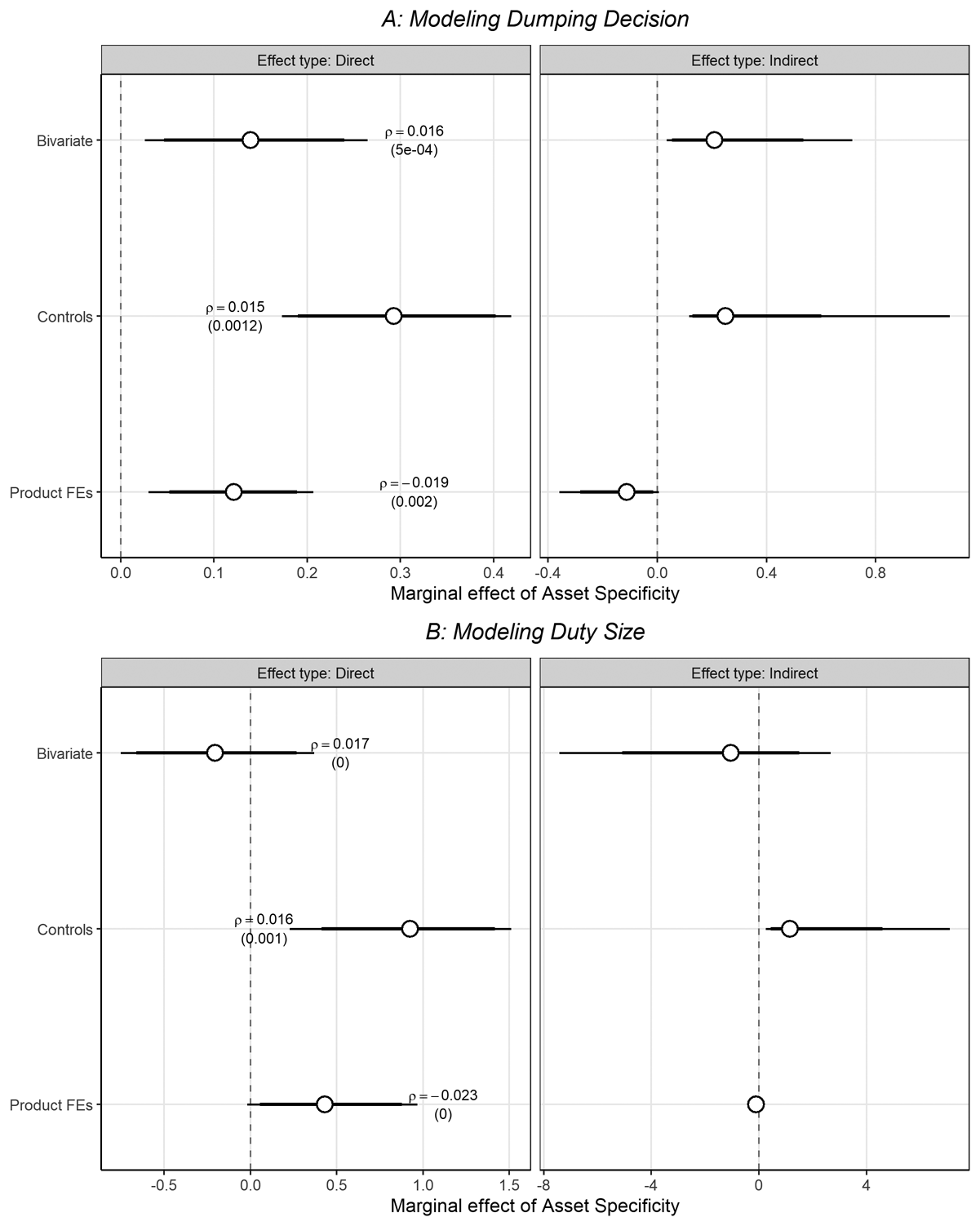
We present the results graphically in Figure 4 and report the coefficients in table form in Appendix D. Panel A of Figure 4 shows the results from models with dumping decision as the outcome. Panel B shows models with duty size as the dependent variable. Models are linear SARs estimated using maximum likelihood. We simulate average direct (left) and indirect (right) effects using the parametric bootstrap (LeSage and Pace Reference LeSage, Pace, Fischer and Nijkamp2014). Details on the model are available in Appendix D.
Asset specificity and antidumping duties
Note: dependent variables: Dumping Decision and Duty Size (logged). Circles are the medians of the bootstrapped distribution. Lines are the 90 per cent (thick) and 95 per cent (thin) bootstrapped confidence intervals. For p, standard errors are in parentheses. Country fixed effects included in all models. Controls include year fixed effects, total assets, revenue, total capital and taxes paid (all logged).

When using dumping decision as the outcome variable, our results show a clear positive and statistically significant relationship between firm-level asset specificity and ADDs. Adding firm-level controls and year fixed effects first and then product fixed effects strengthens this conclusion. When using duty size as the dependent variable, firm-level asset specificity becomes statistically significant only when control variables are included. The results suggest that if a firm increases the specificity of its assets by 18 percent (one standard deviation), we would expect an increase in the likelihood of gaining ADDs of 6 percentage points, and an increase in the size of the duty placed on its foreign competition of 19 percent.
The spatial lag parameter, p, indicates that firms compete for ADD protection. When a firm manages to increase its level of protection, other firms that produce the same good also gain protection. Specifically, a one-standard-deviation increase in asset specificity raises a same-good producer's probability of being protected by 11 percentage points.
Adding product fixed effects – and only investigating diffusion within product groups – changes the results: within-product diffusion is negative. That is, within groups of same-good producers, protection for one firm detracts from the protection available to others.
The fact that diffusion is positive between groups of same-good producers but negative within those groups indicates that both competitive dynamics we have discussed are at play. That is, ADD protection is concentrated on certain products, and producers of those highly protected goods compete to distribute that protection among themselves. First, ADD protection is concentrated on specific products: some goods are protected at the expense of others. This implies that mobile firms can gain some level of protection if they petition for ADDs on a product that an immobile firm was recently successful in having protected. This produces the positive diffusion among same-good producers when we compare all companies. Secondly, even though protection is concentrated on specific products, policy makers are not willing to afford unlimited ADDs to any one good. Therefore, when one company is successful in gaining protection, it will leave less protection available for other producers of that good. This creates competition within groups of same-good producers – not just between them. Importantly, immobile firms typically win this competition: when they gain protection, same-good producers with more liquid assets are less likely to be protected. This produces the negative diffusion when we only compare same-good producers. Overall, this implies a hierarchy of ADD protection in which relatively immobile firms come out on top, while relatively mobile same-good producers gain some protection – and mobile producers of other goods lose out.
Robustness Checks
In the Appendix, we conduct five robustness checks. First, reverse causality may be an issue if firms anticipate that they can obtain protection by investing in specific assets. However, as shown in Appendix E1, firms do not invest very strongly in specific assets when protection for a good was high in the previous period. Secondly, firms with specific assets might also be targets of predatory pricing campaigns more often. If decision makers are more responsive when claims are legitimate, our results could be driven by this possibility. In Appendix E2, we show that predatory pricing campaigns do not drive our results. Thirdly, if firms from certain countries are more likely to dump their prices, this could also drive our results. However, Appendix E2 shows that including fixed effects for the foreign firm's country of origin does not change the results. Fourthly, in Appendix E3, we show that the results are robust to excluding atypical countries and firms. Finally, in Appendix E3, we collect data on Chinese firms seeking ADD protection. Since all complainant firms gain protection in China, there is no variation to test whether ADD decisions are affected by asset specificity. However, the results successfully replicate when looking at duty size.
Mechanisms
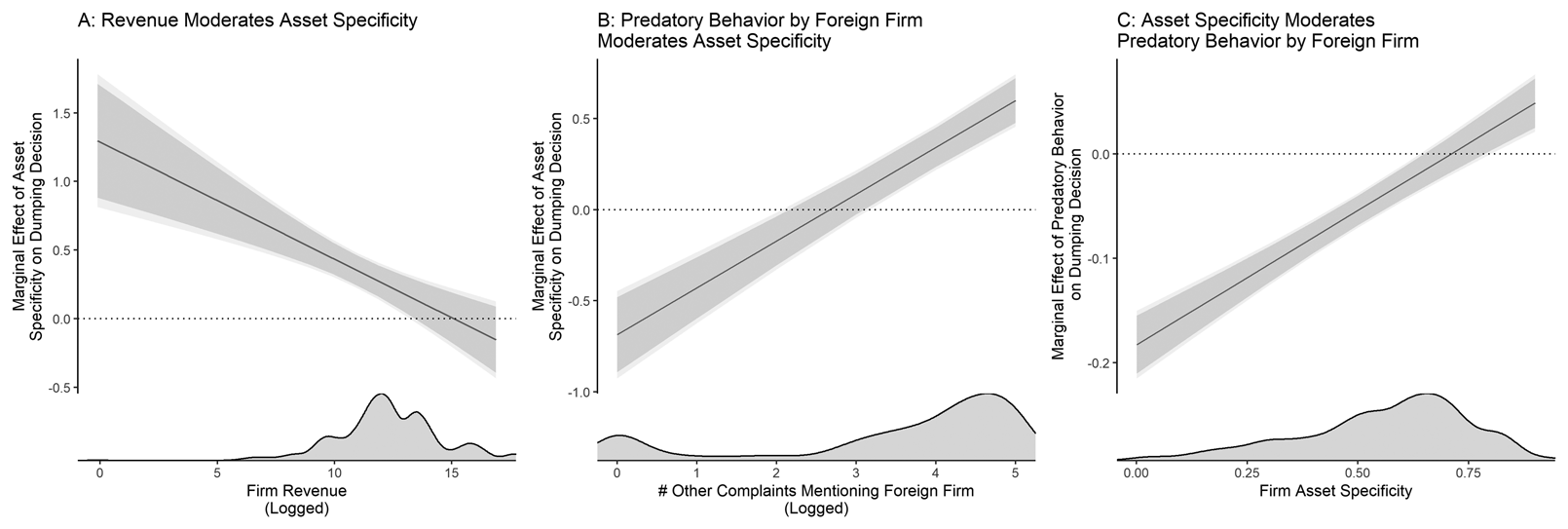
The core of the argument presented here is that decision makers grant more protection to firms with specific assets because they are vulnerable. It is not clear, however, that vulnerable firms with strong financial performance need protection. This suggests an important observable implication: firms with specific assets that also exhibit poor financial performance should obtain more ADD protection, because competition could threaten their survival. In Panel A of Figure 5, we investigate this by interacting firm revenue with asset specificity. This shows a strong interaction effect, suggesting that policy makers react not only to vulnerability, but also to the threat that competition poses to the firm.
Heterogeneous effects
Note: the figure shows marginal SAR coefficients conditional on a moderator in each panel. Shaded areas are 90 per cent (dark) and 95 per cent (light) confidence intervals.

Another important implication is that decision makers’ responsiveness to immobile firms should be strongest when the foreign firm is clearly predatory. In Panel B, we leverage our measure of predatory pricing campaigns to examine this implication. We find a strong interaction: decision makers only grant protection to vulnerable firms when the foreign firm is mentioned in many other complaints. The flipside of this (shown in Panel C) is that policy makers do not react to predatory pricing campaigns unless the domestic firm is immobile; mobile firms are left to fend for themselves.
The remaining question is whether policy makers are able to gauge this themselves, or if vulnerability induces firms to lobby more intensively. While our data do not allow us to examine this question directly, evidence from single-country studies shows that firms with more specific assets do lobby more intensively (Alt et al. Reference Alt1999), and that lobbying intensity translates into more protection (Evans and Sherlund Reference Evans and Sherlund2011).
In Appendix F, we provide evidence on three other potential mechanisms. First, following Mukherjee, Smith and Li (Reference Mukherjee, Smith and Li2009), we should expect immobile firms to be more successful if they are also large employers. We find no such evidence (Figure F1). Secondly, if decision makers primarily respond to fiscal concerns, we would expect asset specificity to matter only if the firm is a large taxpayer as well. We find no evidence of this (Figure F1). Thirdly, supply-side factors could explain the patterns we observe here. For instance, because of electoral concerns, democracies may be more responsive to voters and firms that employ large numbers of voters. If supply-side factors at the aggregate level make decision makers more responsive to immobile firms, we would expect significant country-level differences in effects. We find limited evidence that this is the case (Figure F2).
Conclusion
In this letter, we have examined two important dynamics of firm-level antidumping protection. First, trade policy makers tailor their provision of ADDs to protect vulnerable firms – those owning assets that are difficult to liquidate and relocate in response to international competition. The concentration of protection among these firms is so strong that firms with less specific assets might not gain protection – even if they are the target of predatory pricing campaigns. Our results lend credence to the view that decision makers grant trade protection because it furthers the interests of a specific group of companies.
Secondly, since protection is a scarce resource, ADDs afforded to these immobile firms diffuse. This indicates that same-good producers have the common goal of increasing protection for their product at the expense of other goods. However, once the overall levels of protection are decided, they still have to compete among themselves to be the final recipient of ADDs. Because of the sheer density of the network of protection-seeking firms, ADDs shielding firms with specific assets may have vast economic consequences. Most obviously, they have the direct effect of distorting the competitive environment by blocking foreign competition to immobile domestic firms. However, since this changes the probability that same-good producers are protected as well, the diffusion of antidumping protection further distorts the domestic competitive environment beyond the initial first-order effect.
These results suggest at least three avenues for future research. First, while we have explored a number of plausible explanations why decision-makers are more responsive to immobile firms, future work should focus more on uncovering the mechanisms linking asset specificity to trade protection. Secondly, the diffusion dynamic explored here is likely to be an important reason why ADDs have large economic effects. Further explorations of why the dynamics differ within and between product groups will be important for future research on trade protection. Finally, while the association between asset specificity and trade protection should not be limited to certain types of protection, more work is needed to uncover how asset specificity affects ADD relative to other trade protection policies.
Supplementary material
Online appendices are available at https://doi.org/10.1017/S0007123420000939.
Data availability statement
Data replication sets are available in Harvard Dataverse at: https://doi.org/10.7910/DVN/1WZRY2
Acknowledgements
A previous version of this letter was presented at the panel on Central Banking, Capital Movements and Exchange Rate Politics at the annual meeting of the American Political Science Association. We would like to thank Benjamin Son, Rasmus Tue Pedersen, Jacob Hariri and the two anonymous reviewers for valuable comments.