




No CrossRef data available.
Levels of brain natriuretic peptide in children with right ventricular overload due to congenital cardiac disease
Published online by Cambridge University Press: 13 July 2005
Abstract
Objective: To evaluate the role of the concentration of brain natriuretic peptide in the plasma, and its correlation with haemodynamic right ventricular parameters, in children with overload of the right ventricle due to congenital cardiac disease. Methods: We studied 31 children, with a mean age of 4.8 years, with volume or pressure overload of the right ventricle caused by congenital cardiac disease. Of the patients, 19 had undergone surgical biventricular correction of tetralogy of Fallot, 11 with pulmonary stenosis and 8 with pulmonary atresia, and 12 patients were studied prior to operations, 7 with atrial septal defects and 5 with anomalous pulmonary venous connections. We measured brain natriuretic peptide using Triage®, from Biosite, United States of America. We determined end-diastolic pressures of the right ventricle, and the peak ratio of right to left ventricular pressures, by cardiac catheterization and correlated them with concentrations of brain natriuretic peptide in the plasma. Results: The mean concentrations of brain natriuretic peptide were 87.7, with a range from 5 to 316, picograms per millilitre. Mean end-diastolic pressure in the right ventricle was 5.6, with a range from 2 to 10, millimetres of mercury, and the mean ratio of right to left ventricular pressure was 0.56, with a range from 0.24 to 1.03. There was a positive correlation between the concentrations of brain natriuretic peptide and the ratio of right to left ventricular pressure (r equal to 0.7844, p less than 0.0001) in all patients. These positive correlations remained when the children with tetralogy of Fallot, and those with atrial septal defects or anomalous pulmonary venous connection, were analysed as separate groups. We also found a weak correlation was shown between end-diastolic right ventricular pressure and concentrations of brain natriuretic peptide in the plasma (r equal to 0.5947, p equal to 0.0004). Conclusion: There is a significant correlation between right ventricular haemodynamic parameters and concentrations of brain natriuretic peptide in the plasma of children with right ventricular overload due to different types of congenital cardiac disease. The monitoring of brain natriuretic peptide may provide a non-invasive and safe quantitative follow up of the right ventricular pressure and volume overload in these patients.
Information
- Type
- Original Article
- Information
- Copyright
- © 2005 Cambridge University Press
The cardiac natriuretic hormone plays an important role in the regulation of extracellular fluid volume and blood pressure. These peptide hormones induce natriuresis, diuresis, and vasodilation, and specifically act to counter the effects of the renin–angiotensin–aldosterone system. The natriuretic peptide system allows the heart to participate in the regulation of vascular tone, and control the state of the extracellular volume. The brain natriuretic peptide is synthesized and released by cardiomyocytes in response to increased transmural stress, and is related to left ventricular filling pressures.1–6 Secretion of brain natriuretic peptide results in arterial and venous vasodilation. It has recently been reported that changes in the levels of the peptide can play a role in determining the strategy of treatment for adults in heart failure.7 Many studies in adults have also shown that the levels of brain natriuretic peptide in the plasma are increased in states of left ventricular overload, such as left ventricular failure or left ventricular hypertrophy, and that this can be a useful biochemical marker for left ventricular overload.8, 9 It has also been reported that the concentrations of the peptide in the plasma are elevated in different groups of patients with congestive heart failure due to congenital cardiac disease.10–12 Although measurement of these concentrations has been shown to be an additional tool for the assessment of left ventricular systolic dysfunction in children and adults, there have only been a few studies on how the concentration of brain natriuretic peptide in the plasma may react in the setting of right ventricular volume overload and right ventricular dysfunction.13–15 In children with congenital cardiac disease, the primary complaints are ventricular volume overload and pulmonary hypertension, not cardiac dysfunction. There has been no report, however, regarding the modes of secretion of brain natriuretic peptide when right ventricular overload is encountered in children with congenital cardiac disease. We hypothesized that the levels of brain natriuretic peptide would vary with changes in right ventricular pressure and volume overload due to congenital heart disease. To verify this hypothesis, we measured the concentrations of the peptide in the plasma of children undergoing diagnostic cardiac catheterization.
Patients and methods
Patients
We studied 31 children, at a mean age of 4.77 years, and with a range from 0.2 to 17.3 years, with chronic overload of the right ventricle caused by their congenitally malformed heart. Specifically, we studied 19 patients after surgical correction of tetralogy of Fallot, 11 with pulmonary stenosis and 8 with pulmonary atresia, and 12 patients preoperatively, 7 with atrial septal defects and 5 with anomalous pulmonary venous connections. Clinical and haemodynamic characteristics of all patients, and estimations of pulmonary regurgitation in the patients with tetralogy, are shown in Tables 1 and 2, respectively. Approval was given by the local ethics committee and informed consent was obtained from all adult subjects and parents of all participants below 18 years of age.
Haemodynamic measurements were made at cardiac catheterization (Coroskop Hi-R, Siemens, Germany), and were correlated to the concentrations of brain natriuretic peptide in the plasma. We measured end-diastolic pressure in the right ventricle directly. The systolic pressure in the right ventricle was divided by the comparable systolic pressure in the left ventricle to give the peak ratio of right to left ventricular pressures. In keeping with general clinical practice, we scaled the pressure ratios to those below 0.5, those from 0.5 to 0.75, and those above 0.75, so as to describe the mathematical proportion of the right to the left ventricular pressure in each individual. We then correlated the ventricular pressure ratio to the concentrations of brain natriuretic peptide in the plasma.
We estimated the degree of pulmonary regurgitation in the children with tetralogy of Fallot using cardiac catheterization. Again in keeping with general clinical practice, we graded the extent of regurgitation from zero for no regurgitation, to 4 for extreme regurgitation, with grades 1, 2, and 3 representing mild, moderate, and severe regurgitation.
Samples of venous blood were taken exclusively at the occasion of an already scheduled diagnostic or interventional cardiac catheterization. All patients had good left ventricular function or contraction, with ejection fractions over 0.60. We excluded any patients found to have aortic valvar stenosis, coarctation of the aorta, or pulmonary stenosis. We also excluded patients with the Eisenmenger syndrome. We included in the study only those patients known not to have additional hepatic or renal diseases, or disturbances of water or electrolytes.
Measurement of brain natriuretic peptide
Blood samples were transferred to chilled plastic tubes containing aprotinin, and ethylenediaminetetraacetic acid treated tubes, and then immediately placed on ice and promptly centrifuged at 2,500 rotations per minute and 3 degree Celsius. An aliquot of plasma was frozen immediately at −80 degree Celsius and thawed only once at the time of assay, which was performed within 4 weeks after the sampling. Measurements of brain natriuretic peptide were performed with the Triage® System from Biosite Diagnostics, California, United States of America. A minimum of 0.2 millilitres of plasma was needed for each determination.
Statistical analysis
The data were processed using the SPSS for Windows software (SPSS Inc, Chicago, IL). All data were presented as mean with range. Comparison of concentrations of the peptide between the different groups was carried out using the Mann–Whitney non-parametric test. Correlation with the haemodynamic parameters was examined using the Spearman rank correlation. The null hypothesis was rejected at the 95 per cent confidence interval, considering a p value of less than 0.05 to be significant.
Results
The 31 patients had mean concentrations of brain natriuretic peptide in the plasma of 87.7 picograms per millilitre, with a range from 5 to 316, and mean end-diastolic pressures in the right ventricle of 5.6 millimetres of mercury, with a range from 2 to 10. The mean ratio of ventricular pressures was 0.56, with a range from 0.24 to 1.03 (Table 1).
Table 1. Clinical and haemodynamic characteristics of the study patients.

There was no significant difference (p less than 0.05) in the concentrations of brain natriuretic peptide and the ventricular pressure ratios between the groups of patients with different congenital cadiac malformations. There was a positive correlation between the levels of brain natriuretic peptide and the ventricular pressure ratios (r equal to 0.8512; p less than 0.0001; 31 children) in all patients, and also for the 19 patients with tetralogy of Fallot (r equal to 0.7472; p equal to 0.0002; 19 children), as well as the 12 patients with atrial septal defects and anomalous pulmonary venous connections (r equal to 0.9148; p less than 0.0001 – Fig. 1).

Figure 1. Correlation of the concentrations of brain natriuretic peptide in the plasma to the ratio of right to left ventricular pressures. Filled circles describe patients with tetralogy of Fallot and either pulmonary stenosis or atresia (r equal to 0.7472, p equal to 0.0002; 19 children). Unfilled circles describe patients with atrial septal defect and anomalous pulmonary venous connections (r equal to 0.9148, p less than 0.0001; 12 children). BNP: brain natriuretic peptide; RV/LVP: right to left ventricular pressure ratio; pg/ml: picograms per millilitre.
The 15 patients with ventricular pressure ratios below 0.5 showed a maximal concentration of the peptide of 55 picograms per millilitre. In the 6 children with ventricular pressure ratios from 0.5 to 0.75, the concentrations of the peptide varied from 48 to 115 picograms per millilitre. In our 10 patients with ventricular pressure ratios above 0.75, the levels of peptide varied from 80 to 316 picograms per millilitre (Fig. 2).

Figure 2. The three groups of right to left ventricular pressure ratios and their correlation to the concentrations of brain natriuretic peptide in the plasma. BNP: brain natriuretic peptide; RV/LVP: right to left ventricular pressure ratio; pg/ml: picograms per millilitre; n: number of patients.
We discovered a weak correlation between end-diastolic right ventricular pressure and concentrations of the peptide when assessing all 31 patients (r equal to 0.5947, p equal to 0.0004). For the 19 patients with tetralogy of Fallot, we did not find any significant correlation (r equal to 0.5274, p equal to 0.0559; 19 children), but a strong correlation was found for the 12 patients with atrial septal defects and anomalous pulmonary venous connections (r equal to 0.7830, p equal to 0.0002 – Fig. 3).

Figure 3. Correlation of the concentration of brain natriuretic peptide in the plasma to end-diastolic pressure of the right ventricle. Filled circles describe patients with tetralogy of Fallot with pulmonary stenosis or atresia (r equal to 0.5274, p equal to 0.0559; 19 children). Unfilled circles describe patients with atrial septal defect and anomalous pulmonary venous connections (r equal to 0.7830, p equal to 0.0026; 12 children). BNP: brain natriuretic peptide; RVPed: end-diastolic right ventricular pressure; pg/ml: picograms per millilitre; mmHg: millimetres of mercury.
Our estimation of the pulmonary regurgitation in the patients with tetralogy is shown in Table 2. We did not find any correlation between the estimated pulmonary regurgitation and the concentrations of peptide in the plasma (r equal to 0.1684, p greater than 0.05), nor with the ventricular pressure ratios (r equal to 0.2750, p greater than 0.05) or end-diastolic right ventricular pressure (r equal to 0.0406, p greater than 0.05 – Table 2).
Table 2. Pulmonary regurgitation in relation to RV/LVP and BNP.

Discussion
We have two major findings from our present study. First, concentrations of brain natriuretic peptide are elevated in the plasma from children with right ventricular volume overload or increased systolic right ventricular pressure. Secondly, the levels of the peptide significantly correlate with systolic right ventricular pressure and end-diastolic right ventricular pressure in children with volume overload of their right ventricle.
Previous studies have demonstrated that levels of the peptide are elevated in children and adults with left ventricular dysfunction, including myocardial infarction, severe valvar regurgitation, and myocardial hypertrophy due to hypertension. The levels measured in adults with congestive heart failure correlate strongly with their standing in the classification of the New York Heart Association, and have been shown to be an independent predictor of adverse outcome.16, 17 The aetiology and pathophysiology of congestive heart failure in children, however, is quite different from that in adults. Congestive heart failure in children is most commonly secondary to volume overload from left-to-right shunting, when ventricular function is usually well preserved. Left ventricular pump dysfunction is seen in only a minority of children with acute or chronic heart failure.18
Thus far, however, little information has been available regarding the levels of the peptide in patients with right ventricular volume or pressure overload in the absence of ventricular dysfunction, especially in children. Increased levels were already reported in children with congestive heart failure due to congenital heart disease or cardiomyopathy.11, 12, 19 In our study, all children had good biventricular systolic function. The concentrations of the peptide in the plasma, nonetheless, showed a positive correlation with ratios of right to left ventricular pressure, and diastolic pressure in the right ventricle. These results support again the hypothesis that levels of the peptide are influenced by volume and pressure overload.1, 5 These findings suggest that it may be possible to use the concentrations of the peptide as measured in the plasma to estimate the severity of the ventricular volume and pressure overload in children with congenital heart disease. The clinical usefulness appears to be clear. In many institutions, surgery or coil embolization is favoured for those with even small atrial septal defects or patent arterial ducts in order to prevent infective endocarditis. We focussed on whether the analysis of levels of brain natriuretic peptide would be a useful, safe, and non-invasive diagnostic technique in children with volume or pressure overload. In the future, it seems it may become possible to estimate the prognosis of patients by using levels of the peptide in the plasma. This additional information, if acting as a surrogate of right ventricular pressure, could be very helpful in clinical practice. Our findings, in fact, indicate that levels of the peptide do reflect the severity of congenital heart disease in our patients with right ventricular overload, and that a level of more than 115 picograms per millilitre is useful as one estimated indicator of a ratio of ventricular pressures greater than 0.75.
By combining the measurement of the peptide with echocardiography, we believe it will be possible to determine whether or not conservative or operative therapy should be chosen in patients with congenitally malformed hearts. Most importantly, the monitoring of the levels of the peptide is relatively non-invasive, involving only a venepuncture, and therefore minimizes trauma to the children.
We conclude that an analysis of levels of brain natriuretic peptide in the plasma is a useful, relatively non-invasive, indicator of volume and pressure overload of the right ventricle in infants and children with congenitally malformed hearts, and predict that it will prove useful in clinical paediatric practice.
Limitations of the study
Beside the relatively small number of subjects in whom we were able to make measurements, our study would have been more valuable with measurements of parameters such as the ratio of pulmonary and systemic flows, and right ventricular diameter. It is certainly the case that some of our subgroups contain a small number of subjects. The study would have more power had we been able to collect larger numbers of participants in these subgroups. We are also concerned about the clustering of the data that contribute to the good correlation shown in Figures 1 and 2.
Acknowledgements
We are grateful to all the doctors and nurses of the Paediatric Cardiology Clinic at the University Hospital in Hamburg for their excellent support during this study. Biosite gave no financial support, and had no input into the design of the study or the analysis of the data.
References
Clerico A, Emdin M. Diagnostic accuracy and prognostic relevance of the measurement of cardiac natriuretic peptides: a review. Clin Chem 2004; kala USA 50: 33–50.
Maisel A. B-type natriuretic peptide levels: a potential novel “white count” for congestive heart failure. J Card Fail 2001; 7: 183–193.Google Scholar
Maisel A, Krishnaswamy P, Nowak RM, et al. Rapid measurement of B-type natriuretic peptide in the emergency diagnosis of heart failure. N Engl J Med 2002; 347: 161–167.Google Scholar
Sagnella A. Measurement and importance of plasma brain natriuretic peptide and related peptides. Ann Clin Biochem 2001; 38: 83–93.Google Scholar
Cowie MR, Mendez GF. BNP and congestive heart failure. Prog Cardiovasc Dis 2002; 44: 293–321.Google Scholar
Troughton RW, Frampton CM, Yandle TG, Espiner EA, Nicholls MG, Richards AM. Treatment of heart failure guided by plasma aminoterminal brain natriuretic peptide (N-BNP) concentrations. Lancet 2000; 355: 1126–1130.Google Scholar
McDonagh TA, Cunningham AD, Morrison CE, et al. Left ventricular dysfunction, natriuretic peptides, and mortality in an urban population. Heart 2001; 86: 21–26.Google Scholar
Talwar S, Siebenhofer A, Williams B, Ng LL. Influence of hypertension, left ventricular hypertrophy, and left ventricular systolic dysfunction on plasma N terminal pro BNP. Heart 2000; 83: 278–282.Google Scholar
Koch A, Singer H. Normal values of B type natriuretic peptide in infants, children, and adolescents. Heart 2003; 89: 875–878.Google Scholar
Mir TS, Marohn S, Läer S, Eiselt M, Grollmus O, Weil J. Plasma concentrations of N-terminal-pro brain natriuretic peptide in children from neonatal period to adulthood and in children with congestive heart failure. Pediatrics 2002; 110: 1–6.Google Scholar
Cowley CG, Bradley JD, Shaddy RE. B-type natriuretic peptide levels in congenital heart disease. Pediatr Cardiol 2004; 25: 336–340.Google Scholar
Tulevski II, Groenink M, van der Wall EE, et al. Increased brain and atrial natriuretic peptides in patients with chronic right ventricular pressure overload: correlation between plasma neurohormones and right ventricular dysfunction. Heart 2001; 86: 27–30.Google Scholar
Tulevski II, Dodge-Khatami A, Groenink M, van der Wall EE, Romkes H, Mulder BJ. Right ventricular function in congenital cardiac disease: non-invasive quantitative parameters for follow up. Cardiol Young 2003; 13: 397–403.Google Scholar
Kruger S, Graf J, Merx MW, et al. Brain natriuretic peptide predicts right heart failure in patients with acute pulmonary embolism. Am Heart J 2004; 147: 60–65.Google Scholar
Tsutamoto T, Wada A, Maeda K, et al. Attenuation of compensation of endogenous cardiac natriuretic peptide system in chronic heart failure: prognostic role of plasma brain natriuretic peptide concentration in patients with chronic symptomatic left ventricular dysfunction. Circulation 1997; 96: 509–516.Google Scholar
Cheng V, Kazanagra R, Garcia A, et al. A rapid bedside test for B-type peptide predicts outcomes in patients admitted for decompensated heart failure: a pilot study. J Am Coll Cardiol 2001; 37: 386–391.Google Scholar
Koulouri S, Acherman RJ, Wong PC, Chan LS, Lewis AB. Utility of B-type natriuretic peptide in differentiating congestive heart failure from lung disease in pediatric patients with respiratory distress. Pediatr Cardiol 2004; 25: 341–346.Google Scholar
Mir TS, Laux R, Hellwege HH, et al. Plasma N-terminal pro-atrial-natriuretic peptide and plasma N-terminal-pro brain natriuretic peptide in healthy neonates: marked and rapid increase after birth. Pediatrics 2003; 112: 896–899.Google Scholar
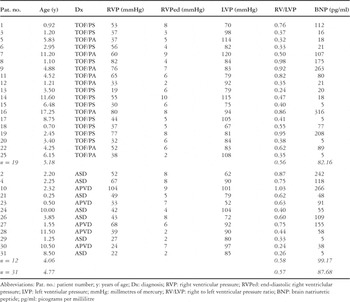
Table 1.

Correlation of the concentrations of brain natriuretic peptide in the plasma to the ratio of right to left ventricular pressures. Filled circles describe patients with tetralogy of Fallot and either pulmonary stenosis or atresia (r equal to 0.7472, p equal to 0.0002; 19 children). Unfilled circles describe patients with atrial septal defect and anomalous pulmonary venous connections (r equal to 0.9148, p less than 0.0001; 12 children). BNP: brain natriuretic peptide; RV/LVP: right to left ventricular pressure ratio; pg/ml: picograms per millilitre.

The three groups of right to left ventricular pressure ratios and their correlation to the concentrations of brain natriuretic peptide in the plasma. BNP: brain natriuretic peptide; RV/LVP: right to left ventricular pressure ratio; pg/ml: picograms per millilitre; n: number of patients.

Correlation of the concentration of brain natriuretic peptide in the plasma to end-diastolic pressure of the right ventricle. Filled circles describe patients with tetralogy of Fallot with pulmonary stenosis or atresia (r equal to 0.5274, p equal to 0.0559; 19 children). Unfilled circles describe patients with atrial septal defect and anomalous pulmonary venous connections (r equal to 0.7830, p equal to 0.0026; 12 children). BNP: brain natriuretic peptide; RVPed: end-diastolic right ventricular pressure; pg/ml: picograms per millilitre; mmHg: millimetres of mercury.
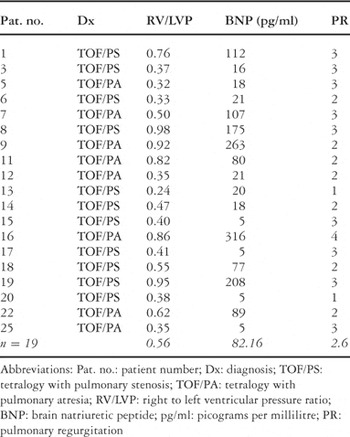
Table 2.
 You have
Access
- 35
- Cited by