Globalization is usually studied at the level of the nation-state with statistics on flows of trade, capital, and people used to classify the extent that countries are “globalized.” The trade-to-GDP ratios of many countries, for instance, are often used to show two distinct waves of globalization from the middle of the nineteenth century—the first peaking in the interwar period of the early twentieth century and the second a sustained period of globalization beginning from the end of the twentieth century.Footnote 1
But there are also studies that have examined globalization beyond the level of the nation-state, at the subnational or supranational level, in disciplines such as political economy, economic geography, and urban studies.Footnote 2 Just like globalization has varied by degree across countries, it has also varied by degree across regions, cities, and firms within a country. As Philip McCann and Zoltan J. Acs have argued, “in today's world the importance of the scale of countries cannot be understood without considering the importance of the scale of the cities in the country, and in turn the importance of the scale of the cities in a country cannot be understood without considering the scale of the multinational firms in the city.”Footnote 3
Concepts such as “world cities” and “global cities” emerged in the late twentieth century to identify influential sites of globalization, but recent scholarship is pointing out that while all cities are globalized, some are much more so than others, and understanding their linkages may prove more fruitful. An emerging theme in studies on globalization is the idea of “inter-city” relations, different from cross-country relations.Footnote 4 Simply put, in such a framework, one may find more similarities in how London, Mumbai, and Dubai were shaped by waves of globalization than in the United Kingdom, India, and the United Arab Emirates, respectively, at the aggregate level. Further, as per Manuel Castells's theory of space of flows, these relations can be conceptualized at three levels: infrastructure, social relations, and elite relations.Footnote 5 Globalization can make cities look familiar across the world because of similar built-up spaces (or the aspirations to create them) and the lifestyles of those who live in them (or the aspirations thereof).
This line of research has added salience because for the first time in human history, more people today live in cities than in villages.Footnote 6 While the urbanization rate crossed 50 percent in the high-income countries several decades ago—and in a few, as early as in the nineteenth century—it was only recently surpassed in China and remains well below 40 percent in India. This massive shift in settlement patterns took place and is taking place against the backdrop of distinct waves of globalization and offers the business historian an alternative framework through which globalization itself could be considered, beyond the level of the country.Footnote 7 After all, firms need to choose not only the countries they wish to engage with but also the cities within.
This article discusses this issue in the context of the large cities of India, a country that went through a tumultuous tryst with globalization in the twentieth century and has generated a rich historiography in business and economic history.Footnote 8 By focusing on the world's largest democracy, now often classified as an “emerging market,” it also broadens the geographic scope of conventional business history of globalization that is dominated by examples drawn from North America, Europe, and Japan.Footnote 9 The next section briefly reviews major economic transitions of India in the twentieth century, followed by a section on globalization and Indian cities, a note on its relationship with firms, and a final concluding section.
Economic Transitions in Twentieth-Century India
There are several distinctive aspects of Indian business and polity in the twentieth century. First, unlike in most colonized countries, a sophisticated indigenous industrialist class emerged while India was still under colonial rule, and this class promoted economic nationalism and protectionism to varying degrees in the twentieth century.Footnote 10 Second, independent India broadly remained a stable democracy, never became a military dictatorship, and maintained a philosophy of nonalignment in Cold War geopolitics, unlike most countries following decolonization.Footnote 11 Third, a unique organizational structure called the managing agency system emerged during colonial rule to foster trade and investment, which left its imprint on business organizational form even after its abolishment in 1970.Footnote 12 Fourth, India's structural transformation was led by the services sector and not by manufacturing.Footnote 13
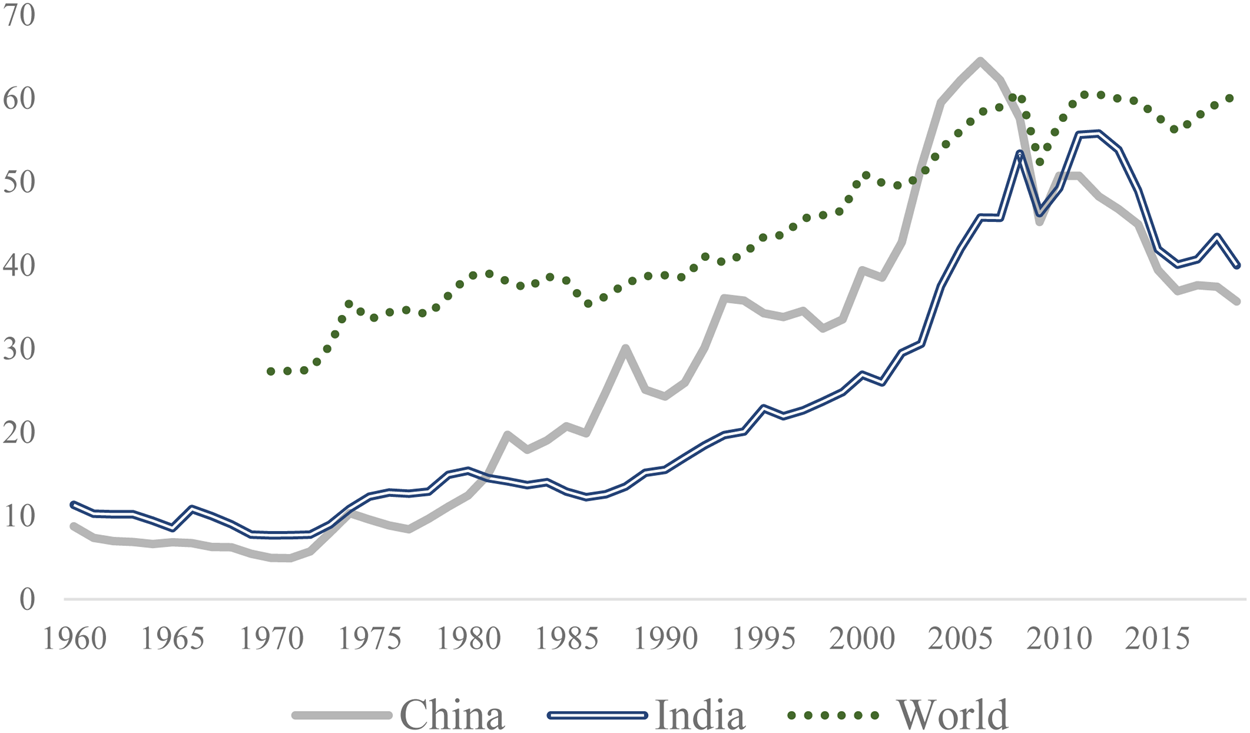
India began the twentieth century under the free trade principles of the British Empire during colonial rule; witnessed calls for Swadeshi, or preference for homemade goods, in the freedom movement; shifted to an autarkic import-substituting model of industrialization after Independence in 1947; and began to liberalize its economy (internally and externally) from the early 1980s, and prominently after 1991. As a result, the U-shaped curve of the trade-to-GDP ratio across the twentieth century has been noted for India as well.Footnote 14 However, as Figure 1 shows, the ratio for India has remained below the global average for the past five decades and lagged behind that of China from the 1980s to 2010.
Trade-to-GDP ratio (%), 1960–2019. (Source: World Bank, World Development Indicators 2020, https://data.worldbank.org/indicator/NE.TRD.GNFS.ZS, accessed 11 Mar.)

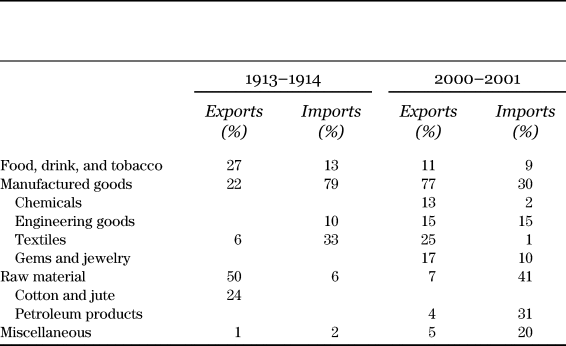
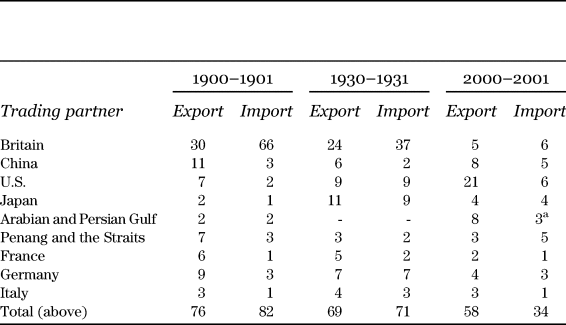
In 2000, India was still a relatively poor country with a per capita income of $2,570, as compared with China's $3,450 or the global average of $11,080.Footnote 15 As Tables 1 and 2 show, India's trading position had, however, transformed over the course of the twentieth century. At the beginning of the twentieth century, India traded heavily with Britain and was generally importing manufactured goods and exporting foodstuff and raw materials such as cotton and jute. It was only after the report of the Indian Industrial Commission of 1916–1918 that trading policies started to change to confer some protection to indigenous industries in India. In the interwar period, Britain's significance as a trading partner decreased and Japan and the United States emerged as important partners (see Table 2). The growing clamor for Swadeshi and protectionism that grew in the interwar period sustained itself after Independence in 1947. It was only in 1991 that major economic reforms were announced that veered away from protectionism. Tirthankar Roy points out that the period from 1914 to 1991 should be seen as one long period of India's withdrawal from the global economy rather than 1947 marking a clean break from the past.Footnote 16
India's Foreign Goods Trade Composition, 1913 and 2000

Source: K. N. Chaudhuri, “Foreign Trade and Balance of Payments (1757–1947),” in Cambridge Economic History of India, vol. 2, ed. Dharma Kumar (New Delhi, 1983), tables 10.16, 10.18, 10.11; Reserve Bank of India, Handbook of Statistics on the Indian Economy, 2010–11 (Mumbai, 2011).
Major Trading Partners of India in 1900, 1930, and 2000, Share in Trade (%)

Source: K. N. Chaudhuri, “Foreign Trade and Balance of Payments (1757–1947),” in Cambridge Economic History of India, vol. 2, ed. Dharma Kumar (New Delhi, 1983), tables 10.21A, 10.21B; Reserve Bank of India, Handbook of Statistics on the Indian Economy, 2010–11 (Mumbai, 2011), table 136.
Note: China includes Hong Kong in 2000–2001. Penang and the Straits is Malaysia and Singapore in 2000–2001.
aThis figure represents a low value, as 30 percent of India's total imports were classified as “unspecified,” which likely reflects oil imports from the Persian Gulf.
From the middle of the twentieth century, India began to run merchandise trading deficits, owing to large fuel imports that comprised nearly a third of its import bill.Footnote 17 This deficit was covered partly by workers’ remittances from abroad (reflecting the globalization of labor) and, from the 1980s, services exports, mainly software services to the United States. The colonial legacy of the English language played an important role in outsourcing services to India and connecting India with the United States in the information technology (IT) sector. India reverted to its longstanding position in textiles as an exporter of finished goods, having exported raw materials when it was under colonial rule.Footnote 18 India also reemerged as a major center for the diamond trade, importing rough stones, polishing them, and exporting them back to the world.Footnote 19
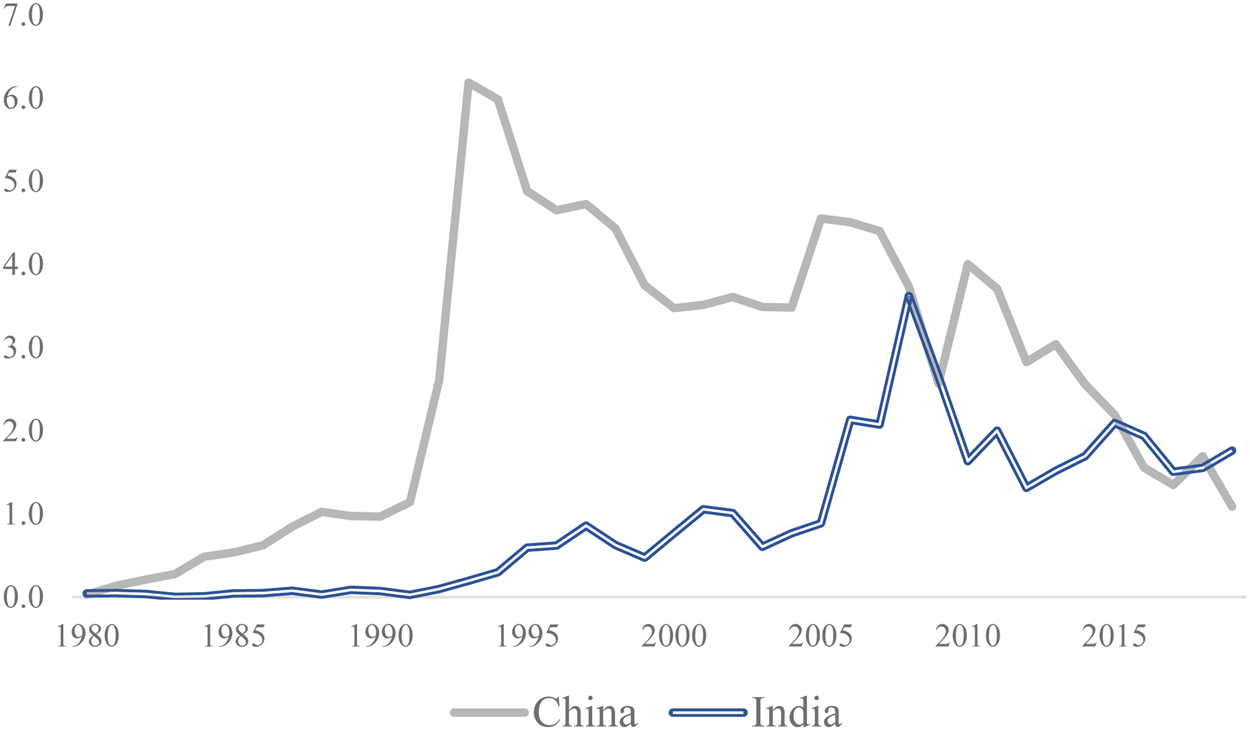
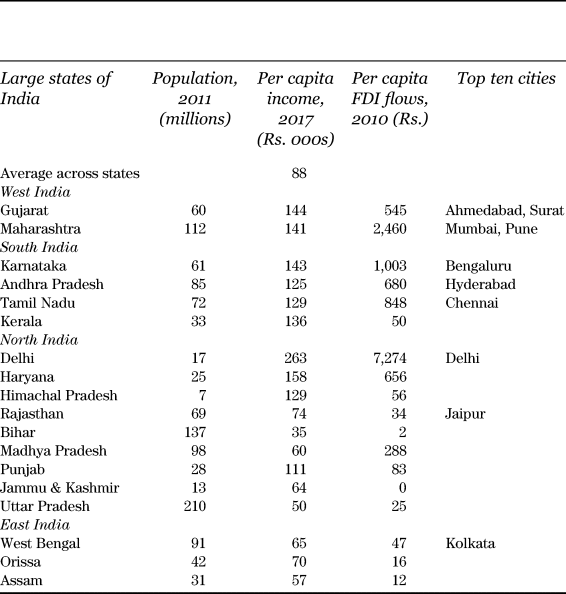
Foreign direct investment (FDI) was present in India throughout the twentieth century but was actively repressed in the 1960s and 1970s, leading to the exit of some multinational firms. As Figure 2 shows, FDI began to kick in only from the 1990s—a decade later than in China—and lagged substantially as a share of GDP. It was, however, directed to a few states and cities of India, as shown in Table 3, and its implication for urban evolution will be discussed in greater detail in the next section.
Foreign direct investment inflow-to-GDP ratio (%), 1980–2019. (World Bank, World Development Indicators 2020, https://data.worldbank.org/indicator/BX.KLT.DINV.WD.GD.ZS, accessed 11 Mar.)

Selected Characteristics of States in India

Source: Census of India, 2011 (population figures); Reserve Bank of India, Handbook of Statistics on the Indian Economy, 2018–19 (Mumbai, 2019); Atri Mukherjee, “Regional Inequality in Foreign Direct Investment Flows to India: The Problem and the Prospects,” RBI Occasional Paper Series 32, no. 2 (2011): 99–127.
Note: Top ten cities are the largest based on population size in 2011.
There were other important transitions in the Indian economy in the twentieth century. Economic growth rates in India were low and stagnant under colonial rule, picked up between 1947 and the 1980s, and thereafter maintained high levels, though not as high as in China.Footnote 20 India's population grew threefold over the twentieth century to more than a billion people in 2001, but population growth rates had peaked by the 1980s and begun to slide downward along the path of the demographic transition. There was also sectoral diversification in output: the share of agriculture and livestock fell from over 60 percent of GDP in 1900 to around 20 percent by 2000; the share of the manufacturing sector gradually increased from 10 percent to 25 percent over the century; the share of the services sector rose from around 30 percent in 1900 to over 45 percent in 2000 and then rapidly to over 60 percent by 2010.Footnote 21 The sectoral diversification in the workforce was far slower, with nearly half the population still engaged in agriculture in 2000.
As a result, India's urbanization rate of 31 percent in 2011 was low by global standards. There were wide variations within the country, as southern and western India urbanized much faster than the northern hinterlands and eastern India (see Figure 3). This was in tune with other regional development indicators and FDI, which concentrated in the south and west (Table 3). Even with a low overall urbanization rate, India's urban population was bigger than the population of the United States and lived in more than four thousand towns and cities. Around fifty cities had a population exceeding a million people. In terms of the urban hierarchy, the ten largest cities in 2011—Delhi, Mumbai, Kolkata, Chennai, Bengaluru, Hyderabad, Ahmedabad, Pune, Surat, and Jaipur—comprised a quarter of the urban population, and their share of total population rose from 2 percent in 1901 to 7 percent in 2001.Footnote 22 Figure 4 shows a political map of Indian states and the location of these cities. The next section explores the globalization of Indian cities and their interrelations.
Change in state-level urbanization rate in India, 1901–2011. Note: Data for 1901 has been back casted in 2011 jurisdictional boundaries. (Source: Census of India, 2011 and 2001, statements 4 and 8 of General Population Tables.)

Top ten populous cities and states of India, 2011. (Source: Census of India, 2011.)

Globalization and Cities
The Industrial Revolution and nineteenth-century globalization fundamentally altered the global hierarchy of cities in the world.Footnote 23 Until then, the world's largest cities were often found across continents, and particularly in India and China, but by 1925 the fifteen largest cities of the world were all located in the richest countries of those times.Footnote 24 New York, London, and Tokyo were the three largest cities and are still considered to be “global cities” in the way they influence the world, especially as financial centers. Over the course of the twentieth century, the demographic transition and spread of industrialization once again altered the global urban hierarchy, and by 2000, ten of the world's fifteen largest cities were located in developing countries.Footnote 25 The twentieth century thus marked a radical break from the past, when the size, strength, and wealth of empires mattered for hosting the most populous cities of the world. Deglobalization and reglobalization over the twentieth century directed capital to new geographies, most spectacularly in China from the 1980s where urbanization took off and created many large cities in a short span of time.
The globalization of Indian cities has deep roots. In ancient India, overland and overseas trade connected the Indian subcontinent with most parts of Asia, Europe, and coastal Africa.Footnote 26 In the first millennium CE, the Chola Empire extended itself from South India to Southeast Asia. Historians have documented the vibrancy of the Indian Ocean trade in the second millennium CE, especially in goods such as textiles and spices, as well as India's close links with the Persianate world.Footnote 27 While port towns proliferated, the largest Indian cities before the 1500s, such as Delhi and Vijayanagar, were typically based inland at a considerable distance from the coasts.Footnote 28
From the sixteenth century onward, Indian goods were increasingly sought after in western Europe, leading to a vibrant textile trade.Footnote 29 Various European players set up business operations and even ports along the vast Indian coastline. The English East India Company (EIC) played an important role in fostering this trade and, after a transition to revenue farming and territorial annexations, ultimately led to direct British imperial rule over most of the Indian subcontinent in 1858. The British colonial trading links revolved around the three port cities of Bombay (now Mumbai), Calcutta (now Kolkata), and Madras (now Chennai). Calcutta was India's largest city at the beginning of the twentieth century, and the capital city for British rule in India, closely followed by Bombay.Footnote 30 The industrial class of Calcutta was dominated by the Europeans while Bombay was far more cosmopolitan. While Bengali was spoken by the majority in Calcutta, no single language commanded a majority in Bombay, on account of varied migration patterns. Bishnupriya Gupta argues that these differences reflected the different economic sectors and the information asymmetry related to them.Footnote 31 While Indian entrepreneurs knew Indian markets, British capitalists knew export markets better. In Calcutta, where tea and jute exports were a specialized business, the British became dominant, whereas the cotton mills of Bombay, catering in large part to the domestic market, drew in Indian entrepreneurs. These differences clearly mattered in the subsequent waves of globalization. Over the course of the twentieth century, Calcutta deglobalized much faster than Bombay, aided in part by the British exit and then, later, through internal capital flight in response to capital-hostile local government policies.
Technological changes in shipping also seemed to matter. The significance of Calcutta as India's premier port for seaborne traffic waned in the second half of the twentieth century. The biographical account of one of India's largest private-sector shipping companies, Great Eastern Shipping Company Limited, noted that when it started operations in 1948, “Calcutta was the most important port for sea-borne traffic in India.”Footnote 32 However, two things led to a steady fall in cargoes loaded or discharged at Calcutta: the fall in draught of the Hooghly River, which runs through Calcutta, and the “progressive increase in the sizes of ships built in the post-war years.”Footnote 33 By 1976, the company had wound up its Calcutta office.
At the same time, it could be argued that Bombay's indigenous industrial base and cosmopolitanism sustained its economy. In 1901, the stock exchanges of Bombay and Calcutta were equally active, but by the end of the century, Bombay had surged ahead as a major financial center. In both cities, trade unions and labor movements were strong, and by the 1980s, the jute mills of Calcutta and cotton mills of Bombay were in disarray. And yet, in the reopening of the Indian economy that followed, it was Bombay's status as a financial center that helped attract FDI in the services sector, and not Calcutta. Table 3 shows the vast difference in per capita FDI received by Maharashtra, of which Mumbai is the capital, and West Bengal, of which Kolkata is the capital. These differences were not only at the city level; the states of Maharashtra and West Bengal were dominated by different political ideologies, the latter much more hostile to capitalists as a result of the dominance of Communist political parties for several decades in the late twentieth century.Footnote 34 Calcutta's relative decline in the twentieth century also meant that eastern India suffered as a region (see Figure 3). In 2011, while Kolkata was still a large city, it was also one of the slowest-growing cities in India.Footnote 35 The globalization of these two cities thus proceeded unevenly over the different waves.
Delhi, one of India's largest cities in the early modern era, was the seventh-largest city in India in 1901 and only a fifth of Calcutta's size. Today it is India's largest urban agglomeration and the second biggest city in the world, behind Tokyo.Footnote 36 Its first wave of growth had little to do with globalization: the British shifted their capital from Calcutta to Delhi in the early twentieth century, Partition refugees fled to the city in the late 1940s, and its status as the political capital of independent India led to substantial growth in the administrative services.Footnote 37 But since the 1960s, firms began to flock to Delhi as it pushed for satellite townships and provided proximity to the political leadership. Table 3 shows the large amount of FDI per capita that Delhi receives, and also its extended areas in Haryana, such as Gurgaon.
In South India, Bengaluru, Chennai, and Hyderabad jumped on the IT bandwagon early and, since the 1980s, cornered a significant amount of FDI. More than conscious policy choices, this often occurred because of the presence of connections forged by Indian migrants in the United States with their homeland. South Indian engineers had begun to migrate to the United States in large numbers since that country opened its immigration doors wide open in 1965. This reveals an important pathway through which globalization affected Indian cities: not through trade or investment before the 1980s but through international migration.Footnote 38 Reglobalization at the end of the twentieth century worked wonders for these cities, especially Bengaluru, which came to be known as India's Silicon Valley. Bengaluru had a vibrant ecosystem of higher educational institutions put in place before and after 1947 that lent itself to the rapid growth of the IT sector.Footnote 39 In this, the location of public-sector units of various types in engineering products in Bangalore during the autarkic era also helped its cause. Bangalore also had the advantage of cosmopolitanism and, like Bombay, did not have any single dominant language spoken due to the nature of the migration to the city. This was not the case with Chennai and Hyderabad, and both these cities joined the IT bandwagon much later, through deliberate policy choices. In the late twentieth century, Bangalore, Chennai, and Hyderabad were also the political capitals of their states—Karnataka, Tamil Nadu, and Andhra Pradesh, respectively—and that provided a boost to administrative jobs. These cities were not part of states dominated by Communist parties, such as the southern state of Kerala, which excelled in human development indicators but did not manage to create a large metropolitan city.
The three biggest cities of southern India also emerged as important poles of economic development, pulling South India further ahead than the north and the east (Figures 3 and 4). In western India, the states of Maharashtra and Gujarat also prospered during the phase of reglobalization. Pune, in Maharashtra, attracted FDI in the IT and auto sectors and subsequently grew quickly. Like Bangalore, it benefited from a plethora of higher educational institutions and a liberal investment climate. Ahmedabad, in Gujarat, had a distinct history of being a cotton mill city almost completely run by Indians in the twentieth century, and profits from these ventures eventually led to diversification, especially in pharmaceuticals and chemicals business. This again attracted FDI on those lines as Ahmedabad-based industrialists actively collaborated with multinational firms and even set up a wide range of educational institutions through international collaborations.Footnote 40
The city of Surat on the west coast, in Gujarat, best illustrates the connection between urban and business history and globalization. As the gateway for the hajj pilgrimage to Mecca and as a leading entrepot in Mughal India, it represented a crucial site of early modern globalization. Known as one of the world's largest cities in the early modern era, it experienced relative decline during the first phase of modern globalization, losing out to Bombay.Footnote 41 Here, British patronage and global connections mattered as Indian merchants based in Surat moved to Bombay. Then, since the 1970s, Surat burst through to become one of the world's fastest-growing cities, powered by the diamond polishing and synthetic textile industries. While the former was a product of transnational business connections forged by Indian entrepreneurs in Belgium, the key wholesale market in the global diamond supply chain, the latter was built on Surat's historic weaving traditions.
The waves of globalization thus interacted with Indian cities through connections forged by migrants and proactive local government policies that wooed FDI. Of the 125 subsidiaries of American multinationals in India in the 1960s, 72 were located in Bombay, 25 in Delhi, 20 in Calcutta, 4 in Madras, and 1 each in Bengaluru, Nagpur, Jamshedpur, and Valsad.Footnote 42 Five decades later, while Mumbai and Delhi continued to be prominent location sites, the distribution had shifted substantially to the large cities of South India.
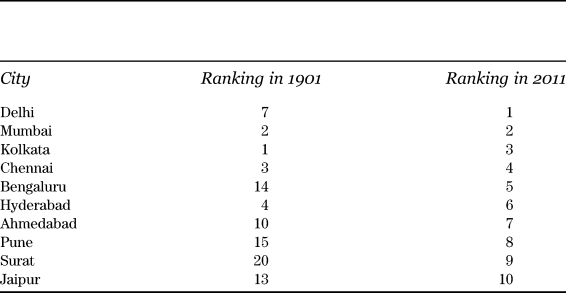
Table 4 shows the ranking of India's ten largest cities in 1901 and 2011. Three cities—Surat, Bengaluru, and Pune—burst through into the top-ten rankings during the twentieth century primarily on account of their globalization. Four cities were part of the top-ten list in 1901 but not in 2011: Lucknow, Benares, Kanpur, and Agra. All of them are based in the state of Uttar Pradesh in North India and failed to globalize. Jaipur, in North India, prospered, partly due to its proximity to Delhi. Between 1951 and 1991, if an urban center in India was a political capital of a regional state, it was likely to grow much faster than others, underscoring the significance of proximity to political power in a controlled autarkic state.Footnote 43 It is significant that as India began to reglobalize after 1991, the “political capital city” effect on urban growth began to wane. Of the ten largest cities in India in 2011, only two were not political capitals—Pune and Surat—but both were close to the political capitals of their states.Footnote 44
City Rankings by Population Size in India, 1901 and 2011

Source: Census of India, 1901 and 2011 (population figures).
Note: “City” refers to the urban agglomeration; for Delhi in 2011, regions beyond the National Capital Territory Region are also considered. Data for 1901 excludes regions comprising modern-day Pakistan and Myanmar.
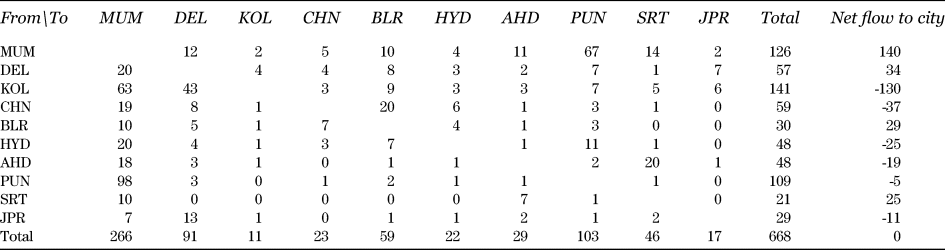
Table 5 shows the interrelations between India's ten largest cities in terms of migration flows in the last decade of the twentieth century. It shows that Delhi, Mumbai, and Bengaluru were the top draws for people to move toward and that people were leaving Kolkata in large numbers for the other metros. If one computes the share of people moving toward the city as a fraction of total movement to and from the city, the figures are stark: Surat (69 percent), Mumbai (68 percent), Bengaluru (66 percent), and Delhi (61 percent) lie on one side and Kolkata (7 percent) is at the other extreme. The other cities lay in between: Pune (49 percent), Ahmedabad and Jaipur (both 38 percent), Hyderabad (32 percent), and Chennai (27 percent).
Migration between Major Cities in India (in Thousands), 1992–2001

Source: Census of India, 2001, D-13. Data for urban populations of districts, rounded to nearest thousand.
Note: “Delhi” refers to National Capital Territory. Other cities correspond to their urban agglomerations. City abbreviations refer to Mumbai, Delhi, Kolkata, Chennai, Bengaluru, Hyderabad, Ahmedabad, Pune, Surat, and Jaipur.
There is an important link here with FDI. The work of Om Mathur shows that between January 1994 and March 2002, nearly 30 percent of FDI received by India was directed toward Delhi (12 percent), Mumbai (10 percent), and Bengaluru (6 percent) alone.Footnote 45 Kolkata received only 1 percent and ranked very low in per capita terms. Surat did not receive a lot of FDI but benefited by being firmly enmeshed in the global diamond trading system. All these points together suggest that globalization mattered for big-city growth in India in the late twentieth century, via international trade, capital, and migration flows.
It can also be viewed through Castells's framework of “infrastructure” as proxied by FDI flows and “social relations” and “elite relations” as proxied by urban-to-urban migration. India's top-end urban hierarchy shifted over the course of the twentieth century as cities relatively locked out of globalization because of European exit and other capital flight lagged behind others that managed to retain cosmopolitanism (through internal and international migration) and a relatively more favorable investment climate. The circulation of South Indians from villages to India metropolitan centers, first, for education, then to the United States and Europe for higher education and work, and back to cities such as Bangalore, Chennai, and Hyderabad, well before 1991, shows how globalization worked differently for some cities than for others. These cities were far more globalized than Kolkata or Lucknow in the east and north before 1991 and later latched on to the new opportunities that reglobalization presented. The wider proficiency of English in South India also helped in the IT sector. This created a virtuous path where FDI entered such cities, created jobs in the high-skilled sectors, and led to an aspirational migration from the surrounding regions to those cities. Or, in the case of Surat, Indian migrant connections from Belgium to Bombay brought Surat to the fore in the global diamond trading system. International trade and migration, more than FDI, brought Surat back onto the global map.
The next section outlines Indian and foreign firms’ responses to globalization in India over the twentieth century and their location choices, which shaped an urban evolution.
Globalization, Firm Responses, and Their Location Choices
Managing Agencies, British and Indian Firms. The managing agency system was the defining feature of large enterprises in colonial India. It was a system of “industrial organisation where the promotion, finance and administration of a vast agglomeration of miscellaneous and unrelated enterprises—mines, plantations, mills, public utilities, shipping interests, sales agencies and investment trusts—are controlled by a single firm.”Footnote 46 It arose in response to the dearth of capital and managerial know-how in the colonial context of the nineteenth century; the managing agent was tied to the company through a contract or a controlling stake. Most of the managing agencies were British-owned “trading firms,” though Indian equivalents also emerged over time.Footnote 47 Large Indian enterprises were founded by a few of the prominent business castes and communities of India: Parsis, Marwaris, Gujaratis, Punjabis, Sindhis and Chettiars.Footnote 48 Of these, the Tata (Parsi) and Birla (Marwari) houses would emerge as powerful business groups in the twentieth century. These enterprises were primarily located in Bombay and Calcutta in the early twentieth century, and several business castes and communities flocked to these centers in large numbers.
In 1900, there were around 1,300 joint-stock companies in India, many set up via managing agencies. Seven fields comprised nearly 60 percent of the total paid-up capital in the corporate sector: cotton mills (16 percent), banking and loans (12 percent), railways and tramways (9 percent), tea and plantations (9 percent), jute mills (8 percent), mining and quarrying (5 percent), and sugar (1 percent).Footnote 49 A staggering 40 percent of corporate India, by paid-up capital, was based in the eastern Indian province of Bengal, home to Calcutta. Another third was located in the Bombay province, home to the city of Bombay. That is, the bulk of corporate capital was located in just two cities, Calcutta and Bombay. Most of the corporate capital of Calcutta was in European hands, while in Bombay they formed a minority. Trade unionism and the rallying crying of Swadeshi in the freedom movement were acutely felt in both cities in the early twentieth century, but because corporate capital was far more “foreign” in Calcutta than in Bombay, so was the impulse for a stronger response.
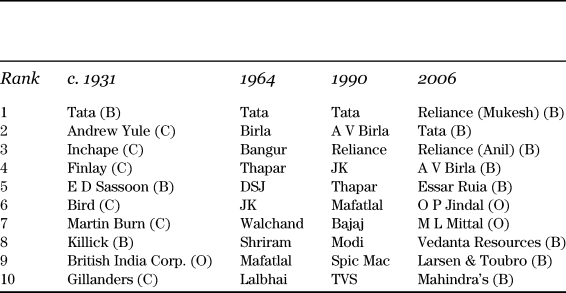
Between 1900 and 1940, the number of companies gradually increased. With Tata's major venture in iron and steel manufacturing, it rose to become the largest business house in India with over twenty firms under its umbrella.Footnote 50 Table 6 shows that in the 1930s, apart from Tata, nine of the top ten business houses in India were British owned and only four of the top thirty were Indian.Footnote 51 Almost all were based in Calcutta. Big business in India was thus dominated by British interests with close links to the ruling political class. As economic nationalism and Swadeshi became central planks of India's freedom movement, Indian business leaders began to side with Mohandas Gandhi, carving out lobbying groups distinct from the European ones.Footnote 52 At times, this led to hostility between the Indians and the British, as in the case of the Walchand group and Inchape in the shipping sector.Footnote 53 Apart from discriminatory business practices, racism in recruitment and staffing was another sore point as Indians rarely made it to the top management of British-owned firms.
Top Ten Business Houses in India and Their Headquarter Locations, 1931–2006

Source: Claude Markovits, Indian Business and Nationalistic Politics (Cambridge, U.K., 1985), 190; Dwijendra Tripathi and Jyoti Jumani, Oxford History of Contemporary Indian Business (New Delhi, 2013).
Note: Headquarter locations for firms in 1931 and 2006: (B) = Bombay, (C) = Calcutta, (O) = Other. In 1964 and 1990, JK = Juggilal Kamplapat, DSJ= Dalmia-Sahu-Jain. Ranking based on total assets, except for 1931, based on total paid-up-capital of group companies.
It was in this context that a remarkable meeting took place in 1944, comprising a few of the leading Indian business leaders and economic policymakers of the day.Footnote 54 The document they published, known as the “Bombay Plan,” specified the resources required for the task of economic development once India attained Independence. Nehru would later adopt a five-year planning system that built on some aspects of the Bombay Plan but was far more statist in its approach than what the writers of the document had conceived. In the 1950s, there were competing voices as to the best path forward but the debate was more concerned with the appropriate level of government intervention in the economy than the merits and demerits of an open economy.Footnote 55 In the period before 1991, India's autarkic policies had substantial acceptance within the business community, whose major grouse was against internal license-based controls.
The License Raj, as it is now called, horrified several Indian business leaders. The Creating Emerging Markets oral history project documents several Indian leaders reminiscing about the fervent patriotism that guided their actions as well as the challenges of navigating labyrinthine regulations. Rahul Bajaj of the Bajaj group, an old and large Indian family business house, made an interesting observation during his oral history: “I have always been an advocate of liberalization and a free market. In fact, that is the Gandhian philosophy. My family stood for that. In fact, nobody thought of and nobody remembered that Gandhi didn't want a big government. He wanted in fact Panchayati Raj [local government].”Footnote 56 Elsewhere in the interview, Bajaj also talked of location choice and how he was among the very few who moved from Bombay to Pune to get outside of regulations prohibiting building of certain types of manufacturing plants. Another Bombay-based business house that moved out in the late twentieth century was the Premji family, which diversified into IT in Bangalore and grew one of the largest firms in the sector, WIPRO. Its location choice was based on the strategic need to be in Bangalore, which was already showing signs of being an important IT hub in the 1970s due to its education-industry ecosystem.
But the place from which many firms exited was Calcutta. The dominant British-owned business houses of India sold their stakes to Indians shortly before and after 1947, many to Marwaris based in Calcutta.Footnote 57 This corporate transfer was a messy process replete with bankruptcies, loss of market share, and even nationalization. The investment climate in Calcutta soured with hostile state-business relations and its most famous business scion, A. V. Birla, moved base to Bombay. If in 1931 virtually every large business house of India was headquartered in Calcutta, by 2006 not a single one figured in the top-ten list (see Table 6). Even now, the large number of non-family-based firms that have emerged as a result of public-sector units or professional private management are rarely headquartered in Calcutta. Among one million active companies in 2015, fewer than 15 percent were registered in the state of West Bengal, a far cry from the 40 to 50 percent mark for Bengal in the early twentieth century.Footnote 58 Instead, 20 percent of all active firms were registered in Delhi and 21 percent were in Maharashtra (reflecting Mumbai and Pune). If the first wave of globalization up to 1914 brought British enterprise to the forefront of India's corporate landscape, especially in Calcutta, deglobalization and decolonization brought Indian elites to the limelight in centers far away from it.
Some firms also chose locations away from India. Strong government intervention in the domestic economy in the 1960s and 1970s, including efforts to check the concentration of economic power (the Monopolies and Restrictive Trade Practice Act of 1969 [MRTP]) and conserve foreign exchange (the Foreign Exchange Regulation Act of 1973 [FERA]), led many large Indian firms to seek greener pastures abroad.Footnote 59 In the 1960s, Birla began to expand his firm's operation overseas, marking it as India's first major multinational manufacturing company, followed by other leading business groups.
Multinationals in India. Multinational firms outside the managing agency system also operated in India in the early twentieth century, through dealers or representatives, and had to craft strategies in tune with the growing backlash against foreign enterprise. The interwar period witnessed new forms of advertising (J. Walter Thompson arrived in 1929), brand names, a push to sell consumer products in a deglobalizing world (Lever Brother's entered in the 1930s), and possibly a new consumer culture.Footnote 60 Christina Lubinski's research work over the past decade shows how multinationals navigated the uncertain political environment of India in the early twentieth century, especially those originating outside Britain. German dye manufacturers, for instance, forged close relationships with Indian firms as they found the nondiscriminatory tariff regime attractive.Footnote 61 The Indian firms were also keen to partner with non-British enterprises that could support their quest to achieve industrial self-reliance. The cases of Siemens (electrical company) and Bayer (chemicals company) in colonial India reflected a kind of “geopolitical jockeying” whereby they downplayed rival multinationals and aligned their strategies to complement Indian interests.Footnote 62 The internment of Germans during the two world wars also created opportunities to network and a close community of German businesspeople in India.Footnote 63 More generally, Lubinski's research shows the context-specificity of the “liability of foreignness” in colonial India.Footnote 64
During the colonial period, India received relatively substantial foreign capital and was ranked eighth in the world in 1914 and third in 1929 (behind the United States and Canada).Footnote 65 At the time of Independence, most foreign capital in India still originated in Britain and was concentrated in trading enterprises; as much as 25 percent was invested in tea and jute alone and less than 20 percent was in manufacturing.Footnote 66 But this would soon change. Nehru's push for large-scale industrialization required collaborating with the United States, USSR, Germany, and several other countries to get the best technology, materials, and expertise. This represented global connections through public-sector undertakings. Many industrial projects (and engineering and management colleges) were set up through such collaborative ventures that created new large urban centers from scratch, in India's urban hierarchy. Location choices for public-sector units were often based on considerations of bringing in equitable regional development rather than purely profit-seeking motives.
Between 1950 and the 1970s, controlling stakes of multinationals were carefully observed and sector-specific equity limits were drawn, often shutting the door completely to foreign participation. Existing multinationals were under pressure to “Indianize” their workforce and overall attitudes.Footnote 67 Nominally, this could lead to firms changing their names with the word “Hindustan” added as a prefix. More specifically, the pressures revolved around changing the composition of their workforce and regulation of foreign exchange. One study on Burmah Oil Company (BOC) shows that BOC changed its ethnocentric staffing strategy to a polycentric one far slower than Unilever and that its tension with the Indian government may have eventually led to its nationalization.Footnote 68 In contrast, Hindustan Unilever (known earlier by various names in India) was quick to Indianize its top management and maintained a distinct organizational identity from its parent company.Footnote 69 It also negotiated successfully with the Indian government to pursue its ends, by showing its commitment to the national cause.Footnote 70
The effort to woo FDI was not tenable for many years after 1947 on the grounds that the hard-fought freedoms of the political movement could once again be surrendered to multinational interests. While India was not aligned with the major powers, the leftward tilt under Indira Gandhi's government toward the USSR in the 1970s led to a pushback against American multinationals. The FERA Act of 1973, with its strict controls on repatriation of revenues, and the ultra-socialistic turn of the 1970s led to capital flight. Some British firms adapted by moving into technologically advanced industries where there was less government resistance and also through joint ventures with Indian firms.Footnote 71 Prithwiraj Choudhury and Tarun Khanna provide a synthesizing framework called “dynamic trajectories” to understand these responses, by analyzing a large sample of multinationals in India.Footnote 72 India's shutting down in the 1970s and opening up in the 1990s presented multinational firms with choices regarding entry, exit, and reentry. For instance, Unilever and British American Tobacco stayed on while Coca-Cola and IBM left India, only to return later. Their strategies were shaped by local considerations and investments made on the input side of the markets.
After 1991 the Indian government, first under the government of P. V. Narasimha Rao and then under various coalition governments, began to dilute equity caps for foreign participation in a variety of sectors. The number of multinationals in India began to rise, and they became aspirational firms for Indians to work in. There has been little research on the location choices of multinationals within India but, as with the U.S. subsidiary list discussed earlier in this article, the concentration is likely to have been in the key cities that received high FDI—Delhi, Mumbai, and Bangalore—followed by Chennai, Hyderabad, and Pune. The service-sector orientation of many multinational firms in sectors such as banking and consulting valued highly educated English-speaking professionals, and several of the above-mentioned cities were well placed as sites for their headquarters. If Bombay and Calcutta were the prominent sites of corporate capital, especially transnational capital in the early twentieth century, the globalized six (Delhi, Mumbai, Bangalore, Chennai, Hyderabad, and Pune) emerged as key sites of growth a century later.
Conclusion
The different waves of globalization in India—from free trade to Swadeshi and import-substituting industrialization and back to free trade—influenced the pace of economic development, the nature of firms’ responses, and the evolution of cities. India's distinctive aspects include its service-led growth (that valued English language skills in a global economy), stable democracy, and a capitalist class comprising narrow social groups and family businesses. On many counts, the post-1991 period appears to have been a watershed moment in India's long business and economic history, whereby the country's economic performance started to improve and Indian firms became large multinationals. It also provided a major boost to FDI, which was directed to a few cities that globalized and grew quickly because of it.
This article has articulated the need to look below the level of the nation-state to understand waves of globalization in history. While India deglobalized for much of the twentieth century, this article has shown how the responses varied across cities and firms. The contrast between the fortunes of Calcutta and of Bombay are striking, the three leading cities of South India show the significance of international migration before 1991, and the reemergence of Surat in the global urban system via the diamond trade shows what can be achieved even without FDI. Across cities, the historical evolution of the capitalist class and overall state-business relations has mattered. It is thus useful to understand how trade, investment, and migration ties are actually forged between two places and change over time. Whether as “infrastructure” or “social and elite relations,” intercity relations are shaping urban evolution in important ways. Therefore, a potentially new area of research on waves of globalization can consider linking business history with urban history.