Nursing facilities integrally serve the larger healthcare system by providing temporary care to acutely ill patients with skilled nursing needs before safely transitioning back to their homes. However, patients transferred from hospitals to nursing facilities are also more likely to be colonized by multidrug-resistant organisms (MDROs), which commonly cause healthcare-associated infections.Reference Mody, Foxman and Bradley 1 Infection prevention and control efforts have focused mostly on acute care, successfully reducing incidence of methicillin-resistant Staphylococcus aureus (MRSA) colonization in hospitals by 31% from 2005 to 2011.Reference Dantes, Mu and Belflower 2 Meanwhile, enterococcal infections and colonization with vancomycin-resistant Enterococcus spp (VRE) have arisen, often with serious clinical implications, including a doubling in VRE-related hospital discharges.Reference Arias and Murray 3, Reference Sievert, Ricks and Edwards 4
Methods
In response, this investigation examined whether nursing facilities mirrored these national trends in MRSA and VRE, using data from 4 sequential multisite nursing facility studies in southeastern Michigan between 2003 and 2016: cross-sectional study A (2003–2004; 14 nursing facilities and 208 residents)Reference Mody, Maheshwari, Galecki, Kauffman and Bradley 5 ; prospective study B (2005–2010; 15 nursing facilities and 178 residents)Reference Min, Galecki and Mody 6 ; prospective study C (2010–2013; 12 nursing facilities and 414 residents)Reference Mody, Krein and Saint 7 ; and prospective study D, the first phase of an ongoing prospective study (2014–2016; 6 nursing facilities and 651 residents).Reference Mody, Foxman and Bradley 1 Study C was limited to residents with a feeding tube or urinary catheter, whereas the other studies included individuals with and without devices. For all studies, swabs were collected at the time of enrollment from residents’ nares, oropharynx, groin, perianal area, and wounds and were tested for MRSA, VRE, and ceftazidime-resistant gram-negative bacteria (CTZR-GNB). Standard microbiological methods were used by trained research staff and were conducted in the same research lab for all 4 studies.Reference Mody, Foxman and Bradley 1 , Reference Mody, Maheshwari, Galecki, Kauffman and Bradley 5 – Reference Mody, Krein and Saint 7 All studies were approved by the institutional review board at the University of Michigan. Written informed consent was obtained from each resident or his or her durable power of attorney.
Results
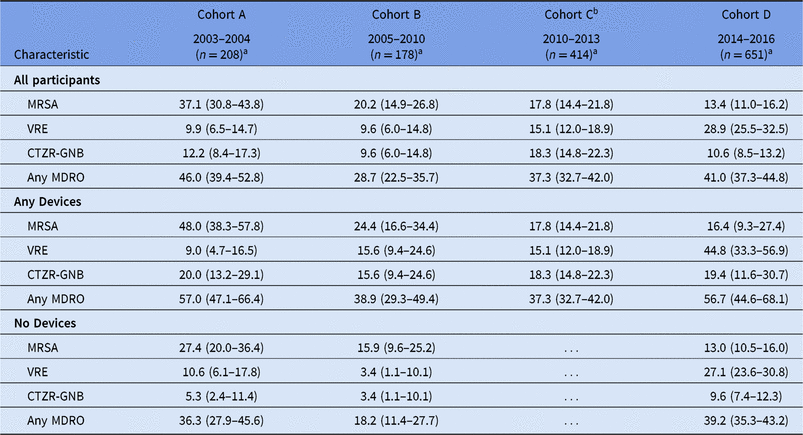
The mean study age ranged from 74.7 years (SD, 12.2) in the period 2014–2016 to 80.5 years (SD, 11.0) in the period 2005–2010. Prevalence of MRSA declined in each sequential study, whereas prevalence of VRE increased over time (Table 1). In the earliest study, 37.1% of participants were colonized with MRSA and 9.9% were colonized with VRE. In comparison, in the most recent study, only 13.4% were colonized with MRSA, but more patients, 28.9%, were colonized with VRE. These trends hold true in the subset of high-risk patients with devices (Table 1); MRSA colonization was 48% in cohort A (2003–2004) compared to 16.4% in cohort D (2014–2016). However, VRE increased from 9.0% to 44.8% from cohort A to cohort D. These trends among patients with devices are more pronounced than those in patients with no devices, especially in the case of VRE.
Trends in Multidrug-Resistant Organism (MDRO) Colonization From 2005 to 2016a

Note. MRSA, methicillin-resistant Staphylococcus aureus; VRE, vancomycin-resistant Enterococcus; CTZR-GNB, ceftazidime-resistant gram-negative bacteria.
a Proportion of residents (%) colonized at baseline and (95% CI) are given.
b Cohort C only included patients with either a urinary catheter or a feeding tube. We show similar trends in MRSA and VRE in nursing facility patients with and without indwelling devices.
Discussion
Our findings indicate that MRSA colonization in southeastern Michigan nursing facilities has steadily decreased since 2003, whereas prevalence of VRE has nearly tripled. A similar trend was reported within a single long-term acute-care hospital in Chicago. In this study, Munoz et alReference Munoz-Price and Sterner 8 reported an increase in the incidence of VRE recovered from rectal swabs from 29% in 2005 to 44% in 2008. This trend was mirrored in nursing facilities, and interventions used to reduce MDROs in hospitals will also benefit nursing facility populations, which could result in a regional approach to combat antibiotic resistance.Reference Wang, Foxman, Mody and Snitkin 9
Our findings suggest several future directions. First, more studies are needed to confirm these trends in postacute care and other alternative care settings from other geographic settings. Second, future infection prevention measures should focus on clinical consequences of increasing VRE, particularly in older adults. Third, healthcare facilities must develop cost-effective, efficient MDRO surveillance strategies to characterize and understand long-term trends.
Acknowledgments
We thank the patients and their families who participated in the 4 described studies. We also thank Bonnie Lansing and Sara McNamara for their role in participant enrollment and data collection.
Financial Support
This study was conducted with support from the National Institutes of Health (grant no. NIH R01AG041780 to Mody and Min and grant no. K24 AG050685 to Mody).
Conflicts of interest
All authors report no conflicts of interest relevant to this article.