Introduction
In support of the neurodevelopmental model of schizophrenia (Weinberger, Reference Weinberger1987; Murray et al. Reference Murray, O'Callaghan, Castle and Lewis1992; Rapoport et al. Reference Rapoport, Addington, Frangou and Psych2005; Fatemi & Folsom, Reference Fatemi and Folsom2009), higher rates of minor physical anomalies (MPAs) among individuals with schizophrenia than in healthy controls have been shown in a growing body of literature (Weinberg et al. Reference Weinberg, Jenkins, Marazita and Maher2007; Compton & Walker, Reference Compton and Walker2009; Huang et al. Reference Huang, Chiu, Lan, Wang, Kuo, Chen, Yu, Liu, Hu and Loh E2009; Aksoy-Poyraz et al. Reference Aksoy-Poyraz, Poyraz, Turan and Arikan2011; Compton et al. Reference Compton, Chan, Walker and Buckley2011; Golembo-Smith et al. Reference Golembo-Smith, Schiffman, Kline, Sorensen, Mortensen, Stapleton, Hayashi, Michelsen, Ekstrom and Mednick2012). MPAs are subtle morphological deviations that are usually determined by the presence of qualitative anomalies in the head, eyes, ears, mouth, hands and feet (Ismail et al. Reference Ismail, Cantor-Graae and McNeil1998). Some studies reported that MPAs were more commonly found in the craniofacial region than other regions among patients with schizophrenia (Tarrant & Jones, Reference Tarrant and Jones1999; Waddington et al. Reference Waddington, Lane, Scully, Meagher, Quinn, Larkin and O'Callaghan1999b ; Gourion et al. Reference Gourion, Goldberger, Bourdel, Bayle, Lôo and Krebs2004), while other studies showed inconsistent findings. An earlier meta-analysis of seven studies of MPAs in schizophrenia failed to find significant differences among six anatomical regions (Weinberg et al. Reference Weinberg, Jenkins, Marazita and Maher2007). By contrast, a more recent meta-analysis of 10 studies reported that nine out of 12 MPA items with significant pooled odds ratios fall in the craniofacial region (Xu et al. Reference Xu, Chan and Compton2011). Other studies considered anthropometric measurements a more objective and quantitative way compared with MPAs to characterize craniofacial features of patients with schizophrenia (Lane et al. Reference Lane, Kinsella, Murphy, Byrne, Keenan, Colgan, Cassidy, Sheppard, Horgan, Waddington, Larkin and O'Callaghan1997; McGrath et al. Reference McGrath, El-Saadi, Grim, Cardy, Chapple, Chant, Lieberman and Mowry2002; Lloyd et al. Reference Lloyd, Dazzan, Dean, Park, Fearon, Doody, Tarrant, Morgan, Morgan, Hutchinson, Leff, Harrison, Murray and Jones2008).
These MPAs and craniofacial features are thought to reflect altered ectodermal morphogenesis during the first or early second trimester, as a result of both genetic and environmental influences (Tarrant & Jones, Reference Tarrant and Jones1999; Waddington et al. Reference Waddington, Lane, Larkin and O'Callaghan1999a ). Some brain imaging studies demonstrated that MPAs and craniofacial dysmorphology were associated with certain neuroanatomical characteristics, indicating such physical anomalies as markers for aberrant brain development (O'Callaghan et al. Reference O'Callaghan, Buckley, Madigan, Redmond, Stack, Kinsella, Larkin, Ennis and Waddington1995; Dean et al. Reference Dean, Fearon, Morgan, Hutchinson, Orr, Chitnis, Suckling, Mallet, Leff, Jones, Murray and Dazzan2006). Research of patients with velocardiofacial syndrome, a severe form of physical anomaly, has led to the discovery of chromosome 22q11 deletion as one of the strongest genetic risk factors for schizophrenia (Murphy, Reference Murphy2002).
Several studies have investigated the relationships between MPAs and clinical symptoms (Lohr & Flynn, Reference Lohr and Flynn1993; McGrath et al. Reference McGrath, van Os, Hoyos, Jones, Harvey and Murray1995; O'Callaghan et al. Reference O'Callaghan, Buckley, Madigan, Redmond, Stack, Kinsella, Larkin, Ennis and Waddington1995; Dean et al. Reference Dean, Fearon, Morgan, Hutchinson, Orr, Chitnis, Suckling, Mallet, Leff, Jones, Murray and Dazzan2006; Compton et al. Reference Compton, Bollini, McKenzie Mack, Kryda, Rutland, Weiss, Bercu, Esterberg and Walker2007; John et al. Reference John, Arunachalam, Ratnam and Isaac2008), but showed inconsistent results (Compton & Walker, Reference Compton and Walker2009), probably due to the time-varying nature of clinical symptoms. An alternative approach is to examine the disease course of schizophrenia. One study found that psychotic patients with more MPAs had more frequent and longer psychiatric admissions (McGrath et al. Reference McGrath, van Os, Hoyos, Jones, Harvey and Murray1995), whereas another study reported no associations between MPAs and disease course in terms of recurrent episodes versus progressive deterioration (Ismail et al. Reference Ismail, Cantor-Graae and McNeil2000). To surpass the arbitrary nature in defining the disease course in schizophrenia, a more objective method would be to use operationally defined treatment resistance.
Approximately 20–30% of individuals with schizophrenia show a poor response to pharmacological treatment, denoted as treatment-resistant schizophrenia (TRS) (Elkis, Reference Elkis2007). Schizophrenia characterized by an earlier onset and a poorer outcome has been postulated as a congenital form reflecting consequences of aberrant neurodevelopment (Murray et al. Reference Murray, O'Callaghan, Castle and Lewis1992). Researchers have proposed a lifetime trajectory model for schizophrenia incorporating the evolution from the early neurodevelopmental origins to the diverse progress of schizophrenia later in life, including various responses to medications (Waddington et al. Reference Waddington, Buckley, Scully, Lane, O'Callaghan and Larkin1998, Reference Waddington, Lane, Scully, Meagher, Quinn, Larkin and O'Callaghan1999b ). An early review suggested that TRS may be a direct result from aberrant neurodevelopment, or involve a pathological process adaptive to neurodevelopmental factors throughout untreated episodes of illness and/or relapses (Sheitman & Lieberman, Reference Sheitman and Lieberman1998). Recent studies showed that genetic variants, dysfunction of central dopamine neurotransmission, and reduced cortical thickness were associated with TRS (Zhang et al. Reference Zhang, Lencz, Geisler, DeRosse, Bromet and Malhotra2013; Zugman et al. Reference Zugman, Gadelha, Assuncao, Sato, Ota, Rocha, Mari, Belangero, Bressan, Brietzke and Jackowski2013; Bilic et al. Reference Bilic, Jukic, Vilibic, Savic and Bozina2014), though one brain imaging study failed to link TRS with elevated dopamine synthesis capacity (Demjaha et al. Reference Demjaha, Murray, McGuire, Kapur and Howes2012). A recent review focusing on the pharmacogenetics of treatment response summarized the potential associations between drug response and the genes involved in neurodevelopment (Reynolds, Reference Reynolds2012). Overall, the literature suggests that patients with TRS may have an etio-pathophysiology different from that of treatment responders. Because MPAs and craniofacial features are relatively easy to measure, we sought to examine whether these dysmorphological features are associated with treatment response in schizophrenia and, hence, whether they can be useful predictors of TRS even before patients start receiving any medication treatment.
In this case–control study, we aimed to investigate whether more MPAs or specific craniofacial features in patients with schizophrenia were associated with operationally defined treatment resistance. Both qualitatively measured MPAs and quantitatively measured craniofacial features were performed in patients with TRS versus age- and sex-matched patients without TRS, in order to identify MPAs and craniofacial measurements that can distinguish TRS patients from non-TRS patients. We hypothesized that TRS patients would have more dysmorphological features, possibly due to greater underlying neurodevelopmental deviations.
Method
Participants
The participants in this study were recruited from the Bali Psychiatric Center in northern Taiwan from April 2010 to October 2010. According to the hospital service report, there were approximately 1200 patients receiving treatment in the Bali Psychiatric Center during this time period, and 930 of them were diagnosed to have a schizophrenic disorder (International Classification of Diseases, 9th revision, clinical modification codes 295.0–295.9). We examined medical charts to identify patients with schizophrenia meeting the Diagnostic and Statistical Manual of Mental Disorders, 4th edition, text revision (DSM-IV-TR; American Psychiatric Association, 2000) criteria for the disease and then assessed whether the patients had treatment resistance.
The operational definitions of TRS used in this study were based on those proposed by Conley & Kelly (Reference Conley and Kelly2001), whereby TRS patients have: (1) persistence of illness; and (2) a drug-refractory condition. The persistence of illness was defined as scoring 4 (moderately ill) or more on the severity of illness subscale of the Clinical Global Impression scale (CGI-S) (Guy, Reference Guy1976), without a stable period of good social or occupational functioning within 5 years. The drug-refractory condition was defined as no clinical improvement to at least two trials of antipsychotics, each for 6 weeks, at dosages of greater than or equal to 600 mg per day of chlorpromazine equivalence for typical antipsychotics or at adequate dosages based on an expert consensus panel (Kane et al. Reference Kane, Leucht, Carpenter and Docherty2003) for atypical antipsychotics. A score of 3 (minimally improved) or more in the global improvement subscale of the Clinical Global Impression scale (CGI-I) after switching to a drug was used to determine the condition of ‘no clinical improvement’. Those who did not fulfill the criteria for TRS were candidates for the non-TRS group. More specifically, those patients who concurrently did not have persistent illness and did not have the drug-refractory condition were classified as the non-TRS group, and their treatment response was assessed using the same criteria as those used to define TRS.
Schizophrenia patients were excluded if they had: (1) a concurrent diagnosis of at least one other major Axis I psychiatric illness or Axis II psychiatric illness; or (2) a parent who was not Han Chinese (e.g. aboriginals or foreigners).
The recruitment process started with the identification of the first 100 TRS cases for the measurement of MPAs and craniofacial measures. The medical charts review started from the chronic ward (400 beds), then to the acute ward (90 beds) and the out-patient department. The distributions of sex and 10-year age groups of TRS cases were then used for frequency matching in selecting non-TRS controls. We then recruited non-TRS controls from the eligible schizophrenia patients and continued to recruit more cases. At the end of the study, 108 TRS cases aged 26 to 68 years (mean age = 44.9 years, s.d. = 9.1 years) and 104 non-TRS controls aged 22 to 65 years (mean age = 43.5 years, s.d. = 8.6 years) were successfully recruited. Of 242 eligible patients, 16 refused to participate, 13 were excluded (nine due to a concurrent diagnosis of another major psychiatric illness and four due to non-Han Chinese ethnicities), and one was lost to follow-up. Written informed consent was obtained from all participants after a complete description of the study was provided. The study was approved by the Institutional Review Board of the Bali Psychiatric Center.
Measurements
Review of medical records
For each patient, a systemic chart review was conducted by a board-certified psychiatrist (A.-S.L.), who confirmed the diagnosis, collected clinical information including drug history, rated the CGI scores retrospectively according to the descriptions on the records, and determined to which group the participant belonged. For determining the drug-refractory condition, patients’ adherence to medication is essential. Only the medication records during hospitalizations were considered in this evaluation because patients’ daily intakes of prescribed drugs were under close supervision in the psychiatric wards. If patients with persistent illness had never been hospitalized, they were excluded from determining TRS group membership. The assignment of TRS group membership for each patient was then reconfirmed by the psychiatrist in charge of the patient's care. There was only one case in which the psychiatrist in charge did not concur with the TRS assignment, and this patient was thus excluded from the study.
Assessments of physical anomalies and craniofacial features
A scale was developed based on previous studies to assess both qualitatively measured MPAs and quantitatively measured craniofacial features. The qualitative part of the scale was based on the scale developed by Ismail et al. (Reference Ismail, Cantor-Graae and McNeil1998), which contains all 16 qualitative items from the Waldrop scale (Waldrop et al. Reference Waldrop, Pedersen and Bell1968) and 23 new items, with a manual scoring system provided by Professor Thomas F. McNeil. We added two new items (strabismus and cuspidal ear), based on findings from a Japanese study (Yoshitsugu et al. Reference Yoshitsugu, Yamada, Toyota, Aoki-Suzuki, Minabe, Nakamura, Sekine, Suzuki, Takei, Itokawa, Mori and Yoshikawa2006). A total of 41 qualitative items for MPAs were used; among them, 33 items were rated as the presence or absence of morphological anomalies in six regions, including global head, eyes, ears, mouth, hands and feet. Another eight items were scored using a three-point Likert scale (0, 1 and 2) to rate the magnitude of the anomalies. For 28 symmetrical anatomical sites, MPAs were measured separately on the right and left sides. We further compiled a booklet based on three anatomical atlases for the graphical illustration of these qualitative anomalies (Smith, Reference Smith1982; Goodman & Gorlin, Reference Goodman and Gorlin1983; Gorlin et al. Reference Gorlin, Cohen and Levin1990). The subtotal scores for the items in each region were computed as the regional scores, and all of the qualitative scores were summed as the total qualitative MPAs scores, with a range between 0 and 83.
For the quantitative anthropometric measures, in addition to the two items on the Waldrop scale (head circumference and canthal distance, which was further divided into inner canthal and outer canthal distance in this study), our scale consisted of items compiled from the scales of Lane et al. (Reference Lane, Kinsella, Murphy, Byrne, Keenan, Colgan, Cassidy, Sheppard, Horgan, Waddington, Larkin and O'Callaghan1997), McGrath et al. (Reference McGrath, El-Saadi, Grim, Cardy, Chapple, Chant, Lieberman and Mowry2002) and Elizarraras-Rivas et al. (Reference Elizarraras-Rivas, Fragoso-Herrera, Cerdan-Sanchez, Ramos-Zepeda, Barajas-Barajas, Troyo-Sanroman, McLean and McGrath2003), with a total of 27 items (among these, 11 items had symmetrical parts). These quantitative items were measured using calipers, tapes and protractors, following the standardized methods used in anthropometric measurements (Farkas, Reference Farkas1981; Hall et al. Reference Hall, Froster-Iskenius and Allanson1989).
Research assistants underwent MPA and craniofacial measurement training before conducting measurements in patients with schizophrenia. In a reliability study of 20 healthy subjects, the inter-rater reliability for the qualitative items ranged between 0.95 and 1.0, and the intra-class correlation coefficients of quantitative items ranged between 0.70 and 0.96. Two well-trained research assistants completed the MPA and craniofacial measurements in this study.
Statistical analyses
All statistical analyses were performed using SAS statistical software, version 9.2 (SAS Institute, USA). For group comparisons, t tests were used for continuous variables, and χ2 tests were used for categorical variables. Assuming that the qualitative MPA scores were ordinal in scale, non-parametric analysis of covariance with adjustment for covariates was applied for group comparisons (Schacht et al. Reference Schacht, Bogaerts, Bluhmki and Lesaffre2008). For quantitative craniofacial variables, the PROC GLM procedure was used for analysis of covariance, with adjustment for covariates. To adjust for multiple comparisons, the procedure developed by Benjamini and Liu (BL procedure) was applied to control for the false discovery rate (Benjamini et al. Reference Benjamini, Drai, Elmer, Kafkafi and Golani2001). This procedure was designed to control the expected proportion of incorrectly rejected null hypotheses (i.e. false discovery rate) while losing less in the ability to discover real differences than traditional approaches such as the Bonferroni procedure.
To construct a parsimonious model predicting the status of treatment resistance, stepwise logistic regression, with a significance level of 0.05 for entry into or inclusion in the model, was employed and the predictive accuracy, receiver-operating characteristic (ROC) curves, and the generalized Cox–Snell R 2 were obtained using the SAS command PROC LOGISTIC. We used the command ROCCONTRAST to compare the areas under ROC curves (AUC) between models. The Hosmer–Lemeshow goodness-of-fit statistic was used to evaluate model fit. For internally validating the model we used the procedure of 10-fold cross-validation. For the ease of interpretation the quantitative variables were also divided into three categories by tertile limits, based upon all participants, and the test for trend was conducted. Additionally, we used logistic regression diagnostics to identify outliers and influential data points.
Results
Descriptive data
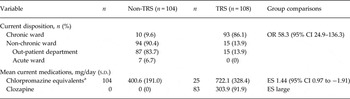
The TRS and non-TRS groups showed clearly different profiles of residential dispositions and medications used at the time of recruitment. Table 1 shows that 86.1% of TRS patients stayed in chronic wards while only 9.6% of non-TRS patients did so. The TRS group received a higher mean dosage of chlorpromazine equivalents than the non-TRS group. The percentage of patients on a clozapine regimen was 91.9% for the TRS group but none for the non-TRS group. (See online Supplementary Table S1 for the details of medication type and dosage.)
Current disposition and medications of the participants grouped by the TRS versus non-TRS classification

TRS, Treatment-resistant schizophrenia; OR, odds ratio; CI, confidence interval; s.d., standard deviation; ES, effect size.
a Both typical and atypical antipsychotics other than clozapine were expressed in terms of chlorpromazine equivalents (Gardner et al. Reference Gardner, Murphy, O'Donnell, Centorrino and Baldessarini2010).
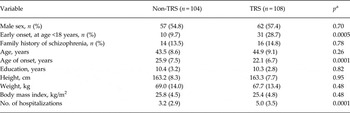
The two groups of 104 non-TRS and 108 TRS patients were comparable in their distributions of age, sex, educational years, body weight, body height, body mass index and family history of schizophrenia (Table 2). The TRS group had a 3.8 years earlier mean age of onset, a higher proportion of patients with an age of onset younger than 18 years, and greater numbers of previous hospitalizations than the non-TRS group. We thus controlled for age of onset and number of hospitalizations in the subsequent analyses. Age and sex were controlled in all models; although they were used in frequency matching, cases and controls were not individually matched by age and sex and thus they needed to be controlled for. Body mass index was additionally controlled for as it was related to both the measurement of certain morphological features and TRS status.
Demographic and clinical characteristics of the study participants

Data are given as mean (standard deviation) unless otherwise specified.
TRS, Treatment-resistant schizophrenia.
a t Test for continuous variables or χ2 test for categorical variables.
Qualitatively measured MPAs
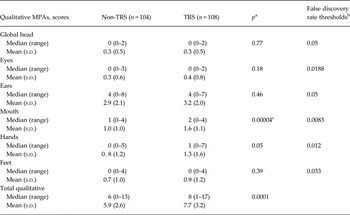
For qualitative MPAs, the TRS group had greater total scores than the non-TRS group after adjusting for age, sex, age of onset, body mass index and number of hospitalizations (Table 3). Among the six regional dimensions, the TRS group had greater scores in the mouth region than the non-TRS group, and the result was still significant after controlling for multiple testing using the false discovery rate. The MPA items of the mouth region included high/steepled palate, furrowed tongue, tongue with smooth-rough spots, cleft uvula, cleft lip and thin upper lip.
Comparison of qualitatively measured MPA scores for patients with non-TRS versus patients with TRS

MPAs, Minor physical anomalies; TRS, treatment-resistant schizophrenia; s.d., standard deviation.
a Group comparison using analysis of covariance with adjustment for age, sex, age of onset, body mass index and numbers of hospitalization.
b Controlling for the false discovery rate using the procedure proposed by Benjamini and Liu (Benjamini et al. 2001).
c p Values less than or equal to the false discovery rate thresholds.
Quantitatively measured craniofacial features
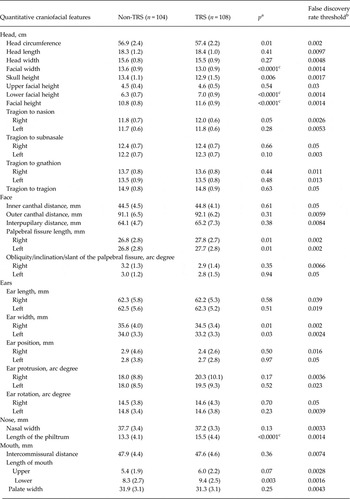
Table 4 displays the quantitatively measured craniofacial features for both groups. Among the 27 items of craniofacial features, there were significant differences in 10 items after controlling for age, sex, age of onset, body mass index and number of hospitalizations. After further adjustments for multiple comparisons, four items passed the false discovery rate-adjusted significance thresholds. The TRS group had narrower facial width (bizygomatic distance), longer length of both lower facial height (from subnasale to gnathion) and facial height (from nasion to gnathion), and longer length of the philtrum than the non-TRS group.
Comparison of quantitatively measured craniofacial features for patients with non-TRS versus patients with TRS

Data are given as mean (standard deviation).
TRS, treatment-resistant schizophrenia.
a Group comparison using analysis of covariance with adjustment for age, sex, age of onset, body mass index and numbers of hospitalizations.
b Controlling for the false discovery rate using the procedure proposed by Benjamini and Liu (Benjamini et al. 2001).
c p Values less than or equal to the false discovery rate thresholds.
Using MPAs and craniofacial features to distinguish TRS from non-TRS
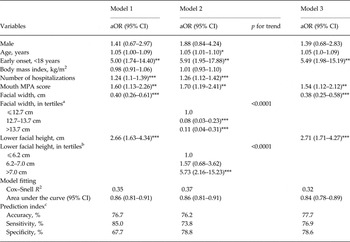
A series of models using a combination of MPAs and craniofacial features was evaluated to identify the model that best distinguished TRS from non-TRS. Spearman correlation coefficients between MPAs and quantitative craniofacial measures ranged from 0.1 to 0.3, indicating only modest correlation. This suggests that the two types of variables may capture different aspects of deviated neurodevelopment and thus can be included in the same model for further model selection. At the beginning, two matching variables (age and sex), three clinical covariates (early onset or not, body mass index and number of hospitalizations), one qualitative MPA regional score (the mouth region) and four quantitatively measured craniofacial features (facial width, lower facial height, facial height and length of the philtrum) were included in a logistic regression model, using the status of TRS as a binary response. Early onset, i.e. younger than 18 years, was included in all subsequent analyses. The procedure of stepwise selection identified five significant variables, including early onset, the number of hospitalizations, qualitative mouth score, quantitative facial width and quantitative lower facial height. Table 5 shows the adjusted odds ratios of these morphological features (model 1). Greater facial width was associated with decreased odds of developing TRS, whereas an increase in the number of mouth anomalies or lower facial height was associated with increased odds of developing TRS. The model-fitting statistics, including Cox–Snell R 2 (0.35) and AUC (0.86), indicated that model 1 has good fitting. At an optimal cut-off point that achieves the maximum of overall accuracy, the sensitivity and specificity were 85.0% and 67.6%, respectively, for the corresponding accuracy rate of 76.7%.
Variables associated with the group assignment to TRS status from logistic regression analysis (n = 212)

TRS, Treatment-resistant schizophrenia; aOR, adjusted odds ratio; CI, confidence interval; MPA, minor physical anomaly.
a The distribution of the tertiles (from small to large): 18 (17.3%), 44 (42.3%) and 42 (40.4%) for non-TRS; and 53 (49.1%), 27 (25.0%) and 28 (25.9%) for TRS.
b The distribution of the tertiles (from small to large): 51 (49.0%), 38 (36.6%) and 15 (14.4%) for non-TRS; and 25 (23.1%), 33 (30.6%) and 50 (46.3%) for TRS.
c At an optimal cut-off point that achieves the maximum of overall accuracy.
* p < 0.05, **p < 0.01, ***p < 0.001.
For a more robust analysis of the trends of two craniofacial features (facial width and lower facial height) relative to TRS, we categorized each of the features into tertiles (model 2), with patients in the bottom tertile as the reference group. As shown in the middle panel of Table 5, the results remained similar to those of model 1, with a decreasing trend in the odds for TRS with increasing facial width and an increasing trend in the odds for TRS with increasing lower facial height. The fitting of model 2 was also good.
Also in Table 5, we present a prediction model of TRS, model 3, which did not include the number of hospitalizations and body mass index among the covariates for two reasons. First, these two variables in the TRS group were probably consequences of TRS. Second, we wanted to build a model that only required information at the onset of the illness. Model 3 had a slightly decreased AUC (0.84), which was not significantly different from that of model 1 (p = 0.11). The sensitivity and specificity at the optimal cut-off point were 76.9% and 78.6%, respectively, for the corresponding accuracy rate of 77.7%. Hosmer–Lemeshow tests showed that the predicted likelihood of outcome was similar to the observed likelihood (p = 0.61). After 10-fold cross-validation, the model has an average AUC of 0.81 [95% confidence interval (CI) 0.77–0.85]. Although the cross-validated AUC drops in statistical significance, it still exhibits good discriminatory ability (>0.8). The AUC of a model consisting merely of age, sex and early onset was 0.65, with an overall accuracy of 56.9%. Compared with model 3, the decrease in AUC of this covariate-only model reached statistical significance (p < 0.0001), and its Cox–Snell R 2 (0.09) was considerably lower than that of model 3 (0.32), indicating that MPAs and craniofacial features contributed to at least modest variations in treatment response.
In addition, we found three influential data points and one outlier by logistic regression diagnostics (online Supplementary Fig. S1). Analyses were repeated after excluding these four data points, and the selected morphological features and the final logistic regression models were not altered. When facial width was divided by lower facial height to create a dimensionless variable called facial shape, the prediction model in which the two original craniofacial measures were replaced by this newly created shape variable had an AUC of 0.83 (95% CI 0.77–0.88), which was not higher than that of model 3.
Discussion
Our results showed that after adjusting for multiple comparisons, patients with TRS had more MPAs in the mouth region than the non-TRS group, and the two groups also differed in four quantitative measurements: facial width, lower facial height, facial height, and length of the philtrum. A prediction model consisting of three dysmorphological items (qualitative mouth score, facial width and lower facial height), as well as an onset before the age of 18 years, after controlling for age and sex, could distinguish TRS from non-TRS with good discriminatory ability (>0.8). These findings provide support for the shared embryological origins between craniofacial dysmorphology and TRS, and indicate a potential clinical utility with such association.
Our findings that TRS is associated with MPAs and craniofacial measures, both being markers of ectoderm maldevelopment during embryo gestation (Compton et al. Reference Compton, Chan, Walker and Buckley2011), are in keeping with several lines of evidence suggesting a neurodevelopmental origin of TRS. For example, past research has shown that TRS has both neurobiological and psychosocial correlates (Altamura et al. Reference Altamura, Bassetti, Cattaneo and Vismara2005; Elkis, Reference Elkis2007). Recent brain imaging studies also demonstrated that patients with TRS had specific pathophysiological processes different from non-TRS patients in cortical neuropathological characteristics (Demjaha et al. Reference Demjaha, Murray, McGuire, Kapur and Howes2012; Zugman et al. Reference Zugman, Gadelha, Assuncao, Sato, Ota, Rocha, Mari, Belangero, Bressan, Brietzke and Jackowski2013).
The dysmorphological features shown to be associated with TRS in our study appear to concentrate in certain craniofacial regions. For MPAs, those in the mouth region exhibited a robust association with TRS. The literature also indicated that the MPAs distinguishing schizophrenia patients from healthy controls occurred largely, but not exclusively, in the mouth region (Green et al. Reference Green, Satz, Gaier, Ganzell and Kharabi1989; McGrath et al. Reference McGrath, van Os, Hoyos, Jones, Harvey and Murray1995; Lane et al. Reference Lane, Kinsella, Murphy, Byrne, Keenan, Colgan, Cassidy, Sheppard, Horgan, Waddington, Larkin and O'Callaghan1997; Ismail et al. Reference Ismail, Cantor-Graae and McNeil1998; Trixler et al. Reference Trixler, Tenyi, Csabi and Szabo2001; Gourion et al. Reference Gourion, Goldberger, Bourdel, Bayle, Lôo and Krebs2004; Kelly et al. Reference Kelly, Lane, Agartz, Henriksson and McNeil2005; Aksoy-Poyraz et al. Reference Aksoy-Poyraz, Poyraz, Turan and Arikan2011). In a meta-analysis of 10 studies comparing schizophrenia patients and healthy controls, 12 MPA items had significant pooled odds ratios, of which four were in the mouth region, and two (tongue with smooth-rough spots and high/steepled palate) had the highest odds ratios (Xu et al. Reference Xu, Chan and Compton2011). For the quantitative measurements of the craniofacial region, our findings were also consistent with early findings that patients with schizophrenia appeared to have narrow and elongated mid- and lower faces (Lane et al. Reference Lane, Kinsella, Murphy, Byrne, Keenan, Colgan, Cassidy, Sheppard, Horgan, Waddington, Larkin and O'Callaghan1997; Kelly et al. Reference Kelly, Lane, Agartz, Henriksson and McNeil2005). The topographical characteristics of the TRS-associated MPAs or craniofacial features lend further support to the ‘cerebro-craniofacial dysmophogenesis’ model (Waddington et al. Reference Waddington, Lane, Larkin and O'Callaghan1999a ). In this model, schizophrenia is postulated to originate from a deviation of midline craniofacial development, which involves the narrowing and vertical elongation of the anterior mid-face during palate formation, supposedly over gestational weeks 9/10 to 14/15, with disturbances in anterior cerebral development and function. During embryo development, the ectoderm gives rise to the neural tube and neural crest, and the former proceeds to brain formation while the latter provides the origin of a large proportion of the skeletal and connective tissues of the head (Carlson, Reference Carlson2009). Thus, our findings imply that TRS may, like the disease itself, have a neurodevelopmental origin during brain formation.
Our data showed that patients with TRS had an earlier onset than those without TRS, in keeping with findings from a previous review (Elkis, Reference Elkis2007). By contrast, previous studies showed inconsistent associations between early onset and MPAs in patients with schizophrenia. Two studies reported that schizophrenia patients with onset earlier than 18 years had higher MPA scores (Green et al. Reference Green, Satz, Gaier, Ganzell and Kharabi1989; Hata et al. Reference Hata, Iida, Iwasaka, Negoro, Ueda and Kishimoto2003), while three other studies found no associations between age of onset and MPAs (McGrath et al. Reference McGrath, van Os, Hoyos, Jones, Harvey and Murray1995; Ismail et al. Reference Ismail, Cantor-Graae and McNeil2000; John et al. Reference John, Arunachalam, Ratnam and Isaac2008). The inconsistency may be due to the heterogeneity of study participants and varying definitions of early onset: one study recruited patients with affective psychoses as well (McGrath et al. Reference McGrath, van Os, Hoyos, Jones, Harvey and Murray1995), another study defined early onset as onset before 21 years (Ismail et al. Reference Ismail, Cantor-Graae and McNeil2000) and the other study recruited only patients with neuroleptic-naive recent-onset schizophrenia (John et al. Reference John, Arunachalam, Ratnam and Isaac2008).
Furthermore, our prediction model implies that the TRS-associated MPAs and craniofacial features may have potential clinical utility since we explicitly selected those predictor variables that can be obtained at the onset of illness among patients with schizophrenia. The model consists of three dysmorphological items (qualitative mouth score, facial width and lower facial height) and early onset (onset before 18 years) with controlling for age and sex. The overall discriminatory ability (AUC), overall accuracy rate and the index of model fitness (Hosmer–Lemeshow test and Cox–Snell R 2) all indicate a good predictive ability. Our results showed the robustness of the model in several ways, including: (1) treating the two craniofacial measures as continuous or ordinal (tertiles); (2) using the 10-fold cross-validation to evaluate the validity of the model; and (3) removing influential data points and outliers from the analysis. However, our prediction model of TRS may not be ready for clinical practice. The current sensitivity and specificity of the model are unsatisfactory (both less than 80%) and have room to improve. Further validation of the model in other samples is needed, and the effect size of the MPAs and craniofacial features in differentiating TRS and non-TRS patients should be taken into account when considering their clinical utility.
We should point out that although MPAs and craniofacial measurements appear to be mostly invariable throughout life this requires further research. Although one early study reported that certain MPAs (absent trichion, short and broad palates, and greater ear protrusion) seemed to be observed more frequently in individuals aged 60 years or over (Lloyd et al. Reference Lloyd, Doody, Brewin, Park and Jones2003), a later report analysing four studies found no trend of increasing mean total MPA scores with increasing age (Henriksson et al. Reference Henriksson, Kelly, Lane, Agartz, Nesvag, Cantor-Graae, O'Callaghan and McNeil2008). This suggests that most MPAs are relatively stable before the age of 60 years, while a few MPAs may be influenced by aging. In our study, there were only six participants (two for non-TRS and four for TRS) older than 60 years. Thus, any confounding by age-related MPAs on our results would be limited. Additionally, some dysmorphologies may be influenced by body figure through changes in skin fat. Nevertheless, in this study we found no association of body mass index with TRS. Moreover, factors related to illness severity, such as early onset and number of hospitalizations, may confound the associations between dysmorphologies and TRS. However, our results remained unchanged after controlling for these two factors. In general, the quantitative measurements are more likely to be influenced by environmental factors, whereas the qualitative MPAs are considered less variable throughout life (Compton & Walker, Reference Compton and Walker2009). However, in our final prediction model created using stepwise selection both qualitative (mouth MPA score) and quantitative (facial width, and lower facial height) variables were retained. This renders it unlikely that our finding was due to the severity of the illness inflicted by schizophrenia. Future follow-up studies of MPAs and craniofacial features in relation to TRS with better control for illness severity are warranted.
There are several additional limitations of this study. First, MPAs and craniofacial features are only markers of deviated morphological development. Measuring MPAs and craniofacial features may not directly detect underlying neurodevelopmental disturbances. Second, the clinical response in this study was rated using the CGI-I and CGI-S in a retrospective manner. Future studies using a more comprehensive rating scale, such as the Positive and Negative Syndrome Scale (Kay et al. Reference Kay, Fiszbein and Opler1987), concurrently may offer a better assessment of clinical response. Third, the adequate dosages of antipsychotics were based on chart records but not blood drug levels. However, to assure adherence we used the medication records during hospitalizations; it was attainable for most TRS patients because 86% of them were recruited from chronic wards. Fourth, the raters for the MPAs and craniofacial measurements were not completely blinded to TRS status because the patients’ functional levels could be easily recognized during face-to-face interviews. Nevertheless, the measurement of MPAs and craniofacial features was unlikely to be affected by this knowledge because they were based on a standardized procedure. Fifth, our findings may not be generalizable to schizophrenia patients of non-Han Chinese ethnicity or to non-hospitalized patients. Finally, some possible covariates of TRS, such as obstetric complications and the duration of untreated psychosis (Elkis, Reference Elkis2007), were not examined because of difficulties in obtaining these data from self-reports or chart reviews.
Conclusion
Our findings suggest that TRS is characterized by a higher MPAs score over the mouth region, a decreased facial width, an increased lower facial height, and early onset. The selected MPAs and craniofacial features may distinguish TRS from non-TRS patients with good validity. Our results add support to the neurodevelopmental underpinnings of the occurrence of treatment resistance. Future research can investigate the validation and the potential clinical use of our TRS-predicting model. Furthermore, TRS could be considered as a more homogeneous subtype in future studies given the etio-pathological heterogeneity of schizophrenia (Tsuang & Faraone, Reference Tsuang and Faraone1995).
Supplementary material
For supplementary material accompanying this paper visit http://dx.doi.org/10.1017/S0033291714002931
Acknowledgements
This work was supported by the National Health Research Institutes, Taiwan (NHRI-EX95, 96, 97, 98, 99–9511PP; NHRI-EX100-10048PI), a grant from the National Taiwan University (97HP0023) and a grant from the Bali Psychiatric Center (99R001). S-S.C. was supported by the Hong Kong Research Grants Council's General Research Fund (HKU784210M and HKU784012M). These funders had no further role in study design; in the collection, analysis and interpretation of data; in the writing of the report; and in the decision to submit the paper for publication. The authors thank Professor Thomas F. McNeil for providing us with the manual and scoring system for the MPA scale used in this study. We thank Ms Jin-Mei Niu and Ms Jia-Yan Wu for their help with conducting the measurement of MPAs in the patients. We also thank Dr Ding-Lieh Liao, who was the co-principal investigator for an ongoing project of the Genome-Wide Association Study for Treatment Refractory Schizophrenia since 2008, conducted in multiple sites including the Bali Psychiatric Center, supported by Academia Sinica. Some of the participants in our study were selected from the project. The definitions of TRS were adapted from the project. We thank Dr Kuanyin Karen Lin for editorial advice.
Declaration of Interest
None.