I. INTRODUCTION
Magnesium (Mg) has been investigated for almost 200 years initiated due to the excellent work of Sir Humphry Davy back in 1808. Reference Davy1 Mg is the sixth most abundant element in the earth’s crust accounting to ∼2.5% of its weight. Reference Avedesian and Baker2 In addition to being the lightest structural material commercially available, properties like enhanced specific strength, excellent castability, excellent weldability, high thermal and electrical conductivity, high damping capacity, and recyclability make it an appealing material for wide spread industrial applications. Reference Winzer, Atrens, Song, Ghali, Dietzel, Kainer, Hort and Blawert3–Reference Itoi, Takahashi, Moriyama and Hirohashi6 However, its limited ductility at room temperature coupled with poor wear and corrosion resistance has narrowed its potential applications. Reference Toda-Caraballo, Galindo-Nava and Rivera-Díaz-del-Castillo7,Reference Johnston, Shi and Atrens8 In recent times, several attempts have been made to understand the behavior of Mg in several physiological environments. Reference Song and Atrens9,Reference Atrens, Liu and Zainal Abidin10 Several advancements in improving the corrosion behavior of Mg and Mg based alloys have been reported in the open literature. Reference Atrens, Song, Cao, Shi and Bowen11,Reference Atrens, Song, Liu, Shi, Cao and Dargusch12 The HCP crystal structure of Mg strongly affects its plastic deformation behavior resulting in limited ductility at room temperature. Reference Gehrmann, Frommert and Gottstein13 In comparison with grain refinement through alloy development, addition of stable inexpensive low volume fraction nanoparticulates leading to dispersion strengthening can be a promising approach to enhance the mechanical properties of Mg-based materials. Reference Umeda, Kawakami, Kondoh, Ayman and Imai14 High ductility in Mg-based materials can be realized by the activation of nonbasal cross slip systems or twinning through the modification of texture by incorporation of nano-length scale secondary reinforcements. Reference Seetharaman, Subramanian, Tun, Hamouda and Gupta15 Hence, the nanocomposite technology has significant potential to enhance the mechanical response of Mg-based materials. The five major strengthening mechanisms for metal matrix nanocomposites (MMNCs) are Reference Ferguson, Sheykh-Jaberi, Kim, Rohatgi and Cho16 : (i) Orowan strengthening mechanism, (ii) Hall–Petch relationship, (iii) Forest strengthening, (iv) Taylor relationship, and (v) Load bearing effect.
Mg is highly susceptible to burning owing to its strong affinity to oxygen resulting in a low oxidation resistance at elevated temperatures. Reference Avedesian and Baker2,Reference Tan, Atrens, Mo and Zhang17–Reference Prasad, Shi and Atrens21 Mg-based materials have potential to catch fire during manufacturing processes like casting, hot rolling, heat treatment leading to surface degradation and hence limiting its use in several aerospace applications. Further, Mg mainly in the form of chips/sheet metal/sharp objects readily ignites in the presence of external spark/flame and continues to burn till it is completely consumed. Reference Boris22 However, in the wake of reduced aircraft weight leading to a decrease in fuel consumption and greenhouse emissions, the Federal Aviation Administration (FAA) have allowed the use of Mg-based materials in the aircraft cabin seats provided it meets the flammability performance requirements. Reference Marker23 Elektron® 43, Elektron® 21, and Elektron® 675 are currently the only magnesium alloys which met the cited performance requirements after passing extensive flammability testing by the FAA. Reference Tekumalla and Gupta24 Hence, development of lightweight ignition proof magnesium materials for aircraft carriers can be a good research direction for the future. Several recent studies have analyzed the influence of microalloying of several elements (mainly rare earth metals) on the ignition characteristics of magnesium. It is observed that alloying Mg with elements like Be, Reference Tekumalla and Gupta24 Ca, Reference Tekumalla and Gupta24 Y, Reference Tekumalla and Gupta24 Sr, Reference Tekumalla and Gupta24 La, Reference Tekumalla and Gupta24 and Ce Reference Lin, Zhou, Sun, Li, Wang, Wang, Guo and Li25 can increase the ignition temperature of Mg through formation of protective oxide layers and thermally stable intermetallic phases. Reference Arrabal, Pardo, Merino, Mohedano, Casajús, Paucar and Matykina26 Previous attempts have also been made to study the effect of ceramics like CaO Reference Lee and Kim27 and SiC Reference Nguyen and Lee28 on the ignition resistance of Mg alloys. Lee et al. Reference Lee and Kim27 revealed that the progressive addition of CaO to AM60 alloys increased its ignition resistance wherein AM60 containing 2.5 wt% CaO exhibited the maximum ignition resistance of 1161 °C. Nguyen et al. Reference Nguyen and Lee28 reported that the addition of 10 wt% SiC to AM60 alloy increased its ignition temperature from 523 to 603 °C. However, no previous attempt has been made to study and analyze the effect of ceramic nanoparticulates (SiO2 in the current system) on the ignition temperature of monolithic magnesium.
Metal oxides (MO) like Al2O3, TiO2, Y2O3, ZrO2, and ZnO have been used as reinforcements within the magnesium matrix owing to their superior strength properties and thermal and chemical stability at elevated temperatures. Reference Meenashisundaram and Gupta29 These MO were able to substantially enhance the mechanical response of pure Mg with minimum or no increase in the density of pure Mg. Reference Meenashisundaram and Gupta29 The ease of handling and processing of these MO within the magnesium matrix gives composite technology a huge advantage over conventional alloying. Silica (SiO2), made up of the two most abundant elements in the earth’s crust (oxygen and silicon), is chemically inert, exhibit high hardness and displays high melting point. Reference Flörke, Graetsch, Brunk, Benda, Paschen, Bergna, Roberts, Welsh, Libanati, Ettlinger, Kerner, Maier, Meon, Schmoll, Gies and Schiffmann30 SiO2 has found various applications in the field of food, pharmaceuticals, microelectronics, and drug delivery systems. Reference Fanderlik31 It is a major constituent of bioglass (∼45%) which has been extensively applied in the clinical and biomedical fields. Reference Wan, Cui, Li, Li, Xiao, Zhu, Ji, Xiong and Luo32 However, its potential as a structural material has yet been tapped by the scientific community. A recent study on the effect of bioglass (30–75 μm) on the biological and mechanical response of pure Mg developed through microwave sintering technique revealed significant enhancements in the compressive strengths and compressive ductility of pure Mg with the gradual increase in the amount of bioglass. Reference Wan, Cui, Li, Li, Xiao, Zhu, Ji, Xiong and Luo32 In a recent study, researchers studied the effect of SiO2 nanoparticulate (∼15 nm) addition on the hardness, damping, and compressive properties of monolithic magnesium. Reference Parande, Manakari, Meenashisundaram and Gupta33 The properties were observed to progressively enhance with the addition of (0.5, 1, and 2 vol%) SiO2 nanoparticulates with Mg 2 vol% nanocomposite exhibiting ∼50% enhancement in the hardness value compared to pure Mg. Mg 2 vol% SiO2 nanocomposite achieved ∼24 and ∼240% improvement in the compressive yield strength and damping capacity when compared to pure Mg. The current study is the first attempt to study the effect of SiO2 nanoparticulates on the tensile and ignition properties of monolithic magnesium.
In the present study, 0.5, 1, and 2 vol% SiO2 reinforced magnesium nanocomposites are synthesized using powder metallurgy assisted by hybrid microwave sintering technique followed by hot extrusion and characterized for the physical, microstructural, mechanical, and ignition properties and compared with pure magnesium. To theoretically predict the tensile yield strength (0.2% TYS) of the nanocomposites, individual contributions of Orowan strengthening, and Hall–Petch strengthening are studied and analyzed. An attempt has also been made to understand the ignition mechanism of the Mg–SiO2 nanocomposites.
II. EXPERIMENTAL PROCEDURES
A. Materials
Pure magnesium (Mg) powder of ≥98.5% purity with a size range of 60–300 μm, supplied by Merck (Darmstadt, Germany), was used as the base material. Silica (SiO2) nanoparticulates of purity 99.5% with a size range of ∼15 nm from Sigma-Aldrich (St. Louis, Missouri) were used as reinforcement.
B. Processing
Pure Mg and (0.5, 1, and 2 vol%) SiO2 reinforced magnesium nanocomposites were primarily synthesized utilizing powder metallurgy. Initially, required amounts of pure Mg powder and SiO2 nanoparticulates were carefully weighed and blended for 1 h at 200 rpm in a RETSCH PM-400 (Retsch GmbH, Haan, Germany) mechanical alloying machine. The blended Mg and Mg–SiO2 powder mixtures were then uniaxially cold compacted at a pressure of 50 tons to obtain billets of 35 mm diameter in size and 40 mm in length. Hybrid microwave assisted two-directional sintering technology was used to sinter the cold compacted billets. The billets were heated to 640 °C in a 900 W, 2.45 GHz Sharp microwave oven with SiC as the microwave susceptor material. The microwaves are absorbed internally by the billet and the SiC susceptor heats up to provide radiant heat to the billet externally. This helps in providing bidirectional heating to the billet as compared to conventional sintering or sintering with microwaves only. Reference Parande, Manakari, Meenashisundaram and Gupta33 The as-sintered billet was then further processed using hot extrusion.
The sintered billets, after soaking at 400 °C for 1 h in a constant temperature furnace, were hot extruded at a die temperature of 350 °C for an extrusion ratio of 20.25:1 using a 150 T hydraulic press. Cylindrical rods of 8 mm diameter were obtained. The samples from the extruded rods were characterized for microstructural, physical, and mechanical properties.
C. Materials characterization
1. X-ray diffraction studies
The X-ray diffraction studies of the extruded pure Mg and Mg (0.5, 1, and 2) vol% SiO2 nanocomposite samples were done using an automated Shimadzu LAB-XRD-6000 (Cu Kα; λ = 1.54056 Å; Shimadzu Corporation, Kyoto, Japan) spectrometer using a scan speed of 2°/min. The studies were carried out in both transverse and longitudinal directions to the extrusion axis and the basal plane orientation of Mg–SiO2 nanocomposites were studied based on the XRD peak intensities.
2. Microstructural characterization
To study the average matrix grain size, SiO2 nanoparticulates distribution in the magnesium matrix and interfacial integrity between the nanoparticulates and the magnesium matrix, microstructure evaluation studies were conducted on the extruded, polished, pure Mg and Mg–SiO2 nanocomposites. Optical microscope (Olympus Corporation, Tokyo, Japan) and field emission scanning electron microscope (Hitachi FESEM-S4300, Hitachi Ltd., Tokyo, Japan) were utilized for this study. Scion Image analysis software (Scion Image, Sacramento, California) was used to analyze the micrographs and determine the grain size and aspect ratio of the polished samples.
3. Coefficient of thermal expansion
Coefficient of thermal expansion (CTE) is a measure of change in size of a material under the influence of temperature. The CTE values of pure magnesium and Mg (0.5, 1, and 2 vol%) SiO2 nanocomposites were determined using a LINSEIS TMA PT 1000LT thermo-mechanical analyzer (Linseis Thermal Analysis, Robbinsville, New Jersey). With a heating rate of 5 °C/min and argon flow maintained at 0.1 lpm, the displacement of the samples was measured using an alumina probe as a function of temperature (50–570 °C).
4. Ignition temperature
Ignition temperature is defined as the temperature at which the material self-ignites without the presence of an external spark or flame. The ignition temperature of the extruded Mg and Mg–SiO2 nanocomposites was determined using a Shimadzu DTG-60H Thermo-Gravimetric Analyzer (TGA; Shimadzu Corporation). Samples with dimensions 2 × 2 × 1 mm were used for the analysis. Owing to the exothermic nature of Mg burning, Reference Kang, Zhang, Zhang, Du and Tang34 the ignition temperature was determined with respect to the sharp increase in the nanocomposite temperature. The samples were heated with a flow rate of 50 mL/min at a heating rate of 10° C/min in purified air from 30 to 750 °C. Three samples of each composition were tested to ensure reproducibility.
5. Tensile testing
The room temperature tensile properties of the extruded pure Mg and Mg (0.5, 1, and 2 vol%) SiO2 nanocomposites were determined as per ASTM E8M-01. A fully automated servo-hydraulic model MTS 810 mechanical testing machine (MTS Systems Corporation, Eden Prairie, Minnesota) was used to determine the tensile behavior of the nanocomposites. Six specimens for each composition with a gauge length 25 mm and diameter 5 mm were used for the tensile testing at a strain rate of 1.693 × 10⁻⁴ s−1. The fracture strain values were measured by an Instron 2630-100 series extensometer (Instron Testing Systems, Singapore, Singapore). A Hitachi S-4300 FESEM was used to characterize the fractured surfaces of tensile samples to provide a better understanding into the possible fracture mechanisms of the samples under tensile loading.
III. RESULTS AND DISCUSSIONS
A. Microstructural characterization
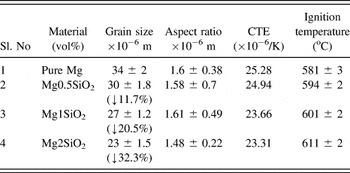
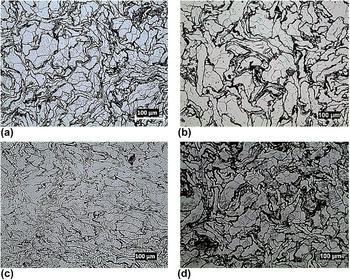
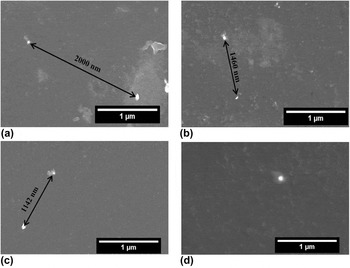
The nearly equiaxed grain morphology of the extruded Mg–SiO2 nanocomposites is shown in Table I and Fig. 1. The grain size of the hot extruded pure Mg was observed to decrease with the addition of SiO2 nanoparticulates with Mg 0.5 vol% and Mg 1 vol% nanocomposite exhibiting a grain size of ∼30 and ∼27 μm as compared to pure Mg with grain size of ∼34 μm. Among the Mg–SiO2 nanocomposites, Mg 2 vol% SiO2 exhibited the lowest grain size of ∼23 μm which is ∼32% lower than that of pure Mg. The micrographs also revealed the presence of limited porosity which can be attributed to the selection of suitable sintering and extrusion parameters. Reference Seetharaman, Subramanian, Tun, Hamouda and Gupta15,Reference German35 Reasonable distribution of isolated SiO2 nanoparticulates within the Mg matrix was observed and their representative micrographs is shown in Fig. 2.
Results of microstructure, CTE and ignition characteristics studies.

Microscopic images showing grain characteristics of: (a) pure magnesium, (b) Mg0.5SiO2, (c) Mg1SiO2, and (d) Mg2SiO2.

Distribution of nano-SiO2 particulates in Mg–SiO2 composites at higher magnifications: (a) Mg0.5SiO2 (45 K), (b) Mg1SiO2 (30 K), (c) Mg2SiO2 (30 K), and (d) interfacial integrity of Mg1SiO2 (80 K).

This decrease in grain size of the magnesium based nanocomposites can be mainly attributed to: (i) the ability of nanoparticulates to act as a site for particle stimulated nucleation and (ii) the ability of ultrafine SiO2 nanoparticulates to effectively pin the grain boundaries. Reference Meenashisundaram and Gupta29,Reference Mirza and Chen36 However, the potency of particle stimulated nucleation increases with the increasing volume fraction of the reinforcement and size of the nanoparticle. The use of reinforcement of particle size <1 μm is generally found to initiate grain boundary pinning mechanism and not particle-stimulated nucleation. Reference Meenashisundaram and Gupta29 Hence, the grain boundary pinning mechanism primarily governs the reduction in grain size in the Mg–SiO2 (∼15 nm) nanocomposites in this study. Reference Meenashisundaram and Gupta29 Finer SiO2 nanoparticulates inhibit the grain growth and result in a pinned microstructure where the grain growth ceases due to their presence at the grain boundaries. The grain boundaries are present at nonrandom locations and the nanoparticulates are closely spaced with each other as the volume fraction of the reinforcement increases. The grain boundary pinning results in a decreasing grain size with increasing volume of nanoparticles.
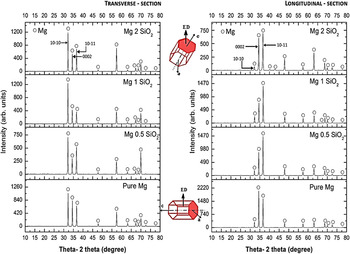
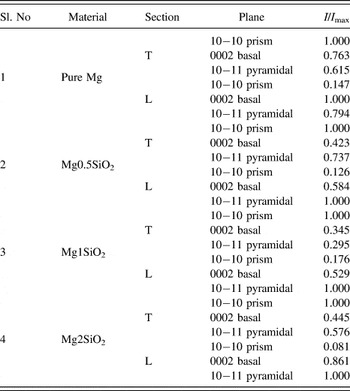
The X-ray diffraction studies along the cross section and longitudinal section of the hot extruded samples are shown in Fig. 3. The high-intensity peaks corresponding to Mg were clearly visible but the peaks corresponding to the SiO2 reinforcement were not prominently seen and this may be attributed to the presence of low volume fraction SiO2 nanoparticulates (<2 vol%) within the Mg matrix which may go undetected during the XRD analysis. Reference Seetharaman, Subramanian, Tun, Hamouda and Gupta15 Despite its absence in the X-ray diffractograms, the presence of nanoparticulates may be confirmed from the micrograph studies as shown in Fig. 2. The X-ray diffraction results were analyzed to understand the influence of nano SiO2 addition on the crystallographic orientation of pure Mg matrix. The texture modification in Mg materials has been observed by the addition of ultrafine reinforcing phases leading to a change in basal plane orientation of Mg crystal. Reference Stanford, Atwell, Beer, Davies and Barnett37 The characteristic peaks observed at 2θ = 32°, 34°, and 36° in the diffractograms (see Fig. 3) for the as-extruded Mg materials correspond to (10−10) prismatic, (0002) basal, and (10−11) pyramidal planes of HCP Mg-crystal. The ratio of the maximum XRD intensity to the respective prismatic, basal, and pyramidal intensities of pure Mg and Mg-SiO2 nanocomposites along both cross section and longitudinal sections is shown in Table II.
X-ray diffractograms of Mg–SiO2 nanocomposites.

X-ray diffractogram results of as extruded Mg–SiO2 nanocomposites.

Along the cross section of the nanocomposite samples, the intensity corresponding to the prismatic plane is observed to be maximum in all the cases which indicate that any of the prismatic planes are aligned in a direction perpendicular to the extrusion axis. The intensity corresponding to the basal plane (2θ = 34°) of pure Mg was found to decrease with the addition of up to 1 vol% SiO2, nanoparticulates and with further addition (∼2 vol%) the intensity corresponding to the basal plane was found to increase indicating a change in the texture of pure Mg with the addition of SiO2 nanoparticulates. Along the longitudinal direction, a strong basal texture is observed for pure Mg wherein the maximum intensity was corresponding to the basal plane. However, with the addition of SiO2 nanoparticulates changes in the intensity of peaks corresponding to the basal plane of pure Mg were clearly visible and intensity of the pyramidal plane was observed to be the maximum for all the synthesized Mg–SiO2 nanocomposites. This indicates texture randomization of hot extruded pure Mg containing SiO2 nanoparticulates with the basal planes remain tilted and not parallel to the extrusion axis. Reference Seetharaman, Subramanian, Tun, Hamouda and Gupta15 From Table II, it is observed that the intensity corresponding to the basal plane of pure Mg decreases with the addition of SiO2 (up to 1 vol%) with Mg 1 vol% SiO2 exhibiting the minimum I/I max value of ∼0.529. Further addition of SiO2 (2 vol%) resulted in the increase in intensity corresponding to the basal plane of pure Mg to I/I max value of ∼0.861.
B. Thermal properties
The CTE values of the synthesized pure Mg and Mg-SiO2 are presented in Table I. The CTE values for Mg 0.5 vol% SiO2 (24.94 × 10⁻⁶/K), Mg 1 vol% SiO2 (23.66 × 10⁻⁶/K), and Mg 2 vol% SiO2 (23.31 × 10⁻⁶/K) were found to be ∼1.3, ∼6.4, and ∼7.6% lower than that of pure Mg (25.28 × 10⁻⁶/K).
This decrease in the CTE values can be attributed to the lower CTE value of silicon dioxide (∼0.5 × 10⁻⁶/K), Reference Bansal and Doremus38 good interfacial integrity between the magnesium matrix and SiO2 nanoparticulates (Fig. 2) and minimal agglomeration of SiO2 nanoparticulates in the developed nanocomposites (Fig. 2). The results of CTE measurements suggest that the SiO2 nanoparticulates contribute positively to the dimensional stability of pure Mg.
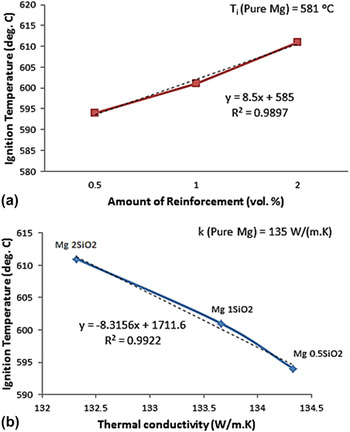
The ignition characteristics of the Mg–SiO2 nanocomposites are shown in Table I and Fig. 4. The ignition temperature of pure Mg increased progressively with the addition of SiO2 nanoparticulates with Mg 0.5 vol% SiO2 (594 °C), Mg 1 vol% SiO2 (601 °C), and Mg 2 vol% SiO2 (611 °C) nanocomposites exhibiting a value ∼13 °C, ∼20 °C, and ∼30 °C greater than that of pure Mg (581 °C), respectively. Mg 2 vol% SiO2 nanocomposite exhibiting the maximum ignition resistance and was found to be greater than commercially available AZ91 alloy (600 °C). Reference Liu, Shih, Parish and Atrens19
Ignition characteristics of Mg–SiO2 nanocomposites: (a) ignition temperature of pure Mg and the synthesized Mg–SiO2 nanocomposites; (b) ignition temperature versus thermal conductivity of the synthesized Mg–SiO2 nanocomposites.

The relationship between the ignition temperature and the amount of reinforcement is given by Eq. (1). The ignition temperature (T i) exhibited a linear trend with the increasing amount of SiO2 nanoparticulates (V f).
 $${T_{\rm{i}}} = 8.5{V_{\rm{f}}} + 585\quad \quad {R_2} = 0.9897\quad .$$
The presence of SiO2 nanoparticulates in the Mg matrix assists in reducing specific areas of oxidation and hence assists in delaying the ignition in the Mg–SiO2 nanocomposites. Reference Tan, Atrens, Mo and Zhang17,Reference Nguyen and Lee28 In addition to the decrease in ignition sites, thermal and dimensional stability of Mg–SiO2 nanocomposites as revealed by the CTE values may be responsible for the increased ignition resistance of the nanocomposite samples. The oxidation in pure Mg and Mg-based materials at temperatures above 400 °C is nonprotective in nature and may lead to ignition and burning. Reference Tan, Atrens, Mo and Zhang17 To further understand the ignition characteristics of the Mg–SiO2 nanocomposites a correlation between the thermal conductivity [W/(m K)] at 400 °C and ignition temperature (°C) of the nanocomposites was attempted in Fig. 4. The thermal conductivity of the nanocomposites was calculated by rule of mixtures using theoretical values of magnesium [135 W/(m K)] and silicon dioxide [1.5 W/(m K)]. Reference Shackelford, Han, Kim and Kwon39 It can be observed that the ignition temperature of the nanocomposites increases linearly with the decrease in the thermal conductivity of the material (k) and can be expressed by Eq. (2).
 $${T_{\rm{i}}} = - 8.3156k + 1711.6\quad \quad {R_2} = 0.9922\quad .$$
The reduction in the thermal conductivity of pure Mg with the addition of SiO2 nanoparticulates improves the insulating property of pure Mg and hence may delay the ignition onset leading to an increase in the ignition temperature of the nanocomposites. A comprehensive study is required to understand the influence of heating rates, ignition kinetics and the related reaction mechanisms on the improvement of ignition resistance of Mg-based nanocomposites.
C. Tensile properties
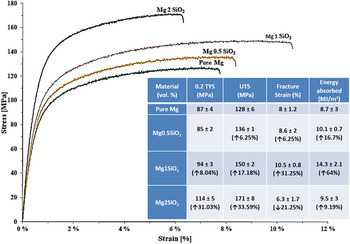
The tensile properties of pure Mg and Mg–SiO2 nanocomposites are shown in Fig. 5. The average 0.2% tensile yield strength (0.2% TYS) of pure Mg initially decreased marginally with the addition of up to 0.5 vol% SiO2. Further, the 0.2% TYS of pure Mg increased with the addition of SiO2 nanoparticulates with Mg 2 vol% SiO2 exhibiting the maximum 0.2% TYS of ∼114 MPa which is a ∼31% enhancement when compared to pure Mg. The ultimate tensile strength (UTS) for pure Mg progressively increased with the addition of SiO2 nanoparticulates and Mg 2 vol% SiO2 indicated the maximum UTS of ∼171 MPa which surpassed the UTS value of pure Mg by ∼34%. The tensile fracture strain of pure Mg increased with the addition of SiO2 nanoparticulates (up to 1 vol%) and exhibited a maximum fracture strain value of ∼10.5% which is ∼32% greater than that of pure Mg. However, Mg 2 vol% SiO2 nanocomposite exhibited a tensile fracture strain of ∼6.3% which is ∼22% lower than that of pure Mg. The energy absorbed (EA) until failure under tensile loading increased with the addition of up to 1 vol% SiO2 nanoparticulates and Mg 1 vol% SiO2 exhibited the maximum EA value of ∼14.3 MJ/m3. However, with the further addition of SiO2 nanoparticulates (2 vol%), a decrease in the EA value of pure Mg (∼9.5 MJ/m3) was observed which however remained higher than pure Mg.
Stress–strain curves and tensile testing results of pure magnesium and the synthesized Mg–SiO2 nanocomposites during tensile loading.

The marginal increase in the 0.2% TYS of the nanocomposites may be attributed to the marginal decrease in the grain size of the nanocomposites due to Hall–Petch strengthening, effect of crystallographic modification of texture due to the addition of SiO2 nanoparticulates and reasonable distribution of individual particulates and agglomerates within the magnesium matrix. Reference Meenashisundaram, Nai, Almajid and Gupta40 Also, the marginal increase in the 0.2% TYS of the nanocomposites may be a result of activation of basal slip at relatively lower stress levels. Owing to these competing factors, the enhancement is 0.2% TYS is marginal and similar to pure Mg. However, the noticeable enhancement in UTSs may be attributed to the dispersion strengthening due to fairly-distributed nanoparticulates throughout the magnesium matrix. For better insights into the tensile behavior of Mg–SiO2 nanocomposites, the individual contributions of the strengthening mechanisms to the increase in the 0.2% TYS are discussed in the Supplementary Material.
In general, the hot extruded magnesium materials exhibit limited fracture strain due to the strong basal texture of Mg with the basal planes (0002) aligned along the extrusion axis. Reference Jayalakshmi, Sankaranarayanan, Koh and Gupta41 The increase in fracture strain of the Mg (0.5 and 1) vol% SiO2 nanocomposites can be attributed to the combined effect of grain refinement, presence of fairly-distributed SiO2 nanoparticulates resulting in the increased fracture strain due to the non-basal slip and cross-slip activation and weakening of basal texture. The near uniform distribution in Mg (0.5 and 1) vol% SiO2 nanocomposites is apparent from Fig. 2 and would result in the activation of non-basal and cross-slip and thereby enhancing the fracture strain of the nanocomposites. Reference Tun, Jayaramanavar, Nguyen, Chan, Kwok and Gupta42,Reference Koike, Kobayashi, Mukai, Watanabe, Suzuki, Maruyama and Higashi43 The decrease in the fracture strain of Mg 2 vol% SiO2 nanocomposite may be attributed to the randomization of the crystallographic texture with strong intensity corresponding to basal plane as seen from the X-ray diffraction studies in Fig. 3. As most of the basal planes in Mg 2 vol% SiO2 nanocomposite are tilted at an angle to the extrusion direction, activation of basal slip can be easily achieved due to the minor misalignment of the basal planes as the critical resolved shear stress is very low for the activation of basal slip. Reference Seetharaman, Subramanian, Tun, Hamouda and Gupta15
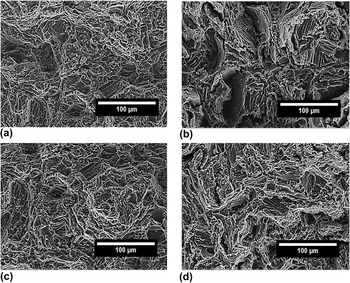
Figure 6 shows the fracture surfaces for pure Mg and Mg–SiO2 nanocomposites under tensile loading. The fracture surfaces of pure Mg and Mg–SiO2 nanocomposites reveal characteristic cleavage features indicating brittle fracture behavior primarily governed by the magnesium matrix.
Fractographs after tensile loading of: (a) pure magnesium, (b) Mg0.5SiO2, (c) Mg1SiO2 and (d) Mg2SiO2.

IV. CONCLUSIONS
Mg composites reinforced with SiO2 nanoparticulates were successfully synthesized using powder metallurgy assisted with hybrid microwave sintering technique and the effects of SiO2 nanoparticulates addition on the mechanical, microstructural, and ignition properties of pure Mg were studied. Structure–property correlations revealed the following conclusions.
-
(1) The grain size of pure magnesium marginally reduced with the addition of SiO2 nanoparticulates with Mg 2 vol% SiO2 nanocomposite exhibiting a maximum grain refinement of ∼32% when compared to pure Mg.
-
(2) X-ray diffraction studies taken along the longitudinal sections of the Mg–SiO2 nanocomposites indicate weakening of basal texture of pure Mg with addition of SiO2 nanoparticulates upto 1 vol%. Further addition of SiO2 (2 vol%) resulted in the increase in the intensity corresponding to the basal plane of pure Mg.
-
(3) The coefficient of thermal expansion (CTE) is observed to decrease with the increase in the amount of SiO2 nanoparticulates with Mg 2 vol% SiO2 nanocomposite exhibiting the CTE value of ∼23.31 × 10⁻⁶/K. This appreciable decrease in CTE values contributes to the dimensional stability of the nanocomposites.
-
(4) The ignition temperature of pure Mg increased with increasing amounts of SiO2 nanoparticulates with Mg 2 vol% SiO2 nanocomposite exhibiting a maximum ignition temperature of 611 °C which is ∼30 °C greater than pure Mg.
-
(5) The room temperature tensile properties of the nanocomposites indicate a marginal improvement in tensile fracture strain upon addition SiO2 nanoparticulates with Mg 1 vol% SiO2 nanocomposite exhibiting the maximum of ∼11% which is ∼30% greater compared to that of pure Mg. This can be attributed to the activation of nonbasal cross-slip confirmed from the XRD analysis. Mg 2 vol% SiO2 nanocomposite exhibits the best tensile strength properties with 0.2% TYS and UTS equal to ∼114 MPa and ∼171 MPa which exceed those of pure Mg by ∼31 and ∼34% respectively. Cleavage features in the fractured samples suggest a matrix driven brittle fracture of the nanocomposites.
-
(6) The Hall–Petch strengthening is identified as the major strengthening contribution mechanism to the increase in 0.2% TYS of Mg–SiO2 nanocomposites. The increased addition of SiO2 nanoparticulates, led to a marginal increase in the Hall–Petch contribution to the strengthening with the difference between the σHall–Petch value for Mg 0.5 vol% SiO2 and Mg 2 vol% SiO2 nanocomposite is ∼7 MPa. This inappreciable increase in the σHall–Petch is reflected in the limited increase in the experimental 0.2% TYS values with the addition of SiO2 nanoparticulates within the Mg matrix.
Supplementary Material
To view supplementary material for this article, please visit https://doi.org/10.1557/jmr.2017.194.
ACKNOWLEDGMENTS
The authors would like to thank Mr. Ng Hong Wei, National University of Singapore for his assistance in the CTE and TGA measurements.