



Most individuals experience at least one traumatic event during their lifetime. The intensity of the symptoms resulting from the event may lead to a diagnosis of post-traumatic stress disorder (PTSD), the most common psychological condition following exposure to a life-threatening event. However, longitudinal studies have shown a variety of adaptation trajectories following traumatic exposure, including resilience, gradual recovery, delayed development of PTSD and symptomatology with no impairment of daily functioning. Reference Bonde, Jensen, Smid, Flachs, Elklit and Mors1 Furthermore, traumatic exposure can lead to a reduction in physical and mental well-being, even in the absence of the development of PTSD. Reference Benjet, Bromet, Karam, Kessler, McLaughlin and Ruscio2
One of the mechanisms studied in the maintenance and aggravation of PTSD in the long term is the notion of altered beliefs and perceptions about oneself, others or the world. These shattered assumptions Reference Janoff-Bulman3 can cause the world to be perceived as unpredictable and negative, and lead to a sense of vulnerability in relation to the future. Recent studies have indicated that individuals with PTSD have difficulty imagining future events. Imagined future events are overgeneralised, in that they are devoid of the specific and episodic details that accompany the recollection of past events Reference Brown, Addis, Romano, Marmar, Bryant and Hirst4,Reference Kleim, Graham, Fihosy, Stott and Ehlers5 and their content is strongly negative or related to the initial trauma. Reference Krans, Peeters, Näring, Brown, de Bree and van Minnen6–Reference White, McManus and Ehlers8 This pattern is not observed in trauma-exposed individuals (i.e. who experienced a traumatic event) who do not have PTSD, suggesting that this change in future imagination is related to the emergence of post-traumatic stress symptom severity. The above-mentioned studies focused on the involvement of autobiographical mechanisms in future imagination and characterised PTSD as a memory disorder. Other studies have suggested that PTSD corresponds to a disorder of prediction, with the persistent sense of threat in PTSD inducing aberrant future predictions. Reference Leone, Postel, Mary, Fraisse, Vallée and Viader9 According to Ehlers and Clark’s cognitive model, Reference Ehlers and Clark10 individuals with PTSD can overgeneralise the trauma and sense of threat to neutral everyday events. However, none of the previous studies of future perspectives measured the influence of trauma on the prediction of neutral and nontraumatic future events.
Only a few studies have measured the influence of individual beliefs and self-perspectives on these future predictions. Sense of control plays an important role in future predictions, by enabling the pursuit of future goals and individual perceived control over time. Reference D’Argembeau, Michaelian, Klein and Szpunar11 The influence of the sense of control has often been studied in PTSD, although its definitions and components vary according to the studies. The most frequent are studies measuring the effect of the sense of self-efficacy in the development and maintenance of PTSD, that is, the perception of one’s own ability to overcome and manage a stressful life event. The study by Brown et al Reference Brown, Kouri, Rahman, Joscelyne, Bryant and Marmar12 is the only one to our knowledge to have examined the influence of sense of self-efficacy on future perspectives in individuals with PTSD. They showed that perceptions of self-efficacy in veterans with PTSD encouraged them to think about the future and solve problems to overcome adversity. More indirectly, Gallagher et al Reference Gallagher, Long and Phillips13 showed in a meta-analysis of 154 studies that positive expectation through hope, optimism and self-efficacy promoted post-traumatic resilience. Self-efficacy and hope were more strongly negatively related to post-traumatic stress symptom severity than other expectations, because, according to the authors, they put more emphasis on the individual’s personal role. According to Benight and Bandura, Reference Benight and Bandura14 a sense of self-efficacy is central to post-traumatic adaptation, as it fosters a feeling of control that facilitates coping with trauma. This sense of control (mediated by self-efficacy) would thus be an important predictor of longitudinal adaptation. While several studies have recently examined the prospects of individuals suffering from PTSD and their link with self-efficacy, few have examined the involvement of the sense of control as an agent of future action in these prospects, or their association with coping strategies.
The aim of this study was to measure changes in future predictions over time according to sense of control in individuals exposed to the 2015 terrorist attacks in France, who had or had not developed PTSD, compared with unexposed individuals (who did not experience these events). A second objective was to measure the link over time between these future predictions and the adaptive development of the exposed individuals, in terms of post-traumatic trajectories (post-traumatic stress symptom severity and sense of well-being) and coping strategies. To this end, we asked participants to estimate the probability of occurrence of neutral future events with or without a sense of control: controllable future events and uncontrollable future events. This methodology differed from that used in previous studies, in that it focused on the memory mechanism behind one’s future perspectives. We aimed to measure the way in which exposed individuals envision the future, and not the content of the imagined future events themselves.
First, we predicted that, given the memory difficulties observed in PTSD and the major impact of the trauma on life history, individuals with PTSD would have more difficulty estimating future events (controllable or uncontrollable) as probable than either exposed individuals without PTSD or controls. Second, given the positive influence of individual sense of control on post-traumatic stress symptom severity and long-term resilience, we assumed that long-term future predictions would be related to changes in participants’ post-traumatic stress symptom severity: the estimated occurrence of controllable events would be related to an improvement in long-term symptoms, whereas the estimated occurrence of uncontrollable events would be related to a deterioration in the long-term symptoms of exposed participants with or without PTSD. Third, we hypothesised a difference in future prediction according to the coping strategies employed over time. We assumed that active coping strategies (such as positive thinking, social support and problem solving) would be linked to controllable future predictions, whereas passive coping strategies (such as avoidance) would be linked to uncontrollable future predictions in exposed individuals with or without PTSD.
Method
We assert that all procedures contributing to this work comply with the ethical standards of the relevant national and institutional committees on human experimentation and with the Helsinki Declaration of 1975, as revised in 2013. All procedures involving human participants were approved by the regional research ethics committee [Comité de Protection des Personnes Nord-Ouest III, sponsor ID: C16-13, RCB, ID: 2016-A00661-50, clinicaltrials.gov registration, number: NCT02810197].
Participants
The present study was based on the 13 Novembre longitudinal research programme, which tracks changes in the way individual and collective memory of the terrorist attacks in Paris and Saint-Denis on 13 November 2015 has been constructed. This nationwide programme has already been described by Mary et al, Reference Mary, Dayan, Leone, Postel, Fraisse and Malle15 Leone et al Reference Leone, Postel, Mary, Fraisse, Vallée and Viader9 and Postel et al. Reference Postel, Viard, André, Guénolé, Flores and Baleyte16 Measures were carried out 7–18 months (T1) and 31–43 months (T2) after the attacks. The presence of PTSD was diagnosed by experienced psychiatrists, using the Structured Clinical Interview for DSM-5. 17 Participants were divided into three groups according to their (non)exposure and the presence of PTSD: exposed individuals with PTSD (PTSD+), exposed individuals without PTSD (PTSD−) and non-exposed individuals, who were recruited from a local panel of volunteers. The groups were formed from volunteers who had not changed their post-traumatic diagnosis between the two time points of the study (the PTSD+ group only includes people who retained a diagnosis of PTSD at the two stages, and the PTSD− group only includes people who have retained an absence of diagnosis).
Some 152 participants completed both series of measures (T1 and T2). They were aged 18–60 years, and were native French speakers. They were asked not to use psychostimulants, drugs or alcohol before or during the measurement sessions. Written informed consent was obtained from all participants.
We ran nonparametric analyses of variance (ANOVAs) and chi-squared tests to compare demographic characteristics across the three groups (Table 1). There was a gender difference between the groups, with the PTSD+ group containing more women than the PTSD− group and the unexposed participants, χ2(2) = 6.143, P = 0.046. Education levels were equally distributed across the PTSD+, PTSD− and non-exposed groups, χ2(2) = 2.94, P = 0.863. There was no significant difference in age between the groups, χ2(2) = 4.82, P = 0.090.
Participants’ demographic characteristics

PTSD, post-traumatic stress disorder.
Future predictions questionnaire
Future predictions were measured with a self-constructed questionnaire in which participants had to rate the probability of occurrence of neutral future events. The questionnaire on predictions about the future is available as supplementary material in the original language (French) and translated into English. The questionnaire included 40 items with contrasting levels of sense of control: 20 controllable future events (e.g. ‘You will go for a picnic by the river’, ‘You will take an aviation course’) and 20 uncontrollable ones (e.g. ‘France will win the Rugby World Cup’, ‘The July 14th parade will be cancelled’). To avoid estimation bias, the future events were constructed to appear either probable or improbable. The estimated likelihood of occurrence was indicated on a Likert scale ranging from 0 (unlikely) to 7 (highly likely). Ratings ≤3 corresponded to a low probability of occurrence, and ratings ≥4 to a high probability, regardless of whether the event involved sense of control or not. We summed the ratings of each of the three groups in each sense of control condition (controllable versus uncontrollable). Internal consistency analyses of the questionnaire (Guttman’s lambda 6), based on data from all groups, showed a reliability of 0.82 for controllable items, a reliability of 0.83 for uncontrollable items and a reliability of 0.92 for all items in the questionnaire.
Post-traumatic stress symptom severity
Post-traumatic stress symptom severity was assessed with the 20-item post-traumatic stress disorder checklist for DSM-5 (PCL-5). Reference Ashbaugh, Houle-Johnson, Herbert, El-Hage and Brunet18 Participants were asked to rate the frequency of occurrence of post-traumatic symptoms on a 5-point Likert-like scale ranging from 1 (not at all) to 5 (very often). Scores were summed for each exposed group (PTSD+ and PTSD−). The closer the PCL score was to 100 (maximum score), the greater the post-traumatic stress symptom severity.
Traumatic exposure can lead to an alteration in individual well-being, even in the absence of the development of post-traumatic symptoms. To check the level of well-being of exposed individuals compared to unexposed individuals, we used the five-item World Health Organization Short Form Well-Being Scale (WHO-5). Reference Topp, Østergaard, Søndergaard and Bech19 Scores on the five items were summed to examine the impact of the traumatic event on participants’ well-being. The closer the WHO-5 score was to 30 (maximum score), the greater the respondent’s well-being.
Coping strategies
We administered a validated French-language version of the Coping Orientation to Problems Experienced Inventory (Brief-COPE) Reference Baumstarck, Alessandrini, Hamidou, Auquier, Leroy and Boyer20 to explore participants’ use of 14 post-traumatic coping strategies. The 28 items were rated on a Likert scale ranging from 1 (not at all) to 5 (always). Statistical analyses were carried out with items grouped into four major strategies: social support seeking, problem solving, avoidance and positive thinking. Summed scores for each of these four strategies were used to measure the use of coping strategies in each experimental group. The higher the score, the higher the use of each coping strategy in everyday life since the traumatic event.
Statistical analysis
To examine longitudinal differences in future predictions across groups and associated levels of control, we ran a Group (PTSD+ versus PTSD− versus non-exposed) × Assessment timepoint (T1 versus T2) × Control (controllable versus uncontrollable) repeated-measures ANOVA. Pairwise comparisons (Tukey’s post hoc) measured the influence of group on controllable versus uncontrollable event probability judgement scores.
Corrected Spearman correlation coefficients were calculated to characterise the changes in future predictions over time and their link to long-term post-traumatic stress symptom severity and coping strategies. We performed these correlations on change scores obtained by subtracting the score at T1 from the score at T2. We thus obtained the following:
-
(a) Future predictions change scores for the controllable and uncontrollable conditions: a positive change score indicated an increase in future predictions over time, whereas a negative change score indicated a decrease in these predictions over time.
-
(b) Post-traumatic stress symptom severity and well-being change scores (PCL-5 and WHO-5). A positive change score indicated an increase in post-traumatic stress symptom severity and in post-traumatic well-being over time.
-
(c) A change score for each coping strategy (social support seeking, problem solving, avoidance, positive thinking): a positive change score indicated an increase in the use of the strategy over time, whereas a negative change score indicated a decrease in the use of the strategy over time.
For significant scores, we calculated the following for our two exposed groups (PTSD+ and PTSD−):
-
(a) Spearman correlations between the future predictions change score and the post-traumatic stress symptom severity and well-being change scores.
-
(b) Spearman correlations between the future predictions change score and the change scores for the four coping strategies.
Results
Future prediction levels
Results of a three-way (Group × Time × Condition) repeated-measures ANOVA on future predictions scores revealed interactions between group and time, F(2,143) = 6.008, P = 0.003, η2 = 0.012, between condition and group, F(2,143) = 3.242, P = 0.042, η2 = 0.005, and between time and condition, F(1,143) = 59.46, P < 0.001, η2 = 0.014. There was no interaction among condition, group and timepoint. There were main effects of condition, F(1,143) = 88.93, P < 0.001, η2 = 0.071, and group, F(2,143) = 3.102, P = 0.048, η2 = 0.025. There was no main effect of time. The gender difference between our three groups as a covariate in the repeated-measures ANOVA did not alter these results.
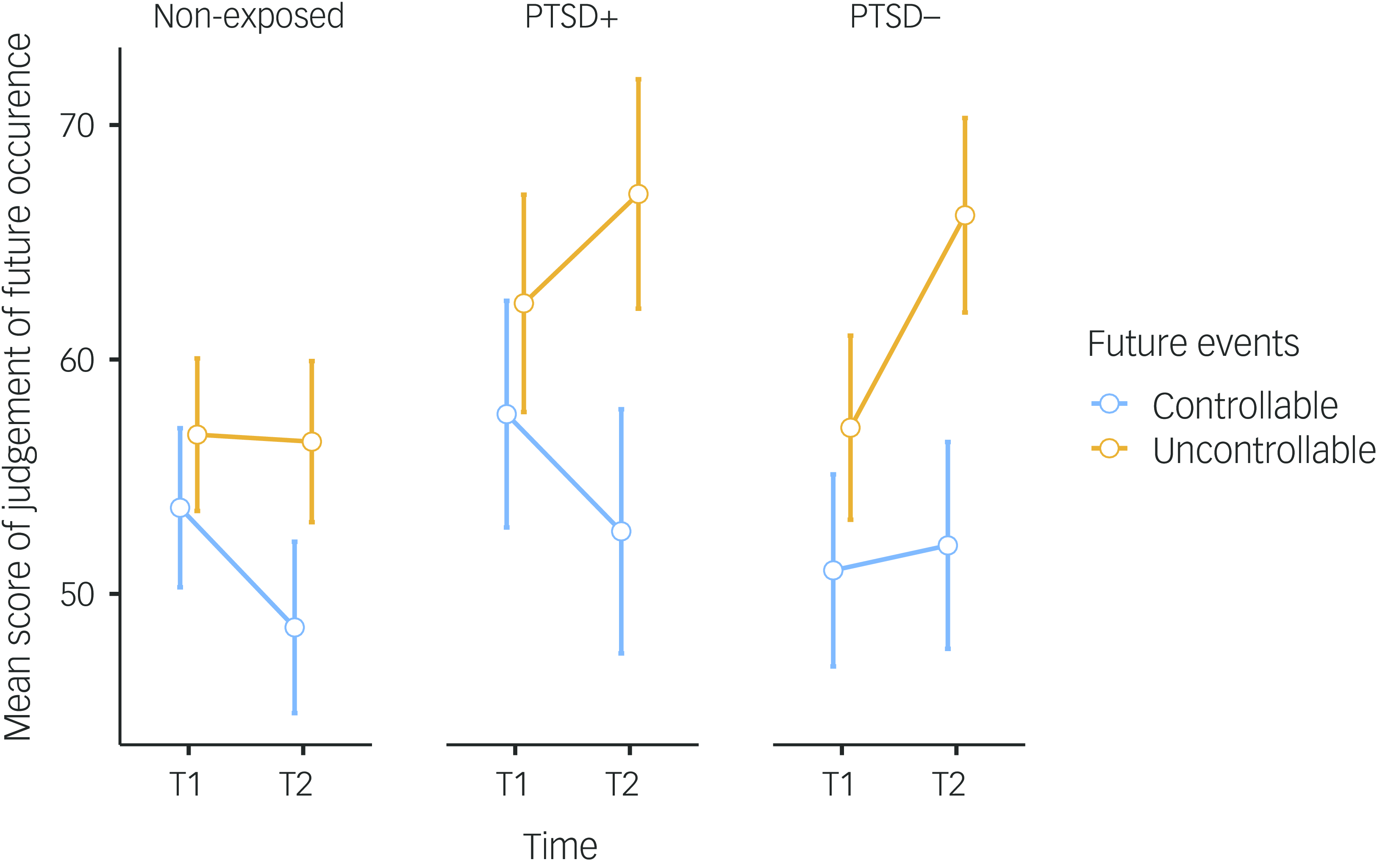
Comparison analyses (Tukey post hoc) showed that exposed individuals with and without PTSD rated the likely occurrence of uncontrollable future events as more likely than controllable future events a long time after the event (P = 0.021, s.e. 2.72; P < 0.001, s.e. 1.73) (Figure 1). In addition, participants in the PTSD+ group rated future uncontrollable events as more likely at T2 than non-exposed control individuals (P = 0.027; s.e. 3.027). Finally, individuals in the PTSD− group rated future uncontrollable events as more likely over time (P < 0.001, s.e. 1.92), with the level of future prediction of uncontrollable events reaching that of individuals in the PTSD+ group at T2 (averages of 67.06 and 65.67, respectively). No significant difference emerged from inter-group comparisons for the controllable condition, with participants in the PTSD+, PTSD− and non-exposed groups rating controllable events as equally likely at T1 and T2.
Probability ratings for future occurrence of controllable and uncontrollable future events of exposed individuals with and without post-traumatic stress disorder (PTSD) over time, compared to unexposed individuals.

The recruitment of such an exposed and unexposed sample resulted in a different mean recruitment time at T1 or of the delay between T1 and T2 between the groups (exposed with PTSD, exposed without PTSD and unexposed). Further analyses, however, showed no effect of this T1 recruitment delay or of the delay between T1 and T2 on future prediction scores, regardless of condition (controllable or uncontrollable) and group (exposed with PTSD, exposed without PTSD and unexposed). Similarly, no significant correlation was found between the time between the 13 November 2015 attacks and participation in T1 and evolution scores in future controllable and uncontrollable predictions, for any group. Finally, analyses showed no significant difference in time delay between T1 and T2 between our three groups (PTSD+, PTSD−, non-exposed), F(2,149) = 0.551, P = 0.577, η2 = 0.007 (respective means in months: 23.97 (s.e. 0.28); 23.64 (s.e. 0.19); 23.92 (s.e. 0.22)).
Correlations
As the future prediction change scores for controllable events did not appear significant, we did not calculate correlations with these scores.
Correlated changes in future prediction of uncontrollable events and post-traumatic stress symptom severity
In participants in the PTSD+ group, there was no significant correlation between the uncontrollable prediction change score and the post-traumatic stress symptom severity change score. In participants in the PTSD− group, however, analysis revealed a positive correlation between the uncontrollable prediction change score and the post-traumatic stress symptom severity change score (P = 0.032, r = 0.299). This correlation indicated that the more likely participants in the PTSD− group were to judge uncontrollable events as probable over time, the greater their post-traumatic stress symptom severity. There was no significant correlation between the uncontrollable prediction change score and well-being score in participants in the PTSD− group.
Correlated change in future prediction of uncontrollable events and coping strategies
There was no significant correlation between coping strategies (social support, positive thinking, avoidance and problem solving) and change score for uncontrollable events in exposed participants with PTSD and exposed participants without PTSD.
Discussion
The aim of the present study was to measure changes in future predictions over time in terms of feelings of control in individuals who experienced the 2015 terrorist attacks in France and who had or had not developed PTSD, compared with individuals who did not experience them. A secondary objective was to measure the longitudinal relationship between future predictions and adaptative trajectories, based on the level of post-traumatic stress symptom severity, well-being and the use of coping strategies over time. To this end, we asked the survivors of trauma with or without PTSD and non-exposed participants to estimate the probability of occurrence of future events with or without a sense of control at two timepoints. We also assessed participants’ post-traumatic stress symptom severity, well-being and coping strategies at each timepoint. Results showed that individuals exposed to the 2015 terrorist attacks, with or without PTSD, provided increasingly high probability ratings for the future occurrence of uncontrollable events – a trend not found for controllable events. We also observed that this increase over time in the estimated probability of uncontrollable events was related to heightened post-traumatic stress symptom severity among participants in the PTSD− group. This relationship was not found in participants in the PTSD+ group. Furthermore, no significant correlation was found between uncontrollable future prediction and coping strategies in exposed participants with or without PTSD.
We predicted that the future predictions (controllable and uncontrollable) of individuals in the PTSD+ group would be lower than those of individuals in the PTSD− and non-exposed groups. However, we failed to find a difference in long-term future prediction levels between individuals in the PTSD+ and PTSD− groups. Over time, both groups tended to overestimate the probability of occurrence of uncontrollable future events. This finding contrasts with previous studies indicating that reduced future perspectives is a post-traumatic symptom. This pattern of uncontrollable predictions observed in participants in the PTSD− group was also surprising, considering that previous studies described a closed future prediction pattern dependent on traumatic psychopathology and sense of ongoing threat. Reference Brown, Addis, Romano, Marmar, Bryant and Hirst4–Reference White, McManus and Ehlers8 We therefore showed that exposure to a traumatic event such as terrorist attacks can induce future predictions of uncontrollable events even in the absence of PTSD. Rialon Reference Rialon21 showed that deficits in future predictions are not necessarily contingent upon diagnostic status, and vary according to type of future expectation. Exposure to a traumatic event can lead to shattered assumptions about the outside world (i.e. reduced optimism). Reference Janoff-Bulman3 This change in worldview induced by traumatic exposure may explain why the exposed participants in our study produced increasingly high probability estimates for the future occurrence of uncontrollable events, regardless of PTSD. Baumeister et al Reference Baumeister, Vohs and Oettingen22 considered future prediction to be pragmatic. Its function is not only to know what will happen, but also to influence or control future events. This long-term uncontrollable estimation tendency in exposed individuals may therefore constitute a trauma response mechanism, particularly through the anticipated occurrence of future uncontrollable events. However, this result alone did not allow us to determine the valence (positive or negative) of this type of uncontrollable predictions over time. Is it an effective resilience factor or, on the contrary, does it hinder acceptance of the trauma and future perspectives?
The resilience trajectories of our exposed participants, in terms of their post-traumatic stress symptom severity, can help us to formulate hypotheses. Although no significant correlation was found between uncontrollable future prediction and coping strategies in exposed participants with or without PTSD, these future predictions are linked to the traumatic symptomatology of PTSD. In individuals in the PTSD− group, uncontrollable prediction change was associated with an increase in post-traumatic stress symptom severity over time. This trajectory may seem paradoxical, as it does not correspond to the known resilience trajectories of individuals exposed to a traumatic event who do not develop PTSD. We hypothesise that this symptomatic trajectory may reflected the absence of a trajectory specific to psychological trauma. In a 17-year longitudinal study, Dekel et al Reference Dekel, Ein-Dor and Solomon23 found that over time, individuals with PTSD exhibited a higher level of post-traumatic growth than resilient exposed participants who did not develop a symptomatic disorder. The emotional struggle of PTSD may encourage the visualisation and acceptance of changes induced by the traumatic event. Thus, even if they do not develop a trauma disorder, exposed individuals without PTSD may have psychological symptoms, as PTSD is only one of the consequences of traumatic exposure. One hypothesis is also that this increase in post-traumatic stress symptom severity linked to the uncontrollable future prediction may constitute a factor in post-traumatic aggravation and represent potential delayed PTSD symptoms following the 2015 terrorist attacks. More detailed measurement of this severity over time could help to confirm these initial hypotheses. Nevertheless, this result shows the importance of considering future prediction as a potential psychological factor useful for understanding post-traumatic experience and treating PTSD.
Several limitations of these study should be acknowledged. First, the time range of data collection between participants (up to 12 months) may have had an influence on the results and therefore their generalisation. Future studies with more exact time frames for the measurements could offer a more valid picture of the studied effects. Furthermore, the controllable nature of the future events proposed in this study is hypothetical. It might have been interesting to offer participants a precise and direct measure of their sense of control (through self-efficacy, for example) in future predictions. Then, the lack of psychometric assessment of the convergent and divergent validity of the self-constructed future prediction questionnaire may limit the internal validity of the results. Finally, studies show differences in the development of post-traumatic reactions between civilians and emergency responders, with greater severity and PTSD in the former. Reference Skogstad, Fjetland and Ekeberg24,Reference Prioux, Marillier, Vuillermoz, Vandentorren, Rabet and Petitclerc25 We did not consider this difference among our participants, made up of a panel of people exposed to terrorist attacks (civilians, witnesses, mourners, professionals). The lack of distinction according to the degree of exposure to the attacks may constitute a limitation and reduce the generalisability of the results.
In our opinion, these results remain interesting as a means of understanding prediction towards the future and its implication in post-traumatic adaptation, and merit further study in the future.
The present study is among the first investigations of a longitudinal association between future predictions and post-traumatic trajectories after traumatic exposure (in this case, a terrorist attack) through the sense of control. Uncontrollable future prediction change over time may have therapeutic implications. Brown et al Reference Brown, Belli, Asnaani and Foa26 recently showed that in the context of psychotherapeutic treatment of PTSD, the reduction in post-traumatic stress symptoms is associated with a simultaneous reduction in negative cognitions about oneself, others and the world, and that this change in cognitions may precede and predict the reduction in post-traumatic stress symptoms during treatment. Interventions focusing on the individual’s own future perspectives could enable not only the individual to project into the future more effectively, but also to feel more in control of it. This study also supports the value of considering an exhaustive range of post-traumatic reactions in future predictions, rather than solely considering the effect of PTSD.
Supplementary material
The supplementary material is available online at https://doi.org/10.1192/bjp.2024.297.
Data availability
The data that support the findings of this study are available on request from the corresponding author, P.Q. The data are not publicly available owing to privacy and ethical restrictions.
Acknowledgements
We thank all the people who volunteered to take part in this study and the victims’ charities that supported this project. We are grateful to the researchers, psychologists, technicians and administrative staff at the Neuropsychology and Imaging of Human Memory research unit (U1077) in Caen, the 13 Novembre programme in Paris, INSERM’s northwest regional delegation in Lille and the Clinical Research Hub in Paris. We thank Elizabeth Portier for the final English editing of the manuscript. We thank Carine Klein-Peschanski for her expert advice. We thank Emilie Breda for designing the preliminary version of the questionnaire on future predictions.
Author contributions
F.E. and D.P. are co-directors of the 13 Novembre programme. P.G. is director of the biomedical ‘REMEMBER’ study of the 13 Novembre programme. P.Q. designed the present study and conceived the experimental questionnaire. F.F. recruited, informed the participants and organised the participations. J.D. and V.d.L.S. oversaw the clinical assessment of the participants. L.C. organised and performed data analysis supervised by F.E., M.L. and P.Q., L.C., F.E. and P.Q. wrote the main manuscript text. L.C. and M.L. designed the figure. All authors were involved in the discussions about the interpretation of the results.
Funding
This study was funded by the French Commissariat-General for Investment (CGI) via the National Research Agency (ANR) and the Investment for the Future Program (PIA) (ANR-10-EQPX-0021-01). This study was conducted under the aegis of the 13 Novembre programme (EQUIPEX Matrice) headed by D.P. and F.E. This programme is sponsored by the CNRS and INSERM and supported administratively by HESAM University and its 35 partners (see www.memoire13novembre.fr). The PhD fellowship of L.C. (first author) was funded by the French Ministry of Higher Education and Research and the French National Resource and Resilience Centre.
Declaration of interest
None.





eLetters
No eLetters have been published for this article.