Introduction
Attention-deficit/hyperactivity disorder (ADHD) is the most common psychiatric disorder of childhood with a worldwide pooled prevalence of 5.3% (Polanczyk et al. Reference Polanczyk, de Lima, Horta, Biederman and Rohde2007; Looby, Reference Looby2008). ADHD is associated with drug use and drug use disorder (DUD) in cross-sectional epidemiological studies (Kessler et al. Reference Kessler, Adler, Barkley, Biederman, Conners, Demler, Faraone, Greenhill, Howes, Secnik, Spencer, Ustun, Walters and Zaslavsky2006; Faraone & Wilens, Reference Faraone and Wilens2007). In addition, most (Mannuzza et al. Reference Mannuzza, Klein, Bessler, Malloy and LaPadula1993; Milberger et al. Reference Milberger, Biederman, Faraone, Wilens and Chu1997; Molina & Pelham, Reference Molina and Pelham2003; Elkins et al. Reference Elkins, McGue and Iacono2007) but not all (Boyle et al. Reference Boyle, Offord, Racine, Szatmari, Fleming and Links1992; Biederman et al. Reference Biederman, Wilens, Mick, Faraone, Weber, Curtis, Thornell, Pfister, Jetton and Soriano1997) longitudinal investigations (Szobot & Bukstein, Reference Szobot and Bukstein2008) have shown associations with alcohol use disorders (Edwards & Kendler, Reference Edwards and Kendler2012) and smoking (Kollins et al. Reference Kollins, McClernon and Fuemmeler2005). These results are consistent with a range of studies showing that behavioral disinhibition and/or impulsivity, common symptoms in ADHD, are important risk factors for future DUD (Iacono et al. Reference Iacono, Carlson, Taylor, Elkins and McGue1999; Kollins et al. Reference Kollins, McClernon and Fuemmeler2005; Elkins et al. Reference Elkins, McGue and Iacono2007; Urcelay & Dalley, Reference Urcelay and Dalley2012).
From these data, it is plausible to conclude that ADHD is a direct cause of DUD. However, alternative interpretations are possible. In particular, both ADHD (Asherson & Gurling, Reference Asherson and Gurling2012; Larsson et al. Reference Larsson, Chang, D'Onofrio and Lichtenstein2013) and DUD (Tsuang et al. Reference Tsuang, Lyons, Eisen, Goldberg, True, Lin, Meyer, Toomey, Faraone and Eaves1996; Merikangas et al. Reference Merikangas, Stolar, Stevens, Goulet, Preisig, Fenton, Zhang, O'Malley and Rounsaville1998; Kendler et al. Reference Kendler, Karkowski, Neale and Prescott2000) are strongly familial, with a large proportion of the familial aggregation resulting from genetic factors. Prior studies have suggested a genetic link between ADHD traits and risk for DUD (Young et al. Reference Young, Stallings, Corley, Krauter and Hewitt2000; Knopik et al. Reference Knopik, Heath, Jacob, Slutske, Bucholz, Madden, Waldron and Martin2006; Hicks et al. Reference Hicks, Iacono and McGue2012; Kendler & Myers, Reference Kendler and Myers2014) and alcohol use disorders (Young et al. Reference Young, Stallings, Corley, Krauter and Hewitt2000; Knopik et al. Reference Knopik, Heath, Jacob, Slutske, Bucholz, Madden, Waldron and Martin2006; Edwards & Kendler, Reference Edwards and Kendler2012).
Our initial objective in this study was to use, for the first time to our knowledge, a nationally representative sample to examine the prospective association between an ADHD diagnosis and a subsequent registration for DUD. We also examined the possible causal relationship between ADHD and DUD by using a co-relative design in cousins, half-siblings and full siblings. Such a design compares the risk for an outcome, here DUD, in relative pairs who are discordant for the risk factor, which in this study was a diagnosis of ADHD.
If the association between ADHD and DUD is not causal but instead results from confounding familial factors, we would expect to see the association decline systematically from that seen in the general population to that seen in cousins, half-siblings and full siblings. By contrast, if the association between ADHD and DUD is largely or entirely causal, the association would remain strong in discordant relative pairs, with no clear trend to be reduced in relative pairs sharing more genetic and family environmental risk factors.
Finally, we examined the degree to which the association between ADHD and subsequent DUD could be mediated through stimulant treatment.
Method
We included all individuals born in Sweden between 1991 and 1995 (n = 551 164) and linked them with multiple nationwide registries to identify those with ADHD prior to age 15 years (1.71%). Cox proportional hazards models were used to examine the future risk for DUD as a function of an ADHD registration. In a second step, we compared the results from the entire population with the results from a co-relative design.
We used linked data from multiple Swedish nationwide registries. Linking was achieved through the unique individual Swedish 10-digit personal ID number assigned at birth or immigration to all Swedish residents. This ID number was replaced by a serial number to preserve confidentiality.
The following sources were used to create our database: the Total Population Register, containing annual data on family and geographical status; the Multi-Generation Register, providing information on family relationships; the Swedish Hospital Discharge Register, containing all hospitalizations for all Swedish inhabitants from 1964 to 2010; the Swedish Prescribed Drug Register, containing all prescriptions in Sweden picked up by patients from July 2005 to 2010; the Out-patient Care Register, containing information from all out-patient clinics between 2001 and 2010; the Swedish Crime Register, which included complete national data on all convictions from 1973 to 2011; the Swedish Suspicion Register, which included complete national data on all individuals strongly suspected of crime from 1998 to 2011; the Swedish Mortality Register, containing causes of death; and the Longitudinal Integration Database for Health Insurance and Labor Market Studies (LISA), containing annual information on socio-economic factors for all individuals from 16 years of age. We secured ethical approval for this study from the Regional Ethical Review Board of Lund University (No. 2008/409).
DUD was identified in the Swedish medical registries by ICD codes [ICD-10: mental and behavioral disorders due to psychoactive substance use (F10–F19), except those due to alcohol (F10) or tobacco (F17)]; in the Suspicion Register by codes 3070, 5010, 5011 and 5012, which reflect crimes related to DUD; and in the Crime Register by references to laws covering narcotics (law 1968:64, paragraph 1, point 6) and drug-related driving offences (law 1951:649, paragraph 4, subsection 2 and paragraph 4A, subsection 2). DUD was identified in individuals (excluding those suffering from cancer) in the Prescribed Drug Register who had retrieved (on average) more than four defined daily doses a day for 12 months from either of Hypnotics and Sedatives [Anatomical Therapeutic Chemical (ATC) Classification System N05C and N05BA] or Opioids (ATC: N02A).
The database began with all individuals born in Sweden between 1991 and 1995. We also required that the individual was living in Sweden during the entire period from 0 to 15 years of age. This database included 551 164 individuals. In the database, 2.8% of the individuals were registered for DUD. Our main exposure variable was childhood ADHD. ADHD was identified in the Hospital Discharge Register and the Out-patient Care Register by ICD codes (ICD-8: 308.3; ICD-9: 314; ICD-10: F90). ADHD was also identified in individuals in the Prescribed Drug Register who had picked up any prescription for stimulants (ATC Classification System codes N06BA01, N06BA02, N06BA04 and N06BA09). The ADHD registration had to be recorded prior to age 15 years; 1.71% of all individuals were registered for ADHD.
There were relatively few missing data. For the population, in-patient and pharmacy registers, missingness was <2%, <1% and nearly 0% respectively. However, for out-patient diagnoses missingness was higher, at approximately 10%.
We used Cox proportional hazards models to investigate the future risk for DA as a function of ADHD registration. Robust standard errors were used to adjust the 95% confidence intervals (CIs) as we had several sibling pairs from the same parents. Follow-up time in number of years was measured from age 15 of the child until the year of first registration for DUD, death, emigration or end of follow-up (year 2011), whichever came first. The proportionality assumption was fulfilled in all models. As covariates in the models we also considered sex of the individual and parental education. To investigate whether use of stimulants confounded the association between ADHD and DUD, we included the use of stimulants in a final model. Of the individuals with ADHD, 77.6% were registered for stimulant use.
In a second step we sought to compare the results from the entire population with the results from a co-relative design (Lawlor & Mishra, Reference Lawlor and Mishra2009). By means of the Swedish Multi-Generation Register, we identified all full-sibling, half-sibling and first-cousin pairs discordant for ADHD. Monozygotic (MZ) twin pairs discordant for ADHD exposure would have been of particular interest in these analyses as they provide complete control for genetic and familial–environmental confounding, where the family environment is defined as those environmental experiences that tend to make siblings or twins reared together similar for the trait in question. However, no MZ twin pairs met our definition of discordance. In a Cox proportional hazards model with a separate stratum for each relative pair, we investigated the future risk for DUD as a function of ADHD diagnosis. The co-relative design allowed us to contrast the rates of DUD in relatives with different exposure of ADHD. The stratum-specific regression provided regression coefficients for ADHD that were adjusted for the familial cluster, and therefore accounted for an array of unknown shared genetic and environmental factors.
We further conducted several sensitivity analyses to test the robustness of the results from our main analyses: in three separate models we investigated (1) the association between individuals with ADHD from the out-patient/in-patient register without stimulant use and DUD; (2) the association between individuals with ADHD from the out-patient/in-patient register and stimulant use, on the one hand, and DUD, on the other; (3) the association between individuals without ADHD from the out-patient/in-patient register but with stimulant use, on the one hand, and DUD, on the other. All statistical analyses were performed using SAS version 9.3 (SAS Institute Inc., USA).
Results
The total number of individuals contained in the sample born in Sweden between 1991 and 1995 was 551 164. In this sample, adolescents with childhood ADHD had a substantially increased risk for future DUD with a hazard ratio (HR) of 4.69 (Table 1). The HR decreased to 3.60 when including gender and to 3.34 when parental education was added as a covariate.
Results from the Cox proportional hazards model in the entire population and using a co-relative design for childhood ADHD and future drug use disorder (DUD)

ADHD, Attention-deficit/hyperactivity disorder.
Values given as hazard ratio (95% confidence interval).
a Adjusted for gender.
b Adjusted for gender and parental education.
We next compared the results from the entire population with the results from a co-relative design analyzing all first-cousin, half-sibling and full-sibling pairs discordant for ADHD with the aim of accounting for family confounding. When we examined discordant cousin pairs, we found that ADHD predicted future DUD with an HR of 3.96 (Table 1). After including gender, the HR decreased to 3.11 and changed minimally (to 3.09) when parental education was also included. Examining discordant half-siblings, those with ADHD had an HR for DUD of 2.10. This increased risk only changed marginally after adding gender and parental education to the model. In discordant full siblings, the HR was 2.80, decreasing to 2.38 after accounting for gender.
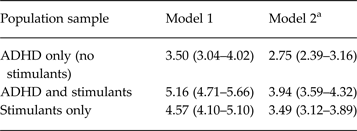
As children and adolescents with ADHD are often treated with stimulant medication, an obvious question to ask was whether the association we observed between ADHD and future DUD was a result of stimulant exposure. The simplest way to address this question was to divide our ADHD cases into three groups: (i) ADHD only: those with an assigned ADHD diagnosis but no record of receiving stimulant medication; (ii) ADHD+stimulants: those with an assigned ADHD diagnosis with a record of also receiving stimulant medication; and (iii) stimulants only: those who were identified as ADHD cases solely through receiving stimulant medication. As shown in Table 2, the HR for DUD was substantially increased in all three groups, although somewhat more so for the ADHD+stimulant and stimulant only versus the ADHD only group. In a more formal statistical test, in the entire population, we added stimulant treatment as a covariate. The HR for DUD decreased modestly from 3.34 to 2.66 (95% CIs 2.32–3.06) and remained highly significant.
Results from the Cox proportional hazards model for the association between subtypes of childhood ADHD and future DUD

ADHD, Attention-deficit/hyperactivity disorder; DUD, drug use disorder.
Values given as hazard ratio (95% confidence interval).
a Adjusted for gender.
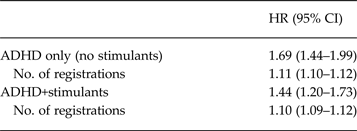
However, these analyses do not take into account the possibility that the ADHD+stimulant group might be more severely ill than the other ADHD groups. Our best available measure for symptomatic severity of ADHD was the number of independent medical registrations. These were considerably higher in the ADHD+stimulant group (mean ± standard error = 7.3 ± 0.07) than in the ADHD only group (3.3 ± 0.04) (and unavailable in the stimulant only group). As shown in Table 3, an expanded model 2 from Table 2 adding the number of registrations shows that risk for DUD is significantly predicted by the number of ADHD registrations and controlling for that, somewhat more strongly predicted by a diagnosis of ADHD only compared to ADHD+stimulants.
Results from the Cox proportional hazards model for cases of ADHD only and ADHD+stimulants controlling for the number of ADHD registrations and gender in the prediction of future DUD

ADHD, Attention-deficit/hyperactivity disorder; DUD, drug use disorder; HR, hazard ratio, CI, confidence interval.
Discussion
This national cohort study is the largest study to date to analyze whether childhood ADHD predicts subsequent DUD and the first, to our knowledge, to use a co-relative design to attempt to disentangle the potential causal nature of this association. We found in the entire population that an ADHD diagnosis robustly predicted future risk for DUD registration, with an HR of 4.69 that decreased to 3.34 when controlling for gender and parental education. In our co-relative design, we found a modest decrease in the association between ADHD and DUD from the general population to cousins and half-siblings discordant for ADHD. However, the association was slightly more pronounced in full siblings than in half-siblings. This finding is inconsistent with expectation but might result from sampling errors as the HRs in half-siblings were not known precisely.
These results are most consistent with the hypothesis that the association between ADHD and DUD is partly causal and partly a result of familial etiological factors that impact on both disorders. If the association was entirely due to familial confounding, we would expect the ADHD–DUD association to be somewhat weaker in full siblings than in half-siblings because full siblings are twice as genetically related as half-siblings and much more likely to share familial–environmental factors. However, the opposite was seen.
We suggest three plausible explanations for the causal features of the ADHD–DUD relationship. First, the effect could be mediated through stimulant treatment. However, in accord with prior studies on this issue (Faraone & Wilens, Reference Faraone and Wilens2007), our results are not consistent with this hypothesis. We found a substantial elevation of DUD risk in ADHD cases with no stimulant treatment. When we controlled for stimulant treatment in the entire population, the association between ADHD and DUD remained highly significant. Furthermore, both clinical experience and one high-quality epidemiological survey (Angold et al. Reference Angold, Erkanli, Egger and Costello2000) confirm that ADHD subjects treated with stimulants are more severely ill than those not treated. Our analyses, using the number of independent registrations for ADHD as an index of severity, support these earlier findings. Indeed, when we controlled for the number of registrations, DUD was slightly more strongly predicted by a diagnosis of ADHD alone than ADHD+stimulants. These results argue strongly that the observed association between ADHD and DUD in our data is not mediated through exposure to stimulant medication.
A second possible causal pathway from ADHD to DUD is through attempts at self-medication. We do not have data to directly address this hypothesis. However, Wilens et al. (Reference Wilens, Adamson, Sgambati, Whitley, Santry, Monuteaux and Biederman2007) specifically examined this hypothesis as part of a longitudinal study of ADHD cases and controls and found no evidence that the two groups differed in their motivation for psychoactive substance use. The third, and probably most likely, explanation for the causal elements of the ADHD–DUD relationship is that certain ADHD traits directly or indirectly predispose to future DUD. Direct effects might include traits such as behavioral disinhibition and/or impulsivity, which are common symptoms in ADHD, and have repeatedly been shown to be important risk factors for DUD (Iacono et al. Reference Iacono, Carlson, Taylor, Elkins and McGue1999; Kollins et al. Reference Kollins, McClernon and Fuemmeler2005; Elkins et al. Reference Elkins, McGue and Iacono2007; Urcelay & Dalley, Reference Urcelay and Dalley2012). In a prospective study, Elkins et al. (Reference Elkins, McGue and Iacono2007) noted that dimensional measures of ADHD predicted future drug use and drug problems. However, further analyses indicated that the predictive effect was entirely a result of symptoms of hyperactivity/impulsivity and not inattention (Elkins et al. Reference Elkins, McGue and Iacono2007). Similar findings have been seen in other cohorts (Kellam et al. Reference Kellam, Ensminger and Simon1980; Chang et al. Reference Chang, Lichtenstein and Larsson2012). Indirect effects of ADHD that might predispose to DUD would include leaving school early, poor socialization and high levels of peer deviance (Marshal et al. Reference Marshal, Molina and Pelham2003; Wolke et al. Reference Wolke, Waylen, Samara, Steer, Goodman, Ford and Lamberts2009).
The evidence that the ADHD–DUD association is not entirely causal but results in part from familial confounding is also consistent with several prior studies that suggest the existence of an ‘externalizing spectrum of disorders’. This spectrum has been detected both in studies examining only phenotypic measures (Krueger, Reference Krueger1999; Krueger et al. Reference Krueger, Markon, Patrick and Iacono2005; Markon & Krueger, Reference Markon and Krueger2005) and in genetically informative studies that find evidence for a set of common genetic risk factors that impact on a range of externalizing disorders and traits including, in several studies, ADHD and DUD (Hicks et al. Reference Hicks, Krueger, Iacono, McGue and Patrick2004; Kendler & Myers, Reference Kendler and Myers2014). For example, in adult twin males in Virginia, Kendler & Myers (Reference Kendler and Myers2014) defined a genetic externalizing spectrum. Path estimates from the genetic common factor were estimated at +0.67 for DUD and +0.30 for ADHD as reported in childhood/adolescence.
Strengths and limitations
The current study has several important strengths. It is the largest and most comprehensive study to date to prospectively examine the association between ADHD in childhood and adolescence and subsequent development of DUD. The use of nationwide out-patient and in-patient diagnoses allowed a more complete ascertainment of ADHD than in previous studies, enabling more generalizable results. The power of the co-relative design originates from our ability to match in relative pairs discordant for AHHD for varying levels of sharing of genetic risk and environmental exposures.
These strengths should be interpreted in the context of potential methodological limitations. First, we detected subjects with DUD from medical, legal and pharmacy records and ADHD from medical and pharmacy records. This method has an important advantage in not requiring cooperation or precise respondent recall and reporting. However, it does produce a proportion of false-negative and false-positive diagnoses. We cannot precisely estimate these biases as no large epidemiological study of DUD has been carried out in Sweden. However, such a survey was conducted in another Scandinavian country, Norway, which has similar rates of drug use and abuse as in this study (Kraus et al. Reference Kraus, Augustin, Frischer, Kummler, Uhl and Wiessing2003; Hibell et al. Reference Hibell, Guttormsson, Ahlström, Balakireva, Bjarnason and Kokkevi2007). The lifetime prevalence rate of DSM-III-R (APA, 1987) drug abuse and dependence in Norway was estimated at 3.4% (Kringlen et al. Reference Kringlen, Torgersen and Cramer2001), relatively close to the 2.7% DUD we detected in all of Sweden. The similarity between our data and those from Norway may reflect the completeness in our data.
Second, although full siblings share much of their rearing environment, they are not fully matched for genetic risk factors. It is possible that the HR for DUD in MZ twins discordant for ADHD could approach unity, suggesting full confounding. However, if a large decline in HR was seen between full siblings and MZ twins, it would predict a similar decline between half-siblings and full siblings, which was not observed. Furthermore, the co-relative design cannot prove causality, it can only produce data consistent with such a hypothesis. The pattern that we observed in full siblings could result from some environmental event unique to one sibling, such as head trauma or meningitis/encephalitis leading to impulsivity, that predisposes to both ADHD and DUD.
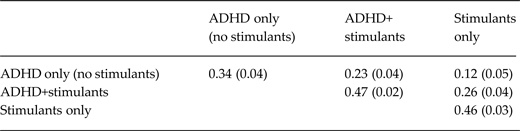
Third, our decision to include as ADHD cases those with only stimulant medication might be questioned. However, these medications are prescribed exclusively at a diagnosis of ADHD and only specialists in, for example, child psychiatry are allowed to prescribe stimulants. We were able to support the validity of this decision with additional findings. Of the cases treated with stimulants, 29% were later diagnosed with ADHD after their 15th birthday. The tetrachoric correlation within sibling pairs between ADHD in one sibling who was treated with stimulants and stimulant treatment without a recorded ADHD diagnosis was substantial for a familial trait and highly significant (+0.26, p < 0.0001) (Table 4). In addition, we have very limited data on what sort of treatment, either pharmacological or psychosocial, was delivered and as such we cannot comment on the long-term impact of treatment.
Tetrachoric correlations among 127 610 sibling pairs born in Sweden 1991–1995

ADHD, Attention-deficit/hyperactivity disorder.
Standard error given in parentheses.
Fourth, unlike with structural models, the co-relative design when applied as it was in this study to multiple relative classes does not produce a single estimate of the proportion of the association under examination that is causal. Instead, a more global sense must be obtained from reviewing results from the general population and all the relative classes. Furthermore, this design also does not produce specific estimates of the degree to which observed confounding results from genetic versus shared environmental factors.
Fifth, compared with the detailed study guidelines from the National Institute for Health and Care Excellence (NICE; http://pathways.nice.org.uk), this study has very crude matching and our findings need to be interpreted with caution.
Conclusions
In a large national Swedish cohort, we found that ADHD diagnosed before age 15 was strongly related to future risk for DUD. The magnitude of this association was modestly reduced in relative pairs discordant for ADHD. These results are most consistent with the hypothesis that the ADHD–DUD association is partly causal and partly a result of shared familial risk factors. Consistent with the prior literature, we found that the causal relationship between ADHD and DUD could not plausibly be the result of stimulant treatment. The findings are important for all clinicians encountering patients diagnosed with ADHD and for drug use prevention.
Acknowledgments
This study was supported by grant R01DA030005 from the National Institute on Drug Abuse and an Agreement on Medical Training and Research (Avtal om Lakarutbildning och Forskning) project grant, Lund, Sweden, the Swedish Research Council for Health, Working Life and Welfare (Reg. no. 2013-1836) and the Swedish Research Council (2012-2378).
Declaration of Interest
None.