Introduction
The popularity of collaborative governance processes has grown over the last three decades across policy arenas (Ansell and Gash Reference Ansell and Gash2008; Emerson and Nabatchi Reference Emerson and Nabatchi2015; Margerum and Robinson Reference Margerum and Robinson2015; Koontz Reference Koontz2016). These processes engage diverse stakeholders in consensus-oriented decisionmaking to produce widely supported policy actions. However, collaborative governance processes may also present significant tradeoffs, making the development of methods to better analyse and evaluate them crucial for practitioners and policy scholars alike. This article develops one such method. Specifically, it demonstrates how the theoretical literature on collaborative governance can be integrated with a well-known policy process framework, the Advocacy Coalition Framework (ACF), to better explain collaborative policy-making dynamics. This integration improves the application of the ACF in collaborative contexts and provides new insight into the study and practice of collaborative governance.
I begin by introducing the ACF and differentiating it from advocacy coalitions theory (ACT), which is frequently used by scholars to hypothesise relationships among ACF variables. Disentangling the ACF from ACT brings to light questions about the universality of the relationships posited by ACT, which has important implications for applying the ACF in collaborative contexts. Following this, I introduce collaborative governance theory and demonstrate how it can be used to adapt the three major foci of ACT – advocacy coalitions, policy-oriented learning and policy change – to better explain policymaking in collaborative contexts. I offer three propositions that summarise my adaptations, illustrate them using data from a case study of a collaborative governance process in Colorado, USA, and suggest next steps for testing and refining them.
Disentangling framework from theory: the ACF and ACT
The ACF was developed by Paul Sabatier and Hank Jenkins-Smith in the 1980s to analyse policy processes grappling with “wicked” problems (Sabatier and Weible Reference Sabatier and Weible2007; Jenkins-Smith et al. Reference Jenkins-Smith, Daniel Nohrstedt, Weible and Sabatier2014a; Pierce et al. Reference Pierce, Peterson, Jones, Garrard and Vu2017). Since then, the ACF has become one of the most frequently applied policy process frameworks across issue areas and political contexts. The ACF outlines a set of variables and basic assumptions important for understanding how policy actors interact to produce policy change. In addition, as applications of the ACF have grown, a “theoretical logic” (Jenkins-Smith et al. Reference Jenkins-Smith, Daniel Nohrstedt, Weible and Sabatier2014a, 186), which I call ACT following Schlager (Reference Schlager2007), has been developed alongside the ACF to hypothesise relationships among framework variables in order to explain various policy process phenomena.
The coevolution of the ACF and ACT has led scholars to apply them simultaneously in most cases, causing ACT to become nearly indistinguishable from the ACF. Recently, however, ACF scholars have begun to call for “a clearer and more explicit articulation of the framework-theory distinction” in order to “differentiate the more stable components of the ACF at the ‘framework’ level from the theoretical components”, which may vary by context or be revised over time through systematic testing (Jenkins-Smith et al. Reference Jenkins-Smith, Daniel Nohrstedt, Weible and Sabatier2014a, 214, note 7). Unpacking the framework-theory distinction is crucial for ensuring that the ACF is applied appropriately in diverse policy contexts – including those using collaborative governance arrangements – and that the resulting empirical findings are interpreted accurately.
According to Ostrom, policy process frameworks provide “the most general list of variables that should be used to analyse all types of institutional arrangements” (Reference Ostrom2007, 25). Frameworks may also include “a statement of assumptions, [and] a description of the scope or type of questions that the framework is intended to help answer” (Jenkins-Smith et al. Reference Jenkins-Smith, Daniel Nohrstedt, Weible and Sabatier2014a, 188). Due to their stable premises, frameworks provide “a shared research platform” (Jenkins-Smith et al. Reference Jenkins-Smith, Daniel Nohrstedt, Weible and Sabatier2014a, 189) and “a common set of linguistic elements” (Ostrom et al. Reference Ostrom, Cox and Schlager2014, 270) for analysing similar policy phenomena. Moreover, because policy scholars often lack true counterfactuals – that is, the opportunity to compare how the same policy process performs under different institutional arrangements or assumptions – frameworks are essential tools for systematically comparing processes. Frameworks alone, however, cannot “provide explanations for, or predictions of, behavior and outcomes” (Schlager Reference Schlager2007, 234) because they are “not directly testable, but [instead] provide guidance toward specific areas of descriptive and explanatory inquiry” (Jenkins-Smith et al. Reference Jenkins-Smith, Daniel Nohrstedt, Weible and Sabatier2014a, 189).
In line with this definition, the ACF directs scholars to examine general categories of variables, including its primary unit of analysis (the policy subsystem) and sets of factors that affect subsystem dynamics (relatively stable parameters, external events, long-term coalition opportunity structures and short-term constraints). The ACF also outlines basic assumptions about the capacities, organisation and actions of relevant actors within a subsystem, such as the assumption that they are boundedly rational (Jenkins-Smith et al. Reference Jenkins-Smith, Daniel Nohrstedt, Weible and Sabatier2014a). These categories of variables and assumptions direct the analyst’s attention to specific features of the policy-making process at the expense of ignoring others, indicating that the ACF (like other policy process frameworks) is not value-neutral. However, the ACF does not purport specific relationships among variables and can therefore be applied to analyse policymaking in multiple institutional contexts.
Theories, on the other hand, explicitly “place value on some of the variables identified as important in a framework, posit relationships among the variables, and make predictions about likely outcomes” (Schlager Reference Schlager2007, 240). In other words, theories “enable the analyst to specify which elements of a framework are particularly relevant to certain kinds of questions and to make general working assumptions about these elements” under defined conditions (Ostrom Reference Ostrom2007, 25). By focussing on certain variables, theories can “provide more precise conceptual and operational definitions of concepts and interrelate concepts in the form of testable and falsifiable propositions”, meaning that they “can (and should be) subject to experimentation, adjustment, and modifications over time” (Jenkins-Smith et al. Reference Jenkins-Smith, Daniel Nohrstedt, Weible and Sabatier2014a, 189). As such, multiple theories can be compatible with one framework (Jenkins-Smith et al. Reference Jenkins-Smith, Daniel Nohrstedt, Weible and Sabatier2014a; Ostrom et al. Reference Ostrom, Cox and Schlager2014).
As introduced above, ACT has coevolved with the ACF to hypothesise relationships among its variables. ACT is typically divided into three “overlapping theoretical foci”: advocacy coalitions, policy-oriented learning and policy change (Weible and Nohrstedt Reference Weible and Nohrstedt2012; Jenkins-Smith et al. Reference Jenkins-Smith, Daniel Nohrstedt, Weible and Sabatier2014a, 188; Pierce et al. Reference Pierce, Peterson, Jones, Garrard and Vu2017), each with associated hypotheses. At the core of ACT is the assumption that policymaking is driven by groups of actors (i.e. advocacy coalitions) who coalesce around shared beliefs and coordinate to promote policies that align with these beliefs before others do the same (Sabatier Reference Sabatier1988). Policy change can therefore be defined as “the translation of beliefs of past winners of policy processes” (Pierce et al. Reference Pierce, Peterson, Jones, Garrard and Vu2017, S17), emphasising the centrality of competition among adversarial coalitions to ACT.
As the ACF is applied in more diverse policy contexts, scholars have begun to question how different institutional configurations may alter the relationships hypothesised by ACT. For example, studies that apply the ACF outside of its traditional American and Western European context (Henry et al. Reference Henry, Ingold, Nohrstedt and Weible2014), such as in Sweden’s consensus democracy (Fischer Reference Fischer2014), China’s unitary system (Han et al. Reference Han, Swedlow and Unger2014) and India’s parliamentary system (Gupta Reference Gupta2014), find that while the ACF remains a useful framework to organise such studies, the relationships hypothesised by ACT may not be universal.
Indeed, the developers of the ACF recognised that institutional arrangements can influence the dynamics of policy subsystems, as reflected by the 2007 addition of “coalition opportunity structures” (Sabatier and Weible Reference Sabatier and Weible2007; Gupta Reference Gupta2012), a category of variables that includes the “openness of the political system” and “degree of consensus needed for policy change”. While little work has been done to theorise how different values of these variables may affect hypothesised relationships, the empirical studies described above have begun to address this gap. Jenkins-Smith et al. note that an important way to advance ACF scholarship is to “promote creativity for applying the ACF in different governing systems” (Reference Jenkins-Smith, Daniel Nohrstedt, Weible and Sabatier2014a, 207), a goal to which these studies contribute by demonstrating both the general applicability of the ACF as well as the potential limitations of ACT.
This study extends the scholarship described above by exploring the theoretical limitations that scholars may face when applying the ACF in studies of collaborative governance processes. Collaborative governance processes, which will be described next, attempt to reduce competition among coalitions by incentivising cooperation and negotiation, thereby shifting the foundational (adversarial) assumptions upon which ACT was developed. Put differently, ACT presents one version of policy-making reality that is generalisable under certain conditions, but that must be adapted when conditions are altered, as they are under collaborative governance arrangements. Following scholars who have integrated concepts from other theories (such as cultural theory) with the ACF to address similar limitations (Sotirov and Memmler Reference Sotirov and Memmler2012; Jenkins-Smith et al. Reference Jenkins-Smith, Silva, Gupta and Ripberger2014b; Ripberger et al. Reference Ripberger, Gupta, Silva and Jenkins‐Smith2014; Swedlow Reference Swedlow2014), I suggest that the theoretical literature on collaborative governance can be integrated with the ACF to better explain collaborative policy-making dynamics. Specifically, it illuminates relationships among ACF variables that differ from those hypothesised by ACT, thereby improving applications of the ACF in collaborative contexts.
Advancing collaborative governance theory
Collaborative governance processes engage diverse stakeholders in deliberative, consensus-oriented decisionmaking about public goods or problems (Ansell and Gash Reference Ansell and Gash2008; Emerson et al. Reference Emerson, Nabatchi and Balogh2012; Gerlak et al. Reference Gerlak, Heikkila and Lubell2013). These processes may reduce issues of cost, politicisation and implementation failure associated with adversarial processes by fostering trust and knowledge-sharing among participants, and by producing policy solutions that are easier to implement and viewed as more legitimate (Sabatier et al. Reference Sabatier, Focht, Lubell, Trachtenberg, Vedlitz and Matlock2005a; Ulibarri Reference Ulibarri2015). However, collaborative processes can be time-intensive, fail to represent all stakeholders and generate “lowest common denominator” solutions with difficult-to-measure outcomes (Kenney Reference Kenney2000; Leach and Pelkey Reference Leach and Pelkey2001; Conley and Moote Reference Conley and Moote2003; Trachtenberg and Focht Reference Trachtenberg and Focht2005; Koontz and Thomas Reference Koontz and Thomas2006; Lubell et al. Reference Lubell, Gerlak and Heikkila2013). Because of these potentially significant tradeoffs, practitioners and policy scholars alike can benefit from the development of methods to better analyse and evaluate collaborative processes, particularly in comparison with other institutional arrangements (Scott and Thomas Reference Scott and Thomas2017).
As collaborative governance has grown increasingly popular, a body of literature focussed on characterising collaborative process dynamics has been developed (Moore and Koontz Reference Moore and Koontz2003; Sabatier et al. Reference Sabatier, Focht, Lubell, Trachtenberg, Vedlitz and Matlock2005a; Ansell and Gash Reference Ansell and Gash2008; Margerum Reference Margerum2008; Emerson and Nabatchi Reference Emerson and Nabatchi2015). This literature, which I collectively call collaborative governance theory, has advanced the identification and measurement of variables central to understanding and modelling collaborative processes. However, it has also been criticised for a lack of generalisability and an inability to illuminate important differences between collaborative and noncollaborative governance arrangements, in part because of its detachment from explanatory variables found in other policy process frameworks and theories (Sabatier et al. Reference Sabatier, Leach, Lubell and Pelkey2005b). Therefore, one avenue for expanding the application of collaborative governance theory is to integrate it with a common tool of the policy process scholar: policy process frameworks. As described above, these frameworks provide general sets of variables and a common language that can be used to compare processes employing different institutional arrangements to derive generalised lessons about policymaking (Ostrom Reference Ostrom2007; Ostrom et al. Reference Ostrom, Cox and Schlager2014). Integrating collaborative governance theory with policy process frameworks can help scholars explore alternate explanations for policy-making phenomena and provide new insight into how collaborative processes are influenced by broader policy process dynamics.
Importantly, policy process frameworks such as the ACF have already been applied in collaborative policy contexts. For example, Weible and Sabatier (Reference Weible and Sabatier2009) use the ACF to examine how participants’ beliefs change as a policy process becomes increasingly collaborative. Leach and Sabatier (Reference Leach and Sabatier2005) test whether ACT assumptions can explain the development of trust among policy adversaries engaged in prolonged negotiations. Moreover, Calanni et al. (Reference Calanni, Siddiki, Weible and Leach2015) test hypotheses associated with ACT and other theories to determine which best explains coordination in collaborative contexts. These studies highlight areas where elements of the ACF must be adapted in order to more accurately explain collaborative policy-making dynamics; yet, they do not explicitly explore alternate, context-specific explanations for these dynamics and/or integrate them with the ACF. In other words, these studies identify areas of the ACF that are ripe for development through integration with collaborative governance theory.
What is perhaps the other most well-known policy process framework, the Institutional Analysis and Development (IAD) framework (Schlager Reference Schlager2007; Ostrom et al. Reference Ostrom, Cox and Schlager2014), has also been applied in collaborative contexts (e.g. see Koontz Reference Koontz2005; Siddiki et al. Reference Siddiki, Carboni, Koski and Sadiq2015).Footnote 1 While the implications of integrating collaborative governance theory with IAD should be explored further, particularly because of the IAD’s emphasis on collective action, this article focusses on the ACF for a variety of reasons. First, the ACF has frequently been applied in analyses of environmental policy processes (Jenkins-Smith et al. Reference Jenkins-Smith, Daniel Nohrstedt, Weible and Sabatier2014a), an area in which collaborative governance has also flourished (Koontz Reference Koontz2016). Furthermore, the developers of the ACF have emphasised the dynamic nature of the framework, and scholars have taken seriously the call to apply the ACF in diverse policy contexts (Sabatier and Weible Reference Sabatier and Weible2007). This has not only provided general insight about how the ACF may be refined in response to new empirical evidence, but has also incorporated elements into the ACF literature that can be further developed to better explain collaborative policy-making dynamics. These include “collaborative policy subsystems” (Weible and Sabatier Reference Weible and Sabatier2009) and “negotiated agreements” (Sabatier and Weible Reference Sabatier and Weible2007), among others, which will be described in more detail below.
Research design
The remainder of this article builds on the literature described above to demonstrate how collaborative governance theory can be integrated with the ACF. To organise this integration, I maintain the three foci of ACT – advocacy coalitions, policy-oriented learning and policy change – and demonstrate how key tenets of collaborative governance theory can be used to adapt each focus. To do this, I first describe each focus in detail and then draw on the findings and implications of empirical studies of collaborative governance processes, as well as from studies that have applied the ACF in nontraditional contexts, to suggest adaptations that better explain collaborative process dynamics. Following Gerlak and Heikkila (Reference Gerlak and Heikkila2011), I summarise these adaptations in the form of a theoretical proposition related to each focus and illustrate each proposition using interview data from a case study of a collaborative governance process in Colorado. These data are not intended to test the validity of the propositions, a task that requires rigorous cross-case analysis using a variety of methods. They simply demonstrate how the propositions may be observed in a single-case study to aid future researchers who desire to apply this approach in other cases or in comparative studies. The context of the case study, as well as the data collection and analysis methods, will be described next.
Case study: Colorado’s Basin Roundtable process
The following exploratory case study (Yin Reference Yin2003) was conducted by the author in 2013-2014 as part of a study of collaborative water governance processes in the western United States. Like the majority of ACF applications identified by Weible et al. (Reference Weible, Sabatier and McQueen2009), it used the ACF to organise inquiry broadly but did not explicitly test any ACT hypotheses. Similar to other studies that use the ACF to examine individual policy-making process or venues rather than entire subsystems (Leach and Sabatier Reference Leach and Sabatier2005; Matti and Sandström Reference Matti and Sandström2011; Leach et al. Reference Leach, Weible, Vince, Siddiki and Calanni2014; Calanni et al. Reference Calanni, Siddiki, Weible and Leach2015), the primary unit of analysis is a single-collaborative governance process embedded within a larger policy subsystem. While the developers of the ACF recommend that the framework is applied at the subsystem level, “the specifics of [institutional] arrangements become most apparent in the venues … in which coalitions seek to influence subsystem behavior” (Weible et al. Reference Weible, Hank Jenkins-Smith, Nohrstedt, Henry and DeLeon2011, 358). This application not only makes the analysis of a complex collaborative process manageable, but it provides necessary insight into the organisational-level processes that comprise subsystems (Jenkins-Smith et al. Reference Jenkins-Smith, Daniel Nohrstedt, Weible and Sabatier2014a).
In 2005, the Colorado legislature passed the Colorado Water for the 21st Century Act (HB 05–1177) in response to regional drought and the anticipation of additional threats to freshwater supplies from climate change and population growth. This law directed the state’s water governance entity, the Colorado Water Conservation Board (CWCB) (2016), to create Basin Roundtables that represent each of the state’s eight major river basins plus the Denver Metro area. Each Roundtable is charged with collaboratively evaluating its basin’s water supplies to produce assessments of current and future needs. In addition, through a consensus-oriented decision-making process, Roundtables allocate funding, provided through the CWCB, to projects that help meet identified needs. Thus, the Roundtables both serve an advisory role (creating new data to inform local and state planning) and have the authority to independently allocate money.
While each Roundtable functions according to a unique set of bylaws, the enacting legislation defines the types of stakeholders that must participate: members designated by the state house and senate agricultural committees, at-large members representing specific interest groups and water rights holders, nonvoting members, and agency liaisons. The legislation also created an umbrella group called the Interbasin Compact Committee (IBCC) to facilitate dialogue and collaboration among Roundtables on statewide water issues (CWCB 2016).
The Roundtables’ largest task arose in 2013 when Colorado’s governor issued an executive order mandating the CWCB to create the first statewide water plan, which would develop comprehensive and actionable strategies to meet Colorado’s future water needs. The Roundtables were asked to provide data and insight for the statewide plan through individual Basin Implementation Plans (BIPs) that integrated their prior assessments with proposed action items. The BIPs, along with policy recommendations created by the IBCC, became the centrepiece of Colorado’s Water Plan, a nonregulatory document that has garnered wide-ranging, voluntary support across sectors and from the public. Going forward, this case will be referred to as the “Roundtable process”.
Methods: data collection and analysis
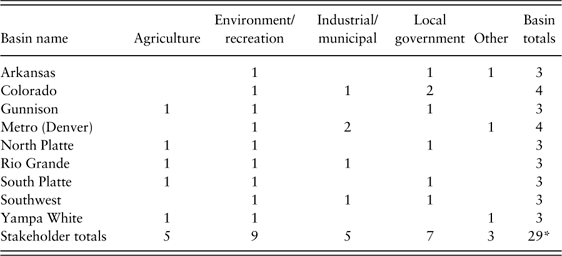
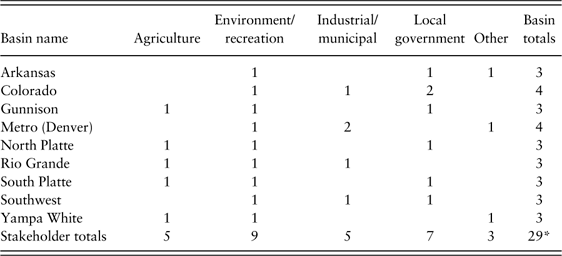
Data were collected through 28 semistructured interviews (Rubin and Rubin Reference Rubin and Rubin2005) with actors who participated in the Roundtable process for multiple years. Interviewees were identified through process documents and observations of process meetings by the researcher, or by other interviewees through snowball sampling (Auerbach and Silverstein Reference Auerbach and Silverstein2003). Interviewees were selected to represent the diverse geographical areas and stakeholder interests encompassed by each Roundtable, including at least one nonconsumptive interest (environmental and recreational water uses) and one consumptive interest (agricultural, municipal and industrial water uses), similar to Leach (Reference Leach2006) (Table 1). In some cases, a representative of a local government or other group (such as an academic or water lawyer) that was an active participant on behalf of either a consumptive or nonconsumptive use was selected in place of a formal representative of that user group due to their long-standing involvement in and knowledge of Roundtable matters. The size of each Roundtable varies due to the number of counties and special districts encompassed in the basin (which each hold a seat) and interest from nonvoting members who actively participate; thus, the sample of interviewees selected from each Roundtable is not proportional to the Roundtable’s size nor to the makeup of interest group representatives. Interviewees were asked about the major water needs and issues in their basin, as well as their experience in the collaborative process, including what activities they participated in, their goals and with whom they cooperated to meet them, what they learned and the decisions or recommendations that their Roundtable produced.
Interview subjects by basin and stakeholder group, adapted from Koebele (Reference Koebele2015)
Note:
* One interviewee refused to be recorded; thus, the interview could not be formally analysed with the other 28.
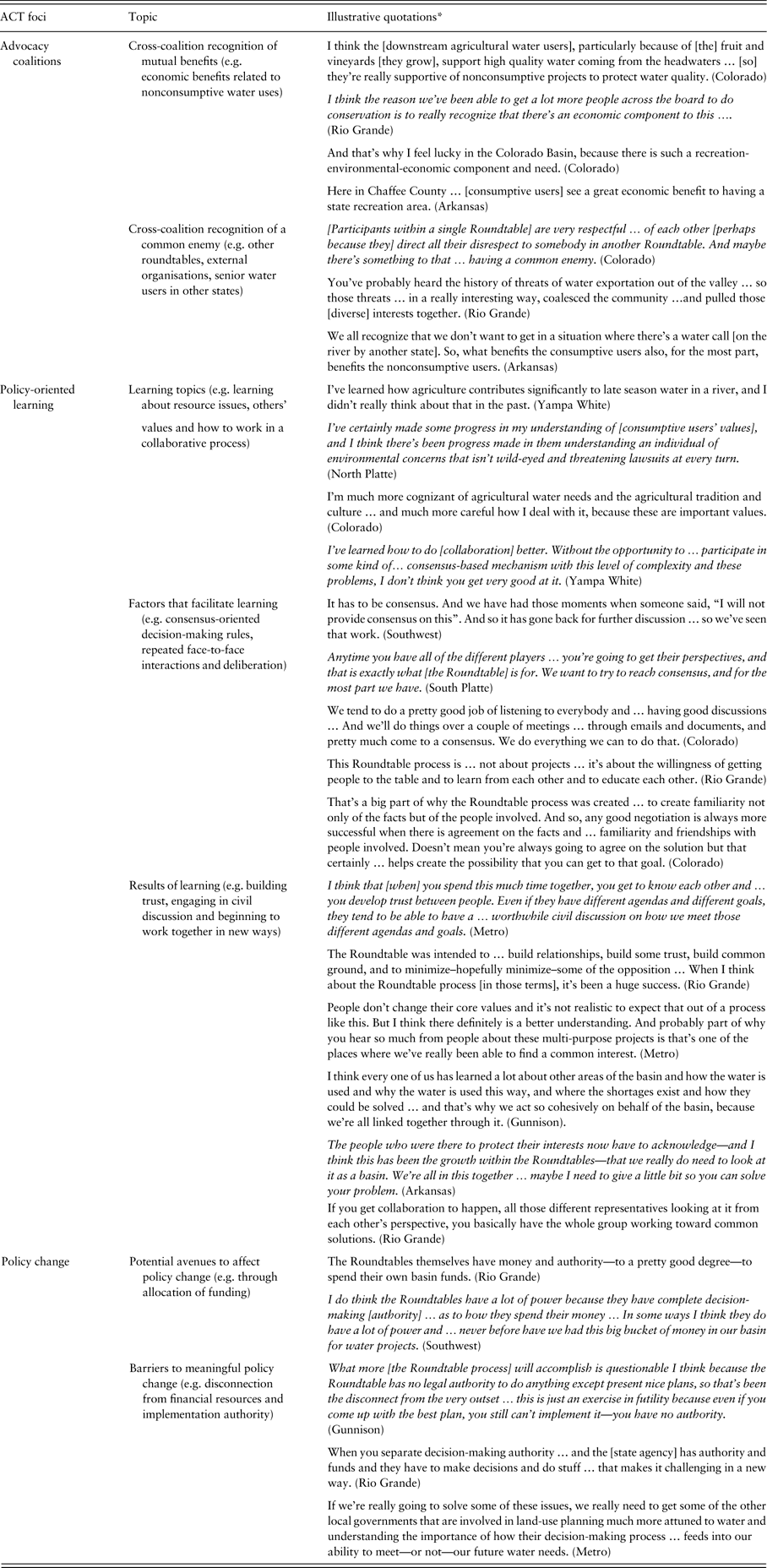
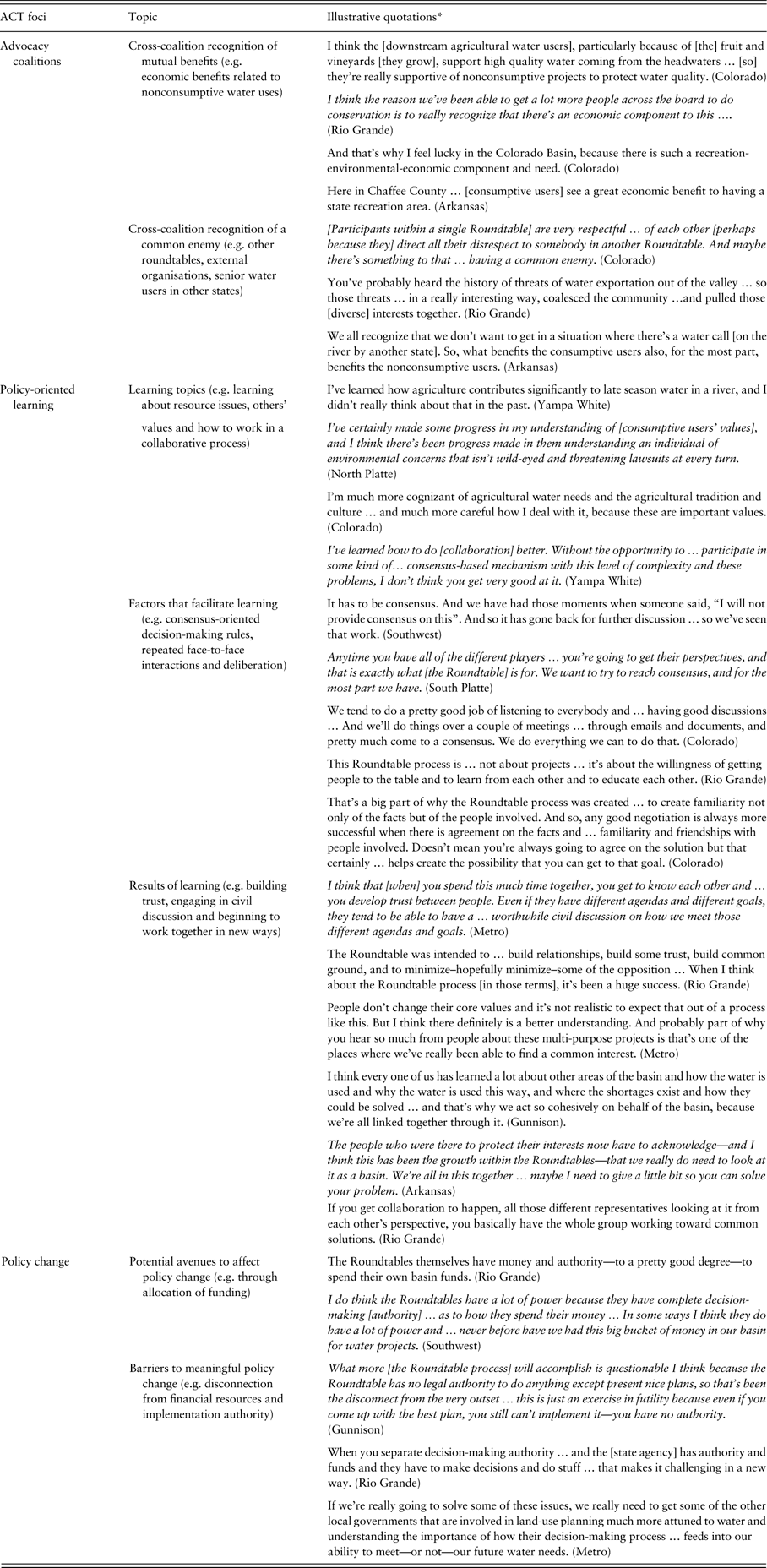
All interviews were conducted by the author after the governor’s executive order (a key moment that catalysed collaboration) but before the Roundtables produced their BIPs (the formal documentation of such collaboration). Interviews were digitally recorded, transcribed verbatim and coded qualitatively (Auerbach and Silverstein Reference Auerbach and Silverstein2003) using QSR NVivo 10 qualitative analysis software and an a priori codebook that focussed on the major topics of inquiry with codes derived from literature on collaborative processes and the ACF.Footnote 2 Data were summarised by code for each Roundtable, allowing the researcher to identify thematic patterns within and across Roundtables (Miles and Huberman Reference Miles and Huberman1994). Select quotations are presented in the main text of the article to illustrate aspects of the major topics being discussed under each ACT foci. For ease of reading, these quotations – as well as a range of others that illustrate additional aspects of the topics – are presented in Appendix A. All quotations include the name of the Roundtable in which the interviewee participates to illustrate that information was gathered from respondents across Roundtables.
Coalitions, learning and policy change in collaborative contexts
In this section, I detail the three major ACT foci and draw from collaborative governance theory to suggest adaptations to each focus that better explain collaborative policy-making dynamics, which are then summarised in the form of three propositions. Table 2 displays the traditional ACT hypotheses associated with each focus alongside the propositions developed here.
Advocacy coalitions theory (ACT) hypotheses and propositions for collaborative contexts
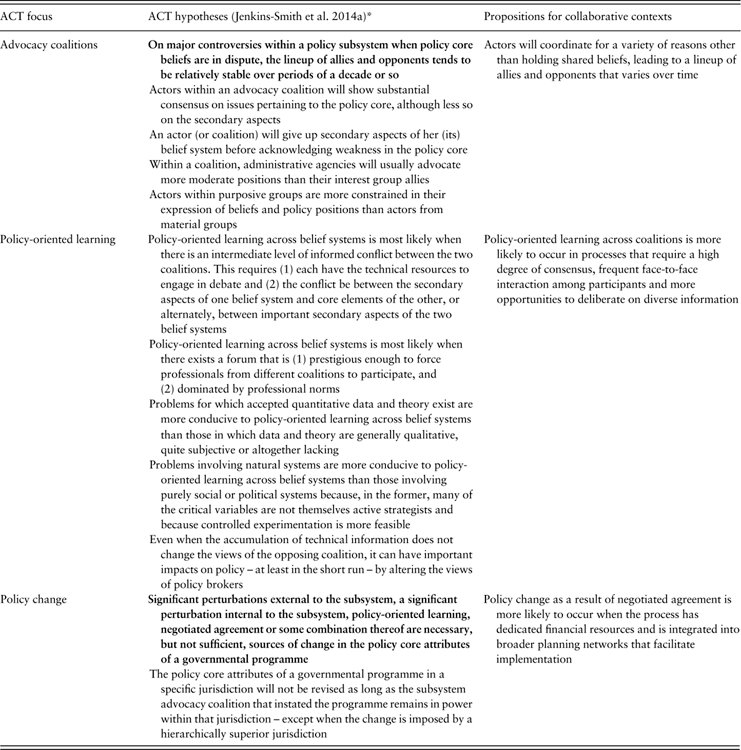
Note:
* ACT hypotheses in bold have found strong empirical support in the literature, according to Jenkins-Smith et al. (Reference Jenkins-Smith, Daniel Nohrstedt, Weible and Sabatier2014a); all others have received mixed support, and many have been seldom tested.
Advocacy coalitions
The first ACT focus concerns actors’ patterns of interaction in a subsystem through their membership in advocacy coalitions. Actors are grouped into coalitions based on two criteria: shared policy core beliefs and a nontrival degree of coordination (Jenkins-Smith et al. Reference Jenkins-Smith, Daniel Nohrstedt, Weible and Sabatier2014a). Policy core beliefs, the central element in the ACF’s three-tiered hierarchical belief structure, are essentially applications of an actor’s broad ontological beliefs to the bounds of a policy subsystem, making them a particularly pertinent level of belief around which actors coalesce. “[T]he expectation that coalitions form based on shared beliefs, which has been termed the Belief Homophily Hypothesis”, has been tested and frequently supported (Jenkins-Smith et al. Reference Jenkins-Smith, Daniel Nohrstedt, Weible and Sabatier2014a, 196). Actors who share policy core beliefs will then coordinate, defined as “some degree of working together to achieve similar policy objectives” (Sabatier and Weible Reference Sabatier and Weible2007, 196). The lineup of allies and opponents, measured through coalition membership, is expected to be relatively stable over long periods of time (Jenkins-Smith et al. Reference Jenkins-Smith, Daniel Nohrstedt, Weible and Sabatier2014a).
Explaining interactions among actors in collaborative contexts based on these two criteria (shared beliefs and coordination) presents unique challenges, however. First, under ACT, coalitions within a subsystem are assumed to be generally adversarial, in that they compete to “translate their beliefs into actual policy before their opponents can do the same” (Sabatier and Weible Reference Sabatier and Weible2007, 196). As collaborative processes typically require that diverse stakeholders deliberate about problems and solutions and reach consensus before a decision can be made (Ansell and Gash Reference Ansell and Gash2008), actors are incentivised to coordinate with others who may not share the same policy core beliefs. Put differently, actors in collaborative processes are expected to engage in frequent cross-coalition coordination, whereas adversarial processes are likely to foster high intracoalition coordination (Weible Reference Weible2008). Consequently, the boundaries between traditional opponents and allies, and the coalitions to which they belong, may become blurred over time – a process Matti and Sandström (Reference Matti and Sandström2011) argue is necessary for legitimising collaborative approaches.
Recent work by ACF scholars recognises the potential for “collaborative subsystems” to exist (Sabatier and Weible Reference Sabatier and Weible2007; Weible Reference Weible2008), in which coalitions hold some overlapping beliefs, share decision-making power and coordinate to develop consensus on “win-win and voluntary solutions” (Weible and Sabatier Reference Weible and Sabatier2009, 197–198). These subsystems arise from hurting stalemates, situations in which all coalitions are dissatisfied with the status quo, are unable to change it independently, and thus have an incentive to negotiate (Sabatier and Weible Reference Sabatier and Weible2007). This development suggests that the distinction between adversarial and collaborative subsystems is not hard-and-fast: even in a largely collaborative subsystem, some groups may remain adversarial, or at least “distinct in their beliefs” (Weible and Sabatier Reference Weible and Sabatier2009, 207), just as coalitions in an adversarial subsystem may coordinate on mutually beneficial goals. Although the adversarial-collaborative subsystem continuum and its consequences for dynamic coordination among policy actors remain underexplored (Weible et al. Reference Weible, Sabatier and McQueen2009), research that addresses these issues provide crucial insight into the limitations of ACT hypotheses about advocacy coalitions in collaborative processes.
These limitations can be addressed using the results of studies of collaborative processes that investigate drivers of coordination other than shared beliefs. These drivers include perceiving someone as trustworthy or having valuable resources (Calanni et al. Reference Calanni, Siddiki, Weible and Leach2015); recognising that a competitor’s beliefs may complement one’s own, or that their consent must be gained to advance one’s own policy goals (Sotirov et al. Reference Sotirov, Blum, Storch, Selter and Schraml2016; Sotirov and Winkel Reference Sotirov and Winkel2016); viewing someone as professionally competent (Weible et al. Reference Weible, Heikkila and Pierce2017); or even sharing a common enemy (Henry et al. Reference Henry, Lubell and McCoy2011). Indeed, an individual’s motivations to engage in coordinated behaviour may vary based on attributes such as their broader worldview (Conner et al. Reference Conner, Nowlin, Rabovsky and Ripberger2016), cultural beliefs and biases (Weare et al. Reference Weare, Lichterman and Esparza2014), or extremeness of their policy position (Weible et al. Reference Weible, Heikkila and Pierce2017), among others. However, collaborative processes are expected to promote learning (Leach et al. Reference Leach, Weible, Vince, Siddiki and Calanni2014), improve actors’ perceptions of opponents (Leach and Sabatier Reference Leach and Sabatier2005; Weible et al. Reference Weible, Siddiki and Pierce2011) and encourage belief convergence (Weible and Sabatier Reference Weible and Sabatier2009), all of which may increase the potential for coordination among actors with different policy core beliefs.
Given these findings, scholars must adapt their expectations about actors’ patterns of interaction in collaborative contexts. In particular, they should expect that actors will coordinate for a variety of reasons other than holding shared beliefs, leading to a lineup of allies and opponents that varies over time (Proposition 1). This proposition is based on the assumption that by incentivising cross-coalition interactions, collaborative processes may lead to new strategic alliances among coalitions, potentially resulting in the erosion of traditional coalitional boundaries over time. As a result, this proposition directly conflicts with ACT’s expectations that coalitions are belief-based and relatively stable, demonstrating what is perhaps the most fundamental theoretical limit of using ACT to explain collaborative contexts. Moreover, this proposition implies that collaborative processes can shift policy-making dynamics by introducing crosscutting incentives for coordination – an important insight for practitioners of collaborative governance that will be discussed further under the policy change focus.
Advocacy coalitions: an illustration
In the Roundtable process, the author identified two coalitions based on their unique policy core beliefs, as described by interviewees when asked about their goals and the strategies they used to meet them. The first is a “nonconsumptive” water users coalition consisting of actors that have a general preference for preserving environmental quality by keeping water in rivers. The second is a “consumptive” water users coalition consisting of actors that have a general preference for diverting water out of rivers for other uses. Despite these belief differences, multiple instances of cross-coalition coordination were reported as both coalitions attempted to advance their policy goals. For example, interviewees belonging to the nonconsumptive coalition highlighted that some of their goals related to conservation and environmental protection were actually complementary to the economic goals of the consumptive coalition, a motivation for coordination suggested by Sotirov et al. (Reference Sotirov, Blum, Storch, Selter and Schraml2016):
I think the reason we’ve been able to get a lot more people across the board to do conservation is to really recognize that there’s an economic component to this …. (Rio Grande)
In addition, interviewees from both coalitions suggested that they engage in cross-coalition coordination to avoid common enemies (Henry et al. Reference Henry, Lubell and McCoy2011), such as the members of another Roundtable, an organisation external to the Roundtable process, and even senior water users in another state that could restrict river flows in Colorado:
[Participants within a single Roundtable] are very respectful … of each other [perhaps because they] direct all their disrespect to somebody in another Roundtable. And maybe there’s something to that … having a common enemy. (Colorado)
While assessing coalition stability requires longitudinal data outside of the scope of this study, these descriptions suggest that actors frequently work across coalitions to achieve their goals. Some interviewees argued that cross-coalition coordination is strategic and short-lived, whereas others suggested that actors may indeed be building longer-term relationships, particularly when they share a common enemy. These examples illustrate how coalition dynamics may differ in collaborative contexts (Proposition 1) from those hypothesised by ACT, particularly when strong incentives exist for long-term, cross-coalition interaction.
Policy-oriented learning
The second ACT focus concerns the conditions under which actors in a policy process experience policy-oriented learning, or “relatively enduring alterations of thought or behavioral intentions that result from experience and/or new information and that are concerned with the attainment or revision of policy objectives” (Sabatier and Weible Reference Sabatier and Weible2007, 123). Although learning is the most understudied of the three theoretical foci (Weible et al. Reference Weible, Sabatier and McQueen2009; Jenkins-Smith et al. Reference Jenkins-Smith, Daniel Nohrstedt, Weible and Sabatier2014a), it is theorised to be an important strategy for creating shared knowledge, overcoming collective action problems and promoting belief convergence (May Reference May1992; Muro and Jeffrey Reference Muro and Jeffrey2008; Leach et al. Reference Leach, Weible, Vince, Siddiki and Calanni2014). However, because complex policy-making systems require actors to “simplify [new information] based on previously learned strategies, by belief heuristics as filters, and by focusing their attention”, learning is predicted to be more likely “within a coalition where members share similar belief systems than between coalitions where opponents likely disagree” (Weible Reference Weible2008, 627). While ACT hypothesises factors that are likely to facilitate cross-coalition learning, there has been mixed empirical evidence to support these hypotheses (Jenkins-Smith et al. Reference Jenkins-Smith, Daniel Nohrstedt, Weible and Sabatier2014a), due in part to difficulties in measuring learning (Muro and Jeffrey Reference Muro and Jeffrey2008; Heikkila and Gerlak Reference Heikkila and Gerlak2013).
Unlike adversarial policy processes, collaborative processes may “provide an optimal setting for … learning across coalitions” (Weible and Sabatier Reference Weible and Sabatier2009, 208). Although learning is expected to be particularly difficult when actors have high degrees of preexisting conflict over seemingly intractable issues or hold significantly different worldviews (Jenkins-Smith et al. Reference Jenkins-Smith, Silva, Gupta and Ripberger2014b; Sotirov et al. Reference Sotirov, Blum, Storch, Selter and Schraml2016), strategies commonly used in collaborative processes can help actors reduce conflict and become more primed to learn. For example, collaborative governance theory finds that learning is more likely in intensive collaborative processes that require actors to achieve a high degree of consensus (Sabatier and Weible Reference Sabatier and Weible2007; Raadgever et al. Reference Raadgever, Mostert and Van de Giesen2012), encourage extensive social interactions among participants (Gerlak and Heikkila Reference Gerlak and Heikkila2011; Leach et al. Reference Leach, Weible, Vince, Siddiki and Calanni2014) and establish a sense of fairness and strong leadership (Muro and Jeffrey Reference Muro and Jeffrey2008; Gerlak and Heikkila Reference Gerlak and Heikkila2011; Leach et al. Reference Leach, Weible, Vince, Siddiki and Calanni2014). Decentralised collaborative processes that encourage deliberation on diverse information and experimentation are also expected to foster learning across coalitions (Gerlak and Heikkila Reference Gerlak and Heikkila2011; Heikkila and Gerlak Reference Heikkila and Gerlak2013), even in contexts where participants have significant cultural differences (Gastil et al. Reference Gastil, Knobloch, Kahan and Braman2016). Collaborative processes can also help actors “recognize the limits of information and proceed adaptively through joint fact-finding strategies” (Weible Reference Weible2008, 628) rather than becoming mired in conflict over poor or contradictory data.
In light of these findings, scholars must adapt their expectations about the factors that foster policy-oriented learning in collaborative contexts. They should expect that policy-oriented learning across coalitions is more likely to occur in processes that require a high degree of consensus, frequent face-to-face interaction among participants and more opportunities to deliberate on diverse information (Proposition 2). This proposition is based on the assumption that the strategies used in collaborative forums to engage actors from different coalitions can reduce barriers to learning (prior conflicts, differing worldviews, etc.). It diverges from the traditional ACT hypotheses about the types of information that may be most conducive to learning and instead focuses on the processes that can foster learning – and ideally the development of consensus – across coalitions, even on issues where they strongly disagree.
Policy-oriented learning: an illustration
In the Roundtable process, interviewees from both coalitions described cross-coalition learning as an important outcome of the collaborative process. Although some interviewees suggested that learning was slow or nonexistent, many explained that, as a result of their participation in the process, they learned about relevant resource issues (particularly in relation to agricultural water use, which became a major focus of the process), other stakeholders’ values, and strategies to better achieve their own goals through collaborative means:
I’ve certainly made some progress in my understanding of [consumptive users’ values], and I think there’s been progress made in them understanding an individual of environmental concerns that isn’t wild-eyed and threatening lawsuits at every turn. (North Platte)
I’ve learned how to do [collaboration] better. Without the opportunity to … participate in some kind of … consensus-based mechanism with this level of complexity and these problems, I don’t think you get very good at it. (Yampa White)
Interviewees alluded to a number of factors that facilitated learning, including consensus-oriented decision-making rules, especially related to the allocation of funding (which will be described further under the policy change focus); repeated face-to-face interactions; and deliberation over both facts and individual perspectives:
Anytime you have all of the different players … you’re going to get their perspectives, and that is exactly what [the Roundtable] is for. We want to try to reach consensus, and for the most part we have. (South Platte)
As a result of learning, actors explained that they built trust, engaged in civil discussion, and began to work together in new ways:
I think that [when] you spend this much time together, you get to know each other and … you develop trust between people. Even if they have different agendas and different goals, they tend to be able to have a … worthwhile civil discussion on how we meet those different agendas and goals. (Metro)
The people who were there to protect their interests now have to acknowledge—and I think this has been the growth within the Roundtables—that we really do need to look at it as a basin. We’re all in this together … maybe I need to give a little bit so you can solve your problem. (Arkansas)
These descriptions of cross-coalition learning in the Roundtable process illustrate how assumptions about the possibility for and factors that facilitate learning may differ in collaborative contexts (Proposition 2) from those hypothesised by ACT. They also provide important insight for practitioners of collaborative governance about strategies to promote cross-coalition learning among stakeholders with divergent beliefs, such as the need to invest in promoting diverse stakeholder participation in repeated deliberations over a long time period.
Policy change
The ACF was intended to be “a clear, conceptual framework of policy change over time” (Sabatier Reference Sabatier1988, 130); thus, the third ACT focus concerns how policy change occurs. Sabatier argues that the “end result” of competition among coalitions in a policy subsystem is “one or more governmental programs, which in turn produce policy outputs at the operational level (e.g. agency permit decisions). These outputs—mediated by a number of other factors—result in a variety of impacts on targeted problem parameters (e.g. ambient air quality) as well as side effects” (Reference Sabatier1988, 133). Policy change is categorised as major (to the core components of a governmental programme that significantly deviate from previous policy) or minor (to secondary aspects of programs, such as administrative rules or budgetary allocations) (Jenkins-Smith et al. Reference Jenkins-Smith, Daniel Nohrstedt, Weible and Sabatier2014a).
According to ACT, coalitions will compete to advance policies germane to their beliefs. Despite this focus on competition among coalitions, ACT includes a pathway by which policy change can occur as the result of collaboration, or at least negotiation, among coalitions: the negotiated agreement (Sabatier and Weible Reference Sabatier and Weible2007). This pathway echoes the notion that adversarial subsystems may become more collaborative as dissatisfied actors run out of options to create change unilaterally and turn to negotiation instead. As described above, collaborative subsystems are more likely to incentivise cross-coalition coordination and increase learning, which can shift policy-making dynamics by encouraging adversarial coalitions to reach consensus on policy actions that provide mutual benefits. Factors that may foster the development of negotiated agreements have been postulated (Sabatier et al. Reference Sabatier, Leach, Lubell and Pelkey2005b; Sabatier and Weible Reference Sabatier and Weible2007), but this pathway to policy change remains underexplored (Weible et al. Reference Weible, Hank Jenkins-Smith, Nohrstedt, Henry and DeLeon2011).
While Sabatier et al. argue that “the raison d’etre” of collaborative processes is to “craft agreements among actors who have been fighting for years” (Reference Sabatier, Leach, Lubell and Pelkey2005b, 194), whether negotiated agreements actually constitute policy change is debated in the collaborative governance literature. Collaborative processes occur at multiple levels with different goals – from adapting on-the-ground operations to overhauling state, national or multinational policy (Margerum and Robinson Reference Margerum and Robinson2015) – resulting in outputs that vary drastically in scope, content and effect (Emerson and Nabatchi Reference Emerson and Nabatchi2015). For instance, some collaborative processes produce a single-comprehensive agreement, whereas others implement a series of piecemeal agreements over time, exacerbating the difficulty of measuring policy change due to its incremental nature. Perhaps even more difficult to observe and measure are the operational-level changes made by collaborative process participants in their home organisations as a result of their participation (Korfmacher Reference Korfmacher1998).
Moreover, collaborative governance theory cautions that negotiated agreements may not actually lead to policy change due to problems with implementation. Agreements developed in collaborative processes often “do not have the force of the law” (Koontz and Newig Reference Koontz and Newig2014, 422), creating the potential for them to become “feel good” symbols of collaboration that languish during implementation. Because of this, “[t]he success of collaborative approaches largely depends on the institutional configurations that support them” (Ananda and Proctor Reference Ananda and Proctor2013, 105). For instance, Koontz (Reference Koontz2005) found that recommendations from collaborative farmland planning groups were more likely to be implemented when the collaborative process was incorporated into a broader land use planning process. Similarly, Koontz and Newig (Reference Koontz and Newig2014) found that the provision of funding specifically linked to collaborative recommendations, as well as the presence of leaders who cultivate relationships and networks within the broader institutional structure, were necessary for the implementation of negotiated agreements.Footnote 3
In light of these debates, scholars should adapt their expectations about the factors that lead to policy change in collaborative contexts. They should expect that policy change as a result of negotiated agreement is more likely to occur when the process has dedicated financial resources and is integrated into broader planning networks that facilitate implementation (Proposition 3). This proposition is based on the assumption that while negotiated agreements can come in many forms, whether or not they lead to policy change depends on the availability of appropriate funding and implementation resources. Rather than contradicting ACT, this proposition elaborates on the conditions necessary for affecting policy change through the pathway most commonly associated with collaborative policy subsystems.
Policy change: an illustration
When interviewees from the Roundtable process were asked to discuss the policy recommendations or decisions that their Roundtable produced, many described the Roundtables’ authority to allocate state-provided funds to projects that helped meet their needs and to which all members could consent. Some characterised this authority as an important way to affect desired change in their basin:
I do think the Roundtables have a lot of power because they have complete decision-making [authority] … as to how they spend their money … In some ways I think they do have a lot of power and … never before have we had this big bucket of money in our basin for water projects. (Southwest)
Others, however, argued that the Roundtables faced other barriers to creating meaningful policy change, especially at higher levels, because the policy recommendations they made were largely disconnected from the entities with the authority to implement them:
What more [the Roundtable process] will accomplish is questionable I think because the Roundtable has no legal authority to do anything except present nice plans, so that’s been the disconnect from the very outset … this is just an exercise in futility because even if you come up with the best plan, you still can’t implement it—you have no authority. (Gunnison)
Mapping the influence of the Roundtables on statewide policy change through the BIPs and Colorado’s Water Plan will require a longer-term look at the process than is captured by this case study; however, interviewees suggest that creating policy change through negotiated agreements is possible under certain conditions. These examples add nuance to ACT’s assumptions about affecting policy change through negotiated agreements (Proposition 3), particularly because consensus-based agreements do not directly translate into formal policy change within many collaborative contexts.
Conclusion
This article suggests how collaborative governance theory can be integrated with the ACF to better explain policy-making dynamics related to coalition behaviour, policy-oriented learning and policy change in collaborative contexts. It builds on scholarship that identifies the theoretical limitations of applying the ACF in diverse institutional contexts, as well as research on the unique dynamics of collaborative governance processes. The theoretical logical commonly employed alongside the ACF – ACT – only presents one version of policy-making reality that is generalisable under certain conditions. When these conditions are altered, as they are under collaborative governance arrangements, this logic must also be adapted. I offer three propositions, corresponding to the three foci of ACT, that summarise how ACT can be adapted for collaborative contexts. While these propositions draw on the structure and concepts central to ACT, they also present ideas that expand it or are even incommensurable with it, which help to further illuminate the context-dependent nature of ACT. These new propositions provide a basis for better explaining relationships among key ACF variables in collaborative contexts, thereby improving applications of the ACF in studies of collaborative governance processes.
Importantly, the propositions presented here are an initial starting point, illustrated using data from a single-case study to demonstrate how they may be observed as a guide for other researchers. Rigorous cross-case analysis using a variety of qualitative and quantitative methods is necessary to test and refine them. Moreover, as scholars use these propositions to compare policy-making phenomena in processes employing different institutional arrangements, additional propositions should be developed that are more specific to the types of comparative questions scholars are asking. Such comparisons can provide insight for scholars and practitioners alike about when collaborative governance arrangements may be an effective approach for reaching desired policy goals within given constraints, and when other institutional arrangements may be more suitable.
In addition to these general needs, a number of specific directions for future research arise. First, scholars should work to better understand the relationship between collaborative subsystems and the landscape of coalitions within them. As suggested in Proposition 1, the lineup of allies and opponents may be unstable over time as a result of regular cross-coalition coordination. Collaborative subsystems, as described by the ACF, contain “cooperative coalitions who continue to disagree …but negotiate and work together” (Weible Reference Weible2008, 625). This definition that may still be too limited to capture the highly fluid interactions or rapidly shifting alliances that occur among coalitions in collaborative processes as they strategically seek to achieve their goals. Therefore, scholars must determine if the lens of “coalitions”, including the methods used to measure the beliefs upon which they are based (Ripberger et al. Reference Ripberger, Gupta, Silva and Jenkins‐Smith2014), is the most appropriate way to examine patterns of interactions among actors in collaborative processes.
If scholars continue to use the ACF in this way, they must also better account for the types of diverse outputs and agreements produced by collaborative processes (Margerum and Robinson Reference Margerum and Robinson2015) and determine how these relate to traditional conceptions of policy change (as discussed in Proposition 3). Reexamining definitions of variables such as “policy outputs” and “impacts” using the literature on outputs and outcomes in collaborative processes (Koontz and Thomas Reference Koontz and Thomas2006; Mandarano Reference Mandarano2008; Siddiki and Goel Reference Siddiki and Goel2015) would be a fruitful avenue through which to begin developing “‘best practices’ for documenting and explaining policy change while accounting for context” (Jenkins-Smith et al. Reference Jenkins-Smith, Daniel Nohrstedt, Weible and Sabatier2014a, 204). Insights from PET (Baumgartner et al. Reference Baumgartner, Jones and Mortensen2014) could also be used to clarify the ACF’s definitions of “major” and “minor” change and better characterise patterns of policy change in collaborative contexts that lack a single dominant policy-making coalition.
Scholars should also work to further disentangle policy process frameworks from the theories commonly employ alongside them – an effort fundamental to this study. Doing this can help scholars integrate collaborative governance theory into other policy process frameworks, such as the IAD framework (Gupta Reference Gupta2012). Positioning collaborative governance theory as an alternative to theories commonly used within IAD, such as game theory or common pool resource theory (Ostrom et al. Reference Ostrom, Cox and Schlager2014), can provide new insight into the structure and performance of collaborative arrangements beyond those derived from the ACF and help scholars determine the most appropriate frameworks for studying collaborative governance processes.
Acknowledgements
The author would like to thank Dr. Deserai Crow, Dr. Lisa Dilling, Dr. Tanya Heikkila, Dr. Doug Kenney, Dr. Tomas Koontz and Dr. Callum Ingram, as well as four anonymous reviewers, for their thoughtful feedback on earlier drafts of this manuscript.
Appendix A
Quotations illustrating the topics addressed under each advocacy coalitions theory (ACT) foci