

Sometimes people wonder why we should look at the morality of property at all. Property rights are taken to be legal constructs. Their validity rests, as Hume suggested, on their utility. In this context it makes little sense to focus on the specific provisions of property law and ask about their moral foundation. What has a foundation in morality is the whole system of property itself: laws, distributions, expectations, conventions. And the general usefulness of this arrangement is so large a question, so fraught with uncertainty, that it is almost beyond serious discussion.
This approach made a certain sense when – perhaps I should say, if – property law and its rights are essentially static. It is not clear that there ever was such a time. Today, however, moral claims are really an important part of the economic system itself, and of its legal expressions. Many billions of dollars turn on moral arguments about intellectual property; whole industries may stand or fall on how judges and legislators decide what moral principles should be embodied in legislation. Morality is no more peripheral to the workings of the market than advertising.
Yet for all its importance, the core morality of property has received little attention, far less than a superficial survey of the vast literature would suggest. A great deal has been written on the fair distribution and re-distribution of property once it has been acquired. A great deal has been written on moral constraints to be imposed on the acquisition process. But the theory of acquisition itself has remained, to a large extent, a gloss on Locke's view that a property in something is obtained by mixing your labour with that thing.
Nozick's discussion of Locke in Anarchy, State and Utopia pretty well typifies the contemporary approach. There are questions about mixing labour: ‘If I own a can of tomato juice and spill it in the sea so that its molecules… mingle evenly throughout the sea, do I thereby come to own the sea, or have I foolishly disseminated my tomato juice?’Footnote 1 There is great concern about the workings of Lockean provisos that constrain the acquisition process: what is it, after all, to leave enough, and as good, for others? And there are suggestions for improving the proviso, driven by the extent to which authors try to make it accommodate considerations of distributive justice. The core acquisition process itself, however, is left to go according to whatever conventions society finds workable. So morality comes into the picture mainly in the formulation of restrictions on acquisition, to be expressed in a proviso that keeps acquisition from wronging others. Thus Nozick formulated his entitlement theory of justice as follows:
1. A person who acquires a holding in accordance with the principle of justice in acquisition is entitled to that holding,
2. A person who acquires a holding in accordance with the principle of justice in transfer, from someone else entitled to the holding, is entitled to the holding,
3. No one is entitled to a holding except by (repeated) applications of 1 and 2.
This, says Nozick, compels a very concise theory of distributive justice: ‘The complete principle of distributive justice would say simply that a distribution is just if it arises from another just distribution by legitimate means’.Footnote 2
Just about everything in Nozick's theory except acquisition itself has received close examination. The principle of justice in acquisition has received it in the form of exhaustive arguments about the proviso. All other statements of the theory have be subject to extensive critique. But acquisition itself hasn't, for the very good reason that Nozick has no principles of acquisition. He simply assumes that we will eventually revise Locke's theory so as to produce them. The process of acquisition, as opposed to the constraints on that process, are seen primarily as an almost technical matter, not an appropriate place for great moral concerns. And so it has gone since his seminal work.
I will argue that this approach is quite wrong. Justice belongs at the core of property rights, not on its periphery. It must be embedded in the acquisition process itself, before any constraints on acquisition are invoked and long before the distribution of property comes into consideration. Only considerations of justice can legitimate the original acquisition process, and these considerations shape it in momentous ways.
Property and justice
The support for this claim is both external and internal to the theory of acquisition. Externally, one might ask what other than justice might legitimate property rights. Traditional, deontological prescriptions cannot do so, because they already presuppose legitimate possession: you must not covet your neighbour's ass because he already has legitimate possession of the animal. Consequentialist justifications, whether of original acquisition or of a whole system of property, are similarly insufficient, not because they are implausible but because they are unstable and uncertain. No doubt at some point in history, somewhere in the world, our current property arrangements may have optimal or satisficing consequences. How we would know that they have such consequences at this moment, I have no idea. And though it may be impractical continually to revise our system of legal property rights, its consequentialist rationale must be subject at least to intermittent, often undetectable failures, for large-scale economic and social reasons beyond our capacity to determine with any useful degree of certainty. So consequentialist justifications for any current system of property may exist, but they are not really available to us. If I have a detectable moral property right to something, it can only be because I deserve to have that thing, that is, because some non-consequentialist principle or consideration of justice implies that I am entitled to possess it.
There is also support for this view internal to Lockean theories of acquisition. Locke believed that acquisition involved a mixing of myself with what is acquired. But it was only the mixing of labour – not, e.g. skin, hair, or excrement – that mattered. Why? Certainly these other items are as much a part of myself as my labour. Or, if meness is what's wanted, why not mix a ground-up finger or toe into the soil? (This question also indicates that a mere extension of self-ownership is not sufficient to create a property right.) The choice of labour in preference to these substances suggests that it was the mixing of some meritorious aspect of myself that mattered. This suggestion is reinforced by Locke's claim that God gave the earth to the industrious.Footnote 3 They deserved what they acquired.
Today, conservatives often extend this half-conscious strategy of basing property rights on justice. They claim that people mix other meritorious aspects of themselves with the object, such as the willingness to take risks, or their creative thought processes. As for Nozick, he explicitly specifies, not only that the proviso is around to impose constraints of justice, but that the process of acquisition itself should be just: there is justice in acquisition.
Justice and acquisition
Suppose, then, that an acquisition process is morally legitimate, and secures a moral entitlement to something, only if that process is just. What sort of justice would be involved? To address the question, I will use Gregory Vlastos's convenient typology of concepts.Footnote 4 He suggests that we can see the various sorts of justice as an allocation of goods according to one of the following formulas:
To each according to
– his need;
– his work;
– his merit;
– his worth;
– the arrangements he has made.
The last two formulae can have little to do with the morality of property acquisition. Vlastos's explanation of ‘to each according to his worth’ concerns that value that persons possess simply in virtue of being people, and apart from their meritorious qualities. Since this value is intrinsic and equal in everyone, it is hard to see how it could be central to a theory of property acquisition: we may have equal human rights to a certain level of material well-being, and this may require us to possess certain things, but such considerations can't explain why I, not you, should possess any particular item. As for ‘to each according to the arrangements he has made’, this evokes the fulfilment of contracts. These contracts may well result in the acquisition of property through transfer, but they cannot easily result in original acquisition which is, as it were, generally an affair between me and some object or creation, not between me and another person. Arrangements between persons involving objects normally presuppose that one party to the arrangement already has legitimate possession of the object, so some prior notion of acquisition is needed. So neither worth nor arrangements can be expected to play a prominent role in determining the moral legitimation of original acquisition.
So we are left with need, work, and merit.Footnote 5 This is hardly surprising. Need always comes up in discussions of the proviso, and left-wing theorists commonly suggest that need by itself creates entitlements to certain goods. Others, of course, place emphasis on work and merit. But if these are the only plausible means to lay a moral foundation for property, then something is very wrong with Lockean and neo-Lockean notions of acquisition, at least as they have been interpreted up to now.
Degrees of justice, degrees of acquisition
My need, work, and merit all admit of degree: I can have more or less need and merit, work more or less. (Note that these are common-sense notions and do not involve essential reference to market conditions.) But according to Lockean theories of acquisition, property does not normally admit of degree. If you and I play different roles in an acquisitive process for an indivisible object, then it may be that the proportion of ownership is divided between us in accordance with one of these principles of justice. But our combined possession of the item is still an all-or-nothing affair, just as it is in the individual case where I alone acquire something. Before external principles of justice or morality kick in, acquisition procedures typically confer a complete and eternal entitlement to the thing acquired.
Logically, there is no reason this should not be the case. Perhaps once my need, work, or merit passes a certain threshold, I am entirely entitled to some object related to those factors. But this doesn't make any sense in moral terms. The more I need, work, or merit, the more I deserve; there is no threshold past which all deserts are equal. If the essence of property right is justice, and therefore desert, why would my deserts level off in this way? Why wouldn't my entitlement to an object be less than entire, and correspond to the degree of desert I had obtained with respect to that object? In practice we might adopt a threshold convention to simplify the allocation of goods. But this would be a case of consequentialist considerations trumping considerations of justice, not an arrangement expressing the role of justice in the acquisition process itself.
A property right that does not admit of degree should also be distinguished from an absolute property right. Lockean property rights are not absolute but presumptive: what I own, I own completely, but I cannot do whatever I like with it. Though Lockean principles of acquisition place no restrictions on what I possess, they always await the application of the restrictions inevitably demanded by moral principles external to the acquisition process itself. Indeed the proviso is a door left open for these external principles to make their demands. However my rightful possession of the object normally remains eternal and complete. It is limited in it use, but possession is still an all-or-nothing affair: either I have the object, forever, or I don't.
We might also say that, though Lockean property is not unlimited and therefore might be said to admit of degree with respect to its spatial extent, that's the wrong sort of degree. True, my labour doesn't get me 100% property in 100% of the universe. But it does get me 100% of whatever I work on in the right way, and the spatial extent of my labour bears no consistent relationship to the desert that labour confers on me. Though my reward has spatial limits, these don't correspond, and aren't intended to correspond, to its ultimate value. The plot of land which I acquired through my labour could over time come to be worth a few thousand dollars, or an indefinitely large amount. You might have worked just as hard and well, yet your reward might quickly become valueless.Footnote 6 This differential does not, in Lockean theories, undermine the rightfulness of acquisition. If we both homesteaded on 40 acres, we both get our forty acres, forever. The same amount of effort produces roughly the same entitlement to roughly the same amount of stuff. Because Lockean property rights do not admit of degree, that one of us was much more richly rewarded is of no consequence. We both completely have what we have, and that's it.
There is, then, a glaring disconnect between the moral basis of Lockean acquisition and the property rights it confers. The acquisition process can create a moral entitlement only by appealing to considerations of justice. But these considerations of justice demand a reward proportionate to the deserts – the needs, work or merit – of the acquisitor. But the all-or-nothing nature of Lockean acquisition fails to meet this demand. The reward can be proportionate to the deserts of the acquisitor only if my property in the reward is proportionate to my desert for it. If people almost always get an eternal and entire property in an object, regardless of their degree of desert for that object, proportionality will rarely be achieved.
Calibrating property rights
How then can we bring the acquisition process into line with its foundations? On a practical level, the answer couldn't be simpler – we can't. Any system that allocates goods among persons has to overcome the ethical challenge of weighting all relevant moral considerations, and the epistemic challenge of determining the facts relevant to those weighted considerations. We cannot expect to meet either challenge in the foreseeable future. Since systems of property acquisition depend on further progress in these areas, we cannot yet expect to develop practically adequate systems of this sort. Just as Lockeans can't come up with a generally accepted proviso or assess all factual claims relevant to their acquisition process, so we can't come up with the generally accepted weightings and factual claims needed to establish precise degrees of property. But this does not change the fact that any practicable systems of property we construct need to be based on recognized principles of justice, modified in accordance with collectively practical, i.e. consequentialist considerations. To construct these systems we need to know what ideal model we're deviating from. So we need to explore how the moral landscape has changed when we realize that ideally legitimate acquisition must take account of the fact that the property in what is required can extend no further than the desert of the acquisitor. And we will find that the moral landscape had changed quite a bit.
In general and theoretical terms, the main change is that distributive justice no longer functions as a constraint on property. There is no longer anything ‘confiscatory’ about it, nor need there be any ‘proviso’ functioning as an externally imposed limit on the acquisition process. If I no longer deserve something, that doesn't mean that justice will come along and constrain my property rights in that thing. In fact that can't happen, because I never had that extensive a degree of property in it in the first place. When we learn, for instance, that the prize book you gave me when I was ten is now worth fifty thousand dollars, it is not as if my property is going to be taken from me. I will no longer be allowed to have physical possession of the book, but my ceasing to have that possession does not mean that justice is somehow trumping my property rights. It is rather that my property right never did extend to my current possession of the book, because I did not have that much property in it. I had property in it only to the point where I had received value from the book in proportion to my merit, and I never did generate fifty thousand dollars worth of merit. If confiscation implies the taking of something I legitimately possess, nothing is confiscated. The item is taken from me so that it can be assigned to its rightful owner.
Formally speaking, degrees of property might be determined in something like the following manner. The degree of property Pxy that a person x has in an item y is a function of x's work, merit, and need in relation to y. The relative weighting of these distributional functions is expressed by the constants w, m, and n respectively. They add up to 1. Wxy is the work x has put into y, Mxy is the merit of the work x has with respect to y, and Nxy is the need x has for y. X's desert in y, Dxy, is the weighted sum of these three factors. X's property in y is Pxy, and must fall between 0 and 1. (Remember that 1 represents full property in y, and will be unusual for items of large value.) So
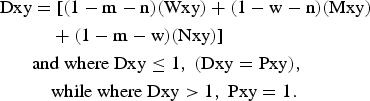
So you can in theory have done more to deserve property than the property itself can reflect, in which case you might be entitled to some sort of social compensation.
Applying a degrees-of-property model
Very atypical sorts of property may escape this model. If there is such a thing as property that I have in virtue of my worth, it will be non-distributional; it doesn't get calculated or enter into the equation. The property in my body may be property of that sort: it may not matter, for instance, how much work you put into my body. You may still have no property in it. On the other hand, non-distributional property is not necessarily absolute property: if the destruction of the universe would be prevented by snipping a hair on your head, against your will, your property right might not extend to such snipping. This means that non-distributional property rights might in fact be balanced against considerations of work, need, and merit, but not according to some distributional formula.
Building justice into the rules of property acquisition does not solve any problems of distributive justice. In particular, we will not agree on the relative weightings of needs, merit and work. These problems now re-emerge as arguments about whether or not someone has some degree of property in something. They persist within the theory of acquisition. For that very reason, what is eliminated is the conflict between property acquisition and distributive justice.
Also eliminated, though in a curious way, is the conflict between justice and free exchange. Nozick and others hold that the patterns of distributive justice will inevitably and legitimately be disturbed by procedurally fair bargains that produce new patterns of holdings. But procedurally fair bargains require that there is something to be bargained away, let's say between me and you. This something may have come into our possession through other exchanges, but at some point, someone acquired it. To simplify the discussion, suppose that the property we are going to exchange is ours by original acquisition. Then it follows that we both justly possess what we have: if we have property in it, it can only be because we deserve to have it according to the principles of justice. Now after the exchange, I may, sooner or later, get more utility out of the item than I deserve; the same holds for you. (This is quite likely when the exchange involves housing or investment vehicles and quite unlikely when it involves consumer goods.) It will not necessarily be the case that a beneficial exchange exceeds my property rights, because there may be some merit, considerable merit, in making the exchange itself. Trading ability is a meritorious skill and may have earned us additional desert for the objects acquired. But quite possibly, an exchange will result in our possessing more than we deserve. In that case, the exchange will be annulled or in some way modified, because it violates property rights, which make it impossible to acquire a right in something beyond one's desert in that thing! Then it is not as if some principle of distributive justice overrides my property rights. It is rather that I have ended up with something in which I never had a property in the first place – not to that degree.
As it goes for this first exchange, so it will go for exchanges dependent on our first exchange, or other exchanges. Whenever an exchange results in the possession of undeserved items, something has to give, because you cannot have any degree of property in something beyond what you deserve. But for that very reason, an exchange never results in people having property they don't deserve: since property is rightful possession of an item, that's impossible. So if we look at property rather than mere physical possession, exchange will not upset just patterns of distribution; it will merely move everyone from one just pattern to another. This may in practice involve much more interference in exchanges than libertarians would like, but they cannot claim that this interference violates their property rights. On the contrary, it is dictated by their property rights.
Practical considerations
In more practical terms, what would degrees of property look like?
When eternal possession of an item corresponds to someone's desert, and possession is limited only by moral constraints external to the acquisition process, then that person's property in the item will look like a conventional property right. This counts as having a 100% property right. How often this will occur depends in part on whether justice must compensate for an unfair ‘baseline’. If I have a head-start in life, perhaps I deserve less in proportion to my work, merit and needs than you do. The notion of degrees of property itself is neutral on this issue.
In other cases, property will have a degree less than 100%. My property in an item will be less than conventional rights would allow. Lesser property will have limitations on the manner in which an item may be used, or how much of it may be used, or the time for which it may be used. These limitations are not like Lockean provisos; they will not normally reflect the claims of others, or external moral constraints. It is not, in other words, that my use is restricted by competing moral considerations. It is rather that the moral considerations on which my property is established do not extend far enough to justify such use.
There are many ways other than limitation in time by which I might have less than complete property in something. I might be forbidden to use it in certain ways, or forbidden to sell it, or forbidden to pass it on to my heirs, or forbidden to profit from its sale. And some of these restrictions are in fairly common use. But these restrictions are almost always a matter of external constraints on property, of compromise with the claims of other owners or with various socially beneficial principles.
I will look at how degrees of property work when built into the acquisition process – first at limitations on land ownership, and then at limitations on intellectual property rights.
From traditional property to intellectual property
Suppose a Lockean case where I work on some unoccupied land; this is the obsolete paradigm of modern property rights. Even if I put in several years of hard work, it will in many circumstances seem implausible that my initial labour could give me eternal title to the land – my mixing of labor is certainly meritorious, but it isn't that meritorious. However, if I continue to farm the land, I continually put labour into it. This increases the likelihood that my work, over time, entitles me to possess the farm. (Considerations of merit may also apply; is my labor productive?) In practical terms, I might be assigned a high degree of property in my farm based on the expectation that it will continually require my labor.Footnote 7
However, there are also reasons why I might have less than a full degree of property in that land. One has to do with the needs of others: if they need some opportunity to work the land, or a portion of its products, then I will never have had title to those opportunities or products in the first place. Again, nothing is confiscated from me; it's just that my work did not suffice for me to acquire it. Perhaps needs will not limit my property right – perhaps the bums should work for a living – but such limits are a real possibility.
Another sort of reason may have to do with the land's increase in value. My work was not meritorious enough to enable me to get thirty million dollars by selling the land for condos. So I never had the right to make such a sale, and my ownership should reflect that fact. I should be constrained from making more than a much lesser amount by the sale.
There is another possibility – one which, I hasten to say, does not reflect the realities of farming in most of the world today. Maybe the land does not increase in value, or not spectacularly. But time passes, perhaps generations pass. Whether in my lifetime or in that of my heirs, the farm has become a very prosperous going concern, and the farm's owners are comfortable, underworked managers. They are coasting, and, over decades or even centuries, perhaps the farm generates hundreds of millions of dollars' worth of wealth. The farmers have become, in the fullest sense of the term, ‘haves’, largely because my initial efforts have been parlayed into eternal ownership.
Or have they? This is a typical case where property rights may not extend that far. After a certain point, the desert accumulated in the heroic early days has been used up, and the additional work put into the farm is not sufficient to sustain full property in it. There will be many cases involving land, especially urban land, where this is to be expected, as it is with other appreciating assets. If and when it is to be expected, a simple way of expressing the limitation on property in these items would be to think of the property right as limited in time. As the asset appreciates in value, the right depreciates in degree. Eventually, barring additional meritorious effort, it vanishes altogether. In the case of holdings such as stocks, a property right might be prolonged by meritorious financial management or risk-taking, but here too one would expect that right to run out after a while. When it does, one might ask what happens to the asset. As a matter of practice, it may revert to the state. But it may well be that other people, on the basis of need, gain title to the asset, at least for a time, or that others may acquire the asset through work or merit.
Remember, however, that we are talking about the moral basis of property acquisition, not a proposal for property laws. In any practicable legal system, one could hardly expect landed property to have a nicely tuned expiration date. Nevertheless it is important to realize that any system which accords permanent property rights to appreciating assets is likely to run afoul of its moral foundations unless it compensates for the conflict elsewhere. This has very real practical consequences, because societies consult their moralities when establishing the legal framework in which the market must operate.
When we turn to intellectual property, it is the Lockean system that seems creaky and impractical, and the notion of degrees of property that seems like a promising replacement candidate. In a Lockean model, it makes sense that everyone has not only long-term, but eternal intellectual property in what they write or create: they've mixed their labor more thoroughly in their creations than has any farmer in a plot of land. It is only the status of copies of the work that create any real issue. And as Lockean rights extend, it makes sense that they should be transferred like any others, so that the works of a great artist might be sold for pennies to make millions for advertisers of toilet paper.
Degrees of property suggest a view more palatable to those disturbed by the current system. In the first place, I will acquire in my creations only as much property as I deserve, that is, as merit and work demand. This at least opens the possibility of some relationship between intellectual property and its intellectual merits, which are usually evaluated in terms other than their market value. Second, since intellectual property can rarely be limited in spatial extent, it is a prime candidate for limitation in time. Property in a great original work might last longer than property in a mediocre one, though there is room for argument here: audience appeal might itself count as a form of merit. But the most important opening to alternative intellectual property arrangements would involve debates around the value of popular creations. Yes, the value of a good song might be quite high, but would it be in the millions? If not, then property in that song would be extinguished by the very fact that a certain income threshold had been crossed. The degree of property you have in an item cannot outstrip your deserts in relation to that thing: you get as much property in an item as your associated needs, talents, and activities are worth. So when an artist has got the value out of a creation that he deserves for creating it, his property in that creation must cease. Presumably, in such cases, it enters the public domain.
Conclusion
The notion that all property admits of degree is more a tidying up of moral considerations than an utterly revolutionary approach. Because the relative weights of need, merit and work are undetermined, the old controversies continue. There is still room for dispute about the extent to which the needs of the have-nots trump the work and merits of the haves. But what vanishes is the conflict between property and distributive justice. No longer can it be asked: if I legitimately acquired my property, if I obtained it playing by your rules, what right have you to make me give it up? The answer now is: “None: if you have to give it up, it is because your property rights have run out. Justice does not trump your property rights. Instead, they never extended past the point where possession runs afoul of justice. Beyond that point, you never acquired it in the first place.”


