

Introduction
In Australia, workforce shortages in healthcare present an imminent future crisis. This problem is particularly acute in Australia, compounded as a result of two key trends. First, baby boomers, who make up a large portion of the healthcare workforce, will reach retirement age within the next two decades (Graham & Duffield, Reference Graham and Duffield2010; Hodgkin et al., Reference Hodgkin, Warburton, Savy and Moore2016; Spence Laschinger & Finegan, Reference Spence Laschinger and Finegan2008; Warburton et al., Reference Warburton, Moore, Clune and Hodgkin2014). Second, as a result of population ageing and increased longevity, an increased demand for health and aged care services is anticipated (Australian Government., 2010). This is particularly evident in rural areas which have a higher proportion of older people (Davis & Bartlett, Reference Davis and Bartlett2008) placing additional demands on an already over-stretched healthcare system. Additionally, the workforce is ageing more rapidly in rural areas (Hodgkin et al., Reference Hodgkin, Warburton, Savy and Moore2016). Targeted retention of this cohort may alleviate the problem in the short term.
The federal policy agenda in Australia is designed to increase retirement age and extend working lives. Despite targeted initiatives, there remains an ongoing trend towards early retirement, with average age of retirement for those who have left work over the past 5 years being 61.5 years (Australian Bureau of Statistics, 2013). Further, women retire younger than men (Australian Bureau of Statistics, 2013). This pattern is more pronounced in the nursing workforce with nurses more likely to retire at an earlier age than general practitioners (Schofield, Reference Schofield2007). The broad body of retirement research has highlighted three salient factors affecting retirement decisions: finances and the available income replacement rate; the health of the older worker and their family; and the nature of the work itself (Blakeley & Ribeiro, Reference Blakeley and Ribeiro2008; Schofield et al., Reference Schofield, Fletcher, Page and Callander2010; Siegrist et al., Reference Siegrist, Wahrendorf, Von Dem Knesebeck, Jurges and Borsch-Supan2006).
In light of the impending healthcare crisis, exploring factors which serve as barriers and incentives to the continuing workforce longevity of this important cohort of older healthcare professionals becomes critically important. A number of general organisational or work-related factors have been identified in the literature. These include job satisfaction, commitment, recognition, scope of practise, supportive culture, and workloads (Armstrong-Stassen & Ursel, Reference Armstrong-Stassen and Ursel2009; Fitzgerald, Reference Fitzgerald2007; Moseley et al., Reference Moseley, Jeffers and Paterson2008; O'Brien-Pallas et al., Reference O'Brien-Pallas, Duffield and Alksnis2004). A more specific literature examines a complex interplay of push and pull factors influencing retention of older healthcare professionals. Poor health, work fatigue and organisational factors such as lack of supervision, overbearing bureaucracy and poor work environments influence intention to retire in the nursing profession (Schulz et al., Reference Schulz, Damkröger, Heins, Wehlitz, Löhr, Driessen and Wingenfeld2009). In contrast, pull factors include flexible work arrangements, outside work interests, financial circumstances, partner's retirement status and caring responsibilities (Shacklock & Brunetto, Reference Shacklock and Brunetto2011; Shultz et al., Reference Shultz, Morton and Weckerle1998).
Theoretical Model
The current research is positioned within a theoretical framework, which allows for a greater understanding of the psychosocial processes at work that might impact on retirement intentions. Two internationally acclaimed models that assess psychosocial work factors include Karasek's (Reference Karasek1979) Job-Demand-Control (JDC) model and Siegrist's (Reference Siegrist1996) Effort Reward Imbalance Mode (ERI). Karasek's (Reference Karasek1979) seminal work established a theory of workplace stress. Karasek theorised that heavy job demands (time pressures and having too much work) and low decision latitude (ability to have some control over work) was associated with both psychological strain and job dissatisfaction. Karasek's model has been used in several studies of workplace stress. More recently, the model has been used to examine whether early retirement thoughts can be explained by the job-demand control model. Elovainio et al.’s (Reference Elovainio, Forma, Kivimäki, Sinervo, Sutinen and Laine2005) study of social and healthcare employees aged 45 years found that poor job control associated with high job demands increased the likelihood of thinking about early retirement. Harkonmaki et al. (Reference Harkonmäki, Rahkonen, Martikainen, Silventoinen and Lahelma2006) also found that employees with high job demands and low job control were more likely to report strong intentions to retire (p. 561). However, in an Australian study of a large public sector organisation, Oakman and Wells (Reference Oakman and Wells2013) were unable to establish that high job demands and low job control predicted intention to retire.
Building on the work of the Karasek's (Reference Karasek1979) model, the ERI developed by Siegrist (Reference Siegrist1996) posits that effort within a work context is expended as part of a contractual agreement based on the fundamentals of social reciprocity, where rewards are afforded. Additionally, the model surmises that work agreements frequently fall short of providing a commensurable exchange. When an imbalance exists between extrinsic effort (time pressure, increased workloads, heightened responsibilities) and a low level of perceived reward (financial, career opportunities, esteem), work-related stress results which can cause sustained strain reactions in the autonomic nervous system (Siegrist et al., Reference Siegrist, Starke, Chandola, Godin, Marmot, Niedhammer and Peter2004). This imbalance has the potential to manifest as a state of active distress by inducing strong negative emotions, which in turn activate the two main stress axes; the sympathetic-adrenomedullary and the pituitary-adrenal-cortical system (Siegrist et al., Reference Siegrist, Matschinger, Cremer and Seidel1988). In the long term, prolonged autonomic nervous system activation can contribute to the development of physical diseases and psychological strain. A final postulation of the ERI model involves individual differences in the experience of effort-reward imbalance (ERI). People characterised by a motivational pattern of excessive work-related commitment and a high need for approval (overcommitment)have a greater risk of experiencing strain(van Vegchel et al., Reference van Vegchel, de Jonge, Bosma and Schaufeli2005). It is assumed that the strain reaction caused by the high effort and low reward condition is intensified by overcommitment, whereby the highly committed will respond with a more intense strain reaction to an ERI, in comparison with an employee who is less committed (van Vegchel et al., Reference van Vegchel, de Jonge, Bosma and Schaufeli2005).
Both the JobDemand-Control and ERI models have generated substantial bodies of research. The reciprocity factors (effort/reward) of the ERI model (Siegrist, Reference Siegrist2010) set it apart from the Job Control model (e.g., Karasek, Reference Karasek1979). It has also been argued that ERI model provides a better predictor of health outcomes (Bohle et al., Reference Bohle, Quinlan, McNamara, Pitts and Willaby2015) with a developing body of research linking ERI and cardio vascular disease (Aboa-Éboulé et al., Reference Aboa-Éboulé, Brisson, Blanchette, Maunsell, Bourbonnais, Abdous and Dagenais2011; Appels et al., Reference Appels, Siegrist and De Vos1997; Gilbert-Ouimet et al., Reference Gilbert-Ouimet, Brisson, Vézina, Milot and Blanchette2012; Siegrist, Reference Siegrist2010; Söderberg et al., Reference Söderberg, Rosengren, Hillström, Lissner and Torén2012) and psychological strain (e.g., Blum et al., Reference Blum, Cull, Braverman and Comings1996; Hinz et al., Reference Hinz, Zenger, Brähler and Spitzer2016; Nourry et al., Reference Nourry, Luc, Lefebvre, Sultan-Taïeb and Béjean2014; Siegrist et al., Reference Siegrist, Klein and Voigt1997; Tsutsumi et al., Reference Tsutsumi, Kawanami and Horie2012).
The ERI model has also been applied to healthcare workforce. Thus, ERI has been linked to burnout in nurses (Bakker et al., Reference Bakker, Killmer, Siegrist and Schaufeli2000; Spence Laschinger & Finegan, Reference Spence Laschinger and Finegan2008); depression in nurse managers (Nourry et al., Reference Nourry, Luc, Lefebvre, Sultan-Taïeb and Béjean2014), reduced job satisfaction and increased mental distress amongst G.P.s (Calnan et al., Reference Calnan, Wainright and Almond2000), and in a large-scale Danish study, health workers had the largest ERI ratios (Rugulies et al., Reference Rugulies, Aust, Siegrist, Von Dem Knesebeck, Bültmann, Bjorner and Burr2009). Similarly, a Japanese study of private physicians found ERI to be significantly associated with depression (Tsutsumi et al., Reference Tsutsumi, Kawanami and Horie2012). Studies of the broader older workforce have found ERI to be associated with intention to retire early (Siegrist et al., Reference Siegrist, Wahrendorf, Von Dem Knesebeck, Jurges and Borsch-Supan2006) and an Australian study of workers aged between 45 and 64 years found ERI to be associated with increased psychological strain (Bohle et al., Reference Bohle, Quinlan, McNamara, Pitts and Willaby2015). Despite this body of work, there is limited research that specifically explores ERI and psychological strain in the older healthcare workforce and whether strain is related to intention to retire early.
Aims of the Study
This study sought to redress the limitations in this research by using the ERI framework to examine psychological strain and intention to retire in Australian healthcare workers (over 55 years) in rural Australia. In addition, this study aimed to contribute to theoretical knowledge by verifying a strand of research that moves away from using the ERI index recommended by Sieriest (Reference Siegrist1996) to using the separate variables effort and reward and interaction effects and examining individual differences (Kinman & Jones, Reference Kinman and Jones2008; Preckel et al., Reference Preckel, Meinel, Kudielka, Haug and Fischer2007).
In line with previous studies and specific recommendations by Siegrist (Reference Siegrist, Perrewe and Ganster2002), the following three hypotheses were tested: (a) the extrinsic ERI hypothesis, which posits that the imbalance between perceived high efforts and low rewards is associated with psychological strain; (b) the intrinsic over-commitment (OVC) hypothesis which posits that the higher the level of OVC the greater the psychological strain and (c) the intrinsic interaction hypothesis which posits that ERI combined with higher levels of OVC increases the risk of psychological strain. A further hypothesis, hypothesis (d) was that intention to retire would be associated with psychological strain.
Method
Ethics approval for this study was sought and granted by the La Trobe Human Ethics Committee (Ref: 10/187).The study was undertaken in one large health region located across rural northern Victoria, Australia. To respond to a gap in knowledge and to minimise variation in the sample, targeted healthcare workers in this study encompassed only nurses and allied healthcare workers working in publicly funded settings, both residential and community, who were 55 years and over. The sample comprised 295 respondents. Of these, 94.3% were female, which, given the recognised feminisation of the healthcare workforce in the realms of the nursing and allied health professions (90.4%), was an expected disparity (Australian Instutute of Health and Welfare, 2011). There were 256 (86.2%) nurses, and 39 (13.1%) allied health professionals, representative of the structure and composition of Australian public health system (Australian Government Productivity Commission, 2005). The age of respondents ranged from 55 years to 71 years, with a mean of 59 and standard deviation of 3. The study was considered adequately powered given the sample size of over 250. The response rate of 39.7% represents an above average response as noted by authors such as Baruch and Holtom (Reference Baruch and Holtom2008).
Measures
Measures developed from existing literature were selected to improve the generalisability of the study's findings. ERI was measured using the comprehensive 23-item version of the model published by Siegrist (Reference Siegrist, Perrewe and Ganster2002). Items were measured on a five-point Likert scale (strongly disagree to strongly agree). The effort component of the model represents features of a work environment (workload, time pressures, responsibility and other demands). It is measured by six items that refer to the demanding aspects of the extrinsic work environment, with an example including ‘I have constant time pressure due to a heavy workload’. The internal consistency of this scale was 0.86. The reward component of the model deals with extrinsic rewards and is broken down into three subscales including monetary reward (salary), esteem (respect and support) and job security (promotion prospects, security and status). The extrinsic reward component was measured by 11 items, with the questions covering each of the three components inherent to the model with an example being, ‘Considering all my efforts and achievements, I receive the respect and prestige I deserve at work’. As recommended by Siegrist (Reference Siegrist, Perrewe and Ganster2002), the ratio score was then computed using an adjustment figure to account for the greater number of reward items, in order to make the scales comparable. The reward scale generated an internal reliability of 0.87. The final six items constituted the OVC scale, which refers to the intrinsic effort expended by participants at work. An example here includes, ‘Work rarely lets me go, it is still on my mind when I go to bed’. The OVC variable yielded an internal consistency of 0.89.
Psychological strain
The 12-item version of the General Health Questionnaire (Goldberg, Reference Goldberg1978) was used to assess the current levels of psychological strain of participants. This standardised instrument has been well established for use in occupational settings and scored on a Likert scale (0–3), where higher scores represent higher degrees of psychological strain. Respondents were asked to indicate the extent to which, over the previous six weeks, they had experienced each of the listed affective and somatic symptoms. The internal consistency of the scale was 0.89, within the range established by Banks et al. (Reference Banks, Clegg, Jackson, Kemp, Stafford and Wall1980) as acceptably high.
Decision to Retire
Respondents were asked about their retirement intentions using the following question, ‘Do you intend to retire early?’ There were four response categories: 1= No; 2= Doubt It; 3= Possibly; 4= Yes. Respondents were also asked as open ended question ‘What is the decision about retiring dependent on?’ Responses were categorised according to identified themes and frequency of responses.
Analysis
Exploratory analyses were performed to describe the distributions of psychological strain, effort, reward, effort-reward ratio, OVC, intention to retire early, and the various demographic variables, as well as the associations among them. The bivariate associations were tested using a Spearman correlation analysis for continuous and ordinal variables, an independent samples t-test for the association between gender and strain, and a chi-square test for the association between gender and intention to retire. Given there were relatively few males in the sample, the first two and last two categories of intention to retire were combined in the chi-square test of independence between gender and intention to retire.
Psychological strain was modelled using the general linear model (regression) as a function of effort, reward, OVC, and all two- and three-way interactions between them. Due to the retirement literature, age was included in the model. Following the work of Kinman and Jones (Reference Kinman and Jones2008), gender was also included in the model. Independent variables were centred on their respective means prior to modelling. Residual diagnostics were checked to ensure the data were consistent with the assumptions of the model.
To test whether intention to retire was directly and/or indirectly (via psychological strain) related to ERI or OVC, intention to retire early (with categories of ‘No’, ‘Doubt it’, ‘Possibly’ and ‘Yes’) was modelled as a function of effort, reward, OVC, and strain using ordinal regression with a logit link. Preliminary analyses suggested that age may be an important control variable, so age was also included in the model. A test of parallel lines was performed to check that proportional odds could reasonably be assumed.
All analyses were performed using IBM SPSS v22.
Results
Exploratory Analysis
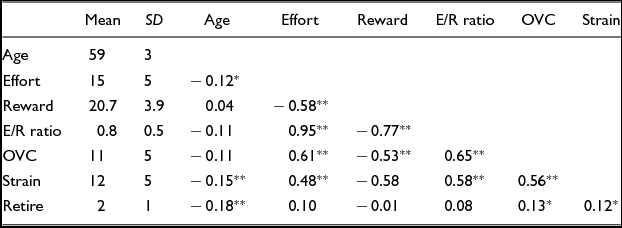
Approximately, 25% of respondents had an effort-reward ratio greater than one (which indicates an ERI). The mean Effort-Reward ratio was 0.8 (SD = 0.5)(Table 1). This is somewhat higher than other studies of predominantly nursing workforce: Nourry et al. (Reference Nourry, Luc, Lefebvre, Sultan-Taïeb and Béjean2014) was 0.68, and in Spence Laschinger and Finegan (Reference Spence Laschinger and Finegan2008) 0.69.
Summary Statistics and Spearman Correlations for Demographic Variables, Effort, Reward, Effort-Reward (E/R) Ratio, OVC and Outcome Variables

*p < .05, **p < .01.
Statistically significant correlations were found between age, effort, effort-reward ratio, OVC and the outcome variable psychological strain (Table 1). Age was negatively correlated with strain (r S = −0.15, p < .01), while effort, effort-reward ratio and OVC were all positively correlated with strain, with Spearman correlations of 0.48, 0.58 and 0.58, respectively (all with p < .01). An independent samples t-test indicated there was no association between gender and strain, t(293) = 1.83 and p = .068. Intention to retire was negatively correlated with age (r S = −0.18, p < .01), and positively correlated with OVC (r S = 0.13, p < .05) and strain (r S = 0.12, p < .05). There was no evidence of an association between gender and intention to retire, χ 2(1, n = 294) = 1.14, p = .286.
The Effect of Demographic Variables, Effort, Reward and OVC on Psychological Strain
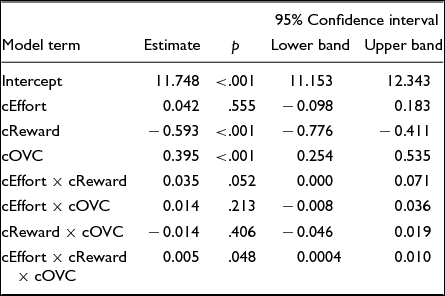
Psychological strain was modelled as a function of gender, age, effort, reward, OVC and all two- and three-way interactions between effort, reward and OVC. The predictors explained 45.5% of the variation in strain, and the model was statistically significant with F(9, 277) = 25.667 and p < .001. Gender and age were non-significant, with F(1, 277) = 2.256 and p = .134 for gender, and F(1, 277) = 3.256 and p = .072 for age. The Effort × Reward × OVC interaction was statistically significant, F(1, 277) = 4.114 and p = .043.
The model was re-fitted without gender and age, and the regression coefficients are given in Table 2, with p-values and 95% confidence intervals. The procedure of zero slope comparison (Nye & Witt, Reference Nye and Witt1995; Francoeur, Reference Francoeur2011) was used for interpreting the three-way interaction between effort, reward and OVC as follows. First, from the model reported in Table 2, equations for strain were derived at OVC levels of 10, 15 and 20 (note that participant's OVC scores ranged from 6 to 28, with mean 10.9):
Parameter Estimates for the Model of Psychological Strain (‘c’ at the Beginning of a Name Signifies that Variable has been Mean Centred)

 $$\begin{eqnarray*}
{\rm At\; OVC} &=& 10 \\
{\rm{Strain}} &=& 32.183 - 0.795\,\, \times {\rm{Effort}} - 1.01 \times {\rm{Reward}} \\
&&+\, 0.029\, \times \,{\rm{Effort}}\, \times \,{\rm{Reward}}
\end{eqnarray*}$$
 $$\begin{eqnarray*}
{\rm At\; OVC} &=& 15 \\
{\rm{Strain}} &=& 42.153 - 1.335 \times {\rm{Effort}} - 1.455 \times {\rm{Reward}} \\
&&+\, 0.054 \times {\rm{Effort}} \times {\rm{Reward}}
\end{eqnarray*}$$
 $$\begin{eqnarray*}
{\rm At\; OVC} &=& 20 \\
{\rm{Strain}} &=& 52.123 - 1.875 \times {\rm{Effort}} - 1.9 \times {\rm{Reward}} \\
&&+\, 0.079 \times {\rm{Effort}} \times {\rm{Reward}}
\end{eqnarray*}$$
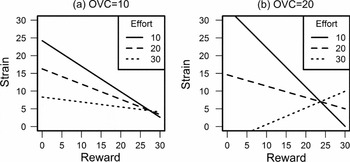
Then, equations for the rate of change in strain with respect to reward (i.e., the partial derivative) were derived for each level of OVC, and from these the value of effort was calculated at the point where the slope (rate of change) is zero. At OVC = 10, the zero slope occurs at an effort of 34.8, which lies outside the effort scale (6–30). When effort is less than 34.8, the slope is negative. This indicates that strain decreases as reward increases, and from the expression for the rate of change it can be shown that this effect is amplified at lower values of effort (i.e., the magnitude of the slope increases, see Figure 1(a)). At OVC = 15, the zero slope occurs at effort 26.9, and the slope is negative below this value and positive above it. That is, at effort levels lower than 26.9 strain decreases with increasing effort, but at higher levels of effort increasing reward leads to greater psychological strain. The same pattern is seen for an OVC level of 20, except that the zero slope occurs at an effort level of 24.1. For example, at an OVC of 20 and effort of 30, an increase in reward from 15 to 30 (i.e., a decrease in the effort/reward ratio from 2 to 1) is predicted to increase strain by 7 units, from 3 to 10 (Figure 1(b)). In contrast, at an OVC of 10 and effort of 30, the same increase in reward reduced predicted strain by 2 units, from 6 to 4 (Figure 1(a)). In sum, at the highest levels of effort and OVC an increasing reward has the effect of increasing psychological strain, whereas at lower levels of OVC increasing reward decreases strain.
Effect of OVC at two levels.

The Effect of Effort, Reward, OVC, Strain and Age on Intention to Retire Early
Intention to retire early was coded as No (1), Doubt it (2), Possibly (3) and Yes (4). The percentage of respondents in each category was 54.3%, 20.9%, 18.5% and 5.7%, respectively. An ordinal regression analysis indicated there was no evidence of an association between intention to retire early and effort (Wald χ 2(3) = 1.167, p = .761), reward (Wald χ 2(3) = 3.341, p = .342), OVC (Wald χ 2(3) = 4.138, p = .247), strain (Wald χ 2(3) = 1.185, p = .757), or any two- or three-way interactions between effort, reward and OVC after adjusting for age. Only age had a statistically significant effect on intention to retire (Wald χ 2(3) = 14.53, p = .002). The cumulative odds of being in a higher category of intention to retire were estimated to decrease by 0.896 times for each year increase in age, with 95% confidence interval (0.833, 0.964). That is, older subjects were less likely to intend on retiring early.
Factors Influencing the Decision to Retire
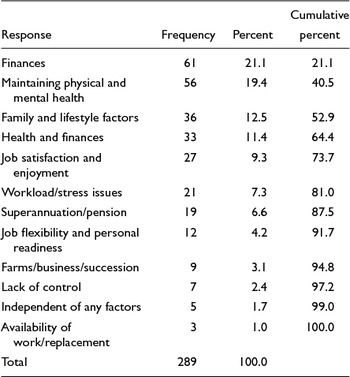
Responses to the question ‘What is the decision about retiring dependent on?’ are summarised in Table 3. The primary factors, which make up 81% of the responses, include finances, maintaining physical and mental health, family and lifestyle, health and finances, job satisfaction and enjoyment, and workload/stress issues. While the ordinal regression in the previous section indicated that psychological strain had no apparent effect on intention to retire, workload/stress issues did rank sixth among the factors influencing the decision to retire.
Frequency Table of Responses to the Question ‘What is the Decision About Retiring Dependent On?’

Discussion
In the present study, we set out to examine whether ERI was related to psychological strain and subsequent intention to retire in rural, older healthcare workers in Australia. We discovered the relationship between ERI, OVC and psychological strain to be more complex than was initially hypothesised. We found some support for the extrinsic hypotheses — that ERI is related to increased strain; however, this could only be confirmed at lower levels of OVC. While we found a three-way interaction between effort, reward and OVC, the consequences of this interaction effect are not consistent with the intrinsic interaction hypothesis — that ERI combined with higher levels of OVC increases the risk of psychological strain. At lower levels of OVC, we found that strain decreases with increasing reward. However, at the highest levels of effort and OVC an increase in reward (i.e., a decrease in ERI) increased psychological strain.
While this result seems counter intuitive to the ERI model, it would appear that for those who score high on overcommitment increasing reward merely increases the psychological strain. This might be explained by how the overcommitted experience increased effort and associated rewards. For most individuals, rewards tend to increase levels of dopamine in the mesolimbic pathway, enhancing self-regulatory resources thus enabling individuals to maintain effort (Siegrist et al., Reference Siegrist, Matschinger, Cremer and Seidel1988). However, it is surmised that for those who are overcommitted, increased reward merely reinforces the excessive effort and as this mounts, increased strain is experienced. This adds a new dimension the ERI research. To date, research undertaken on this interaction effect has produced inconsistent findings. The interaction hypothesis has been rarely tested in the research literature, and when it has support has been mixed (van Vegchel et al., Reference van Vegchel, de Jonge, Bosma and Schaufeli2005). For instance, of the three studies examined by van Vegchel et al. (Reference van Vegchel, de Jonge, Bosma and Schaufeli2005), only one study found that the risk of ERI were aggravated by overcommitted employees whereas the other two found no evidence for a moderating effect (van Vegchel et al, Reference van Vegchel, de Jonge, Bosma and Schaufeli2005, p. 1124). Similarly, other studies (Kinman & Jones, Reference Kinman and Jones2008; Preckel et al., Reference Preckel, Meinel, Kudielka, Haug and Fischer2007) using linear hierarchical regression with continuous variables and strain as the dependent variable, did not find support for the interaction hypothesis. This has led Kinman and Jones (Reference Kinman and Jones2008) to conclude that OVC appears to be an independent risk factor to psychological distress. More recent research has argued that conclusions made by others in relation to the interaction hypothesis have ignored possible individual differences in the interaction of ERI and OVC (Feldt et al., Reference Feldt, Huhtala, Kinnunen, Hyvönen, Mäkikangas and Sonnentag2013). Based on the findings presented here, we would also argue the importance of plotting the change in the role of OVC and the influence of increased/decreased rewards on strain.
With regard to the relationship between intention to retire early and ERI, while the ordinal regression in the previous section indicated that psychological strain had no apparent effect on retention to retire, older subjects were less likely to intend on retiring early. Thus, increased strain might not necessarily promote early retirement, and conversely high income might diminish strain but increase early retirement—suppressing the association between strain and early retirement. Examining factors impacting on retirement decisions, workload/stress issues ranked sixth. While organisational and professional factors are an integral part of retaining employees and delaying retirement, other factors need to be considered. The findings presented here confirm that the decision to retire is complex highlighting the important shift or junction in people's lives (Schwingel et al., Reference Schwingel, Niti, Tang and Ng2009). They lend support to the broader body of retirement research that suggest a complex interplay between push and pull factors (Boumans et al., Reference Boumans, de Jong and Vanderlinden2008; Humphreys et al., Reference Humphreys, Jones, Jones and Mara2002; Schofield & Beard, Reference Schofield and Beard2005; Shacklock & Brunetto, Reference Shacklock and Brunetto2011).
The findings of the present study should be considered in light of the limitations intrinsic to the design. The cross-sectional nature of the data constrains the ability to make causal inferences regarding the relationship among the study variables. Even though there have been similar studies examining ERI amongst health workers using cross-sectional data, the findings should be interpreted with caution. Longitudinal studies that track the changes in ERI scores over time would contribute knowledge of the cause and effect regarding this interface. The present study also relied on self-report measures and may have introduced common method variance. It is also acknowledged that the intention to retire early scale could be further developed and refined in future research. Based on answers to the open-ended question, a new measurement scale could be developed to reflect the complexity involved in retirement decisions.
Despite such limitations, this study has focussed attention on a workforce severely under challenge, and by using the ERI model has provided some insights into intention to retire and psychological strain by these workers. We were able to confirm that ERI is related to increased psychological strain in healthcare workers. A qualitative examination of the psychosocial factors which contribute to the intention to remain or alternately exit the workforce would provide valuable information on the causal effect of effort and reward asymmetry.