Introduction
A hundred years have elapsed since Lionel de La Laurencie explained the essentials concerning the arrival of Eustachio Bambini and his three performers of intermezzos on the Paris Opéra stage in August 1752.Footnote 1 They would be a presence in Paris for eighteen months, along with various other Italian singers who visited later. Unlike most travelling virtuosi, Bambini's artists had become accustomed to putting down roots, since before coming to Paris they had entertained the public at Strasbourg for three years.
The clash between Italian comic opera genres and established traditions of opera was capable of sparking considerable emotion, not least in Italy itself: sometimes the authorities there took action to limit comedy's exposure.Footnote 2 So the much-debated circumstances of Bambini's departure, early in 1754, were not wholly unusual. Yet the government's decision to curtail his performances centred not on reactions to the new music, but rather the anger aroused by an essay: Jean-Jacques Rousseau's Lettre sur la musique françoise. Ever since that time, accounts of the Bambini period have been intertwined with accounts of the sixty-odd polemical publications leading up to Rousseau's Lettre, polemics conveniently labelled as the ‘querelle des bouffons’. As Alessandro di Profio has noted:
Our attention as researchers has basically focused on political or aesthetic questions rather than musical perspectives, so much so that fourteen operas have often been eclipsed by the two ‘corners’ [meaning the spaces adopted by opposed supporters of ‘French’ and ‘Italian’ music at the Opéra]. Repertory studies on performances of Eustachio Bambini's troupe at the Paris Opéra are thus sparse, notwithstanding the overall picture regarding musical sources set out in 1912 by Lionel de La Laurencie.Footnote 3
The available statistics prove the degree of eclipse that Di Profio suggests: currently, should one key ‘querelle des bouffons’ and ‘Eustachio Bambini’ into RILM (Répertoire International de la Littérature Musicale), the former obtains one hundred and four ‘hits’ and the latter just seven.Footnote 4 Indeed, the tendency to conflate ‘querelle’ and ‘bouffons’ is visible even in the opening sentence of an article dedicated to separating them: ‘Much has been written about the Italian Season in Paris, or the “War of the Bouffons”, which evolved over a period of eighteen months from 1752 to 1754.’Footnote 5
A year after Di Profio's article appeared, Andrea Fabiano set out to define ‘the pitfall of the querelle des bouffons’ (‘le piège de la “Querelle des Bouffons”’), according to which the pamphlets ‘have placed a screen in front of the reality of [Bambini's] Paris reception’ (‘ils ont aussi interposé un écran devant la réalité de la réception parisienne’).Footnote 6 Among the resultant distortions, Fabiano found various more detailed ‘interpositions’, ways in which one kind of event had demonstrably displaced other historical realities, thus making a nuanced interpretation of its different threads impossible up to the present. His arguments may be summarized as follows:
(a) A ‘superimposition’ occurred at the time, whereby a still solidifying ‘system of theory and aesthetics’, above all defined by Jean-Jacques Rousseau, coloured and clouded public reception.
(b) Pre-bouffon modes of public dissension, such as Baron von Grimm's Lettre sur Omphale early in 1752, are more significant than we have allowed. They oblige us to reconsider the assumption that the bouffons were the sole cause of later pamphleteering. The two largest clusters of pamphlets were provoked less by bouffon performances than by the two most influential texts themselves, namely Grimm's Le petit prophète de Boemischbroda and Rousseau's Lettre sur la musique françoise.
(c) It suited the philosophes to make La serva padrona the main point of aesthetic and theoretical reference, whereas several other bouffon operas were better received, especially Il giocatore and Bertoldo in corte.
(d) Close reading of reviews in Mercure de France reveals that various strands of reception coexisted at the time.
(e) It was on the philosophes’ agenda to disparage the purely artistic qualities of the Bambini troupe in order to make their actual public success appear the greater. In reality the singers had a long record of performances in Italy and beyond that betokened real quality.
(f) Even among pro-French querelle tracts one can find contradictory arguments, such as the claim that an opera text is secondary to its music, or even negligible by comparison with the effect created by ‘the music itself’.Footnote 7 (Conservatives were wont to ‘assert the dramatic power of the tragédie lyrique’; their opponents vaunted ‘the graceful charm and clear harmonic structure of Italian cantilena’.Footnote 8) In other words, conservative opinion itself had fragmented, even on an aesthetic level.
It seems apt to invoke an essay by Fabrizio della Seta at this point, which examines the acute difficulties concerning opera as a historical subject:
What if we try to grasp the multiplicity of [an age's] links and oppositions, recognizing, with Wittgenstein, that ‘the strength of the thread does not reside in the fact that some one fibre runs through its whole length, but in the overlapping of many fibres’?Footnote 9
Della Seta eventually decided that in opera studies ‘it is essential’ to unravel these fibres on the level of both diachronic ‘systems’ and so-called ‘events’. ‘It is essential to do so if we wish to grasp continuities and breaks … since each single “fact” – whether it is an author, work or event – comes at the intersection of a multiplicity of systems.’Footnote 10 ‘Breaks’ and ‘continuities’ are even harder to construe where one type of field intersects with another, or the demands of different languages and conventions overlap: there may well be resultant gaps in our current histories.
The present article aims to untangle some of Wittgenstein's ‘threads’ by focusing on fresh evidence about the Bambini troupe's residence itself. There are doubtless many more to be untangled in the future, but I hope to reinforce Fabiano's incipient rebalancing of the conventional narrative and his nuanced separation of the Bambini visit from polemical reactions surrounding it.
Against the alterity of the bouffons, historians have always been attracted by the textual security provided de facto by the pamphlets and tracts of the querelle. Not only were the bouffons giving a specialized style of opera, they were doing so within an Italian system that was particularly flexible regarding the identity of ‘works’ as acted on stage, and which (for historians) does not encourage easy estimates, let alone summaries, of an artistic achievement spanning fourteen productions in eighteen months. Such systems helped produce the delay that was experienced before a historiographical acceptance of Italian opera became general. One salient reason della Seta gave for that delay applies also as a characteristic of the bouffon repertory: ‘the possibility of moving an opera's component parts around within the work itself, from one work to another, and indeed from an opera by one composer to that of another’.Footnote 11
When historians before La Laurencie interpreted the visit of Bambini to Paris, a nineteenth-century awareness of national aspiration came in useful, together with metaphors drawn from strife in general. We see these enduring threads clearly in Eugen Hirschberg's 1903 narrative: ‘The reconciliation between supporters of Lully and Rameau became all the stronger in order to make common cause in safeguarding French national opera against the opposition of an Italian company that came to Paris under the leadership of a certain Bambini in summer 1752.’Footnote 12 (It is worth mentioning that in his following list of the individual works presented, Hirschberg omitted an important intermezzo entitled Tracollo, one which was actually revived later during the bouffons’ sojourn.)
In reality, the motives of those querelle participants who left a published trace remain veiled. In the case of Rousseau, however, our knowledge of a personal anti-Rameau campaign is secure.Footnote 13 Within the most detailed analysis to date of the literature of the querelle, Elisabeth Cook leaves the strongest impression that non-musical factors (which she duly explains) account for the initial cluster of pamphlets having been issued only after five works had already been presented on stage by the bouffons.Footnote 14 Cook's awareness of overlapping, synchronous ‘threads’ encourages us, with Fabiano, to decouple the narrative suggested by the pamphlets from the reality of theatre management – and indeed public taste. Cook's final warning, for example, is that the evidential base is still narrowly investigated: ‘have we uncovered all the pamphlets relevant to the “Querelle”, given the vast quantities of censored, often scurrilous, literature that circulated clandestinely in Paris at the time?’.Footnote 15 Without going as far as François Moureau in estimating that the querelle might as well have existed ‘on another planet’ for all its impact on the Opéra's repertory, let us note that the querelle failed to stay alive when many of the Italian arias and ensembles introduced by the Bambini troupe took up long-term residence at the smaller theatres of Paris, in vernacular versions.Footnote 16
Thus we may suggest that hyperbole has had its day, at least as presented in such terms as ‘a flood of writings … without equal in music history’, or ‘This was not just a life-and-death struggle among musicians’.Footnote 17 On the other hand, there is no need to reject Hirschberg's estimate of the importance of Italian singing as such, which he links to issues over and above French vocalism, using the pamphlets as evidence:
The clarity and detail of Italian musical forms were praised, but also the admirably thorough training of the Italian singers by comparison with a poorly developed French vocal art. People felt oppressed by the stubborn fetters and high seriousness of traditional French opera after having been exposed to the gaiety of Italian musical comedy.Footnote 18
Very similar thoughts have been published as recently as 2009: ‘those sympathetic to the offerings of the Italian “buffoons” perceived the intermezzi as free of constraint, spontaneous and relevant to daily life, in comparison with the convention-bound, staid offerings of the Opéra, which reflected an increasingly irrelevant monarchical culture’.Footnote 19
Hermann Abert, a generation after Hirschberg, retained the latter's simplified notion of a confrontation of nationalities, but also explored the notion of some meta-musical dimension at the core of the debate; this he identified as ‘the first noisy echo of the new spirit of radicalism’.Footnote 20 The implications of this line of reasoning have recently been developed by T. C. W. Blanning.Footnote 21 For all his brilliant observations and analyses of subsequent opéra comique, Abert was silent about the Bambini repertory as a whole.
The focus of a 1988 article by Gordana Lazarevich was to identify the presence of Pergolesi's music within Bambini's programmed works: thus she notes that ‘Six out of the fourteen compositions performed during the Italian Season in Paris contained – to a greater or lesser extent – music by Pergolesi’.Footnote 22 This focus, as a method, allowed too little space to be allotted to provenance in general, which in turn resulted in an unequal degree of discrimination being apportioned to different works across the Bambini repertory. But at least Lazarevich sought to characterize its qualities as a whole, as one must surely do, given the exceptional conditions under which the troupe was operating. Some of the latter will be clarified presently by reference to three manuscript sources not previously known to these debates.
There is some logic in Lazarevich's conclusion that Bambini's offerings were, ‘for the most part, little more than a collection of popular airs from a number of comic operas and intermezzi, pasted together in pasticcios’.Footnote 23 (Of course duets and ensembles were performed as well as solos: ‘Of the thirty-six concerted movements encountered [in the Bambini repertory at Paris], the music to twenty-three survives: sixteen of the twenty duets, six of the nine trios, and one of the seven quartets.’Footnote 24) Nevertheless, we do not have access to sufficient musical sources to judge Lazarevich's conclusion with any certainty: significant amounts of music are lacking or unidentified from five out of thirteen Italian-language works presented.Footnote 25 Furthermore, potential exceptions to her summary exist in two works whose Parisian identity is more firmly (if not provably) linked to a particular composer, notwithstanding the fact that their earlier musical and textual filiations remain mysterious: La zingara, associated with the name of Rinaldo di Capua, and Il cinese, with that of Giuseppe Sellitto. Bambini's singers also performed one more recent set of intermezzos whose sources and style suggest far less contamination than might be suggested by the term ‘pasticcio’: Il paratajo, usually credited to Niccolò Jommelli.Footnote 26
It is undeniable that the presence of an available chorus in Paris – the permanent Opéra singers, one infers – enabled the development of one branch of what Lazarevich called an expanded hybrid form in at least two Bambini works: ‘As an intermezzo of enlarged proportions, [Il maestro di musica] represents a hybrid form, for it is larger than an intermezzo of the first half of the eighteenth century, yet smaller than a comic opera.’Footnote 27
The other example of such expansion using a chorus is La zingara. Lazarevich notes that the latter contains an aria by Hasse from Leucippo, a favola pastorale given in Hubertusburg, Venice and Dresden (in 1747, 1749 and 1751 respectively), but this is probably a slip deriving from the identification by Oscar Sonneck of the gypsy chorus in La zingara, ‘O dell’ Egitto’, as being a version of ‘Dea delle selve’ from the same Hasse work.Footnote 28 ‘Hybrid’ versions (two with choral music) also exist in the case of two-act works identified by Lazarevich as contractions of earlier three-act ones. These were Gli artigiani arricchiti;Footnote 29La finta cameriera, derived from an eponymous opera by Latilla with text by Gennarantonio Federico (1737, initially as Il Gismondo, libretto perhaps revised by Giovanni Barlocci);Footnote 30La donna superba, which Barbara Mackenzie has traced back to two operas entitled La commedia in commedia, both deriving from a 1727 play of the same name;Footnote 31 and Bertoldo in corte, deriving ultimately from Carlo Goldoni and Vincenzo Ciampi's Bertoldo, Bertoldino e Cacasenno (Venice, 1749).
Lazarevich's overview makes reference to the success or failure of individual works, but her evidence relies, for lack of better information, on contemporary hearsay.Footnote 32 Performance totals can be adduced, however, and this is another aspect of bouffon activity to be addressed below. The need for such figures is implicitly argued within the analysis of Bambini's repertory by Elisabeth Cook, made from the special perspective of ensembles and duets. She makes the related point that
while the Bouffons remained popular, they lost something of their novelty value, since reviews in the Mercure became less and less detailed. Those for La serva padrona, Il giocatore, and Il maestro di musica, three of the most popular works staged, each comprised at least four pages …. Subsequent commentaries spanned only one or two pages, and at times a paragraph alone.Footnote 33
It might be assumed from this wording, with some justification, that most of the later bouffon works engendered less interest both in the press and in the theatre. But in 2006 Fabiano pointed to the inadvisability of linking press evidence to audience attendance, citing two cases before Easter 1753: La finta cameriera and La scaltra governatrice. Thus ‘in spite of journalists’ criticisms [for instance concerning individual renditions or the problems of Italian recitative], audience attendance did not go down significantly’.Footnote 34 As is discussed below, the existence of shorter reviews in Mercure de France does not correlate at all with the respectable performance totals now available for Il cinese, Gli artigiani arricchiti and Il paratajo.
Another benefit of Cook's overview, apart from its analyses of influential ensemble numbers, has been to emphasize how the bouffons responded to the critical reception that they received. Earlier press reports help us to identify the way in which less successful ensembles were replaced by others in Il giocatore, Il maestro di musica and La finta cameriera: ‘the success of the Italian comedians was in no small measure attributable to their knowledge of how to satisfy their critics and accommodate productions to prevalent taste’.Footnote 35 But this policy went further: new figures discussed below suggest that both La zingara and Tracollo were brought back to the Opéra stage some weeks or even months after their initial presentation.
In his narrative linkage between the querelle des bouffons and the Italian works presented by Bambini, Daniel Heartz found an ingenious way of conceiving the relationship between them: ‘Attendance at the Opéra increased for a time, but it is doubtful if the itinerant Italian players could have continued to hold the public's attention had not Grimm and Rousseau made them a cause célèbre’, and had not Mondonville's Titon et l'Aurore ‘rallied the partisans of French opera’ in January 1753.Footnote 36 ‘What if’ questions are useful, and raise here a wider spectrum of social and political concerns than Heartz has been willing to allow.Footnote 37 In fact, as will be detailed later, the Opéra committed itself to a regular financial arrangement with Bambini from November 1752: in other words, its managers were sure of holding ‘the public's attention’ even before most of the pamphlets started to fly. Perhaps, though, Heartz's linkage might be invoked in a different way: if Baron d'Holbach's Lettre à une dame d'un certain âge sur l'état présent de l'Opéra (the first of the sixty-odd publications to come) emerged sufficiently early in November 1752, and assuming that it came within the management's purview, then it might have played a role in private discussions leading to more permanent arrangements with Bambini.Footnote 38
It remains for future work to attempt to judge how far Parisian taste developed in response to the varied styles of Italian music and drama that were offered by the bouffons: further work on sources must be matched with analysis of reception documents. A narrative built, for example, on the exegesis of ‘systems’ such as genres might have less room to expand on the wider significance of events, human motives, accidental circumstances or ‘hybrids’.Footnote 39 It will not be enough to sweep up the total range of genres offered by the bouffons under one label, whether ‘pasticcio’ or ‘intermezzo’ or ‘opera buffa’; furthermore, the hybrid aspect of their output is not really understandable within a single national framework. The nearest equivalents to what was achieved in La scaltra governatrice (an egregious generic mixture) might be those Italian versions of Rameau's operas shortly to be tried out in Parma.Footnote 40 For undoubtedly, a symbiotic relationship was established between the Italian troupe and the Paris Opéra company. This was cooperation, not the ‘war’ that a reader might construe from a superficial account of the querelle. After all, the very last bouffon offering, I viaggiatori, comprised a full three-act comedy, the first since La scaltra governatrice one year before. This suggests confidence in a now better educated, perhaps even more tolerant public, which was no longer presumed to require a mere two-act ‘hybrid’. In a recent attempt to understand the bouffon repertory I hazarded the view that four different episodes can be identified, which seem to represent considered stages in an accommodation between the creators of the Italian works on the one hand and audience taste on the other. It was a process of trial and error that involved not only occasional participation by the Opéra chorus, but also an increasing complexity of visual resource that we know to have been supplied by the Opéra.Footnote 41 However, everything in my text was adduced in ignorance of the various documents to be discussed below, which were discovered after the book was in production.
The Ville de Paris and the Inventaire
Chronologically, the first of these three ‘new’ manuscripts is a well-preserved, substantial Inventaire (inventory), whose genesis is explained by circumstances that bear some relation to the bouffon episode, and especially its inception.Footnote 42 This Inventaire has not previously formed part of scholarly debate, but a reference to it has appeared since the present article was accepted for publication.Footnote 43
Once the wars with Austria and Britain were over and the Peace of Aix-la-Chapelle was signed, Louis XV and his ministers turned to address matters closer to home. As a result, unexpected change at the Opéra took place through Letters Patent in August 1749: we have several eyewitness accounts.Footnote 44 Louis removed the institution from the directorial control of the holder of its privilège, an ex-arms dealer and victualler named Joseph Guénot de Tréfontaine, and gave the City of Paris the task of appointing future directeurs.Footnote 45 Its Provost of Merchants, Louis-Basile Bernage de Saint-Maurice (1691–1767), took charge. He was well known, for ‘in Lyons as well as Paris the leader of the municipality was a Provost of Merchants’.Footnote 46 Bernage was a conseiller d'état ordinaire, essentially an experienced civil servant, chief of a Town Hall employing nearly a thousand officials and administrators.Footnote 47 He had been responsible for overseeing the civic festivities for the Dauphin's wedding in 1747 to Maria-Josepha of Saxony, when he displayed a strong sense of economy; perhaps this was remembered by the government two years later.Footnote 48
The monarch's actions hinged on an awareness of increased costs at the Paris Opéra: it was normally in debt anyway, but Tréfontaine had roundly overspent by nearly two hundred and fifty-three thousand livres since taking over in 1748.Footnote 49 The king acted to create an apparent distance between himself and the Opéra, partly in order to encourage better financial control by excluding speculators and private financiers, a class whose public image stood no higher then than it does at the moment. (Thus a wealthy arms dealer features in a 1759 polemic as a smooth city ‘rogue’, symptomatic of a recently debased society.Footnote 50) Provost and aldermen alike were entrusted to give the Opéra their care:
de touttes les précautions qui ont été successivement prises pour en assurer l'administration, aucune n'a eu le succès qu'on avoit lieu de s'en promettre par ce qu'elles n'alloient pas directement a détruire la source des abus qui se sont introduits …. Dans ces circonstances, il a paru à Sa Majesté que le seul moyen capable d'y remédier solidement … étoit de confier l'administration aux officiers qui composent l'hôtel de ville de Paris et Sa Majesté [a été] persuadée de tout le zèle avec lequel les prévôt des marchands et échevins se porteront à remplir ce qu'elle attend à cet égard de leurs soins et de leur attention pour le bien public.Footnote 51
Of all the precautions that have successively been taken to assure the [Opéra's] administration, none has had the desired success because none has directly destroyed the source of the abuses that have arisen …. In these circumstances it has appeared to His Majesty that the only solid remedy … was to entrust its administration to the officers composing the Town Hall of Paris [whose] Provost of Merchants and aldermen shall commit themselves to fulfilling his expectations through their care and attention for the public good.
These last words are probably the first indication on record that the Opéra was, in statutory if not juridical terms, no longer a mere benefit accruing to the monarch, which others might pay to enjoy in order to defray the high costs borne by the holder of its privilège.Footnote 52 The City was being charged with a public-interest function. But another relevant function lay in its capacity to raise and handle large sums of money, for example in paying the interest on government bonds.Footnote 53 Of course, the Opéra was still under government control via the relevant secrétaire d'état, who, for example, annually approved its proposed schedule of new and revised operas to be staged over the forthcoming twelve months. But the Opéra management was perfectly able by negotiation to alter in mid-stream what had been originally agreed with the secrétaire d'état, as has been deduced from two of these same schedules.Footnote 54 This becomes a factor relevant to the bouffons in 1752.
The managerial functions of the City of Paris, which lasted just over eight years, were centred on the Bureau de la Ville. Documents obviously circulated between this Bureau and the Opéra, where executive matters remained in the hands of its two inspecteurs, François Rebel and François Francoeur. But so frustrated did these central figures become that they resigned with effect from December 1753. They were in any case burdened with duties at Versailles and at Fontainebleau, and were coping with what may have been an effectively part-time directeur (still Provost of Merchants), and their performances had come under a scrutiny generated by the advent of the bouffons.Footnote 55
The manuscript Inventaire was compiled when the City of Paris ceased its direct managerial involvement in opera and devolved this control to Rebel and Francoeur on their return as directeurs in 1757. Its purpose was to create a systematic record of opera-related dossiers that the Bureau de la Ville had built up between 1749 and the end of municipal management, and would evidently keep. From this point on, Rebel and Francoeur would therefore be able to consult brief descriptions of the dossiers’ contents at a distance, since (except for consulting paperwork or perhaps going to meetings) they themselves had no need to be at the Town Hall; indeed, as the existence of the Inventaire itself suggests, they probably would not have wished to work there. Instead, they could handily identify the paper trail of decisions they or others had made during the previous eight years, covering for example the Palais-Royal theatre, its storehouse, its personnel, all manner of payments, pension arrangements, training plans and so on.Footnote 56
Materially speaking the Inventaire contains brief synopses in chronological order and in clear scribal hand of the contents of documents created, received and stored by the Opéra management between August 1749 and December 1757 inclusive and deposited at the Clerk's Office (the ‘Greffe de la Ville’) at the Town Hall. Synopses also refer to decisions made and actions taken. Documents or decisions are usually referred to as having been drawn up or taken by ‘le Bureau’ rather than being attributed to any named person; exceptions occur, but committee decisions are normally implied. We do not know whether the original dossiers were compiled at the Town Hall itself or at the Opéra. They presumably remained at the Town Hall until being either mislaid or destroyed under the Paris Commune of 1871. It is, however, clear from Elizabeth Giuliani's analysis of documents in Archives Nationales series AJ13 that many papers complementary to the Inventaire survive in that series;Footnote 57 pending systematic future research one cannot be sure that all documents held formerly at the Clerk's Office are inextant.
The Inventaire clarifies obscure details of management during those years. Not only was Pancrace Royer (c1705–1755) brought in as inspecteur to replace Rebel and Francoeur on 28 November 1753, but Eugène de Thuret (a veteran directeur from the 1730s) was on the same day made directeur général. One assumes this was to help out the Provost of Merchants: according to D'Argenson, Bernage was poorly regarded as an opera administrator, however good he may have been in other functions.Footnote 58 After Royer's death, Levasseur and Bontemps became responsible for ‘Direction et Contrôle général’ on 9 April 1755; then Levasseur's role was changed to inspecteur in September of the same year.Footnote 59
Many have wondered why, rather than how, the Opéra decided to hire the bouffons at all. Heartz guessed reasonably: ‘Revenues at the Opéra were declining at the time, and the Italian players, featuring Pietro Manelli, were hired to put on their shows alongside the regular offerings in the hope of stimulating public interest.’Footnote 60 But were there no other factors? Was the advent of Bambini specifically tied to the way the king had reorganized the Opéra? Our task is to judge a nice balance: between the way Bernage may have used the ‘public interest’ factor that the king had charged him with and the undoubted fact that the Opéra could never act autonomously, since France remained an absolute monarchy. There were degrees of ‘quasi-autonomy’. On more important matters, the court decided. Thus René-Louis D'Argenson (brother of the relevant secrétaire d'état, Marc-Pierre) wrote in his journal when it was time to send the bouffons home: ‘[1 February 1754:] The court has finally handed the directeurs of the Opéra its decision to send away the bouffons a fortnight before Easter.’Footnote 61 Eighteen months earlier, however, no one had heard of Eustachio Bambini and, from the evidence of the Inventaire, it seems likely enough that the appearance of the bouffons at the Opéra in the first place was agreed uniquely with the secrétaire d'état.
There are related reasons why Marc-Pierre d'Argenson should have agreed to what was actually a temporary employment of the bouffons. The court had been developing the permanent capacity to mount opera at Fontainebleau, and preparations for an initial season there were nearing completion. Since the king could and did call on the Opéra's personnel for this activity – whether singers, players or technicians – unaccustomed pressure was being felt at the Paris Opéra. To be able to feature the bouffons at a delicate time thus had two potential benefits: public interest at Paris might be generated in counterweight to events at Fontainebleau, and the bouffons might prove a useful way of relieving production pressure during the weeks of rehearsal leading to high-profile court performances, including the premiere of Rousseau's Le devin du village on 18 October.Footnote 62
Initial chronology
Only quite recently has Barbara Mackenzie established that Bambini's troupe was formed in Milan in 1745: Anna Tonelli was already part of the team, and some elements of the future Paris repertory were already being given.Footnote 63 Subsequently the troupe appeared in Turin, Mantua and Ferrara. After visiting Venice and Munich (where Pietro Manelli joined it), Bambini's troupe went to Strasbourg in July 1749 and remained there. On New Year's Day 1750, Bambini signed a contract to give Italian opera for a further fifteen months,Footnote 64 and was still being described as ‘Directeur de l'Opéra italien de Strasbourg’ on 24 May 1752, when he signed an agreement to go to Rouen.Footnote 65 In 2006 Andrea Fabiano confirmed La Laurencie's account of terms agreed on that date, 24 May, at the Parisian office of the notary Delaloëre (or de Laloere). Bambini hereby contracted to provide seven singers, all their requisite costumes and an ‘orquestre complet’ at the Rouen theatre as from 1 November the same year; he was also contracted to present dance.Footnote 66 His countersignatory was Jean-Baptiste Rousselet, ‘Directeur des Spectacles de Rouen’, but by superior command, this agreement was rendered null and void in the following December. Geographically speaking, it was almost inevitable that Bambini should pass through Paris on the journey from Strasbourg to Rouen, and natural that he should seek to perform somewhere on the way in the spare time available, though he used only a core group: Anna Tonelli, the tenor Pietro Manelli and the general-purpose Giuseppe Cosimi.Footnote 67
Until now the first information about the official links connecting Bambini's troupe to the Opéra was known from a journalistic foreshadowing on 26 July of their engagement in Paris:
Recently arrived from Italy, the bouffons are due to appear soon at this theatre [the Opéra], and would have given the public some pleasurable novelties already, had it not been for the indisposition of one of their number.Footnote 68
A few days later, on Tuesday 1 August, the bouffons gave their historic first performance of La serva padrona.
Only the Paris Opéra had the power to license public opera performances with continuous music anywhere in France. La Laurencie, following the ‘Amelot’ manuscript, accepted that the Opéra, having heard about the Rouen contract in July, stood on its dignity, took on the bouffons itself and had the May contract annulled for reasons of breach of privilege by an arrêt du conseil du roi dated 29 December 1752.Footnote 69 By studying the performance pattern in Paris, hints in the press and a note in the Duc de Luynes's diary, Fabiano worked out that the whole process was more gradual and involved trial and error. That interpretation, the evidence for which he clearly documented, is entirely borne out below. Bouffon repertory of some kind was heard on every single Opéra night between 1 August and 9 November 1752, and was resumed eight days after that.Footnote 70 Initially a single set of intermezzos would be paired with one or two French works. When public approval gathered weight, the bouffons were also entrusted, from 6 October, with an increased proportion of the evening's entertainment: two sets of intermezzos instead of one, plus a French work. Surely correctly, Fabiano surmised that ‘This was no unconscious process … but indeed a very deliberate choice [since] the Opéra management took into consideration the possibility of a type of programming that would respond to certain new demands from the public’: namely, a form of comedy fit to compete with the Comédie-Italienne and the newly restored Opéra-Comique.Footnote 71
By the end of 1752 five works had been staged. Solveig Serre, using primary sources, has shown that the three-act La scaltra governatrice, premiered on 25 January 1753, was the first bouffon performance to sustain a whole evening's entertainment without the presence of any French repertory.Footnote 72 This was a collaborative invention with choreographed entr'actes worked into the narrative flow of the opera, plus a final metaphorical divertissement asserting the cultural superiority of France.Footnote 73 From 23 November 1752 the Opéra was committed to a new working arrangement with Bambini's troupe, and from that point in time La scaltra governatrice must have been on the table for planning discussions. Therefore, only at this stage did Bernage get round to initiating the cancellation of Bambini's contract with Rousselet of Rouen.
Implications of the Inventaire
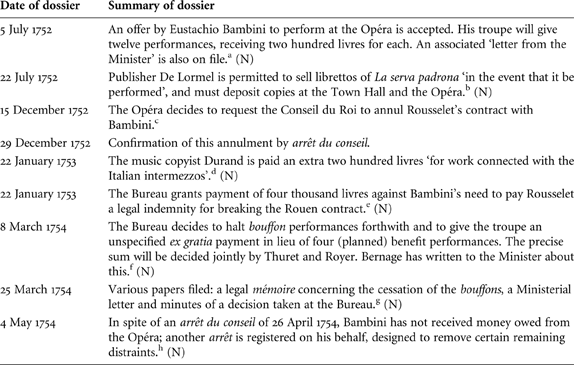
First let us summarize, for convenience, all relevant information in the Inventaire. It gives us the essence of nine dossiers concerning the bouffons, currently assumed lost, and seven of these summaries throw new light on the troupe, while the others confirm existing knowledge (Table 1; the indication ‘N’ in the table points to new information).
Summary of all references to Eustachio Bambini, and to performances by his troupe, contained in F-Po, Opéra Arch. 18 (25)

a Page 29 of the Inventaire: ‘Soumission du Sr Bambini de représenter douze fois sur le Theatre de l'Opera des intermedes italiens, à raison de 200 l[ivres] par chacque fois, acceptée du Bureau, et Lettre du Ministre à ce Sujet’ (Proposal from Mr Bambini to give twelve performances of Italian intermezzos at the Opéra, charging two hundred livres per performance, accepted by the Bureau, with letter on this subject to the Minister).
b Page 30 of the Inventaire: ‘Arreté du Bureau qui accorde au Sieur de Lormel de vendre des Exemplaires des paroles de la Serva padronna Intermede Italien dans le cas ou il sera representé sur le Theatre de L'Opéra, et il a charge d'en remettre un exemplaire au greffe de la Ville, et au depost de L'academie’ (Order from the Bureau permitting Mr de Lormel to sell copies of the libretto of La serva padrona, Italian intermezzo, in the event that it shall be performed at the Opéra, and he is responsible for delivering copies of it to the Clerk's Office and to the Opéra's store).
c This text survives in AN, AJ13 3, III: see Brigitte Labat-Poussin, Archives du Théâtre National de l'Opéra (AJ13, 1 à 1466): inventaire (Paris: Archives Nationales, 1977), 6.
d Page 41: ‘Arrêté du Bureau qui accorde au Sieur Durand Copiste de l'Opera 200 l[ivres] de Gratification extraordinaire à cause des Intermedes Italiens’ (Order from the Bureau granting two hundred livres to Mr Durand, copyist of the Opéra, as bonus payment on account of the Italian intermezzos).
e Page 42: ‘Arreté du Bureau pour 4000 l[ivres] d'Indemnité au Sr Bambini entrepreneur des Intermedes Italiens’ (Order from the Bureau releasing four thousand livres of indemnity to Mr Bambini, impresario of the Italian intermezzos).
f Page 57: ‘Arrêté du Bureau pour faire cesser les Boufons Italiens le Jeudy 7 de ce mois, et qu'au lieu des 4 Representations qu'il leur avoit été [page 58] promise pour gratification il sera déterminé une somme de l'avis des Srs Thuret et Royer Et Copie de Lettre de M. Le Prevost des Marchands au Ministre à ce Sujet’ (Order from the Bureau terminating the Italian bouffons on Thursday the seventh of this month, and instead of the four benefit performances which had been promised to them, there shall be a payment to be decided by Mr Thuret and Mr Royer. Copy [enclosed] of a letter from the Provost of Merchants on this subject to the Minister).
g Page 58: ‘Mémoire, engagement, Lettre du ministre et deliberation pour renvoyer et payer les Bouffons’ (Mémoire, agreement, letter from the Minister and discussion about the dismissal and payment of the bouffons). By ‘Mémoire’ was probably here meant ‘a lawyer's brief, which could range in length from a few pages to several hundred’: see the definition and useful discussion that follows in Sarah Maza's Private Lives and Public Affairs: The Causes Célèbres of Prerevolutionary France (Berkeley and Los Angeles: University of California Press, 1993), 35.
h Page 60: ‘Enregistrement d'un arrêt du Conseil pour faire payer nonobstant les oppositions et saisies au Sr. Rambini [sic] entrepreneur des Bouffons ce qui luy reste deu à l'Opéra, ensuite de L'arrét du Conseil du 26 avril aud. Ar[rêt]’ (Registration of an Order in Council enabling payment to Mr Bambini, impresario of the bouffons, notwithstanding the distraint and seizures made, of what remains due to him from the Opéra, following the Order in Council dated 26 April regarding that enablement). The curious events referred to in these final entries are explained in the Appendix.
The Inventaire's brief record dated 5 July 1752 provides food for thought, especially because these words constitute our first known evidence of contact between Bambini and the Opéra. No earlier Bambini documents are recorded in the Inventaire, but this is consonant with the ‘Amelot’ manuscript account and proves nothing concerning the Italian's actual strategy. He may have made informal approaches to Bernage or others in power during late May or June with a view to being seen in Paris; indeed, if the ‘Letter from the Minister’ mentioned on 5 July actually pre-dated that meeting, this possibility would be wide open. Nevertheless, the decision to agree a specific offer of twelve performances comes at a late juncture, also permitting the conjecture that Bernage and the Bureau grasped an unexpected opportunity to test the water in pursuit of much-needed revenue during the summer.Footnote 74
As the Inventaire's entry for 5 July shows, there was no initial agreement with Bambini to perform for two months, let alone to give only one performance a week.Footnote 75 All twelve agreed performances occurred in August and another twelve came in September, surely an ad hoc arrangement: the ministerial letter mentioned on 5 July had perhaps agreed to the advance possibility of these extra performances. Opéra programmes were not, in day-to-day detail, irrevocably fixed in advance: we can read, for example, ‘During Thursdays in the winter period that opera shall be given which has had most success over the summer and autumn, or else any other opera that is considered the most suitable’ (‘Pendant les jeudys de l'hyver, on donnera celuy des opera qui aura eû le plus de succès pendant l'été & l'autonne, ou tel autre qu'on jugera le plus convenable’).Footnote 76 (Thursdays took less income than other days, at least in four out of the five years studied by Giuliani.Footnote 77) On 8 August 1752 the Inventaire bears witness to a Bureau decision about ‘the selection of theatre works’ up to 3 September, with no ministerial correspondence being recorded: the management itself was rescheduling its programmes.Footnote 78
Bernage and the minister would have considered many lines of response to Bambini's offer. One would have been the general state of comedy in Parisian theatrical life: Andrea Fabiano's discussions emphasize this theme. The first summer season of opéras comiques since 1744 began on 30 June 1752 at the Foire Saint-Laurent; legal challenges from the Comédie-Française had been the cause of its prolonged darkness.Footnote 79 Jean Monnet's new Opéra-Comique might divert some audiences from the Opéra, but one must remember that its reopening was attractive for Bernage because the Opéra's privilège-holders, since 1730, earned a pre-agreed fee from the Opéra-Comique every time it was leased out for the year to an entrepreneur. The bouffons would produce profits additional to that fee,Footnote 80 and there could well have been a political and/or managerial desire to give the impression of competition, or just offer more variety. The bane of ancien-régime theatre life was that these royal monopolies had always tended to harbour defensiveness and to restrict innovation. In terms of precedent, the sheer novelty of Bambini's offer must have recalled the brief appearances in summer 1729 of Rosa Ungarelli and Antonio Ristorini at the Opéra, giving two Italian intermezzos.Footnote 81 Those would have been useful memories since much hung on tradition at the Opéra as well as in broader society; and any potential ‘public-interest’ argument with the minister could also point out that several intermezzos had been seen in London not long before.Footnote 82 The Opéra, theatrical showcase of the nation, was not unaware of its foreign visitors.
By 22 July 1752 the Bambini season was still in some doubt, to judge from the conditional nature of De Lormel's permission to sell librettos. We have seen above that the press reported four days later on ‘l'indisposition d'un leur Confrères’: presumably these texts are mutually supporting.
Financial liabilities (of both parties)
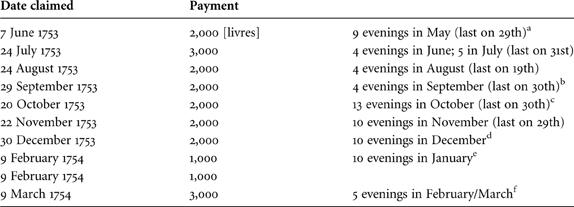
As the popularity of the bouffons grew, the total number of their performances rose in October to fourteen. At an agreed two hundred livres per evening, a fee of two thousand eight hundred livres became payable. The discovery of Bambini's later receipts, all ten of which quote the date ‘23 November 1752’ as if in reference to a contractual element, serves to demonstrate that the Opéra sought to lessen its financial liability while still nourishing its hoped-for golden goose. The first of November was in any case a watershed: Bambini had contracted to appear on that date at Rouen. Fabiano's evidence supports the notion that the Opéra ‘had the contract between Bambini and Rousselet annulled [in order to] engage the Italian troupe for a year, from 23 November 1752 until 11 November 1753’.Footnote 83 The Opéra changed its relationship with the bouffons and decided to collaborate with them.
The Bambini receipts (AN, AJ1318. III) shed light on the more detailed nature of this collaboration. They were catalogued as part of ‘Personnel. Paiements au profit d'artistes employés extraordinairement’ (Employees. Exceptional payments made in favour of artists).Footnote 84 Along with separate payments to extra horn players who were used for two bouffons productions, the ten payment documents help us to elucidate matters raised in the Inventaire. Following Labat-Poussin, I shall call these ‘receipts’ (quittances). The same basic wording appears each time. The left-hand column of script is always signed by Bernage and Bambini, dated, and marked as having been signed in the Bureau de la Ville; the added signature of the Opéra treasurer, Neuville, indicates actual disbursement. These dates (shown in Table 2) are sometimes slightly later than those appearing in the right-hand columns, which in all ten cases reproduce the same justification for payment: ‘Mr Bambini begs Mssrs the Provost of Merchants and Aldermen to grant him payment according to what is owed him for performances he has given of his Italian intermezzos at the Royal Academy of Music [Opéra] between 23 November 1752 and the present day’ (‘Le Sr Bambini supplie messieurs les Prêvot des Marchands et Echevins de vouloir bien lui accorder un payement a compte de ce qui lui est dû pour les représentations qu'il a données de ses Intermedes Italiens sur le Théatre de l'Academie Royale de musique, depuis le 23 novembre 1752 Jusqu'a ce jour’). This, then, is the new funding scheme which came into operation on that date. No receipts have yet turned up for the period extending between 23 November 1752 and the annual Easter recess of 1753. I have added raw monthly performance totals, mostly estimated by reconciling information in Aubert's twice-weekly Affiches, annonces et avis divers (henceforth AAA) with Fabiano's, and taking Mercure reports into account. Aubert's journal (also known as the Affiches de Paris) is a source that is new to accounts of the bouffons work in France, owing perhaps to confusion with its near-namesake, a contemporaneous weekly journal edited by Coste de Pujolas and Meusnier de Querlon (also known as the Affiches de Province): see footnotes numbers 68 and 83.
Information relative to Bambini's ten surviving payment receipts
a Eight explicitly in AAA plus a plausible ninth supplied by Fabiano: see Table 4.
b Three explicitly in AAA plus a plausible fourth supplied by Fabiano, Histoire.
c Eleven explicitly in AAA plus a plausible two suggested by Fabiano, Histoire.
d Seven in AAA plus three plausible from Fabiano, Histoire.
e Ten in Fabiano, Histoire: AAA failed to list any Opéra programmes.
f All in Fabiano, Histoire: AAA failed to list any Opéra programmes.
Bambini's troupe had initially contracted to perform at two thousand four hundred livres a month. In exchange for his subsequent reduction in fees to two thousand livres Bambini presumably obtained, or felt, some security of tenure; but his expenses must have risen sharply at this point, since he employed more singers than hitherto during the period before the end-of-season closure at Easter 1753.Footnote 85 Yet Bernage took on some added risk too: success with audiences could not be guaranteed, and the Opéra had begun to pay for extra music copying: the evidence has been seen in the Inventaire in connection with documents filed under the date 22 January 1753. Durand's payment of two hundred livres ‘à cause des Intermedes Italiens’ is thus important evidence for the Opéra's liabilities within a creative partnership with the bouffons. The printed libretto of La scaltra governatrice shows that the Opéra's own dancers participated in it; and from a single Mémoire recording detailed and dated duties in AN. AJ1318. III we see that the horn-playing brothers Schencker were involved in rehearsals and performances of La scaltra governatrice and La donna superba.Footnote 86 Bambini's own stock of music could have included horn parts since his Rouen contract stipulated that he provide an ‘orquestre complet’.Footnote 87 So a more likely role for Durand than providing horn parts would have been to copy music for the three ballet-pantomimes created for La scaltra governatrice, their composer(s) unknown.Footnote 88 The timeline of this activity is as follows:
• 14 and 16 December 1752: La donna superba×2 rehearsals
• 19 December 1752 to 18 January 1753: La donna superba×13 performances
• 17 January 1752 to 24 January 1753: La scaltra governatrice×4 rehearsals
• 22 January 1753: Durand is paid 200 livres for copying
• 25 January to 27 February 1753: La scaltra governatrice×6 performances
Thus in addition to two hundred livres for music copying, the Opéra paid, as the Mémoire shows, three hundred livres on 22 June 1753 simply as remuneration for the Schencker brothers’ participation in the two Italian operas, as well as 192 livres for playing in Le devin du village.
Unfortunately, the payment to Bambini of three thousand livres on 24 July 1753 cannot be explained at present: there seem to have been no substantial extra numbers of performances at the Opéra's Palais-Royal theatre, so perhaps some extra performances were given elsewhere. Certainly it is true that La zingara (19 June) was very well liked. Anna Tonelli's engraved portrait done in the Parisian style was published for sale together with her music and words from the fortune-telling scene in this work, and it may well reproduce part of her stage costume too.Footnote 89 Few other bouffon images, or other objective records of approbation, are preserved.
In 1754 Bambini gave a mere five showings of I viaggiatori between 12 February and 7 March inclusive.Footnote 90 As is clarified by the Inventaire under the date 8 March 1754, the receipt for three thousand livres made out for Bambini and signed off by the Opéra treasurer on 9 March 1754 (but actually blocked, as will be seen later) must have been intended to cover these performances to date, plus an ex gratia amount in replacement for profits anticipated from the bouffons’ benefit performances, which had just been cancelled (evidently for political reasons).
Performance factors
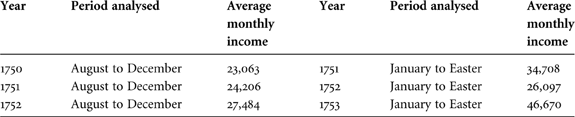
If one makes a recalculation of Elizabeth Giuliani's transcription of box-office takings, proof is seen that Bernage's profits rose just at the time when Bambini's residence began (see Table 3), even though between 30 November 1752 and Easter 1753 the bouffons’ new works gained a smaller number of performances than the initial three had (La serva padrona, Il giocatore, Il maestro di musica). If one compares the two available three-monthly blocks of door receipts for the Bambini period with similar receipts over the equivalent three-monthly periods during the two preceding years, the like-for-like results demonstrate the profitability of the bouffon episode, at least up to the point after which evidence unfortunately becomes lacking.Footnote 91 But a full economic analysis would have to take into account two other, French, successes: Dauvergne's Les amours de Tempé, with thirty-seven performances, and Mondonville's Titon et l'Aurore, with twenty-six.
Box-office takings at the Opéra, August 1750 to 7 April 1753
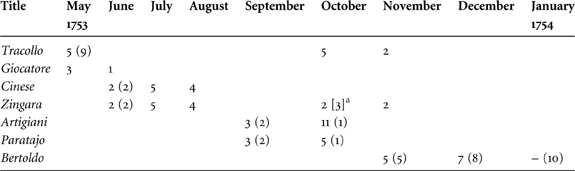
We now return to those newly available published sources of information that throw light on bouffon performances during the more shadowy second half of their residence: ten months whose history has suffered from the loss of original manuscript registres that would otherwise inform us of daily programmes and takings at the Opéra. Until the recent but still partial online facsimile publication of two now-rare journals called at various times Annonces, affiches et avis divers or else Affiches, annonces et avis divers, it was not apparent except perhaps to specialists that confusion had surrounded what were, as mentioned above, two completely different ventures, launched at nearly the same time. Aubert's journal, which is used for the purposes of Tables 4 and 5, came out on Mondays and Thursdays; it often indicated Opéra programme announcements for the coming half-week.
Bouffon performances in Aubert's Affiches, annonces et avis divers (bracketed figures show totals offered in Fabiano, Histoire de l'opéra italien, 236–238)
a To AAA's total is added Mercure's information (November 1753, 169) that La zingara returned on 16 October.
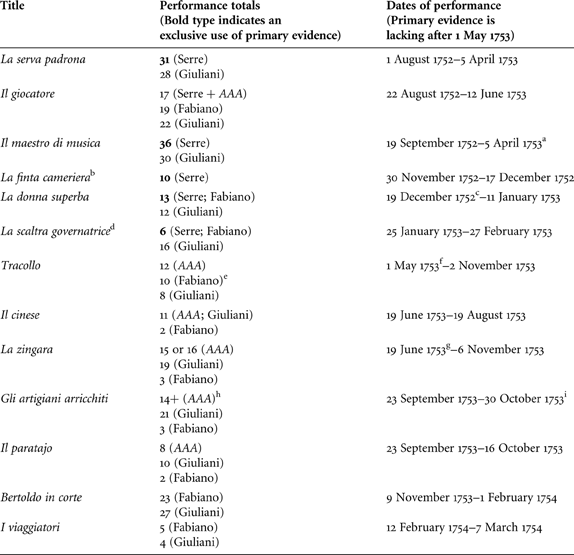
Relative popularity of the bouffon repertory
a Closing date from Serre, ‘L'Académie royale’, volume 3, 696. Fabiano, Histoire, 237, erroneously lists five performances given during the Easter recess; Giuliani, Le public et le répertoire, 75, gives ‘6.11.52’.
b In this case Giuliani found only one performance (Le public et le répertoire, 77, under La fausse suivante: all Italian titles are quoted by her in their French versions). Its premiere date and total ‘10’ are agreed in Fabiano, Histoire de l'opéra italien, and Serre, ‘L'académie royale de musique’, volume 3, 693–694.
c Giuliani, Le public et le répertoire, 77, gives ‘19.11.52’ instead of ‘19.12.1752’: see La femme orgueilleuse.
d Giuliani, Le public et le répertoire, 76, gives ‘1.12.52’ instead of ‘25.1.53’: see La gouvernante rusée, for which ‘16’ performances are suggested.
e Fabiano's performance pattern differs greatly from that of AAA. Closing date is taken from AAA.
f Giuliani, Le public et le répertoire, 77, gives ‘8.5.53’: the date 1 May is found in all other sources consulted.
g Giuliani, Le public et le répertoire, 76, gives ‘18.1.53’, but other sources agree as shown.
h Fourteen performances positively noted; another three dates have blanks where Fabiano's source suggests performances took place.
i Giuliani, Le public et le répertoire, 76, gives ‘7.2.1754’, but this was the rehearsal period for I viaggiatori: I have taken the date of 30 October from AAA, issue 85 (29 October).
This source gives notice of no fewer than forty-seven performances additional to those presented by Fabiano (who was, admittedly, sure that more performances actually took place than he had been able to find).Footnote 92 Our picture regarding Gli artigiani arricchiti is significantly altered and the return of Tracollo is an interesting surprise. An earlier low profile for the former is hardly surprising: it has unique status as the one bouffon opera about which nothing was ever published (coverage in Mercure was promised but remained unrealized), whereas Il paratajo at least earned a short phrase in the November issue.Footnote 93Tracollo is dramatically one of the most extraordinary of the intermezzos and was indeed given a Parisian publication, but Manelli's performance did not please at all at first, either vocally or dramatically; Anna Tonelli and Giuseppe Cosimi, however, were praised.Footnote 94 Its action was found puzzling, but much of the music entrancing; this helps explain why it was brought back – if Affiches, annonces is correct – for seven performances. Unfortunately no reference to it exists as an equivalent to Mercure's note in November that La zingara had been revived, precisely because Il paratajo was less successful than had been hoped for.Footnote 95
The repertory totals in Table 5 add in a further source. Although Giuliani's figures were researched and issued in the 1970s, they were not incorporated into Fabiano's more recent study.Footnote 96 Giuliani's thesis as a whole offers numerous analyses using archival sources from the period of Bernage's directorship, including repertory analyses. When manuscript sources for daily takings and titles of works were lacking, Giuliani used L'année littéraire, Mercure de France and Almanach des spectacles. Their dates sometimes invite adjustment, but her estimated totals often compare favourably with equivalent figures that appear in Aubert's Affiches, annonces et avis divers after Easter 1753 (shown as AAA in Table 5). Serre is the authority prior to that juncture.
The end of the adventure
Rousseau's Lettre sur la musique françoise in November 1753 generated a kind of furore which, he claimed, was a displacement of emotion caused by the exiling of the Paris Parlement in May. ‘[My] pamphlet appeared; instantly every other quarrel was forgotten; all thoughts turned to the perils that threatened French music, and the only uprising was against me.’Footnote 97 On 23 January 1754 a five-hour meeting was held at the Bureau with Bernage present, producing a mémoire of the arguments produced on both sides regarding the bouffons, which was forwarded to the government. By 1 February – again according to information from the marquis d'Argenson – the court had decided to allow the bouffons to remain until the end of the season, Saturday 30 March.Footnote 98I viaggiatori went ahead and Charles Collé's diary usefully shows that it constituted only a relative failure; in fact the libretto offered a quite intriguing dramatic scenario.
On 7 [February] the bouffons gave I viaggiatori, Italian intermezzo in three acts with three divertissements. Its supporters praised it to the skies; their antagonists found it mortally dull. The few claiming impartiality found it well below the three initial intermezzos and much below Bertoldo; unlike La zingara and some others, it had no acting; finally, and I think rightly, they decided Paris is not the place to put up with a three-hour show in Italian.Footnote 99
The Inventaire (8 March) shows that four benefit performances had been planned. Superior orders were then received, for the bouffons were deprived of them. The Inventaire's evidence here is a logical enough refutation of the kind of rumours that were reported to be circulating, such as that the bouffons were ‘poorly supported by those who owe them help, and the directeurs would like their departure to be preceded by a failure, however it occurs’ (‘ils sont mal secondé de ceux qui leur doivent des secours, et les directeurs voudroient que leur Depart fut précédé d'une chute quoiqu'il en arrive’).Footnote 100 This departure was costly for Bernage; the Italians must have been good for business.
With his Lettre sur la musique françoise, Rousseau, who ought to have supported the residence of the bouffons, caused an incendiary effect which promoted its termination. Without this text the Opéra might have continued to collaborate with Bambini. It is arguable that by 1754 Bernage's team, unwittingly no doubt, had won so many conservatives over to new styles that no literal return to older production patterns was likely. The valuable evidence of Chevrier can be taken as paradigmatic: he derided the impotence of the querelle, admitted having been seduced by Italian music, and was unhappy to be (implicitly) steamrollered into favouring Lully's Thésée when it was revived on 3 December 1754.Footnote 101
Fabiano gives additional reasons why Bernage would have retained Bambini: (a) he had developed comic programmes that were apt for modern taste and workable in the special space that was the Opéra; (b) even conservatives like Fréron regarded Italian music per se as constituting something to be emulated by younger French composers;Footnote 102 and (c) Bernage obviously wished to keep up audience levels and had now reached a juncture where a plurality of tastes had come to exist.
Immediately, a number of unforeseen problems arose which are signalled in the documents mentioned by the Inventaire under the date 25 March. At some unknown point an arrêt du conseil was requested and granted; it was heard before the king on 26 April. It is transcribed in the Appendix to this article and tells a powerful story of evident ruination. Rousselet had not felt satisfied or recompensed by the indemnity payable under his 1752 contract with Bambini: this had stipulated that if either party broke the terms agreed, an indemnity of two thousand livres would be liable. On 22 January 1753 four thousand livres were made available by the Opéra to someone, perhaps a lawyer, in respect of Bambini's liability.Footnote 103 Nevertheless, Rousselet's problems, as recorded in the 1754 arrêt, were multiple. He had made payments for sets and costumes in preparation for the bouffon visit, and had suffered various other damages, expenses and losses of time, not to mention yet further harm as a result of having been imprisoned (we infer, as a direct result of indebtedness). Rousselet had evidently learned of the closing award granted to Bambini on 9 March and proceeded to obtain some kind of legal order on 12 March that he presented to Neuville, the Opéra's treasurer. It was ‘une opposition’ couched ‘en termes vagues et généraux’ (in vague and general terms), but it seems to have had the effect of blocking Bambini's final payment. Rousselet had also explained himself in a printed Mémoire (not located so far), a form of petition which he had sent to the secrétaire d'état Marc-Pierre d'Argenson – who merely forwarded it to the Bureau.
Rousselet's wish for further recompense was given short shrift from the Conseil du Roi. He was reminded of the terms of the annulment of December 1752 and forbidden to cause further nuisance either to the Opéra or to Bambini by whatever means, including attempted legal resort. And Bambini's final ex gratia payment was deemed to be valid.
The last relevant entry in the Inventaire, dated 4 May 1754, shows that Rousselet was not daunted by all this: Bambini has recently suffered ‘oppositions et saisies’, which might translate as ‘attachment and seizures’, or ‘distraint orders’. The ultimate outcome is unknown. But nothing could be further from the truth than to believe that the bouffons simply went away overnight. The creative support given to them by the Opéra was firmly continued by its legal and financial modes of support, especially against the unfortunate Rousselet.
‘Structure’ versus ‘event’
That which was traditionally regarded as an ‘event’ – the bouffon visit as something bolted on to a permanent structure (the Opéra) – can now also be seen as ‘structural’ – the forging of a partly hybrid repertory over eighteen months that altered audience taste and programming policy alike, and perpetuated itself through the issuing of several scores in print.Footnote 104 Bambini's originally planned one-month ‘event’, perhaps encouraged by reference to a public-interest mandate from the government, turned into an episodic but continuous residence that had structural support from Bernage's team. The pamphlet war cannot be thought of as structural in the short term, however lengthily it was remembered; its events went in sporadic parallel with a contractual arrangement for Italian intermezzos that already existed, and this literature (whose circulation cannot be measured) had no deleterious impact on performance statistics or on the take-up of Italian music in many forms, even during 1753, or on the development of musical styles that subsequently used its inspiration as a starting-point.
If one wants ‘endings’, there must be at least two: politically and polemically, Rousseau's final grenade misfired and caused damage in the wrong direction, while musically and managerially, the end of Bambini's arrangement was imposed at a time when Bertoldo in corte had just revealed a jewel of great worth, a revelation of new possibilities regarding what fine drama and Italian music could do together. Competitive Italian–French programming in 1753 had worked to advantage, and Mondonville must already have been planning his comedic pastoral Daphnis et Alcimadure (first performed in December 1754), for which he also wrote the libretto. Rameau is thought to have written some or all of the masterly Les paladins by 1756.Footnote 105
Regarded from Wittgenstein's perspective, however, the story must end by emphasizing overlapping threads, of which two might be mentioned. The first would be the evolution of a modern kind of opéra comique, a quickly forming generic structure using new music. The second would be an understanding of the effects of the Parisian sojourn on the subsequent creative work of Bambini and his team elsewhere in Europe. But that thread implies a narrative as yet unconsidered and untold.
Appendix Transcription of Archives Nationales E.2335, document No. 99 in a bound volume of Arrêts, itself unfoliated and unpaginatedFootnote 106
Sur la Requête p[résen]tée au Roy étant [en] son Conseil par les Prévot des Marchands et Echevins de sa bonne Ville de Paris, contenant qu'encore que par arret rendu en iceluy le 29 décembre 1752. Sa Majesté ayant égard aux motifs portés en une délibération prise par le Bureau de la Ville le 15. du même mois, ait cassé et annullé un acte passé le 24 may de la même année, entre le Sr Rousselet Directeur des Spectacles de Roüen, et le Sr Bambini Entrepreneur d'opéra italien, avec déffenses tant audit Bambini qu'aud. Rousselet, de donner aucun Spectacle de Musique et de danse dans toute l'étendüe du Royaume, sans la permission expresse de l'académie Royale de Musique, et ce sous telles peines qu'il appartiendroit; néanmoins le d[it]. Rousselet nonobstant la signification qui luy a été faite du d. arrest, et au préjudice des déffenses y portées, persistant encore dans ses prétentions contre le d. Bambini pour raison de l'exécution du d. Traité quoyque cassé et annullé par sa Majesté, a eu la témérité de former le 12. du mois de mars dernier entre les mains du Sr de Neuville Caissier de l'académie Royale de Musique, une opposition au Payement des sommes qui sont et pourront être dües et ordonnées au profit dud. Bambini, en affectant de libelles la dite opposition en termes vagues et généraux [page 2] pour les causes et moyens a déduire; qu'il est d'autant moins possible de douter de l'objet des prétentions du Sr Rousselet dans cette opposition, qu'il les a luy même expliqués dans un Mémoire imprimé, et par luy adressé au Sr Comte D'Argenson Ministre et Sécretaire d'Etat, qui en a fait le renvoy au Bureau de la Ville, puis qu'il n'est question dans tout l'exposé de ce Mémoire, que du préjudice qu'il a souffert de l'inexécution du Traité passé entre luy et le Sr Bambini le 24. may 1752, Et que ses conclusions ne tendent a autres fins, qu'au payement de la somme de 2000lt ou telle autre dont il plaira a Sa Majesté d'ordonner la retenüe à son profit, sur celles qui seront a payer au Sr Bambini lors qu'il quittera l'opéra, et ce pour lui tenir lieu des sommes principales, interets, et frais, dont il du avoir répondu pour le Sr Bambini, aux marchands et ouvriers à l'occasion des décorations et habits pour les spectacles de Roüen, où les Bouffons devoient représenter en conséquence du dit Traité, que de dommages et intérêts, dépenses, perte de tems et torts résultans de l'Emprisonnement qu'il a souffert; qu'en cet Etat les dits Prévost des Marchands et Echevins, auxquels il paroit tres important pour le bien de l'académie Royale de Musique, dont Sa Majesté a jugé a propos de leur [page 3] confier l'administration, que le Sr Bambini et sa Troupe ne soient pas retenus dans cette Ville par le retardement du payement des sommes qui leur restent duës pour raison du Service qu'ils ont rempli sur le Théàtre de la d. Académie, ne peuvent se dispenser de représenter combien l'opposition formée par le Sr Rousselet sous le seul prétexte d'un Traité qu'il ne luy étoit pas permis de faire, et que le Conseil a expressement annullé par son arrest du 29 Décembre 1752, avec les déffenses les plus précises, est denuée de tout fondement, attentatoire au d. arrest et contraire par toutes les conséquences qui en resulteroient, aux droits et priviléges de l'academie Royale de Musique. A ces Causes requeroient les de Prévot des Marchands et Echevins, qu'il plaise à sa Majesté sans avoir égard à l'opposition formée par le Sr Rousselet sur le d. Bambini, et signiffiée le 12 du mois de mars dernier au Sr de Neuville Caissier de l'académie Royale de Musique, en contravention à l'arrest du 29. xbre 1752. laquelle [page 4] sera déclarée nulle, et comme non avenüe, ordonner que le d. arrest sera exécuté selon sa forme et teneur, ce faisant déclarer bons et valables les payemens qui seront faits de l'ordonnance du Bureau de la Ville, au d. Bambini par le dit Caissier, lequel en demeurera bien et valablement déchargé, sans que ny luy ny l'académie Royale de Musique puissent être inquiétés, poursuivis ny recherchés par le Sr Rousselet, comme aussi d'ordonner que l'arrest qui interviendra, sera exécuté nonobstant toutes oppositions ou empêchemens quelconques, dont si aucuns interviennent sa Majesté s'est réservée et à son Conseil la Connoissance, et icelle interdite à toutes ses Cours et juges. Vu la dite Requête, l'opposition formée par Led. Rousselet sur le Sr Bambini, signiffiée audit Sr Neuville Caissier de l'académie Royale de Musique le 12 mars dernier, et l'arrest du Conseil du 29 xbre 1752 ensemble [page 5] le Mémoire imprimé présenté par le dit Rousselet, Ouy le Raport et tout considéré.
Sa Majesté étant en son Conseil sans avoir égard à l'opposition formée par le Sr Rousselet sur le Sr Bambini entre les mains du S. de Neuville Caissier de l'académie Royale de Musique, le douze Mars dernier, que sa Majesté a déclaré et déclare nulle et comme non avenüe, a ordonné et ordonne que l'arrest de son Conseil d'Etat du vingt-neuf décembre mil sept cent cinquante deux sera exécuté selon sa forme et teneur, en Conséquence veut Sa Majesté qu'en payant par le Sr G. de Neuville au d. Bambini les sommes qui lui seront ordonnées par le Bureau de la Ville, il en soit et demeure bien et talablement quitte et déchargé, sans que pour raison du d. payement ni lui ni l'académie Royale de Musique puissent aucunemt. être inquiétés, poursuivis ni recherchés par le Sr Rousselet. Et sera le présent arrest exécuté nonobstant oppositions ou autres Empêchemens quelconques pour lesquels ne sera diféré, et dont si aucuns interviennent. Sa Mté se reserve la Connoissance et à son Conseil, icelles interdisant à toutes ses Cours et autres juges.
[signed] de Lamoignon Machaut ft. à Versailles le 26 Avril 1754.