Introduction
This paper aims to present the first comprehensive account of shoppers’ experiences of grocery shop queuing during the pioneering phase of self-service retail format development in Britain between 1945 and 1975.Footnote 1 The introduction of self-service methods during this period revolutionized grocery retailing in Britain and consequently had a very significant impact on consumers.Footnote 2 The effects of self-service extended beyond household provisioning. Du Gay, for example, argues that the introduction of self-service involved new forms of personhood attendant upon consumers’ newfound freedoms to review and select products.Footnote 3 The diffusion of self-service methods in grocery retailing could liberate consumers from counter-service, holding the potential to reduce time spent in queues and thus transform shoppers’ expectations and perceptions of time related to the activity of shopping.
Perhaps because of the quotidian character of grocery shop queues and queuing, however, their historical significance has yet to be adequately explored, despite contemporary accounts that highlight the importance of eradicating queues.Footnote 4 During its introduction to Britain in the 1940s, self-service retailing was presented in the popular press as a “no queue” format.Footnote 5 It was welcomed by the Union of Shop, Distributive and Allied Workers, which found that “customers were less irritable because they did not have to wait in queues.”Footnote 6 Some retailers promoted the time-saving nature of the self-service approach to shoppers.Footnote 7 However, later reports suggest that queuing was a routine experience in self-service formats and that queues continued to shape shopper experiences across all retail formats throughout the study period.Footnote 8
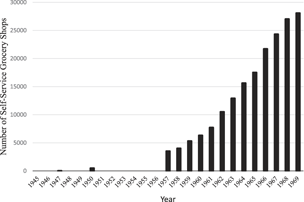
One indication of the importance of understanding the experience of shoppers in self-service format shops is provided by the growing number of such outlets and the increasing share of the grocery trade for which they accounted (see Figure 1). By 1950, there were only around 500 self-service shops in Britain,Footnote 9 yet by the second half of the 1950s, new self-service shops, including conversions, were reported to be averaging sixty-five to seventy per month.Footnote 10 By 1960, there were 6,300 shops operating self-service.Footnote 11 The number of self-service shops was calculated to be 28,062 by 1969;Footnote 12 a related source reported 3,400 supermarkets for the same year.Footnote 13 The share of grocery turnover accounted for by self-service shops increased from 15 percent in 1959 to 64 percent by 1969.Footnote 14
Number of self-service grocery shops in Britain 1947–1969.
Sources: Data for 1947 is from Board of Trade, “Report on Self-Service Trading,” 213; Data for 1950 is from Board of Trade, Census of Distribution, 164. Data for 1957–1961 are from the Nielsen Researcher, Annual Review (1962). Data for 1962–1964 are from the Nielsen Researcher, Annual Review (1966). Data for 1965 and 1966 are from the Nielsen Researcher, Annual Review (1968). Data for 1967–1969 are from the Nielsen Researcher, Annual Review (1970). Self-service data for grocery shops are unavailable for the years 1948–1949 and 1951–1956.

The remainder of the paper is structured as follows. First, we explore the academic literature in relation to queuing within shops. While acknowledging the wide range of social science literature on queuing more generally, the review helps to focus the conceptual scope of this research on grocery shopping. Second, we introduce the methods used in this study and describe the key data sources. Third, shopper experiences and perceptions of queuing are explored in two fundamentally different grocery shop environments; namely, counter-service and self-service. The final section provides a concluding discussion based upon our findings and identifies areas for future research.
Consumer Queues and Retail Distribution
Queues and queuing are part of everyday routines and experienced by most consumers at some point in their daily lives. By definition a queue is a means by which access to a service is ordered in time and space. Within this broad definition, consumer experiences of queues are amenable to wide-ranging disciplinary interpretations.Footnote 15 In relation to marketing and consumer behavior research, for example, Pàmies et al. observe that there have been over “three decades” of research on aspects of consumers’ waiting to obtain services, including queuing at retail checkouts.Footnote 16 However, while there has been a range of different disciplinary perspectives on queues and queuing, we are not aware of any detailed historical research that examines changes in grocery shop queues. Moran, one of the few historians to explore shoppers’ queuing for groceries, explains that queuing is part of “the unremarkable and unremarked upon aspects of our lives.”Footnote 17 It is what Perec terms the “infra-ordinary,” those mundane aspects of life that people take very much for granted.Footnote 18 The aim in the remainder of this section is twofold: first to present the historical research on grocery shop queues in the study period; and second to introduce perspectives from the wider social science literature on queues to provide a conceptual framework to explore the data that are subsequently presented.
The majority of research on British grocery shop queues in the period 1945–1975 relates to the period of austerity from 1945 into the mid-1950s, when shortages created queues that became politicized as a sign and symbol of a variety of social problems. The politicization of the queue in this period is perhaps epitomized by the interventions of Winston Churchill, who interpreted shopper queues “as the essence of Socialism and the restrictive system,”Footnote 19 coining the pejorative term “Queuetopia” to describe conditions in early postwar Britain under Labour rule.Footnote 20 Exploring grassroots organizing, Hinton reveals how dissatisfaction with queues led to the formation of the British Housewives’ League in 1945.Footnote 21 Primary diary and observation sources, reported in KynastonFootnote 22 and Garfield,Footnote 23 also reveal widespread and intense dissatisfaction with queues in the 1940s. Zweiniger-Bargielowska argues that the grocery shop queues of the 1940s contributed to a deepening consumer consciousness, as shoppers’ unequal access to food revealed the presence of wider social inequalities.Footnote 24 The burden of grocery shopping mostly fell upon women, with women in paid employment typically experiencing less time to queue relative to those not in paid employment.Footnote 25 Citing contemporary surveys, Zweiniger-Bargielowska sums up the 1940s shopper experience:
According to a Gallup poll of April 1947, 46 per cent had queued during the previous week, primarily for food. Of the queuers, most had spent between one and two and a half hours queuing, with some spending over three hours, and only one in five queuing for less than one hour.Footnote 26
The evidence, framed within a wider discussion of austerity in Britain, suggests that there were variable experiences in counter-service shops, but beyond this there is little evidence to suggest how the practice of queuing was perceived by shoppers, apart from being a source of intense irritation.Footnote 27
It was into this context that self-service shops were adopted for the first time, with cooperative societies among the early adopters. Co-operative Wholesale Society data from 1949 suggested that self-service offered the prospect of reduced wage costs relative to sales at a time of rising labor costs.Footnote 28 Moreover, it could reduce the problems of queuing faced by the shoppers in some societies’ shops.Footnote 29 There is very little literature that explores what queues and queuing were like within self-service formats. Nonetheless, it is clear, from what literature there is, that shoppers’ reactions revealed the media portrayal of self-service as a no-queue format to be very much an overstatement. Commenting on self-service in cooperative shops, for example, Black argues that “[f]or all the time it gave shoppers, they complained of checkout queues (complicated in the Co-op by the dividend issue).”Footnote 30
Retail formats were changing, and so were shoppers. Moran argues that consumer reactions to self-service formats were conditioned by wider social changes.Footnote 31 Cary Cooper is cited by Moran as representative of scholars who argue that the culture of queuing changed in postwar Britain, as people became more time-poor and consequently became “more like the Americans—more intolerant, more impatient.”Footnote 32 However, Moran argues that in “the absence of longitudinal studies this claim is largely unverifiable.”Footnote 33 While this paper does not seek to settle debates about any changes in the psychology of the nation’s consumers, it does demonstrate the effects of retail innovation on shopper experiences and draws conclusions about how grocery shoppers perceived the impact of these change within the broader context of their lives. More widely, as the study period progressed, so the domestic infrastructure and logistics connected to grocery shopping altered; for example, the increasing household penetration of refrigerators and freezers, combined with rising car ownership, meant that some shoppers could buy greater quantities of goods on a shopping trip, thereby potentially lengthening the time each shopper took to check out.Footnote 34
Drawing upon theoretically informed research from across the social sciences, it is possible to develop the limited historical research on postwar British grocery shop queues in two directions. First, research has explored the micro social organization of queues as cultures, focusing attention on the role of public rules and authority in sustaining the temporal order that characterizes queues.Footnote 35 According to Gray, positions in queues are perceived to carry proprietary rights, given that time can be considered as a commodity.Footnote 36 Queues in Western cultures are typically negotiated upon the assumption of first come, first served (hereafter FCFS), or “sequential priority,” and Gray argues that this norm “is an expression of a more general value structure historically associated with Western society.”Footnote 37
The literature that views queues through the lens of proprietary rights help us to conceive of situations in which queue positions can be traded or gifted. For example, Yang et al. argue that queuers may justifiably trade positions in the queue between themselves without violating the broader FCFS principle; that is, those trading places do not disadvantage others in the queue.Footnote 38 While Yang et al. suggest there are benefits in establishing queue auctions, they conclude that the effects of speculative “squatters” and “placeholders” require further research.Footnote 39 Sandel argues on political and moral grounds that the commercialization of the FCFS principle, associated with the creation of markets in public goods, fundamentally changes the character of those goods and degrades them.Footnote 40 In commercial settings, service providers and queuers may practice a range of antisocial (e.g., queue jumping) and prosocial behaviors (e.g., place keeping or the advancement of those with a lesser capacity to queue).Footnote 41 As Gray argues, the “proprietary subtext of the waiting line is counterbalanced by mutuality and reciprocity.”Footnote 42 In other words, in practice, individual rights are negotiated and interpreted within the scope of public social norms.
A second body of literature is identified with alternative notions of property in the queue, in which the “public wait is to a degree privatized.”Footnote 43 Here, queues and queuing are located at the intersection of public norms of time in relation to property (our first literature), with individual consumer experiences and behaviors within the queueFootnote 44 and the service design decisions made by retailers. More specifically, research has explored the relationships that exist between waiting in a queue and customers’ evaluations of service quality, with the perceived length of a wait shown to be strongly related to negative affect among customers, which in turn has a negative impact on their evaluation of service quality.Footnote 45 In contrast to this perspective, alternative research shows that there is a possible positive side to queuing. For example, as the presence of others behind the consumer increases in the queue, it signals to those queuing that the queuing goal—attaining the product or service—is more valuable.Footnote 46 Clearly, while retail shop managers need to ensure appropriate operational efficiency to control actual queuing times, achieving consumer satisfaction at checkouts is also dependent upon the management of shoppers’ perceptions of the queue and of queuing.
Retailers’ decisions on matters of service design have become more salient since public markets were enclosed within the private premises of markets and shops. Altering ambient elements (e.g., using lighting and music), social elements (e.g., controlling customer-to-customer interactions), and physical design elements (e.g., altering spatial layout) may influence shoppers’ perceptions of the queue and of the time spent queuing and their affective response to this.Footnote 47 The retailer’s organizational capacity and, notably, its ability to deploy resources help to explain variations in management practice in this regard, but such design decisions are not unfettered, of course (e.g., we highlight later the relevance of shop opening-hours regulation to matters of queues and queuing).Footnote 48
Methods and Sources
The data collection and analysis underpinning this paper revolve around three main types of sources. The first source is a collection of oral histories and witness groups that were undertaken by the authors to support this research.Footnote 49 The literature provides discussion on the potential and the challenges of using oral history and the narratives produced by such methods.Footnote 50 In analogous work, for example, Davies and Elliott have used oral histories to investigate shopper behavior in terms of retail change and brand consciousness.Footnote 51 Similar to Davies and Elliott, we used extended life-story interviews among our approaches, aided by physical records of the respondents’ experiences in the form of diaries, old shopping lists, and photographs.Footnote 52 Throughout the research we used all available resources and cross-referenced with memorable events and biographical data to help us to situate shoppers’ recollections as accurately as possible.
In total, seventy-eight oral history interviews and eleven witness groups were conducted, involving 122 interview respondents. Female respondents outnumbered male respondents ninety-six to twenty-six. The oral histories, on average 90 minutes in duration, covered a wide range of topics concerned with grocery shopping over a thirty-year period (1945–1975) and especially shoppers’ reactions to self-service grocery retailing and the supermarket. In the course of these discussions, many respondents recounted their experiences of shopping practices, including queuing. Thematic coding was conducted on the transcripts using NVivo v. 10, using text search queries and close reading of the transcripts. The data were coded under the principal theme of “queues and waiting.” This resulted in 177 coding references, which were drawn from seven witness groups and sixty-one interviews, comprising 91 of the 122 participants.
The second source used is Mass Observation (MO) materials from reports produced on food shopping and on queuing from 1941 and 1948, respectively, and an additional report concerned with research on shopping from 1963.Footnote 53 While the Mass Observation Archive is undoubtedly a rich source of material for the study of everyday life, contemporaries criticized MO in its first phase for openly valuing subjectivity, which was regarded as a source of bias.Footnote 54 These critiques have persisted, with Pickering and Chaney criticizing MO’s “indiscriminate interest in all and sundry, its lack of evaluative criteria and conceptual equipment.”Footnote 55 Moreover, Gurney has revealed how MO reflects middle-class assumptions about working-class social mores and values.Footnote 56 Notwithstanding the critique that MO diaries are simply used as illustrations by researchers who have reached conclusions on the basis of other sources, Hinton argues that the dairies provide invaluable source material to explore the construction of the self.Footnote 57 The perspective adopted here with regard to using the MO Archive is that it provides a rich ethnographic source, but one that must be supported with additional data.
The third and final set of sources relates to a range of contemporary published trade journals and reports, including shopper surveys, supported by relevant articles on shopper queues and queuing from various national and regional newspapers. The trade journals typically focus on the impact of new technologies on efficiency in shop retailing and shopper queues. As with the case of articles from the newspapers, we are careful to observe that the trade journals and reports are themselves not neutral and hence require careful interpretation.Footnote 58 Across these sources we observe that queuing was frequently used as a surrogate measure of shopper satisfaction with self-service shops, which to some extent makes this quotidian phenomenon visible.
Counter-Service Queues, 1945–1975
Counter service underpinned almost all grocery shop formats in Britain in 1945. Purchases were requested of shopkeepers or shop assistants by shoppers, either verbally or using a written list. The goods on display behind the counter or out of view in a storeroom would be selected by the shop assistant and, if necessary, measured out in the correct quantity and wrapped before being passed over the counter to the waiting shopper. Alternatively, many shops would deliver goods to customers, and some would take orders by telephone. Payment would typically be by cash or otherwise, quite frequently on an account that was settled on a weekly or monthly basis. Queues in shops were a common experience for grocery shoppers, being most pronounced during the period under food rationing (1940–1954) due to a combination of factors: the administration of the rationing system; food shortages; and consumer surges associated with pent-up demand for derationed goods.Footnote 59 The MO data also reveal that during the period of food rationing, joining queues could be a “reflex action of the passer-by,” because queues indicated the availability of goods.Footnote 60 Throughout our time period, queues could be compounded by daily lunch-hour closures, statutory weekly half-day closures from one o’clock, and additional restrictions on late-night opening.Footnote 61 The type of shop also had an effect on shopper queues. In department store food halls and larger shops like those being opened by some grocery multiples, shoppers could be required to visit several counters to acquire different items, thus potentially requiring them to queue several times within one shop. However, this was not always the case, as Heather (OH/809/F/1944), a working-class housewife,Footnote 62 recalled of shopping in a multiple in Southfields, London:
If you were really fortunate … the woman behind the counter would say, say you were buying a tin of peas at one counter and you wanted some cheese, she’d call over for—you know “Quarter of Cheddar for a Mrs Smith”, you know and then it would be passed round so it would save you queuing up again.
Shoppers using smaller, often independent local grocers in contrast might need to shop around to make up their orders and could encounter queues in each shop that they visited.
For many housewives queuing was perceived in broadly negative terms, as described by one thirty-year-old female responding to a MO survey about queuing in 1948: “Queuing is a necessary evil, and the only fair method to ensure equal distribution of scarce commodities. At its [most] nauseating in butchers’ shops; at its most depressing in fish shops.”Footnote 63 Male respondents to the MO survey typically expressed a desire to avoid queues. One twenty-five-year-old male student stated ”I would not queue for a hundred pound notes”; while another claimed, “I loathe queuing and will go to a great deal of inconvenience to avoid it” (a forty-four-year-old salesman).Footnote 64
However, not all shopper experiences were negative. Some participants and observers of queues described them as part of a social experience. Tim (OH/TC/M/–), whose father ran a counter-service shop, and who later became a shopkeeper himself, recalled a typical counter-service shop during the late 1940s: “There was a little bit of a social gathering, you know, they [i.e., the shoppers] would come in and happily natter with their neighbours while they were waiting to be served.” This was a familiar experience recounted by many of the respondents in our oral history data collection. Cynthia (OH/18/F/1927), a resident in London during the World War II, recalled that “you got all your news in the queue. You heard about somebody’s son that was missing or somebody that was getting married […] I just loved the queues because I got all the local scandal!” Thus, while grocery shopping was a type of work, it also offered the possibility of a social experience centering around the queue.
The sociability of the queue, however, depended to a large extent upon the familiarity of the shoppers with one another. Recalling shopping in Cardiff city center, Wendy (OH/90/F/1929) remembered “short queues” that were simply “a way of life” and continued: “We weren’t in Cardiff very long, I didn’t get to know that many people and I didn’t tend to talk to strangers.” Similarly, Joan (OH/14/F/1938) rarely met neighbors to talk to in shops, given that her selection of city center shops was dictated by work patterns, varying choice of bus routes, and just eighteen months living in Cardiff. For Wendy and Joan the efficiency of shopping was more important than the potential for sociability provided by the queue in their description of shopping in earlier periods. Likewise, Doris (OH/573/F/1935) experienced queues in South London during the early 1950s. She remembered grocery shopping with her mother:
You had to queue up then and then you always met somebody in the queue and there was always somebody behind the counter who wanted to know how “Aunt Mabel” was getting on and things like that. A social occasion. […] I found it frustrating. I mean my mother enjoyed it […] She liked all of that, but because I was younger and I suppose I wanted things to be on the move really. So yes, I found it frustrating.
Throughout the study period, it was not uncommon for children to shop on behalf of households, and the counter-service queue was a source of both challenge and opportunity for young shoppers. For example, Heather (QR/244/F/1946), who shopped in a village in Hampshire in the 1950s, recalled that as a “child it was intimidating buying meat as…you would be passed over in the queue.” In contrast, Lily (OH/16/F/1934), who took up shopping duties for the household following the onset of her mother’s chronic illness in 1945, valued the moral order of the queue. She recalled that “queuing was the only way to be fair, if you hadn’t had queues a little girl like me would have been pushed to the side.” Other young shoppers used the queue to their own advantage. Raymond (OH/RS/M/1933), a resident of Manchester, calculated the total of his shopping order in the queue, because “if you weren’t sharp then you got done.” The time spent in the queue to plan for and calculate expenditure was perhaps particularly important for less-experienced shoppers and those who were accountable to others on returning home from the shop.
Having children accompany parents on the shopping trip generated additional perspectives on queues and queuing. When asked what she did not like about counter-service shopping in Radlett (Hertfordshire) during the 1960s, Peggy (OH/581/F/1934), a lower-middle-class housewife answered: “If you had to queue at individual counters and you were a bit rushed and the children were fractious.” Yet accompanying children could also be used to speed the counter-service shopping experience. As Heather (OH/809/F/1944) explained of her memories of shopping in outlets with multiple counters, “People used to put their kids in the other queue to save your place.”
The oral history data suggested that social class could be an influencing factor in the counter-service shopping experience more generally, as a result of shopkeepers’ differential treatment of customers. For example, it was perceived by some contributors that certain shopkeepers would reserve more expensive and scarcer goods under the counter for their most valuable customers. Interestingly, we find relatively little mention of social class being a factor in shoppers’ experiences of counter-service queues and queuing. However, one telling case is provided by Margaret (OH/104/F/1932). The daughter of a working-class father who worked as a joiner, Margaret had been sensitized to differences in social class when attending a grammar school on a scholarship. Differences in social class were evident to her, both culturally and economically. By 1955 Margaret was working as a radiographer, which she considers “was a bit of a notch up from the usual sort of jobs,” and by 1957 she was managing a hospital department. Living on a newly built housing estate in Cheadle Hulme (an urban district to the south of Manchester), she noted of the clientele of her local shop that lived in a group of older houses:
[They] were the sort of people who didn’t know about mortgages or they had no concept of what it was like, and they didn’t, like, work, and never had since the day they were married and you know, nice enough people but they weren’t street wise like we were.
She recalled the attitude of counter assistants she encountered in shops and the effect this had upon her queuing experience:
You had to be very careful not to let yourself be elbowed aside when you were waiting in a queue, while they stood and talked ad nauseam with the people from the big houses. “Oh yes and what happened to your son?” and then you’d be standing there waiting to buy whatever you were there to buy, because that was the way it was done.
It is evident that the grocery queue was an arena in which virtues of discipline, patience, self-respect, and tenacity might need to be exercised, particularly in contexts where service encounters conformed to the time budgets of wealthier patrons (e.g., the time afforded by shopkeepers to conversations with more affluent shoppers). Also, in the case of the “privatized queue,” queue management extends beyond those in the line to those interacting with it, including shop staff.
Incidents of counter-service queue jumping were reported in contemporary sources. These reported incidents were frequently associated with the period of austerity in the early postwar years and related to the heightened physical and psychological demands placed upon shoppers by queues at this time. For example, the Daily Mail reported that a fight broke out in Leeds between housewives who had been queuing for two to three hours during shortages following the unexpected announcement of VJ Day.Footnote 65 In 1948, MO diarist Edie Rutherford, a forty-six-year-old housewife from Sheffield, recorded an incident of queue jumping at a tripe shop when “some half-dozen women and one man” jumped an existing queue.Footnote 66 The inclusion of this incident in her diary perhaps indicates that when a group of shoppers contravened the FCFS principle, it was more difficult for other shoppers to contest. Rutherford also records the practice of holding places in the queue for shoppers, which was another cause of frustration to her:
That tripe shop is the most unreliable ever. Women keep dodging out to “just go to pikelet shop,” run over t’fish shop, just fetch us eggs and so on, so that when one joins it, it may seem twenty strong, but when all the missing women return there are thirty ahead of me.Footnote 67
The diary reveals that while blatant acts of queue jumping were usually contested, other queuing practices like holding places in the queue for others, were regarded as generally legitimate.
Pregnant women were entitled to supplementary rations and were sometimes promoted to the front of the queue in grocery shops. Longmate comments that there was “no legal obligation to give a pregnant woman priority, but the convention rapidly became accepted.”Footnote 68 One oral history interviewee, Margaret (OH/289/F/1919), recalled her experience of queuing in Earls Court, London in 1946–1947: “When you were pregnant you had a queue priority … so that was lovely. I was pretty well always pregnant when I was there so I always got to the front of the queue, it was great!”Footnote 69 However, legitimate promotion up the queue such as this could potentially be a source of embarrassment for the recipient, as it brought attention to the individual’s personal circumstances. Nor did it meet with universal approval. In the MO data, for example, diarist Edie Rutherford described the practice of giving pregnant women priority as “nonsense” because it was the “decrepit sixty-year old women with dropped wombs and fallen arches who should not stand around in queues.”Footnote 70 One “Scientist and housewife—26.” also commented that “I have queue priority marking in my ration book, but I have never used it, and have never seen anyone else do so.”Footnote 71 The data suggest that there was considerable variability in how exceptions to the FCFS principle were negotiated in practice and indicate the importance of situational factors in shoppers’ decision making about who had queue priority.
Some shoppers who used counter-service shops throughout the study period, either exclusively or to a greater or lesser extent in combination with self-service shops, including supermarkets, continued to report on the sociability of the counter-service format. Elaine (OH/77/F/1951), clerk (and married to a clerk), recalled her positive experiences of using a counter-service grocer in Stoke-on-Trent to top up her shopping in the early 1970s:
If you were waiting you would chat to the other people in [the queue]—who were waiting and then again, you’d chat to the people over the counter; but, yes, I mean once or twice you did used to have to wait because people did like to chat and they would do so even, you know, even at the expense of holding other people up and I suppose in one sense that was a disadvantage of that type of shopping but in a way it was—it was a nice—it was nice that people felt that they could do that and I don’t think people used to get very irate about it really.
In contrast to these positive memories, however, there is further evidence that some counter-service shoppers were becoming increasingly impatient with the queues that could form. As one MO respondent described in 1967:
Also at Fenwick’s [a department store]; they have a good delicatessen department but you always have to queue at the counters. I stood last week while the girls leisurely served and the queue increased. Then two girls took time out to start arranging things on the trays. Surely with a line of people on both sides of the counter they could leave their rearranging till [sic] the counter was not so busy.Footnote 72
To summarize, shopper perceptions and experiences of counter-service shops were mixed throughout the period. There was widespread dissatisfaction with queues among those looking for a more efficient, faster shopping experience and for those seeking a less conspicuous service. Yet for others, queues afforded certain opportunities for social contact and the practice of ethical behaviors that were valued by some shoppers. Queue experiences were shaped by a range of factors, including the type of counter-service format, the time of day and the location of shop, and perhaps most significantly, the time period. Counter-service queues were reported to be longer and more frustrating under the system of food rationing that was in place up to 1954. Shoppers’ experiences and perceptions of counter service were shaped by their age, social, and economic status and the type of relationship they had with the shop. For example, as we have seen, women in paid employment often had significantly different time budgets compared with housewives outside paid employment, with implications for their perceptions and experiences of queues and queuing.
The Impact of Self-Service on Shopper Queues, 1945–1975
Some retailers, like many of their customers, were frustrated over the problems of queues in grocery shops. The introduction of self-service during the 1940s and early 1950s was directed in part by the need to create efficiency savings and offered the potential to lessen the queues associated with the austerity of early postwar Britain.Footnote 73 The trade press reported shoppers’ attitudes toward queuing in early examples of self-service shops in Britain. The Grocer was clear that housewives preferred self-service because “it worked quicker doing away with queues.”Footnote 74 Retailers claimed that, on average, 100 shoppers per hour could be moved through the checkouts in self-service conditions.Footnote 75 According to one regional cooperative society, while with “the older sales method a person might spend an hour in a crowded store waiting to purchase a few articles, she could come into the self-service shop, help herself to the goods required, pass through the pay box and be out in the street in a matter of seconds.”Footnote 76 In the British Market Research Bureau survey of 1950, some 87 percent of the 200 people interviewed thought self-service was quicker; while 75 percent claimed they had not experienced any excessive delays at the checkout.Footnote 77 Those who claimed they were held up in queues at checkouts were reported on average to be waiting only up to 5 minutes. Moran explains that following the end of food rationing in 1954, the issue of shopper queuing largely “slipped off the political agenda.”Footnote 78 While we agree with Moran, the rise of self-service grocery shops also made some contribution to this, albeit this contribution has been in danger of being overstated, as we now illustrate.
Self-service shops were claimed to have effectively solved the queuing problem at a time when recruiting retail shop assistants was proving more difficult due to labor shortages and rising wage costs.Footnote 79 However, contemporary sources point out that at times of peak demand, self-service shops generated significant queues. First, the opening of self-service shops could be a novelty in itself, which created queues, as curious shoppers were keen to experience the approach in differing retail formats, often encouraged by retailers’ promotional activities. For example, Burton’s in Barnstaple was reported to be the first supermarket to open in North Devon in 1961, with an opening promotion of distributing 100 free roasting chickens to shoppers.Footnote 80 The opening, it was claimed, attracted a queue of 400 people, which required police supervision, as queues to enter the supermarket blocked road traffic and people were accused of jumping the queue.
Second, self-service shop queues usually varied throughout the week. In 1959, an article in the Times (London) reported that a group of supermarkets were reported to take 10 percent of their weekly profit between 6 p.m. and 8 p.m. on Friday evenings.Footnote 81 It was noted that “these evenings are more likely to produce queues at the check-out positions,” but a defense of the supermarket format was offered on the basis that it “is a queue in one store as opposed to queues in four or five shops.” In 1963, a reader wrote to the Financial Times to report that Friday evenings and Saturday mornings were peak times in supermarkets due to the presence of weekly wage earners and noted that “millions of hours are wasted every week by women of this nation standing in queues in shops waiting to buy this or that.”Footnote 82 The letter pointed out that the time saved in supermarkets for the shopper could be lost if goods were out of stock, as was most likely on Saturday afternoons up until the next restocking point, typically on Thursdays.Footnote 83 The implication was that unless self-service shops were well managed, shoppers would again be required to queue in a number of shops to make up their orders.
Third, many self-service shops and supermarkets introduced a potential further delay at checkout by issuing trading stamps.Footnote 84 Grant Thompson wrote to the Times (London), based on his experience as a checkout assistant in the United States:
The extra amount of time required to hand out the stamps (calculated by one supermarket to be equal to the time required to count out the change) means either that queues will be much longer, or that extra check-out positions will have to be opened, sending costs up again.Footnote 85
By May 1963, it was estimated that 18,500 food shops were issuing stamps in Britain.Footnote 86 Some of the larger supermarket chains were soon to follow this trend, with Tesco and Fine Fare adopting stamps in November 1963.Footnote 87
Fourth, inefficient shop design, combined with high levels of demand, meant that queues could disrupt shoppers’ access to both the aisles and shelves. One consultant described the space between “check-outs and the floor sales area” as “a constant jam of customers with trollies, trucks, baskets etcetera, the whole area can be absolute chaos.”Footnote 88 This was a particular issue that emerged in the oral histories and in one witness group in particular. For example, Anne (WG/0708/F/1938), describing her experiences in a shop in Wigan, recalled that “sometimes you couldn’t get around that shop could you? It was so packed.” In the same witness group, Ceila (WG/070807/F/1951) corroborated: “You couldn’t move in the alleyway [i.e., aisles], so when the queues started building up we really did get annoyed.”
Moreover, for some shoppers, queuing at the self-service shop or supermarket checkout represented a more impersonal experience than that in the counter-service environment. Elaine (OH/77/F/1951), who enjoyed the counter-service shop experience, described her self-service shop experience thus:
Rarely did you engage in a real conversation with anyone. So you would just wait there and sort of, daydream or your eyes would be going around the shop or whatever. Occasionally, I would exchange a few words with the girl on the till but very rarely with anybody in the queue.
Dissatisfaction among some shoppers with the more impersonal aspect of self-service shopping led contemporary analysts to predict a more personalized future for self-service shops and supermarkets.Footnote 89 Such ideas were highlighted in the popular press, with the Times (London) pointing out that:
For many people shopping remains a social experience, with people—assistants—an essential part of it. Sadly, for some, it provides the only escape from loneliness.
Probably the ideal envisaged by a few, of self-service softened by the addition of some personal attention when this is required, will eventually prove most efficient overall, combining back-stage economy with the attraction of more customers.Footnote 90
As with counter-service shops, experiences in self-service shops were shaped by a variety of personal and environmental factors and were far from uniform. While new, larger supermarkets in particular were at risk of generating feelings of isolation among some shoppers, in other self-service shops an element of social experience centering on the queue could persist. For example, one of the oral history respondents, Mary (OH/62/F/1945), who patronized a self-service shop called Cee Jay in Blackheath, West-Midlands, recalled that it had a single checkout and generated significant queues. When asked what she would do in the queue, Mary replied: “Mostly, people chatted to me, because when you’ve got children people tend to. We tend to chat, we knew quite a lot of people as well who lived in and around the same area.” Michael (OH/128/M/1944), who worked as a clerical officer for the London County Council in the mid-1960s, also observed the sociability of the self-service queue. Shopping during his lunch hours in a Tesco supermarket, queuing was not a social occasion for Michael. However, he observed that for others: “It was a regular talking shop. People seemed to know each other.”
Thus, the new self-service shopping experience could be far from devoid of the necessity of queuing, although the queues took on a somewhat different form, being typically associated with the checkout rather than the counter-service check-in. Cochoy, for example, demonstrates how self-service demanded the spatial reconfiguration of the payment system and the invention of the checkout queue.Footnote 91 The transition from counter service to self-service shifted consumer attention, and also the emotional experience of queuing, from the question of how to effectively get into the shop, to the question of how to effectively exit the shop.
That queues continued to be seen as a problem in the minds of many shoppers and retailers is indicated by continued attempts to create a more efficient self-service experience. In 1961, for example, the innovations promoted to delegates at the Automatic Vending Exhibition included vending machines designed for installation in shop windows and to serve “as a supplement to the supermarket, so that the housewife who resents the necessity of standing in a queue to purchase only a loaf of bread and a tin of baked beans can obtain her goods without entering the shop.”Footnote 92 While such innovations were promoted to combat shopper frustrations with queuing for subsidiary grocery purchases, the available data suggest that shopper irritation with self-service queues would reach new levels and demand a more fundamental search for solutions from retailers.
Comparing survey data on housewives’ perceptions of supermarket shopping gathered in 1961 and 1970, the authors of the report Shopping in the Seventies concluded that while “shoppers have come to grips with supermarkets” criticism of “the physical discomforts, namely shoving and pushing and queuing are increasing, particularly rapidly.”Footnote 93 While self-service had hitherto offered the prospect of a faster and more time-efficient experience of shopping in comparison to counter-service shops, the impact of queuing was being resurrected as a central element in narratives of the grocery shopping experience.
By the mid-1960s the national press was beginning to question the quality of the shopping experience in the growing number of supermarkets. It was reported that the Consumer Council had informed the Supermarket Association that the most common criticism of supermarkets was the growing length of queues at the checkouts.Footnote 94 The Times (London) reported that the housewife was seeing the supermarkets “at their true worth, offering confusion and poor service.”Footnote 95 In 1967, David Morell, Tesco’s merchandising director, told delegates at a self-service forum that:
housewives avoided supermarkets because of “too many irritations” […]. Most irritating of all were the checkouts where, he said, customers sometimes queued for long periods to pay for their goods.Footnote 96
In 1972, the Grocer cited research undertaken by the Opinions Research Centre that reported an average checkout time of 20 minutes in UK supermarkets. Footnote 97 Moreover, the research suggested that more than “56% of women using self-service stores and supermarkets say that what they dislike most when shopping in these stores, is the long queues at the checkout.”Footnote 98 Survey data from contemporary market research studies reported that the need to queue to get out of the supermarket was identified as a problem by housewives across the social classes.Footnote 99
The oral history data offer evidence from shoppers that provides valuable context to these perspectives. For example, Sheila (OH/698/F/1929), a housewife and former personal assistant, remembered Sainsbury’s in Guildford, Surrey, during the late 1960s, when Sainsbury’s was “the main [grocery] shop in Guildford and you’d queue up for a long time to get out … it wasn’t so bad picking up your stuff, it was getting out of it.” She recalled, “I didn’t like the queue of checking out […] you could wait for ages to get out and you’d queue up down the aisles while people were trying to look for what they wanted, it was dreadful.” Similarly, Jeanette (OH/674/F/1940) described her experience of using a Safeway supermarket in Southeast London at peak times during the 1970s:
Well, it would generally be on Friday evening or a Saturday which is—would be busy times so I think from memory, the one in Sydenham probably had six checkouts, it wasn’t a huge store […] and they would tend to be all manned but there would always be a queue.
In 1968, the Times (London) stated: “As every busy woman knows, the greatest deterrent to weekend shopping in the supermarket emporia is that the time saved in serving oneself is lost 16 times over in the slow moving shuffle to meet the cashier.”Footnote 100 The oral history data reveal that shoppers were making these calculations in practice. For example, Alan (OH/294/M/1946) was from a middle-class family and shopped in supermarkets for the first time with his mother on Saturday mornings during the 1960s. He recalled that the:
tills took for ever, because the girls punched each price in and so it just took forever. So a queue at a supermarket till was far worse than any queue I experienced at a shop before supermarkets.
However, Alan was also keen to stress that the process of selecting your goods was quicker in self-service shops:
Shopping, getting it off the shelf was fast and the choice was fast, and you were in control. That was much nicer. But when you got up to the till, of course it was slow.
Rosemary (OH/458/F/1943), a control room operator from Dudley, claimed that the “greatest thing is supermarkets save an awful lot of time, because you can collect everything and go to the till […] all in one go.” She contrasted this with counter-service shops, in which one could queue for half an hour, only to be informed by the shop assistant “I am sorry we have just sold the last one.” In other words, while self-service and supermarket checkout queues could be slow and frustrating, shoppers nevertheless could still view the overall shopping experience as faster and more reliable than the counter-service alternative. In counter-service shopping, the risk of not achieving the intended goal of the shopping trip was potentially greater at the point of queuing, compared with the situation in self-service shopping.Footnote 101 In the latter, the shopper had the sought-after item(s) in his or her basket or trolley, so the risk of not securing the desired items was likely to be reduced or removed, although the need to queue to check out still loomed ahead.
In response to customer dissatisfaction with queuing times and the need to remain competitive, increasingly against one another rather than against counter-service rivals, supermarkets began to invest in new techniques to ease the problem of checkout queues. Shorter queues were perceived to encourage shoppers into a shop, and once there, to spend more of their overall shopping time looking at and, retailers hoped, selecting from the goods on display.Footnote 102 Rowley, from the National Cash Register Company, explained: “The supermarket operator has been concerned about his checkout queues and is closely examining the modern techniques which are being developed to solve a pressing problem.”Footnote 103
Some interventions involved an attempt to modify customer perceptions. For example, a representative of Osram (General Electric Company noted that “supermarkets are an exception to the general rule that bare fluorescent tubes are not the best means of lighting for selling,” but suggested that “lighting of a more restful nature could be used here to relax the impatient customer” at the checkout.Footnote 104 Checkout advertising and merchandising were also considered useful in distracting waiting shoppers, but with the risk that cashier operators would be less visible, with attendant risks of malpractice by them.Footnote 105 Other initiatives were focused on demand management, flattening peaks across the week by offering special promotions on certain days. Lipsey, for example, claims that Tesco on Tottenham Court Road (London) gave double stamps on Tuesdays to attract shoppers away from more congested times.Footnote 106 The majority of efforts in this period, however, were designed to tackle the cause of supermarket queues through greater operational efficiency at checkouts.
For some shoppers the queue problem brought the economic trade-offs between shopper and retailer back into sharp focus, and the private management of the queue in the self-service store could be a source of some frustration. As Ray (OH/756/F/1932) surmised of a supermarket chain:
I felt […] they limited the number of manned checkouts, so that the queues, you know it was your customer queuing, and the people sitting in the offices saying “if we only use two checkouts this will save us so and so much money and in wages, salary and the customers can wait.”
For Ray and others the solution lay in getting more staff at the checkout. For many retailers, additional checkout staff were introduced in combination with new techniques of managing queues. For example, fast lanes for shoppers purchasing a small number of items were introduced, which had the additional virtue of encouraging more time-sensitive shoppers into self-service stores; long queues could be tolerated by those purchasing larger quantities of goods, but not by those needing just a few items.Footnote 107 These lanes came under the surveillance of staff and also other shoppers operating with everyday notions of fair play. Jeanette (OH/674/F/1940) recalled the introduction of fast lanes to Safeway’s in Sydenham: “They did start the business with five items or less and that would cause punch-ups practically—because people would have six items and people are watching each other like hawks in case they’re sliding through.” It is significant to note that the managerial restructuring of the system of queuing was seemingly dependent upon publicly enforced notions of proprietary order.
The enhanced use of new technology was often the retailers’ preferred solution to maintaining profitability more widely.Footnote 108 One report, Electronics at the Point of Sale, (1972) argued “that the problem [of queuing cannot] be solved by simply adding extra checkout points, because the cost is too high, particularly in high rental central areas where every possible square foot of floor space must be given over to selling.”Footnote 109 Therefore, the proposed solution lay in optimizing checkout functions and adopting new systems.
Identifying different aspects of the checkout process, supermarket retailers and suppliers of shop equipment experimented with several technological innovations. One such aspect was the presentation of goods to the checkout assistant by the shopper. To speed up this process, conveyor belts were installed that could be operated with a foot pedal by the checkout assistant. Toward the mid-1970s, this system began to be automated in supermarkets by a magic eye system that stopped a moving belt when the goods were in the correct position.Footnote 110 A concomitant innovation was the adoption of multibay packing facilities, which permitted one check-out assistant to serve two shoppers simultaneously by means of a movable divide that allowed the goods of the subsequent shopper in the queue to be separated from those of the preceding shopper; while one shopper’s goods were packed after payment, another would have his or her goods checked out.Footnote 111
Entering price information was another area for efficiency gains, and one that could lessen queues. The report Electronics at the Point of Sale predicted the first British orders for a generation of electronic cash registers that would improve the speed and accuracy of supermarket cashiers.Footnote 112 The same report also claimed that Sainsbury’s had “carried out dummy runs which have shown that checkout processes can be speeded up by 20%.”Footnote 113 A more fundamental innovation was to follow, with Universal Product Codes and bar codes, introduced in the United States in 1971 and 1974, respectively, and capable of being read by optical scanning equipment at the checkout.Footnote 114 However, in Britain, it was not until the mid-1980s that scanner technology became widely adopted.Footnote 115
Discussion and Conclusion
This paper provides a historical perspective of grocery shop queues and queuing in counter-service and self-service shops over the period 1945–1975. Within this context there is clear evidence from a range of sources, and especially from detailed oral histories, that shoppers’ perceptions and experiences of queuing were transformed as they encountered self-service retail operations, whether directly or indirectly. The paper illustrates that retail innovations have the potential to alter temporal and spatial patterns of in-store consumer behavior with far-reaching consequences for both retailers and shoppers, as well as for the social reproduction of the institution of the queue itself.
Counter-service queuing could be frustrating for some shoppers, as shown by MO data for the period under food rationing (1940–1954) and to a lesser extent in the ensuing decades. However, oral histories show that for some, the experience was not entirely negative. The counter-service queue was viewed by some shoppers as part of a social network in which valuable news and information were exchanged. In addition, it represented a space where children could be socialized into the role of shoppers. This socialization included the disciplinary principles associated with the FCFS proprietary order of queuing that while not inviolable, was commonplace.Footnote 116
Yet for other shoppers, counter-service queuing could be an impersonal experience, for instance, when shopping was conducted for convenience in locations in which the shopper had weaker social ties or associations (e.g., commuters shopping around workplaces during lunch breaks or at the close of the working day before returning home).
Self-service was seen initially as an antidote for the queues that plagued counter-service grocery shops in early postwar Britain. Yet, as self-service shops and supermarkets became more popular during the 1960s, queuing at the checkout became an increasing problem. It was during this period, it seems, that the perceptions and experiences of many shoppers changed. Overall, negative reactions to queuing in supermarkets was galvanizing by the mid-1960s onward, as these types of stores became firmly established in the grocery retail market. Many oral history respondents tended to view the supermarket queue as a more sterile experience, devoid of social contact and impersonal. However, our research also suggests that self-service queues could sustain social experiences for some shoppers, particularly where shoppers were embedded through shared local networks.
Recent research on present-day consumer patronage has explored the relationship with community embeddedness.Footnote 117 In our research the degree of shopper embeddedness influenced the queue experience in both counter-service and self-service formats. However, technological systems designed to deal with the resurgence of self-service queues risked depersonalizing shoppers’ service experience. The increasing emphasis on fast and efficient service meant that consumer attention was focused on the mastering of revised checkout processes involving the shopper in unloading goods, payment, and packing, with reduced scope for social interaction with fellow shoppers or cashiers apart from a cursory acknowledgment.
We have no unequivocal evidence that queuing was a significant factor in shoppers’ choice of retail formats. However, shoppers’ typically perceived shopping in self-service formats to be faster than in counter-service outlets, even though self-service checkout queues were frequently reported as being problematic. Existing studies suggest that the adoption of self-service and supermarket formats was sometimes related to life-course transitions when time budgets significantly altered for shoppers.Footnote 118 These findings are also borne out in the analysis of queuing presented here. With more limited time budgets available to those women in dual roles as waged workers and carers (e.g., as housewives and mothers), shopping was often regarded instrumentally with respect to saving time, rather than in connection to social elements that could accrue from the practice of queuing. The queuing problem in supermarkets, whether perceived or experienced, led some shoppers to try to bypass queues wherever possible. Delivery services provided one option, although from a retail management perspective increasing the cost of service was not something that advocates of self-service typically recommended.
By providing a longer-term perspective on changes to shop queues than is typical in the literature, our research highlights the wider significance of researching the interface between public values and private management. It reveals the persistence of rules around proprietary order alongside the social and technological changes that comprised self-service format innovation. In many cases the unspoken rules of proprietary order, revealed by shoppers when discussing breaches of order, supported the efficient functioning of new checkout systems (e.g., fast lanes). The research draws attention to the way in which business innovations draw upon untraded public values for their success.
Finally, our research suggests several directions for future research. First, to establish the effect of self-service formats on shoppers’ experiences more broadly, it would be valuable to consider shopper experiences of queuing in non–food shops.Footnote 119 Second, further research needs to be conducting into the psychology of the grocery shopper queuer.Footnote 120 The question of how shoppers perceive waiting time in relation to the characteristics of goods and services purchased remains to be adequately explored. Third, our research could be broadened to include wider aspects of service. This would include, for example, taking into more direct consideration the role of the self-service cashier and practices of checkout management, noting the effect of these aspects of the service encounter on shoppers’ experiences and perceptions.
This article is based upon research undertaken as part of the Arts and Humanities Research Council–funded project Reconstructing Consumer Landscapes: Shopper Reactions to the Supermarket in Early Post-War England. We would like to acknowledge Dr. Dawn Nell and Prof. Jane Hamlett who contributed to the generation of oral histories and collection of archival materials that inform this study. Finally, we would like to thank the editor and the three reviewers for their constructive comments and feedback on earlier versions of this article.