Introduction
Terrorist and insurgent activity is a growing concern world over, more so for underdeveloped and developing nations in Asia. India, for instance, reports chronic activity of varying intensity by Maoist, insurgents, Islamist Separatist, and ethnicity-based movements in 252 of the country's 640 districts. 1 Apart from the recognized centers of chronic activity, like Jammu and Kashmir and Northeast, and districts where Naxalites are active, metropolitan areas like Delhi, Hyderbad, and Mumbai have been the target of repeated terror attacks. Though reported incidents of bomb blast have increased in Delhi since 2000, Mumbai (710 killed and 2,393 injured) outnumbers Delhi (134 killed and 880 injured) with regard to mortality and morbidity over the past two decades. 2
Over this period, though the emergency response mechanisms have evolved considerably in India, scholarly understanding of long-term health and mental health vulnerabilities is limited. The 2008 Johnson and Hobfall review of social science publications since 1980 on the topic of terrorism also highlights that the current understanding of the impact of terrorism on survivors is very limited, especially in the Asian context; 88% of all the scholarly publications dealt with issues in the US or Israel.Reference Johnson and Hobfoll 3 Only four percent of the articles dealt with dimensions of health, stress, and psychological aspects of terrorism, and these had a narrow traumatic stress perspective, with posttraumatic stress disorder as the primary consequence of traumatic exposure to terrorist attacks.Reference De Bocanegra, Moskalenko and Chan 4 – Reference Lating, Sherman, Everly, Lowry and Peragine 9 Thus, in resource-constrained contexts where formal support systems and safety nets are scarce, a reconsideration of the perspectives and approaches for understanding and responding to mental health needs of survivors of terror is warranted. The current report is an attempt towards this shift in understanding, from the traumatic stress perspective to a social science perspective on psychological distress.
Theoretical Framework
Vulnerability as an analytical concept emerged in the environmental sciences for the study of the human impacts of natural disasters. Since then, the concept has been adapted in various fields and is under constant debate and revision. Recent approaches to vulnerability emphasize the structural dimensions of vulnerability and see it as socially constructed.Reference Blaikie, Cannon, Davis and Wisner 10 – Reference Hilhorst and Bankoff 13 However, in the field of mental health, including disaster mental health, vulnerability largely is limited to inherent biological vulnerability for certain syndromes, and the conception of social vulnerability to mental health issues is largely missing. Drawing from the social vulnerability perspectives and the work of Der-Butterfill and Marianti,Reference Der-Butterfill and Marianti 14 the risk of psychological distress is conceptualized as follows:
 $${{\rm{Risk}}\,{\rm{of}}\,{\rm{psychological}}\,{\rm{distress}}\,\, \,{\rm{ = }}\,{\rm{Vulnerability}}\, {\rm{(Exposure/Capacity)}}\, \cr \quad\quad\times \,{\rm{Threat}}{\rm{.}}\eqno\rm$$
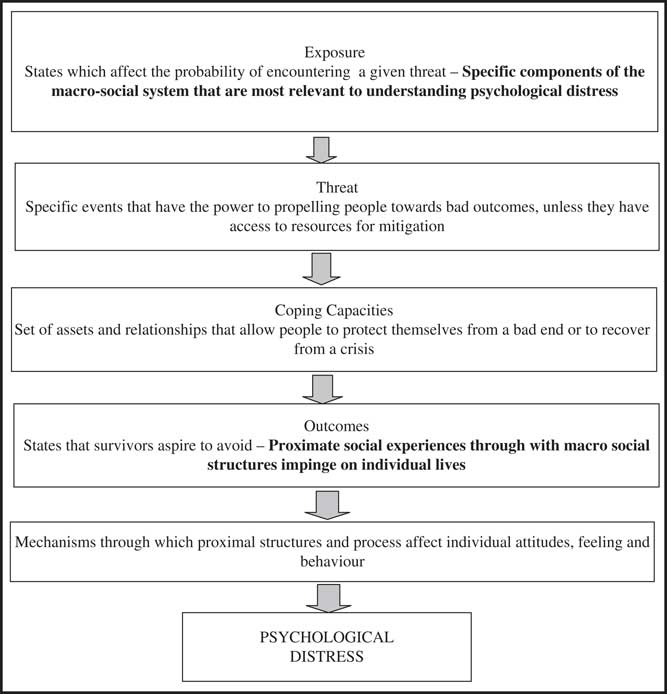
A person's risk of suffering psychological distress or harm is the outcome of a set of related risks, namely: the risk of being exposed to a threat (exposure); the risk of lacking the resources to deal with a threat (coping capacities); and the risk of a threat materializing (threat). Exposure refers to the states which affect the probability of encountering a given threat. Threats are specific events that have the power of propelling people towards bad outcomes, unless the people have access to resources for mitigation. Coping capacities are a set of assets and relationships that allow people to protect themselves from a bad end, or to recover from a crisis. The states that survivors aspire to avoid are outcomes.
With this understanding of vulnerability in disaster situations, this report draws from theoretical traditions in stress research (namely social structure and personality tradition),Reference House 15 , Reference McLeod and Lively 16 symbolic interactionism,Reference Stryker and Statham 17 – Reference Simon 26 and the theoretical frameworks from sociology of emotions (namely Kemper's Social Interactional Theory of EmotionsReference Kemper 27 , Reference Kemper 28 and Heise's Affect Control TheoryReference Heise 29 ). This report attempts to integrate the macro-foundations of the stress process with the meso- and micro-level interactions comprising the world of interpersonal relations and self, as emphasized in the tenets of symbolic interactionism and sociology of emotions, to arrive at the components of vulnerability to psychological distress. Thus, this report explores the specific components of the macro-social system that are most relevant to understanding psychological distress (exposure), the proximate social experiences through which macro-social structures impinge on individual lives (outcomes), and the mechanisms through which proximal structures and processes affect individual attitudes, feelings, and behaviors. Figure 1 summarizes the theoretical framework of the constituent domains of vulnerability to psychological distress, evolved for the report.
Theoretical Framework: The Constituent Domains of Vulnerability to Psychological Distress

Applying the Framework
Using the above framework, this report attempts to identify the constituent domains of vulnerability to psychological distress by analyzing the experiences of the November 26 Mumbai terror attack survivors, over two years after the incident. Since 2008, the Tata Institute of Social Sciences (Deonar, Mumbai) has been working with the families of the deceased and survivors of the November 26 Mumbai terror attack through one of its field action projects, An Avenue for Psychosocial and Therapeutic Interventions, partially funded by Taj Public Service Welfare Trust (Mumbai). This report is based on both qualitative and quantitative data collated as part of the activities of the project over two years. The quantitative analysis is based on 231 family profiles (collated since the incident) and 94 self-reporting questionnaires (SRQs) administered to the injured or to an immediate relative of the deceased, two years after the attack. The qualitative data is based on 40 in-depth case studies constructed from the process records of individual and group sessions, organized as part of the ongoing intervention program. Interviews with respondents reporting significant psychological distress led to the understanding of meso- and micro-level processes that led to psychological distress. The key findings of the exploration are organized under the following subsections: (1) the profile of the injured and deceased; (2) the immediate health consequences of the terror attack; (3) support received; (4) the psychological consequences two years after the terror attack; and (5) key factors contributing to psychological distress.
Report
The Profile of Injured and Deceased
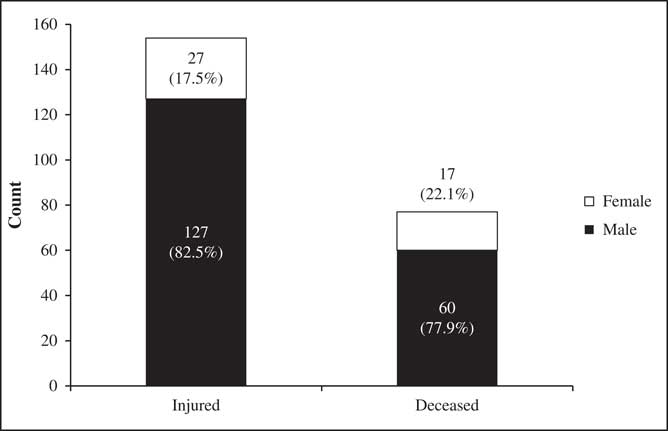
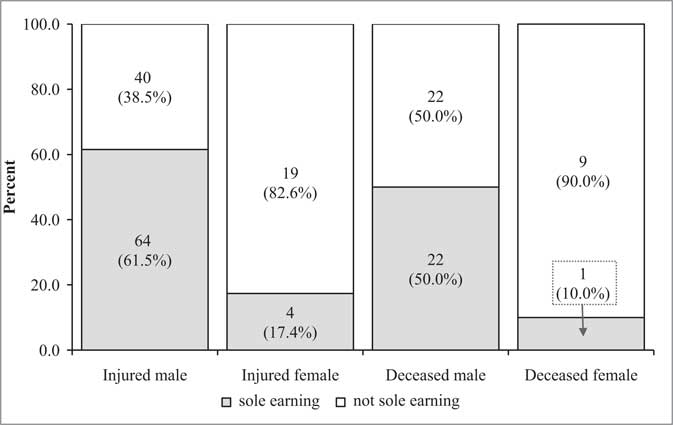
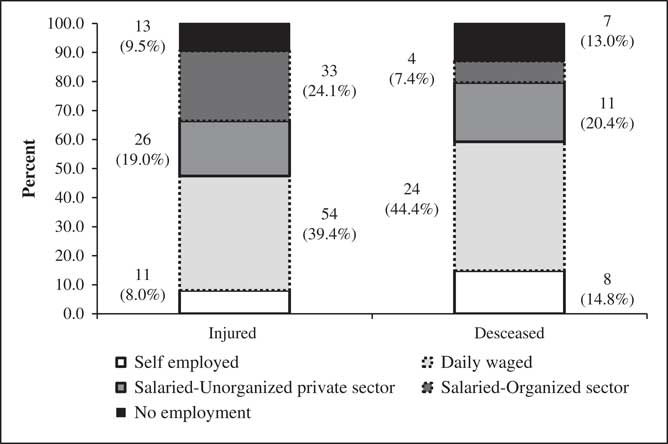
One hundred and fifty four (66.7%) case profiles were that of injured, while the remaining 77 (33.3%) were that of deceased. Figure 2 highlights that the injured and deceased were predominantly men. Forty-two (54.5%) of the deceased were under 40 years of age, and 103 (66.9%) of the injured were under 40 years of age. Further, among men, 64 (61.5%) of the injured and 22 (50.0%) of the deceased were the sole breadwinners of their families (Figure 3). In regards to women, four (17.4%) among the injured and one (10.0%) among the deceased were the sole breadwinners. Eighty (58.4%) of the injured either earned daily wages with various contractors and at different work locations, or were employed in the unorganized private sector where no records of their employment existed. The situation was similar among the deceased, where only four (7.4%) were salaried and working in an organized sector (Figure 4).
Distribution of Injured and Deceased by Gender

Distribution of Sole Earning Member Among Injured and Deceased, by Gender

Occupation of the Injured and Deceased

Immediate Health Consequences of the Terror Attack
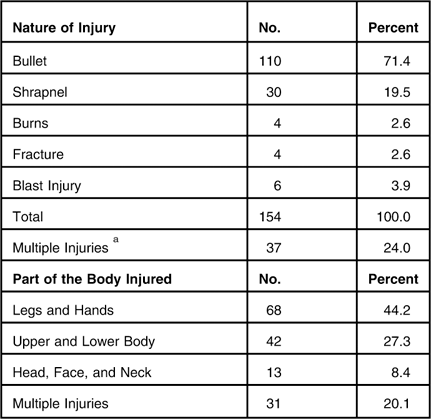
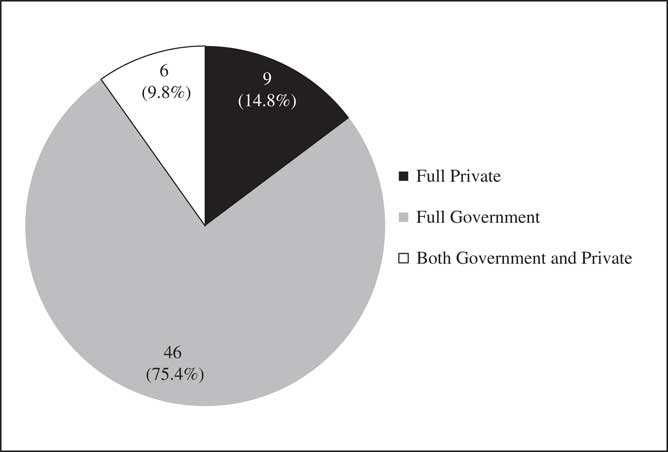
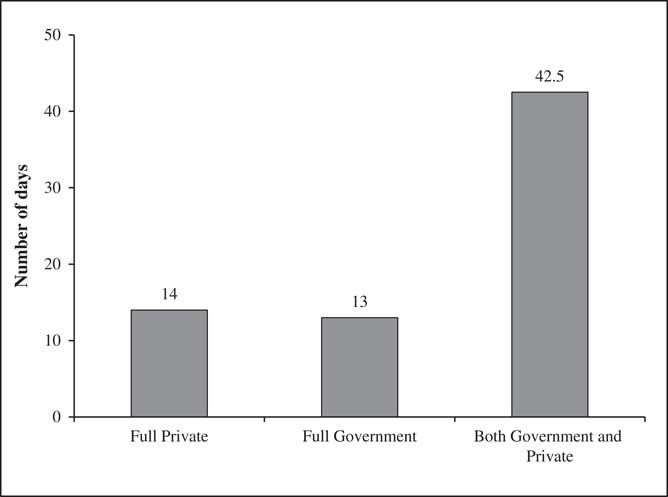
One hundred and ten (71.4%) of the injured had bullet injuries (Table 1). Approximately one-half had injured legs and hands, and approximately one-fourth had upper and lower body injuries. A majority of survivors (46, 75.4%) received initial treatment only at government hospitals (Figure 5). Six (9.8%) were treated only in private hospitals, while nine (14.8%) received treatment in both government and private hospitals (Figure 5). Individuals who shifted from government to private hospitals, on an average, spent 42.5 days in the hospital (Figure 6). Those who were treated only in government or private hospitals, on average, spent 13 and 14 days in the hospital, respectively.
Nature and Part of the Body Injured

a37 of the 154 injured survivors had more than one form of injury.
Hospitalization Details

Average (Median) Days of Hospitalization by Setting

Support Received
Depending on the nature of injury, the total amount received as ex gratia from the central and state government ranged up to 630,000 (US $10,141). On average, the injured received Rs108,685 (US $1,749), but as Table 2 highlights, the variation in the amount received was high. The ex gratia payments received by the families of the deceased ranged from Rs15,000 (US $241) to Rs5,910,000 (US $95,128). In comparison to the injured, the variation in ex gratia payments received by the families of the deceased was less, but the standard deviation of 1,279,198, in itself, is an indicator of a large variance (Table 2).
Details of Ex Gratia Payments Received by the Injured and the Families of the Deceased

Abbreviations: CV, coefficient of variation; SD, standard deviation.
Psychological Consequences Two Years after the Terror Attack
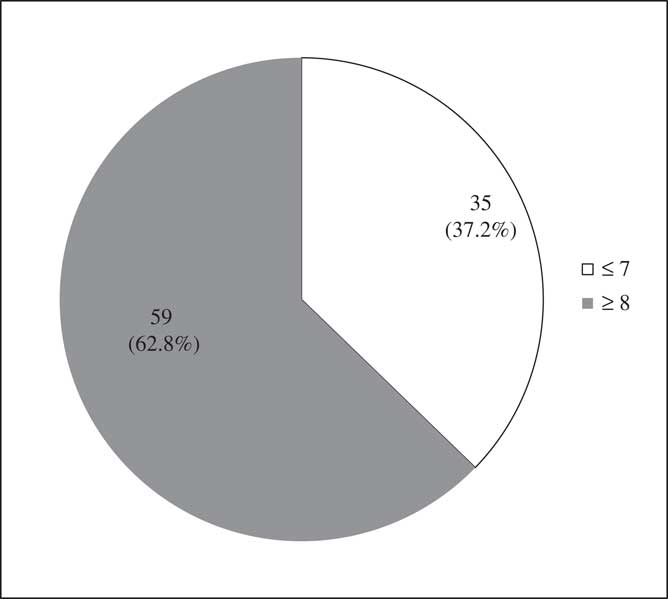
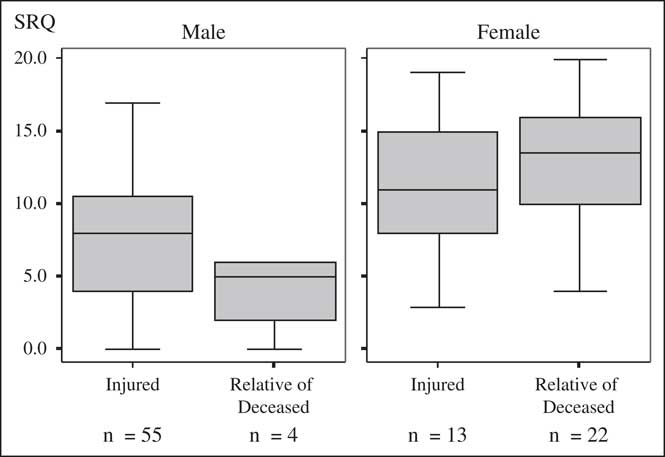
The extent of psychological distress experienced by survivors two years after the incident was assessed using the World Health Organization's (WHO's) self-reporting questionnaire (SRQ), SRQ20. 30 As the SRQ20 previously had been translated and validated in Hindi and Marathi, and the cutoff score arrived at in the general population for caseness was 7/8 (seven “yes's” a noncase, eight “yes's” a case),Reference Jaswal 31 it was decided to use the same score for the current exploration. Harpham et al also report that a cutoff of 7/8 is common.Reference Harpham, Reichenheim and Oser 32
Figure 7 shows that two years after the event, more than one-half of the survivors assessed (injured and relatives of the deceased) expressed significant psychological distress. Among men, the injured reported significantly higher distress than the male relative of the deceased, whereas the female relatives of the deceased expressed higher psychological distress than the injured females (Figure 8). One-half of the injured males, 28 (50.9%), and 11 (84.6%) of the injured females expressed significant psychological distress. Among the relatives of the deceased, no male member expressed significant psychological distress, whereas 20 (90.9%) of the females expressed significant psychological distress.
Psychological Distress Among Survivors (Injured and Relatives of the Deceased)

Psychological Distress Among the Injured and Relatives of the Deceased, by Gender
Abbreviation: SRQ, self-reporting questionnaire.

Key Factors Contributing to Psychological Distress
Forty case studies of those reporting significant distress were reviewed to understand the factors contributing to significant psychological distress. The review of case studies was followed up by in-depth interviews with the injured or the relative of the deceased to seek their understanding of the situation.
The key factor contributing to psychological distress among the injured and the relatives of the deceased is discussed under the following subheadings: Health, Disability, and Treatment Concerns; Impact on Livelihood and Family Income; Ex Gratia Concerns; Change in Family Networks and Available Support; Spiraling Negative Life Events; and Pressures of New Roles and Responsibilities.
Health, Disability and Treatment Concerns
The bullet injuries incurred by 110 (71.4%) of the injured generally left behind deep wounds that took time to recover. The nature of injury warranted repeated surgeries, multiple follow-up visits, physiotherapy sessions, and special procedures such as bone grafting and nerve replacement. Even the leg and hand injuries, which were considered to be less critical than other types of injuries with regard to threat to life, had significant implications for the survivor's recovery in the long run. Though not critically injured in the medical sense of criticality to life, these individuals took almost the same time to recover as those who were more severely injured. Many of the injured faced long-term health impacts (eg, inability to stand for long, difficulty in travelling, numbness of hands and legs, difficulty in moving, involuntary jerks and movements, pain, secondary complications of previous surgeries, and pending surgeries).
During the emergency phase, the majority were treated in government facilities (Figure 5). A small percentage who had insurance coverage, or who could financially afford it, shifted to private hospitals for treatment in the immediate aftermath of the incident. Lapses in treatment at the government hospitals forced some to shift, even when they could not afford the expense. Even the police personnel were shifted to private hospitals, as they were covered by health benefit schemes. The majority resentfully stayed back in government hospitals, and were satisfied with their medical care but unhappy with the supportive health care services (eg, food and stay arrangements for relatives, discriminatory attitudes, ward cleanliness, and support services from nurses and ward staff). A small percentage of survivors who were admitted to the private hospitals immediately after the event did not have to pay for their treatment as per government directive. However, they faced pressures for early discharge and discriminatory treatment, and once they were discharged, their follow-up visits were not subsidized in any manner. This contributed to a deep sense of uncertainty, discontent, and injustice.
After initial hospitalization and discharge, many chose private hospitals for follow-up treatment as the out-of-pocket expenditure on stay, food, and travel exceeded the benefits of free treatment at government hospitals. Repeated prescriptions of painkillers and other medicines which did not work, long queues, lack of continuity of treatment with one doctor, multiple cancellations of appointments, and difficulty in accessing the hospitals through public transport were some of the concerns that pushed people to private hospitals near their homes. This resulted in increased out-of-pocket expenditures for health care. Though survivors were referred to local civil hospitals, certain special procedures and specialists were not available, and hence, the survivors had to travel back to Mumbai for their treatment. Many private hospitals advised survivors to go back to the government facilities and the doctors who initially treated them, as the required expertise was missing, or the survivors were unable to bear the cost of those specialist inputs. After exhausting most of their resources in private hospitals, some shifted back to government hospitals, but they weren't helped much due to systemic issues in the public health care system. Thus for the injured, health concerns predominated in the two years that followed the attack. The social security nets, including that of the family's economic status, to a large extent, determined the nature of health recovery, and health, in turn, had a significant impact on the economic wellbeing and recovery of the families.
The disability assessments for certification of disability were conducted one year after the event. In order to access any service made available for people with disability, an individual must have a minimum of 40% disability. But someone with 100 pieces of shrapnel in and on him/her, with vague sensations and pain, received a disability certification of five percent to six percent. The loss of a right thumb for someone who made living pressing clothes meant complete loss of earning capacity but did not count for much in the disability assessment. A temporary or permanent disability label did not result in any supportive services, except for the certificate which permitted the survivor to travel by the local train using the compartment meant for persons with disabilities (PWD). With the new health problems and the accounted/discounted disabilities, people preferred to travel in the compartments allotted for PWD, as they were less crowded. They used hospital discharge certificates when their disability scores did not make them eligible for availing the services meant for PWD. Many did not go for the disability certification, and many who went did not get more than 10% or 15% as their disability assessment, even when they faced severe functional disabilities when one considers their nature of work and social context. Nonrecognition, or trivializing of their unique health needs and long-term health impacts, too was a cause of anger and discontent for many; they did not know how to move ahead in life with severely limiting health problems, which neither evoked attention nor the sympathy of health professionals.
Impact on Livelihood and Family Income
A significant portion of the injured were young migrant men, who were sole breadwinners, employed in the unorganized sector. Thus, the injured had significant responsibilities to be shouldered in the family and their ill-health had pushed the families to a very vulnerable position. The absence from work meant loss of income and loss of job for most in the unorganized private sector. Being self-employed as pav vala and kabab vala (street food vendors) or dabba vala (lunch delivery boys), working for daily wages, or working in the unorganized private sector also meant a lot of hard work on the job. The injured found it difficult to get back to these strenuous jobs with their newly-acquired health issues following the attack. For women, the long-term health impacts were barriers to fulfilling their reproductive roles and supplementing the family income. Injured men and women either reported inability to continue with their previous jobs that were physically demanding, or reported reduced earnings as they redefined their roles to suit their physical situations. Women who were supplementing the household income by working in the unorganized sector gave up, as they were unable to manage the pressures of physically demanding jobs. The financial crunch owing to job loss led to further relationship strains between survivors and significant others. But the ongoing health issues were a major impediment in getting back to work, thus pushing them to the edge, both in terms of physical and mental wellbeing.
With the reduced income, new migrants could not sustain themselves in Mumbai, and hence returned to their hometowns. These towns could not support or sustain them, even when they were able-bodied, and this forced them to move out in search for a living. They were either dependent on the larger family, or made a marginal living, resulting in giving up of all hopes for a better future.
As supportive health services were weak, the family members had to stay back to care for the survivors in the hospital, and also at home for months after discharge. This resulted in loss of income and role strains for the caregivers. The prolonged recovery time of the injured delayed the prospects of getting back to work, and for many resulted in job loss. When the nature of injury was severe, or when multiple family members were injured, extended family pitched in to care for the injured and their dependents back home. Thus the extended families’ expenses had to be managed. During this period, families exhausted most of the ex gratia money, and in most instances, spent more than what was received. Children often were neglected, and sometimes forced to drop out of school, to substitute for the caretaker or the survivor. The attack and its consequences also had implications for the care of the elderly dependents. Some had to fend for the injured (as in the case of migrants), some were deserted following the death of the breadwinner, and some experienced changes in caretakers as the injured or the deceased's immediate family was unable to continue with the responsibilities of caregiving along with the new pressures of ill health and loss.
Ex Gratia Concerns
Depending on the nature of injury, the amount received as an ex gratia payment from the central and state government put together ranged up to 630,000 (US $10,141) On an average, from all sources put together, the injured received approximately Rs 108,685 (US $1,749), but as Table 2 highlights, the variation in the amount received was high. The fluctuations could be attributed to the individual's position in the social structure. The ones who received more financial support (especially from nongovernmental sources) were well networked within the community, were from a particular religious and political background, had been in Mumbai for long, and knew how to tap the resources. Individuals who received media attention also received better help from nonstate parties. Injured individuals who chose not to be hospitalized in order to care for their more grievously-injured relative, or to manage the death rituals of the deceased, had no supporting documents and thus did not receive any ex gratia payment. Migrants who left Mumbai immediately were among those who were not reached by the nonstate parties.
The variation in the ex gratia payment amounts received by the families of the deceased was related largely to the place of death and the social security benefits which the deceased possessed (eg, group insurance, gratuity, and Provident Fund (PF)). The families of the individuals who were killed at the Chhatrapati Shivaji Terminus railway station were given an extra ex gratia payment of Rs1,000,000 (US $16,096) and a job in Indian Railway Service (as per the rail way department norms). Other families receiving higher payments were those of the deceased who held a job which had provisions for PF and gratuity. As only seven percent of the deceased were salaried and working in the organized sector, the majority of the families of the deceased did not receive any death benefits or PF/gratuity/pension from the employer. Thus, the families were made vulnerable to a whole range of negative life events (eg, children dropping out of school, delayed marriages, neglect of vulnerable family members, illness, and eviction from home). Some families expressed their concern with regard to organizations announcing large compensation packages but not delivering them in the right spirit or on time. There were instances when the contributions of fellow workers were pooled together and counted against the compensation declared by the organization served by the deceased. Denial of ex gratia payments for want of proper documents, a feeling of not been adequately compensated, a sense of discrimination and injustice, and the perception of neglect and apathy from the state also were reported by many survivors, contributing to significant anger and distress.
Change in Family Networks and Available Support
This was evident in both the families of the injured and the deceased. However, negative changes were more evident among the families of the deceased. The inflow of large ex gratia payments, and a temporary period of dependence on family networks for handling the crisis, had resulted in many altercations regarding finances. As the immediate kin of the deceased were in mourning, the larger family unit took up responsibilities of handling the rituals of burial, the ceremonies following death, and finances that came from nonstate members (ie, individual well-wishers, nongovernment organizations, religious groups, and local political party members). Immediate family members started isolating themselves after altercations with the extended family over money spent on rituals, the extended families’ demand for a share of the ex gratia payments, the immediate kin's share of the deceased's property and business enterprises, request for loans or gifts from the ex gratia money, etc. In some instances, extended families had withdrawn since day one, as issues of finances had emerged even before the burial. A sense of mistrust and feelings of being let down and despair emerged as families felt pulled between familial loyalties and uncertainties regarding the future. For example:
Where do I go for help with my four kids?
and
Both our families are behind the money that I received as compensation, what more to say, they are my own people who doomed me; should I put my children's future at risk or do I stay away from my own people?
Among the families of the injured, more of a positive trend was noticed. Extended families pitched in to care for the injured and his/her family. However, there were requests and demands for a share of the ex gratia amount, which generally were accommodated as the injured were very much in need of the support from extended family members.
Spiraling Negative Life Events
With the death of the earning member (sometimes the only earning member) the families became more susceptible to a whole range of negative life events, like children dropping out of school to take over the role of the breadwinner, business enterprises having to be closed down, worsening of health conditions of the dependents for want of proper treatment, poor quality of life, delaying of marriages, giving up higher education, giving up ones house for rent and moving to a rented house in a slum, etc. These negative life events that spiral out of the terror attack keep the incident alive on a daily basis among the survivors causing significant psychological distress.
Pressures of New Roles and Responsibilities
The death of the breadwinner forced many women to take up jobs either offered by railways or by the employer of the deceased. Women who were purely homemakers before the death of their husbands experienced a range of pressures overnight, from handling the husband's funeral, claiming his ex gratia payment, joining work, and interfacing with a range of stakeholders (ie, media, politicians, employers, government official and nongovernment organization personnel), thus introducing them to a life which was very different in all senses. In this rapid transition, some reported economic, physical, and sexual exploitation from within and outside the family, leaving a deep sense of guilt and helplessness. Though most women were able to take over the new roles and responsibilities, the rush to do so left deep emotional scars. This also had a negative impact on the children. Most women were faced with their unresolved grief, confusion regarding handling children and their expressions of grief, apprehensions regarding the future, and the pressures of the new roles that they had assumed inside and outside their homes. Some were so perplexed by the loss that they decided to hand over the jobs offered to a family member, generally the brother of the husband, in the hope that it would at least ensure them some space in the husband's home. But many were proven wrong in just two years after the event, with the rapid deterioration of informal support. The wives of the deceased migrants were the most vulnerable as they came from significantly marginalized communities in the first place and thus were left with no resources. Their pre-existing socio-economic vulnerabilities or lack of resources had a significant impact on their capacity to benefit from the available services or provisions. Even after two years, these women were grappling with the loss, not knowing how to move ahead. The uncertainties ahead of them forced many to cope with day-to-day life by refusing to think about the future and focusing only on the now. This was a major impediment to working on long-term recovery plans.
Discussion
The key factors contributing to psychological distress, processes involved in the progression of vulnerability, and the constituent domains of vulnerability captured from the lived experiences of survivors were synthesized to evolve the psychosocial framework (Figure 9) for understanding psychological distress among the survivors of the November 26 Mumbai terror attack. The components of the macro system most relevant for the understanding of macro factors impacting psychological distress were socio-economic status, age, sex, religion, education, occupation, statehood, and social role (ie, individuals from a poor socio-economic status, being a young widow or an elderly dependent, female, belonging to a minority religious group, poor educational status or being illiterate, working in an unorganized sector, being a migrant, sole breadwinner and a housewife not involved in any economic activity were identified to be more vulnerable to psychological distress owing to their pre-existing social, economic, political, and cultural disadvantages).
A Psychosocial Framework for Understanding Psychological Distress Among Survivors of the November 26, 2008 Mumbai Terror Attack

These individuals were vulnerable to psychological distress independent of the probability of their exposure to external threats, such as injury or death in a terror attack, as there were inherent internal threats (eg, debt default, loss of job, eviction from home, reduced/irregular income, health issues of breadwinner/dependents, and other negative life events). The macro level factors increased the susceptibility of exposure to both internal and external threats. The external threats identified in the study were injury/death in the terror attack, nature of injury, prolonged recovery time for injury, and permanent impairment. In the absence of adequate coping resources, these threats, when encountered, made recovery difficult and negative outcomes unavoidable. External and internal threats were synergistic (ie, internal threats manifested while encountering external threats in the absence of resources). The set of assets, services, and relationships that emerged from the study that allow people to protect themselves from a bad end or recover are summarized in Figure 9 under three subheadings: (1) Individual Capacities; (2) Informal Social Network; and (3) Formal Social Protection. The Formal Social Protection played a significant role with regard to protecting people from encountering bad outcomes, but many were not covered by these protective nets. As the profile of the survivors highlights, not many had the individual capacities to overcome the crisis without external help. In the absence of adequate social protection, bad outcomes were realized, but a bad outcome in itself was not the factor causing significant psychological distress. The help-seeking process, or the interpretation of one's situation from the meanings that emerged during the help-seeking process, had a significant role to play in the emergence of psychological distress. The forgotten promises; delay in provision of services or ex gratia payments; negative experiences at the time of death (ie, the demand for bribes; insensitive behavior of the hospital authorities, employers, and relatives); attribution of suffering to anthropogenic causes; nonacceptance of deflection; uncertainties regarding future; sense of violation; social exclusion; lack of control; hopelessness; reduced self esteem; inability to grieve; unresolved grief and the rush to compensate for social roles and establishing meaningful social identities; perceiving lack of warmth; lack of sympathy and understanding; sense of burden of new responsibilities; newly acquired social identities of a victim; sense of discrimination; and unfair treatment, were identified as the mechanisms through which negative outcomes affected individual attitudes, feelings, and behaviors, leading to psychological distress.
Conclusion
The framework in Figure 9 highlights the need for addressing psychological distress in the context of social and economic justice. A pure traumatic stress perspective becomes irrelevant in explaining psychological outcomes of traumatic events, especially in nonwestern, resource-poor contexts, with significantly high predisaster socio-economic vulnerabilities and poor safety nets. Health services have significant implications for long-term recovery and have to broaden the scope beyond emergency care to include dimensions of disability, accessible follow-up, and support services to facilitate comprehensive recovery of survivors. This report highlights the multi-dimensional and dynamic nature of impacts and thus emphasizes the need for supportive interventions beyond therapeutic services; these interventions should accommodate the changing and unique needs of different categories of survivors impacted by the disaster. Thus, this report also highlights the need for more comprehensive systems for recovery, which go beyond emergency medical care and homogenous ex gratia payments based on pure biological criteria, like nature of injury. This is especially important in the Asian context, where predisaster socio-economic vulnerabilities are key determinants of long-term recovery and wellbeing.