

Introduction
Rising skepticism on the merits of trade and globalization has become a political reality across several key developed countries. An increasing number of voters consider that existing liberal trade policy prescriptions have failed to provide opportunities for much of the population, and this has fostered profound disillusion with both the “elite” and their global vision.Footnote 1 Recently, the COVID-19 pandemic has further exacerbated such antiglobalization sentiments.Footnote 2 This poses new challenges for multinational enterprises (MNEs) and other trade dependent firms (TDFs) across the globe.Footnote 3 These challenges will vary depending on the nature of the company and its national economic system, as well as its position in the global value chain (GVC).Footnote 4 In this paper, we focus on the challenges for TDFs based in developed countries (primarily the United Kingdom and the United States, as well as the European Union), where most MNEs are still based. We define TDFs as enterprises whose business model depends on exporting to foreign markets and/or importing from such markets, or both. We elaborate a series of propositions identifying the strategies that such firms are likely to adopt to respond to this antiglobalization backlash.
As the reasons behind shifts in government and consumer attitudes to trade and globalization are multifaceted,Footnote 5 corporate responses are likely to occur on several levels, through coordinated market and nonmarket strategies (NMSs). In this paper, we focus on NMSs defined by Baron as: “. . . a concerted pattern of actions taken in the nonmarket environment to create value by improving its overall performance.”Footnote 6 Drawing on existing literature, we develop an analytical framework linking protectionist pressures on business with their likely strategic responses. In the interests of brevity, we will not consider market strategies in any detail. Although we recognize that they can contribute to mitigating the threat from protectionism, much of that threat emanates from the nonmarket environment—especially governments and civil society. Thus, strategic responses seem likely to relate more to company relations with these actors. In addition, the question of the interaction between market strategies and the current antiglobalization context has, to some extent, been addressed in existing literature,Footnote 7 although more certainly needs to be done.
Our framework takes into consideration two economic and political factors that were largely absent when most work on NMS and protectionism was developed in the 1980s and ’90s. Firstly, the integration of industries into GVCs and the growing importance of intra-industry trade. This has profound implications for firms’ trade preferences and their NMS in this regard.Footnote 8 GVC integration has been found to impact particularly on one of the key elements of a companies’ NMSFootnote 9: whether to mobilize individually or collectively through their trade associations.Footnote 10 At the same time, GVCs spread the reach of MNEs to far-distant production sites, where oversight is difficult, while also linking them to negative social and environmental externalities, including in contexts where they have no contractual link to production.Footnote 11 They also create shared business interests across nations.Footnote 12
Secondly, although we recognize that protectionism is not a new phenomenon, the protectionist pressures we witness today, as well as the political response, are different to those seen in the past. These tended to be concentrated on a few key industries like labor intensive goods,Footnote 13 cars,Footnote 14 and steel.Footnote 15 The political shift toward wider protectionism is particularly evident in the United States, where antiglobalization and trade rhetoric were key issues in the 2016 presidential election campaign, eventually won by the most trade sceptic candidate.Footnote 16 However, the European Union has also witnessed growing distrust of trade deals like the Trans-Atlantic Trade and Investment Partnership (TTIP) and electoral progress by anti-trade and -globalization candidates, especially in France and Italy, together with the vote for Brexit in the United Kingdom.Footnote 17 Public concerns about trade have already led to important policy reversals and the threat to TDFs of more far reaching protectionist actions looms large, especially after the COVID-19 pandemic led to a further increase in trade barriers.Footnote 18
The widespread nature of protectionist phenomena implies that cooperation is required between affected MNEs both within and across nations, however, it is well established that collective action is complex to launch and sustain because of the potential for free riding.Footnote 19 There is now a large body of work that has looked at the circumstances under which collective action problems can be overcome in the trade policy arena.Footnote 20 One key finding of this work is that political mobilization is most likely when firms face clear and present dangers to their business models.Footnote 21 We argue that the current context represents such a threat, and that MNEs have good reason to mobilize. As several academics have highlighted, the emergence of a government in the United States that is actively reworking the global trading system is not an isolated incident that will recede when the current administration leaves the White House.Footnote 22
The remainder of this paper is organized as follows. We firstly seek to highlight the key factors behind the rise of antiglobalization pressures and trade protectionism, focusing, on the one hand, on concerns about the negative effects of trade on employment and inequality in developed countries and, on the other, on the negative social and environmental impacts of global production networks in developing countries. Although these issues are of concern to different sub-groups of the electorate in developed countries, they both undermine support for globalization, albeit in different ways.Footnote 23 It is likely that TDFs will adjust their NMS in response to both types of societal pressure.Footnote 24 We then draw on existing academic research from political scientists, economists, and international business scholars on companies’ NMS to propose a series of hypotheses on likely corporate responses and, on this basis, propose a framework for understanding corporate strategy in the context of rising protectionism.
The rise of antiglobalization pressures and trade protectionism
Concerns about the negative impacts of globalization are as old as economic integration itself.Footnote 25 Indeed, as recently underlined by Franzese,Footnote 26 the very basis of the theory of comparative advantage is that under free trade some industries will shrink, in order to allow others to grow. During the current wave of globalization, there have been persistent criticisms of the unequal distribution of the gains in developed countries, as well as the potential negative social and environmental impacts in developing countries integrated into GVCs.Footnote 27 It is beyond the scope of this paper to discuss the exact (and wide ranging) roots of these different criticisms.Footnote 28 For our purposes, it is important to note that, although likely to be found in different subgroups of the population,Footnote 29 both sentiments are strongly anchored. As such, they are key examples of the kind of societal pressure that the literature has identified as impacting on corporate NMS.Footnote 30 In the remainder of this section, we will elaborate on the drivers of the antiglobalization backlash and the political responses that have emerged, distinguishing between economic concerns in developed countries and social and environmental concerns in developing countries.
Unequal distribution of gains in developed countries
A common economic concern in developed countries has been that trade liberalization has had negative effects on wages and domestic employment.Footnote 31 Academics have begun to identify both structural shifts in employment in the developed world and links between local unemployment and international trade.Footnote 32 Most concerning for many voters, trade has been found to contribute to the loss of relatively highly paid manufacturing jobs for lower skilled workers.Footnote 33 Many consider that this has contributed to employment insecurity and the increase in economic inequality, which is becoming a major societal issue.Footnote 34 Of course, trade is not the only cause of rising inequality. In fact, many analyses indicate that technological change has greater effects on the labor market than trade,Footnote 35 yet it is difficult to hold governments responsible for robotization, while the tariffs levied on goods entering the market are a public policy choice.
Current antitrade sentiments build on these concerns. Although skepticism about globalization is not new, the global financial crisis (GFC) and the economic downturn that accompanied it, refueled skepticism about developed country gains from trade.Footnote 36 More recently, the COVID-19 pandemic has further intensified distrust of global economic integration and interdependence.Footnote 37 In a context of flat or negative growth, displaced workers have fewer opportunities and risk falling into long-term unemployment, further exacerbating economic inequalities. As politicians have picked up on and exploited, this sentiment—antiglobalization rhetoric—has moved from the margins to the mainstream in many developed counties.Footnote 38
The antiglobalization backlash has been most notable in the United States. Opinion polls show that a significant portion of the US public have negative opinions about international trade,Footnote 39 and research there suggests that voters in regions hit by de-industrialization blame import competition, and by extension open trade policies, for unemployment and job insecurity.Footnote 40 The depth and extent of the change in US trade policy orientation, as a result of these antitrade sentiments, has been unprecedented: the United States has pulled out of the Trans-Pacific Partnership (TPP) trade agreement; renegotiated the North American Free Trade Agreement (NAFTA); unilaterally imposed tariffs, citing a little used regulation on threats to national security under Section 232Footnote 41 and Chinese IPR abuses under Section 301;Footnote 42 and adopted a very hostile attitude toward global trade institutions.Footnote 43
On the other side of the Atlantic, with the exception of Brexit, policy change has been less extensive. However, the debate has also been intense: distrust of trade deals in the European Union crystalized around resistance to the negotiations with the United States on TTIP and with Canada on the Comprehensive Economic and Trade Agreement (CETA).Footnote 44 In the United Kingdom, the Brexit referendum is difficult to place in terms of the wider debate on trade. Research suggests that there is a link between support for leaving the European Union and feelings of economic malaise,Footnote 45 vulnerability to economic change,Footnote 46 and the perception that trade liberalization has generated wealth for certain privileged groups and corporations, while making the majority of citizens and firms worse off.Footnote 47 However, the debate on Brexit and trade was ambiguous and many leave voters did not expect trade to fall after Brexit.Footnote 48 In this sense, the vote for Brexit differs from that for Trump, although the consequences for firms—reduced openness to trade and disrupted supply chains—will be the same, at least in the short term.
Negative social and environmental impacts in developing countries
Until recently, there was more apprehension about the impact of globalization on the Global South than on the North.Footnote 49 These concerns generally emanated from the political Left and were related to the perceived exploitation of developing nations by a system created to benefit the developed world. As developing nations have increased their importance to the world economy, these concerns have expanded to questioning the “fairness” of trade, in as much as differences in standards across countries are perceived to enable developing countries to undercut Northern workers.Footnote 50 Scherer and Palazzo argue that as GVCs have spread across the world they have, almost inevitably, increasingly included actors that are operating in countries where the state is less willing, or able, to effectively regulate, or even in “failed states” where the state does not control, large swathes of the economy.Footnote 51 This, in turn, has resulted in corporations being held responsible for negative impacts along their value chains, even in the context of activities where they have no direct legal or financial link.Footnote 52
As the perceived responsibility of MNEs has expanded, so has the need to demonstrate that they exercise control over their supply chains. Many are being forced to reassess the boundaries of their firms and ask whether “contractual suppliers in another country [are] a part of the definition of ‘us’?”Footnote 53 If suppliers are within the boundary of the firm, ensuring that the former conform to the social and environmental norms of the home state becomes the buyer's responsibility, as the recent imposition of due diligence on US firms dealing in diamonds from conflict areas demonstrates.Footnote 54 In such cases, new regulations expand the boundaries of the firm, or at least its responsibilities, in a sense requiring it to replace ineffectual states.
The case of conflict diamonds is quite extreme, but global operations in other sectors are also being heavily criticized because of concerns about low pay, unsafe working conditions, and lack of worker rights in developing countries. These concerns have fostered a variety of voluntary activities and certification schemes seeking to demonstrate that MNEs, especially lead firms in vulnerable sectors, are operating ethically.Footnote 55 However, many civil society actors are unconvinced of the effectiveness of such schemes, and for some time the European Parliament has been seeking binding due diligence requirements, including in the high profile clothing sector.Footnote 56 The widespread layoffs of developing country workers following the cancellation of contracts during the COVID-19 pandemic has served to increase this pressure.Footnote 57
While much of the criticism of GVCs focuses on worker's rights, there are also very real concerns about the environmental impacts of global production. This is not just because of the inevitable additional transportation involved. There are also fears that lower environmental standards in developing countries lead to “environmental dumping.” Initial research provided little support for the idea that MNEs export polluting activities to less regulated environments.Footnote 58 However, a skeptical environmental movement has long dismissed such analysis, while more recent research has provided more nuanced results.Footnote 59 At the same time, campaigners have launched numerous campaigns highlighting the negative environmental effects of MNEs’ operations across the world.Footnote 60
Although these concerns about social and environmental impacts of globalization resonate with different types of voters to those on negative impacts on the Global North,Footnote 61 both combine to influence public opinion and to increase pressure on politicians to “protect” domestic workers as well as those elsewhere. This, in turn, is likely to have an impact on the NMS of MNEs and other TFDs.Footnote 62
Responses to trade protectionism: Developing an integrated framework for company nonmarket strategy
The concerns outlined above are multifaceted, and thus pose a variety of different challenges to MNEs and other TDFs. In this section, we will formulate testable propositions and an analytical framework (presented below), which link the roots of trade protectionist pressures to likely company strategic responses. Many of these firms will be MNEs, defined as “. . . an enterprise that controls assets of other entities in countries other than its home country, usually by owning a certain equity capital stake.”Footnote 63 Such companies are estimated to be directly responsible for half of global exports, with even higher levels in the European Union (over 80 percent for France and Hungary).Footnote 64 Companies that trade tend to be relatively large and “big business,” whether a classic MNE or not, is more likely to be trade dependent such that: “. . . the protrade coalition includes very large firms that cut across both net-exporting and net-importing industries.”Footnote 65 Although our framework could also apply to smaller firms, they have lower capacity and awareness, reducing the extent of their nonmarket action.Footnote 66
We develop our propositions and framework of likely company strategies based on findings in the existing literature. As indicated in the introduction, our focus is on strategies in the nonmarket arena (NMSs), which have evolved to include two distinct types of nonmarket actions: (i) corporate political activity (CPA), defined as “. . . corporate attempts to shape government policy in ways favorable to the firm”;Footnote 67 and (ii) corporate social responsibility (CSR), defined as “. . . context-specific organizational actions and policies that take into account stakeholders’ expectations and the triple bottom line of economic, social, and environmental performance.”Footnote 68 In developing our propositions, we differentiate between these two types of NMSs.
We assume that firms will use a variety of strategies, depending on their individual circumstances, such as their home and host country institutional context,Footnote 69 the sector in which they operate, their GVC governance structure,Footnote 70 and the nature of their trade-dependence.Footnote 71 Although the propositions below are relevant to all TDFs, the importance of different factors and their likely reaction will vary depending on whether they are import-dependent firms (IDFs) or export-dependent firms (EDFs) or both.Footnote 72 IDFs are those whose business model relies on easy access to low cost and/or high variety products, primarily from overseas. This would include most developed country retailers, like H&M and Walmart, as well as Western brands of labor intensive goods, like Nike, and these firms have often been very active in resisting increased trade barriers, for example, in antidumping actions.Footnote 73 EDFs are those whose business model relies on international markets for a large percentage of their sales. They have often been very active in lobbying for free trade agreements, which open overseas markets, as well as facilitating global production structures.Footnote 74 In developed countries, these would include producers of medium tech products like Volkswagen or Renault, as well as luxury brands, like Gucci or Louis Vuitton. Although most MNEs, including the latter, are dependent on both imports and exports, many have a stronger orientation toward one than the other, with foreign affiliates particularly dependent on exports.Footnote 75 They are therefore likely to vary their strategies depending on their orientation. Where relevant, in the propositions that follow, we differentiate between those strategies which are more likely in IDFs or EDFs, although in many cases MNEs will adopt elements of both.
Mobilizing through corporate political activity
Scholarship exploring the question of how companies use CPA to address rising protectionism is surprisingly limited. Research on CPA in the trade policy arena has mostly focused on how and why companies access the policymaking process, especially when seeking to persuade governments to enact protectionist measures.Footnote 76 The question of how companies seek to counteract such pressures has attracted much less interest.
There are obvious reasons for this bias in the literature. Although it has been claimed that: “free trade enjoys an intellectual status unrivaled by any other doctrine in the field of economics,”Footnote 77 there is also, as Bhagwati notes, a clear discord “between the elegance of the irrefutable demonstration of the advantages of free trade and the inelegance with which practical politics embraces protection.”Footnote 78 He refers here to the fact that, historically, in most states, there has been a bias toward protectionist trade policies. This imbalance between the theoretical merits of free trade and the practice of protectionism is understandable. Trade policy is typically an iterative battle between the “special interests” representing the losers from openness (i.e., import-competing firms and their workers), who favor protectionism, and the “diffuse interests” of those who, in the aggregate, gain from freer trade, especially consumers. The former have a much stronger incentive to mobilize than the latter, whose “gains” (especially in terms of choice and lower prices) may not be clearly perceived as such. In addition, although the number of firms that trade has increased over time, the percentage of TDFs in any given economy remains relatively small.Footnote 79 MNEs and the largest and most productive domestic firms are the key traders.Footnote 80 This is a relatively small group and indeed the number of firms that lose from globalization may often outnumber the winners.Footnote 81 Thus, the efforts of pro-protectionist actors tend to be more high profile and visible than those of pro-liberal actors and have attracted greater academic scrutiny.Footnote 82
This is not to say that there is no literature analyzing the role of pro-liberal firms in trade politics. However, most of this literature has explored their policy preferences and the circumstances under which they become politically active, rather than their likely NMSs. One conclusion of this literature is that although MNEs may seek protection for markets where their plants are located,Footnote 83 most exporters in a given economy will support bilateral or multilateral free trade agreements, as they will give them access to foreign markets.Footnote 84 Both EDFs and IDFs are likely to oppose unilateral protectionist measures (in particular, trade defense instruments), for fear of foreign retaliation and the rising costs of inputs, respectively.Footnote 85 Indeed, recent research in Germany confirmed that the mobilization of business against populism was largely a function of the vulnerability of their sectors to increased protectionism.Footnote 86
In developing our first set of propositions, we build on the general CPA literature,Footnote 87 which provides a comprehensive inventory of corporate political strategies. These are lobbying; constituency building (or coalition formation); communication with governments and the wider public about preferences for policy or policy positions; and financial contributions. Below, we explore these potential strategies in turn, with the exception of the latter. Although in the US context election funding and other financial contributions is a key means to influence policymaking, it plays a much less significant role (if any) in other political systems, especially in the European Union. So we exclude it from our propositions and framework.
When it comes to lobbying, a key strategic question for firms is whether to mobilize individually, or collectively through their trade associations.Footnote 88 The difficulty, in the current context, is the increasing political salience of trade. As indicated above, it has become a high-profile issue in many Western countries and, as several scholars argue, the politics of such salient issues is different.Footnote 89 Specifically in such contexts, which Culpepper terms “noisy politics,” business interests are more likely to be defeated,Footnote 90 while individual firms are reticent to talk out for fear of negative reputational effects.Footnote 91 Hillman and Hitt consider that such issues call for collective CPA both to avoid exposure of individual firms and because of the need for a large coalition to have any impact.Footnote 92
However, research on trade policy issues indicates, on the contrary, that collective lobbying is increasingly not the norm.Footnote 93 Rather, the integration of industries into GVCs and the level of intra-industry trade impacts how firms lobby on trade.Footnote 94 Gilligan finds that, when intra-industry trade is high, individual firms are subject to much more specific trade adjustments costs from import competition such that “. . . lobbying for protection against intra-industry trade is virtually a private good.”Footnote 95 Such findings have lead some scholars to argue that variations in firms’ ability to benefit from globalization have led to differences in their lobbying activity and trade policy preferences,Footnote 96 and that this, in turn, makes industry-wide coalitions more difficult to hold together. This would suggest rather a move to individual lobbying on trade, where firms that are more integrated into the global economy split from more protectionist domestic trade associations, to lobby alone for liberalization.Footnote 97
This literature suggests that in a case where the protection or liberalization of a specific product threatens (or provides opportunities) to only one (or few) companies, they have an incentive to lobby individually. However, in the case where generalized protectionism or liberalization benefits/hurts many companies, they have no incentive to mobilize individually and are more likely to rely on trade associations. In other words, in as much as free trade can be considered a “public good,” classic collective actions problems arise,Footnote 98 such that the TDFs we study here would be expected to be less active in lobbying individually against general protectionism than their associations. Thus, where many TDF's are simultaneously threatened with major disruption to their business models, we would expect them to lobby collectively to combine their resources and reduce exposure. This brings us to our first two propositions:
Proposition 1a: In contexts where protectionist trade policy proposals are economy wide, or remain rhetorical, most TDFs will lobby collectively through their formal trade associations.
Proposition 1b: In contexts where concrete protectionist trade policy proposals are tabled with differential effects across an industry, TDFs will lobby the relevant government individually, or in ad-hoc groupings.
What is more, as the threat of rising protectionism affects companies on both sides of the trading relationship, antiprotectionist lobbying efforts may be strengthened through transnational lobbying and the creation of ad hoc trade lobby groups, techniques that have become increasingly common in recent years.Footnote 99 Recent literature has highlighted that, as GVCs spread across borders, protectionist measures increasingly impact economic actors linked within these chains and motivate them to coordinate their CPA, including in international institutions like the WTO.Footnote 100 In the context of new protectionist measures, we would expect impacted companies and their trade associations to work together across partner economies to lobby their administrations or international institutions. As several authors have recently highlighted, CPA across different institutional contexts is challenging and certain strategic capabilities are more easily transferred than others.Footnote 101 Partnering with local partners in host countries who have common interests can help to overcome such difficulties.Footnote 102
Proposition 1c: In contexts where protectionist policies threaten TDFs in partner countries, they will mobilize together to create transnational ad hoc groupings to lobby their respective governments.
The rising importance of civil society in the debate on tradeFootnote 103 also implies that TDFs need to adapt their CPA strategy from focusing on the political elites who make the final choices to building wider public support for trade. This strategy, termed “constituency building” or “coalition formation” in the CPA literature,Footnote 104 would involve actions across a range of stakeholders at home and abroad, including companies’ own employees, the media, civil society, and trade unions.Footnote 105
In a context of low trust in business, the linking of existing CSR cooperation with NGOs and trade unions with wider corporate advocacy activities, could provide opportunities to regain legitimacy. Indeed, such linkages are increasingly common.Footnote 106 A recent example was the (rather unusual) joint letter of the Confederation of British Industry and the United Kingdom's Trade Union Council warning of the negative effects of a no deal Brexit.Footnote 107 Common cause was found between these often-conflicting interests, as both saw an immediate threat from new trade barriers. More widely, working effectively with trade unions will likely require TDFs to accept the existence of extensive negative externalities from globalization and will imply supporting more effective and high-profile efforts to compensate the losers.Footnote 108
Coalitions with civil society in defense of openness can be very effective. For example, in the solar panel antidumping debate in the European Union, environmental NGOs came out in support of the successful campaign against increased protectionism.Footnote 109 However, companies often see their engagement with civil society uniquely through the lens of CSR, rather than as an asset that can be leveraged to create a more positive (and politically impactful) image of their business activities. Faced with an increasing need to justify their global operations, we would expect this approach to evolve.
Proposition 1d: In contexts where anti-trade rhetoric is rising, TDFs will increase their engagement with civil society and grass-roots organizations with a view to supporting actions in their common interest, which mitigate the negative impacts of both protectionism and globalization.
Finally, the CPA literature underlines the importance of information and communication strategies.Footnote 110 The timing and framing of the debate are particularly important to policy outcomes in this regard. Thus, when faced with antitrade advocacy, early counter mobilization by TDFs is vital. Analyses of two failed campaigns by TDFs in favor of liberalization—the 1997 Fast Track debate in the United StatesFootnote 111 and the 2012 debate in the European Union on the Anti-Counterfeiting Trade Agreement (ACTA)Footnote 112—reveals that business complacency and failure to mobilize quickly were key to the success of the opposing groups. Recently the debate on TTIP in Europe mirrored this experience of complacency leading to negative framing by civil society, who very rapidly set the terms of the debate, putting corporate interests on the defensive.Footnote 113
However, as highlighted above, many consumers and voters in developed countries are now skeptical about the standard arguments on free trade and their beliefs are deep-seated.Footnote 114 Countering the narrative on such salient issues is very challenging.Footnote 115 Constituency building may be supported by information provision and support for counter-expertise,Footnote 116 however the complexity of the arguments for free trade can be a disadvantage: “Opponents’ arguments about the costs of free trade [are] easier to understand than the more abstract arguments about the benefits of free trade, and thus lend themselves more easily to . . . political tactics for swaying the preferences of the median voter.”Footnote 117 This pedagogical challenge has become even more difficult in an age of fragmented production and outsourcing, where direct negative effects are visible and potentially more significant than (individually small) aggregate gains.Footnote 118 Nevertheless, there are employees who depend on trade openness in all economies, and this fact could be better highlighted to balance the tangible reality of negative impacts of openness.
Translating these insights to the current antiglobalization backlash, with trade now a highly salient topic in many developed countries, it seems to be too late for general informational approaches. In a context where trade has already been labeled as “bad” by many civil society actors and political leaders, industry is likely to seek to reframe the debate. A preferable approach to more theoretical abstract arguments may be providing counter information and expertise on the concrete negative impacts of proposed policies. For example, by highlighting specific examples of economic losses (particularly job losses) from protectionism. This is likely to resonate more with the public (and the media) than more theoretical arguments about trade's potential benefits.
Proposition 1e: In the context of rising anti-globalization sentiment, TDFs will seek to re-frame the debate by highlighting the concrete negative effects of protectionism on trade-dependent workers and regions.
Mobilizing through corporate social responsibility
Beyond CPA, the other key NMS that could be mobilized to reduce the threat of protectionism is CSR. The links between CSR and protectionism are only beginning to be explored,Footnote 119 although self-regulation is considered to be an appropriate strategy to address particularly salient issues.Footnote 120 Thus CSR activity could be leveraged to influence public opinion and address criticism of GVCs and their supposed exploitive nature.Footnote 121 Clearly not all voters will be sensitive to CSR actions. As highlighted above, the political Left is historicaly more concerned about globalization's negative impacts in the South.Footnote 122 CSR cannot substantially address the negative impacts in developed countries (unless “bringing back production” becomes an element of CSRFootnote 123). However, it can address consumer concerns that imports are “unfair” in terms of differential labor and environmental standards.Footnote 124 This is a particular threat to those IDFs who are lead firms in long and complex GVCs.
High profile campaigns highlighting negative impacts of GVCs in the South have resulted in strengthening of action by IDFs. One recent high-profile example was the Accord on Fire and Building Safety in Bangladesh, established by large Western clothing retailers and trade union federations to address health and safety concerns in the wake of a major industrial disaster (the Rana Plaza collapse).Footnote 125 Pressure from consumers and NGOs was vital in the establishment of the accord, such that: “. . . brands were pressured to protect their brand image vis-à-vis the critical scrutiny of their consumers.”Footnote 126 In the current climate, we would expect companies to multiply voluntary efforts, like certification and attendant auditing, which address such public concerns.
Furthermore, as discussed above, a key evolution in the CSR domain in recent years has been an increase in corporate activities that are more often considered the role of the state. This has led scholars to develop the concept of political CSR (PCSR), which is probably more pertinent to addressing concerns about globalization than traditional “instrumental” CSR.Footnote 127 PCSR “. . . suggests an extended model of governance with business firms contributing to global regulation and providing public goods.”Footnote 128 The Bangladesh Accord can be considered to be one such model, representing both a reaction to globalization and a means to address some of its negative consequences.
Proposition 2a: In contexts where anti-trade rhetoric is rising, IDFs will increase their enrolment in certification schemes which ensure responsible business conduct and due diligence in supply chains, while taking greater responsibility for public goods in weak states.
Pressure for action from civil society not only encourages greater company engagement in voluntary initiatives, it also calls for communication activities to ensure that consumers are aware of these efforts. CSR action to minimize negative externalities within GVCs and maximize their positive impacts could be leveraged to support CPA, by highlighting the positive impacts of trade and counteracting negative consumer perceptions of GVCs. However, scholars have recently noted a surprising lack of coordination between the two NMSs at the firm level.Footnote 129 This not only risks incoherence, but also fails to capitalize on an important potential corporate resource—its links to civil society through CSR—which could be leveraged to build support from stakeholders for wider company objectives.Footnote 130 Faced with public criticism, IDFs in particular, would be expected to integrate their NMSs more effectively, in order to leverage CSR activities in their CPA communication activities.
Proposition 2b: In contexts where anti-trade rhetoric is rising, IDFs will increasingly integrate their NMSs and seek to extend awareness amongst the public and policymakers about their positive company engagement to address negative impacts on workers and communities involved in their supply chains.
As mentioned earlier, a key feature of CSR has tended to be its voluntary nature. In this, as in most other areas of business activity, MNEs typically have a strong preference for self-regulation.Footnote 131 However, researchers have identified a tendency for certain companies to shift their position toward support for regulation, when they consider it to be inevitable or where they judge that regulatory differences across countries are creating competitive disadvantages, for example, in the climate change debate.Footnote 132 This may also happen in CSR.
Kinderman has detected a move toward stronger regulation of CSR in the European Union, which he links to the financial crisis and the resulting decline in business legitimacy.Footnote 133 The European Parliament together with some member states, have demanded stronger regulation.Footnote 134 Such regulation already exists in several sectors. The timber sector has an EU system in place to address illegal logging—the Forest Law Enforcement, Governance, and Trade (FLEGT) initiative, launched in 2003, and the EU Timber Regulation, which came into force in 2013.Footnote 135 There is also a 2017 supply chain due diligence regulation in conflict minerals.Footnote 136 With generic legislation like French mandatory due diligence in supply chains and the UK Modern-Slavery Act, the likelihood of moving to more widespread “hard” regulation on CSR is very real.Footnote 137 In this variable context, concerns about the (un)level playing field across different member states motivates some individual companies to support “harder” intervention.Footnote 138
Heterogeneous regulations, in combination with growing antiglobalization pressures, create incentives for certain firms to shift position toward stronger regulation. In other words, certain companies, particularly those based in more regulated states, may choose to defect from the traditional strong business stance in support of CSR self-regulation and embrace demands for “hard” (although preferably “light”) regulation. Such a stance, in addition to leveling the playing field, would also create a positive image for the “defecting” companies. This proposition is more relevant to IDFs than EDFs, although some of the latter may have concerns about oversight of their sales in failed or weak states, which could result in pressure for further regulation.Footnote 139
Proposition 2c: In contexts where antitrade rhetoric is rising and governments are considering, or have enacted, “hard” regulation of overseas business conduct, TDFs subject to such regulation will start to support a stronger regulatory role in CSR.
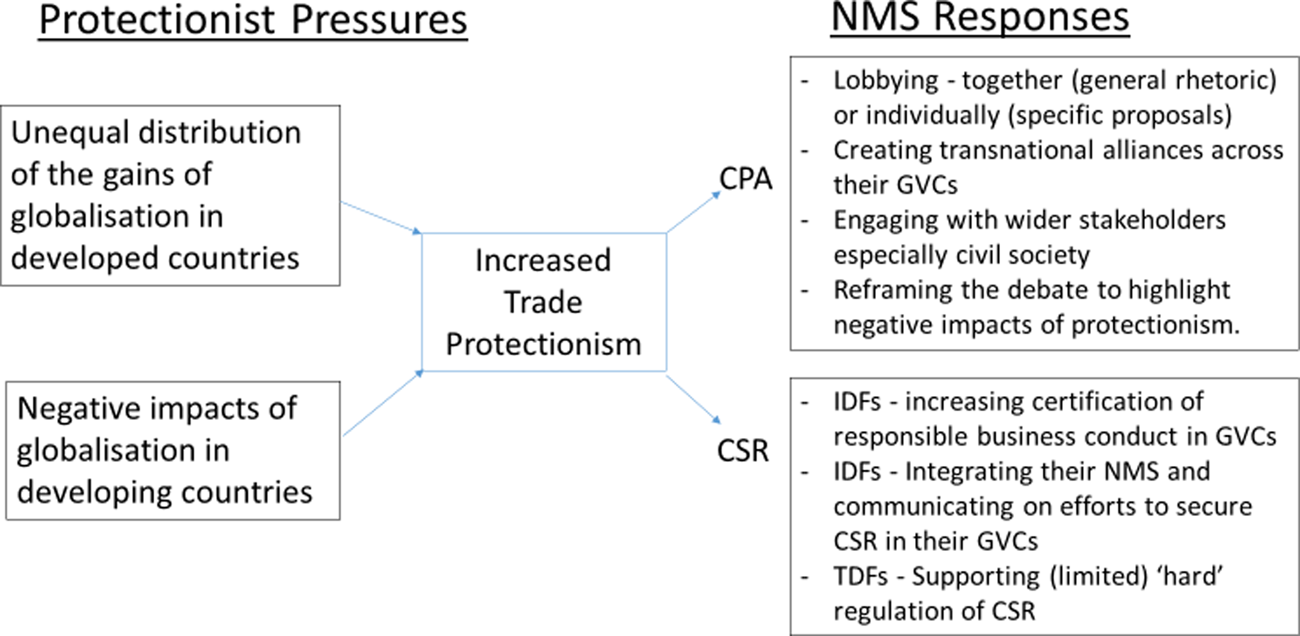
In figure 1, we propose a framework to summarize our work. In it we recall, on the one hand, the different factors currently interacting to increase antiglobalization sentiment and put pressure on traditional company strategies. These are, especially the negative (but differentiated) impact of globalization in developed and developing countries. Emerging from these pressures, and in line with existing literature, we then outline the likely strategic responses of firms in the CPA and CSR arenas detailed above.
A framework for understanding corporate responses to protectionism

Conclusions and further research
This paper has sought to analyze the corporate implications of the current antitrade sentiment in politics and public discourse, and consider the likely strategic responses of MNEs and other TDFs. We focus on NMSs, building on existing literature to develop a series of propositions on likely strategic responses by firms to counter this threat. On this basis we propose a framework for future research. The various propositions outlined above need to be tested in a real-world context, across different national and international levels, to explore whether the strategic reactions we propose are actually emerging in countries where antiglobalization rhetoric is rising. Some initial attempts to explore actual company responses have been made,Footnote 140 yet much more needs to be done to understand how TDFs, both collectively and individually, are adapting their NMSs to this challenging and rapidly changing context.
This paper has proposed a series of strategies that existing literature suggests are likely to be mobilized, yet we have little understanding of their effectiveness, alone or in combination. Existing work on CPA on salient issues highlights that achieving positive outcomes for business is very challenging, as the level of public interest means that policymaking is closely scrutinized.Footnote 141 Empirical analysis of the effectiveness of the strategies proposed by Bonardi and Keim (information and support for contrary expert opinion) is lacking, and the authors themselves acknowledged that the former is likely to be ineffectual for well-known brands,Footnote 142 many of which are TDFs. What limited empirical analysis exists on informational strategies addressing salient issues supports this view.Footnote 143 Our intuition from the previous work outlined here is that cooperation with stakeholders, including the labor movement, combined with more aggressive self-regulation is likely to be more effective. There is an urgent need for further work exploring actual company strategy and its effects, across a range of countries in different institutional contexts, in order to shed light on this important question.
It is also possible for companies to neutralize criticisms on globalization and trade openness by combining their NMSs with their market strategies. Much of the criticisms of trade openness, which underpin antitrade rhetoric, relate to the negative impact on jobs and wages in the developed world—“exporting jobs,” in Trumpian terms.Footnote 144 These impacts are the result of market strategies that seek to leverage differences in factor prices across countries to reduce costs and maximize shareholder value. While this approach may bring benefits for consumers, it imposes significant costs on some workers, and these externalities are becoming increasingly difficult for companies to ignore. As Butzbach and his co-authors recently highlighted, the extent to which such market strategies are feasible for MNEs differs across national institutional contexts, with important implications for the extent of the globalization backlash as well as the feasibility of policy change.Footnote 145 Thus, cross-country comparative work would be particularly insightful. In this short paper, the question of the link between market strategies, protectionism, and NMSs has not been developed in detail, but it is clearly a key issue for future research.Footnote 146
We believe that the propositions developed in this paper will provide useful starting points for such work, however exploring these research questions raises several methodological challenges. For one, data on company lobbying activity is scarce. Much research on CPA has been undertaken in the United States, using widely available US data on lobbying expenditures. For example, most of the key papers that support the view that the competitive context of a sector and firms’ integration in GVCs have important impacts on whether they lobby alone or together on trade policy is based on such data.Footnote 147 Data on lobbying spending is typically not available for other countries, where, as discussed above, direct financial contributions are rare. Thus, research using a wider range of methodologies across other politics contexts, including the European Union, would help to illuminate this important question. Scholars could obtain data on political activities by firms and trade associations through surveys,Footnote 148 analyses of media reports,Footnote 149 or public consultationsFootnote 150 and interviewsFootnote 151 to test our propositions.
Another key challenge in further research will be differentiating between emerging strategies that address the antiglobalization backlash and those that primarily address other changes in the corporate environment, such as technological disruption, climate change, and pandemics, such as COVID-19. Of course, these challenges are strongly interlinked.Footnote 152 The collapse of global trade as a result of COVID-19 and the widespread adoption of trade restrictions in reaction to this pandemicFootnote 153 are a case in point. Yet, different corporate strategies will be required to deal with these various challenges. Identifying the motivations behind shifts in corporate strategy will require a mix of methodologies and, especially, a greater use of qualitative data, such as case studies, public statements, and interviews. These approaches, although labor-intensive and demanding, have the potential to more effectively tease out the relative importance of different contributing factors to strategic decision-making. There is a clear need for a variety of approaches if we are to successfully illuminate the emerging corporate strategic landscape in the new more protectionist context that TDFs now face.