Introduction
Otitis media with effusion (OME) is defined as a collection of fluid in the middle ear, without signs or symptoms of acute ear infection.Reference Stool, Berg, Berman, Carney, Cooley and Culpepper 1 Histologically, it is a chronic inflammatory condition. An underlying stimulus leads to an inflammatory reaction.Reference MacArthur, Pillers, Pang, Kempton and Trune 2 This is associated with the production of more mucin and altered viscous mucin types,Reference Kubba, Pearson and Birchall 3 which then overcome normal mucociliary clearance of the middle ear, with functional obstruction of the Eustachian tube. This results in the accumulation of a thick, mucin-rich middle-ear effusion.Reference Rovers, Schilder, Zielhuis and Rosenfeld 4
Many theories for the development of OME have been postulated. The leading cause is Eustachian tube dysfunction, as it is currently thought that the Eustachian tube plays a role in pressure regulation, secretion clearance and protection from nasopharyngeal pathogens.Reference Rovers, Schilder, Zielhuis and Rosenfeld 4 In addition, in many children, OME may occur as a consequence of acute otitis media taking weeks or months to resolve. Other causes include: chronic biofilm colonisation of the adenoids, which may act as a reservoir for bacteria entering the middle-ear cleft;Reference Saafan, Ibrahim and Tomoum 5 gastroesophageal acid reflux;Reference Tasker, Dettmar, Panetti, Koufman, Birchall and Pearson 6 genetic factors;Reference Li, Hermansson, Ryan, Bakaletz, Brown and Cheeseman 7 and parental cigarette smoke leading to mucin gene overexpression.Reference Preciado, Kuo, Ashktorab, Manes and Rose 8
Many risk factors have been associated with OME, including: young age,Reference Kiris, Muderris, Kara, Bercin, Cankaya and Sevil 9 , Reference Xenellis, Paschalidis, Georgalas, Davilis, Tzagaroulakis and Ferekidis 10 absence of breastfeeding,Reference Kiris, Muderris, Kara, Bercin, Cankaya and Sevil 9 , Reference Duffy, Faden, Wasielewski, Wolf and Krystofik 11 , Reference Martines, Bentivegna, Maira, Sciacca and Martines 12 mother's low education,Reference Martines, Bentivegna, Maira, Sciacca and Martines 12 , Reference Gultekin, Develioglu, Yener, Ozdemir and Kulekci 13 low socioeconomic status,Reference Kiris, Muderris, Kara, Bercin, Cankaya and Sevil 9 , Reference Chadha, Agarwal, Gulati and Garg 14 day care attendanceReference Duffy, Faden, Wasielewski, Wolf and Krystofik 11 , Reference Gultekin, Develioglu, Yener, Ozdemir and Kulekci 13 and allergy.Reference Kiris, Muderris, Kara, Bercin, Cankaya and Sevil 9 , Reference Martines, Bentivegna, Maira, Sciacca and Martines 12 , Reference Gultekin, Develioglu, Yener, Ozdemir and Kulekci 13
The OME treatments often reported on are active treatments or watchful waiting. Active treatments include myringotomy, tympanostomy tube, adenoidectomy, oral or intranasal steroids, antihistamines, decongestants, anti-reflux therapy, antibiotics, and Eustachian tube autoinflation.Reference Berkman, Wallace, Steiner, Harrison, Greenblatt and Lohr 15 , Reference Rosenfeld, Shin, Schwartz, Coggins, Gagnon and Hackell 16
The evidence from in vitro and animal models suggests that steroids reduce effusions and middle-ear pressure.Reference Baggett, Prazma, Rose, Lane and Pillsbury 17 , Reference Yaman, Ozturk, Uyar and Gurbilek 18 In addition, it was reported by Buchman et al. that corticosteroids have some benefit on OME resolution.Reference Buchman, Levine, Balkany and Lee 19
Nowadays, it is accepted that Eustachian tube dysfunction is a common finding in children with OME, and that the Eustachian tube obstruction is probably secondary to the inflammatory process and is usually functional in nature (caused by oedema, viscous secretions or both).Reference Inglis, Gates and Cummings 20 Thus, the usage of nasal corticosteroid sprays may prevent OME by reducing local inflammation around the Eustachian tube.
Intranasal steroids may play a role in patients with concomitant OME and allergic rhinitis because they target the inflammatory component of allergic rhinitis, which may be a contributing factor to OME.Reference Lack, Caulfield and Penagos 21 In addition, there may be a short-term benefit of topical intranasal steroids in children with adenoidal hypertrophy.Reference Bhargava and Chakravarti 22 , Reference Cengel and Akyol 23
However, the American Academy of Otolaryngology – Head and Neck Surgery 2016 clinical practice guidelines on OME showed no significant benefit of using oral or intranasal steroids in the treatment of OME. Nevertheless, many of the studies cited in those guidelines predate the prior guidelines, and it was suggested in the 2016 guidelines that additional randomised clinical trials were not available to support contrary findings.Reference Rosenfeld, Shin, Schwartz, Coggins, Gagnon and Hackell 16
Despite recommendations by the American Academy of Otolaryngology – Head and Neck Surgery to not use intranasal steroids or oral steroids to treat OME, many clinicians still do, and there are many debates regarding this issue. This study was conducted to evaluate the effects of oral steroids alone or followed by intranasal steroids versus watchful waiting on the resolution of OME in children aged 2–11 years.
Materials and methods
The current prospective randomised single-blinded controlled trial study was conducted at the Department of Otorhinolaryngology in the Saudi Airlines Medical Centre, Jeddah, Saudi Arabia, from June 2013 to November 2016. The study protocol was approved by the local ethical committee of our hospital, and all legal guardians of participants were fully informed and signed written consent forms. Only those patients aged 2–11 years were included in the study.
Clinical evaluation
The study included children, aged 2–11 years, with clinical evidence of bilateral middle-ear effusion, bilateral type B tympanograms and hearing loss of more than 20 dB HL.
Children were excluded from the study if they had one or more of the following: Down's syndrome, cilial abnormalities such as Kartagener's syndrome, cleft palate, growth retardation, immunodeficiency states, genetic causes of conductive hearing loss, diabetes mellitus, renal failure, hypertension or congestive heart failure, and nasal tumours or frequent epistaxis. Children in need of steroids for other medical diseases such as uncontrolled asthma, children who had received a live vaccine in the preceding four weeks, children already with ventilation tubes or scheduled or willing to have ventilation tubes in the next six months, and children with a history of acute otitis media in the three months prior to enrolment in the study were also excluded.
The study originally comprised 303 children. Patients were randomly assigned, using random numbers, into three groups: group A (n = 101) was treated with oral steroids followed by intranasal steroids, group B (n = 101) was treated with oral steroids alone, and group C (n = 101) underwent watchful waiting (control group).
Patients were evaluated at six weeks, three months, six months and nine months after starting treatment (groups A and B) or observation (group C). Participants underwent complete ENT examination, with assessment of middle-ear effusion via pneumatic otoscopy and otomicroscopy, and audiology assessment using audiometry and tympanometry.
Thirteen patients were lost to follow up; hence, our study results were based on data from 290 patients: 98 in group A, 97 in group B and 95 in group C.
All patients were examined in both ears by the first author using a pneumatic otoscope (Diagnostic Otoscope; Welch Allyn, Skaneateles Falls, New York, USA) and otomicroscope (OPMI1FC-S2; Carl Zeiss, Thornwood, New York, USA). Any external ear crustation or cerumen was removed for proper visualisation. The clinical findings of middle-ear effusion are variable, and include abnormal colour (e.g. yellow, amber, blue), a retracted or concave tympanic membrane, and abnormal air–fluid levels.
Treatment modalities
Group A and group B patients were treated with a 7-day course of oral soluble prednisolone. This was taken as single daily doses of 1 mg per kg, not exceeding 20 mg for children aged 2–5 years, or 30 mg for those aged 6–11 years. Patients and their guardians were informed about the possible side effects of oral steroids and advised to return to us if they noticed any side effects.
In group B patients, mometasone furoate monohydrate intranasal spray was given after completing the course of oral steroids and for a period of up to three months. Children aged 6–11 years (and their parents) were instructed to administer the spray as one puff (50 mcg of mometasone furoate in each spray) into each nostril once a day (total daily dose of 100 mcg). Instructions were given to parents on the proper method of nasal spray instillation: the child was to be placed tilted backwards on the parent's lap with their head in an extended position (to reach the post-nasal space better). Children aged 6–11 years could use the nasal spray themselves.
In group C patients, no treatments were given and we adopted a watchful waiting policy.
No side effects of oral or intranasal steroids were reported in our patients; steroids were given in proper doses with the proper method of intranasal steroid instillation.
Procedures
Pure tone audiometry, visual reinforcement audiometry or ear specific play audiometry were undertaken. The hearing level, in decibels, was averaged over frequencies of 0.5, 1, 2 and 4 kHz, in both ears. Typically, developing children aged 4–11 years are sufficiently mature to undergo conventional audiometry. In children aged 2–4 years old, visual reinforcement audiometry or ear specific play audiometry were used. Conventional audiometry was used instead of visual reinforcement audiometry or play audiometry in co-operative children aged less than four years old with a good mental age.
Middle-ear pressure assessment was conducted using a tympanometer, GSI Tympstar version 2 (Grason-Stadler, Eden Prairie, Minnesota, USA). The tympanogram findings were interpreted according to Zielhuis and colleagues’ modificationReference Zielhuis, Rach, van den Bosch and van den Broek 24 of Jerger's classification.Reference Jerger 25 Hence, a type A tympanogram is a normal peaked curve, with pressure between +200 and −99 daPa. A type C1 tympanogram is a peaked curve, with negative pressure of −100 to −199 daPa. A type C2 tympanogram is a peaked curve, with negative pressure of −200 to –399 daPa. A type B tympanogram is a flat curve, with no observable peak between +200 and –600 daPa.
The audiology evaluation was carried out by the last author, who was blinded regarding the group allocation and treatment of patients. We combined both tympanogram and hearing evaluation findings to determine the outcome of patients. In addition, we measured the outcome by children rather than by ears. Thus, the outcome for every patient in all groups fell into one of the following three categories: (1) complete resolution of otitis media with effusion (OME) – type A tympanogram, with no hearing loss of more than 20 dB HL; (2) incomplete resolution of OME – type C1 or C2 tympanogram, with or without hearing loss of more than 20 dB HL; and (3) persistent OME – type B tympanogram, with hearing loss of more than 20 dB HL.
Outcomes
Primary outcomes
We evaluated the complete resolution of OME in at least one ear of all patients at six weeks, three months, six months and nine months, and compared the results between the groups.
Secondary outcomes
We measured the percentage of patients with incomplete resolution of OME in at least one ear that had completely resolved by the next follow up. In addition, we evaluated the complete resolution of OME in both ears of all patients at six weeks, three months, six months and nine months, and compared the results between the groups.
Statistical analysis
All statistical calculations were performed using Microsoft Excel spreadsheet software, version 7 (Microsoft, New York, USA), and SPSS statistical software (SPSS, Chicago, Illinois, USA). The chi-square test was used to compare the complete resolution of OME between groups A, B and C. If the probability (p) value was less than 0.05, the difference between the compared groups was considered statistically significant.
Results
The study included 298 patients with chronic middle-ear effusion, with a mean age of 5.7 years (range, 2–11 years). The male-to-female ratio was 1:1.19.
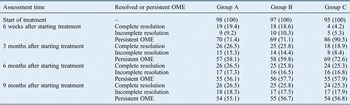
The percentages of patients with complete resolution of otitis media with effusion (OME) in at least one ear at six weeks, three months, six months and nine months were, respectively: 19.4 per cent, 26.5 per cent, 26.5 per cent and 26.5 per cent, in group A (oral steroids followed by intranasal steroids); 18.6 per cent, 25.8 per cent, 25.8 per cent and 25.8 per cent, in group B (oral steroids alone); and 4.2 per cent, 18.9 per cent, 25.3 per cent and 25.3 per cent, in group C (watchful waiting) (Table I).
Patients in each group with resolved (complete or incomplete) or persistent OME in at least one ear

Data represent numbers (and percentages) of patients. OME = otitis media with effusion
The chi-square test was used to compare the complete resolution of OME between each pair of groups at six weeks, three months, six months and nine months (Table II).
Comparison of completely resolved OME between all groups

Data represent p values of complete otitis media with effusion (OME) resolutions, calculated using the chi-square test, at different follow-up periods. P values of less than 0.05 are considered statistically significant.
A significant difference in terms of the complete resolution of OME in at least one ear was found at six weeks between groups A and C (p = 0.001), and between groups B and C (p value = 0.002) (Table II).
No significant differences in the complete resolution of OME in at least one ear were found between: groups A and B at six weeks, three months, six months and nine months (p values were 0.882, 0.904, 0.904 and 0.904, respectively); groups A and C at three months, six months and nine months (p values were 0.209, 0.841 and 0.841, respectively); and groups B and C at three months, six months and nine months (p values were 0.257, 0.935 and 0.935, respectively) (Table II).
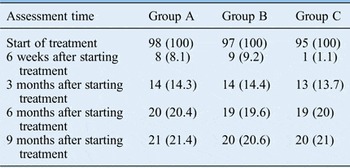
The percentages of complete resolution of OME in both ears in groups A, B and C were, respectively: 8.1 per cent, 9.2 per cent and 1.1 per cent, at six weeks; 14.3 per cent, 14.4 per cent, and 13.7 per cent, at three months; 20.4 per cent, 19.6 per cent and 20 per cent, at six months; and 21.4 per cent, 20.6 per cent and 21 per cent, at nine months (Table III).
Patients in each group with completely resolved OME in both ears

Data represent numbers (and percentages) of patients. OME = otitis media with effusion
A significant difference in the complete resolution of OME in both ears at six weeks was found between groups A and C (p = 0.019), and between groups B and C (p = 0.010) (Table II).
No significant differences in the complete resolution of OME in both ears were found between: groups A and B at six weeks, three months, six months and nine months (p values were 0.783, 0.977, 0.866 and 0.889, respectively); groups A and C at three months, six months and nine months (p values were 0.904, 0.944 and 0.904, respectively); and groups B and C at three months, six months and nine months (p values were 0.881, 0.943 and 0.941, respectively) (Table II).
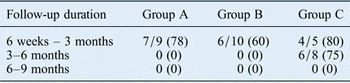
The percentages of patients with incomplete resolution of OME in at least one ear at six weeks' follow up that completely resolved at three months were 78 per cent, 60 per cent and 80 per cent in groups A, B and C, respectively. The percentages of patients with incomplete resolution of OME in at least one ear at three months that completely resolved at six months were 0 per cent in groups A and B, and 75 per cent in group C. The percentages of patients with incomplete resolution of OME in at least one ear at six months that completely resolved at nine months were 0 per cent in groups A, B and C (Table IV).
Patients with incomplete OME resolution in at least one ear that completely resolved with follow up, in all groups

Data represent numbers (and percentages) of patients. OME = otitis media with effusion
Discussion
Secretory otitis media is common enough to be called an ‘occupational hazard of early childhood’.Reference Rosenfeld 26 Around 90 per cent of children have otitis media with effusion (OME) before school age,Reference Tos 27 and they develop, on average, four episodes of OME every year.Reference Mandel, Doyle, Winther and Alper 28 In addition, OME is probably the most common reason for surgery in children.Reference Williamson, Benge, Mullee and Little 29
Nationwide epidemiological studies on middle-ear inflammatory conditions are scarce in the Kingdom of Saudi Arabia.Reference Al-Rowaily, AlFayez, AlJomiey, AlBadr and Abolfotouh 30 , Reference Zakzouk and AbdulJawad 31 Regional studies conducted through local universities help to elucidate the prevalence of such diseases in different provinces of the Kingdom of Saudi Arabia. The prevalence of OME in the Qassim region reaches 7.5 per cent in school children.Reference Humaid, Ashraf, Masood, Nuha, Saleh and Awadh 32 In Riyadh, the prevalence of OME was reported as 13.8 per cent and in Abha it was 2.3 per cent.Reference El-Sayed and Zakzouk 33 , Reference Abolfotouh, Ghieth and Badawi 34
Various mechanisms have been proposed for the role of steroids in resolving middle-ear effusion, including: reducing arachidonic acid and associated inflammatory mediators; shrinking peri-Eustachian tube lymphoid tissue; enhancing the secretion of Eustachian tube surfactant, with resultant improvement in tubal function; and reducing middle-ear fluid viscosity by its action on mucoproteins.Reference Rosenfeld, Mandel and Bluestone 35
In the present study, strict criteria were used to assess the complete resolution of OME. These criteria include the conversion from a type B, C1 or C2 tympanogram to a type A tympanogram, with no hearing loss of more than 20 dB HL. In addition, patients and not individual ears were used for OME assessment, as ears are not independent variables. To our knowledge, this study is the first to evaluate the effect of oral steroids alone or followed by intranasal steroids versus watchful waiting in the management of OME.
In the present study, at six weeks’ follow up, the percentages of complete resolution of OME in at least one ear in patients treated with oral steroids followed by intranasal steroids (group A) or oral steroids alone (group B) were greater than in those managed with watchful waiting (group C), and these differences were statistically significant. However, no significant differences were detected between group A and group B in terms of complete or incomplete resolution of OME. Therefore, oral steroids lead to the early resolution of OME at six weeks, with the addition of intranasal steroids having no benefit following a short course of oral steroids.
In the current study, no further increase in the complete resolution of OME in at least one ear was detected in patients treated with oral steroids followed by intranasal steroids (group A) or oral steroids alone (group B) after three months' follow up, with no significant differences being detected between group A and group B. Consequently, we postulate that if any patient was treated with oral steroids alone or followed by intranasal steroids, and has not recovered from OME at three months' follow up, there is no need for further follow up, and alternative treatment modalities should be considered.
A Cochrane database review reported that oral steroids lead to the quick resolution of OME in the short term, at one month; there was no evidence of a long-term benefit from treating OME with oral steroids.Reference Simpson, Lewis, Van Der Voort and Butler 36 Similarly, our study found that oral steroids alone or followed by intranasal steroids led to the quick resolution of OME in the short term, at six weeks, but no long-term benefit was gained from treating OME with oral steroids alone or followed by intranasal steroids. In our opinion, a degree of the OME improvement in the oral steroids groups (groups A and B) compared with the watchful waiting group (group C) at six weeks’ follow up was partly a result of early natural recovery. It seems that steroids only hasten the natural recovery process of OME.
In the current study, no benefit was gained from the addition of intranasal steroids following a short course of oral steroids in terms of OME resolution. Similarly, MacArthur et al. reported that topical steroids applied through the nose would not be expected to reach the middle ear; however, systemic steroids do reach the middle-ear epithelium and modulate OME in animal models.Reference MacArthur, DeGagne, Kempton and Trune 37
In the present study, no further increase in the complete resolution of OME in at least one ear was detected in the watchful waiting group after six months’ follow up. Rosenfeld and Kay reported that with strict criteria for OME resolution (B to A tympanogram), resolution rates in patients managed with watchful waiting were 20 per cent by three months, rising to 28 per cent by six months.Reference Rosenfeld and Kay 38 However, the resolution rates in our study (18.5 per cent by three months and 25.3 per cent by six months) were a little lower than those reported by Rosenfeld and Kay.Reference Rosenfeld and Kay 38 This is because hearing loss improvement was added to the strict criteria in our study. Consequently, we propose that if any patient is managed with watchful waiting and has not recovered from OME at six months, there is no need for further follow up, and alternative treatment modalities should be considered.
Thomsen and Tos reported an increase in OME resolution using a liberal criterion (B to A, C1, C2 or a non-B tympanogram), from 81 per cent by 9 months, to 88 per cent by 15 months, to 98 per cent by 27 months.Reference Thomsen and Tos 39 In addition, Fiellau-Nikolajsen and Lous reported three-year resolution rates of 51 per cent using strict criteria and 65 per cent using relaxed criteria (B to A or C1 tympanogram).Reference Fiellau-Nikolajsen and Lous 40 In the present study, no increase in OME resolution was detected from six to nine months. This is because we used strict criteria, and hearing loss improvement was added to these criteria; also, our study ended at nine months, with no further follow up. In our opinion, the long-standing follow up of children with OME will expose them to the hazards of long-standing OME with its effect on speech in young children, and may lead to recurrent acute otitis media with its sequelae; hence, it is not logical to adopt a watchful waiting policy over a long time period.
In order to determine the significance of incomplete resolution of OME, we studied those patients with incomplete resolution of OME that completely resolved with further follow up. In the present study, the percentage of patients with incomplete resolution of OME at six weeks that completely resolved at three months was higher in the watchful waiting group (80 per cent) than in the oral steroid groups (78 per cent in group A and 60 per cent in group B). In addition, the percentage of patients with incomplete resolution of OME at three months that completely resolved at six months was 75 per cent in the watchful waiting group and 0 per cent in the other groups.
Based on the present study findings, we hypothesise that any patient managed with watchful waiting who has incomplete resolution of OME at six weeks or three months may experience complete resolution with further follow up. However, any patient subject to watchful waiting who has incomplete resolution of OME at six months’ follow up has no possibility of complete resolution with further follow up. On the other hand, any patient treated with oral steroids alone or followed by intranasal steroids, who has incomplete resolution of OME, may experience complete resolution with further follow up at six weeks, but not at three months or six months of further follow up. However, these findings must be considered with caution because of the small patient numbers; further studies are needed to prove these findings.
It is well known that persistent OME, even in one ear, provides an exceptional environment for the proliferation of bacteria; therefore, recurrent acute otitis media with its potential complications is a threat. Hence, if one ear improves while the other ear does not improve in the same patient, the patient will still be a candidate for further medical or surgical interventions. In the present study, the percentages of complete bilateral resolution of OME in the ears of patients treated with oral and intranasal steroids (group A) or oral steroids alone (group B) were higher than those for watchful waiting at six weeks, and these differences were statistically significant. However, no significant differences were found between group A and group B; in addition, no significant differences were found between any pair of groups at three, six and nine months’ follow up.
-
• American Academy of Otolaryngology – Head and Neck Surgery 2016 guidelines recommend not using steroids for otitis media with effusion (OME)
-
• Nevertheless, there are still many debates regarding this issue
-
• Oral steroids lead to greater quick OME resolution at six weeks than watchful waiting
-
• There is no long-term benefit gained from using oral steroids for OME management
-
• There is no benefit gained from using intranasal steroids after oral steroids for OME management
-
• If OME has not resolved three months after oral steroid treatment, or after six months of watchful waiting, alternative treatment should be considered
Interestingly, in the current study, there were further increases in the complete resolution rate of both ears from three to six months in patients treated with oral steroids followed by intranasal steroids (group A) or oral steroids alone (group B). In addition, there were further increases in the complete resolution rate of both ears in all groups from six to nine months, while no further increases in the complete resolution rate in at least one ear were detected in the groups from six to nine months. In our opinion, those patients with improvement in one ear are more likely to show improvement in the other ear with further follow up. Therefore, if one ear is improved in any OME patient treated with oral steroids or watchful waiting at three or six months, there is still a chance for the other ear to improve with further follow up.
The present study findings indicate that oral steroids alone or followed by intranasal steroids lead to greater early resolution of OME in at least one ear or both ears at six weeks than watchful waiting, but there is no long-term benefit gained from using oral steroids alone or followed by intranasal steroids for OME treatment in at least one ear or both ears. In addition, if OME has not resolved at three months in patients treated with oral steroids, or at six months in patients managed with watchful waiting, there is no need for further follow up, and alternative treatment (e.g. surgical) modalities should be considered. However, if OME has resolved in only one ear in any patient at or after three months’ follow up, further follow up of the other ear is justified, as there is still a chance of complete resolution in the other ear.
Conclusion
There is no benefit gained from using intranasal steroids after a short course of oral steroids for the management of otitis media with effusion (OME). In addition, oral steroids lead to the quick resolution of OME at six weeks, but there is no long-term benefit gained from using oral steroids. The study findings support the American Academy of Otolaryngology – Head and Neck Surgery 2016 recommendations of not using oral steroids to treat OME.