




No CrossRef data available.
Neurocognitive impairment as a moderator in the development of borderline personality disorder
Published online by Cambridge University Press: 12 December 2005
Abstract
Borderline personality disorder (BPD) is characterized by a pervasive instability of interpersonal relationships, affects, self-image, marked impulsivity, dissociation, and paranoia. The cognitive dimension of the disorder has received relatively little attention and is poorly understood. This paper proposes that neurocognitive impairment is a key moderator in the development of BPD and elaborates a possible pathway for the expression of the cognitive domain. Neurocognitive impairment is hypothesized to moderate the relationship between caretaking and insecure disorganized attachment and pathological dissociation in the formation of the disorder contributing to impaired metacognition and a range of cognitive difficulties. The empirical evidence from studies of cognitive processes, brain function, attachment, and dissociation that support this theory are reviewed and discussed. Areas for future research that might verify or refute this theory are suggested.
The author thanks Geralyn Windt for assistance in manuscript preparation, Dr. Jack Maser for early review of the manuscript, and Dr. Elizabeth Twamley for her invaluable consultation and expert review of the manuscript.
Information
- Type
- Research Article
- Information
- Copyright
- © 2005 Cambridge University Press
Borderline personality disorder (BPD) is characterized by a pervasive instability of affects, interpersonal relationships, self-image, and marked impulsivity according to the Diagnostic and Statistical Manual of Mental Disorders—4th Edition, Text Revision (DSM-IV-TR; American Psychiatric Association, 2000). It results in high morbidity, functional impairment, and serious health and social costs. This paper proposes that neurocognitive impairment plays a key role in the development and maintenance of the disorder and outlines a possible developmental pathway for its expression. Cognitive organization is consistently identified as a key dimension of underlying BPD psychopathology (Skodol et al., 2002). A trait dimension approach to understanding personality disorders has identified cognitive dysregulation as an underlying borderline trait, with a phenotypic and genetic dimension. However, there has been minimal exploration of the cognitive dimension of the disorder and minimal understanding as to what neurobehavioral processes might underlie this trait or dimension or what its developmental course might be.
The organizational model of development, which posits that normal development is a progression from diffuse and undifferentiated states to those of more organized complexity (Cicchetti & Schneider–Rosen, 1984, 1986; Sroufe, 1979), is used to elaborate a possible pathway for expression of the cognitive dimension. It is based on a transactional approach in which genetic, biological, and environmental forces influence each other and make reciprocal contributions to developmental outcomes (Sameroff & Chandler, 1975).
In the organizational model, the child's development is marked by the differentiation and hierarchical organization of interdependent competencies in the emotional, social, and cognitive arenas. Developmental accomplishments occur within the matrix of the attachment system and continue to be shaped by environmental forces throughout life. They are continually reintegrated with subsequent accomplishments such that successive adaptations are a product both of new experiences and of development to that point. Psychopathology emerges largely because of a lack of integration of the many competencies that underlie adaptation at various developmental stages (Cicchetti & Schneider–Rosen, 1984, 1986; Sroufe & Rutter, 1984).
An integrated developmental model of BPD has been proposed that elaborates transactions among underlying neurobehavioral vulnerabilities and environmental factors and how these influence the development and course of the disorder (see Judd & McGlashan, 2003, chap. 1). The model identifies cognitive impairment as one of the underlying vulnerabilities. Vulnerabilities, as defined by Cowan, Cowan, and Schulz (1996), can be conceptualized as conditions or processes associated with an increased risk for negative outcomes when combined with another vulnerability or during times of increased stress. The developmental pathway illustrated in Figure 1 proposes that the neurobehavioral vulnerability of cognitive impairment (arising from genetic inheritance or acquired cerebral insult) may interact with the parent–child relationship so as to amplify or exaggerate the vulnerability of poor affective fit and/or maltreatment. These transactions may contribute to an insecure and disorganized attachment model and pathological dissociation (hereinafter referred to as dissociation) conceptualized as an impaired ability to process and integrate emotional and sensorimotor information into interpersonal memory systems. Inadequate integration would contribute to unstable cognitive processing in the interpersonal arena and impaired metacognition defined as immature or faulty analysis of interpersonal situations. This, in turn, would lead to the various manifestations of cognitive problems identified in BPD including denial, splitting, unusual beliefs, all or nothing (black/white) thinking, paranoia, transient psychoses, and illusory phenomena. Disorganization or lack of integration of the attachment model and impaired metacognition would influence vulnerabilities in the emotional and behavioral domains and contribute to the instability of functioning across these domains. Deviation would spread along so many developmental lines because of the central importance of attachment and cognition in moving development forward. The developmental process would be disrupted beginning in infancy and persist throughout childhood and adolescence without modifying environmental circumstances and/or treatment intervention. As developmental processes are dynamic in nature problems in the cognitive domain would interact with vulnerabilities in other domains to maintain the disorder.

The proposed developmental pathway for neurocognitive impairment in BPD.
With this overview the role of cognitive impairment and key elements of its proposed developmental pathway will be elaborated. Clinical descriptions and empirical evidence from neuropsychological studies of children and adults, psychophysiological and brain imaging findings and available longitudinal evidence that support this model will be discussed. Future research that would verify or refute the model is suggested.
The Borderline Syndrome in Children
Clinical descriptions
Early descriptions of the borderline syndrome in children were replete with references to cognitive and developmental problems. Anna Freud (1969) proposed that children who would now be characterized as suffering from borderline disorder (BD) had massive developmental arrests, poor reality testing, and difficulty synthesizing information. Murray (1979) hypothesized that minimal brain dysfunction (MBD) was a major etiological factor in the development of BD, and that speech and language disorders were common. Similarly, Kernberg (1983) described the syndrome as at “the border” of an organic disorder and related to MBD. Bemporad, Smith, Hanson, and Cicchetti (1982) also identified “organic impairment” in these children, and described social awkwardness, neurological soft signs, and general unevenness in development. Pine (1983, 1986) was the first to hypothesize that constitutional neuropsychological deficits in combination with early trauma underlie the child's problems and interfere with normal development. He observed that children with this syndrome exhibited excessive dependence on the presence of a primary object to maintain stable functioning. These clinical observations led to a conceptualization of the syndrome as an atypical pervasive developmental disorder (PDD) with disturbances in cognitive processes, social relations, anxiety, attentional regulation, and neuromaturation (Cohen, Shaywitz, Young, & Shaywitz, 1983).
More recently, BD has been characterized by complex developmental deficits and integrative failures or a complex developmental (socioemotive–dyssocial) disorder (Ad-Dab'Bagh & Greenfield, 2001; Lincoln, Bloom, Katz, & Boksenbaum, 1998; Towbin, Dykens, Pearson, & Cohen, 1993). This conceptualization has evolved into use of the term multiple complex developmental disorder (MCDD) under the rubric of PDD with an onset before age 6 and characterized by functional deficits that lead to a consistent, enduring pattern of (a) impaired regulation of affective state, (b) consistent impairments in social behavior and sensitivity, and (c) impaired cognitive processing (Cohen, Paul, & Volkmar, 1986; Towbin et al., 1993).
A cluster analytic study of four groups of children found that fluctuations in the level of functioning was the strongest differentiating feature between children with MCDD and other childhood disorders (Van der Gaag et al., 1995). This feature, “fluctuations in level of functioning” corresponds to the DSM-IV description of “pervasive instability” supporting a similarity between the child and adult disorder.
Empirical studies of cognitive problems in children
The studies that have formally investigated children with the borderline syndrome have consistently found evidence for neurocognitive impairment. Hartocollis (1968) found that 15 adolescents diagnosed with the borderline syndrome exhibited moderate impairments on a modified Halstead–Reitan neuropsychological battery. A prospective study that followed children diagnosed with MBD or learning disorders into adulthood found that those diagnosed with the borderline syndrome exhibited language and thinking deficits (Milman, 1979). An in-depth review of 106 adolescents and adult patients found that 40% had a history of organicity (Andrulonis et al., 1980). Other studies have found that children with BD have a variety of heterogeneous cognitive impairments (Bemporad et al., 1982) and heterogeneous developmental learning disorders including auditory processing and discrimination problems (Berg, 1992; Gualtieri, Koriath, & Van Bourgondien 1983).
Two recent controlled studies provide more compelling evidence for cognitive problems in children with BD. One studied the pathophysiology of children in a residential treatment setting with BD/MCDD and comorbid attention-deficit/hyperactivity disorder (ADHD) compared to children with ADHD alone and normal controls (Lincoln et al., 1998). The borderline group was distinguished by the presence of wide fluctuations in functioning. They exhibited auditory processing abnormalities in both nonlinguistic and linguistic information processing and impairment on nonverbal measures of executive functioning involving planning and cognitive flexibility.
Lincoln et al.'s study (1998) also investigated attentional performance in all three groups using an event-related potentials (ERPs) paradigm. The BD group performance was unique when compared to ADHD and normal controls in that they exhibited consistently smaller amplitudes when presented with rare auditory but not visual targets, suggesting increased difficulty processing auditory versus visual stimuli. The latency of P300 was also longer in both the BD/MCDD and ADHD children compared to normal controls.
Another neuropsychological study compared BD children to those with other primary diagnoses in a day treatment program (Paris, Zelkowitz, Guzder, Joseph, & Feldman, 1999). Both groups exhibited neurological soft signs and impaired performance on visual memory and planning, vigilance, and attention, but the borderline group had a unique profile with problems in cognitive flexibility and abstraction as measured by the Wisconsin Card Sort Test (WCST; Heaton, 1981). The BD group appeared unable to achieve an overall conceptualization of the demands set by the test. These findings were independent of comorbidity with conduct disorder and ADHD.
A study supporting the theory of a transaction among neurocognitive and psychosocial factors in the development of the disorder compared the relative contribution of psychosocial risk factors and a set of neuropsychological variables (Zelkowitz, Paris, Guzder, & Feldman, 2001). The authors found that both psychological trauma and deficits in executive functioning act as risk factors for borderline pathology in children and make separate and independent contributions. The combination of both factors correctly classified 83% of the sample.
Additional evidence is available that cognitive dysfunction is not only strongly associated with the disorder in children and adolescents but also may be genetically based (Coolidge, Segal, Stewart, & Ellett, 2000; Coolidge, Thede, & Jang, 2004). In a study of 314 twins, ages 5–17 years, BPD as assessed by a DSM-IV based parental measure of personality disorders and executive function deficits was found to have a .77 heritability estimate and .52 correlations with executive function deficits (Coolidge et al., 2004).
Although the empirical evidence in children is supportive of the model proposed, the relationship between the child and adult disorder is poorly understood. Only one study was found that presents evidence for the validity of the adult diagnosis of BPD in children with BD (Bemporad, Smith, Hanson, & Cicchetti, 1982). One prospective study found that 19 out of 32 children diagnosed as borderline had an array of adult personality disorders but not BPD per se (Lofgren, Bemporad, King, Lindem, & O'Driscoll, 1991). Another study illustrated an association between the presence of major depression, disruptive behavior disorders, and/or substance abuse disorders in childhood or adolescence and the adult diagnosis of personality disorders (Ramlindt, Von Knorring, Von Knorring, & Ekselius, 2003). The authors concluded that Axis I conditions predispose to adult PD. However, PD may have been present during childhood and, undetected, influenced the expression of the Axis I condition. A method for diagnosing personality disorders in children is now available, and may further our understanding of this important area (see Coolidge, Thede, Stewart, & Segal, 2002). As with other neurodevelopmental disorders such as schizophrenia, it is probable that BD is only diagnosed in those children with a high degree of dysfunction. The disorder may not be detected until the developmental demands of young adulthood and/or adverse life events precipitate a significant disorganization in function and entry into treatment in the late teens and early 20s.
Cognitive Impairments in Adults With BPD
Clinical descriptions
The term “borderline” originated from the view that the disorder shared features of both psychosis and neurosis pointing towards a cognitive disturbance as a key feature of the disorder. However, it took 14 years from the first appearance of BPD in the DSM-III (American Psychiatric Association, 1980) for the cognitive features of paranoia and dissociation to be included in the diagnostic criteria for the disorder. This inclusion followed a series of empirical studies finding a high prevalence of stable cognitive disturbances in adults with BPD (Chopra & Beatson, 1986; George & Soloff, 1986; O'Connell, Cooper, Perry, & Hoke, 1989; Pope, Jonas, Hudson, Cohen, & Tohen, 1985). These disturbances have been characterized as unusual beliefs (e.g., superstitiousness, magical thinking, belief in a sixth sense, clairvoyance, or telepathy) dichotomous (black/white) thinking, overvalued ideas, unusual perceptions, severe dissociation, paranoia, and transient psychotic thought (Zanarini, Gunderson, & Frankenburg, 1990). Cognitive symptoms seem to occur as frequently as they do in schizotypal personality disorder and are a stable part of the disorder (Sternbach, Judd, Sabo, McGlashan, & Gunderson, 1992).
Neuropsychological studies in adults
The presence of cognitive problems suggested a potential link between BPD and underlying brain dysfunction, which led to a broad investigation into cognitive functioning assessed by neuropsychological measures. At least 18 neuropsychological studies of BPD have been published. These studies have examined inpatients and outpatients both off and on psychotropic medications, without schizophrenia, current psychosis, history of serious head injury, neurological disorder, low IQ, or current substance abuse in comparison to normative samples, healthy normal or clinical controls.
Fourteen of these studies have found cognitive deficits in BPD patients when compared to matched normal and/or clinical controls or normative data (Bazanis et al., 2002; Burgess 1990; Carpenter, Gold, & Fenton, 1993; Dinn et al., 2004; Dowson et al., 2004; Judd & Ruff, 1993; Lenzenweger, Clarkin, Fertuck, & Kernberg, 2004; Monarch, Saykin, & Flashman, 2004; O'Leary, Brouwers, Gardner, & Cowdry, 1991; Stevens, Burkhardt, Hautzinger, Schwarz, & Unckel, 2004; Swirsky–Sacchetti et al., 1993; Travers & King, 2005; Van Reekum, Conway, Gansler, White, & Bachman, 1993; Van Reekum et al., 1996). Four studies have reported negative findings, one without a control group (Cornelius et al., 1989), two compared to normal controls (Driessen et al., 2000; Kunert, Druecke, Sass, & Herpertz, 2003), and one compared to both a clinical and normal control group (Sprock, Rader, Kendall, & Yoder, 2000).
There are many challenges in the interpretation of neuropsychological findings. Most studies are not based in a comprehensive theory of brain functioning. Each test can measure multiple and different cognitive functions and domains that correspond to varying regions of the brain. For the purpose of discussion Luria's (1973) theory of brain functioning provides a basis for interpretation that can be applied across at least six of the controlled neuropsychological studies that used a similar comprehensive battery (see Table 1). Luria's theory was verified by a factor analytic study of a neuropsychological test battery similar to those listed in Table 1 (Baser, 1985; Judd, 1989).
Summary of significant findings in neuropsychological studies using a similar comprehensive battery according to Luria's theory of brain functioning

Luria (1973) proposed three functional units of the brain that are hierarchical in structure. Unit I regulates arousal, which includes measures of attention and vigilance and refers to a ready state primed for neural activity and necessary for rapid processing of information. Unit II includes mnestic and complex information processing tasks, which include measures of verbal and visuospatial processing, integration, learning and memory, and speed of processing. This involves the transformation of concrete perceptions into symbolic schemes necessary for encoding and storage of information. Unit III is responsible for goal directed intentional behaviors and includes executive function measures of abstraction, planning, and organization that entail the identification of a problem, investigation into the conditions of the problem, and analysis of its components.
Based on this analysis, BPD patients appear to have impairments primarily in Luria's Unit II consisting of mnestic and complex intellectual processes. These processes involve creating meaningful associations among stimulus cues and then forming these into multidimensional systems where elements are simultaneously synthesized. It also involves the rapid processing and complex integration of auditory, visual, and sensory information and their transformation into internal schemes, symbols, and abstract representations. All of these processes are central to the integration of information into memory systems, which appears to be impaired in patients with BPD.
Findings can also be clustered according to sensory modality and cognitive domain. Applying this approach to studies reported in Table 1, impairments occur as follows: (a) visuospatial modality, that is, Rey–Osterreith, block span, digit symbol, figural fluency, porteus mazes, block design, picture arrangement; (b) learning and memory, that is, Rey–Osterreith delayed recall, block span, Wechsler logical memory, and the California Verbal Learning Test; and (c) speed of processing, that is, digit symbol, trails A and B and the Continuous Performance Test. This approach highlights a deficit in nonverbal processing in areas of learning, memory, and speed of processing. These deficits could specifically interfere with rapid analysis and integration of incoming emotional and sensory information that might be incongruous as is typical of maltreating environments.
Another method of analysis of neuropsychological findings is to cluster impairments across various cognitive domains. In one study that applied a cognitive domain approach the BPD group was significantly impaired on the global impairment index and on seven of the nine domains (Monarch et al., 2004). Subjects were unimpaired on measures of abstraction and flexibility and fine manual motor skills. This finding suggests an impairment that may impact multiple areas of cognitive function.
In the largest controlled study to date, 42 BPD inpatients and outpatients were compared to normal comparison subjects on computerized neuropsychological tasks (Bazanis et al., 2002). In contrast to the studies reported in Table 1, BPD subjects were unimpaired on tasks of spatial and pattern recognition and visual memory, but did exhibit deficits on measures of visuospatial decision making and planning. The authors note that the impairment was partially due to longer deliberation time. Similarly, Dowson et al. (2004) compared BPD subjects to ADHD and normal controls and also found the BPD group was distinguished from the ADHD group by a longer deliberation time on a visuospatial decision making task. These findings add support for impairment in processing speed and/or allocation of resources on more complex visuospatial tasks.
These findings are further supported in a study of controlled or effortful processing that compared patients with BPD to normal matched controls on computerized measures of sustained attention, working memory, and executive functioning (Lenzenweger et al., 2004).
This study also explored the relationships between cognitive performance and the personality dimensions of positive and negative emotion and nonaffective constraint (control). The BPD group performed significantly worse than did the normal control group on the WCST, an executive functioning measure assessing abstraction and cognitive flexibility. These deficits were associated with decreased levels of control. State anxiety, depression, and positive or negative emotion levels were not significantly related to WCST performance, further supporting the specificity of the findings. The finding on the WCST parallels a similar finding in a study of children with BD described earlier (Paris et al., 1999). The WCST is also primarily a visuospatial measure supporting greater vulnerability in this area.
The likelihood that organic factors either genetic or acquired may underlie the cognitive deficits identified in patients with BPD has been further explored. Travers and King (2005) administered a neuropsychological battery to 80 BPD subjects divided into those with and without a history of significant organic factors. Organic factors included ADHD, learning disabilities, loss of consciousness, traumatic brain injury, and epilepsy. For the purposes of analysis the authors divided subjects into two groups: the nonorganic group and the organic group. A comparison of the two groups found significant differences on a measure of verbal fluency, two measures that assess speed and accuracy of visuospatial processing, and an attention factor. In comparison to a normative sample the organic group performed significantly worse on the majority of measures, whereas the nonorganic group performed significantly worse on some measures only. The positive findings in both groups were similar to those listed in Table 1. This study highlights the prevalence of organic factors in patients with BPD and supports an association between organic factors and poorer performance on neuropsychological tests. However, it also suggests that known organic factors do not fully explain the presence of cognitive impairment, as the nonorganic group still performed more poorly than did the normative group on multiple measures.
Four neuropsychological studies failed to find cognitive deficits in BPD patients. The Cornelius et al. (1989) study was hampered by the use of a brief screening battery and lacked a control group matched for age and education. The Driessen et al. (2000) study, administered only four neuropsychological measures known to be sensitive to the disorder. Although the BPD group performed more poorly on all four measures the authors concluded that the level of depression accounted for the findings. Depression is an associated feature of the disorder, and this raises questions as to the validity of these findings. Kunert et al. (2003) found no differences between subjects and controls on a comprehensive computer assisted battery of tests. However, they used a nonstandard diagnostic threshold for the categorical diagnosis of BPD (see Lenzenweger et al., 2004). Sprock et al. (2000) compared BPD patients to both a clinical (depressive disorders) and normal control group. There were no significant differences among groups on most measures. The BPD subjects were more impaired than normal controls on two tasks, but the depressed group had poorer performance than the two other groups on some measures.
Although the cumulative evidence supports the presence of cognitive impairment on BPD, both negative findings and variability within findings suggest that there may be subgroups of BPD patients on this dimension. Support for this possibility comes from the Swirsky–Sacchetti et al. (1993) study, which found large variability within their all female BPD group on most neuropsychological measures. A post hoc subgroup analysis found an “impaired” and “intact” group. Sprock et al. (2000) also conducted a subgroup analysis and found that a small subset of BPD patients (N = 6/18) exhibited poorer performance than depressive and normal controls on memory functions.
In summary, most of the published studies indicate that BPD can be characterized by cognitive impairments primarily in visuospatial learning, memory and speed of processing. Further, it appears that this impairment may represent a particular difficulty with effortful processing and/or allocation of cognitive resources. The findings represent subtler forms of cognitive impairment as the individual test scores are generally in the average (albeit lower) range and intelligence scores are generally in the average or above average range. It is unknown how BPD performance compares to other personality disordered groups, although one study did find a distinctly different pattern from antisocial personality disorder (Dinn et al., 2004).
Within BPD samples there appear to be heterogeneous findings that represent both varying degrees of severity and area of dysfunction. This is to be expected, because if there is a cognitive impairment that is unique for BPD, it is embedded in a normal variation in cognitive functioning and co-occurs with learning disabilities, ADHD, traumatic brain injury, epilepsy, and other organic factors.
Psychophysiological studies
Findings from psychophysiological studies provide additional information to support both the presence of brain dysfunction and a deficit in processing speed and allocation of resources. Studies using electroencephalograms suggest global brain dysfunction as evidenced by abnormal diffuse slow activity (Cowdry, Pickar, & Davies, 1985; De La Fuente, Tugendhaft, & Mavroudakis, 1998; Snyder & Pitts, 1984). One study used a backwards masking paradigm and found that BPD subjects were slower than controls in stimulus perception and had a slower motor response, suggesting that visual processing accuracy was reduced (Stevens et al., 2004). Further, in a delayed matching to sample paradigm in which visual, auditory, and crossmodal stimuli were presented, the BPD subjects' performance was inferior to controls on all tasks, suggesting a performance deficit independent of the sensory system involved.
The P300 ERP has been used to assess the presence of information processing deficits in a variety of psychiatric conditions. The relatively few studies of P300 in BPD have found reduced amplitudes and prolonged P300 latencies using a simple auditory oddball task (Blackwood, St. Clair, & Kutcher, 1986; Drake, Phillips, & Pakalnis, 1991; Kutcher, Blackwood, St. Clair, Gaskell, & Muir, 1987). Confirming and extending these findings, a recent study of adolescents with borderline symptomatology compared to normal controls found reduced P300 amplitudes on a visual task (Houston, Bauer, & Hesselbrock, 2004). Those with borderline symptomatology also exhibited a decrement of processing of all stimulus types on a modified version of the Stroop Color–Word Test, which may be accurate in detecting subtle cognitive impairments (Polich, Pollock, & Bloom, 1994). The authors concluded that their findings may indicate a generalized dysfunction involving attention or resource allocation. Of note, the P300 studies of adults are similar to those reported in children as described earlier (Lincoln et al., 1998).
Magnetic resonance imaging (MRI) and functional MRI (fMRI) studies
There have been at least four reports using imaging studies that suggest abnormalities in brain structure and function associated with BPD. One study (Lyoo, Han, & Cho, 1998), pursuing a hypothesis regarding executive dysfunction in BPD, found a significantly smaller frontal lobe volume in BPD subjects compared to healthy subjects. The other three studies found reduced volume in the hippocampus and/or amygdala, which are considered central to memory and to emotional processing.
Stein, Koverola, Hanna, Torchia, and McClarty (1997) found evidence for hippocampal abnormalities in a study of patients with posttraumatic stress disorder, some of whom also had BPD. Driessen et al. (2000) found a 16% reduction of the bilateral volumes of the hippocampus and 8% smaller volume of the amygdala in a sample of 21 female BPD patients. Schmahl, Vermetten, Elzinga, and Bremner (2003) compared 10 BPD subjects to 23 controls and also found smaller bilateral volumes of the amygdala (21.9%) and the hippocampus (13.1%) in the BPD group. The left and right amygdala had the greatest magnitude of effect.
Three fMRI studies have explored patterns of brain activation in BPD patients and confirm abnormalities in the amygdala. One study compared six patients with BPD without comorbid Axis I conditions and six age-matched controls while viewing 12 emotionally aversive slides compared to 12 neutral slides (Herpertz et al., 2001). The BPD group showed a greater activation pattern bilaterally in the amygdala when viewing slides inducing negative emotions.
Another study compared 15 BPD subjects to 15 normal controls and found greater levels of left amygdala activation in response to faces exhibiting various emotions (Donegan et al., 2003). A third study examined a small sample of patients with DSM-IV Axis II Cluster B disorders (predominantly BPD) on a task assessing response inhibition (Vollm et al., 2004). Although Cluster B patients achieved successful response inhibition, they activated a more extensive left hemisphere neuronal network whereas activation in normal controls was predominantly in the right hemisphere. The authors suggested that the more widespread activation in the patient group may indicate a need to recruit additional cortical resources to effectively inhibit responding.
In summary, the impairments identified through neuropsychological and psychophysiological studies appear to reflect a predominant visuospatial performance deficit in speed of processing, encoding and memory, and/or a problem with general resource allocation that impacts a range of cognitive functions including executive functions. Preliminary imaging studies point to brain dysfunction that expresses itself in the amygdala and hippocampus both central to memory processes. The amygdala has also been described as a rapid transient information processing pathway for emotionally relevant stimuli (LeDoux, 1996). These findings support the presence of impairment in cognitive processes that may influence the rapid encoding and storage of emotional information through the amygdala into memory systems.
Learning Disabilities and ADHD
Both child and adult studies link BPD with a range of developmental and learning disorders and ADHD (Andrulonis et al., 1980; Berg, 1992; Gardner, Lucas, & Cowdry, 1987; Gualtieri et al., 1983; Kimble, Oepen, Weinberg, Williams, & Zanarini, 1997; Lincoln et al., 1998; Milman, 1979; Murray, 1979; Paris et al., 1999; Travers & King, 2005). It is important to explore this association further, because one study found that 87.5% of its BPD sample had either acquired or developmental disorders (Kimble et al., 1997). These hetereogeneous disorders are presumably due to brain dysfunction and manifested by difficulties in the acquisition and use of listening, speaking, reading, writing, reasoning, or mathematical abilities and attention. From this perspective, BPD may be understood as a form of social learning disability. A model for this approach is available in Bourke's work on nonverbal learning disorder, which is a complex of cognitive and emotional deficits (Rourke, 1995).
In a review of theoretical positions regarding the relationship between learning disabilities and emotional disorders, Spreen (1989) proposed a transactional model in which learning disabilities and emotional disorders both result from brain dysfunction. The long-term outcome relates to complex interactions among type of disability and environmental response including availability of remedial assistance from the school and therapy. Geschwind and Galaburda (1985) wrote that minor developmental pathology (such as defective neuronal migration and assembly) found in neuroanatomical studies of subjects with learning disabilities, may be a risk factor for many learning disabilities and psychiatric conditions (see Spreen, 1989).
A small body of evidence associates personality disorders in general with learning disabilities. Flynn, Matthews, and Hollins (2002) found that 39% of patients hospitalized for challenging behaviors such as those seen in BPD and who had mild to moderate learning disabilities also met criteria for a PD. There was also a significant association between PD and early child maltreatment potentially supporting the link between cognitive problems and psychosocial factors in the development of PD in general. Another study found a 31% prevalence rate for PD among learning disabled service users in the community (Khan, Cowan, & Roy, 1997). Alexander and Cooray (2003) reviewed studies conducted in the past 25 years and found that the prevalence for co-occurrence of learning disabilities and PD ranged from 1 to 91% in a community setting and 22 to 92% in hospital settings. The enormous range is explained by differences in diagnostic approach, research methodologies and ethical controversies over whether personality disorders should be diagnosed in those with learning disabilities (Tyrer, Casey, & Ferguson, 1993).
The Attachment System
Cognitive impairment is proposed to moderate the caretaker's ability to parent and the child's ability to interpret and integrate communications from the parent, contributing to an insecure, disorganized attachment, and pathological dissociation. Luria's theory on higher cortical functioning (Luria, 1973, 1980) provides a useful bridge between biological and environmental theories of etiology. Drawing on his combined experience in neurology and psychoanalysis, Luria posits that the functions of the brain develop during the “period of communication between the child and adult when function was shared between two people” (Vygotsky, cited in Luria, 1973, p. 247). It is within this critical period that development may go awry.
The medium for all aspects of infant development is through the attachment system. Attachment is defined as a genetically based behavioral control system that maintains the infant's safety and survival through access to parental protection care and nurture (Bowlby, 1969/1982, 1973, 1980). This system functions to regulate infant safety and restore equilibrium. When the child is stressed the attachment behavioral system is activated and has as its goal the reduction of arousal and restoration of a sense of security and the ability to function. The child emits signals to the caretaker that assistance is needed, and when the response is sensitive and reliable, the child's emotions are regulated.
Attachment models are initially developed as sensorimotor schemas that appear prior to the emergence of language and include elaborate memories that combine sensation, perception, action, emotion, and goals that occur in temporal, physical, and causal relationships. They evolve through complex interactions between the child and caretakers mediated through touch, smell, affective expressions, nonverbal gestures, and speech. The attachment schema becomes increasingly integrated detailed and complex, or spare, vague, and disorganized as caregivers and child interact around the following developmental needs: (a) regulation of somatic states such as hunger and thirst, (b) regulation of emotional arousal, and (c) exploration of the world. Development of the schema requires the integration of emotional, sensory, and motor signals; the translation of nonverbal information into verbal codes; and/or meaningful discrimination and prioritization of divergent visual and verbal interpersonal responses.
The attachment model is a result of repeated interpersonal interactions that have been encoded in memory as prototypic (Stern, 1985). During optimal development, when a secure attachment pattern is formed, the cumulative experience with varied caregivers is encoded in memory in an integrated manner and forms a working model that allows for the cognitive generation of effective responses to novel interpersonal situations (Crittenden, 1990). The model serves as a reliable method for reducing anxiety and regulating emotion, and enables the child and later the adult to respond with flexible attention to environmental demands.
Suboptimal experiences with caretakers contribute to insecure attachment models that are organized but rigid and described as either insecure with an avoidant pattern or insecure with an ambivalent/preoccupied pattern (Ainsworth & Wittig, 1969; Ainsworth, Blehar, Wathers, & Wall, 1978; Main, 2000; Main & Solomon, 1990). Avoidant/dismissing patterns are characterized by avoiding the caretaker as a means to get needs met. These infants excessively control emotion through avoidance of engagement. Infants with resistant or preoccupied models are characterized by excessive attention to the caretaker. Infants with this pattern exhibit emotional dysregulation and excessive requests for caretaking. Both insecure modes enable the individual to approach relationships in an organized coherent manner, but they are less flexible and require greater emotional resources than does secure attachment. This rigidity interferes with optimal development.
Another manifestation of insecure attachment is described as disorganized/disoriented. Bowlby (1973) first identified adults who appeared disorganized and suggested that they had multiple working models of the self. Children with an insecure disorganized attachment display a diverse array of odd, disorganized, disoriented, or overtly conflicted behaviors in response to separation and reunion with the parent (Hesse & Main, 2000). This is hypothesized to relate to the parent's insensitive and/or unpredictable responsiveness, which challenges the child's ability to form a coherent model. The child's behaviors represent both behavioral disorganization and rudimentary attachment patterns that the child cannot organize into a consistent coherent pattern for getting needs met. As a result, the child has difficulty obtaining needed care which impedes regulation of emotion and behavior and amplifies distress.
There are at least 13 empirical studies that have found a strong association between BPD and insecure, preoccupied, and disorganized attachment (Agrawal, Gunderson, Holmes, & Lyons–Ruth, 2004). A proposed role for insecure and disorganized attachment in the etiology, and long-term course of the disorder has been elaborated elsewhere (see Judd & McGlashan, 2003). There is also provisional evidence that childhood attachment patterns influence information processing in the areas of both attention and memory providing support for the model proposed here (Zeijlmans van Emmichoven, van IJzendoorn, de Ruiter, & Brosschot, 2003).
Infant–mother relationships develop in a reciprocal bidirectional manner (Sameroff & Fiese, 1990, 2000). Infant temperament and traits play a role in the formation of attachment relationships in that they influence how the caretaker will respond (Goldsmith & Alansky, 1987). The presence of cognitive deficits in the child and vulnerabilities in caretakers could result in suboptimal parenting and various forms of maltreatment or make the child more vulnerable and less resilient in the face of maltreatment. The broader term maltreatment is used here instead of trauma or abuse to refer to a range and pattern of caretaker responses that fail to meet the child's developmental needs and amplify and aggravate rather than modulate distress.
In one of the largest studies investigating experiences of maltreatment in those with BPD, 91% of subjects reported sexual, physical, or emotional abuse, and 92% reported neglect (Zanarini et al., 1997). I propose that this may be partially related to the presence of neurocognitive deficits that impact behavior in subtle ways so that the parent has greater difficulty understanding the child's needs and responding appropriately. These problems would be further aggravated in dyads were there is a poor affective fit between caretaker and child and/or the caretakers are suffering with a mental disorder, undergoing stressful life events, and/or have limited parenting ability. These risk factors would interfere with the caretaker's ability to understand, acknowledge, and accept the child's limitations or special needs. Increased risk also would occur when the parents have highly opposite communication styles. Disparate styles would be a greater challenge for a child with compromised processing ability.
There is some evidence to suggest that in clinical samples with depressed and maltreating mothers, the mother appears to play a more important role than the child in shaping the quality of the attachment relationship (van IJzendoorn, Goldberg, Kroonenberg, & Frenkel, 1992). This role might be even more pronounced with a vulnerable child. Genetic studies suggest that the heritability of BPD is as high as .69 or .77 (Coolidge et al., 2004; Torgersen, 2000). Higher heritability implies that one or both parents have similar difficulties, which may interfere with their parenting. Furthermore, the child may require more effective parenting to compensate for greater heritability.
An association has been established between disorganized attachment and maltreatment as 48–80% of the children studied in maltreatment samples have been classified as having a disorganized attachment classification (Carlson, Cicchetti, Barnett, & Braunwald, 1989; Lyons–Ruth & Block, 1996; van IJzendoorn, 1995). A key feature that is hypothesized to underlie the development of disorganized attachment is frightening behavior on the part of the caretaker (Hesse & Main, 2000; Main & Hesse, 1990). When the child is distressed, the parent who may be struggling with the issues described above is unable to understand what the child needs and responds with behaviors that may frighten the child. Hesse and Main (2000) described these behaviors as a disoriented or frightened face. Behaviors such as withdrawal, silence, yelling, or rough physical treatment in response to the child's expression of need would also heighten rather than reduce the child's anxiety. Such behaviors may also be experienced as an absence of care or neglect. Bowlby (1973) has suggested that, “Children lacking confidence in the availability of care … would be prone to intense or chronic fear” (p. 202).
Attachment security in a sample of neurologically impaired children was strongly associated with the parent's responses to the diagnosis (Barnett et al., 1999). The children of parents who were unresolved regarding their child's diagnoses were three times as likely to have an insecure attachment. The authors suggest that the mother's grief and/or denial over the diagnosis may disrupt her ability to serve as a secure base for the child. Milder forms of neurocognitive impairment such as that found in BPD are often puzzling and frustrating to parents and their impact on behavior is often misunderstood as bad behavior rather than a sign of a developmental problem.
In the course of early development the cognitively impaired child and the caregiver who does not understand the child's special needs would have difficulty constructing a shared coherent meaning about events. Caretakers may communicate through contradictory and confused verbal and nonverbal messages. One of the most deleterious consequences of faulty attunement is that content, vocal tone, emotion, and facial gesture are incongruous with intentions; caretaker responses do not serve their function to clarify, symbolize, and regulate, but instead obfuscate, frustrate, and frighten. Children with cognitive vulnerabilities are especially dependent upon caretakers for predictability in responsiveness as they are less able to make sense of contradictions in behavior.
Vygotsky (in Rieber & Carton, 1987) noted that speech gives the child the power to free herself from and go beyond the limits of immediate impressions and that language serves as the primary medium for integration and order in human mental life. As the child develops language and engages in verbal dialogue with caregivers emotions become increasingly complex and differentiated and linked in various assemblies to cognitions. Language, but more importantly, the dialogue between parents and child, fosters cognitive development, and integrated representations of self and other.
Between the ages of 2 and 5, parent and child engage in rudimentary verbal discussions of feelings and plans that Bowlby (1969/1982) termed a goal-corrected partnership. Through these transactions children learn to use language to communicate and gain skill in conducting a reciprocal relationship. As part of this process they develop pragmatic language, which refers to discourse skills, words, and phrases that initiate and sustain conversation. Words as symbols gradually replace sensorimotor schemas with abstract representations. This process fosters cognitive development, and is most likely derailed in children who develop BPD, as the parent's verbal communications may be incongruous with nonverbal messages. The child would have difficulty learning how, when, and under what conditions to use language to meet his or her needs. Evidence for this is found in studies of maltreated children whose language is impoverished, especially in use of pragmatic language, that is, questions, descriptive utterances, discourse skills (Coster, Gersten, Beeghly, & Cicchetti, 1989). Receptive language appears intact but expressive language is affected (Beeghly & Cicchetti, 1994). Maltreated children produce fewer words referring to their internal state, which leads to fewer dyadic exchanges about feeling states and an impoverished, disorganized emotional vocabulary. This is hypothesized to interfere further with the acquisition of interpersonal regulatory skills and increasing self-other differentiation (Beeghly & Cicchetti, 1994). Lincoln et al. (1998) highlighted this difficulty in children with BD when they wrote the following:
… borderline children appear to experience more fundamental impairment in the ability to respond adaptively to anxiety and develop the language skills that support the verbal mediation of stressful situations and conflicts … (leading) to less executive control under stress … and greater difficulty with disinhibiton. (p. 15)
In summary, cognitive impairment can be conceptualized as a moderator of the relationship between caretaking behavior and the formation of insecure, disorganized attachment such that the relationship between these constructs is stronger when cognitive impairment is present. The following section presents evidence to suggest that neurocognitive impairment may also underlie the expression of dissociation.
Dissociation
Severe or pathological dissociation is one of the DSM-IV-TR diagnostic criteria for BPD, as borderline patients experience moderate to severe levels of dissociation and a wide variety of dissociative experiences (Zanarini, Ruser, Frankenburg, Hennen, & Gunderson, 2000). Dissociation has been found to be a mediator between BPD and general symptomatology (Wildgoose, Waller, Clarke, & Reid, 2000); childhood sexual abuse and psychiatric disturbance as exhibited in BPD (Kisiel & Lyons, 2001); and between trauma and psychopathology (Becker–Lausen, Sanders, & Chinsky, 1995; Griffin, Resick, & Mechanic, 1997). A significant association was found between dissociation and both personality fragmentation and identity diffusion, key features of BPD (Wildgoose et al., 2000). This underscores the role dissociation may play in the formation of the disorder.
The clinical description of dissociation refers to disruptions in the normal integration of memories, perception, and identity (DSM-IV-TR). Its key features include disturbance of memory, depersonalization, derealization, a discontinuity of personal existence, and hallucinatory phenomena (Waller, Putnam, & Carlson, 1996). Historically, dissociation is viewed as a defensive coping strategy that protects one from the overwhelming emotion and intolerable information induced by traumatic events (Terr, 1991). Explorations of the underlying neurobehavioral and psychological processes that result in dissociation have been largely conducted within this context. However, the view hypothesized here is that dissociation reflects an interaction between cognitive impairment and suboptimal parenting or maltreatment that interferes with the ability to process and integrate sensorimotor and emotional information into representational schemes so they can be encoded in memory and retrieved in an integrated fashion. An inability to integrate experience with the caretaker is hypothesized to underlie disorganized attachment, which leads to a lack of continuity and coherence of the self over time (Ogawa, Sroufe, Weinfield, Carlson, & Egeland, 1997).
Multiple studies have found an association between the presence of dissociation and childhood trauma suggesting that trauma causes dissociation (Chu & Dill, 1990; Macfie, Cicchetti, & Toth, 2001; Putnam, 1993; Strick & Wilcox, 1991; Waldinger, Swett, Frank, & Miller, 1994). A trauma-based theory poses that dissociation reflects a failure of information processing related to large quantities of stress hormones and neurotransmitters being released during traumatic or highly emotionally arousing situations (Bower & Sivers, 1998). This would lead to high levels of activation of the sympathetic nervous system that could interfere with the processing of information.
Liotti (1999) proposed that dissociation is the result of an interaction between failed information processing and automatic defensive processes. These theories suggest that the experience of traumatic events is not processed, and therefore cannot be remembered in an integrated manner. The emotions generated by the event are separated from the events that caused them. This separation operates to prevent one from being overwhelmed and presumably facilitates coping. However, this theory is problematic in that dissociation interferes with adaptive coping because the individual lacks access to important emotional information that can guide behavior, help the person cope with the effects of the trauma, and prevent its recurrence. This would not be an adaptive evolutionary development. Further, the maltreatment described in these studies is often a regular occurrence to which the child could habituate rather than highly arousing single events.
There is evidence that dissociation is related to biologic rather than environmental factors. Three studies explored the presence of dissociation in those with and without histories of trauma and concluded that dissociation is a form of psychopathology that is not necessarily connected to trauma (Bremner & Brett, 1997; Waller et al., 1996; Zweig–Frank, Paris, & Guzder, 1994a, 1994b).
Furthering the biologic hypothesis, it has been proposed that dissociation be viewed as a rare discontinuity in and extreme deviation from consciousness rather than a dimensional construct moving from normal to pathological (see Waller et al., 1996). This has been validated in a series of taxometric analyses, which found that pathological dissociation is distinct from normal dissociation and characterized by dissociative amnesia, depersonalization, derealization, and identity alteration.
These findings raised the question of the prevalence of pathological dissociation and the relative role of genetics and environment in its development. Genetic studies have yielded contradictory findings. One study found no genetic variance but moderate shared and nonshared environmental effects (Waller & Ross, 1997). Two other studies found evidence for genetic inheritance. In one, the authors concluded that the predisposition to dissociation is genetic but its expression is differentiated by environmental factors (Jang, Paris, Zweig–Frank, & Livesley, 1998). The other study found dissociative behaviors to be moderately stable over time with moderate to substantial genetic and nonshared environmental variance and no significant shared environmental variance (Becker–Blease et al., 2004).
Although inconclusive regarding the distinction between pathological and nonpathological dissociation, these findings support the likelihood of both genetic and environmental interactions in its expression. The establishment of a possible genetic basis for dissociation still does not address the underlying mechanisms of its expression, but it would support the hypothesis of a brain dysfunction that interferes with processing and integration of interpersonal information. Items on the Dissociative Experiences Scale (Bernstein & Putnam, 1986; Carlson & Putnam, 1993), the most widely used measure of dissociation, might also indirectly measure cognitive problems (e.g., “can't concentrate,” “can't pay attention for long,” “confused or seems to be in a fog,” “daydreams,” “stares blankly”).
A strong association between disorganized behavior in infancy and later dissociation has been established in a longitudinal study of at-risk infants (Carlson, 1998; Ogawa et al., 1997). Disorganized attachment was found to be predictive of dissociative behavior and experiences from middle childhood to 17 years of age (Carlson, 1998). The variables that predicted dissociation in young adulthood were present during infancy, and included lower scores on the Attention Span and Persistence subscales of the Carey Infant Temperament Scale measured at 3 months (Carey, 1970), psychological unavailability of the parents, and a disorganized pattern of attachment.
The Carey Attention Span and Persistence subscales measures the infant's ability to persevere with tasks. High scorers persist even when the task is beyond their skill set. Low scorers become frustrated and give up easily. Although the scale measures an aspect of infant temperament, it may also be an indirect measure of information processing, that is, the ability to quickly process and grasp the demands of the task to facilitate engagement in a persistent fashion. This same study found that high scores on the Carey Persistence subscale differentiated infants with high dissociation scores from those with low normal scores further supporting a possible association between low persistence and pathological dissociation. The study also supported the construct of pathological dissociation as distinct from normal forms of dissociation rather than along a dimensional continuum.
These findings further support the validity of the proposed developmental pathway in that the child's deficits appear to be present early, and when met with a psychologically unavailable parent contribute to disorganized attachment and dissociation, influencing the course of development. It is also of interest that the disorganized group in the Ogawa et al. (1997) study, who did not experience maltreatment, also had higher mean dissociation scores lending additional evidence to the finding that dissociation can occur independent of maltreatment. This may offer an alternative developmental route for those individuals who develop BPD who have not experienced maltreatment. Perhaps in these situations the child's cognitive problems overwhelm the parent's resources, and although overt maltreatment may not occur, the parent is unable to provide sufficient structure and modulation to help compensate for the child's difficulties.
The importance of unavailability of the parent as a factor is further confirmed in a recent study in which dissociation was found to be significantly correlated with emotional neglect but not other types of childhood trauma (Simeon, Nelson, Elias, Greenberg, & Hollander, 2003). Psychological unavailability and neglect imply an absence of responsiveness to and dialogue with the child about his/her needs, which would interfere with regulation of emotion and behavior and the processing and integration of experiences.
The link between dissociation and cognitive functioning has received some attention. Spiegel (1996) posits that dissociation is a “dis-association” of fundamental cognitive processes. A study designed to investigate the relationship between dissociative symptoms and memory found that both declarative and procedural forms of memory were associated (Prohl, Resch, Parzer, & Brunner, 2001). The authors concluded that dissociative symptoms are associated with general mnestic deficits, which correspond to the neuropsychological findings presented in Table 1.
A few studies addressing neurocognitive functioning in those with dissociative disorders (presumably representing pathological dissociation) have been conducted. Subjects with depersonalization disorder performed significantly worse than controls on measures of attention, spatial reasoning, and short-term and visual memory (Guralnik, Schmeidler, & Simeon, 2000), supporting cognitive problems in nonverbal processing. In a noncontrolled study of cognitive functioning among patients with dissociative disorders a subset of patient showed deficits on the Wechsler Adult Intelligence Scale (WAIS; Wechsler, 1981) subtests that assess short-term memory and attentional processes (Rossini, Schwartz, & Braun, 1996). A promising preliminary study conducted on a nonclinical sample explored the relationships among WAIS-III scores and the DES and found that higher scores on the DES were associated with decreases in processing speed and perceptual organization measures (symbol search, picture arrangement, and picture completion; Levin & Pearson, 2003). As the study was conducted on a nonclinical sample, it suggests that more pronounced differences might be present in a clinical sample.
The brain–behavior basis for dissociation has been proposed as lying between a primitive, subcortical emotional conditioning system versus a cortically based, cognitive system that mediates conscious awareness of threatening stimuli and being able to verbalize a response to the threat (Bower & Sivers, 1998). Learning about emotional scenes involves adrenocortical hormones and the amygdala complex (Cahill et al., 1996). The hippocampus appears to act as a critical structure for bringing together and binding a variety of inputs to those multiple neocortical regions that are encoding and recording the various parts of an emotionally arousing experience (McClelland, McNaughton, & O'Reilly, 1995). Abnormalities of hippocampal functioning may affect the binding and integration function, and sensory parts of an episode may be stored in isolation from an association to the cortically based, experiencing ego or self (Bower & Sivers, 1998; Bremner & Brett, 1997). In addition, emotional memories have been associated with long-term potentiation in the amygdala, with the prefrontal cortex influencing the expression of emotional memory through the amygdala (LeDoux, 1996).
Research on the development of long-term explicit memory late in the first year of life found considerable individual differences in recall, and that these differences appear related to the status of hippocampal dentate gyrus development (Bauer, Wiebe, Carver, Waters, & Nelson, 2003). Integration and consolidation processes are hypothesized to be carried out by the hippocampus and the major pathway is through the dentate gyrus (see Squire, Knowlton, & Musen, 1993). Perhaps there is some abnormality in this region of the brain that underlies the processes hypothesized to occur in those who develop BPD.
Metacognitive monitoring
As depicted in Figure 1, a proposed further developmental outcome of dissociation and disorganized attachment is impaired metacognition in the interpersonal arena (see Main, 1991; Main & Goldwyn, 1998) Interpersonal metacognition corresponds to the level of formal operations in Piaget's theory and empathy is the hallmark of formal operations in the interpersonal arena (Lane & Schwartz, 1987). Hughlings Jackson hypothesized that the higher psychological functions (i.e., the sense of self, consciousness about self, and self-reflective function) are the most recent in evolutionary history, the most vulnerable to maturational disturbance, and the most experience dependent (see Meares, Stevenson, & Gordon, 1999). Fonagy, Target, and Gergely (2000) have proposed that disorganized attachment interferes with the development of reflective function which helps to integrate self–other representations.
Metacognitive monitoring refers to the ability to observe oneself while speaking, and to detect errors in reasoning or inconsistencies in one's narrative (i.e., to think about thinking; Flavell, 1979). Metacognitive knowledge refers to the recognition of an appearance–reality distinction that things may not be as they appear, and that appearances are never certain (Flavell, Flavell, & Green, 1983). It also refers to an awareness that the same things might appear differently to different persons, and that our thoughts vary from day to day about the same topic (Forguson & Gopnik, 1988). These operations and knowledge, which appear impaired in patients with BPD, are central to empathic ability and require a high degree of analytic, synthetic, and flexible thinking. They are hypothesized to be related to secure attachment and an integrated representational model of self and others (Main, 2000).
Impaired metacognition has been identified in adults with insecure, disorganized attachment as assessed by the Adult Attachment Interview (AAI; George, Kaplan, & Main, 1996; Hesse & Main, 2000). Disorganized attachment is scored on the AAI by an analysis of the person's narrative use of language and the ability to reflect upon significant interpersonal events while regulating emotion about these events and attending to the collaborative goals of the interview. Those with disorganized attachment are described as “incoherent speakers” related to their inability to provide a clear narrative about their personal history and to stay focused on the collaborative nature of the interview. Their narratives are replete with illogical thinking and lapses in reasoning about their attachment figures.
Dissociation in everyday life
Based on the model proposed here, dissociation would be a constant feature of the psychological life of those with BPD and impact the person with BPD on a continuum from mild to greater severity. In this hypothetical context the clinical manifestations of dissociation relate to the degree of difficulty integrating and processing emotionally arousing information. During periods of low stress individuals with BPD may feel mildly disconnected and unaware of their emotional life. However, they would be able to process most interpersonal information in an adaptive manner although still missing key elements. More stressful times would interfere to a greater degree with processing of arousing information, and would lead to feelings of depersonalization and derealization. Amnesia could occur in states of extreme stress, and represent a complete absence of cognitive processing of the arousing event with sense and emotional memories compartmentalized although capable of retrieval in psychotherapy.
Denial, projection, and splitting as manifestations of impaired metacognition
Kernberg (1967) first described the clinical manifestations of borderline personality organization in adults, and highlighted the patient's reliance on the defenses of denial, splitting, and projection. These defenses may be better understood as manifestations of inadequate analysis and processing of interpersonal information, impaired metacognitive monitoring, and fluctuating metacognitive knowledge as defined above.
Denial refers to the apparent lack of awareness of many aspects of the self, including the emotional impact of other's behaviors on oneself and of one's own behaviors on self and others. BPD patients are often unaware of their feelings of hurt and anger, and when asked, will look blank, minimize, or deny. They minimize or ignore the dangerousness of their self-damaging behaviors as though it were not happening to them. Although it is beyond the scope of this paper to elaborate all of the processes involved in denial, a significant aspect is an impaired ability to cognitively process emotional information as part of an analysis of an interpersonal event.
Similarly, splitting implies an inability to think dichotomously, that is, to entertain opposing thoughts about others and understand that they have competing motivations and separate states of mind and also to realize that thoughts and actions vary day to day. Significant others are experienced as all good or bad, based upon immediate experience rather than on a continuous and integrated experience of the person. Kernberg (1967) noted that, “Splitting interferes with the ability to synthesize which normally brings about … abstraction and integration of an object relationship” (p. 672), but it may more accurately be described as an outcome of the inability to integrate and abstract in the interpersonal arena.
Projection refers to the attribution of one's own thoughts and emotions to another. This reflects lack of awareness and confusion as to who is the owner of one's emotions as they have not been integrated into one's personal history. Projection incorporates elements of denial and splitting and contributes to a variety of cognitive distortions, paranoia, and paranoid states. Here, too, the individual is unable to observe and self-reflect, and include the self and interpersonal context in the analysis.
Unusual beliefs, cognitive distortions, and black and white thinking
Impaired metacognition can result in a variety of unusual beliefs, cognitive distortions, and rigid thinking patterns that impair social relationships. Patients with BPD often rely on magical thinking, telepathy, clairvoyance, and a “sixth sense” to understand interpersonal situations. This reflects an underlying difficulty in analyzing interpersonal interactions in an integrated fashion through use of empathy. Patients with BPD intuit part of the interpersonal picture but make the wrong interpretation and at a higher or lower level of abstraction than is needed. Their interpretation of interpersonal situations is distorted in that they cannot reflect upon their role, the context, and the other's point of view, but focus on their own immediate needs.
Another developmental outcome of impaired metacognition is all or nothing/black and white thinking. Patients with BPD are unable to see the middle ground or “grey” in a variety of situations. They rely on overvalued ideas as a means to guide their behavior. This inflexibility in their thinking impairs interpersonal problem solving and interferes with new learning.
Transient psychotic states
When in a state of extreme crisis and unable to obtain needed care from a significant other, the BPD patient's underlying disorganized attachment and impaired metacognition become most apparent. They are prone to brief losses of reality, transient hallucinatory, or illusory phenomena and paranoid states. These states represent a collapse of problem-solving strategies and a complete breakdown in the coherent processing of information.
Summary and Future Research
In summary, this paper hypothesizes that cognitive impairment is a key moderator in the development of BPD, influences the formation of insecure disorganized attachment and dissociation and interferes with cognitive development in the interpersonal arena. It contributes to impaired metacognition and a range of cognitive disturbances that impair social functioning. Implicit in the model is an assumption that BPD is a neurodevelopmental disorder. The heterogeneity in course and outcome can be understood through application of the systems concepts of equifinality and multifinality, which posit that the final state of any system may be reached from different initial conditions, and similar initial conditions can lead to heterogeneous outcomes. The individual who develops BPD will have a unique set of genetic predispositions, unique temperament and traits, and selective or multiple mild to severe cognitive impairments; will experience no or mild to severe maltreatment and adverse life events; and will have greater or lesser degrees of social support. All of these risk and protective factors plus potential unknown others will transact in inimitable ways so that each person with the disorder will be unique while sharing certain common features.
To further explore the role of neurocognition it is important to continue to identify the selective or cluster of associated cognitive impairments and search for the earliest stage at which impairment might be seen. As Bishop (1997) discusses, “A selective impairment at an early stage of processing will have repercussions throughout all subsequent stages” (p. 905). One of the many problems in drawing conclusions or making inferences from cognitive assessments made in middle childhood is that they represent the outcome of development to that point and cognitive development continues to take place through late adolescence and early adulthood. Similarly, assessments made in adulthood represent the outcome of many interacting lines of development. Continued studies of children with BD and identifying children who are at risk for the disorder and following them longitudinally would help clarify this question.
The link between developmental learning disorders and ADHD in those with BPD and neuropsychological test findings also requires investigation. It would be fruitful to covary these disorders in any neuropsychological study. In addition, future neuropsychological studies should investigate the presence of subgroups and attempt to describe the differences in symptom clusters, type and area of cognitive dysfunction, and severity of disorder. Studies also need to compare groups of personality disordered patients, perhaps according to DSM-IV clusters, to determine if there are patterns of deficit unique to BPD.
To work toward verification of the developmental pathway proposed here it would be necessary to assess those children who are at risk for BPD with repeat diagnostic, attachment, neuropsychological, and dissociation measures, and to study the associations among these domains. This would help to clarify the relationship between the childhood and adult disorder and the relationships among cognitive deficits, dissociation, attachment status, and diagnosis over time. As first steps in that direction studies that investigate the following relationships in children and adults would be invaluable (a) among neuropsychological measures of cognitive functioning and measures of dissociation, (b) between attachment status and cognitive functioning, (c) between attachment status and measures of dissociation, and (d) between dissociation and measures of metacognition.
Finally, much work has to be done to understand the phenomenology of dissociation and the neurobehavioral and cognitive processes underlying it. As more evidence is gained regarding its key role as a mediator of psychopathology, this becomes an urgent theoretical and research question. An important first step would be to consider it as a pathological neurocognitive process rather than a defensive coping strategy.
References
REFERENCES
Ad-Dab'Bagh, Y., &
Greenfield, B.
(2001).
Multiple complex developmental disorder: The “multiple and
complex” evolution of the “childhood borderline
syndrome” construct.
Journal of American Academy of Child Adolescent Psychiatry
40,
954–964.CrossRefGoogle Scholar
Agrawal, H. R.,
Gunderson, J.,
Holmes, B. M., &
Lyons–Ruth, K.
(2004).
Attachment studies with borderline patients: A review.
Harvard Review of Psychiatry
12,
94–104.CrossRefGoogle Scholar
Ainsworth, M. D. S.,
Blehar, M. C.,
Wathers, E., &
Wall, S.
(1978).
Patterns of Attachment: A psychological study of the strange
situation.
Hillsdale, NJ:
Erlbaum.
Ainsworth, M. D. S., &
Wittig, M. A.
(1969).
Attachment and the exploratory behavior of one-year-olds, in a
strange situation. In
B. M. Foss (Ed.),
Determinants of infant behavior (pp.
111–136).
London:
Methuen.
Alexander, R., &
Cooray, S.
(2003).
Diagnosis of personality disorders in learning disability.
British Journal of Psychiatry,
182(Suppl. 44),
28–31.CrossRefGoogle Scholar
American Psychiatric Association.
(1980).
Diagnostic and statistical manual of mental disorders
(3rd ed.).
Washington, DC:
Author.
American Psychiatric Association.
(2000).
Diagnostic and statistical manual of mental disorders
(4th ed., text revision).
Washington, DC:
Author.
Andrulonis, P. A.,
Glueck, B. C.,
Stroebel, C. F.,
Boget, N. G.,
Shapiro, A., &
Aldridge, D.
(1980).
Organic brain dysfunction and the borderline syndrome.
Psychiatric Clinics of North America
4,
47–66.Google Scholar
Barnett, D.,
Hunt, K. H.,
Butler, C. M.,
McCaskill, J. W., IV,
Kaplan–Estrin, M., &
Pipp–Siegel, S.
(1999).
Indices of attachment disorganization among toddlers with
neurological and non-neurological problems. In
J. Solomon &
C. C. George (Eds.),
Attachment disorganization (pp.
189–202).
New York:
Guilford Press.
Baser, C. A.
(1985).
Discrimination among schizophrenic, head-injured and normal subjects
using a Luria-based neuropsychological approach.
Dissertation Abstracts International,
46,
2794.Google Scholar
Bauer, P. J.,
Wiebe, S. A.,
Carver, L. J.,
Waters, J. M., &
Nelson, C. A.
(2003).
Developments in long-term explicit memory late in the first year of
life.
Psychological Science
14,
629–635.CrossRefGoogle Scholar
Bazanis, E.,
Rogers, R. D.,
Dowson, J. H.,
Taylor, P.,
Meux, C.,
Staley, C.,
et al.
(2002).
Neurocognitive deficits in decision-making and planning of patients
with DSM-III-R borderline personality disorder.
Psychological Medicine
32,
1395–1405.Google Scholar
Becker–Blease, K. A.,
Deater–Decker, K.,
Eley, T.,
Freyd, J. J.,
Stevenson, J., &
Plomin, R.
(2004).
A genetic analysis of individual difference in dissociative
behaviors in childhood and adolescence.
Journal of Child Psychology and Psychiatry
45,
522–532.CrossRefGoogle Scholar
Becker–Lausen, E.,
Sanders, B., &
Chinsky, J. M.
(1995).
Mediation of abusive childhood experiences: Depression, dissociation
and negative life outcomes.
American Journal of Orthopsychiatry
65,
560–573.CrossRefGoogle Scholar
Beeghly, M., &
Cicchetti, D.
(1994).
Child maltreatment, attachment, and the self system, emergence of an
internal state lexicon in toddlers at high social risk.
Development and Psychopathology
6,
5–30.CrossRefGoogle Scholar
Bemporad, J. R.,
Smith, H. F.,
Hanson, G., &
Cicchetti, D.
(1982).
Borderline syndromes in childhood: Criteria for diagnosis.
American Journal of Psychiatry
5,
596–602.Google Scholar
Berg, M.
(1992).
Learning disabilities in children with borderline personality
disorder.
Bulletin of the Menninger Clinic
56,
379–392.Google Scholar
Bernstein, F. M., &
Putnam, F. W.
(1986).
Development, reliability and validity of a dissociation
scale.
Journal of Nervous and Mental Disease
174,
727–735.CrossRefGoogle Scholar
Bishop, D. V. M.
(1997).
Cognitive neuropsychology and developmental disorders: Uncomfortable
bedfellows.
Journal of Experimental Psychology
4,
899–923.CrossRefGoogle Scholar
Blackwood, D. H. R.,
St. Clair, D. M., &
Kutcher, S. P.
(1986).
Event-related potential abnormalities in borderline personality
disorder.
Biological Psychiatry
21,
560–564.CrossRefGoogle Scholar
Bower, G. H., &
Sivers, H.
(1998).
Cognitive impact of traumatic events.
Development and Psychopathology
10,
625–653.CrossRefGoogle Scholar
Bowlby, J.
(1969/1982).
Attachment and loss, 1: Attachment.
New York:
Basic Books.
Bowlby, J.
(1973).
Attachment and loss, 2: Separation.
New York:
Basic Books.
Bowlby, J.
(1980).
Attachment and loss, 3: Loss: Sadness and depression.
London:
Hogarth Press and Institute of Psychoanalysis.
Bremner, J. D., &
Brett, E.
(1997).
Trauma-related dissociative states and long-term psychopathology in
post-traumatic stress disorder.
Journal of Traumatic Stress
10,
37–49.CrossRefGoogle Scholar
Burgess, J. W.
(1990).
Cognitive information processing in borderline personality disorder,
a neuropsychiatric hypothesis.
Jefferson Journal of Psychiatry
8,
34–48.Google Scholar
Cahill, L.,
Haier, R. J.,
Fallon, J.,
Alkire, M. T.,
Tang, C.,
Keator, D.,
et al.
(1996).
Amygdala activity at encoding correlated with long-term free recall
of emotional information.
Proceedings of the National Academy of Science of the United States
of America
93,
8016–8021.CrossRefGoogle Scholar
Carey, W.
(1970).
A simplified method for measuring infant temperament.
Journal of Pediatrics
77,
188–194.CrossRefGoogle Scholar
Carlson, E. A.
(1998).
A prospective longitudinal study of disorganized/disoriented
attachment.
Child Development
69,
1107–1128.CrossRefGoogle Scholar
Carlson, E. B., &
Putnam, F. W.
(1993).
An update on the Dissociative Experiences Scale.
Dissociation
6,
16–27.Google Scholar
Carlson, V.,
Cicchetti, D.,
Barnett, D., &
Braunwald, K.
(1989).
Disorganized/disoriented attachment relationships in maltreated
infants.
Developmental Psychology
25,
525–531.CrossRefGoogle Scholar
Carpenter, C.,
Gold, J., &
Fenton, W.
(1993).
Neuropsychological test results in BPD patients.
New Research Program and Abstracts of the One Hundred
Forth-Sixth Annual Meeting of the American Psychiatric Association, San
Francisco, CA.
Chopra, H., &
Beatson, J.
(1986).
Psychotic symptoms in borderline personality disorder.
American Journal of Psychiatry
143,
1605–1607.Google Scholar
Chu, J. A., &
Dill, D. L.
(1990).
Dissociative symptoms in relation to childhood physical and sexual
abuse.
American Journal of Psychiatry
147,
887–892.Google Scholar
Cicchetti, D., &
Schneider–Rosen, K.
(1984).
Theoretical and empirical considerations in the investigation of
the relationship between affect and cognition in atypical populations of
infants, contributions to the formulation of an integrative theory of
development. In
C. Izard,
J. Kagan, &
R. Zajonc (Eds.),
Emotions, cognition and behavior (pp.
366–406).
New York:
Cambridge University Press.
Cicchetti, D., &
Schneider–Rosen, K.
(1986).
An organizational approach to childhood depression. In
M. Rutter,
C. Izard, &
P. Read (Eds.),
Depression in young people: Clinical and developmental
perspectives (pp.
71–134).
New York:
Guilford Press.
Cohen, C. J.,
Paul, R., &
Volkmar, F. R.
(1986).
Issues in the classification of pervasive developmental disorder:
Toward DSM-IV.
Journal of American Academy of Child Psychology,
25,
213–220.CrossRefGoogle Scholar
Cohen, D. J.,
Shaywitz, S. C.,
Young, J. G., &
Shaywitz, B. A.
(1983).
Borderline syndromes and attention deficit disorders of childhood:
Clinical and neurochemical perspectives. In
K. S. Robson (Ed.),
The borderline child (pp.
197–221).
New York:
McGraw–Hill.
Coolidge, F. L.,
Segal, D. L.,
Stewart, S. E., &
Ellett, J. A. C.
(2000).
Neuropsychological dysfunction in children with borderline
personality disorder features: A preliminary investigation.
Journal of Research in Personality
34,
554–561.CrossRefGoogle Scholar
Coolidge, F. L.,
Thede, L. L., &
Jang, K. L.
(2004).
Are personality disorders psychological manifestations of executive
function deficits: Bivariate heritability evidence from a twin
study.
Behavior Genetics
34,
75–84.CrossRefGoogle Scholar
Coolidge, F. L.,
Thede, L. L.,
Stewart, S. E., &
Segal, D. L.
(2002).
The Coolidge Personality and Neuropsychological Inventory for
Children (CPNI), preliminary psychometric characteristics.
Behavior Modification
26,
550–566.CrossRefGoogle Scholar
Cornelius, J. R.,
Soloff, P. H.,
Schulz, G. A.,
Tarter, R.,
Brenner, R. P., &
Schulz, P. M.
(1989).
An evaluation of the significance of selected neuropsychiatric
abnormalities in the etiology of borderline personality disorder.
Journal of Personality Disorders
3,
19–25.CrossRefGoogle Scholar
Coster, W.,
Gersten, M. S.,
Beeghly, M., &
Cicchetti, D.
(1989).
Communicative functioning in maltreated toddlers.
Developmental Psychology
25,
1020–1029.CrossRefGoogle Scholar
Cowan, P. A.,
Cowan, C. P., &
Schulz, M. S.
(1996).
Thinking about risk and resilience in families. In
E. M. Hetherington &
E. A. Bleechman (Eds.),
Stress, coping, and resiliency in children and families (pp.
1–38).
Mahwah, NJ:
Erlbaum.
Cowdry, R. W.,
Pickar, S., &
Davies, R.
(1985).
Symptoms of EEG findings in the borderline syndrome.
International Journal of Psychiatry and Medicine
15,
201–211.Google Scholar
Crittenden, P. M.
(1990).
Internal representational models of attachment relationships.
Infant Mental Health Journal
11,
259–277.3.0.CO;2-J>CrossRefGoogle Scholar
De La Fuente, J. M.,
Tugendhaft, P., &
Mavroudakis, N.
(1998).
Electroencephalography abnormalities in borderline personality
disorder.
Psychiatric Research
77,
131–138.Google Scholar
Dinn, W. M.,
Harris, C. L.,
Aycicegi, A.,
Greene, P. B.,
Kirkley, S., &
Reilly, C.
(2004).
Neurocognitive function in borderline personality disorder.
Progress in Neuro Psychoparmacology and Biological Psychiatry
28,
329–341.CrossRefGoogle Scholar
Donegan, N. H.,
Sanislow, C. A.,
Blumberg, H. P.,
Fulbright, R. K.,
Lacadie, C.,
Skudlarski, P.,
et al.
(2003).
Amydala hyperactivity in borderline personality disorder:
Implications for emotional dysregulation.
Biological Psychiatry
54,
1284–1293.CrossRefGoogle Scholar
Dowson, J. H.,
McLean, A.,
Bazanis, E.,
Toone, B.,
Young, S., &
Robbins, T. W.
(2004).
Impaired spatial working memory in adults with
attention-deficit/hyperactivity disorder: Comparisons with performance
in adults with borderline personality disorder and in control
subjects.
Acta Psychiatrica Scandinavica
110,
45–54.CrossRefGoogle Scholar
Drake, M. E.,
Phillips, B. B., &
Pakalnis, A.
(1991).
Auditory evoked potentials in borderline personality
disorder.
Clinical Electroencephalography
22,
188–192.CrossRefGoogle Scholar
Driessen, M.,
Herrmann., J.,
Stahl, K.,
Zwaan, M.,
Meier, S., &
Hill, A.
(2000).
Magnetic resonance imaging volumes of the hippocampus and the
amygdala in women with borderline personality disorder and early
traumatization.
Archives of General Psychiatry
57,
1115–1122.CrossRefGoogle Scholar
Flavell, J. H.
(1979).
Metacognition and cognitive monitoring: A new area of
cognitive–developmental inquiry.
American Psychologist
34,
906–911.CrossRefGoogle Scholar
Flavell, J. H.,
Flavell, E. R., &
Green, F. L.
(1983).
Development of the appearance–reality distinction.
Cognitive Psychology
15,
95–120.CrossRefGoogle Scholar
Flynn, A.,
Matthews, H., &
Hollins, S.
(2002).
Validity of the diagnosis of personality disorder in adults with
learning disability and severe behavioural problems. Preliminary
study.
British Journal of Psychiatry
180,
543–546.CrossRefGoogle Scholar
Fonagy, P.,
Target, M., &
Gergely, G.
(2000).
Attachment and borderline personality disorder, a theory and some
evidence.
The Psychiatric Clinics of North America
23,
103–122.CrossRefGoogle Scholar
Forguson, L., &
Gopnik, A.
(1988).
The ontogeny of common sense. In
J. W. Astington,
P. L. Harris, &
D. R. Olson (Eds.),
Developing theories of mind (pp.
226–243).
New York:
Cambridge University Press.
Freud, A.
(1969).
The assessment of borderline cases. In
The writings of Anna Freud.
New York:
International Universities Press.
Gardner, D.,
Lucas, P. B., &
Cowdry, R. W.
(1987).
Soft sign neurological abnormalities in borderline personality
disorder and normal control subjects.
Journal of Nervous and Mental Disease
175,
77–180.Google Scholar
George, A., &
Soloff, P.
(1986).
Schizotypal symptoms of inpatients with borderline personality
disorder.
American Journal of Psychiatry
143,
212–215.Google Scholar
George, C.,
Kaplan, N., &
Main, M.
(1996).
Adult Attachment Interview protocol
(3rd ed.).
Unpublished manuscript,
University of California, Berkeley.
Geschwind, N., &
Galaburda, A. M.
(1985).
Cerebral lateralization, biological mechanisms, associations, and
pathology.
Archives of Neurology
42,
428–459.CrossRefGoogle Scholar
Goldsmith, H., &
Alansky, J. A.
(1987).
Maternal and infant temperamental predictors of attachment: A
meta-analytic review.
Journal of Consulting and Clinical Psychology
55,
805–816.CrossRefGoogle Scholar
Griffin, M. G.,
Resick, P. A., &
Mechanic, M. B.
(1997).
Objective assessment of peritraumatic dissociation:
Psychophysiological indicators.
American Journal of Psychiatry
154,
1081–1088.Google Scholar
Gualtieri, C. T.,
Koriath, U., &
Van Bourgondien, M. E.
(1983).
Borderline children.
Journal of Autism and Developmental Disorders
13,
67–72.CrossRefGoogle Scholar
Guralnik, O.,
Schmeidler, J., &
Simeon, D.
(2000).
Feeling unreal: Cognitive processes in depersonalization.
American Journal of Psychiatry
157,
103–109.CrossRefGoogle Scholar
Hartocollis, P.
(1968).
The syndrome of minimal brain dysfunction in young adult
patients.
Bulletin of the Menninger Clinic
32,
102–114.Google Scholar
Heaton, R. K.
(1981).
Wisconsin Card Sorting Test manual.
Odessa, FL:
Psychological Assessment Resources.
Herpertz, Z. C.,
Dietrich, T. M.,
Wenning, B.,
Krings, T.,
Erberich, S. G., &
Willmes, K.
(2001).
Evidence of abnormal amygdala functioning in borderline personality
disorder: A functional MRI study.
Biological Psychiatry
50,
292–298.CrossRefGoogle Scholar
Hesse, E., &
Main, M.
(2000).
Disorganized infant, child, and adult attachment: Collapse in
behavioral and attentional strategies.
Journal of the American Psychoanalytic Association
489,
1097–1127.CrossRefGoogle Scholar
Houston, R. J.,
Bauer, L. O., &
Hesselbrock, V. M.
(2004).
Effects of borderline personality disorder features and a family
history of alcohol or drug dependence on in adolescents.
International Journal of Psychophysiology
53,
57–70.CrossRefGoogle Scholar
Jang, K. L.,
Paris, J.,
Zweig–Frank, H., &
Livesley, W. J.
(1998).
Twin study of dissocative experience.
The Journal of Nervous and Mental Disease
186,
345–351.CrossRefGoogle Scholar
Judd, P. H.
(1989).
Evidence for cognitive dysfunction in patients with borderline
personality disorder obtained through neuropsychological assessment.
Doctoral dissertation,
California School for Professional Psychology,
San Diego.
Judd, P. H., &
McGlashan, T. H.
(2003).
A developmental model of borderline personality disorder,
understanding variations in course and outcome.
Washington, DC:
American Psychiatric Association.
Judd, P. H., &
Ruff, R.
(1993).
Neuropsychological dysfunction in borderline personality
disorder.
Journal of Personality Disorders
7,
275–284.CrossRefGoogle Scholar
Kernberg, O.
(1967).
Borderline personality organization.
Journal of the American Psychoanalytic Association
15,
641–685.CrossRefGoogle Scholar
Kernberg, P.
(1983).
Borderline conditions: Childhood and adolescent aspects. In
K. S. Robson (Ed.),
The borderline child: Approaches to etiology, diagnosis, and
treatment (pp.
101–119).
New York:
McGraw–Hill.
Khan, A.,
Cowan, C., &
Roy, A.
(1997).
Personality disorders in people with learning disabilities, a
community survey.
Journal of Intellectual Disability Research
41,
324–330.Google Scholar
Kisiel, C. L., &
Lyons, J. S.
(2001).
Dissociation as a mediator of psychopathology among sexually abused
children and adolescents.
American Journal of Psychiatry
158,
1034–1039.CrossRefGoogle Scholar
Kimble, C. R.,
Oepen, G.,
Weinberg, E.,
Williams, A. A., &
Zanarini, M. C.
(1997).
Neurological vulnerability and trauma in borderline personality
disorder. In
M. C. Zanarini (Ed.),
The role of sexual abuse in the etiology of borderline personality
disorder (pp.
165–170).
Washington, DC:
American Psychiatric Press.
Kunert, H. J.,
Druecke, H. W.,
Sass, H., &
Herpertz, S. C.
(2003).
Frontal lobe dysfunctions in borderline personality disorder?
Neuropsychological findings.
Journal of Personality Disorders
17,
497–509.CrossRefGoogle Scholar
Kutcher, S. P.,
Blackwood, D. H. K.,
St. Clair, D.,
Gaskell, F., &
Muir, W. J.
(1987).
Auditory in borderline personality disorder and
schizophrenia.
Archives of General Psychiatry
44,
645–650.CrossRefGoogle Scholar
Lane, R. D., &
Schwartz, G. D.
(1987).
Levels of emotional awareness: A cognitive–developmental
theory and its application to psychopathology.
American Journal of Psychiatry
144,
133–143.Google Scholar
LeDoux, J. E.
(1996).
The emotional brain.
New York:
Simon and Schuster.
Lenzenweger, M. F.,
Clarkin, J. F.,
Fertuck, E. A., &
Kernberg, O. F.
(2004).
Executive functioning and neurobehavioral systems indicators in
borderline personality disorder: A preliminary study.
Journal of Personality Disorders
18,
421–438.CrossRefGoogle Scholar
Levin, R., &
Pearson, J.
(2003, August).
Neurocognitive correlates of dissociation.
Poster presented at the American Psychological Association,
Toronto, Canada.
Lincoln, A. J.,
Bloom, D.,
Katz, M., &
Boksenbaum, N.
(1998).
Neuropsychological and neurophysiological indices of auditory
processing impairment in children with multiple complex developmental
disorder:
Journal of American Academy of Child and Adolescent
Psychiatry
35,
100–112.Google Scholar
Liotti, G.
(1999).
Disorganization of attachment as a model for understanding
dissociative psychopathology. In
J. Solomon &
C. George (Eds.),
Attachment disorganization (pp.
291–317).
London:
Guilford Press.
Lofgren, D. P.,
Bemporad, J.,
King, J.,
Lindem, K., &
O'Driscoll, G.
(1991).
A prospective follow-up study of so-called borderline
children.
American Journal of Psychiatry
148,
1541–1547.Google Scholar
Luria, A.
(1973).
The working brain.
New York:
Basic Books.
Luria, A.
(1980). In
B. Haigh (Trans.),
Higher cortical functions in man
(2nd ed.).
New York:
Basic Books.
Lyons–Ruth, K., &
Block, D.
(1996).
The disturbed care-giving system: Relations among childhood trauma,
maternal caregiving and infant affect and attachment.
Infant Mental Health Journal
17,
257–275.3.0.CO;2-L>CrossRefGoogle Scholar
Lyoo, I. K.,
Han, M. H., &
Cho, D. Y.
(1998).
A brain MRI study in subjects with borderline personality
disorder.
Journal of Affective Disorders
50,
235–243.CrossRefGoogle Scholar
Macfie, J.,
Cicchetti, D., &
Toth, S. L.
(2001).
The development of dissociation in maltreated preschool-aged
children.
Development and Psychopathology
13,
233–254.CrossRefGoogle Scholar
Main, M.
(1991).
Metacognitive knowledge, metacognitive monitoring, and singular
(coherent) vs multiple (incoherent) models of attachment: Findings and
direction for future research. In
P. Marris,
J. Stevenson–Hine, &
C. Parkes (Eds.),
Attachment across the life cycle (pp.
127–159).
New York:
Rutledge.
Main, M.
(2000).
The organized catergories of infant, child, and adult attachment:
Flexible vs. inflexible attention under attachment-related stress.
Journal of the American Psychoanalytic Association
48,
1055–1096.Google Scholar
Main, M., &
Goldwyn, R.
(1998).
Adult attachment scoring and classification systems.
Unpublished manuscript.
University of California, Berkeley.
Main, M., &
Hesse, E.
(1990).
Parents' unresolved traumatic experiences are related to
infant disorganized attachment status: Is frightened and/or
frightening parental behavior the linking mechanism? In
M. Greenberg,
D. Cicchetti, &
E. M. Cummings (Eds.),
Attachment in the preschool years: Theory, research and
intervention (pp.
161–184).
Chicago:
University of Chicago Press.
Main, M., &
Solomon, J.
(1990).
Procedures for identifying infants as disorganized/disoriented
during the Ainsworth Strange Situation. In
M. Greenberg,
D. Cicchetti, &
E. M. Cummings (Eds.),
Attachment in the preschool years: Theory, research and
intervention (pp.
121–160).
Chicago:
University of Chicago Press.
McClelland, J. L.,
McNaughton, B. L., &
O'Reilly, R. C.
(1995).
Why there are complementary learning systems in the hippocampus and
neocortex: Insights from the successes and failures of connectionist
models of learning and memory.
Psychological Review
102,
419–457.Google Scholar
Meares, R.,
Stevenson, J., &
Gordon, E.
(1999).
A Jacksonian and biopsychosocial hypothesis concerning borderline
and related phenomena.
Australian and New Zealand Journal of Psychiatry
33,
831–840.CrossRefGoogle Scholar
Milman, D. H.
(1979).
Minimal brain dysfunction in childhood, outcome in late adolescence
and early adult years.
Journal of Clinical Psychiatry
40,
371–380.Google Scholar
Monarch, E. S.,
Saykin, A. J., &
Flashman, L. A.
(2004).
Neuropsychological impairment in borderline personality
disorder.
Psychiatric Clinics of North America
27,
67–82.CrossRefGoogle Scholar
Murray, M. E.
(1979).
Minimal brain dysfunction and borderline personality
adjustment.
American Journal of Psychotherapy
33,
391–403.Google Scholar
O'Connell, M.,
Cooper, S.,
Perry, J. C., &
Hoke, L.
(1989).
The relationship between thought disorder and psychotic symptoms in
borderline personality disorder.
Journal of Nervous and Mental Disease
177,
273–278.CrossRefGoogle Scholar
Ogawa, J. R.,
Sroufe, L. A.,
Weinfield, N. S.,
Carlson, E. A., &
Egeland, B.
(1997).
Development and the fragmented self: Longitudinal study of
dissociative symptomatology in a nonclinical sample.
Development and Psychopathology
9,
855–879.CrossRefGoogle Scholar
O'Leary, K. M.,
Brouwers, P.,
Gardner, D. L., &
Cowdry, R. W.
(1991).
Neuropsychological testing of patients with borderline personality
disorder.
American Journal of Psychiatry
148,
106–111.Google Scholar
Paris, J.,
Zelkowitz, J.,
Guzder, J.,
Joseph, S., &
Feldman, R.
(1999).
Neuropsychological factors associated with borderline pathology in
children,
Journal of American Academy of Child and Adolescent
Psychiatry
38,
770–774.Google Scholar
Pine, F.
(1983).
Borderline syndromes in childhood: A working nosology and its
therapeutic implications. In
D. S. Robson (Ed.),
The borderline child (pp.
83–100).
New York:
McGraw–Hill.
Pine, F.
(1986).
On the developmental of the
“borderline-child-to-be.”
American Journal of Orthopsychiatry
56,
450–457.CrossRefGoogle Scholar
Polich, J.,
Pollock, V. E., &
Bloom, F. E.
(1994).
Meta-analysis of amplitude from males at risk for alcoholism.
Psychological Bulletin
115,
55–73.CrossRefGoogle Scholar
Pope, H.,
Jonas, J.,
Hudson, J.,
Cohen, B. M., &
Tohen, M.
(1985).
An empirical study of psychosis in borderline personality
disorder.
American Journal of Psychiatry
142,
1285–1290.Google Scholar
Prohl, M. A.,
Resch, F.,
Parzer, P., &
Brunner, R.
(2001).
Relationship between dissociative symptomatology and declarative and
procedural memory in adolescent psychiatric patients.
Journal of Nervous and Mental Disease
189,
602–607.CrossRefGoogle Scholar
Putnam, F. W.
(1993).
Dissociative disorders in children: Behavioral profiles and
problems.
Child Abuse and Neglect
17,
39–45.CrossRefGoogle Scholar
Ramlindt, M.,
Von Knorring, A. L.,
Von Knorring, L., &
Ekselius, L.
(2003).
Child and adolescent psychiatric disorders predicting adult
personality disorder: A follow-up study.
Nordic Journal of Psychiatry
57,
23–28.Google Scholar
Rieber, R., &
Carton, A. S.
(1987).
The collected works of L. S. Vygotsky. In
T. Ribot (Ed.),
Problems of general psychology
(Vol. 1, pp.
325–339).
New York:
Plenum Press.
Rossini, E. D.,
Schwartz, D. R., &
Braun, B. G.
(1996).
Intellectual functioning of inpatients with dissociative identity
disorder and dissociative disorder not otherwise specified: Cognitive and
neuropsychological aspects.
Journal of Nervous and Mental Disease
184,
289–294.CrossRefGoogle Scholar
Rourke, B.
(1995).
Syndrome of nonverbal learning disabilities neurodevelopmetnal
manifestations.
New York:
Guilford Press.
Sameroff, A. J., &
Chandler, M. J.
(1975).
Reproductive risk and the continuum of caretaking casualty.
In
F. D. Horowitz (Ed.),
Review of child development research
(Vol. 4, pp.
187–244).
Chicago:
University of Chicago Press.
Sameroff, A. J., &
Fiese, B. H.
(1990).
Transactional regulation and early intervention. In
S. J. Meisels &
J. P. Shonkoff (Eds.),
Handbook of early childhood intervention (pp.
119–149).
New York:
Cambridge University Press.
Sameroff, A. J., &
Fiese, B. H.
(2000).
Models of development and developmental risk. In
C. H. Zeanah (Ed.),
Handbook of Infant mental health
(2nd ed., pp.
3–19).
New York:
Guilford Press.
Schmahl, C. G.,
Vermetten, E.,
Elzinga, B. M., &
Bremner, D.
(2003).
Magnetic resonance imaging of hippocampal and amygdala volume in
women with childhood abuse and borderline personality disorder.
Psychiatry Research: Neuroimaging
122,
193–198.CrossRefGoogle Scholar
Simeon, D.,
Nelson, D.,
Elias, R.,
Greenberg, J., &
Hollander, E.
(2003).
Relationship of personality to dissociation and childhood trauma in
borderline personality disorder.
CNS Spectrums,
8,
755–757, 760–762.Google Scholar
Skodol, A. E.,
Siever, L. J.,
Livesley, W. J.,
Gunderson, J. G.,
Pfohl, B., &
Widiger, T. A.
(2002).
The borderline diagnosis I: Psychopathology, comorbidity, and
personality structure.
Biological Psychiatry
51,
951–963.CrossRefGoogle Scholar
Snyder, S., &
Pitts, W.
(1984).
Electroencephalography of DSM-III borderline personality
disorder.
Acta Psychiatrica Scandinavica
69,
129–134.CrossRefGoogle Scholar
Spiegel, D. M.
(1996).
Cognition, memory, and dissociation.
Child and Adolescent Psychiatric Clinics of North America
5,
509–536.Google Scholar
Spreen, O.
(1989).
The relationship between learning disability, emotional disorders,
and neuropsychology; some results and observations.
Journal of Clinical and Experimental Neuropsychology
11,
117–140.CrossRefGoogle Scholar
Sprock, J.,
Rader, T. J.,
Kendall, J. P., &
Yoder, C. Y.
(2000).
Neuropsychological functioning in patients with borderline
personality disorder.
Journal of Clinical Psychology
56,
1587–1600.3.0.CO;2-G>CrossRefGoogle Scholar
Squire, L. R.,
Knowlton, B., &
Musen, G.
(1993).
The structure and organization of memory.
Annual Review of Psychology
44,
453–495.CrossRefGoogle Scholar
Sroufe, L. A.
(1979).
Socioemotional development. In
J. Osofsky (Ed.),
Handbook of infant development (pp.
462–516).
New York:
Wiley.
Sroufe, L. A., &
Rutter, M.
(1984).
The domain of developmental psychopathology.
Child Development
55,
17–29.CrossRefGoogle Scholar
Stein, M.,
Koverola, C.,
Hanna, C.,
Torchia, M. G., &
McClarty, B.
(1997).
Hippocampal volume in women victimized by childhood sexual
abuse.
Psychological Medicine
27,
951–959.CrossRefGoogle Scholar
Stern, D. N.
(1985).
The interpersonal world of the infant: A view from psychoanalysis
and developmental psychology.
New York:
Basic Books.
Sternbach, S.,
Judd, P.,
Sabo, A.,
McGlashan, T., &
Gunderson, J. G.
(1992).
Cognitive and perceptual distortions in borderline personality
disorder and schizotypal personality disorder in a vignette sample.
Comprehensive Psychiatry
33,
186–189.CrossRefGoogle Scholar
Stevens, A.,
Burkhardt, M.,
Hautzinger, M.,
Schwarz, J., &
Unckel, C.
(2004).
Borderline personality disorder: Impaired visual perception and
working memory.
Psychiatry Research
125,
257–267.CrossRefGoogle Scholar
Strick, F. L., &
Wilcox, S. A.
(1991).
A comparison of dissociative experiences in adult female outpatients
with and without histories of early incestuous abuse.
Dissociation
4,
193–199.Google Scholar
Swirsky–Sacchetti, T.,
Gorton, G.,
Samuel, S.,
Sobel, R.,
Genetta–Wadley, A., &
Burleigh, B.
(1993).
Neuropsychological function in borderline personality
disorder.
Journal of Clinical Psychology
49,
385–396.3.0.CO;2-4>CrossRefGoogle Scholar
Terr, L. C.
(1991).
Childhood traumas: An outline and overview.
American Journal of Psychiatry
148,
10–20.Google Scholar
Torgersen, S.
(2000).
Genetics of patients with borderline personality disorder.
Psychiatric Clinics of North America
23,
1–9.CrossRefGoogle Scholar
Towbin, K. E.,
Dykens, E. M.,
Pearson, G. S., &
Cohen, D. J.
(1993).
Conceptualizing “Borderline syndrome of childhood” and
“childhood schizophrenia” as a developmental disorder.
Journal of the American Academy of Child and Adolescent
Psychiatry
32,
775–782.CrossRefGoogle Scholar
Travers, C., &
King, R.
(2005).
An investigation into the neuropsychological functioning of patients
with borderline personality disorder.
Journal of Personality Disorders
19,
1–18.Google Scholar
Tyrer, P.,
Casey, P., &
Ferguson, B.
(1993).
Personality disorder in perspective. In
Personality disorder reviewed (pp.
1–16).
London:
Gaskell.
Van der Gaag, R. J.,
Buitelaar, J.,
Van Den Ban, E.,
Bezemer, M.,
Njio, L., &
Van Engeland, H.
(1995).
Journal of American and Child Adolescent Psychiatry
34,
1096–1106.
van IJzendoorn, M. H.
(1995).
Adult attachment representations, parental responsiveness, and
infant attachment: A meta-analysis on the predictive validity of the
adult, attachment interview.
Psychological Bulletin
117,
387–403.CrossRefGoogle Scholar
van IJzendoorn, M. H.,
Goldberg, S.,
Kroonenberg, P. M., &
Frenkel, O. J.
(1992).
The relative effects of maternal and child problems on the quality
of attachment: A meta-analysis of attachment in clinical samples.
Child Development
63,
840–858.CrossRefGoogle Scholar
Van Reekum, R.,
Conway, C.,
Gansler, D.,
White, R., &
Bachman, D. L.
(1993).
Neurobehavioral study of borderline personality disorder.
Journal of Psychiatry and Neuroscience
18,
121–129.Google Scholar
Van Reekum, R.,
Links, P. S.,
Finlayson, M. A.,
Boyle, M.,
Boiago, I., &
Ostander, L. A.
(1996).
Repeat neurobehavioral study of borderline personality
disorder,
Journal of Psychiatry and Neuroscience
21,
13–20.Google Scholar
Vollm, B.,
Richardson, P.,
Stirling, J.,
Elliott, R.,
Dolan, M.,
Chaudhry, I.,
et al.
(2004).
Neurobiological substrates of antisocial and borderline personality
disorder: Preliminary results of a functional MRI study.
Criminal Behavior and Mental Health
14,
39–54.CrossRefGoogle Scholar
Waldinger, R. J.,
Swett, C.,
Frank, A., &
Miller, K.
(1994).
Levels of dissociation and histories of reported abuse among women
outpatients.
Journal of Nervous and Mental Disease
182,
625–630.CrossRefGoogle Scholar
Waller, N.,
Putnam, F. W., &
Carlson, E. B.
(1996).
Types of dissociation and dissociative types: A taxometric analysis
of dissociative experiences.
Psychological Methods
1,
300–321.CrossRefGoogle Scholar
Waller, N. G., &
Ross, C. A.
(1997).
The prevalence and biometric structure of pathological dissociation
in the general population: Taxometric and behavior genetic
findings.
Journal of Abnormal Psychology
106,
499–510.CrossRefGoogle Scholar
Wechsler, D.
(1981).
Wechsler Adult Intelligence Scale Revised manual.
New York:
The Psychological Corporation/Harcourt, Brace, Janovich.
Wildgoose, A.,
Waller, G.,
Clarke, S., &
Reid, A.
(2000).
Psychiatric symptomatology in borderline and other personality
disorders: dissociation and fragmentation as mediators.
Journal of Nervous and Mental Disease
188,
757–763.CrossRefGoogle Scholar
Zanarini, M. C.,
Gunderson, J., &
Frankenburg, F.
(1990).
Cognitive features of borderline personality disorder.
American Journal of Psychiatry
147,
57–63.Google Scholar
Zanarini, M. C.,
Ruser, T. F.,
Frankenburg, F. R.,
Hennen, J., &
Gunderson, J. G.
(2000).
Related factors associated with the dissociative experiences of
borderline patients.
Journal of Nervous and Mental Disease
188,
26–30.CrossRefGoogle Scholar
Zanarini, M. C.,
Williams, A. A.,
Lewis, R. E.,
Reich, R. B.,
Vera, S. D.,
Marino, M. F.,
et al.
(1997).
Reported pathological childhood experiences associated with the
development of borderline personality disorder.
American Journal of Psychiatry
154,
1101–1106.Google Scholar
Zeijlmans van Emmichoven, I. A.,
van IJzendoorn, M. H.,
de Ruiter, C., &
Brosschot, J. F.
(2003).
Selective processing of threatening information: Effects of
attachment representation and anxiety disorder on attention and
memory.
Development and Psychopathology
15,
219–237.CrossRefGoogle Scholar
Zelkowitz, P.,
Paris, J.,
Guzder, J., &
Feldman, R.
(2001).
Diathesis and stressors in borderline pathology of childhood: The
role of neuropsychological risk and trauma.
Journal of the American Academy of Child Adolescent
Psychiatry
40,
100–105.CrossRefGoogle Scholar
Zweig–Frank, H.,
Paris, J., &
Guzder, J.
(1994a).
Dissociation in female patients with borderline and non-borderline
personality disorders.
Journal of Personality Disorders
8,
203–209.Google Scholar
Zweig–Frank, H.,
Paris, J., &
Guzder, J.
(1994b).
Dissociation in male patients with borderline and non-borderline
personality disorders.
Journal of Personality Disorders
8,
210–218.Google Scholar
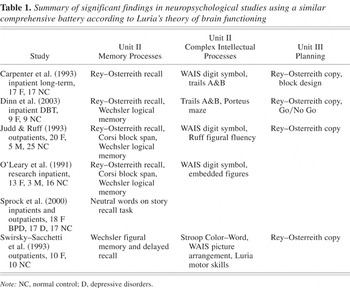
Summary of significant findings in neuropsychological studies using a similar comprehensive battery according to Luria's theory of brain functioning
 You have
Access
- 42
- Cited by