


Introduction
Violence against Pakistani women occurs at an alarming prevalence that reflects a significant risk to the health of the victims and their families (LaBore et al., Reference LaBore, Ahmed, Rizwan-Ur-Rashid and Ahmed2019). A study in a Pakistani community sample reported that as many as half of all women in this setting experienced battering or violence (Naeem et al., Reference Naeem, Irfan, Zaidi, Kingdon and Ayub2008). Women who experience domestic violence are at high risk of mental health problems (Ayub et al., Reference Ayub, Irfan, Nasr, Lutufullah, Kingdon and Naeem2009) and studies have reported high rates of post-traumatic stress disorder (PTSD) and depression in this group (Golding, Reference Golding1999).
Cognitive behaviour therapy (CBT) is an evidence-based intervention for PTSD that is recommended by national guidelines in most high-income countries (APA, 2017). There is robust evidence that therapist-delivered trauma-focused CBT is useful for the treatment of PTSD (Bisson et al., Reference Bisson, Roberts, Andrew, Cooper and Lewis2013; Jonas et al., Reference Jonas, Cusack, Forneris, Wilkins, Sonis, Middleton, Feltner, Meredith, Cavanaugh, Brownley, Olmsted, Greenblatt, Weil and Gaynes2013) and can be used in a brief format (Wu et al., Reference Wu, Li and Cho2014). Self-help and guided self-help interventions have been found to be efficacious and cost-effective (Bower et al., Reference Bower, Richards and Lovell2001; Cuijpers and Schuurmans, Reference Cuijpers and Schuurmans2007; Lewis et al., Reference Lewis, Anderson, Araya, Elgie, Harrison, Proudfoot, Schmidt, Sharp, Weightman and Williams2003; Lewis et al., Reference Lewis, Roberts, Simon, Bethell and Bisson2019)
Notwithstanding this, the availability of CBT in low- and middle-income countries (LAMICs) remains low (Beck et al., Reference Beck, Nadkarni, Calam, Naeem and Husain2016) despite evidence showing it to be an effective treatment for psychiatric problems in these settings (Aslam et al., Reference Aslam, Irfan and Naeem2015; Chatterjee et al., Reference Chatterjee, Naik, John, Dabholkar, Balaji, Koschorke, Varghese, Thara, Weiss, Williams, McCrone, Patel and Thornicroft2014; Husain et al., Reference Husain, Afsar, Ara, Fayyaz, Rahman, Tomenson, Hamirani, Chaudhry, Fatima, Husain, Naeem and Chaudhry2014; Naeem et al., Reference Naeem, Gul, Irfan, Munshi, Asif, Rashid, Khan, Ghani, Malik, Aslam, Farooq, Husain and Ayub2015a; Naeem et al., Reference Naeem, Saeed, Irfan, Kiran, Mehmood, Gul, Munshi, Ahmad, Kazmi, Husain, Farooq, Ayub and Kingdon2015b). However, given the fact that social and cultural factors influence symptom perception and treatment engagement (Bhikha et al., Reference Bhikha, Farooq, Chaudhry and Husain2012), interventions need to be tailored to the socio-cultural needs of patients. Converging evidence indicates a strong benefit to culturally adapting interventions (Chowdhary et al., Reference Chowdhary, Jotheeswaran, Nadkarni, Hollon, King, Jordans, Rahman, Verdeli, Araya and Patel2014; Griner and Smith, Reference Griner and Smith2006; Rathod et al., Reference Rathod, Gega, Degnan, Pikard, Khan, Husain, Munshi and Naeem2018).
Our group has culturally adapted and tested CBT in Pakistan and the UK (Aslam et al., Reference Aslam, Irfan and Naeem2015; Naeem et al., Reference Naeem, Ayub, Gobbi and Kingdon2009; Naeem et al., Reference Naeem, Waheed, Gobbi, Ayub and Kingdon2011; Naeem et al., Reference Naeem, Gul, Irfan, Munshi, Asif, Rashid, Khan, Ghani, Malik, Aslam, Farooq, Husain and Ayub2015a; Naeem et al., Reference Naeem, Saeed, Irfan, Kiran, Mehmood, Gul, Munshi, Ahmad, Kazmi, Husain, Farooq, Ayub and Kingdon2015b; Naeem et al., Reference Naeem, Phiri, Nasar, Munshi, Ayub and Rathod2016; Rahman et al., Reference Rahman, Hamdani, Awan, Bryant, Dawson, Khan, Azeemi, Akhtar, Nazir, Chiumento, Sijbrandij, Wang, Farooq and Ommeren2016; Rathod et al., Reference Rathod, Kingdon, Phiri and Gobbi2010; Rathod et al., Reference Rathod, Phiri, Harris, Underwood, Thagadur, Padmanabi and Kingdon2013; Rathod et al., Reference Rathod, Phiri and Naeem2019). Based on our experience of culturally adapting CBT we have developed culturally adapted self-help manuals for depression, anxiety and stress. The self-help manual for depression and anxiety has been tested in a multi-centre randomized controlled trial (RCT) and has been found to be effective (Naeem et al., Reference Naeem, Sarhandi, Gul, Khalid, Aslam, Anbrin, Saeed, Noor, Fatima, Minhas, Husain and Ayub2014). Similarly, we recently developed a culturally adapted self-help manual for PTSD (BASID Ki Kahani – story of BASID – Baad uz Sadma Zehni Dabao, literal translation of post-traumatic stress). To our knowledge there are no published clinical trials of culturally adapted interventions for PTSD from South Asia.
Herein we report results of a feasibility RCT of the ‘BASID Ki Kahani’ manual as guided self-help (GSH) delivered by CBT-trained therapists to help Pakistani women who have experienced domestic violence and subsequent PTSD. The primary aim of this trial was to assess feasibility and acceptability of culturally adapted trauma-focused CBT-based GSH. We also assessed measures of traumatic distress, depression and anxiety as secondary outcomes.
Method
Participants
Inclusion and exclusion criteria
Inclusion criteria were: female sex, history of domestic violence, a diagnosis of PTSD using DSM-5 criteria, age 18 to 65 years and at least 5 years of formal education. The exclusion criteria were: substance use disorder according to DSM-5 criteria, significant cognitive impairment (for example due to a profound learning disability or dementia) and active psychosis.
Procedure
Study design
This study is a RCT using a pre–post measure and parallel design. It was conducted from July 2018 to June 2019.
Study sites
The trial was conducted in one shelter home in Karachi, Pakistan. The shelter home accommodates victims of domestic violence, women at risk of violence from their families after choosing to marry against their approval, and survivors of sexual assaults. Shelter homes provide free lodging, and legal and medical help to these survivors.
Recruitment
Individuals who had experienced domestic violence and were living in a shelter home were recruited in Karachi, Pakistan. Participants were initially identified by the shelter home staff.
Those considered eligible and who consented to be contacted were then contacted by a member of the research team. A clinical psychologist (M.L.) assessed them for symptoms of PTSD during a clinical assessment using DSM-5 criteria. Those meeting criteria for PTSD were given information about the study. After a full description of the study, all participants provided written informed consent before recruitment to the study.
Trial intervention: CatCBT-based self-help manual for trauma – BASID Ki Kahani
We developed a self-help manual for depression to improve access to CBT. This manual was found to be effective in a multi-centre RCT when used as guided self-help (Naeem et al., Reference Naeem, Sarhandi, Gul, Khalid, Aslam, Anbrin, Saeed, Noor, Fatima, Minhas, Husain and Ayub2014). We recently developed a culturally sensitive self-help manual in Urdu for victims of trauma, BASID Ki Kahani. It focuses on stories of four victims of trauma. The book describes how they help themselves with symptoms of PTSD, depression and anxiety using CBT techniques. The self-help manual focuses on psychoeducation, symptom management, graded exposure, cognitive restructuring, behavioural activation, problem-solving, improving relationships and communication skills. The self-help manual consists of seven chapters, with two additional chapters on conflict management and communication skills. The chapters on changing negative thoughts focus on identifying negative thoughts, challenging them and finding alternative thoughts by using diaries. There are also other stories in the manual; for example, the story of an elephant and six blind men to explain the concept of CBT and the story of a lion to explain exposure. The book also uses other examples from local folklore as well as from the Islamic religion. It can be used by patients or carers with at least 5 years of education. For the purposes of the current study, the intervention was facilitated by research assistants (RAs) who were Masters-level psychologists. The RAs provided face-to-face guidance on how to use the manual in nine sessions over a 12-week period. At each session, RAs would elicit feedback of the previous session and give a brief 15–20 minute overview on the content of the chapter in the manual that the current session was focused on. The manual can be downloaded from the Pakistan Association of Cognitive Behaviour Therapy (PACBT) website (http://www.pacbt.org/).
Waitlist control
Clients in shelter homes mainly receive help and advice concerning legal and financial issues. Clients are not routinely offered psychological help to deal with their trauma symptoms. When a person needs physical or mental health care, they are referred to a local primary care physician or hospital.
Measures
Assessment of feasibility and acceptability
Feasibility and acceptability were assessed through recruitment, retention and informal feedback from participants. At the end of the intervention, participants were asked by RAs to describe their experience. They were also requested to name the sessions that they found the most helpful or unhelpful, and to provide suggestions to improve the intervention. Those attending less than six of nine (66%) sessions were considered drop-outs.
Assessment of clinical outcomes
The following assessments were performed at baseline and at the end of the intervention at 12 weeks: Impact of Events Scale revised for PTSD (IES-R; Weiss and Marmar, Reference Weiss and Marmar1996), the Hospital Anxiety and Depression Scale (HADS; Zigmond and Snaith, Reference Zigmond and Snaith1983) and the WHO Disability Assessment Schedule 2.0 (WHO DAS 2.0; Üstün et al., Reference Üstün, Chatterji, Kostanjsek, Rehm, Kennedy, Epping-Jordan, Saxena, von Korff and Pull2010). A data form was used to collect demographic information from participants. All assessment scales were translated in Urdu.
The IES-R (Weiss and Marmar, Reference Weiss and Marmar1996) is a 22-item self-report measure (for PTSD according to DSM-IV criteria) that assesses subjective distress caused by traumatic events. Respondents are asked to identify a specific stressful life event and then indicate how much they were distressed or bothered during the past 7 days by each ‘difficulty’ listed. Items are rated on a 5-point scale ranging from 0 (‘not at all’) to 4 (‘extremely’). The IES-R yields a total score (ranging from 0 to 88). The authors recommend using means instead of raw sums for each of these subscales scores to allow comparison with scores from the Symptom Checklist 90-Revised (SCL-90-R; Derogatis and Lazarus, Reference Derogatis, Lazarus and Maruish1994). In general, the IES-R (and IES) is not used to diagnose PTSD. However, cut-off scores for a preliminary diagnosis of PTSD have been cited in the literature (Murphy et al., Reference Murphy, Ross, Ashwick, Armour and Busuttil2017). The IES-R is the only validated tool in Urdu in Pakistan (with a reported good reliability; Cronbach’s alpha of 0.92) and satisfactory content and convergent validity for that sample (Tareen et al., Reference Tareen, McDowell, Naqvi, Bashir, Keenan, ur Rehman and Farrell2012). Ehring et al. have used the scale in their studies for assessing PTSD in Pakistan (Cronbach’s alphas for their two studies were 0.91 and 0.94) (Ehring et al., Reference Ehring, Razik and Emmelkamp2011; Razik et al., Reference Razik, Ehring and Emmelkamp2013).
The HADS (Zigmond and Snaith, Reference Zigmond and Snaith1983) is a 14-item, self-assessment scale designed to measure anxiety and depression. It has high internal consistency, face validity and concurrent validity. Even-numbered questions relate to depression and odd-numbered questions relate to anxiety. Each question has four possible responses. Responses are scored on a scale from 3 to 0. The maximum score is therefore 21 for depression and 21 for anxiety. A score of 11 or higher indicates the probable presence of depression with a score of 8 to 10 being just suggestive of the presence of the respective state. The two subscales, anxiety and depression, have been found to be independent measures. In its current form the HADS is now divided into four ranges: normal (0–7), mild (8–10), moderate (11–15) and severe (16–21). The HADS has been validated in Urdu and has been used previously in Pakistan, showing a good internal consistency with a Cronbach’s alpha value of 0.81 (Waqas et al., Reference Waqas, Aedma, Tariq, Meraj and Naveed2019).
The WHO DAS 2.0 (Üstün et al., Reference Üstün, Chatterji, Kostanjsek, Rehm, Kennedy, Epping-Jordan, Saxena, von Korff and Pull2010) is a self-report questionnaire that assesses disability and functioning in the prior month that has been used in Pakistan. The WHO DAS 2.0 was developed to assess six different adult life tasks: (1) understanding and communication; (2) self-care; (3) mobility (getting around); (4) interpersonal relationships (getting along with others); (5) work and household roles (life activities); and (6) community and civic roles (participation). There are 36- and 12-item versions of the WHO DAS 2.0. We used the 12-item version for this study. The WHO DAS 2.0 has been translated into Urdu and has previously been used in Pakistan showing good internal consistency (Federici et al., Reference Federici, Bracalenti, Meloni and Luciano2017).
Data analysis
Sample size and randomization
This is a first feasibilty study using a RCT design, therefore no power calculation was conducted. The results of this study will be used to calculate sample sizes for future larger, confirmatory RCTs. It has been suggested that a sample size of 12 in each arm should suffice for pilot studies (Julious, Reference Julious2005). Allowing for up to 40–60% drop-outs, we therefore recruited 50 participants for the study, including 25 participants per arm. Randomization was performed using a web-based platform (www.randomization.com).
Statistical analysis
SPSS frequency and descriptive commands were used to measure descriptive statistics. The SPSS explore command was used to measure normality of the data, using histograms and Kolmorogov–Smirnov tests. Baseline comparisons were made using chi-square and t-tests. Comparisons at two time points in psychopathology and disability were measured using ANCOVA to account for differences at baseline. To calculate effect sizes, we used adjusted means difference as nominator. For denominator we used this formula: √[(n 1-1)SD1 2 + (n 2-1)SD2 2]/(n 1 + n 2-2) (Lakens, Reference Lakens2013). We made additional adjustments by multiplying the results from the above formula with (N-3/N-2.25) and √N-2/N (Durlak, Reference Durlak2009) (PMID: 19223279). We made these calculations in Microsoft Excel.
Results
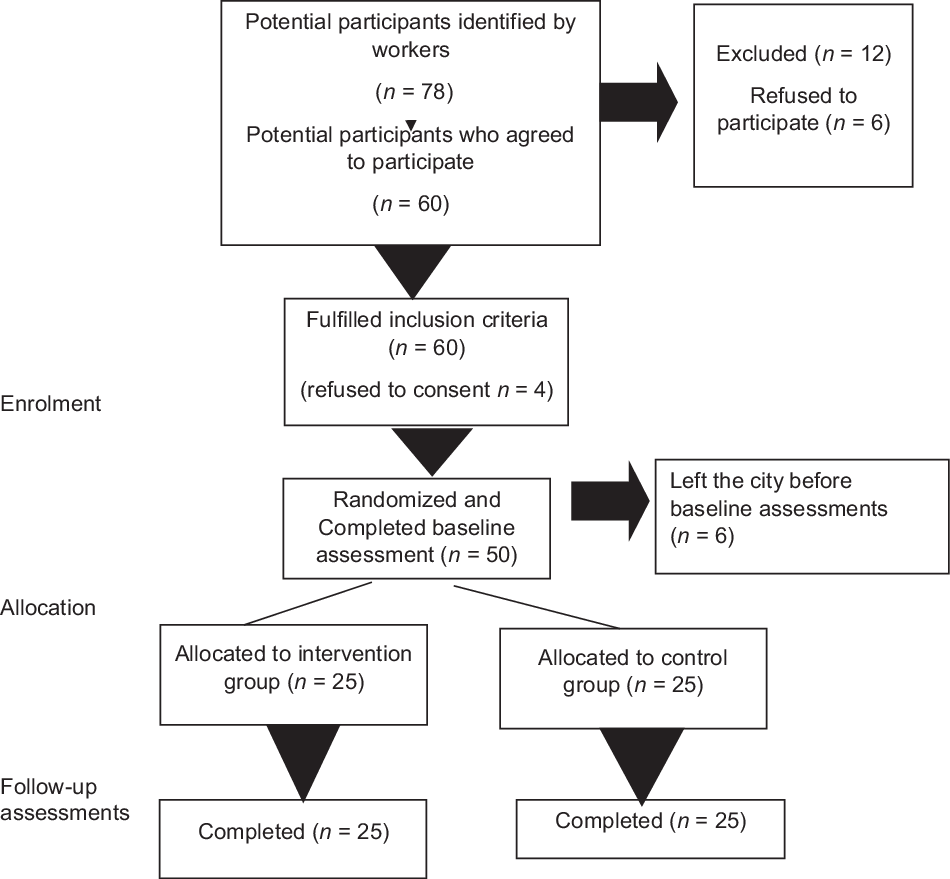
The shelter home staff identified 78 individuals who could potentially meet the inclusion criteria for the study. Research staff contacted this group, and 60 met the DSM-5 criteria for PTSD. Figure 1 shows the recruitment and flow of participants during the trial
CONSORT flow diagram of the trial.

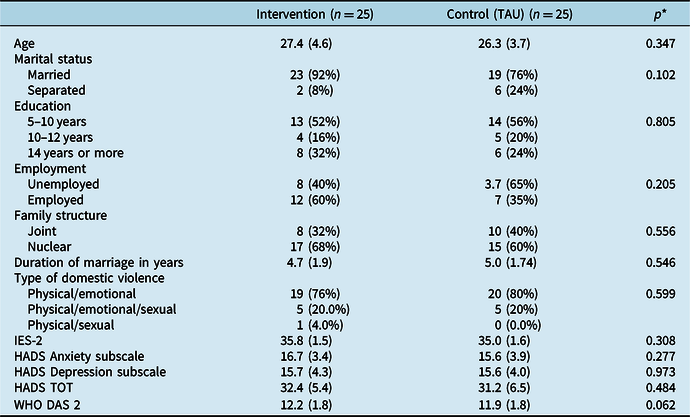
Table 1 provides a summary of baseline characteristics of included participants. The majority of participants were married (n = 42, 84%) and most had been victims of physical and emotional abuse (n = 39, 78%). All participants identified as Muslim with regard to their religious identity. There were no significant differences in demographic or clinical variables between groups at baseline.
Differences in demographic variables and psychopathology between the intervention and control groups at baseline

The figures for demographic details are means (standard deviation) for age and clinical metrics, while the rest are sample size (% within treatment group). *p-values are calculated using, non-parametric Mann–Whitney U-test for continuous variables (age and clinical metrics) and Fisher’s exact test for the rest of variables that were categorical. TAU, treatment as usual.
Feasibility and acceptability
With regards to feasibility of the trial, recruitment was successful and occurred to time and target. Out of 60 clients who met the criteria for PTSD, 56 (93.3%) agreed to participate in the study. As six clients left the shelter home before the baseline assessment and randomization, 50 participants completed baseline assessments and were randomized to either the intervention group or waitlist control. Retention to the intervention group was excellent, with 92% (23/25) attending more than 6 sessions. Twenty participants attended all 9 sessions, three attended 6–9 sessions and another two attended 3–6 sessions.
Informal feedback from the participants and the shelter care staff was positive, describing the intervention as acceptable and helpful. Almost all those who completed the study reported the intervention to be easy to read and understand. Of those who completed the intervention, almost all the participants (21/25) described the sessions on dealing with thoughts to be the most helpful. One participant, in particular, found activity scheduling to be effective; other popular sessions included fear hierarchy (20/25), awareness about sleep issues and suggestion for improving sleep (18/25) and cognitive restructuring (19/25).
Clinical measures
There were statistically significant differences between the two time points in symptoms of PTSD, depression, anxiety and disability. Table 2 describes these results.
Differences between the treatment and control groups, both uncontrolled and controlled for initial differences. Analyses were carried out using an ANCOVA

SD, standard deviation; TAU, treatment as usual; CI, confidence interval. *p-values calculated using ANCOVA, controlling for baseline value of the outcome. ‡Cohen’s d was calculated by dividing the adjusted difference at end of trial (column 5) by the SD at baseline (column 2). +Difference baseline – post; negative values mean improvement.
Discussion
To our knowledge, this is the first report of a culturally adapted GSH intervention for victims of trauma from South Asia. The study proved feasible, and the intervention was acceptable to participants. The intervention also reduced symptoms of PTSD, depression, anxiety and disability.
Despite the strong evidence for its effectiveness, CBT remains under-utilized in LAMICs. One key strategy to improve access to evidence-based care suggested by the World Health Organization (WHO) is through task shifting or task sharing (WHO, 2008). There is evidence to suggest that lay therapist-delivered psychosocial interventions are feasible and effective (Jordans et al., Reference Jordans, Luitel, Garman, Kohrt, Rathod, Shrestha, Komproe, Lund and Patel2019; Patel et al., Reference Patel, Weobong, Weiss, Anand, Bhat, Katti, Dimidjian, Araya, Hollon, King, Vijayakumar, Park, McDaid, Wilson, Velleman, Kirkwood and Fairburn2017; Rahman et al., Reference Rahman, Hamdani, Awan, Bryant, Dawson, Khan, Azeemi, Akhtar, Nazir, Chiumento, Sijbrandij, Wang, Farooq and Ommeren2016). However, LAMICs might not be able to afford lay therapist-delivered therapy. Therefore, there is a need to explore further low-cost evidence-based interventions that can be delivered with minimum resources in LAMICs. One such option is CBT-based self-help and guided self-help (CBT GSH), which have a strong evidence base for depression and anxiety disorders in high-income settings (Cuijpers, Reference Cuijpers1997; Cuijpers and Schuurmans, Reference Cuijpers and Schuurmans2007; Falbe-Hansen et al., Reference Falbe-Hansen, Le Huray, Phull, Shakespeare and Wheatley2009). However, only limited data (Naeem et al., Reference Naeem, Sarhandi, Gul, Khalid, Aslam, Anbrin, Saeed, Noor, Fatima, Minhas, Husain and Ayub2014) are available on use of CBT-based GSH from LAMICs.
These results are in line with studies conducted in high-income countries (Cuijpers et al., Reference Cuijpers1997), as well as with our previous work (Naeem et al., Reference Naeem, Sarhandi, Gul, Khalid, Aslam, Anbrin, Saeed, Noor, Fatima, Minhas, Husain and Ayub2014). The results highlight the need for developing culturally adapted therapies that can be delivered using available resources. The cultural relevance of the self-help material may have played a vital role in engaging clients, although this theory would need to be tested within the framework of an RCT comparing the BASID Ki Kahani intervention with the Western version of CBT-based GSH, to confirm our hypothesis.
Strengths and limitations
This feasibility study successfully achieved its required sample size, and drop-out rates were low, which are considerable strengths. However, these might be explained by the fact that clients were bound to shelter homes. Moreover, potential participants were initially identified by shelter home staff prior to a screening with the research team, which may be a source for selection bias when interpreting the feasibility of recruitment. We collected informal feedback from study participants, which was largely positive. However, as the qualitative data were not formally analysed, we cannot rely on it to confirm that the intervention was acceptable to participants. Notwithstanding this, although they had the option to refuse, most participants completed the intervention. The sample consisted of clients who had experienced trauma and there were significant improvements at the final assessment in terms of post-traumatic stress symptoms, depression, anxiety and disability. The informal feedback collected at the end of the study indicated that the treatment was highly acceptable and helpful to participants. Moreover, the study was conducted in real-life settings in a shelter home and this pragmatic approach to recruitment is reproducible in routine care.
We observed a drop in psychopathology scores in both the treatment arm and control arm, although there was a greater reduction in the treatment arm, which was statistically significant. The improvement in the control arm may be due to the fact that participants in the control arm also received some therapeutic benefit from the structured follow-up assessments with the research staff. Moreover, the environment of the shelter home itself provides respite from a traumatic and abusive environment, leading to a sense of safety. The significant reduction in symptom scores in the treatment group may be an indication of treatment effect. Although the effect sizes in the study are large, this is mainly because of the small standard deviations, which are likely to be a function of the small sample size.
Conclusions
Overall, the findings of this feasibility study are encouraging, but they require replication in a larger, confirmatory RCT. If a larger study confirms the clinical findings of our feasibility trial, this low-cost intervention has the potential to be scaled up across LAMICs like Pakistan to improve outcomes for female victims of domestic violence who experience symptoms of PTSD. Future work may consider delivering this intervention to victims of other traumas. The current study did not include an assessment of history of other traumas, which may limit our findings to only women with a history of domestic violence. There is also a need to develop self-help CBT material using technologies that do not depend on reading alone, for example, using multimedia and smartphone applications. Self-help interventions can be delivered digitally, have been used for treatment of PTSD, and have been found to be effective (Hedman et al., Reference Hedman, Ljótsson and Lindefors2012; Wickersham et al., Reference Wickersham, Petrides, Williamson and Leightley2019). Furthermore, digital self-help interventions have been shown to reduce healthcare costs in high-income countries (Alaoui et al., Reference Alaoui, Hedman-Lagerlöf, Ljótsson and Lindefors2017). Mobile cellular ’phone subscriptions exceed 80% of the population in many low-income countries, and there is a growing evidence base for the efficacy of mobile health interventions in LAMICs (Naslund et al., Reference Naslund, Aschbrenner, Araya, Marsch, Unützer, Patel and Bartels2017; Wickersham et al., Reference Wickersham, Petrides, Williamson and Leightley2019). Such approaches may help address the significant mental health treatment gap for victims of violence in LAMICs, who experience PTSD and other disabling psychological sequelae.
Acknowledgements
None.
Financial support
This study was funded by the PACBT. The work is also funded in part by a University of Toronto, Department of Psychiatry Academic Scholars Award to M.I.H.
Conflicts of interest
The authors have no conflicts of interest to declare.
Ethical Statement
The trial protocol was approved by the Pakistan Association of Cognitive Behaviour Therapy (PACBT) institutional review board. All authors have abided by the Ethical Principles of Psychologists and Code of Conduct as set out by the BABCP and BPS.




Comments
No Comments have been published for this article.