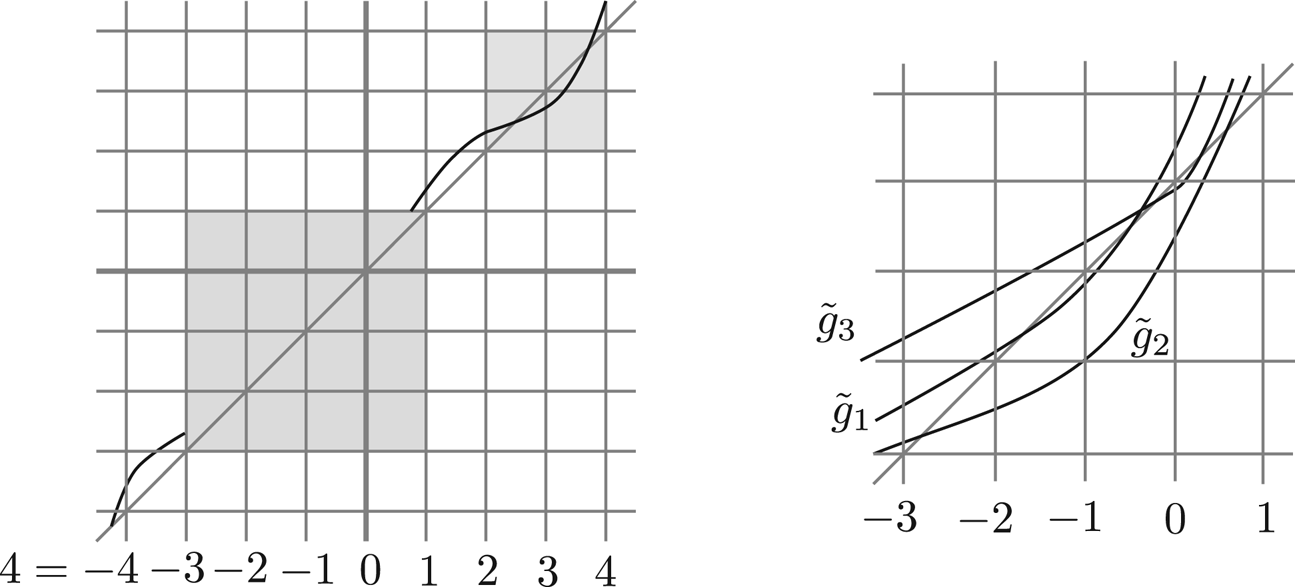
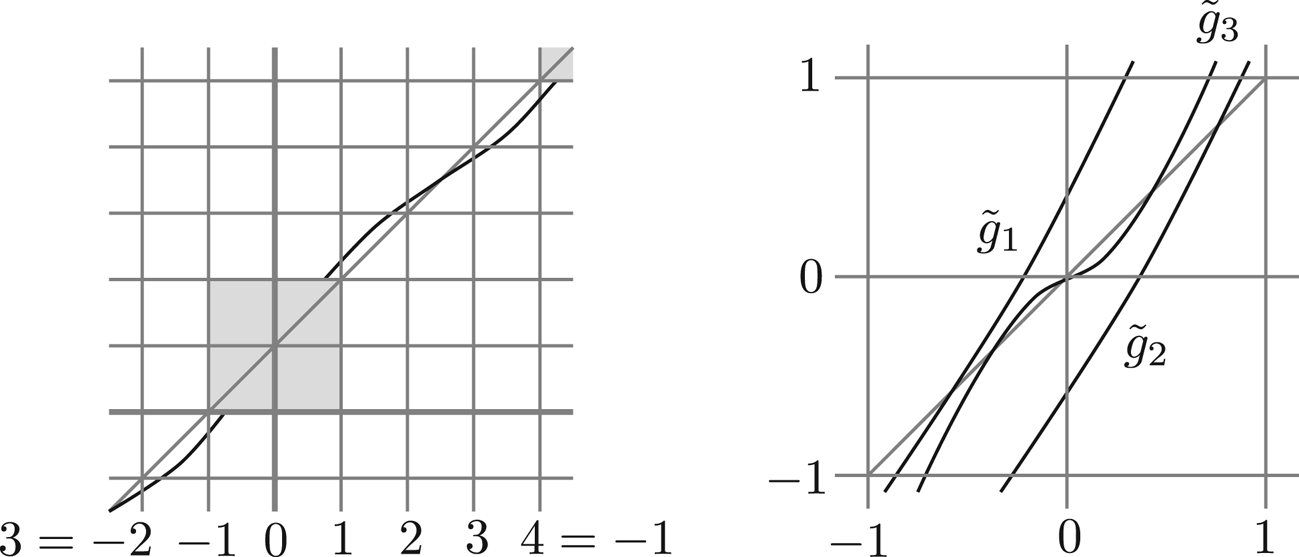
1. Introduction
1.1 Backgrounds: non-hyperbolicity versus the growth of the number of periodic points
In the research of dynamical systems, the growth of the number of periodic points as a function of the period has been one of the most fundamental themes and studied extensively. For a set  $X$ and a self-map
 $f:X {{\rightarrow }}X$, we denote the set of fixed points of the
 $n$-times iteration
 $f^{n}$ of
 $f$ by
 $\operatorname {Fix}(f^{n})$ for
 $n \geq 1$. We also denote the cardinality of a set
 $S$ by
 $\# S$. We say that the growth rate of the number of fixed point is at most exponential if
 $\limsup _{n {{\rightarrow }} \infty } ({1}/{n})\log \#\operatorname {Fix}(f^{n})<\infty$ and super-exponential if all
 $\#\operatorname {Fix}(f^{n})$ are finite but
 $\limsup _{n {{\rightarrow }} \infty } ({1}/{n})\log \#\operatorname {Fix}(f^{n})=\infty$. According to the classical result by Artin and Mazur [Reference Artin and MazurAM65], for a dense set of smooth diffeomorphisms the growth of the number of isolated periodic points is at most exponential independently of the type of the dynamics of the map. Later, Kaloshin improved the result by dropping the isolatedness assumption [Reference KaloshinKal99]. Although the generality of these results are impressive, one might think that a result on a dense subset of the space of maps is not quite satisfactory, because the complement of a dense set can be very large. Thus, we are naturally lead to be interested in the results which are valid for diffeomorphisms in larger subsets (open or residual).
A milestone result in this direction was given by Bowen [Reference BowenBow08]: every uniformly hyperbolic (axiom A) diffeomorphism admits a finite Markov partition over its non-wandering set, which implies that the number of the periodic point grows at most exponentially with period, independently of the regularity of the diffeomorphism. As the axiom A property together with no-cycle condition is  $C^{1}$-robust, this result implies the existence of an open set of diffeomorphisms where the growth of the periodic points is at most exponential.
On the other hand, for maps of an interval, there are situations where we can observe the robust exponential growth even under the absence of uniform hyperbolicity. The main result in this direction is due to Martens, de Melo, and van Strien [Reference Martens, de Melo and van StrienMMS92]: For smooth ( $C^{r}$ where
 $r\geq 3$) maps of an interval, a sufficient condition for the at-most exponential growth is the non-flatness of all critical points (the points where the derivative of the map vanishes). This is a regularity type condition: at least one of the first
 $r$ derivatives of the map must be non-zero for each point in the interval. As shown in [Reference Kaloshin and KozlovskiKK12] this condition cannot be essentially weakened.
When higher-dimensional maps are considered, the situation changes. Since the 1960s, it has been known that there are open sets of diffeomorphisms of any manifold of dimension two and higher, such that every diffeomorphism from such sets fails to be uniformly hyperbolic. Thus, we are naturally lead to ask what properties could we generically observe among such diffeomorphisms.
Under the slogan ‘beyond uniform hyperbolicity’, a myriad of interesting research directions have been explored for decades (see [Reference Bonatti, Díaz and VianaBDV04] for a panorama of results). There are two known mechanisms which robustly destroy the uniform hyperbolicity: (i) homoclinic tangencies (critical behavior) and (ii) heterodimensional cycles. Although up to now we do not know whether these structures are the only mechanisms which produce robust non-hyperbolicity in diffeomorphisms (this is the subject of the famous Palis conjecture; see [Reference PalisPal00] for the precise statement), this classification serves as a useful guide for the research of non-hyperbolic systems. Thus, we continue the discussion of the growth of periodic points from this viewpoint.
We begin with systems of class (i). A diffeomorphism is said to have  $C^{r}$-robust homoclinic tangency (see [Reference Bonatti and DíazBD12]) if it has a hyperbolic set and there is a
 $C^{r}$-neighborhood of the diffeomorphism where the continuation of the hyperbolic set is defined and for every map in this neighborhood the unstable manifold and the stable manifold of the hyperbolic set have a point of tangency.
The robust homoclinic tangencies were discovered by Newhouse [Reference NewhouseNew79]. He constructs an open set of  $C^{r}$-diffeomorphisms (
 $r \geq 2$) with robust homoclinic tangencies to a hyperbolic set of a sufficiently large ‘thickness’, a numerical indicator which describes how large a Cantor set is from the viewpoint of fractal geometry (see [Reference Palis and TakensPT93, Chapter 4] for details). Nowadays such an open set of diffeomorphisms is called a Newhouse domain. In striking difference to the uniformly hyperbolic case,
 $C^{r}$-generic diffeomorphisms in a Newhouse domain exhibit super-exponential growth of the number of periodic points. Namely, it was discovered by Kaloshin [Reference KaloshinKal00] that given any candidate upper bound for the growth rate of the number of periodic points this bound will be exceeded by a generic diffeomorphism from a Newhouse domain.
The fact that there is no bound on the rate of growth of the number of periodic orbits for generic diffeomorphisms from the Newhouse domain is a manifestation of the general phenomenon of unrestricted richness of chaotic dynamics in non-hyperbolic diffeomorphisms with robust homoclinic tangencies, see [Reference TuraevTur10, Reference TuraevTur15]. Thus, it is interesting to consider the problem for systems of class (ii), that is, systems exhibiting robust heterodimensional cycles, in order to figure out how different are the dynamics of such systems from the uniformly hyperbolic case and from the case of Newhouse domain.
Let us review the definition of maps in class (ii). We say that a diffeomorphism has a  $C^{r}$-robust heterodimensional cycle (see [Reference Bochi, Bonatti and DíazBBD16]) if it has two hyperbolic basic sets
 $\Lambda$ and
 $\Sigma$ whose unstable indices (dimensions of the unstable bundles) are different and in the
 $C^{r}$-neighborhood of the diffeomorphisms the continuations of
 $\Lambda$ and
 $\Sigma$ have a cycle between their stable and unstable manifolds (that is, the stable manifold of
 $\Lambda$ intersects the unstable manifold of
 $\Sigma$ and the stable manifold of
 $\Sigma$ intersects the unstable manifold of
 $\Lambda$). The coindex of a heterodimensional cycle is the difference of the unstable indices of
 $\Lambda$ and
 $\Sigma$. The existence of a heterodimensional cycle of coindex one implies, typically, the existence of orbits with zero Lyapunov exponents, see [Reference Gorodetski, Ilyashenko, Kleptsyn and NalskyGIKN05, Reference Díaz and GorodetskiDG09]. Thus, the dynamics are non-hyperbolic, however this does not preclude the partial hyperbolicity of the system.
Although there are several classical examples of robustly non-hyperbolic partially hyperbolic systems such as the examples by Abraham and Smale, Mañé or Shub (see [Reference Bonatti, Díaz and VianaBDV04, § 7] for more details), a general and simple mechanism which produces a robust heterodimensional cycle was introduced by Bonatti and Díaz [Reference Bonatti and DíazBD96]. It is called a blender, which corresponds to a different version of the Newhouse's thickness argument in the context of partially hyperbolic diffeomorphisms of manifolds of dimension three and higher.
In this paper, we prove the  $C^{r}$-genericity (
 $r \geq 2$) of the super-exponential growth of the number of periodic points for a class of partially hyperbolic diffeomorphisms with one-dimensional central direction, having robust heterodimensional cycles produced through a blender. Before a more precise statement of our result, we recall that the
 $C^{1}$-genericity of the super-exponential growth of the number of periodic orbits for systems with robust heterodimensional cycles has been proven in [Reference Bonatti, Díaz and FisherBDF08]. For a special (still open) class of such systems where the heterodimensional cycle is embedded into a certain normally-hyperbolic invariant fibration by circles, the super-exponential growth is shown to be
 $C^{\infty }$-generic [Reference BergerBer17].
In general, the answer to the question of the genericity of the super-exponential growth for maps with heterodimensional cycles depends on the regularity class of the map. In the previous paper [Reference Asaoka, Shinohara and TuraevAST17], we considered free semi-group actions on an interval, in other words, step skew-products over the full-shift of two symbols. It is a simplified model for partially hyperbolic diffeomorphisms which we discuss in this paper. For such systems, we have identified a sufficient condition for a  $C^{r}$-generic (
 $r \geq 2$) super-exponential growth. On the other hand, in the same paper, we described
 $C^{2}$-open and
 $C^{3}$-open classes of semi-group actions with non-critical behavior (which corresponds to the existence of a robust heterodimensional cycle) where the growth of the number of periodic orbits is at most exponential, even though these classes lie in the
 $C^{1}$-interior of the set of systems where the super-exponential growth is
 $C^{1}$-generic.
The present paper is a sequel to [Reference Asaoka, Shinohara and TuraevAST17]. We show that main constructions can be transferred to the general case of partially hyperbolic diffeomorphisms. Such generalization is non-trivial in several respects. In particular, we do not require a large spectral gap assumption, so we do not have a smooth center foliation, hence there is no reduction to a smooth skew-product system.
1.2 Description of the main theorem
Let us give our main result. As formulating the assumptions of the theorem precisely involves several concepts with definitions that are not short, the complete statement is postponed until § 3. Here, we only give a schematic description of the assumptions, see also Figure 1.
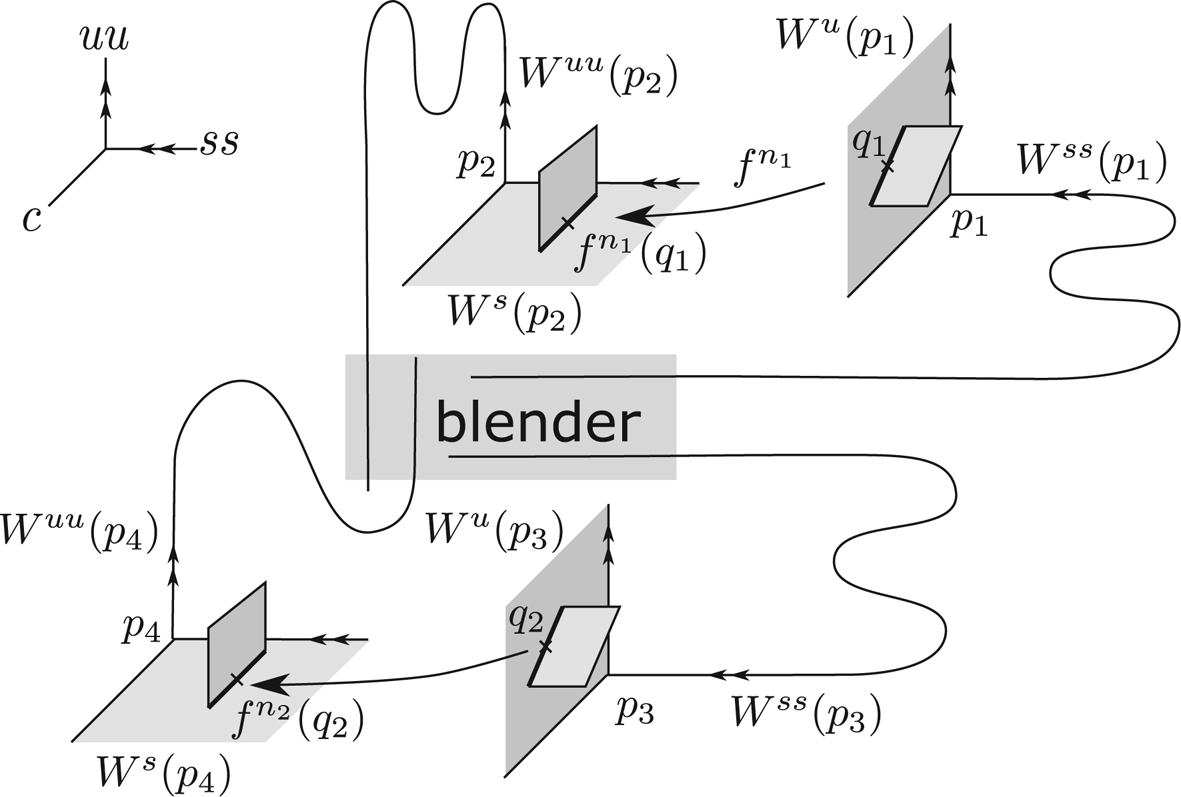
An illustration of the setting of the main theorem. There are four periodic points  $p_1,\ldots ,p_4$. The pairs
 $(p_1, p_2)$ and
 $(p_3,p_4)$ have transverse heteroclinic connection and they are weakly connected with a blender.

Heteroclinic pairs. Let  $n \geq 3$ and
 $M$ be a closed smooth
 $n$-dimensional manifold. Let
 $r \geq 1$,
 $\mathrm {Diff}^{r}(M)$ be the space of
 $C^{r}$-diffeomorphisms with
 $C^{r}$-topology and
 $f\in \mathrm {Diff}^{r}(M)$. Let
 $(p_1, p_2)$ and
 $(p_3, p_4)$ be two pairs of hyperbolic periodic points of
 $f$. Note that we do not exclude the case where
 $p_1 = p_3$ or
 $p_2 =p_4$. We assume that the unstable manifolds of
 $p_1$ and
 $p_3$ have the same dimension
 $\mathrm {u}\text {-}\mathrm {ind}(p_1)= \mathrm {u}\text {-}\mathrm {ind}(p_3)=d+1$ (for a hyperbolic periodic point
 $p$ we denote the dimension of its unstable manifold by
 $\mathrm {u}\text {-}\mathrm {ind}(p)$) and the unstable manifolds of
 $p_2$ and
 $p_4$ have the same dimension
 $\mathrm {u}\text {-}\mathrm {ind}(p_2) = \mathrm {u}\text {-}\mathrm {ind}(p_4) = d$. We assume the existence of two heteroclinic points
 $q_i \in W^{u}(p_{2i-1})\cap W^{s}(p_{2i})$,
 $i=1, 2$, so the orbit of
 $q_1$ tends to
 $p_2$ at forward iterations of
 $f$ and to
 $p_1$ at backward iterations, whereas the orbit of
 $q_2$ tends to
 $p_4$ at forward iterations and to
 $p_3$ at backward iterations.
Partial hyperbolicity. We assume that each periodic point  $p_i$,
 $i=1,\ldots ,4$ admits a partially hyperbolic splitting
 $E^{uu} \oplus E^{c} \oplus E^{ss}$ where
 $\dim E^{uu} =d$ and
 $\dim E^{c} =1$ (note that the subspace
 $E^{c}$ corresponds to the direction of the weakest expansion for
 $p_1$ and
 $p_3$ and the weakest contraction for
 $p_2$ and
 $p_4$). This splitting is assumed to be extended to the neighborhood of the heteroclinic orbits
 ${{\mathcal {O}}}(q_1)$ and
 ${{\mathcal {O}}}(q_2)$. We assume that the center direction has an orientation and it is preserved under the iterations of
 $f$. See §§ 2.2 and 2.3 for the details.
Signatures of the heteroclinic orbits. The partial hyperbolicity guarantees that the intersection  $W^{u}(p_{2i-1}) \cap W^{s}(p_{2i})$ is transverse near
 $q_i$ and is locally a one-dimensional curve
 $\ell _i$ tangent to
 $E^{c}$,
 $i=1,2$. We consider the restriction of
 $f$ to
 $\ell _i$, which gives a one-dimensional
 $C^{r}$-map. Then, following [Reference Asaoka, Shinohara and TuraevAST17], we can introduce the notion of the ‘signature of the heteroclinic orbits’: it is a pair of signatures of certain combinations of the derivatives up to order three of some iteration of the map
 $f|_{\ell _i}$, see § 2.4 for the detail. We assume that
 $q_1$ and
 $q_2$ have opposite signatures.
Blender is a type of hyperbolic set which allows one to produce robust connections between invariant manifolds for which the sum of dimensions is lower than the dimension of the ambient space. We provide a precise description in § 2.6 (see Definition 2.19). We assume that  $f$ admits a blender which provides pseudo-orbits connecting each of the pairs of periodic points
 $(p_2,p_1)$ and
 $(p_4,p_3)$. Furthermore, we assume that the partial hyperbolicity around
 $p_i$ and
 $q_i$ is also extended to a neighborhood of the blender and the center direction has an orientation which is compatible with the iterations of
 $f$.
Main Theorem Take  $r=1, \ldots , +\infty$ and let
 ${{\mathcal {W}}}^{r} \subset \mathrm {Diff}^{r}(M)$ be the open set of diffeomorphisms satisfying above conditions (see § 3 for the precise definition of
 ${{\mathcal {W}}}^{r}$). Then, for every sequence
 $(a_i) \subset \mathbb {N}_{>0}$, there exists a
 $C^{r}$-residual set
 $\mathcal {R}^{r}=\mathcal {R}^{r}_{(a_i)} \subset {{\mathcal {W}}}^{r}$ such that for every
 $f \in \mathcal {R}^{r}$ we have
 \begin{align}\limsup_{n \to +\infty} \frac{ \#\{x \in M\mid f^{n}(x) =x \}}{a_n} ={+}\infty. \end{align}
Considering this theorem for some sequence  $(a_n)$ which grows more rapidly than any exponential function, we have the
 $C^{r}$-generic super-exponential growth of the number of periodic points. We point out that one cannot strengthen the statement (say, to open and dense) because of the result of Kaloshin [Reference KaloshinKal99], which implies that every diffeomorphism can be
 $C^{r}$-approximated by one with at most exponential growth.
As we mentioned, the case  $r=1$ was dealt with in a paper by Bonatti, Díaz, and Fisher [Reference Bonatti, Díaz and FisherBDF08]. In their case, it was enough to find a non-hyperbolic periodic point by an approximation and to create as many periodic points as we want by another perturbation along central direction. The case
 $r \geq 2$ is quite different in nature, as it employs the information about the higher order derivatives. As we show later in § 7, the condition on the signatures of heteroclinic orbits are essential: we give examples which show that this condition can be indeed necessary.
We focus on one-dimensional center case for simplicity. The study of higher coindex heterodimensional cycles under higher regularity will be also interesting but it has substantial extra difficulty. The result of [Reference Bonatti, Díaz and FisherBDF08] holds for heterodimensional cycles having higher codimension. However, it uses low regularity assumption in an essential way. In the  $C^{1}$-topology, there is a perturbation technique for heterodimensional cycles for producing periodic points with intermediate indices; see [Reference Abdenur, Bonatti, Crovisier, Díaz and WenABC+07]. Thus, the problem of the higher-codimension case can be reduced to the codimension-one case. Unfortunately, up to now there is no corresponding result for higher regularity setting and this difference makes the problem difficult and interesting.
Another interesting question related to the main theorem is how such a situation emerges from a natural setting. A candidate situation would be the bifurcation of a heterodimensional cycle satisfying certain conditions. Such a problem should be pursued in future research.
Our theorem is a consequence of the following perturbation result, which is of interest in itself. We say that an  $N$-periodic point
 $p$ of
 $f$ is
 $r$-flat in the central direction if it admits one-dimensional center manifold and the restriction of
 $f^{N}$ to the center manifold has the trivial
 $r$-jet at
 $p$. See § 3 for the details.
Theorem 1.1 Let  $f\in {{\mathcal {W}}}^{r}$ be a
 $C^{\infty }$ diffeomorphism. For any
 $n_0\geq 1$ and
 $r \geq 1$, arbitrarily close to
 $f$ in the
 $C^{\infty }$ topology, there exists
 $g\in {{\mathcal {W}}}^{r}$ which has a periodic point,
 $r$-flat in the central direction, whose least period is greater than
 $n_0$.
It is easy to see that if  $f \in \mathrm {Diff}^{r}(M)$ has an
 $r$-flat periodic point of period
 $\pi$, then by adding a perturbation, arbitrarily small in
 $C^{r}$, we can create as many points of period
 $\pi$ as we want. Then, a standard genericity argument as in [Reference KaloshinKal00, Reference Asaoka, Shinohara and TuraevAST17] leads to the conclusion of the theorem. See the proof of Theorem 3.1 in § 3.
1.3 Outline of the proof
We prove Theorem 1.1 by analysis of the behavior of iterations of points in a neighborhood of heteroclinic cycles, which has similar flavor to that by Díaz and Rocha (see, e.g., [Reference DíazDía95, Reference Díaz and RochaDR02]), together with the refinement of our construction from [Reference Asaoka, Shinohara and TuraevAST17]. Let us see the outline of the proof.
The pair  $(p_{2i-1},p_{2i})$ of saddles is of coindex one and has the transverse heteroclinic point
 $q_i$. The stable manifold
 $W^{s}(p_{2i-1})$ of
 $p_{2i-1}$ intersects transversely with the unstable manifold of a periodic point in the blender and the unstable manifold
 $W^{u}(p_{2i})$ of
 $p_{2i}$ contains a disk in the strictly invariant family of disks associated with the blender. By a connecting lemma (Lemma 2.21), an arbitrary
 $C^{r}$-small perturbation connects
 $W^{u}(p_{2i})$ and
 $W^{s}(p_{2i+1})$ and creates a heteroclinic cycle among
 $p_1,\ldots ,p_4$. Then, we show that by adding an arbitrarily
 $C^{r}$-small perturbation at periodic points
 $p_1,\ldots ,p_4$ one can create a 1-flat periodic point near any of these cycles (Proposition 3.2). This 1-flatness is obtained by ‘matching’ the expanding behavior of
 $p_{2i-1}$ and the contracting behavior of
 $p_{2i}$ in the center direction. As the pairs of periodic points admit heteroclinic orbits and connect with the blender robustly, we can repeat the procedure as many times as we want and, accordingly, we can create as many 1-flat periodic points as we want. We also prove that these newly created periodic points are all weakly connected with the blender.
Next, we create  $2$-flat periodic points by adding perturbations near heteroclinic connections of the
 $1$-flat periodic points we have obtained (Proposition 3.3). As the number of
 $1$-flat periodic points can be made as large as we want, we also have as many
 $2$-flat periodic points as we want. Then we create heteroclinic connections with many
 $3$-flat points and after that we continue inductively until we obtain an
 $r$-flat periodic point. Note that
 $1$-flat,
 $2$-flat,
 $3$-flat, and
 $4$-flat periodic points are obtained by different procedures, whereas the procedure is the same for
 $k$-flat points starting with
 $k\geq 4$.
In the course of this induction, we need to take care of the following matters.
• We need to have control of the support of the perturbation so as to guarantee that each perturbation does not destroy previously constructed flat points.
• For the construction of
 $k$-flat points from the heteroclinic network of $(k-1)$-flat points with $k=2$ and $k=3$, we need to control the sign of the second derivative and, respectively, the Schwarzian derivative of the first return map for the $(k-1)$-flat points. Thus, while creating $(k-1)$-flat points on the previous step, we also need to control these quantities.


These two difficulties are already appeared in the one-dimensional semi-group action case, and the ways we solve these problems are similar to what was done in [Reference Asaoka, Shinohara and TuraevAST17].
For the first point, we overcome this difficulty by carefully choosing the domain of the perturbation based on the knowledge of the positions of the objects involved. Recall that we have a problem of creating connections between stable manifolds and unstable manifolds of periodic points by  $C^{r}$-small perturbations, which is an integral part of our induction argument. To transform the weak connection to a true heteroclinic intersection, the general technique is the connecting lemma by Hayashi [Reference HayashiHay97]. Meanwhile, it is valid only for
 $C^{1}$-topology and cannot be used for our purposes. We circumvent this problem by reviewing the properties of blenders. The weak connections which the blender produces are local because they do not involve any intermediate orbits outside the blender. This makes enough room for the perturbation, enabling us to obtain an appropriate
 $C^{r}$-connecting result (Lemma 2.21). See also [Reference Díaz, Kiriki and ShinoharaDKS14] for the related discussions about the difficulties of making connections under higher regularity settings.
The second problem is solved by direct calculations of the compositions of the polynomials. We prove that we can perform the cancellation of the derivatives keeping the information at the initial heteroclinic points, by tracing the exact effect of the compositions of germs of diffeomorphisms in the center direction. Remark that in the cancellation of the derivatives, the most relevant information is the derivatives at the heteroclinic points, and the derivatives along the quasi-transverse intersections do not play important role, see, for instance, the proof of § 5. Thus, in the assumption of the main theorem, the number of the heteroclinic pairs is not relevant: the main theorem holds even if  $p_1 = p_3$ and
 $p_2 = p_4$. The only information we need is the existence of two heteroclinic points with opposite signatures.
In the multi-dimensional case we consider here, we have another substantially new problem:
• The holonomy between center leaves can be non-smooth, so there is no direct reduction of the dynamics (projected to the center direction) to those generated by iterations of a system of smooth maps of the interval.
Overcoming this problem is one of the most demanding topics of this paper. We solve this problem by carefully developing several perturbation techniques and carrying out direct calculations, see §§ 4 and 5.
Finally, we explain the organization of this paper. In § 2 we discuss basic properties of the objects employed, that is, dynamics around partially hyperbolic periodic points, signatures of transverse heteroclinic points, and blenders. In § 3 we give the precise statement of the main theorem. We also state several propositions which lead to the proof of the main theorem and discuss the general scheme of the proof. In § 4 we prove a perturbation result which is used to produce flat periodic points. In § 5 we discuss the construction of the one-flat periodic points. In § 6 we prove a perturbation result which produces  $(r+1)$-flat periodic point from a heteroclinic network of
 $r$-flat periodic points. In § 7 we give several examples of diffeomorphisms which satisfy the assumptions of the main theorem. We also give examples which elucidate the importance of the assumptions about the signatures in the main theorem.
2. Preliminaries
In this section, we discuss basic definitions and notation necessary for giving the precise statement of the main theorem.
2.1 Basic notation
Let  $(M,p)$ denote a smooth manifold
 $M$ with a point
 $p\in M$. By a local map
 $f:(M_1,p_1) {{\rightarrow }} (M_2,p_2)$ we mean a map defined on a neighborhood of
 $p_1\in M_1$, such that
 $f(p_1)=p_2$. In the rest of this subsection, we consider the case where
 $M_1 = M_2 = \mathbb {R}$ and
 $p_1 =p_2 =0$.
Let  $F:(\mathbb {R},0) {{\rightarrow }} (\mathbb {R},0)$ be a local
 $C^{r}$-map with
 $r \geq 1$. By
 $F^{(s)}$, we denote the
 $s$th derivative of
 $F$ at the origin. We also write
 $F'$,
 $F''$, and
 $F'''$ for the first, second, and third derivatives, respectively.
For  $1 \leq r \leq \infty$, let
 $\operatorname {Diff}_{{\rm loc}}^{r}(\mathbb {R},0)$ be the set of local
 $C^{r}$-maps
 $F:(\mathbb {R},0) {{\rightarrow }} (\mathbb {R},0)$ with
 $F' \neq 0$. For
 $1 \leq s \leq r$, we say that
 $F$ is
 $s$-flat if
 $F'(0)=1$ and
 $F^{(j)}=0$ for
 $2\leq j \leq s$. The non-linearity
 $A(F)$ and the Schwarzian derivative
 $S(F)$ for
 $F \in \operatorname {Diff}_{{\rm loc}}^{r}(\mathbb {R},0)$ are defined as follows:
 \begin{equation} A(F) = \frac{F''}{F'}, \quad S(F) = \frac{F'''}{F'} -\frac{3}{2}\bigg(\frac{F''}{F'}\bigg)^{2}. \end{equation}
For  $F,G \in \operatorname {Diff}_{{\rm loc}}^{r}(\mathbb {R},0)$, we have the following cocycle property of the non-linearity and the Schwarzian derivative (by direct computation):
 \begin{equation} A(G \circ F) =A(G) \cdot F' + A(F), \quad S(G \circ F) =S(F) \cdot (F')^{2} + S(F). \end{equation}
This implies that
 \[ A(F^{{-}1}) ={-}A(F) \cdot (F')^{{-}1}, \quad S(F^{{-}1}) ={-}S(F) \cdot (F')^{{-}2}. \]
Applying these formulas, we obtain the following result (we leave the proof to the reader).
Lemma 2.1 Let  $F, H \in \operatorname {Diff}_{{\rm loc}}^{3}(\mathbb {R},0)$. If
 $F$ is
 $1$-flat, then
 \[ A(H^{{-}1} \circ F \circ H) = A(F) \cdot H', \quad S(H^{{-}1} \circ F \circ H) = S(F) \cdot (H')^{2}. \]
In particular, the signs  $\operatorname {sgn} A(F)$ and
 $\operatorname {sgn} S(F)$ are not changed by a conjugacy by an orientation-preserving local
 $C^{3}$-diffeomorphism.
Remark 2.2 Note that if  $F$ is not
 $1$-flat, then
 $\operatorname {sgn} A(F)$ and
 $\operatorname {sgn} S(F)$ are not invariants of the conjugacy. Indeed, in such case
 $F$ can be linearized by a smooth conjugacy, and both
 $A(F)$ and
 $S(F)$ vanish for linear maps.
For  $r \geq 1$, let
 ${{\mathcal {P}}}^{r}(\mathbb {R},0)$ be the set of real polynomials
 $P(t)$ in one variable with
 $P(0)=0$ and
 $\deg (P) \leq r$. We define the norm
 $\|P\|_r$ for
 $P=a_1t+ \cdots + a_r t^{r} \in {{\mathcal {P}}}^{r}(\mathbb {R},0)$ as
 \[ \|P\|_r=|a_1|+ \cdots +|a_r|. \]
We equip  ${{\mathcal {P}}}^{r}(\mathbb {R},0)$ with the topology induced by this norm.
2.2 $c$-oriented transverse pairs of invariant cones

Next, we give the definition of the pairs of invariant cones which describes the partial hyperbolicity of our dynamics and discuss the notion of their center orientation ( $c$-orientation).
We call the triple  ${{\mathbf {d}}}=(d_{c},d_{s},d_{u})$ of positive integers the index. Throughout this paper, we fix the index
 ${{\mathbf {d}}}=(d_{c}, d_{s} ,d_{u})$ with
 $d_{c}=1$ and denote
 $|{{\mathbf {d}}}|=1+d_{s}+d_{u}$. Let
 $M$ be a compact
 $|{{\mathbf {d}}}|$-dimensional manifold and
 $U$ be an open subset of
 $M$. Let
 $\|\cdot \|$ be a continuous (in
 $x$) metric of
 $T_xM$ for
 $x\in U$. A pair
 $({{\mathcal {C}}}^{cs}, {{\mathcal {C}}}^{cu})$ is called a transverse pair of cone fields of index
 ${{\mathbf {d}}}$ if there exist
 $0<\alpha <1$ and continuous subbundles
 $\tilde {E}^{c}$,
 $\tilde {E}^{s}$, and
 $\tilde {E}^{u}$ of
 $TM|_{U}$ whose dimensions are
 $d_{c}$,
 $d_{s}$, and
 $d_{u}$, respectively, such that
 $TM|_{U}=\tilde {E}^{c} \oplus \tilde {E}^{s} \oplus \tilde {E}^{u}$ and
 \begin{equation} \begin{aligned} {{\mathcal{C}}}^{cs}(x) & = \{v=v{}^{c}+v{}^{s}+v{}^{u} \in T_x M \mid \|v{}^{u}\|\leq \alpha(\|v{}^{c}\|+\|v{}^{s}\|)\},\\ {{\mathcal{C}}}^{cu}(x) & = \{v=v{}^{c}+v{}^{s}+v{}^{u} \in T_x M \mid \|v{}^{s}\|\leq \alpha(\|v{}^{c}\|+\|v{}^{u}\|)\} \end{aligned} \end{equation}
for any  $x\in U$, where
 $v^{c}$,
 $v^{s}$, and
 $v^{u}$ denote the
 $\tilde {E}^{c}$ (respectively,
 $\tilde {E}^{s}$ and
 $\tilde {E}^{u}$) components of
 $v \in T_x M$.
For such a pair, we define the center cone  ${{\mathcal {C}}}^{c}(x)$ at
 $x$ as
 \begin{equation} {{\mathcal{C}}}^{c}(x)={{\mathcal{C}}}^{cs}(x) \cap C^{cu}(x). \end{equation}
Obviously,  ${{\mathcal {C}}}^{c}(x) \cap (\tilde {E}^{s} \oplus \tilde {E}^{u})(x)=\{0\}$. A
 $c$-orientation of the pair
 $({{\mathcal {C}}}^{cs},{{\mathcal {C}}}^{cu})$ is a continuous
 $1$-form
 $\omega$ over
 $U$ such that
 $\operatorname {Ker} \omega \cap {{\mathcal {C}}}^{c}(x) =\{0\}$. Remark that
 ${{\mathcal {C}}}^{c}(x)\setminus \{0\}$ consists of two connected components
 ${{\mathcal {C}}}^{c}_+(x)$ and
 ${{\mathcal {C}}}^{c}_-(x)$, where
 $\omega (v)>0$ for any
 $v\in {{\mathcal {C}}}^{c}_+(x)$ and
 $\omega (v)<0$ for any
 $v\in {{\mathcal {C}}}^{c}_-(x)$. We call the set
 ${{\mathcal {C}}}^{c}_+(x)$ the positive half of
 ${{\mathcal {C}}}^{c}(x)$.
Let  $f$ be a
 $C^{1}$ diffeomorphism of
 $M$. We say that a transverse pair
 $({{\mathcal {C}}}^{cs}, {{\mathcal {C}}}^{cu})$ of cone fields is
 $f$-invariant if
 $Df({{\mathcal {C}}}^{cu}(x)) \subset \operatorname {Int} {{\mathcal {C}}}^{cu}(f(x)) \cup \{0\}$,
 $Df^{-1}({{\mathcal {C}}}^{cs}(f(x)) \subset \operatorname {Int} {{\mathcal {C}}}^{cs}(x) \cup \{0\}$ for any
 $x \in U \cap f^{-1}(U)$. We also say that a
 $c$-orientation
 $\omega$ of an
 $f$-invariant pair
 $({{\mathcal {C}}}^{cs}, {{\mathcal {C}}}^{cu})$ is
 $f$-invariant if
 $\omega ((Df)_x (v_{c}))>0$ for all
 $x \in U \cap f^{-1}(U)$ and all
 $v_{c} \in {{\mathcal {C}}}^{c}(x) \cap Df^{-1}({{\mathcal {C}}}^{c}(f(x)))$ with
 $\omega (v_{c})>0$.
It is obvious that the invariance of  $({{\mathcal {C}}}^{cs}, {{\mathcal {C}}}^{cu})$ and
 $\omega$ persists under
 $C^{1}$-small perturbation of
 $f$ in the following sense.
Lemma 2.3 Let  $f$ be a
 $C^{1}$ diffeomorphism of
 $M$,
 $({{\mathcal {C}}}^{cs},{{\mathcal {C}}}^{cu})$ be an
 $f$-invariant transverse pair of cone fields on an open set
 $U \subset M$ associated with a splitting, and
 $\omega$ be its
 $f$-invariant
 $c$-orientation. Then, for every open set
 $U'$ with
 ${\overline {U'}} \subset U$, there exists a
 $C^{1}$-neighborhood
 $\mathcal {U}$ of
 $f$ in
 $\mathrm {Diff}^{1}(M)$ such that
 $({{\mathcal {C}}}^{cs}, {{\mathcal {C}}}^{cu})$ and
 $\omega$ restricted to
 $U'$ are
 $\bar {f}$-invariant for any
 $\bar {f} \in {{\mathcal {U}}}$.
For  $k \geq 1$, we say that an
 $f$-invariant compact subset
 $\Lambda$ of
 $M$ admits a
 $k$-strongly partially hyperbolic splitting
 $TM|_\Lambda =E^{c} \oplus E^{s} \oplus E^{u}$ of index
 ${{\mathbf {d}}}$ if it is a
 $Df$-invariant continuous splitting with
 $\dim E^{\tau }=d_\tau$ for
 $\tau =c,s,u$ and there exist a metric
 $\|\cdot \|$ of
 $T_xM$ which is continuous in
 $x$ and a constant
 $0<\lambda <1$ such that for every
 $x \in \Lambda$ we have
 \begin{equation} \begin{aligned} \|(Df)_x|_{E{}^{s}}\| \cdot \max\{1,\|(Df)_{f(x)}^{{-}1}|_{E{}^{c}}\|^{k}\}& < \lambda, \\ \|(Df)^{{-}1}_{f(x)}|_{E{}^{u}}\| \cdot \max\{1,\|(Df)_x|_{E{}^{c}}\|^{k}\}& < \lambda. \end{aligned} \end{equation}
In this case, we call the set  $\Lambda$ a
 $k$-strongly partially hyperbolic invariant set of index
 ${{\mathbf {d}}}$. A
 $1$-strongly partially hyperbolic set will be called simply a strongly partially hyperbolic set.
On any strongly partially hyperbolic invariant set, any  $f$-invariant transverse pair of cone fields is compatible with the partially hyperbolic splitting.
Proposition 2.4 Let  $f$ be a
 $C^{1}$ diffeomorphism of
 $M$ and
 $({{\mathcal {C}}}^{cs},{{\mathcal {C}}}^{cu})$ be an
 $f$-invariant transverse pair of cone fields defined on
 $U$. Suppose that
 $f$ has a compact, strongly partially hyperbolic invariant set
 $\Lambda$ in
 $U$. Then, the partially hyperbolic splitting
 $TM|_\Lambda =E^{c} \oplus E^{s} \oplus E^{u}$ satisfies:
1.
$(E^{c}\oplus E^{s})(x) \subset \operatorname {Int} {{\mathcal {C}}}^{cs}(x) \cup \{0\}$, $(E^{c}\oplus E^{u})(x) \subset \operatorname {Int} {{\mathcal {C}}}^{cu}(x) \cup \{0\}$; and2.
$E^{u}(x) \cap {{\mathcal {C}}}^{cs}(x)=E^{s}(x) \cap {{\mathcal {C}}}^{cu}(x)=\{0\}$


for all  $x \in \Lambda$.
Proof. Let  $TM|_\Lambda =\widetilde {E^{c}} \oplus \widetilde {E^{s}} \oplus \widetilde {E^{u}}$ be the splitting in the definition of the transverse pair of cones, and let
 $E^{c}$,
 $E^{s}$, and
 $E^{u}$ be the subbundles of
 $TM|_\Lambda$ from the definition of strong partial hyperbolicity. Denote
 $E^{cu}=E^{c}\oplus E^{u}$ and
 $E^{cs}=E^{c}\oplus E^{s}$.
Take any  $x'\in \Lambda$ and let
 $E(x')$ be any
 $(1+d_{u})$-dimensional subspace of
 $\operatorname {Int} {{\mathcal {C}}}^{cu}(x')\cup \{0\}$ which is transverse to
 $E^{s}(x')$ (such subspace
 $E$ exists from the dimension count). The strong partial hyperbolicity on
 $\Lambda$ implies that the distance between
 $Df^{n}(E^{cu}(x'))$ and
 $Df^{n}(E(x'))$ converges to zero in the Grassmanian bundle as
 $n \to \infty$. Thus, by the invariance of
 $E^{cu}$ and
 ${{\mathcal {C}}}^{cu}$, for each
 $x' \in \Lambda$, and all
 $n$ sufficiently large, we have
 $E^{cu}(f^{n}(x'))) \subset \operatorname {Int} {{\mathcal {C}}}^{cu}(f^{n}(x')) \cup \{0\}$. By the compactness of
 $\Lambda$ and the continuity of
 $E^{cu}(x')$ and
 ${{\mathcal {C}}}^{cu}(x')$, this holds true for some
 $n$ independent of
 $x'\in \Lambda$. Now, by taking
 $x=f^{-n}(x')$, we obtain that
 $E^{cu}(x) \subset \operatorname {Int}{{\mathcal {C}}}^{cu}(x) \cup \{0\}$ for each
 $x \in \Lambda$.
In the same way (by iterating  $f^{-1}$ instead of
 $f$) one proves that
 $E^{cs}(x) \subset \operatorname {Int} {{\mathcal {C}}}^{cs}(x) \cup \{0\}$ for each
 $x\in \Lambda$, thus finishing the proof of assertion 1. Note that this implies also that
 $E^{cs}(x)$ is transverse to
 $\tilde E^{u}(x)$, as follows from the definition of
 ${{\mathcal {C}}}^{cs}$, see (3). Therefore, taking any point
 $x'\in \Lambda$, we infer from the definition of strong partial hyperbolicity that the distance between
 $Df^{n}(E^{u}(x'))$ and
 $Df^{n}(\tilde E^{u}(x'))$ converges to zero in the Grassmanian bundle as
 $n \to \infty$. As the complement to
 ${{\mathcal {C}}}^{cs}\setminus \{0\}$ is
 $Df$-invariant and
 $\tilde E^{u}(x')\cap {{\mathcal {C}}}^{cs}(x')=\{0\}$, it follows that
 $Df^{n}(\tilde E^{u}(x'))$ lies in the complement to
 ${{\mathcal {C}}}^{cs}(f^{n}(x'))\setminus \{0\}$. Hence, the same is true for
 $E^{u}(f^{n}(x'))$ for all sufficiently large
 $n$. As
 $n$ can be chosen the same for all
 $x'\in \Lambda$, we conclude that
 $E^{u}(x) \cap {{\mathcal {C}}}^{cs}(x)=\{0\}$ for all
 $x\in \Lambda$. By iterating
 $f^{-1}$ instead of
 $f$, we prove
 $E^{s}(x) \cap {{\mathcal {C}}}^{cu}(x)=\{0\}$ in the same way, thus finishing assertion 2.
As an immediate corollary, we have the following.
Corollary 2.5 Let  $f$ be a
 $C^{1}$ diffeomorphism of
 $M$ and
 $({{\mathcal {C}}}^{cs},{{\mathcal {C}}}^{cu})$ be an
 $f$-invariant transverse pair of cone fields on
 $U$. Suppose that
 $f$ admits a compact, strongly partially hyperbolic invariant set
 $\Lambda$ in
 $U$ with the partially hyperbolic splitting
 $TM|_\Lambda =E^{c} \oplus E^{s} \oplus E^{u}$. Then,
 $E^{c}(x) \subset {{\mathcal {C}}}^{c}(x)={{\mathcal {C}}}^{cu}(x)\cap {{\mathcal {C}}}^{cs}(x)$ for all
 $x \in \Lambda$.
2.3 Invariant subbundles on the stable set of a periodic points
Let  $M$ be a
 $|{{\mathbf {d}}}|$-dimensional manifold,
 $f \in \mathrm {Diff}^{r}(M)$, and
 $k\geq 1$ be an integer. We say that a point
 $p\in M$ is a
 $k$-strongly partially hyperbolic periodic point of index
 ${{\mathbf {d}}}$ if it is a periodic point of
 $f$ and its orbit
 ${{\mathcal {O}}}(p,f) = \{ f^{k}(p)\}_{k \in \mathbb {Z}}$ is a
 $k$-strongly partially hyperbolic set of index
 ${{\mathbf {d}}}$ for
 $f$. When
 $k=1$, we just call
 $p$ a strongly partially hyperbolic periodic point. Let
 $\operatorname {Per}_{{\mathbf {d}}}^{k}(f)$ be the set of all
 $k$-strongly partially hyperbolic periodic points of index
 ${{\mathbf {d}}}$ and put
 $\operatorname {Per}_{{\mathbf {d}}}(f)=\operatorname {Per}_{{\mathbf {d}}}^{1}(f)$.
Let  $p \in \operatorname {Per}_{{\mathbf {d}}}(f)$. We denote the period of
 $p$ by
 $\pi (p)$. Recall that the space
 $E^{c}(p)$ is one-dimensional, so
 \begin{equation} (Df^{\pi (p)})_p (v) = \lambda_{c}(p) v \quad \text{for } v\in E{}^{c}(p), \end{equation}
with a non-zero constant  $\lambda _{c}(p)$. We will call
 $\lambda _{c}$ the central multiplier of
 $p$.
We define the stable set  $W^{s}(p)$ and the unstable set
 $W^{u}(p)$ of the periodic point
 $p$ by
 \begin{align*} W{}^{s}(p) & = \{q \in M \mid d(f^{n}(p),f^{n}(q)) {{\rightarrow}}0\ (n {{\rightarrow}} +\infty)\},\\ W{}^{u}(p) & = \{q \in M \mid d(f^{n}(p),f^{{-}n}(q)) {{\rightarrow}}0\ (n {{\rightarrow}} +\infty)\}, \end{align*}
where  $d$ is a metric on
 $M$. For
 $x \in M$, we put
 $\mathcal {O}(x) :=\{ f^{n}(x)\mid n \in \mathbb {Z}\}$ and call it the orbit of
 $x$. Thus,
 $x$ is a periodic point if and only if
 $\mathcal {O}(x)$ is a finite set.
Put
 \[ W{}^{s}({{\mathcal{O}}}(p)) = \bigcup_{j=0}^{\pi-1} W{}^{s}(f^{j}(p)), \quad W{}^{u}({{\mathcal{O}}}(p)) = \bigcup_{j=0}^{\pi-1} W{}^{u}(f^{j}(p)), \]
where  $\pi$ is the period of
 $p$. For
 $\delta >0$, we also define the local stable and unstable sets
 $W^{s}_\delta (p)$ and
 $W^{u}_\delta (p)$ by
 \begin{align*} W{}^{s}_\delta(p) & = \Big\{q \in W{}^{s}(p) \Bigm| \sup_{n \geq 0}d(f^{n}(p),f^{n}(q)) \leq \delta \Big\}, \\ W{}^{u}_\delta(p) & = \Big\{q \in W{}^{u}(p) \Bigm| \sup_{n \leq 0}d(f^{n}(p),f^{n}(q)) \leq \delta\Big\}. \end{align*}
Note that we have the following:
 \[ W{}^{s}({{\mathcal{O}}}(p))=\bigcup_{n \leq 0}f^{{-}n}(W{}^{s}_\delta(p)), \quad W{}^{u}({{\mathcal{O}}}(p))=\bigcup_{n \leq 0}f^{n}(W{}^{u}_\delta(p)). \]
In the following we consider the case where  $|\lambda _{c}(p)|\neq 1$, i.e. the periodic point is hyperbolic. Then the stable and unstable sets are
 $C^{r}$-smooth manifolds; more precisely, they are smooth embeddings of
 $\pi (p)$ disjoint balls. The dimension of
 $W^{s}({{\mathcal {O}}}(p))$ is
 $d_{s}$ if
 $|\lambda _{c}|>1$ and
 $d_{s}+1$ if
 $|\lambda _{c}|<1$. It is tangent at
 $p$ to
 $E^{s}_p$ in the former case and to
 $E^{s}_p\oplus E^{c}_p$ in the latter one (here
 $T_p M=E^{c}_p \oplus E^{s}_p \oplus E^{u}_p$ is the partially hyperbolic splitting at
 $p$). The dimension of
 $W^{u}({{\mathcal {O}}}(p))$ is
 $d_{u}$ if
 $|\lambda _{c}|<1$ (then
 $T_pW^{u}(p)=E^{u}(p)$) and
 $d_{u}+1$ if
 $|\lambda _{c}|>1$ (then
 $T_p W^{u}(p)=E^{u}(p)\oplus E^{c}(p)$).
The next lemma says that we can extend the center-stable splitting over the whole of the stable manifold when the center direction of the periodic point is contracting.
Lemma 2.6 Let  $p\in \mathrm {Per}_{{{\mathbf {d}}}}(f)$ and
 $T_p M=E^{c}_p \oplus E^{s}_p \oplus E^{u}_p$ be the partially hyperbolic splitting at
 $p$. Then, there exist unique subbundles
 $E^{s}$ and
 $E^{cs}$ of
 $TM|_{W^{s}({{\mathcal {O}}}(p))}$ such that the restrictions of
 $E^{s}$ and
 $E^{cs}$ to
 $W^{s}_\delta (p)$ are continuous for some
 $\delta >0$,
 $E^{s}(p)=E^{s}_p$,
 $E^{cs}(p)=E^{c}_p \oplus E^{s}_p$, and they are
 $f$-invariant:
 $Df(E^{s}(q))=E^{s}(f(q))$ and
 $Df(E^{cs}(q))=E^{cs}(f(q))$ for any
 $q \in W^{s}({{\mathcal {O}}}(p))$.
Proof. Let  $\pi$ be the period of
 $p$ and take small
 $\delta >0$. Then, using the fact that
 $f^{\pi }(W^{s}_\delta (p)) \subset W^{s}_\delta (p)$ and that
 $E^{cs}_p$ is an attracting fixed point in the Grassmanian bundle of
 $TM|_{W^{s}_\delta (p)}$ in regard to the dynamics induced by
 $Df^{\pi }$, we have the lemma for
 $W^{s}_{\delta }(p)$ by the standard argument of the
 $C^{r}$-section theorem if we choose sufficiently small
 $\delta >0$ (see, for instance, [Reference ShubShu87, Proposition 7.6]). Next, by taking backward images, we extend the bundle
 $E^{c} \oplus E^{s}$ to the whole
 $TM|_{W^{s}(\mathcal {O}(p))}$.
We call  $E^{s}$ and
 $E^{cs}$ the strong stable subbundle and, respectively, the center-stable subbundle on
 $W^{s}({{\mathcal {O}}}(p))$. By the (strong) stable manifold theorem, if
 $|\lambda _{c}(p)|<1$, then
 $W^{s}({{\mathcal {O}}}(p))$ is an injectively immersed manifold of dimension
 $d_{s}+1$ and
 $E^{s}(x)=T_x W^{s}({{\mathcal {O}}}(p))$ for any
 $x \in W^{s}({{\mathcal {O}}}(p))$, and if
 $|\lambda _{c}(p)|>1$, then
 $W^{s}({{\mathcal {O}}}(p))$ is an injectively immersed of dimension
 $d_{s}$ and
 $E^{s}(x)=T_x W^{s}({{\mathcal {O}}}(p))$ for any
 $x \in W^{s}({{\mathcal {O}}}(p))$.
Remark 2.7 Similar to the lemma, we can define two vector bundles  $E^{u}$ and
 $E^{cu}$ over
 $W^{u}({{\mathcal {O}}}(p))$ satisfying similar properties. We call them the strong unstable subbundle and the center-unstable subbundle, respectively.
The following proposition summarizes the well-known result about the existence and uniqueness of the strong stable foliation in  $W^{s}(p)$ (the foliation whose fibers are tangent to
 $E^{s}$). The foliation is of codimension one, so the quotient of
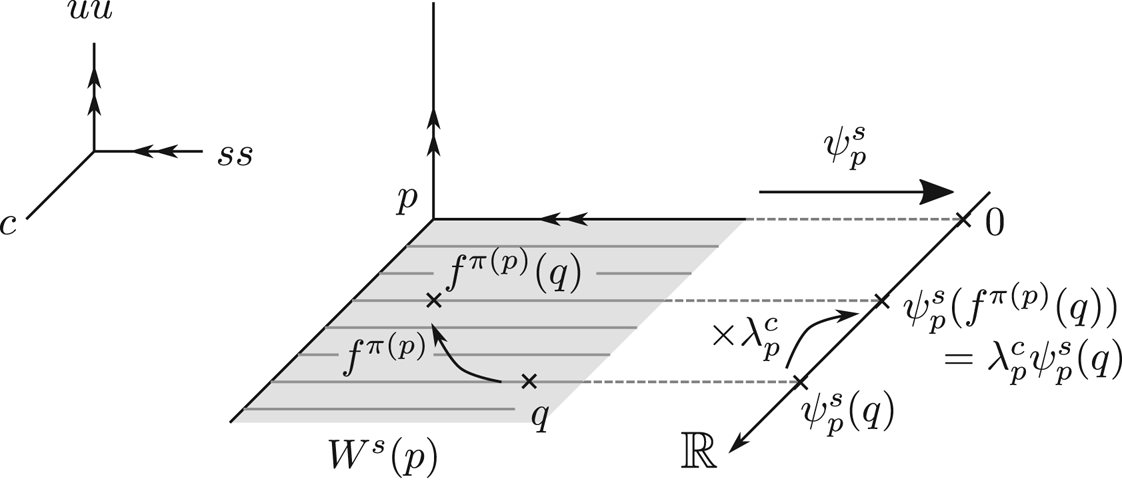
 $f^{\pi (p)}$ is linearized near its hyperbolic fixed point (see Figure 2 and (7) in Proposition 2.8).
Proposition 2.8 Let  $p \in \operatorname {Per}_{{\mathbf {d}}}(f)$. Suppose that
 $f$ is
 $C^{r}$ for
 $r \geq 2$ and
 $|\lambda _{c}(p)|<1$. Then, there exists a
 $C^{r}$-function
 $\psi ^{s}_p$ on
 $W^{s}({{\mathcal {O}}}(p))$ such that for all
 $q \in W^{s}({{\mathcal {O}}}(p))$ the kernel of
 $(D\psi ^{s}_p)_q$ coincides with
 $E^{s}(q)$ (where
 $E^{s}(q)$ is the vector bundle of Lemma 2.6) and
 \begin{equation} \psi{}^{s}_p \circ f^{\pi (p)} =\lambda{}^{c}_p \cdot \psi{}^{s}_p. \end{equation}
Moreover,
• On each connected component of
$W^{s}({{\mathcal {O}}}(p))$, $\psi ^{s}_p$ is uniquely determined up to a multiplication by a non-zero constant; and• if a sequence of diffeomorphisms
$\{f_i\} \subset \mathrm {Diff}^{r}(M)$ converges to $f_\infty$ in the $C^{r}$-topology and points $p_i \in \operatorname {Fix}_{{\mathbf {d}}}(f_i^{n})$ converge to $p_\infty \in \operatorname {Fix}_{{\mathbf {d}}}(f_\infty ^{n})$, then we can choose $\psi ^{s}_{p_i}$ such that $\psi ^{s}_{p_i}$ converges to $\psi ^{s}_{p_\infty }$ in the $C^{r}$-topology.


Linearizing coordinate in  $W^{s}(p)$. The
 $C^{r}$ function
 $\psi ^{s}_{p}$ gives a coordinate in
 $W^{s}(p)$ with respect to which the first return map (the map
 $f^{\pi (p)}$ near
 $p$) is given by a linear map
 $x \mapsto \lambda ^{c}_{p}x$.

The proof for the existence of  $\psi ^{s}_p$ on
 $W^{s}_\delta (p)$ for a sufficiently small
 $\delta$ can be found, for example, in [Reference Gonchenko, Shilnikov and TuraevGST08, Lemma 6]. The function
 $\psi ^{s}_p$ is uniquely defined (when scaled so that
 $(D\psi ^{s}_p)_p|_{E^{c}(p)}=\mathrm {id}$) in terms of a convergent power series [Reference Gonchenko, Shilnikov and TuraevGST08, formula A.6]. As each term depends continuously on
 $f$ with respect to the
 $C^{r}$-topology, and the convergence rate is uniform for all maps
 $f_i$ which are
 $C^{r}$-close to
 $f$, we obtain the required continuity of
 $\psi ^{s}_p$ with respect to
 $f$. The function
 $\psi ^{s}_p$ is uniquely extended to the whole of
 $W^{s}({{\mathcal {O}}}(p))$ from
 $W^{s}_\delta (p)$ by iterating relation (7).
We call the function  $\psi ^{s}_p$ a central linearization (a
 $c$-linearization) on
 $W^{s}({{\mathcal {O}}}(p))$. In the same way, we can define a
 $c$-linearization
 $\psi ^{u}_p$ on
 $W^{u}({{\mathcal {O}}}(p))$ if
 $|\lambda _{c}(p)|>1$.
Remark 2.9 In addition to (7), if we require
 \[ \psi{}^{s}_p \circ f^{k} =\psi{}^{s}_p, \quad k=0,\ldots, \pi(p)-1, \]
then this condition determines  $\psi ^{s}_p$ up to a multiplication by a non-zero constant. Note that under this convention, for every integer
 $k$ we have
 \begin{equation} \psi{}^{s}_p \circ f^{k} = \lambda_{c}(p)^{[k/\pi(p)]} \cdot \psi{}^{s}_p, \end{equation}
where  $[x]$ denotes the largest integer which is not greater than
 $x$.
Let  $U$ be an open subset of
 $M$. We denote
 \[ \operatorname{Per}_{{\mathbf{d}}}(f, U) = \{ p \in U \mid {{\mathcal{O}}}(p) \subset U\}. \]
For  $p\in \operatorname {Per}_{{\mathbf {d}}}(f, U)$, we put
 \begin{align*} W{}^{s}({{\mathcal{O}}}(p),U) & = W{}^{s}({{\mathcal{O}}}(p)) \cap \bigcap_{n \geq 0} f^{{-}n}(U),\\ W{}^{u}({{\mathcal{O}}}(p),U) & = W{}^{u}({{\mathcal{O}}}(p)) \cap \bigcap_{n \geq 0} f^{n}(U). \end{align*}
As  ${{\mathcal {O}}}(p)$ is contained in
 $\mathrm {Int}(U)$ (where
 $\mathrm {Int}(U)$ denotes the topological interior of
 $U$), we have
 \[ W{}^{s}_\delta(p) \subset W{}^{s}({{\mathcal{O}}}(p),U), \quad W{}^{u}_\delta(p) \subset W{}^{u}({{\mathcal{O}}}(p),U) \]
if  $\delta >0$ is sufficiently small.
Let  $({{\mathcal {C}}}^{cs},{{\mathcal {C}}}^{cu})$ be an
 $f$-invariant transverse pair of cone fields of index
 ${{\mathbf {d}}}$ on an open set
 $U_{{\mathcal {C}}}$ and
 ${\omega _{{\mathcal {C}}}}$ be an
 $f$-invariant
 $c$-orientation of
 $({{\mathcal {C}}}^{cs},{{\mathcal {C}}}^{cu})$. Lemmas 2.10 and 2.11 state that the partially hyperbolic splittings and the orientation on
 $U_{{{\mathcal {C}}}}$ are compatible with the structures introduced in Lemma 2.6 and Proposition 2.8 for points inside
 $U_{{{\mathcal {C}}}}$. Note that because
 $f$ preserves the
 $c$-orientation, we have
 \[ \lambda_{c}(p)>0 \]
for any point  $p\in \operatorname {Per}_{{\mathbf {d}}}(f, U_{\mathcal {C}})$.
Lemma 2.10 Let  $p \in \operatorname {Per}_{{\mathbf {d}}}(f,{U_{{\mathcal {C}}}})$ and
 $\lambda _{c}(p)\neq 1$. Then,
 $E^{cs}(q) \subset {{\mathcal {C}}}^{cs}(q)$ and
 $E^{s}(q) \cap {{\mathcal {C}}}^{cu}(q)=\{0\}$ for
 $q \in W^{s}({{\mathcal {O}}}(p),U_{{\mathcal {C}}})$. Similarly,
 $E^{cu}(q) \subset {{\mathcal {C}}}^{cu}(q)$ and
 $E^{u}(q) \cap {{\mathcal {C}}}^{cs}(q)=\{0\}$ for
 $q \in W^{u}({{\mathcal {O}}}(p),U_{{\mathcal {C}}})$.
Proof. By Proposition 2.4, we have  $E^{cs}(p) \subset {{\mathcal {C}}}^{cs}(p)$ and
 $E^{s}(p) \cap {{\mathcal {C}}}^{cu}(p) =\{0\}$. The continuity of cones and subbundles
 $E^{cs}$ and
 $E^{s}$ on
 $W^{s}_\delta (p)$ (for some
 $\delta >0$) implies that
 $E^{cs}(f^{n}(q)) \subset {{\mathcal {C}}}^{cs}(f^{n}(q))$ and
 $E^{s}(f^{n}(q)) \cap {{\mathcal {C}}}^{cu}(f^{n}(q))=\{0\}$ for some sufficiently large
 $n$. By the invariance of
 $E^{cs}$ and
 $({{\mathcal {C}}}^{cs},{{\mathcal {C}}}^{cu})$, this implies that
 $E^{cs}(q) \subset {{\mathcal {C}}}^{cs}(q)$. The proof for the claims about
 $E^{s}$ and
 $W^{u}({{\mathcal {O}}}(p),U_{{\mathcal {C}}})$ is done in a similar way.
Let  $p$ be a point in
 $\operatorname {Per}_{{\mathbf {d}}}(f,U_{{\mathcal {C}}})$ with
 $\lambda _{c}(p)<1$ and
 $\psi ^{s}_p$ be the
 $c$-linearization on
 $W^{s}({{\mathcal {O}}}(p))$. By Lemma 2.10, we have
 ${{\mathcal {C}}}^{c}(p) \cap E^{cs}(p)={{\mathcal {C}}}^{cu}(p) \cap E^{cs}(p)$ and
 ${{\mathcal {C}}}^{c}(p) \cap E^{s}(p)=\{0\}$. Therefore, because the kernel of
 $(D\psi ^{s}_p)_p$ coincides with
 $E^{s}(p)$, we may choose
 $\psi ^{s}_p$ so that
 $(D\psi ^{s}_p)_p(v)$ and
 $\omega _{{\mathcal {C}}}(v)$ have the same sign for all
 $v \in {{\mathcal {C}}}^{cu}(p) \cap E^{cs}(p)$. Such
 $\psi ^{s}_p$ is said to be compatible with
 $\omega _{{\mathcal {C}}}$. Remark that a compatible
 $c$-linearization on
 $W^{s}({{\mathcal {O}}}(p))$ is unique up to a multiplication by a positive constant.
The next lemma states that a compatible  $c$-linearization respects the orientation
 $\omega _{{\mathcal {C}}}$ everywhere on
 $W^{s}(\mathcal {O}(p), U_{{\mathcal {C}}})$.
Lemma 2.11 Let  $p$ be a point in
 $\operatorname {Per}_{{\mathbf {d}}}(f,U_{{\mathcal {C}}})$ with
 $0<\lambda _{c}(p)<1$ and
 $\psi ^{s}_p$ be a
 $c$-linearization on
 $W^{s}({{\mathcal {O}}}(p))$, compatible with
 $\omega _{{\mathcal {C}}}$. Then, for any
 $q \in W^{s}({{\mathcal {O}}}(p), U_{{\mathcal {C}}})$ and
 $v \in {{\mathcal {C}}}^{cu}(q) \cap E^{cs}(q)$, we have
 $\omega _{{\mathcal {C}}}(v)>0$ if and only if
 $(D\psi ^{s}_p)_q(v)>0$. The same holds true for
 $\psi _p^{u}$ and all
 $q \in W^{u}({{\mathcal {O}}}(p), U_{{\mathcal {C}}})$ if
 $\lambda _{c}(p)>1$.
Proof. By the continuity of  $\omega _{{\mathcal {C}}}$ and
 $D\psi ^{s}_p$, there exists
 $\delta >0$ such that
 $(D\psi ^{s}_p)_{\tilde q}(v)$ and
 $\omega _{{\mathcal {C}}}(v)$ have the same sign for any
 $\tilde {q} \in W^{s}_\delta (p)$ and
 $v \in {{\mathcal {C}}}^{cu}(\tilde {q}) \cap E^{cs}(\tilde {q})$. Take any
 $q \in W^{s}({{\mathcal {O}}}(p))$ and
 $v \in {{\mathcal {C}}}^{cu}(q) \cap E^{cs}(q)$. The forward invariance of
 ${{\mathcal {C}}}^{cu}$ and
 $E^{cs}$ implies that
 $Df^{n}(v)$ is contained in
 ${{\mathcal {C}}}^{cu}(f^{n}(q)) \cap E^{cs}(f^{n}(q))$ for all
 $n\geq 0$. By Lemma 2.10,
 $Df^{n}(v)$ belongs to
 ${{\mathcal {C}}}^{c}(f^{n}(q))$ for any
 $n \geq 0$. By the invariance of the orientation over
 $U_{{{\mathcal {C}}}}$, we have
 $\omega _{{\mathcal {C}}}(v)$ and
 $\omega _{{\mathcal {C}}}(Df^{n}(v))$ have the same sign for
 $q \in W^{s}({{\mathcal {O}}}(p), U_{{{\mathcal {C}}}})$ and
 $v \in {{\mathcal {C}}}^{cu}(q) \cap E^{cs}(q)$. Then, we choose a large
 $n$ such that
 $f^{n}(q) \in W^{s}_\delta (p)$. As
 $(D\psi ^{s}_p)(Df^{n}(v))=\lambda _{c}(p)^{n}(D\psi ^{s}_p)(v)$, we see that
 $(D\psi ^{s}_p)(Df^{n}(v))$ and
 $(D\psi ^{s}_p)(v)$ have the same sign. This implies that
 $\omega _{{\mathcal {C}}}(v)$ and
 $(D\psi ^{s}_p)(v)$ have the same sign.
2.4 The signature of a heteroclinic point
In this subsection, we analyze local dynamics along a heterodimensional heteroclinic orbit between two hyperbolic periodic points. More precisely, we define the notion of a transition map along a heteroclinic orbit. It enables us to establish the notion of signatures of heteroclinic points.
We keep using the notation of § 2.3. We also assume that  $f$ has an invariant transverse pair of cone fields
 $({{\mathcal {C}}}^{cs},{{\mathcal {C}}}^{cu})$ of index
 ${{\mathbf {d}}}$ on an open set
 $U_{{\mathcal {C}}}$ and
 ${\omega _{{\mathcal {C}}}}$ is an
 $f$-invariant
 $c$-orientation of
 $({{\mathcal {C}}}^{cs},{{\mathcal {C}}}^{cu})$. We call a pair of periodic points
 $(p_1,p_2)$ a heteroclinic pair in
 $U_{{\mathcal {C}}}$ if
 $p_1$ and
 $p_2$ are in
 $\operatorname {Per}_{{\mathbf {d}}}(f,U_{{\mathcal {C}}})$,
 $\lambda _{c}(p_1)>1>\lambda _{c}(p_2) >0$, and
 $W^{u}({{\mathcal {O}}}(p_1),U_{{\mathcal {C}}}) \cap W^{s}({{\mathcal {O}}}(p_2),U_{{\mathcal {C}}}) \neq \emptyset$. A point of
 $W^{u}({{\mathcal {O}}}(p_1),U_{{\mathcal {C}}}) \cap W^{s}({{\mathcal {O}}}(p_2),U_{{\mathcal {C}}})$ is called a
 $U_{{\mathcal {C}}}$-heteroclinic point for the pair
 $(p_1,p_2)$. Note that
 ${{\mathcal {O}}}(p_1) \cup {{\mathcal {O}}}(p_2) \cup {{\mathcal {O}}}(q)$ is an
 $f$-invariant compact subset in
 $U_{{\mathcal {C}}}$.
Lemma 2.12 Let  $(p_1,p_2)$ be a heteroclinic pair in
 $U_{{\mathcal {C}}}$ and
 $q$ be its
 ${U_{{\mathcal {C}}}}$-heteroclinic point. The
 $f$-invariant set
 ${{\mathcal {O}}}(p_1) \cup {{\mathcal {O}}}(p_2) \cup {{\mathcal {O}}}(q)$ admits a (continuous) partially hyperbolic splitting
 $E^{c} \oplus E^{s} \oplus E^{u}$ which is compatible with that for
 ${{\mathcal {O}}}(p_1)$ and
 ${{\mathcal {O}}}(p_2)$.
Proof. First, let  $\bar {E^{s}}$,
 $\bar {E}^{cs}$,
 $\bar {E}^{u}$,
 $\bar {E}^{cu}$ be the vector bundles defined by Lemma 2.6 on
 $W^{u}({{\mathcal {O}}}(p_1),U_{{\mathcal {C}}}) \cap W^{s}({{\mathcal {O}}}(p_2),U_{{\mathcal {C}}})$. Put
 $E^{c}(q) = \bar {E}^{cs}(q) \cap \bar {E}^{cu}(q)$. Lemma 2.10 implies that
 $E^{c}(q)$ is one-dimensional. Furthermore,
 $E^{c}(q)$ is complementary to
 $\bar {E}^{s}(q)$ in
 $\bar {E}^{cs}(q)$ and
 $\bar {E}^{u}(q)$ in
 $\bar {E}^{cu}(q)$, respectively. Thus, we see that
 $T_q M=E^{c}(q) \oplus \bar {E}^{s}(q) \oplus \bar {E}^{u}(q)$. Similar splitting exists for any point in
 ${{\mathcal {O}}}(q)$. Along with the index-
 ${{\mathbf {d}}}$ partially hyperbolic splittings for the periodic orbits
 ${{\mathcal {O}}}(p_1)$ and
 ${{\mathcal {O}}}(p_2)$, this gives a
 $Df$-invariant splitting
 $TM|_\Xi =E^{c} \oplus E^{s} \oplus E^{u}$ of index
 ${{\mathbf {d}}}$ where
 $\Xi ={{\mathcal {O}}}(p_1) \cup {{\mathcal {O}}}(p_2) \cup {{\mathcal {O}}}(q)$. By a standard argument (see, e.g., [Reference TuraevTur96]), this splitting is continuous and partially hyperbolic.
Remark 2.13 In the assumption of Lemma 2.12, let us furthermore assume that there exists a point  $q' \in W^{s}(p_1, U_{{{\mathcal {C}}}}) \cap W^{u}(p_2, U_{{{\mathcal {C}}}})$. Then, by Remark 2.7 and the same argument as in Lemma 2.12, we also have the existence of a partially hyperbolic splitting
 $E^{c} \oplus E^{s} \oplus E^{u}$ over
 ${{\mathcal {O}}}(p_1) \cup {{\mathcal {O}}}(q') \cup {{\mathcal {O}}}(p_2)$ which is compatible with that for
 ${{\mathcal {O}}}(p_1)\cup {{\mathcal {O}}}(p_2)$. We call this splitting a compatible partially hyperbolic splitting.
The lemma implies that the invariant set  ${{\mathcal {O}}}(p_1) \cup {{\mathcal {O}}}(p_2) \cup {{\mathcal {O}}}(q)$ is strongly partially hyperbolic in
 ${U_{{\mathcal {C}}}}$. The sets
 $W^{u}({{\mathcal {O}}}(p_1))$ and
 $W^{s}({{\mathcal {O}}}(p_2))$ are injectively immersed submanifolds tangent to
 $E^{cu}$ and
 $E^{cs}$ respectively. Hence, they intersect transversely at
 $q$ and the intersection near
 $q$ is a
 $C^{r}$-embedded curve
 $I_q$ tangent to
 $E^{c}(q)$ at
 $q$.
Consider  $c$-linearizations
 $\psi ^{u}_{p_1}$ on
 $W^{u}({{\mathcal {O}}}(p_1))$ and
 $\psi ^{s}_{p_2}$ on
 $W^{s}({{\mathcal {O}}}(p_2))$ which are compatible with
 $\omega _{{\mathcal {C}}}$. As
 $E^{c}(q) \cap E^{u}(q)=\{0\}$ and the kernel of
 $D(\psi ^{u}_{p_1})_q$ is
 $E^{u}(q)$, the restriction of
 $\psi ^{u}_{p_1}$ on
 $I_q$ induces a local
 $C^{r}$-diffeomorphism from
 $(I_q,q)$ to
 $(\mathbb {R},\psi ^{u}_{p_1}(q))$. In the same way, the restriction of
 $\psi ^{s}_{p_2}$ on
 $I_q$ induces a local
 $C^{r}$-diffeomorphism from
 $(I_q,q)$ to
 $(\mathbb {R},\psi ^{s}_{p_2}(q))$. Now we can define a local
 $C^{r}$-diffeomorphism
 $\psi _q \in \operatorname {Diff}_{{\rm loc}}^{r}(\mathbb {R},0)$ determined by the formula
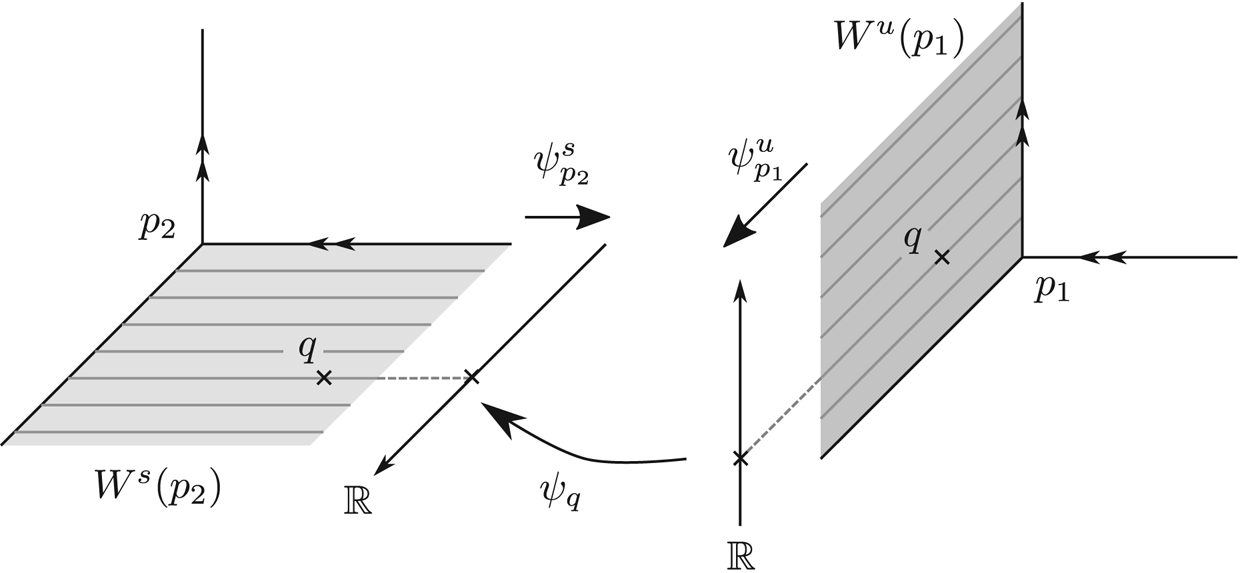
 \begin{equation} \psi{}^{s}_{p_2}(q')-\psi{}^{s}_{p_2}(q)=\psi_q(\psi{}^{u}_{p_1}(q')-\psi{}^{u}_{p_1}(q)) \end{equation}
for all  $q' \in I_q$ close to
 $q$.
We call such  $\psi _q$ the transition map (see Figure 3). By Lemma 2.11, both
 $D(\psi ^{u}_{p_1})_q(v)$ and
 $D(\psi ^{s}_{p_2})_q(v)$ have the same sign as
 $\omega _{{\mathcal {C}}}(v)$ for any
 $v \in E^{c}(q)$. This implies that the transition map
 $\psi _q$ preserves orientation. Recall that
 $\psi ^{u}_{p_1}$ and
 $\psi ^{s}_{p_2}$ are uniquely defined up to a multiplication by positive constants. This guarantees that the signs of
 $A(\psi _q)$ and
 $S(\psi _q)$ (see (1)) are uniquely defined quantities, because a multiplication by a positive constant does not affect the signs. Now, we define the signature of
 $q$ as the pair of signs
 \begin{equation} \tau_A(q;f)=\operatorname{sgn}(A(\psi_q)),\quad \tau_{\rm S}(q;f)=\operatorname{sgn}(S(\psi_q))). \end{equation}
Remark 2.14 As the  $c$-linearizations
 $\psi ^{s}$,
 $\psi ^{u}$ vary continuously with respect to the
 $C^{r}$-topology, if
 $f$ is
 $C^{2}$ (or
 $C^{3}$), then
 $A(\psi _q)$ (respectively,
 $S(\psi _q)$) depends continuously on
 $f$. In particular, if
 $A(\psi _q) \neq 0$ (respectively,
 $S(\psi _q) \neq 0$), then its sign is locally constant in
 $\operatorname {Diff}^{2}(M)$ (respectively,
 $\operatorname {Diff}^{3}(M)$).
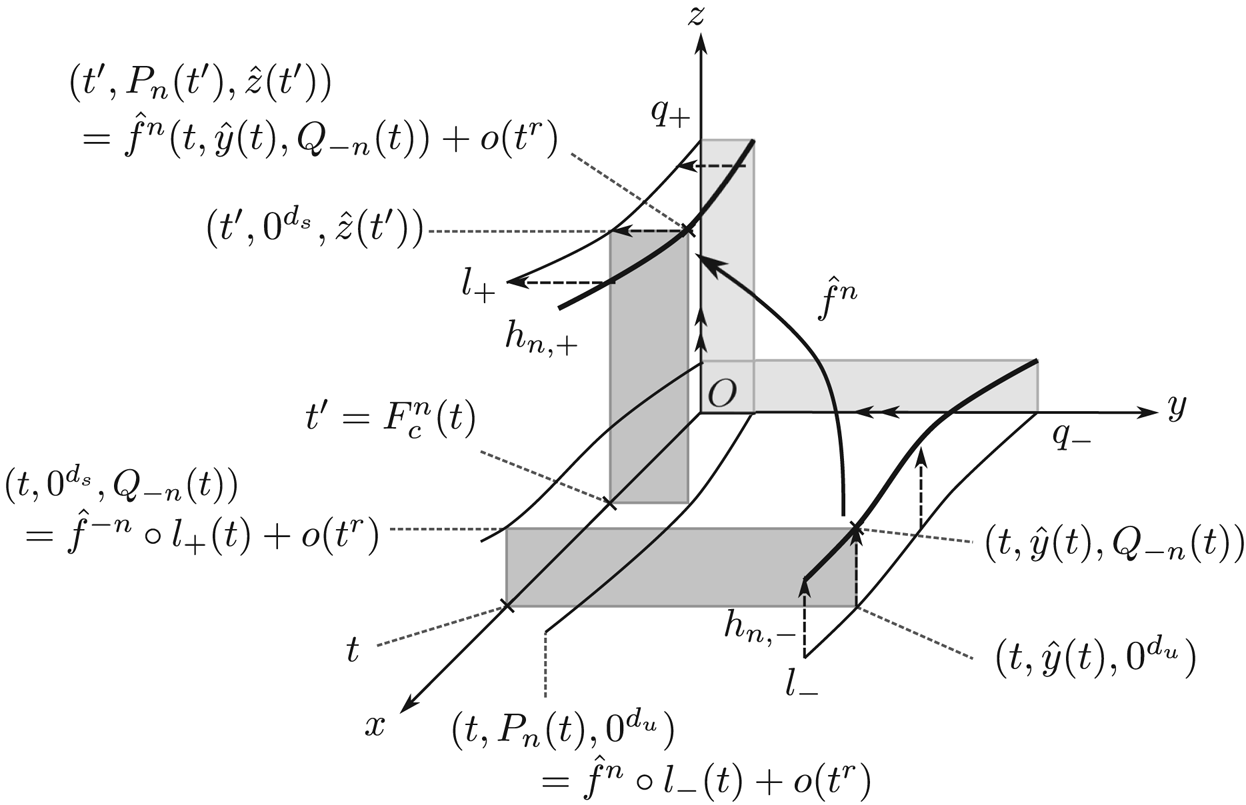
The definition of the transition map  $\psi _q$.

2.5 Central germs and flatness at a periodic point
In this subsection, we give a definition of the ‘center dynamics’ for a periodic point  $p\in \operatorname {Per}_{{{\mathbf {d}}}}(f)$. Using this, we introduce the notion of the flatness of the periodic point and define signatures (the signs of the non-linearity and the Schwarzian derivative) for flat periodic points. For a manifold
 $M$, a point
 $p \in M$, and local
 $C^{k}$ maps
 $l_1,l_2:(\mathbb {R},0) {{\rightarrow }} (M,p)$, We write
 $l_1(t)=l_2(t)+o(|t|^{k})$ if
 \[ \lim_{t {{\rightarrow}}0}\frac{1}{|t|^{k}}\|\varphi \circ l_1(t) -\varphi \circ l_2(t)\|=0 \]
for a  $C^{k}$ local chart
 $(\varphi ,V)$ of
 $M$ with
 $p \in V$, where
 $\|\cdot \|$ is the Euclidean norm. In other words, two curves
 $\varphi \circ l_1(t)$ and
 $\varphi \circ l_2(t)$ are equal up to degree
 $k$. Remark that if
 $l_1(t)=l_2(t)+o(|t|^{k})$, the same holds for any
 $C^{k}$ local chart at
 $p$.
Definition 2.15 Let  $k \leq r$,
 $f \in \mathrm {Diff}^{r}(M)$,
 $p\in \mathrm {Per}_{{{\mathbf {d}}}}(f)$,
 $\pi$ be the period of
 $p$. We say that a local
 $C^{k}$-map
 $l:(\mathbb {R},0) {{\rightarrow }} (M,p)$ is a
 $k$-central curve of
 $p$ if
 $(dl/dt)(0) \in E^{c}(p)$ and there exists a local
 $C^{k}$-diffeomorphism
 $F_l:(\mathbb {R},0) {{\rightarrow }} (\mathbb {R},0)$ such that
 \begin{equation} f^{\pi} \circ l(t)= l \circ F_l(t)+o(|t|^{k}), \end{equation}
in other words, the  $k$-central curve has a tangency of order
 $k$ to its image by
 $f^{\pi }$ at the point
 $p$. The local diffeomorphism
 $F_l$ will be called the central germ of
 $f$ associated with the central curve
 $l$.
For two  $k$-central curves
 $l_1$ and
 $l_2$ of
 $p$, we say that
 $l_1$ and
 $l_2$ have the same orientation if
 $(dl_1/dt)(0)$ and
 $(dl_2/dt)(0)$ are contained in the same connected component of
 $E^{c} \setminus \{0\}$.
By the center manifold theorem (see, e.g., [Reference Shilnikov, Shilnikov, Turaev and ChuaSSTC98, Theorem 5.20]), for a  $k$-strongly partially hyperbolic periodic point there exists a
 $C^{k}$-smooth invariant curve of
 $f^{\pi }$ tangent to
 $E^{c}(p)$, i.e. at least one
 $k$-central curve exists for such points. By definition, the central curves are not unique. However, the next lemma shows that for a
 $k$-strongly partially hyperbolic periodic point the
 $k$-central curves and the associated central germs are uniquely defined up to order
 $k$ up to a conjugacy by a local diffeomorphism.
Lemma 2.16 Let  $f \in \mathrm {Diff}^{r}(M)$ and
 $k \leq r$. Let
 $p \in \operatorname {Per}_{{\mathbf {d}}}^{k}(f)$ and let
 $l_1,l_2:(\mathbb {R},0) {{\rightarrow }} (M,p)$ be
 $k$-central curves of
 $p$, with the same orientation, and
 $F_1,F_2$ be the central germs associated with them. Then, there exists a polynomial (hence,
 $C^{\infty }$) orientation-preserving local diffeomorphism
 $H:(\mathbb {R},0) {{\rightarrow }} (\mathbb {R},0)$ such that
 $l_1(t) = l_2\circ H (t) + o(|t|^{k})$ and
 $F_1(t)=H^{-1} \circ F_2 \circ H(t)+o(t^{k})$.
Proof. Let  $\pi$ be the period of
 $p$. We take a
 $C^{k}$-coordinate chart
 $\varphi$ such that
 \begin{equation} \varphi\circ l_1(t)=(t,0,0)+o(|t|^{k}) \end{equation}
and the differential  $D\varphi$ sends the splitting
 $T_p M = E^{c} \oplus E^{s} \oplus E^{u}$ to
 $T_0 \mathbb {R}^{{{\mathbf {d}}}}=\mathbb {R} \oplus \mathbb {R}^{d_{s}} \oplus \mathbb {R}^{d_{u}}$. Denote
 $f_\varphi =\varphi \circ f^{\pi } \circ \varphi ^{-1}$. By the
 $k$-strong partial hyperbolicity of
 $p$, we have
 \begin{equation} f_\varphi(x,y,z) =(\lambda_{c} x, Ay,Bz)+o(\|(x,y,z)\|), \quad (x,y,z) \in \mathbb{R}^{|{{\mathbf{d}}}|}, \end{equation}
where  $\lambda ^{c}\neq 0$ is the central multiplier (see (6)) and
 $A$ and
 $B$ are square matrices such that the absolute values of the eigenvalues of
 $A$ are strictly smaller than
 $\min \{1, |\lambda _{c}|^{k}\}$ and the absolute values of the eigenvalues of
 $B$ are strictly larger than
 $\max \{1, |\lambda _{c}|^{k}\}$.
As  $l_1$ and
 $l_2$ are
 $k$-central curves with the same orientation, there exists an orientation-preserving local
 $C^{k}$-diffeomorphism
 $\tilde {H}:(\mathbb {R},0) {{\rightarrow }} (\mathbb {R},0)$ such that the
 $x$-coordinate of
 $\varphi \circ l_2 \circ \tilde {H}(t)$ is
 $t$. Let
 $H$ be the Taylor polynomial of
 $\tilde {H}$ up to degree
 $k$. The Taylor expansion of
 $\varphi \circ (l_2 \circ H)$ up to order
 $k$ has the form
 \begin{equation} \varphi \circ (l_2 \circ H)(t)=(t,P_-(t),P_+(t))+o(|t|^{k}) \end{equation}
and the curve  $l_2 \circ H$ is a
 $k$-central curve with the central germ
 $H^{-1} \circ F_2 \circ H$. We claim that
 $P_-(t)=0$ and
 $P_+(t)=0$. Once it is shown, we will immediately obtain that
 $l_1(t)=l_2 \circ H(t)+o(|t|^{k})$ and
 $F_1(t)=H^{-1} \circ F_2 \circ H(t)+o(|t|^{k})$, i.e. this will prove the lemma.
Denote
 \[ P_-(t)=t^{2}v_2+\cdots +t^{k} v_k, \quad P_+(t)=t^{2}w_2+\cdots +t^{k} w_k, \]
where the coefficients  $v_2,\ldots ,v_k$ lie in
 $\mathbb {R}^{d_{s}}$ and the coefficients
 $w_2,\ldots ,w_k$ lie in
 $\mathbb {R}^{d_{u}}$. Given
 $j=2,\ldots ,k$, suppose that
 $v_i=0$ and
 $w_i=0$ for
 $i< j$.
 \begin{align*} f_\varphi(t,0,0) & = f_\varphi \circ \varphi \circ l_1(t) + o(|t|^{k}) = \varphi \circ f^{\pi} \circ l_1(t) + o(|t|^{k}) \\ & = \varphi \circ l_1(F_1(t))+ o(|t|^{k}) =(F_1(t),0,0)+o(|t|^{k}). \end{align*}
Thus, by (13),
 \[ f_\varphi \circ \varphi \circ (l_2 \circ H)(t) = f_\varphi(t,t^{j}v_j,t^{j} w_j)+o(|t|^{j}) = (F_1(t), t^{j} A v_j, t^{j} B w_j)+o(|t|^{j}). \]
As  $(H^{-1} \circ F_2 \circ H)(t) = F_2'(0)\cdot t+o(t)=\lambda _{c}t+o(|t|)$, we also have, by (11) and (14), the following:
 \begin{align*} f_\varphi \circ \varphi \circ (l_2 \circ H)(t) & = \varphi \circ (l_2 \circ H) \circ (H^{{-}1} \circ F_2 \circ H)(t)+o(|t|^{k})\\ & = (H^{{-}1} \circ F_2 \circ H(t), (\lambda_{c} t)^{j} v_j, (\lambda_{c} t)^{j} w_j)+o(|t|^{j}). \end{align*}
Therefore,  $A v_j= (\lambda _{c})^{j} v_j$ and
 $B w_j= (\lambda _{c})^{j} w_j$. By the
 $k$-strong partial hyperbolicity of
 $p$, no eigenvalues of
 $A$ and
 $B$ can be equal to
 $(\lambda _{c})^{j}$ as long as
 $j\leq k$. This implies that
 $v_j=w_j=0$. Thus, by induction, we obtain that
 $v_j=w_j=0$ for all
 $j=2,\ldots ,k$, i.e. we have proved that
 $P_-(t)=0$ and
 $P_+(t)=0$.
In the following we assume that the periodic point  $p$ is non-hyperbolic and the central multiplier
 $\lambda _{c} = 1$. We will call such a point
 $1$-flat. The
 $1$-flat periodic points are
 $k$-strong partially hyperbolic. Thus we can Lemma 2.16 apply to such points. This implies that the following notion of ‘
 $k$-flatness’ is well-defined.
Definition 2.17 Let  $f \in \mathrm {Diff}^{r}(M)$,
 $p\in \operatorname {Per}_{{{\mathbf {d}}}}(f)$,
 $k \leq r$, and
 $F_{c}\in \operatorname {Diff}^{k}(\mathbb {R}, 0)$ be the central germ associated with a
 $k$-central curve. We say that
 $p$ is
 $k$-flat if
 $F_{c}$ is
 $k$-flat, i.e.
 $F_{c}(t)=t+o(|t|^{k})$.
Lemma 2.16 also enables us to define the notion of the signatures of flat periodic points. Let us consider a diffeomorphism  $f$ which admits an
 $f$-invariant transverse pair of cone fields in an open set
 $U_{{{\mathcal {C}}}}$ with an
 $f$-invariant orientation
 $\omega _{{{\mathcal {C}}}}$. Let
 $p \in \operatorname {Per}_{{\mathbf {d}}}(f, U_{{{\mathcal {C}}}})$ and assume
 $p$ is
 $1$-flat. The
 $1$-flatness implies that
 $p \in \operatorname {Per}_{{\mathbf {d}}}^{3}(f,U_{{\mathcal {C}}})$. We say that a
 $3$-central curve
 $l$ of
 $p$ is adapted if
 $\omega _{{\mathcal {C}}}((dl/dt)(0))>0$. Choose any such curve. By Lemmas 2.1 and 2.16,
 \begin{equation} \tau^{\operatorname{Per}}_A(p;f) = \operatorname{sgn}(A(F)), \quad \tau^{\operatorname{Per}}_{\rm S}(p;f) = \operatorname{sgn}(S(F)) \end{equation}
are well-defined, where  $F$ is the
 $3$-central germ of
 $l$ at
 $p$. As mentioned in Remark 2.2, for periodic points which are not 1-flat, the signs of the non-linearity and the Schwarzian derivative are not well-defined in general.
Remark 2.18 In the definition (15) of the signature of the flat periodic point, the fact that the diffeomorphism preserves the central orientation plays an important role. In the orientation-reversing setting, only  $\tau ^{\operatorname {Per}}_{\rm S}$ will remain a well-defined quantity.
2.6 Blenders and a connecting lemma
In this section, we introduce the notion of a blender following [Reference Bochi, Bonatti and DíazBBD16, § 3] and prove a connecting lemma for periodic points.
For  $k \geq 1$, let
 $D^{k}$ be a closed unit disk of dimension
 $k$ in the Euclidean space and
 ${{\mathcal {D}}}^{k}(M)$ be the set of
 $C^{1}$ embedded images of
 $D^{k}$ in
 $M$. Fix a distance
 $d_{C^{1}}$ on
 $\operatorname {Diff}^{1}(M)$ which gives the
 $C^{1}$-topology. As in [Reference Bochi, Bonatti and DíazBBD16, Proposition 3.1], the set
 ${{\mathcal {D}}}^{k}(M)$ admits a distance
 $\delta _{C^{1}}$ satisfying the following properties.
• For any
$C^{1}$-embedding $g_0$ of $D^{k}$ into $M$ and its $C^{1}$-neighborhood ${{\mathcal {U}}}$, there exists $\epsilon >0$ such that $\{D \in {{\mathcal {D}}}^{k}(M) \mid \delta _{C^{1}}(g_0(D^{k}),D)<\epsilon \}$ is a subset of $\{g(D^{k}) \in {{\mathcal {D}}}^{k}(M) \mid g \in {{\mathcal {U}}}\}$.• For any
$K>0$ and $\epsilon >0$ there exists $\eta >0$ such that if $f,g \in \operatorname {Diff}^{1}(M)$ satisfy $d_{C^{1}}({{\rm Id}},f)< K$ and $d_{C^{1}}(f,g)<\eta$ then $\delta _{C^{1}}(f(D),g(D))<\epsilon$ for any $D \in {{\mathcal {D}}}^{k}(M)$.


Given a family of disks  ${{\mathcal {D}}}$ in
 ${{\mathcal {D}}}^{k}(M)$ and
 $\eta >0$, we denote the
 $\eta$-neighborhood of
 ${{\mathcal {D}}}$ by
 ${{\mathcal {V}}}^{\delta }_\eta ({{\mathcal {D}}})$, i.e.
 \[ {{\mathcal{V}}}^{\delta}_\eta({{\mathcal{D}}})=\{D'\in {{\mathcal{D}}}^{k}(M) \mid \delta_{C^{1}}(D',D)<\eta \text{ for some }D \in {{\mathcal{D}}}\}. \]
Definition 2.19 Dynamical blender [Reference Bochi, Bonatti and DíazBBD16, Definition 3.11]
Let  $f$ be a diffeomorphism in
 $\operatorname {Diff}^{1}(M)$ and
 $\Lambda$ an
 $f$-invariant compact subset of
 $M$. We say that
 $\Lambda$ is a dynamically defined
 $cu$-blender of
 $uu$-index
 $k$ if the following hold.
• There exists an open neighborhood
$U_{{\rm bl}}$ of $\Lambda$ such that $\Lambda =\bigcap _{n \in \mathbb {Z}}f^{n}({\overline {U_{{\rm bl}}}})$.• The set
$\Lambda$ is a uniformly hyperbolic set whose $u$-index (the dimension of the unstable subspace of the hyperbolic splitting) is strictly greater than $k$.• The restriction of
$f$ to $\Lambda$ is topologically transitive.• Here
${\overline {U_{{\rm bl}}}}$ admits a strictly $f$-invariant cone field of index $k$, i.e. there exists a continuous splitting $TM_{{\overline {U_{{\rm bl}}}}}=E_1 \oplus E_2$ and $\alpha >\alpha '>0$ such that $\dim E_1=k$ and $Df({{\mathcal {C}}}^{uu}(x,\alpha )) \subset {{\mathcal {C}}}^{uu}(f(x),\alpha ')$ for any $x \in {\overline {U_{{\rm bl}}}} \cap f^{-1}({\overline {U_{{\rm bl}}}})$, where
for\[ {{\mathcal{C}}}^{uu}(x,\beta) =\{v+w \mid v \in E_1(x), w \in E_2(x), \|w\| \leq \beta \|v\|\} \]$x \in {\overline {U_{{\rm bl}}}}$ and $\beta >0$.• There exists a family of disks
${{\mathcal {D}}}$ in ${{\mathcal {D}}}^{k}(M)$ and $\epsilon >0$ such that $D \subset U_{{\rm bl}}$, $T_x D \subset {{\mathcal {C}}}^{uu}(x,\alpha )$, and $f(D)$ contains a disk in ${{\mathcal {D}}}$ for any $D \in {{\mathcal {V}}}^{\delta }_\epsilon ({{\mathcal {D}}})$ and $x \in D$.


We call the open set  $U_{{\rm bl}}$ the domain of the blender, the cone field
 ${{\mathcal {C}}}^{uu}(\cdot ,\alpha )$ the strong unstable cone field, and the family
 ${{\mathcal {D}}}$ the strictly invariant family of disks.
For a diffeomorphism  $f$, its compact invariant set
 $\Omega$, and a neighborhood
 $U$ of
 $\Omega$, we define the stable set
 $W^{s}(\Omega ,U)$ and unstable set
 $W^{u}(\Omega ,U)$ of
 $\Omega$ localized to
 $U$ by
 \begin{align*} W{}^{s}(\Omega,U) & = \Big\{x \in M \Bigm| f^{n}(x) \in U \text{ for any }n \geq 0, \lim_{n {{\rightarrow}} \infty}d(f^{n}(x),\Omega)=0 \Big\},\\ W{}^{u}(\Omega,U) & = \Big\{x \in M \Bigm| f^{{-}n}(x) \in U \text{ for any }n \geq 0, \lim_{n {{\rightarrow}} \infty}d(f^{{-}n}(x),\Omega)=0 \Big\}. \end{align*}
A dynamical blender is robust under perturbation and is a geometric blender in the sense of [Reference Bochi, Bonatti and DíazBBD16, Definition 3.10] with localization of the stable set of  $\Lambda$.
Proposition 2.20 [Reference Bochi, Bonatti and DíazBBD16, Lemma 3.14 and Scholium 3.15]
Let  $(\Lambda ,U_{{\rm bl}}, {{\mathcal {C}}}^{uu},{{\mathcal {D}}},\epsilon )$ be a dynamically defined
 $cu$-blender of
 $uu$-index
 $k$ of a diffeomorphism
 $f$. Put
 ${{\mathcal {D}}}_{\epsilon /2}={{\mathcal {V}}}^{\delta }_{\epsilon /2}({{\mathcal {D}}})$. Then, there exist a
 $C^{1}$-neighborhood
 ${{\mathcal {U}}}$ of
 $f$ and
 $\epsilon '>0$ such that
 $(\Lambda _g,U_{{\rm bl}},{{\mathcal {C}}}^{uu},{{\mathcal {D}}}_{\epsilon /2},\epsilon ')$ is a dynamical blender and
 $D \cap W^{s}(\Lambda _g,U_{{\rm bl}}) \neq \emptyset$ for any
 $g \in {{\mathcal {U}}}$ and
 $D \in {{\mathcal {D}}}$, where
 $\Lambda _g=\bigcap _{n \in \mathbb {Z}}g^{n}({\overline {U_{{\rm bl}}}})$.
For  $p \in \operatorname {Per}_{{\mathbf {d}}}(f)$, let
 $W^{ss}(p)$ and
 $W^{uu}(p)$ be the strong stable and unstable manifolds associated with the partially hyperbolic splitting
 $T_p M=E^{c}(p) \oplus E^{s}(p) \oplus E^{u}(p)$ of index
 ${{\mathbf {d}}}$. That is,
 $W^{ss}(p)$ (respectively,
 $W^{uu}(p)$) is the unique injectively immersed submanifold of dimension
 $d_{s}$ (respectively,
 $d_{u}$) invariant under
 $f^{\pi (p)}$ (respectively,
 $f^{-\pi (p)}$) which contains
 $p$ and is tangent to
 $E^{s}(p)$ (respectively,
 $E^{u}(p)$) at
 $p$, where
 $\pi (p)$ is the period of
 $p$. For an open subset
 $U$ of
 $M$ and
 $p \in \operatorname {Per}_{{\mathbf {d}}}(f)$, we put
 \begin{align*} W^{ss}({{\mathcal{O}}}(p),U) & =\bigcup_{j=0}^{\pi(p)-1}W^{ss}(f^{j}(p)) \cap \bigcap_{n \geq 0} f^{{-}n}(U), \\ W^{uu}({{\mathcal{O}}}(p),U) & =\bigcup_{j=0}^{\pi(p)-1}W^{uu}(f^{j}(p)) \cap \bigcap_{n \geq 0} f^{n}(U). \end{align*}
If  $g$ is a diffeomorphism
 $C^{1}$-close to
 $f$ and
 $p\in \operatorname {Per}_{{\mathbf {d}}}(g)$, we write
 $W^{ss}({{\mathcal {O}}}(p),U; g)$ and
 $W^{uu}({{\mathcal {O}}}(p),U; g)$ for the strong stable and strong unstable manifolds of
 $p$, respectively, localized to
 $U$ for the map
 $g$.
Suppose that  $f$ admits a dynamically defined
 $cu$-blender
 $(\Lambda ,U_{{\rm bl}},{{\mathcal {C}}}^{uu},{{\mathcal {D}}},\epsilon )$ of index
 $d_{u}$ such that the
 $u$-index of the hyperbolic set
 $\Lambda$ is
 $d_{u}+1$. For an open subset
 $U$ of
 $M$, we say that a pair
 $(p_1,p_2)$ of periodic points in
 $\operatorname {Per}_{{\mathbf {d}}}(f,U)$ is weakly connected with the blender
 $\Lambda$ in
 $U$ if:
•
$W^{uu}({{\mathcal {O}}}(p_1),U)$ contains a disk in the family ${{\mathcal {D}}}$;•
$W^{ss}({{\mathcal {O}}}(p_2),U)$ intersects with $W^{u}(p_\Lambda ,U)$ transversely for some periodic point $p_\Lambda$ in $\Lambda$.


Remark that the weak connection of a pair of periodic points with a blender is robust under  $C^{1}$-perturbation. When
 $p_1=p_2$, then we say just
 $p_1$ is weakly connected with the blender
 $\Lambda$ in
 $U$.
For a diffeomorphism  $h \in \mathrm {Diff}^{1}(M)$, we call the set
 ${\overline {\{ x \mid h(x) \neq x \}}}$ the support of
 $h$ and denote it by
 $\mathrm {supp}(h)$. The following ‘connecting lemma’ will be used throughout the proof of the main theorem. This lemma enables us to produce a true heteroclinic connection between periodic points weakly connected by a blender by adding a
 $C^{\infty }$-arbitrarily small perturbation. Furthermore, the perturbation can be chosen in such a way that its support is arbitrarily close to one of the periodic point and disjoint from given compact set
 $K$ which is disjoint from a local unstable manifold of the periodic point.
Lemma 2.21 Suppose that a  $C^{1}$-diffeomorphism
 $f$ admits a dynamically defined
 $cu$-blender
 $(\Lambda ,U_{{\rm bl}},{{\mathcal {C}}}^{uu},{{\mathcal {D}}},\epsilon )$ of
 $uu$-index
 $d_{u}$ and let the
 $u$-index of the hyperbolic set
 $\Lambda$ be
 $d_{u}+1$. Let
 $U$ be an open subset of
 $M$ with
 ${\overline {U_{{\rm bl}}}} \subset U$ and
 $(p_1, p_2)$ a pair of periodic points in
 $\operatorname {Per}_{{\mathbf {d}}}(f, U) \setminus {\overline {U_{{\rm bl}}}}$ which are weakly connected with the blender
 $\Lambda$ and have distinct orbits.
Then, for any given neighborhood  $V$ of
 $p_1$, any compact subset
 $K$ of
 $M$ with
 $V \cap K \cap W^{uu}(p_1,U)=\{p_1\}$, and any neighborhood
 ${{\mathcal {U}}}$ of the identity map in
 $\operatorname {Diff}^{\infty }(M)$, there exists
 $h \in {{\mathcal {U}}}$ such that the following hold:
• the support of
$h$ is contained in $V \setminus K$;•
$W^{uu}({{\mathcal {O}}}(p_1), U; h\circ f) \cap W^{ss}({{\mathcal {O}}}(p_2), U; h\circ f) \neq \emptyset$.


Proof. If  $W^{uu}({{\mathcal {O}}}(p_1), U; f)$ intersects with
 $W^{ss}({{\mathcal {O}}}(p_2), U; f)$, then the lemma holds trivially for the intersection point, letting
 $h$ the identity map. Thus, let us assume that
 $W^{uu}(p_1, U; f)$ does not intersects with
 $W^{ss}(p_2, U; f)$.
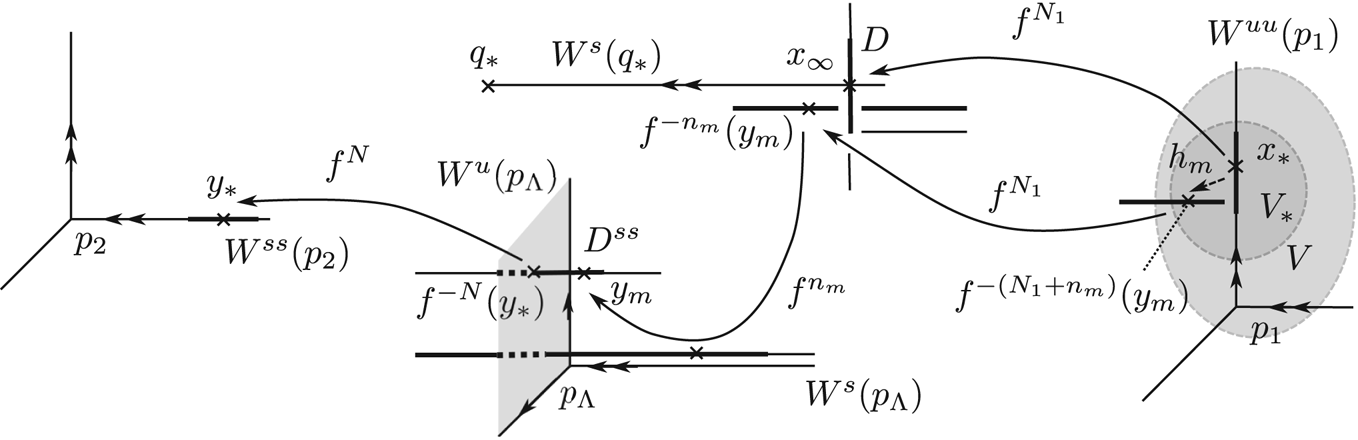
Step 1: fixing the heteroclinic orbits. As the pair  $(p_1,p_2)$ is weakly connected with the blender
 $\Lambda$,
 $W^{uu}({{\mathcal {O}}}(p_1),U)$ contains a disk
 $D \in {{\mathcal {D}}}$ and there exist a periodic point
 $p_\Lambda \in \Lambda$ such that
 $W^{u}(p_\Lambda ,U)$ intersects with
 $W^{ss}({{\mathcal {O}}}(p_2),U)$ transversely at a point, say,
 $y_*$. Take
 $N \geq 1$ such that
 $f^{-N}(y_*) \in W^{u}(p_\Lambda ,U_{{\rm bl}})$. As
 $y_* \in W^{u}(p_\Lambda ,U) \cap W^{ss}({{\mathcal {O}}}(p_2),U)$, we have
 $f^{n}(y_*) \in U$ for any
 $n \in \mathbb {Z}$ and, hence,
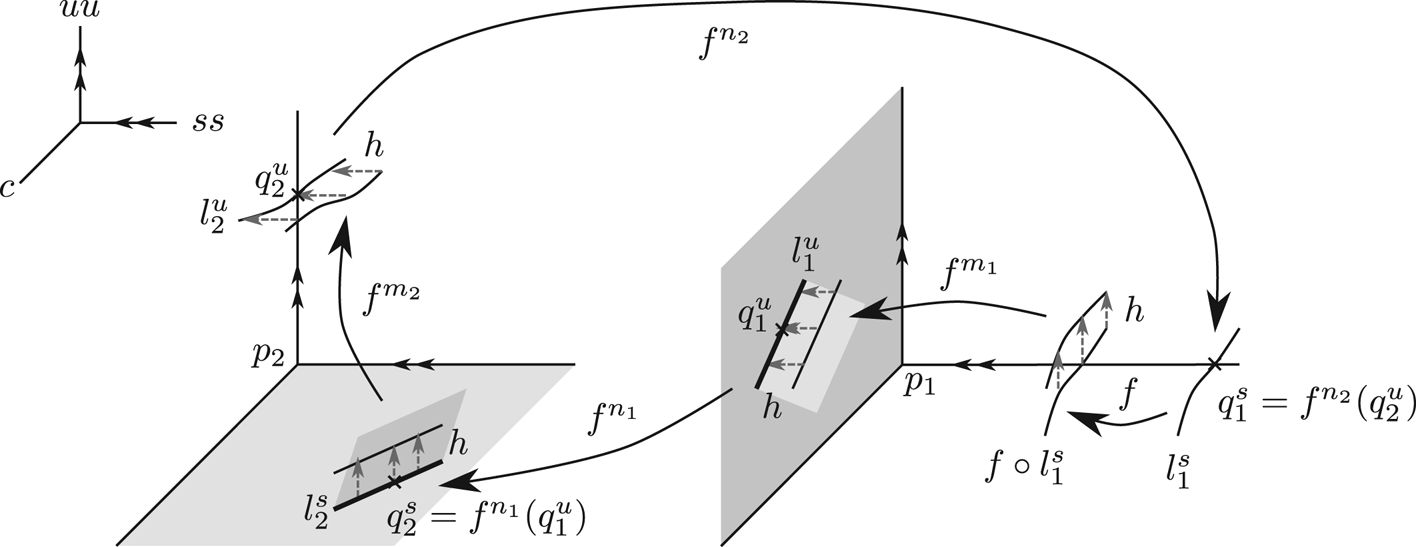
 $f^{-N}(y_*) \in W^{ss}({{\mathcal {O}}}(p_2),U)$, see Figure 4.
For the proof of Lemma 2.21.

As a dynamical blender is a geometric blender (see Proposition 2.20), we know that the disk  $D$ intersects with
 $W^{s}(\Lambda ,U_{{\rm bl}})$. Thus, we can take
 $q_* \in \Lambda$ such that there is a point of intersection between
 $D$ and
 $W^{s}(q_*,U_{{\rm bl}})$. Let us denote it by
 $x_{\infty }$. Note that the topological transitivity of
 $\Lambda$ implies that
 $W^{s}(p_\Lambda ,U_{{\rm bl}}) \cap \Lambda$ is dense in
 $\Lambda$. By the continuous dependence of the local stable sets with respect to points, we know that
 $x_\infty$ is accumulated by points in
 $W^{s}({{\mathcal {O}}}(p_\Lambda ),U_{{\rm bl}})$, see Figure 4 again.
Take a compact neighborhood  $D^{ss}$ of
 $f^{-N}(y_*)$ in
 $W^{ss}({{\mathcal {O}}}(p_2),U)$ and apply the
 $\lambda$-lemma for the transverse intersection of
 $W^{u}(p_\Lambda ,U_{{\rm bl}})$ and
 $D^{ss}$ at
 $f^{-N}(y_*)$. Then we obtain sequences
 $(y_m)_{m \geq 1}$ in
 $D^{ss}$ and
 $(n_m)_{m \geq 1}$ of positive integers such that
 $f^{-n}(y_m) \in U_{{\rm bl}}$ for any
 $0 \leq n \leq n_m$,
 $\lim _{m {{\rightarrow }} \infty } y_m=f^{-N}(y_*)$, and
 $\lim _{m {{\rightarrow }} \infty } f^{-n_m}(y_m)=x_\infty$.
Step 2: choosing the perturbation domain. Put  $\Omega _2= {{\mathcal {O}}}(p_2) \cup \bigcup _{n \geq 0}f^{n}(D^{ss})$. This set is contained in
 $U \setminus {{\mathcal {O}}}(p_1)$ and is compact because
 $d(f^{n}(x),{{\mathcal {O}}}(p_2))$ converges to zero uniformly with respect to
 $x \in D^{ss}$ as
 $n$ goes to infinity. Fix a neighborhood
 $V$ of
 $p_1$ and a compact subset
 $K$ of
 $M$ with
 $V \cap W^{uu}(p_1,U) \cap K = \{p_1\}$. By shrinking the neighborhood
 $V$ if necessary, we may assume that
 $V \cap (\overline{U_{{\rm bl}}} \cup \Omega _2)=\emptyset$. We fix sufficiently large
 $N_1 \geq 1$ such that the set
 $\Omega _1=\{f^{-n}(x_\infty ) \mid n \geq N_1\} \cup {{\mathcal {O}}}(p_1)$ is a compact subset of
 $M \setminus ({\overline {U_{{\rm bl}}}} \cup \Omega _2)$ and the point
 $x_*=f^{-N_1}(x_\infty )$ is contained in
 $V$. Then, because
 $x_*$ is a point in
 $W^{uu}({{\mathcal {O}}}(p_1),U) \setminus \{p_1\}$ and the compact set
 $K$ satisfies
 $V \cap W^{uu}({{\mathcal {O}}}(p_1),U) \cap K= \{p_1\}$, we can take a neighborhood
 $V_*$ of
 $x_*$ such that
 $V_* \subset V \setminus K$ and
 $V_* \cap \Omega _1=\{x_*\}$. Remark that
 $V_* \cap (\Omega _1 \cup \Omega _2 \cup {\overline {U_{{\rm bl}}}})=\{x_*\}$.
Step 3: giving the perturbation. As  $f^{-n_m}(y_m)$ converges to
 $x_\infty =f^{N_1}(x_*)$, there exists a sequence
 $(h_m)_{m \geq 1}$ in
 $\operatorname {Diff}^{\infty }(M)$ such that
 $h_m$ converges to the identity map,
 $\operatorname {supp}(h_m) \subset V_*$ for any
 $m$, and
 $h_m(x_*)=f^{-(N_1+n_m)}(y_m)$ for every sufficiently large
 $m$. Then, the support of
 $h_m$ is contained in
 $V \setminus K$ and we can check
 \[ (h_m \circ f)^{n}(f^{{-}1}(x_*))= \begin{cases} f^{n-1}(x_*) & (n \leq 0),\\ f^{n-1-(N_1+n_m)}(y_m) & (n \geq 1). \end{cases} \]
This implies that  $f^{-1}(x_*)$ is contained in both
 $W^{uu}({{\mathcal {O}}}(p_1),U;h_m \circ f)$ and
 $W^{ss}({{\mathcal {O}}}(p_2),U;h_m \circ f)$. Thus, the proof is complete.
We use the following lemma for confirming that periodic orbits we create by perturbing heteroclinic chains are weakly connected with a blender.
Lemma 2.22 Let  $f$ be a
 $C^{1}$ diffeomorphism of
 $M$ and
 $U_{{{\mathcal {C}}}}$ an open subset of
 $M$. Suppose that
 $U_{{{\mathcal {C}}}}$ admits an
 $f$-invariant transverse pair of cone fields of index
 ${{\mathbf {d}}}$ and there exists a dynamically defined
 $cu$-blender
 $(\Lambda ,U_{{\rm bl}},{{\mathcal {C}}}^{uu},{{\mathcal {D}}},\epsilon )$ of
 $uu$-index
 $d_{u}$ such that the
 $u$-index of
 $\Lambda$ is
 $d_{u}+1$ and
 ${\overline {U_{{\rm bl}}}} \subset U_{{{\mathcal {C}}}}$. Let
 $p_1,\ldots ,p_k$ (
 $k\geq 1$) be periodic points in
 $\operatorname {Per}_{{\mathbf {d}}}(f,U_{{{\mathcal {C}}}})$ such that the pair
 $(p_2,p_1)$ is weakly connected with the blender
 $\Lambda$ and each pair
 $(p_i,p_{i+1})$ admits a heteroclinic point
 $q_i \in W^{u}(p_i, U_{{{\mathcal {C}}}}) \cap W^{s}(p_{i+1}, U_{{{\mathcal {C}}}})$ for
 $1 \leq i \leq k$, where we put
 $p_{k+1}=p_1$.
Then, there exist a neighborhood  $V$ of
 $\bigcup _{i=1}^{k}({{\mathcal {O}}}(p_i) \cup {{\mathcal {O}}}(q_i))$, a neighborhood
 $U_1$ of
 $p_1$ and
 $U_2$ of
 $p_2$, and a
 $C^{1}$-neighborhood
 ${{\mathcal {U}}}$ of
 $f$ which satisfy the following: if
 $g \in {{\mathcal {U}}}$ and
 $p' \in \operatorname {Per}_{{\mathbf {d}}}(g,U_{{{\mathcal {C}}}})$ satisfy
 ${{\mathcal {O}}}(p',g) \cap U_1 \neq \emptyset$,
 ${{\mathcal {O}}}(p',g) \cap U_2 \neq \emptyset$, and
 ${{\mathcal {O}}}(p',g) \subset V$, then
 $p'$ is weakly connected with the blender
 $\Lambda _g$ for
 $g$, where
 $\Lambda _g=\bigcap _{n \in \mathbb {Z}}g^{n}(U_{{\rm bl}})$.
Proof. Put  $\Omega =\bigcup _{i=1}^{k}({{\mathcal {O}}}(p_i) \cup {{\mathcal {O}}}(q_i))$. It is a strongly partially hyperbolic set of index
 ${{\mathbf {d}}}$, see Remark 2.13. By the persistence of strongly partial hyperbolic sets, there exist a neighborhood
 $V \subset U_{\mathcal {C}}$ of
 $\Omega$ and a
 $C^{1}$-neighborhood
 ${{\mathcal {V}}}$ of
 $f$ such that the set
 $\Omega _g=\bigcap _{n \in \mathbb {Z}}g({\bar {V}})$ admits a strongly partially hyperbolic splitting of index
 ${{\mathbf {d}}}$ for any
 $g \in {{\mathcal {V}}}$.
The set  $W^{ss}({{\mathcal {O}}}(p_1),U_{{\mathcal {C}}})$ contains a
 $d_{s}$-dimensional closed disk
 $D^{s}_1$ such that
 $\operatorname {Int} D^{s}_1$ intersects with
 $W^{u}(p_\Lambda ,U_{{\rm bl}})$ transversely for some periodic point
 $p_\Lambda$ in
 $\Lambda$. The set
 $W^{uu}({{\mathcal {O}}}(p_2),U_{{\mathcal {C}}})$ also contains a
 $d_{u}$-dimensional disk
 $D^{u}_2$ in the strictly invariant family
 ${{\mathcal {D}}}$ of disks associated with the blender. We fix small
 $\delta >0$ and take large integers
 $N_1, N_2 \geq 1$ such that
 $f^{N_1}(D^{s}_1) \subset W^{ss}_\delta (p_1;f)$ and
 $f^{-N_2}(D^{u}_2) \subset W^{uu}_\delta (p_2;f)$. Recall that the local strong unstable and the strong stable manifolds
 $W^{uu}_\delta (p',g)$ and
 $W^{ss}_\delta (p',g)$ depend continuously on
 $g \in {{\mathcal {U}}}$ and
 $p' \in \Omega _g$ as
 $C^{1}$-embedded disks for any sufficiently small
 $\delta >0$. As a consequence, if
 $g$ is sufficiently close to
 $f$ and the orbit of a periodic point
 $p' \in \operatorname {Per}_{{\mathbf {d}}}(g) \cap \Omega _{g}$ contains a point
 $p'_1$ sufficiently close to
 $p_1$ and another point
 $p'_2$ sufficiently close to
 $p_2$, then
 $W^{ss}_\delta (p'_1;g)$ contains a disk close to
 $f^{N_1}(D^{s}_1)$ and
 $W^{uu}_\delta (p'_2;g)$ contains a disk close to
 $f^{-N_2}(D^{u}_2)$. This means that
 $W^{ss}({{\mathcal {O}}}(p'_1),U_{{{\mathcal {C}}}};g)$ intersects with
 $W^{u}(p_{\Lambda ,g},U_{{{\mathcal {C}}}};g)$ transversely, where
 $p_{\Lambda ,g}$ is the continuation of
 $p_\Lambda$ for
 $g$, and
 $W^{uu}({{\mathcal {O}}}(p'_2),U_{{{\mathcal {C}}}};g)$ contains a disk in the family
 ${{\mathcal {D}}}_{\epsilon /2}$, where
 ${{\mathcal {D}}}_{\epsilon /2}$ is the family given in Proposition 2.20.
3. Main theorem and outline of the proof
In this section, we give the precise statement of our results. Then we give two key propositions employed for the proof of the main theorem and explain how we complete the proof with them.
Fix an index  ${{\mathbf {d}}}=(1,d_{s},d_{u})$. Let
 $M$ be a compact smooth manifold of dimension
 $|{{\mathbf {d}}}| = 1 +d_{s}+d_{u}$. We define the subset
 ${{\mathcal {W}}}^{r}$ of
 $\operatorname {Diff}^{r}(M)$ for each
 $1 \leq r \leq \infty$. Let
 ${{\mathcal {W}}}^{1}$ be the set of
 $C^{1}$ diffeomorphisms of
 $M$ which satisfy the following three conditions.
Cone condition. There exists an open set  $U_{{\mathcal {C}}} \subset M$, an
 $f$-invariant transverse pair
 $({{\mathcal {C}}}^{cs},{{\mathcal {C}}}^{cu})$ of cone fields of index
 ${{\mathbf {d}}}$ defined on a neighborhood of
 ${\overline {U_{{\mathcal {C}}}}}$, and an
 $f$-invariant
 $c$-orientation
 $\omega$ of
 $({{\mathcal {C}}}^{cs},{{\mathcal {C}}}^{cu})$, see § 2.2 for the definition.
Existence of a blender. There is a dynamically defined  $cu$-blender
 $\Lambda$ of
 $uu$-index
 $d_{u}$ for
 $f$ (see § 2.6 for the definition) such that the
 $u$-index of
 $\Lambda$ is
 $d_{u}+1$ and the domain of the blender
 $U_{{\rm bl}}$ satisfies
 ${\overline {U_{{{\rm bl}}}}} \subset U_{{{\mathcal {C}}}}$.
Existence of heteroclinic pairs. There exists two heteroclinic pairs (see § 2.4 for the definition of heteroclinic pairs)  $(p^{\ast }_1,p^{\ast }_2)$ and
 $(p^{\ast }_3,p^{\ast }_4)$ in
 $U_{{\mathcal {C}}}$ such that
•
$\{p^{\ast }_1,p^{\ast }_2, p^{\ast }_3,p^{\ast }_4\} \not \in {\overline {U_{{{\rm bl}}}}}$,• the pairs
$(p^{\ast }_2,p^{\ast }_1)$ and $(p^{\ast }_4,p^{\ast }_3)$ are weakly connected with the blender $\Lambda$.


We do not exclude the case  $p_1^{*} = p_3^{*}$ or/and
 $p_2^{*} =p_4^{*}$.
Let  ${{\mathcal {W}}}^{2}$ be the set of maps
 $f \in {{\mathcal {W}}}^{1} \cap \operatorname {Diff}^{2}(M)$ which satisfy the following condition (see (10) for the definition of the signature
 $(\tau _A,\tau _{\rm S})$).
Sign condition I. There exist  $U_{{{\mathcal {C}}}}$-heteroclinic points
 $q$ of the pair
 $(p^{*}_1,p^{*}_2)$ and
 $q'$ of
 $(p^{*}_3,p^{*}_4)$ such that
 \[ \tau_A(q) \cdot \tau_A(q')<0. \]
Let  ${{\mathcal {W}}}^{3}$ be the set of maps
 $f \in {{\mathcal {W}}}^{2} \cap \operatorname {Diff}^{3}(M)$ which satisfy the following condition.
Sign condition II.
 \[ \tau_{\rm S}(q) \cdot \tau_{\rm S}(q')<0. \]
For  $4 \leq r \leq \infty$, we put
 ${{\mathcal {W}}}^{r}={{\mathcal {W}}}^{3} \cap \operatorname {Diff}^{r}(M)$. By Remark 2.14,
 ${{\mathcal {W}}}^{r}$ is a
 $C^{r}$-open subset of
 $\operatorname {Diff}^{r}(M)$. Now we are ready to give the precise statement of our main theorem.
Theorem 3.1 Take any  $r=1, \ldots , \infty$. For every sequence of positive integers
 $(a_n)$ there exists a
 $C^{r}$-residual subset
 $\mathcal {R}$ of
 ${{\mathcal {W}}}^{r}$ such that for every
 $f \in \mathcal {R}^{r}$ we have
 \begin{equation} \limsup_{n \to +\infty} \frac{ \#\{x \in U_{{\mathcal{C}}}\mid f^{n}(x) =x \}}{a_n} ={+}\infty. \end{equation}
The proof of the theorem is based on the following two propositions. The first (Proposition 3.2; the proof is given in § 5, see Propositions 5.1 and 5.2) states that  $1$-flat periodic points can be produced by an arbitrarily
 $C^{r}$-small perturbation of any map from
 ${{\mathcal {W}}}^{r}$.
Proposition 3.2 Let  $f$ be a diffeomorphism in
 ${{\mathcal {W}}}^{1} \cap \operatorname {Diff}^{\infty }(M)$. Suppose that a heteroclinic pair
 $(p_1,p_2)$ in
 $\operatorname {Per}_{{\mathbf {d}}}(f,U_{{\mathcal {C}}})$ admits a
 $U_{{\mathcal {C}}}$-heteroclinic point
 $q$ such that
 $\tau _A(q) \neq 0$ and
 $\tau _{\rm S}(q) \neq 0$ and the pair
 $(p_2,p_1)$ is weakly connected with the blender
 $\Lambda$ in
 $U_{{\mathcal {C}}}$. Then, for any neighborhood
 $V$ of
 $\{p_1,p_2\}$ and any
 $C^{\infty }$ neighborhood
 ${{\mathcal {U}}}$ of the identity map in
 $\operatorname {Diff}^{\infty }(M)$, there exists
 $h \in {{\mathcal {U}}}$ with the support contained in
 $V$, such that
 $h\circ f$ has a
 $1$-flat periodic point
 $\bar {p} \in \operatorname {Per}_{{\mathbf {d}}}(h \circ f, U_{{{\mathcal {C}}}}) \setminus {\overline {U_{{\rm bl}}}}$ which is weakly connected with the blender
 $\Lambda$ in
 $U_{{\mathcal {C}}}$ and satisfies
 \[ \tau_A^{\operatorname{Per}}(\bar{p}; h \circ f)=\tau_A(q;f), \quad \tau_{\rm S}^{\operatorname{Per}}(\bar{p}; h \circ f)=\tau_{S}(q;f) \]
(where the signature  $(\tau _A^{\operatorname {Per}},\tau _{\rm S}^{\operatorname {Per}})$ is defined in (15)).
The second proposition (for the proof see § 6.3) states that if we have a number of  $k$-flat periodic points (satisfying, at
 $k\leq 2$, certain conditions on their signatures), then by an arbitrarily small perturbation we can create
 $(k+1)$-flat periodic points.
Proposition 3.3 Let  $f \in {{\mathcal {W}}}^{1} \cap \operatorname {Diff}^{\infty }(M)$ and suppose that
 $f$ has eight
 $k$-flat periodic points
 $p_1,\ldots , p_8 \in \operatorname {Per}_{{{\mathbf {d}}}}(f, U_{{{\mathcal {C}}}}) \setminus {\overline {U_{{{\rm bl}}}}}$ (belonging to different periodic orbits) and heteroclinic points
 $q_i \in W^{uu}(p_i, U_{{{\mathcal {C}}}}) \cap W^{ss}(p_{i+1}, U_{{{\mathcal {C}}}})$ (we put
 $p_9 = p_1$). Suppose that the following conditions are satisfied:
1.
$p_i$ is weakly connected with the blender in $U_{{\mathcal {C}}}$ for $i= 1,\ldots , 8$; recall that the $cu$-blender $\Lambda$ has $uu$-index $d_{u}$ and the $u$-index of $\Lambda$ is $d_{u}+1$;2. if
$k=1$, then $\tau ^{\operatorname {Per}}_{A}(p_1) \cdot \tau ^{\operatorname {Per}}_{A}(p_3) <0$ and $\tau ^{\operatorname {Per}}_{S}(p_1) \cdot \tau ^{\operatorname {Per}}_{S}(p_3) <0$;3. if
$k=2$, then $\tau ^{\operatorname {Per}}_{S}(p_1) \cdot \tau ^{\operatorname {Per}}_{S}(p_3) <0$.


Then, for any neighborhood  $V$ of
 $\{ p_i\}_{i =1,\ldots , 8}$, arbitrarily close to the identity map in the
 $C^{\infty }$ topology there exists
 $h \in \operatorname {Diff}^{\infty }(M)$ with the support contained in
 $V$ such that
 $h \circ f$ has a
 $(k+1)$-flat periodic point
 $\bar {p} \in \operatorname {Per}_{{{\mathbf {d}}}}(h\circ f, U_{{{\mathcal {C}}}}) \setminus {\overline {U_{{\rm bl}}}}$ weakly connected with the blender
 $\Lambda$ in
 $U_{{{\rm bl}}}$.
Remark 3.4
1. In the proposition, we can take
$\bar {p}$ such that its period is as large as we want.2. If
$k=1$, then the sign of the center Schwarzian derivative $\tau ^{\operatorname {Per}}_{S}(\bar {p})$ at the $2$-flat periodic point $\bar p$ can be made as we want it ($+$ or $-$).


Let us now see how Theorem 3.1 follows from these two propositions. We use the following perturbation result.
Lemma 3.5 Let  $1 \leq r < +\infty$,
 $f\in \operatorname {Diff}^{r}(M)$ and let
 $p$ be an
 $r$-flat periodic point of period
 $\pi$. Then, for every integer
 $a>0$, there exists
 $\tilde {f}\in \operatorname {Diff}^{r}(M)$ which is arbitrarily
 $C^{r}$-close to
 $f$ and the number of hyperbolic fixed points of
 $\tilde f^{\pi }$ exceeds
 $a$.
Proof. For an  $r$-flat periodic point
 $p$, by the center manifold theorem (see, e.g., [Reference ShubShu87, Theorem III.8]) there exists a one-dimensional
 $C^{r}$-smooth center manifold
 $W^{c}$ which is an
 $f^{\pi }$-invariant
 $r$-central curve. The restriction of
 $f^{\pi }$ to
 $W^{c}$ is given by
 \[ F_{c}(t)=t+o(|t|^{r}), \]
see Definition 2.17. One can add an arbitrarily  $C^{r}$-small perturbation to
 $f$ which is supported in a small neighborhood of the point
 $f^{\pi -1}(p)$ so that the new map
 $f_1$ preserves
 $W^{c}$ and the associated central germ
 $F_{1,c}$ satisfies
 \[ F_{1,c}(t)=t \]
for all small  $t$. Next, choose sufficiently small
 $\varepsilon >0$ and
 $\delta >0$ and add a
 $C^{r}$-small perturbation to
 $f_1$ so that the new map
 $f_2$ preserves
 $W^{c}$ and the associated central germ
 $F_{2,c}$ satisfies
 \[ F_{2,c}(t)=t + \varepsilon \prod_{j=0}^{a} \bigg(t- \frac{j \delta }{a}\bigg) \]
for  $|t|\leq \delta$. This map has
 $(a+1)$ hyperbolic fixed points
 $t=j \delta /a$, which gives
 $(a+1)$ different periodic orbits that are hyperbolic in the restriction to
 $W^{c}$. Owing to the strong partial hyperbolicity of the original
 $r$-flat point, we also have the hyperbolicity of the newly obtained periodic orbits transverse to
 $W^{c}$; the same argument can be found in [Reference KaloshinKal00].
Proof of Theorem 3.1 Let  $\operatorname {Fix}^{h}(f^{n})$ denote the set of hyperbolic fixed point of
 $f^{n}$. Given a sequence
 $(a_n)$, we show that for every
 $N$, the following set
 \[ {{\mathcal{U}}}_N := \{ f \in {{\mathcal{W}}}^{r} \mid \#\operatorname{Fix}^{h}(f^{n}) \geq n \cdot a_n \text{ for some } n \geq N, \} \]
is an open and dense set in  ${{\mathcal {W}}}^{r}$ for every
 $r\geq 1$. Obviously, every map
 $f$ from the set
 $\bigcap _{N=1}^{\infty } \mathcal {U}_N$ satisfies (16) and this set is residual, which gives the theorem.
The openness of the set  $\mathcal {U}_N$ is an obvious consequence of the hyperbolicity of the periodic points. Thus, it is enough to prove the denseness of
 $\mathcal {U}_N$. Let us first prove the theorem for the case of finite
 $r$. By Lemma 3.5, it is enough to prove that for any given
 $f \in {{\mathcal {W}}}^{r}$ there exists
 $g$ which is arbitrarily
 $C^{r}$-close to
 $f$ such that
 $g$ has an
 $r$-flat periodic point of the period as large as we want.
Owing to the density of  $C^{\infty }$ diffeomorphisms in
 $\operatorname {Diff}^{r}(M)$ and because the set
 ${{\mathcal {W}}}^{r}$ is
 $C^{r}$-open, we may from the very beginning assume that
 $f$ is
 $C^{\infty }$. Applying Proposition 3.2 to the heteroclinic pair
 $(p^{\ast }_1, p^{\ast }_2)$, we obtain a one-flat periodic point in
 $U_{{\mathcal {C}}} \setminus {\overline {U_{{\rm bl}}}}$, say,
 $\tilde {p}$ by an arbitrarily
 $C^{\infty }$-small perturbation. This finishes the case
 $r=1$.
For  $r \geq 2$, we again apply Proposition 3.2 letting the support of the perturbation disjoint from
 ${{\mathcal {O}}}(\tilde {p})$ (this is possible because the support can be taken arbitrarily close to
 $(p_1^{\ast }, p_2^{\ast })$). Thus, by another arbitrarily small perturbation, we obtain another
 $1$-flat periodic point. Note that the signatures of these
 $1$-flat points are the same as the signature of the heteroclinic point
 $q$ of
 $(p^{\ast }_1, p^{\ast }_2)$ and that these
 $1$-flat periodic points are weakly connected with the blender in
 $U_{{\mathcal {C}}}$. We repeat this process and produce
 $(8^{r-1}-8^{r-2})$ of
 $1$-flat periodic orbits in
 $U_{{\mathcal {C}}} \setminus {\overline {U_{{\rm bl}}}}$ (e.g.
 $7$ orbits if
 $r=2$,
 $56$ orbits if
 $r=3$, etc.). We call the set of these periodic points
 $P$. Then we construct another
 $8^{r-2}$ periodic orbits in
 $U_{{\mathcal {C}}} \setminus {\overline {U_{{\rm bl}}}}$ from the heteroclinic pair
 $(p^{\ast }_3, p^{\ast }_4)$. Recall that the signatures of these 1-flat periodic points are the same as those of the heteroclinic point
 $q'$ of
 $(p^{\ast }_3, p^{\ast }_4)$. We call the set of these
 $1$-flat points
 $P'$.
Now we have  $8^{r-1}$ of
 $1$-flat periodic points in
 $U_{{\mathcal {C}}} \setminus {\overline {U_{{\rm bl}}}}$. Choose one point from
 $P'$ and seven points from
 $P$ (all belonging to different periodic orbits); this creates an octuple of
 $1$-flat periodic points
 $p_1,\ldots , p_8$ in
 $U_{{\mathcal {C}}} \setminus {\overline {U_{{\rm bl}}}}$, all weakly connected with the blender
 $\Lambda$ in
 $U_{{\mathcal {C}}}$. By applying Lemma 2.21 to pairs of these eight points, we create, by an arbitrarily small perturbation supported outside of
 $P$ and
 $P'$, heteroclinic intersections
 $q_i \in W^{uu}(p_i, U_{{{\mathcal {C}}}}) \cap W^{ss}(p_{i+1}, U_{{{\mathcal {C}}}})$ (where
 $p_9=p_1$). Now, we apply Proposition 3.3 to this octuple (where
 $p_3$ refers to the only point from
 $P'$). This perturbation gives us a
 $2$-flat periodic point in
 $U_{{\mathcal {C}}} \setminus {\overline {U_{{\rm bl}}}}$ which is weakly connected with the blender
 $\Lambda$ in
 $U_{{\mathcal {C}}}$. Note that we can assume that the perturbation to create this periodic point does not affect other
 $1$-flat periodic points in
 $P$ or
 $P'$.
By Remark 3.4, the created  $2$-flat point can have the period as large as we want, so this finishes the proof of the theorem in the case
 $r=2$. For
 $r>2$, we continue the process (using the rest of the points of
 $P$ and
 $P'$) and produce
 $8^{r-2}$ of
 $2$-flat periodic orbits which are weakly connected with the blender. We can assume that half of them have the central Schwarzian derivative
 $S$ with the sign opposite to that for the other half, see Remark 3.4.
Then we again apply Lemma 2.21 and Proposition 3.3 to construct  $8^{r-3}$ of
 $3$-flat periodic orbits, all weakly connected with the blender. As the period can be chosen arbitrarily large, see Remark 3.4, we have the theorem for
 $r=3$.
The further induction for  $r>3$ does not require any sign condition in order to apply Proposition 3.3. Thus, by repeating the process starting with
 $k=3$, we produce
 $8^{r-k}$ of
 $k$-flat periodic orbits weakly connected with the blender and, at the end, we obtain one
 $r$-flat periodic point, as required. In each perturbation the size of the perturbation can be chosen arbitrarily small. Thus, we have proved that arbitrarily close to the initial diffeomorphism
 $f$ there exists another diffeomorphism having an
 $r$-flat periodic point, which gives the theorem for the finite
 $r$ case.
We can now proceed to the case  $r =\infty$. Recall that two
 $C^{\infty }$ diffeomorphisms are close in the
 $C^{\infty }$ topology if they are close in the
 $C^{r}$ topology for some
 $r$. Thus, proving the density of
 ${{\mathcal {U}}}_N$ in
 ${{\mathcal {W}}}^{\infty }$ is the same as proving the density of
 ${{\mathcal {U}}}_N$ in
 ${{\mathcal {W}}}^{r}$ for all finite
 $r$. Therefore, the proof for the finite
 $r$ case completes the case
 $r=\infty$ too.
4. Local perturbations around periodic points
In this section, we prepare several local perturbation techniques for the proof of Propositions 3.2 and 3.3. The proof of these propositions is divided into two steps: we first construct a network of periodic points, with the help of Lemma 2.21, and then perform perturbations near this network to obtain flat periodic points. We use two techniques for the second step. The first (Lemma 4.4) enables us to take convenient coordinates around 1-flat periodic points. The second (Lemma 4.5) describes perturbations we use to create periodic points.
4.1 Matrix-valued polynomial maps
We start with some general estimates on the composition of maps (Lemmas 4.1 and 4.2). For a multi-index  $I=(i_1,\ldots ,i_d) \in (\mathbb {Z}_{\geq 0})^{d}$ and
 $t=(t_1,\ldots ,t_d) \in \mathbb {R}^{d}$, put
 $|I|=i_1+\cdots +i_d$ and
 $t^{I}=t_1^{i_1}\cdots t_d^{i_d}$. For positive integers
 $k$ and
 $l$, we denote the set of real
 $(k \times l)$-matrices by
 $\operatorname {{Mat}}(k,l)$. Let
 $\|A\|$ be the operator norm of
 $A \in \operatorname {{Mat}}(k,l)$ with respect to the Euclidean norms in
 $\mathbb {R}^{l}$ and
 $\mathbb {R}^{k}$. For
 $n \geq 1$, we identify
 $\mathbb {R}^{n}$ with
 $\operatorname {{Mat}}(n,1)$. Remark that the operator norm
 $\|v\|$ for
 $v \in \operatorname {{Mat}}(n,1)=\mathbb {R}^{n}$ coincides with the Euclidean norm in
 $\mathbb {R}^{n}$.
Let  $F$ be a local
 $C^{r}$ map from
 $(\mathbb {R}^{d},p)$ to
 $(\operatorname {{Mat}}(k,l),q)$. Write the Taylor expansion for
 $F$:
 \[ F(p+t)=\sum_{|I|\leq r} t^{I} A_I+o(\|t\|^{r}), \]
where  $A_I \in \operatorname {{Mat}}(k,l)$. Then we define a semi-norm
 $\|F\|_{p,r}$ by
 \[ \|F\|_{p,r}=\sum_{|I| \leq r} \|A_I\|. \]
It is easy to see that  $\|F+G\|_{p,r}\leq \|F\|_{p,r}+\|G\|_{p,r}$ for local maps
 $F,G$ from
 $(\mathbb {R}^{d},p)$ to
 $\operatorname {{Mat}}(k,l)$.
Lemma 4.1 For local  $C^{r}$ maps
 $A:(\mathbb {R}^{d},p) {{\rightarrow }} \operatorname {{Mat}}(k,l)$,
 $F:(\mathbb {R}^{d},p) {{\rightarrow }} \mathbb {R}^{l}=\operatorname {{Mat}}(l,1)$ and
 $G:(\mathbb {R}^{d},p) {{\rightarrow }} \mathbb {R}$, we have
 \[ \|A \cdot F\|_{p,r} \leq \|A\|_{p,r} \cdot \|F\|_{p,r}, \quad \|G \cdot A \|_{p,r} \leq \|G\|_{p,r} \cdot \|A\|_{p,r}, \]
where  $A \cdot F$ denotes the product of matrices
 $A$ and
 $F$ whereas
 $G \cdot A$ denotes the scalar product.
Proof. The proof for the scalar product case is similar to the first case. Thus, we only consider the first case. Put  $A(p+t)=\sum _{|I| \leq r}t^{I} A_I+o(|t|^{r})$ and
 $F(p+t)=\sum _{|I| \leq r}t^{I} v_I+o(|t|^{r})$. Then,
 \begin{align*} \|A \cdot F\|_{p,r} & = \bigg\|\sum_{|I| \leq r}\sum_{|J| \leq r} t^{I+J} A_I v_J \bigg\|_{p,r} \leq \sum_{|I| \leq r} \sum_{|J| \leq r}\|A_I \cdot v_J\| \\ & \leq \sum_{|I| \leq r} \sum_{|J| \leq r}\|A_I\| \cdot \|v_J\| =\|A\|_{p,r} \cdot \|F\|_{p,r}. \end{align*}
Thus, the proof is complete.
Note that, by Lemma 4.1, for local  $C^{r}$-functions
 $\gamma , \beta$ from
 $(\mathbb {R}^{d},p)$ to
 $\mathbb {R}$ we have
 \begin{equation} \|\gamma \cdot \beta\|_{p,r} \leq \|\gamma\|_{p,r} \cdot \|\beta\|_{p,r}. \end{equation}
For a local  $C^{r}$-map
 $F=(F_1,\ldots ,F_l):(\mathbb {R}^{d},p) {{\rightarrow }} \mathbb {R}^{l}=\operatorname {{Mat}}(l,1)$ and
 $I=(i_1,\ldots ,i_l)$, we define a local function
 $F^{I}:(\mathbb {R}^{d},p) {{\rightarrow }} \mathbb {R}$ by the rule
 \[ F^{I}(t) =F_1(t)^{i_1}\dots F_l(t)^{i_l}. \]
By (17), we have
 \begin{equation} \|F^{I}\|_{p,r} \leq \|F_1\|_{p,r}^{i_1} \dots \|F_l\|_{p,r}^{i_l} \leq \|F\|_{p,r}^{|I|}. \end{equation}
Lemma 4.2 Let  $F:(\mathbb {R}^{d},p_1) {{\rightarrow }} (\mathbb {R}^{d'},p_2)$,
 $G:(\mathbb {R}^{d'},p_2){{\rightarrow }} \operatorname {{Mat}}(k,l)$ be local
 $C^{r}$-maps. Then,
 \[ \|G \circ F\|_{p_1,r} \leq \|G\|_{p_2,r} \cdot \max\{1,\|F-p_2\|_{p_1,r}\}^{r} \]
Proof. Let  $F(p_1+t)=\sum _{|I| \leq r}t^{I} v_I+o(t^{r})$,
 $F_0=F-p_2$ and
 $G(p_2+t)=\sum _{|I| \leq r}t^{I} A_I$. By Lemma 4.1 and (18), we have
 \begin{align*} \|G \circ F\|_{p_1,r} &= \|\sum_{|I| \leq r} F_0^{I} \cdot A_I\|_{p_1,r} \leq \sum_{|I| \leq r} \|F_0^{I} \cdot A_I\|_{p_1,r} \\ & \leq \sum_{|I| \leq r} \|F_0^{I}\|_{p_1,r} \cdot \|A_I\| \leq \sum_{|I|\leq r} \|F_0\|_{p_1,r}^{|I|} \cdot \|A_I\|. \end{align*}
As  $\|F_0\|_{p_1,r}^{|I|} \leq \max \{1,\|F_0\|_{p_1,r}\}^{r}$ for
 $0 \leq |I| \leq r$, we have
 \[ \|G \circ F\|_{p_1,r} \leq \sum_{|I| \leq r} \max\{1,(\|F_0\|_{p_1,r})\}^{r} \cdot \|A_I\| = \|G\|_{p_2,r} \cdot \max\{1,\|F -p_2\|_{p_1,r}\}^{r}. \]
Thus, the proof is complete.
4.2 Takens coordinates
Fix an index  ${{\mathbf {d}}}=(1,d_{s},d_{u})$. We write
 $\mathbb {R}^{{{\mathbf {d}}}}$ for the product
 $\mathbb {R} \times \mathbb {R}^{d_{s}} \times \mathbb {R}^{d_{u}}$. By
 $0^{d_{s}}$ and
 $0^{d_{u}}$, we denote the origins of
 $\mathbb {R}^{d_{s}}$ and
 $\mathbb {R}^{d_{u}}$, respectively. We call a subset
 $B_{{\mathbf {d}}} \subset \mathbb {R}^{{{\mathbf {d}}}}$ a polyball of index
 ${{\mathbf {d}}}$ if there exists
 $\alpha _{c}, \alpha _{s}, \alpha _{u}>0$ such that
 \[ B_{{\mathbf{d}}}=\{(x,y,z) \in \mathbb{R} \times \mathbb{R}^{d_{s}} \times \mathbb{R}^{d_{u}} \mid |x| <\alpha_{c}, \|y\| <\alpha_{s}, \|z\|<\alpha_{u} \}. \]
For a polyball  $B_{{\mathbf {d}}}$ of index
 ${{\mathbf {d}}}$, we define its subsets
 \begin{align*} B_{{{\mathbf{d}}}}^{s} & =\{(x,y,z) \in B_{{\mathbf{d}}} \mid x=0, z=0^{d_{u}}\},\quad\ \,\,\, B_{{{\mathbf{d}}}}^{cs} =\{(x,y,z) \in B_{{\mathbf{d}}} \mid z=0^{d_{u}}\},\\ B_{{{\mathbf{d}}}}^{u} & =\{(x,y,z) \in B_{{\mathbf{d}}} \mid x=0, y=0^{d_{s}}\},\quad\ \,\,\, B_{{{\mathbf{d}}}}^{cu} =\{(x,y,z) \in B_{{\mathbf{d}}} \mid y=0^{d_{s}}\},\\ B_{{{\mathbf{d}}}}^{c} & =\{(x,y,z) \in B_{{\mathbf{d}}} \mid y=0^{d_{s}}, z=0^{d_{u}}\}, \quad B_{{{\mathbf{d}}}}^{su} =\{(x,y,z) \in B_{{\mathbf{d}}} \mid x=0\}. \end{align*}
Let  $B_{{\mathbf {d}}}$ be a polyball of index
 ${{\mathbf {d}}}$ and
 $\hat f:B_{{\mathbf {d}}} {{\rightarrow }} \mathbb {R}^{{{\mathbf {d}}}}$ be a
 $C^{r}$-diffeomorphism onto its image. We say that
 $\hat f$ is in the Takens standard form if, for all
 $(x,y,z) \in B_{{\mathbf {d}}}$,
 \begin{equation} \hat f(x,y,z)=(F_{c}(x), A{}^{s}(x)y, A{}^{u}(x)z), \end{equation}
where  $F_{c}(0)=0$ and
 $A^{s}(x)$ and
 $A^{u}(x)$ are square matrices whose entries are
 $C^{r}$ smooth functions of
 $x$.
In the following, we restrict our attention to the case where  $F_{c}'(0)=1$, whereas the eigenvalues of
 $A^{s}(0)$ lie strictly inside the unit circle and the eigenvalues of
 $A^{u}(0)$ lie strictly outside the unit circle. Thus, the origin is a non-hyperbolic (
 $1$-flat),
 $r$-strongly partially hyperbolic fixed point, the invariant curve (the center manifold)
 $l_{c}(t)=(t,0^{d_{s}},0^{d_{u}})$ is an
 $r$-central curve near the origin and
 $F_{c}$ is the central germ associated with
 $l_{c}$.
For a diffeomorphism  $f$ and a
 $1$-flat periodic point
 $p \in \operatorname {Per}_{{\mathbf {d}}}(f)$ of period
 $\pi$, we call a
 $C^{r}$-coordinate chart
 $\varphi$ around
 $p$ a
 $C^{r}$ Takens coordinate if
 $\varphi$ maps
 $p$ to the origin and
 $\varphi \circ f^{\pi } \circ \varphi ^{-1}$ is in the Takens standard form on some polyball. By [Reference TakensTak71, Theorem, p. 134], we know that Takens coordinates exist if
 $p$ satisfies non-resonance conditions. Let us recall the definition of it. Let
 $\lambda _0,\lambda _1, \ldots ,\lambda _{d_{s}+d_{u}}$ be the eigenvalues of
 $(Df^{\pi })_p$; by the 1-flatness and strong partial hyperbolicity of
 $p$, we have
 $\lambda _0=\lambda _{c}(p)=1$ and
 $|\lambda _i|\neq 1$ for
 $i\geq 1$. We say that the non-resonance conditions up to degree
 $K$ (or Sternberg K-condition) are satisfied for non-neutral eigenvalues if
 \[ \lambda_j \neq \prod_{i\geq 1} \lambda_i^{m_i} \]
for all  $j\geq 0$ and all non-negative integers
 $m_1,\ldots , m_{d_{s}+d_{u}}$ such that
 $2 \leq m_1+\cdots + m_{d_{s}+d_{u}}\leq K$.
Proposition 4.3 [Reference TakensTak71]
Let  $f \in \operatorname {Diff}^{\infty }(M)$. Let
 $p\in \operatorname {Per}_{{{\mathbf {d}}}}(f)$ be
 $1$-flat, i.e.
 $\lambda _{c}(p) =1$. Then, for every
 $k$ there exists a
 $C^{\infty }$-neighborhood
 ${{\mathcal {V}}} \subset \operatorname {Diff}^{\infty }(M)$ of
 $f$ and an integer
 $K(k) >0$ such that the following holds. Given any
 $g \in {{\mathcal {V}}}$, if
 $p$ is a
 $1$-flat periodic point of
 $g$ (i.e.
 $g^{\pi (p)}p=p$ and
 $\lambda _{c}(p, g) =1$) and the non-resonance conditions up to degree
 $K(k)$ are satisfied for non-neutral eigenvalues of
 $(Dg^{\pi (p)})_p$, then
 $g$ admits
 $C^{k}$-Takens coordinates around
 $p$.
For the proof of our main theorem, it would be convenient if  $C^{\infty }$-Takens coordinates are available. Lemma 4.4 states that we can always have such coordinates after adding an arbitrarily
 $C^{\infty }$-small perturbation supported near a flat periodic point, without changing the central germ up to any given finite order.
Lemma 4.4 Let  $f \in \operatorname {Diff}^{\infty }(M)$. Let
 $p \in \operatorname {Per}_{{\mathbf {d}}}(f)$ be
 $1$-flat and let
 $\pi$ be the period of
 $p$. Take an
 $r$-central curve
 $l:(\mathbb {R},0) {{\rightarrow }} (M,p)$ of
 $f$ at
 $p$, where
 $r \geq 1$, and let
 $F_0:(\mathbb {R},0) {{\rightarrow }} (\mathbb {R},0)$ be a central germ associated with
 $l$ (see § 2.5 for the definition). Take any neighborhood
 $U$ of
 $p$ in
 $M$ and a neighborhood
 ${{\mathcal {U}}}$ of the identity map in
 $\operatorname {Diff}^{\infty }(M)$. There exist
 $h \in {{\mathcal {U}}}$ with the support in
 $U$ and a
 $C^{\infty }$-coordinate chart
 $\varphi : U_p {{\rightarrow }} \mathbb {R}^{{\mathbf {d}}}$ around
 $p$, where
 $U_{p} \subset U$, such that
 $p$ remains a periodic point of period
 $\pi$ for the perturbed map
 $h\circ f$ and the corresponding return map
 $\hat f=\varphi \circ (h \circ f)^{\pi } \circ \varphi ^{-1}$ is in the Takens standard form whose central germ
 $F_{c}(x)$ in (19) is
 $C^{\infty }$ and satisfies
 $F_{c}(x)=F_0(x)+o(|x|^{r})$.
Proof. First, without loss of generality we may and do assume that  $F_0(x)$ is a
 $C^{\infty }$ germ, because the notion of the central germ is well-defined only up to some degree.
Take a  $C^{\infty }$ coordinate chart
 $\varphi _1$ at
 $p$ such that
 $\varphi _1 \circ l(t)=(t,0^{d_{s}},0^{d_{u}})+o(|t|^{r})$ and
 $D(\varphi _1)_p$ sends the partially hyperbolic splitting of index
 ${{\mathbf {d}}}$ at
 $p$ to
 $\mathbb {R} \oplus \mathbb {R}^{d_{s}} \oplus \mathbb {R}^{d_{u}}$. Take
 $h_1 \in {{\mathcal {U}}}$ with small support such that
 $\varphi _1 \circ h_1 \circ (\varphi _1)^{-1}(x,y,z)=(z,A y,B z)$ in some small neighborhood of the origin (where
 $A$,
 $B$ are some square matrices) and non-neutral eigenvalues of
 $D(h_1 \circ f^{\pi })_p$ satisfy non-resonance conditions of all degrees.
Take any  $\bar {r} \geq r$ and a small
 $C^{\bar {r}}$ neighborhood
 ${{\mathcal {U}}}'$ of
 $h_1$ in
 $\operatorname {Diff}^{\infty }(M)$ such that
 ${{\mathcal {U}}}' \subset {{\mathcal {U}}}$. By Proposition 4.3, there exists a
 $C^{\bar {r}}$ coordinate chart
 $\varphi _2$ around
 $p$ such that the return map
 $\varphi _2 \circ (h_1 \circ f)^{\pi } \circ \varphi _2^{-1}$ for the perturbed map
 $g=h_1 \circ f$ is in the Takens standard form (19). By construction of
 $h_1$, the curve
 $l$ is an
 $r$-central curve for
 $h_1 \circ f$ and its central germ coincides with
 $F_0$ up to order
 $r$. The invariant center manifold
 $\varphi _2^{-1}(x,0^{d_{s}},0^{d_{u}})$ of
 $g$ is also an
 $r$-central curve. By Lemma 2.16, we obtain
 \begin{equation} \varphi_2 \circ (h_1 \circ f^{\pi}) \circ \varphi_2^{{-}1}(x,0^{d_{s}},0^{d_{u}}) = (F_0(x),0^{d_{s}},0^{d_{u}})+o(|x|^{r}) \end{equation}
after a  $C^{\infty }$ change of the
 $x$ coordinate in (19).
To prove the lemma, we need to modify the chart  $\varphi _2$ to make it
 $C^{\infty }$ while keeping the relation (20). Let
 $\hat g$ be the Taylor polynomial of
 $\varphi _2 \circ (h_1 \circ f) \circ \varphi _2^{-1}$ of order
 $\bar {r}$ at the origin. Then,
 $\hat g$ is also in the Takens standard form with
 \begin{equation} \hat g(x,0^{d_{s}},0^{d_{u}})=(F_0(x),0^{d_{s}},0^{d_{u}})+o(|x|^{r}). \end{equation}
Take a  $C^{\infty }$ coordinate chart
 $\varphi$ at
 $p$ such that
 $\varphi \circ \varphi _2^{-1}(x,y,z)=(x,y,z)+o(\|(x,y,z)\|^{\bar {r}})$. Such
 $\varphi$ can be taken as follows: take any
 $C^{\infty }$ chart around
 $p$, say
 $\psi$. Let
 $\eta$ be the Taylor polynomial of order
 $\bar r$ for
 $\varphi _2\circ \psi ^{-1}$. Then
 $\varphi = \eta \circ \psi$ satisfies the condition. Now, because
 $\varphi \circ (h_1 \circ f^{\pi }) \circ \varphi ^{-1}(x,y,z) =\hat g(x,y,z)+ o(\|(x,y,z)\|^{\bar {r}})$ and all maps in this formula are
 $C^{\infty }$, we can find a small perturbation
 $h$ of
 $h_1$ in
 ${{\mathcal {U}}}'$ with small support such that
 $\varphi \circ (h \circ f^{\pi }) \circ \varphi ^{-1}(x,y,z) = \hat g(x,y,z)$ in a small neighborhood of the origin. Thus, the map
 $\varphi \circ (h \circ f^{\pi }) \circ \varphi ^{-1}$ is in the Takens standard form and, by (21)
 \[ \varphi \circ (h \circ f^{\pi}) \circ \varphi^{{-}1}(x,0^{d_{s}},0^{d_{u}}) =(F_0(x),0^{d_{s}},0^{d_{u}})+o(|x|^{r}) \]
as required. As  $h_1$ was chosen arbitrarily close to the identity map and we can choose
 $\bar {r}$ as large as we want and
 ${{\mathcal {U}}}'$ as small as we want, we see that
 $h$ can be chosen arbitrarily
 $C^{\infty }$-close to the identity map.
4.3 Perturbations near flat periodic points
Lemma 4.5 describes the main step of the perturbation we use for the creation of flat periodic points. In the application, the map  $\hat {f}$ corresponds to the first return map near a flat periodic point and
 $q_{+}$ and
 $q_{-}$ correspond to heteroclinic intersection points between another flat periodic points, see Lemma 6.9.
Lemma 4.5 Assume that we have the following.
• A
$C^{\infty }$ map $\hat f:B_{{{\mathbf {d}}}} {{\rightarrow }} \mathbb {R}^{{{\mathbf {d}}}}$ in the Takens standard form $\hat f(x,y,z)=(F_{c}(x),A^{s}(x)y,A^{u}(x)z)$, satisfying the following pinching conditions (for the definition of the norm $\| \, \cdot \,\|_{0, r}$, see § 4.1):
where\[ \|A{}^{s}\|_{0,r} \cdot \max\{1,\|F_{c}^{{-}1}\|_{0,r}\}^{r} < 1, \quad \|A^{u,-1}\|_{0,r} \cdot \max\{1,\|F_{c}\|_{0,r}\}^{r} < 1, \]$A^{u,-1}:(\mathbb {R},0) {{\rightarrow }} \operatorname {GL}(\mathbb {R}^{d_{u}})$ is given by $A^{u,-1}(x)=(A^{u}(F_{c}^{-1}(x)))^{-1}$.• The points
$q_-$ and $q_+$ are points of $B_{{\mathbf {d}}}^{s} \setminus \{(0,0^{d_{s}},0^{d_{u}})\}$ and $B_{{\mathbf {d}}}^{u} \setminus \{(0,0^{d_{s}},0^{d_{u}})\}$, respectively.• The curves
$l_-:(\mathbb {R},0) {{\rightarrow }} (B_{{\mathbf {d}}}^{cs},q_-)$ and $l_+:(\mathbb {R},0) {{\rightarrow }} (B_{{\mathbf {d}}}^{cu}, q_+)$ are smooth non-singular curves of the form $l_{-}(t) = (t, \hat y(t), 0)$ and $l_{+}(t) = (t, 0, \hat z(t))$. Note that by the definition of $q_{-}$ and $q_{+}$, we may assume $q_-$, $q_+$ have the form $(0, \hat y(0), 0^{d_{u}})$ and $(0, 0^{d_{s}}, \hat z(0))$, respectively, see also the definition of $B_{{\mathbf {d}}}^{cs}$ and $B_{{\mathbf {d}}}^{cu}$ given at the beginning of § 4.2.


Then, there exists a sequence  $(h_n)_{n \geq 1}$ of compactly supported
 $C^{\infty }$ diffeomorphisms of
 $B_{{\mathbf {d}}}$ such that:
• the support of
$h_n$ converges to $\{\hat f(q_-), q_+\}$ in the Hausdorff topology;•
$(h_n)$ converges to the identity map in the $C^{\infty }$-topology;•
$(h_n \circ \hat f)^{j}(q_-)$ is contained in $B_{{\mathbf {d}}}$ for every $j=0,1,\ldots ,n$;• for every sufficiently large
$n$, there exists $\delta _n >0$ such that for $|t| < \delta _n$ we have
(22)\begin{equation} (h_n \circ \hat f)^{n}(l_-(t)) =l_+(F_{c}^{n}(t))+o(|t|^{r}). \end{equation}


In our applications of this lemma,  $\hat f$ will be the first return map of a periodic point
 $p$. This point will have heteroclinic connections with other periodic points
 $p_{-}$ and
 $p_{+}$ so that
 $l_{-}(t)$ will be a part of the intersection
 $W^{cs}(p) \cap W^{cu}(p_{-})$ and
 $l_{+}(t)$ will be a part of the intersection
 $W^{cu}(p) \cap W^{cs}(p_{+})$.
Proof of Lemma 4.5 Let
 \[ A^{s, n}:(\mathbb {R},0) {{\rightarrow }} \operatorname {GL}(\mathbb {R}^{d_{s}}),\quad A^{u, n}:(\mathbb {R},0) {{\rightarrow }} \operatorname {GL}(\mathbb {R}^{d_{u}}),\quad A^{u,-n}:(\mathbb {R},0) {{\rightarrow }} \operatorname {GL}(\mathbb {R}^{d_{u}}) \]
be local  $C^{\infty }$ maps defined by
 \begin{gather*} A^{s,n}(x) = A{}^{s}(F_{c}^{n-1}(x)) \cdots A{}^{s}(x), \quad A^{u,n}(x) = A{}^{u}(F_{c}^{n-1}(x)) \cdots A{}^{u}(x), \\ A^{u,-n}(x) =(A^{u,n}(F_{c}^{{-}n}(x)))^{{-}1} =A{}^{u}(F_{c}^{{-}n}(x))^{{-}1} \cdots A{}^{u}(F_{c}^{{-}1}(x))^{{-}1}. \end{gather*}
Take  $0<\beta <1$ such that
 $\|A^{s}\|_{0,r} \cdot \max \{1, \|F_{c}^{-1}\|_{0,r}\}^{r} < \beta$. By Lemmas 4.1 and 4.2, we have
 \begin{align*} \| (A^{s,n+1} \cdot \hat{y}) \circ F_{c}^{{-}n-1}\|_{0,r} & = \|( A^{s} \cdot (A^{s,n} \cdot \hat{y}) ) \circ [F_{c}^{{-}n} \circ F_{c}^{{-}1}]\|_{0,r}\\ & \leq \|A{}^{s}\|_{0,r} \cdot \| (A^{s,n} \cdot \hat{y}) \circ F_{c}^{{-}n}\|_{0,r} \cdot \max\{1, \|F_{c}^{{-}1}\|_{0,r}\} \\ & \leq \beta\|(A^{s,n} \cdot \hat{y}) \circ F_{c}^{{-}n}\|_{0,r}, \end{align*}
where  $(A^{s,n} \cdot \hat {y})(x)=A^{s,n}(x) \cdot \hat {y}(x)$ for
 $x \in \mathbb {R}$ close to zero. Inductively, we have
 \[ \| (A^{s,n} \cdot \hat{y}) \circ F_{c}^{{-}n}\|_{0,r} \leq \beta^{n}\|\hat{y}\|_{0,r} \]
and, thus,  $\| (A^{s,n} \cdot \hat {y}) \circ F_{c}^{-n}\|_{0,r}$ converges to zero as
 $n\to \infty$. Similarly,
 $\|(A^{u,-n} \cdot \hat {z}) \circ F_{c}^{n}\|_{0,r}$ converges to zero as
 $n\to \infty$. Let
 $P_n:\mathbb {R} {{\rightarrow }} \mathbb {R}^{d_{s}}$ and
 $Q_{-n}:\mathbb {R} {{\rightarrow }} \mathbb {R}^{d_{u}}$ be the Taylor polynomial of order
 $r$ for
 $( (A^{s,n} \cdot \hat {y}) \circ F_{c}^{-n} )(x)$ and
 $((A^{u,-n} \cdot \hat {z}) \circ F_{c}^{n} )(x)$, respectively. Then, the polynomials
 $P_n(x)$ and
 $Q_{-n}(x)$ converge to zero.
Recall that  $F_{c}(0)=0$, so
 \begin{equation} F_{c}^{n}(0)=0, \end{equation}
which implies  $A^{s,n}(0)=A^{s}(0)^{n}$ and
 $A^{u,-n}(0)=A^{u}(0)^{-n}$. Hence,
 \begin{equation} Q_{{-}n}(0)=(A{}^{u}(0))^{{-}n}\hat z(0), \quad P_n(0)=(A{}^{s}(0))^{n} \hat y(0). \end{equation}
Define  $C^{\infty }$ diffeomorphisms
 $(h_{n,-})$ and
 $(h_{n,+})$ of
 $\mathbb {R}^{{{\mathbf {d}}}}$ by
 \[ (h_{n,-})(x,y,z) = (x,y,z+ Q_{{-}n}(x)),\quad (h_{n,+})(x,y,z) = (x,y-P_{n}(x), z) \]
for  $x \in \mathbb {R}$,
 $y \in \mathbb {R}^{d_{s}}$, and
 $z \in \mathbb {R}^{d_{u}}$. They converge to the identity map on
 $B_{{\mathbf {d}}}$ in the
 $C^{\infty }$ topology as
 $n\to +\infty$. Thus, we can find a sequence
 $(h_n)_{n\geq 1}$ of diffeomorphisms of
 $B_{{{\mathbf {d}}}}$ such that:
•
$h_n=\hat f \circ (h_{n,-}) \circ \hat f^{-1}$ in a neighborhood of $\hat f(q_-)$;•
$h_n=h_{n,+}$ in a neighborhood of $q_+$;• the support of
$h_n$ converges to $\{\hat f(q_-),q_+\}$; and•
$h_n$ converges to the identity in the $C^{\infty }$ topology as $n\to +\infty$.


For the time being we assume the existence of such  $(h_n)$ and proceed the proof. We discuss the construction of
 $(h_n)$ later.
For sufficiently large  $n$, we have
 $(h_n \circ \hat f)^{j}(q_-) \in B_{{\mathbf {d}}}$ for
 $j=0, 1,\ldots , n$. In addition, because
 $h_n$ differs from identity only in a small neighborhood of the points
 $q_+$ and
 $\hat f(q_-)$, we have
 \[ \hat f \circ (h_n\circ \hat f)^{n-1}=\hat f^{n} \circ (h_{n,-}) \]
in a small neighborhood of the point  $q_-$. Thus, for small
 $t$ we have
 \[ \hat f \circ (h_n\circ \hat f)^{n-1}(t,\hat y(t),0^{d_{u}})=( (F_{c})^{n}(t), A^{s, n}(t) \hat{y}(t), A^{u,n}(t) Q_{{-}n}(t)), \]
see Figure 5. By (23) and (24), the right-hand side is close to  $q_+=(0,0,\hat z(0))$ for small
 $t$. Near this point
 $h_n = h_{n,+}$, which gives
 \begin{align*} (h_n\circ \hat f)^{n}(t,\hat y(t),0^{d_{u}}) & = (h_{n,+})((F_{c})^{n}(t), A^{s, n}(t) \hat{y}(t), A^{u,n}(t) Q_{{-}n}(t))\\ & = ( (F_{c})^{n}(t), A^{s, n}(t) \hat{y}(t) -P_{n}(F_{c}^{n}(t)), A^{u,n}(t)Q_{{-}n}(t)). \end{align*}
As  $A^{s, n}(t)\hat {y}(t) -P_{n}(F_{c}^{n}(t)) =o(|t|^{r})$ and
 $A^{u,n}(t) Q_{-n}(t) = \hat {z}(F_{c}^{n}(t)) + o(|t|^{r})$ by the definition of
 $P_{n}$ and
 $Q_{-n}$, we have
 \[ (h_n \circ \hat f)^{n}(l_-(t)) =l_+(F_{c}^{n}(t))+o(|t|^{r}) \]
as required.
For the proof of Lemma 4.5.

Finally, let us discuss the construction of the sequence  $(h_n)_{n \geq 1}$. Choose a
 $C^{\infty }$-smooth bump function
 $\rho :\mathbb {R} \to \mathbb {R}$ such that
 $\rho (s)=1$ for
 $|s|\leq 1$ and
 $\rho (s)=0$ for all
 $|s|\geq 2$. For
 $k \geq 1$ and
 $(x,y,z) \in B_{{\mathbf {d}}}$ with
 $\hat {f}^{-1}(x,y,z)=(x',y',z')$, put
 \begin{align*} &\bar{h}_{n,k}(x,y,z)\\ &\quad = \begin{cases} (x,y-\rho(\|(x,y,z)-q_+ \|/k) P_n(x), z ) & (\|(x,y,z)-q_+ \|\leq 2/k),\\ \hat f (x',y', z'+\rho(\|(x',y',z')-q_- \|/k ) Q_{{-}n}(x') ) & (\|(x',y',z')-q_- \| \leq 2/k),\\ (x,y,z) & \text{(otherwise)}. \end{cases} \end{align*}
Let  $\delta _{n,k}$ be the
 $C^{k}$-distance between
 $\bar {h}_{n,k}$ and the identity map. As
 $Q_{-n}$ and
 $P_n$ converge to zero in the
 $C^{\infty }$-topology as
 $n$ goes to infinity, the sequence
 $(\delta _{n,k})_{n \geq 1}$ converges to zero as
 $n$ goes to infinity for each
 $k \geq 1$. Hence, there exists a sequence
 $(n_k)_{k \geq 1}$ such that
 $\delta _{n,k}<1/k$ for any
 $k \geq 1$ and any
 $n \geq n_k$. We may assume that
 $n_{k+1} \geq n_k$ for any
 $k \geq 1$. Remark that
 $\delta _{n,k} \leq \delta _{n,k'} <1/k'$ if
 $k' \geq k$ and
 $n \geq n_{k'}$ because the
 $C^{k}$-norm is not greater than the
 $C^{k'}$ norm if
 $k' \geq k$. Define
 $h_n=\bar {h}_{n,1}$ if
 $n < n_1$ and
 $h_n=\bar {h}_{n,k}$ if
 $n_k \leq n < n_{k+1}$ with some
 $k \geq 1$. Then, the
 $C^{k}$-distance between
 $h_n$ and the identity map is smaller than
 $1/k'$ if
 $k' \geq k$ and
 $n \geq n_k'$. This implies that
 $h_n$ converges to the identity map in the
 $C^{k}$-topology for any
 $k \geq 1$ and, hence, in the
 $C^{\infty }$-topology. For
 $n_k \leq n \leq n_{k+1}$, the support of
 $h_n$ is contained in the ball of radius
 $1/k$ centered at
 $q_+$ and the
 $\hat {f}$-image of the ball of radius
 $1/k$ centered at
 $q_-$. This implies that the support of
 $h_n$ shrinks to
 $\{\hat f(q_-),q_+\}$.
Remark 4.6 Suppose  $f:B_{{{\mathbf {d}}}} \to B_{{{\mathbf {d}}}}$ is in the Takens standard form and assume that the origin is a
 $1$-flat fixed point, i.e.
 $F_{c}'(0)=1$. Let
 $\psi _\alpha$ be a diffeomorphism of
 $R^{{{\mathbf {d}}}}$ given by
 ${\psi _\alpha (x,y,z)=(\alpha x,y,z)}$. Then,
 \[ \psi_\alpha^{{-}1} \circ \hat f \circ \psi_\alpha(x,y,z) =(\alpha^{{-}1} F_{c}(\alpha x), A_{s}(\alpha x)y, A_{u}(\alpha x)z) \]
is in the Takens standard form and the norms
 \[ \|\alpha^{{-}1} F_{c}(\alpha x) - x\|_{0,r}, \quad \|A{}^{s}(\alpha x)-A{}^{s}(0)\|_{0,r}, \quad \|A{}^{u}(\alpha x)-A{}^{u}(0)\|_{0,r} \]
converge to zero as  $\alpha$ goes to zero. Thus, by taking a conjugacy by
 $\psi _\alpha$ with any sufficiently small
 $\alpha >0$, we can obtain the pinching condition of Lemma 4.5:
 \begin{align*} \|A{}^{s}({\cdot})\|_{0,r} \cdot \max\{1,\|F_{c}^{{-}1}\|_{0,r}\}^{r} & < 1,\\ \|A{}^{u}({\cdot})^{{-}1}\|_{0,r} \cdot \max\{1,\|F_{c}\|_{0,r}\}^{r} & < 1. \end{align*}
By performing this modification we can apply this lemma for any  $1$-flat point.
When using Lemma 4.5 near  $1$-flat points, we need to control the quantity
 $S(F_{c})/A(F_{c})$. Suppose
 $S(F_{c}), A(F_{c})$ are not equal to zero. The coordinate change given by
 $\psi _\alpha$ behaves as a conjugacy by a linear transformation in the center direction (the
 $x$-coordinate). Accordingly, by Lemma 2.1, we see that
 $|S(F_{c})/A(F_{c})|$ will be multiplied by
 $\alpha$ after the conjugacy. Thus, we can also assume that the value
 $|S(F_{c})/A(F_{c})|$ is smaller than any given positive number.
4.4 Hyperbolic case
In this section, we consider a variant of Lemma 4.5 for the case where the fixed point is hyperbolic. The difference with Lemma 4.5 is that the point of the heteroclinic connection now is not necessarily in the strong stable manifold, that is,  $q_{-}$ is not necessarily in
 $B^{s}$ but in
 $B^{cs}$. We consider only the case where the map is linear in a neighborhood of the fixed point. This is enough for our purpose, as the maps that admit linearizing
 $C^{\infty }$ coordinates near a hyperbolic fixed point are dense in
 $C^{\infty }(M)$, as it follows from Sternberg linearization theorem [Reference SternbergSte57].
Lemma 4.7 Assume the following.
• The isomorphism
$\hat f:B_{{{\mathbf {d}}}} {{\rightarrow }} \mathbb {R}^{{{\mathbf {d}}}}$ is a linear isomorphism of the form $\hat f(x,y,z)=(\lambda _{c} x,A^{s} y, A^{u} z)$ such that
(25)\begin{equation} \|A{}^{s}\|<\lambda_{c}<1 \quad \mbox{and}\quad \|(A{}^{u})^{{-}1}\|<1, \end{equation}• The points
$q_-=(x_*,y_*,0^{d_{u}})$ and $q_+=(0,0^{d_{s}},z_*)$ are points of $B_{{\mathbf {d}}}^{cs}\setminus \{(0,0^{d_{s}},0^{d_{u}})\}$ and $B_{{\mathbf {d}}}^{u} \setminus \{(0,0^{d_{s}},0^{d_{u}})\}$ respectively,• The curves
$l_-:(\mathbb {R},0) {{\rightarrow }} (B_{{\mathbf {d}}}^{cs},q_-)$ and $l_+:(\mathbb {R},0) {{\rightarrow }} (B_{{\mathbf {d}}}^{cu}, q_+)$ are smooth non-singular curves of the form $l_{-}(t) = (x_*+ t, \hat {y}(t), 0^{d_{u}})$ and $l_{+}(t) = (t, 0^{d_{s}}, \hat {z}(t))$, where $\hat {y}(0)=y_*$ and $\hat {z}(0)=z_*$.


Then, there exists a sequence  $(h_n)_{n \geq 1}$ of compactly supported
 $C^{\infty }$ diffeomorphisms of
 $B_{{\mathbf {d}}}$ such that:
• the support of
$(h_n)$ converges to $\{\hat f(q_-), q_+\}$ in the Hausdorff topology;•
$(h_n)$ converges to the identity map in the $C^{\infty }$ topology;•
$(h_n \circ \hat f)^{j}(q_-)$ is contained in $B_{{\mathbf {d}}}$ for any $j=0,1,\ldots ,n$; and•
$(h_n \circ \hat f)^{n} \circ l_-(t) =l_+(\lambda _{c}^{n} t)+o(|t|).$


Proof. The proof is done by an argument similar to the proof of Lemma 4.5 with minor modifications concerning the position of  $q_{-}$.
Let  $P_n(t)= (A^{s})^{n}(y_* + \hat {y}'(0) t)$ and
 $Q_{-n}(t)=(A^{u})^{-n}(z_*+\hat {z}'(0) \lambda _{c}^{n} t)$ (they are the Taylor polynomials of
 $(A^{s})^{n}\hat {y}(t)$ and
 $(A^{u})^{-n} \hat {z}(\lambda _{c}^{n} t)$ up to order
 $1$). Take sequences
 $(h_{n,+})$ and
 $(h_{n,-})$ of diffeomorphisms of
 $\mathbb {R}^{{\mathbf {d}}}$ given by
 \[ h_{n,-}(x,y,z) = (x,y,z +Q_{{-}n}(x-x_*)), \quad h_{n,+}(x,y,z) = (x-\lambda_{c}^{n} x_*, y-P_{n}(\lambda_{c}^{{-}n}x-x_*),z). \]
By (25),  $h_{n,-}$ and
 $h_{n,+}$ on any given ball in
 $\mathbb {R}^{{\mathbf {d}}}$ converge to identity the
 $C^{\infty }$ topology as
 $n\to +\infty$. As in the proof of Lemma 4.5, we can construct a sequence of diffeomorphisms
 $(h_n)_{n \geq 1}$ such that the support of
 $h_n$ is compact and converges to
 $\{\hat f(q_-),q_+\}$, as
 $n\to +\infty$,
 $h_n = \hat f \circ (h_{n,-}) \circ \hat f^{-1}$ in (an
 $n$-dependent) neighborhood of
 $\hat f(q_-)$,
 $h_n = h_{n,+}$ in a neighborhood of
 $q_+$, and
 $(h_n)_{n \geq 1}$ converges to the identity map in the
 $C^{\infty }$ topology.
Then, for every sufficiently large  $n$, we have that for small
 $t$
 \begin{align*} (h_n \circ \hat f)^{n} \circ l_-(t) & = h_{n,+} \circ \hat f^{n} \circ h_{n,-}(x_*+t,\hat{y}(t),0^{d_{u}})\\ & = h_{n,+} (\lambda_{c}^{n} (x_*+t), (A{}^{s})^{n}\hat{y}(t), (A{}^{u})^{n} Q_{{-}n}(t)) \\ & = (\lambda_{c}^{n} t , (A{}^{s})^{n}\hat{y}(t)-P_n(t), (A{}^{u})^{n} Q_{{-}n}(t)). \end{align*}
As  $(A^{s})^{n}\hat {y}(t)=P_n(t)+o(t)$ and
 $(A^{u})^{-n}Q_{-n}(t) = \hat {z}(\lambda _{c}^{n} t) +o(t)$, this implies that
 $(h_n \circ \hat f)^{n} \circ l_-(t)=l_+(\lambda _{c}^{n} t)+o(|t|)$.
5. Creating $1$-flat periodic points

In this section, we prove Proposition 3.2. The proof is divided into two steps. First, by applying techniques of § 4, we create a  $1$-flat periodic point in the way similar to that we use for the construction of
 $r$-flat periodic points for
 $r \geq 2$, see § 6. However, in Proposition 3.2 we need to ensure that the
 $1$-flat point has signature of a given type. The computation of the signature will be done at the second step.
5.1 Construction of a candidate orbit
Recall that every diffeomorphism  $f\in {{\mathcal {W}}}^{1}$ has an invariant transverse pair
 $({{\mathcal {C}}}^{cs},{{\mathcal {C}}}^{cu})$ of cone fields of index
 ${{\mathbf {d}}}=(1, d_{s}, d_{u})$ on the closure of an open subset
 $U_{{\mathcal {C}}}$ of
 $M$. It has a pair of hyperbolic periodic points
 $p_1$ and
 $p_2$ (of periods
 $\pi _1$ and
 $\pi _2$, respectively) contained in
 $U_{{\mathcal {C}}}$ such that
 $W^{u}(p_1, U_{{\mathcal {C}}})$, the
 $(d_{u}+1)$-dimensional unstable manifold of
 $p_1$ in
 $U_{{\mathcal {C}}}$, has a non-empty transverse intersection with
 $W^{s}(p_2, U_{{\mathcal {C}}})$, the
 $(d_{s}+1)$-dimensional stable manifold of
 $p_2$ in
 $U_{{{\mathcal {C}}}}$. That is, there is a point
 $q \in W^{s}(p_1, U_{{\mathcal {C}}})\cap W^{s}(p_2, U_{{\mathcal {C}}})$. Furthermore,
 $(p_2, p_1)$ are weakly connected with a dynamical blender
 $\Lambda$ and
 $p_1, p_2$ are outside the domain of the blender.
Let  ${{\mathcal {W}}}^{1}_*$ be the set of diffeomorphisms in
 ${{\mathcal {W}}}^{1}\cap \operatorname {Diff}^{\infty }(M)$ such that:
• the return maps
$f^{\pi _1}$ and $f^{\pi _2}$ near the points $p_1$ and $p_2$ are locally linear in certain $C^{\infty }$ coordinates;•
$\log \lambda _{c}(p_1)$ and $\log \lambda _{c}(p_2)$ are rationally linearly independent; and• in addition to the heteroclinic intersection of
$W^{u}(p_1,U_{{{\mathcal {C}}}})$ and $W^{s}(p_2,U_{{{\mathcal {C}}}})$, there exists a non-transverse intersection of $W^{s}(p_1,U_{{{\mathcal {C}}}})$ and $W^{u}(p_2,U_{{{\mathcal {C}}}})$.


It is not difficult to see that  ${{\mathcal {W}}}^{1}_*$ is
 $C^{r}$-dense in
 ${{\mathcal {W}}}^{1} \cap \operatorname {Diff}^{r}(M)$ for any
 $1 \leq r \leq \infty$. Indeed, the first condition is fulfilled by Sternberg theorem [Reference SternbergSte57] if the eigenvalues
 $\lambda (p_1)$ of the linearization matrix
 $(D f^{\pi _1})_{p_1}$ and
 $\lambda (p_2)$ of
 $(D f^{\pi _2})_{p_2}$ are non-resonant, i.e. for
 $p=p_1$ and
 $p=p_2$,
 \[ \lambda_j(p)\neq \prod_{i=1}^{|{{\mathbf{d}}}|} \lambda_i(p)^{m_i} \]
for all  $j=1,\ldots , |{{\mathbf {d}}}|$ and all integer indices
 $m_i\geq 0$ such that
 $m_1+\cdots + m_{{{\mathbf {d}}}}\geq 2$. One can easily achieve this, and the second condition as well, by an arbitrarily small perturbation of
 $f$ supported in a small neighborhood of the points
 $p_1$ and
 $p_2$. In order to obtain the last condition while keeping the previous two conditions intact, we use Lemma 2.21. Note that the perturbation in Lemma 2.21 is chosen such that it does not affect the local behavior near
 ${{\mathcal {O}}}(p_1)$ and
 ${{\mathcal {O}}}(p_2)$. Thus, we can apply Lemma 2.21 without disturbing the conditions about the eigenvalues at
 $p_1$ and
 $p_2$.
For diffeomorphisms in  ${{\mathcal {W}}}_{*}^{1}$, we prove the following.
Proposition 5.1 Let  $f \in {{\mathcal {W}}}^{1}_*$,
 $l=1,2$,
 $\{p^{*}_{2l-1},p^{*}_{2l}\}$ be the heteroclinic pair with a
 $U_{{{\mathcal {C}}}}$-heteroclinic point, and
 $\Lambda$ the blender in the definition of
 ${{\mathcal {W}}}^{1}_*$. For any neighborhood
 $V$ of
 $\{p^{*}_{2l-1},p^{*}_{2l}\}$ and any
 $C^{\infty }$ neighborhood
 ${{\mathcal {U}}}$ of the identity map in
 $\operatorname {Diff}^{\infty }(M)$, there exist
 $h \in {{\mathcal {U}}}$ with the support of
 $h$ contained in
 $V$ such that the diffeomorphism
 $h\circ f$ has a
 $1$-flat periodic point
 $p_* \in \operatorname {Per}_{{\mathbf {d}}}(h \circ f,{U_{{\mathcal {C}}}})$ such that
 $p_{*} \not \in {\overline {U_{{{\rm bl}}}}}$ and
 $p_{*}$ is weakly connected with the blender
 $\Lambda$ in
 $U_{{\mathcal {C}}}$.
This proposition gives the part of Proposition 3.2. The remaining part is given by the following result.
Proposition 5.2 In the hypothesis of Proposition 5.1, we furthermore assume that the heteroclinic point  $q$ satisfies
 $\tau _A(q)\neq 0$ and
 $\tau _{\rm S}(q) \neq 0$ and the same for
 $q'$. Then, in the conclusion of Proposition 5.1, we can take
 $p_{\ast }$ such that
 $\tau _A^{\operatorname {Per}}(p_{\ast }; h \circ f)=\tau _A(q;f)$, and
 $\tau _{\rm S}^{\operatorname {Per}}(p_{\ast }; h \circ f)=\tau _{S}(q;f)$.
Proof of Proposition 5.1 To simplify notation, put  $p_1=p^{*}_{2l-1}$ and
 $p_2=p^{*}_{2l}$. Take
 $q=q_1 \in W^{u}(p_1,U_{{\mathcal {C}}}) \cap W^{s}(p_2,U_{{\mathcal {C}}})$ and
 $q_2 \in W^{u}(p_2,U_{{\mathcal {C}}}) \cap W^{s}(p_1,U_{{\mathcal {C}}})$; these heteroclinic points exist by the definition of
 ${{\mathcal {W}}}_{*}^{1}$. Let
 $\Omega ={{\mathcal {O}}}(p_1) \cup {{\mathcal {O}}}(p_2) \cup {{\mathcal {O}}}(q_1) \cup {{\mathcal {O}}}(q_2)$. By Lemma 2.12 and Remark 2.13, the
 $f$-invariant set
 $\Omega$ admits a compatible partially hyperbolic splitting
 $E^{c}\oplus E^{s}\oplus E^{u}$ of index
 ${{\mathbf {d}}}$. By Lemma 2.22, there exist neighborhoods
 $U_{\Omega }$,
 $U_1$, and
 $U_2$ of
 $\Omega$,
 $p_1$, and
 $p_2$, respectively, and a neighborhood
 ${{\mathcal {U}}}_*$ of the identity map in
 $\operatorname {Diff}^{r}(M)$ such that the following hold:
• the open sets
$U_1,\ldots ,f^{\pi _1-1}(U_1), U_2,\ldots , f^{\pi _2-1}(U_2)$ are mutually disjoint;•
$U_1$, $U_2$ are subsets of $U_\Omega \setminus {\overline {U_{{\rm bl}}}}$;• for any
$h \in {{\mathcal {U}}}_*$, any compact $h \circ f$-invariant subset of $U_\Omega$ is a strongly partially hyperbolic set of index ${{\mathbf {d}}}$; and• any
$p_* \in \operatorname {Per}(h \circ f,U_\Omega )$ satisfying $\mathcal {O}(p_*) \cap U_i \neq \emptyset$ for $i=1, 2$ is weakly connected with the blender in $U_{{\mathcal {C}}}$ for $h \circ f$.


By the linearizability assumption, for each  $i=1,2$, if
 $U_i$ is small enough, then there exists a
 $C^{\infty }$ coordinate chart
 $\varphi _i:U_i {{\rightarrow }} \mathbb {R}^{{{\mathbf {d}}}}$ at
 $p_i$ such that the map
 $\varphi _i \circ f^{\pi _i} \circ \varphi _i^{-1}$, defined on a polyball
 $B_{{{\mathbf {d}}},i}$, has the form
 \[ \hat f_i(x,y,z)=(\lambda_i x,A{}^{s}_i y, A{}^{u}_i z) \]
where  $\lambda _i=\lambda _{c}(p_i)$ are the central multipliers of the points
 $p_i$ (
 $i=1,2$),
 $\lambda _1>1>\lambda _2>0$,
 $A^{s}_i \in \operatorname {GL}(\mathbb {R}^{d_{s}})$, and
 $A^{u}_i \in \operatorname {GL}(\mathbb {R}^{d_{u}})$.
Note that  $\lambda _i=\lambda _{c}(p_i;f)$. Let
 $\varphi _i^{x}$ be the
 $x$-coordinate function of
 $\varphi _i$. The map
 $\varphi _i^{x}$ satisfies
 $\varphi _i^{x} \circ f^{\pi _i}=\lambda _i \cdot \varphi _i^{x}$. Thus, it is a
 $c$-linearization (see § 2.3 for the definition). By replacing
 $\varphi _i$ with
 $-\varphi _i$, if necessary, we may always assume that
 $\varphi _i^{x}$ is compatible with the
 $c$-orientation
 $\omega _{{\mathcal {C}}}$. By Lemma 2.11, the compatibility implies that
 $D\varphi _i^{x}(v)>0$ if and only if
 $\omega _{{\mathcal {C}}}(v)>0$, where
 $v$ is any vector from
 ${{\mathcal {C}}}^{c}(z)$ and
 $z$ is any point in
 $U_i$.
Take  $\delta >0$ such that
 \begin{align*} W{}^{s}_\delta(p_1) & \subset \varphi_1^{{-}1}(B_{{{\mathbf{d}}},1}^{s}), \quad W{}^{u}_\delta(p_1)\subset \varphi_1^{{-}1}(B_{{{\mathbf{d}}},1}^{cu}),\\ W{}^{s}_\delta(p_2) & \subset \varphi_2^{{-}1}(B_{{{\mathbf{d}}},2}^{cs}), \quad W{}^{u}_\delta(p_2) \subset \varphi_2^{{-}1}(B_{{{\mathbf{d}}},2}^{u}).\end{align*}
As  $q_1 \in W^{u}(p_1) \cap W^{s}(p_2)$ and
 $q_2 \in W^{u}(p_1) \cap W^{s}(p_1)$, we can pick four heteroclinic points
 \begin{align*} q_1^{s} & \in W{}^{s}_\delta(p_2) \cap {{\mathcal{O}}}(q_1), \quad q_1^{u} \in W{}^{u}_\delta(p_1) \cap {{\mathcal{O}}}(q_1), \\ q_2^{s} & \in W{}^{s}_\delta(p_1) \cap {{\mathcal{O}}}(q_2), \quad q_2^{u} \in W{}^{u}_\delta(p_2) \cap {{\mathcal{O}}}(q_2). \end{align*}
Take  $n_1,n_2 \geq 1$ such that
 $f^{n_1}(q_1^{u})=q_1^{s}$,
 $f^{n_2}(q_2^{u})=q_2^{s}$ and let
 \[ Q=\{f^{j}(q_i^{u}) \mid i=1,2, 1 \leq j \leq n_i\}. \]
The intersection of  $W^{u}(p_1)$ and
 $W^{s}(p_2)$ is transverse at the points of the orbit of
 $q_1$. As
 $\dim (W^{u}(p_1))+ \dim (W^{s}(p_2))=|{{\mathbf {d}}}|+1$, near each of these points the intersection is a regular smooth curve. For the heteroclinic points
 $q_1^{u}$ and
 $q_1^{s}$ we denote these curves as
 $l^{u}_1$ and
 $l^{s}_1$. We parameterize these curves such that they can be viewed as local
 $C^{\infty }$ maps
 $l^{u}_1:(\mathbb {R},0) {{\rightarrow }} (\varphi _1^{-1}(B_{{{\mathbf {d}}},1}^{cu}), q_1^{u})$,
 $l^{s}_1:(\mathbb {R},0) {{\rightarrow }} (\varphi _2^{-1}(B_{{{\mathbf {d}}},2}^{cs}),q_1^{s})$, such that
 $\varphi _1^{x}(l^{u}_1(t))=\varphi _2^{x}(l^{s}_1(t))=t$. By construction, the curve
 $l^{s}_1$ is taken to
 $l^{u}_1$ by
 $f^{n_1}$, so there exists a local
 $C^{\infty }$-map
 $G:(\mathbb {R},0) {{\rightarrow }} (\mathbb {R},0)$ such that
 \begin{equation} f^{n_1} \circ l{}^{u}_1(t)=l{}^{s}_1(G(t)). \end{equation}
Note that, by construction,  $G$ coincides with the transition map
 $\psi _q$ defined by (9) where one should put
 $q=q_1^{s}$.
Recall that the tangent  $(dl^{u}_1/dt)(0)$ lies in the center subspace
 $E^{c}(q_1^{u})$ and
 $(dl^{s}_2/dt)(0)$ lies in
 $E^{c}(q_2^{s})$. In particular, they are contained in the cone field
 ${{\mathcal {C}}}^{c}$. The invariance of the
 $c$-orientation
 $\omega _{{{\mathcal {C}}}}$ and the compatibility of
 $\varphi _i^{x}$ implies that
 $G'>0$. Denote
 $\mu _1=G'(0)$. By (26), we have
 \[ f^{n_1} \circ l{}^{u}_1(t)=l{}^{s}_1(\mu_1 t)+o(t). \]
In a similar way, we consider curves lying in the intersection of  $W^{cs}(p_1)$ and
 $W^{cu}(p_2)$ near the heteroclinic points
 $q_2^{s,u}$. The manifolds
 $W^{cs}(p_1)$ and
 $W^{cu}(p_2)$ are not defined uniquely; we choose them such that in the linearizing coordinates
 $\varphi _{1}$ the manifold
 $W^{cs}_\delta (p_1)$ is given by the equation
 $z=0^{d_{u}}$ and in
 $\varphi _{2}$ the manifold
 $W^{cu}_\delta (p_2)$ is given by the equation
 $y=0^{d_{s}}$. In particular, the manifolds
 $W^{cs}(p_1)$ and
 $W^{cu}(p_2)$ are of
 $C^{\infty }$ class. Thus,
 $W^{cu}_\delta (p_2)\cap f^{-n_2} (W^{cs}_\delta (p_1))$ contains a
 $C^{\infty }$ curve
 $l^{u}_2$ through
 $q_2^{u}$ tangent to
 $E^{c}(q_2^{u})$ and
 $f^{n_2} (W^{cu}_\delta (p_2))\cap W^{cs}_\delta (p_1)$ contains a
 $C^{\infty }$ curve
 $l^{s}_2$ through
 $q_2^{s}$ tangent to
 $E^{c}(q_2^{s})$. In other words, we have local
 $C^{\infty }$ maps
 $l^{u}_2:(\mathbb {R},0) {{\rightarrow }} (B_{{{\mathbf {d}}},2}^{cu},q_2^{u})$,
 $l^{s}_2:(\mathbb {R},0) {{\rightarrow }} (B_{{{\mathbf {d}}},1}^{cs},q_1^{s})$ such that
 $\varphi _2^{x} \circ l^{u}_2(t)=\varphi _1^{x} \circ l^{s}_2(t)=t$ and
 \[ f^{n_2} \circ l{}^{u}_2(t)=l{}^{s}_2(\mu_2 t)+o(|t|) \]
for some  $\mu _2>0$
Now, we apply Lemma 4.7 for  $\hat f=(\hat f_1)^{-1}$,
 $l_-=l^{u}_1$, and
 $l_+=l^{s}_2$ (see Figure 6). We also apply Lemma 4.7 for
 $\hat f=\hat f_2$,
 $l_-=l^{s}_1$, and
 $l_+=l^{u}_2$. We thus find that there exist
 $N \geq 1$ and a family
 $(h_{m_1,m_2})_{m_{1}, m_{2}\geq N}$ of diffeomorphisms in
 ${{\mathcal {U}}}_1$ such that
 \begin{gather*} \operatorname{supp}(h_{m_1,m_2}) \subset (U_1 \cup U_2) \setminus Q,\\ \{(h_{m_1,m_2} \circ f)^{j\pi_i}(q{}^{s}_i) \mid 0 \leq j \leq m_i\} \subset U_i,\\ (h_{m_1,m_2} \circ f)^{m_i\pi_i} \circ l{}^{s}_i(t) =l{}^{u}_i(\lambda_i^{m_i} t)+o(t) \end{gather*}
for  $i=1,2$. Then, for all
 $m_{1}, m_{2} \geq N$,
 \[ (h_{m_1,m_2} \circ f)^{m_1\pi_1+m_2\pi_2+n_1+n_2} \circ l{}^{u}_1(t) =l{}^{u}_1(\lambda_1^{m_{1}}\mu_2 \cdot \lambda_2^{m_2} \mu_1 t)+o(|t|). \]
As  $\lambda _1 > 1 > \lambda _2>0$ and
 $\log \lambda _1$ and
 $\log \lambda _2$ are rationally linearly independent, there exist a sequence
 $((m_{1,j},m_{2,j}))_{j \geq 1}$ of pairs of positive integers such that
 $\lambda _1^{m_{1,j}}\mu _2\lambda _2^{m_{2,j}}\mu _1$ converges to
 $1$ as
 $j\to \infty$.
For the proof of Proposition 5.1.

Thus,  $q_1^{u}=l^{u}_1(0)$ becomes a periodic point in
 $\operatorname {Per}_{{\mathbf {d}}}(h_{m_{1,j}, m_{2,j}} \circ f,{U_{{\mathcal {C}}}})$ such that
 ${{\mathcal {O}}}(q_1^{u}; h_{m_{1,j},m_{2,j}} \circ f) \subset U_{\Omega }$, and
 $(h_{m_{1,j},m_{2,j}})^{n_1}(q_1^{u})=q_1^{s} \in U_2$. Moreover, its central multiplier
 $\lambda ^{*}=\lambda _{c}(q_1^{u};h_{m_{1,j},m_{2,j}} \circ f)$ gets as close as we want to
 $1$ as
 $j\to \infty$. It remains to note that for any sufficiently large
 $j$, by an additional small perturbation one can modify the diffeomorphism
 $h_{m_{1,j},m_{2,j}}$ near
 $q_1^{u}$ such that for the modified diffeomorphism
 $\tilde h_{m_{1,j},m_{2,j}}$ the point
 $q_1^{u}$ will remain the periodic point of
 $\tilde h_{m_{1,j}, m_{2,j}} \circ f$ and
 $\lambda ^{*}$ will become exactly
 $1$. Indeed, by construction, there is a neighborhood
 $W$ of
 $q_1^{u}$ such that
 ${{\mathcal {O}}}(q_1^{u}; h_{m_{1,j},m_{2,j}} \circ f) \cap W =q_1^{u}$ holds for every
 $j$. Thus, the closeness of the central multiplier
 $\lambda ^{*}$ to
 $1$, together with the strong partial hyperbolicity guarantees the existence of the required sequence of perturbations
 $\tilde {h}_{m_{1,j},m_{2,j}}$.
Thus, we have constructed the 1-flat periodic point  $p_*=q_1^{u}$ for the map
 $h\circ f$ where
 $h=\tilde {h}_{m_{1,j},m_{2,j}}$ and
 $j$ is large enough. Note that the orbit of
 $p_*$ lies entirely in
 $U_\Omega$ and intersects with both
 $U_1$ and
 $U_2$. By the choice of
 $U_\Omega$,
 $U_1$, and
 $U_2$, the periodic point
 $p_*$ is weakly connected with the blender.
5.2 $C^{r}$-flatness of the center-stable and center-unstable manifolds

In the rest of this section we prove Proposition 5.2. The proof is done by comparing the behavior of the first return map at the periodic point restricted to a central curve and the transition map at the heteroclinic point (see Proposition 5.6). As our calculation shows, the  $C^{r}$-distance between these maps may be quite large, see Remark 5.8. Nevertheless, we are able to establish the closeness of the characteristics we are interested in, namely, the non-linearities and the Schwarzian derivatives.
Note that for large enough  $m_{1,2}$, the maps
 $f_{m_1,m_2}=\tilde {h}_{m_1, m_2} \circ f$ constructed in Proposition 5.1 keep many of the properties of the map
 $f$ itself, as detailed in the following. We therefore will omit the indices
 $m_{1,2}$ but denote the original map
 $f$ as
 $f_\infty$ from now on. Thus,
 $f\to f_\infty$ in the
 $C^{\infty }$-topology as
 $m_{1,2}\to +\infty$. Note that the support of the perturbations
 $\tilde {h}_{m_1, m_2}$ is away from a neighborhood of the orbits of periodic points
 $p_{1, 2}$, so the return maps
 $f^{\pi _1}$ and
 $f^{\pi _2}$ coincide with
 $f_\infty ^{\pi _1}$ and
 $f_\infty ^{\pi _2}$ near
 $p_{1,2}$. Thus, by shrinking the domain of the definition of
 $\varphi _{1, 2}$, we can assume that they remain linear in the charts:
 \begin{equation} \varphi_i\circ f^{\pi_i} \circ (\varphi_i)^{{-}1}(x, y, z) = (\lambda_i x, A{}^{s}_i y, A{}^{u}_i z ), \quad i =1,2, \end{equation}
where the origin corresponds to  $\varphi _i (p_i)$, and
 $\pi _i$ is the period of
 $p_i$. We assume that the linearization is defined over polyballs
 $B_{\mathbf {d}, i}$,
 $i=1, 2$. As
 $p_1$ and
 $p_2$ have a transverse heteroclinic connection, which is robust under small perturbations of the map, there is a point
 $q^{u}_{1} \in (\varphi _1)^{-1}(B^{cu}_{\mathbf {d}, 1})$ which is sent to
 $q_{1}^{s} \in (\varphi _2)^{-1}(B^{cs}_{\mathbf {d}, 2})$ by some iteration of
 $f$, that is, there exists
 $n_1>0$ such that
 $f^{n_1}(q^{u}_{1}) = q^{s}_{1}$. We choose the points
 $q_1^{u}$ and
 $q_1^{s}$ continuously dependent on the map
 $f$, so they tend to the original heteroclinic points
 $q_1^{s,u}$ as
 $f\to f_\infty$.
Near each of these points the intersection of the  $(d_{u}+1)$-dimensional manifold
 $W^{u}(p_1)$ and the
 $(d_{s}+1)$-dimensional manifold
 $W^{s}(p_2)$ is a smooth curve. We denote the corresponding curves as
 $l^{u}_1$ and
 $l^{s}_1$. We parameterize them such that they are given by local
 $C^{\infty }$ maps
 $l^{u}_1:(\mathbb {R},0) {{\rightarrow }} (\varphi _1^{-1}(B_{{{\mathbf {d}}},1}^{cu}), q_1^{u})$,
 $l^{s}_1:(\mathbb {R},0) {{\rightarrow }} (\varphi _2^{-1}(B_{{{\mathbf {d}}},2}^{cs}),q_1^{s})$, such that
 $\varphi _1^{x}(l^{u}_1(t))=\varphi _2^{x}(l^{s}_1(t))=t$. The corresponding transition map
 $G:(\mathbb {R},0) {{\rightarrow }} (\mathbb {R},0)$ is defined by relation (26). It depends continuously on
 $f$ in the
 $C^{\infty }$ topology, thus
 $S(G)$ and
 $A(G)$ have the same sign for every
 $f$ which is
 $C^{3}$-close to
 $f_\infty$.
For the original map  $f_\infty$ we also have heteroclinic points
 $q_2^{u} \in (\varphi _2)^{-1}(B^{uu}_{\mathbf {d}, 2})$,
 $q_2^{s} \in (\varphi _1)^{-1}(B^{ss}_{\mathbf {d}, 1})$ such that
 $f^{n_2}(q^{u}_{2}) = q^{s}_{2}$ for some
 $n_2>0$. These points correspond to a non-transverse intersection of
 $W^{u}(p_2)$ and
 $W^{s}(p_1)$, that is, the sum of dimensions of these manifolds is less than
 $|{{\mathbf {d}}}|$. Thus, in general, this heteroclinic intersection disappears as the map
 $f_\infty$ is perturbed.
By Proposition 5.1 the maps  $f$ we consider here have a 1-flat periodic point
 $p_{\ast }$ of period
 $\pi _{\ast } :=m_1\pi _1+m_2\pi _2 +n_1 +n_2$.
Remark 5.3 Recall that the sequence  $(m_{1, j}, m_{2,j})$ was chosen so that
 $\lambda _1^{m_{1,j}} \lambda _2^{m_{2,j}}$ converges to some positive constant as
 $j\to +\infty$. Therefore, we further assume that the product
 $\lambda _1^{m_1} \lambda _2^{m_2}$ is bounded away from zero and infinity.
The periodic point  $p_{\ast }$ has the following itinerary:
•
$f^{n_1}(p_{\ast })$ is a point close to $q^{s}_{1}$;•
$f^{n_1+\pi _2 j}(p_{\ast })$ is in the linearized region $(\varphi _2)^{-1}(B_{\mathbf {d}, 2})$ for $j=0,\ldots , m_2$ and $f^{n_1+m_2\pi _2}(p_{\ast })$ is a point close to $q^{u}_{2}$;•
$f^{n_1+m_2\pi _2+n_2}(p_{\ast })$ is a point close to $q^{s}_{2}$; and•
$f^{n_1+m_2\pi _2+n_2+j\pi _1}(p_{\ast })$ is in the linearized region $(\varphi _1)^{-1}(B_{\mathbf {d}, 1})$ for $j=0, \ldots , m_1$.


Recall that  $\mathcal {O}(p_{\ast })$ admits a partially hyperbolic splitting deriving from the strong partial hyperbolicity in
 ${{\mathcal {U}}}_{{{\mathcal {C}}}}$. By construction, the return map
 $f^{\pi _*}$ has derivative equal to
 $1$ in the center direction at the point
 $p_*$. Therefore, by the center manifold theorem, we can find a center-unstable manifold
 $\mathcal {W}^{cu}$ passing through
 $p_{\ast }$ which is
 $C^{k}$ where
 $k$ can be chosen arbitrarily large. We choose
 $k \geq 3$. Similarly, we consider a center-stable
 $C^{k}$-manifold
 $\mathcal {W}^{cs}$ through the point
 $f^{n_1}(p_{\ast })$.
The manifold  $\mathcal {W}^{cu}$ is tangent to the subspace
 $E^{cu}$ at the point
 $p_*$. As
 $p_*$ is close to
 $p_1$,
 $E^{cu}$ is close to
 $y=0^{d_{s}}$ in the linearizing chart
 $\varphi _1$. Therefore,
 $\mathcal {W}^{cu}$ is a hypersurface of the form
 $y=\psi _{cu}(x,z)$ for some
 $C^{k}$-smooth function
 $\psi _{cu}$. Similarly,
 $\mathcal {W}^{cs}$ is, in the chart
 $\varphi _2$, a surface of the form
 $z=\psi _{cs}(x,y)$ for some
 $C^{k}$-smooth function
 $\psi _{cs}$.
In general, suppose  $\Psi$ is a piece of a hypersurface in
 $B_{\mathbf {d}, i}$,
 $i=1,2$, which is a graph of a
 $C^{k}$-function
 $\psi$, that is,
 $\Psi = \{(x, \psi (x, z), z )\}$, where
 $x, z$ vary in some domain in
 $B_{{{\mathbf {d}}}, i}^{cu}$. Let
 $X= (x_0, y_0, z_0)$ be a point in
 $\Psi$. We define
 $\| \partial ^{k}_{cu} \Psi \|_{X}$ as the value
 $\|\psi (x, z)-y_0\|_{(x_0, z_0), k}$ (see § 4.1 for the definition of this semi-norm). In a similar way we define
 $\|\partial ^{k}_{cs} \Psi \|_{X}$ where
 $\Psi$ is a surface of the form
 $\{(x, y, \psi (x, y))\}$.
Lemma 5.4 As  $m_1$ and
 $m_2$ go to
 $+\infty$,
 $\|\partial ^{k}_{cu} \mathcal {W}^{cu}\|_{\varphi _1(p_{\ast })}$ and
 $\|\partial ^{k}_{cs} \mathcal {W}^{cs}\|_{\varphi _2(f^{n_1}(p_{\ast }))}$ converge to zero.
We only give a proof for the manifold  ${{\mathcal {W}}}^{cu}$. The proof for
 ${{\mathcal {W}}}^{cs}$ is obtained in the same way, owing to the symmetry of the problem. We use the following.
Lemma 5.5 Let  $\Psi := \{(x, \psi (x, z), z) \} \subset B_{{{\mathbf {d}}}, 1}$ be a piece of
 $C^{k}$-surface such that
 $\varphi _1 (p_{\ast }) \in \Psi$ and
 $\|\partial ^{k}_{cu} \Psi \|_{\varphi _1(p_{\ast })} \leq \delta$. Suppose that the tangent space of
 $(\varphi _1)^{-1}(\Psi )$ at the point
 $p_{\ast }$ is contained in the invariant cone field
 ${{\mathcal {C}}}^{cu}$. Let
 $\bar {\Psi } = \varphi _{1}\circ f^{\pi _{\ast }}\circ \varphi _{1}^{-1}(\Psi )$. Then
 $\bar \Psi$ is a surface of the form
 $y=\bar \psi (x, z)$ and
 \begin{equation} \|\partial_{cu}^{k} \bar{\Psi}\|_{\varphi_1(p_{{\ast}})} \leq C_{1, k}(\lambda_1^{m_1}\lambda_2^{m_2})^{{-}k} \|A_{1}^{s}\|^{m_1}\|A_{2}^{s}\|^{m_2}(\delta + C_{2, k}) + \|A_{1}^{s}\|^{m_1}\lambda_1^{{-}km_1}C_{3,k}, \end{equation}
where  $C_{1, k}$,
 $C_{2, k}$, and
 $C_{3, k}$ are constants independent of the choice of
 $m_i$, and
 $\lambda _{1,2}$,
 $A^{s}_{1,2}$ are defined in (27).
Once we have proven this lemma, we can obtain Lemma 5.4 for  ${{\mathcal {W}}}^{cu}$ as follows. Let
 $\|\partial _{cu}^{k} {{\mathcal {W}}}^{cu}\|_{\varphi _1(p_{\ast })} = \delta _{m_1,m_2}$. As
 ${{\mathcal {W}}}^{cu}$ is invariant with respect to
 $f^{\pi _*}$, we find from (28) that
 \[ \delta_{m_1,m_2}\leq C_{1, k}(\lambda_1^{m_1}\lambda_2^{m_2})^{{-}k} \|A_{1}^{s}\|^{m_1}\|A_{2}^{s}\|^{m_2}(\delta_{m_1,m_2} + C_{2, k}) + \|A_{1}^{s}\|^{m_1}\lambda_1^{{-}km_1}C_{3,k}. \]
As  $\lambda _1>1$,
 $\|A_{1}^{s}\|<1$,
 $\|A_2^{s}\| < 1$ and
 $\lambda _1^{m_1}\lambda _2^{m_2}$ is uniformly bounded (see Remark 5.3), we have that
 $(\lambda _1^{m_1}\lambda _2^{m_2})^{-k} \|A_{1}^{s}\|^{m_1}\|A_{2}^{s}\|^{m_2} \to 0$ and
 $\|A_{1}^{s}\|^{m_1}\lambda _1^{-km_1} \to 0$ as
 $m_1, m_2 \to \infty$. This implies that
 $\delta _{m_1,m_2} \to 0$ as
 $m_1, m_2 \to \infty$.
It remains to prove Lemma 5.5.
Proof of Lemma 5.5 As the tangent space of  $\Psi$ is contained in the invariant cone field
 ${{\mathcal {C}}}^{cu}$, the tangent space of the image of
 $\Psi$ under the iteration of
 $f$ also lies in
 ${{\mathcal {C}}}^{cu}$. In particular, it follows that
 $\bar \Psi$ is also a surface of the form
 $y=\bar \psi (x,z)$.
Put  $\Psi _1 = \Psi$ and
 \begin{gather*} \Psi_2 = \varphi_2 \circ f^{n_1} \circ \varphi^{{-}1}_1 (\Psi_1), \quad \Psi_3 = \varphi_2 \circ f^{m_2\pi_2} \circ \varphi^{{-}1}_2 (\Psi_2), \\ \Psi_4 = \varphi_1 \circ f^{n_2} \circ \varphi^{{-}1}_2 (\Psi_3), \quad \bar\Psi =\Psi_5 = \varphi_1 \circ f^{m_1\pi_1} \circ \varphi^{{-}1}_1 (\Psi_4). \end{gather*}
First, let us estimate  $\| \partial ^{k}_{cu}\Psi _2\|_{\varphi _2( f^{n_1}(p_\ast ))}$. We have that
 $\|\partial _{cu}^{k} \Psi _1\|_{\varphi _1(p_\ast )} \leq \delta$. As
 $\Psi _2$ is a image by the map
 $\varphi _2 \circ f^{n_1} \circ \varphi ^{-1}_1$ whose derivatives are bounded independently of the values of
 $m_1$ and
 $m_2$ (because
 $n_1$ is a constant that does not depend on
 $m_{1,2}$), we have an estimate of the form
 \[ \|\partial_{cu}^{k} \Psi_2\|_{\varphi_2( f^{n_1}(p_\ast))} \leq C'_{1, k}\delta + C'_{2,k}, \]
where  $C'_{i, k}$ are constants defined in terms of the supremum norms of the map
 $\varphi _2 \circ f^{n_1} \circ \varphi ^{-1}_1$.
Next, we estimate  $\|\partial _{cu}^{k} \Psi _3\|_{\varphi _2( f^{n_1+m_2\pi _2}(p_\ast ))}$. Let
 $(x, y, z) \in \Psi _3$. As the map
 $f^{\pi _2}$ is linear in the chart
 $\varphi _2$ (see (27)) and the effect of
 $\tilde {h}_{m_1, m_2}$ goes to zero as
 $m_{1,2} \to +\infty$, we have
 \[ y = (A{}^{s}_2)^{m_2}\psi_2((\lambda_2)^{{-}m_2}x, (A_2^{u})^{{-}m_2}z), \]
where  $\psi _2$ is the function whose graph is the hypersurface
 $\Psi _2$. By taking the derivatives up to order
 $k$, and taking into account that
 $\|(A_2^{u})^{-m_2}\|<1$, we obtain the following estimate:
 \[ \|\partial_{cu}^{k} \Psi_3\|_{\varphi_2( f^{n_1+m_2\pi_2}(p_\ast))} \leq (A_2^{s})^{m_2}\lambda_2^{{-}km_2}\|\partial_{cu}^{k} \Psi_2\|_{\varphi_2( f^{n_1}(p_\ast))}. \]
One can see that similar estimates hold for  $\|\partial _{cu}^{k} \Psi _4\|$ and
 $\|\partial _{cu}^{k} \Psi _5\|$. By combining all the estimates, we obtain the conclusion.
5.3 Calculation of $A$ and $S$


Let us compute the non-linearity and the Schwarzian derivative at  $p_{\ast }$. For this purpose we fix a center curve passing through
 $p_{\ast }$. A convenient curve is
 $\ell _1 = \varphi _1( \mathcal {W}^{cu}) \cap ( \varphi _1\circ f^{-n_1}\circ \varphi _2^{-1})(\mathcal {W}^{cs})$. It is tangent to the center direction
 $E^{c}$ at
 $\varphi _1(p_{\ast })$. Note that, by Lemma 5.4,
 $\varphi _1(\mathcal {W}^{cu})$ is
 $C^{3}$-close to
 $\varphi _1(W^{u}(p_1))$ and
 $\varphi _2(\mathcal {W}^{cs})$ is
 $C^{3}$-close to
 $\varphi _1(W^{s}(p_2))$ in a neighborhood of
 $f^{n_1}(p_{\ast })$, if
 $m_1$ and
 $m_2$ are sufficiently large. Thus, the curve
 $\ell _1$ is
 $C^{3}$-close to the curve
 $l_1^{u}$, that is, to the heteroclinic intersection
 $\varphi _1(W^{u}(p_1) \cap W^{s}(p_2))$ near the point
 $\varphi (q_1^{u})$.
We denote
 \begin{gather} \ell_2 = F_1(\ell_1) := \varphi_2\circ f^{n_1}\circ \varphi_1^{{-}1}(\ell_1), \quad \ell_3 = F_2(\ell_2) := \varphi_2\circ f^{m_2\pi_2}\circ \varphi_2^{{-}1}(\ell_2), \end{gather}
 \begin{gather} \ell_4 = F_3(\ell_3) :=\varphi_1\circ f^{n_2}\circ \varphi_2^{{-}1}(\ell_3), \quad \ell_5 = F_4(\ell_4) :=\varphi_1\circ f^{m_1\pi_1}\circ \varphi_1^{{-}1}(\ell_4). \end{gather}
We want to analyze the non-linearity and the Schwarzian derivative  $A(F)$ and
 $S(F)$ of the map
 $F=\varphi _1\circ f^{\pi _\ast }\circ \varphi ^{-1}_1$ defined on the curve
 $\ell _1$. Note that
 $F = F_4 \circ F_3 \circ F_2 \circ F_1$, where the maps
 $F_i$ are defined in formulas (29) and (30).
Let  $(x, y, z)$ be the coordinates of
 $B_{\mathbf {d}, 1}$ and
 $(\tilde {x}, \tilde {y}, \tilde {z})$ be the coordinates of
 $B_{\mathbf {d}, 2}$. Let the point
 $\varphi _1(p_*)\in \ell _1$ have coordinates
 $(x_0,y_0,z_0)$, the point
 $F_1(\varphi _1(p_*)) \in \ell _2$ have coordinates
 $(\tilde x_0,\tilde y_0,\tilde z_0)$, the point
 $F_2\circ F_1(\varphi _1(p_*))\in \ell _3$ have coordinates
 $(\tilde x_1,\tilde y_1,\tilde z_1)$, and the point
 $F_3 \circ F_2\circ F_1(\varphi _1(p_*)) \in \ell _4$ have coordinates
 $(x_1, y_1, z_1)$. We set
 \begin{gather} \ell_{1} = \{ (x=x_0+t, y=y_0+\sigma_1(t), z=z_0+\eta_1(t)) \}, \end{gather}
 \begin{gather} \ell_{2} = \{ (\tilde{x}=\tilde x_0+t, \tilde y =\tilde y_0+\sigma_2(t), \tilde z=\tilde z_0 + \eta_2(t)) \}, \end{gather}
 \begin{gather} \ell_{3} = \{ (\tilde{x}=\tilde x_1+t, \tilde y =\tilde y_1 + \sigma_3(t), \tilde z=\tilde z_1+\eta_3(t)) \}, \end{gather}
 \begin{gather} \ell_{4} = \{ (x=x_1+t, y=y_1+ \sigma_4(t), z=z_1+\eta_4(t)) \}. \end{gather}
As the curve  $\ell _1$ is at least
 $C^{3}$-close to the curve
 $l_1^{u}$ for large
 $m_{1,2}$, the restrictions of the map
 $F_1$ to these two curves are also
 $C^{3}$-close. Therefore, the map
 $F_1$ is, in the parameterization (31) and (32) at least
 $C^{3}$-close to the transition map
 $G$ for the heteroclinic point
 $q_1^{u}$, as defined by (26).
Let us state the goal of this section in the form of a proposition.
Proposition 5.6 As  $m_1, m_2 \to \infty$, we have
 \[ A(F)(\varphi_1(p_*)) \to A(G)(\varphi_1(q)), \quad S(F)(\varphi_1(p_*)) \to S(G)(\varphi_1(q)) . \]
In particular, if  $m_1$ and
 $m_2$ are sufficiently large, then the signature of the 1-flat point
 $p_{*}$ is the same as for the heteroclinic point
 $q$.
Proof. We have
 \[ A(F) = A((F_4\circ F_3) \circ (F_2\circ F_1) ), \quad S(F) = S((F_4\circ F_3) \circ (F_2\circ F_1)). \]
Note that the map  $F_2$ is affine:
 \begin{equation} \tilde{x} \mapsto \lambda_2^{m_2}\tilde{x}. \end{equation}
Thus, we have  $A(F_2) =0$,
 $S(F_2)=0$. Hence, by (2),
 \[ A(F_2 \circ F_1) = A(F_2)\cdot F_1' + A(F_1) = A(F_1), \quad S(F_2 \circ F_1) = S(F_1). \]
Similarly, we have  $A(F_4 \circ F_3) =A(F_3)$,
 $S(F_4 \circ F_3) =S(F_3)$. Hence,
 \begin{equation} A(F) = A(F_3)\cdot(F_2\circ F_1)'+A(F_1), \quad S(F) = S(F_3)\cdot[(F_2\circ F_1)']^{2}+S(F_1). \end{equation}
As we mentioned, by the  $C^{k}$-convergence of
 $\ell _1$ to
 $l_1^{u}$, the map
 $F_1$ converges to the transition map
 $G$ in
 $C^{3}$ topology, which implies
 $A(F_1)\to A(G)$ and
 $S(F_1)\to S(G)$ as
 $m_{1,2}\to +\infty$. Note also that
 \[ (F_2\circ F_1)' = O(\lambda_2^{m_2}), \]
as follows from (35) and the uniform boundedness of  $F_1$ in
 $C^{k}$. Therefore, we immediately obtain Proposition 5.6 from (36), once we prove the following result.
Proposition 5.7 As  $m_1, m_2 \to +\infty$,
 \[ A(F_3) = o(\lambda_2^{{-}m_2}), \quad S(F_3) = o(\lambda_2^{{-}2m_2}). \]
The proof these estimates involves calculations of the derivatives of  $F_3$ up to order three. For this purpose, we first collect information about the curves
 $\ell _{3}$ and
 $\ell _4$. As
 $\ell _3$ is the image of the curve
 $\ell _2$ by
 $f^{m_2\pi _2}$ and
 $\ell _4$ is the image of
 $\ell _1$ by
 $f^{-m_1\pi _1}$, it follows from (31)–(34) and (27), that
 \begin{gather} \sigma_3(\tilde{x}-\tilde x_1) = (A_2^{s})^{m_2}\sigma_2(\lambda_2^{{-}m_2}(\tilde{x}-\tilde x_1)), \end{gather}
 \begin{gather} \eta_4(x-x_1) = (A_1^{u})^{{-}m_1}\eta_1(\lambda_1^{m_1}(x-x_1)). \end{gather}
Note that,  $\ell _2$ is contained in
 $\mathcal {W}^{cs}$ and
 $\ell _1$ is contained in
 $\mathcal {W}^{cu}$. As these surfaces are close to
 $W^{s}(p_2)$ and
 $W^{u}(p_1)$, respectively, the derivatives of the functions
 $\sigma _2$ and
 $\eta _1$ in (31) and (32) are uniformly bounded. Thus, we infer from (37) (together with the fact that
 $o(\lambda _1^{m_1})=o(\lambda _2^{-m_2})$, see Remark 5.3) that
 \begin{gather} \sigma_3' = o(1), \quad \sigma_3'' = o(\lambda_2^{{-}m_2}), \quad \sigma_3''' = o(\lambda_2^{{-}2m_2}), \end{gather}
 \begin{gather} \eta_4' = o(1), \quad \eta_4'' = o(\lambda_2^{{-}m_2}), \quad \eta_4''' = o(\lambda_2^{{-}2m_2}). \end{gather}
Let
 \[ \Phi(\tilde{x}, \tilde{y}, \tilde{z}) =\varphi_1 \circ f^{n_2} \circ \varphi_2^{{-}1} (\tilde{x}, \tilde{y}, \tilde{z}) =(x, y, z) \]
be the coordinate representation of the map  $\varphi _1 \circ f^{n_2} \circ \varphi _2^{-1}$ from a neighborhood of the point
 $\varphi _2(f^{n_1+m_2\pi _2}(p_{\ast })) \in B_{{{\mathbf {d}}}, 2}$ to a neighborhood of the point
 $\varphi _1(f^{n_1+m_2\pi _2+n_2}(p_{\ast })) \in B_{{{\mathbf {d}}}, 1}$. It will be convenient for us to rewrite this map in the so-called cross-form (see, e.g., [Reference Gonchenko, Shilnikov and TuraevGST08]).
Let us explain what it is. As the map  $f$ is strongly partially hyperbolic, its iteration
 $\Phi : (\tilde {x}, \tilde {y}, \tilde {z})\mapsto (x,y,z)$ is also strongly partially hyperbolic, so
 $\Phi$ takes a hypersurface whose tangent space lies in
 ${{\mathcal {C}}}^{cu}$ into a surface whose tangent space lies in
 ${{\mathcal {C}}}^{cu}$. In particular, it takes a surface
 $(\tilde x,\tilde y)=\text {const.}$ into a surface of the form
 $z=\psi (x,y)$ where
 $\psi$ is a smooth function with uniformly bounded derivative (for all
 $m_{1,2}$ large enough). This means that
 $\partial z/\partial \tilde z$ is invertible (uniformly for all
 $m_{1,2}$ large enough). Therefore, there exists a local diffeomorphism
 $U$ (the cross-form of
 $\Phi$) such that
 \begin{equation} (x, y, \tilde{z}) = U(\tilde{x}, \tilde{y}, z) \end{equation}
if and only if  $(x,y,z)=\Phi (\tilde {x}, \tilde {y}, \tilde {z})$. The derivatives of
 $U$ up to any given order are uniformly bounded.
We denote the first coordinate of  $U$ by
 $u$, that is, we put
 \begin{equation} x = u(\tilde{x}, \tilde{y}, z) \end{equation}
in (41). Note that  $\partial u/\partial \tilde {x}$ is bounded away from zero. Indeed, by differentiating (42), we obtain
 \begin{equation} dx = \frac{\partial u}{\partial \tilde x} \,d \tilde{x} + \frac{\partial u}{\partial \tilde y} \,d \tilde{y} + \frac{\partial u}{\partial z} \,d z. \end{equation}
By the strong partial hyperbolicity of  $\Phi$, the image of any hypersurface whose tangent space lies in
 ${{\mathcal {C}}}^{cu}$ is transverse to any hypersurface whose tangent space lies in
 ${{\mathcal {C}}}^{s}$. In particular, the image under
 $\Phi$ of
 $\tilde y= \text {const.}$ and the hyperplane
 $(x,z)= \text {const.}$ are transverse. The transversality condition implies that the relation
 \[ 0 = \frac{\partial u}{\partial \tilde x} \,d \tilde{x}, \]
which is obtained by putting  $d\tilde y=0$ and
 $(dx,dz)=0$ in (43), has only trivial solution
 $d\tilde x=0$. This means
 $\partial u /\partial \tilde x\neq 0$ for the diffeomorphism
 $f_\infty$, and hence, for every
 $C^{1}$ close diffeomorphism
 $f$ that is, for
 $m_{1,2}$ sufficiently large.
By construction, we have the following formula for the map  $F_3: \ell _3\to \ell _4$ (whose derivatives we need to estimate):
 \begin{equation} F_3(\tilde x) =u(\tilde x, \tilde y_0+\sigma_3(\tilde x-\tilde x_1), z_1 + \eta_4(F_3(\tilde x)-x_1)) \end{equation}
(see (33) and (42)). By differentiating both sides by  $\tilde x$, we obtain
 \[ F_3' =\frac{\partial u}{\partial \tilde x} + \frac{\partial u}{\partial \tilde y} \sigma_3' + \frac{\partial u}{\partial z} \eta_4' F_3' \]
and, hence,
 \begin{equation} F_3' = \frac{\displaystyle \frac{\partial u}{\partial \tilde x} +\frac{\partial u}{\partial \tilde y} \sigma_3'}{\displaystyle 1- \frac{\partial u}{\partial z} \eta_4'}, \end{equation}
where the derivatives of  $u$ are evaluated at
 $(\tilde x, \tilde y_0+\sigma _2(\tilde x-\tilde x_1), z_1 + \eta _4(F_3(\tilde x)-x_1))$, and
 $\eta _4'$ at
 $F_3(\tilde x)-x_1$.
As  $\sigma '_3=o(1)$,
 $\eta '_4=o(1)$ (see (39) and (40)), and the derivatives of
 $u$ are uniformly bounded, we find that
 \[ F_3'= \frac{\partial u}{\partial \tilde x}+o(1). \]
As  $\partial u/\partial \tilde {x}$ is bounded away from zero and infinity, we find that
 \begin{equation} F_3'=O(1), \quad (F_3')^{{-}1}=O(1), \end{equation}
uniformly for all large  $m_{1,2}$.
Let us differentiate Equation (45) with respect to  $\tilde {x}$. Note that the partial derivatives of
 $u$ are differentiated by the rule
 \[ \frac{d}{d\tilde x} = \frac{\partial}{\partial \tilde x} + \sigma_3'\frac{\partial}{\partial \tilde y} + \eta_4' F_3' \frac{\partial}{\partial \tilde z} \]
and the function  $\eta _4$ and its derivatives
 $\eta _4^{(s)}$ are differentiated by the rule
 \[ \frac{d}{d\tilde x} (\eta_4^{(s)}) = \eta_4^{(s+1)} \cdot F_3'. \]
As  $\sigma _3'=o(1)$ and
 $\eta _4'=o(1)$ (see (39) and (40)),
 $u$ and its derivatives are bounded and
 $F_3'$ is bounded by (46), we find from (45) that
 \begin{align*} |F_3''| & \leq C_1 +C_2 |\sigma_3''| + C_3 |\eta_4''|,\\ |F_3'''| & \leq C_1 +C_2 |\sigma_3''| + C_3 |\eta_4''| +C_4 |\sigma_3'''| + C_5 |\eta_4'''| \end{align*}
where  $C_{1,2,3,4,5}$ are some constants. By (39) and (40), this gives us
 \begin{equation} F_3'' =o(\lambda_2^{{-}m_2}), \quad F_3''' =o(\lambda_2^{{-}2m_2}). \end{equation}
By combining the estimates (47) and (46) in the definition (1) of the non-linearity  $A$ and the Schwarzian
 $S$, we immediately obtain Proposition 5.7, which concludes the proof of Proposition 5.6.
Remark 5.8 This calculation does not preclude the map  $F_3$ having very large second and third derivatives, in some cases resulting in very large derivatives of the map
 $F$.
6. $k$-flat periodic points

In this section, we prove Proposition 3.3.
6.1 Idea of the proof
Before discussing the details of the proof, let us present a rough idea of the proof.
Suppose that we have eight  $k$-flat periodic points
 $\{p_i\}_{i=1,\ldots , 8}$ which are weakly connected with a blender. First, we construct a circuit of heteroclinic connections among these periodic points (see Figure 7) by applying the connecting lemma (Lemma 2.21) carefully. This is done in Lemma 6.8.
The network of periodic points obtained by Lemma 6.8.

Now, we want to find a periodic point near this circuit by adding some perturbation such that the first return map in the center direction is  $(k+1)$-flat. We construct such a periodic point following the strategy used in [Reference Bonatti, Díaz and PujalsBDP03]. First, we consider pseudo-orbits which have the following itinerary.
• The initial point
$x$ is close to $p_1$ and spends $n_1\pi _1$ times near $p_1$, where $\pi _1$ is the period of $p_1$ and $n_1$ is some positive integer.• We have that
$f^{n_1\pi _1}(x)$ is close to the heteroclinic point $W^{uu}(p_1) \cap W^{ss}(p_2)$. Thus, after certain iteration of $f$, say $N_1$ times, this point arrives near $p_2$.• Then the orbit enjoys similar itineraries along
$\{p_i\}$ ($i=2,3,\ldots ,8$) in this order. That is, for $2 \leq i \leq 8$, the point spends $n_i\pi _i$ times near $p_i$, where $\pi _i$ is the period of $p_i$. After that the point arrives near the heteroclinic point $W^{uu}(p_i) \cap W^{ss}(p_{i+1})$. Then after $N_i$ iterations, the point arrives at near $p_{i+1}$, where we put $p_9 =p_1$.• Finally, the point arrives very close to the initial point
$x$.


For such a pseudo-orbit, we can get a rough estimation of the center dynamics of the first return map by using the center dynamics at  $p_i$. By using the partially hyperbolic structure near this network, we can see that for every octuple of sufficiently large integers
 $(n_i)$, we can find such a pseudo-orbit. We choose the octuple in such a way that we can make this pseudo-orbit to the true orbit and the first return map in the center direction to be
 $(k+1)$-flat.
In order to make the center dynamics  $(k+1)$-flat, we use the dynamics near
 $p_{2i}$ (
 $i=1,2,3,4$) to cancel the effect of the transitions in the center direction between
 $p_{2i-1}$ and
 $p_{2i+1}$. Thus, we may assume that the first return map of the pseudo-orbit is close to
 $Df^{n_7\pi _7} \circ Df^{n_5\pi _5} \circ Df^{n_3\pi _3} \circ Df^{n_1\pi _1}$. Let us denote the germ of
 $f^{\pi _i}$ by
 $F_i$. Then, by the
 $k$-flatness of
 $p_i$, we can put
 \[ F_i(t) = t + a_it^{k+1} + o(t^{k+1}) \quad (i=1,3,5,7). \]
Now the problem is reduced to find  $(n_1, n_3, n_5, n_7)$ such that the germ
 $(F_7)^{n_7} \circ (F_5)^{n_5} \circ (F_3)^{n_3} \circ (F_1)^{n_1}$ is close to some (
 $k+1$)-flat germ up to
 $C^{r}$-small perturbation. This problem is one of the central topic of the paper [Reference Asaoka, Shinohara and TuraevAST17] and we already found the answer there. In § 6.2 we review the results from the previous paper which solves the problem. Finally, in Lemma 6.9, we complete the proof combining these results and the perturbation techniques in § 4.
As we mentioned, the structure of the proof in this section is similar to that of the arguments given in [Reference Bonatti, Díaz and PujalsBDP03]. Namely, we begin with a set of periodic points exhibiting degenerate behaviors. Then, we consider the semigroup generated by the germs of first return maps around them. Now, the problem is reduced to a simple arithmetic problem: We only need to find a ‘candidate element’ of the semigroup which admits small perturbation into another element having more degenerate properties.
Meanwhile, there are two striking differences among the techniques commanded in the proofs. First, although the results in [Reference Bonatti, Díaz and PujalsBDP03] were obtained with respect to the  $C^{1}$-topology, in this paper we are working on the
 $C^{r}$-topology. Thus, we need to develop several new perturbation techniques, for instance in order to reduction of the problem to the semigroup case and add the
 $C^{r}$-small perturbation to the candidate element. These techniques are already prepared in § 4. The second is that the semigroup we need to consider has more complicated algebraic structure than in [Reference Bonatti, Díaz and PujalsBDP03]. In [Reference Bonatti, Díaz and PujalsBDP03], after cancelling the effect of the transitions, what they needed to consider was the semigroup generated by diagonal matrices. As the multiplication between diagonal matrices are Abelian, the problem of finding the candidate element was not very difficult from the arithmetic viewpoint. In contrast, in this paper we truly need to deal with non-Abelian objects, that is, germs of one-dimensional maps modulo fixed (possibly high) degree. Thus, this problem is indeed entangled in itself and we do not try to review the full argument. For readers interested in this problem, we recommend referring to the paper [Reference Asaoka, Shinohara and TuraevAST17].
6.2 Germs of one-dimensional diffeomorphisms
We start with a result about the composition of germs.
Proposition 6.1 Let  $k$ be a positive integer. Let
 $\{F_i\}_{i=1,\ldots ,8}$ and
 $\{G_i\}_{i=1,\ldots ,8}$ be orientation-preserving germs in
 $\operatorname {Diff}_{{\rm loc}}^{\infty }(\mathbb {R},0)$ such that each
 $F_i$ is
 $k$-flat. If
 $k=1$, assume also that
 \begin{equation} A(F_1) \cdot A(F_3)<0, \quad S(F_1) \cdot S(F_3)<0, \quad |S(F_1)/A(F_1)| >|S(F_3)/A(F_3)|. \end{equation}
If  $k=2$, assume that
 \begin{equation} S(F_1) \cdot S(F_3)<0. \end{equation}
Then, for any neighborhood  ${{\mathcal {V}}}$ of the identity map in
 ${{\mathcal {P}}}^{k+1}(\mathbb {R},0)$ and any
 $N \geq 1$, there exist polynomial maps
 $H_i\in {{\mathcal {V}}}$ and integers
 $n_i\geq N$ (
 $i=1,\ldots ,8$) such that the germ
 \begin{equation} \bar{F}=G_8 \circ (H_8 \circ F_8)^{n_8} \circ \cdots \circ G_1 \circ (H_1 \circ F_1)^{n_1} \end{equation}
is  $(k+1)$-flat. Furthermore,
 $S(\bar {F}) \cdot S(F_1)>0$ in the case
 $k=1$.
Proof. For a proof, we use several results of [Reference Asaoka, Shinohara and TuraevAST17].
Lemma 6.2 [Reference Asaoka, Shinohara and TuraevAST17, Lemma 3.1]
For any  $\Phi \in \operatorname {Diff}_{{\rm loc}}^{\infty }(\mathbb {R},0)$ satisfying
 $\Phi ' >0$ and for every
 ${k \geq 1}$, there exists a continuous (in the
 $C^{\infty }$-topology) family of germs of diffeomorphisms
 $\{\Phi ^{\mu }\}_{\mu \in \mathbb {R}}$ such that
 \[ \Phi^{0}={{\rm Id}}, \quad \Phi^{1}(t)=\Phi+o(t^{k}), \]
and
 \[ \Phi^{\mu} \circ \Phi^{\mu'}(t)=\Phi^{\mu+\mu'}(t)+o(t^{k}) \]
for all  $\mu , \mu ' \in \mathbb {R}$.
Lemma 6.3 [Reference Asaoka, Shinohara and TuraevAST17, Lemma 3.5]
Let  $Q_1$ and
 $Q_2$ from
 $\operatorname {Diff}_{{\rm loc}}^{\infty }(\mathbb {R},0)$ be
 $1$-flat germs. Assume that
 $A(Q_1) \cdot A(Q_2)<0$,
 $S(Q_1) \cdot S(Q_2)<0$, and
 $|S(Q_1)/A(Q_1)|>|S(Q_2)/A(Q_2)|$. Then, for any neighborhood
 ${{\mathcal {V}}}$ of the identity map in
 ${{\mathcal {P}}}^{2}(\mathbb {R},0)$ and any
 $\alpha ,\beta \in \mathbb {R}$, there exists a
 $1$-flat map
 $H \in {{\mathcal {V}}}$ such that
 \begin{align*} A(Q_2^{n}\circ (H \circ Q_1)^{m})+\alpha & = 0,\\ S(Q_1) \cdot (S(Q_2^{n}\circ (H \circ Q_1)^{m}))+\beta ) & >0 \end{align*}
for some integers  $m,n \geq 1$.
Lemma 6.4 [Reference Asaoka, Shinohara and TuraevAST17, Lemma 3.6]
Let  $Q_1$ and
 $Q_2$ from
 $\operatorname {Diff}_{{\rm loc}}^{\infty }(\mathbb {R},0)$ be
 $k$-flat germs such that
 $Q_1^{(k+1)}(0) \cdot Q_2^{(k+1)}(0) <0$ for some
 $k \geq 2$. Then, for any neighborhood
 ${{\mathcal {V}}}$ of the identity map in
 ${{\mathcal {P}}}^{k+1}(\mathbb {R},0)$ and any
 $\gamma \in \mathbb {R}$, there exists a
 $1$-flat polynomial
 $H \in {{\mathcal {V}}}$ such that
 \begin{equation} Q_2^{n} \circ (H \circ Q_1)^{m}(t) =t +\gamma t^{k+1}+o(t^{k+1}) \end{equation}
for some integers  $m,n\geq 1$. Moreover,
 $m$ and
 $n$ can be taken arbitrarily large.
Remark 6.5 According to Lemma 6.4, the fact  $m$ and
 $n$ can be chosen arbitrarily large is not stated explicitly in the original statement but it is clear from the proof.
Lemma 6.6 [Reference Asaoka, Shinohara and TuraevAST17, Lemma 3.7]
Suppose  $k \geq 3$. Let
 $Q_1,\ldots ,Q_4$ from
 $\operatorname {Diff}_{{\rm loc}}^{\infty }(\mathbb {R},0)$ be
 $k$-flat germs. Then, for any neighborhood
 ${{\mathcal {V}}}$ of the identity map in
 ${{\mathcal {P}}}^{k+1}(\mathbb {R},0)$ and any
 $\alpha \in \mathbb {R}$, there exist
 $1$-flat polynomial maps
 $R_1,\ldots ,R_4 \in {{\mathcal {V}}}$ such that
 \begin{equation} (R_4 \circ Q_4)^{n} \circ \cdots \circ (R_1 \circ Q_1)^{n}(t) =t+\alpha t^{k+1} +o(t^{k+1}) \end{equation}
for an integer  $n$ which can be chosen arbitrarily large.
Remark 6.7 In the original formulation of Lemmas 3.6 and 3.7 in [Reference Asaoka, Shinohara and TuraevAST17], the germs  $H$ are
 $R_i$ are
 $C^{\infty }$ diffeomorphisms. However, if we replace them by their Taylor polynomials up to order
 $k+1$, the relations (51) and (52) will still hold. Therefore, we can take
 $H$ and
 $R_i$ as polynomial maps. The
 $1$-flatness of the maps
 $H$ and
 $R_i$ immediately follows from the explicit formulas for them given in the proof of Lemmas 3.6 and 3.7 in [Reference Asaoka, Shinohara and TuraevAST17].
We can now proceed to the proof of Proposition 6.1. First, we define the maps  $H_2, H_4, H_6, H_8$ and the numbers
 $n_2,n_4,n_6,n_8$. For that, we apply Lemma 6.2 to each of the maps
 $\Phi _j=G_{2j}^{-1} \circ G_{2j-1}^{-1}(t)$ for
 $j=1,\ldots ,4$. This gives us four continuous families
 $\{ \Phi _j^{\mu } \}_{\mu \in \mathbb {R}}$ of smooth germs such that
 $\Phi _j^{0}$ is the identity map,
 $\Phi _j^{1}(t)=G_{2j}^{-1} \circ G_{2j-1}^{-1}(t)+o(t^{k})$, and
 $\Phi _j^{\mu +\mu '}(t)=\Phi _j^{\mu } \circ \Phi _j^{\mu '}(t)+o(t^{k})$. Let
 $H_{2j}$ be the Taylor polynomial of
 $\Phi _j^{1/n_{2j}}(t)$ up to order
 $k$. We take
 $n_{2j} \geq N$ large enough such that
 $H_{2j} \in {{\mathcal {V}}}$.
With this choice of  $H_{2,4,6,8}$ and
 $n_{2,4,6,8}$, we have
 \begin{equation} \bar{F}=\bar F_8 \circ (H_7 \circ F_7)^{n_7} \circ \bar F_6 \circ (H_5 \circ F_5)^{n_5} \circ \bar F_4 \circ (H_3 \circ F_3)^{n_3} \circ \bar F_2 \circ (H_1 \circ F_1)^{n_1} \end{equation}
for the map  $\bar F$ from (50), where we denote
 \[ \bar{F}_{2j}=G_{2j} \circ (H_{2j} \circ F_{2j})^{n_{2j}} \circ G_{2j-1}. \]
As  $F_{2j}$ is
 $k$-flat, it follows from the construction of
 $\bar H_{2j}$ that
 $\bar {F}_{2j}$ is also
 $k$-flat:
 \[ \bar{F}_{2j}(t) =G_{2j} \circ H_{2j}^{n_{2j}} \circ G_{2j-1}(t)+o(t^{k})=t+o(t^{k+1}). \]
The maps  $H_{1,3,5,7}$ (which are determined in the following) are
 $1$-flat, so the maps
 $(H_{2j-1} \circ F_{2j-1})^{n_{2j-1}}$ in (53) are also
 $1$-flat (
 $j=1,\ldots ,4$). Therefore, it follows from the
 $k$-flatness of the maps
 $\bar F_{2j}$ that
 \begin{equation} \bar{F} =\hat F \circ (H_7 \circ F_7)^{n_7} \circ (H_5 \circ F_5)^{n_5} \circ (H_3 \circ F_3)^{n_3} \circ (H_1 \circ F_1)^{n_1} + o(t^{k+1}), \end{equation}
where
 \begin{equation} \hat F=\bar F_8 \circ \bar F_6 \circ \bar F_4 \circ \bar F_2. \end{equation}
We can now prove Proposition 6.1 for the case  $k\geq 3$. Indeed, apply Lemma 6.6 to the quadruple
 $(Q_1,Q_2,Q_3,Q_4)=(F_1,F_3,F_5,F_7)$ and the constant
 $\alpha =-({1}/{k!})\hat {F}^{(k+1)}$. Then, letting
 $H_{2j-1}=R_j$ and
 $n_{2j-1}=n$ where
 $n$ and
 $R_j$ (
 $j=1,\ldots ,4$) are given by Lemma 6.6, the map
 $\bar F$ becomes
 $(k+1)$-flat (see (52) and (54)), as required.
In the cases  $k=1$ and
 $k=2$, let
 $H_3=H_5=H_7=\mathrm {Id}$ and
 $n_5=n_7=N$. Then, (53) becomes
 \[ \bar{F} = \bar{F}_8 \circ F_7^{N} \circ \bar{F}_6 \circ F_5^{N} \circ \bar{F}_4 \circ F_3^{n_3} \circ \bar{F}_2 \circ (H_1 \circ F_1)^{n_1}. \]
As all the maps on the right-hand side of this formula are  $1$-flat, the map
 $\bar F$ is also
 $1$-flat (at least). Note also that it follows from the
 $1$-flatness of all the maps in the right-hand side and from the cocycle property (2) that
 \begin{align} A(\bar{F}) & = A(\hat{F}) + N\cdot (A(F_7)+A(F_5))+ A(F_3^{n_3}\circ (H_1 \circ F_1)^{n_1}), \end{align}
 \begin{align} S(\bar{F}) & = S(\hat{F}) + N\cdot (S(F_7)+S(F_5)) + S(F_3^{n_3}\circ (H_1 \circ F_1)^{n_1}), \end{align}
where  $\hat F$ is given by (55).
Define constants  $\alpha$ and
 $\beta$ by
 \begin{equation} \alpha = A(\hat{F}) + N \cdot (A(F_5)+A(F_7)), \quad \beta = S(\hat F) + N\cdot(S(F_5)+S(F_7)). \end{equation}
Recall that  $A$ vanishes for
 $2$-flat maps, therefore
 $\alpha =0$ if
 $k = 2$.
In the case  $k=1$, apply Lemma 6.3 to the pair of germs
 $(Q_1,Q_2)=(F_1,F_3)$. Letting
 $H_1=H$,
 $n_1=m$, and
 $n_2=m$, where
 $H$ are
 $m$ are given in the conclusion of Lemma 6.3, we have
 $A(\bar F) =0$, see (56) and (58). This means the
 $2$-flatness of the map
 $\bar F$. We also have
 $S(F_1) \cdot S(\bar F) >0$ as required.
In the case  $k=2$, note that
 $S(F_1)\cdot S(F_3) <0$ and the
 $2$-flatness of
 $F_1$ and
 $F_3$ imply
 $F_1^{(3)}\cdot F_3^{(3)} <0$. Thus, we can apply Lemma 6.4 to
 $(Q_1,Q_2)=(F_1,F_3)$ and the constant
 $\gamma =-\beta /6$. Then, letting
 $H_1=H$,
 $n_1=m$, and
 $n_2=m$, where
 $H$,
 $m$, and
 $n$ are given in the conclusion of Lemma 6.4, we obtain
 $A(\bar F)=0$ and
 $S(\bar F)=0$, see (56), (57), and (58). This implies that the 3-flatness of the map
 $\bar F$.
6.3 Construction of $k$-flat points

We start the proof of Proposition 3.3. First, given eight  $k$-flat periodic points, after a preparatory perturbation, we apply Lemma 2.21 repeatedly to obtain a network of heteroclinic connections between the periodic points (see Figure 7). Then, we use Lemma 4.5 and Proposition 6.1 together and construct a
 $(k+1)$-flat periodic point.
Let us recall the setting. We consider a diffeomorphism  $f \in {{\mathcal {W}}}^{1} \cap \operatorname {Diff}^{\infty }(M)$. Thus, there exist open subsets
 $U_{{{\mathcal {C}}}}$ and
 $U_{{{\rm bl}}}$ of
 $M$ with
 ${\overline {U_{{{\rm bl}}}}} \subset U_{{{\mathcal {C}}}}$ such that
 $f$ admits an invariant transverse pair of cone fields on
 $U_{{{\mathcal {C}}}}$, preserves an orientation on it, and admits a blender
 $\Lambda$ whose domain is
 $U_{{{\rm bl}}}$. We prove the following two lemmas. The first creates a heteroclinic network of flat periodic points.
Lemma 6.8 Suppose the diffeomorphism  $f$ has eight
 $k$-flat periodic points
 $p_1,\ldots ,p_8 \in \operatorname {Per}_{{{\mathbf {d}}}}(f, U_{{{\mathcal {C}}}})$ with mutually different orbits such that each
 $p_i$ is weakly connected with the blender
 $\Lambda$ in
 $U_{{\mathcal {C}}}$ but not contained in
 ${\overline {U_{{{\rm bl}}}}}$. Then, for any given neighborhood
 $V$ of
 $\{ p_i\}$ and any
 $C^{\infty }$ neighborhood
 ${{\mathcal {V}}} \subset \operatorname {Diff}^{\infty }(M)$ of the identity map, there exists a diffeomorphism
 $h \in {{\mathcal {V}}}$ such that
 $\operatorname {supp}(h) \subset V \setminus \big ( \bigcup _{i=1}^{8} {{\mathcal {O}}}(p_i)\big )$,
 $W^{uu}(p_i, U_{{{\mathcal {C}}}} ;h \circ f) \cap W^{ss}(p_{i+1},U_{{{\mathcal {C}}}} ;h \circ f) \neq \emptyset$ for every
 $i =1, \ldots , 8$ (we put
 $p_9 = p_1$).
The next lemma produces a  $(k+1)$-flat point by adding a perturbation to the network in the previous lemma.
Lemma 6.9 Let  $k \geq 1$ and suppose that
 $f \in {{\mathcal {W}}}^{1} \cap \mathrm {Diff}^{\infty }(M)$ admits eight
 $k$-flat periodic points
 $p_1,\ldots ,p_8 \in \operatorname {Per}_{{{\mathbf {d}}}}(f, U_{{{\mathcal {C}}}})$ with mutually different orbits and there exists a heteroclinic point
 $q_{j} \in W^{uu}(p_{j},U_{{{\mathcal {C}}}}) \cap W^{ss}(p_{j+1}, U_{{{\mathcal {C}}}})$ for each
 $j=1,\ldots ,8$ (where we put
 $p_9 = p_1$). We also suppose that each
 $p_{i}$ admits
 $C^{\infty }$ Takens coordinates with a center germ
 $F_{i}$. Put
 $\Omega = \bigcup _{i=1}^{8} ({{\mathcal {O}}}(p_i) \cup {{\mathcal {O}}}(q_i))$. Then, for any neighborhood
 ${{\mathcal {U}}} \subset \operatorname {Diff}^{\infty }(M)$ of the identity map, any neighborhood
 $V \subset U_{{\mathcal {C}}}$ of
 $\Omega$, and any neighborhoods
 $U_{p_1},\ldots ,U_{p_8}$ of
 $p_{1}, \ldots , p_{8}$, respectively, there exist eight germs
 $G_{1},\ldots ,G_{8} \in \operatorname {Diff}_{{\rm loc}}^{\infty }(\mathbb {R},0)$ such that for any
 $H_{1},\ldots ,H_{8}\in {{\mathcal {P}}}^{k+1}(\mathbb {R},0)$ that are sufficiently close to the identity maps and any sufficiently large integers
 $n_{1},\ldots ,n_{8}$, there exist
 $h \in {{\mathcal {U}}}$ and a periodic point
 $\bar {p} \in \operatorname {Per}_{{\mathbf {d}}}(h \circ f, V)$ for which the following hold:
•
${{\mathcal {O}}}(\bar {p} ;h \circ f) \cap U_{p_1} \neq \emptyset$, ${{\mathcal {O}}}(\bar {p} ;h \circ f) \cap U_{p_8} \neq \emptyset$;•
$\operatorname {supp}(h) \subset \bigcup _{i=1}^{8}U_{p_i}$;• the germ
(59)is a center germ of\begin{equation} \bar{F} = G_{8} \circ (H_{8} \circ F_{8})^{n_{8}} \circ \cdots \circ G_{1} \circ (H_{1} \circ F_{1})^{n_{1}} +o(t^{k+1}) \end{equation}$\bar {p}$ of $h \circ f$ for some $(k+1)$-central curve; and• the period of
$\bar {p}$ is larger than $\sum _{i=1}^{8} n_i$.


First, let us show how Proposition 3.3 and Remark 3.4 follow from these lemmas and Proposition 6.1.
Proof of Proposition 3.3 and Remark 3.4 Let eight  $k$-flat periodic points
 $p_1,\ldots ,p_8$ satisfying the assumptions of Proposition 3.3 be given.
For each  $p_i$, thanks to their flatness we can find an
 $m$-central curve for any
 $m$. Put
 $\tilde {k} = \max \{ k, 3\}$. Take a
 $\tilde {k}$-central curve
 $\ell _p$ and apply Lemma 4.4 to
 $p_i$ and
 $\ell _p$. Then, by adding a perturbation, which is arbitrarily small in the
 $C^{\infty }$ topology and whose support is contained in an arbitrarily small neighborhood of
 ${p_i}$, we can assume that each
 $p_i$ admits
 $C^{\infty }$ Takens coordinates and
 $p_i$ is still
 $k$-flat with the same central germ.
Next, we apply Lemma 6.8. Then by adding an arbitrarily small perturbation to  $f$ we obtain the heteroclinic connection
 $W^{uu}(p_i; f) \cap W^{ss}(p_{i+1}; f) \neq \emptyset$ for every
 $i$. As the support of this perturbation can be chosen arbitrarily close to
 $p_i$ but is disjoint from
 $p_i$, we can assume that each
 $p_i$ still admits Takens coordinates, possibly with a smaller domain of definition. Note that this perturbation also does not change the central germs.
When  $k=1$ we perform preparatory coordinate transformations that gives us the condition on
 $S(F)/A(F)$ in the assumptions of Proposition 6.1 if necessary, see Remark 4.6. Note that the coordinate transformations correspond to a conjugacy by an orientation-preserving diffeomorphism, so it does not change the signatures of the germs, see Lemma 2.1.
Now,  $\{p_i\}$ and
 $f$ satisfy the assumptions of Lemma 6.9 and the center germs
 $\{F_i\}$ of
 $\{p_i\}$ satisfy the assumptions of Proposition 6.1. We apply Lemma 6.9, which gives us germs
 $\{G_i\}$. Then we apply Proposition 6.1, which gives us germs
 $\{H_i\}$ arbitrarily close to the identity and large numbers
 $n_1,\ldots , n_8$. Then, the conclusion of Lemma 6.9 gives us a diffeomorphism
 $h$ which is
 $C^{\infty }$ close to the identity map such that
 $h \circ f$ admits a periodic point
 $\bar {p}$ whose orbit is contained in a given neighborhood
 $V$ of
 $\Omega$ and passes through given neighborhoods
 $U_{p_1}$ and
 $U_{p_8}$. As the center germ of
 $\bar {p}$ is given by (59), by Proposition 6.1, we know that
 $\bar {p}$ is a
 $(k+1)$-flat periodic point.
Let us discuss the signature of the Schwarzian derivative in the case  $k=2$. In this case, from Proposition 6.1 we know that
 $\tau ^{\operatorname {Per}}_{\rm S}(\bar {p}) = \tau ^{\operatorname {Per}}_{\rm S}(p_1)$. Thus, if we exchange
 $p_1$ and
 $p_3$ at the very beginning, then we obtain the conclusion with the equality
 $\tau ^{\operatorname {Per}}_{\rm S}(\bar {p}) = \tau ^{\operatorname {Per}}_{\rm S}(p_3)$. As
 $p_1$ and
 $p_3$ have opposite Schwarzian derivative, it follows that we can choose the signature
 $\tau ^{\operatorname {Per}}_{\rm S}(\bar {p})$ as we want.
Finally, by Lemma 2.22 we can guarantee that if we chose the neighborhood  $V$ and the neighborhoods
 $U_{p_1}$ and
 $U_{p_8}$ sufficiently small, the orbit of
 $\bar p$ is weakly connected with the blender.
It remains to prove the two lemmas. Let us complete their proofs.
Proof of Lemma 6.8 First, let us find a perturbation which produces the connection between  $W^{uu}(p_1, U_{{{\mathcal {C}}}})$ and
 $W^{ss}(p_{2}, U_{{{\mathcal {C}}}})$. Given the neighborhood
 $V$ of
 $\{p_1,\ldots ,p_8\}$, we choose a neighborhood
 $V_i$ of
 $p_i$ for each
 $i=1,\ldots ,8$ such that
 $V_i \subset V$ and
 $V_i \cap V_j=\emptyset$ if
 $i \neq j$. Put
 $K_1= \bigcup _{i=1}^{8} {{\mathcal {O}}}(p_i) \cup {\overline {U_{{\rm bl}}}}$. Then,
 $V_1 \cap K_1 \cap W^{uu}(p_1,U_{{\mathcal {C}}})=\{p_1\}$. As both of
 $p_1$ and
 $p_2$ are weakly connected with the blender by assumption, Lemma 2.21 gives us an arbitrarily small perturbation
 $h_1$ such that there exists a point of heteroclinic connection
 $q_1 \in W^{uu}(p_1, U_{{{\mathcal {C}}}}; h_1 \circ f) \cap W^{ss}(p_{2}, U_{{{\mathcal {C}}}}; h_1 \circ f)$ and the support of
 $h_1$ is contained in
 $V_1 \setminus K_1$.
Then, we again apply Lemma 2.21 for the pair of points  $p_2$ and
 $p_3$ and the map
 $h_1\circ f$ as follows. Put
 $K_2=K_1 \cup {{\mathcal {O}}}(q_1)$. Then,
 $V_2 \cap K_2 \cap W^{uu}(p_2,U_{{\mathcal {C}}})=\{p_2\}$. As both
 $p_2$ and
 $p_3$ are weakly connected with the blender, we can apply Lemma 2.21 and obtain an arbitrarily small perturbation
 $h_2$ such that
 $h_2 \circ h_1 \circ f$ has a heteroclinic point
 $q_2 \in W^{uu}(p_2, U_{{{\mathcal {C}}}}; h_2\circ h_1 \circ f) \cap W^{ss}(p_{3}, U_{{{\mathcal {C}}}}; h_2\circ h_1 \circ f)$ and the support of
 $h_2$ is contained in
 $V_2 \setminus K_2$. Remark that the perturbation by the composition of
 $h_2$ does not affect the previous connection
 $q_1 \in W^{uu}(p_1, U_{{{\mathcal {C}}}};$
 $h_1 \circ f) \cap W^{ss}(p_{2}, U_{{{\mathcal {C}}}}; h_1 \circ f)$.
We continue this construction and obtain  $h_3,\ldots ,h_8$. Then the diffeomorphism
 $h := h_8 \circ \cdots \circ h_1$ satisfies the desired conditions.
Proof of Lemma 6.9 First, by shrinking  $U_{p_i}$, we may assume that
 $U_{p_i} \cap U_{p_j} = \emptyset$ for
 $i\neq j$. We also assume that we have
 $f^{k}(U_{p_i}) \subset V$ for every
 $i$ and
 $0\leq k \leq \pi _i$, where
 $\pi _{i}$ is the period of
 $p_{i}$. For each
 $i$, we take a
 $C^{\infty }$ Takens coordinate chart
 $(\varphi _i, U_i)$. Assume
 $U_i \subset U_{p_i}$. We fix a polyball
 $B_{{{\mathbf {d}}},i} \subset \varphi _i(U_i)$ such that
 $f_{i}=\varphi _i \circ f^{\pi _{i}} \circ \varphi _i^{-1}$ is in the Takens
 $C^{\infty }$ standard form on
 $B_{{{\mathbf {d}}}, i}$, that is, for
 $(x, y, z) \in B_{{{\mathbf {d}}},i}$,
 $f_{i}(x,y,z)=(F_{i}(x),A^{s}_{i}(x)y, A^{u}_{i}(x)z)$ where
 $A^{s}_{i} :B_{{{\mathbf {d}}}, i}^{c} {{\rightarrow }} \operatorname {GL}(\mathbb {R}^{d_{s}})$ and
 $A^{u}_{i}: B_{{{\mathbf {d}}}, i}^{c} {{\rightarrow }} \operatorname {GL}(\mathbb {R}^{d_{u}})$, are matrices which depend
 $C^{\infty }$-smoothly on
 $x \in B_{{{\mathbf {d}}}, i}^{c}$. We denote by
 $\varphi _{i}^{x}$ the
 $x$-coordinate function of
 $\varphi _{i}$.
For each  $i=1,\ldots ,8$, we take heteroclinic points
 $q^{s}_{i} \in \varphi _{i}^{-1}(B_{{{\mathbf {d}}},i}^{s}) \cap {{\mathcal {O}}}(q_{i-1})$ (we put
 $q_0 = q_8$) and
 $q^{u}_{i} \in \varphi _{i}^{-1}(B_{{{\mathbf {d}}},i}^{u}) \cap {{\mathcal {O}}}(q_{i})$. For each
 $i$, we can choose a small polyball
 $B_{i} \subset B_{{{\mathbf {d}}}, i}$ such that
 \[ \varphi^{{-}1}_{i}(\overline{B_{i}}) \cap
\Omega = \{ p_i \} \cup \{
f^{m\pi_i}(q{}^{s}_{i}),
f^{{-}n\pi_i}(q{}^{u}_{i}) \mid m
\geq M_{s}, n \geq
M_{u}\} \]
for some non-negative integers  $M_{s}$ and
 $M_{u}$. By replacing
 $q^{u}_{i}$ with
 $f^{-n_{u}\pi _i}(q^{u}_{i})$ and
 $q^{s}_{i}$ with
 $f^{n_{s}\pi _i}(q^{s}_{i})$, we may assume
 $M_{s} = M_{u} =0$. Thus, from now on, we assume that
 \[ \varphi^{{-}1}_{i}(\overline{B_{i}})
\cap \Omega = \{ p_i \} \cup \{
f^{m\pi_i}(q{}^{s}_{i}),
f^{{-}n\pi_i}(q{}^{u}_{i}) \mid m
\geq 0, n \geq 0\} \]
We also choose another smaller polyball  $B'_{i}$ satisfying
 $\overline{B'_i} \subset B_i$ such that
 \[ \varphi^{{-}1}_{i}(\overline{B'_{i}}) \cap
\Omega = \{ p_i \} \cup \{
f^{m\pi_i}(q{}^{s}_{i}),
f^{{-}n\pi_i}(q{}^{u}_{i}) \mid m
\geq 1, n \geq 0\}, \]
In other words,  $B'_{i}$ is a polyball shrunk in such a way that it does not contain the point
 $q_i^{s}$ but contains all the other points of
 $\Omega \cap B_i$. We fix smooth bump functions
 $\rho _i(x, y, z): B_i \to \mathbb {R}$ such that:
•
$\rho _i(x, y, z) =1$ if $(x, y, z) \in B'_i$;•
$\rho _i(x, y, z) =0$ if $(x, y, z)$ is near the boundary of $B_i$;•
$\rho _i(x, y, z) =0$ near $q_i^{s}$.


In a way similar to Lemma 4.7, for every  $i$ we find integers
 $N_{i} \geq 1$ such that
 \[ f^{N_{i}}(q{}^{u}_{i})=q{}^{s}_{i+1} \]
and  $C^{\infty }$ local maps
 $l^{s}_{i}:(\mathbb {R},0) {{\rightarrow }} (B_{i}^{cs},q^{s}_{i})$ and
 $l^{u}_{i}:(\mathbb {R},0) {{\rightarrow }} (B_{i}^{cu},q^{u}_{i})$ such that
 \[ \varphi_{i}^{x} \circ l{}^{s}_{i}(t)=\varphi_{i}^{x} \circ l{}^{u}_{i}(t)=t, \]
and
 \[ f^{N_{i}} \circ l{}^{u}_{i}(t) =l{}^{s}_{i+1}(G_{i}(t)) \]
for some orientation-preserving germs  $G_{i} \in \operatorname {Diff}_{{\rm loc}}^{\infty }(\mathbb {R},0)$.
Take  $y^{s}_{i} \in \mathbb {R}^{d_{s}}$ and
 $z^{u}_{i} \in \mathbb {R}^{d_{u}}$ for each
 $i$ such that
 $\varphi _{i}(q_{i}^{s})=(0,y^{s}_{i},0)$ and
 $\varphi _{i}(q_i^{u})=(0,0,z^{u}_{i})$ hold. Take a neighborhood
 ${{\mathcal {U}}}^{1/8}$ of the identity map in
 $\operatorname {Diff}^{\infty }(M)$ such that
 $g_{1} \circ \cdots \circ g_{8} \in {{\mathcal {U}}}$ for any
 $g_{1},\ldots ,g_{8} \in {{\mathcal {U}}}^{1/8}$.
For a polynomial map  $H \in {{\mathcal {P}}}^{r+1}(\mathbb {R},0)$, let
 $\gamma _{i, H}$ (
 $i=1,\ldots ,8$) be a diffeomorphism such that
 $\gamma _{i, H}= {{\rm Id}}$ outside
 $\varphi _i^{-1} (B_i)$, whereas inside
 $\varphi _i^{-1} (B_i)$ the map
 $\gamma _{i, H}$ satisfies
 \[ \varphi_{i} \circ \gamma_{i,H} \circ \varphi_{i}^{{-}1}(x,y,z) =( \rho_i (x, y, z) (H(x) -x) + x, y, z) \]
for all  $(x,y,z) \in B_i$.
Let  ${{\mathcal {N}}}_i$ be a neighborhood of the identity map in
 ${{\mathcal {P}}}^{r+1}(\mathbb {R},0)$ such that if
 $H\in {{\mathcal {N}}}_i$, then
 $\gamma _{i, H} \in {{\mathcal {U}}}^{1/8}$ and the pinching conditions in the assumption of Lemma 4.5 holds with
 $r=k+1$ for
 $A^{s}=A^{s}_i$,
 $A^{u}=A^{u}_i$, and
 $F_{c}=H\circ F_i$.
Note that the following hold.
• On
$B'_i$, we have $\varphi _{i} \circ \gamma _{i,H} \circ \varphi _{i}^{-1}(x,y,z) = ( H(x), y, z)$. Thus, $\varphi _i$ is a Takens coordinate chart for the map $(\gamma _{i,H} \circ f)^{\pi _i}$ near $p_i$.• The point
$p_{i}$ is a $(k+1)$-partially hyperbolic fixed point for $(\gamma _{i,H} \circ f)^{\pi _{i}}$.• On
$B^{su}_{i}$, we have $\varphi _i\circ \gamma _{i,H} \circ \varphi ^{-1}_i|_{B^{su}_{i}} = \mathrm {Id}$. In particular, perturbing the map $f$ by taking the composition with $\gamma _{i,H}$ does not affect the orbits contained in $B_i^{su}$.• As
$\gamma _{i,H} \circ f = f$ near $\{f^{m}(q^{u}_i) \mid 0 \leq m \leq N_i \}$, the curves $\{l_i^{s}\}, \{l_i^{u}\}$ and the germs $\{G_i\}$ are not affected when $f$ is composed with $\gamma _{i,H}$.


Now, we apply Lemma 4.5 to  $\hat f=\varphi _{i} \circ (\gamma _{i,H} \circ f)^{\pi _{i}} \circ \varphi _{i}^{-1}$ letting
 $r = k+1$: for each
 $i=1,\ldots ,8$, we obtain a sequence of diffeomorphisms
 $\{h_{i,H,n}\}_{n \geq 1}$ of
 $B_{i}$ such that
 $\operatorname {supp}(h_{i,H,n})$ converges to the pair of points
 $\{f^{\pi _{i}, q_{i}^{u}}(q_{i}^{s})\}$, the map
 $h_{i,H,n}$ converges to the identity map as
 $n\to +\infty$ in the
 $C^{\infty }$ topology, and
 \[ ( h_{i,H,n} \circ \varphi_i \circ
(\gamma_{i, H} \circ f)^{\pi_{i}} \circ \varphi_i^{{-}1})^{
n} \circ l_{i}^{s}(t)
=l_{i}^{u}((H \circ
F_{i})^{n}(t))+o(t^{k+1}) \]
for sufficiently large  $n$ (say, for
 $n \geq N_i$).
We define  $\tilde {h}_{i, H, n} =\varphi ^{-1}_i \circ h_{i, H, n} \circ \varphi _i$ on
 $\varphi ^{-1}_i(B_i)$ and extend it to the whole of
 $M$ as the identity map. Then,
 $\tilde {h}_{i, H, n}\in \mathrm {Diff}^{\infty }(M)$. Put
 ${{\mathcal {N}}} = \cap _{i=1}^{8} {{\mathcal {N}}}_i$ and
 $N = \max _{i=1,\ldots ,8} \{N_{i}\}$. Now, take any maps
 $H_{i}\in {{\mathcal {N}}}$ and any integers
 $n_{1},\ldots ,n_{8} \geq N$. Put
 $\bar {F}= G_{8} \circ (H_{8} \circ F_{8})^{n_{8}} \circ \cdots \circ G_{1} \circ (H_{1} \circ F_{1})^{n_{1}}$ and
 $\Pi = (\sum _{i=1}^{8} \pi _{i} n_{i}+N_{i})$. Then by Lemma 4.5, if
 $n_{1},\ldots ,n_{8}$ are sufficiently large, the diffeomorphism
 $\tilde {h}=(\tilde {h}_{1, H_1, n_{1}} \circ \gamma _{1, H_1}) \circ \cdots \circ (\tilde {h}_{8, H_8, n_{8}} \circ \gamma _{8, H_8})$ satisfies
 $\tilde {h} \in {{\mathcal {U}}}$,
 $\operatorname {supp}(\tilde {h}) \subset \bigcup _{i=1}^{8} U_{p_i}$,
 \[ (\tilde{h} \circ f)^{\Pi} \circ
l_{1}^{s}(t)
=l_{1}^{s}(\bar{F}(t))+o(t^{k+1}),
\]
and  $q_1^{s}$ is a periodic point of
 $\tilde {h} \circ f$ of period
 $\Pi$ such that
 \begin{gather*}
{{\mathcal{O}}}(q_{1}^{s};\tilde{h}
\circ f) \subset \bigcup_{i=1}^{8}\bigg(\{f^{n}(q_{i}^{u})
\mid 0 \leq n \leq N_{i}\} \cup \bigg(\bigcup_{j=0}^{\pi_i}
f^{j}(\varphi_{i}^{{-}1}(B_{i})) \bigg)\bigg) \subset V, \\
{{\mathcal{O}}}(q_{1}^{s};\tilde{h}
\circ f) \cap U_{p_1} \neq \emptyset, \quad
{{\mathcal{O}}}(q_{1}^{s}
;\tilde{h} \circ f) \cap U_{p_8} \neq \emptyset,
\end{gather*}
see (59) for the definition of  $\bar {F}$. Therefore, the point
 $\bar {p} = q_{1}^{s}$ and the diffeomorphism
 $\tilde {h}$ satisfy the required conditions.
7. Examples
In this section, we give several constructions of partially hyperbolic diffeomorphisms which satisfy the hypotheses of the main theorem.
The examples we discuss in this section are constructed on three-dimensional manifolds. Note that one can obtain examples on higher-dimensional manifolds just by embedding the examples in this section into higher-dimensional manifolds as normally hyperbolic invariant manifolds.
In §§ 7.1 and 7.2, we prove that  $C^{1}$-robustly transitive strongly partially hyperbolic, center orientation-preserving diffeomorphisms can be
 $C^{1}$-approximated by a map which satisfies the assumptions of the main theorem. From § 7.3 to the end of this section we discuss another method of constructing examples. As an application, we give several examples which elucidate the necessity of the conditions on the non-linearity and the Schwarzian derivatives.
7.1 Examples in robustly transitive systems
In this and the next subsection, we show that the systems which satisfy the assumptions of the theorem are quite abundant among robustly transitive, strongly partially hyperbolic systems.
Let us recall some definitions. We say that a diffeomorphism  $f:M \to M$ is strongly partially hyperbolic if
 $M$ itself is a strongly partially hyperbolic set (see § 2.2 for the definition). We say that
 $f$ is transitive if there is a dense orbit, that is, there exists
 $x \in M$ such that the closure of
 $\mathcal {O}(x)$ coincides with
 $M$. A transitive
 $C^{r}$-diffeomorphism
 $f$ is said to be
 $C^{r}$-robustly transitive if there exists a
 $C^{r}$-neighborhood
 $\mathcal {U}$ of
 $f$ in
 $\mathrm {Diff}^{r}(M)$ such that every
 $g \in \mathcal {U}$ is transitive.
We prove the following result.
Theorem 7.1 Let  $M$ be a three-dimensional smooth closed manifold. Let
 $\mathcal {T} \subset \mathrm {Diff}^{1}(M)$ be the
 $C^{1}$-open set of diffeomorphisms
 $f$ satisfying the following conditions:
•
$f$ is strongly partially hyperbolic, the center bundle is orientable and $f$ preserves the orientation of the center bundle;•
$f$ has two hyperbolic periodic points $p_1$ and $p_2$ such that $u$-$\mathrm {ind}(p_1) = 1$ and $u$-$\mathrm {ind}(p_2) = 2$;•
$f$ is $C^{1}$-robustly transitive.


Then for every  $k=1,2,\ldots , +\infty$,
 $\mathcal {W}^{k} \cap \mathcal {T}$ is dense in
 $\mathcal {T}$ with respect to the
 $C^{1}$-topology.
Robustly transitive, strongly partially hyperbolic systems are one of large classes of non-uniformly hyperbolic systems (see [Reference Bonatti, Díaz and VianaBDV04, § 7] for instance). There are examples of  $M$ where
 $\mathcal {T}$ is non-empty (for instance, see the example of Mañé in § 7 of [Reference Bonatti, Díaz and VianaBDV04]). Thus, Theorem 7.1 shows that the range where the Theorem 7.1 is quite large.
The proof of Theorem 7.1 is divided into two steps.
Proposition 7.2 The set  $\mathcal {W}^{1} \cap \mathcal {T}$ is (
 $C^{1}$-open and) dense in
 $\mathcal {T}$.
Proposition 7.3 The set  $\mathcal {W}^{\infty }$ is dense in
 $\mathcal {W}^{1}$ with respect to the
 $C^{1}$-topology.
Note that these two propositions imply Theorem 7.1 for  $k \geq 2$ as well. In addition, note that the second result is a general result in the sense that it has no relation with robust transitivity.
For the proof of the first step, we cite a few results from [Reference Bonatti, Díaz and UresBDU02].
Proposition 7.4 [Reference Bonatti, Díaz and UresBDU02, Propositions 2.1 and 2.3]
Let  $f \in \mathcal {T}$. Let
 $p$ be a hyperbolic periodic point of
 $u$-index
 $2$ and
 $\mathcal {V}$ be a
 $C^{1}$-neighborhood of
 $f$ where the continuation of
 $p$ is defined. Then, there is a
 $C^{1}$-open and dense subset
 $\mathcal {V}_{p}$ of
 $\mathcal {V}$ such that for every
 $g \in \mathcal {V}_{p}$,
 $W^{u}(p)$ and
 $W^{s}(p)$ are dense in
 $M$. Note that by considering
 $f^{-1}$ the same result holds for periodic points of
 $u$-index
 $1$.
Proposition 7.5 [Reference Bonatti, Díaz and UresBDU02, Corollary 2.5]
There is a  $C^{1}$-open and dense subset of
 $\mathcal {T}$ consisting of diffeomorphisms for which the sets of hyperbolic periodic points of
 $u$-index 1 and that of
 $u$-index 2 are both dense in
 $M$.
The following result is not given in the form of a proposition in [Reference Bonatti, Díaz and UresBDU02], but stated in one of the proofs. Recall that a diffeomorphism  $f$ has a (codimension-one) heterodimensional cycle if there are two hyperbolic periodic points
 $p$ and
 $q$ of
 $u$-indices
 $k+1$ and
 $k$, respectively (where
 $k$ is some integer), such that
 $W^{u}(p)$ and
 $W^{s}(q)$ have non-empty transverse intersections and
 $W^{s}(p)$ and
 $W^{u}(q)$ have a quasi-transverse intersection (i.e. there is a point
 $x \in W^{s}(p) \cap W^{u}(q)$ such that
 $T_x W^{s}(p) \oplus T_x W^{u}(q)$ has dimension
 $\mathrm {dim}(M) -1$).
Proposition 7.6 [Reference Bonatti, Díaz and UresBDU02, proof of Proposition 2.6]
Let  $f \in \mathcal {T}$. Let
 $p$,
 $q$ be hyperbolic periodic points of
 $u$-index
 $2$,
 $1$, respectively, and
 $\mathcal {V}$ be a
 $C^{1}$-neighborhood of
 $f$ where the continuation of
 $p$ and
 $q$ are defined. Then there is a dense subset
 $\tilde {\mathcal {V}}$ of
 $\mathcal {V}$ consisting of diffeomorphisms
 $g$ having a heterodimensional cycle associated with
 $p_g$ and
 $q_g$.
The following result is used when we construct a robust heterodimensional cycle (see § 1.1 for the definition) from a heterodimensional cycle.
Proposition 7.7 [Reference Bonatti and DíazBD08, Theorem 1.5]
Let  $f$ be a
 $C^{1}$-diffeomorphism having a codimension-one heterodimensional cycle associated with a pair of hyperbolic periodic points. Then there are diffeomorphisms arbitrarily
 $C^{1}$-close to
 $f$ having robust heterodimensional cycles of coindex one.
Finally, we cite some results from [Reference Bochi, Bonatti and DíazBBD16] about the creation of dynamical blender from a robust heterodimensional cycle. The result is stated based on the notion of dynamical objects spawners [Reference Bochi, Bonatti and DíazBBD16, Definition 5.1] and flip-flop configurations [Reference Bochi, Bonatti and DíazBBD16, Definition 4.1]. As their definitions are involving and we do not need their precise definitions in this paper, in the following we just give a review of some of their properties relevant to us.
A spawner  $\Sigma$ of a diffeomorphism
 $f$ is a strongly partially hyperbolic
 $f$-invariant set satisfying certain properties, contained in a disjoint union of compact sets
 $S_{123} = S_1 \cup S_2 \cup S_3$ which is a proper subset of
 $M$ (see [Reference Bochi, Bonatti and DíazBBD16, Definition 5.1] for the precise definition). The
 $u$-index of a spawner is the dimension of the strong unstable bundle of it. The next proposition says that one can construct a spawner from a robust heterodimensional cycle.
Proposition 7.8 [Reference Bochi, Bonatti and DíazBBD16, Proposition 5.2]
If  $f$ has a coindex-one robust heterodimensional cycle between transitive hyperbolic basic sets of respective
 $u$-indices
 $i$ and
 $i-1$, respectively, then there exists a diffeomorphism
 $g$ arbitrarily
 $C^{1}$-close to
 $f$ having a spawner of
 $u$-index
 $i-1$.
The following proposition enables us to construct a dynamical blender from a spawner.
Proposition 7.9 [Reference Bochi, Bonatti and DíazBBD16, Proposition 5.3]
If  $f$ has a spawner of
 $u$-index
 $i$, then every
 $C^{1}$-neighborhood
 $\mathcal {V}$ of
 $f$ contains a non-empty
 $C^{1}$-open set
 $\mathcal {U} \subset \mathcal {V}$ such that every
 $g\in \mathcal {U}$ has:
• a dynamically defined
$cu$-blender $(\Gamma , V, \mathcal {C}^{uu}, \mathcal {D})$ of $uu$-index $i$ whose domain $\Gamma$ is contained in $S_{1} \cup S_{2}$ and the $u$-index of $\Lambda$ is $i+1$;• a unique hyperbolic periodic orbit
$\mathcal {O}(r_0)$ of $u$-index $i$ contained in $S_3$ that forms a flip-flop configuration (whose meaning will be explained later) with the dynamical blender.


Let us briefly see what a flip-flop configuration means. A flip-flop configuration is a set of conditions between a dynamical blender and a hyperbolic periodic point. If a dynamical blender  $(\Gamma , V, \mathcal {C}^{uu}, \mathcal {D})$ of
 $uu$-index
 $i$ and a hyperbolic periodic point
 $r$ of
 $u$-index
 $i$ has a flip-flop configuration, then it implies the following (see [Reference Bochi, Bonatti and DíazBBD16, Definition 4.1]): there is a disc
 $\Delta ^{u}$ contained in the unstable manifold
 $W^{u}(r_0)$ such that the disc
 $\Delta ^{u}$ belongs to the interior of the family
 $\mathcal {D}$.
Now we are ready to prove Proposition 7.2.
Proof of Proposition 7.2 As  $\mathcal {W}^{1}$ is
 $C^{1}$-open, we only need to prove the density of
 $\mathcal {W}^{1}$ in
 $\mathcal {T}$. In other words, we need to confirm the cone condition, the existence of a blender and the existence of heteroclinic pairs for the dense set of diffeomorphisms in
 $\mathcal {T}$.
Cone condition. Given  $f \in \mathcal {T}$, we can confirm the cone condition directly. In fact, this condition can be checked without perturbation. Suppose that
 $f$ satisfies the condition (5) in § 2.2. Then consider the cone field defined by (3) in § 2.2 for any fixed
 $0<\alpha <1$ at each point
 $x \in M$. Then one can check that it satisfies the invariance property by a straightforward computation. In addition, one can find the invariant orientation by using the orientation of the center bundle: take the 1-form whose kernel is
 $E^{s} \oplus E^{u}$ and which takes positive values for vectors of
 $E^{c}$ in the positive direction. Note that in our situation we have
 $\overline{U_{{{\mathcal {C}}}}} = M$.
Existence of a blender. Given  $f \in \mathcal {T}$, we can find
 $\tilde {f}$ having a dynamical blender which is arbitrarily
 $C^{1}$-close to
 $f$ by applying Propositions 7.6–7.9 in this order.
More precisely, given  $f \in \mathcal {T}$, recall that
 $f$ has two hyperbolic periodic points
 $p_1$ and
 $p_2$ whose
 $u$-indices are
 $1$ and
 $2$, respectively. Then, by Proposition 7.6 we can find
 $f_1$ arbitrarily
 $C^{1}$-close to
 $f$ such that (the continuation of)
 $p_1$ and
 $p_2$ forms a codimension-one heterodimensional cycle. Then, by applying Proposition 7.7 to this heterodimensional cycle, we can find
 $f_2$ which is
 $C^{1}$-arbitrarily close to
 $f_1$ such that
 $f_2$ has coindex-one robust heterodimensional cycle. Then, we apply Proposition 7.8 to
 $f_2$. This guarantees that we can find
 $f_3$ which is
 $C^{1}$-arbitrarily close to
 $f_2$ and
 $f_3$ has a spawner of
 $u$-index
 $1$. Now, we apply Proposition 7.9 to
 $f_3$: we can find a diffeomorphism
 $f_4$ which is
 $C^{1}$-arbitrarily close to
 $f_3$ such that it has a dynamically defined
 $cu$-blender
 $(\Lambda , U_{\mathrm {bl}}, \mathcal {C}^{uu}, \mathcal {D})$ of
 $uu$-index 1, where the
 $u$-index of
 $\Lambda$ is
 $2$, and a hyperbolic periodic point
 $r_0$ satisfying the conclusion of Proposition 7.9. As a result, we have seen that we can find a diffeomorphism
 $f_4$ having a dynamical blender which is
 $C^{1}$-arbitrarily close to given
 $f \in \mathcal {T}$.
Existence of heteroclinic pairs. Given  $f\in \mathcal {T}$, we take a diffeomorphism
 $f_1 \in \mathcal {T}$ arbitrarily close to
 $f$ which has a dynamical blender
 $(\Lambda , U_{\mathrm {bl}}, \mathcal {C}^{uu}, \mathcal {D})$. The existence of
 $f_1$ is guaranteed by the ‘Existence of a blender’ condition which we have already confirmed. Note that the blender persists in a
 $C^{1}$-neighborhood of
 $f_1$. Let us show that
 $C^{1}$-arbitrarily close to
 $f_1$ there is a diffeomorphism having heteroclinic pairs. First, we apply Proposition 7.5 to approximate
 $f_1$ with
 $f_2$ such that the set of hyperbolic periodic points of
 $u$-index 1 and that of
 $u$-index 2 are both dense in
 $M$. Then, for
 $f_2$ we can find hyperbolic periodic points
 $p^{\ast }_1$ and
 $p^{\ast }_3$ of
 $u$-index 2 and
 $p^{\ast }_2$,
 $p^{\ast }_4$ of
 $u$-index 1 such that
 $p^{\ast }_i \not \in \overline{U_{\mathrm {bl}}}$ for
 $i=1,2,3,4$. Now, we apply Proposition 7.4 to the stable and the unstable manifolds of
 $p^{\ast }_i$. Then we can find a diffeomorphisms
 $f_3$ which is
 $C^{1}$-arbitrarily close to
 $f_3$ such that
 $W^{s}(p^{\ast }_i), W^{u}(p^{\ast }_i)$ are dense for
 $i=1,2,3,4$.
We shall show that this  $f_3$ satisfies the required condition with heteroclinic pairs
 $(p^{\ast }_1, p^{\ast }_2)$ and
 $(p^{\ast }_3, p^{\ast }_4)$. We need to check (i)
 $W^{u}(p^{\ast }_1) \cap W^{s}(p^{\ast }_2) \neq \emptyset$, (ii)
 $W^{u}(p^{\ast }_2)$ contains a disk in
 $\mathcal {D}$, and (iii)
 $W^{s}(p^{\ast }_1)$ has heteroclinic intersection with the unstable manifold of some hyperbolic periodic point in
 $\Lambda$. We also need to confirm the similar condition for the pair
 $(p^{\ast }_3, p^{\ast }_4)$. The confirmation can be done in a similar way so we only give the confirmation for
 $(p^{\ast }_1, p^{\ast }_2)$.
For condition (i), we know that  $W^{u}(p^{\ast }_1)$ is dense in
 $M$. Thus, it accumulates to a point in
 $W^{s}(p^{\ast }_2)$. As
 $W^{u}(p^{\ast }_1)$ is tangent to
 $E^{c} \oplus E^{u}$, it is transverse to
 $E^{s}$ direction. Then, using the fact that
 $W^{s}(p^{\ast }_2)$ contains the curve tangent to
 $E^{s}$ and
 $W^{u}(p^{\ast }_1)$ contains the curve tangent to
 $E^{u}$ (see Proposition 2.8), we see that
 $W^{u}(p^{\ast }_1) \cap W^{s}(p^{\ast }_2) \neq \emptyset$. The proof of condition (iii) is similar. Let us check condition (ii). Recall that
 $f_4$ has the periodic point
 $r_{0}$ which forms a flip-flop configuration with the blender (see Proposition 7.9). It means that
 $W^{u}(r_{0})$ contains a disk
 $\Delta ^{u} \in \mathcal {D}$. Now, consider
 $W^{u}(p^{\ast }_2)$. By using the density of
 $W^{u}(p^{\ast }_2)$ and the strong partial hyperbolicity, we can see that
 $W^{u}(p^{\ast }_2)$ and
 $W^{s}(r_0)$ has a transverse intersection point. Then, by the
 $\lambda$-lemma, we can see that
 $W^{u}(p^{\ast }_2)$ contains a manifold which is
 $C^{1}$-arbitrarily close to
 $\Delta ^{u}$. As
 $\mathcal {D}$ is open, this shows that
 $W^{u}(p^{\ast }_2)$ contains a disk in
 $\mathcal {D}$.
Thus, the proof of Proposition 7.2 is complete.
7.2 Proof of Proposition 7.3
For the proof of Proposition 7.3, we prepare one more result, which essentially comes from [Reference Bonatti and DíazBD08]. This result (Proposition 7.12) guarantees that we can modify the dynamics near a heteroclinic points and periodic points are affine in such a way that the size of the modification is arbitrarily small with respect to the  $C^{1}$-topology. To state the result we prepare a definition, which is a variant of the concept called simple cycles (see [Reference Bonatti and DíazBD08, Definition 3.4] for the precise definition of it).
Definition 7.10 Let  $p_1, p_2 \in M$ be hyperbolic periodic points of a
 $C^{\infty }$-diffeomorphism
 $f$ having
 $u$-index 2 and 1, respectively, such that
 $(p_1, p_2)$ forms a heteroclinic pair with the heteroclinic point
 $q$. We denote the period of
 $p_1$,
 $p_2$ by
 $\pi (p_1)$,
 $\pi (p_2)$, respectively. We say that
 $q$ is a locally linearized heteroclinic point if there are
 $C^{\infty }$-coordinate neighborhoods
 $(U_1, \phi _1)$ of
 $p_1$ and
 $(U_2, \phi _2)$ of
 $p_2$ such that the following hold.
• For
$i= 1, 2$, the map $\phi _{i} \circ f^{\pi (p_i)}\circ (\phi _{i})^{-1}$ has the form
where\[ (x, y, z) \mapsto (\lambda_{i} x, (a{}^{s}_i) y, (a{}^{u}_i)z), \]$(x, y, z) \in \mathbb {R}^{d_{c}} \times \mathbb {R}^{d_{s}} \times \mathbb {R}^{d_{u}} \cap \phi _i(U_i) \cap (f^{-\pi (p_i)}\circ \phi _i(U_i))$ and $\lambda _{i}, a^{s}_i, a^{u}_i$ are the center, strongly stable and strongly unstable eigenvalues of $Df^{\pi (p_i)}$, respectively. Note that $\lambda _{1}>1$ and $0 < \lambda _{2}<1$.• There is a neighborhood
$U_q$ of $q$ contained in $U_1$ satisfying the following: there exists a positive integer $\kappa$ such that $f^{\kappa }(U_q) \subset U_2$ and the map $\phi _{2} \circ f^{\kappa }\circ (\phi _{1})^{-1}$ on $\phi _{1}(U_q)$ has the form
where\[ (x+\tilde{q}, y, z) \mapsto ( x + \tilde{q}', \Lambda y, M z), \]$\phi _1(q) = (\tilde {q}, 0, 0)$, $\phi _2(f^{\kappa }(q)) = (\tilde {q}', 0, 0)$, $(x+\tilde {q}, y, z) \in \mathbb {R}^{d_{c}} \times \mathbb {R}^{d_{s}} \times \mathbb {R}^{d_{u}} \cap \phi _1(U_q)$, $|\Lambda | <1$ and $|M| >1$.


Note that this definition implies there is a segment  $\ell \subset (W^{u}(p_1) \cap W^{s}(p_2) \cap U_q)$ containing
 $q$ in its interior such that
 $\phi _1(\ell )$ has the form
 $J \times \{0\} \times \{0\}$ in the local coordinates, where
 $J$ is some closed interval.
Remark 7.11 The definition of simple cycles in [Reference Bonatti and DíazBD08] also involves linearization condition near the quasi-transverse intersection point. The difference between the simple cycle and Definition 7.10 is only whether it has this condition or not.
For the creation of linearized heteroclinic point, we have the following result.
Proposition 7.12 Let  $f$ be a
 $C^{\infty }$ diffeomorphisms having a heteroclinic pair
 $(p_1, p_2)$. Then arbitrarily
 $C^{1}$-close to
 $f$ there is a
 $C^{\infty }$-diffeomorphisms
 $g$ such that
 $(p_1, p_2)$ are still a heteroclinic pair and there is a locally linearized heteroclinic point
 $q \in W^{u}(p_1) \cap W^{s}(p_2)$.
Proof. In fact, to produce the linearized heteroclinic point we only need to repeat the half of the argument of the proof of Proposition 3.5 of [Reference Bonatti and DíazBD08]. The only non-trivial point is that the we can obtain the resulted diffeomorphisms  $g$ as a
 $C^{\infty }$ one if we start from a
 $C^{\infty }$ one. The construction of the linearized heteroclinic point is done by repeating perturbation akin to Franks' lemma finitely many times, in which we cut and paste linear maps by using bump functions. In the course of the proof if we use smooth bump functions, then we know that the resulted map turns to be
 $C^{\infty }$ as well.
As the preparation of the proof of Proposition 7.3, let us calculate the signatures at locally linearized heteroclinic points.
Remark 7.13 We keep using the notation in Definition 7.10. Suppose that the hyperbolic periodic points  $p_1$ and
 $p_2$ forms a heteroclinic pair with a locally linearized heteroclinic point
 $q$. We fix a heteroclinic point
 $q_0 \in \mathrm {int}(\ell )$ near
 $q$ and calculate the non-linearity and the Schwarzian derivative of the transition map at
 $f^{\kappa }(q_0)$.
We begin with identifying the linearization  $\psi ^{u}_{p_1}$ on
 $U_1$ and
 $\psi ^{s}_{p_2}$ in
 $U_2$ (see § 2.4 for the notation). As
 $f^{\pi (p_i)}$ near
 $p_i$ are linear, the
 $\mathbb {R}^{d_{c}}$-coordinate itself gives the linearization of
 $f^{\pi (p_1)}$. The same argument holds for
 $\psi ^{s}_{p_2}$. In other words, we can choose
 $\psi ^{u}_{p_1}$ and
 $\psi ^{s}_{p_2}$ as follows:
 \[ \psi{}^{u}_{p_1} \circ (\phi_1)^{{-}1}(x, 0, z) = x, \quad \psi{}^{s}_{p_2} \circ (\phi_2)^{{-}1}(x, y, 0) = x. \]
Now let us determine the transition map  $\psi _{f^{\kappa }(q_1)}$. We write
 $\psi ^{u}_{p_1}(q_0) = (\tilde {q}_0, 0, 0)$ and
 $\psi ^{s}_{p_2}(f^{\kappa }(q_0)) = (\tilde {q}'_0, 0, 0)$. Choose a point
 $q_1$ near
 $q_0$. We may write
 $\phi _1(q_1)=(\tilde {q}_0+ \delta , 0, 0)$ where
 $\delta$ is some real number close to zero. By the definition of
 $\psi ^{u}_{p_1}$, we know that
 \[ \psi{}^{u}_{p_1} \circ f^{\kappa}(q_1) = \psi{}^{u}_{p_1} \circ f^{\kappa} \circ (\phi{}^{u}_{p_1})^{{-}1}(\tilde{q}_0+ \delta, 0, 0) = K(\tilde{q}_0+ \delta), \]
where  $K$ is some positive constant (if we follow the convention of Remark 2.9, then we have
 $K = \lambda _{1}^{[\kappa /\pi (p_1)]}$). Recall that we have freedom of choice of
 $\psi ^{u}_{p_1}$ up to a multiplication by a positive constant. Thus, for the sake of simplicity we change
 $\psi ^{u}_{p}$ in such a way that we have
 $\psi ^{u}_{p_1} \circ f^{\kappa }(q_1)=\tilde {q}_0+\delta$. Thus, we have
 $\psi ^{u}_{p_1}(q_1) = (\tilde {q}_0+\delta )/K$ now.
Using the fact that  $q$ is locally linearized heteroclinic point, we also have
 \[ \psi{}^{s}_{p_2} \circ f^{\kappa} \circ (\phi_1)^{{-}1}(\tilde{q}_0+ \delta, 0, 0) = \psi{}^{s}_{p_2} \circ (\phi_2)^{{-}1} (\tilde{q}'_0 + \delta, 0, 0) = \tilde{q}'_0+\delta. \]
Thus, if we put  $\psi _{f^{\kappa }(q_0)} (t) = t$, then we have the equality (9) in § 2.4 near
 $q_0$. Thus, the transition map
 $\psi _{f^{\kappa }(q_0)}$ may be chosen as a linear map. As the non-linearity and the Schwarzian derivative of a linear map is equal to zero, for
 $f^{\kappa }(q_0)$ we have
 $A(\psi _{f^{\kappa }(q_0)}) = S(\psi _{f^{\kappa }(q_0)}) =0$.
Now we are ready to give the proof of Proposition 7.3.
Proof of Proposition 7.3 Let  $f \in \mathcal {W}^{1}$ be given. By taking smooth approximation, we may assume that
 $f$ is
 $C^{\infty }$. The diffeomorphism
 $f$ has a blender and two heteroclinic pairs
 $(p_1, p_2)$ and
 $(p_3, p_4)$ such that both of them are weakly connected with the blender. Let us construct a
 $C^{\infty }$ diffeomorphism
 $\tilde {f}$ which is
 $C^{1}$-arbitrarily close to
 $f$ and there are
 $U_{\mathcal {C}}$-heteroclinic points
 $q_1, q_2 \in W^{u}(p_1) \cap W^{s}(p_2)$ satisfying the sign condition I and II (see § 3), which guarantees
 $\tilde {f}\in \mathcal {W}^{\infty }$. Note that in our construction the heteroclinic points involved are taken only from
 $W^{u}(p_1) \cap W^{s}(p_2)$ and the heteroclinic pair
 $(p_3, p_4)$ does not play any role. In other words, we consider the case where
 $(p^{\ast }_3, p^{\ast }_4)$ coincides with
 $(p^{\ast }_1, p^{\ast }_2)$, see § 3 for notation.
Given  $f$ and
 $(p_1, p_2)$, we first apply Proposition 7.6. Then we can find a
 $C^{\infty }$-diffeomorphism
 $f_1$ which is
 $C^{1}$-arbitrarily close to
 $f$ and the continuation of the heteroclinic pair
 $(p_1, p_2)$ has a locally linearized heteroclinic point
 $q$. In the following, we use the notation of Definition 7.10. We choose two different points
 $q_1, q_2 \in \mathrm {int}(\ell )$ and give local perturbation near
 $f_1^{\kappa }(q_1)$ and
 $f_1^{\kappa }(q_2)$ in such a way that
 $f_1^{\kappa }(q_1)$ and
 $f_1^{\kappa }(q_2)$ satisfy the sign condition I and II for the resulted map.
We describe the perturbation near  $f_1^{\kappa }(q_1)$ which makes the signatures at
 $f^{\kappa }(q_1)$ both positive. First, recall that the condition that
 $q_1\in \mathrm {int}(\ell )$ implies that local map
 $\phi _2 \circ f^{\kappa } \circ (\phi _1)^{-1}$ from
 $\phi _1(q_1)$ to
 $\phi _2(f_1^{\kappa }(q_1))$ is given by
 \[ (\tilde{q}_1 +x, y, z) \mapsto (\tilde{q}'_1 +x, \Lambda y, M z) \]
Now we consider the sequence of diffeomorphism  $(h_n)$ of
 $M$ satisfying the following (see Lemma 4.5).
• The map
$\phi _2 \circ h_n \circ (\phi _2)^{-1}$ has the form
in a neighborhood of\[ (\tilde{q}'_1 +x, y, z) \mapsto (\tilde{q}'_1 + x +a_n x^{2} + b_n x^{3}, y, z) \]$\phi _2(f_1^{\kappa }(q_1))$, where $a_n, b_n$ are sequence of real numbers satisfying $a_n > 0$, $b_n - (a_n)^{2} >0$, $a_n \to 0$ and $b_n \to 0$ as $n \to \infty$.• The support of
$h_n$ converges to $\{f_1^{\kappa }(q_1)\}$ as $n \to \infty$, and• The sequence
$(h_n)$ converges to the identity map in the $C^{\infty }$-topology as $n\to +\infty$.


As the polynomial  $x +a_n x^{2} + b_n x^{3}$ converges to
 $x$ as
 $n \to \infty$, we can choose such
 $(h_n)$ as is in the proof of Lemma 4.5. Then, consider the diffeomorphism
 $h_n \circ f_1$. If
 $n$ is large, then the composition by
 $h_n$ does not change the orbit of points near
 $f_1^{\kappa }(q_1)$. Also, the map
 $h_n$ does not move points in
 $\mathbb {R}^{d_{s}}$ and
 $\mathbb {R}^{d_{u}}$ directions near
 $f_1^{\kappa }(q_1)$. Thus, the composition by
 $h_n$ does not affect the function
 $\psi ^{s}_{p_2}$ near
 $f_1^{\kappa }(q_1)$ and the effect of the composition on
 $\psi ^{u}_{p_1}$ can be determined by the local behavior of
 $h_n$ around
 $f_1^{\kappa }(q_1)$. Recalling the fact that the original map
 $f_1$ has the transition map
 $\psi _{f_1^{\kappa }(q_1)}(t) =t$ (see Remark 7.13), we see that we can choose
 $\psi _{f_1^{\kappa }(q_1)}(t) = t + a_n t^{2} + b_n t^{3}$ as the new transition map at
 $f_1^{\kappa }(q_1)$ for
 $h_n \circ f_1$. Now, by a direct calculation we have
 ${A(\psi _{f_1^{\kappa }(q_1)}) = 2a_n}$ and
 $S(\psi _{f_1^{\kappa }(q_1)}) = 6(a_n -b_n^{2})$. Thus, we have that
 $\tau _A(f_1^{\kappa }(q_1); h_n\circ f_1)$,
 $\tau _{\rm S}(f_1^{\kappa }(q_1); h_n\circ f_1)$ are both positive for sufficiently large
 $n$.
Now, for  $q_2$ we perform a similar perturbation letting the sign condition opposite: we choose a sequence of diffeomorphisms
 $(j_n)$ whose support converges to
 $f^{\kappa }(q_2)$ and near
 $f^{\kappa }(q_2)$ the map has the form
 \[ (\tilde{q}_2' +x, y, z) \mapsto (\tilde{q}'_2 + x +a'_n x^{2} + b'_n x^{3}, y, z), \]
where  $a'_n < 0$,
 $b'_n - (a'_n)^{2} <0$,
 $a'_n \to 0$ and
 $b'_n \to 0$ as
 $n \to \infty$. Then consider the diffeomorphisms
 $(j_n \circ f_1)$. For this map we can confirm that when
 $n$ is large, then
 $\tau _A(f^{\kappa }(q_2); j_n \circ f_1)$ and
 $\tau _{\rm S}(f^{\kappa }(q_2); j_n \circ f_1)$ are both negative. Furthermore, when
 $n$ are large, then the support of
 $j_n$ and
 $h_n$ has no overlaps. Thus, these two perturbation does not have any interference. As a result, we see that the diffeomorphism
 $j_n \circ h_n \circ f_1$ is in
 $\mathcal {W}^{\infty }$ when
 $n$ is large.
7.3 Fundamental construction
In this subsection, we describe a construction of a partially hyperbolic diffeomorphism from a one-step skew-product. This construction will be used in the subsequent sections.
7.3.1 Step skew products
Put  $\mathbb {T}^{2}=\mathbb {R}^{2}/\mathbb {Z}^{2}$ and fix
 $N \geq 3$. We begin with the Shub–Wilkinson-like example [Reference Shub and WilkinsonSW00] of a partially hyperbolic diffeomorphism
 $F$ on the 3-torus
 $\mathbb {T}^{3} = \mathbb {T}^{2} \times (\mathbb {R}/N\mathbb {Z})$, which has the following form:
 \begin{equation} F(x, y)=(B(x), f_{x}(y)), \end{equation}
where  $B$ is a hyperbolic toral automorphism of
 $\mathbb {T}^{2}=\mathbb {R}^{2}/\mathbb {Z}^{2}$ and
 $(f_{x})_{x \in \mathbb {T}^{2}}$ is a smooth family of orientation-preserving diffeomorphisms of the circle
 $\mathbb {R}/N \mathbb {Z}$. It has an
 $F$-invariant foliation
 $\mathcal {F}^{c} = \mathcal {F}^{c} (F)$ with leaves
 $\{ \{ x \} \times (\mathbb {R}/N\mathbb {Z})\}_{x \in \mathbb {T}^{2}}$. Let
 $\mu$ be the eigenvalue of the hyperbolic integer matrix associated with the automorphism
 $B$ with
 $|\mu |>1$. Note that the other eigenvalue is
 $\mu ^{-1}$. For any fixed integer
 $k >0$, if the family
 $(f_x)_{x \in \mathbb {T}^{2}}$ satisfies that
 $|\mu |^{-1/k}<|f'_x(y)|<|\mu |^{1/k}$ for any
 $(x,y) \in \mathbb {T}^{2} \times (\mathbb {R}/N\mathbb {Z})$, then the foliation
 $\mathcal {F}^{c}$ is
 $k$-normally hyperbolic for
 $F$. In particular, this is a strongly partially hyperbolic diffeomorphisms and it has an
 $F$-invariant transverse pair
 $({{\mathcal {C}}}^{cs}, {{\mathcal {C}}}^{cu})$ of cone fields of index
 $(1, 1, 1)$ defined on
 $\mathbb {T}^{2} \times (\mathbb {R}/N\mathbb {Z})$. As
 $f_{x}$ preserves the orientation, there is an
 $F$-invariant
 $c$-orientation of the cone fields.
In the following, we are interested in the behavior of perturbations  $G$ of
 $F$, that is, the
 $C^{k}$ diffeomorphisms
 $G$ which are
 $C^{k}$ close to
 $F$ in
 $\mathrm {Diff}^{k}(\mathbb {T}^{2} \times (\mathbb {R} / N \mathbb {Z}))$. Recall two theorems from [Reference Hirsch, Pugh and ShubHPS77].
Proposition 7.14 [Reference Hirsch, Pugh and ShubHPS77, Theorems 7.1 and 7.4]
Suppose that the center foliation  ${{\mathcal {F}}}^{c}$ is
 $k$-normally hyperbolic for some
 $k\geq 1$. If
 $G$ is
 $C^{k}$ close to
 $F$ then there is a center-leaf conjugacy
 $h$ between
 $F$ and
 $G$. Namely, there is a homeomorphism
 $h : \mathbb {T}^{2} \times (\mathbb {R} / N \mathbb {Z}) \to \mathbb {T}^{2} \times (\mathbb {R} / N \mathbb {Z})$ such that
 ${{\mathcal {F}}}^{c}_G := h(\mathcal {F}^{c})$ is a
 $C^{k}$ lamination which is
 $k$-normally hyperbolic and
 $G(h(L))=h(F(L))$ for any leaf
 $L$ of
 ${{\mathcal {F}}}^{c}$.
Proposition 7.15 [Reference Hirsch, Pugh and ShubHPS77, Theorems 6.1 and 6.8]
If  $G$ is sufficiently
 $C^{k}$-close to
 $F$, then each perturbed leaf
 $h(L)$ is uniformly
 $C^{k}$-close to the original leaf
 $L$ of
 $\mathcal {F}^{c}$.
Suppose the center foliation  ${{\mathcal {F}}}^{c}$ is
 $k$-normally hyperbolic. For
 $x \in \mathbb {T}^{2}$, we denote the leaf
 $\{x\} \times \mathbb {R}/N\mathbb {Z}$ of
 ${{\mathcal {F}}}^{c}$ by
 $L^{c}(x)$. Take a
 $C^{k}$ diffeomorphism
 $G$ which is
 $C^{k}$-close to
 $F$. Let
 $h$ be the homeomorphism in Proposition 7.14. Then,
 $h(L^{c}(x))$ is a
 $C^{k}$ submanifold which is
 $C^{k}$-close to
 $L^{c}(x)$ and
 \[ G(h(L{}^{c}(x))=h(F(L{}^{c}(x)))=h(L{}^{c}(B(x))) \]
for any  $x \in \mathbb {T}^{2}$. Let
 $P^{G}_x:h(L^{c}(x)) {{\rightarrow }} \mathbb {R}/N\mathbb {Z}$ be the restriction of the projection. Then we define
 $f^{G}_x:\mathbb {R}/N\mathbb {Z} {{\rightarrow }} \mathbb {R}/N\mathbb {Z}$ by
 \[ f^{G}_x = P^{G}_x \circ G \circ (P^{G}_x)^{{-}1}. \]
As  $h(L^{c}(x))$ is a
 $C^{k}$ submanifold which is
 $C^{k}$-close to
 $L^{c}(x)$, the map
 $f^{G}_x$ is a
 $C^{k}$-diffeomorphism which is
 $C^{k}$-close to
 $f_x$. We call the family
 $(f^{G}_x)_{x \in \mathbb {T}^{2}}$ of
 $C^{k}$-diffeomorphisms the perturbation of
 $(f_x)_{x \in \mathbb {T}^{2}}$ associated with
 $G$. Note that
 $G$ is topologically conjugate to the skew product
 $\hat {G}: (x,y) \mapsto (Bx, f^{G}_x(y))$. In fact, the homeomorphism
 $\Theta : (x,y) \mapsto ((P_1 \circ h^{-1})(x,y),y)$, where
 $P_1$ is the projection
 $(x,y) \mapsto x$, gives the conjugacy
 $\hat {G}\circ \Theta = \Theta \circ G$.
7.3.2 Rectangles and fiber maps
Fix a hyperbolic toral automorphism  $B_0$ of
 $\mathbb {T}^{2}$ such that the associated hyperbolic integer matrix has an eigenvalue
 $\mu _0>1$. Note that the other eigenvalue is
 $\mu _0^{-1}$. Let
 $e^{u}$ and
 $e^{s}$ be unit eigenvectors associated with the eigenvalues
 $\mu _0$ and
 $\mu _0^{-1}$, respectively. We define a covering map
 $\Pi :\mathbb {R}^{2} {{\rightarrow }} \mathbb {T}^{2}$ by
 $\Pi (x^{s},x^{u})=x^{s} e^{s}+x^{u} e^{u}$. Remark that
 $(B_0 \circ \Pi )(x^{s},x^{u})=\Pi (\mu _0^{-1} x^{s},\mu _0 x^{u})$. Take
 $\delta >0$ such that the restriction of
 $\Pi$ to the square
 $[-\delta ,\delta ]^{2}$ is an embedding.
Then, we can see that the curve  $\Pi (\{(0,x^{u}) \mid x^{u} \in \mathbb {R}\})$ has irrational slope and, hence, it is a dense subset of
 $\mathbb {T}^{2}$. In particular, there exist
 $T_1,T_2,T_3 \in \mathbb {R}$ and
 $a_1,a_2,a_3 \in [-\delta /2,\delta /2]$ such that
 $T_1 > \delta$,
 $T_2>T_1+1$,
 $T_3>T_2+1$, and
 $\Pi (0,T_i) = \Pi (a_i,0)$ for
 $i=1,2,3$. Take
 $n_0 \geq 1$ satisfying
 $\mu _0^{n_0}>4$ and
 $|\mu _0^{-n_0}T_i| \leq \delta /2$ for any
 $i$. We put
 $B=B_0^{n_0}$,
 $\mu =\mu _0^{n_0}$, and
 $b_i=\mu ^{-1}T_i=\mu _0^{-n_0}T_i$. Remark that
 $B$ has the eigenvalues
 $\mu ,\mu ^{-1}$ whose eigenvectors are
 $e^{u},e^{s}$, respectively. For
 $i=1,2,3$, we define a rectangle
 $R_i$ by
 \[ R_i = \Pi([-\delta,\delta] \times [b_i-\mu^{{-}1}\delta,b_i+\mu^{{-}1}\delta]). \]
As  $T_{i+1}>T_i+1$, we have
 $b_{i+1}>b_i+\mu ^{-1}$. This implies that the rectangles are mutually disjoint, see Figure 8. We also have
 \[ B(R_i) = \Pi([a_i-\mu^{{-}1}\delta,a_i+\mu^{{-}1}\delta] \times [-\delta,\delta]). \]
We put  $\Lambda =\bigcap _{n \in \mathbb {Z}}B^{n}(R_1 \cup R_2 \cup R_3)$. Then,
 $\Lambda$ is a hyperbolic invariant set of
 $B$ and the restriction of
 $B$ on
 $\Lambda$ is conjugate to the full-shift of three symbols by a conjugacy map which sends a sequence
 $(s_n)_{n \in \mathbb {Z}}$ (where
 $s_n \in \{ 1,2,3\}$) to the singleton
 $\bigcap _{n \in \mathbb {Z}}B^{-n}(R_{s_n})$. As
 $\mu >4$ by assumption and
 $b_i \in [-\delta /2,\delta /2]$, we can see that
 \[ R_i \cap B(R_j) \cap B^{{-}1}(R_k) \subset \operatorname{Int} R_i \]
for any triple  $(i,j,k)$. This implies that
 $\operatorname {Int} (R_1 \cup R_2 \cup R_3)$ is an isolating neighborhood of
 $\Lambda$.
Rectangles and their images under  $B$.

For  $k \geq 1$, let
 ${{\mathcal {G}}}^{r}_{\mu ,k}$ be the set of
 $C^{r}$ diffeomorphisms
 $\tilde {f}$ of
 $\mathbb {R}$ such that
 \[ \tilde{f}(\tilde{y}+mN)=\tilde{f}(\tilde{y})+mN,\quad \mu^{{-}1/k}< \tilde{f}'(\tilde{y}) <\mu^{1/k} \]
for any  $\tilde {y} \in \mathbb {R}$ and
 $m \in \mathbb {Z}$. The set
 ${{\mathcal {G}}}^{r}_{\mu ,k}$ is closed under the formation of convex combination as functions on
 $\mathbb {R}$.
Fix  $C^{\infty }$ functions
 $\chi _1,\chi _2,\chi _3$ on
 $\mathbb {T}^{2}$ such that
 $0 \leq \chi _i \leq 1$ and
 $\chi _i(x)=1$ on
 $R_i$ for any
 $i=1,2,3$, and
 $\chi _1+\chi _2+\chi _3=1$. For any given triple
 $(\tilde {g}_1, \tilde {g}_2, \tilde {g}_3)$ in
 ${{\mathcal {G}}}^{r}_{\mu ,k}$, the map
 \[ \tilde{f}_x:\tilde{y} \mapsto \sum_{i=1,2,3}\chi_i(x)\tilde{g}_i(y) \]
also belongs to  ${{\mathcal {G}}}^{r}_{\mu ,k}$ for every
 $x$. Let
 $f_x$ be the diffeomorphism of
 $\mathbb {R}/N\mathbb {Z}$ whose lift to
 $\mathbb {R}$ is
 $\tilde {f}_x$. Then, we define a
 $C^{r}$ diffeomorphism
 $F$ of
 $\mathbb {T}^{2} \times \mathbb {R}/N\mathbb {Z}$ of the form (60) with the family
 $(f_x)_{x \in \mathbb {T}^{2}}$. Remark that the center foliation
 ${{\mathcal {F}}}^{c}$ of
 $F$ is
 $k$-normally hyperbolic and
 $F(x,y)=(B(x),g_i(y))$ for any
 $i=1,2,3$ and
 $(x, y) \in R_i \times (\mathbb {R}/N\mathbb {Z})$, where
 $g_i$ is the diffeomorphism of
 $\mathbb {R}/N\mathbb {Z}$ whose lift is
 $\tilde {g}_i$. Accordingly, the restriction of
 $F$ to
 $\Lambda \times (\mathbb {R}/N\mathbb {Z})$ can be identified with the step skew-product over the full-shift of three symbols.
7.3.3 Blenders
Following [Reference Bochi, Bonatti and DíazBBD16, § 5], we show that a diffeomorphism  $F$ in the above construction admits a dynamical blender if we choose
 $\tilde {g}_1$ and
 $\tilde {g}_2$ suitably. Let
 ${{\mathcal {B}}}^{r}_{\mu ,k}$ be the subset of
 ${{\mathcal {G}}}^{r}_{\mu ,k} \times {{\mathcal {G}}}^{r}_{\mu ,k}$ consisting of pairs
 $(\tilde {g}_1, \tilde {g}_2)$ such that:
1.
$\tilde {g}'_i>1$ on $[-1,1]$ for $i=1,2$;2.
$\tilde {g}_1(-1/2)=-1/2$ and $\tilde {g}_1([-1/4,1/8]) \subset (-1/4,1/4)$;3.
$\tilde {g}_2(1/2)=1/2$ and $\tilde {g}_2([-1/8,1/4]) \subset (-1/4,1/4)$.


For example, if the pair  $(\tilde {g}_1,\tilde {g}_2)$ satisfy that
 \[ \tilde{g}_1(\tilde{y}) =\lambda\tilde{y}+\frac{\lambda-1}{2}, \quad \tilde{g}_2(\tilde{y}) =\lambda\tilde{y}-\frac{\lambda-1}{2} \]
for  $\tilde {y} \in [-1,1]$ with
 $1<\lambda <6/5$, then it is an element ofFootnote 1
 ${{\mathcal {B}}}^{r}_{\mu ,k}$. Fix
 $(\tilde {g}_1,\tilde {g}_2) \in {{\mathcal {B}}}^{r}_{\mu ,k}$ and
 $\tilde {g}_3 \in {{\mathcal {G}}}^{r}_{\mu ,k}$.
Let  $F$ the partially hyperbolic diffeomorphism defined as above from the triple
 $(\tilde {g_1},\tilde {g_2},\tilde {g}_3)$. Let us denote the natural projection from
 $\mathbb {R}$ to
 $\mathbb {R}/N\mathbb {Z}$ by
 $\pi _\mathbb {T}$. We put
 $U_{{\rm bl}}=\operatorname {Int}(\Pi (R_1 \cup R_2) \times \pi _\mathbb {T}([-1,1]))$,
 $\Lambda _{{\rm bl}}=\bigcap _{n \in \mathbb {Z}} F^{n}(U_{{\rm bl}})$. We also define
 \[ I{}^{c}_1=[{-}1/4,1/8],\quad I{}^{c}_2=[{-}1/8,1/4], \]
and
 \[ I{}^{u}_i=[b_i- \mu^{{-}1}\delta,b_i+\mu^{{-}1}\delta], \quad i=1,2. \]
Fix  $0<\alpha <1/8$ and define a cone field
 ${{\mathcal {C}}}^{uu}_\alpha$ on the closure of
 $U_{{\rm bl}}$ by
 \[ {{\mathcal{C}}}^{uu}_\alpha(p)= \{v{}^{s}+v{}^{u}+v{}^{c} \in T_p \mathbb{T}^{2} \times (\mathbb{R} /N\mathbb{Z}) \mid \|v{}^{s}+v{}^{c}\| \leq \alpha\|v{}^{u}\|\} \]
for  $p \in U_{{\rm bl}}$, where
 $v^{s},v^{u},v^{c}$ be components with respect to the partially hyperbolic splitting of
 $F$. For
 $i=1,2$, let
 ${{\mathcal {D}}}_i$ be the set of disks (segments) in
 $\mathbb {T}^{2} \times (\mathbb {R}/N\mathbb {Z})$ of the form
 \[ \{(\Pi(\gamma_{s}(x^{u}),x{}^{u}),\pi_\mathbb{T}(\gamma_{c}(x^{u}))) \mid x{}^{u} \in I^{u}_i\} \]
with  $C^{1}$ functions
 $\gamma _{s}:I^{u}_i {{\rightarrow }} [-1,1]$ and
 $\gamma _{c}: I^{u}_i {{\rightarrow }}I^{c}_i$ such that
 $|\gamma _{s}'|,|\gamma _{c}'|<\alpha$. Then, we can show the following by the same proof as Proposition 5.5 of [Reference Bochi, Bonatti and DíazBBD16].
Proposition 7.16 We have that  $(\Lambda _{{\rm bl}}, U_{{\rm bl}}, {{\mathcal {C}}}^{uu}_\alpha ,{{\mathcal {D}}}_1 \cup {{\mathcal {D}}}_2)$ is a dynamical
 $cu$-blender of
 $uu$-index
 $1$.
Next, we see that how a fixed point in  $R_3 \times \mathbb {R} / N\mathbb {Z}$ is weakly connected with the blender. Put
 $U=\operatorname {Int}(\Pi ([-\delta ,\delta ]^{2}) \times \pi _\mathbb {T}([-1,1]))$. For each
 $i=1,2,3$, the hyperbolic automorphism
 $B$ has the unique fixed point
 $x_i$ in
 $R_i$. Let
 $(x^{s}_i,x^{u}_i)$ be the lift of
 $x_i$ in
 $[-\delta ,\delta ]^{2}$. By the assumption on
 $\tilde {g}_1$,
 $-1/2$ is a repelling fixed point of
 $\tilde {g}_1$ whose unstable set contains
 $[-1,1]$. Put
 $p_1=( x_1,\pi _\mathbb {T}(-1/2))$. Then,
 $p_1$ is a hyperbolic fixed point whose
 $u$-index is
 $2$ and
 \[ W{}^{u}(p_1,U;F) \supset \Pi(\{(x{}^{s}_1,x{}^{u}) \mid x{}^{u} \in [-\delta,\delta]\}) \times \pi_\mathbb{T}([{-}1,1]). \]
Lemma 7.17 Suppose that  $\tilde {g}_3$ has a fixed point
 $\tilde {y}_*$ in
 $(-1/4,1/4)$. Put
 $p_3=(x_3,\pi _\mathbb {T}(\tilde {y}_*))$.
1. If
$(\tilde {g}_3)'(\tilde {y}_*)>1$, then $p_3$ is a hyperbolic fixed point of $F$ whose $u$-index is two and $W^{s}(p_3,U;F)$ intersects with $W^{u}(p_1,U;F)$ transversely.2. If
$(\tilde {g}_3)'(\tilde {y}_*)<1$, then $p_3$ is a hyperbolic fixed point of $F$ whose $u$-index is one and $W^{u}(p_3,U;F)$ contains a disk in ${{\mathcal {D}}}_1 \cup {{\mathcal {D}}}_2$.


Proof. If  $(\tilde {g}_3)'(\tilde {y}_*)>1$, then then
 $p_3$ is a hyperbolic fixed point of
 $F$ whose
 $u$-index is two and
 \[ W{}^{s}(p_3,U;F) \supset \Pi(\{(x{}^{s},x^{u}_3) \mid x{}^{s} \in [-\delta,\delta]\}) \times \{\pi_\mathbb{T}(\tilde{y}_*)\}. \]
This implies that  $W^{u}(p_1,U;F)$ and
 $W^{s}(p_3,U;F)$ intersects at
 $(\Pi (x^{s}_1,x^{u}_3),\pi _\mathbb {T}(\tilde {y}_*)))$ transversely.
If  $(\tilde {g}_3)'(\tilde {y}_*)<1$, then
 $p_3$ is a hyperbolic fixed point of
 $F$ whose
 $u$-index is one and
 \[ W{}^{u}(p_3,U;F) \supset \Pi(\{(x{}^{s}_3,x{}^{u}) \mid x{}^{u} \in [-\delta,\delta]\}) \times \{\pi_\mathbb{T}(\tilde{y}_*)\}. \]
This implies that  $W^{u}(p_3,U;F)$ contains a disk in
 ${{\mathcal {D}}}_1 \cup {{\mathcal {D}}}_2$.
7.3.4 Attracting regions and periodic points
We use the following lemma for bounding the number of periodic points of a perturbation of  $F$.
Lemma 7.18 Take  $\tilde {y}_1<\tilde {y}_2<\tilde {y}_3<\tilde {y}_1+N$ and a triple
 $(\tilde {g}_1,\tilde {g}_2,\tilde {g}_3)$ of diffeomorphisms in
 ${{\mathcal {G}}}_{\mu , k}^{r}$ such that
 $\tilde {g}_i(\tilde {y})>\tilde {y}$ for
 $\tilde {y} \in [\tilde {y}_1,\tilde {y_2}]$ and
 $\tilde {g}_i(\tilde {y}_3)<\tilde {y}_3$ for each
 $i=1,2,3$. Let
 $F$ be the diffeomorphism on
 $\mathbb {T}^{2} \times (\mathbb {R} /N \mathbb {Z})$ constructed as previously from the triple
 $(\tilde {g}_1,\tilde {g}_2,\tilde {g}_3)$. Then, there exists a
 $C^{1}$ neighborhood
 ${{\mathcal {U}}}$ of
 $F$ such that any periodic point
 $p_*$ of any
 $G \in {{\mathcal {U}}}$ is contained in either
 $\bigcap _{n \in \mathbb {Z}}G^{n}(\mathbb {T}^{2} \times \pi _\mathbb {T}([\tilde {y}_2,\tilde {y}_3]))$ or
 $\bigcap _{n \in \mathbb {Z}}G^{n}(\mathbb {T}^{2} \times \pi _\mathbb {T}([\tilde {y}_3,\tilde {y}_1+N]))$.
Proof. Recall that the map  $F$ has the form
 $F(x,y)=(Bx,f_x(y))$, where
 $(f_x(y))_{x \in \mathbb {T}^{2}}$ is a family of diffeomorphisms of
 $\mathbb {R}/N\mathbb {Z}$ and a lift
 $\tilde {f}_x$ of
 $f_x$ to
 $\mathbb {R}$ is a convex linear combination of
 $\tilde {g}_1, \tilde {g}_2$, and
 $\tilde {g}_3$. This implies that each
 $\tilde {f}_x$ satisfies
 $\tilde {f}_x(\tilde {y})>\tilde {y}$ for
 $\tilde {y} \in [\tilde {y}_1,\tilde {y_2}]$ and
 $\tilde {f}_x(\tilde {y}_3)<\tilde {y}_3$. By compactness of
 $\mathbb {T}^{2} \times [\tilde {y}_1,\tilde {y}_2]$, there exists
 $\eta >0$ such that
 $\tilde {f}_x(\tilde {y})>\tilde {f}_x(\tilde {y})+\eta$ for any
 $(x,\tilde {y}) \in \mathbb {T}^{2} \times [\tilde {y}_1,\tilde {y}_2]$. Take an integer
 $n_* \geq (\tilde {y}_2-\tilde {y}_1)/\eta$. Then,
 \[ F^{n}(\mathbb{T}^{2} \times \pi_\mathbb{T}([\tilde{y}_1,\tilde{y_3}])) \subset \mathbb{T}^{2} \times \pi_\mathbb{T}((\tilde{y}_2,\tilde{y}_3)). \]
for any  $n \geq n_*$. Let
 ${{\mathcal {U}}}$ be a
 $C^{1}$ neighborhood of
 $F$ in which each diffeomorphism
 $G$ satisfies the same inclusion condition. For any
 $G \in {{\mathcal {U}}}$, if a periodic point
 $p_*$ is not contained in
 $\bigcap _{n \in \mathbb {Z}}G^{n}(\mathbb {T}^{2} \times \pi _\mathbb {T}([\tilde {y}_3,\tilde {y}_1+N]))$, then
 $G^{n}(p_*)$ is contained in
 $\mathbb {T}^{2} \times (\tilde {y}_1,\tilde {y}_3)$ for some
 $n \geq 1$. By the above inclusion for
 $G$ and the periodicity of
 $p_*$, the periodic point
 $p_*$ must be contained in
 $\bigcap _{n \in \mathbb {Z}}G^{n}(\mathbb {T}^{2} \times \pi _\mathbb {T}([\tilde {y}_2,\tilde {y}_3]))$.
7.4 The set ${{\mathcal {W}}}^{\infty }$ is non-empty

In this section, we give an example of a diffeomorphism in  ${{\mathcal {W}}}^{\infty }$, namely, a
 $C^{\infty }$-diffeomorphism which satisfies conditions of the main theorem. See § 3 for the definition of
 ${{\mathcal {W}}}^{\infty }$.
We construct the partially hyperbolic diffeomorphism  $F$ in the previous subsection with a suitable choice of the triple
 $(\tilde {g}_1,\tilde {g}_2,\tilde {g}_3)$. Let
 $B$ be a hyperbolic automorphism
 $B$ on
 $\mathbb {T}^{2}$ with an eigenvalue
 $\mu >4$ and rectangles
 $R_1,R_2,R_3$ as in § 7.3.2. Fix
 $N \geq 3$ and choose
 $(\tilde {g}_1,\tilde {g}_2) \in {{\mathcal {B}}}^{\infty }_{\mu ,3}$ as in § 7.3.3.
Now, we choose a diffeomorphism  $\tilde {g}_3$ in
 ${{\mathcal {G}}}^{\infty }_{\mu ,3}$ such that:
• in
$[-1/4, 1/4]$, $\tilde {g}_3$ has three fixed points $-1/4<\tilde {p}_1<\tilde {p}_2<\tilde {p}_3<1/4$ and there are no other ones;•
$\tilde {p}_1$, $\tilde {p}_3$ are attracting fixed point, and $\tilde {p}_2$ is a repelling fixed point of $\tilde {g}_3$;•
$\tilde {g}'_3(\tilde {p}_3) \cdot \tilde {g}'_3(\tilde {p}_2)<1 <\tilde {g}'_3(\tilde {p}_1) \cdot \tilde {g}'_3(\tilde {p}_2)$.


Let  $F$ be the partially hyperbolic diffeomorphism of
 $\mathbb {T}^{2} \times (\mathbb {R} / N \mathbb {Z})$ obtained from the triple
 $(\tilde {g}_1,\tilde {g}_2,\tilde {g}_3)$. As each
 $\tilde {g}_i$ is a diffeomorphism in
 ${{\mathcal {G}}}^{\infty }_{\mu , 3}$, the center foliation
 ${{\mathcal {F}}}^{c}$ of
 $F$ is
 $3$-normally hyperbolic and
 $F$ satisfies the cone condition on the whole manifold
 $\mathbb {T}^{2} \times (\mathbb {R} / N \mathbb {Z})$. Let
 $(\Lambda _{{\rm bl}},U_{{\rm bl}},{{\mathcal {C}}}^{uu}_\alpha ,{{\mathcal {D}}}_1 \cup {{\mathcal {D}}}_2)$ be the dynamical
 $cu$-blender defined in § 7.3.3. The
 $uu$-index of it is one and the
 $u$-index of
 $\Lambda _{{\rm bl}}$ as a hyperbolic set is two.
Recall that the hyperbolic toral automorphism  $B$ has a unique fixed point
 $x_i$ in
 $R_i$ for
 $i=1,2,3$. Put
 $p_{{\rm bl}}=(x_1,\pi _\mathbb {T}(-1/2))$ and
 $p_i=(x_3,\pi _\mathbb {T}(\tilde {p}_i))$ for
 $i=1,2,3$. As
 $-1/2$ is a repelling fixed point of
 $\tilde {g}_1$,
 $p_{{\rm bl}}$ is a hyperbolic fixed point whose
 $u$-index is two. By Lemma 7.17,
 $W^{s}(p_2;F)$ intersects with
 $W^{u}(p_{{\rm bl}})$ transversely and both
 $W^{u}(p_1;F)$ and
 $W^{u}(p_3;F)$ contain disks in
 ${{\mathcal {D}}}_1 \cup {{\mathcal {D}}}_2$. Thus, the pairs
 $(p_2, p_1)$ and
 $(p_2, p_3)$ are heteroclinic pairs with heteroclinic points contained in the invariant one-dimensional leaf
 $\{x_3\} \times \mathbb {R}/N\mathbb {Z}$. As the blender region is contained in
 $(R_1 \cup R_2) \times (\mathbb {R} / N \mathbb {Z})$ and
 $\{x_3\} \times \mathbb {R}/N\mathbb {Z}$ are contained in
 $R_3 \times (\mathbb {R} / N \mathbb {Z})$, we have seen that
 $(p_2, p_1)$ and
 $(p_2, p_3)$ are outside the domain of the blender. Therefore, we have
 $F \in {{\mathcal {W}}}^{1}$.
Now, let us check the sign condition I and II. As the fiber map of  $F$ near
 $\{x_3\} \times \mathbb {R}/N\mathbb {Z}$ is locally constant, the calculations of the signatures are reduced to the one-dimensional map
 $\tilde {g}_3$, see also the discussion in Remark 7.13. Recall that
 $\tilde {g}'_3(\tilde {p}_1) \cdot \tilde {g}'_3(\tilde {p}_2)>1$ and
 $\tilde {g}'_3$ has no fixed points of
 $\tilde {g}'_3$ in
 $(p_1, p_2)$. Based on these properties, a simple calculus shows that there is a heteroclinic point
 $q_+$ of the pairs
 $(p_2,p_1)$ such that both
 $\tau _A(q_+,F)$ and
 $\tau _{\rm S}(q_+,F)$ are positive, see the calculation in [Reference Asaoka, Shinohara and TuraevAST17, Proposition 8.3]. In the same way, we can obtain heteroclinic point
 $q_-$ of the pairs
 $(p_2,p_3)$ such that both
 $\tau _A(q_{-},F)$ and
 $\tau _{\rm S}(q_{-},F)$ are negative. Therefore, the heteroclinic points
 $q_+$ and
 $q_-$ satisfy the sign conditions I and II and this shows
 $F \in {{\mathcal {W}}}^{\infty }$.
7.5 An example of $C^{1}$-generic super-exponential growth which is not $C^{2}$-generic


In this section, we give an example of a partially hyperbolic diffeomorphism such that for every  $C^{2}$-close map the growth of the number of periodic points is at most exponential, although a
 $C^{1}$-generic diffeomorphism in any sufficiently small
 $C^{1}$-neighborhood exhibits super-exponential growth.
The idea of the construction is simple. We follow the strategy depicted in [Reference Asaoka, Shinohara and TuraevAST17, p. 1280]. Consider a skew product map which has finitely many number of attracting regions and repelling regions where the fiber map is convex. As the compositions of convex maps with positive derivatives are again convex and a convex map on a interval has at most two fixed points, we can obtain an upper bound for such a skew product map. Note that this property is  $C^{2}$-robust if center foliation is 2-normally hyperbolic. Thus, we only need to construct such an example in such a way that it has a robust heterodimensional cycles. See also [Reference EstevesEst18].
Let us start the construction. In this section, we set  $N=8$. Recall that we have fixed a hyperbolic toral automorphism
 $B$ with an eigenvalue
 $\mu >4$. We consider smooth functions
 $\tilde {g}_1,\tilde {g}_2,\tilde {g}_3$ on
 $\mathbb {R}$ which have the following properties.
• On
$[-3,1]$, we have
\[ \tilde{g}_i(\tilde{y}) = \begin{cases} (1+10^{{-}3})\tilde{y}+\frac{10^{{-}3}}{2}+\frac{10^{{-}3}}{9}(4\tilde{y}^{2}-1) & (i=1), \\ (1+10^{{-}3})\tilde{y}-\frac{10^{{-}3}}{2}+\frac{10^{{-}3}}{9}(4\tilde{y}^{2}-1) & (i=2), \\ \tilde{y}+10^{{-}3}(64\tilde{y}^{2}-1) & (i=3). \end{cases} \]• On
$[2,4]$, we have
\[ \tilde{g}_i(\tilde{y}) = \tilde{y}+10^{{-}2}(\tilde{y}-3)^{2}-10^{{-}3} \quad (i=1,2,3). \]


By direct computation, we can check that  $\mu ^{-1/2}<\tilde {g}_i'<\mu ^{1/2}$ and
 $\tilde {g}_i(\tilde {y}_*)>\tilde {y}_*$ for
 $i=1,2,3$ and
 $\tilde {y}_{*}=-3,1,2,4$. Consequently, each
 $\tilde {g}_i$ extends to a diffeomorphism (which we denote by
 $\tilde {g}_i$ as well) in
 ${{\mathcal {G}}}^{\infty }_{\mu ,2}$ so that
 $\mu ^{-1/2}<\tilde {g}_i'<\mu ^{1/2}$ and
 $\tilde {g}_i(\tilde {y})>\tilde {y}$ for
 $i=1,2,3$ and
 $\tilde {y} \in [1,2] \cup [4,5]$, see Figure 9.
The maps  $\tilde {g}_1$,
 $\tilde {g}_2$, and
 $\tilde {g}_3$ in § 7.5.

Let  $F$ be the partially hyperbolic diffeomorphism of
 $\mathbb {T}^{2} \times (\mathbb {R} / 8 \mathbb {Z})$ constructed as in § 7.3 from the triple
 $(\tilde {g}_1,\tilde {g_2},\tilde {g_3})$ and
 $(f_x)_{x \in \mathbb {T}^{2}}$ the associated family of diffeomorphisms of
 $(\mathbb {R}/8\mathbb {Z})$. Note that
 $\tilde {g}_3$ has two fixed points
 $\pm 1/8$. Thus, there are two corresponding fixed points
 $p_{-1/8}$ and
 $p_{+1/8}$ in
 $R_3 \times (\mathbb {R}/8\mathbb {Z})$ of
 $F$ such that
 $(p_{+1/8}, p_{-1/8})$ forms a heteroclinic pair. Now the same proof as the previous subsection shows that the diffeomorphism
 $F$ is contained in
 ${{\mathcal {W}}}^{1}$, considering
 $(p_1,p_2)=(p_3,p_4) = (p_{+1/8}, p_{-1/8})$. In particular, a
 $C^{1}$-generic diffeomorphism in a small
 $C^{1}$-neighborhood of
 $F$ exhibits super-exponential growth of the number of periodic points. On the other hand, the following holds.
Theorem 7.19 There exists a  $C^{2}$-neighborhood
 ${{\mathcal {U}}}$ of
 $F$ such that
 $\# \operatorname {Fix}(G^{n}) \leq 4 \mu ^{n}$ for any
 $G \in {{\mathcal {U}}}$ and
 $n \geq 1$.
Proof. Note that we have  $\tilde {g}_{i}(3) < 3$ for
 $i=1,2,3$. Applying Lemma 7.18 for
 $(\tilde {y}_1,\tilde {y}_2,\tilde {y}_3)=(1,2,3)$, we obtain a
 $C^{1}$-neighborhood
 ${{\mathcal {U}}}_1$ of
 $F$ such that any periodic point of
 $G \in {{\mathcal {U}}}_1$ is contained in either
 \[ X_1 :=\bigcap_{n \in \mathbb{Z}}G^{n}(\mathbb{T}^{2} \times \pi_\mathbb{T}([2,3])) \mbox{ or } X_2 := \bigcap_{n \in \mathbb{Z}}G^{n}(\mathbb{T}^{2} \times \pi_\mathbb{T}([3,9])). \]
Remark that we have  $\pi _\mathbb {T}([3,9])) = \pi _\mathbb {T}([-5,1]))$. Applying the same lemma for
 $(\tilde {y}_1,\tilde {y}_2,\tilde {y}_3)=(-4,-3,3)$ we also obtain a
 $C^{1}$-neighborhood
 ${{\mathcal {U}}}_2$ of
 $F$ such that any periodic point of
 $G \in {{\mathcal {U}}}_2$ is contained in either
 \[ X_3 :=\bigcap_{n \in \mathbb{Z}}G^{n}(\mathbb{T}^{2} \times\pi_\mathbb{T}([{-}3,3])) \mbox{ or } X_4 :=\bigcap_{n \in \mathbb{Z}}G^{n}(\mathbb{T}^{2} \times\pi_\mathbb{T}([3,4])). \]
Hence, for any  $G \in {{\mathcal {U}}}_1 \cap {{\mathcal {U}}}_2$, we have
 \begin{equation} \operatorname{Per}(G) \subset X_1 \cup X_4 \cup (X_2 \cap X_3). \end{equation}
Note that  $X_2 \cap X_3 = \bigcap _{n \in \mathbb {Z}}G^{n}(\mathbb {T}^{2} \times \pi _\mathbb {T}([-3,1])).$
As a lift of  $f_x$ is a convex combination of
 $\tilde {g}_1$,
 $\tilde {g}_2$, and
 $\tilde {g}_3$ and these functions have positive second derivatives on
 $[-3,1] \cup [2,4]$, we have we have
 $(f_x)''>0$ on
 $\pi _\mathbb {T}([-3,1] \cup [2,4])$ for any
 $x \in \mathbb {T}^{2}$. Take a
 $C^{2}$ diffeomorphism which is
 $C^{2}$-close to
 $F$. Let
 $h$ be the center leaf conjugacy between
 $F$ and
 $G$, and
 $(f^{G}_x)_{x \in \mathbb {T}^{2}}$ the perturbation of
 $(f_x)_{x \in \mathbb {T}^{2}}$ associated with
 $G$. For
 $n \geq 1$ and
 $x \in \mathbb {T}^{2}$, we define a diffeomorphism
 $f^{G,n}_x$ of
 $\mathbb {R}/8\mathbb {Z}$ by
 $f^{G,n}_x=f^{G}_{B^{n-1}x} \circ \cdots \circ f^{G}_x$. If
 $G$ is sufficiently
 $C^{2}$-close to
 $F$, then by Proposition 7.15 we may assume that
 $(f^{G}_x)''(y)>0$ for any
 $x \in \mathbb {T}^{2}$ and
 $y \in \pi _\mathbb {T}([-3,1] \cup [2,4])$.
Suppose that a leaf  $L=h(L^{c}(x))$ of
 $h({{\mathcal {F}}}^{c})$ satisfies
 $G^{n}(L)=L$ for some
 $n \geq 1$. Then,
 $B^{n} x=x$ and the restriction of
 $G$ to
 $L$ is
 $C^{2}$-conjugate to the composition
 $f^{G,n}_x=f^{G}_{B^{n-1}x} \circ \cdots \circ f^{G}_x$. As any composition of convex function with the same orientation is again convex, the composition
 $f^{G}_{B^{n-1}x} \circ \cdots \circ f^{G}_x$ is convex on intervals
 $\bigcap _{m=0}^{n-1}(f^{G,m}_x)^{-1}([-3,1])$ and
 $\bigcap _{m=0}^{n-1}(f^{G,m}_x)^{-1}([2,4])$. Accordingly, the map
 $f^{G,n}_x$ has at most two fixed points on each interval. By (61), this implies that the number of fixed point of
 $G^{n}$ on
 $L$ is at most four. The number of
 $G^{n}$-fixed leaves of
 $h({{\mathcal {F}}}^{c})$ coincides with the number of fixed point of
 $B^{n}$, which can be computed by the Lefschetz fixed point formula:
 \[ \#\operatorname{Fix}(B^{n})=\mu^{n}+\mu^{{-}n}-2 \leq \mu^{n}. \]
This finishes the proof.
7.6 An example of $C^{2}$-generic super-exponential growth which is not $C^{3}$-generic


In this section, we give an example of a partially hyperbolic diffeomorphism such that for every  $C^{3}$-close map the growth of the number of periodic points is at most exponential, whereas a
 $C^{2}$-generic diffeomorphism in any sufficiently small
 $C^{2}$-neighborhood exhibits super-exponential growth. The idea of the construction is very similar to that of the previous section. The only difference is that in this section we use Schwarzian derivatives instead of non-linearities. Recall that if an orientation-preserving
 $C^{3}$ map
 $f:I \to I$ has positive Schwarzian derivatives over
 $I$, then it has at most three fixed points, because the positivity of the Schwarzian derivatives, together with the positivity of
 $f'$, imply
 $f'''>0$ and this implies the convexity of
 $f'$.
In this section, we set  $N=5$. Let us consider functions
 $\tilde {g}_1, \tilde {g}_2, \tilde {g}_3$ satisfying the following.
• On
$[-1,1]$, we have
\[ \tilde{g}_i(\tilde{y}) = \begin{cases} (1+10^{{-}3})\tilde{y}+\frac{10^{{-}3}}{2}+10^{{-}4}(\tilde{y}+1/2)^{3} & (i=1), \\ (1+10^{{-}3})\tilde{y}-\frac{10^{{-}3}}{2}+10^{{-}4}(\tilde{y}-1/2)^{3} & (i=2), \\ \tilde{y}+10^{{-}6}\tilde{y}(64\tilde{y}^{2}-1) & (i=3). \end{cases} \]• On
$[2, 3]$, for $i=1,2,3$ we have
\[ \tilde{g}_i(\tilde{y}) = (1-10^{{-}3})\tilde{y}+\frac{5}{2} \cdot 10^{{-}3}. \]


By direct computation, we can check that for  $i=1,2,3$ we have:
•
$\sqrt [3]{\mu }^{-1}<\tilde {g}_i'<\sqrt [3]{\mu }$ on $[-1,1]$ and $0<\tilde {g}_i'<1$ on $[2,3]$;•
$\tilde {g}_i(-1)<-1$, $\tilde {g}_i(1)>1$, $\tilde {g}_i(2)>2$ and $\tilde {g}_i(3)<3$.


Thus, we can see that each  $\tilde {g}_i$ extends to a diffeomorphism in
 ${{\mathcal {G}}}^{\infty }_{\mu ,3}$ so that
 $\sqrt [3]{\mu }^{-1}<\tilde {g}_i'<\sqrt [3]{\mu }$,
 $\tilde {g}_i(\tilde {y})>\tilde {y}$ for
 $\tilde {y} \in [1,2]$,
 $\tilde {g}_i(\tilde {y})<\tilde {y}$ for
 $\tilde {y} \in [3,4]$ for
 $i=1,2,3$, see Figure 10.
The maps  $\tilde {g}_1$,
 $\tilde {g_2}$, and
 $\tilde {g}_3$ in § 7.6.

Let  $F$ be the partially hyperbolic diffeomorphism of
 $\mathbb {T}^{2} \times (\mathbb {R} / 5 \mathbb {Z})$ constructed as in § 7.3 from the triple
 $(\tilde {g}_1,\tilde {g}_2,\tilde {g}_3)$ and
 $(f_x)_{x \in \mathbb {T}^{2}}$ the associated family of diffeomorphisms of
 $\mathbb {R}/5\mathbb {Z}$. As in the previous sections, we can confirm that
 $\tilde {g}_1$ and
 $\tilde {g}_2$ produce a blender. Let
 $x_i$ be the unique fixed point of
 $B$ in
 $R_i$ for
 $i=1,2,3$. Note that
 $\tilde {g}_3$ has an attracting fixed point
 $0$ and two repelling fixed points
 $\pm 1/8$. Put
 $p_1=(x_3,\pi _\mathbb {T}(-1/8))$,
 $p_2=(x_3,\pi _\mathbb {T}(0))$, and
 $p_3=(x_3,\pi _\mathbb {T}(1/8))$. Then one can confirm that the pairs
 $(p_1, p_2)$ and
 $(p_3, p_2)$ are heteroclinic pairs of
 $F$ weakly connected with the blender, and thus the map
 $F$ is contained in
 ${{\mathcal {W}}}^{1}$. Furthermore, we have the following result.
Theorem 7.20 The map  $F$ is contained in
 ${{\mathcal {W}}}^{2}$, which implies that a
 $C^{2}$-generic diffeomorphism sufficiently
 $C^{2}$-close to
 $F$ exhibits super-exponential growth. Meanwhile, there exists a
 $C^{3}$-neighborhood
 ${{\mathcal {U}}}_3$ of
 $F$ such that
 $\# \operatorname {Fix}(G^{n}) \leq 4 \mu ^{n}$ for any
 $G \in {{\mathcal {U}}}_3$ and
 $n \geq 1$.
Proof. First, we show that  $F$ is in
 ${{\mathcal {W}}}^{2}$. As is in the example in § 7.4, the calculation in [Reference Asaoka, Shinohara and TuraevAST17, Proposition 8.3] implies that there exist heteroclinic points
 $q_-$ and
 $q_+$ of the pairs
 $(p_1,p_2)$ and
 $(p_3,p_2)$, respectively, such that
 $\tau _A(q_-,F)$ is negative and
 $\tau _A(q_+,F)$ is positive. Then by a similar argument as in § 7.4, we can see that
 $F$ is an element of
 ${{\mathcal {W}}}^{2}$.
Let us confirm that at most exponential growth for maps  $C^{3}$-close to
 $F$ By using Lemma 7.18 as in the previous section (letting
 $(\tilde {y}_1, \tilde {y}_2, \tilde {y}_3) = (1,2,3)$ for
 $F$ and
 $(\tilde {y}_1, \tilde {y}_2, \tilde {y}_3) = (-2,-1,1)$ for
 $F^{-1}$) we can obtain a
 $C^{1}$-neighborhood
 ${{\mathcal {U}}}$ of
 $F$ such that
 \[ \operatorname{Per}(G) \subset \bigg(\bigcap_{n \in \mathbb{Z}}G^{n}(\mathbb{T}^{2}\times\pi_\mathbb{T}([{-}1,1]))\bigg) \cup \bigg(\bigcap_{n \in \mathbb{Z}}G^{n}(\mathbb{T}^{2}\times\pi_\mathbb{T}([2,3]))\bigg) \]
for any  $G \in {{\mathcal {U}}}$.
Take a  $C^{3}$ diffeomorphism
 $G\in {{\mathcal {U}}}$ which is
 $C^{3}$-close to
 $F$. Let
 $h$ be the center leaf conjugacy between
 $F$ and
 $G$ and
 $(f^{G}_x)_{x \in \mathbb {T}^{2}}$ the perturbation of
 $(f_x)_{x \in \mathbb {T}^{2}}$ associated with
 $G$. By a direct calculation, for any
 $i=1,2,3$, on
 $[-1, 1]$ we have
 \[ 1-10^{{-}6}\leq \tilde{g}'_i<1+2 \cdot 10^{{-}3}, \quad |\tilde{g}''_i|< 10^{{-}3}, \quad 10^{{-}4}<\tilde{g}'''_i< 10^{{-}3}. \]
Using these estimates, we can see that any linear convex combination of  $\tilde {g}_1$,
 $\tilde {g}_2$,
 $\tilde {g}_3$ has positive Schwarzian derivatives on
 $[-1,1]$. This implies that
 $S(f_x)>0$ on
 $\pi _\mathbb {T}([-1,1])$ for any
 $x \in \mathbb {T}^{2}$. Hence, if
 $G$ is sufficiently
 $C^{3}$-close to
 $F$,
 $S(f^{G}_x)>0$ on
 $\pi _\mathbb {T}([-1,1])$ for any
 $x \in \mathbb {T}^{2}$. As
 $\tilde {g}'_i(\tilde {y})=1-10^{-3}<1$ for any
 $i=1,2,3$ and
 $\tilde {y} \in [2,3]$, we also have
 $f_x'(y)=1-10^{-3}<1$ for any
 $(x,y) \in \mathbb {T}^{2} \times \pi _\mathbb {T}([2,3])$. As a result, we have
 $0<(f^{G}_x)'(y)<1$ for any
 $G$ which is
 $C^{3}$-close to
 $F$ and any
 $(x,y) \in \mathbb {T}^{2} \times \pi _\mathbb {T}([2,3])$.
For  $n \geq 1$ and
 $x \in \mathbb {T}^{2}$, put
 $f^{G,n}(x)=f^{G}_{B^{n-1}x} \circ \cdots \circ f^{G}_x$ as before. Suppose that a leaf
 $L=h(L^{c}(x))$ of
 $h({{\mathcal {F}}}^{c})$ satisfies
 $G^{n}(L)=L$ for some
 $n \geq 1$. Then,
 $B^{n} x=x$ and the restriction of
 $G$ to
 $L$ is
 $C^{3}$-conjugate to the composition
 $f^{G,n}_x=f^{G}_{B^{n-1}x} \circ \cdots \circ f^{G}_x$. Since
 $S(f^{G}_{B^{m} x})>0$ on
 $[-1,1]$ for any
 $m=0,1,\ldots ,n-1$, together with the cocycle property of the Schwarzian derivative (see (2) in § 2.1), we have
 $S(f^{G,n}_x)>0$ on
 $\bigcap _{m=0}^{n-1}(f^{G,m}_x)^{-1}([-1,1])$. Similarly, because
 $0<(f^{G}_{B^{m} x})'<1$ on
 $\pi _\mathbb {T}([2,3])$ for any
 $m$, the map
 $f^{G,n}_x$ is a contraction on
 $\bigcap _{m=0}^{n-1}(f^{G,n}_x)^{-1}([2,3])$. This implies that
 $f^{G,n}_x$ has at most three fixed points on
 $\pi _\mathbb {T}([-1,1])$ and one fixed point on
 $\pi _\mathbb {T}([2,3])$. The same argument as the previous subsection gives the bound
 $\#\operatorname {Fix}(G^{n}) \leq 4\mu ^{n}$.
Acknowledgements
This work was supported by the grants 19-11-00280 and 19-71-10048 from the RSF, by the Mathematical Center at the Lobachevsky University of Nizhny Novgorod, by EPSRC grant EP/P026001/1, the Royal Society grant IE141468, the grant 075-15-2019-1931 from the Russian Ministry of Science and Higher Education, and JSPS KAKENHI Grant Numbers 26400085, 16k17609, and 18k03357. The authors also acknowledge the support of the JSPS Bilateral Open Partnership Joint Research Projects.