This article analyses the dynamics between the incumbent movement and the emerging opposition in local communities in Uganda in the months following the referendum in July 2005, in which 92.5 per cent of the votes cast were in favour of reintroducing a multiparty system in Uganda. Despite the overwhelming support for a multiparty system, this analysis reveals that many local leaders did not expect this change to affect politics in their community. In the communities studied, political contestation was considerable, but the politicians preferred to support the incumbent National Resistance Movement (NRM-O)Footnote 2 or to be non-partisan. Very few wanted to make use of their newly won freedom of association and join the opposition. Hence, the prospects of the opposition parties were not promising. The analysis supports some of the current explanations in the literature regarding the reasons for the opposition remaining weak in Sub-Saharan Africa. In spite of constitutional changes, informal practices and people's notions of representation prevent opposition parties from establishing a foothold at the local level.
The article draws on 198 semi-structured interviews with local politicians and stakeholders, as well as non-participatory observation of local council meetings, political rallies, functions in churches and meetings between politicians and traditional authorities. The research was conducted after the 28 July referendum, between mid-August and mid-November 2005.
Political opposition in a very broad sense can be defined as ‘the existence of independent vehicles for the articulation of alternative policies and views in competition with those of the incumbents in power’.Footnote 3 Democracy is only functioning if the opposition is viable and able to compete effectively against the incumbent. Van de Walle has analysed the political dynamics in African states after the introduction of multiparty systems and observed that if the opposition receive significant support in the first election, they remain important in politics throughout the next elections. If the incumbents win the first multiparty elections, they are likely to remain in power for the following decade. The consequence of these mechanisms is the emergence of a dominant system.Footnote 4
Drawing on van de Walle's findings, this article focuses on the relationship between the opposition and the incumbent at the local level. Analysing the local level is relevant since how new policies are perceived at this level is crucial for whether the new multiparty system is going to work as intended. In her analysis of support for the 1995 Constitution in Uganda, Moehler reveals that local political leaders are crucial opinion leaders in their communities, and since new political processes are difficult for citizens to evaluate, they frequently rely on political elites for information and opinions.Footnote 5 An analysis of local perspectives on the reintroduction of a multiparty system may give us an insight into how citizens understand the meaning of an opposition in a democracy.
FROM ONE PARTY TO MULTIPARTY SYSTEM
In the first years after independence in 1962 Uganda was run by a coalition government made up of Milton Obote's Protestant Uganda People's Congress (UPC) and the Buganda traditionalist's party the Kabaka Yekka.Footnote 6 The key opposition party was the Democratic Party (DP), with a Catholic core constituency. Post-independent Uganda was, however, dogged by political instability and the leaders were not committed to democratic practices or constitutional rule. In 1966 Prime Minister Obote used the military forces to stage a coup against President Edward Mutesa (who was the King of Buganda) and abrogated the Independence Constitution. A new legislative framework was written to secure the political control of the UPC and in 1969 all opposition groups were banned. After years of conflict, this first experience of a multiparty system ended in a bloody coup when Idi Amin seized power in 1971. After Idi Amin fled the country, four political parties participated in the election of December 1980. The UPC claimed that they won the election, but international observers as well as the DP and the new party of Yoweri Museveni argued that the election was rigged.
The tumults started a five-year guerrilla war that came to an end when Yoweri Museveni and the National Resistance Army (later National Resistance Movement, NRM) ousted Obote in 1986. The NRM designed a new system of governance – the movement system – that intended to break with the political sectarianism of the past. Three features were important. First, all Ugandans were included in local government through obligatory membership of the NRM. Second, political authority, resources and government functions were devolved from the central government to the local councils (LCs) to make government more accountable to constituents at the local level. Three, ‘no-party elections’ were introduced to end the political havoc that was, according to Museveni, caused by competition between political parties that represented particular ethnic groups and religions.
The LCs were originally resistance councils (RCs) developed during the guerrilla war to enlist sympathetic civilians into the NRA. When in power, the government made efforts to institute the RCs in every village of the country.Footnote 7 With the 1997 Local Government Act the resistance councils were renamed local councils, comprising the following geographical units: village (LC I), parish (LC II), subcounty (LC III), county (LC IV) and districts (LC V). In the first years, only the executive committees of the LC Is were directly elected by adult suffrage,Footnote 8 while the leaders of the higher tier level were elected indirectly through electoral colleges.Footnote 9 However, since 1998 most of the representatives at the LC I, LC III and LC V tiers are directly elected.Footnote 10 In total as many as 945,351 seats are contested at various levels of government in the country.Footnote 11
Even if popular participation was widespread in the movement system, candidates had to run on individual merit in elections and not as representatives of political parties. Political parties existed, but party activities were subject to strict limitations prohibiting delegate conferences, public rallies, local branches and the sponsoring of candidates for election.Footnote 12 Carbone argues that because of the absence of organized competition and the NRM's privileged relationship with the state, the movement system has to be classified as a hegemonic party system.Footnote 13 Yet, as KasfirFootnote 14 and TherkildsenFootnote 15 observe, the leadership of the NRM justified the ban on parties by pointing to the upheavals and conflicts of the past.
The UPC has denounced the movement system as illegitimate and has always boycotted it. In the first years, the DP's strategy was to participate in the new structures. However, when the no-party system was inscribed in the 1995 Constitution, they decided to boycott the 1996 presidential elections. All through the 1980s and the 1990s the no-party democracy was questioned, and in 2000 the future political system of Uganda was put to a vote in a national referendum. More than 90 per cent of those casting their ballot voted in favour of the movement system. The overwhelming support for the Movement has been interpreted by Bratton and Lambright as a silent boycott. They found that although 83 per cent said that they planned to vote in the election, the turnout was only 52 per cent. Their explanation is that the political atmosphere at the time did not encourage open expression of partisan preferences, and many kept silent about their intentions by following the recommendation of the opposition to boycott the referendum.Footnote 16
On 28 July 2005 a second referendum on the political system took place. As a result of internal conflicts within the NRM after the 2001 election, but also because of international pressure, the leadership of the NRM had changed its attitude towards organized political pluralism.Footnote 17 The leadership now opted for reintroducing the multiparty system, combined with changing the Constitution to let the president run for a third term. The executive and some parts of the NRM sided with the opposition parties and advocated the return to a multiparty system, while other NRM activists campaigned against it.Footnote 18 The electorate was asked; ‘Do you agree to open up the political space to allow those who wish to join different organizations/parties to do so and compete for political power?’ The response was that 92.5 per cent of the voters voted ‘Yes’, but the turnout was just 47 per cent. Consequently, the end of no-party democracy was declared, and political parties could prepare for the presidential, parliamentary and local council elections in February/March 2006.
The key challenger in the elections was the Forum for Democratic Change (FDC), a political party chaired by a former ally of Museveni, Kizza Besigye, who ran against Museveni in the presidential elections of 2001. Along with several smaller parties, the two traditional parties, UPC and DP, also started to organize for the elections. After years in a no-party system, did local politicians with alternative views see this as an opportunity to join together in opposition to challenge the dominant ruling elite?
EXPLANATIONS OF THE WEAK OPPOSITION IN SUB-SAHARAN AFRICA
The weakness of the opposition in Sub-Saharan Africa has been addressed by different scholars. In the following, some of the most established explanations are presented. The aim is not to test whether these explanations are true or false in this particular context, but to make use of them as a tool to interpret the meaning of opposition at the time the multiparty system was reintroduced in Uganda.
A first set of explanations centre on formal institutions and how they constrain the opposition. The first-past-the-post electoral system that operates in most African political systems often discriminates against the opposition, since the number of seats that the opposition wins is not proportionate to its share of the votes.Footnote 19 Bratton and Lambright have argued that the opposition could try to advocate alternative institutional arrangements that can reduce the winner-take-all features of electoral institutions.Footnote 20 In addition, Randall and SvåsandFootnote 21 argue that one reason for incumbent parties remaining strong in African states is that they frequently use state instruments to their own advantage while newer parties lack access to state resources. Van de Walle suggests that the meagre situation of the opposition must be seen in relation to a context where elections may be nominally free, but where the governments engage in extensive gerrymandering, manipulation of voter registration and harassment of opposition parties.Footnote 22
A second set of explanations involve the nature of representation in Sub-Saharan Africa and how it favours the dominant party because of the widespread legitimization of patronage structures. Chabal and Daloz argue that African politicians are expected to act as the spokespeople and torchbearers of their community.Footnote 23 According to them, Africans ‘do not vote because they support ideas, even less read the programmes, of a particular party, but because they must placate the demands of their existing or putative patron’.Footnote 24 What matters is the extent to which the nominee is a worthy embodiment of that community, not the degree to which the candidate reflects the views and opinions of the electorate. To be in opposition is of no political value, since the politicians are expected to represent their constituents properly, which means that they have to make sure that resources are delivered to them.Footnote 25 In such systems, where patronage is pervasive, opposition politicians have little incentive to coalesce with each other, except to ensure access to patronage. As van de Walle has explained, prebendal dynamics create disincentives for opposition party consolidation because the individual politicians know that they are more likely to get access to state resources if they are in the president's party. If they are not, another option is to maintain an independent power base because this increases their chance of striking a deal with the president.Footnote 26
To obtain a further understanding of the dynamics affecting the opposition in Sub-Saharan Africa, this article analyses local leaders' perspectives on the relationship between the incumbent and the opposition. An analysis of local perspectives is fruitful because it is possible to identify mechanisms that have an impact on how national policies are interpreted and negotiated in society. Some of these mechanisms are highly contextual, while others might contribute to a further understanding of the premises for democratization in Africa.
Methodology
Stakeholders in three different districts and 198 local politicians in Uganda were interviewed for this study. The three districts were selected on the basis of three criteria: (1) to secure representation from south-west, central and eastern Uganda.Footnote 27 (2) To include both semi-urban and rural areas. The key respondents were local councillors. First, a sample was drawn from a list of councillors at the LC V, then councillors within three subcounties (LC III) in each district were selected and, finally, one village/zone was selected in each subcounty for interviews with LC I chairmen and a few other stakeholders. The selection of the councillors was made to assure representation on the basis of gender, party affiliation, position in local council (executive versus ordinary councillor), geographic location and type of representation (councillors with special responsibilities such as young people, older people and people with disabilities). (3) To get a broader impression of the context and outside perspectives on the dynamics between opposition and position in local politics, interviews with members of political parties, local journalists, members of NGOs/CBOs, teachers, business people, religious leaders and traditional leaders were also conducted. These respondents were selected to be representatives of a number of demographically relevant groups. For instance, teachers were selected to represent both private and governmental schools, journalists were selected from both independent and government institutions and the religious leaders represented different church communities.
Interviewees were obtained from lists of councillors with name, position and gender provided by the clerk of the council. The respondents were selected as randomly as possible within their category, but since two out of three selected districts were predominantly rural, this probably influenced the low number of opposition party members. If the research had been conducted in the capital or in the north the number of opposition members may have increased. It is therefore important to emphasize that the analysis captures tendencies that are observed in the semi-rural and rural parts of the south-western, the central and the eastern parts of Uganda. The support of the NRM in the north is extremely difficult to assess because of the ongoing war with the Lord's Resistance Army (LRA).Footnote 28
The interviews were conducted at the respondents' workplace, in their homes, at LC headquarters or at a restaurant. Most respondents answered in English, but in a few cases a translator interpreted the conversation. The first interviews were organized as conversations guided by a set of questions about a number of important subjects. After six to seven introductory interviews a certain set of questions crystallized as most important and the rest of the interviews were semi-structured. From then on, the respondents answered about 20 standardized questions, but they were always encouraged to clarify and elaborate. Some questions were added later in the process, after the answers of the respondents had sparked my interest in new issues. After the field research, categories were established by transcribing and analysing in depth more than one-third of the data material. When the categories where developed, the rest of the data material was treated in a more quantitative manner.Footnote 29
In addition to semi-structured interviews, non-participatory observations were made to enable a more qualitative description of the behaviour of different groups of people and the political culture operating in the communities. Observations were made at political rallies, church functions, meetings of traditional authorities, council meetings and by simply observing the atmosphere in the communities at the times of the primaries before the February/March elections in Uganda.
ATTITUDES TOWARDS A MULTIPARTY SYSTEM AT THE LOCAL LEVEL
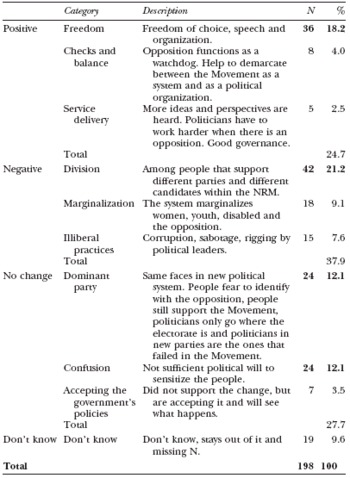
One of the key questions in this analysis is whether the respondents thought that the change from the movement system to the multiparty system would have a favourable or unfavourable effect on the local politics in their area. The responses to this question can be divided into three categories: negative impact, positive effect and no influence. Qualitative and specific descriptions of the respondents' replies are presented in Table 1.
How is the Change to a Multiparty System Going to Affect Local Politics?

The largest group (37.9 per cent) thought the new political system would affect local politics in a negative way. The majority of these thought the new party system would create division among people, either because the hostility between people with opposing party affiliation would increase or because the important process of candidate selection in the NRM would cause infighting. Other respondents were afraid that the new system would marginalize specific groups even further or contribute to more illiberal practices by political leaders. About a quarter of the respondents (24.7 per cent) thought the multiparty system would affect the local politics in a positive way. Most of these thought that the system would bring political freedoms such as freedom of speech, choice and organization. This result shows that freedom of speech is highly valued in Uganda. Other positive remarks were that a multiparty system would bring checks and balances and more efficient service delivery. The last category consists of those who thought that there would be no change (27.7 per cent), either because there was too much confusion about the new system or because they believed that the process would result in a dominant party system where the incumbent would still be in power. A few respondents thought that there would be few real changes, but they were willing to accept the government's policies.
These results show that in the weeks following the referendum most of the local leaders did not think that the multiparty system would bring positive changes at local level.Footnote 30
Attitudes by Party Affiliation
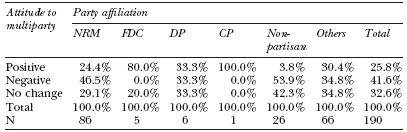
To what extent is the attitude towards the reintroduction of the multiparty system related to party affiliation? As Table 2 shows, the result from the chi-square test suggests that the covariation is unlikely to be observed in a population in which the party affiliation and attitude to a multiparty system are unrelated. However, the lambda test reveals that the respondent's value on the independent variable, party affiliation, is not particularly strong in predicting the respondent's value at the dependent variable, attitude to multiparty system. A descriptive analysis of Table 2 shows that respondents identified as NRM members share the attitude of the non-partisans and the local stakeholders categorized as ‘others’. Hence, even though many of the NRM members had agitated for the reform, they did not think it would bring positive changes, while the few respondents who identified themselves with the opposition did feel that reform would bring positive changes.
Attitude Towards the Multiparty System by Party Affiliation, 2005

Chi-square (χ2) = 19.912.
Lambda (λ) = 0.045.
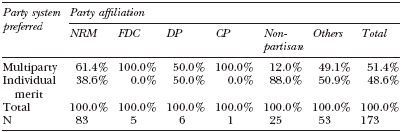
The predictability of party affiliation on whether the respondents preferred to run as representatives of a political party rather than on individual merit is significantly stronger. Table 3 thus reveals that even though the NRM members are sceptical as to whether the new system will bring any positive changes, 61.4 per cent prefer to run as a representative of a party rather than running on individual merit. Most of the respondents classified as member of the opposition parties also prefer to be a representative of a political party. This result strengthens the theoretical hypothesis, suggesting that it is important to be a member of a political party in order to get financial support. However, it might be self-evident that the ones who identify themselves with a party also want to be the candidate of that party in the elections.
Party Representation Preference by Party Affiliation, 2005

Chi-square (χ2) = 24.684.
Lambda (λ) = 0.238.
The most intriguing result of this analysis is why so many respondents do not identify themselves with any of the political parties, but prefer to be identified as non-partisan. If a respondent is classified as non-partisan the probability of that person being sceptical of the effects of the reintroduction of the multiparty system and in favour of assuring the right to be elected as an individual candidate is very high. Another interesting question is why so many of the local stakeholders do not seem to appreciate their new-won freedom of association even though the result of the referendum shows an overwhelming support for the reintroduction of the multiparty system. A qualitative analysis of local perspectives on the reintroduction of the multiparty system helps explain this.
WHY BE IN OPPOSITION?
Only a handful of the 121 councillors interviewed intended to run on an opposition party ballot in the upcoming election. The local branch offices of the opposition parties were therefore visited to talk with politicians who were interested in running for political offices at the local level. Few such offices existed, and where they did, they were not yet well organized and the opposition politicians preferred to run for positions at the national level. In one of the districts, different respondents said that representatives of the local government had tried to sabotage the opening of local branch offices of the FDC. Three different landlords were threatened when it was known that they had agreed to rent out offices to the FDC. The process of opening new FDC offices in the district was stalled for months until the well-respected chairperson of the DP in the district decided to accommodate the FDC on his premises.
When the members of opposition parties were asked about their expectations for the new political system, it was the members of the strongest opposition party, the FDC, who had the most positive reactions towards the change. One female councillor argued: ‘The president says that parties are bad because of the history, but I think Uganda is at another stage. We were united by the movement system, so it will not be a problem now.’ The members of the FDC were also the ones who expressed most dissatisfaction about the old individual merit system, as reflected in the comments of one respondent: ‘In the old system candidates were standing as individuals, but the movement system was supporting their candidates like it was a party.’ The FDC supporters also argued that it was very expensive to run as individual candidates, and many lost their property in the campaign. As members of a political party, they believed that the party would be able to sponsor them financially.
On the opposite side, members of the weaker DP were sceptical about the new system in which they had to run as representatives of political parties. One DP councillor stated: ‘My party is DP, but everyone here is in the Movement. I have to go on individual merit because my party is not able to help me financially, and it is wiser to stand on individual merit if you want contributions from friends.’ Another DP member supported this view and argued that ‘as a DP member it is impossible to get elected. It is difficult to get financial support because the potential fundraisers don't want their name to be known.’ He therefore decided to stay out of politics until the political culture had changed.
Opposition by Default
An analysis of the councillors who are classified as non-partisan helps us understand why only a few politicians identified themselves with opposition parties.Footnote 31 During interviews and observations, it was apparent that in each district there were groups of councillors who contested the local leadership of the NRM. In the previous system, these could be re-elected if their communities still supported them, but with the reintroduction of the multiparty system, they were not natural candidates for the NRM. In the most urban of the districts, some councillors were viewed as belonging to the opposition because the female candidate they supported in the national election in 2001 joined the FDC soon after she became a member of parliament. Her defection had repercussions for her supporters, who were now also seen as opposition supporters. The group had worked together and discussed matters of the district council, but they were threatened because the other councillors believed they would cause divisions in the council. Some of them joined the opposition parties, while others chose to stand alone.
In the second district, several of the councillors had charged the top civil servants with corruption, and by doing so they also confronted the top political leadership in the district. The civil servants were suspended and waited for the judgment of the court. The politicians who presented the motion found themselves in a difficult position in relationship to the NRM, since they had contested the leadership in the district. Consequently, quite a few were now regarded as ‘opposition by default’, since it would be difficult for them to be nominated as NRM candidates in the upcoming election. In the third district there was a severe conflict between two factions within the NRM led by two members of parliament. All the local NRM supporters had to choose between the two factions, thus creating problems in the primary elections and tension inside the NRM. However, both factions decided to keep their fight inside the NRM. They did not threaten to join or create an opposition party, with the losing candidates in the primaries preferring to run as individual candidates. These conflicts reflect a significant degree of political contestation in all the three districts and, because of this, many former NRM supporters had ended up in the ‘opposition by default’. Yet few of these were willing to join forces or to join the opposition parties to challenge the incumbent. They would rather run alone as individual candidates, and hence they were the ones who were most negative towards the multiparty system.
THE PROSPECTS OF THE OPPOSITION
In his analysis of elections and attitudes in Uganda in the mid-1990s, OttemoellerFootnote 32 argues that it is the Ugandans' extensive experience with grassroot democracy that has resulted in a lack of appreciation of the multiparty system. His conclusion is based on a survey where Ugandans were asked to define democracy. Their answers implied that Ugandans associated democracy with individual rights and privileges, and not with associational rights and the aggregation of popular power. The reason for this, according to Ottemoeller, is that at the village level citizens have long experience with participating in local elections, but because of the intimacy of the village setting there is no need for formal organization to aggregate and represent political opinion. Ottemoeller does not explain what he means by the intimacy of the village setting. In the following section I am going to suggest how this intimacy has an effect on the prospects of the opposition by exploring local perspectives on how the widespread and all-embracing local government structure contributes to the limitation of the opposition.
The Process of Reintroducing the Multiparty System
An analysis of the process of reintroducing the multiparty system helps explain the meagre prospects of the opposition. According to respondents, both within the NRM and other stakeholders, the campaign organized by the government had misled the electorate. At rallies and on the radio people were told that if they voted for ‘the tree’, the symbol for opening up the political space, they also voted for President Museveni to stay in power. If they voted for ‘the house’, it meant that they were against the president. A journalist from an independent newspaper covering the campaign reported that he got very upset when a minister said in his speech that ‘we are not campaigning for the return of political parties, but for the retention of the president!’ Others explained that it was a ‘necessity’ to mislead the electorate. One councillor commented:
It was very difficult to tell local people that we were going to multiparty. The old parties had done a lot of havoc. Now we had to tell people that we were going back, but they resisted. That's why we told them that NRM is going to be a party, and that they could vote for the movement by voting for ‘the tree’. That's how they agreed to go and vote in the referendum.
Dissatisfaction with this way of tricking people into supporting the multiparty system was expressed by different kinds of respondents. Their concern was that many who had cast their ballot did not know that they had voted in favour of reintroducing party politics. Additionally, the political will of the government to create awareness, to ‘sensitize people’ about the party system was almost non-existent according to the respondents. A councillor at the LC III level said: ‘Even we have not gotten any sensitization. The chairman attended a workshop. That's it!’ Hence, many thought that the reintroduction of the multiparty system was an opportunity to include those who were discriminated against in the movement system, but because of the lack of civic education they were afraid that people would behave as if they were still in the movement system. Or worse, it would cause conflicts because people would be hostile to members of opposition parties.
The Legacy of the Past
When the respondents believed that people would be hostile to the opposition, it was because of the legacy of previous periods of multiparty politics in Uganda. Many complained about how people simply refused to forget history. Particularly, in one district, respondents reported that people had started to dig into the candidates' past: ‘People have started to follow up on the background of the ones in the Movement. Was he in UPC earlier? Is he really a Movementist?’ A similar practice was expressed by a non-partisan councillor: ‘People take ideologies too serious in their private life. Like, if the father of your neighbour was in the UPC, then you think your neighbour is in the UPC, and then you should shy away from him, so people don't think you belong to the UPC as well.’ Some of the religious leaders also expressed concern about how people were afraid to make political statements. One religious leader said: ‘People have their parties at heart, but they don't express them. A short time back, a politician talked about politics at a church function, and people just left.’ People's fatigue and fear of politics was also addressed by a spokesperson from a Catholic church, who told about her development projects in the area: ‘People don't want to be involved in our projects any more because they fear that it will relate them to the DP. You know: a person that is a Muganda and a Catholic, well, historically, that's a DP supporter. People think that since we are a Catholic church, we support the DP.’
Many emphasized that the party system had caused tensions and conflicts in the past. Yet, despite their apparent collective memory of a violent past – of which they are reminded in speeches by the president – not everyone predicted that history would repeat itself. Some respondents thought that the Movement had united them and that the parties could not divide them again. Respondents of all ages believed that the situation had changed, but that the youth particularly were tired of the political leadership and wanted change. Stories about how people's houses were burnt down and how their parents had to hide in the bush did not scare them any longer.
The Dominant Position of the NRM
That there was a high probability of the NRM winning the upcoming election explains why many of their supporters welcomed the multiparty system. For many, the new system was an advantage, as reflected in one respondent's statement: ‘I want to show the other parties who the strong one is!’ In addition, the opposition and international donors could not accuse them of being dictatorial. As one female NRM councillor expressed it: ‘The multiparty system will give the government a good name. Some used to call them dictators, but now everyone can participate!’ While many NRM supporters viewed this as an advantage, others were more concerned. Many of the non-partisan councillors said that the change to a multiparty system would not have any effect: ‘If the same faces are coming, then nothing is going to happen.’
There is no doubt that women and men in Uganda cherish the Movement because of their policies that, for instance, ‘brought women out of the kitchen’. There are, however, other reasons to support the Movement. Both NRM supporters and others believed that the multiparty system could bring political sabotage, where certain people or communities did not get services because they supported other parties. A local journalist explained: ‘Outside they talk about democracy, but to get favours, you still have to say you support the Movement.’ Many councillors said openly that they preferred to run as NRM candidates in the election because it was the party in power. One councillor said: ‘I sympathize with FDC's policies, but you have to join where the big horn is. So only if I fail to be the NRM candidate, I go to the FDC.’ It was also regarded as an advantage to run on a NRM ticket because it could help the campaign financially, particularly since the NRM is well resourced.
The Inclusiveness of the Merit System
The inclusiveness of the individual merit system also explains the meagre prospects of the opposition. Some argued that they could already see tendencies of the new party system to be even more corrupt than the old movement system. Candidates in the nomination process had started to ‘buy’ other members in the political parties to win the primary elections. Such tendencies would eliminate good candidates who were not adequately financed because they would have to buy the electorate twice – first in the primary elections, then in the final election. Others also argued that it was easier for a party to buy the electoral college in order to get favours than it would be for an individual candidate.
Marginalization of weak groups was another concern mentioned. Many women preferred individual merit because the parties were afraid of nominating women for the mainstream seats because they were regarded as weaker than their male counterparts. In the old system, men and women competed, and it was up to the electorate to decide who was the most capable. In the new system, the few women who wanted to run for a ward seat, not only a women's seat, were afraid of being sidelined by their party. Money is important in the election campaign and some argued that since women had less money than men, it was difficult for them to finance the internal primaries as well as the election. The multiparty system also limited the options of the electorate. There could be many capable candidates within one party, and party selection of candidates limited the power of the vote.
In the respondents' opinion, the opposition would be further marginalized when party competition was introduced at the local level. If a candidate from an opposition party was elected, would not that person lose all the debates in the council? In the movement system the councillors could agree with the majority in some cases, and disagree in others, but in a multiparty system the opposition would have limited impact. Consequently, if a village elected candidates from the opposition, those councillors would not be able to bring back development funds to their constituencies.
The Judicial Duties of Representatives in Local Politics
Another aspect that limits the opposition is the important judicial and administrative role played by local politicians. The role of the LC I chairperson is similar to that played by traditional leaders in many other countries in Africa. Whenever people have problems at home, in their business or at their workplace, the LC I chair usually is the first person they turn to. If there is a small dispute, the chairperson calls an LC I meeting and people try to sort out their differences. If the dispute cannot be solved at the village/zone level, they refer the case to the LC III chairperson,Footnote 33 or if it is of a criminal matter, they involve the police. People do not turn up as frequently in the LC I councils as previously, but both businesspeople and members of different community groups confirmed that they always turned to the LC I if there was a problem.
Another duty that the LC I chairperson has is to write introduction letters for people who wants to migrate to another zone, letters that confirm, for instance, how many animals are to be moved from one village to another, and recommendation letters for persons looking for jobs or wanting to open a bank account. When I asked business people whether they asked for recommendation letters if they wanted to employ someone, most of them confirmed that they would not hire anyone without such a letter. Therefore LC I chairpersons were asked if they ever refused to write such letters, and the LC chairpersons answered that they rarely refused to write them, but in some instances they declined to write a letter for someone who had misbehaved. As one chairperson told me: ‘You know, if a person is a witch, I can't write an introduction letter if that person wants to move. I have to tell the truth!’
Because of all the administrative and judicial duties of the elected leaders at local level, the respondents worried about the effects of the multiparty system. Up until now, the chairpersons were elected because of their personal capacities and position in society. So would the system be fair if the local leaders represented political parties? If the chairperson was from one party, he or she would be biased against members belonging to other parties. Accordingly, many thought that the multiparty system would function at the national level, but they could not see its positive impact on the local level. Due to its problematic features, the destiny of the village LCs was brought in front of the Constitutional Court by the FDC. On 3 April 2007 the Constitutional Court nullified several provisions of laws regarding the organization of the village LCs because they denied people's freedom of association. The planned elections at the LC I level were therefore postponed in 2006.
CONCLUSION
When one connects these local perspectives with the proposed explanations of the weak opposition in the literature, two important aspects emerge regarding whether this process is going to establish meaningful independent vehicles for the articulation of alternative views and policies in Uganda. In the current legal framework, both the functions of local politicians and the electoral system limit the opposition. If the politicians continue to play a significant judicial and administrative role in the extensive local system, it is difficult to see how a multiparty system where representation is based on aggregated interests is going to be viewed as fair. The electoral system, based on the idea of constituency representation, also limits the opposition parties, since the candidates can gain from standing as individuals rather than being representatives of the weak opposition parties. In addition, patronage and corruption, which are made possible by the incumbent's use of state resources, make it attractive to be non-partisan.
Yet, one should not understand the weakness of the opposition in Uganda only as a cause of inappropriate use of formal and informal institutions. There are different features within the movement system that seems to fit people's understanding of representation. These findings demonstrate that many who supported the change to multiparty system did so because this would secure the freedom of expression. Others who opposed the multiparty system did so because they thought it would have negative consequences for participation. It seems as if many prefer a system in which everyone can run as candidates for political positions, and in which the electorate's role is to determine the one who is most capable of representing the community's interests. This makes the system of patronage open, since even though different kinds of patronage system exist, the electorate understands their right to withhold support from those who do not act in a responsive manner.
The importance of vertical accountability is cherished to a certain extent, but from a liberal democratic perspective the problem is that the aggregative role of the parties is not visible in Ugandan politics. When the aggregative role of the parties is nonexistent, it is just as rational to vote for a non-partisan candidate as for a member of a weak opposition party. The non-partisan does not oppose the policies and organization of the incumbent party, but only the qualifications of one of its representatives. In such a way, people do not have to be afraid of sabotage and other methods of punishment. Accordingly, if the multiparty system is going to give the opposition parties any chance of affecting local politics in Uganda, the local government structure has to be altered. Since the current system is in accordance with the Ugandan people's notion of representation, this outcome depends on whether the non-partisans will join the opposition and press for constitutional amendments.