THE SETTING
Many economists and economic historians assume that there is a positive relationship between economic growth on the one hand and well-functioning markets for labour, land and capital on the other. They also assume that these factor markets need the backing of an institutional framework promoted by the state.Footnote 1 Evidently, Western Europe is an area for which these links have been and are being demonstrated, going back as far as the pre-modern period, but there is mounting evidence that these relationships can also be demonstrated for Japan, for (parts of) China prior to 1800 and possibly for (parts of) India before 1750.Footnote 2
The ‘discovery’ of such links for Asian countries appears to coincide with their high rates of economic growth during recent (China) or fairly recent (Japan) decades. This might lead one to expect that Southeast Asia, with very satisfactory growth rates during the decade or so preceding the 1997 financial crisis, is now on the brink of being discovered as another example of the above-mentioned links in more remote periods.Footnote 3 Those who started reading this chapter with that expectation in mind will have to be disappointed. However, there are recent studies that suggest that economic developments in Southeast Asia came much closer to the Western European pattern than is usually believed.Footnote 4 This is quite a departure from the traditional point of view that Southeast Asia, prior to the colonial experience, was mired in some kind of eternal Middle Ages.Footnote 5 In much of the literature published before the 1980s, the countries of Southeast Asia were regarded as ‘hermit states’, as they were supposed to have done their utmost to keep outside influences at bay. New research shows convincingly that population growth and international trade led to many changes in the region between, say, 1400 and 1870.
One of the reasons scholars can have such divergent opinions about the levels of development of Southeast Asia in the past is that statistics for many of its areas are absent or dubious for everything prior to 1900 or, for some remote areas, even 1950. Thus, it is very difficult to present statistics that reflect the pre-colonial or proto-colonial situation for most Southeast Asian areas, and it is likely that the more quantitative aspects of our knowledge of the early modern economic history of the region (between 1400 and 1870) will always remain unsatisfactorily documented. Much of the evidence that is presented in this chapter is, therefore, of a qualitative nature and contains speculative elements.
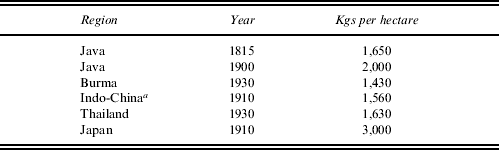
However, some data have been collected that may be assumed to reflect the area's ‘best practice’ level of development and that can be used in a comparison with other Eurasian countries.Footnote 6 The data presented in Table 1 clearly suggest that in one of the most developed Southeast Asian areas, the Indonesian island of Java, the level of productivity per unit of land – a measure often used as an indicator of the level of economic development – lagged behind that of the leading Asian country, Japan.
Rice production (in the husk) per hectare, for various regions and periods

a Indo-China consisted of what is nowadays Laos, Cambodia and Vietnam.
Sources: Peter Boomgaard and Jan Luiten van Zanden, Food crops and arable lands, Java 1815–1942, Changing economy in Indonesia, 10 (Amsterdam, 1990), 41 (for Java), and Cheng Siok-Hwa, The rice industry of Burma 1852–1940 (Kuala Lumpur/Singapore, 1968), 28 (for all other areas).
Around 1900, Java was far ahead of most Southeast Asian countries, but Japan was doing much better than Java in terms of yields per unit of land.Footnote 7 There are no comparable figures for the early nineteenth century for the Southeast Asian areas except Java, but it may be assumed that all the figures were higher around 1900 than they were around 1800, as was the case with Java. This was due to the fact that declining acreage per capita, caused by population growth, had to be compensated for by higher labour input per hectare. In Java, part of the increase may reflect ‘mature’ colonial rule.Footnote 8
Another comparison has been made between labour productivity in Javanese agriculture around 1815 and that in Europe around 1800. The results are presented in Table 2. Java was on the same level as Portugal in terms of labour productivity, and came fairly close to Finland. These were the most economically backward European countries for which such data can be produced. In comparison to the United Kingdom, the most advanced European country at the time, Java's labour productivity was evidently very low. As Java's labour productivity was probably higher than that of most other Southeast Asian regions, Southeast Asian productivity of labour cannot have been at par with the more developed European areas.
Productivity of labour expressed in millions of (net direct) calories per adult male agricultural labourer per year around 1800, in Java and selected European countriesFootnote a

a In the calculations the procedure set out by Paul Bairoch (see source note below) has been followed. The figure for Java means that a male agricultural labourer produced on average 3.2 million net direct calories per year (female labour could not be taken into consideration, as the relevant data is missing, both for Europe and for Java). ‘Direct’ means that ‘indirect’ animal calories have been converted into direct ‘vegetative’ calories, and ‘net’ means that seed and fodder have been deducted from the gross figures. All production data was converted to calories, including that regarding non-consumables, which was first converted into rice equivalents.
Sources: P. Bairoch, L'Agriculture des pays développés, 1800 à nos jours: production, productivité, rendements (Paris, 1999), 136; Peter Boomgaard, ‘Long hours for high yields: agricultural productivity in pre-industrial Java (Indonesia)’, paper presented at the 13th Economic History Conference, Buenos Aires, 2002, where the details of the calculations for Java are given.
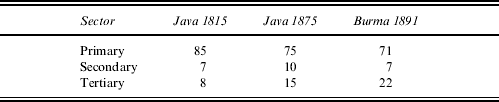
Looking at both indicators – productivity of land and labour – the conclusion appears to be inescapable that during the nineteenth and early-twentieth centuries Southeast Asia was not at the same level of economic development as were the most advanced areas in Eurasia. This is in keeping with a number of other indicators, one of which is the small size of the non-agrarian sectors of the Southeast Asian economy. Data for two areas at various points in time have been summarized in Table 3. The data there may be compared with those of a number of Western European countries, where the primary sector was already much smaller around 1850, as was the case in Great Britain (20%), the Netherlands (45%) and Belgium (50%).Footnote 9 Generally speaking, areas with a large agrarian sector (say, over 60% of the economically active population) are economically less developed than regions where the industrial and service sectors account together for 50 per cent or more of the active population.
Occupational structure of the population in Java in 1815 and 1875, and in Burma in 1891 (%)

Sources: Peter Boomgaard, Children of the colonial state: population growth and economic development in Java, 1795–1880 (Amsterdam, 1989), 109–35, and ‘The non-agricultural side of an agricultural economy: Java, 1500–1900’, in Paul Alexander, Peter Boomgaard and Ben White eds., In the shadow of agriculture: non-farm activities in the Javanese economy, past and present (Amsterdam, 1991), 34; Teruko Saito and Lee King Kiong, Statistics on the Burmese economy: the 19th and 20th centuries (Singapore, 1999), 23.
Another, related indicator is the degree of urbanization. Around 1890, 3 per cent of Java's population was living in towns of 20,000 inhabitants or more, while that figure for the Netherlands in the same year was 29 per cent and for the British Isles as much as 48 per cent.Footnote 10 As a rule, before 1950 high rates of urbanization and high rates of economic growth, mainly generated by the secondary and tertiary sectors, went hand in hand.
Moreover, compared to Western Europe, Northern India, (South-)Eastern China and Japan, Southeast Asia was relatively sparsely populated, and it seems to be an almost universal rule that in early modern societies the highest rates of economic growth were to be found in densely populated regions.
A factor of a more qualitative nature to be mentioned here is the low level of (‘industrial’) technological development in most of Southeast Asia. The use of steam was restricted to the (small) Western industrial sector and was hardly significant prior to 1900, and in many areas prior to 1950. But even older technologies, such as water- and windmills, were badly represented in the region, and were intimately linked to the European and occasionally Chinese presence. Perhaps even more remarkable is the absence of saws prior to European influence, for instance in Java, perhaps because steel-making was poorly developed.Footnote 11
A look at seventeenth- and eighteenth-century Southeast Asian exports versus Indian or Chinese exports confirms the lack of technological development in the former region. Southeast Asian countries exported agricultural, forest, maritime, and mining products, but very little that could be termed ‘industrial,’ small quantities of cotton textiles apart. This is in contrast to China, which exported huge quantities of silk and ceramics, and India, with its voluminous cotton textile exports.Footnote 12
All this implies that rates of economic growth in early modern Southeast Asia were relatively low. If the assumption is to be confirmed that there is a link between levels of economic development and the functioning of factor markets, we should find labour, land and capital markets in Southeast Asia that were not functioning as well as they did in the more highly developed parts of Eurasia. This assumption will now be tested.
LABOUR
Little has been written about Southeast Asian labour prior to, say, 1850, but what we know can be summarized as follows.Footnote 13 Free (wage) labour had probably always been available in small (sometimes no doubt very small) numbers, but during the early modern period various forms of dependent or bonded labour were predominant. From around 1400, the supply of various kinds of free and unfree labour was increasing due to the influence of the international market. In order to respond to growing foreign demand, labour was recruited in increasing quantities. In the urban areas and the densely settled rice bowls, this could be free labour, but at the same time various forms of unfree labour had to be employed.
However, locally from the late eighteenth century, and across the region during much of the nineteenth, corvée obligations and fully fledged slavery were being increasingly abolished, while free wage labour took their place. This development was linked to three factors – population growth (which led to falling man–land ratios and therefore to cheaper labour), the continuing growth of international trade and measures taken by the colonial rulers. I will now deal with these topics in more detail.
Bonded labour, was, at one time, quite important in parts of Asia.Footnote 14 It was an indigenous institution, not introduced there by Europeans. My impression is that it was much more important, say, around 1500 in Southeast Asia than it was in either South or East Asia.
Bonded labour – which includes serfdom, debt peonage (debt slavery) and people with heavy corvée labour obligations – was widespread in Southeast Asia during the pre-modern period (and therefore prior to European influence), probably particularly in the core areas of the early states. Nieboer's thesis that there is a negative link between population density and slavery, with bonded labour to be found particularly in societies where people were scarce and land abundant, is often assumed to apply.Footnote 15 That rule applies to Southeast Asia as well.
However, within such societies, at least in Southeast Asia, bonded labour appears to have been connected to those core areas where a monarch ruled over a sedentary peasant population, with a moderate population density. Here, bonded labour was ‘created’ through debt bondage, punishment meted out by the ruler or a magistrate, the commutation of fines that could not be paid, the slave trade and raiding outside the core areas. Bonded labourers were put to work on religious properties and the secular building projects of the ruler. Bonded labour was also used for the production of export commodities.Footnote 16
A few remarks are in order about the many gradations of servility in these societies. The question should be asked whether every person with labour obligations towards the ruler should be regarded as bonded. If, as was often the case, these obligations amounted to six months per year, the answer clearly should be positive. But what about those with a corvée obligation of only one month per year? If that is bonded labour, there were many Southeast Asian regions where not much labour was not bonded, that is, free. If, for instance, we were to regard everyone with corvée obligations in eighteenth-century Thailand as bonded, there would be hardly any free people left.Footnote 17 Be that as it may, there were sufficient people with a genuinely bonded status to enable us to say that bonded labour was quite important in early modern Southeast Asia.
Looking into the causes of bonded labour, I am inclined to agree with Nieboer, that we are dealing here with land-rich and labour-poor societies where labour was at a premium, and often could not be acquired without some degree of compulsion. Or, as Domar has reformulated the Nieboer thesis, there was no wage rate where demand and supply met, and in that sense there was no labour market in many Southeast Asian regions prior to 1850 or so. That explains the demand for bonded labour. Looking at the supply side, it can be observed that these were risk-prone societies where during the many lean periods that occurred people sometimes had to sell themselves or their families into slavery, or just offered themselves as slaves to rich people.Footnote 18
In addition to this, mention should be made of a basic ordering of society in countries such as Burma and Thailand during the early modern period. Here we encounter a basic division of commoners (usually peasants) into those groups (often entire villages) who owed corvée labour to the monarch and those who did not. The latter were either paying taxes or owed labour obligations to the nobility or the clergy. Labour obligations to the crown were often quite heavy, but they could also be regarded as an honour, such as having a high rank in the military or serving in some other non-menial capacity at court.Footnote 19
Of course we would like to know what proportion of the population was actually entirely ‘free’, here defined as tax-paying but not subject to servile obligations. I have the impression that in some societies this number might have been very small. One group of people, though, appears to have been free everywhere in Southeast Asia. I am referring to foreigners, and in particular to Chinese migrants. It is well known that Chinese migrants played an important role as merchants, petty traders and moneylenders, but it should not be forgotten that most Chinese migrants arrived in Southeast Asia as coolies, owning nothing but their labour power (and they were also often in debt).Footnote 20
It is also likely that those groups – often tribal – who lived too far away from the core areas or that could not be easily reached for other reasons (for example because they lived in forests or swamps) paid only token homage to a ruler, and it is unlikely that they were called upon for corvée labour. In principle, therefore, they were free to do with their labour as they saw fit. However, for the same reasons that the state left them alone, one can hardly expect them to have been available on a routine basis for the labour market. Therefore, in the nineteenth century, when under colonial rule Western enterprise was opening up ‘waste’ lands in tribal areas, local wage labour was often hard to get, and entrepreneurs had to import (indentured) labour from elsewhere.
Finally, data for Java suggest that at least from 1650 onward there were always some unskilled wage labourers – usually called ‘coolies’ – available in and around the areas where the Vereenigde Oostindische Compagnie (Dutch East India Company, VOC for short) had established itself.Footnote 21 These were small numbers of people who, for various reasons, had left their village societies. They were an unruly lot who appear to have spent most of their income on gambling, whoring, drinking and opium. They figure prominently in reports about criminal activities. Here, apparently, we find a genuine proletariat in the making – free people who had to sell their labour. Data on wages between 1650 and 1800, although not abundantly available, suggest that there was a downward tendency, which implies that the supply of coolies was increasing.
However, around 1750 there are signs that in Java this development towards a fully fledged proletariat was rivalled by another tendency. This was the appearance of what in Java was called a bujang, a young, unmarried male (occasionally a female), who was temporarily looking for work outside his village. Of course such people had always existed, but their presence in larger numbers in the ‘Western’ sector of the economy appears to have been a rather novel phenomenon. They were temporary migrants, who came looking for work during one or two seasons, perhaps more, but who intended eventually to go back to their village and get married, for which they should have been saving part of their income, in order to be able to pay the brideprice.
By 1400, those living in most Southeast Asian core areas were familiar with coinage of one kind or another. Nevertheless, this was far from being a fully monetized society when the Europeans arrived on the scene. After 1500, the region received large amounts of (American) silver from Europe, while Japanese silver and copper may have played a much larger role than many of us have been aware of.Footnote 22
It has been suggested that increased monetization may initially have led to more rather than less debt slavery,Footnote 23 which comes perhaps as a surprise to those who would have expected ‘more market’ to have led to more free labour. And yet there are various indications that an increased demand for export products could only be met by employing more bonded labour, particularly if and when remuneration for labour, because of increased competition and therefore falling prices, had to be low, and was therefore unattractive to peasant-cultivators and others with a reasonable income. The incidence of obligatory labour, therefore, appears to have increased, at least initially in many instances, due to stronger market influence.
Nevertheless, market influence in the end has been the undoing of corvée labour. Between 1700 and 1900, service obligations in many Southeast Asian countries (Burma, Thailand, Vietnam, Java) were being gradually commuted to monetary payments, or they were reduced and finally abolished, while work for the state was increasingly being paid for. This happened more or less at the same time as the substitution of monetary taxation for taxes in kind, and no doubt for the same reasons – more money had become available, more people were willing to work for wages, probably largely because population growth led to lower amounts of arable land per capita, and therefore more dependence on wage labour, while at the same time increasing imports from outside the region made more desirable goods available.Footnote 24
The development of slavery and serfdom is a somewhat more complicated story. Fully fledged slavery – as a proportion of the total labouring population – may never have been very important during the period we are discussing, as so much corvée labour was available to the state and to the nobility. However, many elements of the population could not access corvée labour and, as wage labour was difficult to get, slavery was often the only solution for non-noble entrepreneurs, and in the less populous areas even for the nobility. There is also evidence that rulers and nobility of ports-of-trade availed themselves of slaves, while slavery was often also the only solution for resident foreigners looking for workers.Footnote 25
Slavery then, far from being (only) a ‘backward’ mode of production, was almost certainly stimulated by the growth of international trade and the increasing importance of production for export, a defining feature of the period from the fifteenth to the nineteenth century. However, in the densely settled core areas of Java and Northern Vietnam for instance, slavery was rare in the indigenous countryside and was largely restricted to the ports-of-trade.
When the influence of European powers increased during the nineteenth century and solidified into formal colonialism, slavery was slowly but surely phased out. Slavery in Southeast Asia was not abolished for economic reasons by the colonial powers, but for humanitarian ones. However, it coincided conveniently with the increasing availability of free wage labour in the region. Nevertheless, slavery persisted in many Southeast Asian fringe areas into the twentieth century, and in the late 1940s Condominas encountered a few slaves when he was doing fieldwork in a tribal upland area in Vietnam.Footnote 26
LAND
Generally speaking, unidirectional development from communal land tenure to individual rights to land under the influence of the colonial state – a notion dear to many present-day writers – does not seem to reflect very well what happened, while it is, furthermore, not sufficiently specific to tell us much about the social and economic effects of changing land-tenure arrangements. Individual, hereditary private tenure has existed for ages in many areas of Southeast Asia. The occurrence of this form of tenure appears to be related to population density and the working of the international market. However, ‘communal rights to land’ could also be found in village communities in the populous core areas. Such land tenure arrangements were different from what has been called customary or communal tenure among marginal (tribal) groups. Not all rights to land in such areas were ‘communal’, but neither was there a land market, as land was abundantly available.
It can also be established that many European regulations between 1570 and 1870 were not aimed at the creation of private property in land, and in various cases they led to distortions of private property rights already in existence, for instance by stimulating the transformation of peasant freehold into communal tenure, as happened in nineteenth-century Java. Even after 1870, there are many instances of colonial states preferring long leases for Western enterprise instead of private holdings. In the case of forests the option of private property was never contemplated, the forests being declared sovereign domain instead.
Various colonial regulations have, indeed, facilitated the creation of private landed property since the late nineteenth century. In many instances, however, this was not conversion from communal land into privately owned land, but from open access and state land. The following paragraphs deal with the land market problems in more detail.
There are not many reliable historical studies concerning rights to land in Southeast Asia that are based on empirical data. It is still possible, as Glenn May recently did for the Philippines, to write an article based on actual research of the primary sources in which the received wisdom about the historical development of land rights is stood on its head.Footnote 27 Therefore, much of what is said here is preliminary and awaits further research.
Nowadays, many students of land-tenure arrangements distinguish four types of land rights – open access land, state land, common property and individually owned private property.Footnote 28 However, historiographically the terminology was subject to changes. During the nineteenth century most colonial regimes assumed that the indigenous rulers of Southeast Asia were the owners of all the lands, a notion they copied from the ruling elites. The colonial states regarded themselves as the successors to such rights.Footnote 29 However, since the early twentieth century, the view has been gaining ground that it was not the ruler or the state but the village or the clan in which land rights were ultimately vested.Footnote 30 In this view, land was the common property of the villagers, for which terms such as ‘communal rights’ or ‘customary rights’ are often used. Such rights were often no longer in evidence around 1900, so the argument went, because the indigenous or the colonial state had usurped them. However, in stateless societies, village rights to land could still be encountered.
Both opinions – the king as the original owner of all the land or all rights to land originally vested in the local community – can still be encountered in the recent literature. Usually, those who cite the former version are interested in the densely settled core areas of the Southeast Asian states, while supporters of the latter hypothesis are interested in the sparsely populated tribal margins. Therefore, these views are not necessarily mutually exclusive.
It is also assumed that these rights have changed drastically since the colonial state took matters in hand and introduced individual private rights to land. The general trend, therefore, suggested implicitly or explicitly by many scholars writing about Southeast Asia, is that land rights were transformed from state or common property to private property as a result of colonial intervention.Footnote 31
A few comments on these views are in order. Individual ownership of land predates the colonial experience in Southeast Asia. Perhaps the best-documented area in this respect is tenth-century Java, where epigraphic evidence strongly suggests that land, particularly irrigated rice land, could be bought and sold on a freehold basis, pawned and leased. Individual hereditary private property in land prior to 1500 or 1600 is also to be found in Burma, Vietnam and the Philippines. Thailand appears to have been the country where the claim that the king was the sole owner of the land was taken more seriously than elsewhere. Here, private individual rights to land were weakest prior to the late eighteenth century, and those who cultivated the land could not claim more than usufruct rights. Even around 1800, when land could be sold and bequeathed by the cultivator, it was not generally used as collateral.Footnote 32
The areas where hereditary private tenure of land predominated were mostly to be found in the densely populated core areas of the indigenous states, in and around capital cities and ports-of-trade. Here, land had become scarce and therefore valuable at an early stage, and ‘commodified’ even if its legal status may have been that of regal domain land. In areas where land was abundant, land rights were often less clear, but a hereditary right to the land of the first person who reclaimed and continued cultivating it was usually recognized. In these areas there was no real land market, as land was considered a free good which could be acquired by anyone willing to cultivate it and pay the taxes on it. Land sales, therefore, were exceptional here.Footnote 33
Not much discussed in the literature is the size of privately owned lands, with the exception of the situation in the Philippines, where large ecclesiastical and private estates came into being after the arrival of the Spaniards.Footnote 34 Large estates of the nobility are mentioned in pre-modern Vietnam, but around 1500 rulers actively sought to discourage such latifundia, which were seen as competition for the monarch. Relatively large landholdings – but nothing compared to what could be found in the Philippines – came into existence after the clearing of large new areas for agriculture, as happened in the Mekong Delta in Vietnam in the eighteenth century and the Irrawaddy and Chao Phraya Deltas in Burma and Thailand respectively during the nineteenth century. There does not appear to have been much difference in this respect between indigenous and colonial rule. The new lands had in common the fact that it was difficult for individual smallholders to clear these swampy deltas and to dig the canals needed for transportation. People with access to capital were in a much better position to carry out such activities as a large-scale enterprise. It seems therefore that environmental circumstances dictated the land-tenure arrangements in these cases.Footnote 35
Common property or communal tenure, sometimes also termed ‘customary tenure’ in the literature, is now often regarded as the form of tenure historically to be found in stateless societies.Footnote 36 Many anthropologists writing about tenure and the environment seem to feel that it is private property, introduced by alien forces (the colonial state, Capitalism), that is to blame for many of the environmental problems of today. In their view, customary rights to land would be better suited to sustainable exploitation of the natural environment.Footnote 37
There are a number of problems with these terms. In the first place, they suggest that all ‘primitive’ or ‘tribal’ communities owned land in common. This appears not to be the case. This, at least, is what could be concluded from research done around 1950 among the Iban and the Land Dayak by, respectively, Derek Freeman and Bill Geddes.Footnote 38 The claims created here by the individual through clearing the land are admittedly not identical with our ‘individual tenure’ in the usual sense of the word, but neither is it communal tenure – the village or the longhouse do not appear to have had residual claims.Footnote 39 However, there are many instances in Borneo of stronger communal claims on the land.
The second point is that there is another phenomenon called ‘communal tenure’, which has nothing to do with the ‘pristine’ arrangements mentioned here. It refers to the fact that in villages of sedentary peasant-agriculturalists, often located in long-settled, densely populated wet-rice-growing areas, part or all of the arable lands did not have permanent individual owners. These lands were distributed by the village head among all families (in Java), or among a section of the villagers, often, but not always, the landless and/or the ‘dwarfholders’ (in Vietnam). Redistribution could take place annually or after more years. This phenomenon was to be found in Java and northern Vietnam around 1800 and later. As a rule, such communal holdings could not be alienated.Footnote 40
Were the colonial masters as interested in introducing private property as many scholars seem to think? In the first place some colonial powers preferred concessions to outright property, at least for large-scale Western enterprise. Ever since the Agrarian Law of 1870, plantations in the Indonesian Archipelago had to depend entirely on the acquisition of leases, usually for a period of 75 years. Such a period was sufficiently long for banks to accept leasehold land as collateral. In Java, the situation had been more complicated between 1820 and 1870, when no non-Javanese had been permitted to buy land. The planting of crops for the world market by Western enterprise could only be undertaken on arable lands hired from villages. These arrangements were part of the so-called ‘cultivation system’.Footnote 41
In the Philippines, Spanish legislation during the nineteenth century worked in favour of the creation and expansion of haciendas, but this was done at the expense of small private holdings. Even as late as 1914, under US rule, the legislation stimulated the acquisition of large landholdings by the high and mighty, to the detriment of smallholders, who became tenants on the properties they once owned. The state, therefore, encouraged the growth of the numbers of large private holdings, but it also encouraged the disappearance of smallholdings.
There are also indications that colonial powers during certain stages of their presence in Southeast Asia were in favour of communal holdings. The Spanish crown, for instance, gave land grants to Philippine villages in the late sixteenth and early seventeenth centuries, thus creating communal holdings out of the royal domain. But even during part of the nineteenth century the Dutch colonial state actively encouraged the growth of communal holdings in Java, as it was convenient for the sugar industry and for other aspects of the ‘cultivation system’.Footnote 42
It is also clear that between about 1800 and 1940 almost all the forests in Southeast Asia were declared to be the property of the state. Before 1800, most forests in the more remote areas had been open access resources, while in the more densely settled areas they had been regarded as part of the village commons. Forests as private property, well known from Europe, must have been rare or even non-existent in Southeast Asia, both before and after 1800.Footnote 43
Whatever the formal arrangements of landed property, it is arguably of equal importance whether such lands were owner-operated or worked by tenants. It is generally accepted that tenancy – probably mainly share tenancy – has increased considerably during the last 100 or 150 years. It has been estimated that by the 1950s around 50 per cent of all farms were tenant-operated. This means that a large proportion of all cultivators were not able to put up the land they were cultivating as collateral. This made them dependent on ‘improving landlords’ (while most landlords were better known for their rentier mentality) or moneylenders who charged usurious rents in order to compensate for the risk they were running.Footnote 44
It is undoubtedly true that most colonial states attempted from the late nineteenth century onwards to improve the registration and therefore the creation and recognition of private property in land. Most countries – but not the Netherlands (East) Indies – introduced the so-called ‘Torrens system’, where the registration of title deeds was coupled to cadastral surveys and an exact positioning of the relevant plots of land. However, this attempt was fraught with many difficulties, of which the main ones were the lack of trained personnel and the endless disputes over conflicting claims. The pace of registration was therefore excruciatingly slow, and the process was far from finished at the end of colonial rule.Footnote 45
Finally, the point should be made that up until today the existence of so many property regimes (‘legal pluralism’) that have succeeded but not replaced each other – indigenous, colonial, post-colonial – is a source of incredible confusion and uncertainty as regards titles to land.Footnote 46
CAPITAL
Interest rates were generally speaking high in this period, and the highest rates were paid by the poorest, who, as we have seen when dealing with the labour market, could easily become debt bondsmen. During the seventeenth century, the interest rates for large sums of money dropped considerably in various places, but certainly not everywhere. They remained higher than in the most developed regions of Western Europe. Capital, therefore, was expensive, and the performance of the capital market left much to be desired. The following paragraphs will highlight a number of relevant details.
Asia always had the reputation of a money-poor, cash-hungry and debt-ridden part of the world with very high interest rates, a sink of imported specie and bullion.Footnote 47 This is easily illustrated – at least for South and Southeast Asia – for the period between 1600 and 1900, when we have quantitative data on interest-rate levels. The lowest interest rates in the indigenous sphere in Southeast Asia during this period, both in legal texts and in actual practice, appear to have fluctuated at between 25 and 35 per cent per year, rates that were probably only applicable if some sort of collateral was present. In Java, Europeans who lent money to the Chinese sometimes charged somewhat lower rates during the seventeenth and eighteenth centuries – 16 to 18 per cent. However, much higher rates were found in many cases.
Occasionally, the laws set limits to the amount of interest to be charged, but we do not know whether people actually paid any heed to such injunctions. Given the structure of authority – which will be discussed in the next section – it is unlikely that the state actually upheld such rules on a routine basis. Indigenous legal texts mention maximum rates of between 80 and 150 per cent. Occasionally, the principle is formulated that the repayment of a debt cannot be more than double the original sum that was borrowed, which, therefore, after one year would have been an interest rate of 100 per cent. So even if such maximum legal rates had been adhered to, repayment must have been an enormous burden on Southeast Asia's commoners, often people living on the edge of survival.
The highest rates appear to have been paid on the smaller sums, both according to the law and in actual practice, which was still the case in colonial times. Pierre Gourou, writing about northern Vietnam in the 1930s, presents the example of people borrowing 1 piaster, for which they had to pay an interest of 1 sou a day, or a rate of 100 per cent for a hundred-day period (and therefore 365 per cent after one year).Footnote 48 Such amounts of money, though very small in our eyes, were to be taken seriously from a Southeast Asian peasant's perspective.
Interest rates were lower in the major ports-of-trade in seventeenth-century India, at least for loans made available by local merchants to the VOC. The rates were also decreasing over the century, no doubt as a result of large silver imports from Europe. The lowest rates were found in Surat, where they dropped from 12 to 7½ per cent, those in Bengal were somewhat higher, dropping from 15 to 10, while the highest rates occurred in Coromandel, decreasing from 24 to 12 per cent. All these rates were charged for very large amounts, so rates for smaller amounts would have been higher.
Finally there are data for the European-dominated centres in the seventeenth-century Indonesian Archipelago, Batavia and Ambon. Here, interest rates paid by the VOC to private persons, probably mainly Europeans and European institutions (such as the orphan chamber) varied between 6 and 9 per cent per year. This was getting close to rates charged in the Netherlands during the same period, at that moment the most advanced financial centre in the world, where interest rates varied from 3½ and 5 per cent for large loans to the state or the VOC.
The most plausible explanation for these differences in interest rates appears to be a combination of the different degrees of penetration of European capital and the different levels of economic development. The economies of areas such as Gujarat, Coromandel and Bengal were of a more complex nature than the indigenous economies of Southeast Asia, and larger amounts of European capital were imported in India than in Southeast Asia. Only places such as Batavia and Ambon, where the European element was numerically and economically dominant, were doing marginally better in terms of interest rates than Surat, the Indian city with the lowest rates.
Why were interest rates higher in Southeast Asia than they were in Western Europe around the same time? A number of factors will be mentioned, or rather complexes of factors.Footnote 49
Early modern Southeast Asian societies were characterized by status based on ostentation (conspicuous consumption) and reciprocity. Status could be acquired by organizing large ceremonies, which had to be reciprocated by competing status-seekers (in competitive feasting). For Southeast Asians of a certain standing – particularly kings and aristocrats – wealth had no meaning unless it could be displayed. Being indebted owing to conspicuous consumption was not regarded as morally wrong.
A second factor is the scarcity of money. Although, as was mentioned earlier, many Southeast Asian countries did have various types of coinage from the pre-modern period, the minting of coins came much later than it did in Europe. This phenomenon might be related to the fact that the proportion of the economy that was market-oriented was small in comparison with more advanced countries, which, in turn, appears to be related to the less complex nature of Southeast Asia's pre-modern economy and society. Low levels of population density appear to have played a role here, which might ultimately be linked to environmental factors. Within Southeast Asia there were huge differences, and one could find barter economies not too far from the monetized core areas. The scarcity of money may have been stimulated by the often-reported proclivity of Southeast Asians to ‘hoarding’. Besides the well-known fact that gold and silver coins were taken out of circulation and turned into jewellery, there are many instances found in the sources of buried treasures.Footnote 50
A third factor is that of natural and human-made hazards. Natural risks are present in every society, and most early modern societies had few buffers against such disasters. It seems likely that Southeast Asian societies were even more at risk than others because of the hazards connected to the ENSO (El Niño–Southern Oscillation) phenomenon, which hits the region harder than other areas, causing droughts and floods with sad regularity in addition to the weather anomalies that are found in other regions as well. It has also been argued that tropical areas are more subject to all kinds of diseases, which would make Southeast Asia – a region entirely located in the intertropical zone – more risky in this respect too. Finally, Reid has argued that Southeast Asia was characterized by a higher than average level of conflicts.Footnote 51 Even if all these factors only made a marginal difference in comparison with other parts of the world, taken together they are likely to have made a big difference, which would imply more risk and therefore higher interest rates, all other things being equal.Footnote 52
Finally, high rates may also have been caused by high transaction costs. Gourou argued that in Tonkin (northern Vietnam) moneylenders only got their money back if they were supported by a local Mandarin, and Mandarins did not come cheap. In many areas of Southeast Asia moneylenders were aliens (Arabs, Indians, Chinese), and it is well known that, particularly in times of economic crisis, recouping their loans would be very difficult. They needed bodyguards-cum-enforcers to stay in business or, occasionally, to stay alive. Particularly regarding Indonesia various authors have convincingly argued that the lack of trust would contribute to an adverse business climate, and thus to high levels of interest. Finally the lack of contract enforcement should be mentioned, a factor pertaining to the institutional features to be dealt with next.Footnote 53
THE INSTITUTIONAL FRAMEWORK
The low interest rates in Batavia were not only the result of the presence of more cash, but also, one assumes, of the will and the means to enforce contracts. Thus, we arrive finally at the institutional factors, which will be dealt with briefly.
Although it is no longer fashionable to speak of ‘Oriental despotism’, one is hard put to find another equally evocative term to describe the behaviour of Southeast Asian power-holders. They were certainly absolute rulers by the fifteenth century, and income and firearms acquired through trade with Europeans strengthened their position. Evidently, Southeast Asian society prior to 1850 was not a civil society. The king could, up to a point, do as he pleased, and he was certainly above the law (as the laws themselves show us convincingly). The states we have been dealing with in this chapter had subjects, not citizens.
There was a generally high level of insecurity among commoners and nobility alike. One of the reasons people – mainly commoners – were hoarding is that they would not dare show too much of their wealth, lest they made the monarch jealous. Rulers were known to make unexpected and unreasonable financial demands. These factors have generally been held responsible for the lack of an indigenous stratum of well-to-do (non-royal and non-noble) large-scale merchants. Rulers preferred to deal with Chinese, Arab, Indian or European merchants, as these, in their eyes, could never pose a threat to their position.Footnote 54
The fact that many of Southeast Asia's commercial transactions were thus in the hands of strangers might be an additional explanation for the eternal shortage of cash in the region, as these merchants repatriated a (large?) proportion of their earnings.
Next to the role of the monarch, the quality of the legal framework within which a society operates is of great importance for the issues we are dealing with. Written laws were present in most Southeast Asian countries from an early age. These laws contain clauses about property (but not much on landed property), financial transactions, written contracts, bondage and punishment for crimes.Footnote 55
A typical feature of various Southeast Asian laws was that public law and private law were not strictly separated, so that someone who had been found guilty paid not only compensation to the party that had been wronged, but also a fine to the ruler, who, as will be shown presently, was often the judge. Most penalties consisted of fines, but corporal and capital punishment were often applied as well. The latter types of punishment could be commuted to – rather stiff – fines. Those who could not pay their fine became slaves, in principle, again, of the ruler who had sat in judgement. The ruler-judge was, therefore, far from impartial – the more people he found guilty, the more income and slaves he obtained.Footnote 56
Moreover, the means to decide innocence or guilt was often the ordeal – mainly total immersion in water (whoever came up for air first was guilty) and the plunging of hands in boiling water or molten tin. People might understandably have been reluctant to avail themselves of this type of legal process.
We do not know how much of the written law was ever put into practice (some of it surely was – we know of instances where debts were registered, for example), but we do know that the existing law books were not much used for sentencing. We also know that justice was usually administered by the ruler or by one of his representatives. Legal specialists were usually only involved in the process in an advisory role, and independent judges hardly existed in the indigenous sphere. The general impression is that might was stronger than right, and that it was fairly easy for someone with money to pervert the course of justice. There were doubtless many just kings and good magistrates, but there were also many examples to the contrary, and there were no institutional constraints to keep a bad king from doing things he should not. The rule of law did not apply where the monarch was concerned.Footnote 57
Finally, it should be pointed out that there are no traces of self-governing bodies, such as the cities in Europe, or of representative bodies in which commoners held seats, such as the parliaments in many European countries.
CONCLUSION
It is probably fair to say that in the more highly developed areas of early modern Southeast Asia, such as Java and the Red River Delta, factor markets of sorts did exist, and that they became more efficient in the course of time. Some free labour was available in the ports-of-trade, and if it was not, people could usually hire or buy slaves. As time went by, the supply of free labour appears to have increased in the most densely settled urban areas. However, in many areas labour was not available at any price an employer was willing to pay, and labour recruitment took place outside the labour market, through adoption, marriage and procreation, an option usually not available to outsiders.Footnote 58
Arable lands could be bought and sold in the wet-rice-producing areas where population density was high, but it is not clear to what extent such sales were entirely unfettered. We do know that the village or the extended family often had residual rights to land. In many areas, however, there was no land market at all, mainly because land was a free good for anyone willing to clear it, pay tax and do the corvée-labour duties. As it was often impossible to hire labour in such areas, outsiders could not avail themselves of this free good.
Capital was expensive in most areas of early modern Southeast Asia, and interest rates were prohibitively high. Only where imported cash was available in large amounts do interest rates appear to have dropped somewhat during the seventeenth century, and in European-dominated places such as Batavia and Ambon they came relatively close to rates obtaining in Europe. However, even in cities not so far away from European establishments interest rates could remain quite high, let alone in the remote rural areas where money was rare.
The Southeast Asian monarch was an absolute ruler, and the rule of law did not apply where the king was concerned. Merchants and industrialists, in Western Europe the motors of development, often had to live in constant fear of arbitrary confiscation, and even noblemen, who were obliged to consume conspicuously, were never certain that they would be left in peace by the ruler. Therefore, with free labour not abundantly available, landownership often burdened with residual rights, capital scarce and expensive, and an institutional framework that was not conducive to economic growth, one is hardly surprised to find lower levels of economic development in Southeast Asia than one does in Japan and Western Europe during the early modern period.
However, we have observed gradual changes between the sixteenth and the nineteenth centuries, towards greater convergence with Western patterns. These changes appear to have been driven largely by two factors – population growth and an increasing demand for commodities, at least partly generated by the European trading companies and accompanied by increased monetization. In places where the European presence was particularly strong, access to European-style law courts may have contributed as well, particularly regarding contract enforcement.
For further research, it would be interesting to concentrate on the more advanced areas, where free labour, individual rights to land, and relatively large amounts of money were available (and, one assumes, lower interest rates). These were the ports-of-trade, sometimes also the capitals of the various core areas. It is in these areas that slavery and debt peonage were also reportedly of great importance, an anomaly worthy of further investigation.