INTRODUCTION
Coccidiosis is a very serious parasitic disease in the broiler industry (Shirley et al. Reference Shirley, Smith and Tomley2005) and is caused by highly host-specific protozoan parasites belonging to the genus Eimeria (Williams, Reference Williams1999). Infections caused by E. acervulina, E. maxima and E. tenella are frequently diagnosed in intensive poultry systems (McDougald et al. Reference McDougald, Fuller and Mattiello1997) and the control of these species is usually given higher priority than other Eimeria species affecting broilers (Shirley et al. Reference Shirley, Smith and Tomley2005).
Coccidiosis is primarily controlled by medication and a range of limitations have been reported in the past few years (Martin et al. Reference Martin, Danforth, Barta and Fernando1997). Underdosing of anticoccidials in broiler feed could lead to parasitic resistance (Daugschies et al. Reference Daugschies, Gässlein and Rommel1998) and the extensive use of drugs has led to the development of resistance to coccidostat products (Chapman, Reference Chapman1993), giving rise to a need for alternative approaches in controlling coccidiosis.
The substitution of ionophore drugs is unlikely to be possible with a single-strand approach, but a comprehensive combination of strategies could help to reduce the prevalence of coccidiosis in intensive production systems (Pinard-van der Laan et al. Reference Pinard-van der Laan, Monvoisin, Pery, Hamet and Thomas1998). Research has been carried out to find effective, but non-pathogenic vaccines (Lillehoj and Trout, Reference Lillehoj and Trout1993; Williams, Reference Williams2002) to be used in the substitution of anticoccidial products. The use of plants and extracts as therapeutics might likewise be an option (Naidoo et al. Reference Naidoo, McGaw, Bisschop, Duncan and Eloff2008; Akhtara et al. Reference Akhtara, Haia, Awaisa, Iqbala, Muhammadb, Haqc and Anward2012). Thus, natural ingredients, e.g. plants, extracts and their combinations, rather than synthetic drugs are believed to have an important role to play in the near future because they are usually residue-free and well accepted by consumers (Orengo et al. Reference Orengo, Buendía, Ruiz-Ibáñez, Madrid, Del Río, Catalá-Gregori, García and Hernández2012). For example, Artemisia annua has previously been suggested for control of Eimeria acervulina given as prophylactic supplementation before a coccidial challenge (Allen et al. Reference Allen, Lydon and Danforth1997), and we found that a 3% content of dried A. annua leaves in the feed of broilers 3 weeks before subjecting the broilers to a coccidial challenge reduced oocyst excretion by 60–70% (Almeida et al. Reference Almeida, Horsted, Thamsborg, Kyvsgaard, Ferreira and Hermansen2012). However, at the same time, feed intake was suppressed due to a larger content of unpalatable substances in the feed. Also, it has been shown that different levels of artemisinin (the main bioactive component of A. annua) in feed and oral supplementation had no effect against E. maxima, suggesting a species-specific mode of action (Allen et al. Reference Allen, Lydon and Danforth1997; Arab et al. Reference Arab, Rahbari, Rassouli, Moslemi and Khosravirad2006).
Another relevant plant with known anti-protozoan properties is the spice turmeric, Curcuma longa (Shahiduzzaman et al. Reference Shahiduzzaman, Dyachenko, Khalafalla, Desouky and Daugschies2009), which has been suggested as a potential candidate for treating human malaria (Reddy et al. Reference Reddy, Vathsala, Keshamouni, Padmanaban and Rangarajan2005; Cui et al. Reference Cui, Miao and Cui2007). In Pakistan, smallholder farmers add turmeric powder to the feed to control coccidiosis in broilers (Abbas et al. Reference Abbas, Colwell and Gilleard2012). Allen et al. (Reference Allen, Danforth and Augustine1998) reported a reduction in intestinal lesions and lower oocyst excretion with 1% dietary inclusion for broilers challenged with E. maxima oocysts. Here the effective bioactive ingredient is supposedly curcumin (diferuloylmethane), a phenolic compound with high antioxidative (Subramanian et al. Reference Subramanian, Sreejayan Rao, Devasagayam and Singh1994), anti-inflammatory (Huang et al. Reference Huang, Newmark and Frenkel1997) and anti-carcinogenic properties (Rao et al. Reference Rao, Rivenson, Simi and Reddy1995; Jung et al. Reference Jung, Lee, Kim and Park2004), and found in C. longa roots in concentrations ranging from 1 to 5% (Conney et al. Reference Conney, Lysz, Ferraro, Abidi, Manchand, Laskin and Huang1991).
With the reported anti-protozoan activity of both artemisinin and curcumin, we hypothesized that a combination of these ingredients in A. annua and C. longa herbal extracts could provide suppressive effects and act against dual infections caused by E. maxima and E. acervulina oocysts in fast-growing broilers, similar to chemical coccidiostats.
On this background, this study was undertaken to evaluate the effect of three different dose levels of herbal extracts supplying artemisinin:curcumin for avian coccidiosis. The extracts were administered in the drinking water and compared with appropriate controls, with broilers receiving chemical products (representing the conventional production system), and with broilers vaccinated or given a product based on oregano, thus representing alternative strategies available in the market to control coccidiosis in organic production systems.
MATERIALS AND METHODS
Experimental design and broilers
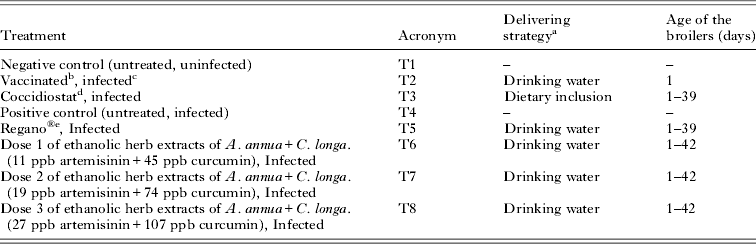
The study was carried out at the experimental facilities of Korin Agricultural Ltd. (www.korin.com.br) located in the municipality of Ipeúna, Sao Paulo, Brazil (22°24′S, 47°41′W). On 15 August 2011, 1-day-old male broilers (Cobb 500S, n = 1440) previously vaccinated in hatchery against Marek's Disease, fowlpox and Gumboro Disease were randomly allocated to 48 pens distributed in eight treatment combinations with six replicates of 30 broilers, giving a total of 180 broilers per treatment. Three different dose levels of a combination of A. annua and C. longa ethanolic extracts (Low, Medium and High) supplemented in drinking water were compared with a negative control (uninfected, untreated), a positive control (infected and untreated), treatment with chemical coccidiostats (see next section), vaccination and a product based on oregano. Table 1 describes the treatments, the supplementation strategies, doses, age and duration of treatments. Each pen measured 3·0 m2 (1·5×2 m) with food and water supplied ad libitum.
Description of treatments, acronyms, supplementation strategy and age of the broilers when treatments were supplemented

a Preparation of mixtures were performed every second day. 155 L of tap water were mixed with dosages of herbal ingredients in T5, T6, T7 and T8.
b Livacox vaccine (Merial Ltd. Brazil) consisted of attenuated oocysts of E. acervulina, E. maxima and E. tenella.
c Three (3) ‘seeders’ per pen (10%/pen) aged 8 days old where orally inoculated with 1 mL suspension containing 5×10⁴ E. maxima and 2×10⁵ E. acervulina sporulated oocysts. ‘Seeders’ were removed from the pens at 17 days old, 9 days post-inoculation.
d 50 ppm Nicarbazin+Narazin (Maxiban®) supplemented from 1 to 22 days of age and 66 ppm Salinomycin 12% (Coxistac®) supplemented from 22 to 39 days of age.
e 42 g Kg−1 Carvacrol+1·25 g kg−1 Timol (Regano®).
All pens were cleaned and disinfected 2 days before the beginning of the experiment and high standards of hygiene were followed during the trial. All practical handling was performed from outside the 48 pens in lateral corridors and the pens were isolated from each other by the use of PVC walls. When necessary, technicians used disposable plastic bags over their shoes to avoid contamination. Broilers were raised on concrete floors with wood shavings until they were 43 days of age, when the experiment was terminated. Broilers were raised in the comfort range of temperature and humidity recommended by the guidelines for the breed and the experimental protocols were in accordance with international guidelines for animal care and health and with Brazilian legislation.
Experimental diets, water supply and oral administration of herbal extracts
The feeding programme in our study followed the routine of farmers linked to the collaborative broiler company with diets adapted to the different development periods: initial (1–8 days), growth (9–22 days), fattening I (23–29 days), fattening II (30–36 days) and final (37–43 days). Broilers in the control groups (positive, T1 and negative, T4) were fed the basic diet without any other type of supplementation. Nicarbazin+narazin (Maxiban®) 50 ppm was supplemented from day 1 to 22 and salinomycin (Coxistac®) 66 ppm from day 22 to 39 in the diet of broilers receiving the chemical coccidostats (T3). Livacox vaccine at recommended doses (Merial Ltd. Brazil) was administered to the broilers on the day they arrived from the hatchery by the use of the movable water dispensers situated in each replicated pen (T2). Broilers in group T5 were supplemented with a product based on oregano extract containing carvacrol+timol (Regano®) and broilers in T6, T7 and T8 received the herbal mixtures via drinking water from day 1 of their lives.
Eight water tanks (one tank per treatment) of 160 L capacity were raised above ground in the chicken house and water was distributed by gravity to each replicated pen (n = 6 per treatment) by the use of plastic hoses. Every other day from the beginning of the trial, the water in the tanks including the herbal extract mixture, also including T5, was replaced. Treatment supplements in water were prepared at 2-day intervals to avoid any confounding factor related to possible instability or oxidation of the herbal components.
The herbal extracts of A. annua and C. longa were prepared at CPQBA – University of Campinas, Brazil – using the same extraction procedure for both plant species. In summary, 100 g of dried leaves or 100 g curcuma powder were mixed with 1 L ethanol 70% (700 mL ethanol 97°+300 mL distilled water) in two 1-L Erlenmeyer flasks wrapped with aluminium foil to prevent oxidation and degradation by light. The mixtures were kept in a dark, temperature-controlled room at 22 °C and homogenized with circular movements twice a day for 20 days. The contents were filtered by using paper filters and transferred to 100-mL flasks with dropping glass dispensers. Flasks were properly labelled and stored in the refrigerator at 5 °C until needed.
One week before the trial, the flasks containing the ethanolic herbal extracts of A. annua and C. longa were transported to the experimental station at Korin Agropecuária Ltd. and kept in the fridge before use. One day before allocating chicks to pens, the ethanolic concentrated solutions were mixed with 155 L tap water using the same volume of the herbal extracts for each dosage (1·5 mL of each extract in T6, 2·5 mL for T7 and 3·6 mL for T8). The content of active ingredients was estimated by HPLC-UV according to Ferreira and Gonzales (Reference Ferreira and Gonzales2009). The A. annua ethanolic extract was found to contain 1·15 mg artemisinin mL−1, while from proximal calculations, the ethanolic extract of C. longa had an estimated concentration of 4·6 mg curcumin mL−1. From relevant literature on curcumin and artemisinin contents in raw materials and in herbal ethanolic extracts (Souza and Glória, Reference Souza and Glória1998; Ferreira et al. Reference Ferreira, Peaden and Keiser2011 respectively) we estimated that the three dosages supplemented provided a 1:4 ratio of artemisinin:curcumin (Table 1).
Transmission by contact and monitoring strategy
At day 8, three randomly chosen broilers per pen (n = 18 per treatment) were artificially inoculated by gavage with a 1-mL suspension of distilled water with 5×10⁴ E. maxima+2×10⁵ E. acervulina sporulated oocysts. Strains of intermediary virulence were obtained in the Laboratory of Molecular Biology of Coccidians, Department of Parasitology, University of Sao Paulo. These broilers were nominated ‘seeders’ and were raised with contemporary broilers with the aim of transmitting the disease by contact (Velkers et al. Reference Velkers, Swinkels, Rebel, Bouma, Daemen, Klinkenberg, Boersma, Stegeman, de Jong and Heesterbeek2010). Seeders were removed from the pens 9 days post inoculation and harvested (cervical dislocation) for scoring of lesions (n = 5 per treatment) in a strategy adapted from Johnson and Reid (Reference Johnson and Reid1970) and supported by illustrations provided by Anonymous (1990). Results (Table 3) of scoring of lesions show the distribution of lesions caused by E. acervulina (duodenum) and E. maxima (middle section of small intestine) separately as proposed by Conway et al. (Reference Conway, Sasai, Gaafar and Smothers2003).
To assess the spread of infection by the seeders, five broilers were randomly selected in each pen and nominated as ‘tracers’. Twice weekly starting 3 days post inoculation of seeders, the tracers were placed in communal cages (one cage per pen) until one drop per tracer was available for pooled samplings of fecal samples. In total, eight pooled fecal samples per pen were examined during the trial. On the same day as fecal collection, pooled samples (n = 48) were analysed by a modified McMaster technique using saturated NaCl solution with 50% glucose monohydrate as flotation fluid with a sensitivity of 20 oocysts per g of feces (OPG) (Almeida et al. Reference Almeida, Horsted, Thamsborg, Kyvsgaard, Ferreira and Hermansen2012).
Performance attributes
Consumption of feed per pen was monitored and recorded every week. Individual body weight of the same 10 broilers in each pen (not seeders or tracers) (n = 60 per treatment) was measured every week. We estimated performance attributes by considering the mean body weight at 24 h post hatch, at 22 days of age, and when broilers were 43 days old before slaughter. With this strategy, we could estimate body weight gain, daily gain, feed intake and feed conversion rate for two main periods – before and after expected infection and for the total experiment (1–22 days; 23–43 days and 1–43 days of age). Results of performance attributes are presented as the mean±s.e.m. and averaged for each treatment combination. Performance attributes were the most important indicators of responses to different treatments, while lesion scores and infection dynamics provided by OPG were supportive indicators.
Statistical analysis
Broilers in our study were allocated to pens in a completely randomized design. Differences in performance attributes were assessed by analysis of variance with one-way ANOVA in SAS and the dependent variables were the mean values for each attribute observed for each pen (individual body weight gain, feed intake and feed conversion rate) and the independent variables were the treatments. Data on mortality were analysed by the Chi-square test. Categorical data on lesion score were analysed using the GENMOD procedure in SAS (DIST = MULTINOMIAL) with link functions for cumulative probabilities (LINK = CUMLOGIT). Differences between individual treatments were tested with Fisher's Exact Test for 2×2 tables for small samples (Quinn and Keough, Reference Quinn and Keough2002). The infection dynamics were analysed by a mixed procedure (PROC MIX) in SAS (SAS, 2000) where the statistical unit was the logarithmically transformed value for each OPG observation according to the following model:
 $$Y_{ijk} = \mu + \alpha _i + \beta _j + \left( {\alpha \beta} \right)_{ij} + A_{k(ij)} + \varepsilon _{ijk} $$
where Y ijk is the natural logarithm of the number of oocysts per gram of feces (OPG) for each pen in each sampling date; μ is the mean value; α i is the treatment, i is 1,2,3,4,5,6,7,8 (Uninfected negative control; Vaccinated, infected; Coccidiostat, infected; Untreated, Infected; Regano®, Infected; Dose 1 (LOW) of herbal extracts, Infected; Dose 2 (MEDIUM) of herbal extracts, Infected; Dose 3 (HIGH) of herbal extracts, Infected); β j is the OPG sampling date; j is (1 to 8); (αβ) ij is the interaction treatment×OPG sampling date; A k is the random effect of pen number (1 to 48) and ε ijk is the residual. Sampling date was defined as repeated measurement and ε ijk was assumed to have a multivariate distribution where observations from different treatments were uncorrelated, while observations from different weeks were assumed to have a Toeplitz (Type = TOEP) correlation structure. P-values less than or equal to 0·05 were considered statistically significant.
RESULTS
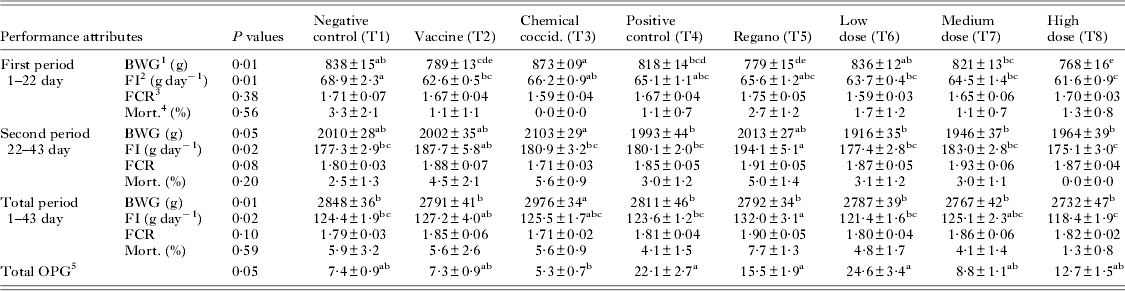
For the initial growing period (1–22 days), broilers supplemented with the botanical mixtures (T6, T7 and T8) and broilers vaccinated (T2) had lower feed intakes compared with broilers in the uninfected group (T1) (Table 2). In the final period investigated (22–43 days), broilers supplemented with Regano® (T5) and broilers vaccinated (T2) had the highest feed intakes compared with broilers in the negative control group (T1). Measured over the entire experimental period, feed intake was highest for the broilers consuming Regano® (T5) and lowest for the broilers consuming the High dose of the botanical mixture (T8).
Performance attributes for each treatment* for two distinct periods under investigation and for the entire period investigated. Periods consisted of 1 to 22 days of age, 22 to 43 days of age and 1 to 43 days of age. Degree of infection is represented by the total sum of OPG over 8 consecutive samplings for each treatment combination. All results presented are in LS means±s.e.m.

Number in a row marked with different letters are significantly different (P<0·05).
* Treatments consisted of: T1 = Uninfected negative control (untreated, uninfected); T2 = Vaccinated, infected; T3 = Coccidiostat, infected; T4 = Untreated, Infected (positive control); T5 = Regano®, Infected; T6 = Dose 1 (Low) of herbal extracts, Infected; T7 = Dose 2 (Medium) of herbal extracts, Infected; T8 = Dose 3 (High) of herbal extracts, Infected.
1 BWG=Body weight gain for the period specified (g).
2 FI=Feed intake for the period specified (g/broiler/day).
3 FCR=kg feed consumed/body weight gain in kg for the period specified.
4 Mort. (%)=Percentage mortality observed for the period specified.
5 Total OPG=Total sum over 8 sampling dates×100.
In the initial period (1–22 days), body weight gain (BWG) was higher for the broilers supplemented with the chemical coccidiostats (T3) than in most other treatments, whereas broilers vaccinated (T2), supplemented with Regano® (T5), and given the High dose of the herbal mixture (T8) had the lowest BWG.
In the second growing period (22–43 days), after the dissemination of oocysts by the seeders, supplementation of chemical coccidiostats resulted in a higher BWG than supplementation with the herbal mixture, but with no difference from the vaccinated broilers (T2), the broilers in the negative control group (T1) and the broilers fed Regano® (T5). There were no differences in FCR in any of the periods investigated (Table 2). For the total duration of the experiment (1–43 days), BWG was higher for the broilers given chemical coccidiostats than in all other treatments, but no significant differences between any of the other treatments were observed (Table 2).
Mortality was low in the first part of the experiment (1–22 days) with no deaths in the group given the chemical coccidiostat. However, in the second growing period (22–43 days), there was a trend for mortality to be lower (P = 0·08) for the broilers given the highest dosage of the herbal combination (T8, 0·0%) compared with the birds given the chemical coccidiostat (T3, 5·6%).
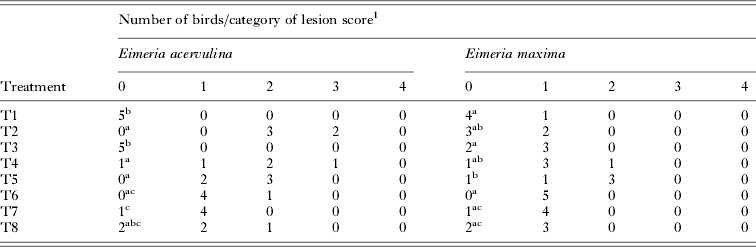
Table 3 illustrates the distribution of scores of lesions observed in the duodenum (E. acervulina) and in the small intestine (E. maxima), respectively, of the five seeders per treatment 9 days post inoculation. Overall, the treatment affected lesion score distribution significantly for both E. acervulina and E. maxima (P<0·01 and P<0·05, respectively). As expected, no lesions were observed for the broilers in the negative control group (T1) and for broilers supplemented with the chemical coccidiostat (T3) in the duodenum (E. acervulina). Vaccinated broilers (T2) showed the highest frequency of lesions from E. acervulina, very similar to broilers in the positive control group (T4).
Distribution of lesion scores in broilers inoculated with E. acervulina or E. maxima supplemented with different treatments

1 Distributions of scores in five categories based on severity of lesions (0 to 4). Different superscripts in the same column represent statistically different (P⩽0·05) distributions after Fisher Exact Tests. Number of birds per treatment level equals 5.
Source: After Conway et al. Reference Conway, Sasai, Gaafar and Smothers2003. Treatments consisted of: T1 = Negative control (untreated, uninfected); T2 = Vaccinated, infected; T3 = Coccidiostat, infected; T4 = Untreated, Infected (positive control); T5 = Regano®, Infected; T6 = Dose 1 (Low) of herbal extracts, Infected; T7 = Dose 2 (Medium) of herbal extracts, Infected; T8 = Dose 3 (High) of herbal extracts, Infected.
Broilers supplemented with Regano® (T5) did not differ from the positive control group (T4) or vaccinated (T2) in extent of lesions caused by E. acervulina (Table 3). Broilers supplemented with Low, Medium and High doses of the herbal mixture (T6, T7 and T8 respectively) had an intermediary distribution of lesions, with response tending to be dosage-dependent (Table 3). The two higher doses of the mixture A. annua and C. longa produced fewer lesions compared with the vaccinated broilers (T2), broilers supplemented with Regano® (T5) and broilers in the positive control group (T4). However, higher scores were observed for treatments T6, T7 and T8 when compared with broilers given the chemical coccidiostat (T3) and broilers in the negative control group (T1).
The scoring of lesions in the mid-intestinal mucosal surface (E. maxima) (Table 3) indicated that broilers receiving the two highest dosages of the herbal combination (T7 and T8) did not differ from broilers receiving the chemical coccidiostats (T3). In addition, vaccinated broilers (T2) had the lowest lesion scores in the middle section of the intestine, while broilers given Regano® (T5) had the highest scores.
In terms of oocyst excretion, broilers in groups T6 and T4 had the highest infection peaks at 15 days post inoculation (PI) and a second peak at 22 days PI compared with broilers receiving the chemical coccidiostat (T3), the uninfected group (T1) and broilers receiving the Medium dose of the combined A. annua and C. longa extracts (T7) (Fig. 1). Considering the total number of oocysts excreted, broilers supplemented with Medium (T7) and High (T8) levels of herbal ethanolic extracts showed intermediary numbers of OPG that were no different from those recorded for vaccinated broilers (T2) and for broilers in the uninfected group (T1), and not statistically different from the broilers given chemical coccidiostats (Table 2).
Mean oocyst excretion over time for each treatment combination*. Samplings for OPG counts begun when broilers were 11 days old, the third day after the inoculation of the ‘seeders’ in respect to pre-patent periods of Eimeria spp. Treatments consisted of: T1 = Negative control (untreated, uninfected); T2 = Vaccinated, infected; T3 = Coccidiostat, infected; T4 = Untreated, Infected (Positive control); T5 = Regano®, Infected; T6 = Dose 1 (Low) of herbal extracts, Infected; T7 = Dose 2 (Medium) of herbal extracts, Infected; T8 = Dose 3 (High) of herbal extracts, Infected.

DISCUSSION
To our knowledge, this is the first field study investigating the combined use of A. annua and C. longa (ethanolic extracts) against coccidiosis in broilers. The rationale for the study was the reporting of complementary effects of the artemisinin:curcumin combination against malaria (Nandakumar et al. Reference Nandakumar, Nagaraj, Vathsala, Rangarajan and Padmanaban2006; Isacchi et al. Reference Isacchi, Bergonzi, Grazioso, Righeschi, Pietretti, Severini and Bilia2012; Padmanaban et al. Reference Padmanaban, Nagaraj and Rangarajan2012). Our results showed a trend for a dose-dependent effect (based on a 1:4 ratio) against dual infections caused by Eimeria acervulina and E. maxima reflected by performance attributes and survival, reduced lesion score and excreted oocysts.
In general, broilers in the uninfected group (T1) showed no lesions in the mucosal surface caused by E. acervulina infection and a very low score attributed to infections caused by E. maxima (Table 3). However, when OPG counting was considered (Table 2 and Fig. 1), tracers located in two replicate pens in T1 started excreting oocysts between days 18 and 23, suggesting contamination of pen litter due to the opportunism of the Eimeria parasites.
Thus, when broilers were 25 to 30 days old, oocysts were found in two replicates of the negative group (T1). Even with the strict hygiene measures applied during the study, broilers in all six replicates of the uninfected group (T1) were contaminated and excreted oocysts in the final part of their growing period (22–43 days). Even though BWG for the second period did not differ from broilers fed chemical coccidiostats (T3), when the total period was taken into account, broilers in T1 had a smaller BWG than broilers receiving chemical coccidiostats (T3) (Table 2). However, Rosen (Reference Rosen, Wallace and Chesson1995) in a review of more than 1200 studies concluded that supplementation with ionophores improves performance attributes of fast-growing broilers, suggesting that the low infection experienced in tracer broilers for group T1 did not influence performance attributes and would be compatible with uninfected broilers. Nevertheless, flies, ants, other insects, and also the feet and hands of technicians may have served as vectors and highlight the fast dissemination of the Eimeria parasites (Henken et al. Reference Henken, Ploeger, Graat and Carpenter1994).
In contrast, broilers in the positive group (T4) had the highest lesion scores for E. acervulina infections (Table 3) and a larger number of excreted oocysts, but with no increase in mortality compared with other groups (Table 2). Broiler seeders were artificially challenged with dual coccidial infections at 8 days of age and euthanized for lesion scoring 9 days post inoculation, allowing sufficient time to contaminate the litter in each pen in accordance with the pre-patent period of E. acervulina and E. maxima parasites (Eckert et al. Reference Eckert, Taylor, Catchpole, Licois, Coudert, Bucklar, Eckert, Braun, Shirley and Coudert1995). From this strategy (even compromising the identification of lesions in broiler intestines in accordance with the pre-patent period of the parasites as proposed by Johnson and Reid (Reference Johnson and Reid1970)), it allowed our group to assess the effects of treatments on intestinal lesions and, at the same time, allow seeders to infect fellow broilers by contact (Velkers et al. Reference Velkers, Swinkels, Rebel, Bouma, Daemen, Klinkenberg, Boersma, Stegeman, de Jong and Heesterbeek2010) imitating the natural transmission pathway on commercial farms, which was the objective of the current study.
Vaccinated broilers had the highest lesion scores (three individuals scored 2 and two individuals scored 3) in the duodenum mucosal surface (Table 3). Perhaps the time of the E. acervulina challenge, provoked by the artificial inoculation (2×10⁵ oocysts), was too close to vaccination time, suggesting that the time lapse between vaccination and challenge was not sufficient to allow proper immunization, as also found by Oviedo-Rondón et al. (Reference Oviedo-Rondón, Clemente-Hernández, Salvador, Williams, Losa and Stephen2006). This also harmonizes with the theory that antibodies released after an initial challenge take time to induce protection by blocking the development and replication of parasites (Crane et al. Reference Crane, Murray, Gnozzio and MacDonald1988; Hafeez et al. Reference Hafeez, Akhtar, Javed and Haq2007; Anwar et al. Reference Anwar, Akhtar, Hussain, Muhammad and Haq2008).
Vaccinated broilers (T2) had the lowest distribution of lesions in the middle section of the small intestine (three individuals scored 0 and two individuals scored 1), which is the site of E. maxima infections, the results being comparable to uninfected controls (T1). This could be either because vaccination provided sufficient immunity against E. maxima, quite different from what was observed with the absence of protection against E. acervulina, or because – according to Mathis (Reference Mathis2005) – heavier challenges from E. acervulina may inhibit the development of E. maxima. The former hypothesis sounds more plausible since the lesion scores caused by E. acervulina were higher for broilers in T2 (Table 3).
We observed a trend in mortality of broilers and lesions caused by E. acervulina for dose-dependent response when supplementing ethanolic extracts of A. annua and C. longa equivalent to a artemisinin:curcumin ratio of 1·4. In addition, when assessing the scoring of lesions in the mid-intestinal mucosal surface caused by E. maxima infections (Table 3), broilers in T7 and T8 did not differ from broilers supplemented with the chemical coccidiostats (T3).
In terms of total numbers of oocysts excreted by tracers, broilers given Medium and High doses did not respond differently from broilers receiving the chemical coccidiostat supplement (Table 2). But on the other hand, the two higher dosages of the mixtures A. annua and C. longa (T7 and T8) provided some protection compared with the untreated group (T4), although not statistically different for the total OPG (Table 2). Also (as supported by Table 3), the lesion score caused by E. acervulina was significantly lower for group T7 than for group T4 (infected, untreated). For the total period, groups T7 and T8 had lower mortality rates (4·1 and 1·3%, respectively) than the group treated with the chemical coccidiostat (T3, 5·6%). Even though they were not different in terms of total number of oocysts excreted (Table 2), the infection dynamics (Fig. 1) illustrate that the broilers receiving the Medium (T7) dose had a smaller but not statistically different infection peak than broilers receiving the High dose (T8), comparable to broilers on the chemical coccidiostat.
Although one could argue that the interval between samplings for OPG did not capture the peak of oocyst excretion, in our opinion the combination of measured parameters (OPG and lesion score) helped explain the effects on the main indicators (performance attributes), and thus captured the differences observed in tested treatments.
Strategies to control coccidiosis in conventional production systems are dependent on chemical drugs, while in organic systems live vaccines or commercial preparations of plant-based products are used (Abbas et al. Reference Abbas, Colwell and Gilleard2012). Some studies associate vaccination with botanical products. For example, Waldenstedt (Reference Waldenstedt2003) suggested vaccination in combination with oregano-containing products to improve the intestinal health of chickens and thus reduce the effects caused by coccidiosis.
From the results achieved in this study, we conclude that broilers given a supplement of chemical coccidiostats showed superior performance attributes during the trial due to a better protection against dual infections caused by E. acervulina and E. maxima parasites. However, despite a lower BWG for the two highest doses of the herbal mixture, we suggest that the trend in reduced mortality, the protection against lesions and reduced OPG counts provided by the high dose of the combined A. annua and C. longa ethanolic extracts, compared with the positive control, are indications that the supplementation of herbal extracts in drinking water can be a feasible alternative method of coccidia control in intensive organic production systems. It is affordable, easy to implement at farm level and is residue-free. However, the suitability of the herbal extracts used in this study to control clinical coccidiosis resulting from exposure to high infection pressure, or more pathogenic species, remains to be investigated. Further investigations into dosages and modes of action of this combination would be useful. In addition, supplementation of herbal extracts in combination with other management practices may help farmers engaged in the production of broilers reduce the use of synthetic drugs.
ACKNOWLEDGEMENTS
The authors wish to thank Evandro Possamai, Dayana Pereira and Pedro Lorga from Korin agropecuaria Ltd. for the logistical and technical support during the study. We also wish to thank the anonymous reviewers who constructively contributed to the quality of the manuscript.
FINANCIAL SUPPORT
The Danish Ministry of Science, Technology and Innovation is thanked for financing collaboration between Brazilian and Danish scientists. Aarhus University, SOAR – Research School for Organic Agriculture and Food Systems and Korin Agropecuária Ltd. – are thanked for supporting our study.