Individual differences in fearfulness have been the focus of considerable developmental research in the last few decades. Fearful individuals are characterized by behavioral inhibition; they tend to avoid risky acts and punishment and become physiologically aroused with unfamiliar people, situations, and events (Hirshfield, Biederman, Brody, Faraone, & Rosenbaum, Reference Hirshfield, Biederman, Brody, Faraone and Rosenbaum1997; Hirshfield-Becker et al., Reference Hirshfield-Becker, Biederman, Calltharp, Rosenbaum, Faraone and Rosenbaum2003). Fearfulness in early childhood has been found to predict behavioral inhibition in later childhood, which is in turn associated with anxiety and depression in later life (Biederman et al., Reference Biederman, Rosenbaum, Bolduc-Murphy, Faraone, Chaloff and Hirshfield1993; Schwartz, Snidman, & Kagan, Reference Schwartz, Snidman and Kagan1999).
Conversely, children who are temperamentally fearless are behaviorally disinhibited; they display high approach and lack of restraint to novel and unfamiliar people and situations (Hirshfield-Becker et al., Reference Hirshfield-Becker, Biederman, Calltharp, Rosenbaum, Faraone and Rosenbaum2003). Fearlessness is associated with higher levels of externalizing symptoms (Colder, Mott, & Berman, Reference Colder, Mott and Berman2002), and fearless individuals are more likely to engage in aggressive and antisocial behavior because they do not fear the negative consequences of their behavior (Raine, Reference Raine1993).
Extremes in fearful temperament have long been associated with later psychopathology and risk pathways. However, there are three limitations in this line of work. First, there is a lack of prospective, longitudinal research from infancy onward examining the stability of fearful temperament. Second, few studies have used a multimethod approach in which physiological parameters are assessed, as well as behavioral and maternally reported emotion. Third, we know very little about the associations between fear and later emerging emotions, for example, moral emotions such as guilt, which also play an important role in the development of internalizing and externalizing psychopathology (Stuewig, Tangney, Heigel, Harty, & McCloskey, Reference Stuewig, Tangney, Heigel, Harty and McCloskey2010). As a result, our understanding of the early development of fearful temperament is limited. We address these limitations in this study by measuring fearful temperament longitudinally from infancy through to early childhood. In addition, we investigate the association between early fearfulness and the development of guilt later in childhood.
The Development of Fear
Past research in child psychopathology has focused almost exclusively on school-aged children (Calkins & Dedmon, Reference Calkins and Dedmon2000). It is important to improve our understanding of the development of children's temperament across early childhood, because we know that temperament is an underlying factor that can facilitate or inhibit children's socioemotional functioning (Blandon, Calkins, Keane, & O'Brien, Reference Blandon, Calkins, Keane and O'Brien2010). Individual differences in fearful and fearless temperament are posited by some to be relatively stable over time (Buss & Plomin, Reference Buss and Plomin1984), whereas others argue that temperamental changes occur as a result of neurobiological changes (Blandon et al., Reference Blandon, Calkins, Keane and O'Brien2010; Derryberry & Rothbart, Reference Derryberry, Rothbart, Kalverboer and Gramsbergen2001). Further research is needed to understand the stability of fear in order to make predictions about how it develops over time.
Although fear has been studied in infants (Kagan, Reference Kagan and Izard1982; Kochanska, Coy, Tjebkes, & Husarek, Reference Kochanska, Coy, Tjebkes and Husarek1998; Schwartz et al., Reference Schwartz, Snidman and Kagan1999), much less research has focused on the development of fear from infancy onward. Studies that have investigated the stability of fear from infancy failed to find consistency with respect to the age at which fear becomes a stable temperament characteristic. Kochanska (Reference Kochanska2001) investigated fear from 9 months, finding stability from 14 months onward; whereas Lemery and colleagues began their investigation at 3 months, finding some stability from 24 months, but only intermediate forms of fearfulness were stable (Lemery, Goldsmith, Klinnert, & Mrazek, Reference Lemery, Goldsmith, Klinnert and Mrazek1999). These studies used only one method of assessment (observational or mother reported fear, respectively).
Finding stability in fearfulness and fearlessness has significant implications for later psychopathology. Fearfulness in early childhood has been associated with shyness and internalizing psychopathology, including agoraphobia, panic disorders, and multiple anxiety disorders (Biederman et al., Reference Biederman, Rosenbaum, Bolduc-Murphy, Faraone, Chaloff and Hirshfield1993; Biederman, Rosenbaum, Hirshfield, & Faraone, Reference Biederman, Rosenbaum, Hirshfield and Faraone1990; Schwartz et al., Reference Schwartz, Snidman and Kagan1999). Many externalizing behavioral problems also have an early onset. The Diagnostic and Statistical Manual of Mental Disorders requires many behaviors to be apparent before middle childhood. However, the vast majority of developmental research into risk pathways for externalizing disorders studies children from middle childhood onward. Mothers of children with externalizing behavioral problems have reported that their children were difficult and irritable as infants (Weiss & Hechtman, Reference Weiss and Hechtman1993). Frick (Reference Frick2004) has suggested that certain temperamental characteristics observed in infants could actually be symptoms of externalizing behaviors. Regardless of temperamental risk factors for aggression that are seen in infancy, such as a difficult temperament, there is a lack of longitudinal data to identify risk pathways.
Kagan and colleagues examined early temperament, identifying profile patterns in children at 21 months of age. Children were classified as either inhibited or uninhibited. Inhibited children were identified as being fearful, avoiding novelty, and displaying a higher heart rate (HR) during unfamiliar situations (Kagan, Reznick, Clarke, Snidman, & Garcia-Coll, Reference Kagan, Reznick, Clarke, Snidman and Garcia-Coll1984; Kagan, Reznick, & Snidman, Reference Kagan, Reznick and Snidman1987). Uninhibited children were identified as being fearless, approached novelty, and had a lower HR during unfamiliarity. Behavioral differences between the two groups were maintained across childhood, as was a higher HR in inhibited children. However, Pfeifer, Goldsmith, Davidson, and Rickman (Reference Pfeifer, Goldsmith, Davidson and Rickman2002) found that children changed in their levels of inhibition over the course of childhood. More research is needed to clarify the organization of children's behaviors over early development, whether there are changes in levels of fear or whether behaviors remain stable over early childhood. In order to gain a fuller picture, a multimethod approach investigating behavior and biological components of fear is needed.
Fear Physiology
Although most definitions of temperament suggest that there is a biological basis, developmental research has largely focused on observations of temperament in the laboratory and on parental reports. These measures are not without limitations (Kagan, Reference Kagan1994). Both behavioral and physiological measures of fear are needed in order to capture a reliable picture of individual differences in fear response (Lewis & Ramsay, Reference Lewis and Ramsey1999).
Psychophysiological measures are useful in the study of infant temperament for a number of reasons. They are sensitive to changes in psychological state, and because they are nonverbal they are particularly useful when studying infants (Campos, Reference Campos and Lipsitt1976). Measures of HR and skin conductance level (SCL) have been carried out in infants and children (e.g., Burgess, Marshall, Rubin, & Fox, Reference Burgess, Marshall, Rubin and Fox2003; Buss, Goldsmith, & Davidson, Reference Buss, Goldsmith and Davidson2005; Calkins & Dedmon, Reference Calkins and Dedmon2000; Fracasso, Porges, Lamb, & Rosenberg, Reference Fracasso, Porges, Lamb and Rosenberg1994; Hernes et al., Reference Hernes, Mørkrid, Fremming, Ødegården, Martinsen and Storm2002; Provost & Gouin-Decarie, Reference Provost and Gouin-Decarie1979) and appear to be reliable, sensitive, and well validated physiological measures of temperament (Campos, Reference Campos and Lipsitt1976; Nigg, Reference Nigg2006; Strelau, Reference Strelau1998). However, psychophysiological assessments in infancy, specifically those involving the autonomic nervous system (ANS), are rarely carried out following emotion provocation (i.e., Laboratory Temperament Assessment Battery [Lab-TAB]; Goldsmith & Rothbart, Reference Goldsmith and Rothbart1999), nor are they done across childhood (Fox, Reference Fox1989; Scarpa, Raine, Venables, & Mednick, Reference Raine, Venables and Mednick1997). The few studies in which psychophysiology was measured during emotional challenge did not involve infants (Calkins & Dedmon, Reference Calkins and Dedmon2000; Kagan et al., Reference Kagan, Reznick and Snidman1987).
Research in developmental psychopathology has integrated the role of physiology in order to understand the development of risk pathways (Cicchetti & Gunnar, Reference Cicchetti and Gunnar2008). It is important to investigate potential biological risk pathways to aggression, because antisocial and criminal adults often have their onset of deviant behavior in childhood (Loeber & Stouthamer-Loeber, Reference Loeber and Stouthamer-Loeber1997). There is increasing evidence that aggressive children with persistent antisocial behavior are characterized by neurobiological problems (van Goozen, Fairchild, Snoek, & Harold, Reference van Goozen, Fairchild, Snoek and Harold2007). Physiological dysregulation is common in children with internalizing and externalizing disorders (Bauer, Quas, & Boyce, Reference Bauer, Quas and Boyce2002). High resting HR and low HR variability predict more extreme fear and inhibition (Kagan, Reference Kagan1997) and more behavioral inhibition longitudinally (Kagan et al., Reference Kagan, Reznick, Clarke, Snidman and Garcia-Coll1984). By contrast, low resting HR has been proposed to be the best marker of antisocial behavior (Scarpa et al., Reference Scarpa, Raine, Venables and Mednick1997). Low baseline SCL has also been linked to externalizing behavior (Snoek, van Goozen, Matthys, Buitelaar, & van Engeland, Reference Snoek, van Goozen, Matthys, Buitelaar and van Engeland2004; van Goozen, Matthys, Cohen-Kettenis, Buitelaar, & van Engeland, Reference van Goozen, Matthys, Cohen-Kettenis, Buitelaar and van Engeland2000) and to predict persistence of conduct disorder from childhood onward (Van Bokhoven, Matthys, van Goozen, & van Engeland, Reference Van Bokhoven, Matthys, van Goozen and van Engeland2005).
Much less is known about physiological reactivity during stress in very young children. The few available findings suggest that physiological reactivity is an important factor that not only reflects variation in temperament but also identifies those at risk for externalizing or internalizing behavioral problems in later life (Kagan, Reference Kagan1994).
There is evidence that physiological indices of fearlessness in early childhood predict later externalizing psychopathology. In a prospective study Raine, Venables, and Mednick (Reference Raine, Venables and Mednick1997) found that children who had low HR at 3 years of age were rated as more aggressive at 11 years. Similarly, Gao, Raine, Venables, Dawson, and Mednick (Reference Gao, Raine, Venables, Dawson and Mednick2010) found that poor fear conditioning at age 3 predicted crime at age 23. According to the authors, these findings suggest that low levels of physiological arousal early in life impact on later behavior through a lack of fear associated with the low arousal. The consequence is that the individual fails to avoid situations, events, and contexts associated with punishment now and in the future; and this affects the development of their conscience. The question arises as to whether it is possible to identify predictors before the age of 3. The work by Raine and colleagues highlights the importance of a multimethod approach, including the identification of early physiological profiles. At present we do not know whether behavioral and physiological responses to fear challenge are stable in children or whether there is differential stability in physiological and behavioral reactivity.
In the present research we were interested in (a) whether we would be able to identify fearless and fearful infants based on behavioral, physiological, and maternal report measures; (b) whether children would still be characterized as fearful or fearless 2 years later; and (c) which type of measure would be helpful in identifying these subgroups.
Fear and the Development of Guilt
In addition to understanding the role of early fear as a precursor to later psychopathology, it is important to investigate other emotions with which fear may be associated, especially moral emotions such as guilt. Guilt in children is defined as the feeling of distress following a mishap or transgression (Cole, Barrett, & Zahn-Waxler, Reference Cole, Barrett and Zahn-Waxler1992; Kochanska, Gross, Lin, & Nichols, Reference Kochanska, Gross, Lin and Nichols2002). Extremes in guilt proneness have been associated with later psychopathology. A lack of guilt proneness has been found to be positively related to externalizing behavior (Ferguson, Stegge, Miller, & Olsen, Reference Ferguson, Stegge, Miller and Olsen1999); aggression (Stuewig et al., Reference Stuewig, Tangney, Heigel, Harty and McCloskey2010); and anger, hostility, and externalization of blame (Stuewig et al., Reference Stuewig, Tangney, Heigel, Harty and McCloskey2010; Tangney & Dearing, Reference Tangney and Dearing2002). Moreover, children who experienced guilt were less likely to be arrested, convicted, and incarcerated as adolescents and more likely to practice safe sex and not abuse drugs (Tangney & Dearing, Reference Tangney and Dearing2002). Explanations for these adaptive effects focus on guilt requiring the individual to self-reflect and think about what they did and why (Stuewig et al., Reference Stuewig, Tangney, Heigel, Harty and McCloskey2010). Individuals high in psychopathic traits fail to experience guilt (Raine, Reference Raine1993).
Guilt is likely to be influenced by temperament (Kochanska, Barry, Jimenez, Hollatz, & Woodard, Reference Kochanska, Barry, Jimenez, Hollatz and Woodard2009). Fearful temperament, in particular, has been proposed to be a critical component in the development of guilt and conscience. Guilt is said to develop once the child feels empathy for others and responsibility for themselves, with fearful children more likely to feel guilty following a transgression because of their increased sensitivity to punishment (Dienstbier, Reference Dienstbier, Izard, Kagan and Zajonc1984; Gray, Reference Gray1982; Kagan, Reference Kagan and Damon1998; Kochanska, Reference Kochanska1993) and because they learn more easily to inhibit transgressions of moral behavior that are associated with punishment (Dienstbier, Reference Dienstbier, Izard, Kagan and Zajonc1984). In contrast, children who are temperamentally fearless are less likely to learn from the distress associated with transgressing, not only because they are less responsive to the fear of punishment following a wrongdoing (Dienstbier, Reference Dienstbier, Izard, Kagan and Zajonc1984) but also because they do not anticipate these feelings in future situations (Fowles, Reference Fowles and Spaulding1994; Lykken, Reference Lykken1995).
There are many inconsistencies in the developmental literature on guilt, including when guilt develops, how it differs from other moral emotions such as shame, and how it can be measured. Although there are large discrepancies in views about the age at which guilt develops, ranging from 8 years to 18 months (Ferguson, Stegge, & Damhuis, Reference Ferguson, Stegge and Damhuis1991; Kagan, Reference Kagan1984; Kochanska, Reference Kochanska1991), Kochanska (Reference Kochanska2001) argues that most developmental psychologists believe that in the second year of life young children begin to be clearly aware of their transgressions, misbehaviors, or substandard performances. Defined in this way, guilt has been identified as early as 22 months (Kochanska et al., Reference Kochanska, Gross, Lin and Nichols2002) or 24 months (Barrett, Zahn-Waxler, & Cole, Reference Barrett, Zahn-Waxler and Cole1993).
A number of researchers believe that it is important to distinguish between guilt and shame early in development (Barrett et al., Reference Barrett, Zahn-Waxler and Cole1993; Ferguson et al., Reference Ferguson, Stegge, Miller and Olsen1999), whereas others question whether this is possible (Kochanska et al., Reference Kochanska, Gross, Lin and Nichols2002). Kochanska (Reference Kochanska2001) believes that distinguishing guilt from shame at this point in development is premature, given the lack of understanding of very young children's responses to their transgressions. When children respond to transgressions by showing behavioral and affective signs of discomfort, this is regarded as an antecedent of future guilt (Kochanska et al., Reference Kochanska, Gross, Lin and Nichols2002). Barrett (Reference Barrett and Bybee1995) also claimed that in order to safely claim that a child experiences guilt, the toddler must display guilt-relevant behavior (e.g., facial/bodily distress, promoting reparation, acknowledgment/apology/confession for act) in a relevant context (i.e., just after a transgression happened). In the present research the term guilt will be used to describe a child's distress response to a mishap or transgression.
Most developmental research on guilt is with older children. It is difficult to relate empirical research on guilt in adolescents and adults to research on guilt in children. Guilt in adolescents and adults is often measured by self-report, with few studies using behavioral or physiological measures (Tilghman-Osborne, Cole, & Felton, Reference Tilghman-Osborne, Cole and Felton2010). Kochanska, DeVet, Goldman, Murray, and Putnam (Reference Kochanska, DeVet, Goldman, Murray and Putnam1994) used observational and maternal reported measures of guilt and found only a modest convergence between these two methods. Given our limited understanding of the development of guilt, a multimethod approach is needed to fully capture guilt expression in young children (Tilghman-Osborne et al., Reference Tilghman-Osborne, Cole and Felton2010).
From the above it will be clear that little developmental research has investigated the physiological component of guilt. It seems reasonable to assume that individual differences in arousal will also play an important role in variations in guilt. Fowles and Kochanska (Reference Fowles and Kochanska2000) investigated fear as a moderator of conscience in children at 32 months and 4 years using a multimethod approach. Fearful and SCL reactive children were more anxious later in childhood, and the behavioral and physiological measures of fear were almost equivalent in their role as moderators of socialization.
Are Fear and Guilt Linked?
It is widely accepted that the experience of guilt and the associated aversive arousal have an adaptive function. Diminished capacity to experience discomfort following a transgression may be a factor in poor avoidance learning and antisocial conduct (Lykken, Reference Lykken1995). If this is the case, children who experience guilt following a transgression would be less likely to transgress in the future (Dienstbier, Reference Dienstbier, Izard, Kagan and Zajonc1984; Hoffman, Reference Hoffman, Higgins, Ruble and Hartup1983; Kochanska et al., Reference Kochanska, Gross, Lin and Nichols2002). Fearless children are by definition less likely to inhibit behavior because they experience less arousal following aversive events and are therefore less likely to experience guilt. The inability to assimilate these feelings over time will fail to act as a deterrent to misbehave in future.
Kochanska and colleagues (1994) have investigated the association between fearful temperament and early conscience development using maternal report and behavioral data. In an influential study, Kochanska et al. (Reference Kochanska, Gross, Lin and Nichols2002) studied the association between observational guilt and fearfulness in 112 children at 22, 33, and 45 months; maternal ratings of guilt were collected at 22, 33, and 56 months. Fear and guilt were significantly correlated at every age of assessment, with fear at 33 months also being significantly associated with guilt at 45 months. Gender differences were also found, with girls displaying higher levels of guilt than boys at 33 and 45 months. These findings complement an earlier study finding a positive association between fearfulness in infancy and parent rated guilt at age 6 (Rothbart, Ahadi, & Hershey, Reference Rothbart, Ahadi and Hershey1994).
These findings show that there are associations between fear and guilt in early childhood. Fear has been found to be associated with guilt across early childhood, with higher levels of fear being associated with higher levels of guilt and predicting later guilt. Kochanska and colleagues' research investigates children from the age of 2 years, using maternal report and observational data. At the moment, we do not know whether earlier assessments of fear would be associated with the later development of guilt or how fear physiology is associated with guilt.
In the present research we studied the stability of fear over the first 3 years of life using behavioral, maternal reported, and physiological assessments, as well as its associations with guilt. Fear and guilt may act to inhibit and prevent problem behaviors, such as aggression and antisocial behavior. As such, they are important emotions in our understanding of developmental psychopathology more generally.
Method
Participants
Participants and their families were recruited from local nurseries and play centers in Cardiff (Wales). The participants were 100 infants who first took part in our research around their first birthday. All participants were reinvited around their second birthday. Of those, 20 were unable to attend and a further 10 were unable to complete the final part of the study around the third birthday, although one mother–child dyad returned who had not taken part at age 2. The main reasons for participants not completing the study were that the mothers had returned to work or had moved away from South Wales or we were unable to contact them. Overall, 70 children (36 boys, 34 girls) took part in the three waves of the study and are included in the current sample. The sample did not differ from the participants who dropped out in demographic characteristics (e.g., maternal age, family composition) or any of the study's dependent measures. The study was approved by the School of Psychology Research Ethics board at Cardiff University. The study was conducted in accordance with British Psychological Society guidelines and ethical protocol.
Procedure of the experimental session
The procedure took place in a child-friendly laboratory playroom. Mothers were asked to accompany their child to the laboratory where the children were assessed individually using several procedures designed to present an increasingly novel and challenging situation for the infants. The infant was given time to adjust to being in the laboratory and allowed to play with some age-appropriate toys while the procedure was explained to the mother. Once the mother thought the child had settled, ECG and SCL electrodes were placed on the child; baseline HR and SCL measures were taken when the mother and child were quietly playing together in the room for 3.5 min. The fear procedure took approximately 3.5 min. The mishaps paradigm lasted for approximately 2 min and was initiated after the child had recovered from the fear procedure. The mishaps/guilt paradigm was only used at the Year 3 assessment.
Lab-TAB Fear Paradigm
At each year of assessment, child fear and distress were assessed using the unpredictable mechanical toy component of the Lab-TAB (Goldsmith & Rothbart, Reference Goldsmith and Rothbart1999). It closely followed the protocol of the Lab-TAB. However, for the purposes of the present study the mechanical toy dog used in Lab-TAB was replaced by a remote-controlled robot and the mother was asked to leave the room. An unfamiliar experimenter entered the room and placed the robot approximately 1.5 m away from the child, who was strapped into a child car seat. The experimenter made the robot approach the child, stopping approximately 15 cm from the child, while making movements with its arms and emitting noise. The robot then walked backward and stopped at the back of the room for about 10 s before moving forward again. This trial was repeated three times, in line with the Lab-TAB protocol.
Coding
The Lab-TAB's guidelines were followed for the behavioral coding of the episode, which was carried out using video recording of the session. It was important to gain clear and full frontal shots of the infant's face. Each of the three trials of robot approach and movement in front of the child was separated into three epochs (robot walk toward child, robot moving in front of child part one, robot moving in front of child part two). This created a total of nine epochs that were scored separately. A subgroup of the six Lab-TAB dimensions was used for scoring in this study in order to score the same distress parameters as the mishap procedure measuring guilt. Each epoch was scored on the following dimensions and scales: intensity of facial fear (0–3), intensity of distress vocalization (0–2), and intensity of bodily fear (0–3). A composite fear score was made from the sum of the three scores. The fear score using three dimensions of Lab-TAB fear correlated highly with the full Lab-TAB composite score (Year 1, r = .87, p < .01; Year 2, r = .91, p < .01; Year 3, r = .94, p < .01).
To reduce the number of data, the highest score from a single epoch was used in the analyses to reflect the most intense behavioral score at a point in time. Scores ranged between 0 and 8 across all categories coded.
Four coders scored the episodes independently for 22% of the sample. Intracorrelation coefficients between coders ranged between 0.70 and 0.99 across the behavioral variables.
Mishap guilt paradigm
The mishaps paradigm was adapted from Kochanska et al. (Reference Kochanska, Gross, Lin and Nichols2002). The task involved contrived transgressions or “mishaps.” The experimenter presented the child with a tower, which she described as being her favorite toy and that she had made it herself. She told the child that she would share it with he/she, as long as they were very careful. Because the tower had been “rigged,” the object fell apart as soon as the child began to handle it. The experimenter then said “Oh my. . . .” with mild regret, and sat still in front of the child, with her face covered with her hands for 30 s. The experimenter then asked three standard questions, “What happened?”, “Who did it?”, and “Did you do it?” The child was then told that it was not their fault and there had been a problem with the tower. She then presented another partially built tower and asked the child to help her make it. The experimenter reassured the child the damage had not been the child's fault and assumed responsibility for it.
Coding
The coding system used in the current study was adapted from Kochanska et al. (Reference Kochanska, Gross, Lin and Nichols2002). To avoid ambiguity over the distinction of guilt and shame, the coding system focused on the level of distress to a mishap. The child's behavior was coded in 5-s epochs from when the tower fell to when the experimenter first told the child it was not his/her fault. The scoring reflects the level, or intensity, of the behavior. A subgroup of the five dimensions was used to measure the same parameters as distress during the fear procedure. Each epoch was scored on the following dimensions and scales: (a) bodily tension was scored on four categories: facial, posture, discomfort, and intense (if any behavior within the category was observed, the category would get a single score); this behavior was scored 0–3, depending on how many categories were present (intense would score the epoch a 3); (b) facial tension was scored the same as bodily tension with four categories: eyes, eyebrows, and mouth intense (0–3); and vocal distress (0–2). A composite guilt score was made from the sum of the three scores. The intensity score using three dimensions of distress correlated highly with the full mishaps distress score (r = .94, p < .01).
Data reduction
In order to reflect the level of distress to guilt, an intensity score was given. The highest score from a single epoch was used. This score is regardless of when this peak response occurred or the duration of the procedure. The score ranged between 0 and 8 across all categories coded, with 8 showing the highest level of distress. The kappa coefficients were calculated for two raters for each coded behavior for 30% of the sample (bodily tension, κѕ = 0.69; facial tension, κѕ = 0.83; vocal distress, κѕ = 0.84).
Mother-reported fear (Year 1)
Infant Behavior Questionnaire Revised
The Infant Behavior Questionnaire Revised (Gartstein & Rothbart, Reference Gartstein and Rothbart2003) assesses 14 domains of infant temperament, and the current study focused on the domain of “fear.” The fear subscale consisted of 16 items (Cronbach α = 0.88). Each item was rated by the frequency with which it had been observed over the last week (or in some cases 2 weeks) on a 7-point scale from never (1) to always (7). There was also the option to respond “does not apply” to each item. The items were deliberately constructed so that parents rated observed behaviors and did not have to make comparisons or global judgments or recall past behaviors (Rothbart, Reference Rothbart1981).
Mother-reported psychopathology (Years 2 and 3)
The Child Behavior Checklist for Ages 1.5–5
The Child Behavior Checklist (Achenbach & Rescorla, Reference Achenbach and Rescorla2000) is a standardized form that rates diverse aspects of behavioral, emotional, and social functioning within a normal or clinical range. The mother rates 99 problem items as 0 = not true of the child, 1 = somewhat/sometimes true, and 2 = very true/often. The scores are organized in syndromes and grouped into internalized or externalized groupings. Of interest in the current study is the Iinternalizing score (Cronbach α = 0.89), computed by summing the scores from the four internalizing syndromes: emotionally reactive, anxious/depressed, somatic complaints, and withdrawn. Participants were identified as borderline or clinically internalized (N = 10) or within the normal range (N = 60) from their internalizing syndrome scales and grouping scale in either Year 2 or Year 3.
Physiological reactivity
The HR and SCL recording and analysis software programs were custom made using the PSYLAB program (PsyLab, 2007). Three ECG electrodes were attached to the child's back to measure HR in beats per minute. Two SCL electrodes were securely attached on the left foot (Edelberg, Reference Edelberg1967). The electrodes placed on the participant were attached to a PSYLAB Stand Alone Monitor that is powered by 12-V universal power units that run on any voltage between 100 and 250 V at 50–60 Hz. Measures of HR and SCL were taken throughout, recording mean levels at 30-s intervals.
Missing data
All 70 participants in the sample took part in every procedure, at all three assessments (Year 1 [Y1], Year 2 [Y2], and Year 3 [Y3]). A number of participants had missing data during these episodes, but none had all of the data missing during an entire episode. The missing data resulted from equipment malfunction or refusal to take part (missing data across variables: behavioral fear, Y1 = 2, Y2 = 3, Y3 = 3, guilt = 3; SCL fear, Y1 = 0, Y2 = 6, Y3 = 7, guilt = 7; HR fear, Y1 = 0, Y2 = 6, Y3 = 9, guilt = 9). Data imputation was implemented using linear trend computation (Little & Rubin, Reference Little and Rubin1987).
Data analysis
We first investigated the associations between variables by examining the intercorrelations between fear variables and between fear and guilt variables. A stepwise (forward) regression was used to assess the unique contribution of Y1 and Y2 infant behavioral, physiological, and maternal reported fear to the explanation of Y3 fear and guilt.
SCL and HR were measured continuously during baseline (3.5 min, seven 30-s periods) and the fear procedure (3.5 min, seven 30-s periods). An overall mean baseline (SCLbase, HRbase) and fear (SCLfear, HRfear) was calculated and used in subsequent analyses.
Results
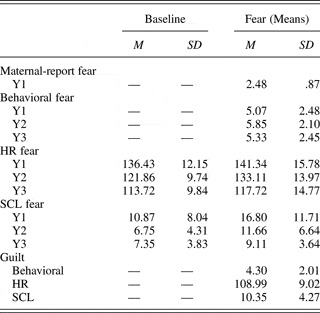
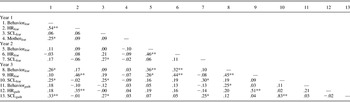
Descriptive data are presented in Table 1 and the correlations between the variables in Table 2. Stepwise regressions examining predictors of later fear and guilt are presented in Table 3 and Table 4, respectively.
Descriptive statistics for all measures

Note: (—) No measurement taken. Y1, Year 1; Y2, Year 2; Y3, Year 3; HR, heart rate; SCL, skin conductance level.
Correlations for each measure of fear and guilt at each year of assessment

Note: HR, heart rate; SCL, skin conductance level.
*p < .05. **p < .01.
Summary of all stepwise regression analysis for variables predicting behavioral, HR, and SCL fear in Y3 (N = 70)

Note: HR, heart rate; SCL, skin conductance level, Y3, Year 3; Y1, Year 1; Y2, Year 2.
*p < .05. **p < .01. ***p < .001.
Summary of all stepwise regression analyses for variables predicting HR and SCL guilt in Y3 (N = 70)

Note: HR, heart rate; SCL, skin conductance level; Y3, Year 3; Y1, Year 1; Y2 Year 2.
*p < .05. **p < .01. ***p < .001.
A repeated measures analysis of variance revealed a significant main effect of year of assessment for HR, F (2, 138) = 80.35, p < .001, and SCL, F (2, 138) = 25.84, p < .001, and of condition for HR, F (1, 69) = 118.95, p < .001, and SCL, F (1, 69) = 8.30, p < .01. There was also a significant interaction between condition and year for HR, F (1.72, 118.48) = 53.83, p < .01, and SCL, F (2, 138) = 42.53, p < .001. The significant effect of year means that levels of HR and SCL arousal generally decreased over the three assessments, whereas the main effect of condition shows that physiological arousal significantly increased from baseline to stress, indicating that fear was successfully induced. However, the effect of our fear manipulation was much more pronounced in Y2 (percentage increase from baseline to fear: HR = 9.46%, SCL = 125.10%) compared to Y1 (HR = 3.74%, SCL = 87.48%) and Y3 (HR = 3.60%, SCL = 57.39), as reflected by the significant interaction effect for both HR and SCL (see Table 1 for means). There was no main effect of year on behavioral fear, F (2, 138) = 2.60, p = .08, suggesting that observed behavioral fear remained stable over time.
Fear from Y1 to Y3: Associations across measures
Associations between all measures of fear at each age of assessment are presented in Table 2. Y1 behavioral fear was associated with Y1 HRfear (r = .54, p < .01) and Y1 maternal reported fear (r = .25, p < .05). HRfear and behavioral fear continued to have a positive association in Y2 (r = .46, p < .01) and Y3 (r = .45, p < .01). SCLfear was not associated with any other fear measure at any of the assessments.
The measures of behavioral fear were associated between Y1 and Y3 (r = .26, p < .05) and between Y2 and Y3 (r = .36, p < .01) but not between Y1 and Y2 (r = .11, p = .37). Similarly, the measures of HRfear were associated between Y1 and Y3 (r = .46, p < .01) and between Y2 and Y3 (r = .44, p < .01), but not between Y1 and Y2 (r = .08, p = .51). Positive associations were found for SCLfear across all ages of assessment, from Y1 to Y2 (r = .27, p < .05), from Y1 to Y3 (r = .25, p < .05), and from Y2 to Y3 (r = .30, p < .05; see Table 2).
Gender
Gender differences for all study variables were investigated using Fisher r to z transformations. There were no significant differences between the correlation coefficients for boys and for girls. Gender was not considered in further analyses.
Early fear as a predictor of fear in Y3
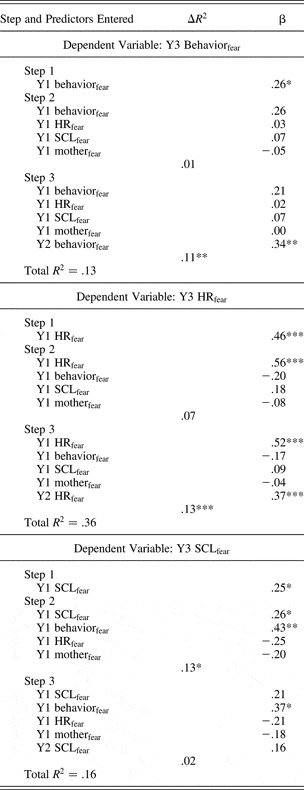
Table 3 summarizes the results of a series of regression analyses, highlighting the predictors of each measure of fear. In order to test whether early measures of fear predicted later fear, stepwise (forward) regressions were used for each measure of fear. At Step 1 the Y1 assessment of the dependent measure in question was included as a predictor variable. At Step 2 the other Y1 measures of fear were entered. At Step 3 the Y2 assessment of the dependent measure in question was included as a predictor variable.
Behavioral fear in Y3
Y1 behavioral fear positively predicted Y3 behavioral fear. This association was reduced to nonsignificance when the other Y1 variables were entered as predictors. Y2 behavioral fear positively predicted Y3 behavioral fear over and above all Y1 measures. None of the Y1 physiological measures of fear predicted Y3 behavioral fear.
Y3 HRfear
Y1 HRfear significantly predicted Y3 HRfear, and this remained the case after the introduction of the other Y1 variables and the Y2 measure of HRfear. This shows that infants who had a higher HRfear in Y1 and Y2 continued to have a higher HRfear in Y3. Y1 behavioral fear, SCLfear, or maternal report of fear did not predict Y3 HRfear.
Y3 SCLfear
Y1 SCLfear predicted Y3 SCLfear after controlling for the influence of the other Y1 measures. This association was reduced to nonsignificance with the introduction of Y2 SCLfear. Infants with higher levels of behavioral fear in Y1 had higher levels of Y3 SCL arousal during fear. This association remained the largest after the introduction of other Y1 variables and Y2 SCL.
Associations between fear and guilt
Y3 behavioral measures of fear were associated with Y3 guilt, and Y3 physiological measures of fear were also positively associated with Y3 guilt (see Table 2), suggesting that these are related constructs. However, these associations were only within the type of measure: behavior (r = .25, p < .05), HR (r = .51, p < .01), and SCL (r = .83, p < .01). There were no associations between different types of measure in Y3. There were no significant correlations between Y1 behavioral or physiological measures of fear and Y3 behavioral guilt. Behavioral guilt was not included in further analyses.
Early fear as a predictor of guilt
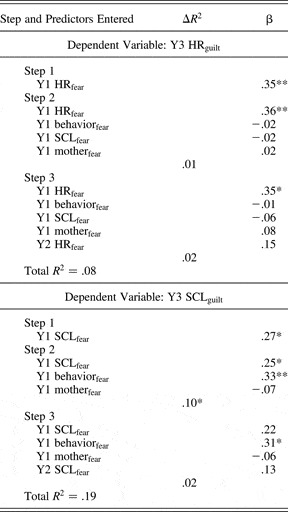
Table 4 summarizes the results of a series of regression analyses, highlighting the predictors of each type of measure of Y3 guilt. In order to test whether measures of fear in Y1 and/or Y2 predicted Y3 guilt, stepwise (forward) regressions were used.
Y3 HRguilt
Y1 HR arousal during fear predicted HR arousal during guilt in Y3.
SCLguilt
Y1 SCLfear predicted SCL arousal during guilt in Y3. Regression diagnostics revealed that the relationship between behavioral fear and HRfear at Y1 could be biasing the model (from inspection of the variance inflation factor). Stepwise regressions were conducted excluding Y1 HRfear. The association between Y1 SCLfear and SCLguilt was reduced to nonsignificance with the introduction of Y2 SCLfear. Infants with higher levels of behavioral fear in Y1 had higher levels of Y3 SCL arousal during guilt. This association remained significant after the introduction of other Y1 variables and Y2 SCL.
Taken together, the results show that measures of HR and SCL fear arousal in Y1 predicted guilt responses in toddlers. Year 2 measures of fear arousal did not predict Y3 guilt.
HR and behavioral fear in infancy and later internalizing psychopathology
Children who were rated by their mothers as clinically internalized at age 3 had significantly higher levels of HR during baseline and fear in Y1 (HRbaseline, U = 171, z = –2.17, p < .05; HRfear, U = 162.5, z = –2.31, p < .05). Internalized children had significantly higher HRbaseline (M = 143.16, SD = 7.69) and HRfear (M = 152.74, SD = 14.81) in Y1 than those in the normal range (HRbaseline, M = 134.72, SD = 11.03; HRfear, M = 139.44, SD = 15.23). Clinically internalized children also had higher behavioral fear scores (M = 6.5, SD = 1.72) in Y1 than those in the normal range (M = 4.83, SD = 2.52); however, this difference was only marginally significant (U = 193.5, z = –1.81, p = .07).
Discussion
This study had four aims: (a) to investigate the associations among behavioral, maternal reported, and physiological parameters of fear in infants; (b) to examine the stability of fear from infancy to early childhood; (c) to find out whether fear and guilt are associated; (d) to explore whether early fear predicts later guilt; and (e) to find out whether internalized toddlers differ from normal toddlers on measures taken in infancy.
We began by examining the associations between different measures of fear. The levels of HR and SCL increased significantly from baseline during fear induction, confirming that the procedure used in the current study was successful in arousing the ANS. We predicted positive associations between behavioral and physiological fear, such that behaviorally fearless children would exhibit lower levels of ANS arousal during fear challenge. This prediction was partly supported: although at each year of assessment behavioral fear and HRfear were significantly positively associated, this was not the case for SCL. Fowles, Kochanska, and Murray (Reference Fowles, Kochanska and Murray2000) found associations between SCL and fear behavior at 4 years, but not earlier. In the present study the association between SCL and fearfulness strengthened with each assessment (r = .06–.19), suggesting that this association might develop across time.
HR and SCL are different components of the ANS; SCL is controlled solely by the sympathetic nervous system, whereas HR is the result of the combined action of the sympathetic nervous system and parasympathetic nervous system. Particularly important in this respect is the vagal control of the heart (i.e., vagal tone; Lovallo, Reference Lovallo1997). HR and SCL were not associated in the present data, suggesting that although they both independently index arousal responses to fear, they reflect different components of fear. It is worth noting that the nonassociation of HR and SCL is a well-known phenomenon in research on antisocial behavior (even though antisocial or conduct disordered individuals are characterized by both low HR and low SCL; e.g., Raine, Reference Raine1993; Van Goozen et al., 2000) and emotion research more generally. Fear is a complex construct, and the findings from the present study underscore this once more. It is only through the continued use of multimethod approaches to testing that we can begin to understand it.
In Y1 mothers' reports of infant fear corresponded with independently observed fear, but not with physiological fear. This indicates that different observers may agree about what they see, but what they see is not necessarily what the child experiences. Thus, mothers who rated their child as having a fearful temperament did not necessarily have a child who became highly aroused during fear. Kagan (Reference Kagan1994) argues that maternal reports are too subjective, with mothers reporting their impressions of the child, which are likely influenced by their expectations of their child's temperament. Maternal report does not appear to be the best measure of a child's fear experience.
Our next aim was to assess the associations of fear from infancy up to age 3. Although HR and SCL baseline and stress levels decreased significantly over time, physiological fear reactivity was significantly higher in Y2, showing that physiological fear is not stable over time. This pattern of increased fearfulness in Y2 was not reflected in significantly greater behavioral fear, although observed fear distress was somewhat higher in Y2 (M = 5.85) than in Y1 (M = 5.07) and Y3 (M = 5.33). Individual differences in fearfulness were found to be associated, however, as reflected in the positive and significant correlations between the measures over time. Fearless infants continue to be fearless toddlers.
In addition to the associations between different types of measures, we were interested in whether individual differences in early fear were predictive of later fear. Behavioral fearlessness in infancy predicted behavioral fearlessness and low SCL fear arousal in Y3, and low HR fear arousal in infancy predicted low HR fear arousal in Y3. All measures in infancy predicted their counterpart measures in Y3, with behavioral fear also predicting across measures in Y3. The inclusion of the equivalent measure of fear at Y2 enabled us to include this more temporally proximal measure in the analysis and to observe whether Y1 measures continued to have predictive utility. This was largely the case, especially for physiological fear. However, with the inclusion of other estimates of fear in Y1 and the Y2 behavioral measure of fear, behavioral fear in Y1 was no longer associated with behavioral fear in Y3. Overall, the inclusion of Y2 assessments shows that even after controlling for more proximal assessments, Y1 indices play a role in the explanation of variance in individual differences at Y3.
Kochanska and colleagues (2002) found that fearfulness and guilt were associated at each of their assessments. We therefore predicted that fearful individuals would experience and exhibit more guilt and, conversely, that fearless individuals would have lower levels of guilt. We assessed guilt in Y3, so we first were interested in the concurrent association with fear in Y3. Behavioral and physiological measures of fear and guilt were found to be positively associated within the type of measure, confirming this prediction. Toddlers exhibiting less behavioral or physiological fear also showed less distress and experienced less arousal during the mishap guilt procedure.
We next predicted that fear in infancy would predict guilt proneness in toddlers. To our knowledge, there is no previous study investigating this relationship using behavioral and physiological measures and few studies have examined this association from infancy. Our findings not only confirmed the existence of a concurrent association between fear and guilt but also showed some evidence that fear in infancy was predictive of guilt 2 years later. Such an association was found for HR and SCL, but not for behavioral fear, although behavioral fear in infancy predicted SCL arousal during guilt.
Behavioral fear in infancy predicted Y3 behavioral fear, which was in turn strongly associated with behavioral guilt. However, contrary to our predictions, behavioral fear in infancy was not correlated with behavioral guilt in Y3. We can infer that although behavioral measures of fear and guilt are associated at the same stage of development, earlier behavioral fear is not predictive of later behavioral guilt. It is worth noting that Kochanska and colleagues (2002) also only found associations between concurrent measures of fear and guilt.
With increasing age, children are better able to engage in emotion regulation and therefore to inhibit or mask an overt expression of negative affect and to avoid intense emotional expressions (Kochanska et al., Reference Kochanska, Gross, Lin and Nichols2002). It may therefore be that fear- and guilt-prone toddlers, the ones who become aroused when challenged, modulate their expression of their feelings during and following a transgression, resulting in a weaker association between infant fear and toddler guilt.
In contrast to fear, a basic emotion that is present from birth and does not necessarily entail a lot of cognitive processing, guilt is complex and requires a higher level of cognitive understanding. It is possible that guilt is still developing at the age of 3 and therefore that the stability of the relation between behavioral expressions of fear and guilt only emerges later. It is interesting, however, that physiological fear arousal in infancy predicted physiological arousal to guilt in Y3, suggesting that a child's arousal during these emotions draws on the same underlying mechanism.
Our findings indicate that the physiological response develops first and the cognitive processes follow. This concurs with current theories of emotion. According to Izard (Reference Izard1992), the brain mechanisms of the emotion systems mature earlier than some of the mechanisms (e.g., hippocampus) required for contextual learning and for autobiographical and declarative memory. He conceived emotion experience as a “feeling state” that does not require cognitive mediation and suggested that emotion processes can operate independently of cognition. Emotions can be activated by a subcortical (thalamoamygdala) pathway that can operate independently of the neocortex and therefore independently of any type of cognition requiring cortical processing or integration (LeDoux, Reference LeDoux and Plum1987). Sympathetic arousal, an index of emotional behavior released by the amygdala, can be seen as an indicator of an intervening feeling–motivational state generated by the subcortical pathway (Izard, Reference Izard1992).
Our data show that the discomfort that fearful children experience during fear-arousing situations appears to bleed into other negative emotions such as guilt, and the proneness to experience these feelings seems to be relatively stable across early childhood. This is important because the subjective discomfort associated with fear and guilt encourages children to learn to avoid these situations in the future (Kochanska et al., Reference Kochanska, Gross, Lin and Nichols2002), perhaps being influenced by somatic markers (Damasio, Reference Damasio1996). The present evidence suggests that the feelings associated with fear and guilt (insofar as these are captured by physiological measures) are relatively stable over time but that the overt expression of these emotions is less stable, being consistent within but not across time. This highlights the importance of investigating multiple components of emotions.
The inclusion of the more temporally proximal counterpart measure of fear in Y2 did not play a role in the explanation of the variance in levels of guilt proneness. Fear in infancy alone predicted guilt proneness in toddlers, within and across measures. That Y1 measures were significant predictors even when controlling for Y2 highlights the importance of starting to assess these variables in the first year. Y2 measures may be less predictive than Y1 measures because the general tendency for children to score more highly on Y2 measures of fear arousal may have masked the relationship with guilt.
The present study investigated variations in fear in normally developing children to establish whether it is possible to identify risk pathways from an early age. Within a typically developing sample extremes can be identified and may even be classified in the clinical range. Although we predicted that extremes in early fearfulness would be associated with later internalizing problems, little is known about the early risk factors for this association. We found that a subgroup of internalized toddlers showed significantly higher levels of HR during baseline and fear in infancy. These infants also showed more behavioral distress, which is consistent with previous findings (Kagan et al., Reference Kagan, Reznick, Clarke, Snidman and Garcia-Coll1984, Reference Kagan, Reznick and Snidman1987). These findings further underline the salience of investigating infant emotion and show that risk factors for later psychopathology can be identified at an early age.
Fearful temperament not only plays a role in children's expression of emotion but may also affect infants' developing sense of self-efficacy. Young children's expression of positive and negative emotions may play a significant role in their development of social relationships. Positive emotions appeal to social partners and seem to facilitate the formation of relationships, whereas problematic management or expression of negative emotions leads to difficulty in social relationships (Denham & Weissberg, Reference Denham, Weissberg, Chesebrough, King, Bloom and Gulotta2004).
Between birth and the end of toddler age, children develop the foundation for all social interactions. They learn to feel and identify a wide variety of emotions, and they experience a wide range of social interactions. We already mentioned that infants experience and express emotions before they fully understand them. In learning to recognize, label, manage, and communicate their emotions children build skills that connect them with their family and later with their peers and others in their environment. These emerging capacities help young children to become competent in increasingly complex social interactions and to reap the benefits of social support crucial to healthy human development and functioning.
Prior studies have found gender differences in fear and guilt, finding girls to be more fearful and guilt prone (Kochanska et al., Reference Kochanska, DeVet, Goldman, Murray and Putnam1994, Reference Kochanska, Gross, Lin and Nichols2002), leading us to anticipate gender differences in fear and guilt. However, we found no differences between boys and girls on any of our study variables at any age of assessment. It may be that gender differences in fear and/or guilt only become apparent after age 3. It is also possible that the power to detect gender differences in the current study was too low because of the relatively modest sample size. Future research should aim to investigate gender differences in fear and guilt in larger samples.
Developmental investigations into risk pathways for later psychopathology should not wait until middle childhood (Cicchetti & Toth, Reference Cicchetti and Toth2009). The current study highlights the value of investigating emotion development from infancy onward and shows that fearfulness in infancy is stable and predicts fear and guilt in toddlerhood. Fearfulness and high levels of guilt have been linked to internalizing problems (Biederman et al., Reference Biederman, Rosenbaum, Hirshfield and Faraone1990, Reference Biederman, Rosenbaum, Bolduc-Murphy, Faraone, Chaloff and Hirshfield1993; Harder, Reference Harder, Tangney and Fischer1995; O'Connor, Berry, Weiss, & Gilbert, Reference O'Connor, Berry, Weiss and Gilbert2002; Schwartz et al., Reference Schwartz, Snidman and Kagan1999; Zahn-Waxler, Kochanska, Krupnick, & McKnew, Reference Zahn-Waxler, Kochanska, Krupnick and McKnew1990). Conversely, fearlessness and deficient guilt experience have long been linked to externalizing problems, including aggression and antisocial behavior (Gao et al., Reference Gao, Raine, Venables, Dawson and Mednick2010; Raine et al., Reference Raine, Venables and Mednick1997). Although relationships between emotionality and later psychopathology have been confirmed in children, our results suggest that some patterns are already established in infancy, highlighting the early development of risk pathways.
The current study adopted a prospective, multimethod approach and by doing so showed that physiology is an important and stable measure of individual differences in children's temperament. Fearless infants not only had lower levels of ANS arousal across the years of assessment but also showed less fear behavior and physiological reactivity to fear and guilt 2 years later. Research in the area of developmental psychopathology should not wait until children have developed emotional and behavioral problems. If we seek to understand pathological development and to prevent problems from developing, we need to know when and how emotions develop and when temperament becomes stable. By showing that individual differences in fearful temperament are associated from the first year of life and predictive of later fear and guilt, the present study strongly suggests that the first 3 years of life represent a crucial period when important systems that are involved in the experience and expression of emotions are established and children become emotionally “hardwired.” By investigating normal development from infancy onward we can extend our understanding of developmental trajectories and begin to identify risk pathways that extend beyond early childhood.
The present study highlights the role of individual differences in physiology and fearful temperament at a time before important external factors also begin to affect emotion development (e.g. peers and school, or effects of smoking, exercise, and puberty on ANS functioning; Raine et al., Reference Raine, Venables and Mednick1997). Another important factor in early emotion development is the quality of the parent–child relationship. The period of our study coincides with the theorized development of attachment relationships with primary caregivers, and the research paradigm shared some of its features with the Strange Situation procedure (Ainsworth, Blehar, Watrers, & Wall, Reference Ainsworth, Blehar, Watrers and Wall1978; e.g., a separation and reunion between parent and child, the presence of a stranger, exposure to a potential stressor and a laboratory setting). Future studies may wish to study features of the child's social world (including parenting behavior and attachment security) as part of investigations into early temperament (Blandon et al., Reference Blandon, Calkins, Keane and O'Brien2010), emotion regulation (Bowlby, Reference Bowlby1969; Kim & Cicchetti, Reference Kim and Cicchetti2010), risk pathways (Barker, Oliver, Viding, Salekin, & Maughan, Reference Barker, Oliver, Viding, Salekin and Maughan2011), and moral development (Kochanska, Reference Kochanska1991; Kochanska, Barry, Aksan, & Boldt, Reference Kochanska, Barry, Aksan and Boldt2008).
Similar developmental pathways to the ones identified in this study have been found in later life. Fearless individuals display low levels of ANS arousal to fear (Gao et al., Reference Gao, Raine, Venables, Dawson and Mednick2010; Quay, Reference Quay1965; Raine, Reference Raine1993) and are seen to experience low levels of guilt (Kochanska et al., Reference Kochanska, Gross, Lin and Nichols2002), whereas fearful individuals display higher levels of physiological fear (Kagan, Reference Kagan and Damon1998; Kagan et al., Reference Kagan, Reznick and Snidman1987) and higher levels of guilt (Kochanska et al., Reference Kochanska, Gross, Lin and Nichols2002). These profiles in normal healthy samples can extend into psychopathological patterns, with extremely fearful and guilt-prone children showing anxious and depressive tendencies subsequently (Biederman et al., Reference Biederman, Rosenbaum, Hirshfield and Faraone1990, Reference Biederman, Rosenbaum, Bolduc-Murphy, Faraone, Chaloff and Hirshfield1993; Harder, Reference Harder, Tangney and Fischer1995; Zahn-Waxler et al., Reference Zahn-Waxler, Kochanska, Krupnick and McKnew1990) and fearless and low guilt-prone individuals being at risk for developing callous and unemotional (i.e., psychopathic) personalities and exhibiting antisocial and aggressive behavior (Blair, Reference Blair1997). This is not to say that these developmental patterns in infancy are fixed and will inevitably develop into these more extreme profiles. Children are resilient and continue to develop throughout their lives. However, we have shown that there is some degree of stability over time from infancy onward. Early detection of more extreme variations in fear and guilt proneness in very young children may ultimately have implications for the prevention of both internalizing and externalizing disorders.