Introduction
The period from conception to early childhood is considered critical for human growth and development.Reference Balbus, Boxall, Fenske, McKone and Zeise1–Reference Hanson and Gluckman3 Specifically, the first 1000 d after conception form the basis of a child’s future risk for obesity, diabetes, cardiovascular disease and other non-communicable diseases (NCD). This concept is commonly known as the Developmental Origins of Health and Disease (DOHaD).Reference Barker and Osmond4–Reference Whincup, Kaye and Owen8 Currently, there are many public health initiatives based around NCDs that could be amalgamated by applying the DOHaD perspective.Reference Barnes, Heaton, Goates and Packer9 However, in many health care professions, there is a dearth of DOHaD research and knowledge.Reference Barnes, Heaton, Goates and Packer9,Reference Thiele and Anderson10 Knowledge translation or ‘the process of communicating research-based knowledge to the people and organisations positioned to use such knowledge in their private lives, in their work or in the formation/reformation of policies in institutions’ (Canadian Institutions for Health Research11 found in McKerracher et al. Reference McKerracher, Moffat, Barker, Williams and Sloboda12 p. 421) has been highlighted as imperative for understanding DOHaD-related topics.Reference Hanson and Gluckman3,Reference Hanson and Gluckman13 In particular, the growing body of research evidence on developmental programming calls for training of physicians and other health professionals about the importance of DOHaD,Reference Hanson and Gluckman3,Reference Hanson and Gluckman13 and identifying barriers and facilitators to translation and use of this knowledge in practice settings.
Best approach for front-line clinicians to use for counselling expectant families on DOHaD has yet to be determined. Counselling on complex topics such as DOHaD has been a perpetual object of inquiry in health education research.Reference Lown14–Reference Barker, Baird and Tinati17 Health care providers have expressed difficulty counselling patients due to factors such as time constraints, administrative expectations and lack of communication skills to discuss sensitive topics, such as smoking cessation, weight gain and gestational diabetes.Reference Orgel, McCarter and Jacobs15,Reference Barker, Baird and Tinati17–Reference Vears and D’Abramo20 Other challenges include a lack of uniformity in counselling among physicians, or whether physicians counsel at all.Reference Fortmann, Sallis, Magnus and Farquhar21–Reference Ockene, Quirk and Goldberg23 Some qualitative research has been conducted to understand the concerns of health care providers counselling pregnant women and their families on perinatal concerns, and has highlighted barriers to counselling such as willingness and capability to make changes, time constraints and a lack of clinical guidelines.Reference Jelsma, van Leeuwen and Oostdam24,Reference Mazza, Chapman and Michie25 However, these studies are typically on a specific group of health care providersReference Mazza, Chapman and Michie25 or focus on specific topics (e.g., obesity) within the DOHaD paradigm.Reference Jelsma, van Leeuwen and Oostdam24,Reference Huepenbecker, Wan and Leon26,Reference Leverence, Williams, Sussman, Crabtree and Clinicians27 Our study, thus, aimed to understand a variety of health care providers’ perspectives on developmental programming, and how best to facilitate practitioners’ uptake of DOHaD and related issues to apply in clinical practice.
Increased understanding of health care providers’ knowledge and perception of DOHaD and its implementation into clinical practice can serve to inform strategies for effective knowledge translation and counselling practices from a variety of disciplines. The purpose of this study was to explore from the health provider perspective how DOHaD knowledge can be effectively integrated in clinical practice. The objectives of this study were to explore: 1) how clinicians providing care to patients from preconception to the first 2 years of life and treating chronic diseases like to learn about DOHaD; 2) what factors influence counselling on developmental programming to patients; and 3) how knowledge translation about DOHaD can be enhanced in reproductive health care practice.
Methods
Ethics approval was obtained from Western University’s Health Science Research Ethics Board (REB 109157) prior to starting the study. This study followed a naturalistic paradigm and used a qualitative descriptive designReference Straus, Tetroe and Graham28 to collect rich data on health providers’ perceptions about DOHaD and how they counsel patients on the topic. Qualitative descriptive design offers a flexible method well suited to reveal and describe at a manifest level individuals’ experiences with less emphasis on abstraction than other qualitative methodologies.Reference Sandelowski29,Reference Sandelowski30
Sample
A purposive sample of heath care providers was invited to participate in the study. Eligibility criteria included being a licensed and registered health care provider in the province of Ontario, over 18 years of age, providing care in reproductive health or NCD and being fluent in English orally and in writing. Participants were recruited via departmental emails which outlined the purpose of the study. Referrals to the study via word of mouth and through snowball sampling were also used.Reference Creswell31 Interested participants contacted the researcher directly via email.
Data collection
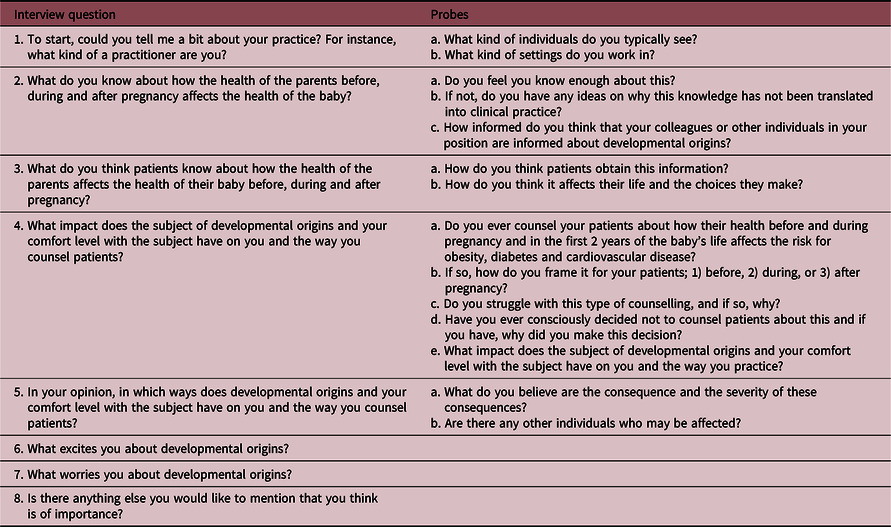
One-on-one semi-structured interviews were scheduled at a convenient time and place for the health care provider. Written informed consent was obtained from all participants prior to data collection. Interviews lasted approximately 60 min and were conducted in-person at the offices of the providers (19) or by phone (4) between July and November 2017. Using an interview guide (Table1), topics such as knowledge of DOHaD, concerns regarding counselling and perceived barriers to knowledge translation were covered. The interviews were open and conversational in style and prompts were used as needed to generate further in-depth information from participants. The interviews were digitally recorded and transcribed verbatim by trained typists at Transcript Heroes. Identifying information was removed from the transcripts.
Interview questions

Data analysis
Thematic analysis, as described by Braun and Clarke,Reference Braun and Clarke32 was used for data analysis and supported by NVivo 11.4.3 software (QRS International Proprietary Limited, Doncaster, Victoria, Australia). Data collection and data analysis occurred concurrently, and recruitment continued until it was determined no new themes emerged and data saturation was reached.Reference Morse33 All transcripts were initially read while listening to the audiotapes to ensure accuracy and completeness. They were subsequently read in their entirety to gain a sense of familiarity with what was stated. Two research team members (MM, ME) read and re-read the transcripts and independently engaged in open line by line coding of the transcripts, identifying and labelling words or phrases.
The first author (MM) who has experience using different qualitative methodologies and the second author (ME) an expert on qualitative research, discussed, compared and modified the initial codes and similar codes were then grouped into preliminary themes. The research team reviewed and modified the preliminary themes, and through group consensus, the final themes were identified. The transcripts were re-read to then highlight direct quotes from the participants which reflected the themes. To establish the study’s integrity, trustworthiness was ensured throughout the study.Reference Lincoln and Guba34 This was done through investigator triangulation in the analysis process and reflective journaling to capture ideas, thoughts, insights and biases of the researchers. MultivocalityReference Tracy35 was also emphasised by collecting and highlighting the perspectives of multiple health care providers, further establishing the study’s rigour.
Results
Participants
The final sample consisted of 23 health care providers who practiced in Southwestern Ontario: four obstetrician/gynaecologists (OB/GYN), four family physicians (FAM), three midwives (MidW), two endocrinologists (ENDO), two internal medicine generalists (IntM), four maternal fetal medicine specialists (MFM) and four paediatricians (PED).
Themes
Three themes were identified which together describe the health providers’ knowledge, perception and experience of incorporating DOHaD topics into practice settings.
Theme I: knowledge about DOHaD
This theme concerns the health care providers’ level of knowledge about developmental programming and their perceptions of what their patients know. Some mentioned their knowledge of DOHaD and its related topics was due to educational opportunities relevant to their discipline, while others commented having limited or no training on the topic. One midwife stated that ‘there isn’t any focus on, developmental origins of health in midwifery curriculum’. (MidW1).
The participants contended that providers’ expertise and specialty, clinical interest, proximity to an academic institution and patient characteristics (i.e., a child or pregnant person) contribute to varying levels of knowledge about DOHaD-related topics. Although the level of knowledge on DOHaD varied among the participants, all stated that they were willing and interested in learning more.
The health care providers claimed expectant parents’ knowledge regarding DOHaD topics and developmental programming as ‘at a superficial level’ (MFM1) and that many do ‘not really understand the necessary implications for later on in life with childhood or adulthood’ (MFM3). Women were described as being more concerned about their health during pregnancy, but ‘I don’t know that they necessarily have an understanding of some of the pre-conceptual things that might be important, or the things that they can’t actually modify during the pregnancy’ (MFM1). Others mentioned that parents’ concerns about the well-being of the fetus and the pregnancy were more immediate than on future developmental outcomes for their expected child. Overall, participants considered developmental programming to be a ‘difficult concept’ (MFM3) for most people to understand.
Some providers reported pregnant women’s knowledge of DOHaD to be dependent on pre-existing medical conditions or past pregnancy experiences, such as pregnancy complications or high blood pressure. However, one obstetrician-gynaecologist highlighted a lack of knowledge regarding obesity and pregnancy: ‘Um, obesity would be an extremely good example of how moms don’t know what the impact of their personal obesity has on their baby’ (OB/GYN2).
Participants mentioned that although women ask questions about making necessary lifestyle modifications during pregnancy, it is difficult to know if they understand the long-term implications for their child. This point was reiterated by a maternal fetal medicine specialist, who also stressed that pregnant women may only grasp the immediate health implications of a pregnancy complication for the fetus rather than future outcomes for their child.
I don’t think they necessarily translate that to: is your child later on in life going to be at risk of developing hypertension or having growth problems because their endocrine system has been reprogrammed in some way to deal with a lack of nutrient delivery and a stressful environmental hypoxia, and they’re going to develop differently going forward. (MFM3)
Incorporating evidence about developmental programming into practice was revealed as a challenge. Providers described current research on DOHaD is still emerging and ‘we don’t know what the magnitude is or what we can actually modify’ (MFM1). One obstetrician felt uninformed on the latest evidence and expressed the need for constant updates on the topic. Participants mentioned that their knowledge needs regarding DOHaD have begun to be addressed by research; however, clinical research regarding pregnant women was considered sparse.
The providers also expressed that current knowledge translation strategies for DOHaD are inadequate for knowledge uptake: ‘…all the information isn’t necessarily in the most practitioner friendly formats, so there’s a ton of it, especially in journals but, you know, primary care people don’t read specialty journals. And second is it’s not taught very well’ (PEDS2). Many also suggested that there needs to be more collaboration between basic researchers and clinicians to address the gap between basic research and practice.
Theme II: counselling on DOHaD in practice settings
Counselling patients on DOHaD was perceived as difficult for a variety of reasons. The first concern was prioritising a discussion of DOHaD topics with patients; in particular, providers mentioned being considerate of other aspects of patients’ health that were ‘imminently more at hand, you know you’ve got a patient who’s coming in depressed and that’s really the focus of the visit’ (FAM4). The providers emphasised the need to address more pressing matters affecting patients in the short term before considering counselling on developmental programming. One participant mentioned having to focus on intimate partner violence and women’s safety:
I had one patient who didn’t have a lock on her door. That was all we worked on. We didn’t do sugar screening ‘cause we just had to keep her safe…. she was not worried about what was gonna happen to her adult child. We were just focused on her not getting beat up in the pregnancy. (OB/GYN1)
Providers also expressed feeling pressured by time constraints, high patient loads and being unable to ‘spend the appropriate amount of time with the patients’ (OB/GYN4). Others mentioned tending to be ‘reactive and not proactive’ (PEDS2), ‘running over time’ (OB/GYN4) and only able to discuss one issue at each appointment. Furthermore, some providers do not see their patients preconception and may ‘have missed a window period of treatment’ (MFM4) to counselling their patients on DOHaD.
Many providers stated patients were more focused on their immediate pregnancy and how their current health might impact their well-being and that of the fetus, instead of the long-term health outcomes for the child, creating challenges to counselling on developmental programming. As one provider explains:
…I think the majority of patients respond more concernedly to the acute problems; they see the concern that the baby is going to be big or their baby’s going to have to spend time in the NICU, the baby’s going to have metabolic, um, you know, sugar management problems immediately after birth, that are going to put the baby at risk. As opposed oh 10 years down the road your baby might have a higher chance of developing diabetes. (MFM3)
Health care providers also commented on the futility of counselling on DOHaD as patients often have non-modifiable risk factors and ‘may [find] out that there are some things that happen in baby and then you can’t ever undo it because of whatever happened to the modelling in you’ (ENDO1). Some opined there was no point in counselling on DOHaD because ‘what’s done is done’ (OB/GYN2). Providers mentioned informing patients about risks but facing challenges of discussing ‘certain things that they can’t do much about’ (MFM1). Some also expressed the concern that counselling on a topic in which patients have little or no control may cause undue stress and anxiety and that some individuals might be ‘doomed to fail because of the extrauterine environment that they’re raised in’ (OB/GYN1). Participants were cognisant of and highlighted the difficulties associated with making lifestyle changes for some people even after being counselled and provided with information, as the ability to make change is based on their personal context.
Providers described how the complexity of DOHaD and related health issues made it difficult to fully ‘sort out’ (PEDS2) what health outcomes are the result of developmental programming, rather than environment, or genetics.
I don’t think that there’s one cause and effect for the diseases that we say are from in utero exposure or it may – again it’s multimodal. It may be all from that but I don’t know that we can say that ‘cause there’s just so many other confounding variables (FAM1).
Many expressed the challenges of addressing modifiable and non-modifiable factors when addressing developmental programming.
Multiple concerns were raised about the negative impact a discussion on developmental programming during pregnancy might have on pregnant women. An endocrinologist mentioned that women are already anxious while pregnant and counselling on developmental programming could ‘overwhelm’ and ‘scare them’ (ENDO1). The providers discussed that pregnancy can be stressful; to have an uneventful pregnancy, an uncomplicated birth and a healthy child are often primary aims for expectant parents. The potential for ‘blaming the parents’ (MFM1) and/or instilling ‘guilt’ (OBGYN2) was a concern raised by many participants. One participant believed telling pregnant women who try to stay healthy that they still might contribute to long-term health problems for their child could be ‘a really, really detrimental thing to mental health and to bonding with their children and to their relationships, and, to self-esteem’ (MFM1).
Health care providers argued counselling on DOHaD must use an empowering and non-directive approach to avoid undue guilt or added stress. Overall, there was consensus among the participants that counselling must be supportive, patient-centred and considerate of social context. Patient-centred care, in this context, emphasises collaboration, shared decision-making and partnership between patients and healthcare providers and acknowledges patients’ specific needs and desired health outcomes in providing care. They identified a need for practice guidelines on how to effectively introduce the topic with patients. By creating guidelines for implementation in practice, providers stated they would be more likely to counsel on DOHaD and feel more ‘comfortable’ (MFM3) discussing it with patients.
Theme III: impact of DOHaD on health
Participants described a ‘domino/ripple effect’ (ENDO1) and remarked on the potential impact of DOHaD on health of patients, their families and society at large. They argued if patients made behavioural changes after learning about DOHaD, it could increase self-efficacy and the potential for them to make further lifestyle changes. The DOHaD long-term impact of health at individual and societal levels was described by many as ‘really cool that if we could actually change the health of somebody going into a pregnancy that we may actually get long term benefits for health in society’ (FAM1). A midwife described the implications of DOHaD for health across the lifespan: ‘If we can make healthy children…they’ll have a healthier teenaged life, they’ll have a healthier adult life and the more healthy we are, the better life is’ (MidW1) and further explained the health care system will also benefit. Providers expressed excitement for patients and their ability to potentially modify factors that would have transgenerational effects. One participant described the area of developmental programming as ‘completely mind-blowing’ (ENDO2).
Some providers mentioned that sharing this knowledge could empower and motivate people to make changes for themselves, their children and future generations. One provider suggested that understanding developmental programming, its impact on fetal development and how risk factors might be modified is ‘incredibly motivating to try and provides someone a better pregnancy experience and better pregnancy outcomes’ (OB/GYN2). One paediatrician stated how fascinating and exciting it was that one could make a huge difference by making changes ‘so quickly and so soon into creation of a being’ (PEDS3).
Although the health care providers had concerns, all mentioned it was important to learn about and subsequently counsel patients on developmental programming, as the benefits outweighed the concerns. Furthermore, they recommended more emphasis be placed on translating DOHaD knowledge into clinical practice to improve the health of future generations.
Discussion
The level of DOHaD-related knowledge varied across the health disciplines and was largely dependent on area of specialty, pre-service education, primary focus of care and proximity to an academic setting. A general lack of knowledge among the various professionals about the concept, poor knowledge translation from bench to bedside and a lack of clinical practice guidelines were identified as barriers to health providers’ knowledge uptake on DOHaD. Knowledge generation and its dissemination is insufficient to ensure the application of knowledge in practice settings,Reference Straus, Tetroe and Graham28 and limited uptake of research evidence in practice has hindered the development of clinical practice guidelines.Reference Davis, Evans and Jadad36–Reference Henderson, MacKay and Peterson-Badali38 Critique of knowledge translation strategies indicate that clinical research evidence is primarily disseminated via academic conferences and overly complicated, dense and jargon-rich research articles that are often not attended or read by frontline health care providers.Reference Backer, Liberman and Kuehnel37,Reference Henderson, MacKay and Peterson-Badali38 Our findings were similar and providers suggested information about developmental programming be presented in a format that is easily accessible to the intended users. This is in conjunction with MayReference May39 and Barker et al. Reference Barker, Baird and Tinati17 who contend that DOHaD-related interventions or knowledge must be useable and understandable. To improve the uptake of evidence concerning developmental programming, there is a need for tailoring messages through other methods, such as practice guidelines and recommendations on developmental programming implementation into clinical practice. Furthermore, more teaching around the principles of DOHaD is required to enhance professional competencies on how to effectively provide information to patients about the long-term implications of health conditions.
The health care providers also reported a lack of knowledge among pregnant women about developmental programming and its implications for their children and future generations. Pregnant women’s level of knowledge about DOHaD was considered to be related to their personal context and specific circumstances. PainterReference Painter40 has argued that, should the long-term health effects on their children be known, patients would prefer to be made aware of developmental programming. This is in concert with the arguments of patients with gestational diabetes mellitus (GDM) in Jelsma et al. Reference Jelsma, van Leeuwen and Oostdam24 study, who reported that if preventative information was available by way of counselling from their health care provider, they would prefer to know to try and implement changes during their pregnancy.Reference Jelsma, van Leeuwen and Oostdam24
The health providers reported struggling with how to counsel patients on its related health issues and offer precautionary advice that is empowering, non-judgmental and patient-centred. Concerns were raised regarding potentially eliciting additional guilt or stress among pregnant women when counselling them about developmental programming, particularly for those who had non-modifiable risk factors (e.g., age, family history). Indeed, othersReference Vears and D’Abramo20,Reference Sharp, Schellhas, Richardson and Lawlor41–Reference Richardson, Daniels and Gillman44 have suggested research on developmental programming highlights the primacy of maternal effects and has the potential to reinforce the unfair assumption that mothers are responsible for the health outcomes of future generations. Previous literature on obesity counselling in obstetrics, gynaecology and family medicine has echoed these concerns.Reference Huepenbecker, Wan and Leon26,Reference Leverence, Williams, Sussman, Crabtree and Clinicians27 The providers might have highlighted these concerns as many of their patients come from social positions that often impact their ability to make lifestyle changes needed to make a noticeable difference. These concerns are in contrast with what women in previous research have indicated as their preference with regards to counselling about healthy behaviours. In studies on counselling women on weightReference Huepenbecker, Wan and Leon26,Reference Leverence, Williams, Sussman, Crabtree and Clinicians27 and diabetes,Reference Jelsma, van Leeuwen and Oostdam24 women have articulated that they would prefer an advocate approach to counselling.
In counselling patients on DOHaD, there needs to be a delicate balance between being assertive about the modifiable risk factors (e.g., smoking behaviours, physical activity and dietary habits) while being tactful and attuned to patient’s needs.Reference Hanson and Gluckman13,Reference Eriksson45,Reference Barouki, Gluckman, Grandjean, Hanson and Heindel46 To do this, and in concert with the providers in our study, Dupras and RavitskyReference Dupras and Ravitsky47 have argued that a person-centred approach is most appropriate. The responsibility of changing modifiable risk factors is not to be solely placed on individuals (particularly pregnant women), as epigenetic mechanisms are ambiguous and influenced by a variety of factors. Previous literature has also highlighted that focusing attention on individual patients diverts attention away from the influence of structural barriers (e.g., employment, wealth distribution and food production) that influence access to resources.Reference McKerracher, Moffat, Barker, Williams and Sloboda12,Reference Patel48–Reference Tarasuk and Beaton50 Therefore, we recommend that counselling on DOHaD and related topics should inform patients that they have some capacity to make change and support them in making changes; however, their personal behaviours are only a small piece of an epigenetic and environmental puzzle.Reference McKerracher, Moffat, Barker, Williams and Sloboda12,Reference Winett, Wulf and Wallack51,Reference Pentecost, Ross and Macnab52
Time constraints, prioritisation of patients’ immediate needs and futility were revealed as additional barriers to counselling patients on DOHaD. Health care providers play a critical role by partnering with their patients to deliver holistic, comprehensive and individualised care. Being an empowering advocate for patients is important when counselling pregnant women on risk factors that could affect future generations. However, as our findings indicate, the message may be difficult or impossible to translate to the individual patient, suggesting educating people about DOHaD health-related issues may be best served in the public health realm. Our results indicate that patients often have other issues that need immediate attention when seeking care. Integrating the influence of social and cultural issues across the life course is warranted to address environmental factors many patients experience.Reference Heindel, Balbus and Birnbaum53
To our knowledge, there are few knowledge translation strategies for incorporating DOHaD and related topics into practice and public health initiatives within Canada. Our providers opined that knowledge translation must branch beyond academic journals and conferences and could be integrated into practice guidelines. Furthermore, based on our findings, it was apparent that in order to facilitate an understanding of DOHaD among their patients, an upstream approach to education is also needed. This is consistent with literature on developing DOHaD-based interventionsReference Barnes, Heaton, Goates and Packer9,Reference Gore and Kothari59 that contend that upstream approaches help mitigate structural barriers that may impede individuals’ ability to seek care or make healthy choices. Participants suggested that a more effective way to translate this knowledge to more members of the general public could be through public health initiatives. Public health translation of DOHaD brings a wider awareness to social determinants of health and also is underlined with an acknowledgement that many individual’s choices are constrained or determined by these influences. Thus, public health initiatives may make this information more widely accessible and may be more effective as they shfit from individual blaming and bring focus on the socioecological factors that have bearing on decision-making surrounding DOHaD.
Adolescence has also been suggested as an optimal period of primary prevention intervention with DOHaD concepts as many life-long health behaviours are established during this period.Reference Bay, Morton and Vickers54–Reference Alberga, Sigal, Goldfield, Prud’homme and Kenny57 Although adolescence is often a time still distant from pregnancy, the health behaviours developed during this time will eventually have bearing on their preconceptual and periconceptual health, therefore having a generational effect on health outcomes for their children.Reference Bay, Morton and Vickers54,Reference Bay and Vickers58 There have been DOHaD translation programmes developed and evaluated in recent years that have shown promise for population-level knowledge translation, specifically in regard to educating adolescents.Reference Bay, Morton and Vickers54,Reference Bay and Vickers58,Reference Gore and Kothari59–Reference Bay, Yaqona and Tairea62 These interventions focus on establishing partnerships between the scientific community and educators, in which health literacy is developed and emphasised, so that an understanding of the biological underpinnings of DOHaD is paired with a critical awareness of the social and environmental determinants of health.Reference Bay, Morton and Vickers54,Reference Bay and Vickers58 Such an approach establishes an understanding that developmental programming is multifaceted and contextualised.Reference Bay, Morton and Vickers54,Reference Bay and Vickers58 Further research should involve discussions with women on the barriers and facilitators to making changes to modifiable risk factors, in order to inform public health policies and ensure strategies are tailored towards their needs and maintain a person-centred approach.Reference Vears and D’Abramo20
Our findings indicate that developmental programming is an exciting emerging area of research with far reaching potential for improving health at individual and societal levels. The transfer of knowledge on DOHaD and its associated topics could lead to the ‘domino effect’ with each individual, family and society benefiting from knowing and understanding the implications. The health care providers perceived that women who, once informed about the implications of developmental programming on the future health of their children, might be motivated to make changes, but more research is warranted to determine if such knowledge acquisition impacts behaviour changes at the individual level. Our study results also suggest the developmental programming in reproductive health offers an upstream approach to health promotion and disease prevention. Our findings support concentrating on fundamental social environmental factors that place some people at risk for disease and health inequities and reflect the shift in practice settings to encompass wider determinants of health rather than individual behaviour. Health care providers see the merit of implementing principles of DOHaD in reproductive health at the individual, family and societal levels. However, more research is needed to identify strategies to translate DOHaD evidence in the area of reproductive health and has positive impact of the health of future generations.
A significant amount of the previous research on DOHaD is primarily based on animal models and highlights the biological and metabolic mechanisms behind developmental programming. More evidence on human perspectives on DOHaD and methods for implementation into clinical practice or public health initiatives is warranted. Our results provide insight on how to improve knowledge uptake of developmental programming in practice as well as how to best counsel patients on the topic using empowering and supportive person-centred approach.
Strengths and limitations
There are some limitations to this study that warrant mention. Participants were recruited from Southwestern Ontario; the perspectives of health care providers from other regions may differ. Furthermore, the providers were from an academic centre with a DOHaD research group and their knowledge surrounding DOHaD would likely differ from those who do not. We also did not collect any demographic information about our participants, such as their years of experience, which could have bearing on their understanding of DOHaD. However, a strength of our research was the recruitment of a variety of health care providers from differing disciplines and providing them an opportunity to share their experience.
Conclusion
This qualitative descriptive study provided insight into the health care providers’ knowledge of DOHaD and perception of its translation into clinical practice to counsel women both preconception and while pregnant. DOHaD is an exciting area of research and has the potential to be a far-reaching public health initiative for reproductive health. Knowledge among health care providers is currently lacking and better knowledge translation strategies are need to ensure effective counselling of patients in practice settings.
Acknowledgements
The authors would like to thank Jennifer Ryder for her unwavering support and assistance throughout all aspects of this study: from applications to data collection, analysis and the preparation of any and all materials created from this project. The authors would also like to thank all providers who participated in the study and shared invaluable perspectives on DOHaD.
Financial Support
This work was supported by the CIHR/IHDCYH/SOGC Clinician-Investigator Teams in Obstetrics & Maternal-Fetal Medicine (MFM-146443), Western University (R3948A11), Children’s Health Research Institute (R3948A12), Women’s Development Council (LHSC, R3948A13), Department of Obstetrics and Gynaecology.
Conflicts of Interest
None.
Ethical standards
The authors assert that all procedures contributing to this work comply with the ethical standards of the relevant national guidelines on human experimentation (Health Canada) and with the Helsinki Declaration of 1975, as revised in 2008, and has been approved by the institutional committees (Western University Research Ethics Board).