Since the start of democratization in 1987, coalition building has played a significant role in South Korean politics. Building coalitions has been a crucial tool used by political parties towards electoral success. However, it did not ensure governability.Footnote 1 After each election, in fact, the ‘fission and fusion’ of political parties in the legislature have undermined the government's capacity to legislate and eventually harmed governability. To avoid political deadlocks in the legislature, the ruling parties have relied on attracting legislators from competing parties and on building coalitions with other parties in order to enlarge the size of the government.
The key question that this paper seeks to answer is whether ungovernability is linked to the coalition government's minority status in the legislature. Searching for answers, this paper speaks to different bodies of literature, which have thus far rarely talked to each other: scholarship on coalition theories in parliamentary systems and regime studies in presidential systems. Coalition research on parliamentary systems focuses on the formation, size, and termination of government.Footnote 2 Research on presidential systems has concentrated on political deadlock as a result of divided (or minority) government.Footnote 3 Recent scholarship questions the extent to which deadlock is structural in the cases of minority governments or coalitions in presidential systems.Footnote 4 Scholars in this field contend that minority governments do not necessarily face deadlock and coalition governments are not necessarily unstable.Footnote 5
The case of the Kim Dae-jung administration in South Korea, with its high levels of party fission and fusion, merger and break-ups, provides an interesting vantage point to examine the case of a minority coalition government in a semi-presidential system where the ruling coalition faces a large opposition in the legislature, ultimately leading to political deadlock.Footnote 6 In particular, the paper pays close attention to the area of intra-party politics and the mechanisms of negotiation and compromise.
By emphasizing the salience of party organization and showing how intra-party politics impacts on governability, the paper aims to contribute to the study of minority coalition governments under presidential and semi-presidential systems. The paper advances two main claims. First, that ungovernability does not derive from government size (the minority status not being a sufficient condition for the lack of governability); even when majority status was attained, instability persisted. Second, the paper proposes that attention should be paid to the question of party organization. Understanding how the party system and parties are run and function sheds significant light on the whole coalition formation and instability process.
Of course, the power to infer generalizable findings from a single case study is limited at best. Nevertheless, this in-depth analysis also contributes to broader debates on political actors’ behaviour and intra- or inter-party politics in recently democratized countries, in East Asia (Taiwan) and elsewhere (East Europe and Latin America). By doing so, it answers the requests in the literature that more attention be paid to single or small-N comparative studies with in-depth qualitative methodology.Footnote 7
The paper is divided into two main sections. The paper starts with a discussion of party politics and government–opposition conflict during the Kim Dae-jung administration, which eventually led to a deadlock in the legislature. I show why the deadlock occurred and especially focus on the behaviour of the main opposition party. The second section moves on to examine party organization as a crucial factor affecting governability. Following the work by Panebianco, Lawson, Katz, and Mair on party organization, I discuss, by looking at the level of factionalism within the party, the type of party leadership, the party funding system, and the extent to which the party continues to play its linkage role between the political system and society at large.
Party politics and organization
As Katz and Mair point out, there has been remarkably little literature on ‘the organizational development of parties’ and – more surprisingly – there are limited numbers of case studies of single parties or single countries.Footnote 8 This relative neglect in the literature is particularly noteworthy because, as Lawson contends: it is ‘only by looking within can we understand internal play of party power and why party functions’.Footnote 9
Studies of presidential and semi-presidential systems have devoted little space to analysis of how the organization of political parties impacts on governability. Within regime type studies, a frequently made argument is that presidential systems institutionally create divided or minority governments and they fatally lead to a ‘crisis of governability’Footnote 10 or political deadlock and political instability. Presidential regimes were widely assumed to be less cooperative due to the tension in executive and legislative relations in the 1980s, with many cases in Latin America where presidential regimes were often blamed for poor political performance and the failure of democratic governance. While arguing that ‘there is no universally best form of government’,Footnote 11 Mainwaring and Shugart point to ‘lower level of development and non democratic political culture’ as reasons for the poor performance of presidential systems.Footnote 12 In this respect, Sartori's point,Footnote 13 that undisciplined parties are problematic − not only in a presidential system, but they could be even worse in a parliamentary system − appears especially pertinent. In addition, Cheibub maintains that highly disciplined parties would mitigate tensions in the legislature and avoid political crises such as deadlock by forming legislative coalitions.Footnote 14
Given the overall lack of in-depth studies of how party politics affects governability in presidential systems, in order to understand the dynamics of intra-party politics we need to turn to the study of coalition governments in parliamentary systems, particularly in Western Europe.
Here an issue traditionally indicated as crucial for cabinet stability is the size of government. The size of government is a key variable commonly used to explain governability or the duration of the government. The small size of government, such as a minority government or divided government, is widely believed to be related to the poor performance of a government as it faces big opposition in the legislature. However, as will be shown in the following pages, there may be other factors other than size affecting governability, which the paper identifies in the level of party organization. This is important because, as some scholars have recently shown,Footnote 15 this suggests that there might be a fundamental element of political stability beyond regime type and the size of government, and this is where the two bodies of literature identified above come together.
A final point that has to be made is that the study of coalitions and coalition governments is new in Korean scholarship.Footnote 16 This can be partly ascribed to widespread negative perceptions of coalition building by many scholars such as SonFootnote 17 and ParkFootnote 18 who view coalition building and the search for broader political alliances as key factors in bringing about factionalism and conflicts among parties. A second reason stems from the fact that South Korea does not seem to belong anywhere in the mainstream of existing coalition studies, mostly focused on Western cases and parliamentary systems. South Korea's system is semi-presidential and its location in North-East Asia has somehow isolated it from clusters of regional studies examining and comparing Latin American and/or European countries. Also, despite an extensive literature on the size of government and formation of coalition governmentsFootnote 19 scholars working on coalitions seem to pay little attention to non-Western cases and non-parliamentary systems. Although a large-N research strategy has been traditionally applied to the study of coalitions, Korea has never fully been taken into account. Scholars working on Korea on the other hand have mainly focused on democratic consolidation and political deadlock.
Coalition politics in South Korea
Since the start of democratization in 1987, two political leaders have won political elections through a strategy based on coalition building in Korea: Kim Young-sam (1993–98) and Kim Dae-jung (1998–2003). More recently, the outgoing president Roh Moo-hyun (formerly presidential candidate of the New Millennium Democratic Party, MDP, 2003–08) has also greatly benefited from entering a coalition with Chung Mong-joon, the leader of the People's Power 21 (PP 21) Party in order to win the 2002 presidential election, even though Chung Mong-joon withdrew his support a few hours before the presidential election.Footnote 20
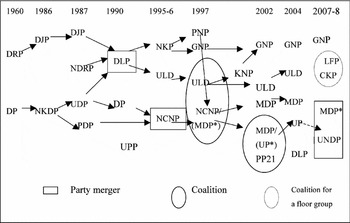
Coalition building had also played a role even in the transitional period from authoritarian rule to democracy, as the military regime was forced by the opposition into a process of bargaining and compromise. The ruling Democratic Justice Party merged with two opposition parties in 1990: the Unification Democratic Party led by Kim Young-sam and the New Democratic Republican Party led by Kim Jong-pil. The three parties merged and later renamed themselves as the Democratic Liberal Party and agreed to nominate Kim Young-sam as presidential candidate for the then approaching elections. As Figure 1 shows, most of the parties have their origins in the Democratic Republic Party and the Democratic Party going back to 1960.
Party system and coalition building (1960–2008)
Notes: Party acronyms: DRP: Democratic Republican Party led by Kim Jong-pil (1963); DP: Democratic Party led by Park Sun-cheon 1963 (Later New Democratic Party in 1964 and its former party of the New Korea Democratic Party (NKDP) in the 1980s led by Kim Young-sam and Kim Dae-jung); DJP: Democratic Justice Party – ruling party led by Chun Doo-hwan (1980) and later by Roh Tae-Woo (1987); NKDP: New Korea Democratic Party led by Kim Young-sam and Kim Dae-jung (1985); UDP: Unification Democratic Party led by Kim Young-Sam (1987); NDRP: New Democratic Republican Party led by Kim Jong-Pil (1987); PDP: Peace Democratic Party led by Kim Dae-Jung (1987); DLP: Democratic Liberal Party after the parties’ merger (1990); DP: Democratic Party led by Lee Ki-taek (1990); UPP: United People's Party led by Chung Ju-young (1992); NKP: New Korea Party led by Kim Young-sam (1996); PNP: People's New Party led by Lee In-je (1997); GNP: Grand National Party led by Lee Hoe-chang (1997) and Lee Myung-bak (2008); ULD: United Liberal Democrats led by Kim Jong-pil (1995); KNP: Korea's New Party led by Kim Yong-hwan (2000); NCNP: National Congress for New Politics led by Kim Dae-jung (1996); MDP: New Millennium Democratic Party led by Kim Dae-jung and later Roh Moo-hyun (2000*); PP 21: People's Power 21 led by Chung Mong-joon (2002); UP: Uri Party led by Roh Moo-hyun (2003*); DLP: Democratic Labour Party led by Kwon Young-kil (2004); UNDP21: United New Democratic Party (2007) led by Chung Dong-young and later led by Son Hak-kyu; LFP: Liberty Forward Party (2008) led by Lee Hoe-chang22; CKP: Creative Korea Party led by Mun Kook-hyun (2007). Source: Author.

A second moment where coalition-building seemed to be decisive in Korea's political life was before the 1997 presidential elections, when the ruling party faced internal divisions and the political environment was in turmoil following the outbreak of the ‘Asian crisis’ and the simultaneous condemnation of its perceived inefficiency by the public. The opposition National Congress for New Politics (NCNP) party leader, Kim Dae-jung, formed an alliance with the United Liberal Democrats party leader, Kim Jong-pil, in order to fight the election. After a long history as an opposition leader, Kim Dae-jung finally became president.
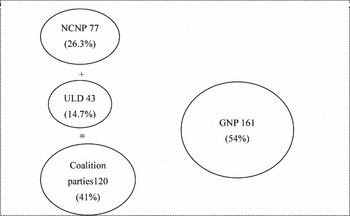
When Kim Dae-jung became president in 1998, the NCNP (the president's party) had 77 seats (26.3%) out of a total 293 seats, his coalition partner ULD had 43 seats (14.7%), and the opposition Grand National Party had 161 (54%). In combination, the two ruling parties of the coalition government had 120 seats (41%) out of 293, which is still far below a majority (see Figure 2).
Party seat numbers after coalition building in February 1998
Notes: NCNP − The National Congress for New Politics (later the New Millennium Democratic Party) led by Kim Dae-jung. ULD − The United Liberal Democrats led by Kim Jong-pil. GNP − The Grand National Party led by Lee Hoi-chang. Source: Author.

The Kim Dae-jung administration set out with an extensive agenda, and yet the ruling party found it difficult to implement its policies from the early outset of the legislature. Facing a political deadlock in the National Assembly, the ruling coalition parties immediately started to enlarge the size of the ruling parties by attracting defectors from the opposition. Enlarging the government's size at all costs did not seem to bring any solution to the political deadlock, however. Quite the contrary, the conflicts deepened not only with the opposition parties but also with the coalition partner(s) as well as with factions within the ruling party.
As noted, Kim Dae-jung won office by building a coalition with the previous coalition partner of the ruling party, Kim Jong-pil, a leading figure of the Democratic Republic Party under the Park Jeong-hee administration, who was determined to change the constitution. Kim Jong-pil believed that a parliamentary system would work better than the present presidential system.
The 1990 coalition was created around the agreement between the leaders to change the system from presidential to parliamentary (the objective was never achieved). The second coalition with Kim Dae-jung and his party, the National Congress for the New Politics, set out again to reach this goal. If the coalition were to win the elections, Kim Dae-jung would become president and Kim Jong-pil prime minister. The prime minister would thus be able to carve out a role in making decisions on domestic affairs.Footnote 23
Deadlocks: Does government size matter?
The approval vote. The case of the vote of approval for the prime minister illustrates the nature of Korean politics well. As a part of the coalition agreement, the first action of the president was to appoint Kim Jong-pil as Prime Minister, a nomination that would then need to be ratified by the members of the National Assembly. This was a necessary move to consolidate the ruling coalition, as Kim Dae-jung's party could count on only 77 lawmakers and the coalition partner's 43 lawmakers. A majority (50% plus 1) of the National Assembly members’ attendance for the vote was needed to allow Kim Jong-pil to become Prime Minister. It also required two-thirds of the votes from those who took up their seats in the chamber when the vote was called.
In theory, this condition was not insurmountable. If the NCNP and the ULD succeeded in negotiation with non-party affiliated legislators, then the ruling coalition parties would need the support of just 13 out of a 163 opposition members belonging to the GNP. Kim Jong-pil could rely on personal connections with many members within the Grand National Party ranks. Many of them were in fact from his native Chungcheong province, including some from the same high school, while others were alumni from the same university. Some of them also used to work with Kim Jong-pil in previous parties, the Democratic Republic Party in the Park Jeong-hee era and the United Liberal Democrats under the Kim Young-sam administration. There was more than enough margin to reach a compromise. So why did they not reach one?
If Kim Jong-pil had become Prime Minister, it was thought it would damage the GNP in the following local election in June 1998 and the general election, especially in Chungcheong province, where Kim Jong-pil had loyal electoral support.Footnote 24 If the GNP were to support Kim Jong-pil's bid as Prime Minister, this would appear as if the GNP accepted the legitimacy of the ruling coalition parties. This would also help Kim Jong-pil to gain stronger support from Chungcheong province. The National Congress for the New Politics had strong support in Seoul, Gyeonggi, and Jeolla provinces, so if the GNP lost in the following local election, this would give the Grand National Party a chance to become the party of Gyeongsang province only.Footnote 25 Therefore, the Grand National Party had to fight for its own survival in the legislature. The main objective of the GNP was to break the coalition between the NCNP and the ULD and gain power again.
At the approval vote for the prime minister, all the legislators of the GNP were ‘advised’ to attend the vote but to submit empty ballot sheets. In doing so, the opposition party would avoid popular blame for not attending an important National Assembly meeting. At the same time, the empty ballot sheets would force the vote to be annulled. Within 20 minutes of the start of voting on 2 March 1998, the legislators of the United Liberal Democrats became aware that opposition party members were handing in blank ballots. The National Assembly descended into chaos, with the ruling party legislators asking to have the ballot declared null and void and the opposition instead demanding the voting be completed.
The vote was cancelled at the last moment and the president appointed Kim Jong-pil as a deputy (or an acting) Prime Minister on 3 March. It took nearly six months to arrange another vote, which in fact took place on 17 August. Kim Jong-pil became the prime minister gaining 171 votes of support in the National Assembly. However, this was only after political reorganization (Jeonggye-Gaepyeon) of the ruling parties, which attracted high numbers of defectors from the opposition parties. By then the National Congress for New Politics had 88 legislators and the United Liberal Democrats had 49 legislators. Except for one member belonging to the ULD, the members of the ruling party all voted to approve Kim Jong-pil as prime minister and by then the ruling party had managed to gain around 30 votes from the Grand National Party.Footnote 26
The previous vote in February had shown that independent voting for legislators was not an option given the prevailing Korean political culture. The question arising here is of course how parties manage to control secret ballots. Considering that each party is home to different factions (e.g. regional basis, school ties), that party leaders discipline party members to coordinate party decisions so strictly is surprising. Chosun Ilbo reported that the committee of the Grand National Party announced that if any members voted to approve Kim as prime minister, the member(s) would be required to leave the party (as it happened in a handful of cases).Footnote 27
When Cho Sun and Lee Ki-taek, formerly leaders of the ‘little’ Democratic Party, were excluded from standing as candidates in the 2000 elections, this confirmed Lee Hoe-chang's tendency to marginalize legislators holding dissenting views.Footnote 28 This marginalization of dissent points to the lack of democracy in Korean party politics, where fear of not being allowed to stand again in elections acts as a powerful constraint on the deputy's behaviour. There seemed to be no margin for compromise or negotiation among party members belonging to different parties unless they defected from one party and joined another. Park No-cheol, a chief secretary of Jeong Hee-su, the Seventeenth National Assembly member for the GNP, mentioned that:
There are four different levels of punishment when the individual lawmaker does not follow the party's directives. The legislator acting against the party's instructions will be sanctioned by the party committee and may lose his position in the party. Some may even have to leave the party. Especially when the legislators are not elected through the general elections but by proportional representation, they would not have any choice but to leave the party.Footnote 29
Too many bills, not enough votes. After Kim Dae-jung took office, the legislature was supposed to deal with an overwhelming 300 law proposals. The numerous conflicts and political crises in the legislature provided the Kim Dae-jung administration with the opportunity to legitimize its attempt to reorganize the whole party system. The ruling party managed to attract large numbers of defectors from the opposition parties and managed, in September 1999, to gain 160 seats out of 293 total seats, with 133 seats going to the opposition Grand National Party. Because of the opposition party's boycott of the National Assembly, this was occupied by members of the ruling parties, while the opposition party spent most of the time outside it. Until August 1999, meetings of the National Assembly were held 19 times from the 189th National Assembly Extraordinary Session to the 207th National Assembly Session; about half of the meetings were held either by the ruling parties or the opposition party who otherwise took to the streets protesting against the government.
In the eyes of the public, the government looked inefficient and unable to deliver its policies. Legislators only appeared interested in particularistic infighting and blocked each other's bills. While the budget bill and related bills were waiting to be approved, the Assembly Session was paralyzed for ten days, from 3 to 13 October 1999, due to the conflict over the media reform report. There were 112 bills still awaiting to be approved, which were all related to reform policies, including public subsidy bills, national security, human rights, etc.Footnote 30 In this section I have shown that the enlarged ruling parties did not secure governability, as the opposition went on to protest outside of the National Assembly rather than attending the National Assembly meetings.Footnote 31 I have revisited what happened in the legislature and why deadlock occurred from the very beginning of the administration. I have shown that enlarging the size of the government was the main strategy adopted by the government to ensure governability. The strategy nonetheless failed, suggesting that other factors may have been hindering compromise and negotiation, in particular a highly disciplined, or more rigid party organization, as the next section illustrates.
Party organization in South Korea
Korean political parties hardly fit in any existing party typology, presenting features of mass parties, as well as those of cadre parties.Footnote 32 Most parties in Korea do not have enough due-paying members to be regarded as mass parties. However, in terms of organization, Korean parties show a mass-party structure. Parties are structured into central (core) and peripheral levels. Parties are mass bureaucratic organizations with leaders; however, they do not have members. This would be, as Duverger notes, like having a school with teachers but without pupils.Footnote 33
Most party members are mobilized by the staff recruited to run the election campaigns. As will be shown later in the paper, they are not party members but temporary electoral campaigners.Footnote 34 Kim Young-ho notes that 6,146,187 party members were registered in the political parties in 1999, but 6,122,300 members were recruited to carry out electoral campaigning and were paid for their effort.Footnote 35 In fact, regular members paying dues mounted to only 23,889, that is only 0.07% of the total. That is very low compared to that of Austria with 17.66% and even the UK with 1.92.Footnote 36
Many scholars note that parties in Korea closely resemble cadre parties.Footnote 37 In Korea, the candidate in each electoral district bears most of the financial burden on his or her own, with some subsidy from the central party. In terms of the party, it is more likely that all candidates rely on the party leaders to raise funds. At both central and periphery levels, the party revolves around the leader. The organization is often called a one-man party or boss party. In addition, the financial burden is on the shoulders of the party leaders and so is the right to nominate candidates. Considering that the stakeholders in a mass party can be regarded as all of the members who share the financial burden for the functioning of the party by paying party dues, the ownership of Korean parties de facto belong to the leaders. Herein lies the reason why, when the party leader leaves his/her own party, the party often collapses and re-emerges under another name (with the same leader). This is another reason why leaders are the only actors in the coalition-building process, whereas ordinary party members are virtually excluded.
Others refer to Korean political parties as a type of ‘cartel party’, a concept developed by Katz and Mair.Footnote 38 Similarly, to other cartel parties, political parties in Korea do not financially rely on party dues, but mainly on the state's subvention. As a result, as Jang Hoon notes, since democratization parties in Korea have functioned as cartel parties between the state and society.Footnote 39 Finally, Gunther and Diamond argue that classical party typology does not accommodate real-world parties, especially not West-European parties.Footnote 40 According to their typology, parties in South Korea, especially during the Kim Dae-jung administration, can be characterized as a hybrid type of elite-based and clientelistic party. They are organizationally thin and similar to Panebianco's ‘electoral professional party’. For electoralist parties, personal charisma or attractiveness is more important than organizational functions or ideology. Gunther and Diamond add that parties in South Korea are catch-all parties but, given the strong regional base for elections, parties in South Korea can also be said to be similar to ‘ethnic parties’.
Having provided a short overview of Korean political parties as organizations blurring the divides between different party types, the section now turns to examining how these parties are actually organized by looking at the following dimensions: leadership, factionalism, funding, and party–citizens linkage.
Leadership
Parties in Korea did not create the leaders, rather leaders created the party. Party leadership is fundamentally based on perceptions of legitimacy and support from the majority of the followers. Panebianco argues that the legitimacy of leadership relies in the control of public goods (collective incentives) and private goods (selective incentives).Footnote 41 When the benefit is not distributed fairly enough, the legitimacy of the leadership is undermined. Looking into the party system in Korea, where the linkage between the state and civil society is limited, parties are unlikely to achieve an equal distribution of either public goods or private goods.
At the local branch level, the legislators fail to come up with policies reflecting the views of the majority of the people and tend to focus on some voters (generally relatives of other members) and not others. Thus, there are a large number of alienated citizens or voters who do not enjoy equal distribution of public goods. It is no different at level of the central party. The party is more interested in gaining power and, in order to do so, the leaders are busy collecting funds from a few conglomerates or interest groups than in chasing after the small dues paid by the majority of the party's members.
Kim Dae-jung won office with only 40.3% of the total votes, a mere 1.6% more than his competitor, Lee Hoe-chang. The problem is that his supporters were concentrated in the Honam (or Jeolla) region. Kim Dae-jung gained 90% of the total votes in Jeolla province 44.2% in Seoul, 43% in Chungcheong province, but only 13% in the Yeongnam (Gyeongsang) regions and 20% in Gangwon province.Footnote 42 He gained relatively high votes compared to the previous presidential election in Chungcheong province but this was due to the coalition partner. As scholars like Linz, Skach and Stepan, and Mainwaring and Shugart note, the dual legitimacy of the executive and the legislative branches of government structurally induces conflicts in the legislature.Footnote 43 Kim Dae-jung gained legitimacy with a higher vote rate from the presidential election; however, the opposition GNP hardly sees itself as a loser, as it received much higher votes in the general election and therefore became the party with the largest number of seats in the legislature. This dual legitimacy created strains in the legislature for the entire period of the Kim Dae-jung administration. With small numbers of supporters, it started to govern, although the lack of legitimacy hindered the implementation of reform policies. The government was driven off track by the big opposition party nearly every time it tried to pass any new bills.
Another significant problem for political leadership in Korea is that presidential power and the ruling party's elite are not equal; the party elite are subjugated by the president. When the parties are not separated from the power of the president, this easily can lead to delegated democracy with leadership highly concentrated on the president and the president simply relying on his charismatic popular support to govern. This also leads to lack of legitimacy in the legislature, especially when facing an opposition party or parties with more seats in the chamber. Decision-making procedures as well as the right to select the candidates are highly concentrated in the party leaders. If the leaders fail to gain agreement in committee meetings in the legislature, the ordinary legislators barely have the right to vote according to their preferences but are required to follow the leaders’ indication. In the case of ruling parties, the party chairmen (Chongjae) do not have much power but they are more like delegates of the original charismatic leaders: Kim Dae-jung and Kim Jong-pil respectively. In the case of the MDP, the ultimate leader of the ruling party is the president. Therefore, above the party representative (mostly chairman, Chongjae) of the floor negotiation group, the president's decision is also crucial in the process of compromise and negotiation. Lee Yang-hee, a former legislator of the ULD, pointed out that:
The power of the president is bigger than that of a King under the Joseon Dynasty. Our constitutional laws allow too much power to the president. This is a disadvantage of the presidential system in South Korea. That is why we think the parliamentary system would work better in Korea. In the case of the US, if a republican or democratic president suggests a new policy, an individual legislator of the respective party is not required to follow the party whip in the legislature, as in the ‘Westminster’ system. In the Korean system, however, if you do not follow the president's line a range of disadvantages will arise. This is particular the case if a legislator harbours ambitions to be the chairman, a position appointed by the president. If you are the chairman, you essentially have to listen to the president who appointed you. This is not doing politics but being controlled.Footnote 44
This also hinders party leaders from compromising with the opposition party. The legislature cannot play its balancing role against the executive. The president occupies a pivotal place in the government and often dominates his own party. In the legislature, the ruling party is not free from the president's decisions and this hinders negotiations and compromise among the parties. The opposition party, of course, can aim to restrain the power of the executive but the ruling parties will not or cannot reach an agreement with the opposition on numerous pieces of legislation. This strict top–down hierarchy also matters in the process of negotiations and compromise. Once the decision has been made by the party leaders, the followers − that is, the ordinary legislators − will not vote against the party's decision. The reason is straightforward: to do so would mean no possibility to stand as a candidate for the following general election, no more promotion within the party and no more financial support from the party leader. In short, when legislators do not obey the party decision, they are punished in these and many other ways. Some are even forced to leave the party.
Factionalism
According to Panebianco, an analysis of dominant coalitions can be carried out in terms of the degree of internal cohesion, degree of stability, and the party's organizational power map.Footnote 45 When the level of internal cohesiveness is low, the coalition is likely to be unstable. In the case of the Kim Dae-jung administration, this was not a dominant coalition in a Western parliamentary system, but a minority coalition facing a big opposition party under a semi-presidential system. So the government was not going to collapse as a result of investiture or a no-confidence vote and, no matter how much difficulty the government faced, it was highly unlikely to collapse during the term of the presidency. In other words, the period of political rule is institutionally secured. However, regardless of this stability, the Kim Dae-jung administration seemed to roll towards ungovernability from the start, as a result of the level of factionalism within the coalition and even within Kim's own party.
The high level of factionalism within Korean parties also hindered the consolidation of party organization in the country. The case of the NCNP, and of its oldest faction (the so-called Donggyo-dong faction), is illustrative in this respect.Footnote 46 The members of Donggyo-dong have all been secretaries or colleagues of Kim Dae-jung since the beginning of his political life. When the government was launched, four out of eight executive members of the NCNP were from the Donggyo-dong faction, two were former lawyers, one was a businessman, and the other was a journalist. The leaders of the NCNP were mainly from the Donggyo-dong faction and played dominant roles within the party.
The NCNP leaders were highly dependent on President Kim Dae-jung and this relationship acted as a barrier in reaching an intra-party consensus. The dependency of the Donggyo faction on the president means the party itself is dependent on the president. It is also a fundamental reason for the personalized characteristics of the party. If the leader disappears, so does the party. In other words, loyalty to the president would undermine not only the internal cohesiveness of the party, but also the balance of power between the legislature and the administration. This also hinders creating mechanisms of compromise in order to address conflicts with the opposition party and coalition partner.
The factions within the NCNP were also divided according to high school alumni networks. With Kim Dae-jung (from Jeolla province) in power, some among his high schools’ alumni from Jeolla province were appointed to senior positions in the administration. High school ties are very important in Korean politics (and arguably in economy as well) as they provide one of the key networks in terms of employment and career development. Having school connections to a ‘senior’ who now holds an important office is a key ‘door-opener’ in Korean politics. For example, during the Kim Young-sam presidency, Gyeonggi high school (based in Seoul) and Gyeong-nam high school (based in Busan, Gyeongsang province) alumni enjoyed high status and positions in the administration as well as judiciary and legislature. Under Kim Dae-jung, the Gwangju high school, Gwangju Il high school, and Jeonju high school, all based in Jeolla province, gained pre-eminency. For the sixteenth general election all of the Jeonju high school alumni of the MDP members were selected as candidates by the MDP leader. Within the ruling party, the high school factions were divided into Jeonju, Gwangju Il, and Gwangju high schools alumni factions. These factions competed over leading positions in the administration, judiciary, and legislature, as candidates for the elections, and even in the army.Footnote 47
The unfair personnel policy of the Kim Dae-jung administration undermined the efficiency of the organization and came under criticism by the opposition party. Kim Pan-seok argues that official appointments were concentrated in the president's hands and there was no professional human resource department in the party able to suggest highly competent personnel.Footnote 48
During the Kim Dae-jung administration, each minister kept his/her post for an average period of 10.54 months – that is the lowest average compared to 11.45 months for the Kim Young-sam administration, 12.88 months for the Roh Tae-woo administration, 17.11 months for the Chun Doo-hwan administration, and 24.54 months for the Park Jeong-hee administration.Footnote 49 This also illustrates that the Kim Dae-jung administration did not hold hegemonic power. The government could not back up its ministers against the opposition party or public opinion in the case of political disputes. It is obvious that, if the government cannot secure the position of a minister for even a year, the minister can hardly implement new policies. It was not only the short period of the minister's tenure that illustrates this point, but also the chief executives’ positions could not be secured for more than 14 months.Footnote 50
The process of personnel appointment was not institutionalized, let alone open and fair. Instead, it was carried out through either factional connection to the president or party leaders.
Linkage
Unlike other types of parties, the cartel party does not link the state with civil society. When the party does not link civil society with the state, and fails to represent civil society it is more likely to represent a small number of elite interests and this eventually will lead to the erosion of legitimacy. Lawson argues that:
Participation, leadership recruitment, allocation of resources, the creation, and propagation of values, the control of behaviour (through the control of force and/or through educative communication) all require the creation of connections between different levels of aggregation. Creating linkages is itself an extremely important function of politics.Footnote 51
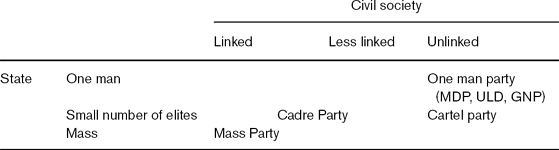
In other words, to secure a party's legitimacy and power in the legislature the party must provide linkages between the state and the citizens. When the citizens are alienated from participation, resource allocation, and developing policies, it is hardly likely to consolidate internal power with a wide range of support. Even if the lawmakers achieve a majority status through building coalitions, as long as elections are held for the party to be judged by the citizens, the ruling party will face the citizens’ judgement. However, apart from the election, citizens and sometimes even ordinary legislators are excluded from the functions of party organization. The highly centralized power among the elites fails to provide the essential linkage between the state and the citizens (see Table 1). Lawson argues that linkage matters when the party fails.Footnote 52 For Key, linkage means ‘interconnections between mass opinion and public decision’.Footnote 53 Lawson emphasizes that creating linkages is essential in order to gain legitimacy and consolidate internal power. The party should remain in the core position between the state and the grassroots. Linkages between the two means that neither of them should be isolated from the other and the two should remain balanced. When the party wins office, the function of creating linkages between the government and civil society or citizens is crucial to gaining legitimacy and wide support. If the party fails to link with the state and the citizens, the ruling party would hardly find wide and strong support from the people, no matter how good the reform policies. The Kim Dae-jung administration failed to link itself with civil society. Leadership without nationwide legitimacy undermined governability during his administration.
South Korean political parties between the state and civil society
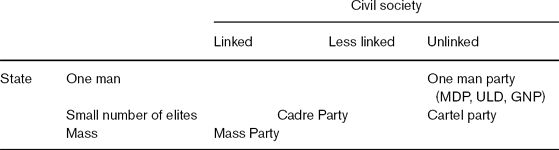
Source: Author.
Funding
According to the National Audit Report, the rate of dues paid by each party's membership is 0.5%. In late 1997, just before Kim Dae-jung took office, the New Korea Party and then ruling party officially had 3,723,138 members; however, only 22,793 members paid their dues − that is, 0.6%. The NCNP (by then led by Kim Dae-jung) had a 0.5% rate among the party members, the Liberal Democratic Party had 0.03%, and the People's Nation had a rate of 0.1%.Footnote 54
Most of the electoral campaign in Korea is funded by the individual party candidate and the candidate mainly relies on self-generated funds, often from his own business or business supporters. Therefore, the number of members who pay party dues is limited. At the local level, no members pay their dues; rather, they are mobilized to attend electoral rallies and campaigns either through the use of gifts. Such gifts include watches, towels, meals, and sometimes tours to tourist spots. ‘The more money or gifts, the more votes’ is a popular saying in Korea. Citizens have no chance to play a more active role in politics because they have no opportunity to receive education and thus rely on the favours by local leaders, such as the redistribution of gifts and funds. According to an investigation carried out by the Chosun Ilbo, a candidate distributed envelops with 100,000 won in cash to 30 potential voters in a village meeting in Busan. Another candidate confessed that he had to give a minimum of 30,000 won in each envelop to try to woo potential voters; this increases to 70,000 won as the election day approaches. At the central level, parties receive annually 800 won per voter as an ordinary subvention. In the year of the presidential election and general election, an additional 800 won subvention is granted per voter. When it is the year with local elections that are held on three levels (Si/Do Council Members, Autonomous Gu/Si/Gun Council Members, Education Board Members) the subvention is given three times so it amounts to 1,800 won per voter.Footnote 55 Half of the subventions are given to the floor negotiation groups and the other half is given to the parties on the basis of the number of seats in the legislature, the percentage of the national votes each party gained at the general election, and the percentage of votes each party gained at the local election. The subvention is given to the parties at central level.
Political donations can be made by an individual or organizations. An individual can donate from 10,000 won to a hundred million won or 5% of the previous year's income. A company can donate five million won or 2% of the previous year's income and organizations can donate 5 million won.Footnote 56 The local party branches can raise dues, donations, or can carry out some other activities to raise income; however, they can only be subsidized by the central party and cannot receive subventions from the state directly.
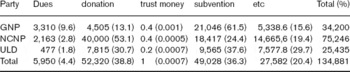
The problem is that most of the local branches do not rely on membership dues but on the legislator of the area who is the leader of the local branch: in most cases, he is the only source of finance. In terms of dues (membership fees), only a very small number of members pay. In 2000, only 9.6% of the GNP's central income was from members’ dues, 13.1% from donations, and 61.5% from subventions out of a total income of about 34 billion won. The NCNP received 2.8% from members’ dues, 53.1% from donations, and 24.4% from subventions out of a total income of about 75 billion won. For the ULD, the ratio was 1.8% from members’ dues, 30.7% from donations, and 37.6% from subventions out of a total income of about 25 billion won.Footnote 57 Overall, parties relied on members’ dues on average 4.4%. As the ruling party, the NCNP, had the biggest proportion of donations and the ULD, as its coalition partner, also seemed to enjoy more donations as well (see Table 2).
Central party income in 2000 (Unit: Million won)

Source: Adapted from Jiyun Sim and Minjeon Kim, ‘Hanguk Jeondangui Suipgujo Yeongu – 1997–2002 Nyeondo Jeongdang Hoegyebogo Jaryoreul Jungsimeuro [Revenue Structure of Korean Political Parties]’, Hankukkwa Kukjejeongchi, 38(3) (2002): 163.
In terms of party income, the difference between the ruling party and the opposition party is significant. The GNP had the largest amount of subvention (about 21 billion won) as a result of the large number of legislature seats compared to that of the NCNP (about 18 billion won). However, the total income was nearly half of the NCNP's income. This shows that political donors expect some benefit from their donations.
There is a higher rate of membership dues paid at the local branch of the party compared to the central party. But this results from donations by the members rather than from membership dues. In 2000, the GNP's 85,000 members paid 12.8 billion won in dues.Footnote 58 This means that an individual member paid 1.5 million won on average. The NCNP's 6,300 members paid 10 billion won, that is 1.6 million won per head. The ULD's 3, 700 members paid 4.7 billion won, that is 1.3 million won per head on average. In the local branch, the ratio of the subvention received from the central party is relatively low at 23.5% for the GNP, 13.4% for the NCNP, and 4.5% for the ULD.Footnote 59
As these figures show, the membership dues are not the same as the dues paid to so-called mass political parties in Western democracies. In Korea, membership dues are paid by very small numbers of members and parties are more likely to be dependent on legislators’ personal source of finance, donations, and subventions. Overall most of the party income is based on the small numbers of party leaders able to attract more donations at the party's central level and at the local level as well as the subvention and their own personal financial resources. To raise donations, candidates at the general election hold supporters’ meetings (Huwonhoe). The supporters’ meetings can be held in various forms, as illustrated by inviting people to concerts, a party for a book launch, or exhibition of the candidate's own calligraphy.Footnote 60 Jang Seong-min, a former legislator, contends that:
Although the situation has changed slightly, even now but still supporters donate funds under the table. Many supporters donate funds to prevent a change in the laws. The recent incident with the Private School Law is a case in point.Footnote 61 Many involved in the private schools administration donated funds to politicians in order to protect the existing laws.Footnote 62
Taking care of local voters' needs is a very important role played by the legislator who is the leader of the local branch. Each local branch spends an average of 10–30 million won a month on these sorts of activities.Footnote 63 The main expenses for the local branch lie in taking care of the family events of local voters.Footnote 64 Attending and sending money to a funeral or wedding is a part of traditional culture in Korea to help each other on a happy day or sad day; however, most of the legislators who have local supporters in their areas spend more than two-thirds of their monthly expenses in taking care of the potential voters' family events.Footnote 65 Lee Yang-hee, a former legislator, has stated that ‘only a few who are in high positions have enough funds, especially in the ruling party. Ordinary legislators mainly rely on their very close relatives as supporters. Being a legislator does not have advantages economically.’Footnote 66
However, this comment actually contrasts with other legislators I interviewed. A former legislator of the ruling party stated that:
During the supporters meeting many supporters come. Imagine one supporter donates 100 million won (about 100,000 US dollars) each. How much would it be? Yes, it costs 200 million won to 300 million won to run the local office where you are elected, but if you manage to have more than 10 supporters donating 100 million won each, you still have 700 million won in your pocket.Footnote 67
This shows how unequally the funding is allocated. Pye describes such leadership as follows:
Korean rulers, like Korean fathers, are expected to be embattled, needing to prove themselves in adversary contacts; but they are also expected to be masterful at all times, for like the Chinese leader-father, the Korean is supposed to be an aloof, lonely authority figure, able to cope single-handedly with all of his wishes. Yet again, he is expected to be sympathetic, nurturing, and sensitive to the wishes of his followers’ family, though at the same time vicious and aggressive in fighting external foes.Footnote 68
Similarly, the party leader takes care of the ordinary legislators with subsidies to sustain the local branch and to carry out electoral campaigns or appointment of the candidate in the next election or executive position in the government in the case of the ruling parties. What happens if legislators do not conform to this pattern of behaviour? Jang Seong-min, a former legislator, points out that:
There are three kinds of punishment if ordinary legislators do not follow the leaders of the party. First, the allocation of the expenses for the local branch depends on the legislators’ loyalty toward the leaders or elite members of the party. When a legislator does anything against the leaders’ opinion the support funding for the local branch can be decreased right away. Second, when there is an important meeting among legislators in the party the less loyal legislators are not contacted. They are simply marginalized in the legislators meeting in the party. Third, there is no possibility of gaining a position within the party when he or she is not loyal to the leaders.Footnote 69
Conclusion
Through an analysis of the case of the Kim Dae-jung administration in South Korea, the paper has shown that size (majority status most notably) is not a sufficient condition for a government to secure governability. Instead, paying closer attention to the dimensions of party organization offers better insights into the determinants of governability (and ungovernability). A study of party organization in South Korea reveals that parties were created from above (by the elites during the American military occupation), not from below (by the grassroots). When the party leadership failed to provide mechanisms for compromise with the opposition party, and the ruling party faced deadlock in the legislature, governability was undermined. Failure by the ruling party to consolidate the cohesiveness of the party organization contributed to factionalism within the party as well as the coalition and increased conflict with the coalition partner. Without party consolidation within the ruling parties, the government was unable to implement reform policies. As a result, the administration rapidly entered the lame-duck period.
The findings of the paper have important implications for scholars of Korean politics. Research on South Korea has thus far concentrated on the presidency and on the broader issue of democratic consolidation.Footnote 70 Overlooking the contribution of coalition theories has meant understanding how political actors behave, and why and how their behaviour actually influences the process of compromise and negotiation, has been neglected. Understanding the intra-party politics and the mechanisms of negotiation and compromise within the party and the party system in South Korea significantly enhanced our understanding of why coalitions form and especially break down in Korea and how that affects governability.
In addition, explaining coalition building in Korea, therefore, has implications that go beyond the specificity of the case study. Coalition building is not just an issue that concerns South Korea (or Western Europe, for that matter), but it is frequent in East Asia (Taiwan, Japan), Central-Eastern Europe (Poland, Slovakia, Czech Republic, Romania), and Africa (Zambia). Therefore, the paper contributes to enhance our understanding of factors affecting governability with coalition building across regime types.Footnote 71 By emphasizing the importance of party politics (and of party organization most notably), the paper not only bridges two streams of scholarship (on coalition studies in the parliamentary systems with West European countries data sets and democratic governability in the presidential regimes with Latin American data sets) but it shows how party organization, and in particular a low level of institutionalization, affects governability.
In conclusion, the study of coalitions in South Korea adds a new non-Western case to the expanding field of coalition studies as well as to the debates on regime types and democratic governability allowing these two fields of scholarship to broaden their geographic scope, opening the way to new research across regions as well as across regime types in order to shed light on the determinants of ungovernability.