INTRODUCTION
In Euripides’ Erechtheus, Athena proclaims that the souls of Erechtheus’ daughters ‘have not gone to Hades’. Instead, she has ‘caused their spirit to dwell in the upper reaches of the sky and [she] shall make a famous name throughout Hellas for men to call them the Hyakinthian goddesses’ (Euripides, Erechtheus [Kannicht Reference Kannicht2004] fr. 370.71–74; Hard Reference Hard2004, 370). A scholiast to Aratos identifies these with the star cluster of the Hyades (Schol. Aratos, Phaenomena 172).Footnote 2 This proclamation of the emplacement of the girls in the night sky as the Hyades is followed by another proclamation from Athena that the girls are from now on to be considered goddesses. The Athenians are to offer them annual sacrifices, and choral dances are to be performed by young girls (Euripides, Erechtheus [Kannicht Reference Kannicht2004] fr. 65.77–80; Calame Reference Calame2001, 181). Other sources concur with this myth of the girls’ death, informing us that it was the result of an oracle from Delphi, ordering that one of them had to be sacrificed so that their father, Erechtheus, could win the war against the Eleusinian Eumolpos. The youngest daughter of Erechtheus was chosen to be sacrificed, but her sisters, who had sworn that they should all die together, killed themselves (Apollodoros 3.15.4; Euripides, Ion 277–82; Hyginus, Fabulae 46; Euripides, Erechtheus [Kannicht Reference Kannicht2004] fr. 370.70–71). The myth related by Euripides forms one of the most prominent versions of the catasterism myth of the star cluster of the Hyakinthidai or Hyades.Footnote 3
Epigraphic records have helped in shedding some light on the existence of a cult of the Hyakinthidai, but our knowledge of their cult and its location remains frustratingly inadequate. A fragment from a fifth-century bc inscription found in the Agora testifies that the young girls were indeed offered annual purificatory offerings in Athens (Agora I 7577, Face B.16–17), although it has not been possible to reconstruct the month in which these rites were performed (Gawlinski Reference Gawlinski2007, 49–50, 53–4). It is because of another inscription that we know of the existence of a Hyakinthion in Attica, mentioned in a list of restored monuments of the Augustan period (Kirchner Reference Kirchner1913–16, no. 1035.52), but the location of the shrine has, regrettably, not survived.
We are left, then, with the events which are narrated in the myths as taking place on the Acropolis. According to the literary sources, this was the location of Erechtheus’ dwelling (Homer, Odyssey 7.81; Homer, Iliad 2.546–50), the place where the girls met their death, and also Erechtheus’ burial ground. In this paper we investigate the possibility that the catasterism myth of the Hyades may have linked the star cluster to certain cult rites held on the Acropolis, in which the participation of young girls (arrhēphoroi) was important and which connected the daughters of Erechtheus/Erichthonios with the aition myths of those cult rites.
FESTIVALS AND TIMING
Two myths narrate the death of maidens on the Athenian Acropolis: one is that mentioned by Euripides (discussed above), of the sacrifice of the young daughters of Erechtheus. The second is the myth of the three daughters of Kekrops (Aglauros, Herse and Pandrosos), also of young age (Apollodoros, Library 3.14.2; Philochoros [Jacoby Reference Jacoby1964] 328 F 105), who were entrusted by Athena with the box containing the newborn Erichthonios (Euripides, Ion 270–2). The girls threw themselves from the Acropolis in a frenzy of madness sent upon them by Athena as punishment for disobeying her orders not to open the box (Apollodoros, Library 3.14.6; Pausanias 1.18.2). As both Kekrops and Erechtheus/Erichthonios were mythical kings of Athens believed to have lived with their families on the Acropolis, the myths of the maidens’ deaths are also associated with the same location. The presence of these young girls on the Acropolis was in a sense commemorated by the Athenians through the office of the arrhēphoroi, young girls at the service of Athena, who also dwelt on the Acropolis (παρθένοι δύο τοῦ ναοῦ τῆς Πολιάδος οἰκοῦσιν οὐ πόρρω… [Pausanias 1.27.3]).Footnote 4 The arrhēphoroi were associated with the weaving of Athena's peplos (robe) (Hurwit Reference Hurwit1999, 42) and played a significant role in at least three Acropolis cults: the Kallyntēria, the Plyntēria, and the Arrhēphoria.
The Kallyntēria (held on 22 Thargelion), a small nocturnal purification rite, were associated with the east part of the Acropolis. The rite involved the cleansing of the Athena Polias shrine, and the relighting of the eternal flame of the goddess.Footnote 5 Photios also links the festival with Aglauros (a daughter of Kekrops and the first priestess of Athena),Footnote 6 who was the first to adorn the gods (Photios, Lexicon κ 127 s.v. Καλλυντήρια, cf. Parker Reference Parker2005, 381, 474). A few days later (on the night of 25 Thargelion), the purification rites continued with the Plyntēria, which involved the stripping of the cult statue of the goddess, the removal of its jewellery, and the wrapping (Plutarch, Alkibiades 34.1; Xenophon, Hellenika 1.4.12) and carrying of the xoanon in a night procession to the seashore, to bathe and purify it in running (salt) water, while also washing its robe (Burkert Reference Burkert1985, 228). The participation of maidens (called πλυντρίδες or λουτρίδες) in this procession was essential, as they were the ones performing the ritual bathing (Aristophanes, frag. 841: Photios and Hesychios, s.v. λουτρίδες). The statue was then returned to the Acropolis, clothed with the clean peplos and adorned with jewels. Apart from the participation in this festival of young maidens, who were drawn from the clan of the Praxiergidai (Mansfield Reference Mansfield1985, 366–9),Footnote 7 it is believed that the rite commemorated the death of Aglauros, as the sacred vestments of Athena were now washed for the first time during the Plyntēria, a year after Aglauros’ death (Hesychios, s.v. Πλυντήρια; Photios, Lexicon κ 124 s.v. Καλλυντήρια; Philochoros [Jacoby Reference Jacoby1964] 328, F 106; Lexeis Rhetorikai, s.v. Καλλυντήρια [Bekker Reference Bekker1814, 270.1–5]).Footnote 8 The association of the festival with the death of Aglauros makes it apparent that the way the cult statue of Athena was treated during this festival was as if it were the dead Aglauros, since several aspects of the rite resemble Greek funerary practices (Mansfield Reference Mansfield1985, 372).Footnote 9 These similarities with the treatment of the dead are confirmed and epitomised by the ancestral sacrifices that were offered by the Praxiergidai either during or a day before the Plyntēria (Kirchner Reference Kirchner1913–16, no. 776.18–20). That this day was a day of mourning is also confirmed by Plutarch, who states that ‘no Athenian would venture the undertaking of important business on the day of the Plyntēria’ (Plutarch, Alkibiades 34.2), and by other writers, who state that on the day of the Plyntēria the sanctuaries were closed (Polydeukes, Onomastikon Attikon 8.141; Phanodemos [Jacoby Reference Jacoby1964] 325 F11).
The Arrhēphoria, associated with the north to northeast part of the Acropolis, were a secret fertility rite held in honour of Pandrosos and Athena (Herrington Reference Herrington1955, 29). The rite took place in Skirophorion (Burkert Reference Burkert1985, 228; Mikalson Reference Mikalson1975, 166–7) and was the re-enactment of the myth of Athena entrusting newborn Erichthonios to the three daughters of Kekrops. On the night before the day celebrating the festival, the priestess of Athena gave the arrhēphoroi (young girls in the service of Athena) baskets – with unknown contents – to take to the sanctuary of Aphrodite through a secret passage, descending from the north slopes (Pausanias 1.27.3; Broneer Reference Broneer1932, 50–5; Hurwit Reference Hurwit1999, 42). The girls were to leave the baskets they were carrying, pick up some new ones from the sanctuary of Aphrodite (again with unknown contents) and bring them back to the Acropolis. A steep staircase has been unearthed in the area of the north slopes, which during Mycenaean times would have led to a spring, thought to have been the one used by the arrhēphoroi (Broneer Reference Broneer1933, 351–3, 416; Broneer Reference Broneer1935, 129; Broneer Reference Broneer1956, 12–13). Archaeologically, the rite that was eventually named Arrhēphoria (which started and ended on the Acropolis) seems to have been either resumed or initiated in the eleventh century bc, when the Mycenaean stairway appears to have been restored (Broneer Reference Broneer1939, 423; Burkert Reference Burkert1985, 233).
The conversion of ancient Athenian calendar months to our Gregorian calendar can be achieved only with an accuracy of within three to four weeks because of the nature of the Athenian calendar. This is because New Year's Day in the Athenian calendar was similar to Christian Easter and Jewish Passover, in being tied to both a lunar phenomenon of variable date and a solar event of more or less fixed date – in the case of Easter and Passover to the first full moon after the spring equinox, and in the case of ancient Athens, to the first new moon after the summer solstice. As a result, New Year's Day in Athens, 1 Hekatombaion, could shift from one year to the next by about three weeks, and over a period of years by as much as four weeks between the earliest occurrence of New Year's Day and the latest. The date 1 Hekatombaion would fall generally in mid to late July, but in some years it would occur earlier, in late June to mid-July. Consequently, Thargelion, two months earlier, could start in mid to late May in some years, but as early as late April or the first half of May in others. Therefore, since the festival of the Kallyntēria was celebrated towards the end of Thargelion, it would often take place around our end of May–beginning of June.
THE ASTRONOMICAL MOVEMENT OF THE HYADES AND AURIGA
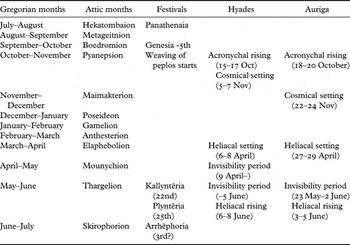
Table 1 shows a correlation between the timing of the above rites associated with the young girls (the arrhēphoroi, and the daughters of Kekrops and Erechtheus) and the movement of the Hyades, the star cluster believed to be the catasterism of some of these mythical young girls. As seen in Table 1, the Kallyntēria, which marked the commencement of three consecutive rites timed within three weeks of one another (Kallyntēria, Plyntēria and Arrhēphoria), were timed at the time of, or very close to, the most astronomically significant period of the Hyades and the constellation of Auriga. Auriga was, for the Greeks, the stellar representation of Erechtheus/Erichthonios (Eratosthenes, Katasterismoi 13; Hyginus, Astronomica 2.13).
Calendrical correlation between festivals involving young girls and the movements of the Hyades and Auriga, visible from the Acropolis’ south, southeast, east and northeast horizons, in the years 700–300 bc.

The heliacal rising of the star cluster of the Hyades would have taken place between our 6 and 8 June in the years between 700 and 300 bc (calculated through reconstructions of the ancient night sky, and using Aldebaran, α Tauri, as the focal star in the cluster). The heliacal rising marks the reappearance of the star cluster in the night sky, seen to rise in the east, approximately an hour before dawn, after its annual invisibility period, which started on 9 April. Until the time of the heliacal rising, the star cluster had been rising (and for much of this time setting) during the day and was therefore invisible at night. The star cluster became visible again for the first time for a few minutes before dawn. It would be seen to rise in the east approximately one to two hours before the glare of the rising sun made it invisible at dawn. From that date on and for the next few months, the Hyades would rise earlier and earlier every night until the following April/May, when they climbed above the horizon just after sunset, while it was still too bright for them to be visible. The rising Auriga is located in the northeast part of the night sky, in the section of the horizon visible between the Erechtheion's north porch and the entrance to the sanctuary of Athena Polias. Between 700 and 300 bc, Auriga's heliacal rising occurred between 3 and 5 June and its invisibility period started on 23 May. In the years when the month would have started earlier, the heliacal rising of the Hyades (6–8 June) may not have been visible during the Kallyntēria, but it would have been visible at the very latest by the time of the Arrhēphoria in the following month of Skirophorion.Footnote 10
This phenomenon of the heliacal rising, which is culturally the most significant in the annual movement of a star or constellation, took place very close to the time of the celebration of the aforementioned three festivals associated with young maidens on the Athenian Acropolis. In addition, not only were these festivals nocturnal, but they also took place in the eastern part of the Acropolis, from where the rising Hyades would have been seen best.
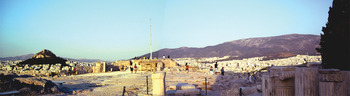
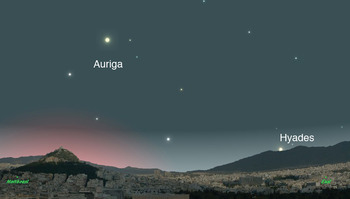
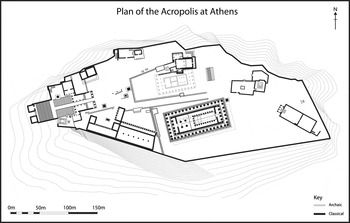
The Hyades are seen to rise in Greece in the east part of the sky, almost due east (at azimuth 80°). This part of the sky is visible from the Athenian Acropolis if one is standing in front of or near the entrance of the Parthenon, the Great Altar and the Athena Polias shrine (Fig. 1). This eastern horizon visible from the east part of the Acropolis is not particularly high. Its outline is formed by Mt Hymettos across the east and with Mt Lykabettos rising sharply at a much closer distance in the east-northeast (Fig. 2).
Panoramic view of the horizon if standing near the entrance of the Parthenon, and the Athena Polias shrine and the Great Altar (photo: E. Boutsikas).

Heliacal rising of the Hyades over the ‘Horns’ of Mt Hymettos, as seen from the east end of the Parthenon in Athens, 600 bc. Auriga is already risen and sits over Mt Lykabettos to the northeast (Voyager 4.5, with Athenian horizon incorporated by R. Hannah).

The catasterisms of Erechtheus/Erichthonios and his daughters would become visible on the eastern horizon of the Acropolis, in front of the Parthenon, the Great Altar and the Athena Polias cella, at the time when the nocturnal Kallyntēria, Plyntēria, and Arrhēphoria rites would be coming to completion, at the end of the night around that part of the Acropolis. The Great Altar in particular was the focus of cult rites performed on the Acropolis; with the exception of the sacrifices offered to Athena Hygeia and those to Athena Nike, all sacrifices were offered on the Great Altar (Herrington Reference Herrington1955, 31). The chthonic character of the Kallyntēria, Plyntēria, and Arrhēphoria and their association with the death of the maidens has been argued here and elsewhere.Footnote 11 This period is marked by the reappearance of the virgin Hyades and Auriga in the night sky during their heliacal rising.
A similar astronomical association occurs at the time when the weaving of Athena's peplos would have commenced, in Pyanepsion (October–November). This is the time when the acronychal rising (the star cluster is seen to rise at dusk just after sunset) (15–17 October) and the cosmical setting (the star cluster is seen to set just before dawn) (5–7 November) of the Hyades would have occurred. Between 18 and 20 October the acronychal rising of Auriga would have also been visible (Table 1). The peplos was offered to the goddess nine months later, during the Panathenaia upon the arrival of the Panathenaic procession to the Acropolis. The Parthenon's west frieze – the location from which the Hyades would have been seen to set at the time the weaving was starting – has been interpreted as depicting either the preparations for the procession, at the end of which the peplos would have been dedicated to Athena (Nagy Reference Nagy1992, 56; Root Reference Root1985, 103, 105, Stillwell Reference Stillwell1969, 231, 233–4), or the commemoration of Eumolpos’ military threat which led to the sacrifice of Erechtheus’ daughters (Connelly Reference Connelly1996, 71). Whether the weaving of the peplos by the arrhēphoroi was ‘a symbolic re-enactment of the role of the two sisters in weaving the funeral cloth for the one to be sacrificed’ (Connelly Reference Connelly1996, 79), or whether it was the new robe of the goddess who catasterised the Hyades, the mythological and ritual association between the young girls, their death and Athena, is strengthened further at a temporal level by the timing of this weaving.
THE EASTERN LANDSCAPE
The Kallyntēria, Plyntēria, and Arrhēphoria were nocturnal rites and – with the exception of the Plyntēria, which involved at some point a trip from the Acropolis to the sea for the cleansing of the cult statue – all of these rites were performed in the north and northeastern part of the Acropolis, from where the heliacal rising of the Hyades would have also been visible. At the bottom of the east slope of the Acropolis rocks, a small cave-sanctuary dedicated to Aglauros has been discovered (Dontas Reference Dontas1983; Hurwit Reference Hurwit2004, 7–8), probably commemorating her and her sisters’ deaths (Fig. 3). It is possible that the location of this sanctuary was not accidental, but instead was believed to have marked the spot where the young girls died after jumping from the east part of the Acropolis. Interestingly, part of the festival celebrated in honour of Aglauros and her two sisters in Aglauros’ sanctuary also had a mystical character and included a night-long pannychis (Lexeis Rhetorikai, s.v. Δειπνοφόρος [Bekker Reference Bekker1814, 239.7–11]; Athenagoras, Legatio 1.1; Dontas Reference Dontas1983, 56 and n. 23). Even though the cave of Aglauros is located at a considerably lower altitude, at the foot of the Acropolis hill, the eastern horizon is still visible, as the ground in front of the cave slopes sharply (also visible in Fig. 3). At the time of the festival of Aglauros the rising Hyades would therefore have still been seen over the horizon which the cave faces.
Southeast corner of the Athenian Acropolis. The cave of Aglauros dominates the lower east slope to the right (photo: R. Hannah).

We have then a spatio-temporal association which links the mythological narratives – used as aitia of cults on the Acropolis – with the optimal location from which the relevant astronomical observations could be visible during the rites; a case where time and space entwine. In addition to the spatial association, the rites were timed on the occasion of the most astronomically significant phases of the same stellar bodies. This cosmic association between, on the one hand, the myth of the death of the young maidens, the timing of religious rites in which these girls were commemorated, and the location where the rites would have taken place, and, on the other hand, the astronomical observations, would have come together once a year, at the precise moment in time when the cosmos would transition from night to day. This transition between night and day is also depicted on the Parthenon's east pediment, where Selene is seen to dive in her chariot below the base of the pediment and, on the opposite corner, Helios is depicted as climbing above the ‘horizon’.Footnote 12
A further link may be seen in the surviving sculptural decoration of the Parthenon. The Parthenon's east frieze depicts a larger number of maidens than any other sculptural decoration on the Acropolis. Here, over 30 maidens are depicted, while the place of prominence in the frieze is occupied by the depiction of three girls and a woman, who may represent either the daughters of Erechtheus (Connelly Reference Connelly1996, 80), or the arrhēphoroi (Hurwit Reference Hurwit1999, 223, 227). The narration of the eastern sculptural decoration of the Parthenon is therefore linked by projecting one's field of view from the east frieze to the east horizon, where the Hyades would have been visible.
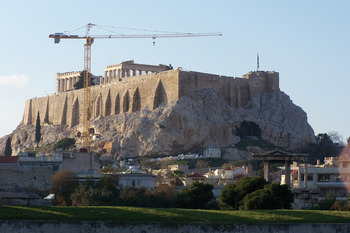
At the end of the Erechtheus, Athena instructs the wife of Erechtheus, Praxithea, to establish a temenos at the place where her daughters were buried and to build a stone peribolos around her husband's precinct (sēkos) in the middle of the Acropolis (Euripides, Erechtheus [Kannicht Reference Kannicht2004] fr. 370.65–67, 90ff). Two locations have been proposed as containing tombs on the Acropolis: the Erechtheion and its peribolos as Erechtheus’ precinct, and the area occupied by the Classical Parthenon as the burial ground of his daughters.Footnote 13 This last idea has been argued on the basis of other tombs of heroic maidens being located close to the temples of the goddesses with whom they were associated (Connelly Reference Connelly1996, 76), such as Iphigeneia's tomb at the sanctuary of Artemis at Brauron (Euripides, Iphigeneia at Tauris 1452–3).Footnote 14 Early literary evidence may support this idea: Euripides tells us that the sacrificed daughter was buried at the place of her sacrifice and that her sisters were buried in the same tomb (Euripides, Erechtheus [Kannicht Reference Kannicht2004] fr. 370.67–68). In support of this argument could also be taken the Roman inscription (first century bc) referring to the Hyakinthion (Kirchner Reference Kirchner1913–16, no. 1035.52) mentioned above, which was found on the Acropolis. If the hypothesis of the girls’ tomb on the Acropolis is accepted, it is possible that the west room of the Parthenon – the remains of which show that both in the Classical structure and in its predecessor the room was accessible only from the west (Fig. 4) – rested atop the tomb of the virgins, the parthenoi, just as the tomb of Erechtheus may have been believed to rest under part of the Erechtheion (Connelly Reference Connelly1996, 76). If the word παρθενών was initially used as a locality referring to several parthenoi, such as ‘the maidens’ quarters’ or the ‘place of the maidens’ (Connelly Reference Connelly1996, 76–7), then the west section of the Parthenon would have been associated with Erechtheus’ daughters. Appealing as this interpretation seems, it is not possible to conclude with certainty that this was the location where the young girls were buried. In any case, however, this part of the Parthenon can (like the eastern part) be linked with the constellation of the Hyades: the heliacal setting of the Hyades would have been visible from this location, a month before the Kallyntēria and their cosmical setting at the time when the weaving of the peplos would have started (Table 1).
Plan of the Athenian Acropolis (drawn by L. Bosworth).

The astronomical movement of the Hyades coincides with rites associated with the arrhēphoroi and the parthenoi. The association of the heliacal rising of the Hyades with the Arrhēphoria is also consistent with the identification of the rite as a possible fertility rite (Herrington Reference Herrington1955, 29). The heliacal rising of the Hyades, just like that of the Pleiades, marked the time of harvesting and their setting the beginning of the ploughing season (Hesiod, Astronomia fr. 291 M–W; Hesiod, Works and Days 609–17; Hannah Reference Hannah2005, 20–4). Although the worship of the moon and the sun may have been considered a barbarian practice during the Classical period (Davidson Reference Davidson and Ogden2007a, 205), the divinity and worship of stars was proclaimed and is testified in the literary sources (Euripides, Erechtheus [Kannicht Reference Kannicht2004] fr. 370.71–7; Plato, Timaeus 41d–e, 42b; Chrysippus, Stoicorum Veterum Fragmenta 810–11, 813–15, 1076–7). It is also confirmed in Athena's statement in the Erechtheus that the Hyades should be worshipped as goddesses (Euripides, Erechtheus [Kannicht Reference Kannicht2004], fr. 65.77–80).
Observing the heliacal rising of stars and constellations was common practice in Greece from at least the time of the Iliad (Homer, Iliad 22.25–31 for Sirius). Evidence for the use of stellar observations for the timing of religious festivals in Greece can be dated to at least as early as the fourth century bc. Exemplifying such a practice are the Keans, who anticipated the heliacal rising of Sirius and offered sacrifices to the star (Apollonius, Argonautica 2.516–27).Footnote 15 Watching the movement of stars during the course of religious rites is explicitly recorded in early, as well as later, sources. Alkman in his Partheneion (middle of seventh century bc), for example, describes a ritual that was taking place just before dawn at the time of the heliacal rising of the Pleiades (Alkman, Partheneion 39–43, 60–3; Boutsikas and Ruggles Reference Boutsikas and Ruggles2011, 60–5) and Euripides seems to describe Helen watching Hyakinthos, i.e. the constellation of Orion (Euripides, Helen 1465–74; Davidson Reference Davidson and Ogden2007a, 208; Davidson Reference Davidson2007b, 244). Similarly, Aristophanes times the beginning of the fifth day of the Eleusinian Mysteries, when the hiera would be returned to Eleusis, to the sighting of the morning star (‘the light-bearing star of our nocturnal rite’, Aristophanes, Frogs 342–3). In view of this evidence, it is possible that when Athena declares the divinity of the young girls after their death and their placement in the sky, and orders that sacrifices should be made to them, it is assumed that the sacrifices and festival would take place at the time of the heliacal rising of the Hyades. In this way, rites and sacrifices would be offered to the stars in commemoration of their once mortal existence.
CONCLUSION
Although the content and interpretation of the sculptural elements of the Acropolis structures (especially for the Parthenon) have been widely debated and discussed, the role of the surrounding landscape, and the timing of festivals in relation to the local sky and horizons, have been absent from studies of Athenian religion and cult performance.Footnote 16 In this paper we argue that the structures and their architecture, the cult rites with their timing and foundation myths, were all tightly interwoven in expressing a religious and cosmological narrative and context. This study would have benefited immensely from definitive answers on the exact location of the Hyakinthion in Attica and the month in which the rites to the Hyakinthidai mentioned in the Agora inscription took place, but even in the absence of such evidence it is possible to conclude that there was an astronomical relationship between the cults of young girls on the Acropolis and the movement of the star cluster of the Hyades.