Developmental psychopathology is founded in part on the notion that proximal, microsocial interaction processes in interpersonal relationships are the engines of child development (Bronfenbrenner & Morris, Reference Bronfenbrenner, Morris, Damon and Lerner1998). The development of children's self-regulation is especially likely to be influenced by these microsocial interpersonal processes (Olson & Lunkenheimer, Reference Olson, Lunkenheimer and Sameroff2009). Self-regulation is an active process that plays out in seconds or minutes in the context of environmental or interpersonal challenges (Cole, Martin, & Dennis, Reference Cole, Martin and Dennis2004). Thus, it follows that the way in which parent and child actively organize or “coregulate” their interaction in real time could be particularly influential in shaping the child's developing ability to regulate behavior. However, it is surprising that, despite ample research on how the content of parent–child interactions in early childhood relates to children's behavior (e.g., Eisenberg et al., Reference Eisenberg, Gershoff, Fabes, Shepard, Cumberland and Losoya2001), we have comparatively little research on how the dynamic structure or organization of early parent–child interaction impacts the development of children's behavioral adjustment over time.
Coercion theory (Patterson, Reference Patterson and Thoresen1972) and transactional models of development (Sameroff & Chandler, Reference Sameroff and Chandler1975) hold that recurring dyadic interaction patterns become stable over time and in turn contribute to increasingly stable individual differences in children's developmental psychopathology. Empirical research has supported these theories, demonstrating that rigid, mutually negative interaction patterns between parent and child contribute to children's higher levels of externalizing and antisocial behavior problems (e.g., aggression, impulsivity, and hostile defiance; Achenbach, Reference Achenbach, Lewis and Miller1990) within and across time (e.g., Dumas, Lemay, & Dauwalder, Reference Dumas, Lemay and Dauwalder2001). For example, Cole, Teti, and Zahn-Waxler (Reference Cole, Teti and Zahn-Waxler2003) found that mothers' contingent, angry emotional responses with 5-year-olds predicted higher teacher-rated externalizing problems at age 7 years.
There is evidence that when dynamic systems (DS) methods are applied to these same processes, we learn more about the fine-grained coregulatory patterns that predict children's behavioral adjustment. Hollenstein, Granic, Stoolmiller, and Snyder (Reference Hollenstein, Granic, Stoolmiller and Snyder2004) used state space grid (SSG) analyses (Lewis, Lamey, & Douglas, Reference Lewis, Lamey and Douglas1999) to test whether parent–child rigidity predicted growth in children's externalizing and internalizing behavior problems across the kindergarten year. Rigidity was operationalized as a diminished behavioral repertoire, a tendency to avoid change, and a tendency to remain in certain affective states. They found that parent–child rigidity predicted the child's inclusion in the “consistently high” and “increasing” externalizing problem groups over the course of four assessments during the kindergarten year. Research has also shown that when initially disorganized interactions with peers become organized around deviance, measured via low entropy scores, adolescents are more likely to show stable antisocial behaviors (Dishion, Nelson, Bullock, & Winter, Reference Dishion, Nelson, Winter and Bullock2004). Thus, we have some research to suggest that, at least in children aged 5 years and older, interpersonal rigidity and dyadic organization around negative content predict increases in children's behavior problems over time.
In contrast, we know less about the corresponding adaptive parent–child interaction processes of dyadic positive affect and flexibility. If the combination of negative affect and rigidity predicts higher levels of children's externalizing problems over time, do shared positive affect and flexibility have the opposite effect, predicting lower levels of externalizing problems over time? Early externalizing behavior problems predict long-term difficulties in major domains like mental health (King, Iacono, & McGue, Reference King, Iacono and McGue2004), peer relations, and academic performance (Campbell, Spieker, Burchinal, & Poe, Reference Campbell, Spieker, Burchinal and Poe2006). Therefore, a better understanding of the link between adaptive parent–child interactions and children's emerging behavioral adjustment could inform our understanding of the development and prevention of children's behavior problems. Understanding the effects of real-time, adaptive patterns of parent–child interaction, compared with global interaction styles or the frequency of positive behaviors, is particularly important for prevention because it is these moment-to-moment interchanges that practitioners work to improve upon in family interventions (Lunkenheimer & Dishion, Reference Lunkenheimer, Dishion, Guastello, Koopmans and Pincus2009). The present study was designed to address these gaps by examining dyadic flexibility and positive affect in parent–child interactions at child age 3 years and whether they predicted lower levels of children's externalizing behavior problems after the transition to school at age 5.5 years. A secondary goal was to address whether the effects of dyadic flexibility and positive affect differed between mother–child and father–child interactions, considering that little research to date has addressed how dynamic father–child interaction patterns contribute to early child development.
Dyadic Flexibility and Positive Affect
DS approaches from various fields suggest that positive affect and flexibility tend to accompany one another in interpersonal interactions. For example, from organizational psychology, we know that the highest performing business teams show the highest ratio of positive interactions and greatest flexibility and generativity (Losada, Reference Losada1999). In developmental research, research has shown that parent–adolescent discussion of positive topics is characterized by greater levels of flexibility than the discussion of negative topics (Hollenstein & Lewis, Reference Hollenstein and Lewis2006). From clinical psychology, we know that parents and children who improve in family intervention display a move from rigid negative dyadic interactions to more flexible, positive ones over time (Granic, O'Hara, Pepler, & Lewis, Reference Granic, O'Hara, Pepler and Lewis2007). This link is also supported by research on intraindividual cognitive processes, illustrating that positive moods tend to produce increased cognitive flexibility in processes such as problem solving and working memory (Ashby, Isen, & Turken, Reference Ashby, Isen and Turken1999). Although flexibility has been operationalized and interpreted differently across these disciplines, we have general reason to believe that positive affect and flexibility accompany one another and tend to characterize adaptive interpersonal interactions.
Developmental research in infancy has addressed the importance of positive, reciprocal interactions between parent and child, most often studied as parental responsiveness to infant needs. Although the construct of “flexibility” per se has not been studied in infancy, the coregulation of affect in infancy involves the caregiver and infant attempting to coordinate states of positive affective arousal in close temporal proximity (Feldman, Reference Feldman2003; Fogel, Reference Fogel, Nadel and Camaioni1993). Tronick and Cohn (Reference Tronick and Cohn1989) found that mother–infant pairs spend the majority of their playtime in uncoordinated affective states, but that these are typically corrected in the next time interval. This time-lagged correction likely reflects the parent's flexible and responsive adaptation to the infant's state. In turn, this mother–infant coregulation at 3 and 9 months has been shown to predict the child's regulatory ability at 2 years of age (Feldman, Greenbaum, & Yirmiya, Reference Feldman, Greenbaum and Yirmiya1999). Thus, it is likely that, in infancy, the flexible coregulation of positive arousal between parent and child is an adaptive process that lays the groundwork for the child's later self-regulatory ability.
In early childhood, we would expect shared positive affect and flexible coregulation between parent and child to continue to be important as children begin to internalize the ability to modulate affective responses in interpersonal relationships. Although flexibility has not been studied in this age range, cross-sectional research has shown that positive, well-regulated (e.g., temporally coordinated) parent–child interactions are associated with children's lower levels of behavior problems in early childhood (e.g., Harrist, Pettit, Dodge, & Bates, Reference Harrist, Pettit, Dodge and Bates1994; Mize & Pettit, Reference Mize and Pettit1997). Similarly, longitudinal research in middle childhood indicates that mothers' contingent, positive responses predict reductions in children's externalizing problems from age 5 to age 7 (Cole et al., Reference Cole, Teti and Zahn-Waxler2003). In children aged 7 to 9 years, dyadic mutuality defined as reciprocity (e.g., joint attention), responsiveness (e.g., frequency of responses to one another), and cooperation (e.g., explicit agreement about the task) also relates to lower levels of externalizing problems when coupled with dyadic positive affect (Deater-Deckard, Atzaba-Poria, & Pike, Reference Deater-Deckard, Atzaba-Poria and Pike2004).
Thus, there is evidence that coregulatory constructs such as temporal coordination, contingency, and mutuality in parent–child interactions are adaptive in the context of positive affect and relate to children's behavioral adjustment within and across time. However, we do not yet have research that examines the longitudinal effects of dynamic coregulatory processes in early childhood, given that research to date has been cross-sectional and/or focused on other developmental periods. The early childhood period is especially important to the internalization of children's self-regulation through interactions with their parents and the concurrent emergence of individual differences in children's behavior problems (Calkins, Reference Calkins1994). Flexibility, in particular, would appear to be an important component of early coregulation in that children need to learn to regulate affect and behavior adaptively in response to real-time, interpersonal demands. Further, the majority of coregulation research to date has either measured individual parent or child behaviors rather than dyadic behaviors, or has employed overall coding of parent–child interaction styles, which does not address the nature of coregulation as an active, real-time process (Cole et al., Reference Cole, Martin and Dennis2004).
The Present Study
We examined whether dyadic flexibility and positive affect between parents and their 3-year-olds interacted to predict children's lesser behavior problems at age 5.5 years after the transition to kindergarten. Our hypothesis was that the flexible coregulation of positive, neutral, and occasional negative affective states during parent–child interaction would foster the dyad's success in meeting interpersonal and contextual demands. Typically, interpersonal interactions involve movement from a baseline of neutral affect to varying levels of positive and negative affective intensity and back to neutral again (e.g., Dishion, Andrews, & Crosby, Reference Dishion, Andrews and Crosby1995). Our expectation was that when faced with a challenging task, parents would modulate the intensity and valence of their own affect in an attempt to influence their child's affective state and therefore engage them or gain their compliance. For example, a child who does not want to clean up toys may need his mother to move from a low-positive to a high-positive affective state through the use of a clean-up song to make the task more appealing. If the child then joins her in happily singing the song and cleaning up, this would reflect a dyad showing higher flexibility, because both partners were able to modulate their affect in order to meet the desired goal. The downregulation of positive affect or the repair from a negative to a positive affective state may also be essential modulations in order to guide the child or dyad toward completing a given task (Granic et al., Reference Granic, O'Hara, Pepler and Lewis2007). Similarly, we expected that children would attempt to gain their parents' attention through increases or decreases in positive or negative affect, and thus that this coregulatory process would occur in both directions. Research has demonstrated that positive affective processes in parent–child interactions can buffer children from higher levels of behavior problems, even in the face of concurrent negative affective displays (Lunkenheimer, Shields, & Cortina, Reference Lunkenheimer, Shields and Cortina2007). Thus, we hypothesized that if flexible coregulation occurred in the context of predominantly positive affective content, this would lay the groundwork for the child's later adaptive behavioral adjustment.
In order to study this interaction between dyadic flexibility and positive affect, we took a structural (i.e., content-free) approach to the measurement of flexibility based on the dyad's modulation of affective intensity. Our operationalization was based on existing work in the developmental psychopathology literature (e.g., Granic et al., Reference Granic, O'Hara, Pepler and Lewis2007; Hollenstein et al., 2006). We used SSGs (Lewis et al., Reference Lewis, Lamey and Douglas1999), which allowed for the study of structural dimensions independent of affective valence. Specifically, flexibility was operationalized as the number of transitions among varying degrees of affective intensity, the degree of engagement in a range of levels of affective intensity, and the even versus uneven dispersion of dyadic behavior across the range of available levels of intensity (see Measures). This approach allowed us to examine the statistical interaction between the flexible modulation of affective intensity and the degree of shared positive affective content during parent–child interaction.
We also included an individual measure of the child's self-regulation, effortful control, as a control variable. Effortful control, or the ability to suppress a dominant response and initiate and sustain a subdominant response in the face of contextual challenges (Rothbart, Reference Rothbart, Kohnstamm, Bates and Rothbart1989), has been linked to relations between parent–child interactions and the development of children's externalizing behavior problems (e.g., Eisenberg et al., Reference Eisenberg, Zhou, Spinrad, Valiente, Fabes and Liew2005). We considered that children who can inhibit impulsive behaviors in order to adjust to task demands might have an advantage in coregulatory tasks with parents that require such behavior. In other words, effortful control may act as a temperamental marker of the child's individual capacity to flexibly modulate his or her affective intensity in response to situational demands. Thus, primary analyses also addressed whether dyadic coregulation between parent and child had an effect on children's externalizing problems above and beyond the contribution of the child's individual self-regulatory capacity.
A final goal was to examine differences in the dynamic interaction patterns of mother–child versus father–child dyads. Fathers' mental health factors have been linked to children's behavior problems (e.g., Loukas, Zucker, Fitzgerald, & Krull, Reference Loukas, Zucker, Fitzgerald and Krull2003; Low & Stocker, Reference Low and Stocker2005), but more information is needed about how real-time patterns of father–child interaction contribute to the development of children's externalizing problems. To our knowledge, no research to date has examined differences between mother–child and father–child interactions in early childhood from a DS framework. Available research has shown that mothers are more likely than fathers to socialize their children's emotions (Garside & Klimes-Dougan, Reference Garside and Klimes-Dougan2002), to share greater mutual responsiveness with their children (Kochanska & Aksan, Reference Kochanska and Aksan2004), and to show more cyclic, regulated interaction patterns with their infants (Feldman, Reference Feldman2003). However, as this research is still preliminary, we made no specific hypotheses regarding differential effects of mother–child versus father–child interactions.
Method
Participants
Participants were 167 children (53% male) and their parents and teachers who were a subset of a larger longitudinal study of young children at risk for school age conduct problems (Olson & Sameroff, Reference Olson and Sameroff1997). Most families (95%) were recruited through newspapers and fliers in day care centers regarding both normative and “hard-to-manage” toddlers; others were referred by preschool teachers and pediatricians. Children were screened by maternal ratings on the Child Behavior Checklist/2–3 (CBCL; Achenbach, Reference Achenbach1992), and oversampled for the medium–high to high range of the Externalizing Problems Scale (39% with T > 60, 30% with T = 50–60, and 31% with T < 50). We excluded children for whom severe individual or familial risk factors might overwhelm the subtler effects in question (e.g., pervasive developmental disorders, severe economic hardship). Four mother–child dyads and three father–child dyads were dropped from the study because their DS-based indices of flexibility could not be calculated because of overly short observation times (less than 3 min), resulting in a valid N of 163 families.
Children were assessed at age 3 years (Time 1 [T1]; M = 37.7 months, SD = 2.7 months, range = 27–45 months) and age 5.5 years (Time 2 [T2]; M = 63.4 months, SD = 2.7 months, range = 52–71 months). At T2, all children in the study had made the transition to kindergarten. By T2, eight participants had dropped out of the study. These participants did not differ significantly from the rest of the sample in terms of the level of child behavior problems at the initial screening, gender, SES, or parent–child dyadic positive or negative affect. Families were representative of the local population, with 86% of European American heritage, 5% African American, and 8% biracial. Eighty-nine percent of parents were married, 3% were cohabiting, 5% were single, and 3% were divorced. Fifty-five percent of mothers worked outside the home full time. Nineteen percent of mothers and 24% of fathers had high school educations, 46% of mothers, and 34 % of fathers had 4 years of college, and 35% of mothers and 42% of fathers had additional graduate or professional training. The median annual family income was $52,000, ranging from $20,000 to over $100,000. Mean occupational status was 7.58 on Hollingshead's (Reference Hollingshead1975) occupational scale (range = 2–9, SD = 1.59), representing the minor professional category.
Procedure
Home assessment
A female social worker conducted the home assessment, which included a 2-hr semistructured interview with parents followed by an hour of videotaped observations of the parent–child dyad, including the specific parent–child interaction task used in the present study. Mothers and fathers completed this interaction with their child separately and on different days. Because of scheduling difficulties, not all fathers were available to conduct the in-home assessment, thus sample sizes differed for mothers (N = 163) and fathers (n = 94). Following the home assessment, parents were provided a packet of questionnaires (including the CBCL) that they were allowed to fill out on their own time and returned by mail or experimenter pickup.
Laboratory assessment
Children completed a 4-hr laboratory assessment in a preschool setting that involved various one-on-one tasks with examiners followed by structured and unstructured play with unfamiliar peers. This assessment included the six laboratory tasks that constituted the aggregate effortful control score, which was examined in preliminary analyses as a potential control variable. Laboratory examiners were doctoral students in clinical and developmental psychology, master's degree students in social work, and third- and fourth-year undergraduate psychology majors. Families were given $100 for each of the two waves of data collection in which they participated.
School assessment
Teachers were asked to contribute ratings of children's behavioral adjustment. Those who agreed were mailed a packet of questionnaires, and asked to return them by mail or by experimenter pickup when completed. They were given $20 gift certificates to a local bookstore for their participation.
Measures
Parent–child interaction task
Videotaped block design. A videotaped block design task completed by parent and child in the home (mothers and fathers separately) was used to capture parent–child interaction around a task that would challenge the parent and child's regulatory skills. Block designs were borrowed from the Wechsler Intelligence Scale for Children—Revised (Wechsler, Reference Wechsler1991), a standard assessment of intelligence for children aged 6 years to 16 years, 11 months. The block design task was selected because it had a clear goal and presented a challenge above the child's cognitive ability level, thus requiring parental assistance for successful solutions. This was a novel use of the Wechsler Intelligence Scale for Children—Revised block task and was necessary to ensure that we used a task that children could not complete on their own. Parents and children were asked to work together to complete three block designs that increased in difficulty, and were provided in turn by the experimenter. Parents were allowed to help the child in any way they desired in order to complete the task. The experimenter did not provide a set time limit for, or requirement of completion of, a particular design or the task as a whole. On average, mother–child interactions lasted 5.71 min (SD = 2.66 min, range = 3–16 min) and father–child interactions lasted 6.53 min (SD = 2.88 min, range = 3–17 min).
Affect coding
Parents and children were coded for positive and negative affective intensity on the block task at 30-s intervals using an ordinal 3-point scale (none, low, high). Coding of affect was based on a combination of voice tone, facial expression, eye contact, and body language. For parents' positive affective intensity, “none” was indicated by the absence of positive affect; “low” positive was indicated by more than one instance of warm fluctuation in voice tone and/or smiles with eye contact, or one instance of higher positive affect such as a laugh accompanied by a smile and eye contact; and “high” positive was indicated by more than one instance of laughter, singing, or physical affection in the context of regular smiles, positive voice fluctuations, and eye contact. Examples of parental positive affect included smiles, hugs and other affectionate physical contact, warm or singsong fluctuations in vocal tone, and laughter. For parents' negative affective intensity, “none” was indicated by the absence of negative affect; “low” negative was indicated by one instance of low level irritation or annoyance as expressed through irritated voice tone, eyes narrowed in anger, or frowning; and “high” negative was indicated by more than one instance of these expressions or any higher level of negative affect such as yelling at or grabbing the child. Examples of parental negative affect included frowns, a harsh or irritated vocal tone, heavy sighs, eye rolling, and a voice raised in anger. Child positive and negative affect were coded similarly but incorporated developmentally appropriate behaviors (e.g., shrieks of delight, crying, and tantrums).
The coding team consisted of three doctoral students, one bachelor's level research assistant, and one undergraduate research assistant in psychology. Reliability for this system was established on 40% of the sample (using both mother–child and father–child dyads and including regular “coder drift” reliability checks) at the following average weighted kappa values: κ = 0.96 for parent negative affect, 0.89 for parent positive affect, 0.99 for child negative affect, and 0.92 for child positive affect. Weighted kappas were used to take relative concordances into account (in addition to absolute concordances), which is important when coding systems are ordinal in nature; for example, the difference between none and high is weighted more heavily than between low and high. Disagreements in the coding system were resolved by consensus.
SSGs
The dyadic flexibility and affect variables were derived from the aforementioned affect coding system and calculated using SSGs in Gridware 1.1 (Lamey, Hollenstein, Lewis & Granic, Reference Lamey, Hollenstein, Lewis and Granic2004). The Gridware program involves a graphical approach that utilizes observational data to quantify two ordinal variables that define a state space for the system (see Hollenstein, Reference Hollenstein2007). The sequence of dyadic states is plotted as it proceeds in real time on a grid representing all possible behavioral combinations of the dyad.
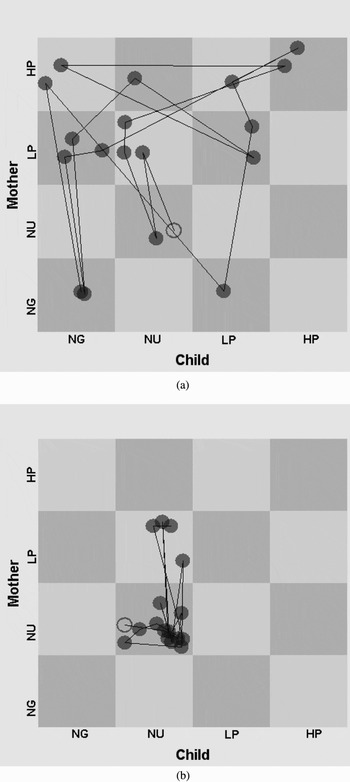
Originally, there were three possible levels (none, low, high) of positive and negative affect for each partner in the dyad. In order to condense the potential matrix of affective dyadic states for analytic purposes, the “none” levels of positive and negative affect were aggregated into one category reflecting neutral affect. In addition, a low base rate of negative behaviors for parents and children dictated that the “low” and “high” levels of negative affect should be combined into one negative affect code. These adjustments resulted in a 4 × 4 or 16-cell grid with the four behaviors negative affect, neutral affect, low-positive affect, and high-positive affect on each axis. Child behaviors were plotted on the x axis and parent behaviors were plotted on the y axis, with mother–child and father–child interactions plotted on separate graphs. Therefore, the combination of parent and child codes occurring in each 30-s time interval produced a dyadic state for that time unit that was represented in one of the 16 cells of the grid (e.g., mother low positive–child neutral). If parent or child was both positive and negative within the same time interval, negative affect was mapped and positive affect was not. This decision was based on work showing that negative affect carries more weight than does positive affect in interpersonal interactions (e.g., Gottman, Reference Gottman1994; Ito, Larsen, Smith, & Cacioppo, Reference Ito, Larsen, Smith and Cacioppo1998). According to this prior research, we expected that concurrent positive affect would be less influential in the wake of a negative interchange. Figure 1 provides general examples of a flexible and a rigid parent–child interaction.
State space grid examples of (a) flexible and (b) rigid dyadic interactions. NG, negative affect; NU, neutral affect; LP, low positive affect; HP, high positive affect.

Dyadic affect
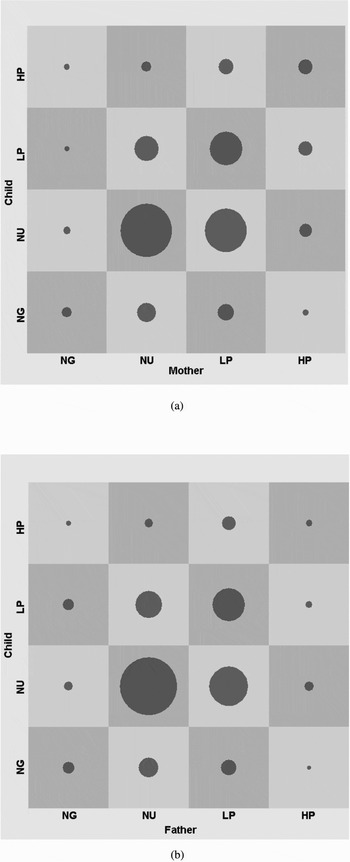
Figure 2 shows SSGs of the durational proportion of time spent in each dyadic affective state for mother–child and father–child dyads for the whole sample. Dyadic positive affect was calculated as the duration of time (the number of 30-s intervals) the dyad spent in which both parent and child displayed low- or high-positive affect based on the SSG. This variable equated the duration of time the dyad spent in only 4 out of the 16 possible cells (i.e., parent low–child low, parent low–child high, parent high–child low, parent high–child high). Total task time was controlled in all primary analyses.
Durational proportions of time spent in each dyadic state for (a) mother–child and (b) father–child interactions. Note: 39% of mother–child dyads and 43% of father–child dyads displayed some negative affect during the task. NG, negative affect; NU, neutral affect; LP, low positive affect; HP, high positive affect.

Generally, negative affect was skewed towards the “none” level in these interactions (e.g., skewness = 6.57, SE = 0.16 for mothers; skewness = 4.39, SE = 0.16 for children with their mothers). Thirty-nine percent of mother–child dyads and 43% of father–child dyads showed negative affect during the interaction. Thus, the base rates of negative affective content across the sample were too low to calculate a dyadic negative affect variable using real-time, dynamic-systems methods. However, in order to retain a test of the role of negative affective content in primary analyses, we created a dichotomous variable that reflected the presence versus absence of observed negative affect in the interaction; this variable was included as a covariate in primary analyses.
Dyadic flexibility
Dyadic flexibility was represented as variation in affective intensity and valence using three dynamic systems-based indices of dyadic interaction patterns. These indices were derived from the 16-cell SSG including all levels and types of affect (negative, neutral, low positive, and high positive). The first index, range, was measured using a count of the number of unique cells visited on the grid. A higher number of unique cells visited indicated the use of a greater range of affective states and therefore greater dyadic flexibility. The second index, dispersion, represented the distribution of behavior across cells and was calculated as the sum of squared proportional durations across all cells, adjusted for the total number of cells in the grid matrix and inverted so that cell values range from zero (no dispersion; all behavior in one cell) to one (maximum dispersion; behavior equally distributed across the grid). The corresponding formula is

where D is the total duration, d is the duration in cell i, and n is the total number of possible cells in the grid. Thus, the more evenly distributed the behaviors across the grid of possible affective states, the more flexible the dyad. The third index, transitions, represented the number of transitions the dyad made between cells of the grid during the course of their interaction. Thus, more frequent changes between affective states represented higher flexibility.
Externalizing behavior problems
The externalizing behavior problem subscales on the CBCL/2–3 (Achenbach, Reference Achenbach1992) and CBCL/4–18 (Achenbach, Reference Achenbach1991a) and the Caregiver/Teacher Report Form for Ages 5–18 (Achenbach, Reference Achenbach1991b) were used to assess children's externalizing behaviors. Mothers' ratings of externalizing behavior problems at age 3 years were used to represent baseline levels of externalizing problems. Mothers' and teachers' ratings of externalizing problems were used as outcome measures at child age 5.5 years. Fathers' ratings of child externalizing were also obtained, but were not used in the present study due to a high rate of missing data (40%) and its subsequent restriction on adequate analytic power with which to test hypothesized effects.
Effortful control
Children's effortful control, a temperament-based index of self-regulation, was incorporated as a covariate in order to understand the effects of dyadic positive affect and flexibility on children's behavior problems accounting for children's individual contributions to their regulatory development. Effortful control was assessed in the laboratory using six tasks from Kochanska, Murray, Jacques, Koenig, and Vandegeest's (1996) toddler-age behavioral battery. Each task was designed to tap Rothbart's (1989) general construct of effortful control (suppressing a dominant response and initiating a subdominant response according to varying task demands). All tasks were introduced as “games” and children were reminded of the rules midway through each task. To provide a check on accuracy of recording, 15 test administrations were videotaped and independently scored. Reliability was excellent (mean κ = 0.95, range = 0.92–0.98). Following Kochanska et al. (Reference Kochanska, Murray, Jacques, Koenig and Vandegeest1996), a total effortful control score was computed by summing the six individual task scores (α = 0.65). For a description of individual tasks, please see Olson, Sameroff, Kerr, Lopez, and Wellman (Reference Olson, Sameroff, Kerr, Lopez and Wellman2005).
SES
The Hollingshead Four Factor Index (1975) was used to assess family SES. Mothers' and fathers' occupational status and education was obtained via self-report. Occupational status was coded on a 9-point qualitative scale ranging from (1) farm laborers/menial service workers to (9) higher executives, proprietors of large businesses, and major professionals. Mothers' and fathers' education was coded on a 7-point qualitative scale from (1) less than seventh grade to (7) graduate or professional training. SES was computed by summing the parent's occupation score multiplied by five with the parent's education score multiplied by three. An individual SES was obtained for each parent, and then these two values were averaged if both parents worked. If only one parent worked, then this parent's individual SES was used.
Results
Preliminary analyses
From the outset, we planned to control for three specific covariates in primary analyses. We controlled for baseline levels of externalizing problems rated by mothers at age 3 years given the high stability in externalizing problems typically demonstrated across the early childhood period (e.g., Smith, Calkins, Keane, Anastopoulos, & Shelton, Reference Smith, Calkins, Keane, Anastopoulos and Shelton2004). We also controlled for the time that the parent and child spent on the observational task, given that the task was untimed and that variation in time could impact the positive affect variable (which was based on duration) as well as the formulas for dyadic flexibility (e.g., longer times could offer the dyad the opportunity for a greater range of affect). We also controlled for the child's effortful control (derived via laboratory assessment) at T1 to understand the effect of dyadic parent–child coregulation above and beyond the contribution of the child's temperament-based self-regulation.
We then examined other factors that could potentially covary with parent–child interaction processes and the development of children's externalizing behavior problems. Child gender and SES have been shown to play a role in the development of children's externalizing behavior problems (Keenan & Shaw, Reference Keenan and Shaw1997; Shaw et al., Reference Shaw, Winslow, Owens, Vondra, Cohn and Bell1998). Although dyadic negative affect was too low base rate in these interactions to be examined using DS methods, we considered that the simple presence or absence of observed negative affect in these interactions could relate to children's later behavior problems. We also assessed whether age had an impact on any of the variables of interest, given that there was some variation in age at the T1 and T2 assessments. We examined these potential covariates separately for mother–child and father–child interactions because research has shown differences in socialization processes by parent gender (e.g., Denham & Kochanoff, Reference Denham and Kochanoff2002).
Girls showed higher levels of effortful control than boys, t (161) = 4.08, p < .001, and there was a trend that mothers rated boys as having higher externalizing problems than girls at T2, t (161) = −1.63, p < .10. Father–child dyads showed greater range of affect when the child was male, t (92) = −2.00, p < .05, and marginally greater dispersion of affect when the child was male, t (92) = −1.77, p < .10. The presence of negative affect in father–child interactions was related to teachers' higher ratings of externalizing problems at T2, t (92) = −3.84, p < .001; however, negative affect in mother–child dyads was uncorrelated with children's behavior problem outcomes. SES and age were not correlated with any of the predictors or outcomes of interest. Consequently, we retained the following covariates in multivariate analyses: baseline externalizing problems at T1, effortful control at T1, task time, child gender, and the presence versus absence of observed negative affect.
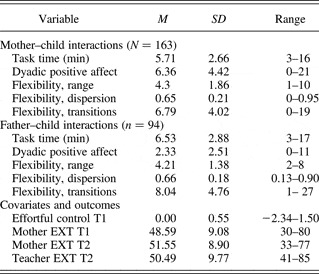
Means and standard deviations for task time, children's externalizing behavior problems, effortful control, dyadic positive affect, and the three indices of dyadic flexibility (range, dispersion, and transitions) are shown in Table 1. Mother–child dyads showed significantly higher levels of dyadic positive affect than father–child dyads, t (85) = 7.77, p < .001. Bivariate correlations between parent–child interaction data and other primary variables of interest are shown in Table 2. Parent–child flexibility variables were generally uncorrelated with children's externalizing problems. Higher mother–child dyadic positive affect was marginally correlated with children's higher effortful control at T1; higher father–child positive affect was correlated with children's higher externalizing problems at T1; and both mother–child and father–child dyadic positive affect were modestly related to lower teacher externalizing ratings at T2. Dyadic positive affect and flexibility were intercorrelated in both mother–child and father–child interactions, and father–child dispersion was positively correlated with multiple dyadic mother–child variables.
Descriptive data

Note: Mother EXT, T score of mothers' externalizing problem ratings; Teacher EXT, T score of teachers' externalizing problem ratings; T1, age 3 assessment (Time 1); T2, age 5.5 assessment (Time 2).
Bivariate correlations

Note: M-C, mother–child; F-C, father–child; Mother EXT, T score of mothers' externalizing problem ratings; Teacher EXT, T score of teachers' externalizing problem ratings; T1, age 3 assessment (Time 1); T2, age 5.5 assessment (Time 2).
†p < .10. *p < .05. **p < .01. ***p < .001.
Multivariate analyses
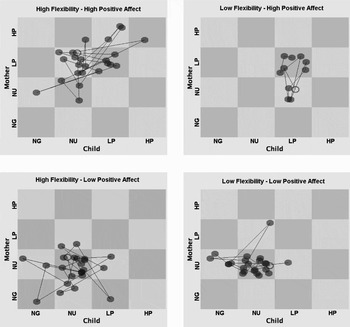
Our primary research question was whether the interaction between dyadic flexibility and positive affect in early parent–child interactions predicted lower levels of children's later externalizing behavior problems as rated by mothers and teachers. Analyses were performed in Mplus Version 5 (Muthén & Muthén, Reference Muthén and Muthén1998–2007) separately for mother–child and father–child interactions. Figure 3 illustrates specific examples of mother–child SSGs with combinations of high and low levels of dyadic flexibility and positive affect as a visual aid for how the interaction between flexibility and positive affective content could have manifested.
Examples from four mother–child dyads showing varying combinations of high and low levels of dyadic flexibility and positive affect. NG, negative affect; NU, neutral affect; LP, low positive affect; HP, high positive affect.

Mother–child interactions
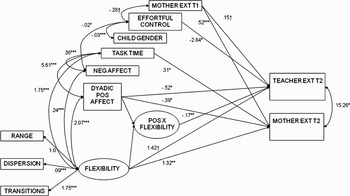
First, a measurement model was conducted for a latent factor of dyadic flexibility with range, dispersion, and transitions acting as the three observed indicators. The model converged with adequate standardized factor loadings of 0.98, 0.82, and 0.73 for range, dispersion, and transitions, respectively. (Note that overall goodness of fit measures are not available in Mplus for single latent factors with three indicators.) Second, the partial model without the primary predictor, the interaction term between flexibility and positive affect, was examined using longitudinal structural equation modeling. Predictors at T1 (child age 3 years) included the covariates of child externalizing problems, effortful control, task time, child gender, and observed negative affect and the main effects of observed dyadic positive affect and the dyadic flexibility latent factor. Outcomes at T2 (child age 5.5 years) included children's externalizing problems as rated by mothers (mother EXT) and by teachers (teacher EXT). Model fit without the primary predictor was reasonable but not strong, χ2 (19) = 108.9, p = .00, comparative fit index = 0.85, root mean square error of approximation = 0.09, standardized root mean square residual = 0.06.
Third, the full theoretical model was tested by adding in the multiplicative interaction term (Baron & Kenny, Reference Baron and Kenny1986) between dyadic positive affect and the dyadic flexibility latent factor. The multiplicative interaction term was calculated within Mplus as part of the model identification process. The results are displayed in Figure 4. With regard to covariates, mothers' ratings of child externalizing problems were stable over time. There was a main effect of children's higher effortful control at T1 predicting lower teacher EXT at T2. Higher effortful control was also related to the absence of negative affect during the interaction. Longer mother–child task times at T1 predicted higher mother EXT at T2. Child gender and observed negative affect did not contribute to outcomes in the model. Task time was positively related to dyadic positive affect and flexibility; negative affect was also positively related to flexibility.
Structural equation modeling results for mother–child interactions (N = 163). Note: Values are unstandardized parameter estimates and insignificant paths have been omitted; MOTHER EXT, T score of mothers' externalizing problem ratings; TEACHER EXT, T score of teachers' externalizing problem ratings; T1, Time 1 age 3 assessment; T2, Time 2 age 5.5 assessment; †p < .10, *p < .05, **p < .01, and ***p < .001 based on two-tailed z distribution.

As hypothesized, there was an interaction effect such that the interaction term between higher mother–child positive affect and higher flexibility at age 3 years predicted lower ratings of child externalizing problems at age 5.5 years; this interaction effect was present for teachers' ratings but not mothers' ratings. Thus, in the analysis of mother–child interactions, our hypothesis was supported with respect to teacher ratings: higher levels of dyadic flexibility interacted with dyadic positive affect in mother–child interactions to predict teachers' lower ratings of externalizing problems after the transition to school at child age 5.5 years. There were also main effects of dyadic positive affect and flexibility on both mother EXT and teacher EXT: higher levels of positive affect at T1 predicted lower externalizing problems at T2, whereas higher levels of flexibility at T1 predicted higher externalizing problems at T2 (although the latter showed only marginal significance for teacher ratings).
Mplus does not provide model goodness of fit measures when interaction terms involving a latent factor are included (Muthén & Muthén, Reference Muthén and Muthén1998–2007). In the case where goodness of fit measures are not available, it is recommended to compare Bayesian information criterion (BIC; Schwarz, Reference Schwarz1978) values for nonnested models to examine incremental model fit (Singer & Willett, Reference Singer and Willett2003). A smaller BIC value indicates the better fitting model. Therefore, we compared the full theoretical model to a model without the primary hypothesized predictor of interest, the interaction between dyadic positive affect and flexibility, to examine whether its addition provided a better overall fit to the observed data. Post hoc analysis revealed an absolute difference of 1.149 between the sample-size adjusted BIC of the full model and the reduced model, indicating modest but positive evidence for an improved model fit (see Rafferty, Reference Rafferty and Marsden1995) when the interaction between dyadic positive affect and flexibility was included. We also examined whether specific pathway parameters changed in significance or direction between the models with and without the interaction term. There were no significant changes except that in the model without the interaction term, the parameter for the main effect of flexibility on teachers' ratings of children's behavior problems dropped from trend level to nonsignificance.
Father–child interactions
For father–child interactions, the measurement model of dyadic flexibility converged with adequate standardized factor loadings of 0.84, 0.91, and 0.55 for range, dispersion, and transitions, respectively. The partial model without the interaction term was tested next. Once again, predictors at T1 (child age 3 years) included the covariates of child externalizing problems, effortful control, task time, child gender, and observed negative affect and the main effects of observed dyadic positive affect and the dyadic flexibility latent factor. Outcomes at T2 (child age 5.5 years) included children's externalizing problems as rated by mothers (mother EXT) and by teachers (teacher EXT). Once again, without the primary predictor, model fit was reasonable but not strong, χ2 (19) = 61.8, p = .00, comparative fit index = 0.86, root mean square error of approximation = 0.09, standardized root mean square residual = 0.05.
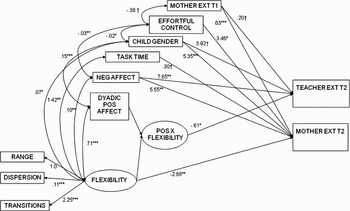
Then the full theoretical model was tested using longitudinal structural equation modeling including the multiplicative interaction term (Baron & Kenny, Reference Baron and Kenny1986) between dyadic positive affect and the dyadic flexibility latent factor. The multiplicative interaction term was calculated within Mplus as part of the model identification process. Results are displayed in Figure 5. With respect to covariates, ratings of externalizing behavior problems showed stability over time. In addition, longer task times, male gender, and the presence of observed negative affect during the interaction all predicted higher mother EXT at T2; observed negative affect and male gender also predicted higher levels of teacher EXT at T2. It was surprising that higher effortful control at T1 predicted higher mother EXT at T2. Once again, children's higher effortful control was related to the absence of observed negative affect in the interaction, and in contrast to the analysis of mother–child interactions, child gender was related to higher levels of dyadic positive affect (i.e., father–son dyads were more positive than father–daughter dyads).
Structural equation modeling results for father–child interactions (n = 94). Note: Values are unstandardized parameter estimates and insignificant paths have been omitted; MOTHER EXT, T score of mothers' externalizing problem ratings; TEACHER EXT, T score of teachers' externalizing problem ratings; T1, Time 1 age 3 assessment; T2, Time 2 age 5.5 assessment; †p < .10, *p < .05, **p < .01, and ***p < .001 based on two-tailed z distribution.

Similar to the analysis of mother–child interactions, there was an interaction effect such that higher levels of dyadic positive affect and higher flexibility predicted lower teacher EXT at T2. Thus, once again, our hypothesis was supported with respect to teachers' but not mothers' ratings of externalizing problems after the transition to school at child age 5.5 years. There was also a main effect of dyadic flexibility predicting mother EXT. However, in contrast to mother–child interactions where higher dyadic flexibility predicted higher mother EXT at T2, higher levels of dyadic flexibility with fathers predicted lower mother EXT at T2.
Post hoc analyses were performed comparing the full theoretical model to a model without the primary hypothesized predictor of interest, the interaction between dyadic positive affect and flexibility, to examine whether its addition provided a better overall fit to the observed data. The results revealed an absolute difference of 138.695 between the sample size-adjusted BIC of the full model and the reduced model, indicating strong, positive evidence for an improved model fit (see Rafferty, Reference Rafferty and Marsden1995) when the interaction between dyadic positive affect and flexibility was included. When compared, there were no differences in the significance or direction of specific pathways between these two models; the only exceptions were that in the model without the interaction term, the effects of age three externalizing problems and gender on teachers' ratings of children's behavior problems as well as the correlation between age three externalizing problems and effortful control dropped from trend level to nonsignificance.
Discussion
In the present study, we targeted two goals: (a) to examine whether adaptive, dynamic processes within early parent–child interactions, specifically those of dyadic flexibility and positive affect, could inform our understanding of the development of children's externalizing behavior problems across the early childhood period and (b) to explore differences between the effects of dynamic patterns in interactions with mothers versus fathers. Our hypothesis was that the combination of dyadic flexibility and positive affect in parent–child interactions would contribute to children's lower levels of externalizing problems over time. This hypothesis was supported across both mother–child and father–child interactions with respect to teachers' ratings of child outcomes: dyadic flexibility and positive affect interacted to predict teachers' lower ratings of child externalizing problems after the transition to kindergarten. This finding suggests that parent–child coregulation of affective intensity and valence during a challenging task contributes to adaptive child outcomes as long as the content of the interaction is predominantly positive.
Our hypothesis regarding the interactive effects of dyadic positive affect and flexibility was guided by three theoretical propositions that should be tested more explicitly in future work. The first is that affective changes in the context of a generally positive interpersonal interaction provide the child real-time opportunities to practice regulation in a supportive context, leading to stronger regulatory skills and thus fewer difficulties in regulating behavior. Research has demonstrated that a combination of positive and negative affective experiences is related to children's higher levels of emotion regulation and lower levels of behavior problems, as long as negative affect is not too dominant (Dunn & Brown, Reference Dunn and Brown1994; Lunkenheimer et al., Reference Lunkenheimer, Shields and Cortina2007; Raver & Spagnola, Reference Raver and Spagnola2003; Roberts & Strayer, Reference Roberts and Strayer1987). The second proposition is that when flexibility and positive affect co-occur during a challenging interpersonal interaction, they foster the development of other key skills such as the adaptive allocation of attention and resourcefulness in problem solving that then buffer the child from having the kinds of behavior problems that are most likely to be reported by parents and teachers. According to Fredrickson's broaden-and-build theory (Fredrickson, Reference Fredrickson2001; Fredrickson & Branigan, Reference Fredrickson and Branigan2005), positive affect encourages flexibility in the behavioral repertoire and resourcefulness in problem solving. The third proposition is that positive, flexible dyadic interaction is a reflection of an adaptive and securely attached model of interpersonal relationships that the child then internalizes, leading to fewer difficulties in making adjustments to new relationships and settings, such as preschool. More research is needed from a DS perspective that incorporates and links affective interpersonal processes at multiple time scales (Lewis, Reference Lewis2000), for example, how real-time interaction patterns contribute to the emergence of stable dyadic relationship profiles such as attachment styles, and how these, in turn, contribute to children's developmental trajectories.
Our findings build upon existing research on the content of parent–child interactions (e.g., Denham et al., Reference Denham, Workman, Cole, Weissbrod, Kendziora and Zahn-Waxler2000) to provide evidence that structural patterns between parent and child also play a role in the development of behavior problems in early childhood. We have more to learn about the dynamic structure of positive interactions and relations between positive affect and children's developmental psychopathology (Feldman, Reference Feldman2003; Pettit, Bates, & Dodge, Reference Pettit, Bates and Dodge1997). A better understanding of adaptive, real-time parent–child interactions may be important in promoting preschoolers' development of self-regulatory abilities and related competencies (Olson & Lunkenheimer, Reference Olson, Lunkenheimer and Sameroff2009). If content and structure in parent–child interactions combine to confer risk or protection in early childhood when children's individual differences begin to stabilize, this information could inform both the etiology of disruptive behavior problems and targets for preventive interventions with children at risk for behavior problems (Lunkenheimer & Dishion, Reference Lunkenheimer, Dishion, Guastello, Koopmans and Pincus2009).
Coregulatory constructs have been labeled and operationalized many different ways in the literature. We operationalized flexibility as a structural, content-free variable, which, in light of the findings, had its advantages and disadvantages. We observed relatively low levels of negative affect (expressed by only 40% of families), perhaps because only a portion of the sample was at risk and the task, although challenging, was pleasant for most dyads. In general, researchers have struggled to obtain sufficient displays of negative affect in laboratory observations (Dishion, Duncan, Eddy, & Fagot, Reference Dishion, Duncan, Eddy and Fagot1994). Thus, for the 60% of the families who did not show negative affect, flexibility was calculated from change parameters among neutral, low-positive, and high-positive affective states. This relative absence of negativity likely allowed us a more valid test of our hypothesis that parent–child flexibility across levels of positive intensity and neutral affect, with minimal forays into the negative, was adaptive for children's behavioral outcomes. As we expected based on prior research (Dishion et al., Reference Dishion, Andrews and Crosby1995), dyadic neutral affect was the most common state (see Figure 2) and thus dyads did tend to move from neutral into varying levels of positive or negative and back again. In contrast, for the 40% of families who displayed some negative affect, higher levels of flexibility could have been more adaptive, reflecting instances of repair from the negative to the positive, or more maladaptive, reflecting disorganization among negative states. In addition, attempting to make conclusions about the main effects of purely structural variables such as flexibility may be difficult given the complex, nonlinear nature of the data. This issue highlights the need to study structure and content as separate but interrelated dimensions of interpersonal interaction: structural variables must be interpreted in terms of the interaction content, goal, and population under study (e.g., Dishion et al., Reference Dishion, Nelson, Winter and Bullock2004). More research will be needed to determine whether and how to aggregate dynamic behavioral sequences such as these in order to generate conclusions in nomothetic research.
In light of these methodological considerations, we should be cautious in interpreting the main effects of dyadic flexibility on the development of children's externalizing behavior problems. Higher levels of dyadic flexibility with mothers predicted mothers' higher ratings of behavior problems, whereas higher flexibility with fathers predicted mothers' lower ratings of behavior problems. Why the difference? Maternal interaction styles involving proactive guidance and feedback are related to children's inhibition (Lunkenheimer et al., Reference Lunkenheimer, Dishion, Shaw, Connell, Gardner and Wilson2008), compliance (Calkins, Smith, Gill, & Johnson, Reference Calkins, Smith, Gill and Johnson1998), and task persistence (Kelley, Brownell, & Campbell, Reference Kelley, Brownell and Campbell2000). In addition, mothers' indiscriminate affective responses have been associated with child aggression (Dumas, LaFreniere, & Serketich, Reference Dumas, LaFreniere and Serketich1995). Perhaps mothers are key in offering the consistency and contingencies needed to promote the child's development of regulatory skills, and thus overly flexible mother–child interactions are atypical, contributing to the child's development of behavior problems. Fathers, in contrast, tend to interact with their children using more sudden and intense bouts of positive affect (Feldman, Reference Feldman2007), which would increase opportunities for modulation of affective intensity and therefore dyadic flexibility (per our definition). Additionally, fathers are often counted on to provide structure and discipline (Phares, Reference Phares1996), which could mean that a more flexible father–child interaction indicates a particular sensitivity on the part of the father. Thus, flexibility in father–child interactions would appear adaptive according to the present findings. A fascinating direction for future research is whether mothers and fathers socialize differing aspects of self-regulation through the effects of structural patterns, for example, if mothers are more likely to influence aspects of self-regulation requiring persistence and compliance (e.g., effortful control) whereas fathers influence aspects of self-regulation needed to cope with frequent or sudden changes (e.g., emotional reactivity).
Another difference between mothers and fathers was that covariates that reflected child factors (e.g., gender, effortful control) played a larger role in father–child interactions, whereas dyadic predictors appeared to carry more weight in mother–child interactions. These findings support prior work showing that fathers are more influenced by child temperament during parent–child interactions than are mothers (Gordon & Feldman, Reference Gordon and Feldman2008) and that mother–child dyads show stronger dyadic coordination of behavior than father–child dyads (Feldman, Reference Feldman2003; Kochanska & Aksan, Reference Kochanska and Aksan2004). It should be noted that in post hoc tests, the interaction effect between dyadic positive affect and flexibility made more of a statistical difference in father–child interactions than in mother–child interactions. This may be due to greater variability in the content of fathers' interactions with their children, indexed in part because mean levels of flexibility were similar, but dyadic positive affect was significantly lower, in father–child interactions compared to mother–child interactions. These findings suggest that more research is needed on the role of positive father–child interactions in children's behavioral adjustment and that we should continue to study the independent contributions of both mother–child and father–child interaction dynamics.
It is unclear why dyadic flexibility and positive affect interacted to predict teachers' but not mothers' ratings of their children's behavior problems. It is possible that these coregulatory processes between parent and child contribute to the child's flexible adjustment to new settings and relationships, and thus are more likely to influence ratings of behavioral adjustment by other caregivers in contexts where these particular skills are activated. It is also possible that our conservative model that controlled for high levels of stability in mothers' ratings of externalizing behavior over time made it difficult to predict mothers' ratings at T2 above and beyond this stability. Another potential statistical artifact was the relationship between higher effortful control at T1 and higher mother EXT at T2 in father–child interaction analyses. Considering that effortful control was negatively related to both child gender and observed negative affect, which were both strong positive predictors of mother EXT at T2, it is possible that the pathway between effortful control and mother EXT at T2 was artificially inflated. It is also possible that this is an indirect indication of child gender differences in father–child interactions that we did not have an adequate sample size with which to test.
Limitations and future directions
In our efforts to study a complex, dialectic coregulatory process between parent and child, it was still necessary to reduce dynamics into separate or simplified units for the purpose of study. The effects of dyadic flexibility were uncharted territory with respect to early childhood, and so we began by examining a latent factor of flexibility involving components that were computed across the entirety of the interaction. However, in future studies, the use of DS-based measures can assist in understanding more nonlinear aspects of interpersonal interaction, for example, when a specific behavior or a response to an experimental perturbation sets off a new dyadic pattern.
We were limited in using an available coding system that was based on 30-s intervals that could not be broken down into microlevel sequences, even though individual and dyadic regulatory patterns often occur on a moment to moment basis. Additionally, the variation in task time across families may have influenced our investigation of flexibility if longer task times offered the opportunity for a greater range of affect or more transitions among affective states. In future work, the second by second study of affective patterning in tasks of fixed length could be more informative about the specific facets of parent–child interaction that predict children's individual differences in developmental psychopathology over time. Additionally, observational tasks could be improved to elicit specific emotions and track emotions and emotion regulation independently of one another (see Cole et al., Reference Cole, Martin and Dennis2004).
Our measures of dyadic positive affect and flexibility were based on the same general set of affect codes, increasing multicollinearity among our primary predictors. Although it would be difficult to obtain separate sets of data to represent affective content and affective flexibility, we could broaden our flexibility variable in future work to include additional behavioral variables such as parental discipline and child compliance that are an important part of early parent–child interactions (e.g., Dumas et al., Reference Dumas, Lemay and Dauwalder2001). Children in preschool may be more likely to express regulation and dysregulation via compliance behaviors than purely affective ones. Likewise, parents may be more likely to use disciplinary strategies than affect to regulate interactions with their children geared around a problem-solving task.
We would also do well to further separate and refine constructs of self-regulation. Although affect regulation, behavior regulation, and behavior problems are intimately related constructs, they are not synonymous. In the present study, we employed children's behavioral problems as an index of maladaptive self-regulation, and hypothesized that adaptive affective coregulation between parent and child would reduce these behavioral problems. Although we included effortful control as a covariate to account for children's normative behavior regulation, future work should specify the mediating mechanism at work: that is, does the dynamic structure of parent–child interaction foster children's individual affect and behavior regulation skills, which in turn, prevent behavior problems? This would be more feasible with a third wave of data collection (e.g., Eisenberg et al., Reference Eisenberg, Zhou, Spinrad, Valiente, Fabes and Liew2005). In addition, given that self-regulation is such a central construct to normative and developmental psychopathology, we should note that the present study is limited in having a predominantly White, married sample of families and therefore the present findings need to be replicated with more sociodemographically diverse samples.
Researchers of developmental psychopathology have called for methodological advancements that will allow us to better study the dynamic interpersonal systems that are so integral to early child development (Cicchetti & Toth, Reference Cicchetti, Toth, Luthar and Burack1997; Granic, Reference Granic, Lewis and Granic2000; Sameroff & MacKenzie, Reference Sameroff and MacKenzie2003). Our ability to adequately operationalize dyadic processes, and in particular the mutually changing and sustaining system of the parent–child relationship, has been limited. Children's developmental health is dependent upon the fit or adaptation between the child and his or her context, and thus it is crucial to study the structure of parent–child dyadic interaction in addition to the content. Pinpointing specific dynamics of proximal parent–child interaction that contribute to adaptive versus maladaptive patterns of child self-regulation is essential to an understanding of what delineates normative from atypical developmental pathways in early childhood.