INTRODUCTION
Crocker Range Park (CRP) in the state of Sabah, Malaysia, became the setting of a conflict between the Government parks department – Sabah Parks (SP) – and the local community of Ulu Senagang/Mongool Baru (USMB). As a result of limited surveying efforts during the gazettement process in the 1980s, half the land settled by USMB, including both homes and farms, was included within the Park boundaries. SP proposed in 2006 to implement a co-managed community use zone (CUZ) in which local practices would be allowed to continue if conducted in an ecologically sound and sustainable fashion, but negotiations soon stalled due to disagreements over how the CUZ should be structured, managed and implemented. Despite regular dialogue, meetings and workshops, the two sides in the negotiation process remained at an impasse for 10 years.
The impasse in CRP reflects growing tensions in protected area (PA) management in less developed countries linked to global trends of political decentralization (Edmunds & Wollenberg Reference Edmunds and Wollenberg2004; Moeliono et al. Reference Moeliono and Limberg2009), indigenous/local empowerment (Nepal Reference Nepal2002; Borrini-Feyerabend et al. Reference Borrini-Feyerabend, Kothari and Oviedo2004) and associated shifts in international conservation guidelines on good PA management (Dearden et al. Reference Dearden, Bennett and Johnston2005; Dudley Reference Dudley2008). In many countries, state-led PA agencies have responded to these trends by adopting more participatory modes of PA governance and management (Lockwood et al. Reference Lockwood, Worboys and Kothari2006).
Co-managed PAs (CMPAs) have become a popular strategy for indigenous and community conserved area management in many regions of the world (Castro & Nielsen 2001; Borrini Feyerabend et al. Reference Borrini-Feyerabend, Kothari and Oviedo2004; Lockwood Reference Lockwood2010), yet the efficacy of the CMPA approach remains a topic of academic and political debate. Whilst there is evidence that more equal partnerships that empower locals to actively participate in PA governance may have higher chances of success (Lockwood et al. Reference Lockwood, Worboys and Kothari2006; Hoffmann et al. Reference Hoffmann, Roeger, Wise, Dermer, Yunupingu and Lacey2012), there is also evidence of high failure rates and/or lacklustre project performance (Christie Reference Christie2004; Ban et al. Reference Ban, Mills, Tam, Hicks, Klain and Stoeckl2013; Roe et al. Reference Roe, Booker, Day, Zhou, Allebone-Webb and Hill2014).
It is widely acknowledged that capacity for conflict management is a major determiner of co-management success: even initially strong co-managements can falter when inter-stakeholder relations become strained (Castro & Nielsen Reference Castro and Nielsen2003; Christie Reference Christie2004; Bruckmeier Reference Bruckmeier2005; Mascia & Naidoo Reference Mascia, Claus and Naidoo2010; Redpath et al. Reference Redpath, Young, Evely, Adams, Sutherland and Whitehouse2013). A variety of conservation conflict management strategies have been proposed in recent years. Burgess and Burgess's (Reference Burgess and Burgess1996) ‘constructive confrontation’ model treats conflicts as diseases in need of monitoring and treatment. Madden and McQuin's (Reference Madden and McQuinn2014) ‘conservation conflict transformation’ model aims to assess and address the diverse drivers of conflict in a holistic fashion. Warner (Reference Warner2000) advocates a consensus-building approach that strives to generate ideal win–win solutions. Other scholars (Rescher Reference Rescher1993; Daniels & Walker Reference Daniels and Walker1997; Colyvan et al. Reference Colyvan, Justus and Regan2011) advocate fostering genuine stakeholder engagement and trust between parties as the best path to sustained inter-stakeholder conflict management (Hahn et al. Reference Hahn, Olsson, Folke and Johansson2006; Ostrom Reference Ostrom2008; Reed Reference Reed2008).
Despite these efforts, there remains no widely accepted method for managing conflict within the field of conservation (Agardy et al. Reference Agardy, Bridgewater, Crosby, Day, Dayton and Kenchington2003; Reed et al. Reference Reed, Graves, Dandy, Posthumus, Hubacek and Morris2009). Conflict management strategies and tools for measuring their effectiveness are rarely a feature of CMPA management plans (Christie Reference Christie2004; Agardy et al. Reference Agardy, Di Sciara and Christie2011). There is an ongoing need for effective, practical conflict management tools that can be readily understood and applied by both researchers and conservation practitioners alike (Agardy et al. Reference Agardy, Bridgewater, Crosby, Day, Dayton and Kenchington2003; Reed et al. Reference Reed, Graves, Dandy, Posthumus, Hubacek and Morris2009).
This study deployed a tool developed in medical sciences known as Ethical Analysis (EA) (Roberts & Reich Reference Roberts and Reich2002) to the CRP conflict. The EA tool is designed to create a common picture of conflict through identifying barriers and bridges between stakeholder positions, thereby setting the stage for informed conflict mitigation or resolution (Gritten et al. Reference Gritten, Saastamoinen and Sajama2009). Gritten et al. (Reference Gritten, Saastamoinen and Sajama2009) and Kröger and Nylund (Reference Kröger and Nylund2012) successfully employed EA to assess conflicts in forestry, but the present study is the first to utilize EA in the context of PA management.
The EA tool
The EA framework was designed by Roberts and Reich (Reference Roberts and Reich2002) as a standardized procedure for practitioners in the medical field faced with critical situations that demand immediate and ethical resolutions. EA seeks to generate a shared reality for stakeholders by revealing the underlying drivers of conflict in a form that all parties can easily access and comprehend. EA is not designed for resolving conflicts, but provides a platform for constructive future dialogue by fostering honesty and trust between parties.
EA was first applied to the forestry context by Gritten et al. (Reference Gritten, Saastamoinen and Sajama2009) and comprises four key stages: identification of key stakeholders; identification of their interests, values and principles (IVPs); identification of their views of their ‘opponents’; and identification of IVPs that are barriers and bridges to meaningful dialogue.
The identification of IVPs is central to the EA tool. In this study, we employed Blackburn's (Reference Blackburn1996) definitions, namely: interests are things that a person needs or that are conductive to his/her flourishing or success, values are enduring beliefs that guide actions in varying situations and principles are common rules that people wish would direct and harmonize the activity of themselves and those around them. Principles are more general than values and can best be determined by recording the justifications people provide for their actions.
Gritten et al. (Reference Gritten, Saastamoinen and Sajama2009) used EA to assess a land use conflict between reindeer herder cooperatives and a state-owned forestry enterprise. Subsequently. EA has also been utilized by Kröger and Nylund (Reference Kröger and Nylund2012) and Arevalo et al. (Reference Arevalo, Ochieng, Mola-Yudego and Gritten2014) in assessing complex multi-stakeholder conflicts in Brazil and Kenya.
Case overview
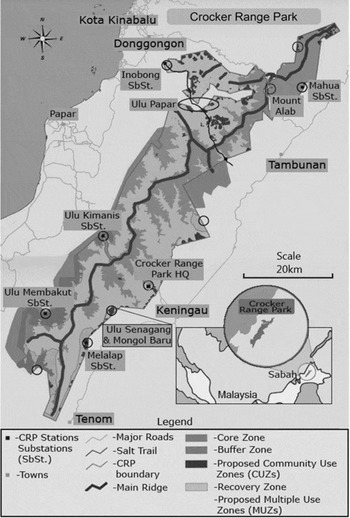
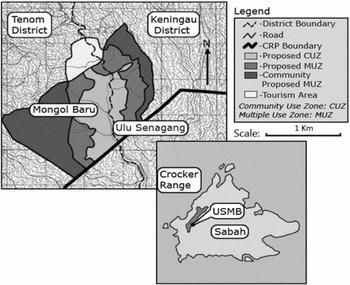
CRP is located in western Sabah, Malaysian Borneo, and is its largest state park, covering 1399 km2 (Figure 1). The community of USMB, located in the vicinity of 5° 20′ 53.32″, 116° 0′ 47.49″ within CRP, inhabits a steep valley in the eastern foothills of the range (Figure 2). A majority of the population are indigenous Muruts who practise slash-and-burn agriculture and utilize the surrounding forests for housing materials, medicines and bush meat (BBEC II 2009).
Map of Crocker Range Park.

Ulu Senagang/Mongool Baru community use zone.

CRP was designated from aerial surveys conducted preceding the Park's establishment in 1984. During a 1998 ground survey, SP became aware that some 30 communities use or occupy land inside the Park boundary. Community members were equally unaware that their lands had been appropriated into the Park. Under the Sabah Parks Enactment (1984) Part II, land cannot be privately owned inside a State Park. As a result, the people of USMB are technically squatters on the lands that they occupy and have since opposed the designation vigorously.
Article B1.3.6 of the Sabah Biodiversity Strategy 2012–2022 advocates for the development and adoption of more inclusive modes of park governance (Kokusai Reference Kokusai2006). In the case of USMB, the CRP Management Plan recommended the establishment of a co-managed CUZ based on mutual agreement between SP and local people. The proposed CUZ is intended to allow locals the right to remain on their land as long as they do not compromise the Park's conservation goals (CUZ Task Force, unpublished data 2013).
Given the often limited resources available to conservation practitioners and the increasing volume of conflicts they face worldwide (Redpath et al. Reference Redpath, Young, Evely, Adams, Sutherland and Whitehouse2013), any tool intended for widespread practical use must be straightforward and efficient. Ideally, such a tool should also be manageable for the novice practitioners/researchers that typically conduct such assessments in the field. As such, this study posed three key questions: (1) Can the application of EA produce insight that could contribute towards resolution of the conflict? (2) Could EA be applied more widely as a PA co-management conflict assessment tool? (3) What developments/modifications could further improve EA's utility?
A key objective of the Management Plan is the establishment of a CUZ Management Committee consisting of six representatives from different Government departments (including SP) and five elected representatives from the community. This Committee would develop and enforce regulations affecting the CUZ in collaboration with SP officials (Kokusai Reference Kokusai2006). After 10 years of negotiation, USMB and SP failed to reach a mutually acceptable agreement that would allow the CUZ to be established. In that time, USMB has continued to expand deeper into the park even as its long-term future has remained uncertain.
METHODS AND APPROACH
Site selection
The impasse in CRP was selected as a test application of EA for the following reasons: firstly, the impasse has proved impossible to resolve via traditional channels of conflict resolution and therefore presented an opportunity to assess whether EA can contribute something new and valuable to the negotiation process. Secondly, the two key actors in the conflict negotiations are a local community and a Government parks department. Given that global rates of conflict between PA managers and local people have steadily increased, managing conflicts between these two key actor categories is vital for effective conservation practice (Pimbert & Pretty Reference Pimbert and Pretty1997; Castro & Nielson, Reference Castro and Nielsen2003). Thirdly, the actors in the conflict were actively seeking fresh solutions to the conflict. SP had asked for support from Universiti Sabah Malaysia (UMS) in assessing the conflict and recommending solutions and USMB community members had expressed their desire to resolve the dispute to University staff (Porodong, personal communication 2013). The openness of actors to the EA process makes it significantly simpler to employ the tool within the short timeframe allowed. Finally, the conflict is located in South-East Asia, a key biodiversity hotspot with the world's highest rates of habitat loss (Sodhi & Brook Reference Sodhi and Brook2006).
Interview and literature review approach
The research drew on a combination of document review and semi-structured interviews. Documents relating to the conflict were supplied by SP, community leaders and academics at UMS.
Mixtures of structured and semi-structured interviews were used (see Appendices S1 & S2; available online). Structured interviews were conducted individually with 60 community members and the SP staff at the substation so as to obtain a wide sample of respondents in a short time period. Structured interviews were reviewed by a UMS researcher and piloted with CRP substation staff. Longer semi-structured interviews were conducted with five SP and two community officials. Before interviews commenced, the intentions of the research were explained and interviewees provided with consent letters. SP interviewees were all officials involved in the CUZ proposal and community negotiations.
Prospective interviewees from the community were grouped into two categories: ‘community officials’ and ‘community members’. Access to the community was facilitated by introductions from a local anthropologist who had conducted research in the community previously. The first author was introduced as a university student working alongside UMS to investigate the impasse surrounding the CUZ proposal.
In order to minimize any negative perceptions community members might have of the researcher as a result of his position as a white, urban, educated male, he spent a week in the village prior to the commencement of formal research, getting to know village members and participating in a number of local activities including church services, parties and handicraft production. Handicraft production is an important activity for the majority of women in USMB and is being promoted by SP as an alternative source of income for the village. The researcher's involvement with this activity proved a significant asset to the research process. The handicraft makers helped arrange interviews with village members/officials and their support was invaluable in gaining the trust of the community and completing the research in a timely fashion.
Interviews were conducted at the village community centre and SP substation, either in English, Malay or Murut with the help of interpreters including village members. After each interview, memos of key points were compiled and later used to identify themes and determine the frequency with which they were referred to (Newling Reference Newling2011). With reference to Blackburn's definitions (Reference Blackburn1996), each theme was then sorted into one of the EA's three key categories of ‘interest’, ‘value’ or ‘principle’ based on a meta-analysis of all responses in that category. If, for example, the majority of responses in a thematic category considered it an issue that was crucial to their economic success, then the theme as a whole was classified as an interest.
Application of EA
Given the limited roles played by other stakeholders in influencing the CUZ debate, this EA was applied only to SP and USMB. In order to assess the efficacy of EA as a real-world conflict management tool, this study emulated conditions typically experienced by field researchers/practitioners. This was the first author's first experience of using the EA tool and a 1.5-month period was allowed for its application (June–July 2013).
RESULTS
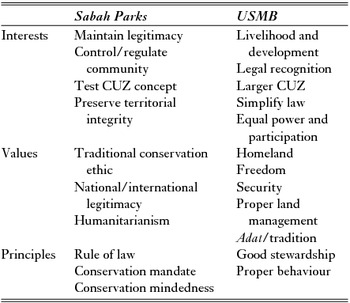
Interests, values and principles (Table 1)
Sabah Parks
Interests
The most significant SP interest was the delivery of their mandate outlined in the 1984 Parks Enactment: to protect biodiversity within their parks for the benefit of tourism and future generations. To avoid future conflicts, SP also aimed to improve relations with local people. They wanted the USMB CUZ to serve as a model for community–Department interactions that could be applied in similar situations around their parks. SP also sought to alter community IVPs to better align with their own so that USMB might one day serve as ambassadors to other communities. Finally, SP had an interest in maintaining and developing its professional image and legitimacy nationally and internationally.
Stakeholder interests, values and principles.

CUZ = Community use zone; USMB = Ulu Senagang/Mongool Baru.
Values
SP officials regularly highlighted their desire to stay at the cutting edge of international conservation best practice, as demonstrated by their continual efforts to gain honours and awards in the international sphere. SP subscribed to a protectionist conservation ethos that holds that nature is best conserved by separating it from human interference. Nonetheless, respondents were eager to increase engagement with local people and referred proudly to successes in this regard. They were proud that of all Malaysian states (e.g. SUHAKAM 2013), Sabah had done the most to embrace and implement collaborative conservation models (Majid-Cooke & Vaz Reference Majid-Cooke and Vaz2011).
Principles
A core principle of SP officials was the importance of upholding laws. Parks officials commented that if they failed to do so, then the Department would lose legitimacy locally and internationally. Secondly, the 1984 Parks Enactment mandates a basic set of principles that SP must uphold (e.g. “No action can be allowed to disrupt the park's ecology and hydrology” [Section 48]). A final principle was ‘conservation-mindedness’, the mental state that should inform all activity within their parks. To quote a SP official, “A conservation-minded person should be aware of conservation issues, seek to act in a sustainable manner by keeping conservation values in mind and wish to uphold the conservation goals of the park.”
USMB
Interests
USMB were interested in securing official recognition of their land rights and accessing the development funding and support that the Sabah state provides to communities outside PAs. Community officials also want a larger CUZ and the laws governing it be ‘simplified’. This is because population growth is driving demand for more agricultural land and regulations are seen as stifling. As one community official sarcastically asserted, “You can be arrested for killing an ant here.” Additionally, USMB want recognition for, and integration of, their management systems within the Management Plan, and an even 50/50 split of USMB/Government representatives on the Management Committee to ensure their rights and interests are protected.
Values
USMB villagers valued freedom of choice in managing their own affairs. As a poor community with little financial resilience, USMB interviewees emphasized the importance of land to their economic, moral and spiritual well-being. They expressed values of stewardship and placed value on ‘proper’ land management. This includes soil protection and erosion control, preserving the quality of rivers and, when cultivating land or collecting from the forest, using no more than is necessary. One official described how they had driven off illegal logging companies from their area “ten times” on the basis that “we could have made good money from the logging but the damage to our land would have been permanent.”
Principles
Drawing on customary adat ideas of good stewardship, the USMB community expressed the principle that clearing, occupying and working land over a period of time and in a manner that maintains soil and water quality confer a secure claim to land. The fact that most respondents referred to “our land” demonstrates a strong sense of ownership and the view that State law should accommodate local conceptualizations of land rights. Interviewees also noted that interpersonal interactions amongst community members follow a code of “proper” behaviour involving honesty, decency, hospitableness and respectfulness, and they only accorded respect to others who follow the same code.
Views of each other
SP argued that they had demonstrated good faith to the locals through long-term commitment to the negotiation process. They attributed community objections to a combination of disruptive influences from outsiders and the lack of ‘conservation-mindedness’. The example of USMB's push for an ever-larger CUZ was cited in support of this point. All officials interviewed were frustrated with the slow pace of negotiations and bemoaned the community's changes of opinion from one meeting to the next. To them, such indecision justified a strong SP role in managing and regulating the CUZ.
Interviewees from USMB expressed distrust of SP and its intentions. In the words of one community official, “They want to put a ring through our noses like a buffalo and lead us wherever they want.” Three sources of distrust were identified: (1) the perception that the Department had shown little interest in hearing their opinions despite expectations that they would be working with SP as equals; (2) difficulties understanding why SP was so concerned about their activities in one small valley when the CRP is “already very big”; and (3) perceived lack of respect for the services that USMB have provided SP by maintaining soil and water quality and protecting the area from illegal logging companies. They also saw SP as “toothless” and unable to back up its promises; after years of negotiation, interviewees stated that they were “fed up” with SP and threatened to take their concerns to the State Assembly instead.
Barriers and bridges to meaningful dialogue
Barriers
A key barrier identified by the EA was differing expectations of how decision-making power was to be distributed within the CUZ Management Committee: SP demanded a leading role, whilst the USMB community expected an even distribution of power in co-management. SP perceived these demands to be at odds with its legal mandate, whereas USMB saw this as a crucial concession because “the decisions will affect villagers more than Sabah Parks.” SP intended to retain a commanding role in the CUZ because it considered itself better equipped intellectually and technically. They were unwilling either to simplify the laws governing the CUZ or to grant the community freedom to manage their own affairs within its bounds. This attitude, perceived by the community as condescending, violated their code of good behaviour and hardened their hostility towards SP.
Bridges
The USMB community was aware that it needed to work with SP if it was to gain some form of legal recognition for their presence within CRP, giving them a strong incentive to negotiate. A successful CUZ, symbolizing Sabah's shift towards new and progressive conservation strategies, would bring great prestige to SP and provide a model for future community–Park interactions in the state. Despite many positional differences, the community's ethic of good stewardship and desire to protect their land from outside exploitation often complemented SP's own conservation mentality; having already expressed a desire to support the Department in enforcing its laws, USMB could ultimately be valuable allies if SP manages to assuage their other concerns.
DISCUSSION
Can the application of EA produce insight that could contribute towards resolution of the conflict?
The application of EA revealed two key issues that will continue to troubled CUZ negotiations in the future: (1) lack of a conflict management strategy within the CUZ Management Plan; and (2) general fatigue due to the excessive length of the negotiation process. Furthermore, the EA revealed significant misalignments between stakeholders’ positions that are sufficient to prevent a perfect win–win solution from emerging. This does not mean that a solution cannot be reached. Indeed, Redpath et al. (Reference Redpath, Young, Evely, Adams, Sutherland and Whitehouse2013) asserts that, in most cases, conflict resolution involves stakeholders assessing their options and making trade-offs.
Despite the long negotiation process, both sides continue to hold distorted views of one another's positions, underlining why authors such as Bruckmeier (Reference Bruckmeier2005) and Gritten et al. (Reference Gritten, Saastamoinen and Sajama2009) consider the mapping of stakeholder positions to be a crucial phase in any effective conflict management scheme. Lacking the space in which to address disagreement, CUZ negotiations became stuck in a phase described by Kröger and Nylund (Reference Kröger and Nylund2012) as ‘politics of power’ – a contest of wills in which both parties attempt to assert their solution based on their perception of the conflict, at each other's expense.
Ross et al. (Reference Ross, Robinson and Hockings2005) asserted that whilst it is important to acknowledge stakeholder differences, more is gained in negotiation by focusing on similarities. Both SP and USMB faced significant challenges that the establishment of a CUZ could mitigate – namely, SP's need to establish a working model for SP–community interactions within Park boundaries and USMB's desire to gain secure rights to its land. These substantial benefits for both parties revealed by the EA could entice them to make the concessions necessary for the CUZ to be effectively implemented (Naughton-Treves et al. Reference Naughton-Treves, Holland and Brandon2005).
Could EA be applied more widely as a PA co-management conflict assessment tool?
This test application of EA suggests that the tool has potential for wider use as an instrument for conflict management for conservation researchers/practitioners. The four steps in the process of the EA framework were straightforward and easy to apply, and produced valuable insight in less than a 2-month period. Moreover, this study demonstrates that the framework can be successfully applied by novice researchers with training in interview surveys and document analysis. Indeed, youth, openness and a lack of political alignment may be assets in the conduction of EAs.
EA possesses a number of qualities that earn it a unique and valuable position within the current suite of conservation conflict management tools: firstly, a clear, simple structure such as EA's makes it user-friendly for novices (Ostrom Reference Ostrom2000; Hahn et al. Reference Hahn, Olsson, Folke and Johansson2006; Colyvan et al. Reference Colyvan, Justus and Regan2011). Secondly, its narrow focus on one stage of conflict management allows it to be easily integrated into existing strategies, such as those proposed by Burgess and Burgess (Reference Burgess and Burgess1996), Warner and Jones (Reference Warner and Jones1998), Reed (Reference Reed2008) and Madden and McQuin (Reference Madden and McQuinn2014). These strategies often include their own methods for assessing stakeholder positions, but generally lack the structure and nuance of EA.
This test, however, also highlighted several challenges and pitfalls that could impede the successful implementation of EA. Due to time constraints, this study was unable to follow up on several lines of investigation (e.g. the role of other actors in empowering the community to pursue its own agenda) that could have yielded greater insight into the conflict and its wider context. Gaining the support of local allies such as the handicraft makers of USMB can greatly increase both the quantity and quality of results. Nevertheless, users of EA will inevitably have to make value judgements concerning which issues are worth pursuing in order to reveal the key roots of the conservation conflict in a timely fashion.
The division of individual stakeholders into separate categories also risks ignoring significant differences within those groups. No organization or community is monolithic, and SP and USMB are composed of multiple individuals with differing objectives and their own unique sets of IVPs. Although both sides have adopted reasonably clear positions vis-à-vis one another, these internal differences and disagreements are likely to play a role behind the scenes and will continue to drive the trajectory of events over time. Researchers should make efforts to identify key rifts within stakeholder bodies and designate separate stakeholder categories when necessary.
Lastly, the dependence of EA on qualitative social survey approaches introduces the risk that the groups or persons applying the tool could introduce or emphasize their own preferences and biases; its application is not apolitical or separate from a conflict. Thus, we suggest that guidelines need to accompany EA (e.g. required training in appropriate research methods/ethical practices).
What developments/modifications could further improve EA's utility?
Integrate stakeholder priorities
Clashes over priorities were identified by Schmidtz (Reference Schmidtz2000) as one of the major causes of conservation conflicts. For example, both stakeholders in this study value Crocker Range's virgin forests – a potential positional bridge between them – but because the community prioritizes agricultural expansion over easy access to forest products, it is actually a barrier. The inclusion of priorities in the EA will also allow IVPs to be ranked based on their relative importance to stakeholders, revealing areas where they are more willing to make compromises.
Integrate stakeholder worldviews
The EA framework may downplay the importance of worldviews, defined here as the “cultural and social norms, customs, traditions, and institutions that constitute the basis for existence, self-understanding and identity” (Chitlango & Balcomb Reference Chitlango and Balcomb2004). USMB villagers, for example, may view CRP as large, but from the position of SP, CRP is likely to appear relatively small, isolated and under threat. Equally, whilst USMB feels that its knowledge and management expertise is unrecognized by SP, we wonder how much USMB knows about and/or respects SP's expertise and technical capacity. A systematic survey of both sides’ support of conservation social values using tools such as the social purpose framework of Jepson and Canney (Reference Jepson and Canney2003) could help to highlight key differences in worldviews.
Integrate EA as a dynamic and adaptive tool within PA management structures
Ross et al. (Reference Ross, Robinson and Hockings2005) and Armitage et al. (Reference Armitage, Plummer, Berkes, Arthur, Charles and Davidson-Hunt2009) note that because co-managements are complex, evolving works-in-progress without clear end-points, they must be particularly adaptive and dynamic in order to remain resilient to change. Reliance on the outcome of a single EA in order to inform long-term policy will ultimately result in the re-emergence of the misconceptions and caricaturing of stakeholders’ positions, which EA is designed to dispel. We therefore propose that EA should be regularly reapplied and updated in order to provide a long-term platform for stakeholder dialogue.
CONCLUSION
The impasse in CUZ negotiations between the community of USMB and SP was resolvable. The application of EA highlighted the differences in stakeholder perceptions that led to the impasse by allowing all sides to identify problem areas, engage in thoughtful introspection and voice their IVPs. This process emphasized the positive side of conflict in which self-reflection leads to greater mutual understanding. If EA had been applied at the beginning of negotiations, it is possible that the impasse would not have escalated. EA cannot solve conflicts, but it can provide a clearer picture of what has occurred and what is at stake. Because both sides have a great deal to gain from a successful resolution, it is in their mutual interest to strengthen their alliance and concentrate on areas of common ground. Furthermore, applying EA to a languishing 10-year conflict provided the spark that initiated renewed enthusiasm on both sides for seeking a mutually acceptable solution.
This study has demonstrated the effectiveness of EA in assessing conflict co-managements. Indeed, given the crucial importance of trust and cooperation in the success of co-managements, all such partnerships would benefit from the insights that EA provides. Furthermore, rather than supplanting existing methods for PA conflict management, EA's narrow focus allows it to easily complement these strategies and improve their efficacy on the ground.
Further applications of EA and the additions/integrations proposed by this study are needed in order to determine the extent to which it can improve global PA co-management success rates. Given the ongoing proliferation of conservation conflicts worldwide and simultaneous global trends towards more equitable modes of conservation governance, tools such as EA are needed now more than ever. We hope that through the use of this versatile tool, researchers and practitioners will be able to develop more effective and sophisticated conflict resolution strategies whilst simultaneously refining the EA tool as an aid to conservation conflict management.
SUPPLEMENTARY MATERIAL
To view supplementary material for this article, please visit http://dx.doi.org/10.1017/S0376892916000345