I. INTRODUCTION
Hydrogen is always considered as an ideal, abundant, environmentally friendly, and clean energy, however the hydrogen storage still remains a critical issue that hinders its application readily.Reference Grochala and Edwards1,Reference Somayazulu, Dera, Goncharov, Gramsch, Liermann, Yang, Liu, Mao and Hemley2 An excellent hydrogen storage material should satisfy a number of criteria, such as high volumetric H density, high H content, near ambient pressure–temperature condition for H absorption/discharge, and low cost.Reference Grochala and Edwards1,Reference Somayazulu, Dera, Goncharov, Gramsch, Liermann, Yang, Liu, Mao and Hemley2 Although no material has yet met all criteria, researchers still pursue and explore new hydrogen storage materials with excellent properties. For instance, materials with extremely high H atomic ratio (n) have been synthesized in Xe(H2)8 (n = 16) through high pressure experiment by P. Baettig and E. Zurek.Reference Baettig and Zurek3 G. Markopoulos et al. have predicted NaH9 (n = 9) by theory methods.Reference Markopoulos, Kroll and Hoffmann4 BaReH9 with a very high volumetric H density (134 g/L) has been predictedReference Fukai5 to chemically precompress its discrete H2 units in the structure.
Metal hydrides are typical hydrogen storage materials,Reference Mitsui, Rose, Fomin, Ogletree and Salmeron6 in which H often exists in the atomic form, filling the octahedral or tetrahedral sites of the close-packed metal atoms. The chemical formula of MH (M is metal element) is common monohydrides, and the typical crystal structure has been drawn in Fig. 1(a). Hydrides of platinum group metals (PGM: ruthenium (Ru), rhodium (Rh), iridium (Ir), osmium (Os), palladium (Pd), and platinum (Pt)) are widely focused because of those favorable characteristics. For instance, the palladium hydride shows exceptional catalytic properties and kinetic reversibility of hydrogen.Reference Somayazulu, Dera, Goncharov, Gramsch, Liermann, Yang, Liu, Mao and Hemley2,Reference Lopez, Łodziana, Illas and Salmeron7,Reference Antonov, Belash, Malyshev and Ponyatovsky8 However, the shortcomings of PGM hydrides are their low gravimetric and volumetric H densities due to their high atomic mass and low n in MHn (usually, n ≤ 1).
Crystal structure of RhH, RhH2 and Rh metal. (a) RhH; (b) RhH2; (c) Rh.

Recently, B. Li and Y. Ding et al.Reference Li, Ding, Kim, Ahuja, Zou and Mao9 discovered a new rhodium dihydride (RhH2) with high volumetric hydrogen density (163.7 g/L) by using high-pressure synchrotron x-ray diffraction technique and theoretical calculations. fcc-Rh metal absorbs hydrogen in the process of being compressed in fluid hydrogen at ambient temperature. fcc-Rh expands unit cell volume by two discrete steps to NaCl typed fcc rhodium monohydride (RhH), and then to fluorite-typed fcc RhH2 at 8 GPa. RhH2 is the first dihydride discovered in the PGM under high pressure.
The newly discovered PGM dihydride, RhH2, may be prospectively applied in many scientific and engineering fields. However, before the new RhH2 is applied, many key properties, such as mechanical stability, thermodynamic and elastic properties under high pressure and temperature should be acquired. Nevertheless, the property measurements under high temperature and high pressure are difficult, inaccurate, and costly. Accordingly, it is necessary to recognize these properties under high temperature or high pressure by theoretic calculation. In this work, based on the experimental work of B. Li and Y. Ding et al.,Reference Li, Ding, Kim, Ahuja, Zou and Mao9 we exploit mechanical stability, thermodynamic and elastic properties of RhH (0–2000 K, 0–8 GPa), and RhH2 (0–2000 K, 8–100 GPa) by ab initio together with quasiharmonic Debye model. Those properties of Rh (0–2000 K, 0–100 GPa) are calculated as well, which are significant reference or comparison. The results of present work may be useful for other groups working on or with PGM and PGM hydrides.
II. THEORETICAL METHOD
In this work, ab initio method together with quasiharmonic Debye model are used to estimate mechanical stability, thermodynamic and elastic properties of Rh, RhH, and RhH2 under high temperature and pressure. All ab initio calculations (total energy, elastic properties, electron density distribution, etc.) of present work are based on ‘Cambridge Serial Total Energy Package’ (CASTEP) code.Reference Hohenberg and Kohn10–Reference Stephens, Devlin, Chabalowski and Frisch14 For investigating the thermodynamic properties (heat capacity, thermal expansion, etc.) of Rh, RhH, and RhH2, the quasiharmonic Debye model is used. Quasiharmonic Debye model calculations are executed by GIBBS code.Reference Blanco, Francisco and Luana15,Reference Otero-de-la-Roza, Abbasi-Pérez and Luaña16
As for ab initio calculation of this work, ultrasoft pseudopotential, together with the Perdew–Burke–Ernzerhof generalized gradient approximation exchange–correlation functionsReference Perdew, Burke and Ernzerhof17 are applied. Plane-wave basis set with energy cut-off 500.00 eV is applied for Rh, RhH, and RhH2, respectively. Pseudoatomic calculations are performed for Rh 4d 8 5s 1, H 1s 1. For the Brillouin-zone sampling, we use the 8 × 8 × 8 Monkhorst-Pack mesh, where the self-consistent convergence of the total energy is at 10−6 eV/atom.
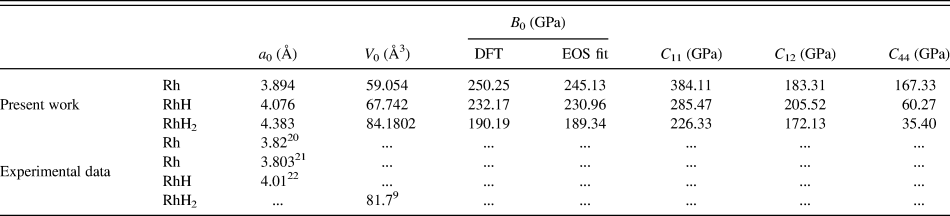
First of all, we execute a series of total energy calculation of Rh, RhH, and RhH2 with different cell volumes, and then we obtain the total energy versus cell volume (E–V data). By third-order Birch–Murnaghan equation of state fit (third B–M EOS), as expressed in Eq. (1), we acquire cell volume (V 0) and bulk modulus (B 0) under the ground state, which are listed in Table I.
 $$E(V) = {E_0} - {9 \over {16}}{B_0}\left[ {(4 - B'){{V_0^3} \over {{V^2}}} - (14 - 3B'){{V_0^{7/3}} \over {{V^{4/3}}}} + (16 - 3B'){{V_0^{5/3}} \over {{V^{2/3}}}}} \right]\quad .$$
a 0, V 0, B 0, and elastic constant of Rh, RhH, and RhH2 of present work together with other experimental results.
The E–V data, obtained by CASTEP easily, are utilized as the most important input data of GIBBS code. By quasiharmonic Debye model calculation, we obtain thermodynamic properties, such as cell volume (V), heat capacity (C v), and thermal expansion (α) of Rh, RhH, and RhH2 under different temperatures and pressures. The detailed calculation methods are discussed in Refs. Reference Blanco, Francisco and Luana15 and Reference Otero-de-la-Roza, Abbasi-Pérez and Luaña16.
To study elastic constants of cubic Rh, RhH, and RhH2, we execute a numerical density functional theory (DFT) calculation by computing the components of the stress tensor ε for small strains δ. It is well known that the elastic constants are calculated by means of Taylor expansion of the total energy (E(V,δ)), for the system with respect to a small strain δ of the cell volume V. The elastic energy of a strained system is expressed as followsReference Fast, Wills, Johansson and Eriksson18:
 $$E(V,\delta ) = E({V_0},0) + {V_0}\left( {\mathop\sum\limits_i {{\varepsilon _i}{\delta _i}{\xi _i} + {1 \over 2}\mathop\sum\limits_{i,j} {{C_{ij}}{\delta _i}{\xi _i}{\delta _j}{\xi _j}} } } \right)\quad ,$$
where E(V 0,0) is the energy of the unstrained system with equilibrium volume V 0, εi is an element of stress tensor, and ξi is a factor present to take care of the Voigt index.Reference Fast, Wills, Johansson and Eriksson18 There are three independent components of the elastic tensor for cubic crystal, i.e., C 11, C 12, and C 44. C 11 is obtained directly by deforming one of the three edges of the cubic unit cell (<100> direction). C 12 is given indirectly from a volume-conserving strain involving the contraction of the two edges and the stretching of the other by twice as much. The shear constant C 44 resulted from the application of a volume-conserving rhombohedral strain along the <111> direction. A detailed description of the calculation method has been reported in Ref. Reference Sin’ko and Smirnow19. In our computations, all elastic constants calculations are based on CASTEP code too.
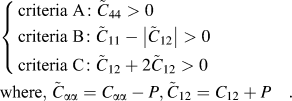
By GIBBS code, we obtain the cell volume under different temperature and pressure (V-T and V-P). As a cubic crystal, lattice constant a = b = c = (V)1/3, then we acquire a-T and a-P data. Lattice constant a is used as initial parameter for elastic constants calculation, and then we obtain the elastic constants under different temperature and pressure. Though we have no detailed experimental data of Rh, RhH, and RhH2 under high temperature or pressure for checking our calculated elastic constants, the mechanical stability of cubic Rh, RhH, and RhH2 crystal under isotropic pressure is judged using the following conditionReference Sin’ko and Smirnow19:
 $$\eqalign{ & \left\{ \matrix{ {\rm{criteria}}\;{\rm{A\!:}}\;{{\tilde C}_{44}} > 0 \hfill \cr {\rm{criteria}}\;{\rm{B\!:}}\;{{\tilde C}_{11}} - \left| {{{\tilde C}_{12}}} \right| > 0 \hfill \cr {\rm{criteria}}\;{\rm{C\!:}}\;{{\tilde C}_{12}} + 2{{\tilde C}_{12}} > 0 \hfill \cr} \right. \cr & {\rm{where,}}\;{{\tilde C}_{\alpha \alpha }} = {C_{\alpha \alpha }} - P,{\rm{ }}{{\tilde C}_{12}} = {C_{12}} + P\quad . \cr}$$
III. RESULTS AND DISCUSSION
Figure 1 shows crystal structure of Rh, RhH, and RhH2 under the ground state. As shown in Fig. 1(a), in RhH crystal, Rh atoms occupy fcc lattice points at (0, 0, 0); and the H atoms occupy the octahedral sites at (0.5, 0.5, 0.5). Figure 1(b) displays that Rh atoms occupy fcc lattice points at (0, 0, 0), and H atoms occupy the tetrahedral sites at (0.25, 0.25, 0.25) in the RhH2 phase. As for Rh, it is just a typical fcc crystal structure [Fig. 1(c)]. In present work, lattice constants of Rh, RhH, and RhH2 are 3.894, 4.076, and 4.383 Å, respectively, which agree with other experimental or theoretic data.Reference Li, Ding, Kim, Ahuja, Zou and Mao9,Reference Hull and Davey20–Reference Somenkov, Glazkov, Irodova and Shilstein22 Lattice constant of RhH and RhH2 is a little more than that of Rh, which is due to H atom's occupying in octahedral and tetrahedral sites. Bulk modulus under the ground states (B 0) calculated by CASTEP and fitted from third-order B–M EOS are coincident. a 0, B 0 together with elastic constants are listed in Table I. Moreover, enthalpy of formation of RhH and RhH2 is calculated too. There is almost no distinction between present results and the data in Ref. Reference Li, Ding, Kim, Ahuja, Zou and Mao9, which indicates that the calculation method of present work is reliable.
Figure 2 shows elastic constants and bulk modulus of Rh, RhH, and RhH2 under different temperature and pressure calculated by CASTEP. B. Li has predicted, by ab initio method, that RhH2 is dynamically stable up to at least 90 GPa.Reference Li, Ding, Kim, Ahuja, Zou and Mao9 Though we obtain similar results from phonon dispersion calculations, we execute mechanical stability test according to Eq. (3) (the results are shown in Fig. 3). Figure 3(a) displays that Rh is mechanically stable under the condition of 0 GPa and 0–2000 K, 0 K and 0–100 GPa; at the same time, RhH is stable in the region of 0 GPa and 0–2000 K, 0 K and 0–8 GPa [Fig. 3(b)]. However, Fig. 3(c) illustrates that RhH2 is no longer mechanically stable when the pressure is higher than 22.7 GPa. The pressure is quite less than 90 GPa. Figure 4 displays the phonon dispersion of RhH2 under the condition of 22 GPa. Figures 3(c) and 4 indicate that RhH2 is both mechanically and dynamically stable when the pressure is not higher 22.7 GPa. Accordingly, in this work, all calculated results of RhH2 under higher pressure (more than 22.7 GPa) would not be discussed further.
Elastic constants of Rh, RhH and RhH2 under different temperature and pressure calculated by CASTEP. (a) Elastic constants of Rh; (b) RhH; (c) RhH2.
Mechanical stability criteria of Rh, RhH, and RhH2 versus temperature and pressure. (a) Rh; (b) RhH; (c) RhH2.
Phonon dispersion of RhH2 under the condition of 22 GPa.
As shown in Fig. 2, elastic constants and bulk modulus, irrespective of whether the same related to Rh, RhH, or RhH2, decrease with temperature and increase with pressure. C 11, C 12, and C 44 of Rh under 0 GPa and 0 K are 384.11, 183.31, and 167.33 GPa, respectively; that of RhH are 285.47, 205.52, and 60.27 GPa; and that of RhH2 are 226.33, 172.13, and 35.40 GPa. Elastic constants of RhH and RhH2 are obviously less than that of Rh, which is due to H atom's entering in octahedral or tetrahedral sites of fcc-Rh lattice. Figure 5 shows partial density of states (PDOS) of Rh, RhH, and RhH2 under the ground state. As shown in Fig. 5(a), in fcc-Rh crystal, the most contribution of Rh-5d is from −6 to 1.2 eV. After H atom's entering, in fcc-RhH crystal, the main contribution of Rh-5d is −5∼1 eV [Fig. 5(b)]; in fcc-RhH2 crystal, the contribution of Rh-5d is −4∼1 eV [Fig. 5(c)]. The obvious width reducing of 5d electrons in PDOS indicates that the strong interaction between Rh atoms is weakened, which is due to decrease of elastic constants in the process of H atom's entering.
PDOS of Rh, RhH, and RhH2 under the ground state. (a) Rh; (b) RhH; (c) RhH2.
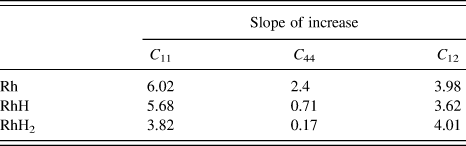
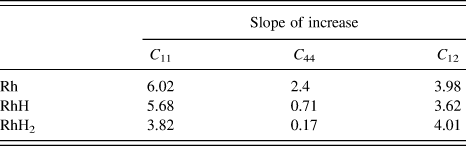
As shown in Fig. 2, under a certain pressure, elastic constants of Rh, RhH, and RhH2 all reduce with temperature. With increasing temperature, lattices of Rh, RhH, and RhH2 are expanded gradually, which would elongate the length between atoms and weaken the interaction between atoms, and then reduce the elastic constants. However, the decreasing tendency caused by temperature is not very obvious. At the same time, elastic constants of Rh, RhH, and RhH2 increase almost linearly with pressure. Nevertheless, the raising of Rh, RhH, and RhH2 is different. Increasing slopes of C 11, C 44, and C 12 of Rh, RhH, and RhH2 are listed in Table II. Slopes of C 11, C 44, and C 12 of Rh are 6.02, 2.4, and 3.98, respectively, which indicate that elastic constants of Rh increase with pressure rapidly. Slopes of C 11, C 44, and C 12 of RhH are 5.68, 0.71, and 3.62; that of RhH2 are 3.82, 0.17, and 4.01. The increasing rates of C 11 and C 44 of the three crystals are quite different, and the rates of C 11 and C 44 of RhH and RhH2 are all less than that of Rh. Figure 6 is electron density contour of (100) and (110) planes of Rh, RhH, and RhH2. As shown in Figs. 6(a) and 6(b), abundant electrons are located uniformly near Rh atom, which causes intense repulsive interaction under high pressure. And then, C 11 and C 44 of Rh increase linearly with pressure rapidly (large slope). However, while H atom enters in octahedral sites (RhH) or tetrahedral sites (RhH2), electron distributions along <100> and <111> are substantially less than that of Rh, which generates little increasing of C 11 and C 44 of RhH and RhH2. Especially, as shown in Fig. 6(f), electrons near Rh atom along <111> direction have not been observed, which is mainspring of little increasing slope of C 44 of RhH2 (just 0.17) with pressure. Because the increasing rate of C 44 of RhH2 is quite less than that of C 11 and C 12, mechanical stability is destroyed under high pressure (22.7 GPa), which agrees with Figs. 4(c) and 5.
Slope of increasing of elastic constants of Rh, RhH, and RhH2.
Electron density contour of Rh, RhH, and RhH2. (a) Rh (100) plane; (b) Rh (110) plane; (c) RhH (100) plane; (d) RhH (110) plane; (e) RhH2 (100) plane; (f) RhH2 (110) plane.
Constant volume heat capacity (C v) and thermal expansion (α) are the most significant parameters in thermodynamic study, which are quite important for many applications. Figure 7 displays the C v of Rh, RhH, and RhH2 as a function of temperature and pressure. Figure 8 shows the α of Rh, RhH, and RhH2 versus temperature and pressure. As an old topic of the condensed matter physics, C v of crystal helps to cognize the vibrational properties of the atom.Reference Einstein23–Reference Debye25 Through, we could acquire the C v under different temperatures by experimental methods, it would take a long testing time and be affected by external factors easily. Moreover, the experimental test is quite expensive. Fortunately, by theoretical calculation method, we can obtain these thermodynamic properties accurately and intuitively. Furthermore, calculated results would be useful guidance for experimental work and engineering application. According to the standard elastic continuum theory,Reference Debye25 one can predict two limit cases correctly: (1) at high temperature, C v tends to the Petit and Dulong limit under any pressureReference Petit and Dulong26; (2) at extremely low temperature, C v is proportional to T 3,Reference Debye25 which is due to thermal excitation of acoustic mode with long wavelength.Reference Debye25 At intermediate temperatures, C v is governed by the details of vibrations of the atoms. Calculation of quasiharmonic Debye model shows that C v of Rh and RhH are 198.88, 354.22 J/(kg·K) under ambient temperature and pressure (300 K and 0.1 GPa); C v of RhH2 is 487.75 J/(kg·K) under the condition of 300 K and 8 GPa. It is observed that, irrespective of whether it relates to Rh, RhH, or RhH2, C v increases proportional to T 3 obviously under low temperature (about less than 100 K), and tends to Dulong–Petit limit (about 241.67, 478.47, and 706.15 J/(kg·K), respectively) at higher temperature (higher than 1500 K). Comparing the Dulong–Petit limit, we find out that, though fcc-RhH2 has just two H atoms more than fcc-Rh in chemical formula, the Dulong–Petit limit of RhH2 are about thrice as much as that of Rh, which indicates that H atom is capable of raising heat capacity. At the same time, it is observed that C v decreases with pressure. However, the restrain effect on C v caused by pressure is not obvious under the condition of too low or too high temperature which indicates that the atom's vibrations are quite sensitive to pressure, just in the area of intermediate temperatures.
The heat capacity at constant volume (C v) of Rh, RhH, and RhH2 as a function of temperature and pressure. (a) Rh; (b) RhH; (c) RhH2.
The thermal expansion (α) of Rh, RhH, and RhH2 versus temperature and pressure. (a) Rh; (b) RhH; (c) RhH2.
As shown in Fig. 8, as a whole, αRh <αRhH <αRhH2, which is due to H atom's entering in fcc-Rh lattice. Intrinsic electron distribution of fcc-Rh lattice is changed greatly in the process of H atom's entering in, which has weakened attractive interaction between atoms significantly. Figure 8 also displays that the α of Rh, RhH, and RhH2 increases acutely when the temperature is not more than 300 K. And then, the increasing of α slows down. Moreover, it is observed that the higher the pressure is, the less the increasing tendency is, while the temperature is more than about 450 K. We also find out that, irrespective of whether at high or low temperature, the α reduces with pressure transiently [as shown in right part of Figs. 8(a)–8(c)], which indicates that high pressure could suppress expansion caused by high temperature greatly. Moreover, unlike the C v, the reducing tendencies of α are almost similar.
IV. CONCLUSIONS
In this work, mechanical stability, thermodynamic and elastic properties of Rh, RhH, and the newly discovered RhH2 under high temperature and pressure are studied by ab initio method and quasiharmonic Debye model. Mechanical stability test indicates that RhH2 is no longer mechanically stable when pressure is higher than 22.7 GPa. Elastic constants and bulk modulus of Rh, RhH, and RhH2 decrease with temperature and increase with pressure. C v of Rh and RhH are 198.88, 354.22 J/(kg·K) under ambient temperature and pressure (300 K and 0.1 GPa); C v of RhH2 is 487.75 J/(kg·K) under the condition of 300 K and 8 GPa. C v of Rh, RhH, and RhH2 increases proportionally with T 3 under low temperature, and tends to Dulong–Petit limit (about 241.67, 478.47, and 706.15 J/(kg·K), respectively) at higher temperature. Moreover, C v decreases with pressure. The restraining effect on C v caused by pressure is not noticeable under the condition of too low or too high temperature. α of Rh, RhH, and RhH2 increases acutely while temperature is not more than 300 K. And then, the increasing of α slows down. The α reduces with pressure transiently. All the differences in the properties among the three crystals are due to large changes of electron density distribution caused by H atom's entering in fcc-Rh lattice.
ACKNOWLEDGMENTS
This work was financially supported by Science and Technology Research Projects of Chongqing Educational Committee (KJ120402); Doctoral Fund of Ministry of Education of China (20115522110003); The Applied Basic Research Programs of Ministry of Transport of China (2013319814030); Open Foundation of Laboratory for Extreme Conditions Matter Properties, China (Grant No. 11zxjk05); First Funding Scheme of Young Teachers in Institution of Higher Education, Chongqing, China; Key Science and Technology Project of Ministry of Education 2012, China.