Introduction
Attention deficit hyperactivity disorder (ADHD) is one of the most common neuropsychiatric disorders in childhood and adolescence (Kieling et al. Reference Kieling, Kieling, Rohde, Frick, Moffitt, Nigg, Tannock and Castellanos2010) and is one of the most underdiagnosed psychiatric disorders in adults (Faraone, Reference Faraone2007). It is defined with age-inappropriate symptoms of hyperactivity/impulsivity and inattention, and with functional impairments in social, family and school/work settings.
Evidence shows that adults with ADHD commonly present with neurocognitive impairments in several domains, including response inhibition, delay aversion, working memory, sustained attention, time processing, and motivational processes (Seidman et al. Reference Seidman, Doyle, Fried, Valera, Crum and Matthews2004).
One area of neuropsychological performance not well studied in adults with ADHD is time perception. Sense of time is a multidimensional construct encompassing perceiving the passing of moments from one to another, organizing a sequence of actions, and predicting when future events will occur (Toplak et al. Reference Toplak, Dockstader and Tannock2006). Thus far, the majority of the research exploring time-processing impairments in ADHD has been conducted in children showing impairments in temporal processing domains including time production (Van Meel et al. Reference Van Meel, Oosterlaan, Heslenfeld and Sergeant2005), motor timing (Rubia et al. Reference Rubia, Overmeyer, Taylor, Brammer, Williams, Simmons and Bullmore1999; Smith et al. Reference Smith, Taylor, Lidzba and Rubia2003), time perception (Smith et al. Reference Smith, Taylor, Rogers, Newman and Rubia2002; Yang et al. Reference Yang, Chan, Zou, Jing, Mai and Li2007) and time reproduction (Barkley et al. Reference Barkley, Koplowitz, Anderson and McMurray1997; Bauermeister et al. Reference Bauermeister, Barkley, Martinez, Cumba, Ramirez, Reina, Matos and Salas2005; Rommelse et al. Reference Rommelse, Oosterlaan, Buitelaar, Faraone and Sergeant2007). However, research has shown that time reproduction deficits are the most consistent timing problems found in children and adolescents with ADHD (Barkley et al. Reference Barkley, Edwards, Laneri, Fletcher and Metevia2001a ; Bauermeister et al. Reference Bauermeister, Barkley, Martinez, Cumba, Ramirez, Reina, Matos and Salas2005; Barkley, Reference Barkley and Barkley2006; Toplak et al. Reference Toplak, Dockstader and Tannock2006). In a typical reproduction task a light bulb presented on a computer screen is switched on for different time durations, and then the participant must reproduce the sample duration using the same means (e.g. by switching on the light bulb and turning it off when they think the time duration has elapsed). In such paradigm children with ADHD show an increase in error magnitude with the length of the time intervals to be reproduced (West et al. Reference West, Douglas, Houghton, Lawrence, Whiting and Glasgow2000; Bauermeister et al. Reference Bauermeister, Barkley, Martinez, Cumba, Ramirez, Reina, Matos and Salas2005; Block et al. Reference Block, Hancock and Zakay2010). Seminal work by Barkley et al. (Reference Barkley, Koplowitz, Anderson and McMurray1997) examined time reproduction performance taking into account also the effects of attentional demands and use of methylphenidate (MPH). While all children (both ADHD and controls) performed similarly at short durations, children with ADHD made significantly larger errors of reproduction than controls on intervals of 6, 10, and 16 s. In studies using supra-second intervals, children with ADHD showed a trend towards progressively greater time underestimation as the target time interval to be reproduced increased (Kerns et al. Reference Kerns, McInerney and Wilde2001). Poor temporal reproduction performances seem to persist over time, as adolescents with ADHD are also impaired in time reproduction tasks compared to age-matched controls (Barkley et al. Reference Barkley, Edwards, Laneri, Fletcher and Metevia2001a ). As seen, abnormalities in reproducing temporal durations have been consistently documented in children with ADHD. However, there is still paucity of research in adults. One study showed that adults with ADHD also have poorer time reproduction abilities compared to typically developing controls (Barkley et al. Reference Barkley, Murphy and Bush2001b ). Marx and colleagues showed that increasing age ameliorated time reproduction deficits in ADHD; however, abnormalities persisted into adulthood in individuals with ADHD compared to controls (Marx et al. Reference Marx, Hubner, Herpertz, Berger, Reuter, Kircher, Herpertz-Dahlmann and Konrad2010).
We know little about the neuroanatomical and neurophysiological correlates of time-processing impairments in adult ADHD. In the only neuroimaging study examining time processing in adults with ADHD, using a finger-tapping paradigm in age- and IQ-matched adults, Valera and colleagues (Reference Valera, Spencer, Zeffiro, Makris, Spencer, Faraone, Biederman and Seidman2010) found an atypical pattern of neural activity in the cerebellum and basal ganglia.
In healthy individuals temporal information processing seems to engage multiple brain areas including the cerebellum, basal ganglia and prefrontal cortex (e.g. Ivry, Reference Ivry1996; Ivry et al. Reference Ivry, Spencer, Zelaznik and Diedrichsen2002; Meck et al. Reference Meck, Penney and Pouthas2008). To our knowledge, there are no studies to date examining the association between neuroanatomical characteristics and time reproduction in adult ADHD. In this study we assessed the brain volumetric correlates of temporal reproduction performances in adults with ADHD, using voxel-based morphometry (VBM), focusing on one region of interest (ROI) including areas previously described having a role in timing, namely cerebellum, prefrontal cortex, and basal ganglia.
Investigating time reproduction abilities in adult ADHD might also contribute to the search of cognitive endophenotypes in adult ADHD, which in turn should progress the search for susceptibility genes for the disorder (Gottesman & Gould, Reference Gottesman and Gould2003) and inform novel pharmacological and neurocognitive treatment discoveries based on a biomarker approach. Endophenotypes are defined as internal, quantitative traits closer to the expression of the genes than the clinical picture per se. If the clinical phenotype is reduced to its basic neurocognitive components, the number of genes associated with endophenotype variation might be fewer compared to the number of genes linked to the overt clinical phenotype. Reducing the number of genes to test for should enhance the statistical power in molecular genetic studies aimed at discovering susceptibility genes for the disorder (Leboyer et al. Reference Leboyer, Leboyer, Bellivier, Jouvent, Nosten-Bertrand, Mallet and Pauls1998; Almasy & Blangero, Reference Almasy and Blangero2001; Gottesman & Gould, Reference Gottesman and Gould2003; Aron & Poldrack, Reference Aron and Poldrack2005; Doyle et al. Reference Doyle, Willcutt, Seidman, Biederman, Chouinard, Silva and Faraone2005). Time reproduction might meet several of the criteria for an endophenotype: heritable, associated with the disorder, and expressed at higher rates in unaffected relative of probands with ADHD than individuals drawn from the general population (Almasy & Blangero, Reference Almasy and Blangero2001; Gottesman & Gould, Reference Gottesman and Gould2003). It has been shown that children with ADHD and their unaffected siblings were both impaired in time reproduction compared to controls (Rommelse et al. Reference Rommelse, Oosterlaan, Buitelaar, Faraone and Sergeant2007). Therefore, we further assessed whether time reproduction is a potential endophenotype in adult ADHD testing the hypothesis that first-degree relatives of ADHD patients would share abnormalities in a temporal reproduction paradigm compared to unrelated controls. To our knowledge, this is the only study examining time reproduction deficits as a cognitive endophenotype in adult ADHD.
Method
Participants
We tested 20 adults with ADHD, 20 unaffected first-degree relatives of adults with ADHD, and 20 typically developing control participants. Written consent was obtained from each participant. The study was approved by the Cambridgeshire 3 Research Ethics Committee (REC: 09/H0306/38). ADHD proband–relative pairs were recruited from the Adult ADHD Research Clinic, Addenbrooke's Hospital, Department of Psychiatry, University of Cambridge. Patients received a diagnosis of ADHD according to DSM-IV-TR (APA, 2000), based on a full clinical interview with the patient and an informant who had known the patient since childhood. The clinical assessment also included rating scales: Barkley Adult ADHD Rating Scale, self-report and informant report, childhood and adulthood symptoms (BAARS; Barkley, Reference Barkley2011), assessing childhood and adulthood symptoms from the perspective of the patient and the informant. Eligible patients were asked to contact a first-degree relative who undertook the same clinical protocol to screen for undiagnosed ADHD in adulthood. Control participants were recruited via posters in the local community and underwent the same procedure.
On the testing day, all participants were interviewed using the Mini International Neuropsychiatric Inventory (Sheehan et al. Reference Sheehan, Lecrubier, Sheehan, Amorim, Janavs, Weiller, Hergueta, Baker and Dunbar1998) to screen for DSM-IV Axis I disorders, and completed the BAARS, self-report (Barkley, Reference Barkley2011). Estimate of full IQ was obtained using the National Adult Reading Test (NART; Nelson & O'Connell, Reference Nelson and O'Connell1978). Neither controls nor first-degree relatives of ADHD probands showed ADHD symptoms meeting the DSM-IV-TR diagnostic threshold for ADHD. Moreover, they did not show clinically significant symptoms of another DSM-IV-TR disorder. Finally, ADHD participants did not show relevant symptoms of a co-morbid disorder reaching clinical significance for a formal DSM-IV-TR diagnosis. To reduce confounds resulting from other major psychiatric and neurological conditions, exclusion criteria were: (i) full IQ ⩽90, (ii) current or past history of pervasive developmental disorder, any neurological disorder (including tic disorders), bipolar disorder, substance-use disorders, schizophrenia or other psychotic disorders, (iii) current major depressive disorder, and (iv) contraindications to magnetic resonance imaging (MRI) scan. To minimize the impact of psychotropic medications on cognitive performance, participants were asked to omit taking that medication 24 h before testing (Gualtieri et al. Reference Gualtieri, Wargin, Kanoy, Patrick, Shen, Youngblood, Mueller and Breese1982; Turner et al. Reference Turner, Blackwell, Dowson, McLean and Sahakian2005) and were asked to refrain from consuming alcohol or caffeine-containing drinks on the day of testing. The ADHD group comprised 16 patients with combined type and four with inattentive type; 16 of the patients were ordinarily medicated with MPH, and four did not receive medication for ADHD. None of the participants were excluded due to a NART full IQ ⩽90.
Cognitive task
Time reproduction task
Participants were asked to reproduce sub-second and supra-second stimulus durations watching a computer screen where two light bulbs appeared. After the top light bulb was switched on for a specific interval length, the bottom light bulb had to be kept lit for the same interval length by pressing the space bar continuously (this response is defined as response length). Following four practice trials, the task comprised 42 trials (six per stimulus length) that were randomly distributed. Stimulus durations were 500, 1000, 3000, 6000, 12 000, 18 000, and 24 000 ms.
The dependent variable was the absolute discrepancy score measured as the absolute discrepancy between the target duration and the reproduction provided by the subject (response length). We also calculated the omnibus absolute discrepancy score (i.e. the sum of the seven different absolute discrepancy scores for each duration); the higher the score, the more impaired the performance.
A repeated-measure analysis of covariance (ANCOVA) was used with group as the fixed factor with three levels (ADHD, relatives, controls) and target duration as repeated measure (seven levels of durations of 500, 1000, 3000, 6000, 12 000, 18 000, 24 000 ms). Age and full IQ were included as covariates. Finally, since Mauchly's test of sphericity was always significant for target duration factor of the design, the Huynh–Feldt values for the F tests involving the duration factor was used. Given the number of comparisons a Bonferroni correction was applied; however, when Levene's test for equality of variance was significant, Tamhane's correction was used.
MRI acquisition
Images were acquired at the Wolfson Brain Imaging Centre, University of Cambridge, UK, using a Siemens TIM Trio 3-T system. T1-weighted MR scans were acquired using a magnetization-prepared rapid acquisition gradient-echo (MPRAGE) sequence (176 slices, 1 mm thickness, TR = 2300 ms, TE = 2.98 ms, TI = 900 ms, flip angle = 9°, FOV = 240 × 256) and manually aligned to the anterior commissure–posterior commissure line. VBM analysis was performed using SPM8 (Welcome Department of Imaging Neuroscience, UK). To improve the registration of the MRI images, we used the diffeomorphic anatomical registration through an exponentiated Lie algebra algorithm (DARTEL; Ashburner, Reference Ashburner2007). DARTEL provides improved registration accuracy compared to conventional VBM, and VBM with DARTEL is more sensitive than conventional VBM methods (Klein et al. Reference Klein, Andersson, Ardekani, Ashburner, Avants, Chiang, Christensen, Collins, Gee, Hellier, Song, Jenkinson, Lepage, Rueckert, Thompson, Vercauteren, Woods, Mann and Parsey2009). The following processing steps were implemented: (1) structural images of all 60 participants were included for creating a study-specific template; (2) structural images of each participant were segmented (using unified segmentation) and imported into DARTEL to create the study-specific template, while all images were warped to the study-specific template and then into standard Montreal Neurological Institute (MNI) space; (3) Jacobian modulation was applied to preserve information about local volumes; and (4) images were smoothed with an 8 mm full-width at half maximum kernel. A correlation analysis between grey-matter volume and the omnibus absolute discrepancy score across groups was performed in SPM8 (using GLM) with age and IQ included as covariates. We were interested in cortical areas previously found to be associated with time processing, for this reason one ROI was employed using WFU Pick-Atlas (Maldjian et al. Reference Maldjian, Laurienti, Kraft and Burdette2003), comprising prefrontal cortex, basal ganglia, and cerebellum. Only clusters surviving at family-wise error (FWE) p < 0.05 corrected at the cluster level, with a conservative voxel-level cluster-forming threshold, αc, of 0.001 are reported.
To characterize differences between the three groups, cluster regional volume estimates surviving the correlation analyses were extracted using Marsbar (http://marsbar.sourceforge.net/; Brett et al. Reference Brett, Anton, Valabregue and Poline2002) and imported into SPSS version 21 (http://www.spss.com/) to perform ANOVA analyses, with group (ADHD, relatives, controls) as a fixed factor and cluster regional volume estimates as dependent variables. This ROI analysis methodology has been widely implemented in other studies (Egner & Hirsch, Reference Egner and Hirsch2005; Carmona et al. Reference Carmona, Hoekzema, Ramos-Quiroga, Richarte, Canals, Bosch, Rovira, Carlos Soliva, Bulbena, Tobena, Casas and Vilarroya2011). All brain coordinates are given in MNI convention. A Probabilistic MRI Atlas of the Human Cerebellum (Diedrichsen et al. Reference Diedrichsen, Balsters, Flavell, Cussans and Ramnani2009) was used to assign anatomical labels to cerebellar structures.
Results
Participant characteristics
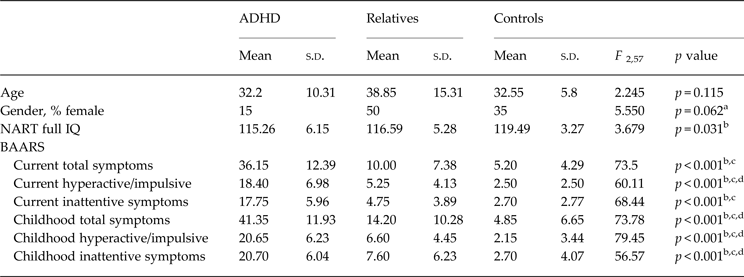
The three groups did not differ significantly in age and gender. The ADHD group scored 4 points lower than typically developing controls on NART full IQ. The ADHD group differed from relatives and controls in self-reported current and childhood ADHD symptoms. Unaffected first-degree relatives were significantly different from ADHD and control groups on self-reported current hyperactive/impulsive symptoms, childhood total symptoms, childhood hyperactive/impulsive and inattentive symptoms (Table 1).
Sample characteristics and clinical measures

ADHD, Attention deficit hyperactivity disorder; BAARS, Barkley Adult ADHD Rating Scale; NART, National Adult Reading Test.
a χ2.
b The ADHD group differs significantly from the controls.
c The ADHD group differs significantly from the relatives.
d Relatives differ significantly from controls.
Behavioural analysis
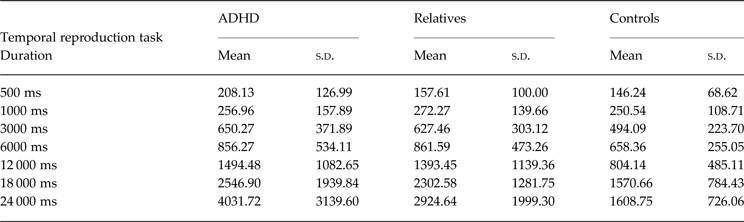
Table 2 shows the mean and s.d. of the time reproduction task performance (absolute discrepancy score).
Mean and s.d. of the absolute discrepancy score for the seven different target durations (averaged across trials) according to group

ADHD, Attention deficit hyperactivity disorder.
A main effect of group was found (F 2,56 = 4.070, p = 0.009) consistent with the hypothesis of ADHD performing significantly worse than the other groups. A main effect of duration (F 1.796,100.566 = 10.057, p < 0.001) was also found, indicating that performance deteriorated as interval length increased, reflecting effects of task difficulty. Moreover, a significant interaction between duration and group was also present (F 3.592,100.566 = 4.627, p = 0.003), suggesting that increasing interval length had differential effects for the three groups (Fig. 1). Pairwise comparisons decomposing the main effect of group showed that the ADHD group was significantly worse in time reproduction than the control group (p = 0.010), but first-degree relatives were not significantly different from the ADHD group (p = 1.00). There was a trend difference in performance between first-degree relatives and controls (p = 0.082).
Mean absolute magnitude of error in the time reproduction task according to target duration and group. Bars represent standard error of the mean.

Neuroimaging analysis
MANCOVA analysis assessing for total intracranial volume (TIV) and total brain volume.
(TBV) with group as the fixed factor and age as a covariate showed no differences between the three groups for both variables (TIV: F 2,56 = 1.536, p = 0.224; TBV: F 2,56 = 1.827, p = 0.170).
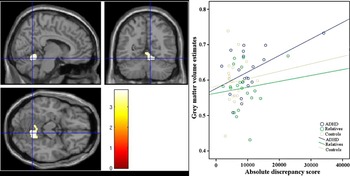
Voxel-level GLM analysis within our ROI, covaried for age and full IQ, showed one significant cluster of 797 voxels surviving FWE cluster-level correction at q < 0.05 (Fig. 2), where increased volume was correlated with increased absolute discrepancy score across groups (implying poorer time reproduction; r = 0.297, p = 0.021). This cluster was located in the cerebellum, at peak voxel centred on MNI coordinates (x = 9, y = −57, z = −15; right cerebellar lobule V). There were no significant results showing a negative correlation. Between-group analysis showed no significant differences (F 2,55 = 2.151, p = 0.126). Decomposing the correlation using a bivariate analysis between grey-matter volume estimates within this cluster and the absolute discrepancy score according to group showed that only the correlation within the ADHD group remained significant at p = 0.05 (ADHD: r = 0.505, p = 0.023; relatives: r = 0.121, p = 0.613; controls: r = 0.079, p = 0.740), suggesting a role of grey-matter variability in driving performance within the ADHD group.
Positive correlation between absolute discrepancy scores and grey-matter volume estimates across groups, suggesting the more grey-matter volume in the cerebellum (right lobule V) the poorer is the performance in time reproduction abilities. No significant results were found in the prefrontal cortex and basal ganglia.

Discussion
One of the aims of this study was to test whether adults with ADHD were impaired in temporal information processing, specifically in a time reproduction paradigm. The results show that not only children with ADHD (Barkley et al. Reference Barkley, Koplowitz, Anderson and McMurray1997; Block et al. Reference Block, Hancock and Zakay2010) but also adults with ADHD suffer from time-processing deficits. In addition, we also found that impairments in time reproduction were not mainly due to differences between ADHD and control samples in intellectual ability as the findings remained unchanged when the effect of IQ was held constant in the analysis. Overall, time reproduction is abnormal in adults with ADHD. Trend gender distribution differences between groups within our sample are unlikely to be the main driver for such significant differences in performances, as previously it was shown that in a large sample of individuals with ADHD followed for 7 years there was no evidence that gender moderated the association between ADHD and the phenotypic expression of the disorder, the prevalence of lifetime or current co-morbid psychiatric disorders, or patterns of cognitive and psychosocial functioning (Biederman et al. Reference Biederman, Faraone, Monuteaux, Bober and Cadogen2004).
At the neuroanatomical level, we found that across the whole sample, the main structure associated with temporal reproduction processing was at the cerebellum, rather than at the basal ganglia or prefrontal cortex. This suggests a substantial role of cerebellum in time reproduction abilities. More specifically, we found that an increase in grey-matter volume in the right cerebellar lobule V was associated with worse performance in reproducing time durations. The present positive correlation in the ADHD group between grey-matter volume in the cerebellum and time reproduction score is consistent with the hypothesis that an abnormal increase in grey-matter volume in lobule V of the cerebellum has a role in time reproduction deficits; however, this correlation becomes a trend without all data points included, and therefore this finding requires further replication. Nonetheless, this result is consistent with recent research highlighting a role of the cerebellum in temporal processing in the general population (Stoodley, Reference Stoodley2012).
Despite that cerebellar neuroanatomical abnormalities in ADHD have been shown by previous studies (Berquin et al. Reference Berquin, Giedd, Jacobsen, Hamburger, Krain, Rapoport and Castellanos1998; Castellanos et al. Reference Castellanos, Lee, Sharp, Jeffries, Greenstein, Clasen, Blumenthal, James, Ebens, Walter, Zijdenbos, Evans, Giedd and Rapoport2002; Seidman et al. Reference Seidman, Valera and Makris2005; Bledsoe et al. Reference Bledsoe, Semrud-Clikeman and Pliszka2011), to our knowledge this is the first study examining the neuroanatomical correlates of time reproduction performances specifically in adults with ADHD. The relationship of the cerebellum and prefrontal cortex on timing tasks has been explored in recent studies that directly compared the performance of patients with lesions of either of these structures. The results suggest that, whereas lesions of the cerebellum directly affect the ability to encode temporal information, prefrontal lesions interfere with maintaining and monitoring these representations in working memory (Handy et al. Reference Handy, Gazzaniga and Ivry2003). The basal ganglia have also been tied to the operation of an internal clock which contributes to the representations of the subjective passage of time (Ivry, Reference Ivry1996). Our results, highlighting the involvement of the cerebellum rather than prefrontal cortex or basal ganglia, might suggest that the deficit driving poor timing in adults with ADHD is linked to the encoding phase and not related to deficits in maintaining and monitoring temporal information in working memory. This is in line with the lack of a clear relationship between working memory and temporal reproduction (Mette et al. Reference Mette, Grabemann, Zimmermann, Strunz, Scherbaum, Wiltfang and Kis2015). Overall, grey-matter abnormalities in the cerebellum might cause inefficiencies in frontocerebellar networks critical for time processing. For example, lobule V is part of the sensorimotor network receiving projections from primary motor and sensory cortices (M1, S1 and premotor cortex) dealing with sensorimotor integration and motor timing (Stoodley & Schmahmann, Reference Stoodley and Schmahmann2009; Stoodley, Reference Stoodley2012). It is plausible that grey-matter increase in lobule V causes difficulties in engaging this network optimally, therefore contributing to poor timing reproduction performance in adults with ADHD compared to typically developing controls.
A final aim of this study was to test temporal reproduction as a putative cognitive endophenotype for ADHD in adults. Interestingly, the performance of unaffected first-degree relatives fell in between that of ADHD patients and controls, although not statistically significantly different from either group. This is in line with the notion that as an endophenotype, a characteristic should present also in relatives of affected individuals but milder (Almasy & Blangero, Reference Almasy and Blangero2001; Gottesman & Gould, Reference Gottesman and Gould2003). Therefore, our results suggest that time reproduction deficits might be a cognitive endophenotype for ADHD in adulthood. However, this significant result awaits further replication.
In conclusion, we have extended the literature from children to adults, to show that time reproduction performances were impaired in ADHD across different ages. Moreover, there was a statistical trend delineating a difference between relatives and controls, suggesting that time reproduction performances were in between ADHD and controls. This pattern of results is consistent with the idea that time reproduction might be a cognitive endophenotypes in adult ADHD. Finally, grey-matter volume in the cerebellum, but not basal ganglia and prefrontal cortex, was associated with time reproduction performances (particularly in the ADHD group), such that the more grey-matter volume in the cerebellar lobule V the poorer the timing performance. This is consistent with the hypothesis of ineffective pruning which might have an important aetiological role in the symptomatology of adult ADHD; an hypothesis to be tested in future research.
Acknowledgements
This work was funded by a Core Award from the Medical Research Council and the Wellcome Trust to the Behavioural and Clinical Neuroscience Institute (MRC ref. G1000183; WT ref. 093875/Z/10/Z). V.A.P. was supported by a Medical Research Council Doctoral Training Grant, University of Cambridge, Department of Psychiatry.
Declaration of interest
E.T.B. is employed half-time by GSK and half-time by the University of Cambridge; he holds stock in GSK. B.J.S. consults for Cambridge Cognition, Peak, Servier and Lundbeck; she holds a grant from Janssen/J&J. U.M. has received honoraria for consultancy and speaking at conferences and travel expenses from Bristol-Myers-Squibb, Eli Lilly, Janssen-Cilag, Lundbeck, Pharmacia-Upjohn and UCB Pharma. The remaining authors reported no biomedical financial interests or potential conflicts of interest.