Introduction
The 1972 Convention Concerning the Protection of the World Cultural and Natural Heritage (World Heritage Convention) created an international system to preserve heritage of global significance for humanity.Footnote 1 The World Heritage List, the Convention’s implementing mechanism, allows states that have ratified the Convention to identify, within their territory, heritage sites of outstanding universal value and to place them under the protection of the global community. As of 2021, the Convention has been ratified by 194 states parties and has 1,121 sites on its prestigious World Heritage List.Footnote 2 In the 49 years since its establishment, the Convention has created a space of high visibility for the ideal of intergovernmental responsibility for the conservation of heritage. However, this enhanced prominence has also embroiled World Heritage in the tensions of multilateral diplomacy, torn between the overarching aims of international cooperation and the restrictions of national sovereignty.
In the sessions of the World Heritage Committee (the Committee), comprised of 21 representatives of the states parties to the World Heritage Convention, these diplomatic tensions play out through debates over documents, including proposed amendments and revised versions. As anthropological work on international organizations has shown, ethnographic perspectives call into question monolithic representations of institutions that focus only on the documents they produce without looking at the intermediate phases of debates and negotiations before decisions are formalized.Footnote 3 When one is able to witness the procedures, relationships, and hierarchies that produced those texts, documentary analysis gains greater depth.Footnote 4 Documents, as constitutive of bureaucratic activities, truly underpin institutional practices and represent the ideal ethnographic artifact for an anthropological study on organizations.Footnote 5 Thus, a document-based ethnography can uncover the micro-processes of negotiation and reveal how alternative interpretations are silenced in the final stages of production.Footnote 6 Ethnography can make a “written document speak,” in Birgit Muller’s words, by tracking how “drafts are tamed” using linguistic tools that achieve neutral discourses and mask political issues under the pretense of technicality.Footnote 7 Focusing on the minutiae of text-based negotiations ultimately reveals the aesthetics of documents, including their highly formalized norms and forms, and renders them – and the organizations that produce them – more understandable and less opaque. Indeed, ethnographically informed readings of document-making processes contribute to a nuanced understanding of the workings of institutions of global governance, ultimately revealing the strong relationships between document production and specific forms of bureaucratic organization.Footnote 8
In this article – a case study based on long-term ethnographic observation and archival analysis of UNESCO’s documents and bureaucratic processes – the focus will be on the verbal interventions and text-based negotiations related to consensual decisions of the Committee. In addition to contributing to the growing literature on the inner workings of UNESCO and its intergovernmental committees,Footnote 9 this study enhances scholarly understanding of the political tensions and practical limitations of cultural policymaking within an intergovernmental organization of the United Nations (UN) family such as UNESCO by unraveling how documents are enacted in practice. In particular, I analyze the revisions to paragraphs 40, 61, and 123 of the Operational Guidelines of the World Heritage Convention that were discussed by a consultative body (Working Group) at the thirty-ninth session of the Committee in 2015. The revisions to those articles are particularly relevant to showing how linguistic nuances can be used strategically to trump the rights of minorities and procrastinate on urgent measures with severe financial consequences.
In the first two sections of the article, I propose a model for analyzing the different phases of document production in the World Heritage context and detail the contradictory pressures toward transparency and performance in the negotiations of the Committee and the Working Groups. In the third section, I apply the concept of the “boundary object”Footnote 10 to the World Heritage Convention’s Operational Guidelines, and, in the final two sections, I turn to the revisions to paragraphs 40, 61, and 123 respectively. The revision process for paragraphs 40 and 123 is an example of consensual decisions adopted in the Committee’s plenary, while the process for paragraph 61 produced a more fragile version of consensus that was ultimately unmade in the plenary. Both examples reveal how expanded discussions favor colonial attitudes and disregard the rights of minorities at the same time that they encourage deferment and inertia in World Heritage decision-making processes.
The life cycle of documents
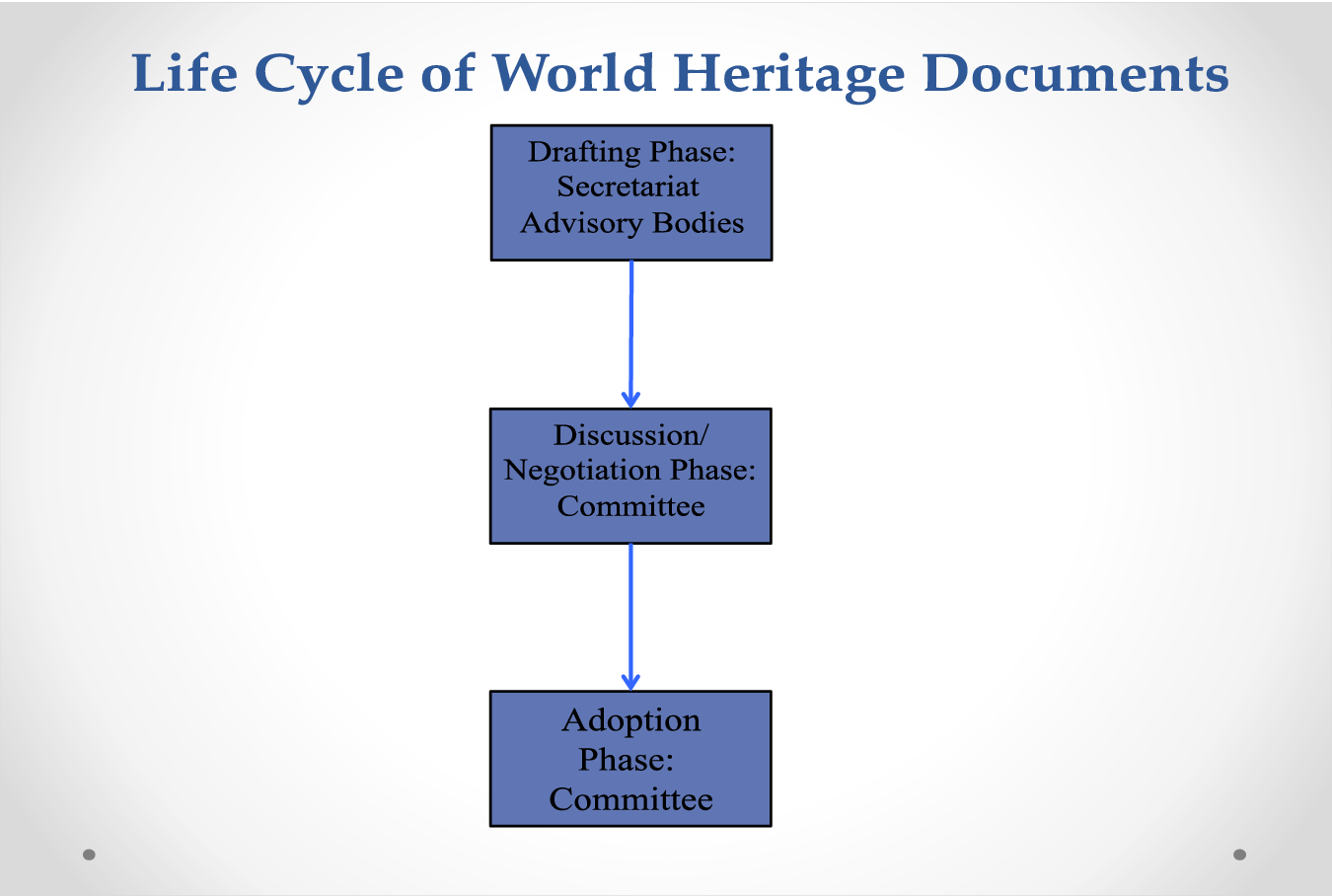
Although the World Heritage Convention “is not only ‘words on paper’,”Footnote 11 World Heritage procedures require a substantial amount of paperwork. The Committee’s mandate is to develop policies and the overarching framework for implementation of the Convention and to decide on new nominations to the World Heritage List. The Committee also oversees the monitoring and managing of sites already on the World Heritage List and considers the need for special measures regarding sites on the List of World Heritage in Danger, including allocating monies from the World Heritage Fund.Footnote 12 The Committee is supported in its decision-making process by experts from UNESCO’s three Advisory Bodies,Footnote 13 while the day-to-day operations related to the implementation of the Convention have been overseen since 1992 by its Secretariat, the World Heritage Center, located at the UNESCO headquarters in Paris. Documents are produced in response to Committee requests or to comply with statutory processes, such as nominations dossiers and the periodic monitoring of already-inscribed sites. For example, in order for a cultural or natural heritage site to become part of the World Heritage List, its material existence must be documented, evaluated, and analyzed in a series of documents mandated by bureaucrats. As in the work of scientists described by Bruno Latour and Steve Wolgar, bureaucrats and experts working within the context of World Heritage transform “pieces of matter,” such as archaeological monuments or natural sites, into texts.Footnote 14 These texts, regarded as being in direct relationship to their material counterparts, are deployed during processes of discussion and negotiation by World Heritage governing bodies.Footnote 15 As reified representations of the subject matter under discussion, they constitute the ideal ethnographic artifacts to study World Heritage processes. The production of documents examined during Committee sessions is subject to distinct phases that can be schematized as the life cycle of World Heritage documents (Figure 1).Footnote 16
Schematized illustration of the life cycle of World Heritage documents (courtesy of the author).

Drafting phase
Documents are prepared in consultation with UNESCO officials, the Advisory Bodies, and sometimes external experts. On occasion, consultations with states parties on specific policy documents may be initiated. It is the task of the Secretariat to collate the various proposals and amendments into draft working documents to be examined during Committee sessions. As noted by Billaud, in preparing World Heritage documents, experts and UNESCO officials acquire skills that enable them to work within the exigencies and constraints of the system.Footnote 17 The required skills include technical expertise as well as knowledge of diplomatic etiquette. Drafters will properly select and classify information in order to obtain a balance between conformity and change and to maintain an aura of technicality and impartiality.Footnote 18 Over time, drafters develop a sense for using language in proper patterns and following the aesthetic requirements of the genre.Footnote 19 However, these sense-making and predictive skills also create a kind of feedback loop, by which the drafters’ choices of literary expressions will also determine the future of the issues discussed.Footnote 20
Another aspect that influences this phase, and a key characteristic of the official documents, is the lack of individual authorship.Footnote 21 Papers drafted through the collaborative work of officials and experts are not formally considered as their creation but acquire the identity of the organization as a whole.Footnote 22 Indeed, the construction of a collective agency from the agency of individuals is a central task of bureaucracy.Footnote 23 The collective voice is built progressively, through the participation of different actors and the use of lexical features, such as passive voice and abstract nouns, which create the appearance of anonymity to enhance legitimacy and objectivity.Footnote 24
Discussion/Negotiation phase
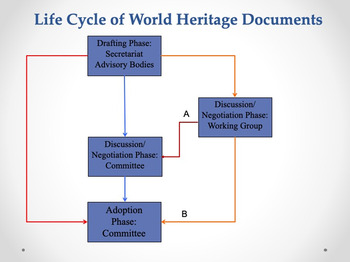
Draft documents are made available on the World Heritage Center’s website six weeks before the Committee’s annual sessions. They may be debated and revised during committee sessions or formally endorsed without discussion. This is a laborious process of consensus building by which the conflicting interests of delegates are provisionally resolved. If requested by the Committee, national delegates, UNESCO officials, and representatives of the Advisory Bodies may intervene to comment as observers. However, the ultimate decision rests solely with the Committee. During debates, Committee members may propose amendments to the draft documents, turning them into composite texts containing several alternative proposals. Sometimes the negotiation phase is extended and separated into different moments, in Committee negotiations and Working Group negotiations (Figure 2).
Life cycle of World Heritage documents (courtesy of the author).

During plenaries, discussions among delegates are organized around specific documents, according to the conduct of business mandated by the Rules of Procedure.Footnote 25 Documents to be examined are presented as numbered items on the agenda, and they usually follow a standard template. Committee documents begin with a summary, followed by a series of headings and subheadings describing the history of the item under discussion. There are then references connecting the documents with each other in a paper trail of successive revisions and debates lasting years, if not decades. At the end of each document, there is a draft decision that Committee members are asked to adopt. The Committee may also decide whether or not to debate and possibly amend any item on the agenda. Decisions may also contain a list of specific follow-up steps requested by the Committee.
Discussion/negotiation phase: Working groups
If a particular document is too controversial or complex to be discussed and revised in the plenary, it is temporarily taken out of the plenary, and a consultative body, known as a Working Group, is formed. A Working Group examines the revisions to a draft document. Additional amendments may be added during debate, with the ultimate goal of generating a consensual text. This text, as amended, represents a provisional consensus that still requires formal adoption by the Committee (Figure 2). Working Groups conduct their business by focusing on documents paragraph by paragraph. When a paragraph is resolved and a consensual form is agreed upon, the discussion moves to another one.Footnote 26 The work of Annelise RilesFootnote 27 on the meetings of the UN Commission on Women in the mid-1990s, although separated by more than 20 years from today’s Committee meetings, is still highly relevant for understanding the process of document making in multilateral contexts. Riles describes how, in the process of revising documents, amendments are inserted, using a system of brackets. At first, the system of brackets produces confusing clusters of words, resulting in unreadable texts.Footnote 28 During negotiations, delegates try to consolidate the text by “resolving the brackets,” eliminating various options to achieve the cleanest possible version.Footnote 29 During hours-long, labor-intensive discussions, delegates work together, word by word and paragraph by paragraph, in a building-block approach, discussing all possible alternative formulations. The paragraph becomes what Riles has termed “a self-contained unit of information and negotiation.”Footnote 30 To facilitate the revision process and counterbalance the tendency of texts to expand indefinitely “within the brackets,”Footnote 31 delegates have recourse to what Riles calls the system of “quotation,” a set of phrases already accepted in the UN context to foster consensus.Footnote 32 The goal of this collective endeavor is to achieve a consensual text, clean and without brackets. Riles also notes how, paradoxically, what is at stake in this process is not so much meaning but form: documents are judged according to a UN-specific aesthetic. But the aesthetic of the text does not always coincide with its quality so that hours-long negotiations may not necessarily create a better text but, rather, one that has all the formal characteristics of one written in the UN context.Footnote 33 In this regard, meaning and content are secondary to political considerations. Hours of debate may be spent editing drafts and eliminating language that suggests any clear commitment, giving way to anodyne statements.
In the World Heritage context, Working Group participants similarly work out ways to consolidate the text, paragraph by paragraph, proposing amendments and suggesting new language. Amendments are added in real time, using the text review function of a word processor that tracks changes, with different colors highlighting suggested revisions in English and French. However, simultaneous and bilingual amendments sometimes generate texts that are not mirror images. In those circumstances, delegates, especially native speakers, suggest appropriate wording, which adds another layer to the final resolution of each paragraph into a consensual form. During negotiations, delegates who hold opposing positions are adversaries and collaborators at the same time, as they participate in the challenge of producing an acceptable text in the allotted time.Footnote 34 The more contested paragraphs become more “colorful” during debates. One could say that the goal of the discussion is to reach minimal coloring by bringing paragraphs to black characters and letters over a white background, visually equivalent to a consensual text form. The final text – after the purging of controversial statements and the use of less prescriptive linguistic forms to foster compromise – will bear traces of the multiple constraints limiting the participants.
Discussion/negotiation phase: Committee
A document revised and integrated by the Working Group will then be presented to the Committee plenary. The Committee may engage in a further reworking of the document or even revert to the original draft document as distributed by the World Heritage Center. These operations create a kind of ping-pong process, producing a swinging movement of addition and subtraction,Footnote 35 until the moment when amended drafts are adopted. Having the ultimate decisional power, the Committee may just void the slow work of collective textual manipulation by Working Groups. Ultimately, the dynamics of document making and the negotiation processes in World Heritage allow the enactment of proper procedure in a pendulum of back and forth that sometimes maintains, and, at other times, challenges, the status quo.
Adoption phase
Documents are transformed into a clean text before being adopted, preferably by consensus or, in rare cases, by vote. These final versions are archived for follow-up actions and future reference. Archiving makes the documents a part of the official institutional memory of the World Heritage program. Archived documents may be referred to in future meetings and add another layer to the already vast collection of World Heritage documents.
Transparency and performance at World Heritage Committee meetings
In practice, the schematized life cycle of document production that I have just traced plays out in a material context in which countervailing pressures for transparency and performance interact in ways far more complicated than the clean text that is the ideal final outcome of negotiations would suggest, and this context also needs to be sketched before turning to the two sets of revisions to the World Heritage Operational Guidelines to be considered here. The increased popularity of the World Heritage program over the years has transformed it from a program of international collaboration for preserving the heritage of global value into a venue of international lobbying and political confrontation.Footnote 36 On the one hand, the public nature of the Committee plenary sessions, intended as a contribution to transparency and accountability, is also an incentive to engage in political performance rather than serious negotiation. On the other hand, the extended time accorded to the Working Groups, while it may have the positive effect of deepening discussion, also provides an opportunity to delay decision making, thus contributing to the continuation of institutional inertia in World Heritage processes.
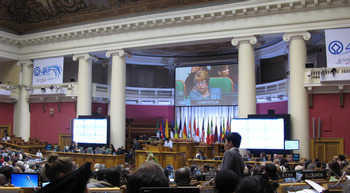
Each year, the Committee sessions are hosted by a state party of the World Heritage Convention in historic buildings or luxurious conference centers. In 2012, for instance, the Russian Federation hosted the committee in the magnificent Tauride Palace in St. Petersburg (Figure 3); in 2014, Qatar hosted the Committee session in the National Convention Center, designed by the renowned Japanese architect Arata Isozaki. The plenary sessions of the Committee that I have attended as an accredited observer since 2011 took place in large conference halls. Seating was arranged hierarchically, with UNESCO officials, representatives of the Advisory Bodies, the Committee chairperson, and the rapporteur all sitting on a podium. Committee members sit closest to the podium, while states parties not serving on the Committee sit immediately behind them. Observers are seated in the back of the room or in separate areas.
Thirty-seventh Committee session, St. Petersburg, Russia (photo courtesy of the author).

In 2012, the Committee sessions were live-streamed for the first time, and video records were archived on the World Heritage Center’s website. Since the early 1990s, in line with wider trends among international organizations to improve accountability and enhance transparency,Footnote 37 most World Heritage documents have been published on the Center’s website.Footnote 38 In addition, beginning in 2002, summary records of the Committee sessions have been produced and published on their website. Compared to the brief reports released in earlier years, these documents greatly increased the information available to the public, but they remained carefully ordered accounts, produced ex post facto from the disorder and chaos of the discussions.Footnote 39 While offering the semblance of a live record, they are in fact condensed and heavily edited versions of the actual debates.Footnote 40 In my interviews with UNESCO officials and national delegates, many claimed that the new practice of live-streaming increased the performative dimension of the Committee sessions; delegates were forced to prepare more detailed public statements, including technical arguments, in order to justify political support for specific points of discussion.Footnote 41 Similar outcomes have been noted in other venues of multilateral diplomacy, where calls for transparency and the presence of media have backfired, encouraging political posturing and offering diplomats the opportunity to perform before a global audience.Footnote 42
Amid mounting criticism about the credibility and financial sustainability of the program, live-streaming of Committee sessions has created an illusion of transparency and accountability, yet the discreet norms and hidden agendas of diplomacy and the behind-the-scenes practices of World Heritage governance have not been substantially affected. Plenary sessions of the Committee are the end point of a series of informal consultations held worldwide throughout the year. These discussions involve a wider network and multilateral linkages that go well beyond the Committee and UNESCO.Footnote 43 Informants also suggest that live-streaming of plenary sessions has pushed the real substance of negotiations out of the public eye.
Even during the annual Committee meetings, furthermore, there are still many events that only delegates of states parties, representatives of Advisory Bodies, and accredited participants can witness. Examples of these are the discussions taking place in the Working Groups. These subsidiary bodies were created to improve the performance and conduct of the Committee’s work on critical policy and financial issues.Footnote 44 Negotiations and revisions of draft documents during those meetings are not detailed in writing or preserved by video recording. At the conclusion of these meetings, the chairperson makes a verbal presentation to the Committee, summarizing the discussions and presenting the revised draft document for adoption or further discussion.
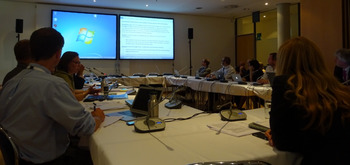
Meetings of the Working Groups are hosted in smaller rooms, where the hierarchy is more dispersed, with participants normally seated around tables (Figure 4). Members of the Secretariat and the chairperson sit together at one end, usually opposite two screens to project the draft documents in both English and French. During discussions, some representatives of the states parties and Advisory Bodies sit at the table, while others, for simple reasons of space, may also sit in rows around the table. According to the size of the room, speakers may be asked to use a microphone.
Working Group meeting at the thirty-ninth session of the Committee, Bonn, Germany, 2015 (photo courtesy of the author).

The details of Working Group discussions are particularly noteworthy in order to understand the micro-processes of negotiation and document revision within the Committee. First, such groups focus on some of the most fundamental issues related to implementation of the World Heritage Convention, including issues that require detailed analysis and additional time beyond that allowed during plenary sessions. This detailed attention is a double-edged sword: while it allows for further reflection, it can also be used strategically to preserve the status quo. Second, participation in these groups is voluntary and open to all participants at Committee sessions. Committee representatives may or may not join, indirectly revealing their stakes in the issues discussed. However, all states parties, as well as observers and members of the Advisory Bodies, can participate. Thus, since non-Committee members may contribute to the revision process, there may be a more diverse representation of viewpoints on the issues examined. Nevertheless, the final say is still in the hands of the Committee.
Working Groups strategically allow the Committee to give the semblance of additional reflection and open participation on crucial issues, while still maintaining the ultimate power of decision. Sometimes, the iteration of the same issues year after year, and their translation into technicalities by these smaller groups, allow the more politically contentions proposals to move slowly forward through the diplomatic entanglements of the Committee. As we will see below, the revisions to paragraphs 40, 61, and 123 of the World Heritage Operational Guidelines are instances of how both slow progress and institutional inertia can be the result of recourse to Working Groups.
Boundary objects: The Operational Guidelines
As the foundational document for the implementation of the World Heritage Convention, the Operational Guidelines underpin World Heritage procedures and contain, inter alia, the rules for the preparation of nomination dossiers, the monitoring of inscribed properties, and the distribution of funds for conservation. Given their central role in the implementation of the World Heritage Convention and the fact that they were designed to be regularly revised, the Operational Guidelines represent the ideal ethnographic object to analyze text-based negotiations during Committee sessions. They also represent a paradigm to highlight the importance of focusing on text-based negotiations to understand the political tensions and practical limitations of policymaking within UNESCO.
The Operational Guidelines embody the spirit of the boundary objects described by Susan Star and James Griesemer in their study of heterogeneity and cooperation in scientific work.Footnote 45 Boundary objects are artifacts that reside in the interaction between different organizations and groups of people. They require actors with competing interests to engage in the strenuous work of “translation, negotiation, debate, and triangulation” in order to reconcile their differences.Footnote 46 Documents, as boundary objects, enable the creation of a “common ground between the different interpretations,” acting as mediators to bridge perceptual and practical differences.Footnote 47 Similarly, the Operational Guidelines are the product of mediation among various actors who need to reconcile contrasting interpretations and conflicting political and economic interests to succeed. Actions related to their adoption move beyond UNESCO to different communities of practice involved in World Heritage worldwide.
The Operational Guidelines embody some of the most salient characteristics of boundary objects. First, they contain “precise criteria” and detailed indications of procedures, such as those for the inscription of sites on the World Heritage List or the submission of international assistance requests.Footnote 48 Second, they are not only “plastic enough” to be applied to a variety of contexts worldwide but also “robust enough to maintain a common identity across sites.”Footnote 49 Lastly, they are “concrete and abstract, specific and general, conventionalized and customized, [and] often internally heterogeneous” in their effort to maintain “integrity across time, space, and local contingencies.”Footnote 50 The plasticity and lasting integrity of the Operational Guidelines are reflected in their ability to maintain parts of their accepted standards, even after multiple revisions, and to encapsulate additional aspects and categories not yet covered.Footnote 51 Indeed, as Sarah Titchen puts it, the Operational Guidelines were conceived as a “fluid and flexible document”Footnote 52 to be “revised by the Committee to reflect new concepts, knowledge, or experiences.”Footnote 53 Since their original adoption in 1977, the Operational Guidelines have been the subject of more than 20 revisions to incorporate theoretical advances related to the conceptualization of natural and cultural heritage. The initial version, adopted in 1977, contained 28 paragraphs, but that number has expanded exponentially over the years, increasing the complexity of World Heritage governance.Footnote 54 The first Working Group for the revision of the Operational Guidelines was established in 1988.Footnote 55 Generally, suggested revisions are drafted by the Secretariat in collaboration with representatives of the Advisory Bodies and, in some cases, other non-governmental organizations (NGOs).Footnote 56
Continuous revisions over the years have created a convoluted text, one in need of comprehensive editing and reorganization.Footnote 57 A long-term revision project began in 2000Footnote 58 with the collaboration of states parties, experts, the Advisory Bodies, and the Secretariat. Comments on successive drafts were incorporated by drafting groupsFootnote 59 until the adoption of a new version in 2005.Footnote 60 This collaborative system gave the Operational Guidelines an aura of legitimacy, making the process look like “teamwork” among the various actors involved.Footnote 61 The 2005 revision increased the complexity of the Guidelines, with the number of paragraphs jumping from 139 to 290. Since then, proposals for minor revisions have been discussed almost every year. Frequent revisions created problems of consistency, so the Committee decided that a new official revised version should be released at regular intervals. To facilitate this process, the use of Working Groups was revived in 2010.
However, since 2010, there have been changes in the geopolitical configuration of the Committee, resulting in an increasing role of new emerging powers, especially in Brazil, Russia, India, China, and South Africa (or the BRICS countries).Footnote 62 These changes in regional representation, coupled with an increasing role and participation of nations from Asia and the Pacific region,Footnote 63 have affected not only the workings of the Committee but also those of its Working Groups, with debates becoming longer and documents sometimes failing to achieve a consensual form. For example, in 2010, there was a large number of proposed amendments, and the Working Group focusing on the Operational Guidelines failed to produce a consensual draft.Footnote 64 The extended deliberations that result in such cases offer additional time to continue in-depth discussions on controversial issues, but the danger here is that the exercise of increased reflection may instead result in the continuation of the status quo and institutional inertia. Both the advantages and the disadvantages of the Working Group procedure, as well as the impact of greater geographical diversity among participants, can be seen in the 2015 revisions to which we now turn.
The making of consensus in World Heritage processes: The first mention of Indigenous Peoples in the Operational Guidelines
The revisions of paragraphs 40 and 123 of the Operational Guidelines at the thirty-ninth session of the Committee in 2015, which related to the role of Indigenous peoples in World Heritage, illustrate the challenges of reconciling different interpretations and competing interests through text-based negotiations in multilateral contexts. Indigenous peoples have long denounced the lack of a human rights-based approach and the absence of formal bureaucratic procedures to ensure their involvement in all aspects of implementation of the World Heritage Convention,Footnote 65 and, until 2015, there was no mention of Indigenous peoples in the Operational Guidelines.Footnote 66 Past efforts to integrate Indigenous Peoples in World Heritage processes included a failed attempt to create a World Heritage Indigenous Peoples Council of Experts.Footnote 67 More recent discussions have focused on the inclusion of the principle of the free, prior, and informed consent (FPIC) of Indigenous peoples in World Heritage processes. FPIC encompasses the specific right of Indigenous peoples to give or withhold consent on projects that may affect their territories, as defined in the 2007 United Nations Declaration of the Rights of Indigenous Peoples (UNDRIP).Footnote 68
This principle has become crucial to ensure that Indigenous Peoples’ human rights are respected internationally. Over the years, the Committee has adopted decisions that encouraged respect for the rights of Indigenous peoples, including their involvement in the nomination, conservation, and management of World Heritage sites within their territories.Footnote 69 In addition, an expert group on the World Heritage Convention and Indigenous peoples demanded consistency between implementation of the Convention and the UNDRIP.Footnote 70 However, discussions on the implementation of FPIC in the context of World Heritage stalled due to the lack of an organizational policy on Indigenous peoples for consideration by UNESCO’s Executive Board.Footnote 71 In 2013, for example, in the nomination dossier of Pimachiowin Aki (Canada),Footnote 72 the former UN special rapporteur on the rights of Indigenous Peoples, James Anaya, wrote a letter to the director of the World Heritage Center, urging him to fill in those gaps and also put forward a structure that would address Indigenous peoples’ “rights, interests, and concerns” in the nomination process for inscription of sites on the World Heritage List.Footnote 73
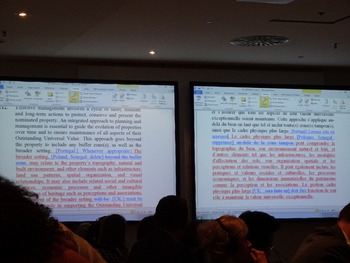
In 2015, the Working Group on the Revision of the Operational Guidelines examined paragraphs 40 and 123, which concerned the preparation of nomination dossiers for inscriptions on the World Heritage List and the management and conservation of inscribed sites (Figure 5).Footnote 74 Working Groups on the revision of the Operational Guidelines have been historically well attended. In 2015, there were more than 100 delegates in attendance daily. These delegates represented between 40 and 60 states parties as well as many observers from NGOs and research institutions.Footnote 75 Jad Tabet, a cultural heritage expert from the Lebanese delegation, chaired the group. In line with Abdulqawi Yusuf and Yuki Daijo’s studyFootnote 76 on the negotiations leading to the adoption of the UNESCO Convention on Cultural Diversity, according to which the particular style of the chairperson can radically influence the outcome of deliberations, ensure rapid progress, and move multilateral negotiations to a successful conclusion, Tabet’s background, as well as the subject under discussion, allowed for a very active chairmanship and definitely influenced the final outcome of the negotiations.Footnote 77
The Working Group on the Revision of the Operational Guidelines, thirty-ninth session of the Committee, Bonn, Germany, 2015 (photo courtesy of the author).

Three main negotiating strategies were used in the 2015 Working Group on the Revision of the Operational Guidelines to foster consensus building on amendments. First, the creation of informal drafting groups, comprised of states with “strong positions” on complex issues, offered an alternative setting where delegates could negotiate freely and openly.Footnote 78 Those drafting groups would develop compromise texts, refined by further negotiations during Working Group meetings. Second, to avoid stalling the discussion, the chair or the Secretariat sometimes suggested specific wordsFootnote 79 to foster the formulation of compromise solutions and the finalization of the text. Third, specific linguistic patterns, already accepted in the UN context or adopted in previous UNESCO meetings, were frequently referred to in order to foster consensus.Footnote 80
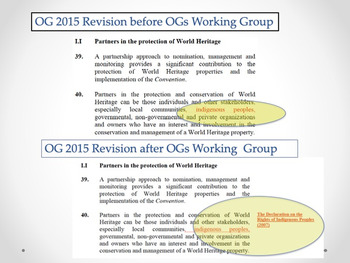
This last technique was especially applicable when the meaning attributed to certain categories was particularly controversial, as in the case of the term “Indigenous Peoples” itself. The revisions to paragraphs 40 and 123 included an expanded list of actors to be consulted in the protection of World Heritage, among them a first specific reference to Indigenous peoples (Figures 6, 7, and 8). While delegates from settler societies like Canada, the United States, and Australia and from European countries like Norway and Switzerland supported the mention of “Indigenous Peoples” in the paragraphs, some participants from Africa and Asia objected to this term, questioning its applicability to specific national contexts. They suggested using the more general term of “local communities,” which for many already included Indigenous Peoples. The chairperson was not in favor of the use of “Indigenous Peoples,” as the use of the term “native” in French would exclude people like him who were born in another country. He stressed the limits of the applicability of universal definitions in diverse settings and added that well-meaning concepts could have the reverse effect of excluding people in certain categories. As a consensus-building strategy, Senegal, seconded by Portugal, suggested including a reference to the definition of Indigenous Peoples from the UNDRIP. The reference to this UN-specific definition was accepted by the Working Group, even as the discussion illustrated the difficulty in reconciling different interpretations of, and competing interests around, the same or similar concepts.
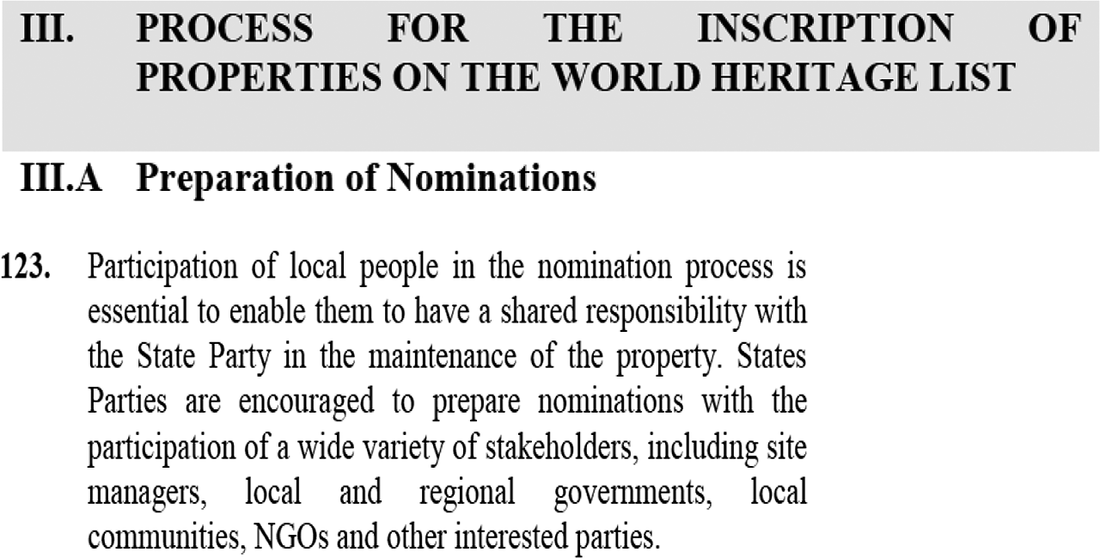
The version of paragraph 123 of the Operational Guidelines before the proposed revision; it does not mention Indigenous Peoples (Doc. WHC-15/39.Com/11, 2011).

The versions of paragraph 40 of the Operational Guidelines before and after the proposed revision (Doc. WHC-15/39.Com/11, 2015).

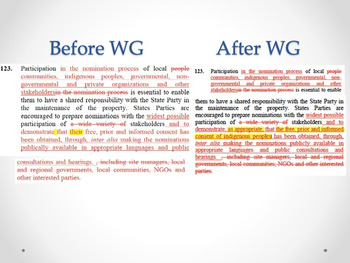
The revisions to paragraph 123 of the Operational Guidelines before and after the Working Group’s efforts (Annex to Doc. WHC-15/39.Com/11, 2015).

On the other hand, sometimes proposals aimed at fostering consensus by reverting to set phrases already accepted in the UN contextFootnote 81 are met with resistance, implicitly showing the limited applicability of certain definitions to multilateral settings. This was the case in the revisions to paragraph 123, which encouraged the states parties to include the participation of a wide variety of stakeholders and to demonstrate that “their free, prior and informed consent” had been obtained. The recourse to the set phrase from the UNDRIP did not facilitate consensus but, instead, was contested by many delegates from nation-states. A delegate representing the UN Forum on Indigenous Issues intervened in the debate to argue that the revisions, which recognized Indigenous Peoples as stakeholders and not rights holders, contained some good points but were insufficient and not consistent with UN provisions. He explained: “We are not any stakeholder like a shop owner in a heritage site, we are rights holders.” Yet insertion of the word “rights” was not supported by many delegates from Africa, like the Senegalese delegate who worried about “setting aside some categories of people from others,” or Europe, like the French delegate who protested introducing “a form of discrimination” that “could trump national sovereignty.” Bolivia pointedly reminded delegates that those rights were already given to Indigenous peoples by the UN and that the World Heritage Convention “should not be in contradiction with other UN documents.” Australia seconded the comment of the Bolivian delegate, as did Switzerland.
In this case, claims to sovereignty and the historically limited recognition of the rights of minorities within UNESCO resurfaced in this technical discussion over World Heritage procedures. One delegate from the Philippines argued that the problem was caused by the fact that they were “trying to import human rights language on technical issues,” thus attempting to depoliticize the discussion by stripping away its political context and putting it back in the safe realm of technicality.Footnote 82 The same delegate suggested that the Working Group could “introduce the principle” – that is, mention Indigenous Peoples as stakeholders and leave the other issue – the rights part – until later “for lack of time.” Turkey also seconded the suggestion of leaving out the mention of rights “for the sake of time.” More generally, Asian and African delegates, as well as Germany and France, opposed the inclusion of the words “rights holders” in the text.
During the discussion, the text was amended multiple times until it was consensually agreed not to include any mention of “rights holders.” The final version included the reference to Indigenous Peoples and the need to demonstrate that “their free, prior and informed consent” had been obtained, but only “as appropriate” to account for the concerns and address national legal differences. This provision was suggested by the representative from the UN Forum on Indigenous Issues to ease the gridlock in the discussion, in an example of the second of the three negotiating strategies discussed above. The insertion of this linguistic nuance not only created a space for “interpretive flexibility” but also diluted its enforceability.Footnote 83 However, it allowed different constraints on the discussants to be accommodated in a consensual text presented to the Committee. Under time pressure and the alleged need for further reflection, the mention of the rights of Indigenous Peoples in the text of the Operational Guidelines was deferred (Figure 8).
In the plenary session, to the surprise of many, the Committee adopted the proposal without further debate or additional revision. Extended reflection over time had allowed language to solidify and enabled some delegates to maintain their principles while compromising on some words, even as the mention of rights was omitted from the Operational Guidelines under the pretense of technicality. Although other factors, including the presence of more pressing issues, may also need to be taken into account in explaining the Committee’s decision not to reopen the discussion in the plenary, the adoption of the amendment was considered a success in the context of the Committee, even though the policy decision was provisional and conditioned on the adoption of a UNESCO regulation at a later point.Footnote 84 Notwithstanding its limits, this example shows how during the debate, through the insertion of specific linguistic formulations, some competing interests were resolved in the formulation of a consensual text ultimately adopted by the Committee. It also shows how political issues and post-colonial legacies are played out under the façade of debates over linguistic details and technical discussions.
The UN-making of consensus in the Committee: The failure to reduce the number of nominations to the World Heritage List
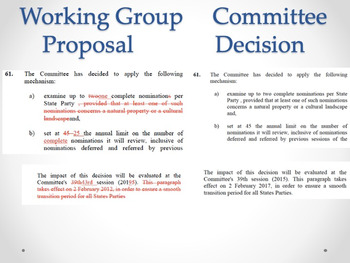
If the 2015 revisions to paragraphs 40 and 123 can be considered a relative success, it is also the case that consensual formulations, achieved through hours-long debates and considerable accommodation of diverging interests, are sometimes rejected and unmade in the final stage of deliberation. These represent a more fragile version of consensus that does not survive the second stage of the discussion/negotiation phase outlined above (Figure 2), which was the case with the revisions to paragraph 61 of the Operational Guidelines, which concerned a proposal to reduce the yearly number of nominations for new inscriptions to the World Heritage List.
In 2015, the limit was set at a total of 45 nomination dossiers per year, with a maximum of two submissions per state party,Footnote 85 but the Secretariat, following up on a Committee request to find cost-saving measures and ensure the sustainability of the World Heritage program,Footnote 86 suggested reducing the number to a total of 25 nomination dossiers per year and only one nomination per state party. The proposed revision was also examined separately by another Working Group, which focused exclusively on the financial sustainability of the measure.Footnote 87 Instead, the Working Group on the Revision of the Operational Guidelines examined the question exclusively from an ethical point of view: whether the new cap on submissions could address the imbalance of geographical representation of sites on the World Heritage List and slow down the pace of new inscriptions from already well-represented countries.Footnote 88 This clear-cut separation between representativeness and finances was difficult to maintain during debates, and the artificial boundary between ethical arguments and practical consequences kept blurring. For example, when delegates inquired about the logic behind the choice of a cap of 25 nominations, the Secretariat admitted that it would make sense financially. This response suggests that the allegedly ethical discussion was really about finances.
Many delegates argued that such a proposal would limit the “dynamism” of the World Heritage List and suggested putting forward alternatives to increase the “capacity” of unrepresented countries to present new nomination dossiers. Suggested proposals included the creation of a priority system to “slow down inscriptions,” but the “rush to inscribe,” as Lynn Meskell has noted, seemed to supersede any other argument.Footnote 89 Delegates were aware that the lack of consensus would mean keeping the status quo. Eventually, an imperfect consensus emerged with the understanding that the issue would be discussed further (Figure 9). The Working Group that examined the issue from a fiscal angle reached the same conclusion, reinforcing the recommendation from both an ethical and a pragmatic perspective. Slowing down the pace of new inscriptions was seen as a necessary measure; otherwise, the system would lose credibility and collapse financially.
The revision to paragraph 61 of the Operational Guidelines proposed by the Working Group and the final decision of the Committee (Annex to Doc. WHC-15/39.Com/11, 2015).

However, in the plenary session, the Committee examined the proposals in depth but eventually opted to avoid taking action on the issue. Instead, it established another ad hoc Working Group to continue debate and postponed deliberation to the following Committee session.Footnote 90 The options proposed were deleted and can no longer be found in the official documents. The decision was somehow expected; for decades, the Committee has avoided finding any long-term solutions to the financial challenges of implementing the World Heritage Convention. Since 2011, when the financial crisis and cash shortfall that resulted from the United States withholding its dues called for bold measures, the Committee has continued to delay, ignoring deliberations that made sense from multiple points of view.Footnote 91 While further iterations of discussions and slow progress is a feature of many UN bodies, built-in inertia, in this case, has come to characterize the Committee’s decision-making processes. Ultimately, the pretense of action, in the form of improved reflection, masked repeated procrastination.
Conclusions: The making and un-making of consensus in the World Heritage Committee
The examples discussed above allow for some general conclusions concerning the function of Working Groups within decision-making processes during Committee sessions and, more generally, in relation to the procedure of consensual deliberations. Despite inherent problems and limitations, consensus is still the preferred decision-making process of the Committee. The process, while not exactly efficient, is typically justified as proper bureaucratic procedure. Even if consensual decisions are not necessarily less political, they are a necessary compromise for an intergovernmental body like the Committee, with no power to sanction but only to persuade. From my observation of Working Groups, it is evident that consensual decisions do not result in the implementation of radical proposals. Instead, they reinforce the lowest common denominator, slowly moving away from the status quo, which is an imperfect product that, as stated by one of my informants, “everyone can live with.” The inclusion of Indigenous groups as stakeholders and not as rights holders in the revised text of the Operational Guidelines is an example of this action.
Working Groups consensual deliberation also allows some of the more contested proposals to advance in some semblance of an agreed-upon deliberation. This is shown by my second example, related to the reduction of nomination dossiers examined by the Committee. In this case, the agreed-upon text was nuanced to create a suspended version of consensus, a temporary state whose final outcome was later unmade by the committee. Yet diplomacy also works through continual iteration and slow progress. Thus, sometimes, it is only through prolonged debate that the most controversial issues gradually advance.Footnote 92 While adding a cover of legitimacy, the recommendations of Working Groups leave the ultimate power of decision to a smaller group of players – the 21 members of the Committee – who have, in practice, informal veto power.Footnote 93 Yet Working Groups allow the pretense of a wider democratic forum, one that is geographically more diverse than the Committee and allegedly focused on technical issues. Occasionally, debating political issues under the pretense of technicality slowly moves the path forward for more reluctant states and fosters “international cooperation into the specialized micro-sphere of techno-normativity.”Footnote 94
There is a curious temporal aspect to the debates of the Committee’s Working Groups; they are both accelerated and delayed at the same time. The number and length of meetings are constrained by the packed agenda of Committee sessions, and, as a result, time pressure impels participants to accelerate their work to produce a consensual revised draft in the limited time allocated. On the other hand, the Working Groups also decelerate and delay; when the allocated time is exhausted and no consensus has been reached, the issue is handed back to the Committee. In many cases, the Committee opts to postpone final deliberation by suggesting that additional reflection is required. This strategy expands the time frame of debates and multiplies venues of discussion almost indefinitely, using purportedly improved reflection to postpone action.
Ultimately, Working Groups perform two different and opposing functions. They allow progressive consolidation of ideas through the continued exploration of nuances at different Committee sessions. They can also be used to facilitate a continuation of the status quo, by presenting it as the best option between alternatives, which are then excluded in the final stage of deliberation. On occasion, proposals that are the products of hours of deliberations are put forward, seeking consensus in documents, only to evaporate in the exercise of multilateral diplomacy – that is, in the process of the making and UN-making of consensus of UNESCO’s Committee. In the case of paragraphs 40, 61, and 123 of the Operational Guidelines, layers of paper and technical jargon were used strategically to trump the rights of minorities and procrastinate on urgent measures with severe financial consequences.
Acknowledgments
I wish to thank to the colleagues at the World Heritage Center, the International Council on Monuments and Sites, the International Centre for the Study of the Preservation and Restoration of Cultural Property, and International Union for Conservation of Nature and the many national delegations who have taken the time to meet with me over the years. I am grateful to Lynn Meskell for her support, encouragement, her inspiring enthusiasm, and the many engaging discussions around the politics of World Heritage. I also thank Lynn for providing valuable feedback at different stages of this manuscript. Finally, I thank the editor and two anonymous reviewers for their time and expertise and for providing helpful suggestions that made this a better piece.