INTRODUCTION
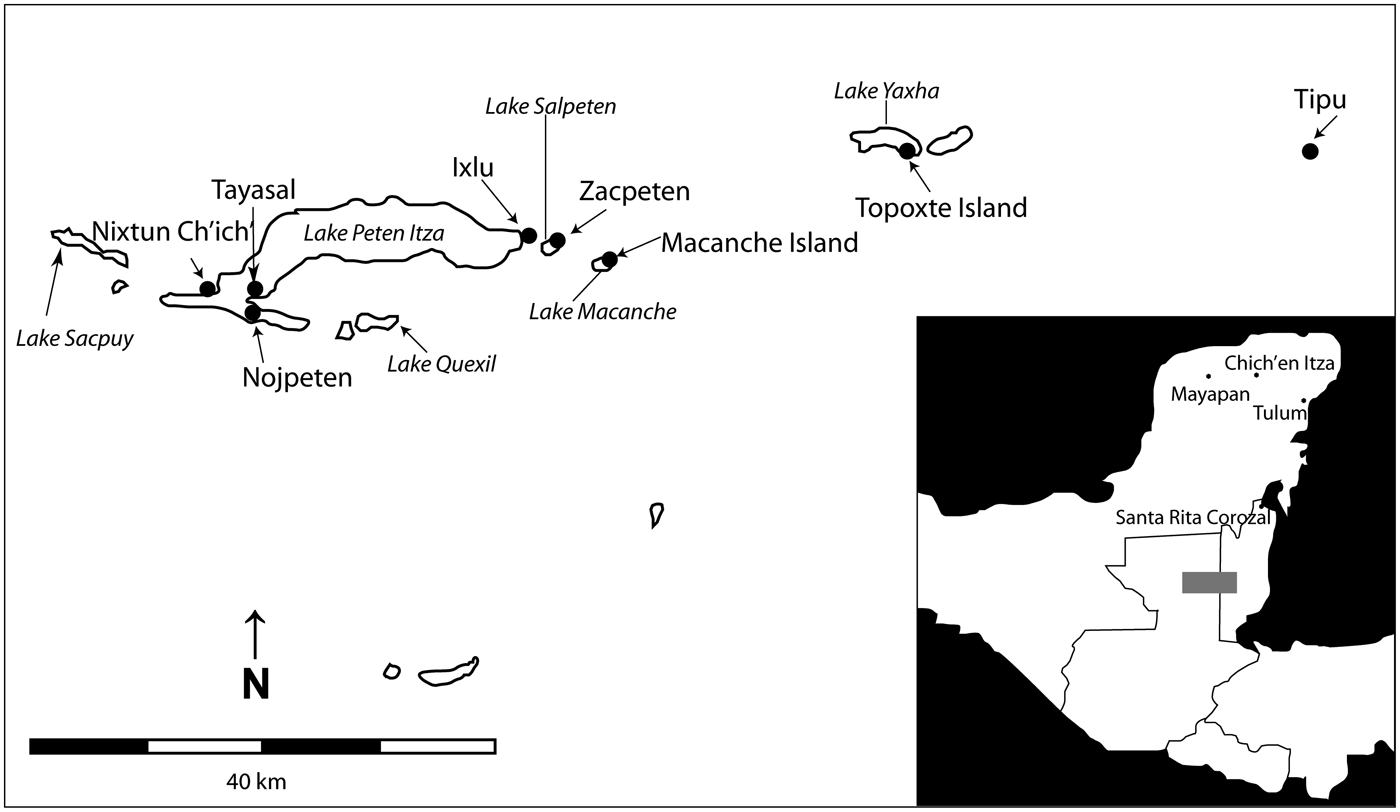
Many world cultures maintain contact with their ancestors through material objects employed in rituals such as dances, venerations, and magical acts, as well as through the architectural settings of such activities. Objects do not exist in a vacuum; they are part of multifaceted social, political, and religious networks in which their social power and quotidian utility may be manipulated to accommodate collective needs. Material culture from the past, which may be animated with supernatural forces and thus spiritually connected to ancestors or even gods, stimulates memory and identity, and its efficacy can be heightened by non-material means. The Postclassic (a.d. 900–1525) Kowoj Maya of the Peten lakes region of northern Guatemala (Figure 1) illustrate the use of spirit-infused ancient objects to stay connected to their ancestors. Two examples are discussed here: use of spolia, repurposed building components or monuments, and the manufacture of pottery incense burners (incensarios, censers) with attached anthropomorphic effigies.
Map of the Postclassic archaeological sites in Peten, Guatemala.

ANIMISM, MANA, AND RITUAL
Animism is the belief that animals and objects possess an inherent force or spirit (Tylor Reference Tylor1871). Many cultures, including the ancient and current Maya, believe that objects defined by Western standards as inanimate (buildings, pottery vessels), are actually animate and powerful, with a life history or cultural biography (Brown and Emery Reference Brown and Emery2008; Brown and Walker Reference Brown and Walker2008; Gosden and Marshall Reference Gosden and Marshall1999; Lucero Reference Lucero, Mills and Walker2008). This invisible animating spirit or power is mana: a magical or religious essence that can be possessed by someone, such as a ritual specialist or shaman, who can mediate between the natural and supernatural worlds. Mana is transmitted to an object by such specialists and operated by gods and spirits, making that object powerful and awesome with regard to admiration, respect, and fear (Keesing Reference Keesing1984:149–151; Marett Reference Marett1909:13; Mauss Reference Mauss and Brain1972:134–135; Walker Reference Walker, Skibo, Walker and Nielsen1995; Walker and Schiffer Reference Walker and Schiffer2006). Some objects may possess more animating spirit than others, and in some cases, it can be so potent that the object is believed to exercise agency:
[S]ome objects are experienced as having intentions, awareness, and the power to influence people's lives. Whether these abilities dwell in the objects themselves or are bestowed upon them by other invisible forces (including people's minds), object animation allows entities from the (mythic or historic) past—gods, ancestors, or ghosts—to continue participating in current social practice (Nielsen Reference Walker, Mills and Walker2008:209).
Many things seem to be “possessed” or to have agency because objects can “outlive” their owners (Miller Reference Miller and Miller2001:107). The older the object, the more likely it is to possess active power that can affect change (Zedeño Reference Zedeño2008:368). Like objects given as gifts (Mauss Reference Mauss1966), old things may be inalienably bound to their original owners. Heirlooms, for example, are special as they are linked to ancestors and group memories (Lillios Reference Lillios1999:243). Their seeming permanence can contribute to the notion that they embody spiritual power and are associated with origins, “outside beings,” and, consequently, liminality (Helms Reference Helms1998:165–173). As objects from another time or “out of time,” they could be considered both dangerous and powerful (Hamann Reference Hamann2008:808). Although an object may be created to fulfill one need at one time and place, how it is used may change during the object's life span, thus creating its life history. To fully understand an object's place in society, one cannot assume that its final use yields all possible information about it.
Many cultures hold the belief that objects used in rituals, whether it be contacting ancient ancestors or ensouling a structure, are active agents mediating between the living and the dead. This mediation brings inanimate objects to life, thus (re)creating the connections between the natural and supernatural worlds (Gosden Reference Gosden2005; Zedeño Reference Zedeño2008). The past becomes the present and the present the past. This juxtaposition allows for collective memories that establish mind and body connections to cultural objects (Neilsen Reference Neilsen, Mills and Walker2008), making inanimate objects animate social agents associated with “remembering, memorializing, and forgetting” (Walker Reference Walker, Mills and Walker2008:14). For example, current Maya in Santiago Atitlán, Guatemala, who perform a deer and jaguar dance, believe that they are embodying the saints and deities of the mythical past, that their ancestors continue to live in their blood (Christenson Reference Christenson2016:153, 164), and that the spirits of the ancestors continue to influence Maya social and political realms through empowering ancestral memory (Stuart Reference Stuart, Benson and Griffin1988:193).
Maya ancestral memory also is reflected in the concept of ch'ulel that is part of modern Maya belief systems (Blaffer Reference Blaffer1972; Pitarch Ramon Reference Pitarch Ramon1993; Vogt Reference Vogt1965, among others) as well as ancient Maya society (Houston and Stuart Reference Houston and Stuart1996:292; O'Neil Reference O'Neil2009). Ch'ulel is an everlasting and recyclable spirit or essence that is extra-somatic, but resides in the heart, and energizes people as well as ritual objects (Blaffer Reference Blaffer1972:101; Pitarch Ramon Reference Pitarch Ramon1993:45). This spirit/essence, like mana, has power and agency and can inhabit people and inanimate objects connecting the natural and supernatural realms. According to the Tzeltal Maya, ch'ulel has to be “implanted or fixed” to a person or thing through a ritual specialist and is essential for life (sickness results when parts of the ch'ulel are missing), emotion, and memory (Pitarch Ramon Reference Pitarch Ramon1993:58–61). Maya archaeologists also believe that the ancient Maya's concept of ch'ulel encompassed an indispensable force/power/essence that existed in ritual objects (such as spolia and incensarios), connecting their ancestors to the present. For example, O'Neil (Reference O'Neil2009:122; 132) describes that the Late Classic Maya used various objects with a ch'ulel (inner soul), such as stelae, in the new construction or manufacture of others in order to transmit the ancestral power that “enlivened and sacralized them” from one object to another.
In addition to transferring mana or ch'ulel, humans can instill animating essences in objects through ritual consecration, manufacture, or use, accompanied by chants and invocations. These mechanisms vary cross-culturally. During rituals, the ritual specialist brings the spirits into the present realm and directs the property of mana into animate or inanimate objects. Found things discarded by past people can also gain a new life. In some cases, they may be connected with malevolent forces and avoided (Villa Rojas Reference Villa Rojas1945:104). In others, they can be associated with ancestral power. That a person was “chosen” to find the object might add to the power of a ritual practitioner or signal a divine calling (Brown Reference Brown2000:328–328). Although the receiving object may look ordinary, it is now “mana: it works by virtue of its potentiation by spirit beings, complementary to human skill and knowledge” (Keesing Reference Keesing1984:148). Something with mana, be it a person or an object, has a force and quality that has been transformed and can be transformative. As a transformative object, it possesses magical qualities because it has been “mana-ized” by the ancestors and deities (Keesing Reference Keesing1984:138,149) and can be instructed by humans to affect their lives and activities (e.g., ancestor worship; Walker Reference Walker, Skibo, Walker and Nielsen1995; Zedeño Reference Zedeño2008). Many magical acts that transfer mana from the supernatural to the natural realm involve objects of material culture. “The objects manipulated are chosen analogically on the basis of similarity and difference to convey meaning. From the performative perspective, the action [the transfer of mana] consists of an operation done on an object-symbol to make an imperative and realistic transfer of its properties to the recipient” (Tambiah Reference Tambiah and Tambiah1973:222). The resulting symbol acts as a potent magical symbol (Gravel Reference Gravel1995:66) that functions in conjunction with humans with mana.
The ritual specialist, as a result of having and being able to evoke and direct mana, is thereby legitimized, thus deepening the belief in magic and its powers, as many rituals of this nature are part of the collective conscious. “We cannot conceive of any magical judgment which is not the object of collective confirmation… More usually, however, magic has the support of more extensive groups, whole societies and cultures” (Mauss Reference Mauss and Brain1972:125). Because of the needs of the community, their sense of place and belonging (Mondragon Reference Mondragon2004:289), and their belief in the transformative effect of mana, the belief in mana becomes rationalized and perpetuated within the culture.
The means by which ancestors are contacted or acknowledged in such rituals differs widely across space and through time, but the belief in the ability of a person (e.g., ritual specialist) or material object to mediate between the natural and supernatural worlds prevails throughout history. Such mediation also can take place through the process of manufacture of objects. The person who is creating the piece is ensouling it through the collective memory of creation, the traditional processes, and the materials used. Two forms of such creation-mediation are of interest here and discussed below: spolia and effigy incensarios. The practice of contacting ancestors through such means is “grounded in pragmatism that drew power from the past, legitimized the current state of affairs… and charted a course for the future” (McAnany Reference McAnany1995:1). The past need not be the local past; objects such as relics and spolia can be brought from long distances to tie, politically and/or spiritually, a settlement with a distant powerful place (Brenk Reference Brenk1987).
POSTCLASSIC MAYA IN CENTRAL PETEN, GUATEMALA
The Maya are best known for their magnificent temple constructions, hieroglyphic inscriptions, and polychrome-painted pottery of the Classic period (a.d. 250–900) in the lowlands of southern Mexico, Belize, and northern Guatemala (Department of El Petén). Classic Maya civilization declined and “collapsed” at the end of the Classic period, issuing in an era of war, population decline at the large centers, social and political reorganization, and migrations of populations. Current research on the Postclassic region of central Peten conjoins ethnohistory and archaeology (Cecil Reference Cecil2001, Reference Cecil, Rice and Rice2009; Jones Reference Jones1998; Pugh Reference Pugh2001, Reference Pugh2004; Rice and Rice Reference Rice and Rice2009, Reference Rice and Rice2018a, Reference Rice and Rice2018b, among others), revealing a time of dynamic sociopolitical alliances and dominance relations, changing religious cults, long-distance exchange, and migrations of sociopolitical groups from northern Yucatan to central Peten and vice versa.
In the lakes region, this ethnohistoric and archaeological research indicates the presence of multiple socio-political groups during the Postclassic to Colonial periods, two of which are the Itza and the Kowoj. The Itza controlled the southern and western basin of Lake Peten Itza, a large area stretching from Lake Quexil west to Lake Sacpuy, with their capital, Nojpeten, on modern Flores Island (Figure 1; Jones Reference Jones1998; Jones et al. Reference Jones, Rice and Rice1981; Rice and Rice Reference Rice and Rice2018b). Hernán Cortés encountered the Itza in 1525, when he traveled through Peten on his way from Mexico to Honduras (Cortés Reference Cortés1976:219–285). Itza architecture is characterized by formal open halls, raised shrines, and architectural sculpture that includes raptorial birds, possible coyotes, serpents, small phalli, and turtles (Pugh Reference Pugh, Rice, Rice, Polo and Jones1996:206–211; Rice et al. Reference Rice, Rice, Pugh, Cuidad Riuz, Fernández Marquínez, García Campillo, Ponce de León, García-Gallo and Sanz Castro1998, Reference Rice, Rice, Polo and Jones1996; for a thorough perspective see Rice and Rice Reference Rice and Rice2018b).
The Kowoj occupied the northeastern area of Lake Peten Itza and the east-central Peten lakes (Lakes Salpeten, Macanche, and Yaxha) in central Peten by the time of Spanish conquest in 1697 (Figure 1). One of their communities, Zacpeten, on a peninsula in Lake Salpeten, was occupied from the Middle Preclassic to the Historic period (Pugh Reference Pugh2001, Reference Pugh2004; Rice and Rice Reference Rice and Rice2009; Rice et al. Reference Rice, Rice, Polo and Jones1996, Reference Rice, Rice, Pugh, Cuidad Riuz, Fernández Marquínez, García Campillo, Ponce de León, García-Gallo and Sanz Castro1998). Mapping and excavations identified two large temple-assemblage ceremonial groups (Groups A and C), domestic structures clustered around the ceremonial groups, and a defensive wall at the neck of the peninsula.
From 1995 to 1997, Proyecto Maya Colonial conducted archaeological investigations at the site of Zacpeten. The work included both horizontal and vertical excavations with an emphasis on the former. Horizontal excavations investigated activity areas and associations with architectural features in the latest occupations of the site, which ranged from the Late Postclassic (a.d. 1400–1525) through the Contact (a.d. 1525–1697) periods. A test unit to bedrock was excavated in all buildings in which it was safe to do so to investigate construction histories. Structures were gridded into one-by-one meter units (total n = 4685) and each was excavated according to stratigraphic and cultural levels. Soil was screened through one-eighth-inch hardware cloth. Intact cultural surfaces were generally identified 10 to 25 centimeters below the modern ground surface. In some cases, the entire building was excavated, but most excavations focused upon the superstructure, the central stairway, the plaza in front of buildings, and the back and sides of the substructures.
These excavations investigated two public temples, a domestic temple, two public oratorios, four open halls, two statue shrines, two raised shrines, a ceremonial sakbe (causeway), five residences or compounds, an ossuary, large areas of plaza, and the defensive walls. Several buildings incorporated stelae or altar fragments in the construction, as well as Classic dressed construction stones. Ceramics recovered in and around these loci included nearly 7,000 incense burner fragments alone: 4,448 effigy, 1,606 non-effigy, and 890 unidentifiable. The vast majority was recovered as de facto refuse in the three temples. One temple included multiple paired censers that appeared to have been complete prior to the collapse of the temple ceiling and walls. The other temples held censers that had been smashed and their pieces intermingled, most likely to “terminate” them (Pugh et al. Reference Pugh, Rice, Cecil, Rice and Rice2009:159). Censers were also found in other contexts such as ceremonial refuse deposits or in households.
ARCHITECTURE AND SPOLIA
Spolia can refer to both reused weapons captured in war and old blocks reused in new buildings. A pertinent question is whether such stone is reused because it is a convenient quality stone or because it is associated with the past: is the selection based on material or memory or a combination (Greenhalgh Reference Greenhalgh, Brilliant and Kinney2011:78–79)? Spolia in Medieval Europe was so prominent and widespread that it became a sort of unwritten ideology (Brenk Reference Brenk1987:103), a way of bringing the past into the present and, in the process, adding some sort of value to the present. For example, the Ostrogothic ruler, Theodoric, used stones from Rome to build a palace and other structures in his capital, Ravenna, to draw parallels with Roman emperors. Subsequently, the Frankish king Charlemagne imported building stones from both Rome and Ravenna to link himself to Rome and Theodoric (Brenk Reference Brenk1987:108–109). Medieval Islamic architecture incorporated spolia for political reasons, but also as magical items that were believed to protect and heal (Gonnella Reference Gonnella2010:104). Spoliation did not end with the Middle Ages and was brought by the Europeans to the Americas, where the practice can be discerned in colonial churches in Latin America (Wren et al. Reference Wren, Nygard, Spencer, Kristan-Graham and Amrhein2015:178–184).
Yet spoliation existed in the Maya region before the arrival of Europeans. Like Medieval Europeans, the Postclassic Maya established and maintained relations with the past though an active dialogue with ancient architecture. They dug into buildings, moved stelae, placed caches in temples, and reused other artifacts (Adams and Trik Reference Adams and Trik1958; Andrews and Andrews Reference Andrews and Andrews V1980:109–118; Hammond and Bobo Reference Hammond and Bobo1994; Satterthwaite Reference Satterthwaite1958).
In Peten, Postclassic architecture appropriated the past (and perhaps its mana) in varied ways. Postclassic structures were built on top of Classic buildings—at least one at Zacpeten following the same wall lines—and it seems likely that the goal was more than just to take advantage of building mass. Moreover, almost all civic-ceremonial buildings and many elite residences excavated at Zacpeten and other Postclassic sites in the lakes area incorporated spolia. Generally, the stones were soft cut limestone blocks reset into building facades, bench faces, or central features such as altars and shrines. The same buildings almost always included back walls composed of hard limestone rubble, which also could have been borrowed from earlier constructions, and the same can be said of earthen fill. In the open front room of one elite residence, Structure 719 of Zacpeten, numerous soft cut limestones were set as seat dividers in a bench (Pugh et al. Reference Pugh, Rice, Cecil, Rice and Rice2009:194–195).
The incorporation of Classic stelae and altars into buildings is the most salient example of reuse of earlier masonry by the Postclassic Maya. Carved stelae and other sculptures were reset into Postclassic buildings in many sites throughout the lowlands, including Mayapan to the north in Yucatan, one of the most influential centers of that time (Milbrath and Peraza Lope Reference Milbrath and Peraza Lope2003:9–10). The use of spolia had some precedence, as the Classic Maya cached monuments in order to appropriate their ch'ulel (O'Neil Reference O'Neil2009:123–133). The Postclassic Maya also buried caches that introduced ch'ulel into buildings, but their reuse of monuments was an overt relationship with the past. The items were put on display rather than cached.
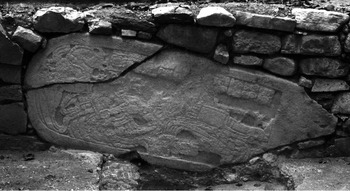
In the Peten lakes region, carved monuments were reset into Postclassic architecture at Topoxte, Zacpeten, and Tayasal. In all cases, they were placed with the carving outward and were meant to be seen. In Kowoj territory (Zacpeten and Topoxte), they were placed in walls, whereas in the Itza region (Tayasal) they were reset as standing stelae, revealing some ethnospecific variations. At Zacpeten, a carved altar had been split in half and a stela rested upon its side suggesting some sort of desecration (Figure 2). In fact, most (ca. 60 percent) of the facing of ceremonial buildings at Zacpeten was reclaimed stone. Some stones reused from Preclassic and Classic period constructions were likely selected for their material. Yet, it also seems likely that the Maya were dressing the buildings in the stones of the past. The monuments likely evoked awe, fear, and wonder, but they certainly brought the past into the present.
Stela 4 incorporated into east wall of lower terrace of Structure 601, Zacpeten.

Stelae used as spolia did not always include inscriptions. Some Postclassic shrines at Ixlú included uncarved stelae in their walls. Carved monuments were distinguished from uncarved monuments at both Tayasal and Zacpeten, however, because special objects were placed in front of them. At Tayasal, quantities of large incensario sherds, including an in situ base, were scattered in front of carved Stela 4, as were numerous side-notched points of chert and obsidian (Pugh et al. Reference Pugh, Sánchez and Shiratori2012:9). At Zacpeten, ceremonial refuse including censer and other ceramic sherds, a stingray spine, and a human tooth were deposited in front of Stela 4, which had been set into the east platform wall of a raised shrine. Across the plaza in the south wall of the platform of an open hall were embedded the two halves of Altar 1, separated by a blank stela. Half of an eroded human mandible, likely removed from an earlier burial by Postclassic people, had been cached in front of one half of the altar. In front of these monuments was ceremonial refuse with effigy and composite incensario sherds, miscellaneous ceramics, obsidian and chert flakes, and miscellaneous shell. One refuse deposit included fragments of Classic period censer stands that typically depict the Jaguar Sun God of the Underworld (JGU or GIII). These fragments must have been encountered by the Postclassic occupants and placed in veneration with their own ritual refuse in front of the altar (Pugh and Rice Reference Pugh, Rice, Rice and Rice2009a:154).
INCENSARIOS
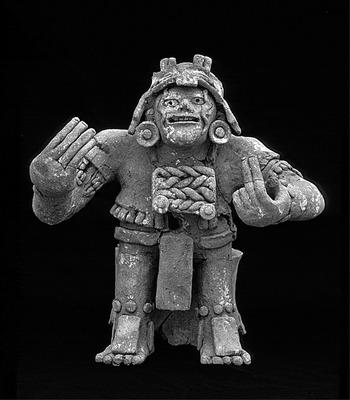
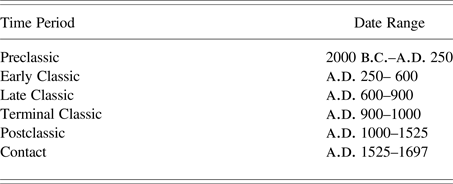
Incense burners were used in the Maya region (and elsewhere in Mesoamerica) from the Preclassic period through Colonial times (Table 1). The most basic vessel is a vase (often on a pedestal), small cup, or bowl that served as a receptacle for burning resins, gums, copal, or other fragrant organics as offerings. Postclassic composite censers may be decorated with buttons, spikes (perhaps symbolizing the young Ceiba pentandra tree, the Maya tree of life), or flanges; effigy censers feature a modeled deity face or a full figure of a deity or ancestor. Both types may be stuccoed and/or painted. Incensarios range from 10 cm to more than 50 centimeters in height (Figure 3). Regardless of size or decoration, their primary ritual function was to link the living Maya to their gods and ancestors.
Nearly complete effigy incensario from Zacpeten (Patojo Modeled: Patojo Variety, sample PCD611). Approximate height is 44 centimeters. Photograph courtesy of Don S. Rice.

Time periods in Maya history in central Peten, Guatemala.

At Postclassic sites, incensarios are typically associated with ritual contexts, such as altars, shrines, and temples, and some high-status residential structures (Chase Reference Chase, Chase and Rice1985:116–118, 127; Smith Reference Smith1971:vol. I). At Zacpeten, many censers were smashed on temple floors (sometimes in pairs) and were excavated from refuse associated with the temples (Pugh Reference Pugh2001; Pugh and Rice Reference Pugh, Rice, Rice and Rice2009a). Composite censers with spikes and buttons also are depicted in the Maya codices and on murals (Graff Reference Graff, Bricker and Vail1997; Graff and Vail Reference Graff and Vail2001; Miller Reference Miller1982; Paxton Reference Paxton, Robertson and Fields1991; Vail Reference Vail1996; Villacorta and Villacorta Reference Villacorta and Villacorta1930). In the Dresden Codex, they occur on the pages associated with New Year ceremonies.
Effigy incense burners are of particular interest. Made to resemble either deities or important figures (perhaps ancestors) for the culture calling upon their powers, effigy censers highlight that ritual specialists, rulers, and/or elites invoked the powers of deities/ancestors to help achieve some goal. During this process, the person calling ancestral spirits into being may have been imbued with mana and/or was able to imbue the objects in the form of various deities with mana. Effigy incensarios are rarely seen in the codices, but the Madrid Codex (ff. 63c and 64c; Vail and Hernández Reference Vail and Hernández2013) may depict them with deities sitting with their backs to the vase (Graff Reference Graff, Bricker and Vail1997:162). On the murals, non-effigy incense burners are associated with the rain god Chaak and iconographic clusters depicting the cosmological “themes of rebirth and the passage from the Underworld to the Middleworld” (Miller Reference Miller1982:59). These censers occur with a seated deity and different kinds of incense (Graff Reference Graff, Bricker and Vail1997:147). Effigy censers also may be depicted on Tulum Mural 16 (Miller Reference Miller1982:Plate 37) and the west half of the north wall in Mound 1 at Santa Rita (Gann Reference Gann and Powell1900:Plate 30). In each, human figures are depicted holding smaller figures, and at Santa Rita the smaller figure is associated with a bowl with a braid motif (Ball Reference Ball and Miller1982; Robicsek Reference Robicsek1975).
In early colonial Yucatan, Bishop Diego de Landa (Tozzer Reference Tozzer1941) recorded many facets of Maya religion, life, and language. He noted that the Maya made “idols” of clay for braziers (probably effigy incensarios) during the Maya month of Yax and “each idol should have its brazier in which they would burn their incense to it” (Tozzer Reference Tozzer1941:161). He also recorded rituals related to calendrical cycling that involved replacing old idols with new ones during Wayeb’ days (the five dangerous days at the end of the 365-day calendar), New Year ceremonies, and K'atun (periods of 20 years) endings. The cycling of year-bearer idols (most likely effigy incensarios) for the Wayeb’ days resulted in the Maya lord hosting the previous year's idol and the upcoming year's idol in his house (or temple; Morley and Brainerd Reference Morley and Brainerd1983). After the ritual feeding and incensing of the two idols for the Wayeb’ period, the idol for the past year was taken to its assigned town entrance (north, south, east, or west) and smashed. During New Year ceremonies all household goods (e.g., plates, bowls, and perhaps incensarios) were destroyed and later replaced with newly manufactured items (Elson and Smith Reference Elson and Smith2001). Even everyday objects and dirt discarded during yearly cleaning rites in Colonial Yucatan were placed in special locations and considered dangerous (Tozzer Reference Tozzer1941:151–152). During K'atun rituals, an idol had a 30-year period in the temple. The first 10 years were served as a guest to the existing idol, the second 10 years were seen as a joint rule with the existing idol, and the last 10 years were spent hosting the new idol (Chase Reference Chase, Chase and Rice1985; Morley and Brainerd Reference Morley and Brainerd1983; Tozzer Reference Tozzer1941:166–269). Chase (Reference Chase, Chase and Rice1985) has documented this pattern at Santa Rita Corozal in Belize.
The destruction of the idols associated with Wayeb’, New Year, and K'atun rituals released any residue of ritual power that may have remained after the ceremonies (Chase Reference Chase, Chase and Rice1985:118–120). At Palenque, the ending of a K'atun cycle is indicated by broken incensario pedestal bases that were smashed and buried “en la mismo espacio arquitectónico que los había visto nacer” (Cuevas García and Bernal Romero Reference Cuevas García and Bernal Romero2002:30). Similarly, the Northern Lacandon of Chiapas placed terminated censers into caves and considered these objects to be “the bones of our Lords” (McGee Reference McGee and Mock1998:45). Among the Aztecs, sherds of terminated censers were sometimes used as construction fill to enhance the spiritual power of ceremonial buildings (Hamann Reference Hamann2008:808).
The Northern Lacandon have origins in the Colonial period as refugees from Yucatan and/or Peten (Pugh Reference Pugh, Rice and Rice2009). They made effigy incensarios until recently and believed that the censers allowed them to communicate with deities or the spirit of the deity that possessed the incensario. They cyclically replaced the censers, which were believed to live and die. To place the spirit of a deity into a new ceramic censer, a rite was conducted in which cacao beans, “copal residue” from the bowl of the old censer, and a stone from the god's home (ruins or a cave) were placed in the new censer's bowl (Davis Reference Davis1978:73; McGee Reference McGee and Mock1998:46). The stone in the censer can also be considered spolia, another vehicle through which the Postclassic Maya may have mediated between the natural and supernatural worlds. In addition to the Lacandon, many modern Maya still use incensing (censers, copal, and animal blood) as a way to communicate with and ask assistance from the gods to help gather maize, with the communities mayordomo's duties, and purification rituals and curing of the sick (Villa Rojas Reference Villa Rojas1945; Wagley Reference Wagley1941; Wantanabe Reference Watanabe1992).
Analyses
Cecil (Reference Cecil2014) carried out a study of Postclassic incensarios (and also red-slipped wares) from nine lowland Maya sites to explore the transmission of technological and ideological concepts, as opposed to physical exchange of vessels. Of the 455 censer sherds sampled, 218 were from excavations in ritual contexts (ceremonial refuse deposits directly associated with temples and elite structures) at Peten lakes area sites (Zacpeten, Nixtun-Ch'ich’, Tayasal, Macanche Island) and Tipu (western Belize). The ceremonial refuse contexts, especially at Zacpeten, suggest ritual activities associated with sweeping events of the New Year's ceremonies because the deposits contained plates and bowls with year bearer glyphs (Ak'b'al), bones, shells, human teeth, obsidian, and chert and other materials that would have been destroyed and swept out of the structures (Pugh Reference Pugh2001; Rice and Cecil Reference Rice, Cecil, Rice and Rice2009:262–263). The incensario sherds from these contexts were selected for three levels of analyses: low-tech, mineralogical, and chemical.
The first level of analysis included ceramic type (Smith et al. Reference Smith, Willey and Gifford1960) and form (vase form, effigy or non-effigy) identifications for all samples. The second level of analysis was an examination of petrographic thin sections of 138 censer fragments to identify minerals present in the clay pastes. Petrography permits simultaneous analysis of many clay materials and inclusions: “the clay itself, natural inclusions in the clay, purposefully added inclusions, and glazes or slips on the clay surface” (Childs Reference Childs1989:24). Each mineral has a specific wavelength under polarized light and, with the use of a polarizing microscope with polarized light, the analyst can determine which minerals and other inclusions are present, which are natural to the clay, and which are added by the potter (temper).
The third level of analysis, chemical, was conducted through instrumental neutron activation analysis (INAA). INAA is a bulk method examining the ceramic paste (clay, natural inclusions, and temper) to identify the geochemical constituents and demonstrate behavioral practices that are represented in the paste (Bishop and Rands Reference Bishop, Rands and Sabloff1982; Bishop et al. Reference Bishop, Rands, Holley and Schiffer1982; Blackman and Bishop Reference Blackman and Bishop2007; Cecil Reference Cecil2001; Fry Reference Fry1979; Little et al. Reference Little, Kosakowsky, Glascock and Speakman2004; Neff Reference Neff2003, among others). Because different manufacturing patterns result from various technological choices of clay and temper, variability in chemical signatures will indicate differences in clay resources and/or recipes. All 218 censer samples were analyzed by INAA. Finally, INAA data were combined with the typological and petrographic data previously attained to explain the differences in Postclassic Maya incensario manufacturing.
Results
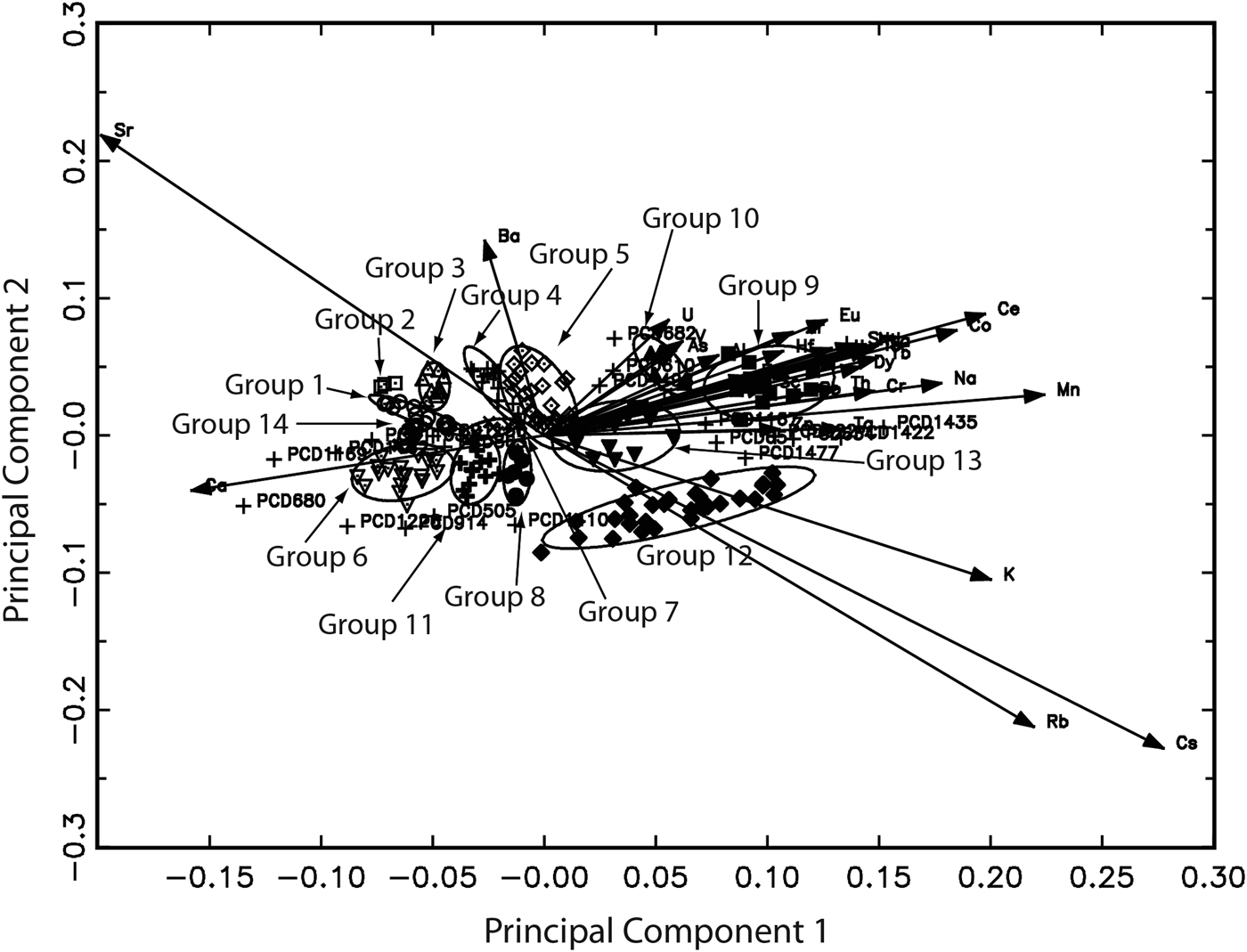
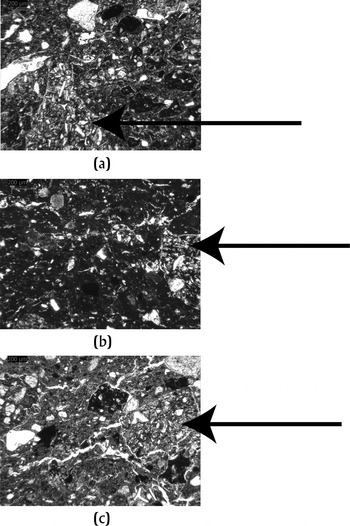
Completion of all three levels of analysis of the censer samples revealed a small, distinct technological group of effigy incensarios. Sherds in this group (Group 9, Figure 4) had higher sodium (also hafnium, cerium, and chromium) concentrations, which usually suggests the presence of igneous rocks and especially volcanic ash tempering. Ash temper is typical of pottery manufactured during the Late Classic period, rather than the Postclassic period. In thin-section analysis, the 15 effigy censer sherds of chemical Group 9 were characterized by grog temper produced from pottery fragments incorporating volcanic ash in the clay matrix (Figure 5).
Peten Postclassic incensario compositional groups with unassigned samples labeled with sample identification numbers. The compositional group of interest for this paper is chemical Group 9 (far right). Ellipses represent a 90 percent confidence interval for group membership.

Petrographic thin section photographs (plane polarized light, 5× magnification) of samples from chemical composition Group 9: (a) Patojo Modeled: Patojo Variety from Zacpeten (PCD611); (b) Patojo Modeled: Patojo Variety from Zacpeten (PCD648); and (c) Patojo Modeled: Moza Variety from Zacpeten (PCD677). Grog with volcanic ash temper is indicated with black arrow.

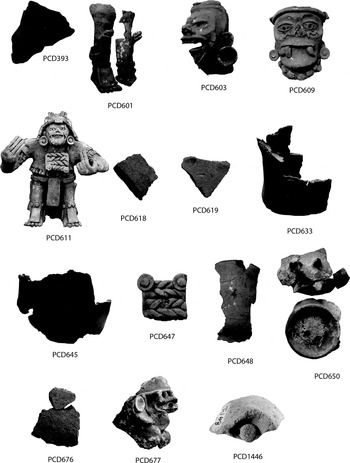
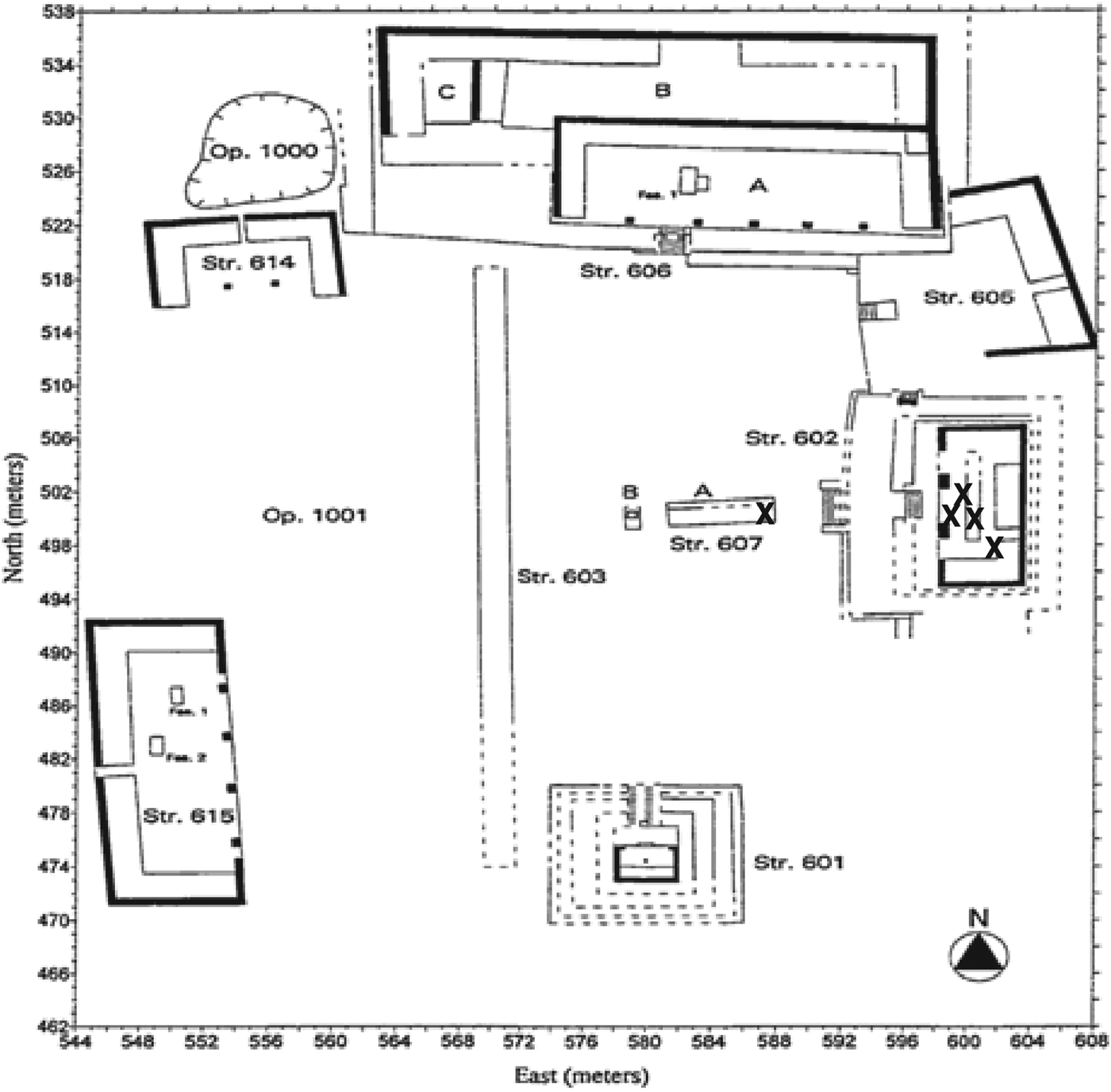
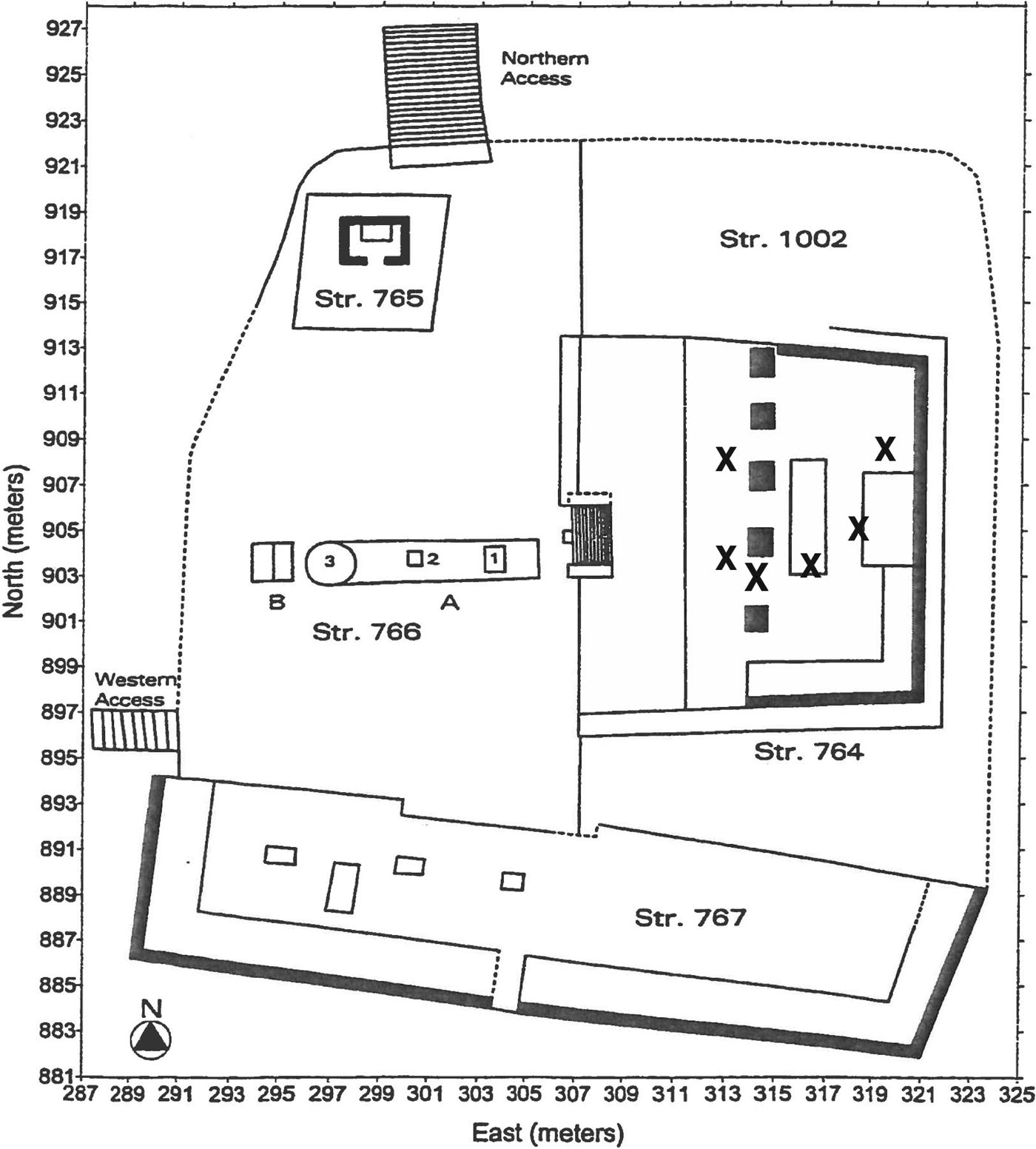
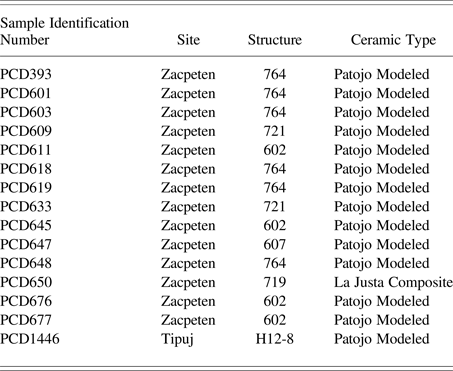
All samples in chemical Group 9 with volcanic ash-tempered grog represent the Patojo Modeled ceramic type of effigy censers. A coarse, calcite-rich ceramic paste that fires to a dark brown or light orange-red color on the exterior surface characterizes this type (Rice Reference Rice, Rice and Rice2009:307–308). These incensarios are large (height = 40–46 cm) and heavy, and consist of a pedestal vase with an attached effigy figure (Figure 6; see Rice Reference Rice, Rice and Rice2009:308 for a complete type-variety description). All but one of the sherds in this group were excavated from Zacpeten (the exception being from Tipu): four from Structure 602 and one from Structure 607 (associated with Structure 602) in the Group A temple assemblage (Figure 7, Table 2); six sherds from Structure 764 of the Group C assemblage (Figure 8, Table 2); one sherd from the Structure 719 council house, and two from the adjacent temple Structure 721. The one sherd from Tipu was excavated from Structure H12-8, which may have served as a residence during the Late Postclassic/Contact era. All of the structures are associated with elite and/or ritual activities.
The 15 effigy incensario fragments that are the focus of this paper. See Table 2 for contextual information.

Location of censers used in this study from Zacpeten Group A.

Location of censers used in this study from Zacpeten Group C.

Contextual information for the incensarios with mana.
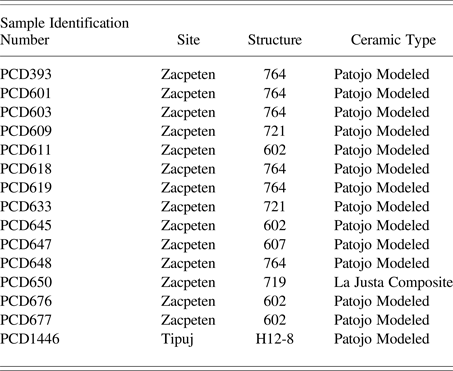
The samples from Structures 602 and 764 were recovered in the inner room of the temple. Those from Structure 602 represent two effigy censers (one full-figure and one face) and two large vases to which the effigies were attached. Samples from Structure 764 represent two matching legs (right and left) of an effigy, the face of another, a woven breastplate, and two pieces of large vases. The sherds from Structure 721 are large vase fragments and that from Structure 719 is a composite censer with spike adornos. The sample from Tipu is an effigy face and eye. All these fragments show evidence of stucco coating.
DISCUSSION
Many cultures use material remains created by their ancestors to actively display and invoke spirits and mana of the past into the present. Spolia and incensarios excavated from Zacpeten in central Peten demonstrate that the Postclassic Maya, much like the modern Maya of the Guatemala highlands, actively moved between the supernatural and natural worlds because the Maya believed, and still do, that humans maintained social relationships with the spirits of objects (Brown and Emery Reference Brown and Emery2008; Christenson Reference Christenson2016; Houston Reference Houston2014:29).
Although figurines and amulets are typically discussed as having been part of magical acts or protection from such acts, objects functioning as containers (such as buildings and incensarios) appear to be the most common category of material culture in which mana is imbued or transferred, resulting in people and objects with power and agency (Gosselain Reference Gosselain1999; Mondragon Reference Mondragon2004; Pendergast Reference Pendergast and Mock1998; Smith Reference Smith1989; Sterner Reference Sterner1989; Stross Reference Stross, Mock and Walker1998). The construction of buildings reflects not only a building event, but a consecration of space that “activates” and cleanses places, establishing a connection with the larger sacred landscape as well as gods and ancestors, and may protect its occupants from malevolent forces (Stross Reference Stross, Mock and Walker1998:32). The cyclical renovation of buildings, particularly ceremonial buildings, using spolia and their associated mana ties constructions to the past, but most importantly prepares the buildings for the future (Pendergast Reference Pendergast and Mock1998:62). Similar to architecture, the manufacture of incensarios, as well as other vessel forms, also ties the potter (the builder) to the sacred as making pottery is a transformational (raw material to fired vessel) process ensouling vessels by their mere creation. During the manufacturing process, intentional choices are made by potters with specialized knowledge. One of those choices, crushing older vessels and incorporating them into newer ones, reflects the Maya's intent to make the supernatural active in the natural world.
Buildings and Spolia
The reuse of building elements exists throughout history and includes individual stones, monuments (including stelae and altars), and decorative elements. The Maya had a custom of building new traditions on top of old structures (Abrams Reference Abrams and Houston1998:124), and also practiced cyclical construction. Cyclical construction, as opposed to monocyclic construction, involves continued community involvement, thus blurring the boundary between past and present. It is one means by which groups connected the community with monuments and also tied community permanence to monuments (Blake and Smith Reference Blake and Smith2000). In the case of the Maya, it also connected the living to the dead (Chase and Chase Reference Chase, Chase and Houston1998:326). While many structures were covered and terminated or “killed,” creating what many would think to be a definitive boundary, the covered building was contained within the newer structure, appropriating the power (soul/ch'ulel) of the former (Hamann Reference Hamann2008:807). Just as cyclical construction differentiates and connects sequential construction, cosmic time connects, yet distinguishes similar events together in “cyclical rhythm” and time (Farriss Reference Farriss1987:581).
Cyclical construction also could have been a means of human control of time, particularly memory. Because stone buildings outlast their human occupants, places may be granted agency through the belief that they are haunted (Miller Reference Miller and Miller2001). The Maya seem to have avoided such uncontrolled hauntings through various rituals that activated spaces and also killed and renewed them (Stross Reference Stross, Mock and Walker1998:33–35); the ensouling was under human control. Ritual objects (such as incensarios) were also killed and replaced during cyclical rituals and construction (Coe Reference Coe1965:100; Tozzer Reference Tozzer1941:151–152) and construction may have been timed by the calendar as well.
The incorporation of Classic stelae and altars into Postclassic construction is particularly telling. The artist carving a stela knows the motifs to be carved, and is intentionally creating images of power and bringing ancestors into the realm of the living. The act of dedicating a stela establishes a collective memory that brings together the present, past, living, and dead. When these items break or are no longer needed, they are not simply thrown away but, instead, have a prescribed method of disposal as they have an animate spirit (Lucero Reference Lucero, Mills and Walker2008; Walker Reference Walker, Skibo, Walker and Nielsen1995; Walker and Schiffer Reference Walker and Schiffer2006:83–84). As such, their designated location of disposal that occurs outside of an ordinary midden suggests that they had some continuing life/spirit force. The resetting of Late Classic period stelae and an altar into the building facades of Group A was an appeal “to tradition, as they cloaked the faces of buildings in the masks of the past” (Pugh and Rice Reference Pugh, Rice, Rice and Rice2009a:169). This also may represent an intentional act by rulers to imbue their civic-ceremonial architecture with mana of spolia to aid with the future.
Late Postclassic buildings also include more pragmatic use of ancient stone. Soft cut limestones were removed from ancient buildings and placed in facades because they are decorative. This practice was not rigidly followed at Zacpeten, as most nicely dressed stones were buried by later constructions. The fact that many later constructions matched footprints of past buildings may have evoked continuity with the past. Postclassic temple assemblages may also reflect ties to earlier architectural plans (e.g., E-groups, Plaza Plan 2).
Postclassic Maya who reoccupied lakes region sites that had been abandoned in the Terminal Classic period often built directly upon ruined structures, sometimes even Preclassic buildings. They appropriated them as their own and seem to have done so seamlessly. In some cases, such as at Zacpeten (Pugh and Rice Reference Pugh, Rice, Rice and Rice2009b:Figure 5.3), Postclassic walls were built directly above Terminal Classic walls, suggesting the “construction” of continuity. Perhaps the placement of a dedicatory cache activating and ensouling the space linked the social lives of the ancients to those of the present. We have no documents attesting to the justifications of the appropriations, but Maya mythohistory is replete with migrating ancestors and it is possible that they simply imagined the abandoned sites as the spaces of ancestors.
Censers and Grog Temper
Continuous use and ensouling of space is mirrored by the effigy incense burners at Zacpeten excavated from many different primary ritual contexts (inside temples as well as other civic-ceremonial structures) that exhibit spolia. The fact that they were smashed in place in pairs suggests that they were associated with ritual ceremonies that employed paired incensarios (Wayeb’, New Year's, and/or K'atun, described above) in the temples and also to honor the deities and/or ancestors (Pugh et al. Reference Pugh, Rice, Cecil, Rice and Rice2009:209; Rice Reference Rice, Rice and Rice2009:301; Rice and Cecil Reference Rice, Cecil, Rice and Rice2009:247–250). Effigy incensarios are the most ritually laden category of Postclassic Maya pottery. During the production of these vessels, the potter knows the power of the deities and ancestors on which the effigy is modeled. While many different deities have been identified outside of the central Peten lakes region (Itzamna, Chaak, Ek Chuah, Ah Muzencab, whiskered gods, the Maize God, Venus, the Death god, Xipe Totec, Tlazoteotl, and Tlahuizcalpantecuhtli; Milbrath and Peraza Lope Reference Milbrath, Peraza Lope and Aimers2012; Sidrys Reference Sidrys1983; Smith Reference Smith1971), we have only been able to provisionally identify two deities: Itzamna (PCD611) and God M, perhaps Tlaloc (Pugh and Rice Reference Pugh, Rice, Rice and Rice2009a:Figure 7.2). That alone may lead to the conclusion that these incensarios were important for rituals, which may have included those associated with calendrical cycling. The use of clay from a known source may have special meaning beyond tradition and costumbre (Arnold Reference Arnold1971; Cecil Reference Cecil, Rice and Rice2009), but incorporation of grog, fragments of ancient pottery, temper confers additional power through the spirit or mana of ancient ancestors/deities.
Grog is an uncommon, though not unheard of, tempering agent in Postclassic pottery in the Peten lakes region. Postclassic effigy incensarios in north-central Yucatan and northern Belize have grog temper, typically crushed from pottery of the same time period, similar to the original vessel, or pastes of local redware vessels (Cecil Reference Cecil2014). A late sixteenth century Spanish writer reported that the Postclassic Maya in Yucatan used the “dust” from older idols (effigies) to make new ones (and he threw the broken idols into a cenote to stop their manufacture; Chuchiak Reference Chuchiak, Cecil and Pugh2009:146). The incorporation of dust from earlier ceramics to form new censers suggests the “killed” objects had a measure of “afterlife” in their life cycles (after Hamann Reference Hamann2008:808).
The 15 Peten censers in technological Group 9 Peten differ from their northern counterparts not only because their grog temper is a different ceramic paste, but also because the grog paste is heavily tempered with volcanic ash. It is highly likely that these effigy incensarios (and one spiked incensario) were tempered with Late Classic pottery, suggesting intentional choice rather than convenience. Where did this Late Classic ash-tempered pottery come from? It could, of course, have been scavenged from fragments from Classic construction fills or refuse deposits at Zacpeten. Two other possibilities suggest themselves, however. One is the refuse in front of the altar fragment embedded in the face of Structure 606 in Group A. This refuse included fragments of Late Classic ash-tempered censer stands that were apparently encountered by the Postclassic occupants and placed with their own ritual refuse. The deity most commonly represented on these earlier ritual objects was the Jaguar Sun God of the Underworld (Rice Reference Rice1999:36). Effigy censer or censer stands depicting JGU may be linked to “kinship, with state and/or dynastic cults and belief systems, and with rituals invoking the sanctity of the king (especially the king as manifestation of the Sun god) and supernatural patrons of the royal lineage” (Rice Reference Rice1999:42). The relationship of JGU and the sanctity of the king can be seen at Palenque as many of the JGU incensarios, and other incensarios, were found broken and buried in the Temple of the Cross and the Temple of the Foliated Cross. Cuevas García and Bernal Romero (Reference Cuevas García and Bernal Romero2002:20–24) suggest that the location of the incensarios and their associated offerings (blood and incense) final interment indicates that the two temples were places where deities and men (the supernatural and the natural) passed between death and resurrection on a daily basis thus allowing communication between the two realms. Ferree (Reference Ferree1972:147–149) examined Late Classic to Terminal Classic censers from Tikal and compared them to those from Palenque, and determined that volcanic ash was used as a tempering agent in effigy incensarios (representing deities) such as those that represented JGU. Thus, grog made from these Classic censers may transfer the mana of the JGU into the Postclassic vessels.
A second possibility is that the grog was made by crushing Late and Terminal Classic figurines, mostly anthropomorphic, which were ash tempered. These earlier objects were found among Late Postclassic ceramics on living surfaces at Zacpeten: in fact, only three of the 35 figurines recovered from excavations at the site were Postclassic in date (Christina Halperin, personal communication 2017). Although named deities are rarely identified in these figurines (Halperin Reference Halperin2014:130–131), they depict elderly individuals and human and animal supernaturals.
By manufacturing effigy incensarios with crushed pieces of pottery (grog) from an earlier time period (Late Classic), the Postclassic Maya may have been evoking not only the spirit of the modeled deity/ancestor effigy or figurine, but also calling the spirit or mana of those earlier deities and/or ancestors into action. Notably, although the Lacandon did not use grog in their censers, the residue and stone moved from the old to the new “god pots” are functionally analogous in bringing the past to the present.
Although it cannot be proven that the Postclassic Maya at Zacpeten were specifically incorporating the JGU censer stands into their effigy incensarios, the fact remains that they manufactured these ritual vessels with volcanic ash-tempered grog from an earlier era. It is possible that the incorporation of this grog in and of itself was an act of imbuing the Postclassic vessels with the spirit and power of past ancestors because the grog had mana as a result of previous ritual actions. Cuevas García and Bernal Romero (Reference Cuevas García and Bernal Romero2002:24) suggest that during the final stage of incensario manufacture (firing), the fire united the clay object with the mana/power/ch'ulel of the deity represented on the front of the vessel, thus making it come alive and able to function in the natural and supernatural worlds. If the grog came from a JGU effigy incensario, it may carry the spirit/power of JGU and/or the dynastic cult or past ruler who had mana and/or used the vessel and gave it mana. Additionally, it could represent a very powerful ritual vessel that combined the ancient mana (Late Classic deity/ruler) with the current ritual specialist's mana and the mana of the Postclassic deity attached to the front of the vases. Thus, the Postclassic Maya of Zacpeten appropriated these spaces and ritual vessels and incorporated them into their constructed universe and their historical consciousness of their Late Classic ancestors and places, transforming newcomers into homecomers.
CONCLUSION
Postclassic civic-ceremonial buildings in the central Peten lakes region, especially at the archaeological site of Zacpeten, were often constructed with monuments from earlier (Classic-period, a.d. 200–900) Maya constructions. They also were built atop earlier structures and installed with ritual caches (sometimes incorporating curated objects) to re-animate the older buildings. Postclassic Kowoj effigy incensarios used in calendric rituals and ceremonies to honor their ancestors/deities were manufactured with crushed fragments of earlier-dating pottery (grog) incorporated into the clay. This grog is thought to have been made from Classic ash-tempered ritual pottery such as censer stands, or possibly figurines. These architectural and pottery-making practices suggest that the Kowojs actively mediated between the natural and the supernatural worlds. They animated their material reality by injecting supernatural power (mana) into the natural realm.
RESUMEN
En este artículo se presenta la investigación realizada al grupo maya del postclásico llamado kowoj, el cual se ubicó en la región de los lagos del Peten central en el departamento de Petén, Guatemala. Los mayas antiguos hacían un enlace entre el maná (poder ritual) y los objetos ceremoniales, deduciendo que estos hacen una mediación entre el mundo natural y el mundo sobrenatural. En muchas culturas alrededor del mundo y en diferentes épocas, el maná (poder mágico y sobrenatural que provee a las personas u objetos de una fuerza viviente) tiene la facultad de transformar lo ordinario en el poder espiritual.
El grupo kowoj usaba la cerámica de incensarios de efigie y los edificios quemados para hacer una conexión con sus antepasados. Presentamos un análisis de los materiales utilizados en la mezcla de la cerámica de incensarios quemados (desgrasante), como también el de los edificios cívico-ceremoniales del sitio Zacpeten con la finalidad de argumentar que el grupo kowoj utilizaba estos objetos para mediar entre los vivos, los muertos y el mundo sobrenatural. Por ultimo, se puede decir que los kowoj daban a estos objetos el maná, proveyéndolos de un poder espiritual y sobrenatural. Por lo que, el grupo kowoj construyó un universo donde regularmente se comunicaba con sus ancestros y construían edificios con la finalidad de conmemorar la historia de su pueblo.
This research was supported by the National Science Foundation (BCS-0741535, 9515443). We would like to thank Evelyn Chan, Romulo Sánchez Polo, Don and Prudence Rice, and the community of Ixlú. We are grateful to our three anonymous reviewers and Prudence Rice for commenting on earlier versions of this paper and the Instituto de Anthropología e Historia, Guatemala for their help. Of course, any errors, omissions, or oversights are the authors’ alone.