Introduction
Emotion concepts are abstract representations of the experiences of various emotions in one's mind (Oosterwijk et al., Reference Oosterwijk, Rotteveel, Fischer and Hess2009). They are used for understanding emotional episodes during life events, and they help people make sense of their own emotions and the emotions of others. The inter-individual nature of emotion concepts alone highlights the fact that despite emotion concepts being mental representations of an individual, they are developed by the interaction of an individual with his or her social and cultural contexts. Emotion concepts are shaped by cultural and societal influences (Alvarado and Jameson, Reference Alvarado and Jameson2011; Trnka et al., Reference Trnka, Poláčková Šolcová and Tavel2018), and their investigation is essential for an in-depth understanding of emotionality in the older population.
The conceptual act theory (CAT; Barrett, Reference Barrett2006; Barrett et al., Reference Barrett, Wilson-Mendenhall, Barsalou, Barrett and Russell2015) is a recent, very influential theory explaining how conceptual knowledge about emotions affects how emotions emerge in an individual. Emotion concepts are suggested to be directed by language, where emotion words work as a ‘glue’ that integrates various sensorimotor states into a common category (Barrett, Reference Barrett2006). Language acts as the context for affect (Barrett et al., Reference Barrett, Lindquist and Gendron2007). Emotion concepts are activated during emotional episodes and help subjects make sense of their own emotional experience and the emotions of others. Thus, according to CAT, conceptual knowledge is the basal substance for experiencing emotions. Emotion concepts are suggested to have two basic dimensions, the valence, i.e. pleasantness or unpleasantness, and the arousal, i.e. the intensity or degree of activation (Barrett and Russell, Reference Barrett and Russell1998; Russell, Reference Russell1983). Valence and arousal have been found to be independent dimensions of human conceptual knowledge of emotions (Trnka et al., Reference Trnka, Lačev, Balcar, Kuška and Tavel2016).
Previous research has shown that age-related changes are responsible for differences in concept formation. Various card sorting tests and scales have revealed that older and younger adults differ in their abilities relating to concept formation (for an overview, see Hartman and Stratton-Salib, Reference Hartman and Stratton-Salib2007). The concept-identification ability, i.e. the ability to generate abstract concepts from stimulus features, which is the central cognitive ability of concept formation, remains relatively intact in older adults. In contrast, reduced selective attention is considered to be responsible for a reduced performance in concept formation in older adulthood (Hartman and Stratton-Salib, Reference Hartman and Stratton-Salib2007). The question is how these age-related changes relating to the general process of concept formation influence the qualities of emotion concepts, e.g. valence and arousal, in older adulthood?
Empirical evidence showing age-related differences in emotion concepts is relatively sparse, and the empirical findings are mixed in this field. Some studies have shown findings supporting the assumption of the narrowing of affective representational space in the older adults (Labouvie-Vief, Reference Labouvie-Vief2003). Wurm (Reference Wurm2011: Experiment 1) revealed a narrowing of affective space, operationalised as a weaker interaction between valence and arousal, in older adults during the auditory processing of emotion words. Older adults also showed fewer complex lexical representations of emotions compared to younger adults. Furthermore, Keil and Freund (Reference Keil and Freund2009) showed that the older adults held fewer complex conceptualisations of emotions in comparison to younger adults. More specifically, younger adults showed a greater differentiation between valence and arousal dimensions when evaluating emotion concepts. The above-mentioned findings support the dynamic integration theory (DIT; Labouvie-Vief, Reference Labouvie-Vief2003), which suggests a narrowing of affective space as a result of cognitive decline in the older adults. Due to reduced cognitive resources (Trnka et al., Reference Trnka, Cabelkova, Kuška and Nikolai2019), older adults are suggested to be less capable of maintaining complex affective representations than younger adults. Therefore, both the dimensionality of complex situations and the representational space are assumed to be narrowed in older adults.
In contrast, other evidence shows a broadening of affective representational space in older adulthood. Several studies revealed more complex emotional experiences in older adults (Labouvie-Vief and Medler, Reference Labouvie-Vief and Medler2002; Magai et al., Reference Magai, Consedine, Krivoshekova, Kudadjie-Gyamfi and McPherson2006). The studies of Ersner-Hershfield et al. (Reference Ersner-Hershfield, Mikels, Sullivan and Carstensen2008) and Charles (Reference Charles2005) also revealed increased emotional complexity in older adults, when compared to younger adults. The broadening of affective space has also been documented in the field of research of emotion concepts. Ready et al. (Reference Ready, Santorelli and Mather2017) investigated the judgement and classification of emotion words in younger and older adults. They utilised a card-sorting task to determine how 70 emotion words of discrete emotions are classified. Older adults rated emotion words as more positive and activating in comparison to younger adults.
A more positive rating of emotion words can also be explained by the so-called positivity effect (Mather and Carstensen, Reference Mather and Carstensen2005), which suggests that older adults have an increased processing of positive emotional stimuli and a decreased processing of negative emotional stimuli. This assumption is in accordance with the results of a study focused on age-related differences in the emotional rating of affective pictures, where older women rated affective pictures as more positive than younger women (Kehoe et al., Reference Kehoe, Toomey, Balsters and Bokde2013). Also, Kehoe et al. (Reference Kehoe, Toomey, Balsters and Bokde2013) suggested, based on an fMRI (functional magnetic resonance imaging) and behavioural analysis, that in the emotional processing of older people there may be an increased sensitivity to positive valence and attenuated arousal processing. Interestingly, low-arousing pleasant stimuli were rated as more pleasant with increasing age, but high-arousing stimuli were rated as more unpleasant in older women only (Ferrari et al., Reference Ferrari, Bruno, Chattat and Codispoti2017).
In the light of inconsistent results and contradictory findings, the present study aims to contribute to current knowledge on age-related differences in emotion concepts. Grühn and Smith (Reference Grühn and Smith2008) pointed out that empirical evidence for age-related differences in evaluations of emotional material is scarce and based mainly on the rating of pictures. The main aim of the present study was to explore how valence and arousal ratings of emotion concepts differ between younger and older adults. Focus was given to provide the participants with a complex set of emotion words covering most instances of discrete emotions. This approach was inspired by a discrete emotions perspective on emotional ageing (Kunzmann et al., Reference Kunzmann, Kappes and Wrosch2014), which assumes that each discrete emotion serves a specific and distinct function. Each lifestage is suggested to be typified by a specific configuration of environmental challenges, personal needs, attitudes, and future expectations, and therefore the frequency, intensity, and specificity of experience of discrete emotions may also be different in different life stages. For the same reason, the qualities of emotion concepts, i.e. subjective mental representations of the experiences of various discrete emotions, may also differ in different life stages.
To build working hypotheses for the present study, the results of previous empirical research were utilised. The study of Ready et al. (Reference Ready, Santorelli and Mather2017) revealed that older adults rated emotion words as more positive in comparison to younger adults. Therefore, it was hypothesised that:
• Hypothesis 1: Older adults rate emotion words as more positive than younger adults.
As Kehoe et al. (Reference Kehoe, Toomey, Balsters and Bokde2013) summarised, a large number of previous studies have investigated age-related differences in emotional valence processing, while the question of age-related differences in the processing of emotional arousal remains relatively unexplored. Some previous research revealed a broadening of affective space in older adults (Mather and Carstensen, Reference Mather and Carstensen2005; Schneider and Stone, Reference Schneider and Stone2015). Therefore, it was hypothesised that:
• Hypothesis 2: Older adults rate emotion words as more arousing than younger adults.
Methods
Participants
Participants were recruited via flyers in public places, mailing lists, and introductory courses for younger adults at the Prague College of Psychosocial Studies. Participants who initially registered for the study were later contacted via email. To assure the proportional inclusion of younger and older adults, only the participants older than 55 years and participants aged from 20 to 30 years were invited to participate. The participants were asked about their current medication and chronic diseases during the contact phase. Participants suffering from diseases that could potentially influence their emotionality, e.g. depression, were not included in the sample. Also, participants medicated by drugs influencing their emotionality, e.g. psychopharmaceutic drugs or antiepileptic drugs, were excluded from the sample.
Both older and younger adults were included in the present study. The older group of participants consisted of 178 adults older than 55 years (mean age = 63.27; standard deviation (SD) = 6.89; 74 men and 104 women; 74 with higher education, 104 with primary or secondary education). The younger group of participants included 176 younger adults aged from 20 to 30 years (mean age = 22.28; SD = 2.52; 78 men and 98 women; 71 with higher education, 105 with secondary education). All the participants were citizens of the Czech Republic.
The study was approved by the ethics committee of Prague College of Psychosocial Studies. All participants took part voluntarily and anonymously in the present study, and all signed an informed consent with their participation in the study.
Measures and procedure
At the beginning, participants filled in basic demographic characteristics. Afterwards, each participant was provided with two evaluation sheets. We used the Semantic Emotion Space Assessment task (SESA; Trnka et al., Reference Trnka, Lačev, Balcar, Kuška and Tavel2016) for analysing the intensity and valence of emotion concepts of participants. Sixteen emotion words were used as stimuli and judged by participants: anger, fear, sadness, happiness, disgust, hope, love, hate, contempt, guilt, compassion, shame, gratefulness, envy, disappointment, and jealousy. These emotion words cover five basic emotions (anger, fear, sadness, happiness, disgust) as well as complex emotions like hope, love, hate, contempt, guilt, compassion, shame, gratefulness, envy, disappointment, and jealousy. All of the emotion words used were non-synonymous.
Participants judged all 16 emotion words twice. First, participants judged all 16 emotion words on the dimension of valence. A 10 centimetre (cm) horizontal line was provided next to each of the 16 emotion words. Participants were asked to rate the degree to which they experienced this emotion as pleasant/unpleasant using the instruction: ‘Please mark on the following lines how much you experience the particular emotion as pleasant or unpleasant.’ Participants then marked the position of each emotion word on the 10 cm lines provided next to each of the 16 emotion words. After finishing the valence judgement, participants judged the same 16 emotions on the dimension of arousal introduced by the instruction: ‘Please mark on each line how much you experience a particular emotion as calm or aroused.’ Participants then marked the position of each emotion word on the 10 cm lines provided next to each of the 16 emotion words. A separate evaluation sheet including the 16 above-mentioned emotion words was used for each of the judgements.
Statistical analyses
To test whether there is a difference in perceived valence and arousal between age and gender groups, we fitted two linear mixed models (one with valence and one with arousal as the dependent variable) with participants and emotion labels as crossed random effects, and age group, gender and age group–gender interaction as fixed effects. We opted for using the mixed effect model (i.e. hierarchical linear regression) because of the hierarchical structure of our data. The deviation coding for age group and gender variables was used, i.e. younger adults and men were coded as −0.5, and older adults and women as 0.5. Consequently, the intercept of the models reflects the grand mean (accounting for random effects), and the coefficients reflect the main effects of age group and gender. Furthermore, the significance of the coefficients of the fixed effects was tested using a type II Wald-type chi-square test.
To test whether there is a linear or quadratic relation between valence and arousal in younger or older adults (compare Keil and Freund, Reference Keil and Freund2009), we fitted linear mixed models and non-linear mixed models, with participants and emotion labels as crossed random effects, valence as a fixed effect and arousal as a dependent variable. The valence was modelled as either a linear or quadratic term. The models for younger and older adults were fitted separately. The models’ fit was evaluated via the Akaike information criterion (AIC), the Bayesian information criterion (BIC) and conditional R 2 (reflecting the amount of variability accounted for by both fixed and random effects).
To test whether there was a difference in the evaluation of single discrete emotion labels between age and gender groups, a series of 2 × 2 analyses of variance with valence or arousal evaluation as the dependent variable, and age group, gender and age group–gender interaction as independent variables were applied. To test the assumptions of normality of residuals and homogeneity of variances, a visual inspection of the residual plots was used. We used type III sum of squares estimation when there was a significant interaction term and type II sum of squares estimation otherwise. Due to the large number of tests conducted, the Benjamini–Hochberg (BH) correction for multiple comparisons was applied to control the False Discovery Rate on the 5 per cent level.
All analyses were performed using the software environment for statistical computing R version 3.5.3 (R Core Team, 2019). We used the ‘lme4’ package for fitting the mixed models (Bates et al., Reference Bates, Maechler, Bolker, Walker, Christensen, Singmann, Dai, Scheipl, Grothendieck G and Fox2019), the ‘car’ package for calculating the p-values for main effects and interactions (Fox and Weisberg, Reference Fox and Weisberg2011), the ‘effects’ package for creating the interaction plots (Fox, Reference Fox2003) and a built-in ‘stats’ package for calculating the BH adjustment.
Results
Age and gender difference in overall affective ratings
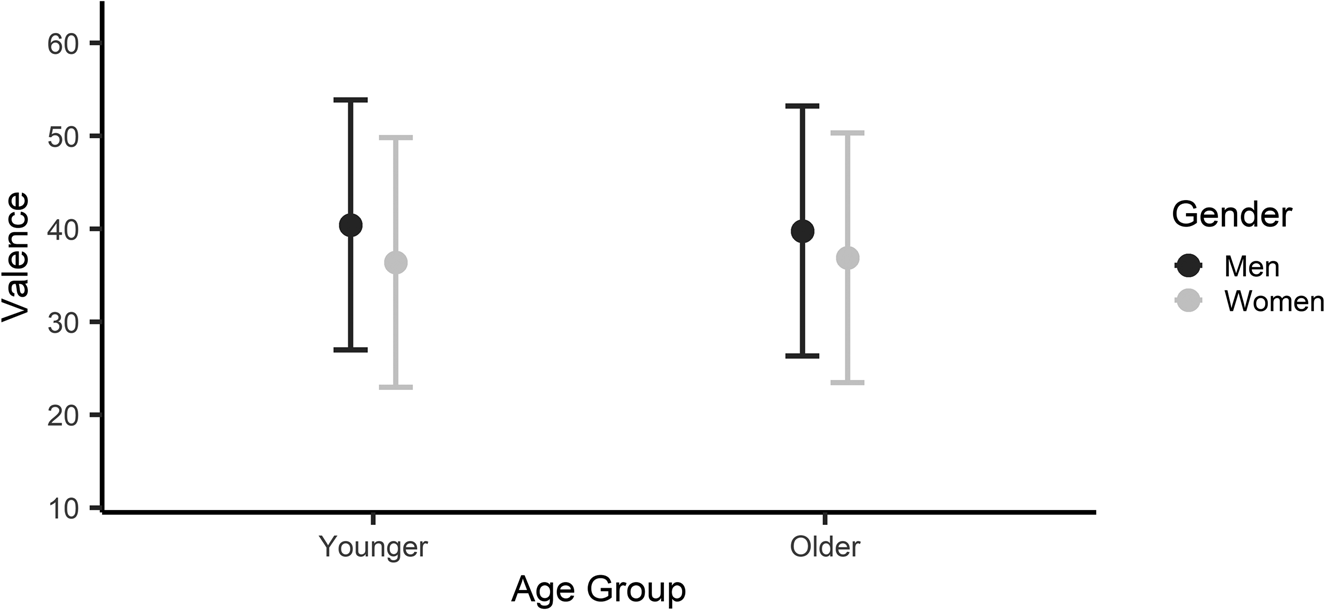
Figure 1 depicts the means and 95 per cent confidence intervals for valence evaluation as differentiated by age group and gender. The grand mean of valence evaluation was 38.37 (standard error (SE) = 6.83). The effect of age group (B = −0.08, SE = 0.66, χ2 < 0.01, p = 0.994) and age group–gender interaction (B = 1.14, SE = 1.33, χ2 = 0.73, p = 0.393) on valence failed to reach significance. There was a gender difference in the perceived valence of emotion words (B = −3.46, SE = 0.67, χ2 = 27.27, p < 0.001), with men scoring on average 3.46 points higher than women. Thus, Hypothesis 1 predicting more positive ratings of emotion words in older adults was not confirmed.
Valence evaluation differentiated by age and gender (means and 95% confidence intervals).

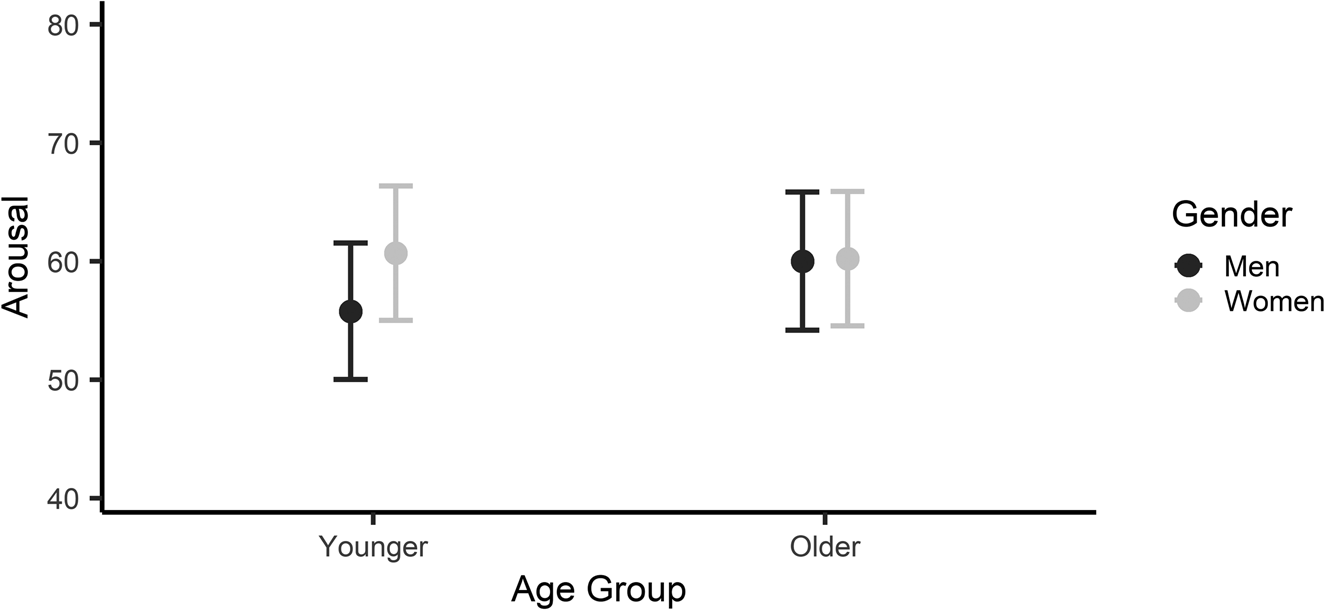
Figure 2 depicts the means and 95 per cent confidence intervals for arousal evaluation as differentiated by age group and gender. The grand mean of arousal was 59.17 (SE = 2.75). The effect of age group on arousal failed to reach significance (B = 1.88, SE = 1.14, χ2 = 1.96, p = 0.170). There was a significant effect of gender (B = 2.56, SE = 1.14, χ2 = 5.53, p = 0.020), with women scoring on average 2.56 points higher than men, and age group–gender interaction (B = −4.70, SE = 2.28, χ2 = 4.12, p = 0.039) on arousal. To elucidate this interaction, we compared the arousal ratings within the sub-groups. There was a significant difference between younger and older men (B = 4.23, SE = 1.70, χ2 = 6.16, p = 0.013), with older men scoring 4.23 points higher than younger men, and between younger men and younger women (B = 4.91, SE = 1.36, χ2 = 13.14, p < 0.001), with younger women scoring 4.91 points higher than younger men. The difference in arousal ratings between older and younger women (B = −0.48, SE = 1.51, χ2 = 0.10, p = 0.753) and between older men and older women (B = 0.21, SE = 1.87, χ2 = 0.01, p = 0.912) failed to reach significance. Older adults were hypothesised (Hypothesis 2) to rate emotion words as more arousing than younger adults. The results showed that older men rated emotion words as more arousing than younger men. This age-related difference was not found when comparing ratings of older and younger women. Thus, Hypothesis 2 was partly confirmed.
Arousal evaluation differentiated by age and gender (means and 95% confidence intervals).

Linear and quadratic models of affective space
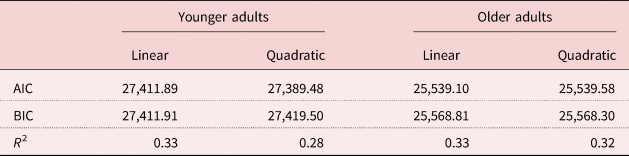
Table 1 presents AICs, BICs and conditional R 2 for linear and quadratic models of the arousal/valence relationship, separately for younger and older adults. The linear and quadratic models perform comparably in both groups.
Evaluation of linear versus quadratic models of the relationship between valence and arousal

Notes: AIC: Akaike information criterion. BIC: Bayesian information criterion. R 2: conditional R 2. Smaller values for AIC and BIC indicate better performance of the model based on the criterion. Bigger values for R 2 indicate better fit.
Age and gender differences in affective rating of discrete emotion words
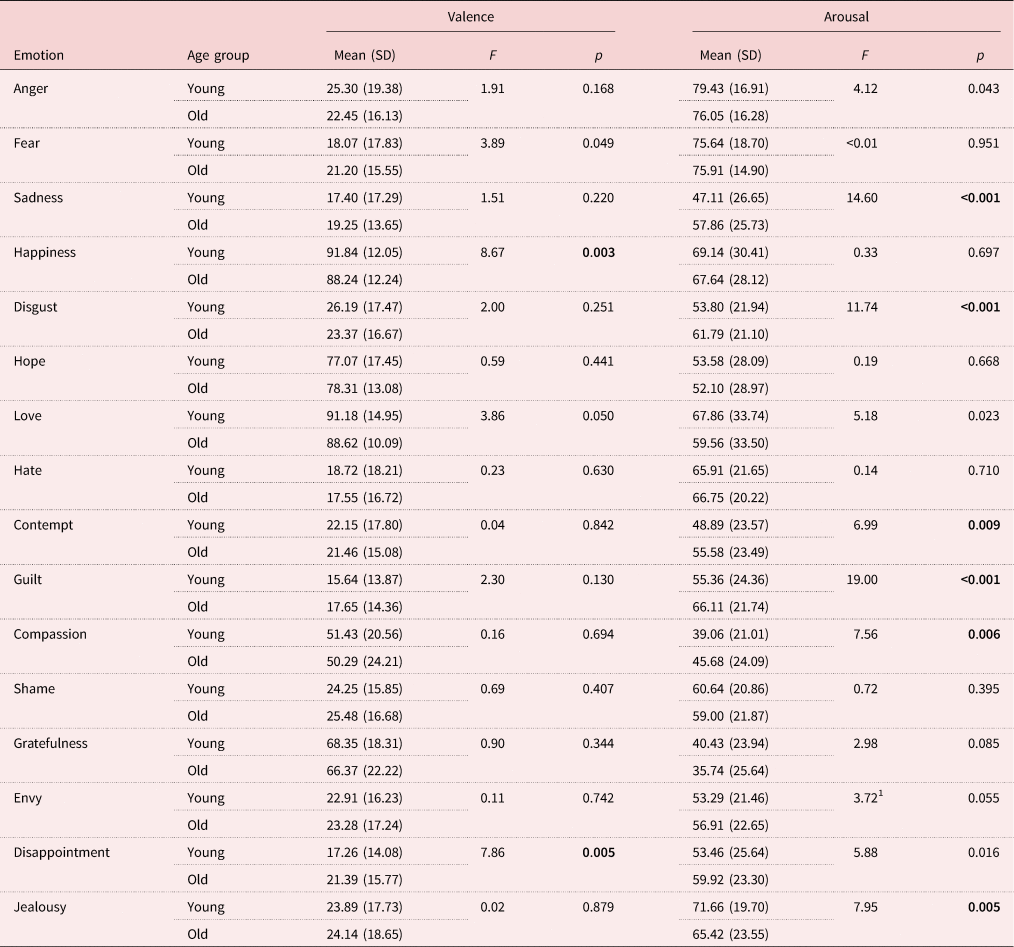
Table 2 presents descriptive statistics and results from the main effect analysis of valence and arousal evaluation differences between younger and older adults. In the valence dimension, younger adults evaluated happiness as more pleasant and disappointment as less pleasant than older adults. In the arousal dimension, older adults evaluated sadness, disgust, contempt, guilt, and compassion as more aroused and jealousy as less arousing than younger adults.
Factorial analysis of variance (ANOVA) main effect comparing emotion valence and arousal between younger and older adults for single emotion labels

Notes: SD: standard deviation. Degrees of freedom (df) were omitted from the table to keep it intelligible and equal, df1 = 1, df2 = 359 for all F statistics. 1. The sum of squares type III ANOVA was used here, otherwise the sum of squares type II ANOVA was used.
Significance level: Bold p-values indicate a statistically significant effect after applying the Benjamini–Hochberg (BH) correction for multiple comparisons.
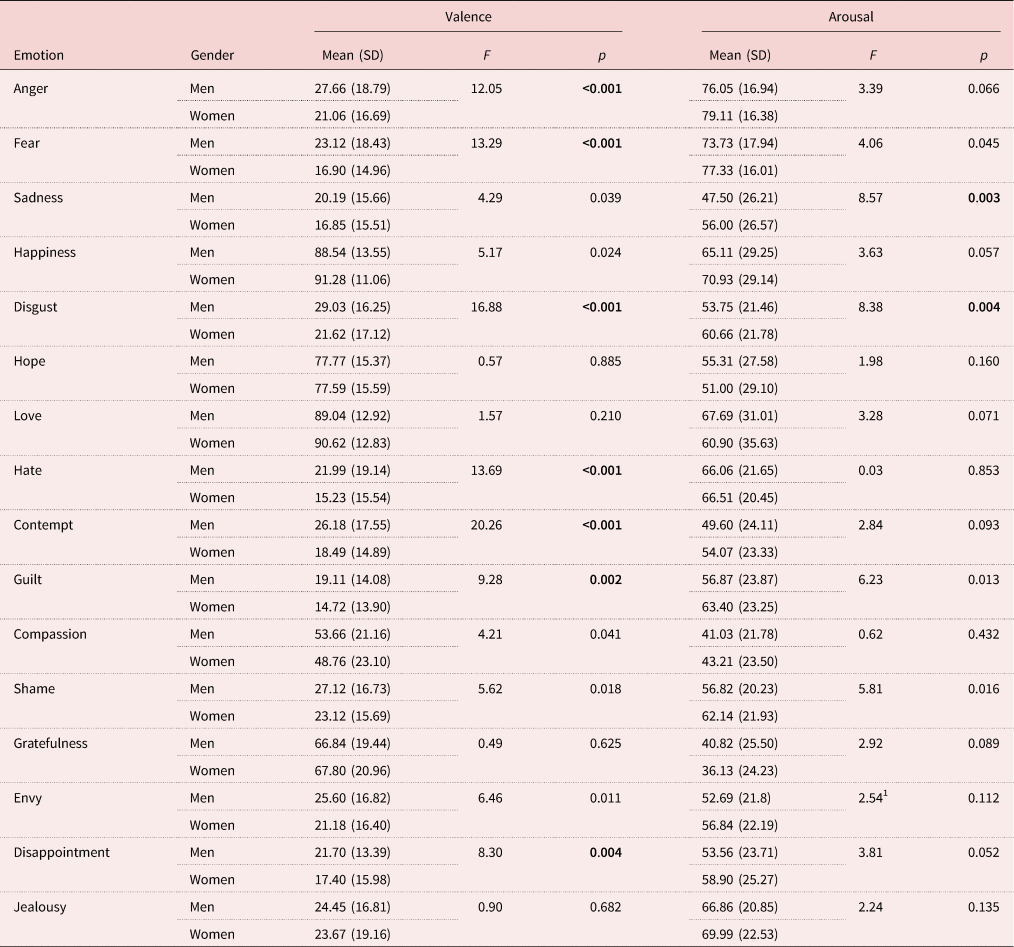
Table 3 presents descriptive statistics and results from main effect analysis of valence and arousal evaluation difference between genders. In the valence dimension, women evaluated anger, fear, disgust, hate, contempt, guilt, and disappointment as less pleasant than men. In the arousal dimension, women evaluated sadness and disgust as more intense than men.
Factorial analysis of variance (ANOVA) main effect comparing emotion valence and arousal between men and women for single emotion labels

Notes: SD: standard deviation. Degrees of freedom (df) were omitted from the table to keep it intelligible and equal, df1 = 1, df2 = 359 for all F statistics. 1. The sum of squares type III ANOVA was used here, otherwise the sum of squares type II ANOVA was used.
Significance level: Bold p-values indicate a statistically significant effect after applying the Benjamini–Hochberg (BH) correction for multiple comparisons.
There was a significant interaction between age and gender in the evaluation of arousal for envy (F(1, 359) = 10.02, p = 0.002), with younger men (mean = 47.3, SD = 21.7) evaluating envy as less intense than younger women (mean = 58.3, SD = 20.0), older men (mean = 59.0, SD = 20.3) and older women (mean = 55.4, SD = 24.2).
Discussion
The main goal of the present study was to explore how evaluations of the valence and arousal of discrete emotion words differ between younger and older adults. A set of 16 non-synonymous emotion words were used as stimuli to provide diverse abstract representations of human emotional experiences. The present study brought evidence that older and younger adults do not generally differ in the valence of their emotion concepts, which cover a wide spectrum of possible instances of discrete emotions. In contrast, several interesting differences were found in the evaluations of emotional arousal between younger and older adults.
The results of the present study can be interpreted as follows. From the perspective of CAT (Barrett, Reference Barrett2006; Barrett et al., Reference Barrett, Wilson-Mendenhall, Barsalou, Barrett and Russell2015), conceptual knowledge about the emotions of an individual is not static over time. Given the fact that the cognitive system of a human individual is perpetually developing and changing, subjective concepts may also change in the course of development and ageing. Theoretically, the actual quality of conceptual knowledge about emotions at a particular time is a result of previous differentiation of conceptual knowledge shaped by various factors. Although this study was not longitudinal, its results do indicate that ageing causes differentiation of conceptual knowledge of emotions in the dimension of arousal rather than in the dimension of valence. In contrast to the evaluations of emotional valence, i.e. the intensity or degree of activation, many more age differences were found in the evaluations of emotional arousal. Older men rated emotion words as more arousing than younger men, and testing age differences in ratings of discrete emotion concepts revealed many interesting differences between older and younger adults. Specifically, older and younger adults differed in the arousal ratings of three basic emotions (sadness, disgust, contempt) and three complex emotions (guilt, compassion, jealousy); for a detailed interpretation, see below.
In contrast to the evaluations of arousal, older and younger adults did not generally differ in the valence of their emotion concepts. Also, when testing age differences within 16 discrete emotions, most evaluations of valence did not differ significantly between older and younger adults (see Table 2). These results imply that older adults do not differ from younger adults in the way they understand how pleasant or unpleasant subjective prototypes of emotions are. Taken together, the results of the present study indicate that the process of ageing affects the emotional arousal of emotion concepts more than the emotional valence. It can be preliminarily hypothesised that age-related differentiation of conceptual knowledge proceeds more in regard to how intense, rather than how pleasant or unpleasant, individuals understand their subjective prototypes of emotions. The present results should be taken with caution, however, as the data were gathered in only one country and several variables that could possibly be responsible for the age differences found were not controlled for, e.g. income or location.
The results of the present study also have some important implications for the CAT (Barrett, Reference Barrett2006; Barrett et al., Reference Barrett, Wilson-Mendenhall, Barsalou, Barrett and Russell2015). Despite the fact that valence and arousal are considered to be the two basic dimensions of conceptual knowledge about emotions, recently yielded empirical evidence indicates that each of these dimensions may play a different role in the age-related differentiation of emotion concepts. Emotional episodes, life events, and many other experiences impact the differentiation of conceptual knowledge of emotions in the course of ageing. However, the differentiation of conceptual knowledge of emotions seems to proceed more in the dimension of emotional arousal, i.e. the subjectively perceived intensity of emotions, rather than in the dimension of emotional valence, i.e. the pleasantness or unpleasantness of emotions. The present study was a cross-sectional study and thus cannot bring more detailed insights into the differentiation of emotion concepts in the course of emotional ageing. Future studies using longitudinal designs are in particular needed to reveal the underlying dynamics of changes in the course of emotional ageing.
Furthermore, the present study revealed very interesting gender differences in the mean arousal ratings of emotion words between older and younger adults. Specifically, older men rated emotion words as more arousing than younger men, but this difference was absent in women. Older adults were generally hypothesised (Hypothesis 2) to rate emotion words as more arousing than younger adults. However, the results of the present study show the broadening of the arousal dimension in affective representational space only in men, not in women. Some gender-specific differences between older and younger adults have been found by previous research, e.g. by studies utilising the rating of affective pictures (e.g. Neiss et al., Reference Neiss, Leigland, Carlson and Janowsky2009). On the other hand, the results of the present study are in contrast to the studies of Keil and Freund (Reference Keil and Freund2009) and Gomez et al. (Reference Gomez, von Gunten and Danuser2013), which supported the so-called stability hypothesis, suggesting that gender differences in self-reported pleasantness and arousal are not age-related. More studies are needed in this field.
Age-related differences in the evaluations of discrete emotions
When testing age differences in the evaluations of 16 discrete emotions, more detailed insights into age-related differences were revealed, especially in arousal ratings. Older adults evaluated sadness, disgust, contempt, guilt, and compassion as more arousing, and jealousy as less arousing, than younger adults. In contrast, older and younger adults did not differ in arousal ratings of three basic emotions (anger, fear, happiness) and seven complex emotions (hope, love, hate, shame, gratefulness, envy, disappointment).
Following the discrete emotions perspective on emotional ageing (Kunzmann et al., Reference Kunzmann, Kappes and Wrosch2014), a different configuration of environmental challenges, personal needs, attitudes, and future expectations in younger and older adulthood may be responsible for the revealed differences. Different age-specific aspects may explain the results found in the present study (see the following paragraphs). This variability supports the assumption of the discrete emotions perspective that age differences caused by emotional ageing are multi-directional and specific for each discrete emotion (Kunzmann et al., Reference Kunzmann, Kappes and Wrosch2014). In the following sections, the interpretations of the findings are presented step-by-step, along with the age differences found in the emotion concepts of sadness, disgust, guilt, compassion, and jealousy.
A more aroused rating of sadness in older adults compared to younger adults may be related to a specific adjustment of goals in older adulthood. Relative to younger adults, older adults increasingly face losses of fundamental resources, loneliness, social isolation, and poor relationship quality with a spouse, children, family members or friends (Kunzmann et al., Reference Kunzmann, Kappes and Wrosch2014; Santini et al., Reference Santini, Koyanagi, Tyrovolas, Haro and Koushede2019; Sedláková and Souralová, Reference Sedláková and Souralová2019). Because sadness helps older adults cope with losses by facilitating disengagement from unattainable goals and enhancing social support, older adults are suggested to experience sadness more intensively and frequently (Kunzmann et al., Reference Kunzmann, Kappes and Wrosch2014). This may explain the more arousing rating of sadness in older adults compared to younger adults found in the present study. A more readily accessible sadness in older age could change the affective representation of sadness, which may become more intense in older adulthood. One longitudinal study revealed that the frequency of sadness increased in old age (Kunzmann et al., Reference Kunzmann, Richter and Schmukle2013). Past studies have revealed a higher intensity of sadness (Alea et al., Reference Alea, Bluck and Semegon2004) as well as greater sadness reactivity in older adults (Kunzmann and Grühn, Reference Kunzmann and Grühn2005; Seider et al., Reference Seider, Shiota, Whalen and Levenson2011), but there are also studies showing comparable levels of sadness among younger and older adults (Charles and Carstensen, Reference Charles and Carstensen2008; Kunzmann and Thomas, Reference Kunzmann and Thomas2014).
Furthermore, older adults evaluated disgust as a more arousing emotion than younger adults. Disgust is typically experienced as a feeling of revulsion accompanied by a strong desire to withdraw from the eliciting stimulus (Rozin et al., Reference Rozin, Haidt, McCauley, Lewis and Haviland-Jones2000). Interestingly, the emotion of disgust is suggested to be an adaptive mechanism protecting people from disease by minimising contact with pathogens (Oaten et al., Reference Oaten, Stevenson and Case2009). In the context of disease avoidance, older adults show more frequent health-promoting behaviours than younger adults (Janowski et al., Reference Janowski, Kurpas, Kusz, Mroczek and Jedynak2013). It may be possible that older adults are more sensitive to disgust elicitors and more prone to experience disgust, because this experience can protect them from contact with pathogens. Therefore, the more aroused subjective representations of disgust of older adults may be adaptive and related to health-protective reasons.
Emotional maturation and the accumulation of experience with various emotions during the life course are processes that may explain the observed results, especially in the cases of complex and self-conscious emotions, such as shame or guilt (Davidenko, Reference Davidenko2019). As people age, they are suggested to become more prone to experiencing psychologically adaptive self-conscious emotions, such as guilt, and less prone to experiencing psychologically maladaptive ones, such as shame (Orth et al., Reference Orth, Robins and Soto2010). Guilt has been found to be linked to pro-social, well-adjusted interpersonal behaviours, whereas shame has been found to be linked to low psychological wellbeing and dysfunctional interpersonal behaviours. The results of the present study showed that older adults evaluated guilt and compassion as more arousing than younger adults, whereas older and younger adults did not differ in their evaluation of hate, shame, and envy. It seems that older adults may have a more intense representation of guilt and compassion compared to younger adults, because the goals of older adults may be adjusted to value pro-social, well-adjusted interpersonal behaviours more than younger adults. These results are in accordance with the maturity principle of personality development (Orth et al., Reference Orth, Robins and Soto2010).
Interestingly, jealousy was the only discrete emotion that was rated as less arousing in older adults in comparison to younger adults. The lower arousal in jealousy may be related to less-intense concerns about a partner's fidelity in older adulthood. Compared to older adults, younger adults show more partner splits, more newly established partner relationships, etc. During this earlier stage of life, emotions that accompany partner relationship, such as jealousy, may occur more frequently. In contrast, emotional life in relation to the maintenance of a partner relationship may be expected to be calmer and with less-frequent instances of jealous outbursts in older adulthood (Tetley et al., Reference Tetley, Lee, Nazroo and Hinchliff2018; Heywood et al., Reference Heywood, Minichiello, Lyons, Fileborn, Hussain, Hinchliff, Malta, Barrett and Dow2019). Interestingly, no age-related differences were found in the arousal rating of love, which indicates that the subjective intensity of affective representational space of love is similar in older and younger adulthood.
Whereas many significant differences were revealed upon comparing evaluations of the arousal of emotion concepts in older and younger adults, two important differences were found when comparing evaluations of the valence of emotions. Younger adults evaluated happiness as more pleasant and disappointment as less pleasant than older adults. In comparison to arousal ratings of emotions, where six of the 16 discrete emotions differed significantly between younger and older adults, our results indicate that perceived valence of discrete emotions is very similar in both younger and older adults.
Limitations
The present study has several limitations. First, the change of emotion concepts during the life course of the participants was not investigated in the present cross-sectional study. Future research should utilise a longitudinal design to capture the process of emotional ageing better. Second, our study is based on participants’ subjective evaluation of valence and intensity of discrete emotion words. This means that participants did not evaluate their real emotions, but only the qualities of their emotion concepts, i.e. their mental representations of prototypical emotional experiences stored in memory. Using subjective evaluations of real-life emotional episodes or objective physiological measures would bring more insights into this research field. Third, the present study is a single, correlational study, and the results presented herein should be taken with caution. More systematic, replicable studies are needed in this field.
Acknowledgement
Many thanks to Tereza Slavickova for her kind support during preparation of the manuscript.
Financial support
This work was supported by the Palacky University Olomouc Institutional Support of Research Organizations – CMTF (I-2020) and by the Czech Science Foundation (GA CR, project no. 18-26094S).
Ethical standards
The study was approved by the ethics committee of Prague College of Psychosocial Studies.