INTRODUCTION
The Portunidae is one of the best-known crab families, because of its ecological importance and as a promising source of food in coastal waters (Montelatto & Fransozo, Reference Mantelatto and Fransozo1999). The predominance of portunids inside estuarine systems contributed to the popularization of swimming-crab fisheries (Callinectes Stimpson, 1860), making this one of the oldest fishing activities along the Brazilian coast. Presently several communities survive from the commercialization of these crabs (Barreto et al., Reference Barreto, Leite and Aguiar2006; Pereira et al., Reference Pereira, Branco, Christoffersen, Freitas-Júnior, Fracasso and Pinheiro2009).
Callinectes danae Smith, 1869 and Callinectes ornatus Ordway, 1863 are usually found near river mouths and bays, most commonly in waters of intermediate salinity. These species inhabit sand, mud or shell substrates, and occur from the intertidal zone to 75 m depth in the western Atlantic (Melo, Reference Melo1996). They are opportunistic and omnivorous, and play an important role in regulating the numbers and distributions of prey species (Branco & Verani, Reference Branco and Verani1997; Mantelatto & Cristofoletti, Reference Mantelatto and Cristofoletti2001; Branco et al., Reference Branco, Lunardon-Branco, Verani, Schveitzer, Souto and Vale2002).
In Guanabara Bay these species are sympatric and subject to the same biotic and abiotic conditions. The swimming-crabs are doubly captured by surface pots and traps in the inner area of the bay (Jablonski et al., Reference Jablonski, Azevedo and Moreira2006) and are a large part of the discarded by-catch in the trawling fisheries for the pink shrimps Farfantepenaeus paulensis (Pérez-Farfante, 1967) and Farfantepenaeus brasiliensis (Latreille, 1817) (Keunecke et al., Reference Keunecke, D'Incao, Moreira, Silva and Verani2008, Reference Keunecke, Silva, Vianna, Verani and D'Incao2009a, Reference Keunecke, Silva, Vianna, Verani and D'Incaob). This fishing pressure and the social and economic importance of these crabs indicate the need for information to aid in the development of management strategies, especially in Guanabara Bay, where uncontrolled urban development has profoundly changed the estuarine environment (Lavrado et al., Reference Lavrado, Falcão, Carvalho-Cunha and Silva2000). Knowledge about the reproductive dynamics including the size at first maturity, reproductive period, and spawning season is essential because these processes are responsible for the renewal of the stock (Dumont & D'Incao, Reference Dumont and D'Incao2004).
MATERIALS AND METHODS
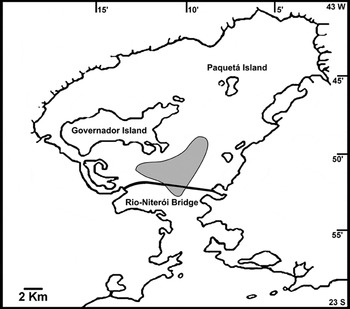
The collections were carried out during 12 consecutive months (January to December 2004), in Guanabara Bay, Rio de Janeiro, Brazil (22°S 48°W). Trawling occurred only at the fishing area (Figure 1) to obtain growth and mortality rates of the swimming-crabs further (Keunecke et al., Reference Keunecke, D'Incao, Moreira, Silva and Verani2008, Reference Keunecke, Silva, Vianna, Verani and D'Incao2009a). A typical boat from the artisanal pink-shrimp fleet was used (an otter trawl with 18 mm mesh size on the cod end). Boat speed was maintained around 1.5 knots and trawling was always carried out at night. Only one haul (50 minutes’ duration) was conducted in each month.
The Guanabara Bay, Rio de Janeiro, Brazil. The shaded area includes the main shrimp fishing points inside the bay.

Carapace width was taken including lateral spines, and the total weight was recorded to the nearest 0.001 g. The ovaries were extracted, weighed, and classified macroscopically, considering size, weight, and gonadal coloration according to a standard Pantone Color Formula Guide (1999) (Dumont et al., Reference Dumont, D'Incao, Santos, Maluche and Rodrigues2007). The macroscopic staging of the gonads was corroborated by histological procedures (Keunecke et al., Reference Keunecke, Silva, Vianna, Verani and D'Incao2009b). Size at maturity was estimated by fitting the frequency of mature females to a logistic model:

where r is the slope, CW is the carapace width and SM the size at maturity.
The reproductive period was estimated from the monthly frequency of ovigerous females and through seasonal analyses of the gonadosomatic index (GSI):

where GW is the gonadal weight, TW is the total weight, and BW is the body weight.
The monthly values for the sex-ratios and size-classes were obtained from the relative frequency of males and females, with an a posteriori Chi-square test.
RESULTS
The size of first gonadal maturity was estimated as 79.9 mm for females of C. danae and 67.4 mm for females of C. ornatus. From these values, the percentage of females below the size of maturity was obtained, which was 16.2% for C. danae and 85.6% for C. ornatus.
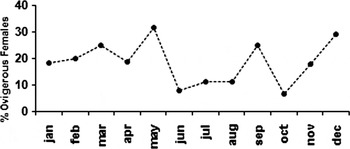
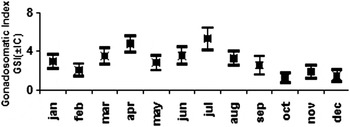
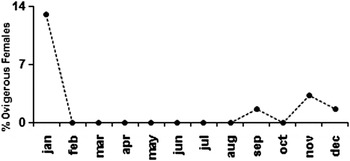
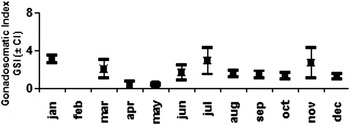
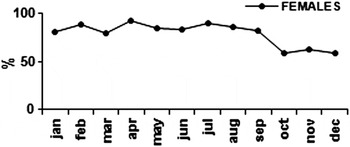
A total of 199 ovigerous females of C. danae were caught during the entire sampling period (January to December 2004). Analysis of the variation in the monthly distribution of the frequency of occurrence of ovigerous females indicated that reproduction is continuous, with three main peaks, in May, September and December (Figure 2). This estimated reproductive pattern was corroborated by the analysis of the monthly variation of the GSI, which showed a more intense increase in gonadal activity of the females in April and July, preceding the peaks of occurrence of ovigerous females (Figure 3). In spite of the absence of ovigerous females of C. ornatus in Guanabara Bay, except for January when 35 ovigerous females were caught, the GSI analysis showed that the gonadal activity varied during the period, indicating changes in the reproductive status of the population during the year (Figures 4 & 5).
Monthly variation of the frequency of occurrence of ovigerous females of Callinectes danae.

Monthly variation of the mean values of the gonadosomatic index of Callinectes danae. The bars indicate the confidence interval.

Monthly variation of the frequency of occurrence of ovigerous females of Callinectes ornatus.

Monthly variation of the mean values of the gonadosomatic index of Callinectes ornatus. The bars indicate the confidence interval.

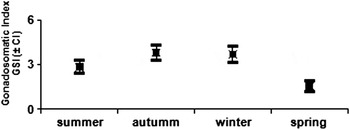
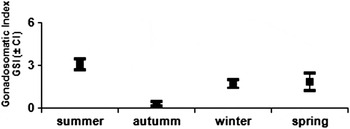
The monthly variations of the GSI of C. danae and C. ornatus were also compared seasonally between the species (Figures 6 & 7), and showed that they alternated periods of gonadal activity. Callinectes danae reached its highest gonadal activity in the autumn and winter, exactly when C. ornatus showed the smallest gonadosomatic indices.
Seasonal variation of the mean values of the gonadosomatic index of Callinectes danae. The bars indicate the confidence interval.

Seasonal variation of the mean values of the gonadosomatic index of Callinectes ornatus. The bars indicate the confidence interval.

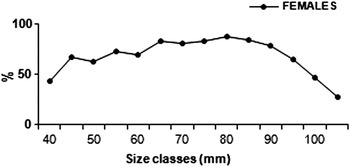
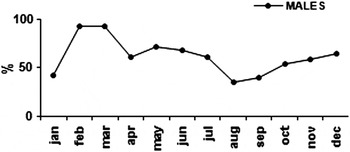
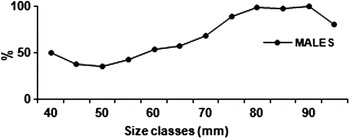
The overall sex-ratio of C. danae was 1:3, with a significant predominance (P < 0.05) of females over males (χ2 = 286.6). The monthly variation of the sex-ratio (Figure 8) also showed this skewed pattern, which was statistically significant in all months except October and December (P ≥ 0.05). Even during these two months, females were more frequent than males. The variation in the sex-ratio by size-classes showed that females of C. danae were significantly more frequent than males (P < 0.05) in nearly all size-classes, except in the classes of smaller and younger individuals (45 mm to 65 mm in width) and the classes of larger and older individuals (over 105 mm in carapace width) (Figure 9). The sex-ratio of C. ornatus over the entire study period also showed a significant difference (1.2:1 χ2 = 14.5), however with a predominance of males over females. Significant differences were lacking only in the months of April, July and October (P ≥ 0.05) (Figure 10). The sex-ratio by size-class showed a predominance of young females in the smaller classes of carapace width. From 70 mm upwards, the ratio was inverted, with males predominating (P < 0.05) (Figure 11).
Monthly variation of the sex-ratio of Callinectes danae.

Variation of the sex-ratio of Callinectes danae by size-classes.

Monthly variation of the sex-ratio of Callinectes ornatus.

Variation of the sex-ratio of Callinectes ornatus by size-classes.

DISCUSSION
The mean width of first maturity of females of C. danae and C. ornatus in Guanabara Bay was estimated as 79.9 mm and 67.4 mm respectively considering the tip of lateral spines. These values are close to those estimated for females of C. danae in the State of Santa Catarina: 88 mm (Branco & Thives, Reference Branco and Thives1991) and 84 mm (Branco & Masunari, Reference Branco and Masunari2000). For C. ornatus it was estimated as 61 mm in the State of Paraná (Branco & Lunardon-Branco, Reference Branco and Lunardon-Branco1993). Although the populations of C. danae and C. ornatus of Rio de Janeiro, Santa Catarina and Paraná live under different climate regimes, it was not possible to relate the differences in size at first gonadal maturation, which were similar, to a latitudinal temperature gradient.
The determination of the size of first gonadal maturity is fundamentally important information for the management of stocks, since the enforced law affecting this resource is based on permitted minimum sizes, 120 mm of total width including lateral spines for C. danae and C. sapidus only (IBAMA, 1983). In Guanabara Bay, 16.2% of the females of C. danae and 85.6% of the females of C. ornatus were caught at a size below that of first maturity, by the pink-shrimp trawl fishery alone. These high percentages, especially for C. ornatus, can directly affect the mortality estimates and cause a significant reduction in the stocks, since Guanabara Bay is a nursery for these species. In addition, many populations under intense fishing pressure may have their asymptotic sizes reduced. Consequently the size of first maturity can also decrease, representing an additional cost for the species, since maturation at smaller sizes results in lower fecundity and probably in exposure to a wider range of predators (Vazzoler, Reference Vazzoler1996), which could subsequently decrease its reproductive potential.
In the Brachyura, the presence of eggs on the pleopods of the females is often but erroneously taken as a sign of gonadal maturity. This criterion is inexact, because the eggs can appear on the abdomen several months after the first gametogenesis (Mantelatto, Reference Mantelatto1995). Precise determination of the breeding season of C. danae and C. ornatus was only possible when the monthly variation of the frequency of ovigerous females was analysed in conjunction with the monthly variation of the GSI.
The small numbers of ovigerous females of C. ornatus caught during the study period, except in January when 35 ovigerous females were caught, may be a result of the biological sampling method, which did not have an experimental character using pre-established collecting points; or perhaps be due to migration of these females toward the sea. Migrations of members of the genus Callinectes to more-saline waters have been widely reported by several investigators (Negreiros-Fransozo & Fransozo, Reference Negreiros-Fransozo and Fransozo1995; Branco & Masunari, Reference Branco and Masunari2000; Posey et al., Reference Posey, Alphin, Harwell and Allen2005); the reason for these migrations may be that the larvae are less tolerant of salinity variations than the adults (Chacur et al., Reference Chacur, Mansur and Negreiros-Fransozo2000). According to Negreiros-Fransozo & Fransozo (Reference Negreiros-Fransozo and Fransozo1995), C. ornatus is less tolerant of salinity and temperature than C. danae, and when the females are ovigerous, it may occupy the ecotone areas nearer the open sea (Lavrado et al., Reference Lavrado, Falcão, Carvalho-Cunha and Silva2000). Peaks of ovigerous females of C. danae in autumn and winter, and of C. ornatus in summer were recorded at Ubatuba on the northern coast of São Paulo by Negreiros-Fransozo & Fransozo (Reference Negreiros-Fransozo and Fransozo1995), corroborating the patterns and reproductive periods found for the two species in Guanabara Bay. These results also concur with the analyses of maturation of the gonadal stages carried out by Costa & Negreiros-Fransozo (Reference Costa and Negreiros-Fransozo1998) and by Mantelatto & Fransozo (Reference Mantelatto and Fransozo1999).
The GSI analysis was used successfully by Branco et al. (Reference Branco, Lunardon, Ávila and Miguez1992) to determine the pattern and reproductive period of C. danae in Lagoa da Conceição in Santa Catarina. The mean monthly GSI values found by these authors suggest that C. danae has a long breeding season, with four peaks of spawning: at the end of autumn (May); in spring (November); at the beginning of summer (January); and at its end (March). Only the autumn peak of GSI coincides with that observed in the present study. In Lagoa da Conceição, among the species of the genus Callinectes present, only C. danae occurs in high abundances (Branco & Masunari, Reference Branco and Masunari2000). This abundance probably allows the species to prolong its GSI peaks in the summer months, since there is no interspecific competition. The increase in the GSI in summer would also allow the species to increase its reproductive potential.
A different situation occurs with C. danae and C. ornatus, which are sympatric, syntopic, and both very abundant in Guanabara Bay. The GSI analysis demonstrated that the species use different reproductive tactics, alternating their reproductive periods and avoiding direct interspecific competition. This strategy may be directly related to the survival of the planktonic larvae, which hatch at different times of year, which would reduce competition for available resources in Guanabara Bay.
Sex-ratios deviating from the expected (1:1) for C. danae and C. ornatus have been reported by some researchers in recent years (Mantelatto & Fransozo, Reference Mantelatto and Fransozo1996; Negreiros-Fransozo et al., Reference Negreiros-Fransozo, Mantelatto and Fransozo1999; Baptista et al., Reference Baptista, Pinheiro, Blankensteyn and Borzone2003). Mantelatto (Reference Mantelatto1995) suggested that a female may copulate with several males during the reproductive period, ensuring the supply of male gametes in the spermatheca for future periods in species with a terminal moult. In the case of C. danae and C. ornatus, several factors may be influencing the fluctuations in abundance of males and females in Guanabara Bay. The predominance of females of C. danae may have occurred because of a higher natural mortality rate in males (Keunecke et al., 2009a). The greater abundance of females may also increase the reproductive potential of the species.
For C. ornatus, the predominance of males above the 70-mm class may be associated with the migration of the females to more-saline areas to spawn; they would therefore not have been caught by the trawlers because they were absent from the sampling area. We presume that this accounts for the relatively low contribution of larger and older females of C. ornatus to the larger size-classes.
According to all indications above, the adult females of C. ornatus move to the more-saline areas of the estuary, and then transfer to adjacent coastal areas to complete their life cycle. The stock of C. ornatus in the estuary would only be replaced by the entry of new cohorts into the population, while remaining within the expected range for the species and slightly skewed in favour of males. Sartor (Reference Sartor1989) also found skewed sex-ratios for C. ornatus on the northern coast of São Paulo, but with a significant predominance of females near the edge of the inner area on the 50-m isobath, indicating that the entrance of females from the estuary may be linked to the dynamics of the regional water masses, especially the coastal water.
However, a different situation may occur with C. danae. After spawning, the females return to less-saline, shallower areas as observed by Branco & Masunari (Reference Branco and Masunari2000) in Santa Catarina and as observed by Baptista-Metri et al. (Reference Baptista-Metri, Pinheiro, Blankensteyn and Borzone2005) on Shangri-lá Beach, Paraná State. This migration would skew the sex-ratio toward females in estuaries. These reproductive strategies may reduce competition between the two species, since in Guanabara Bay they are sympatric and syntopic.