INTRODUCTION
Alzheimer’s disease (AD) is frequently accompanied by anosognosia, that is, an impairment or lack of insight into deficits. According to the majority of studies, anosognosia in AD increases with dementia severity (for reviews, see Clare, Reference Clare2004; Ecklund-Johnson and Torres, Reference Ecklund-Johnson and Torres2005; Kessler and Supprian, Reference Kessler and Supprian2003), even though the degree of insight in dementia can vary interindividually (Lamar et al., Reference Lamar, Lasarev and Libon2002).
The term “anosognosia” was coined by Babinski (Reference Babinski1914) to describe a lack of awareness of disease and has been used to denote unawareness of disease symptoms in different syndromes. It has sometimes been used in a broad sense which includes unwillingness to acknowledge deficits. However, this latter phenomenon is more aptly termed “denial of deficits,” whereas anosognosia in a strict sense refers to inability to recognise deficits or realize their extent (McGlynn and Schacter, Reference McGlynn and Schacter1989). In this article, “anosognosia” and the equivalent terms “impaired insight” and “unawareness of deficits” are used in this strict sense. Despite several empirical studies on anosognosia in AD during the past 15 years (for a review, see Ecklund-Johnson and Torres, Reference Ecklund-Johnson and Torres2005), unsolved issues concerning its nature and methods for its assessment remain. This study intends to address two separate questions.
One issue is the absence of a single established method for assessing insight. Instead, three approaches have been used (for a review, see Leicht and Gertz, Reference Leicht and Gertz2009). One is to let an experienced clinician rate the patient’s level of awareness, based on interviews with the patient and a caregiver (e.g., Derouesné et al., Reference Derouesné, Thibault, Lagha-Pierucci, Baudoin-Madec, Ancri and Lacomblez1999; Ott et al., Reference Ott, Lafleche, Whelihan, Buongiorno, Albert and Fogel1996; Reed, et al., Reference Reed, Jagust and Coulter1993), sometimes also including basic cognitive testing (Harwood et al., Reference Harwood, Sultzer and Wheatley2000). A second approach involves questionnaire discrepancies from parallel questionnaires for patients and caregivers which address potential deficits. Subtracting the patient’s from the caregiver’s average ratings yields a discrepancy score that reflects the degree of anosognosia (e.g., Green et al., Reference Green, Goldstein, Sirockman and Green1993; Kalbe et al., Reference Kalbe, Salmon, Perani, Holthoff, Sorbi and Elsner2005; Starkstein et al., Reference Starkstein, Jorge, Mizrahi and Robinson2006; Vasterling et al., Reference Vasterling, Seltzer and Watrous1997). A disadvantage is that caregiver ratings can be biased by factors such as the caregiver-patient relationship or caregiver distress (Zanetti et al., Reference Zanetti, Geroldi, Frisoni, Bianchetti and Trabucchi1999), but at the same time, they have been shown to be largely accurate (Cacchione et al., Reference Cacchione, Powlishta, Grant, Buckles and Morris2003). They are also the most easily available source of information regarding deficits in activities of daily living (ADL). The third method is based on the comparison of a patient’s cognitive performance in standardized neuropsychological tests and his or her assessment of this performance (so-called performance discrepancies; Ansell and Bucks, Reference Ansell and Bucks2006; Correa et al., Reference Correa, Graves and Costa1996; Duke et al., Reference Duke, Seltzer, Seltzer and Vasterling2002; McGlynn and Kaszniak, Reference McGlynn and Kaszniak1991). Again, the discrepancy between performance and self-assessment is interpreted as an indicator for anosognosia. However, as self-assessment of test performance is prone to errors even in healthy subjects (e.g., Barrett et al., Reference Barrett, Eslinger, Ballentine and Heilman2005; Graham et al., Reference Graham, Kunik, Doody and Snow2005), this method requires a healthy control group to detect errors exceeding the normal range.
Correlations have been reported between clinical ratings and questionnaire discrepancies but not between performance discrepancies and either of the two other methods (see Leicht and Gertz, Reference Leicht and Gertz2009). However, only two comparisons across all three methods have been published which provide limited evidence as one used memory-related measures only (Hannesdottir and Morris, Reference Hannesdottir and Morris2007), while the other used measures that covered either memory or ADL deficits but not both (Howorth and Saper, Reference Howorth and Saper2003).
A second unresolved issue is whether anosognosia in AD affects specific areas of function more than others (domain-specificity). It has been demonstrated that patients show impaired insight for memory dysfunction (Michon et al., Reference Michon, Deweer, Pillon, Agid and Dubois1994; Reed et al., Reference Reed, Jagust and Coulter1993; Verhey et al., Reference Verhey, Rozendaal, Ponds and Jolles1993) and ADL deficits (e.g., Howorth and Saper, Reference Howorth and Saper2003; Vasterling et al., Reference Vasterling, Seltzer and Watrous1997), which constitute core symptoms of AD, but also for a range of other possible symptoms including different cognitive deficits (Graham et al., Reference Graham, Kunik, Doody and Snow2005; Kalbe et al., Reference Kalbe, Salmon, Perani, Holthoff, Sorbi and Elsner2005; Kotler-Cope and Camp, Reference Kotler-Cope and Camp1995), and psychiatric symptoms such as depression, anxiety, or irritability (Snow et al., Reference Snow, Kunik, Molinari, Orengo, Doody and Graham2005; Vasterling et al., Reference Vasterling, Seltzer, Foss and Vanderbrook1995). In addition, a small number of studies have compared insight across domains. Green and colleagues (Reference Green, Goldstein, Sirockman and Green1993) found anosognosia for recent memory and ADL, as opposed to attention and long-term memory. Vasterling and colleagues (Reference Vasterling, Seltzer, Foss and Vanderbrook1995) report impaired insight for memory, ADL, anxiety and irritability, but not for general health and depression. Other studies that examined cognition only report selective anosognosia for specific cognitive functions (Barrett et al., Reference Barrett, Eslinger, Ballentine and Heilman2005; Kalbe et al., Reference Kalbe, Salmon, Perani, Holthoff, Sorbi and Elsner2005; Kotler-Cope and Camp, Reference Kotler-Cope and Camp1995). Memory is the cognitive domain most consistently associated with anosognosia, but beyond memory, virtually no two studies have investigated the same set of domains. There is thus no coherent evidence for domain-specific anosognosia in AD.
Domain-specific anosognosia does occur in other neurological diseases. Most notably, patients may show a striking dissociation between unawareness of hemiplegia or hemianopia following stroke and awareness of cognitive deficits or other physical symptoms (for a review, see McGlynn and Schacter, Reference McGlynn and Schacter1989). In a comprehensive model by Schacter (Reference Schacter1990), such selective forms of anosognosia are attributed to the selective disconnection of modules for cognitive, motor or sensory function from a parietally located conscious awareness system. Thus the perception of hemiplegia, for instance, can be selectively lost while awareness of other deficits remains intact.
Analyses of anosognosia across domains in AD by means of questionnaire discrepancies, however, are limited by the fact that a discrepancy can only arise to the extent that a deficit is present and reported by the caregiver.
An absence of discrepancy can be due to absence of anosognosia if the patient is fully aware of a high deficit level as rated by the caregiver. However, it can also be due to absence of any deficit to be recognized despite an impaired capacity for insight. The degree of deficit is thus an inherent confounding factor in comparisons of discrepancies across domains, and varying degrees of discrepancy may be due to differences in anosognosia, but they may equally result from different degrees of deficit (it should be noted that comparisons of anosognosia across domains by means of performance discrepancies are limited by the same confounding influence).
Previous reports of domain-specific anosognosia in AD as assessed by questionnaire discrepancies have not addressed this confound as an inherent methodological constraint. Green and colleagues (Reference Green, Goldstein, Sirockman and Green1993) and Vasterling and colleagues (Reference Vasterling, Seltzer, Foss and Vanderbrook1995) do consider different degrees of deficit as an explanation of their results, but in other studies domain-specificity is simply inferred from the fact that discrepancies between self- and caregiver questionnaire ratings differ between domains, and no data are provided for levels of deficit in the domains that were investigated (Kalbe et al., Reference Kalbe, Salmon, Perani, Holthoff, Sorbi and Elsner2005; Kotler-Cope and Camp, Reference Kotler-Cope and Camp1995). Thus to date there is no evidence that anosognosia in AD differs between domains with comparable levels of deficit.
The objectives of the present study were twofold. First, the study intended to investigate the relation of clinical rating, questionnaire discrepancies and performance discrepancies in assessing anosognosia, using only measures which were equivalent with respect to the domains they covered (namely, a clinical rating and questionnaire discrepancies that cover anosognosia for both memory and ADL deficits, and a performance discrepancy for recent memory only, as this method is based on standardized neuropsychological tests and cannot be applied to cover ADL). Second, the study examined anosognosia across a range of domains by means of questionnaire discrepancies while taking caregiver-rated deficit levels into account to investigate whether anosognosia in AD is genuinely domain-specific. For this part of the investigation we applied questionnaires that cover core symptoms of AD (recent memory loss and ADL deficits) and other possible cognitive and behavioral symptoms. In addition, we explored performance discrepancies for different cognitive domains.
We expected a correlation between clinical rating and questionnaire discrepancies, but no association between either of these and the performance discrepancies.
Furthermore, we expected that AD patients would show anosognosia across domains. We did expect questionnaire discrepancies to vary between domains, but we expected them to vary in close conjunction with the respective degrees of deficit.
METHODS
Subjects
Thirty-two patients between 65 and 85 years of age with probable AD according to the NINCDS-ADRDA criteria (McKhann et al., Reference McKhann, Drachman, Folstein, Katzman, Price and Stadlan1984) and mild to moderate dementia were recruited consecutively through the memory clinic at the Clinic for Psychiatry, University of Leipzig. For each patient, a caregiver also took part in the study to provide information about the patient. Caregivers were close relatives with the single exception of one close friend (21 spouses or partners, 9 children, 1 sibling, 1 friend), and the majority apart from two sons and five husbands were female. It was established before inclusion that caregivers who were not spouses or partners were closely involved with the patients’ daily lives and were sufficiently familiar with their current deficits. In addition, a healthy sample (n = 26) from the same age bracket as the AD patients was recruited from among caregivers of the patients included in this study and other patients who attended the memory clinic to act as a control group for part of the investigation (see Table 1). No patients, caregivers or control subjects with a significant history of psychiatric illness, neurological disease (e.g., stroke), head injury, or alcohol abuse were included in the study.
Number of subjects, gender ratio, age, MMSE scores, and years of education

Note
MMSE = Mini Mental State Examination; AD = Alzheimer’s disease; SD = standard deviation.
Procedure
The investigation comprised two sessions of approximately 1 hour’s duration each, which were conducted at the Clinic for Psychiatry or at the subjects’ homes, depending on the subjects’ preference. Patient and caregiver were interviewed and tested separately by two researchers (H.L. and M.B.). Before the first session, both the patient and caregiver gave informed written consent. The study procedure was approved by the Ethics Committee at the Medical Faculty of the University of Leipzig.
Instruments
The degree of cognitive impairment was assessed by the Mini-Mental State Examination (MMSE; Folstein et al., Reference Folstein, Folstein and McHugh1975). Basic neuropsychological testing was performed, including a declarative verbal memory task (learning of the CERAD word list; Thalmann et al., Reference Thalmann, Monsch, Schneitter, Ermini-Fünfschilling, Spiegel and Stähelin2007), a concentration test for elderly subjects which required the detection of target items among a set of distractor items (completion time of the Alters-Konzentrations-Test, AKT; Gatterer, Reference Gatterer1990), a Stroop color-word interference task (Farbe-Wort-Interferenztest, FWIT; Bäumler, Reference Bäumler1985), and verbal fluency tasks (semantic fluency and alternating semantic fluency of the Regensburger Wortflüssigkeitstest, RWT; Aschenbrenner et al., Reference Aschenbrenner, Tucha and Lange2000). Caregivers and additional control subjects were also screened with the MMSE. The healthy control sample completed part 3 of the anosognosia assessment (performance discrepancies).
Assessment of Anosognosia
Clinical rating
The Clinical Insight Rating (CIR; translated from Ott and Fogel, Reference Ott and Fogel1992) comprises four items that cover the patient’s awareness of (a) the reason for the visit to the clinic, (b) cognitive deficits, (c) functional deficits, (d) progression of the disease. Based on separate interviews with the patient and caregiver, the items are rated by an expert as 0 (full insight), 1 (partial insight), or 2 (no insight), and summed to yield a total score between 0 and 8. Patients with a total score of > 1 were considered anosognosic.
Questionnaire discrepancies
All questionnaires had parallel versions for patients and caregivers and were coded so that higher values denote a greater deficit. For all measures, total patient scores were subtracted from total caregiver scores to yield a discrepancy score for anosognosia. Total caregiver scores were also evaluated separately.
The Bayer Activities of Daily Living Scale (B-ADL; Hindmarch et al., Reference Hindmarch, Lehfeld, de Jongh and Erzigkeit1998) covers impairment in typical ADL. We used an adapted version with a 5-point rating scale ranging from “never” (has any difficulty) to “very often” (has difficulty) and parallel versions.
A questionnaire with three scales covering recent memory, remote memory, and attention (four items each, rated on a 5-point scale) was translated and adapted from Green and colleagues (Reference Green, Goldstein, Sirockman and Green1993). The three scales probe deficits in memory of very recent events (same or previous day), memory of remote events (covering all of the subject’s life) and attention to everyday tasks.
The Apathy Evaluation Scale (AES; Lueken et al., Reference Lueken, Seidl, Schwarz, Volker, Naumann and Mattes2006) comprises 18 items which are rated on a 4-point scale.
The DEX Questionnaire from the BADS battery (Behavioral Assessment of the Dysexecutive Syndrome; Wilson et al., Reference Wilson, Alderman, Burgess, Emslie and Evans1996) covers behavioral symptoms related to executive deficits such as disinhibition or monitoring and planning problems (20 items, rated on a 5-point scale).
Total average scores ranging from 1.00 to 5.00 (AES: 1.00 to 4.00) were calculated separately for both patients and caregivers for each questionnaire. Questionnaire discrepancies may thus range from −4.00 (overestimation of deficits by the patient) through 0.00 (accurate self-assessment) to +4.00 (no awareness of deficits; AES: −3.00 to +3.00).
Performance discrepancies
There is no gold standard for performance discrepancies (Ecklund-Johnson and Torres, Reference Ecklund-Johnson and Torres2005). The procedure most frequently used, which is prediction of the number of remembered items from a list (e.g., McGlynn and Kaszniak, Reference McGlynn and Kaszniak1991), is only suited to self-assessment of memory performance. As we intended to explore self-assessment of cognitive functions beside memory, we applied the following procedure. For declarative verbal memory (as assessed by the CERAD word list), concentration (AKT), the Stroop task (FWIT), and alternating semantic fluency (RWT), subjects rated their performance after the test on a 5-point scale with each category representing 20% of an assumed age- and education-matched population divided into 5 groups according to performance (1 = 0–20% / significantly below average; 2 = 21–40% / slightly below average; 3 = 41–60% / average; 4 = 61–80% / slightly above average; 5 = 81–100% / significantly above average). The subjects’ performance was coded likewise according to their test results derived from age-specific norm tables, yielding a score between 1 and 5. The performance score was subtracted from the self-rating score, resulting in a discrepancy score between −4 (underestimation of performance) and +4 (overestimation of performance) for each test. While the percentage scale we used is abstract, this procedure allows for self-assessment and performance to be captured on the same scale and affords the comparison of data from different neuropsychological tests.
Analysis
Statistical analyses were performed with the statistical software package SPSS 15.0 for Windows (SPSS Inc. UK Ltd, Surrey, UK).
As all the methods used in this study are based on ordinal scales, mostly nonparametric statistical methods were applied. Spearman’s rank correlation coefficient was used for correlation analyses. Group comparisons were conducted by means of the t test for independent samples, the Friedman test, the Mann-Whitney U test, and the Wilcoxon signed-rank test, as appropriate. The level of significance was set at α = 0.05 unless otherwise indicated.
For the evaluation of presence of anosognosia in the study sample and the relation between assessment methods the analysis was restricted to the domains of recent memory and ADL, to ensure that patients did have deficits in the domains in question, and that the domains covered were equivalent across methods. Thus in assessment of the correlation between CIR and questionnaire discrepancies, only questionnaire discrepancies for recent memory and ADL were used. In assessment of the correlation between CIR and performance discrepancies, only performance discrepancies for recent memory were used. By contrast, the evaluation of domain-specificity was based on the questionnaires for all six domains and all four cognitive tests. We tested for overall significant differences between questionnaire discrepancies across domains, and used post hoc comparisons to examine differences between questionnaire discrepancies across domains. The same procedure was applied to the caregiver ratings. This allows to evaluate whether those domains where questionnaire discrepancies are especially large are the same as those with especially pronounced caregiver-rated deficits, and whether differences between questionnaire discrepancies across domains may thus be determined by different deficit levels. Performance discrepancies were evaluated separately for all four tests.
DATA ANALYSIS & RESULTS
Subjects
The t tests for independent samples showed no significant difference between mean years of education for AD patients and control subjects (t(56) = −0.79; p = .432). The controls were significantly younger than the patients (t(56) = 2.86; p < .01; see Table 1). As performance between patients and controls was compared using age-based norms, this difference was not considered relevant.
Presence of Anosognosia
Clinical insight rating (CIR)
Of the 32 AD patients, 21 were anosognosic as indicated by a CIR value of 2 or above. The mean CIR score for the AD sample was 3.03 (SD 2.60; range, 0–8). There was a moderate inverse correlation between CIR and the MMSE (Spearman’s rho; rs = −.516; p < .01), indicating that anosognosia increases with the degree of cognitive impairment.
Questionnaire discrepancies
There were mean positive discrepancies between patients and caregivers of 1.59 (SD 0.91; range, −0.12–3.20) for the ADL questionnaire, and 1.26 (SD 0.98; range, −0.25–3.25) for the recent memory questionnaire, indicating that on average patients underestimated their deficits in both questionnaires.
Both discrepancies showed a low, but significant inverse correlation with the MMSE (Spearman’s rho; ADL: rs = −.447; p < .05; recent memory: rs = −.352; p < .05).
Performance discrepancy
AD patients had a mean positive discrepancy of 1.69 (SD 0.78; range 0–3) between verbal memory test performance and self-rating of this performance, indicating that they overestimated their performance. The patients’ word list performance discrepancy was also significantly greater than that of the control sample (see below). This measure was not correlated with the MMSE (Spearman’s rho; rs = −.118; p = .522).
Consistency of Measures
Bivariate correlations revealed that the CIR was highly correlated with the ADL questionnaire discrepancy and moderately correlated with the recent memory questionnaire discrepancy. The ADL and recent memory discrepancies were moderately correlated with each other, but neither the CIR nor either questionnaire discrepancy were significantly correlated with the verbal memory performance discrepancy (see Figure 1a–f).
a: Correlation between Clinical Insight Rating and ADL (activities of daily living) questionnaire discrepancy. b: Correlation between Clinical Insight Rating and recent memory questionnaire discrepancy. c: Correlation between Clinical Insight Rating and word list performance discrepancy. d: Correlation between ADL and recent memory questionnaire discrepancies. e: Correlation between ADL questionnaire discrepancy and word list performance discrepancy. f: Correlation between recent memory questionnaire discrepancy and word list performance discrepancy.

Questionnaire Discrepancies
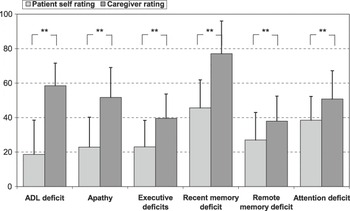
To allow comparisons of questionnaires with four- and five-point scales, the patients’ and caregivers’ total average scores for all questionnaires were transformed into percentages of the respective possible maximum. Caregivers rated deficits as significantly more severe than patients for all six scales (ADL: z = −4,92; p < .001; apathy: z = −4.40; p < .001; executive deficits: z = −3.95; p < .001; recent memory: z = −4.48; p < .001; remote memory: z = −2.98; p < .005; attention: z = −3.06; p < .005; Wilcoxon signed-rank tests, see Figure 2).
Self- and caregiver questionnaire ratings for six domains (patient and caregiver average questionnaire scores expressed as percentages of the possible questionnaire maximum with standard deviation indicated, Wilcoxon signed-rank tests, **p < .01). ADL = activities of daily living.

Correlation analysis further showed that patients’ self-ratings were not related to the caregivers’ assessment of deficits any domain (ADL: rs = .055; p = .764; apathy: rs = .136; p = .459; executive deficits: rs = .320; p = .079; recent memory: rs = .050; p = .786; remote memory: rs = .200; p = .272; attention: rs = .056; p = .762; Spearman’s rho).
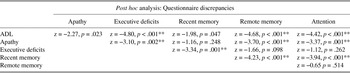
The six questionnaire discrepancies were subjected a Friedman test which indicated significant overall differences between domains (χ 2 = 52.57; p < .001). Post hoc comparisons revealed that the discrepancies for recent memory, ADL and apathy did not differ significantly; however, these were each significantly larger than the discrepancies for executive deficits, remote memory and attention, which again did not differ significantly from each other (see Table 2, cf. Figure 2).
Post hoc comparisons of questionnaire discrepancies across domains

Note
Wilcoxon signed-rank tests with a Bonferroni-corrected significance level of .003, **p < .003). ADL = activities of daily living.
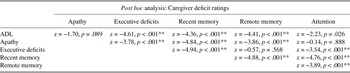
In a parallel procedure, the six caregiver ratings were examined by means of a Friedman test which, again, indicated significant overall differences between domains (χ 2 = 90.26; p < .001). Post hoc comparisons showed that caregiver deficit ratings for recent memory were significantly higher than those in any other domain. Ratings for ADL, apathy and attention deficits did not differ significantly from each other, but were higher than those for executive and remote memory deficits (see Table 3; cf. Figure 2).
Post hoc comparisons of caregiver deficit ratings across domains

Note
Wilcoxon signed-rank tests with a Bonferroni-corrected significance level of .003, **p < .003). ADL = activities of daily living.
There are thus parallels between the respective patterns of results for the analyses of questionnaire discrepancies and caregiver ratings, as both caregiver ratings and questionnaire discrepancies for recent memory, ADL and apathy are higher than those for dysexecutive behavior and remote memory. This suggests a considerable dependence of differences in questionnaire discrepancies on differences in deficit levels.
Performance Discrepancies
Patients’ performance discrepancies were significantly greater than those of the control subjects for verbal memory, the Stroop task and the alternating verbal fluency task. Group average discrepancies indicate that patients overestimated their test performance except for the concentration test. Control subjects tended to underestimate their performance, as shown by negative discrepancies for three tests (see Table 4).
Comparison of performance discrepancies

Note
ADL = activities of daily living; SD = standard deviation; **p < .01).
Correlation analyses of test performances and the respective self-assessments using Spearman’s rho revealed only a trend for the verbal fluency task among the patients while their self-assessment and test performance were otherwise uncorrelated (see Figure 3a–d). Among the control subjects, there was a low correlation between self-assessment and test performance for the Stroop task and the verbal fluency task (Verbal memory: rs = .286; p = .157; concentration: rs = −.175; p = .393; Stroop task: rs = .409; p < .05; alternating verbal fluency: rs = .489; p < .05).
a: Correlation between patient self-assessment and performance for word list learning (test performance indicated on a percentile scale). b: Correlation between patient self-assessment and performance for the concentration task (test performance indicated on a percentile scale). c: Correlation between patient self-assessment and performance for the Stroop task (test performance indicated on a percentile scale). d: Correlation between patient self-assessment and performance for the alternating verbal fluency task (test performance indicated on a percentile scale).

In a case-level analysis, patients were classified as anosognosic (performance discrepancy ≥ 2) or aware of deficits (performance discrepancy < 2) for each cognitive test. The numbers of patients who were anosognosic for one, two, three, or four domains (tests) were determined to assess how widespread anosognosia was across domains in individual patients. Three patients were excluded because of missing performance discrepancies. Of 29 patients, 4 exhibited no anosognosia, 12 were anosognosic in one, 5 in two, and 8 in three domains. However, only three cases of anosognosia occurred among 31 observations for the concentration test (as opposed to 20 cases for verbal memory, 13 for the Stroop test and 12 for verbal fluency). This virtual absence of anosognosia for the concentration test corresponds to the fact that mean performance discrepancies for the concentration test deviate from the discrepancies for the three other tests among both patients and control subjects (cf. Table 4), suggesting a ceiling effect and low level of difficulty in the concentration test.
DISCUSSION
This study intended, first, to evaluate anosognosia in AD patients by means of the three common assessment methods, so as to examine their consistency, and to extend previous findings by using a clinical rating and questionnaire discrepancies which both cover recent memory and ADL deficits. The second major objective was to investigate domain-specificity of anosognosia by means of questionnaire discrepancies across domains while taking into account the confounding influence of degree of deficit which so far has largely been neglected. The study also explored the use of performance discrepancies for different cognitive functions.
Regarding the presence of anosognosia, two-thirds of the study sample were anosognosic to some degree as indicated by clinical rating scores. The questionnaire discrepancies for ADL and recent memory and the performance discrepancies for verbal memory similarly revealed anosognosia among a majority of the AD patients. Both clinical rating and questionnaire discrepancies for ADL and recent memory were related to degree of cognitive impairment, supporting previous findings that anosognosia increases with dementia severity (e.g., McDaniel et al., Reference McDaniel, Edland and Heyman1995; Starkstein et al., Reference Starkstein, Jorge, Mizrahi and Robinson2006; Vogel et al., Reference Vogel, Hasselbalch, Gade, Ziebell and Waldemar2005).
Furthermore, the findings of our study indicate that results from clinical rating and questionnaire discrepancies are comparable as these were correlated, but that this is not the case for results obtained through either clinical rating or questionnaire discrepancies on the one hand, and performance discrepancies on the other. These findings concur with previous studies, which have consistently found correlations between clinical ratings and questionnaire discrepancies (Derouesné et al., Reference Derouesné, Thibault, Lagha-Pierucci, Baudoin-Madec, Ancri and Lacomblez1999; Howorth and Saper, Reference Howorth and Saper2003; Ott et al., Reference Ott, Lafleche, Whelihan, Buongiorno, Albert and Fogel1996; Vogel et al., Reference Vogel, Stokholm, Gade, Andersen, Hejl and Waldemar2004), but not between performance discrepancies and questionnaire discrepancies or clinical ratings (Correa et al., Reference Correa, Graves and Costa1996; Duke et al., Reference Duke, Seltzer, Seltzer and Vasterling2002; Green et al., Reference Green, Goldstein, Sirockman and Green1993; Hannesdottir and Morris, Reference Hannesdottir and Morris2007; Howorth and Saper, Reference Howorth and Saper2003). This lack of overlap may exist because different measures tap into different aspects of self-awareness which are not uniformly impaired. While questionnaire discrepancies and clinical rating rely primarily on long-term memory representations, performance assessment involves on-line monitoring and thus elicits more immediate representations of current experience (Hannesdottir and Morris, Reference Hannesdottir and Morris2007). Duke and colleagues (Reference Duke, Seltzer, Seltzer and Vasterling2002), for example, reported that AD patients retained some capacity for on-line assessment of test performance while being more clearly anosognosic as measured by questionnaire discrepancies.
Regarding domain-specificity of anosognosia, comparisons and correlation analyses of self- and caregiver questionnaire ratings suggest a degree of anosognosia across domains. More specifically, questionnaire discrepancies were especially pronounced for recent memory, followed by ADL, apathy and attention. However, this pattern is mirrored to a considerable extent in caregiver deficit ratings across domains, where deficit levels for recent memory, ADL and apathy were significantly larger than those for dysexecutive behavior, remote memory, and attention. These results indicate a substantial association between questionnaire discrepancies and deficit ratings and suggest that variations in questionnaire discrepancies may largely be due to variations in deficit levels, rather than actual differences in insight between domains. This confirms that differences in size between questionnaire discrepancies across domains should not be taken at face value, but should be considered in conjunction with deficit levels when examining domain-specificity of anosognosia.
Regarding test performance self-assessment, AD patients mostly overestimated their performance, while control subjects tended to underestimate their performance. Again, this distinction between patterns indicates anosognosia in AD patients across cognitive domains. The results also demonstrate that patients’ performance discrepancies should not be interpreted on their own, given that accurate performance assessment in healthy subjects may not be a realistic assumption.
The numbers of patients who were anosognosic in one, two or three domains as assessed by performance discrepancies indicate that individual patients do not invariably exhibit anosognosia across all domains. However, again, the degree of deficit is not controlled for in this analysis, and the number of patients with anosognosia in a given domain may depend on the number of patients who have a significant deficit in this domain.
With respect to questionnaire discrepancies, other authors have reported similar results. Both Vasterling and colleagues (Reference Vasterling, Seltzer, Foss and Vanderbrook1995, Reference Vasterling, Seltzer and Watrous1997) and Green and colleagues (Reference Green, Goldstein, Sirockman and Green1993) found anosognosia to be highest for ADL and recent memory deficits. Green and colleagues (Reference Green, Goldstein, Sirockman and Green1993) propose that apparent differences in insight between domains may be due to outdated self-evaluations resulting from memory failure in AD, which become most evident in the domains where ability decreases most markedly, that is, recent memory and ADL. The same interpretation is considered by Vasterling and colleagues (Reference Vasterling, Seltzer, Foss and Vanderbrook1995, Reference Vasterling, Seltzer and Watrous1997), who reported an increase in caregiver-rated deficits across domains over time, while patient self-ratings did not change significantly. These interpretations concur with our findings.
The only theoretical model which specifically addresses anosognosia in AD, the cognitive awareness model (CAM; Agnew and Morris, Reference Agnew and Morris1998; Morris and Hannesdottir, Reference Morris, Hannesdottir, Morris and Becker2004), postulates three possible types of anosognosia. Primary anosognosia results from damage to a parietal metacognitive awareness system. Secondary anosognosia results from either executive dysfunction, namely impaired ability to detect a discrepancy between current deficits and previously formed self-knowledge (executive anosognosia), or from memory dysfunction, which prevents updates of self-knowledge matching the development of deficits and thus results in outdated self-knowledge (mnemonic anosognosia). To date, no conclusive test of the model has been published, but Souchay (Reference Souchay2007) found that previous results are consistent with both mnemonic and executive anosognosia. The same is true for our findings: A pattern where discrepancies between self- and caregiver ratings are especially large if deficits are pronounced could be due to executive failure to detect discrepancies between experience and memory, or to failure to update self-knowledge because of memory deficits. Both failures would produce similar results in questionnaire discrepancies, as self-reports would be based on outdated self-knowledge.
However, as anosognosia was variable in our sample and the correlations between anosognosia and cognitive impairment were only moderate, no straightforward relationship between memory deficits and anosognosia should be assumed. Instead, it seems likely that anosognosia is produced by a more complex interplay of factors which can vary between individuals.
As yet, evidence concerning specific neuronal correlates of anosognosia in AD is sparse. In one study using functional magnetic resonance imaging (fMRI), however, Ries and colleagues (Reference Ries, Jabbar, Schmitz, Trivedi, Gleason and Carlsson2007) reported an association between anosognosia and diminished brain activity in the so-called cortical midline structures during self-appraisal in mild cognitive impairment, which in a significant number of cases constitutes incipient AD. Again, this association may point to a link between anosognosia in AD and memory function, as medial parietal areas are also involved in the retrieval of autobiographical memories (Cavanna and Trimble, Reference Cavanna and Trimble2006; Northoff and Bermpohl, Reference Northoff and Bermpohl2004). More research using fMRI in combination with experimental tasks may shed light on specific cognitive deficits that produce anosognosia in AD.
However, psychological factors such as personality traits and coping strategies should not be neglected altogether. Although most recent research on anosognosia in dementia has concentrated on neurocognitive deficits as the reason for impaired insight, research with a more qualitative focus suggests that expressed insight is determined by a more complex interplay of cognitive and psychosocial factors than can be captured by the assessment methods commonly used, which by themselves cannot distinguish between alternative reasons for apparent lack of insight (Clare, Reference Clare2003). Psychological factors may also account for interindividual variability in expressed insight and should thus be addressed by future research.
Methodological limitations of the present study deserve mention as the results derive from a relatively small sample. Also, the healthy control group was a convenience sample recruited from caregivers of memory clinic patients who were thus not naïve regarding the subject of the study. However, it is not evident that this should result in systematic over- or underestimation of performance and thus bias our results.
CONCLUSION
The present study is the first to explicitly discuss the problem of degree of deficit as a confound in analyses of anosognosia across domains. Results indicate that differences between questionnaire discrepancies across domains are associated with the respective levels of deficit and are thus likely to arise from a generalized impairment in insight in conjunction with varying degrees of deficit. This interpretation of our findings is consistent with theoretical conceptions of anosognosia in AD and calls into question the notion proposed in previous studies that anosognosia in AD may be genuinely domain-specific. The findings of this study also stress the importance of the methods used for assessing anosognosia. They confirm that clinical rating and questionnaire discrepancies are closely related and thus comparable, but indicate that performance discrepancies may capture different facets of insight.
ACKNOWLEDGMENTS
The authors thank Dr. Florian Siebörger for helpful comments on earlier versions of the manuscript. This work was supported by the Interdisciplinary Center of Clinical Research (IZKF) Leipzig at the Faculty of Medicine of the University of Leipzig, Germany (project C08). No author has any conflict of interest relating to this article. This manuscript and the information it contains has not previously been published electronically or in print.