Bovine milk is produced by the epithelial cells of the alveoli, the mammary gland's functional unit, which drain into interlobular ducts of increasing diameter. These drain collectively into a lactiferous sinus, the gland's cistern, proximally to the teat cistern and separated from the latter by an annular fold with an erectile venous plexus. The teat cistern extends distally from that point to the Furstenberg's rosette. The teat canal completes the mammary gland's excretory system (Couture & Mulon, Reference Couture and Moulon2005).
Intramammary infection (IMI) is defined as an infection occurring in the secretory tissue and/or the ducts and tubules of the mammary gland, which is diagnosed by microbiological culture of aseptically obtained milk samples (IDF, 1999). Colonization and/or infection of the teat canal is therefore not sufficient to be considered an IMI. True IMI leads to an increase in somatic cell count (SCC), a decrease in milk production and changes in milk composition (Seegers et al. Reference Seegers, Fourichon and Beaudeau2003).
Several studies from around the world have found that Corynebacterium bovis and coagulase-negative staphylococci are the most commonly isolated bacteria from milk samples submitted for identification of pathogens causing IMI (Wilson et al. Reference Wilson, Gonzalez and Das1997; Makovec & Ruegg, Reference Makovec and Ruegg2003; Pitkälä et al. Reference Pitkälä, Haveri, Pyörälä, Myllys and Honkanen-Buzalski2004). However, these studies also mention that when these microorganisms are isolated from milk samples, the individual quarter SCC from those samples is most often low.
The objective of this study was to evaluate the difference in bacteriology results from milk sampled in two different ways: the standard milk sampling technique and by use of a teat cannula surpassing the teat canal.
Materials and Methods
A total of 132 lactating cows from a commercial dairy farm that were free from gross signs of disease were used in this study, divided into two groups: a group that was selected randomly (n=65) and a group with SCC >200 000 cells/ml at the previous milk recording (n=67). Individual quarters were selected randomly for sampling in the former group and were selected based on having the highest California mastitis test score in the latter.
The standard milk sampling technique recommended by the National Mastitis Council (NMC) includes: 1) cleaning the teat, by removing visible dirt from the teat e.g with a paper towel; 2) discarding the first milk squirts; 3) predipping, allowing enough time for the solution to act (30 s); 4) drying the teat using an individual paper towel; 5) disinfecting the teat, with cotton wool moistened with 70% alcohol, repeating this operation until no evidence of contamination is evident; 6) milk sampling, removing the lid of the sampling container and keeping it vertical or facing downward so that there is no contamination of the container when the lid is put back on. The top of the container should be kept vertical, away from direct contact with the teat to reduce contamination. A few squirts of milk should be dispensed into the container and it should be immediately closed; 7) sample refrigeration (NMC, 1999). In our study, all the sampled quarters were forestripped, predipped with a chlorine dioxide foam (Valiant Foam-Active®, Genus Breeding Ltd, UK) for 30 s, cleaned with an individual dry udder cloth, swabbed with cotton wool soaked in 70% ethanol and allowed to dry. Each quarter was sampled twice in succession: once by use of the conventional NMC recommended technique, and additionally by insertion of a cannula through the teat canal until the teat cistern was presumably reached and milk flowed into a container held horizontally. The sampling order (conventional or alternative technique first) was selected randomly.
The teat cannula used was a 0·25-ml straw normally used for artificial insemination (IMV technologies, France) from which the plug was removed. The cannulas, 132 mm in length and 2 mm in diameter, were individually packed and sterilized by moist heat in an autoclave (121°C for 15 min). Evaluation of the most adequate cannula dimensions was first performed by insertion of different models into teat and udder specimens collected at a local abattoir.
Milk samples were transported under refrigeration to the laboratory. From each sample, 0·01 ml of milk was plated onto sheep blood agar (Columbia®, bioMérieux) and MacConkey agar (Liofilchem, Italy), incubated at 37°C and observed after 24 h and 48 h of incubation. Colonies of similar morphology were selected for isolation and identification if there was evidence of growth of ⩾500 cfu/ml. Samples yielding more than two morphologically different bacterial isolates were considered to be contaminated. Identification was made through biochemical identification systems (ID 32 Staph®, API Coryne®, API 20 Strep® and API 20 NE®, bioMérieux, France). Individual quarter SCC was determined on the sampling day and 7 d later using flow cytometry (CombiFoss®, Foss, Denmark).
Data were analysed using SPSS version 15.0 (USA). A McNemar test for paired samples was used to determine whether there were differences in the bacteriology results between the two sampling techniques. Agreement between results obtained with the two sampling methods was also sought by use of the kappa statistic. A Wilcoxon signed-rank test was applied to test for differences between individual quarter SCC on the sampling day and 7 d later. A non-parametric test was used for this parameter because the difference between quarter milk SCC between the two days did not have a normal distribution (evaluated by a Kolmogorov-Smirnov test). A two-tailed Fisher's exact probability test was used to determine whether the sampling order led to any differences in the bacteriology results. A significant difference was defined as a probability value of P<0·01.
Results
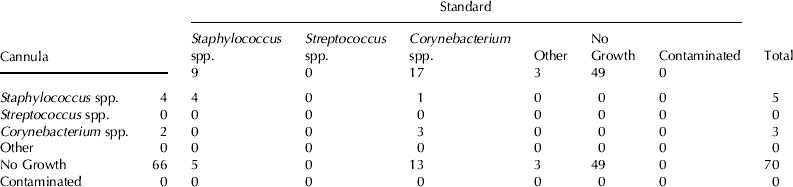
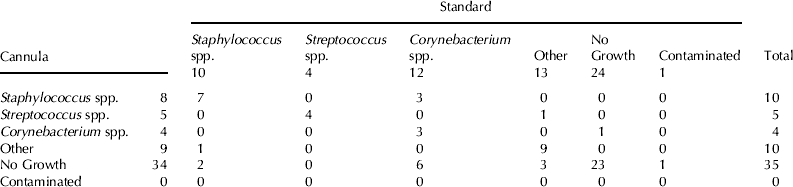
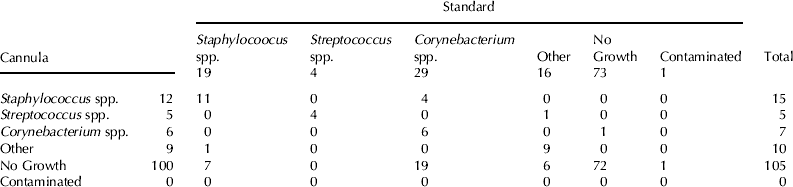
Out of the 132 quarter milk samples collected in duplicate, 72 had SCC<200 000 cells/ml and 60 had SCC above that value. Ten samples obtained with the standard technique yielded two isolates, whereas none of the samples collected with a cannula yielded more than one isolate. Use of the standard sampling technique led to the isolation of 29 Corynebacterium spp., 19 Staphylococcus spp., 4 Streptococcus spp. and 16 microorganisms from other genera; 73 samples showed no growth and 1 sample was contaminated. C. bovis was the most frequently isolated bacterial species, being isolated from 14 samples. Use of a teat cannula to sample led to the isolation of 6 Corynebacterium spp., 12 Staphylococcus spp., 5 Streptococcus spp., 9 microorganisms from other genera; 100 samples showed no growth and no sample was contaminated. C. bovis was isolated twice. The numbers of isolates found in samples collected with the standard technique and in samples collected with the cannula are presented in Table 1 (samples with SCC<200 000 cells/ml), Table 2 (samples with SCC>200 000 cells/ml) and Table 3 (all the samples). Out of the 60 quarter milk samples with SCC>200 000 cells/ml, microorganisms were isolated from samples collected with the standard technique but not from the corresponding samples collected with a cannula on 5 occasions. These microorganisms included Staph. chromogenes, Staph. hyicus, Kocuria rosae, Aerococcus viridans and a yeast that was not identified biochemically.
Comparison of numbers of isolates obtained with the standard sampling technique (columns) and with a cannula (rows) for samples with SCC<200 000 cells/ml (n=72)

Comparison of numbers of isolates obtained with the standard sampling technique (columns) and with a cannula (rows) for samples with SCC >200 000 cells/ml (n=60)

Comparison of numbers of isolates obtained with the standard sampling technique (columns) and with a cannula (rows) for the total number of samples (n=132)

The McNemar test for paired samples showed a statistically significant difference between the two sampling techniques in the number of Corynebacterium spp. isolated and in the number of samples that were culture negative, for both SCC groups and in total. There was a difference that approached significance for staphylococci in the group of samples <200 000 cells/ml and for the total samples. Kappa values were lowest for Corynebacterium spp. across the three SCC groups, except for the ‘Other’ category of microorganisms in the <200 000 cells/ml group (Table 4).
Probabaility values (P) for the McNemar test and Kappa values (K) comparing the two sampling methods in terms of isolated microorganisms, for samples with SCC <200 000 cells/ml, >200 000 cells/ml and for the total number of samples

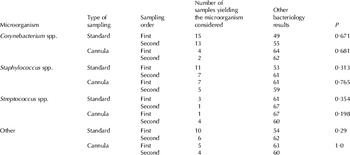
Milk sampling was performed on 68 quarters using the teat cannula technique before the standard technique, and on 64 samples using the standard technique ahead of the cannula technique. Performing a two-tailed Fisher's exact probability test to compare the number of samples from which the several groups of microorganisms were isolated with the two alternative sampling orders, revealed that there was no statistically significant difference between them (Table 5).
Comparison of sampling order in terms of number of samples from which Corynebacterium spp., Staphylococcus spp., Streptococcus spp. and other microorganisms were isolated and respective P values for a two-tailed Fisher's exact probability test

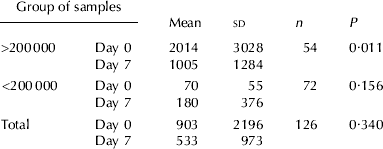
Individual quarter SCC was measured on the sampling day and repeated 7 d later for 126 out of the 132 quarters sampled in the study. There was an increase from below to above 200 000 cells/ml in 13 quarters between the two sampling dates, and a decrease from above to below that value in 12 quarters. Performing a Wilcoxon signed-rank test showed that there was a significant decrease of the mean SCC recorded between initial sampling and sampling 7 d later for the group of samples above 200 000 cells/ml on the initial sampling day; no significant differences were observed for the group of samples that initially were below 200 000 cells/ml and for the totality of samples (Table 6). No clinical mastitis cases were recorded during the period between sampling dates.
Comparison of individual quarter SCC arithmetic means between the sampling day and 7 d later for the groups of quarters that on the initial sampling day had SCC> 200 000 cells/ml, <200 000 cells/ml and for all the samples

Discussion
There was a significant difference in the recovery of Corynebacterium spp. from milk samples collected with the standard technique and with a cannula surpassing the teat canal. This difference was observed for all samples, regardless of having SCC values above or below 200 000 cells/ml. There was also a significant difference between the two sampling techniques in the number of samples yielding no growth, probably a reflection of samples yielding Corynebacterium spp. when collected with the standard technique, and leading to no growth when sampling with the alternative technique. No significant difference was observed between the two sampling techniques for recovery rates of staphylococci, streptococci and ‘other’ microorganisms, despite a difference approaching significance for staphylococci in the group of samples <200 000 cells/ml and overall. Kappa values were lowest for the samples yielding Corynebacterium spp., except for the ‘other’ microorganisms in samples<200 000 cells/ml, which is probably a reflection of a lower environmental contamination when the teat cannula was used. Kappa values for samples yielding staphylococci, ‘other’ microorganisms and streptococci in samples >200 000 cells/ml were 0·74, 0·78 and 0·88 respectively, corresponding to substantial agreement between the two sampling methods for staphylococci and microorganisms from other genera, and to almost perfect agreement for the streptococci.
The observed differences in bacterial isolation rates are probably due to the fact that collecting milk samples with a cannula that surpasses the teat canal avoids contamination of the milk samples with teat canal flora. This way, only microorganisms present in the teat cistern and beyond, more likely to cause true IMI, are isolated. Several large scale studies have reported C. bovis as one of the most frequently isolated bacteria from milk samples submitted for bacteriology (Wilson et al. Reference Wilson, Gonzalez and Das1997; Makovec & Ruegg, Reference Makovec and Ruegg2003; Pitkälä et al. Reference Pitkälä, Haveri, Pyörälä, Myllys and Honkanen-Buzalski2004). However, Black et al. (Reference Black, Marshall and Bourland1972) reported that C. bovis occurred mostly in the teat canal and was seldom recovered from the teat cistern. Honkanen-Buzalski & Bramley (Reference Honkanen-Buzalski and Bramley1984) described an experimental infection with C. bovis that did not produce any clinical mastitis and in which 44% of the infections were limited to the teat canal. Despite the time that has elapsed since these articles were published, the milk sampling technique to detect IMI-causing pathogens has not changed. This means that potentially, over the years, we have been performing bacteriology to detect both bacteria that populate the teat canal and pathogens that truly cause IMI.
To test the hypothesis that the sampling order could influence the results, we collected approximately half the samples with the standard technique before the alternative technique and the other half using the alternative technique before collecting milk with the standard technique. One could consider that sampling conventionally after sampling with a cannula might lead to higher levels of infection because of a physical action of pushing Corynebacterium spp. upwards with a cannula. Alternatively one might think that when the cannula technique was used after the standard technique, the isolation of Corynebacterium spp. would be lower because we had previously reduced their level by physically flushing bacteria out with the milk. In fact, no statistically significant difference between the two sampling orders was observed in the number of times that Corynebacterium spp. or other groups of microorganisms were isolated. Therefore, the observed difference between the two sampling techniques was not influenced by a particular sampling order.
Another concern with the use of a cannula to collect milk samples was the possibility of the iatrogenic introduction of pathogens into the gland cistern, potentially leading to IMI. The fact that sampling took place immediately before milking, with several litres of milk passing through each gland cistern, was thought to contribute to the safety of the alternative technique. To test that hypothesis we performed individual quarter SCC on the sampling day and 7 d later to determine whether there had been an increase that could be attributed to a recent infection. Overall there was a non-significant decrease in the SCC between the initial sampling day and 7 d later (P=0·34). In the group of sampled quarters that were >200 000 cells/ml on the initial sampling day, there was a significant decrease in mean SCC (P=0·01), whereas in the group of quarters that was below that value, there was a non-significant increase (P=0·16), with the mean SCC on the second sampling date still being <200 000 cells/ml. The significant decrease in SCC between the two sampling dates can potentially be explained by a proportion of animals self-curing during that time period. A similar number of quarter samples crossed the 200 000 cells/ml threshold: 13 samples increased to above that value, whereas 12 samples decreased to below that value. A 7-d interval was considered appropriate to detect iatrogenic increases in SCC, albeit some IMIs might lead to more transient rises in SCC (de Haas et al. Reference de Haas, Veerkamp, Barkema, Gröhn and Schukken2004). Collecting milk samples with the alternative technique did not have an obvious negative impact on SCC. This issue needs further addressing in a future larger scale study, probably completed with bacteriology on further sampling dates and use of a DNA fingerprinting technique to compare before and after results.
Our results suggest a negligible loss in the recovery of potential pathogens other than Corynebacterium spp. with the use of teat cannula. On 5 samples with a SCC>200 000 cells/ml there was no recovery of microorganisms using the cannula, whereas there had been with the standard technique. However, it is difficult to know whether the microorganisms involved (Staph. chromogenes, Staph. hyicus, Kocuria rosae, Aerococcus viridans and a yeast) were truly responsible for IMI or if they were merely contaminants.
We do not wish to dispute the fact that C. bovis may cause IMI, because there is evidence of that from experimental infection (Honkanen-Buzalski & Bramley, Reference Honkanen-Buzalski and Bramley1984) and the mean SCC recorded in milk samples from which it is isolated, despite being low, is higher than the mean SCC recorded in milk samples yielding no growth (Wilson et al. Reference Wilson, Gonzalez and Das1997). However, C. bovis infection does not often go beyond the teat canal (Black et al. Reference Black, Marshall and Bourland1972; Honkanen-Buzalski & Bramley, Reference Honkanen-Buzalski and Bramley1984), which needs to be taken into account when sampling or interpreting bacteriology results. In fact, 35% of milk samples from which only C. bovis is isolated by conventional bacteriology, have been shown to harbour other mastitis pathogens (R Bexiga et al. unpublished observations). Collecting milk samples for bacteriology using a teat cannula could help elucidate the relevance of Corynebacterium spp. on farms where this microorganism is isolated from a large proportion of milk samples, ruling out possible teat canal colonization rather than true IMI.
R Bexiga holds grant number SFRH/BD/36759/2007 from the Foundation for Science and Technology. The financial support of the Interdisciplinary Centre of Research in Animal Health from the Faculty of Veterinary Medicina, Technical University of Lisbon (CIISA/FMV-UTL) is gratefully acknowledged. The authors also thank the farmer and practitioner for access to the farm.