1. Introduction
Ostracods appear first in the earliest Ordovician Tremadocian (Tinn & Meidla, Reference Tinn and Meidla2004; Salas, Vannier & Williams, Reference Salas, Vannier and Williams2007; Williams et al. Reference Williams, Siveter, Salas, Vannier, Popov and Ghoubadi Pour2008) and had a global distribution from the Floian Stage onwards. The group occurs in all the major palaeocontinental regions of the Ordovician (Schallreuter & Siveter, Reference Schallreuter and Siveter1985; Vannier, Siveter & Schallreuter, Reference Vannier, Siveter and Schallreuter1989), where they are characteristic of benthic neritic habitats. Prior to the Silurian, ostracods do not appear to have adopted a pelagic lifestyle (Siveter, Vannier & Palmer, Reference Siveter, Vannier and Palmer1991), and may have had limited intercontinental dispersal capability. They are therefore useful for defining the relative palaeogeographic positions of Ordovician continents (Schallreuter & Siveter, Reference Schallreuter and Siveter1985).
Despite being documented from the middle part of the nineteenth century onwards, the Ordovician ostracods of Scotland are poorly known. This contrasts markedly with the more detailed studies of their southern British counterparts, which are known from the Ordovician of Wales, the Welsh Borderland and northern England (e.g. Siveter, Reference Siveter, Bate and Robinson1978, Reference Siveter, Whittaker and Hart2009; Jones, Reference Jones1986, Reference Jones1987; Williams et al. Reference Williams, Floyd, Salas, Siveter, Stone and Vannier2003). In part, the lack of study reflects the mostly poor preservation of much of the Scottish fauna and also the difficulty of recovering ostracods from highly tectonized rocks. Nevertheless, the Ordovician ostracods of Scotland have wide occurrence (Williams et al. Reference Williams, Floyd, Siveter and Miller2001a), with the most extensive faunas being recorded from the Girvan district in the southwest of the country (Jones, Reference Jones, Nicholson and Etheridge1879, Reference Jones1893; Siveter, Reference Siveter, Bate and Robinson1978; Siveter & Curry, Reference Siveter, Curry, Curry, Bluck, Burton, Ingham, Siveter and Williams1984; Floyd, Williams & Rushton, Reference Floyd, Williams and Rushton1999; Williams & Floyd, Reference Williams and Floyd2000; Williams et al. Reference Williams, Floyd, Siveter and Miller2001a). Recent work on the Girvan faunas has documented their biostratigraphic, palaeoecological and palaeogeographic significance (Williams et al. Reference Williams, Floyd, Siveter and Miller2001a). The best preserved faunas comprise ‘crack-out’ material from carbonates. Mould material from clastic rocks (e.g. Floyd, Williams & Rushton, Reference Floyd, Williams and Rushton1999) and silicified material from limestones (e.g. Siveter & Curry, Reference Siveter, Curry, Curry, Bluck, Burton, Ingham, Siveter and Williams1984) are also reported. In some instances the ostracods co-occur with graptolites, thus allowing precise stratigraphic control on their temporal distribution.
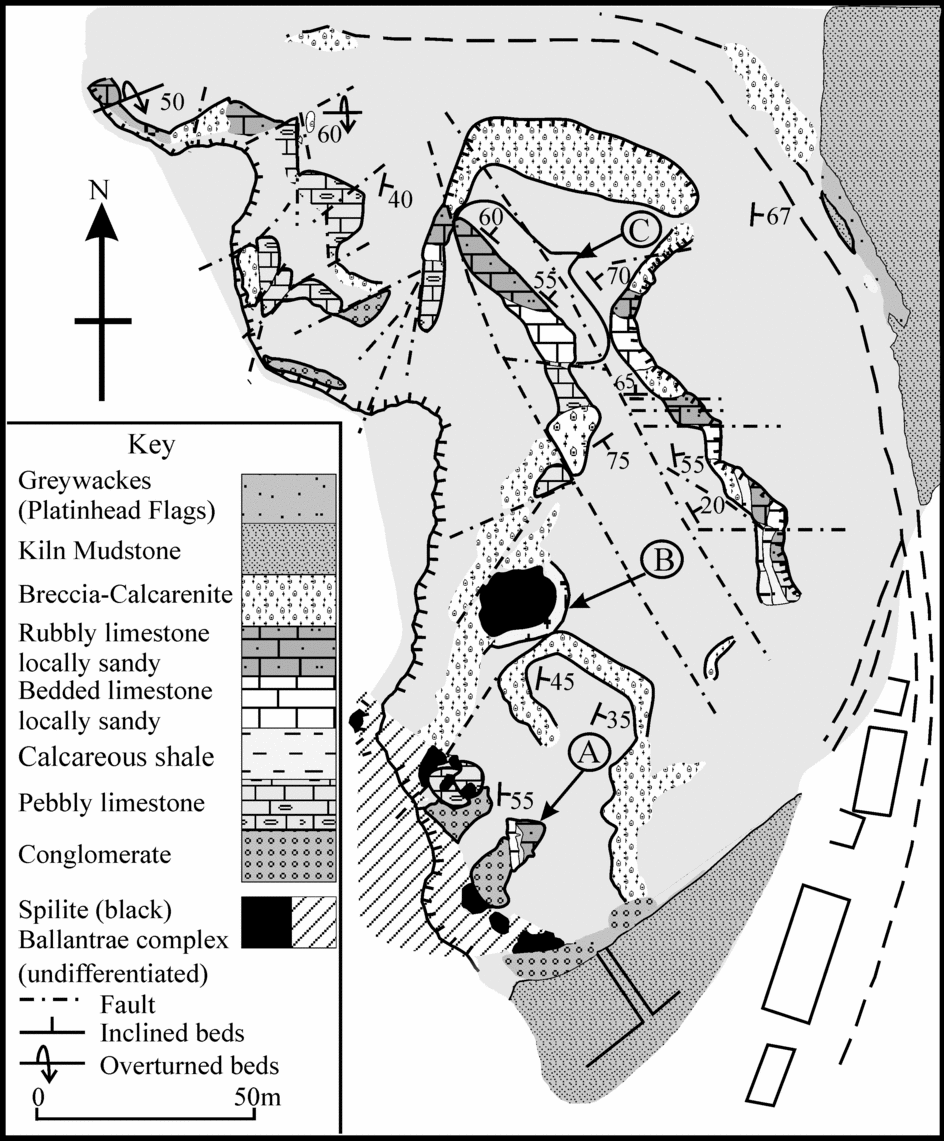
Williams & Floyd (Reference Williams and Floyd2000) briefly documented an ostracod-bearing horizon at a single locality in the Craighead Limestone Formation of the Girvan district (Fig. 1: locality A). The fauna was numerically dominated by palaeocopes, especially Oepikella, and had similarities at species level with assemblages from North America. In the present paper we describe a much more extensive ostracod fauna from fourteen sampled limestone-shale horizons in the northernmost outcrop of the Craighead Limestone Formation at Craighead Quarry, and from one site in massive limestones in the centre of the quarry (Fig. 1). These faunas, among the best preserved from the Scottish Ordovician, are quite different from those described by Williams & Floyd (Reference Williams and Floyd2000). Herein we: (a) identify the systematic relationships of the fauna including the description of a new species; (b) establish the environmental range of the ostracods across four different carbonate lithofacies in the Craighead Limestone Formation; (c) document the temporal distribution of the ostracods and compare their ranges with faunas from North America and Scandinavia; and (d) elucidate the biogeographic significance of key elements of the fauna.
Geological map of Craighead Quarry (redrawn from Williams, Reference Williams1962). ‘A’, fossil locality of Williams & Floyd (Reference Williams and Floyd2000); ‘B’ and ‘C’, new localities. Locality C, from which 14 samples were taken, yields 18 ostracod species from interbedded mudstone and limestone. Grey shading represents the sub-crop of the Craighead Limestone Formation. Numbers next to inclined beds represent degree of inclination.

2. Geological setting of the Craighead Limestone Formation
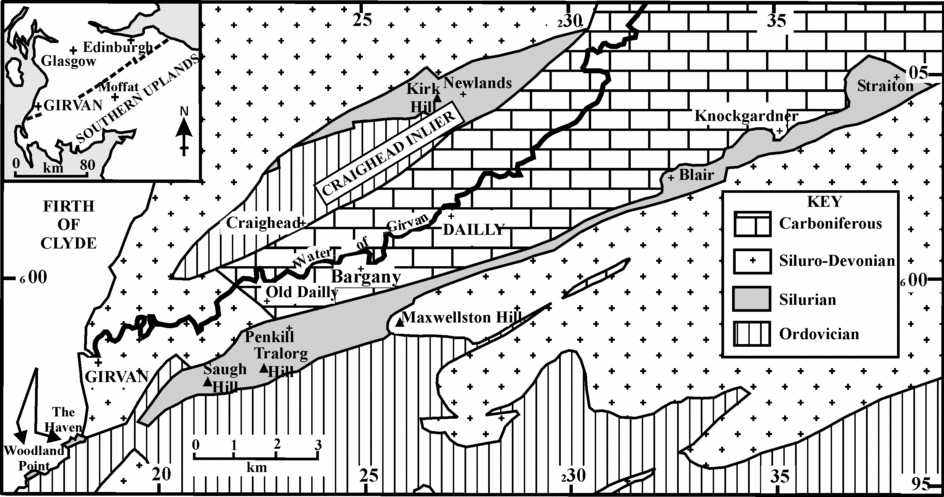
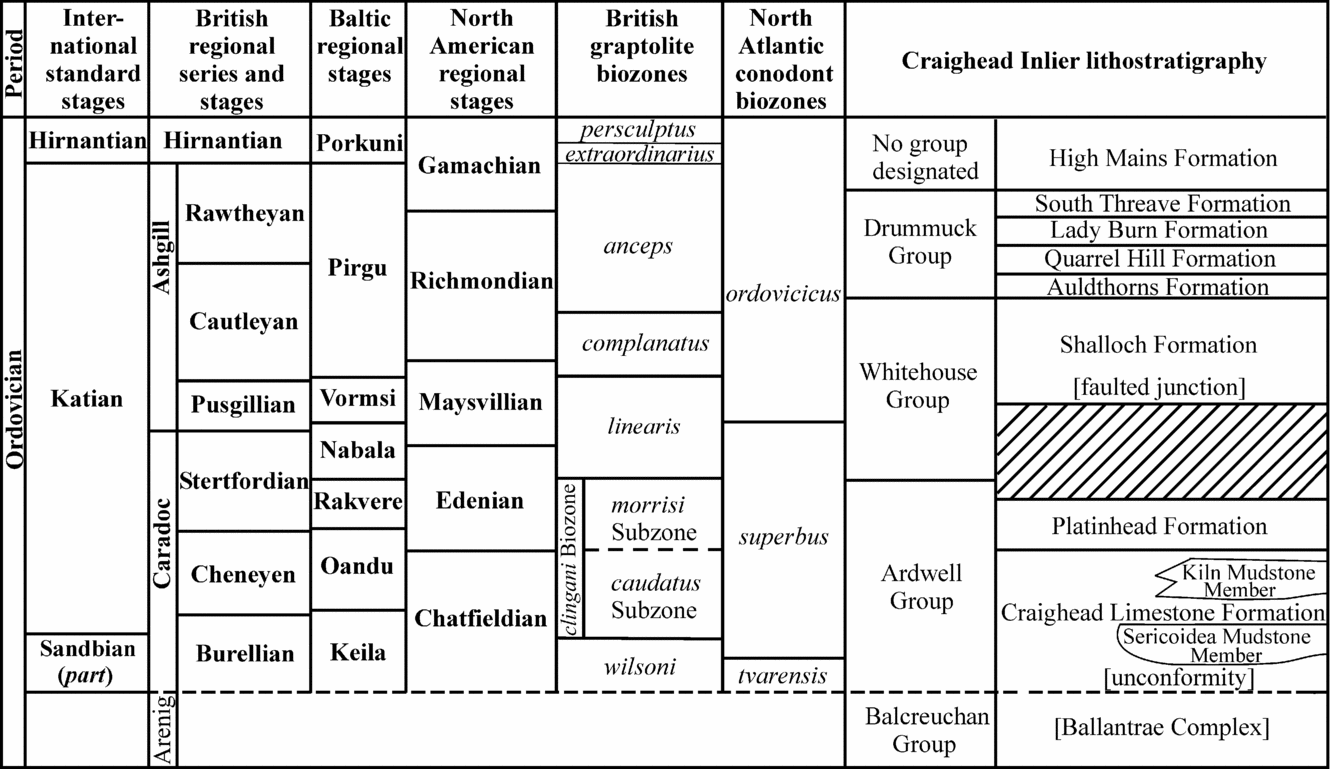
The Craighead Inlier forms a lenticular area some 12 km by 2 km of Ordovician–Silurian marine sedimentary and volcanic rocks that are isolated from the main Lower Palaeozoic outcrop at Girvan, southwest Scotland (Fig. 2). The Inlier forms a gently NE-plunging anticline bounded on its southeast side by the Kerse Loch Fault and is unconformably overlain to the northwest by sandstones and conglomerates of the Lower Old Red Sandstone (Upper Silurian–lower Devonian). The oldest rocks of the Inlier comprise spilitic pillow lavas which may be as old as the Floian-age Ballantrae Complex to the south, but could be as young as Sandbian (Williams & Floyd, Reference Williams and Floyd2000). These are unconformably overlain by a Katian–Llandovery succession of shallow marine limestones and clastic sedimentary rocks (Fig. 3) which have yielded a great abundance and variety of macrofauna and microfauna (e.g. Williams, Reference Williams1962; Harper, Reference Harper1982; Bergström, Reference Bergström1990; Floyd & Williams, Reference Floyd and Williams2003).
Geological map of the Craighead Inlier (after Williams & Floyd, Reference Williams and Floyd2000). British National Grid coordinates shown.

Ordovician stratigraphy of the Craighead Inlier (modified after Williams & Floyd, Reference Williams and Floyd2000).

3. Materials and Methods
The new ostracod material comes from 14 sampled horizons of mudstones interbedded with thin-bedded limestones at the north end of the quarry (Fig. 1: locality C). Both the limestones and mudstones have been investigated for ostracod content. We have also re-sampled ostracod material from limestone at the locality described by Williams & Floyd (Reference Williams and Floyd2000), and recovered a single ostracod specimen from the massive limestones in the middle of the quarry (Fig. 1: locality B). Most of the limestone exposure in the quarry is now inaccessible, especially the high faces in the centre of the quarry (Fig. 1), and this has directed our sampling strategy to those parts of the quarry where rock is recoverable.
Mudstones from the Craighead Limestone Formation were treated with a 10 % solution of H2O2 in cold water, left for one day, wet-sieved with 1 mm, 500 μm and 250 μm sieves, dried and the residues picked for ostracods under a WILD M8 binocular microscope. The ostracods were then mounted on aluminium stubs, coated with gold/silver alloy and imaged using a HITACHI S-3600N scanning electron microscope (SEM). Lateral stereo-pairs were captured with 0 and 10° tilt angles; ventral and dorsal stereo-pairs were captured with 0 and 6° tilt angles (see Sylvester-Bradley (Reference Sylvester-Bradley and Heywood1971) for methodology). Ostracods from the locality of Williams & Floyd (Reference Williams and Floyd2000; see Fig. 1: locality A) have been extracted as ‘crack-out’ material from small limestone blocks and prepared mechanically with needles. Limestones from all localities sampled have been made into polished thin-sections for petrological study. All of the material is deposited in the collections of the British Geological Survey, Keyworth, Nottingham, UK, except GLAHM A1382 and GLAHM A1379, which are deposited in the Hunterian Museum of Glasgow University.
4. Preservation of the ostracods
The Ordovician ostracods of the Craighead Limestone Formation represent calcitic crack-out material and calcitic valves recovered from mudstones. Ostracods from the Kiln Mudstone and the Sericoidea Mudstone members that are associated with the Craighead Limestone Formation (Fig. 3) are preserved mostly as internal moulds (Williams & Floyd, Reference Williams and Floyd2000), while the accompanying brachiopods and trilobites are mostly well preserved (Tripp, Reference Tripp1980). Ostracods preserved as moulds is a common type of preservation in much of the Ordovician succession of Scotland (e.g. Lady Burn Formation, Lower Ardwell Flags, Stinchar Limestone, Balclatchie Group; see Williams et al. Reference Williams, Floyd, Siveter and Miller2001a; Siveter, Reference Siveter, Whittaker and Hart2009) and is also common in England and Wales (see Jones, Reference Jones1986, Reference Jones1987). The ostracods from carbonates of the Craighead Limestone Formation (Fig. 1: locality A) preserve fine details of the original shell ornament. This type of preservation is common in North American Ordovician carbonates and calcareous mudstones (e.g. Williams & Siveter, Reference Williams and Siveter1996) and in similar lithologies of the Baltic region (e.g. Meidla, Reference Meidla1996) but rare in the Ordovician of Scotland. It is found elsewhere in Scotland only in the Stinchar Limestone at Aldons Quarry and from a limestone clast in the Kirkcolm Formation of the Southern Uplands Terrane (Williams et al. Reference Williams, Floyd, Siveter and Miller2001a). The ostracods from the mudstones interbedded with thin-bedded limestones yield calcitic valves that range from good to moderate preservation. In some cases the shells have suffered dissolution so that fine details have been lost.
5. Lithofacies of the Craighead Limestone Formation
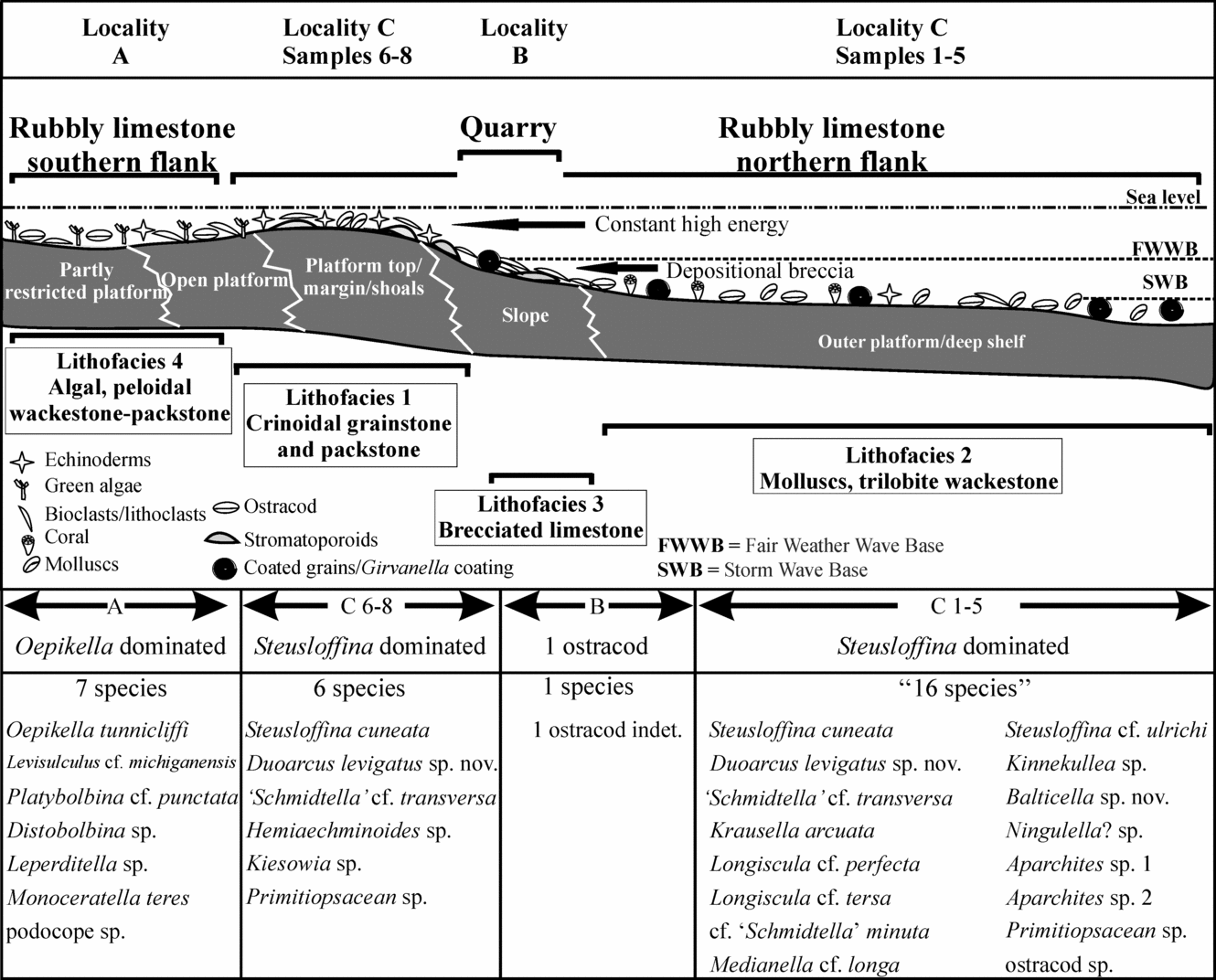
A detailed lithofacies analysis of the Craighead Limestone Formation has not previously been undertaken and most depositional interpretations are founded on field-based lithofacies relationships (e.g. Williams, Reference Williams1962; Tripp, Reference Tripp1980; Bergström, Reference Bergström1990; Ingham, Reference Ingham, Lawson and Weedon1992; Williams & Floyd, Reference Williams and Floyd2000). The lithofacies analysis herein embraces those areas of limestone in the quarry that can still be sampled and does not represent an account of the entire sedimentology of the Craighead Limestone Formation. It nevertheless identifies four facies types that denote open platform-margin (Lithofacies 1), outer platform/deep shelf (Lithofacies 2), slope (Lithofacies 3) and partly restricted platform settings (Lithofacies 4). Detailed descriptions of these lithofacies and their individual interpretations are presented in Appendix 1 and summarized in Figure 4. The four different lithofacies types identified are partly restricted to deeper settings, and indicate that the carbonate platform evolved both shallower and deeper marine environments, with both low to high-energy regimes hosting different biota (Fig. 4). Because of the structural complexity in the quarry (Fig. 1), we cannot be exactly sure how these facies relate to each other in space and time, though those of the northern end of the quarry clearly record deeper marine facies that might be suggestive of a marine transgression. In contrast, the rubbly limestone in the southern flank of the quarry (Fig. 1: locality A) records a low-diversity biota in perhaps the shallowest marine environment represented.
Palaeoenvironmental model for the limestone horizons of the Craighead Limestone Formation at Craighead Quarry. For location of limestone horizons see Figure 1. For additional information on the four lithofacies see Figure 11 and Appendix 1.

6. Ostracod palaeoecology
Modern marine ostracods are predominantly benthic with high diversity in marine shelf habitats. Their biodiversity decreases in very shallow and very deep shelf marine environments (e.g. Ulst, Gailite & Yakovleva, Reference Ulst, Gailite and Yakovleva1982; Stepanova et al. Reference Stepanova, Taldenkova, Simstich and Bauch2007). Following the principle of uniformitarianism the same patterns may be expected in the Palaeozoic. Similarly, ostracod diversity is low in very shallow and deep shelf environments in the Ordovician (Copeland, Reference Copeland1982; Vannier, Siveter & Schallreuter, Reference Vannier, Siveter and Schallreuter1989; Williams & Siveter, Reference Williams and Siveter1996; Williams et al. Reference Williams, Floyd, Salas, Siveter, Stone and Vannier2003) as well as the Silurian (Siveter, Reference Siveter and Bassett1984). Ordovician ostracods were possibly entirely neritic (Williams et al. Reference Williams, Floyd, Salas, Siveter, Stone and Vannier2003) and are useful environmental indicators, with some taxa being restricted to shallow marine environments (e.g. the Leperditella ostracod association of Williams & Siveter (Reference Williams and Siveter1996), and some taxa restricted to the deep shelf (Copeland, Reference Copeland1982)). Copeland (Reference Copeland1982) identified bathymetrically controlled ostracod biofacies in the Ordovician Lower Esbataottine Formation of Canada by comparison with the associated trilobite fauna. He distinguished two ostracod assemblages, one restricted to a deeper shelf marine environment and the other tolerant of a wide range of water depths from shallow to deeper shelf, perhaps equivalent, at least in part, to the Anisocyamus ostracod association of the Bromide Formation of Oklahoma (Williams & Siveter, Reference Williams and Siveter1996).
In the Craighead Limestone Formation, samples were collected on the basis of accessibility and maximum sediment yield; some parts of the quarry are inaccessible, and in addition, some areas of massive limestone are extremely difficult to sample for ostracods. Nevertheless, we can identify that ostracods occur in at least four lithofacies. The most diverse faunas occur in the limestones of the southern end of the quarry at locality A (Fig. 1: locality A, Fig. 4) and from two lithofacies associations at the northern end of the quarry (Fig. 1: locality C, Figs 4, 5). The ostracods associated with these lithofacies of the southern and northern parts of the quarry are quite distinctive, most likely reflecting adaptations to specific environments, rather than temporally discrete assemblages. Graptolite and other faunal evidence suggests the Craighead Limestone Formation was deposited entirely within the early Katian (Tripp, Reference Tripp1980). Of the 25 ostracod species herein recorded from the Craighead Limestone Formation, seven are present in the limestones at the southern end of the quarry (Fig. 1: locality A, Fig. 4), and the remainder are from the northern end of the quarry (Fig. 1: locality C, Figs 4, 5). The ostracods from the limestones of the southern end of the quarry are dominated by the palaeocope Oepikella and form a ‘shallow marine low-diversity assemblage’, while those obtained from the northern end of the quarry are characterized by Steusloffina and define a ‘high-diversity open marine assemblage’.
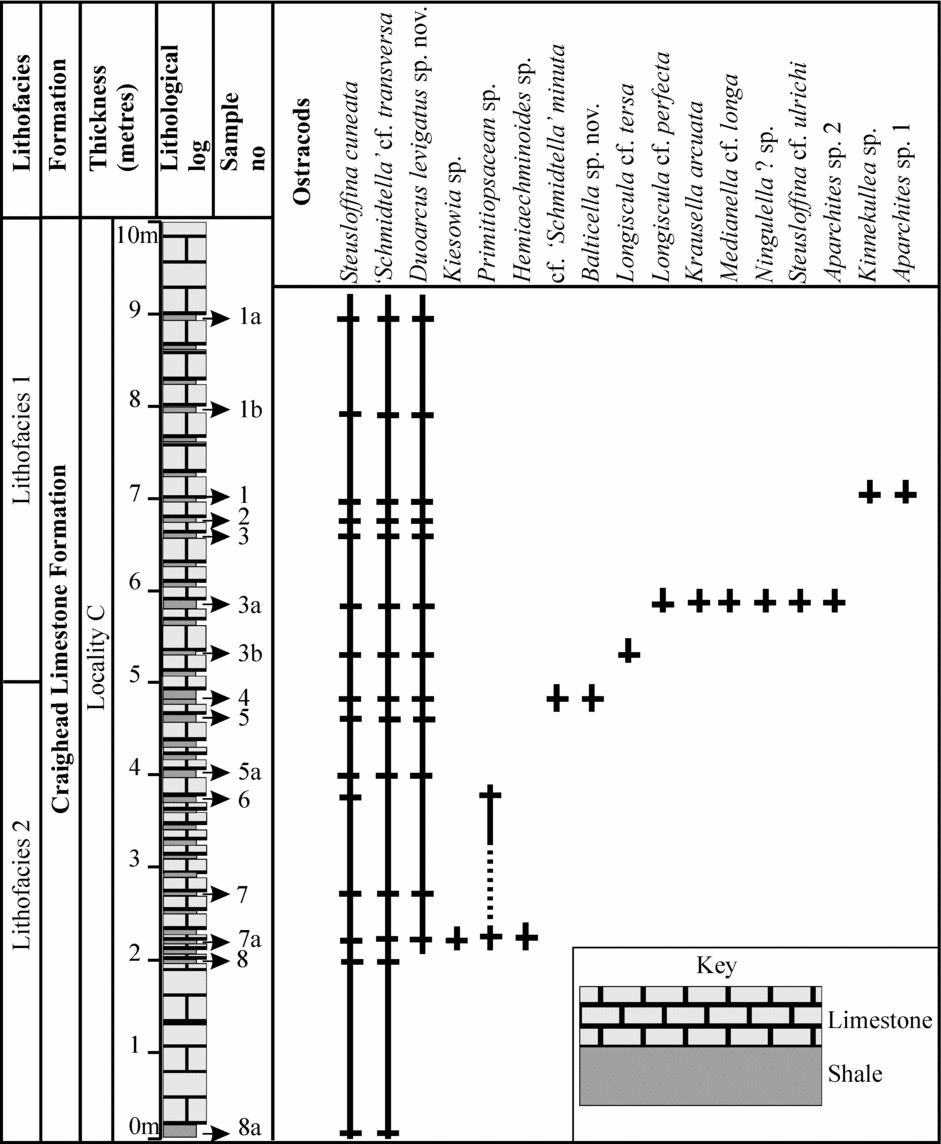
Stratigraphic distribution of ostracods in the mudstones interbedded with thin-bedded limestones at the northern end of Craighead Quarry (Fig. 1: locality C).

6.a. Shallow marine low-diversity ostracod assemblage
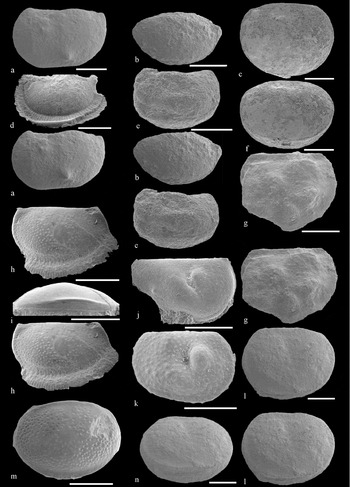
This assemblage is present only in the limestones at the southern end of the quarry (Fig. 1: locality A) and is characterized by Oepikella tunnicliffi. It is dominated by palaeocopes, especially Oepikella (Fig. 4), and includes species of Platybolbina, Distobolbina, Leperditella and Levisulculus (see Fig. 6). The podocope Monoceratella teres also occurs. This assemblage occurs in a lithofacies representing a shallow platform with restricted open marine influence (Fig. 4). Petrological data (Fig. 4 and Appendix 1) indicate overall low biotic diversity dominated by (fragments of disarticulated) molluscs, trilobites, highly neomorphosed echinoderms, and green algae (dasycladaceans). The elements of this shallow marine assemblage are absent from the lithofacies of the northern part of the quarry, where thin-bedded shales and limestone formed in more open marine shelf environments of the carbonate platform. This shallow marine ostracod assemblage bears similarity to the low-diversity Leperditella ostracod association of the Bromide Formation of Oklahoma (Williams & Siveter, Reference Williams and Siveter1996) that comprises a distinctly different (both taxonomically and in terms of diversity) assemblage from the contemporaneous open marine shelf ostracods of the Bromide Formation.
Ordovician ostracods from the Craighead Limestone Formation. (a) MPA49672, Balticella sp. nov., carapace, left lateral view (stereo-pair). (b) GSE15341, ‘Schmidtella’ cf. transversa Harris, Reference Harris1957, carapace, right lateral view (stereo-pair). (c, f) GSE15342, Aparchites sp. 1, carapace, right lateral and oblique lateral views. (d) GLAHM A1382, Platybolbina cf. punctata (Kraft, Reference Kraft1962), tecnomorph left valve, lateral view. (e) GSE15343, Kinnekullea sp., carapace, right lateral view (stereo-pair). (g) GSE15344, Kiesowia sp., carapace, left lateral view (stereo-pair). (h, i, m) Oepikella tunnicliffi, Williams & Floyd, Reference Williams and Floyd2000: (h) BGS 16E1961, holotype, heteromorphic right valve, lateral view (stereo-pair); (i) BGS 16E1967, juvenile tecnomorphic valve, ventral view; (m) BGS 16E1965 tecnomorph right valve, lateral view. (j) BGS 16E1960, Levisulculus cf. michiganensis Kesling, Reference Kesling1960a, right valve, lateral view. (l, n) GSE15345, Primitiopsacean sp., carapace, right lateral (stereo-pair) and oblique lateral views. This species is characterized by a well-developed velum and weakly developed sulcus and plica. (k) BGS 16E1958, Distobolbina sp., tecnomorph right valve, lateral view. (a, c, f) Scale bar 500 μm; (b) scale bar 300 μm; (d) scale bar 750 μm; (e) scale bar 250 μm; (g) scale bar 300 μm; (h, m) scale bar 1000 μm; (i) scale bar 750 μm; (j) scale bar 430 μm; (k) scale bar 380 μm; (l, n) scale bar 500 μm.

6.b. Open marine high-diversity ostracod assemblage
This assemblage is characterized by the common occurrence of Steusloffina. It is present throughout the interbedded shales and limestones of the northern end of the quarry (Fig. 1: locality C; Figs 6, 7, 8) that represent a marine-facing shallow to deeper platform margin setting. This assemblage shows overall relatively high diversity (18 species) and is dominated by podocopes and leiocopes with some binodicopes and palaeocopes (Figs 4–8). Steusloffina cuneata, Duoarcus levigatus gen. et sp. nov. and ‘Schmidtella’ cf. transversa are abundant in both the shallow and deeper platform settings. Rare Kiesowia sp. and Hemiaechminoides sp., both reported for the first time from Scotland, occur only in the shallower platform margin, whereas most of the other species are present only in the deeper platform. The diversity of podocopes and leiocopes is high, while palaeocopes and binodicopes are less common. This open marine assemblage bears similarity to the Anisocyamus ostracod association of Williams & Siveter (Reference Williams and Siveter1996) in the Bromide Formation of Oklahoma, both of which have species of Aparchites, Schmidtella, Krausella and Balticella. The associated fauna recorded from the limestone is of high diversity and comprises echinoderms, brachiopods, bivalves, gastropods, trilobites, stromatoporoids, bryozoans and the alga Girvanella, the shallow platform margin being dominated by crinoids and the deep shelf dominated by molluscs and trilobites. This ostracod assemblage is quite distinct from the carbonate lithofacies deposited in the restricted lagoonal environment of the platform (Fig. 4).
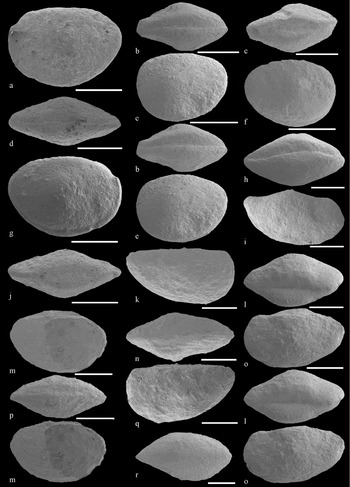
Ordovician ostracods from the Craighead Limestone Formation. (a, d, g, j) GSE15346, cf. ‘Schmidtella’ minuta Harris, Reference Harris1957, carapace, left lateral, ventral, right lateral and dorsal views. This species has characteristic ovate lateral outline, asymmetric valves, and the left valve strongly overlaps the smaller right valve along the entire free margin. (f, e, b, c) Duoarcus levigatus gen. et sp. nov. (f) GSE15347, carapace, right lateral view; (e) GSE15348 (holotype), carapace, left lateral view (stereo-pair); (b) GSE15349, carapace, ventral view (stereo-pair); (c) GSE15350, carapace, dorsal view. This species closely resembles ‘Hyperchilarina’ angularis Harris, Reference Harris1957 from the Tulip Creek Formation of Oklahoma (probably at a stratigraphic level slightly older than our material). (h, i, l, o) Steusloffina cuneata (Steusloff, Reference Steusloff1895). (h) GSE15351, carapace, ventral view; (i) GSE15352, carapace, right lateral view; (l) GSE15353, carapace, dorsal view (stereo-pair); (o) GSE15354, carapace, left lateral view (stereo-pair). (m, p, r) ‘Schmidtella’ cf. transversa Harris, Reference Harris1957. (m) GSE15355, carapace, left lateral view (stereo-pair); (p) GSE15356, carapace, ventral view; (r) GSE15357, carapace, dorsal view. (k, n, q) GSE15358, Steusloffina cf. ulrichi Teichert, Reference Teichert1937, carapace, right lateral, ventral and left lateral views. (a–j, l, o) Scale bar 500 μm; (m, p, r, k, n, q) scale bar 200 μm.

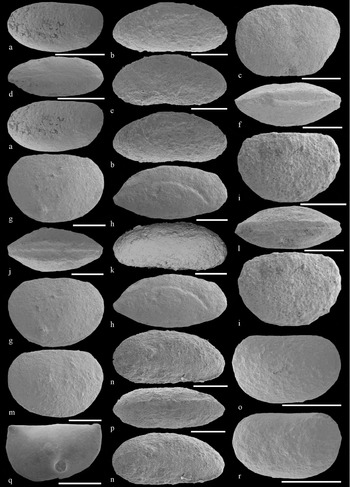
Ordovician ostracods from the Craighead Limestone Formation. (a, d) GSE15359, Medianella cf. longa (Stumbur, Reference Stumbur1956), carapace, left lateral (stereo-pair) and ventral views. (b, e) GSE15360, Longiscula cf. perfecta Meidla, Reference Meidla1993, carapace, left lateral (stereo-pair) and right lateral views. (c, f, l) GSE15361, ostracod sp., carapace, lateral, dorsal and ventral views. (i) GSE15362, Hemiaechminoides sp., carapace, left lateral view (stereo-pair). (g, j, m) GSE15363, Aparchites sp. 2, carapace, left lateral (stereo-pair), ventral and right lateral views respectively. (h) GSE15364, Krausella arcuata Ulrich, Reference Ulrich1894, carapace, right lateral (stereo-pair) view. (k, n, p) GSE15365, Longiscula cf. tersa (Neckaja, Reference Neckaja1966), carapace, left lateral, right lateral (stereo-pair) and dorsal views. (q) GLAHM A1379, Monoceratella teres (Teichert, Reference Teichert1937), left valve, lateral view. (o, r) GSE15366, Ningulella? sp., carapace, left and right lateral views. (a, c, d, f, g, h, j, l, m, o, r) Scale bar 500 μm; (b, e, i, k, n, p) scale bar 200 μm; (q) scale bar 750 μm.

7. Biostratigraphic significance of the ostracods: an early Katian assemblage
The Craighead Limestone Formation is of early Katian age, based on the occurrence of graptolites referable to the lower part of the Dicranograptus clingani Biozone (caudatus Subzone) in the interleaved Sericoidea Mudstone Member (Tripp, Reference Tripp1980; Williams & Floyd, Reference Williams and Floyd2000). The shelly fauna of the Craighead Limestone Formation also suggests an early Katian age (Ingham, Reference Ingham, Lawson and Weedon1992; Leslie & Bergström, Reference Leslie, Bergström, Cooper, Droser and Finney1995). The limestones also yield a conodont fauna considered to denote a low level within the Amorphognathus superbus Biozone (Bergström, Reference Bergström1990). This suggests that the carbonates of the Craighead Limestone Formation are constrained to a fairly short time interval and that the differences in the fauna between the southern (Fig. 1: locality A) and the northern (Fig. 1: locality C) ostracod-bearing carbonates are a function of environment rather than temporal factors.
The ostracod collections of Williams & Floyd (Reference Williams and Floyd2000) were derived from a single limestone horizon at the southern end of the quarry (Fig. 1: locality A). These ostracods include Distobolbina, Leperditella and Oepikella and show a North American affinity at species-level including Platybolbina cf. punctata, Levisulculus cf. michiganensis and Monoceratella teres (Figs 6, 8). Of these latter species, Levisulculus michiganensis and Monoceratella teres are long-ranging and have widespread geographic occurrence. Levisulculus michiganensis is reported from the Sandbian–Katian Bony Falls Limestone of Michigan (Kesling, Reference Kesling1960a) and also from the lower unit of the early Katian Liskeard Formation in Canada (Copeland, Reference Copeland1965). Monoceratella teres is referred to as a zone fossil in the eastern United States by Swain (Reference Swain1957). However, this ‘biozone’ is loosely defined, possessing a long stratigraphic range, being reported from the Sandbian-age Lincolnshire and Edinburgh formations of Virginia, the Hatter and Benner formations of Pennsylvania, and the Day Point and Crown Point limestones of New York (Swain, Reference Swain1957, Reference Swain1962; Kraft, Reference Kraft1962). The presence of Monoceratella teres in the early Katian Craighead Limestone Formation is much younger than the North American occurrences and therefore we do not regard it as indicating the ‘Monoceratella teres biozone’ per se. Oepikella tunnicliffi is a new species reported by Williams & Floyd (Reference Williams and Floyd2000) only from the Craighead Limestone Formation. However, there are many Oepikella species documented from the Late Ordovician strata of the USA (e.g. see Warshauer & Berdan, Reference Warshauer and Berdan1982), Arctic Canada (Copeland, Reference Copeland1977a) and Mid- to Late Ordovician (Darriwilian–Katian) strata of the Baltic region (Vannier, Siveter & Schallreuter, Reference Vannier, Siveter and Schallreuter1989; Meidla, Reference Meidla1996). Platybolbina cf. punctata has close resemblance to the eponymous species from the Edinburg Formation (Sandbian–Katian) of Virginia (Kraft, Reference Kraft1962). Distobolbina elsewhere in the Laurentian palaeocontinent is only documented from the early Katian succession of Arctic Canada (Copeland, Reference Copeland, Bolton, Sanford, Copeland, Barnes and Rigby1977b), but is also reported from the Late Ordovician (Sandbian–Katian) strata of the Baltic region (Vannier, Siveter & Schallreuter, Reference Vannier, Siveter and Schallreuter1989; Williams et al. Reference Williams, Floyd, Salas, Siveter, Stone and Vannier2003) and southern Britain (late Katian) (Williams et al. Reference Williams, Stone, Siveter and Taylor2001b).
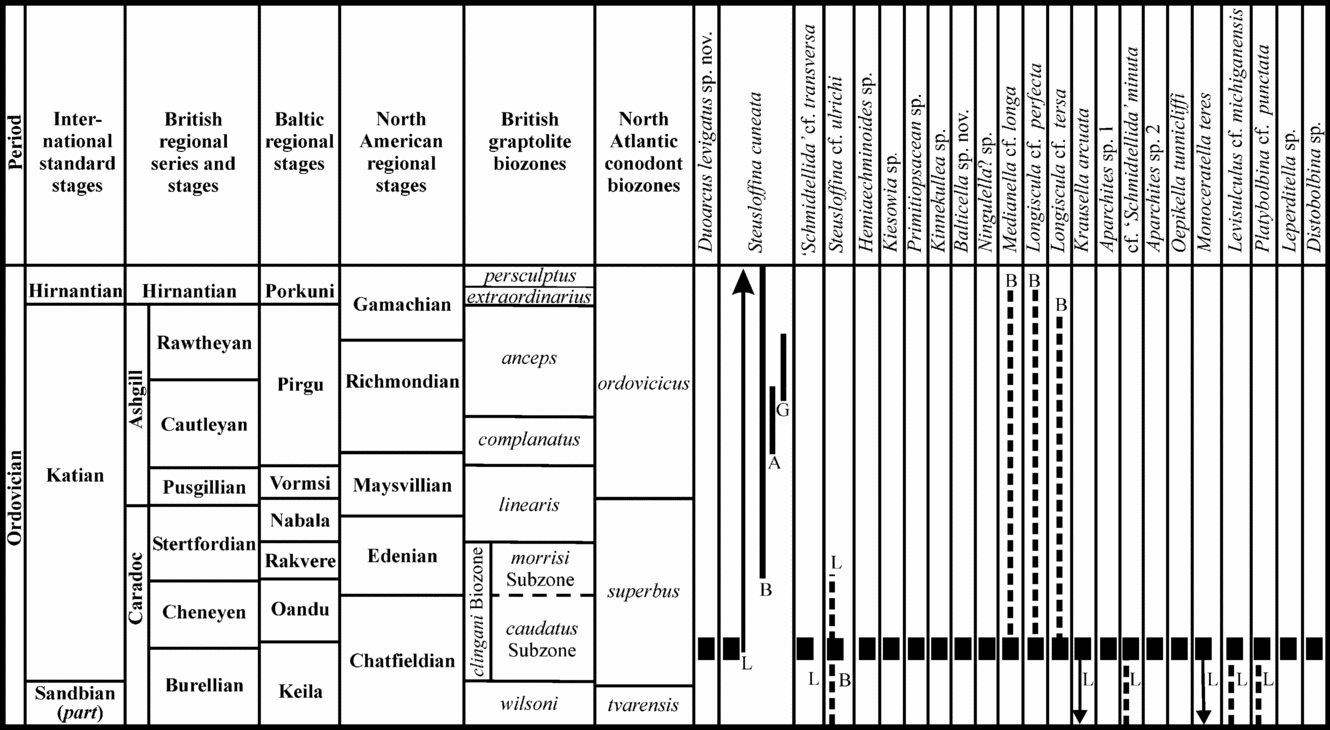
Sampled horizons at the north end of the quarry (Fig. 1: locality C) have produced eighteen species. These include Steusloffina cuneata (Steusloff, Reference Steusloff1895); Balticella sp. nov.; Duoarcus levigatus gen. et sp. nov.; Krausella arcuata Ulrich, Reference Ulrich1894; ‘Schmidtella’ cf. transversa Harris, Reference Harris1957; cf. ‘Schmidtella’ minuta Harris, Reference Harris1957; Hemiaechminoides sp.; Medianella cf. longa (Stumbur, Reference Stumbur1956); Longiscula cf. perfecta Meidla, Reference Meidla1993; Longiscula cf. tersa (Neckaja, Reference Neckaja1966); Steusloffina cf. ulrichi (Teichert, Reference Teichert1937) and species of Kiesowia, Ningulella? and Kinnekullea (Figs 6–8). Some of these species have potential stratigraphic significance (see below). Collectively they are consistent with the early Katian age indicated by other fossil groups, with the ranges of typical Sandbian and Katian ostracods overlapping (Fig. 9). More importantly, the Craighead Limestone Formation contains some ostracod taxa such as Longiscula that enable a stratigraphic link between the Baltic and Laurentian Ordovician successions (Fig. 9).
Ostracod species of the Craighead Limestone Formation compared with their stratigraphic ranges in other palaeogeographic areas. Symbols: black square – stratigraphic position of species in the Craighead Limestone Formation; dotted line – total range of a species that is tentatively identified at Craighead (as ‘cf’) with its unequivocal stratigraphic range elsewhere; L – Laurentia; B – Baltica; A – Avalonia; G – Gondwana.

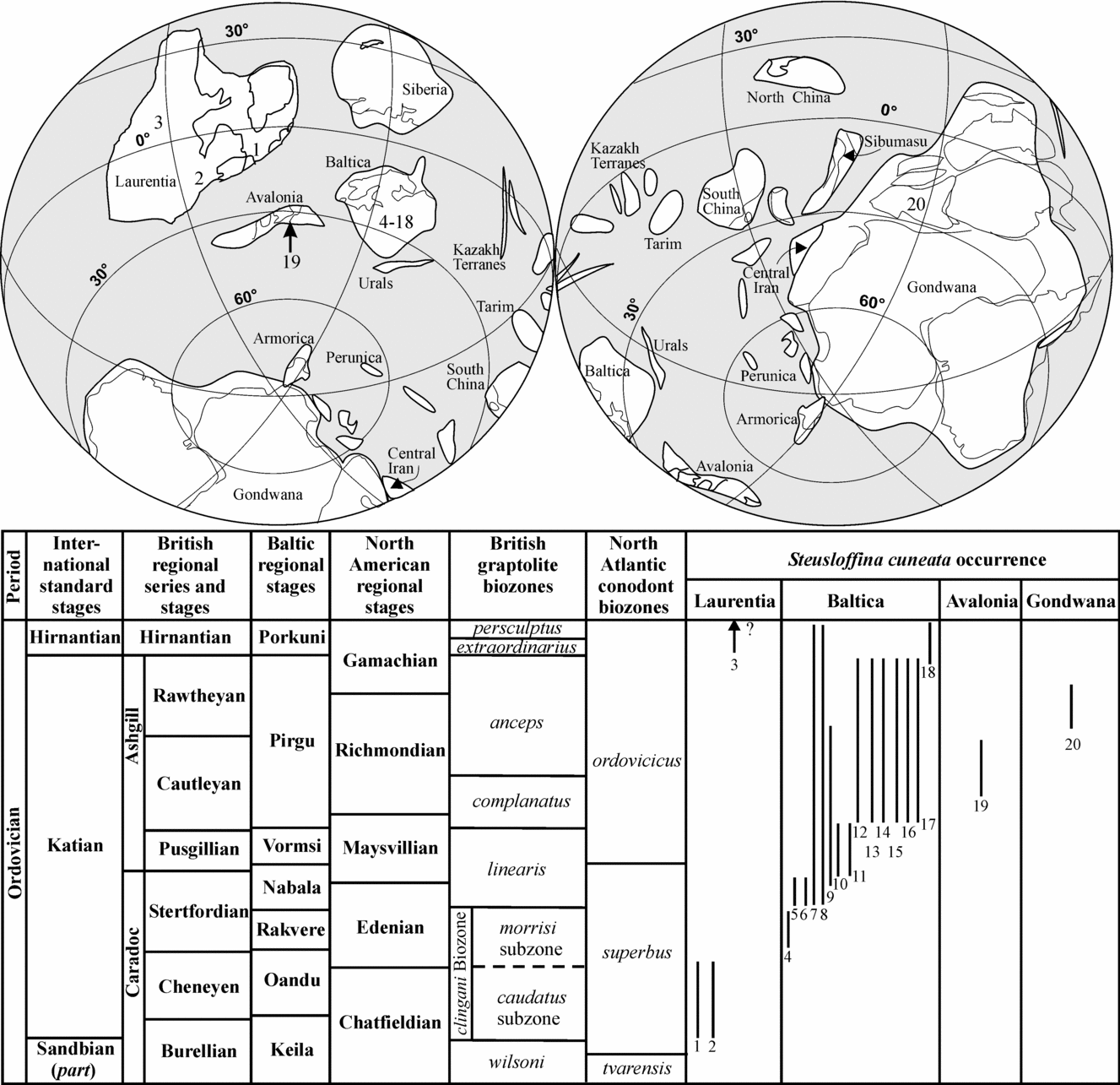
Steusloffina cuneata is long-ranging and widespread, being reported from the Upper Ordovician (Katian) of North America (Hessland & Adamczak, Reference Hessland and Adamczak1974), the Baltic region (Meidla, Reference Meidla1996), Britain (Williams et al. Reference Williams, Stone, Siveter and Taylor2001b) and India (Schallreuter, Hinz-Schallreuter & Suttner, Reference Schallreuter, Hinz-Schallreuter and Suttner2008) (Figs 9, 10), and from the Lower Silurian of Canada (Copeland, Reference Copeland and Lespérance1981, Reference Copeland1983). Steusloffina cuneata thus survived the major climatically-driven extinction event of the Late Ordovician that decimated many ostracod assemblages (Schallreuter & Siveter, Reference Schallreuter and Siveter1985). The presence of Steusloffina cuneata in the early Katian Craighead Limestone Formation and Rysedorph Hill Conglomerate of New York are the oldest known occurrences, indicating the possible origin of this species in the Laurentian palaeocontinent, from whence it presumably spread out to colonize several palaeocontinents. Krausella arcuata is a typical North American species, documented from the Upper Ordovician (Sandbian) Bromide Formation of Oklahoma, the Decorah Formation of Iowa and Minnesota (Kay, Reference Kay1940), the Edinburg and Lincolnshire formations of Virginia (Kraft, Reference Kraft1962) and the Day Point Formation of New York (Swain, Reference Swain1957). It is thus a typical Sandbian form, and its occurrence in the Craighead Limestone Formation extends its range into the early Katian. Species of Kiesowia are documented from the Late Ordovician Decorah Formation of Iowa (Kay, Reference Kay1940) and from the Middle Ordovician (Darriwilian) to Silurian of the Baltic region (Vannier, Siveter & Schallreuter, Reference Vannier, Siveter and Schallreuter1989; Meidla, Reference Meidla1996). The Craighead Limestone Formation Longiscula cf. perfecta is very similar to Meidla's (1993) L. perfecta, which is a long-ranging taxon extending from the early to late Katian (Oandu to Pirgu stages) of the Baltic region (Meidla, Reference Meidla1996). Longiscula tersa is also a long-ranging species, occurring from the early to late Katian of the Baltic region (Meidla, Reference Meidla1996) but has not previously been reported from Laurentia. Several species of Longiscula are documented from the Upper Ordovician of Arctic Canada (Copeland, Reference Copeland, Bolton, Sanford, Copeland, Barnes and Rigby1977b), but not L. perfecta or L. tersa. Medianella longa (Stumbur, Reference Stumbur1956) is recorded from the early to late Katian strata of Estonia and also from the late Katian rocks of the Pskov region in Russia (Meidla, Reference Meidla1996). Medianella longa has not been reported from other Ordovician successions of Scotland and its identification in the Craighead Limestone Formation remains tentative. The presence of Kinnekullea in the Craighead Limestone Formation might also suggest a Laurentian origin for that taxon. Species of Kinnekullea are previously reported from the early to late Katian succession of the Baltic region (Vannier, Siveter & Schallreuter, Reference Vannier, Siveter and Schallreuter1989; Meidla, Reference Meidla1996), late Katian strata of northern England (Williams et al. Reference Williams, Stone, Siveter and Taylor2001b) and late Katian strata of the Girvan District, Scotland (Floyd, Williams & Rushton, Reference Floyd, Williams and Rushton1999). Balticella species are documented from Sandbian-age strata in the Bromide Formation of Oklahoma (Harris, Reference Harris1957), the Edinburg Formation of Virginia (Kraft, Reference Kraft1962), the Balclatchie Conglomerate of the Girvan District (Williams et al. Reference Williams, Floyd, Siveter and Miller2001a) and the Baltic region (Meidla, Reference Meidla1996). Again, the record from the Craighead Limestone Formation extends the range of Balticella into the Katian. Hemiaechminoides species are known from early to late Katian strata of the Baltic region and Silurian of North America (Meidla, Reference Meidla1996).
Temporal and geographic distribution of Steusloffina cuneata. Distribution indicates that this taxon originated in Laurentia, later migrated to Baltica, Avalonia and then Gondwana. Source references: Sarv (Reference Sarv1960), Schallreuter (Reference Schallreuter1968), Pranskevičius (Reference Pranskevičius1972), Hessland & Adamczak (Reference Hessland and Adamczak1974), Siveter (Reference Siveter and Worsley1982), Copeland (Reference Copeland and Lespérance1981, Reference Copeland1983), Meidla (Reference Meidla1996), Williams et al. (Reference Williams, Stone, Siveter and Taylor2001b), Schallreuter, Hinz-Schallreuter & Suttner (Reference Schallreuter, Hinz-Schallreuter and Suttner2008). Numbers 1–20 indicate localities for Steusloffina cuneata: 1 – Craighead Limestone Formation, Girvan, Scotland; 2 – New York (Hessland & Adamczak, Reference Hessland and Adamczak1974); 3 – Silurian of Anticosti Island Quebec Canada (Copeland, Reference Copeland and Lespérance1981, Reference Copeland1983); 4, 5, 6, 10–18 – early to latest Katian of Estonia (Meidla, Reference Meidla1996); 7 – early to latest Katian of Estonia (Sarv, Reference Sarv1960; Pranskevičius, Reference Pranskevičius1972; Siveter, Reference Siveter and Worsley1982); 8 – early to latest Katian of Latvia (Sarv, Reference Sarv1960; Pranskevičius, Reference Pranskevičius1972; Siveter, Reference Siveter and Worsley1982); 9 – Germany (Schallreuter, Reference Schallreuter1968); 19 – Northern England (Williams et al. Reference Williams, Stone, Siveter and Taylor2001b); 20 – India (Schallreuter, Hinz-Schallreuter & Suttner, Reference Schallreuter, Hinz-Schallreuter and Suttner2008).

8. Early Katian ostracod biogeography and the Craighead Limestone fauna
During the Ordovician, Girvan formed part of the southeastern margin of the Laurentia palaeocontinent (Bergström, Reference Bergström1990; Rushton, Tunnicliff & Tripp, Reference Rushton, Tunnicliff and Tripp1996). It was separated from the Baltic region (Baltica palaeocontinent) and from southern Britain (Avalonia microcontinent) by an arm of the Iapetus Ocean (Cocks & Fortey, Reference Cocks and Fortey1982; McKerrow, Dewey & Scotese, Reference McKerrow, Dewey and Scotese1991; Cocks & Torsvik, Reference Cocks and Torsvik2005). In the Late Ordovician these palaeocontinents converged as a result of the northward movement of Avalonia and the subduction of the Iapetus Ocean and the closure of the Tornquist Sea (Pickering, Bassett & Siveter, Reference Pickering, Bassett and Siveter1988; Cocks, McKerrow & van Staal, Reference Cocks, McKerrow and van Staal1997; Cocks, Reference Cocks2000; Cocks & Torsvik, Reference Cocks and Torsvik2005). This is supported by evidence of increasing similarity between the ostracod faunas of these regions (Schallreuter & Siveter, Reference Schallreuter and Siveter1985; Vannier, Siveter & Schallreuter, Reference Vannier, Siveter and Schallreuter1989; Williams et al. Reference Williams, Floyd, Salas, Siveter, Stone and Vannier2003). In the following subsections we discuss the biogeographic affinities of the Craighead Limestone Formation ostracod faunas in terms of their Laurentia and Baltica origins.
8.a. Baltica affinities
Many of the ostracod genera that occur in the Craighead Limestone Formation have a probable Baltica affinity (see Vannier, Siveter & Schallreuter, Reference Vannier, Siveter and Schallreuter1989; Meidla, Reference Meidla1996; Williams et al. Reference Williams, Floyd, Salas, Siveter, Stone and Vannier2003) (Fig. 9). Thus, Platybolbina, Oepikella and Levisulculus occur in the late Darriwilian strata of Baltica (Vannier, Siveter & Schallreuter, Reference Vannier, Siveter and Schallreuter1989; Williams et al. Reference Williams, Floyd, Salas, Siveter, Stone and Vannier2003) and congeneric species may have migrated to Laurentia during the late Sandbian–Katian (see Williams & Floyd, Reference Williams and Floyd2000; Williams et al. Reference Williams, Floyd, Salas, Siveter, Stone and Vannier2003). In Laurentia these genera are present at a Sandbian–Katian (Mohawkian) horizon in the Bony Falls Limestone (Kesling, Reference Kesling1960a,b), the Lexington Limestone (Warshauer & Berdan, Reference Warshauer and Berdan1982) and Edinburg Formation (Kraft, Reference Kraft1962). Kiesowia species also first appear in the Darriwilian of Baltica (Vannier, Siveter & Schallreuter, Reference Vannier, Siveter and Schallreuter1989; Meidla, Reference Meidla1996) and may have migrated to Laurentia in the early Katian. Species of Medianella first appear in the Middle Ordovician of the Baltic region (Williams et al. Reference Williams, Floyd, Salas, Siveter, Stone and Vannier2003) and congeneric species may have migrated to Laurentia in the early Katian, as indicated by their occurrence in the Craighead Limestone Formation. Longiscula first occurred in the Malopolska and Argentine Precordillera terranes during the Darriwilian and later appeared in Baltica (early Sandbian; see Vannier, Siveter & Schallreuter, Reference Vannier, Siveter and Schallreuter1989; Williams et al. Reference Williams, Floyd, Salas, Siveter, Stone and Vannier2003). Species of Longiscula probably migrated to Laurentia in the early Katian (late Mohawkian; see Copeland, Reference Copeland, Bolton, Sanford, Copeland, Barnes and Rigby1977b). Longiscula perfecta, Longiscula tersa and Medianella longa first appeared in the early Katian (Oandu stage of local Baltic usage) in Baltica (Meidla, Reference Meidla1996), which is almost at the same horizon as the tentative occurrence of these taxa in the Craighead Limestone Formation. These species have not been reported from other Ordovician successions of Laurentia. Distobolbina appears in Baltica first during the Sandbian (Vannier, Siveter & Schallreuter, Reference Vannier, Siveter and Schallreuter1989; Williams et al. Reference Williams, Floyd, Salas, Siveter, Stone and Vannier2003) and in Laurentia it occurs at almost the same horizon in Arctic Canada (Mohawkian: Copeland, Reference Copeland, Bolton, Sanford, Copeland, Barnes and Rigby1977b).
8.b. Laurentia affinities
Monoceratella occurs first in the late Darriwilian of Laurentia, and species of this genus might have migrated to Baltica where the genus appears in the latest Katian (Williams et al. Reference Williams, Floyd, Salas, Siveter, Stone and Vannier2003). Krausella appeared first in Laurentia during the Darriwilian and species may have migrated to Baltica in the early Katian (Williams et al. Reference Williams, Floyd, Salas, Siveter, Stone and Vannier2003). Steusloffina cuneata is a cosmopolitan species with a long temporal range (early Katian to earliest Silurian), being reported from Laurentia (Hessland & Adamczak, Reference Hessland and Adamczak1974; Copeland, Reference Copeland and Lespérance1981, Reference Copeland1983), Baltica (Meidla, Reference Meidla1996), Avalonia (Williams et al. Reference Williams, Stone, Siveter and Taylor2001b) and Gondwana (Schallreuter, Hinz-Schallreuter & Suttner, Reference Schallreuter, Hinz-Schallreuter and Suttner2008) (Figs 9, 10). In Baltica S. cuneata first appears in the Katian at a level equivalent to the upper clingani graptolite Biozone (upper Rakvere) in the Rägavere Formation of Estonia (Meidla, Reference Meidla1996). In Avalonia it has been reported from the late Katian (mid-Cautleyan, Ashgill) age strata of England (Williams et al. Reference Williams, Stone, Siveter and Taylor2001b) and in Gondwana it is present in the late Katian strata of India (Schallreuter, Hinz-Schallreuter & Suttner, Reference Schallreuter, Hinz-Schallreuter and Suttner2008). The oldest known reported occurrences of Steusloffina cuneata are those reported in the early Katian Craighead Limestone Formation and the Rysedorph Hill conglomerate, New York, and these suggest a Laurentian origin for the taxon. The migration of Steusloffina cuneata from low-latitude Laurentia and Baltica to high-latitude Gondwana (latitude 60° S, according to Cocks & Torsvik, Reference Cocks and Torsvik2005) represents adaptation to a range of palaeoenvironments. Schallreuter, Hinz-Schallreuter & Suttner (Reference Schallreuter, Hinz-Schallreuter and Suttner2008) speculated that the migration of Steusloffina cuneata may have occurred as a result of dispersal via seaweed or algal mats, though there is no evidence to substantiate this.
8.c. Biogeographic evolution of the Craighead Limestone Formation fauna
Several authors have noticed the faunal similarity between the Late Ordovician ostracod faunas of North America and Scandinavia, arguing that faunal migration between palaeocontinental Laurentia and Baltica was possible across the Iapetus Ocean by Late Ordovician time (e.g. Schallreuter & Siveter, Reference Schallreuter and Siveter1985; Vannier, Siveter & Schallreuter, Reference Vannier, Siveter and Schallreuter1989; Williams et al. Reference Williams, Floyd, Siveter and Miller2001a,Reference Williams, Stone, Siveter and Taylorb, Reference Williams, Floyd, Salas, Siveter, Stone and Vannier2003). This similarity was progressive through the Sandbian and Katian marked by several common genera of trilobites, brachiopods (Cocks & Fortey, Reference Cocks, Fortey, McKerrow and Scotese1990; Cocks, McKerrow & van Staal, Reference Cocks, McKerrow and van Staal1997) and ostracods (Williams et al. Reference Williams, Stone, Siveter and Taylor2001b, Reference Williams, Floyd, Salas, Siveter, Stone and Vannier2003). Williams et al. (Reference Williams, Floyd, Salas, Siveter, Stone and Vannier2003) discussed the broad patterns of Ordovician ostracod migrations between Laurentia, Avalonia and Baltica and demonstrated that the early peak of species migration from Baltica to Laurentia was in the Sandbian–early Katian, noting several genera common to these areas. The ostracods of the early Katian Craighead Limestone Formation confirm these links, suggesting strong migration of species from Baltica to Laurentia and some migrations towards Baltica (Fig. 9). Several of the ostracods in the Craighead Limestone Formation belong to genera whose species show tolerance to a wide range of environments from shallow to deep shelf, for example, Platybolbina (e.g. Kesling, Reference Kesling1960b; Williams & Floyd, Reference Williams and Floyd2000), Kinnekullea (e.g. Meidla, Reference Meidla1996; Floyd, Williams & Rushton, Reference Floyd, Williams and Rushton1999; Williams et al. Reference Williams, Stone, Siveter and Taylor2001b), Krausella (Copeland, Reference Copeland1982), Steusloffina (e.g. Meidla, Reference Meidla1996; Williams et al. Reference Williams, Stone, Siveter and Taylor2001b; Schallreuter, Hinz-Schallreuter & Suttner, Reference Schallreuter, Hinz-Schallreuter and Suttner2008) and Medianella (Meidla, Reference Meidla1996). The adaptation of ostracods to a wide range of shallow to deeper environments might have facilitated their migration between palaeocontinents, for example, via island-hopping routes (see Fortey, Reference Fortey and Bruton1984; Schallreuter & Siveter, Reference Schallreuter and Siveter1985). Faunal migration may also have been influenced by climate, the northwards movement of Baltica and Avalonia into the tropics facilitating the migration of warm-water adapted taxa between these continental masses.
9. Systematic palaeontology
A new genus and species from the Craighead Limestone Formation are described below. Taxonomic notes on taxa recorded for the first time from Scotland are given in Appendix 2.
Class OSTRACODA Latreille, Reference Latreille1802
? Family tvaerenellidae Jannusson, Reference Jannusson1957
Genus Duoarcus gen. nov.
Type species. Duoarcus levigatus gen. et sp. nov.
Derivation of name. From Latin ‘duo’ meaning two and ‘arcus’, a bow-shape (used in the sense of an archer's bow), referring to the bow-shaped structure seen on the ventral surface of both valves. Gender masculine.
Diagnosis. Possible Tvaerenellidae with ventral margin marked by an acute, arcuate bend on both the left and right valves that, from a ventral aspect, forms two opposing bow-shapes.
Remarks. The lateral, dorsal and ventral outline of Duoarcus levigatus resembles Eoaquapulex socialis (Levinson, Reference Levinson1961), but the anterior lateral outline of D. levigatus is more rounded than in Eoaquapulex. Possession of a bow-shaped structure along the ventral margin of both valves, which in D. levigatus is a marked bend, is also similar to Eoaquapulex. However, in the latter genus this structure is formed by a distinct velar ridge, not simply a bend. Because of this difference and the apparent absence of dimorphism in Duoarcus, the familial assignment to the Tvaerenellidae is tentative.
Duoarcus also resembles Schmidtella Ulrich, Reference Ulrich1892, which has an epicline dorsum, smooth, non-sulcate, asymmetrical and umbonate valves, and the left valve overlapping the smaller right valve. Duoarcus lacks the distinct channel along the ventral margin (best developed posteroventrally) present in the type species Schmidtella crassimariginata Ulrich, Reference Ulrich1892. In addition, the ventral bow-shaped bends on the valves of Duoarcus are absent in Schmidtella.
Duoarcus levigatus sp. nov.
Figure 7b, c, e, f
Derivation of name. From Latin, levigatus meaning ‘smooth’, referring to the absence of valve ornament.
Diagnosis. As for the genus which is monotypic.
Holotype. A carapace (GSE15348), 0.93 mm long and 0.72 mm high, Figure 7e.
Material. Twenty carapaces, one left valve and a broken specimen (BGS collections).
Description. Carapace preplete, non-sulcate and smooth. Lateral outline sub-circular, longitudinal and transverse outlines sub-triangular. Lateral surface convex; the posterior is more convex than the anterior and strongly flattened posteriorly. Dorsum epicline; the left valve is larger and overlaps the right valve ventrally. Ventrally an acute bend on both valves forms opposing bow-shaped structures (Fig. 7b). The ventral valve contact is straight. The valve length ranges from 0.58–1.39 mm; maximum valve height is 1.05 mm.
Remarks. Duoarcus levigatus has some similarities to ‘Hyperchilarina’ angularis Harris, Reference Harris1957 from the (Sandbian) Tulip Creek Formation of Oklahoma. Both species have valves that are strongly flattened posteriorly and ventrally, and both have opposing bow-shaped bends when seen in ventral aspect. The anterior of Duoarcus levigatus is more tumid than that of ‘Hyperchilarina’ angularis which is more acutely pointed. Further study might indicate that these two species are congeneric. Both differ from typical Hyperchilarina (type-species Hyperchilarina ovata Harris, Reference Harris1957; see Williams & Vannier, Reference Williams and Vannier1995) in having a bow-shaped bend on the ventral margin of each valve and by lacking admarginal spines on the left valve.
10. Conclusions
The Upper Ordovician (Katian) ostracods of the Craighead Limestone Formation are characterized by two distinct ostracod assemblages: a shallow marine low-diversity assemblage dominated by the palaeocope Oepikella with rare podocopes; and an open marine high-diversity assemblage dominated by podocopes, especially Steusloffina, palaeocopes and binodicopes. The new taxon Duoarcus levigatus forms a common component of the Steusloffina assemblage. The ostracod fauna contains species that facilitate broad correlation with Sandbian–early Katian-age strata of North America. Biogeographically, many of the ostracod taxa of the Craighead Limestone Formation have their probable origins in palaeocontinental Baltica and indicate the migration of Baltica species towards the tropics during Late Ordovician times. This is consistent with supposed palaeogeographic changes as the Iapetus Ocean subducted, bringing Baltica and Avalonia within the tropics and in close geographic proximity to Laurentia.
Acknowledgements
We thank Prof. James D. Floyd for help with fieldwork in the Girvan district and Dr Leonid Popov for use of the palaeogeographic reconstructions of Figure 10. M. Mohibullah thanks the University of Balochistan, Quetta, for supporting his fieldwork in Scotland and the University of Tartu for a scholarship to visit Estonia in September 2009. Paul Shepherd and Louise Neep facilitated access to comparative Ordovician ostracod material at the British Geological Survey. We are very grateful to Drs Jean Vannier and Giles Miller for their constructive reviews of this paper.
Appendix 1. Description of carbonate lithofacies
Lithofacies 1: Crinoidal grainstone and packstone
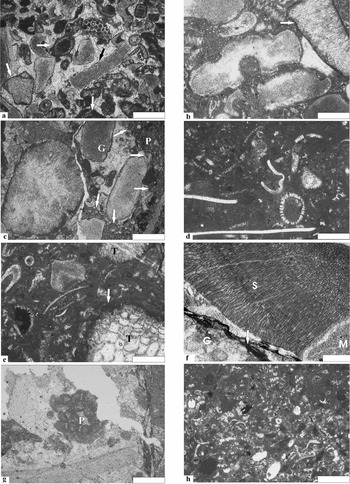
This lithofacies is dominated by grainstone and packstone textures and is characterized by a diverse mixture of skeletal material, coated grains and intraclasts (Fig. 11a–c). The lithofacies contains a diverse faunal assemblage, dominated by pelmatozoans (mainly crinoids) and molluscs (cephalopods and bivalves). Subordinate fauna includes dasycladaceans, codiaceans, solenoporacean red algae, brachiopods, gastropods, trilobites, stromatoporoids, bryozoans and ostracods. Bioclasts of grainstones are commonly fragmented into irregular, sub-rounded and sub-spherical shapes with an average size of 1 mm. Coated grains (grains with micrite envelopes and oncoids), peloids and intraclasts are rare. Some bioclasts are encrusted by thick layers of Girvanella. The oncoids exhibit a range of shapes, but mostly with nuclei of echinoderm and algal fragments, more frequent in packstones. Intraclasts show neomorphic, abraded and brownish surfaces with angular outlines. Grains are moderately sorted, cemented by isopachous and luminescent, bladed to equant calcite. The packstones consist dominantly of similar but fragmented and micritized (especially echinoderm fragments) bioclasts of larger sizes (more than 2 mm) in a silt-sized matrix, likely derived from reworking of echinoderm fragments (Fig. 11b). Rare occurrences of benthic foraminifera have been recorded in the packstone. Microscopic-scale erosional surfaces (Fig. 11c), commonly present between packstone and grainstone, suggest episodic changes in energy regime.
Photomicrographs of Lithofacies 1 to 4 of the Craighead Limestone Formation. (a–c) Lithofacies 1; (d, e) Lithofacies 2; (f, g) Lithofacies 3; (h) Lithofacies 4. (a) Crinoidal grainstone showing fragments of crinoids, dasycladaceans, molluscs, trilobites, intraclasts, peloids, microbial coatings (white arrows) and syntaxial calcite rims (black arrow); high-energy environment. (b) Crinoidal packstone showing large (millimetre-size), worn and partly neomorphosed fragments of crinoids and micrite enveloped (white arrow) codiacean in silt-sand size bioclastic matrix; a relatively calm/low-energy environment compared with the crinoidal grainstone. (c) Erosional surface (white arrows) between grainstone (G) and packstone (P). (d) Molluscan trilobite wackestone showing tentaculatids, thin-shelled bivalves, articulated trilobite and fragments of molluscs in fine, dark micritic matrix; deep shelf environment. (e) Part of mollusc wackestone showing well-preserved tabulate corals (T) coated by Girvanella (white arrow), neomorphosed echinoderm fragments, thin-walled bivalve fragments, dasycladaceans and trilobites; deep shelf environment. (f) Brecciated limestone showing lithoclasts of bioclastic mudstone (M), crinoidal grainstone (G) and well-preserved thick domal stromatoporoids (S). Note pressure solution filled with dark and fine-grained micritic/argillaceous matter (white arrow); depositional breccias formed on a reef fore-slope setting. (g) Cluster of peloids (P) in part of brecciated limestone. (h) Algal, peloidal wackestone–packstone showing finely fragmented dasycladaceans, molluscs and ostracods with scattered peloids of irregular shape and size; lagoonal shelf environment. (a) and (c) are from sample no. 6, (b) from sample no. 7, (d) from sample no. 1 and (e) from sample no. 2 of the rubbly limestone of the Craighead Limestone Formation on the northern flank of Craighead Quarry (Fig. 1: locality C, Figs 4, 5). (g) and (h) are from sample no. 10 of the breccia–calcarenite beds of the Craighead Limestone Formation at Craighead Quarry (Fig. 1: locality B, Fig. 4). (h) is from sample nos 9a–9b from the rubbly limestone of the Craighead Limestone Formation on the southern flank of Craighead Quarry (Fig. 1: locality A, Fig. 4). All photomicrographs (a–h) are taken in plane-polarized light. Scale bar is 900 μm.

Interpretation. This lithofacies occurs in thin- to medium-bedded lower rubbly limestone of the Craighead Limestone Formation at the northern end of Craighead Quarry (Fig. 1: locality C). The grainstone is interpreted as an echinoderm-mollusc-dominated meadow, which was reworked in an environment of constant high-energy currents/storms that removed carbonate mud by winnowing (Flügel, Reference Flügel2004) and was deposited in the form of bioclastic sand bars or blankets on platform top/margin settings (similar to the pelmatozoan meadow facies described by Aigner, Reference Aigner1985 and Ausich, Reference Ausich, Brett and Baird1997). This may have developed on fringing banks or shoals (Read, Reference Read1985) or in sub-tidal sand sheets (Holland, Reference Holland1993; McLaughlin et al. Reference McLaughlin, Brett, Taha-McLaughlin and Cornell2004; see Fig. 4). The packstone suggests a relatively calm/low-energy environment, probably flanked by pelmatozoan meadows/shoals (Flügel, Reference Flügel2004; see Fig. 4). Cortoid grains are considered to be associated with the destructive effects of cyanobacteria, algae and fungi, which are most intense in warm, shallow-marine settings (Flügel, Reference Flügel2004). Palaeozoic solenoporacean red algae and stromatoporoids have been interpreted as typical inhabitants of a reef-carbonate platform (Flügel, Reference Flügel2004). Grains with micrite envelopes, together with highly fragmented bioclasts, are evidence of current-washed sand shoals in inner-ramp settings or in winnowed platform-edge sands (Flügel, Reference Flügel2004). The local microscopic-scale erosional surfaces may have been associated with a slow rate of sedimentation together with episodic storm current or wave erosion, and this was likely a control on burial and exhumation (Hender & Dix, Reference Hender and Dix2008). Girvanella encrustation of some bioclasts may be diagnostic of slow sedimentation rates (Peryt, Reference Peryt1981). This microfacies has similarities with the C2a-b facies of Hender & Dix (Reference Hender and Dix2008) and SMF12 of Flügel (Reference Flügel2004).
Lithofacies 2: Mollusc, trilobite wackestone
This lithofacies is characterized by the abundance of molluscs (mostly tentaculitids and cephalopods) and articulated fragments of trilobites in a clay-grade matrix (Fig. 11d, e). Other common components are brachiopods, bivalves, echinoderms and bryozoans. Green algae are scarce, moderately well preserved and locally encrusted by a thick layer of Girvanella (especially codiaceans), probably associated with transportation from shallow into deeper environments. Ostracods are also present and show well-preserved morphologies. Cyanobacterial structures are rare with poor preservation. Stromatoporoids with highly recrystallized internal structures and external micritic coatings suggest reworking. Echinoderm fragments are angular to sub-rounded, highly micritized, abraded, worn and sometimes rimmed by sparry calcite. Well-preserved scattered tabulate corals are present, locally encrusted by Girvanella (Fig. 11e). Most of the bioclasts are large (greater than 2 mm diameter), poorly sorted and well preserved with little reworking, but some beds contain moderately bioturbated fabrics. The micritic matrix comprises fine debris, likely derived from fragmentation of bioclasts.
Interpretation. This lithofacies occurs in the thin- to medium-bedded upper rubbly limestone of the Craighead Limestone Formation at the northern end of Craighead Quarry (Fig. 1: locality C). An open marine, low-energy shelf environment somewhat near/below storm wave base is interpreted on the basis of a diverse faunal assemblage, a predominance of large, whole articulated fossils, with less frequent smaller fragments, and its poorly sorted nature (Fig. 4). Palaeozoic cephalopod-rich limestones originated in deep shelf-platform settings and in slope or basin environments (Flügel, Reference Flügel2004). For example, Devonian cephalopod-rich limestones in Europe and North Africa developed in a marine environment ranging in depth from several tens to over one hundred metres (Wendit & Aigner, Reference Wendit and Aigner1985) and up to several hundred metres during the Silurian (Ferretti & Kříž, Reference Ferriti and Kříž1995). The tentaculitids lived probably as nektobenthos and contributed to open-marine deep shelf limestone formation (Flügel, Reference Flügel2004). Early Palaeozoic trilobite-rich limestones formed in both low- and high-energy settings of open-marine platforms (Flügel, Reference Flügel2004). The presence of green algae and tabulate corals and the growth of Girvanella, however, means that the depositional environment was not too deep at Craighead, as these algal growths are known to occur only in the photic zone (Selting & Schmitt, Reference Selting and Schmitt1999). This determination can also be explained by the occurrence of bioturbated and fragmented fabrics in parts, suggesting episodic exposure to shallow current-dominated environments. Echinoderm fragments are indicative of reworking and transportation from shallow/high-energy settings into deep/low-energy environments.
Lithofacies 3: Brecciated limestone facies
This lithofacies is characterized by lithoclasts of crinoidal grainstone, bioclastic mudstone/wackestone and fragments of isolated domal stromatoporoids and sponges forming a clast-supported brecciated texture. Lithoclasts are millimetre to centimetre size, showing sharp boundaries, commonly cemented by fibrous and radiaxial calcite cements and rarely by micro-stylolites with veining and fracture features (Fig. 11f, g). The crinoidal grainstone clasts consist of abundant neomorphosed echinoderms, molluscs and algal fragments resembling Lithofacies 1. The bioclastic mudstone/wackestone contains fragmented bioclasts similar to Lithofacies 2, and rare glauconitic grains. Stromatoporoids and sponges, on the other hand, are broken but not rounded and show well-preserved morphologies (Fig. 11f), suggesting they are in place or have undergone limited transport (Da Silva & Boulvain, Reference Da Silva and Boulvain2002). Peloids occur in some cases and show spheroidal–subrounded outlines with dark homogeneous interiors (Fig. 11g). Microbial coating of bioclasts is visible in some parts. Dark fine micritic and argillaceous matrix fills pressure solution boundaries between clasts of grainstone, stromatoporoids and mudstone. Granular sparry calcite cement rarely fills cavities within and between clasts, forming a brownish irregular texture.
Interpretation. This lithofacies occurs in the breccia–calcarenite beds of the Craighead Limestone Formation at Craighead Quarry (Fig. 1: locality B). The facies is interpreted as depositional breccias (Richter & Füchtbauer, Reference Richter and Füchtbauer1981), most probably formed in a fore-slope setting (Fig. 4). This interpretation is based on lithoclast origin, peloidal content, shape, size and type of lithoclast and calcite cementation (e.g. radiaxial, fibrous and granular calcite cement: Demicco & Hardie, Reference Demicco and Hardie1994) and slope/platform margin biotic assemblages (e.g. stromatoporoids and sponges: Flügel, Reference Flügel2004). Carbonate breccias normally form on slopes (Flügel, Reference Flügel, Brander, Flügel, Koch and Yose1991; Haas, Reference Haas1999) and in accretionary settings (Sano & Tamada, Reference Sano and Tamada1994) by debris flows (Leigh & Hartley, Reference Leigh and Hartley1992) and in a catastrophic collapse of high-angle carbonate margins (Spence & Tucker, Reference Spence and Tucker1997) and gravity flows (Assaruri & Langbein, Reference Assaruri and Langbein1987). The crinoidal grainstone, stromatoporoids and sponges were eroded from high-energy platform margin/upper slope and deposited within low-energy deep ramp/slope settings (cf. Herbig, Reference Herbig1984).
Lithofacies 4: Algal, peloidal wackestone–packstone
This lithofacies is characterized by finely fragmented and bioturbated skeletal materials of low diversity with peloids in a fine clay-size micritic matrix (Fig. 11h). The dominant textures are wackestones and packstones with skeletal materials dominated by fragments of less than 1 mm in size without any preferred orientation. Dominant bioclasts are green algae (dasycladaceans), disarticulated molluscs and well-articulated ostracods. Fragments of trilobites and highly neomorphosed echinoderms are also present. Peloids are poorly sorted and display sizes ranging from a few tens of microns to 0.5 mm, with angular to spherical shapes. This microfacies is free of siliciclastic material and dominantly consists of a muddy fine-grained matrix. Sparry calcite fills bioclast interiors, especially in the ostracods.
Interpretation. This lithofacies occurs in medium-bedded (sample nos 9a–9b) rubbly limestones of the Craighead Limestone Formation in the southern part of Craighead Quarry (Fig. 1: locality A). The sedimentary and biotic features indicate a shallow, euphotic and calm (partly protected/low-energy) marine environment, most likely in a lagoon (Fig. 4). This interpretation is based on the abundance of photic green algae (dasycladaceans), the dominance of fine-grained muddy micritic matrix and the low biotic diversity but with a high abundance of endemic organisms (algae) (see Reading, Reference Reading1986). The dasycladacean algae suggest shallow-water conditions in the upper euphotic zone (Barattolo, Reference Barattolo and Riding1991). Peloids may have derived from slight local aggregation and dislocation of the muddy matrix, similar to those described by Wright (Reference Wright1983). The reworked components are most likely a product of re-deposition from nearby high-relief skeletal accumulation by episodic current/wave actions (Fürsich et al. Reference Fürsich, Wilmsen, Seyed-Emami, Schairer and Majidifard2003; Tomašovŷch, Reference Tomašových2006). The fine mud matrix may have been produced by calcified algae, as calcareous green algae are undoubtedly the most significant single source of fine-grained calcium carbonate mud similar to that of foraminifera, molluscs, corals and tunicates (Stieglitz, Reference Stieglitz1973) and are also known to produce biogenic mounds (Wray, Reference Wray1977; Flügel, Reference Flügel2004). This microfacies has similarities with microfacies type SMF18 of Flügel (Reference Flügel2004), the lime mudstone–wackestone facies of Lavoie & Asselin (Reference Lavoie and Asselin1998) and algal packstone of the intra-mound lithofacies of Sivhed et al. (Reference Sivhed, Erlström, Bojeson-Koefoed and Löfgren2004).
Appendix 2. Taxonomic notes
Here we document key features of several taxa described in open nomenclature and those which have hitherto not been reported from the Ordovician of Scotland. All of these species are illustrated in Figures 6–8.
Steusloffina cuneata (Steusloff, Reference Steusloff1895) (Fig. 7h, i, l, o) is a common element of the ostracod fauna recovered at the north end of the quarry (Fig. 1: locality C). This species is described in both smooth and spine-bearing forms (Hessland & Adamczak, Reference Hessland and Adamczak1974; Schallreuter, Reference Schallreuter1968; Meidla, Reference Meidla1996; Schallreuter, Hinz-Schallreuter & Suttner, Reference Schallreuter, Hinz-Schallreuter and Suttner2008). All of the Craighead specimens are non-spinose, serving to distinguish them from S. cuneata in Quebec, Canada (Copeland, Reference Copeland1983), and some Baltic sections (Meidla, Reference Meidla1996). The type material of S. cuneata (Schallreuter, Reference Schallreuter1968) from mid- to late Katian erratic boulders of Germany is also spine-bearing. We found both spinose and non-spinose forms of Steusloffina cuneata in the same sample of the ‘Moe-2 section’ of Estonia (Meidla, Reference Meidla1996, collections). The presence or absence of the spine might be related to preservation and is not considered a species-diagnostic character.
Steusloffina cf. ulrichi Teichert, Reference Teichert1937 (Fig. 7k, n, q) is known only from one specimen in the Craighead Limestone Formation but shows similarity in overall lateral shape and ventral morphology to the type material of S. ulrichi. The Craighead specimen also resembles Steusloffina cf. cuneata as figured by Copeland (Reference Copeland1989). Balticella sp. nov. (Fig. 6a), known only from one specimen, is characterized by a diminutive posteroventral spine and by an indistinct preadductorial node. These characters serve to distinguish the Craighead Limestone Formation species from the North American Balticella deckeri (Harris, Reference Harris1957) and from the Baltic type-species Balticella oblonga Thorslund, Reference Thorslund1940. Krausella arcuata Ulrich, Reference Ulrich1894 (Fig. 8h), a rare element of the Craighead Limestone Formation fauna, is characterized by a weakly epicline dorsum, strongly asymmetric valves, left valve slightly overlapping the right valve dorsally towards the cardinal corners and, most distinctively, by the posteroventral spine on the right valve. The record from the Craighead Limestone Formation extends the temporal range of this species into the early Katian. Longiscula cf. tersa (Neckaja, Reference Neckaja1966) (Fig. 8k, n, p) has the same lateral and dorsal outline and dimensions as Neckaja's L. tersa. However, because of poor preservation, the Scottish specimen can be referred only tentatively. Likewise, Longiscula cf. perfecta (Fig. 8b, e) is known only from one specimen at Craighead, but strongly resembles Meidla's (1993) material of L. perfecta from the Baltic region in having the anterior and posterior margins strongly convex, and in lateral outline with the ventral margin slightly concave. Medianella cf. longa (Stumbur, Reference Stumbur1956) (Fig. 8a, d) is very similar in lateral outline and ventral view to Stumbur's M. longa, but at present we have only one specimen. It differs from the type-species Medianella aequa (Stumbur, Reference Stumbur1956) in having a more elongate lateral shape.
Kinnekullea sp. (Fig. 6e) is characterized by its raised, circular muscle spot (85 μm in diameter) sited in the adductorial depression. This muscle spot is circumvented on three sides by a stout lobe that forms a recumbent ‘n’ shape, the closed end of the ‘n’ pointing anteriorly. The shell surface is smooth and non-sulcate. This distinctive lobal morphology, while typical of Kinnekullea, serves to distinguish this taxon from other congeneric species. Ningulella? sp. (Fig. 8o, r) has a sub-ovate lateral shape with a long and straight hinge-line. The Craighead species resembles the type species Ningulella paupera Warshauer & Berdan, Reference Warshauer and Berdan1982 from the Lexington Limestone of Kentucky in having smooth valves thickened around the anterior margins. Kiesowia sp. (Fig. 6g), a rare element of the Craighead Limestone Formation, is quadrilobate and characterized by lobes partly or completely partitioned by horizontal furrows into nodes. L1 is curved along the anterior margin and partly divided into two nodes; L2 is situated slightly below the anterodorsal region and narrows at its base where it connects with L1; L3 is represented as a node, positioned mid-ventrally and seems to be replaced by a furrow from above; L4 is posterodorsal, extending as a curve posteriorly where it is divided by a furrow into two broad nodes. A perilobal depression is present anteriorly. The Craighead Kiesowia differs from the type species Kiesowia dissecta (Krause, Reference Krause1892) in possessing a velum that is well developed along the anterior margin of the valve. The Craighead Kiesowia has some lobes partly partitioned while in Kiesowia dissecta the lobes are completely partitioned into nodes. Primitiopsacean sp. (Fig. 6l, n), which occurs rarely in the Craighead Limestone Formation, is characterized by a well-developed adductorial sulcus and a dorsal plica. Its velum is wider posteroventrally, as in species of Anisocyamus Martinsson, Reference Martinsson1960, but there are too few specimens available for a firm assignment to that genus. Aparchites sp. 1 (Fig. 6c, f) has a sub-circular lateral shape with a ridge near the margin of the right valve as seen in ventral view. The type species Aparchites whiteavesi Jones, Reference Jones1889 is deeply channelled ventrally with grooves which are not observed in the Craighead specimens. The Craighead taxon referred to as cf. ‘Schmidtella’ minuta Harris, Reference Harris1957 (Fig. 7a, d, g, j) has a characteristic ovate shape like Harris’ material of S. minuta, but the posterior margin in Harris’ specimens is more rounded and convex. ‘Schmidtella’ cf. transversa Harris, Reference Harris1957 (Figs 6b, 7m, p, r) is common in the shales at the northern end of Craighead Quarry. It has a small sub-elliptical smooth carapace, with umbonate valves and with a deep excavated epicline dorsum and slightly curved ventral margin. Some of the Craighead specimens have a sharp pointed ‘nose’ in the anterior which differentiates it from Harris’ S. transversa material.
Hemiaechminoides sp. (Fig. 8i) is reported for the first time from Scotland, the small Craighead species being oval-shaped in lateral view and characterized by a centrodorsally situated boss on the left valve. The position of this boss is equivalent to the spine in Hemiaechminoides minusculus, Meidla, Reference Meidla1986. In the type-species Hemiaechminoides monospinus Morris & Hill, Reference Morris and Hill1952 the boss is situated centro-posterodorsally on the left valve.