Exposure to an actual traumatic event is considered to be a key factor in subsequent psychological outcomes; prolonged post-event, adverse living conditions and limited access to resources can also contribute to stressful psychological outcomes.Reference Davis, Grills-Taquechel and Ollendick 1 - Reference Schnurr and Green 6 Recent studies have identified disaster-related stressors, including the loss of loved ones, loss of home, changes to daily habits, distress related to relocation, and other chronic, prolonged stressors after a disaster.Reference Chan and Rhodes 7 - Reference Norris, Sherrieb and Galea 11 Research also shows that both the degree of acute traumatic exposure and the degree of distress in the period after the trauma correlate with the development of posttraumatic stress disorder (PTSD) and depression.Reference Gleser, Green and Winget 3 , Reference Chan and Rhodes 7 , Reference Green 8 , Reference Chastang, Rioux and Dupont 12 , Reference Reuther, Davis and Matthews 13 Existing measurement tools of exposure do exist,Reference Chan and Rhodes 7 , Reference Beck, Grant and Read 14 , Reference Elal and Slade 15 in addition to the myriad of studies that include unique and varied measures aimed to assess and quantify traumatic exposure.Reference Chan and Rhodes 7 , Reference Reuther, Davis and Matthews 13 , Reference Beck, Grant and Read 14 , Reference Cepeda, Valdez, Kaplan and Hill 16 - Reference Wadsworth, Santiago and Einhorn 18
Although most assessment tools focus on the emotional state of people in response to their traumatic experiences, they do not identify specific traumatic exposures. The few available traumatic exposure assessment tools, such as the Traumatic Exposure Severity Scale (TESS) and the children’s Hurricane Related Traumatic Experiences (HURTE) questionnaires, which had been used extensively after Hurricane Katrina,Reference Chan and Rhodes 7 , Reference Elal and Slade 15 , Reference Heptulla, Hashim and Johnson 19 do not include many of the sources of distress that were identified after Hurricane Maria when victims were canvassed. Examples of these stressors include caring for injured or dying loved ones, extended periods of isolation, and prolonged loss of electricity. A final dimension that must be accounted for is the duration of these stressors. Finally, existing traumatic exposure inventories, namely the TESS and HURTE, are not available as validated Spanish language versions. Validated Spanish versions are imperative to accurately assess the psychological distress and trauma severity in Spanish-speaking populations residing in the proximity of the Atlantic Ocean, the Gulf of Mexico, and the Caribbean Sea, which are geographically prone to hurricanes and tropical storms.Reference Joyette, Nurse and Pulwarty 20 , Reference Staff 21
The aim of the present study is the construction and validation of a modern and socially relevant survey research tool to identify both acute and prolonged trauma and stressors suffered by people, both during and after a natural disaster. Whereas the TESS was originally developed as an instrument to measure the degree of exposure to an earthquake disaster, the Post-Hurricane Distress Scale (PHDS) questionnaire was designed using the TESS as a starting point and then adding hurricane-relevant stressors. These stressors were identified by both the affected individuals and the professional relief workers attending to them in post-Hurricane Maria, Puerto Rico. The PHDS can be used as a research tool to elucidate the relationship between the number of stressors associated with traumatic events and the degree of adverse psychological outcomes as a result of the traumatic event. Moreover, the PHDS adds to the understanding of a relationship between those stressors and their subsequent psychological consequences, such as natural disaster aftermath-induced depression and PTSD symptoms in affected populations. The PHDS was developed in both English and Spanish for administration across the Americas and Caribbean.
METHODS
PHDS Design and Question Formulation
On September 20, 2017, Puerto Rico was hit by Hurricane Maria, a Category 4 hurricane that seriously damaged the already fragile infrastructure of the island. Natural disasters, including hurricanes and earthquakes, have been shown to be particularly challenging for islands, such as the Caribbean islands, as they face unique challenges attributable to their geographic location.Reference Joyette, Nurse and Pulwarty 20 Thirty days after Hurricane Maria, 85 percent of the island’s population still remained without power, water, and methods of communication, especially in the rural areas. Despite the presence of the US military, National Guard, and Federal Emergency Management Agency (FEMA) on the island, many residents of mountainous regions continued to be trapped inside their remote, isolated communities or remained in emergency refugee camps.Reference Hernandez-Suarez, Rodriguez-Ruiz and Malave-Sanchez 22 Forty days after the hurricane, 109 residents were still reported missing, and, by December, 64 people were declared dead as a result of the storm. As a result of interrupted access to health care services, Kishore et al.Reference Kishore, Marques and Mahmud 23 estimates the unofficial direct and indirect death count to be 4645 people, with assessed property damages approaching 90 billion dollars.Reference Hernandez-Suarez, Rodriguez-Ruiz and Malave-Sanchez 22 - 24
Over the 3 months following the landfall of Hurricane Maria, the PHDS research team worked with psychologists from the San Juan Bautista School of Medicine, volunteer physicians, international relief groups, and epidemiologists. The research group began canvassing the general population of post-Maria Puerto Rico to assess factors that victims considered most stressful, traumatic, and relevant to their mental health after the hurricane made landfall. Throughout this period, the authors compiled experiences identified by victims as causing extreme distress that were directly attributable to the storm. Careful consideration was made to include deaths “as a result of the hurricane,” rather than deaths “in the hurricane,” so that the items accurately reflected that many deaths were not caused by the natural disaster itself, but rather by the sequelae of medication shortages and inaccessibility of health services that followed the hurricane.
The goal of this project was to develop a tool for post-storm relief workers and researchers to assess affected populations’ distress and emotional trauma. Beginning with the TESS questionnaire (designed in the setting of earthquakes), questions were added and removed based on relevance to the modern reality of meteorological and hydrological hazards like hurricanes, floods, and typhoons. The primary application of the PHDS questionnaire is identifying individual risk for possible post-disaster psychological disorders, as well as defining local population needs for relief efforts. Both Drs Elal and Slade, the authors of the TESS,Reference Elal and Slade 15 were contacted and informed of our project and that we were working from their validated TESS instrument; both researchers were receptive and supportive. The initial questionnaire developed was approximately a 50% word-for-word retention of applicable original TESS items, while the remaining half was wholly novel items. This work was reviewed by the San Juan Bautista School of Medicine Institutional Review Board and approved as the San Juan Bautista School of Medicine Institutional Review Board protocol #22-2018.
The initial questionnaire, PHDS, consisting of 26 items (Supplementary 3), was applied in a pilot validation study, in the city of Caguas, Puerto Rico. This pilot validation study (n=79) was the basis of our initial question revision and correction analysis, as well as the partitioning of questions into 6 initial factors, a number defined by a scree plot analysis. Our initial 6-factor partition included the following conceptual dimensions of distress: personal harm, resource loss, concern for significant others, professional responsibilities, living conditions, and damage to home and goods. Of the initial 6 factors, 4 (personal harm, resource loss, damage to home and goods, and concern for significant others) were adapted from the dimensions of post-event stress identified in the original TESS tool.Reference Elal and Slade 15
Because the PHDS was adapted from the already existing TESS, we used the same scale system; the PHDS included an occurrence scale and a distress scale for each item. For each item described, participants indicated whether they experienced it or not. If they answered “Yes,” using a Likert scale, they subsequently indicated the degree of distress experienced by that item/event. The occurrence scale total is a net sum of binary responses to the questions, with “Yes” graded as 1 and “No” graded as 0. The distress scale total is the hybrid sum of all of the 1–5 Likert-like scale answers in addition to the occurrence scores; if respondents answered “No” to occurrence, the distress score was coded as 0, and if respondents answered “Yes,” it was coded by their corresponding Likert scale response. The time of completion for both the Spanish and the English versions of the PHDS ranges from 3–10 minutes, with an average completion time of 6 minutes. This average time, as expected, does vary with age, education, and degree of the traumatic exposure of the respondent.
Translation
The Generalized Anxiety Disorder 7 Scale (GAD-7) is available from the Pfizer websiteReference Robert, Spitzer and Kroenke 25 as an open-use, validated translation into Spanish. The PHDS, TESS, Impact of Event Scale – Revised (IES-R), and Peritraumatic Distress Inventory (PDI) were all translated from English into Spanish by native Spanish speakers. Back translations to English were subsequently performed by native English speakers who were not involved in the forward translation process. The original English and back-translated versions were compared by members of the research team and native English speakers who were not involved in the project. Word usage and conceptual flow of the translations were then corrected by the Spanish and English native speakers. The PHDS is available in both English and Spanish for use in the field.
Administration of the Survey
A questionnaire packet containing the PHDS, TESS, IES-R, PDI, and GAD-7 was distributed to volunteers from residential areas across all of Puerto Rico. The participants for the final analysis were selected using a multistage sampling of adults from the 78 municipalities in Puerto Rico. In the months following the hurricane, a sample of municipalities was chosen at random. From approximately 20 municipalities chosen, a sample of private households was chosen at random. Participation in this study was limited to 1 adult per household of at least 18 years of age; if more than 1 willing adult was present in the household, the respondent was selected at random. For the pre-validation phase of the project, from which the scree plot analysis was derived, our research group took advantage of 3 separate health fairs in Caguas and San Juan. All participants were given the purpose of the study by 1 of the researchers, and, if consent was given, the participant was provided with a written consent form that was completed separately to ensure anonymity. Questionnaires were self-administered in the presence of a trained researcher. If, at any point, a participant requested termination of the session, due to emotional distress, the session was ended and participants were informed of psychological resources available to them either through the San Juan Bautista School of Medicine, the health fair, or other resources available island-wide. Data collection began 3 months after the hurricane and continued until 9 months after the hurricane. A complete list of sampling sites is included in the demographics table (Table 1).
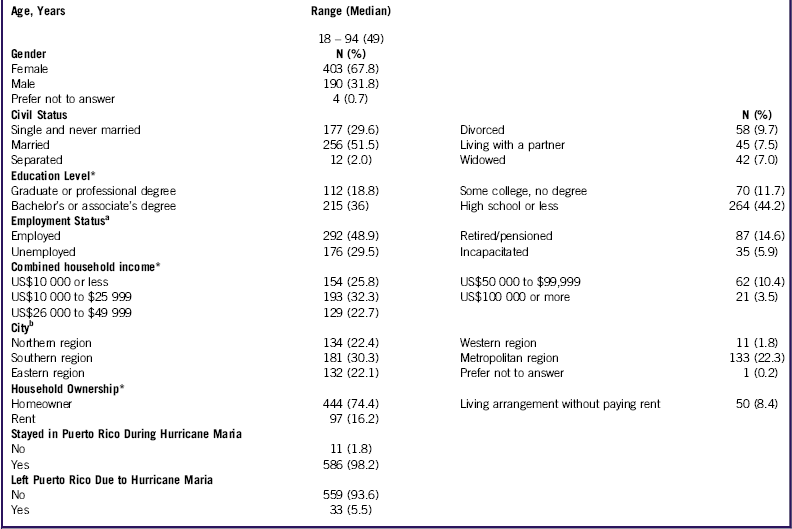
Participant Demographics (N = 597)*

*For brevity “Prefer not to answer” is not listed. a Unemployed include: full time students, homemakers, looking for employment, not looking for employment. Employed include: employed full time, part time, and students with part-time employment. b Cities in northern region : Arecibo, Dorado, Florida, Hatillo, Jayuya, Lares, Manati, Morovis, Utuado, Vega Alta, Vega Baja, Toa Alta, Ciales, Corozal, Naranjito; Southern region : Coamo, Guayama, Juana Diaz, Orocovis, Patillas, Peñuelas, Ponce, Salinas, Santa Isabel, Villalba, Maunabo, Arroyo; Eastern region : Aguas Buenas, Barranquitas, Caguas, Cayey, Cidra, Fajardo, Gurabo, Humacao, Juncos, Las Piedras, Naguabo, Rio Grande, Yabucoa, San Lorenzo, Aibonito, Luquillo; Western region: Aguadilla, Cabo Rojo, Isabela, Moca; Metropolitan region: Bayamon, Guaynabo, San Juan, Trujillo Alto, Toa Baja, Canovanas, Carolina.
Measures of Concurrent Validation
The TESS was developed in 1995 in response to the devastating earthquakes in the Marmara region of Turkey as a measure of the severity of emotional and physical trauma exposure in survivors of earthquakes and other disasters.Reference Elal and Slade 15 Over the years, it has remained a go-to quantitative tool to assess the degree of trauma and distress early in the post-event period. Post-Hurricane Katrina research, as well as initial research after Hurricane Maria, relied heavily on the TESS for early quantification of distress.Reference Chan and Rhodes 7 The TESS is a 24-item, self-administered questionnaire that uses a 6-point hybrid distress scale, from 0 to 5, that includes zero to code a nonoccurrence. We used TESS as a comparative measure in concurrent validation by comparing the PHDS and the TESS in their comparative ability to predict scores of the IES-R, PDI, and GAD-7.
The IES-R is a 22-item, self-report measure designed to quantitatively assess subjective distress caused by traumatic events. The IES-R includes criteria for intrusion, avoidance, and hyperarousal. The IES-R has been extensively used in post-disaster studies, including wars, hurricanes, and earthquakes. Although not used as a diagnosis for PTSD, cutoff scores for the preliminary screening of PTSD have been developed.Reference Brunet, Weiss and Metzler 26 , Reference Morina, Ehring and Priebe 27
The PDI was developed as a quantitative measure of the level of distress experienced during and immediately after a traumatic event. At an early post-exposure application, the PDI attempts to predict the Diagnostic and Statistical Manual of Mental Disorders IV A2 criterion diagnoses of PTSD. It is a verified predictor of PTSD and a quantitative measure of peritraumatic distress.Reference Thomas, Saumier and Brunet 28 Like the IES-R, the PDI uses a 0 to 4, 5-point scale.
The GAD-7 is used as a screening tool and symptom severity measure for the common anxiety disorders, including generalized anxiety disorder, panic disorder, and PTSD. The GAD-7 is useful in primary care and mental health settings, not as a diagnostic tool, but rather as a screening tool.Reference Spitzer, Kroenke, Williams and Lowe 29 The GAD-7 uses a 4-point, 0 to 3 grading scale.
Comparative Concurrent Validity
We compared the PHDS with the TESS using different approaches. First, we used the traditional R-squared approach that quantifies the linear correlation between the tested models (the PHDS and the TESS) and the IES, PDI, and GAD-7. We also included Spearman rank-order correlation coefficients (r s ), a non-parametric correlation measure. Larger R-squared (r 2 ) and r s values reflect better correlation. We supplemented this approach using the Akaike Information Criterion (AIC) that not only considers the amount of variance explained by the model, but also penalizes for complex models.Reference Akaike 30 With AIC analysis, the lower the AIC, the better the tested model (the PHDS or TESS) explains each outcome model (the IES, PDI, and GAD-7).
Measures of Discriminant Validity
Initial divergent validity of the PHDS was demonstrated using a small population sample of Houston residents approximately 9 months after Hurricane Harvey. Fifty respondents completed the PHDS questionnaire in English. Each factor of the PHDS was separately compared in each of the 2 populations of Houston and Puerto Rico. Although Hurricane Harvey was a major hydrological disaster in Houston, it did not directly hit Houston as a Category 4 storm; therefore, the population of Houston was considered appropriate to establish discriminant validity.
RESULTS
Sample Demographics
A total of 597 individuals completed the complete packet consisting of a demographics page and 5 questionnaires. Thirty-seven (6.2%) participants returned largely incomplete packets (more than 5 blank answers) and were excluded from the analysis. Two individuals were excluded due to minimum age (18 years) exclusion criteria. Demographic data of the 597 individuals who were canvassed are included in Table 1. Segregation of respondents by gender and a subsequent non-parametric group-wise comparison demonstrated no gender difference in the cumulative scores for the PHDS, TESS, IES, and the GAD-7. There was a significant difference (Kolmogorov-Smirnov D 0.2220; P<0.001) between the female and male averages for the PDI, which were 16.81±11.68 and 12.57±10.73 (mean±SD), respectively.
Factor Structure
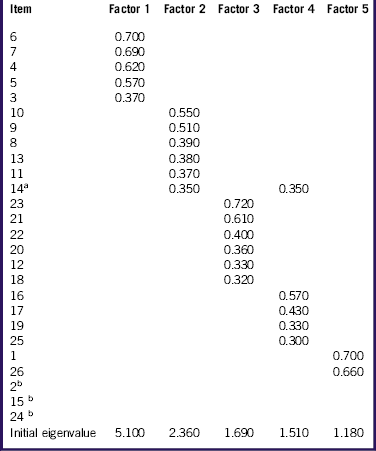
The initial PHDS consisted of 26 items partitioned into 6 initial factors following the scree plot analysis of the pre-validation results (n=79). A comprehensive validation, using an island-wide demographic (n=571), was used for a subsequent principal axis factoring (PAF) analysis. Assuming all factors were at least minimally correlated, an oblique oblimin rotation was used for PAF of the occurrence and distress scale results. For the distress scale, 5 factors were identified, of which the fifth loaded only 2 questions and therefore was dropped. The first factor (being in need) loaded 5 items, the second (resource loss) loaded 6 items, the third (perceived stability) loaded 6 items, the fourth (health concerns) loaded 4 items, and the fifth (relocation) loaded 2 questions only. The respective eigenvalues and percentage of total variance (%) for each factor were being in need, 5.09 (12%); resource loss, 2.36 (10%); perceived stability, 1.69 (5%); health concerns, 1.51 (5%); and relocation, 1.18 (2%). The 5 factors together explained 35% of the total variance. The results of the factor analysis are summarized in Table 2, and the original, numbered questions are available in the online supplementary data (Supplementary 1). The same analysis was repeated for the occurrence scale (Supplementary 2), but given that this approach explained a lower total variance (29%), we focused subsequent validation analyses on using solely the 0 to 6 distress scale.
Factor Analysis of PHDS Distress Items: Principal Axis Method, Oblique Rotation

Note: Only loadings above 0.30 are shown.
PHDS=Post-Hurricane Distress Scale.
The numbered questions (Items) are availabe online in Supplementary Table 3
a Items loading on more than 1 factor.
b Items loading on none of the factors.
The results of the PAF analysis using the distress scale are included in Table 2. Only factor loadings above 0.3 are shown. If an item had at least a 0.30 loading into a factor, it was included as an item in that factor. If any item did not have at least a 0.30 loading (PAF, oblimin) into any factor, it was dropped. Scree plot analysis defined 5 meaningful factors, and, although the fifth factor (relocation) was a theme often mentioned, it explained little of the variance as a factor. This, in addition to its 2-item loading and low internal reliability, led us to remove it from the final PHDS tool. Items 2, 25, and 24 did not load into any of the 5 factors and were excluded; item 14 was dropped because it loaded equally well into 2 disparate factors. For any item loading equally into 2 or more factors, the accepted protocol is to remove it from the questionnaire.Reference Norris and Lecavalier 31 , Reference Reise, Waller and Comrey 32 The final distributable and open-access version of the PHDS questionnaire is included in the digital supplementary section, both in Spanish and English (see Supplementary 3).
Internal Reliability
Cronbach alpha scores included being in need=0.76, resource loss=0.64, personal safety=0.70, health concerns=0.67, and relocation=0.47. The Cronbach alpha score for the complete PHDS questionnaire was 0.81. Of all, relocation showed the lowest internal reliability in the island-wide demographic sampled in this study. A reasonable explanation for this was the sample bias of only including those present in Puerto Rico in this initial study; many of those who relocated after the storm had still not returned at the time of this study. All other factors, as well as the total distress scores, show acceptable internal reliability.
Concurrent Validity
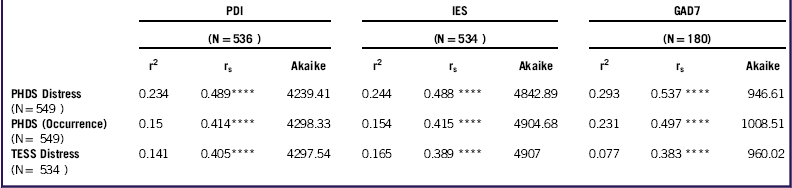
The IES, PDI, and GAD-7 were all administered in parallel with both the PHDS and the TESS. We included the TESS to act as a comparative to show that the PHDS might serve as a better predicator of respondent’s results on the IES, PDI, and GAD-7 questionnaires, in the setting of post-hurricane recovery. We have included the non-parametric Spearman rank-order correlation coefficient (r s ), coefficient of determination (R 2 ), and the AIC as measures of concurrent validity for both the TESS and PHDS. The TESS and the PHDS demonstrated significant correlation to the IES, the PDI, and the GAD7. To directly compare the PHDS and TESS, we followed the techniques described in Tran et al.,Reference Tran and Arabnia 33 wherein an optimum model can be defined as that which has the higher R 2 and the lower AIC. The PHDS performed better than the TESS in all 3 analyses of predictive power for all 3 questionnaires: IES, PDI, and GAD-7 (Table 3).
Comparative Fit Indices and Correlations: PHDS Occurrence and Distress Scales, and TESS Distress Scale

PDI – Peritraumatic Distress Inventory; IES – Impact of Event Scale, GAD7 - Generalized Anxiety Disorder Scale 7 ****P <0.0001
Discriminant Validity
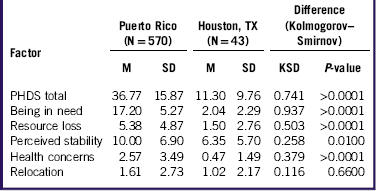
Using the post-hurricane Harvey population of Houston, Texas, that experienced a hurricane with significantly lower magnitude by the time it reached Houston, we conducted a limited comparison of PHDS results with our island-wide, post-Hurricane Maria results. The low sampling number was overshadowed by the very significant difference in scores. Using a non-parametric Kolmogorov-Smirnov D comparison of the 2 group averages, we found a significant difference in the expected direction in total scores and all factor scores, except for the relocation factor (Table 4).
Discriminant Validity: PHDS Distress Scale (Puerto Rico Versus Houston, Texas)

Note: KSD=Kolmogorov-Smirnov D value; PHDS=Post-Hurricane Distress Scale.
DISCUSSION
The occurrence and severity of acute stressors have been well-documented as primary factors in the etiology of PTSD and acute stress disorder.Reference Cahill and Pontoski 34 , Reference Keane, Marshall and Taft 35 Many existing tools designed for early-response relief workers and researchers assess acute stressors not daily sources of distress after the event. A facet missing in existing tools is the inclusion of subtler prolonged changes to daily life, such as job instability and difficulty to maintain personal hygiene, that without respite, can be attributable factors toward depression and suicidality.Reference Chastang, Rioux and Dupont 12 , Reference Ranasinghe, Ramesh and Jacobsen 36 , Reference Libby, Ghushchyan, McQueen and Campbell 37
The PHDS is a 20-item, self-administered instrument developed from the earthquake-focused TESS questionnaire. It has been developed for deployment during the recovery period after hydrological and meteorological disasters, including hurricanes. Validation of the PHDS began 3 months after Hurricane Maria and continued for a duration of 6 months.
After comparing various scoring scales for the PHDS, their subsequent factor loading profiles, and subsequent concurrent validities, we believe that the interpretation of results is best served using a single 0–6 distress scale that is a hybrid of both binary occurrence and Likert distress. This is the reportable score named “distress,” identical to that used in the TESS study, in which it was found to be superior to the occurrence scale.Reference Elal and Slade 15 Likewise, the PHDS is superior in the prediction of IES-R, PDI, and GAD-7 scores in our study of the PHDS. This distress scale is easy to score and is valuable in clinical assessments; it quantifies the subjective impact of each event occurrence in an individual respondent.
At the time of publication, the PHDS does not have a threshold that would allow researchers to classify participants as “high risk” or “low risk” for developing mental illness associated with disaster exposure. A follow-up study, namely the administration of the validated PHDS in tandem with specific psychological disorders screening tools with known cutoffs, such as the Kessler K6 and the Patient Health Questionnaire 9, is underway. This will allow derivation of a PHDS threshold to identify people as “high risk” for a specific mental illness subsequent to disaster exposure. At present, the sum total score of the PHDS can be used as a comparative measure of post-disaster distress, but it does not have a threshold nor significance cutoff value.
Although PAF redefined several of our pre-conceptualized factors, the overlap between our final PAF-defined factors and our initial factors is sufficient to support our initial construct validity. Furthermore, the fifth factor, relocation, poses a compelling topic for discussion and further research. A limitation of this first phase of validation is that it was island-wide, not world-wide. By focusing on the post-Maria population within Puerto Rico, we have introduced a selection bias for those who remained on the island and were not relocated nor displaced. A tangential study is currently using the PHDS in post-Maria populations that were forced to or chose to relocate to the continental United States. This separate study will be the basis of a subsequent comparison of the PHDS in these 2 different populations and the possible development of an alternative form of the PHDS, specifically for the displaced, that does include the factor, relocation.
Evidence for concurrent validity was demonstrated via correlations with the PDI, the IES-R, and the GAD-7; these correlations were directly compared with those of the PHDS predecessor, the TESS. In all comparisons, the PHDS seems to be a more appropriate tool to use in post-hurricane disaster settings. These comparisons are not meant to support that the PHDS supplants the TESS, but rather to provide first responders and researchers a choice in questionnaires based on the nature of the disaster. Our validation and comparisons support the use of the PHDS in hydrological and meteorological disasters. In an earthquake or war setting, in which events such as sudden violent death and dismemberment are more widespread than in a hurricane, the TESS may be preferred.
CONCLUSION
The PHDS represents a powerful new tool in the hurricane first-responder’s toolkit, which gives a new perspective on both acute and prolonged post-disaster stressors. The PHDS is a tool with which first responders and researchers can identify high-risk populations in order to define specific paucities and challenges faced within communities and rapidly and efficiently address those needs. We have compared the PHDS to an existing tool for identifying and quantifying post-disaster stressors and have found that the PHDS performs better in a post-hurricane setting. Now validated, we offer the PHDS, available in both English and Spanish, to disaster researchers for free and open use. We encourage researchers to use the PHDS in a multitude of post-disaster settings. We believe that it can be applied to varied post-disaster settings beyond a hurricane, including but not limited to a flood, tornado, sustained power outages, and drought.
Funding
This research is supported by San Juan Bautista School of Medicine.
Conflicts of Interest
The authors have no conflicts of interest to declare.
Authors’ Contribution
Mr Carl and Mr Rodriguez contributed equally to the preparation of this manuscript.
Acknowledgments
We thank Melissa Matos Rivera, Melissa Milian Rodriguez, Anamaris Torres Sánchez, Rosa Liza Frias, and Grisel Burgos for their participation in data collection; Yolanda Miranda for her input in question design; Jim Mitchum and his colleagues from Heart To Heart for their input on the questionnaire content; Estela S. Estapé for the review of this manuscript; and Raymond L. Tremblay for his manuscript review and guidance in statistical analysis.
Supplementary material
To view supplementary material for this article, please visit https://doi.org/10.1017/dmp.2019.12