Introduction
A dementia-friendly society, whereby people with dementia are recognized as valued citizens and supported to remain meaningfully engaged with the community and in daily life (Davis, Reference Davis, Fleming and Marshall2009), is a vision shared by many researchers, practitioners, educators, and people with personal experience of dementia. However, low community awareness about dementia and stigma and social exclusion experienced by people with the condition, challenges dementia research and translation and early diagnosis (National Health and Medical Research Council, 2015).
Public education is the leading recommended intervention and most popular strategy voted by people with personal experience of dementia, for reducing stigma around the condition (Alzheimer's Disease International, 2012). While initiatives typically target adults (Crabtree and Mack, Reference Crabtree and Mack2010), the current study argues that to tackle this stigma, we need to create positive attitudes at a generational level, among today's youth. Educating children makes empirical sense in that stereotypic beliefs have been shown to increase in flexibility during early adolescence (Alfieri et al., Reference Alfieri, Ruble and Higgins1996); and correspondingly then, that adolescents show more variance and responsiveness to anti-stigma education than adults because their beliefs are less entrenched (Corrigan et al., Reference Corrigan, Morris, Michaels, Rafacz and Rüsch2012). Moreover, children tell us that they want to know about dementia. For example, in a large British poll of 8–17 year olds, 62% reported that they would like to help people with dementia but that a lack of understanding holds them back (Alzheimer's Society, 2015). Over half of the same sample also believed that if people understood more about dementia life would be better for people with the condition.
There are several simple online resources and storybooks targeted towards explaining dementia to youths with a relative with the condition (Sakai et al., Reference Sakai, Carpenter and Rieger2012). However it is not clear how these initiatives reflect the views and needs of those who are using them. Moreover, there is no guarantee that the information is accessed (Denny et al., Reference Denny2012). For example, not all parents initiate conversations about dementia because of limited time, low confidence in their own dementia knowledge, or because they want to shield children from such information (Wolf et al., Reference Wolf2009). Further still, while a third of children know someone with dementia (Alzheimer's Society, 2015; Baker et al., Reference Baker, Goodenough, Jeon, Bryden, Hutchinson and Lowin press) and thus have families potentially motivated to seek information about the condition, what about the two-thirds of children in the community who do not (yet) know a friend or family member with dementia? Improving other people's awareness around dementia helps those who are experiencing dementia in the family feel less isolated (Hutchinson et al., Reference Hutchinson, Roberts, Daly, Bulsara and Kurrle2016). To create a societal change in dementia-friendly attitudes, everyone needs to understand about the condition, not just those currently affected by it.
In order to develop a youth education program to address the negative or misinformed perceptions that form the stigma experienced by people with dementia, we first need to confirm with the stakeholders (i.e. children as the target audience, and people with dementia and their relatives as the target persons whom the program is about), what these negative or misinformed perceptions are. For people with dementia and their carers, in a world survey of 2,500 individuals across 54 countries, commonly described narratives were a lack of community understanding about how to converse with or involve a person with dementia, and the person with dementia being feared, made fun of, ignored, excluded, treated like a child, talked over, or seen as “crazy,” or having a mental illness (Alzheimer's Disease International, 2012). The current study asked people with dementia and the primary carers and relatives of people with dementia, to reflect further upon these lived experiences and identify what would be most important for children to learn in an education program about dementia.
With regard to children's (mis)perceptions about people with dementia, the research is sparse. The intergenerational literature involving elders with dementia and children aged less than 18 years old, typically compounds measures of children's attitudes towards dementia with attitudes towards older adults and aging more generally. Outside of the intergenerational literature, in one study of 89 British 7–11 year olds, when asked what the “consequences” would be for a person with dementia, common responses were “see a psychiatrist,” “do silly things,” and “go to a mental hospital” (Fox et al., Reference Fox, Buchanan-barrow and Barrett2008). In another British survey of 11–14 year olds, 84% cited the media as their principal information source regarding dementia, and repeatedly referenced the “dementors” in the Harry Potter series – half-dead, half-alive creatures who feed on happy thoughts and leave their victims “mindless” state. In the same study, the most recurrent word children used to describe a person with dementia was “weird” or “weirdo” (Cowley, Reference Cowley2005). From this we might infer that misperceptions to be addressed within an education program include misleading variants of the word “demented” and the belief that people with dementia are “weirdos.” Indeed, rather than explicitly asking children what they need to know about dementia – how can children know what they do not know? We can infer what they might need to know from their attitudinal responses.
This can apply to children with and without experience of dementia. For example, in interviews with adolescents with a parent with dementia, a reliance on adults to help them with what they need to know is frequently endorsed (Hutchinson et al., Reference Hutchinson, Roberts, Daly, Bulsara and Kurrle2016); as well as feelings of sadness and anger (Gelman and Greer, Reference Gelman and Greer2011). Similarly, in two separate studies in interviews with 145 Spaniards aged 14–21 years and six Americans aged 21–27 years, reflecting on their experience with a grandparent with dementia, participants commonly reported feeling embarrassed about their relative's behavior, sad, frustrated, and angry (Howard and Singleton, Reference Howard and Singleton2001; Celdrán et al., Reference Celdrán, Triadó and Villar2011). The same Spanish participants described feeling puzzled or not knowing how to react or help their grandparent, and 27% blamed themselves for a worsened relationship with their grandparent (Celdrán et al., Reference Celdrán, Villar and Triadó2014). A youth dementia education program needs to accommodate the full variance of where children start from with dementia knowledge; and includes acknowledging that for some this “simply” is ignorance or a feeling.
Through qualitative inquiry, the present study aimed to advance the currently scant understanding of what children in the community know (or do not know), feel, or behave around people with dementia. Together with the combined perspectives of four different groups of people with personal experience of dementia (i.e. people with dementia; adult primary carers; non-primary carers; and child relatives of people with dementia) the study asked, “what do children need to know about dementia?,” as the foundation to eliciting stakeholder priorities for the message content of future education efforts to improve dementia literacy among youth.
Method
A qualitative inquiry using interviews and focus groups (Morse and Field, Reference Morse and Field1995b; Patton, Reference Patton2002) was conducted to gain a comprehensive understanding of the attitudes of children and people with personal experience of dementia concerning dementia and dementia education content for youth, respectively. Data collection was guided by a tripartite framework that conceptualizes attitudes as having three core elements: cognition, affect, and behavior (Eagly and Chaiken, Reference Eagly and Chaiken1993). For example a child who believes that a person with dementia is dangerous (cognition), might fear (affect), and thus avoid (behavior) people with dementia. Based on this tripartite framework, we explored what children in the community know, feel, or behave around people with dementia, and what people with dementia and their primary carers and relatives would like children to know, feel, or behave around people with dementia.
Participant sampling and setting
The study took place in the Greater Sydney region of New South Wales, Australia. In line with the University Human Ethics Committee approval (HC14328), adult participants gave informed written consent. For child participants, parents gave informed written consent and children provided informed verbal assent. Purposive sampling aimed to achieve maximum variation in dementia experience and participant characteristics. For example, for children in the community participants, we considered their age group, gender, and socio-economic backgrounds, including geographic locations and private/public schooling. For participants with personal experience of dementia, we considered the different perspectives of persons with dementia, their primary carers and adult relatives. After meeting with these three participant groups, it became apparent that perspectives of child relatives of people with dementia were needed to explore in-depth the issues discussed in the earlier focus groups; hence, the inclusion of an additional focus group with children who had intimate experiences as relatives of people with dementia. Recruitment and data collection continued until saturation of themes occurred across all participant groups (see analysis), at which point the dataset was closed at 49 participants (Morse, Reference Morse1995a).
Children in the Community Participants. For the community sample, children were not required to know anyone with dementia. Two Scout Groups (selected based on their locality to the University campuses) invited their members to take part; one Group was situated in a low socio-economic index area of Greater Sydney and the other in a high socio-economic index area of Greater Sydney according to the Australian Bureau of Statistics (Australian Bureau of Statistics, 2013). Four child focus groups were conducted, two with 9–10 year olds Cubs, and two with 11–12 year old Scouts – one of each age group from each of the two Scout Groups (n = 22, 13 boys). The mean age of the children was 10.5 years (SD = 0.93). The majority were Australian born (n = 20) and attended a government-funded school (n = 18).
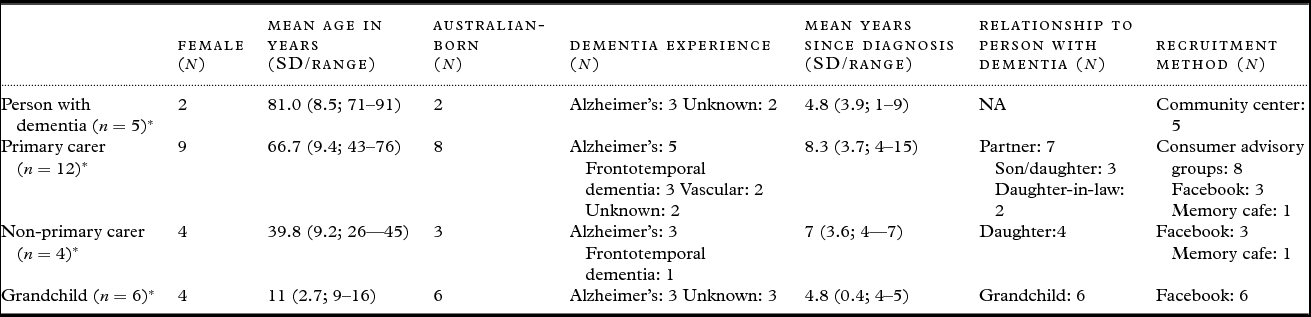
Adult and Child Participants with Personal Experience of Dementia. To obtain a full perspective of the firsthand experience of living with dementia (see Table 1 for demographic details), four different participant groups were recruited: (a) Persons with early-stage dementia able to provide informed consent (n = 5); (b) Adult primary carers of a person with dementia (n = 12); (c) adult relatives of a person with dementia in a non-primary carer role – typically adult children (n = 4); and (d) grandchildren of a person with dementia (n = 6). The six grandchildren came from three different families. While adult participants did not need to have children to be eligible to participate, all but two primary carers had children and/or grandchildren. An inclusion criterion was ability to communicate in English, and highest education levels of adult participants ranged from high school to postgraduate.
Demographic and diagnostic characteristics of consumer participants

*Note: different sample sizes per consumer group.
Procedures
Interview/focus group questions and the delivery methods were based on dementia literature, the tripartite framework, and advisory group input. The latter comprised project team members (authors) representing a range of dementia expertise (care, research, knowledge translation, lived experience), child education, and qualitative methods. Participants with personal experience of dementia were recruited via memory cafes (social outlets for people with dementia and their carers), Facebook, community aged care centers, and Alzheimer's Australia Consumer Advisory Groups.
Children in the Community. To avoid “priming” children about dementia, consent/assent was sought without mentioning the term “dementia” until a specified point in the focus group. Children and their parents were told that the project topic was attitudes toward issues in aging and older people.
Given the young age of the participants an approach was developed in consultation with education experts, to ensure that children were able to express their views in an authentic manner. Author JB guided the following focus group structure:
1) Children watched a video medley of people with different dementia experiences (collected from YouTube and existing dementia education videos (Alzheimer's Australia SA, 2013; Coleman, Reference Coleman2012, Oct 22; Howard251a, 2010, April 13; Marepuwaterloo, Reference Marepuwaterloo2014, June 6; NHSlocal, 2012, July 20; Sambi1968, 2010, Sept 22)); and described their thoughts about the people in the videos, plus any person they had encountered who had behaved in a similar way. (The video medley is available on request from the first author)
2) Children indicated how they might feel when or if they met someone similar to those in the videos, by selecting emotional expressions from a board of Lego faces.
3) Author JB invited a child to perform a role-play with her. Based on a prepared script, JB played a confused person with dementia at a bus stop. The child was prompted to play out how they might behave in such a situation. After the role-play, the other children in the group were invited to discuss how they might act in a similar situation.
4) Children were encouraged to ask any questions they had about the people in the videos, or people they had encountered similar to those in the videos.
5) Children were told that the people in the videos had dementia, and then described what they knew about dementia.
6) Children completed an adapted Level of Contact Report (Corrigan et al., Reference Corrigan, Lurie, Goldman, Slopen, Medasani and Phelan2005) querying their level of familiarity or contact with people similar to those in the videos. The scale describes several situations in which intimacy of contact varies from the lowest – ‘‘I have never observed a person like that” to “I live with a person like that.” The index of familiarity is the rank order score of the most intimate situation that the children check. Each focus group lasted between 40 and 60 min. Each child received a certificate of participation, and the Scout Group was thanked with a small gift voucher.
Participants with personal experience of dementia focus groups and interviews
Adult participants with personal experience of dementia. There were three main prompts:
1) “Thinking about your own children/grandchildren, and children in general, please tell us your experience of children's understanding or knowledge about dementia, and their behaviour around people with dementia”;
2) “Thinking about your experience of living with dementia, what do you like or would you like, children to know and understand about dementia, and to feel and behave around people with dementia?”; and
3) “Thinking about the overall goal of the program to educate children to grow up in such a way to promote inclusive dementia-friendly communities, what can we do better to educate children about dementia; what is important for children to know about dementia; what should the key goals or objectives be of an educational program?”
The focus groups lasted 1 h, and individual interviews about 30 min.
Child Relatives of a Person with Dementia. There were six main prompts:
1) “What it is like to have a grandparent with dementia?”
2) “What is the hardest thing about having a grandparent with dementia?”
3) “What surprised you about your grandparent's dementia?”
4) “What helped you most understand the dementia; for example, what tips or advice might you give another child with a grandparent with dementia?”
5) “How might you explain dementia to your friends?”
6) “What would you like other people to know about your grandparent's dementia, if they met them in the street for example?” The interviews lasted between 15 and 40 min.
Analysis
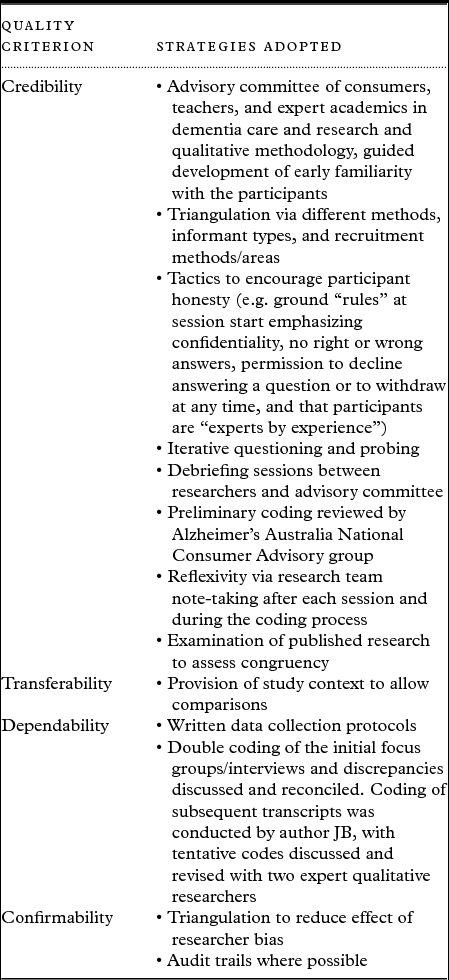
Interviews were digitally recorded and transcribed verbatim by a professional company, then entered into QSR NVivo version 10 (QSR International Pty Ltd, 2012). Field notes were also taken. Qualitative content analysis was largely inductive in the early stages and became more deductive as the analysis progressed (Morse and Field, Reference Morse and Field1995b). For the child group data, initially common patterns of responses towards dementia were coded in terms of cognition, affect, and behavior (Eagly and Chaiken, Reference Eagly and Chaiken1993). For the persons with personal experience of dementia group data, responses were coded based on potential learning objectives of a dementia education program for children. All other information about participant experiences with dementia contextualized their recommendations. To maximize study rigor, the process was guided by Guba's four criteria for trustworthiness (Guba, Reference Guba1981) (see Table 2).
Content analysis process as guided by the four criteria for trustworthiness (Guba, Reference Guba1981)

Results
Children in the community focus groups
Twelve of 22 children reported having a relative who behaved in a similar way to the people in the videos; four reported seeing similar people in a movie or documentary; three reported seeing similar people “in passing”; and another three reported never having seen a person similar to those in the videos.
Cognitive responses
Two main cognitive themes were an unprompted need to try to reason or explain the conduct of the people in the video, and a lack of knowledge about the people in the videos and/or their conduct.
Reasons for the observed conduct of people with dementia
Brain impairment: Most of the children indicated that there was something “not quite right” with the person's brain. For example, the people in the videos were compared to children's familiar others who seemingly had learning difficulties or had “bumped their head. . .and acted weird now.” Similarly, the children reasoned that the person was “sick” or “should see a doctor.” Somewhat compatible with this reasoning, the children identified that the person's behavior was not always under the individual's control, for example, “I know it's not her fault because it's probably just the sickness.”
Sensory impairment: A repeated theme was the suggestion that the person in the video may be behaving that way because they were deaf or blind. Consistent with this reasoning, the children recommended a solution of “a hearing aid” or “a guide dog”.
Making it up: Some children disbelieved that the person's behavior was “real” – suggesting that the individual was acting to play a “trick” or a joke. Upon probing, the children pointed out conduct inconsistencies, for example, the person seeming fine one moment and not the next, which led them to conclude that the person was making it up.
Lack of awareness/knowledge of dementia
Extent of behavior: The children showed surprise that people could be “that forgetful” or “that angry.” One girl asked, “do people actually meet people like this and get stuck in these situations?”
Age: One video depicted a lady in her 50s with younger onset dementia. There was clear surprise that someone so young could show such cognitive and behavioral changes. For example, a boy stated that, “It's not that strange if you see a young boy having cancer. . . But if you see a 40-year-old woman with dementia.”
Disease prognosis: When the children were told that the people in the videos had dementia, the children asked about cure or contagion of the condition.
Affective responses
The children expressed a variety of feelings in reference to people in the videos or similar to those in the videos.
Annoyance: The dominant affective theme was one of intolerance, irritation, or impatience with the person or their conduct. The most common feeling words were “annoying” and “frustrating,” typically followed by negative descriptions of the person as “crazy,” “weird,” child-like or “smelly.” When told that the people in the videos had dementia, and asked what they knew of dementia, one boy said “I was going to say I'd never heard the word dementia, but I've heard the word demented. [Okay, and what do you think the word demented means?] Someone that's very annoying and stupid.”
Concern: The negative theme of “Annoyance” was closely followed by frequent expressions of concern or sympathy or empathy. This caring theme was most closely expressed in conjunction with beliefs that “they can't help it, they just do it.” Children expressed sadness or worry for the person, most typically in that they were vulnerable to being taken advantage of. Children also expressed insightful concern for the person's relatives. For instance, a boy stated “I feel sorry for the people that take care of them because they would have to go through a lot of stress.”
Confusion: Several children used the puzzled Lego face to report feeling confused or not fully understanding what they had just seen. This affective theme showed a strong overlap with the curiosity or lack of awareness detailed above.
Happiness: Children made a few statements about being happy for the person. For example that they can be themselves without worrying about what others think. One girl stated “they're cool in a way because they are quirky. . .I liked that they were different.”
Fear: Some children said that they found the person or their conduct “creepy,” and would feel scared if they met a person behaving in a similar way.
Behavioral intent
Consistent with the cognitions and affect expressed, children typically endorsed three types of behavioral intent towards people in the videos.
Helping: Despite annoyance being a common affective theme, the dominant behavioral intent was one of trying to help the person, for example, by actively engaging with the person, answering their questions, “giving them space,” or ringing the hospital. One boy reflected that “it makes me think is there any way you can help those old people.”
Keeping away: Children were also keen to avoid or ignore the person, either to protect themselves (consistent with feeling fear) or because of perceiving the person as irritating or boring (consistent with feeling annoyed). For example, one boy said:
I would slowly walk away from them. [Okay, why would you slowly walk away from them?] Because I know I was going to get into a conversation that would go on forever.
Laughing at the person: A few children laughed out loud at the videos and mimicked the person.
Ambivalence
The children's thoughts did not flow consistently from a cognition to an equivalent affect and then behavioral intent. Rather the children were constantly reflecting on their thoughts, voicing internal dialogue for and against their ideas. For example, when a girl suggested “I know it's not her fault because it's probably just the sickness,” this was preceded by “So I felt pretty angry, but I didn't feel angry because I know it's not her fault. . .” Similarly, a boy referred to a scene with a retail assistant serving a confused person with dementia and stated:
If I was the shopkeeper person I probably would have lost the plot by then because I would have got so annoyed, but I liked it that they didn't do that and they actually just waited until they – they waited for them to answer and pick up their money and things.
Another boy reasoned
It's like Albert Einstein, if when he gets older maybe he could start to act a bit strange, but he's still actually really smart, just he's got a problem with something that he can't help. . . . He's still the smartest person on earth.
Participants with personal experience of dementia focus groups and interviews
Participants with personal experience of dementia struggled to identify tangible educational objectives; rather, they narrated experiences as ideas for the content for a dementia education program. Four broad and multifaceted themes emerged.
Tell the whole truth about dementia
The most consistent theme to emerge across all participant groups with personal experience of dementia was the need to be wholly open and honest when educating children about dementia. Participants were emphatic that children should know that there is currently no cure for dementia, and that the health of the person with dementia will likely get worse. In the words of a ten-year-old boy with a grandmother with dementia:
I wouldn't say everything will be okay because I hate – I absolutely hate it - you'd rather someone say to you, yeah, your grandma's never going to get better. You know if they're going to be speaking the truth or just saying it.
People with personal experience of dementia emphasized how dementia is different for each person, and the need to talk about all the possible changes. A ten-year-old boy said:
Bob had dementia but it wasn't like grandma. . . .Bob would still make interesting points but with Grandma, the only really time that she'll actually make a point or a statement is like, when she wants food or wants quiet and peace. She doesn't really have conversations; but with Bob you could actually chat about stuff . . .it's like a thumbprint or a mouth. It's never the same. So just remind people of that.
Children with a grandparent with dementia described the changes they saw in their relative, such as in personality or mood, rather than memory loss, as being the hardest to understand. Carers with children spoke about the unpredictability of dementia, how diurnal variations in behavior were confusing for their child. An adult daughter of a person with dementia speaking about her son (her mother's grandson) disclosed, “the thing that really did confuse him was at the beginning when Mum would have moments of lucidity and be fine, and then go into a spiral.”
Adult participants with personal experience of dementia suggested that dementia is difficult for children (and adults) to recognize and understand because it is not visible. For example, a non-primary carer of a mother with dementia said that:
The biggest speed bump for them to get over is the fact that she hasn't got a broken back, she hasn't got a broken arm, it's all in there [point to head], which we don't understand. . . when you see somebody who's physically disabled, you can kind of see people get that instant sympathy and they communicate better with them, they're a more open to being patient, where when it's somebody who's got a mental disability, they don't see it.
Several participants with dementia and relatives of people with younger onset dementia expressed the significance of educating children and the public generally about dementia risk reduction via a healthy lifestyle. A daughter of a woman with younger onset dementia explained:
It's something that really weighs on my mind now. . .like I go oh well what did my mum do that may have hindered her to the point that she is and what could I do to maybe push it back if I was to get it? So I do think that it's important for people to understand tools that they can use that could possibly off set the dementia.
Another major theme was the challenge of residential aged care facilities (RACFs). For participants with experience of a relative with dementia living in an RACF, the facility was described as “this scary place” for children “with lots of weird people” and “a funny smell.” RACFs seemed a challenge for adults too, with the relatives or primary carers of a person with dementia describing how friends stopped visiting their relative with dementia once they moved into a RACF because they seemingly found it too hard or upsetting.
In terms of what children should not, or do not need to know the “truth” about, participants with personal experience of dementia were dismissive of the idea that children learn about the different types of dementia; for example, Alzheimer's disease versus frontotemporal dementia versus vascular dementia. Similarly, participants with personal experience of dementia described suggestions to go into detail about the condition pathology – such as plaques and tangles – as “unnecessary.”
Emphasize personhood
A strong theme to emerge from the discussions with participants with a personal experience of dementia was the sense of personhood, to remind children that a person with dementia is “still a person.” A 12-year-old girl with a grandmother with dementia said:
It's important to know that there is actually a person underneath and that they're actually really special to a family. . .they're not just sort of some random now they've got a disease . . .it's sort of important to know that they're still special to us.
Children with a grandparent with dementia were emphatic that knowing it is not the fault of the person with dementia and that they cannot help or control what they do, was the one key thing that helped them understand the change in their relative. A 12-year-old girl said:
Well, the most important thing really was that it's not her doing this. That was like the most important lesson that I was taught. So, like – yeah, through knowing about the disease I could learn more about how it affects her mind and that it's not really her doing these strange things or anything.
Participants with personal experience of dementia spoke about creating empathy – encouraging children to think about how it might feel to live with dementia. Inversely, some primary carers and relatives of a person with dementia attributed an absence of empathy to their negative experiences in the community. A non-primary carer of a mother with dementia described trying to instill empathy and understanding in her daughter:
What if Mummy asked you to go get something and you forgot to get it, what if you did it all the time? She said, “Oh, Mummy would get really, really angry.” And I said, “And how would you feel?” She said, “Oh, I'd feel really sad,” and she goes, “I'd feel really scared ‘cause I couldn't remember.” And I said, “That's how you feel. That's how Grandma feels.
Address stigma
While few people with dementia and relatives of typical-onset dementia endorsed experiencing stigma (beyond joking exasperation that people need to know that “dementia's not contagious”) stigma was an especially poignant and distressing theme for relatives of people with younger-onset dementia. A primary carer of a mother with younger-onset dementia said that, “before we knew the diagnosis she was treated like an idiot. . . .there's no need for that.” Children with a grandparent with dementia did not express stigma per se, but on probing about how they might explain dementia to a friend, most said they would not tell a friend for fear of them judging it as weird. This was consistent with the less frequent theme of adult carers referring to a “self-stigma,” in that at times they felt embarrassed about caring for a relative with dementia and were initially reluctant to tell people about the diagnosis.
Teach how to relate to a person with dementia
The last quite diverse theme addressed educating children about how best to relate to a person with dementia. Some primary carers and relatives of a person with dementia described their children/grandchildren as scared or hesitant around their relative. Children with a grandparent with dementia also described feeling scared at times, for instance when their grandparent with dementia hit out, or went “a bit insane.” A nine-year-old boy told how, “Well, it's really scary. Like, the first time I saw Grandma with dementia I just backed off, like, who is this person? Like, it's really scary. Sometimes you just look at people with dementia and you just get scared.” Fear or awkwardness around people with dementia was often rationalized by the primary carers or relatives of people with the condition, as “not knowing what to do.” They emphasized that showing “love,” “kindness,” “respect,” and “compassion” was the key, and described the importance of touch and a smile. One 12-year-old girl elaborated that “You just need to know that you can help them, whoever you are, wherever you are.” A popular approach was the idea of not challenging a person with dementia but rather going along with the person's current understanding.
Discussion
Creating positive attitudes among the next generation is the key to addressing the life-changing stigma experienced by people with personal experience of dementia. Using a qualitative approach, perspectives from children, people with dementia, and the relatives (young and old) of people with dementia were obtained to inform what positive attitudes we need to engender and what negative attitudes we might need to address, ultimately within the context of a future education program. The children in the community responded with a keen curiosity to the videos of people with dementia and consistent with past research and were eager to learn more about the condition (Cowley, Reference Cowley2005). This suggests that 9–12 year olds would be receptive to an education program about dementia. The children's feelings of annoyance and wanting to avoid the person with dementia were consistent with the experiences of stigma reported by people with dementia and their carers or relatives (Alzheimer's Disease International, 2012), and adult reports that a significant minority of the public find people with dementia irritating and avoid spending time with them (Alzheimer's Australia, 2012). The children in the community endorsed less fear of people with dementia than what was reported by participants with personal experience of the condition. This may have been because the dementia exposure was video-based, and their responses may have been more fearful if the exposure was in person.
Nonetheless, the children showed a variety of responses which represent and reinforce the challenges to the vision for dementia-friendly communities. These included negative affect, confusion, anticipated avoidance, laughing at the people in the videos, inquisitions, and misperceptions of stupidity or hearing loss. These responses underpin the need for an education program targeting stigma reduction – especially the stigma expressed by participants with younger onset dementia experience. The children's ambivalent responses indicate a target for an education program. Compatible with reports that early adolescents’ show a responsive flexibility in their beliefs (Alfieri et al., Reference Alfieri, Ruble and Higgins1996; Corrigan et al., Reference Corrigan, Morris, Michaels, Rafacz and Rüsch2012), the comment that “I felt pretty angry but I didn't really feel that angry because I know it's not her fault. . .” examples a capacity to guide children toward a reasoning inclusive of people with dementia in the community. Exploring ambivalence is an important part of motivational interviewing for behavior change (Rollnick and Miller, Reference Rollnick and Miller1995). The educational implication is that a candid discussion about how the conduct of a person with dementia can be annoying or weird for example, but that it is not always under the person's control, might be more successful at instilling positive attitudinal or behavior change, than an approach that only covers a “correct” directive or way forward. To provide another example, educational efforts might acknowledge reported concerns that aged care facilities seem like “scary,” smelly places with “weird people,” while also offering the view that they provide important care to someone's parent or grandparent.
Such an approach would converge with the assertions made by child participants with a grandparent with dementia that children want to, and are able to hear the honest and open truth about dementia. A boy as young as ten years old described that he can recognize when a person is telling him it will be fine to make him feel better rather than the truth, which is what he wants to hear. Participants aged 11–18 years with a parent with younger onset dementia also emphasized the importance of their parents’ honesty (Svanberg et al., Reference Svanberg, Stott and Spector2010). Perhaps less overtly, the primary carers and adult relatives of people with dementia corroborated this idea in their descriptions of how they spoke to their children about dementia. The children in the community also wanted to know the truth. For instance, they wanted to know if there was a cure for dementia or if they could “get it”. This matches with participants with younger onset dementia experience wanting children to learn how to reduce their risk of developing dementia. Participants with personal experience of dementia also placed strong emphasis on the importance of instilling personhood and empathy within an education program – and the children in the community demonstrated a capacity for both. For example, in the Albert Einstein quote presented in the results, the boy recognized that despite acting strange, the man in the video was still the same person; he was “still the smartest person on earth.” Similarly, the children demonstrated touching expressions of concern for the person with dementia, wanting to help them, and expressed insightful empathy for the relatives of a person with dementia. Empathic concern is a well-established motivator in youth for helping others (Batson et al., Reference Batson, Batson, Todd, Brummett, Shaw and Aldeguer1995; Williams et al., Reference Williams, O'Driscoll and Moore2014); thus it makes empirical sense to incorporate this into an educational initiative about dementia. Storytelling is a reliable way to elicit empathy in others (Barraza and Zak, Reference Barraza and Zak2009; Castelán Cargile, Reference Castelán Cargile2016). In the current instance, storytelling based on the lives of a family or persons that a target youth audience can identify with, would also likely help emphasize that important message of personhood.
It was also evident from our qualitative inquiry that children need to know about the diversity and unpredictability of dementia – both across people and within people. This might help resolve some of the child relatives’ confusion when “Mum would have moments of lucidity and be fine, and then go into a spiral,” and the children in the community's belief that a person with dementia might be putting it on, if they are fine one moment and not the next. An overarching theme for the learning curriculum is that it is not the fault of the person with dementia. The child participants with a grandparent with dementia were emphatic “that it's not her doing this . . . was like the most important lesson that I was taught.” For the children in the community, it was this reasoning that helped sway a view from anger to understanding, or realizing that the person in the video could still “be the smartest person on earth,” but that “he's got a problem with something that he can't help.” Attributing behavior changes to the disease and not one's relative was a useful strategy noted among adult carers of people with dementia (Purves, Reference Purves2011) and young carers with a parent with younger onset dementia (Svanberg et al., Reference Svanberg, Stott and Spector2010).
Some dementia-related “positives” emerged. The children in the community recognized likable attributes in the people in the videos, such as they were “quirky” and “different,” and did not seem to care what other people think. In past research with adolescents, enjoying happy memories or moments with the parent or grandparent with dementia, or finding humor in the symptoms, was described as valuable in maintaining a good relationship with the relative (Svanberg et al., Reference Svanberg, Stott and Spector2010; Celdrán et al., Reference Celdrán, Triadó and Villar2011). This is corroborated by the people with dementia and the primary carers and adult relatives of people with dementia in the current study, who suggested that teaching children how to relate to a person with dementia may assist with the fear or awkwardness around “not knowing what to do” – especially the benefit of touch and positive non-verbal expression. Indeed, showing affection such as cuddles has been implicated in maintaining positive relations with a grandparent with dementia among adolescents (Celdrán et al., Reference Celdrán, Triadó and Villar2011).
Recruiting participants with a diverse range of experiences with dementia and care services allowed this study to elicit comprehensive and in-depth perspectives regarding the primary research question “what do children need to know?” An important observation for future research sampling is that the few adult participants who were not accessing dementia services or support – recruited more through social media and mainly non-primary carers of people with dementia – were typically less informed about the condition and contributed an important diversity to the research question. For research that can rely on recruitment through dementia advocacy groups or support systems, this is important note for future researchers. It is possible that the children in the community confused their answers about dementia for people with learning disabilities. For example, the children offered analogies between people in the videos, and family members or peers with apparent learning difficulties or brain injury. Nonetheless, the elaborate and candid responses, illustrated in part by the highlighted quotes, demonstrate the authenticity of the responses for both children in the community and the children with a grandparent with dementia. The engaging focus groups methods, such as videos, role-play, and emotive Lego Faces, were successful in enabling the children in the community to speak truthfully and frankly. Thus, they also hint at potentially effective ways to engage children in dementia education efforts.
This study describes the critical step in eliciting stakeholder priorities and content to inform the learning objectives of a future directive to develop a dementia education program for children. Focus groups and interviews with children in the community, and with people with a range of personal experience of dementia, revealed that children need to, or want to, know the whole truth about dementia, and that for example, “your grandma's never going to get better.” Children also need to know that people with dementia are still people; when a person has dementia some conduct may not necessarily be under their control; and that dementia is different and typically unpredictable for everyone. Participant discussions also indicated a need to educate children about ways to relate to a person with dementia and to appreciate “positives” within a relationship. Children are our future citizens. The future development of an education program for children with this message content may be fundamental to destigmatizing dementia and paving a foundation to dementia-friendly communities.
Conflict of interest
None.
Description of authors’ roles
JB initiated the collaborative project, formulated the research questions, drafted the funding submission, designed and implemented the study, analyzed the data, and drafted and revised the paper. YHJ contributed to project design and data analysis and revised the draft paper. BG, LFL, and CB contributed to funding submission, project design, and revised the draft paper. KH and LR contributed to project design, and revised the draft paper.
Acknowledgments
This work was supported by the Dementia Collaborative Research Centre – Assessment and Better Care, University of New South Wales as part of an Australian Government Initiative (RG141810-C). The views expressed in this work are the views of its author/s and not necessarily those of the Commonwealth of Australia. The reader needs to be aware that the information in this work is not necessarily endorsed, and its contents may not have been approved or reviewed, by the Australian Government. We would like to thank all the children and adults who participated in this research and Dr Teresa Atkinson (University of Worcester) for her expert advice from the Dementia4Schools project.