1. INTRODUCTION
Philanthropy was enduring in early modern Europe, and sometimes pivotal. Before the birth of the welfare state, local charities formed the nucleus of institutional welfare in early modern Europe. For centuries, those charities gave small sums that helped many people to survive. The methods used to fund charities varied from place to place. On occasion they were funded from the income from endowments built up over many years; often they depended on public gifts in one form or another; sometimes there was a local poor tax specifically to help fund assistance to the indigent.Footnote 1 The latter was the case in England, although endowed charities and charities collecting for the common good existed there too. In continental Europe, taxation to raise support for the poor was the exception. Instead, voluntary donations often played an important part. Once the importance of that voluntarism is realised, it opens the way to see charity as philanthropy and to ask the same sort of questions that scholars of contemporary philanthropy ask today: why, for instance, do some people give to certain causes and not to others?
This is not the only way to study charitable giving though – the last few decades of the twentieth century saw many studies devoted to either the poor and the importance to them of philanthropy as part of their survival strategies, or to the elites and their efforts to control charity. One cannot entirely dissociate looking at charitable giving from the issue of social control or survival strategies, but a shift in perspective away from either the ‘history from below’ or from ‘social control’ to philanthropic studies may prove refreshing.Footnote 2 While historians might profit from looking at philanthropy in the way that social scientists do for contemporary societies, the past is not the present; nor are contemporary methods of studying philanthropy, such as surveys, available to historians. This essay is an attempt to find and process historical sources, both common and rare, that can be used to study giving in history. The five questions, basic to philanthropic studies, we will address in this article relate first of all to the characteristics of the benefactors; how many gave, who were they and who did not give? Second, we investigate the extent of the benefactions; what, when and where did benefactors give? Third, we ask what were the motives of the benefactors; why did they give? Fourth, we consider the responses to beneficence; what was the attitude of the ecclesiastical and civic authorities to giving? Finally we examine the notion of trust; how could benefactors be sure that their gifts would be used properly?
This article is part of a research tradition that, while always part and parcel of the historiography, grew thin in the closing decades of the last century. Nowhere was the claim that charity was insignificant – and by implication not really worth studying – made more forcefully than in Olwen Hufton's brilliant book on the poor of eighteenth-century France, published in 1974:
For antiquarians and Catholic historians, it has always been possible to be impressed by the range of institutions, produced by the efforts of the pious, which characterized formal relief before the [French] Revolution; institutions to care for the orphaned and aged, the wayward girl, the epileptic, or to distribute soup or blankets to the sick or the paupers of the parish, or to teach the children of the poor their catechism. One can isolate any town of 5,000 or more and expect to find any amalgam of the institutions outlined above. […] This […] should not cloud the main issue, the total inadequacy of formal relief anywhere.Footnote 3
Hufton's book makes a case for the multitude of ‘survival strategies’ open to the poor, which no one, at present, wishes to dispute. This point is well taken and indeed is an outstanding contribution to our understanding not only of the lives of the European poor in the past but also of the functioning of charitable relief. Her other point, however, on the inadequacy of formal relief, is easily misunderstood, both in its nature and in its consequences for the historiography.
In comparison with modern-day welfare, which is is intended to be sufficient to live on, old regime charity only amounted to a fraction of the income of the poor; it was intended merely to supplement other sources of income. One cannot be confident, however, that, in the disorder of the dying days of the Ancien Régime, France was typical of early modern Europe. Given that much institutional welfare in Europe was organised locally, it will be difficult to ascertain empirically what, if anything, was typical for early modern Europe. There are, however, good reasons to assume that what Hufton observed was indeed charity at one of its worst moments in early modern history. First, we know that the number of poor in France had probably been rising since the mid-eighteenth century, thus increasing the demands made on charitable funds. Meanwhile, the revolutionaries tried to smash ancien régime charity, and for a time they were quite successful; however, since the revolutionaries were unable to provide a better alternative, the poor were actually left worse off under the new regime than they had been under the ill-reputed Ancien Régime. Second, the aggregate statistics, available from the 1790s, show France not only far behind England and the Netherlands, but also only gradually approaching the same sort of level of relief as that seen in many other European counties.Footnote 4 Third, and finally, the little evidence we have on the value of relief as a percentage of wages for the different types of poor leads away from the worst-case French scenario to a more qualified conclusion that relief was not a phenomenon of negligible dimensions and that, though modest, it was an important survival strategy deployed by the poor in Europe.Footnote 5
It is the two-sided effect on the historiography that is most important here, however. Precisely because it supplemented social control theories of welfare by drawing attention to a history from below in the form of the survival strategies of the poor, it had the effect of not studying benefactors, their gifts, and the conditions under which they gave. The present article does do so. It does not claim that survival strategies were unimportant, merely that giving strategies were important too. In doing so, it stands at the crossroads of venerable research traditions.
There is, first, a tradition in poverty research which focuses on the financing of poor relief and the ‘structure of giving’, and especially the role of collections.Footnote 6 Some scholars have studied the financial records of charities and the regulations determining how collections were organised. Their work has demonstrated the usefulness of those financial records in establishing the importance of each of the major flows of revenue enjoyed by those charities: capital endowments, collections in sundry forms, subsidies, and other forms of income. Then there is a second tradition which focuses on the social background and motives of benefactors. Although the historical studies footnoted above do to some extent consider this aspect as well, there are also sociological studies in this field.Footnote 7 The third approach is a branch of the historiography that considers wills as ‘autobiographies in miniature’. Examples include older work by Michel Vovelle in France and of Wilbur Kitchener Jordan.Footnote 8 It is this latter category of study that has traditionally tried to embed analyses based on this single source in observations of a more general nature on the history of mentalities.
This essay discusses in general terms the sources, methods and results for each of the questions listed above, drawing on the studies already mentioned but exemplified in particular by a study of giving in Amsterdam during the Golden Age, taken rather broadly here as the period 1580–1800. Wills will be an important source, as are any accompanying probate inventories and records of gifts held by the charities themselves. Qualitatively rich data on the foundation of almshouses form another source of information on the founders' motives. Additionally, some charitable giving was anonymous, and while inherently difficult to study it can still be analysed by looking at appeals to citizens by charitable organisations to open up their purses. For those appeals to be successful, it might be argued, they had to present reasons to give that citizens would accept as well-founded; an analysis of appeals can therefore be used, at least as well as any other method open to historians, to shed light on why people gave to support philanthropy. All those sources combined will illuminate some of the main features of philanthropic giving, from the humble gift to the dazzling donation.Footnote 9
2. FINANCING PHILANTHROPY
In early modern Europe, philanthropy was organised almost exclusively at the community or parish level: funds to support the needy population of a village or town were raised locally and charities were run by local dignitaries. Rarely was there a provincial or national legal framework for philanthropy. The English Poor Law is the most powerful, and thus at the same time the most unusual, example of this.
Most parts of Europe had a mixed system of welfare. Local churches helped the poor of their own congregations, while local authorities helped those, or at least some of those, whom the Church would not or could not help for whatever reason. There were also charitable institutions that were not part of the structures operated by the Church or the authorities. In this system of ‘mixed welfare’ regimes, the distinction between different forms of philanthropy was sometimes blurred. The Dutch Republic was a prime example of mixed welfare.Footnote 10 It is not much of an exaggeration to say that the Republic was home to every strand of religious belief known to Europe. The Calvinist or Reformed Church had the largest number of adherents, followed by the Catholic Church. There were also Lutherans, Ashkenazi Jews, Sephardic Jews, and a host of small Protestant groups such as the Anabaptists. They all tried to look after their poor. In Amsterdam, each of those groups had its own charity. And they did rather well, moneywise.
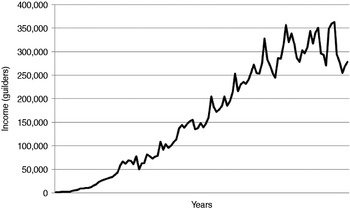
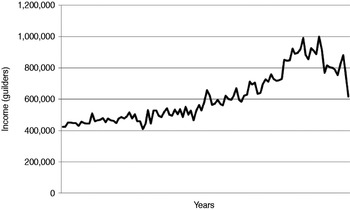
Annual data on charitable income are available for the the Reformed Charity from 1687, and for all major charities from 1687 onwards.Footnote 11 During the Golden Age the Reformed Charity grew from nothing at the time of the Reformation to become an institution handling around 300,000 guilders a year by the mid-seventeenth century (see Figure 1). Poor relief provided by the Reformed Church then continued to grow in importance until the last quarter of the eighteenth century, when it experienced a dramatic fall, reaching its nadir during the period of Batavian and French rule. Poor relief recovered slowly in the following decades. From 1687 onwards, data are available too for the three other major charities as well (see Figure 2). The relief provided by the four major Amsterdam charities (the Reformed, Catholic, Lutheran and Municipal) grew until the final quarter of the eighteenth century; this was followed by a period of stabilisation until a dramatic drop during Batavian and French rule and then renewed stabilisation. The total level of support provided by all four charities grew from around 400,000 guilders at the end of the seventeenth century to one million guilders at the end of the eighteenth century. In absolute terms, Dutch charity was continuous and growing overall, both in and outside Amsterdam.Footnote 12
Annual income of the Reformed Charity in Amsterdam 1578–1687. (Source: J. Wagenaar, Amsterdam in zyne opkomst, aanwas, geschiedenissen, voorregten, koophandel, gebouwen, kerkenstaat, schoolen, schutterye, gilden en regeeringe, beschreeven (Amsterdam, 1760–1767), vol. II, 149–51.)

Annual income of the four biggest charities in Amsterdam 1687–1794. The four biggest charities are the Reformed, the two municipal charities in combination (each covering half of the city), the Lutheran and the Catholic charities. Linear interpolation has been used for some years. (Source: J. Wagenaar, Amsterdam in zyne opkomst, aanwas, geschiedenissen, voorregten, koophandel, gebouwen, kerkenstaat, schoolen, schutterye, gilden en regeeringe, beschreeven (Amsterdam, 1760–1767), vol. II, 149–51.)

Does this conclusion also hold if we take inflation and population growth into account? An index of prices of consumables rose from 40 to 70 from the end of the sixteenth century to the end of the seventeenth century, while nominal wages doubled.Footnote 13 Allowing for inflation, the income of the Reformed Charity in this period still showed an enormous rise. The growth factor of the population can only be approximated for this period. The estimated population in the period 1681–1685 amounted to 220,000 inhabitants, the 1622 census gives about half of this number while the population around 1580 may have been 25 to 30,000.Footnote 14 What proportion was Reformed, and if this changed over time, is unknown. In all, inflation and population growth together may account for a growth factor of say 20, which is huge but still not enough to explain the growth in Reformed charitable income. For the post-1687 period we stand on firmer ground. The population had ceased to increase, and even declined a little to an estimated 214,000 in the period 1791–1795. The index of consumable prices rose from 70 to 95 in 1795, while the index of nominal wages increased from about 100 to 110. Population size and inflation together could therefore explain a rise in charitable income of, say, a quarter, whereas it actually rose from 430,000 guilders per year to 1,000,000 in 1783, that is, by a factor of 2.4. After 1687 there was a clear real rise in charitable income until after 1783, when, in a period of increasing poverty and rising prices, a decline set in.
The rise in charitable income until 1783 is in part the result of a policy of the charities where they tried to spend less than they received, building a capital stock of houses, land, bonds and obligations. The well-informed eighteenth-century historian Jan Wagenaar claimed that the capital of the Reformed Charity acted as a buffer in times of need.Footnote 15 In normal years the charity received more money than it needed for day-to-day poor relief. The surplus on the current account was transferred to the capital account to be used in times of necessity. When times were especially bad the process was reversed. According to Wagenaar, this happened in 1672, one of the most disastrous years in the history of the Dutch Republic. It happened again from the end of the eighteenth century and most certainly during the dark days of Batavian and French rule. In the period 1785 to 1790 the Reformed Charity sold bonds worth a quarter of a million guilders and houses worth 35,000 guilders. From 1791 to 1796 it sold only 35,000 guilders-worth of bonds and 150,000 guilders-worth of property. The capital it held fell from 1,800,000 guilders in 1770 to 1,400,000 guilders in 1797.Footnote 16 The large amount of capital in the hands of the Reformed Charity was thus of advantage in times of need in another way too. It made the organisation creditworthy; people were prepared to lend it significant sums, which the organisation repaid with interest of course. It also was a source of income, and a growing one at that, and it could be used for a limited period to avoid making deep cuts in charity.Footnote 17
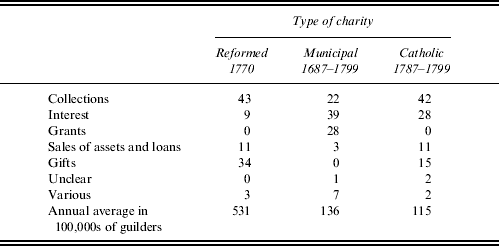
In the case of the Catholic Charity we know that shares and bonds accounted for just over 10 per cent of its income, a proportion that remained fairly constant. The total income of the Catholic Charity, however, increased significantly over time, rising from just over 20,000 guilders a year at the end of the seventeenth century to 100,000 guilders a century later. Interest became five times higher in absolute terms, which probably implies a five-fold growth of the capital stock as well, whereas, as we have seen, inflation and population growth may have accounted for a growth factor of, say, just 0.25. ‘Stock-piling’ for the future common good – or a more general building-up of charitable capital, is thus implied by the income data. This is corroborated by several pieces of evidence.Footnote 18 At the end of the eighteenth century the Catholic Charity owned houses, land and securities worth one million guilders, compared with 100,000 guilders in 1734. Another Catholic body, the Catholic Girls Orphanage, also multiplied its capital during the seventeenth and eighteenth centuries. The level of capital then fell to just over 900,000 guilders in 1809, while subsequently recovering steadily. It may be that the growth in the Catholic Charity's capital during the eighteenth century was unusual for Amsterdam. Between 1771 and 1774 a fierce dispute raged between guardians of the poor and their critics, including many priests. One argument put forward by those critics was that the charities gave too great a priority to increasing their capital above and beyond what was needed for sound policy. While possibly exaggerating, the Catholic charities did, however, conform to the general picture: spending less than they were receiving and thus forming a sizeable capital which in turn was a source of income, which could be used as a buffer in difficult times.
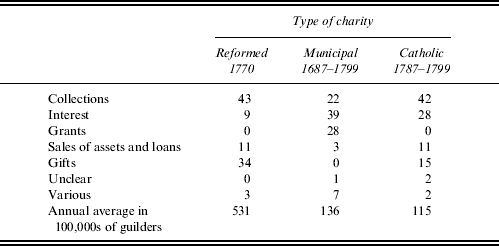
Although Table 1 shows large variations between charities,Footnote 19 generally the majority of their income was not generated by returns on capital invested in houses, land and bonds. In fact, over half of the income of the three Church-run institutions in Amsterdam for which we have data came from ‘living’ sources: collections, cash legacies and gifts. These same sources accounted for only a quarter of the funds available to the Municipal Charity. The Municipal Charity failed to attract charitable bequests, perhaps because the latter were often made with a view to the afterlife, in which case a bequest to a Church-run charity was thought more prudent than one to a secular-run charity. This weakness in attracting funds was compensated by the fact that the municipality gave significant grants only to its own charity. From the mid-eighteenth century these grants rose, ultimately accounting for no less than half of the Municipal Charity's total income at the close of the century.Footnote 20 This was exceptional for early modern times.Footnote 21 Living sources generally were more important for Amsterdam charities, and collections, which all churches in Amsterdam held, formed an important component of these. There were also door-to-door collections, as well as collection boxes placed throughout the city. As discussed later, a veritable web of charity had been spun in the city, from which only the most insistent of misers could hope to escape. From the beginning of the early modern period to its end, no matter how unfortunate times were, Amsterdam charities unfailingly provided help to the city's poorest citizens; that they were able to do so was due in large measure to gifts, and it is to these gifts we now turn, starting with an analysis of wills, a major source for the history of philanthropy in early modern Europe.
Sources of income of Amsterdam charities, 1687–1799, as percentage of total income
Sources: J. Wagenaar, Amsterdam in zyne opkomst, aanwas, geschiedenissen, voorregten, koophandel, gebouwen, kerkenstaat, schoolen, schutterye, gilden en regeeringe, beschreeven (Amsterdam, 1760–1767), vol. II, 149–51; Amsterdam City Archives (ACA), PA 377a no. 408; ACA PA 5028 no. 698, ACA PA 349 nos. 36, 37, 379; ACA, PA 440 no. 151; M. van ‘t Hof, J. Faber and V. Verhoeven, Eindverslag R.C. Oude Armenkantoor (Amsterdam, 1981).
3. GIVERS: EVIDENCE FROM WILLS
Today, surveys can give us a fairly clear idea of how many people give to charity in any particular period. To find out who gives to charity at any time during their lifetime, panel studies, retrospective questionnaires, household accounts covering a long period of time, and tax records can be analysed, although this is not often done even in contemporary philanthropic studies. In historical research such material is rare, but there are some proxies.Footnote 22
Wills are a ubiquitous but indirect indicator of the transmission of wealth between generations. They have been drawn up in Europe since the Middle Ages and have been relatively well preserved because of their legal value to the testators’ descendants. If we examine a sample of wills from notary archives we can discover how many testators made charitable donations, and to whom they made them, and how many did not. In Provence, for example, 45 per cent of wills drawn up in towns in the first half of the eighteenth century included bequests to the poor; this figure fell to 30 per cent at the end of the century. The corresponding figure for rural areas remained unchanged at around 15 per cent.Footnote 23 A recent summary for England indicates that from the late Middle Ages to the middle of the seventeenth century roughly a third of wills contained charitable bequests, a share dropping afterwards outside London, where it remained high.Footnote 24 If we also knew what proportion of the population made wills, it would be simple to work out the proportion of the population leaving money for philanthropic purposes in their wills. Unfortunately, in many cases, we do not. In a small number of cases where information is available the proportion of testators appears to be high. Estimates for the English village of Banbury for the period 1550 to 1800 indicate that ‘about a quarter of the men who might have made a will did so, and about a tenth of the women’. Around 60 to 70 per cent of men and 40 to 50 per cent of women who died in Provence had made a will.Footnote 25
The present essay examines bequests made to charities in Amsterdam in the eighteenth century. The data are taken from the archives of the Reformed Charity and its Catholic counterpart. Using the archives of those charities is less time-consuming than consulting the notary archives, since there is no need to examine wills that do not contain charitable donations, and wills are dispersed across a number of notary archives. In addition, the financial records of the charities indicate the value of the donations.Footnote 26 There is, however, a major drawback to this source: it cannot tell us what proportion of testators – or of the population as a whole – made charitable bequests.Footnote 27
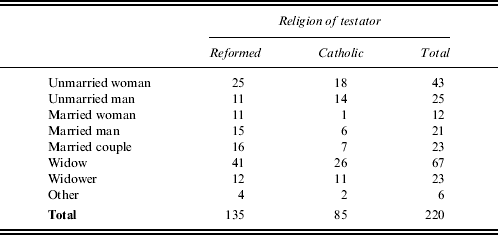
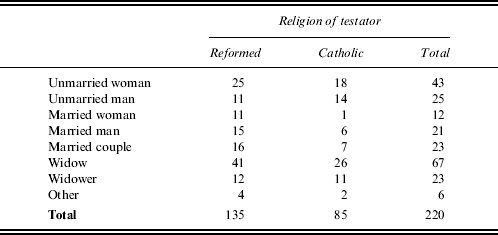
The wills drawn up in Amsterdam in the eighteenth century show that more women than men left money for philanthropic purposes, although the number of men who did so was not inconsiderable. A small number of wills were drawn up by two people (Table 2). Those tended to be joint wills made by spouses; however, there was also one made by a brother and sister and one drawn up by two unmarried women. The predominance of women in charitable giving in the Dutch Golden Age has been observed before: ‘generosity may well have been the major characteristic by which women could distinguish themselves in a positive way and express their own personality’.Footnote 28 Philanthropy was a respectable way for women to make an important, and sometimes lasting, effect on the community in which they lived.
Marital status and sex of those making testamentary dispositions to Amsterdam charities, 1725–1799
Sources: Amsterdam City Archives (ACA), PA 440, nos. 255–264 and PA 377 Red boxes; ACA, PA 440, no. 162; ACA, PA 377, nos. 95–100; notarial archive.
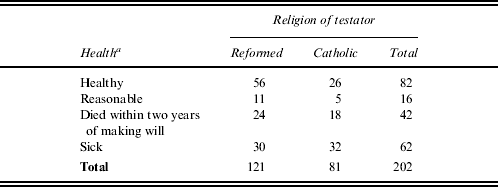
The majority of bequests, although only just, were made by the sick and dying (Table 3). Standard phrases found in wills included ‘in consideration that death is certain and its hour unknown’ or ‘in consideration of the fragility of human existence’.Footnote 29 At a critical stage of life, people felt the need to put their worldly affairs in order before departing for the afterlife. Both Catholic and Protestant testators expressed a desire on their death to distribute in a proper manner the property they had received from God in their lifetime. Charitable giving was seen as a portent of the transition from earthly life and of preparation for eternal life. We do not know whether charities encouraged the very ill to remember them in their wills. However, they probably did keep a close eye on things if they thought someone had made them a bequest. In 1710 the President of the Reformed Charity visited the home of a deceased person after hearing rumours that it had been included in that person's will.Footnote 30
Health of those making testamentary dispositions to Amsterdam charities, 1725–1799
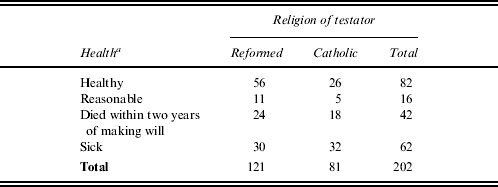
a The descriptions of health are those given in the wills themselves. ‘Died within two years’ refers to those cases in which the health of the testator as recorded in their will was good, but that the testator nonetheless died within two years of drawing up their will.
Sources: Amsterdam City Archives (ACA), PA 440, nos. 255–264 and PA 377 Red boxes; ACA, PA 440, no. 162; ACA, PA 377, nos. 95–100; notarial archive.
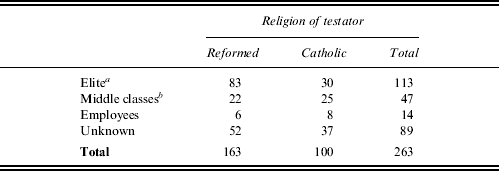
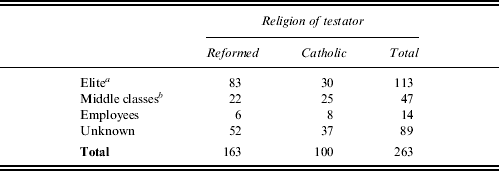
Table 4 shows that donors came from all levels of society, although certainly not to an equal extent. Data are limited to the occupations of men, i.e. male testators or the husbands of married or widowed female testators. Female occupations were rarely mentioned, and usually only in the case of wealthier women.Footnote 31 The social background of male testators can be broken down as follows: 40 per cent came from the elite (nobility, merchants, those from the liberal professions, or individuals of independent means), about 20 per cent from the middle class (members of craft guilds and shopkeepers), and only about 5 per cent from the lower classes. In about a third of cases we have no information on the testator's social position as indicated by their occupation. Since the sources used to ascertain the occupation of testators give more information about the higher social classes, those whose occupation is not known were most probably members of the middle, or perhaps sometimes even lower, classes.Footnote 32
Occupations of those making testamentary dispositions to Amsterdam charities, 1725–1799
a The elite group includes patricians and the nobility, merchants, entrepreneurs, liberal professions, and those of independent means.
b The middle classes include craftsmen, shopkeepers and other self-employed persons.
Sources: Amsterdam City Archives (ACA), PA 440, nos. 255–264 and PA 377 Red boxes; ACA, PA 440, no. 162; ACA, PA 377, nos. 95–100; ondertrouwaktes, poorterboeken and Personele Quotisatie of 1742; Johan E. Elias, De vroedschap van Amsterdam, 1578–1795 (Haarlem, 1903–1905); notarial archive.
The average value of bequests made by those whose social class we do not know was close to that for the middle class. For this reason we may justifiably conjecture that most of the testators whose profession we do not know would have been middle class. If this is correct, then just under half of all testators came from the upper class, the same proportion from the middle classes, with a very small number from the lower classes. Although we have no precise data on the social composition of Amsterdam's population in the eighteenth century, it is quite clear that the lower classes were seriously underrepresented in relation to their absolute number. This conclusion should not come as a surprise: only people with money can bequeath it. What is surprising, though, is that any of the lower classes should have drawn up wills at all. Apparently, wills were not the sole preserve of the merchant living in the exclusive canal district; they were something that concerned his servant too, though not very often. Servants and their families can be said to mark the lower social limit of charitable giving in wills. Admittedly, those servants making charitable bequests might not have been, and probably were not, ordinary servants. Some were servants to elite families, but servants they were all the same. In Amsterdam, charitable giving was practised not only by the rich financiers of the Western world; it characterised the whole social spectrum, while obviously being less prevalent among the lower social classes.
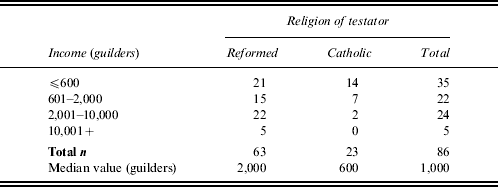
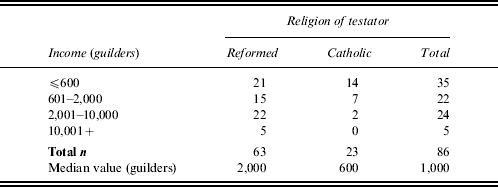
We can approach the same issue from a different angle, this time using income rather than occupation as a yardstick of social position. Table 5 illustrates the income of testators in 1742 (when an income tax was levied). The median income of those who included charities in their will was around 1,000 guilders a year – a large sum, though not a fortune, by the standards of the time. There was considerable variation in income, ranging from individuals with incomes so low that they were exempt from income tax to someone like the rich and powerful Anna Elisabeth Geelvinck, Lady van Hogelanden. She was a dowager and lived on Herengracht, next door to the city's mayor. Her annual income was 25,000 guilders. Her wealth astonished even the tax collector, who noted in the margin of his records: ‘God is not a quarter so rich as the widow Pels’ (Pels being the surname of her second husband). When she died in 1757 her estate was worth one million guilders; she left 12,000 guilders to the Reformed Charity and 18,000 guilders to the Corvershof, a home for the elderly run by the Reformed Church.Footnote 33 Geelvinck was an extreme case, and testators were in fact drawn from across almost the entire income spectrum.Footnote 34 Income and occupational data taken together therefore suggest that charitable giving was not restricted to elite groups in early modern Amsterdam.Footnote 35 The same might have been true in other European cities too.Footnote 36
Income in 1742 of those making testamentary dispositions to Amsterdam charities
Sources: Amsterdam City Archives (ACA), PA 440, nos. 255–264 and PA 377 Red boxes; ACA, PA 440, no. 162; ACA, PA 377, nos. 95–100; notarial archive.
For Catholics, we have data to ascertain whether those who ran Catholic charities gave money to such noble causes on their death, but we do not have sufficiently detailed information to do the same for Calvinists. Only one Catholic testator had ever been an administrator of a Catholic charity; hardly an impressive record. However, other research, based on the financial records of the Catholic Girls Orphanage, shows that administrators, former administrators, and their relatives often gave, but usually during their lifetime.
Inter vivos philanthropic giving was common for these members of the elite.Footnote 37 For example, in 1737 Johanna Elisabeth Blesen, a regent (charity administrator), made a gift of 15,000 guilders on condition that it should remain a secret until her death. Another example concerns the construction of a new orphanage for girls in 1783. The old building was too small and, moreover, unhealthy. First, money was collected among Amsterdam's Catholics. Subsequently, Catholic regents sent a subscription list to their peers and relatives. The great and the good among the regents donated munificently. Adriaan Joan Cloeting van Westenappel gave 25,000 guilders and lent a further 2,000 guilders. Dennis Adriaan Roest van Alkemade contributed 10,000 guilders and his two children each donated 1,000 guilders. Arnout Jan van Brienen, Baron van Groote Lindt, Dordtsmonde en Stadt, donated 10,000 guilders and his son 1,000 guilders. Jan François van Lilaar van Stoutenburg gave 10,000 guilders. Impressive names and impressive gifts indeed. In total, regent families contributed 145,000 guilders, 40,000 of which took the form of annuities and the remainder of outright gifts. As a modest tribute to their generosity, the regents were invited to lay the first stone, and a decorative marble plaque commemorating the occasion was incorporated into what was to be the regents' room. They paid too for the new furniture, the wallpaper, and the carpet laid in that room. The female regents paid for the carpet laid in their rooms.Footnote 38 Although there are few sources to confirm this, it might be true generally in early modern Europe that inter vivos gifts were of no lesser magnitude than testamentary bequests.Footnote 39 The latter source is far more ubiquitous, and easier to interpret, however, as we shall see.
What did people leave, and to whom? In theory, wills can provide us with information on the size of charitable donations, provided we overcome certain difficulties. We first need to clarify whether gifts were actually made. This is not as simple as it sounds, because bequests made in a will are statements of intent. Whether the gifts were in fact made would depend on the estate having sufficient assets to meet all the testator's intentions, and on the charities being able to meet certain conditions stipulated by the deceased. Historians working with wills are also faced with the problem that the value of houses, land and other property is not always known. Sometimes, those values can be estimated from other sources; sometimes the historian is simply forced to make a guess; and often, no attempt is made to quantify their value at all. The value of charitable bequests can in theory be appreciated best by comparing it with the total value of the estate, or to the testator's income prior to death. In practice, the problems involved are often so great that such calculations are rarely attempted. Where attempts have been made, they tend to suggest that the average charitable bequest in early modern Europe accounted for only a few per cent of the value of the entire estate in early modern Europe.Footnote 40
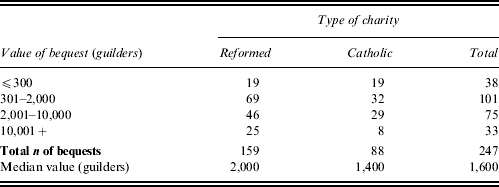
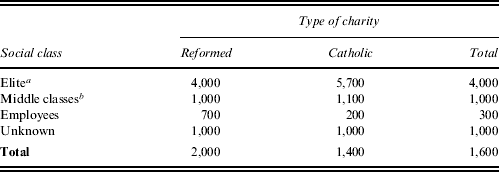
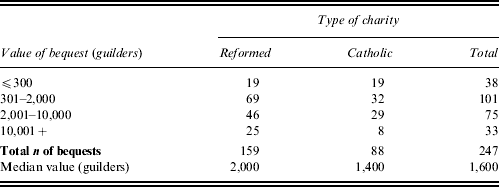
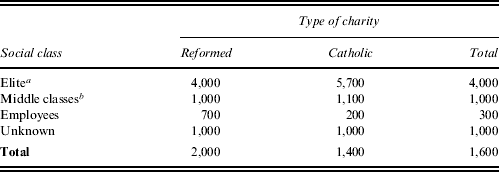
In the present research, the value of charitable bequests was often known, as complementary sources were available. After deducting burial costs, annuities and similar expenses, the median gift made by all Amsterdam testators was 1,600 guilders (Table 6). The range of bequests was very wide: from under 300 to over 10,000 guilders.Footnote 41 The median bequest was 4,000 guilders for the upper classes, 1,000 for the middle classes, and 300 for the lower classes (Table 7). The wide range reinforces the earlier conclusion that the charitable impulse was not confined to the rich and super-rich, but covered more or less the whole social spectrum.
Number of bequests to Amsterdam charities, 1725–1799, by value
Sources: Amsterdam City Archives (ACA), PA 440, nos. 255–264 and PA 377 Red boxes; ACA, PA 440, no. 162; ACA, PA 377, nos. 95–100; ACA, PA 377, nos. 95–100; PA 440, no. 162; notarial archive.
Median value of bequests (in guilders) to Amsterdam charities, 1725–1799, by social class
a The elite group includes patricians and the nobility, merchants, entrepreneurs, liberal professions, and those of independent means.
b The middle classes include craftsmen, shopkeepers and other self-employed persons.
Sources: Amsterdam City Archives (ACA), PA 440, nos. 255–264 and PA 377 Red boxes; ACA, PA 440, no. 162; ACA, PA 377, nos. 95–100; notarial archive.
Wills also tell us something about the beneficiaries of bequests. Normally the estate was left to relatives: children and their partners, brothers and sisters and their partners, or, in the absence of children and siblings, to nephews, nieces and grandchildren. Godchildren were occasionally mentioned. This emphasis on close family members is supported by the findings of sociological and historical research carried out in many Western countries.Footnote 42
An interesting question here is the extent to which a will actually reflects the intentions of the testator, and to what extent the notary could influence testators when a will was being drawn up. It is doubtful whether, other than in exceptional cases, a notary would gain from imposing his own wishes on a testator, and indeed whether he could do so against the wishes of the testator. The only formal statistical test of this shows that, in Grenoble in the seventeenth and eighteen centuries, the notary had no significant influence on the content of a will.Footnote 43
Family was the prime object of making a bequest. Though there was a general preference for leaving property to family members, some testators excluded certain relatives from their wills, left them very little, or left them property subject to certain conditions. Sometimes these conditions were rather odd. The merchant François Mans drew up his last will and testament in 1737. He left 20,000 guilders to the Catholic Charity, 3,000 guilders to the Boys Orphanage, and the same sum to the Girls Orphanage. After these and other bequests had been paid, he appointed his daughter Antonia as his sole heir, on condition she never bequeathed anything to the blood relatives of her late mother.Footnote 44 Stijntje Willems, a married woman, made a will in 1723 leaving 800 guilders to the Reformed Charity in Amsterdam where she lived, and 6,000 to its counterpart in the German town of her birth. The rest of her estate was divided among her brothers, sisters and grandchildren. Her husband received nothing. To make absolutely sure her wishes were carried out, she wrote that any change to her will should be considered invalid and the result of undue pressure unless the words ‘The Lord is my Saviour’ were written in Italian alongside that change.Footnote 45
These examples are a statement of the obvious: some testators excluded certain relatives from their wills because they disapproved of their conduct or had not been in touch with them for many years. The same holds true for the disapproval towards some Jewish testators to converted family members who stayed Catholic and refused to return to Judaism, which was apparently seen as reprehensible conduct.Footnote 46
Testators sometimes refused requests for help during their lifetime for the same reasons as they did from their graves. In 1787 M. de Bolster gave this reply to a letter from a Catholic priest asking him to help his brother Jan:
You write asking me to look after him, but I do not feel obliged to do so because I have never enjoyed any friendship from my brother and he never looked after his mother. And now I am becoming old and ill, and so is my wife, and if I could look after anybody I would first look after myself because I cannot carry on. And he should not write to me about this any more […] and we expect to receive no more letters on this subject.Footnote 47
Testators also left property to people who were not related to them, including friends, and to relatives of friends to whom they felt a kind of indirect obligation. The same idea of obligation lay behind the practice of helping such indirect connections during life. An example of this is the approach made by the widow Maria de Richemont-Pater to the rich Amsterdam merchant Jakob Muhl in 1785. Maria's father had been a friend of Muhl's and had made him the executor of his will, as she reminded him: ‘My father asked your honour to distribute his property. And I ask you: be a father to me; help me manage my affairs and act as a good father would, to help as long as help is possible.’ The merchant did help her; he gave her 100 guilders, even though he was not impressed with what he regarded as her materialistic attitude.Footnote 48
Servants often received legacies: a small sum to buy decent mourning clothes or a few dozen guilders for every year of service. Sometimes they were allowed to live rent free in the deceased person's house for a while to avoid their becoming homeless straightaway. There was one case in the Amsterdam wills studied here in which the testator was more generous. The servant Anna Lipmans was given the usufruct, i.e. the use and profit, but not ownership of the house and the capital of her employer, worth about 56,000 guilders, which can either be seen as an act of great benevolence by the standards of the time or an indication of a relationship that was closer than was usually the case between an employer and his servant. But even in the latter case, neither law nor custom would have obliged the testator to take this step. The Catholic Charity might certainly have regretted it. Although the will stipulated that the house would eventually pass to it after Anna's death, she made them wait 20 years.Footnote 49
Wills and related documents also show that the deceased's clothing was sometimes given to the poor. Neeltje Bijtebier specified, in a handwritten draft of her will, that a certain Katrijntie Remmen should receive all her bed linen and books, but must ‘distribute all my linen to the poor, choosing those people that she thinks are in greatest need of it’. This was a fairly established tradition. In 1660, for example, Salomon Doria remarked that ‘all clothes and linen had been given to the poor in accordance with the custom among the Jewish people’.Footnote 50
4. GIVERS: EVIDENCE FROM COLLECTIONS
To find out where and when charitable donations were made, we would need access to detailed household accounts or tax records covering the entire lifespan of a large number of individuals. Such records do not normally exist for the early modern era. However, we can study collections. How often were they held? When and where were collection boxes set up?
The sea of philanthropy was a well-used fishing ground. Charitable donations may be positioned on a sliding scale, ranging from anonymous, entirely voluntary gifts at one extreme to public ‘extortion’ at the other. Anonymous donations in collection boxes were entirely voluntary. People could give in churches, lodging-houses, shops and inns, at the quays where the canal boats left, at the offices of major companies such as the Admiralty, the post offices, and the East India and West India companies. The city was covered by a network of collection boxes. The Catholic Charity had about 150 collection boxes, and its Protestant counterpart some 300; one was never far from a box.Footnote 51
Most donations were probably made during church services. The Protestant vicar or Catholic priest would urge his congregation to give for the poor.Footnote 52 Deacons or sidesmen would hold out a small offertory bag hung on the end of a long pole under the noses of worshippers. Giving in this way was semi-public. It was probably not possible to avoid making a gift without that fact being noticed, but worshippers might give small coins, foreign coins of little value, or simply pieces of metal. Indeed, in another Dutch city, most coins deposited in the offertory box were of the smallest denomination, suggesting that even members from the lower social classes could give.Footnote 53 All of Amsterdam's churches held collections, though the Catholic Church did not start doing so until 1772 when it was faced with the need to raise funds to cover increasing expenditure on poor relief. Even Mennonites collected money, albeit reluctantly, as they distrusted anything that tended towards the formalisation of charity since they believed that this diminished the love of one's neighbour. Collections were seen as a better option than the more formalised alternative of funding charity from fixed assets though: in the latter situation love of one's neighbour would die altogether.Footnote 54
Door-to-door collections also took place: collectors visited the homes of believers with closed collection boxes or even open plates, which were less anonymous.Footnote 55 District wardens held collections for city-run charities seven times a year using a silver plate, and another plate did the rounds once a month. The use of plates implies that gifts were embedded in a giving structure that relied on forms of social obligation. Even misers were sometimes willing to give in order to escape public opprobrium. Gifts of this kind are less voluntary, because the collector sees what is given or not given; in Amsterdam, this occasionally led to arguments in the street.Footnote 56 Weekly collections for the municipal orphanage were held using closed, sealed boxes while open-plate collections took place five times a year. The mental asylum organised collections twice a year and the municipal school for the poor did so just once a year. The Reformed Charity collected once a month on a Thursday; 25 deacons and a large number of orphans visited the homes of members of the congregation with their collection plates, recognising their co-religionists by the board attached to the front of the house. They also visited the poor living in almshouses, indicative, once again, of the wide social spectrum that giving had. The Walloon Reformed Church held door-to-door collections twice a year (and also every two months during communion). The Catholic Charity for the elderly poor collected four times a year; the Catholic Girls Orphanage came round twice.
Some collections were organised differently. For example, the Lutherans and the Sephardic Jews used lists on which they could note down the names of benefactors.Footnote 57 This was done on request, and shows that some benefactors wanted their gift not to be anonymous; their generosity would thus be known among their fellow believers and bring them honour.
Large numbers of people were needed to distribute and collect all these boxes, plates and bags. At the Reformed Charity, the collections were carried out by orphans and deacons (mostly newly qualified deacons, who had to do the more tedious work). Lutherans probably worked in the same way. Deacons were in charge of charity and set policy, but they also did a great deal of the practical work needed to implement it. In other bodies, such as the Catholic Charity, there was a division between policy, which was a matter for a small group of prominent citizens, and practical work, which was normally carried out by a small number of paid employees and a large group of middle-class volunteers. The Municipal Charity relied on help from hundreds of district wardens and unpaid collectors. When numbers threatened to fall, fresh forces were co-opted to the cause; administrators and even aldermen were forceful in reminding reluctant recruits of their duty.Footnote 58
Some large anonymous gifts were made. One administrator of the Catholic Charity handed over ‘the sum of five hundred guilders, which had been left at his home in a bag the previous evening by an unknown individual, the bag being sealed with the word charity’. Another time ‘the benediction of fifteen hundred guilders was received, which sum […] had been thrown over his door into his house in the evening, but he did not know where it had come from’.Footnote 59
In a nutshell, everyone in Amsterdam was confronted with silent or audible appeals to his or her charitable nature made by charities more or less ubiquitous in the city.Footnote 60 In addition there were friends, relatives, neighbours and former employees who had fallen on hard times, hordes of children begging in the streets, buskers, cripples, women with babes in their arms and a pleading look in their eyes, and beggars thrusting a festering wound in your face and setting a threatening shadow over your path, or simply singing a cheerful tune. Opportunities to exercise generosity were presented every moment of the day, in every neighbourhood, either anonymously or in the public gaze. Poor and wealthy alike could give, to strangers or to acquaintances and to the countless charitable institutions in which the city was rich.
This was the situation in Amsterdam, as it was in many other European cities at that time. For Aix-en-Provence, for example, it is noted that:
So frequent were the collections for charities in Aix that they were almost impossible to avoid. A citizen of the town going to church on Sunday would be met outside the door by a rector of the Charité; once inside he would be approached during the service by a collector from the Misericorde […] And church was not the only place where quêtes were made. The citizen would be approached in his home by rectors of the hôtel-Dieu and the Charité in January. […] In February […] it was the turn of the Refuge. The Mont-de-Piété made its annual quête […] in March […] while the [Hôpital des] Insensés made its drive the first week in April. Then came the turn of the Oeuvre de la Propagande de la Foi, the Incurables, the Bon Pasteur.Footnote 61
5. REASONS TO GIVE: EVIDENCE FROM ALMSHOUSES AND BEGGING LETTERS
Philanthropy is easier to describe than to explain, but when explaining it is less difficult to uncover the reasons why large donations were made. Large donations leave more traces than small ones, in the form of celebratory poems, speeches, contemporary accounts, paintings, coats of arms, obituaries and wills. Records of this kind are less likely in the case of small donations.
Wills provide only indirect pointers to the motives of testators. In Amsterdam none of the eighteenth-century Catholic wills examined contained a reference to the Virgin Mary, the Holy Spirit or a patron saint. However, recommending one's soul to God's mercy was a standard formula. In 1726 the distiller Cornelis de Lange began his will by ‘commending his immortal soul to the inconceivable mercy of God’.Footnote 62 A decent burial – to be arranged by the Catholic Charity – was often requested in wills.
Catholic testators often directed that after their death a priest should hold masses for the purification of their soul, again under the auspices of the Catholic Charity. Indeed, masses for the souls of the deceased were common. It was a case of quid pro quo. A good example of this is provided in the handwritten will of Neeltje Bijtebier, drawn up in 1736. She wished:
For my body an honest funeral, for my soul three masses at that church at which extreme unction was administered. And then also two masses at other churches, and for the service Gouda candles on the altar and after a month at that church at which I received extreme unction. And on the first anniversary, new candles again, as at the funeral service, and twenty-five guilders for the perpetual memory [a fund out of which the cost of masses for the souls of the dead was paid].Footnote 63
Consider too the example of the merchant Octavio Francisco Tensini.Footnote 64 In 1675 he left 60,000 guilders to the poor on condition that a mass for his soul be read every day until the Day of Judgement. His wish did not quite reach that far; the masses were said until 1945, paid for by the foundation managing his estate, but then they stopped.
Catholics in Amsterdam tried, for that matter, to ensure their soul's salvation by giving to the poor before their death as well. An administrator of one Catholic charity noted in 1671: ‘the ship's master when first leaving port took this box [i.e. collection box for the poor] with him on his journey to Smyrna. May God protect and save him so that he can return the box to us.’Footnote 65 This is part of an old and rich tradition of votive offerings made by sailors on long and dangerous journeys. At this time, Amsterdam charities supported many sailors' wives and widows, and so sailors would have special reasons for giving to those organisations.Footnote 66
Descriptions of almshouse foundations also give us an insight into the motives of charitable benefactors.Footnote 67 Verses explaining their good works are illuminating, whether they were written by the benefactors themselves or at their suggestion, or whether it was simply assumed they would like the text.Footnote 68 The childless and the unmarried, and those who had fallen out with their spouse or descendants, saw themselves bereft of the usual ways of distributing their estate and had special reason to contribute to the common good. For example, after quarrelling long and bitterly with her daughter-in-law, in 1695 Agneta Deutz made a bequest to found an almshouse to be named after her. An added bonus was that the foundation would act as a concrete example of her good conduct and ensure that her name lived on: ‘Here Agneta Deutz expressed her love and religious faith, as a comfort to the poor and as an example to the rich.’ Another example is that of Gerard van de Rijp, who had separated from his wife and even took her to court at one stage. The unhappiness of his married life caused him to leave his estate to his sister's sons, on condition that they spent 20,000 guilders to found an almshouse in his name. That almshouse opened in 1748. Christoffel van Brants, a merchant who had built up a fortune of more than two million guilders from nothing and had become a member of the Russian aristocracy, acted as host to Peter the Great when he visited Amsterdam. Van Brants was probably right in thinking that his worldly fame, though certainly impressive, would not be sufficient to ensure that his name would live on forever. Just 260 years later – a fairly short period compared with eternity – hardly anyone remembers him as a celebrated man of arms. He did, however, escape from obscurity by giving 250,000 guilders to create an almshouse in his name in 1733.
Another almshouse, the Grill almshouse, was set up in 1721 by a childless Lutheran couple, Anthony and Elizabeth Grill, who explained the reasons for their good work: ‘ANTHONY GRILL with his wife created me and teach us even after their death how every member of the Christian Church should express their faith in their deeds.’ Going a step further, the motive of salvation is found in a charitable donation made by Johanna van Mekeren, née Bontekoning, who gave 30,000 guilders to the Reformed Charity in 1789. The gift was recognised in these words: ‘The generous love of Johanna Bontekoning gave this house for the use of Jesus’ poor […] Now resting after her labour, she sees her love rewarded, Her work, out of mercy, rewarded with eternal salvation.' A century earlier, in 1684, a home for the elderly run by the Reformed Church was founded thanks to a donation from Mr Helleman:
Give thanks, God-fearing people, by whom this House here stands,
for the generous bequest of the high mighty magistrate
for the money given, and for Helleman who by dying
To the fund did bequeath at the right time no small sum
the brethren for their care, for loss of time and for industry,
All await of their Talent the Interest in time to come.
These examples indicate that, in addition to considerations of status, issues of religion, and in particular the idea of salvation for one's immortal soul or at least a reward in the afterlife, were fundamental in charitable giving, and that this was so not only for Catholics but also for Amsterdam's Protestant denominations, as, for that matter, for Sephardic Jews.Footnote 69 That this is the case for Protestants is a surprising finding that will be addressed later.
The motives behind small donations are more difficult to ascertain than is the case with the bequests and almshouse foundations examined above. Dropping a coin into an offertory bag is an anonymous act. However, one can consider charitable appeals in order to find out what people making small donations regarded as valid reasons for giving. This approach provides more information than an analysis of policy documents relating to philanthropy because those relate to individuals of a higher social status. The underlying assumption here is that the reasons for giving will be reflected in the ‘begging letters’ written by charities to persuade people to support them. If those letters are to be effective, they must appeal to the views of potential donors. Fairchild expressed this assumption as follows:
Because these pamphlets were designed for the purpose of fund-raising, it is probable that the arguments they present were calculated to appeal to the assumptions of their audience – the pamphlets would have been ineffective otherwise. We can therefore assume that the ideas they elaborate were actually held by the people […] The ideas found in these pamphlets are as near to truly “popular” attitudes as the historian is likely to get – much nearer at least, than the analyses of royal legislation and the writings of individuals which are usually employed as sources for “attitudes” about the poor.Footnote 70
Letters sent out by the Amsterdam Catholic Charity in 1738 to raise funds for the construction of a new Girls Orphanage, and in 1800 and 1807 to raise money for general purposes, show what tactics were used to kindle benevolence.Footnote 71 What a primer does for paint, the begging letters do for giving. The letters would open with an appeal to the general compassion of their readers. They mention innocent victims such as ‘suffering motherless children, begging for help […] many elderly grey-haired folk and simple, gentle babes […] with their parents [who] all need our help: look down on us with merciful eyes; take care of us or we will perish.’ The affected reader is reminded that people are suffering through no fault of their own. The orphan girls were living in an overcrowded old building, forced ‘to breathe in the seeds of sickness and disease, and […] almost to suffocate in the bad air’. The poor in general were suffering as a result of the harsh winter, high unemployment in shipping, trade and industry, and the high cost of food. Once the suffering had been described and the reader's sympathy awakened, it was time to get them to open their purse. The first argument for giving was that of compassion. A second reason was force of habit: you gave in the past, nothing has changed, so we are counting on you to be generous once again. A third argument related more to insurance than to sympathy: the same might happen to you; giving now affords protection against misfortune in the future. Misplaced economy, so the reader is told, throws a shadow over what is to come. The governors of the Girls Orphanage wrote as follows:
Consider those who are dearest to you, your children, your relations, your friends! Who among us is so far removed from human disaster that he can be sure that none of these people, or their descendants, will ever have to seek refuge in this establishment? There is a way to escape this fate, because sparse sowing, sparse reaping; sow bountifully and you will reap bountifully; he is ever merciful and lendeth and his seed is blessed.Footnote 72
Here, the appeal referred to the Catholic doctrine of Good Works and the doctrine of the Care by the Living of the Dead, promising that the grateful orphan girls would later ‘send their sighs from a grateful heart to heaven, for your salvation and that of your family’. This brings us to the fourth and last argument for giving: obtaining salvation for the soul. The God of Mercy, the Father of the Orphans, gives his ‘solemn promise: he hath dispersed, he hath given to the poor; his righteousness endureth for ever, his horn shall be exalted with honour.’Footnote 73 In other letters, the charity claimed that benefactors ‘will earn their reward for their generosity, both here and in eternal bliss!’ Looking at it from that point of view, a gift to the poor was a high-interest loan to God. Charity brought benefits to benefactors both here on earth and in the hereafter: ‘In this way the charitable gifts of the wealthy and well-off […] will rise up to the Lord […] and then rain down on us a hundred fruits that will not perish now or in all eternity.’Footnote 74
That argument was used by Protestant charities too. The Lutheran Charity displayed the coats of arms of Abraham Cromhuysen and his sister Johanna Maria, who gave it large sums in 1751 and 1763. Abraham's gift was commemorated in the following:
Here stands his immortal escutcheon,
That stands for his joy and salvation;
Blessed be those who, like him, have faith in the Saviour,
And give their treasure to the service of God's Church, to earn their
Heavenly Interest.Footnote 75
Mennonites also understood the Heavenly Interest argument. A governor of the Mennonite orphanage wrote: ‘Give generously from what you have, as the money you invest in our poor orphans will not be lost. God will return it with interest, both now and in the life to come.’Footnote 76
The Heavenly Interest motif was found too among Calvinists, as can be seen in a letter from the Reformed Charity.Footnote 77 This appeal for funds ends with the promise that giving to those in need will earn eternal reward:
[…] how many fatherless children, unhappy widows, old people, parents of large families, will not recommend you, your family, and all that is dear to you to the Almighty in their daily prayers, and ask blessings for you, your spouse and your children; they will tell their children of your good deeds; and your generosity will still be praised after your death. And if you give […] purely out of charity […] then the same [charity] will be shown to you on the Day of Judgment […] and you will enjoy heavenly treasure for all eternity.Footnote 78
This was not an isolated case. There are many other instances of Protestants being promised their reward in heaven.Footnote 79 The prospect of such reward was an important reason for giving in Amsterdam, both for Protestants and Catholics, alongside considerations of enhancing the status and reputation of the donor.
Amsterdam was not alone in this; French and English studies reveal these motifs again and again. An eighteenth-century Anglican archbishop made the following comment on the beneficial by-product of philanthropy: ‘all around us commend and applaud us for it. By these means our goodness often brings us worldly advantages.’ Or, as another Englishman put it: ‘willingness to do Good is always rewarded with the esteem of mankind.’Footnote 80 In Turin during the sixteenth, seventeenth and eighteenth centuries, the status of donors was reflected in statues and paintings of coats of arms. Giving to the poor was also good for the rich benefactor's soul. Many tracts emphasised that God had given riches to the wealthy for them to use to do good, and that doing good protected the wealthy from pride and lack of faith in God.
Some went one step further: in the Catholic city of Turin during the ancien régime, poor people used to pray for the souls of their benefactors,Footnote 81 and in the Catholic city of Aix-en-Provence pamphlets printed during the seventeenth and eighteenth centuries often referred to the Paradis Ouvert. Philanthropy bought salvation for the soul: money invested in land, houses or banks gave a return of four or five per cent, but the returns from philanthropy were much greater: a hundredfold, and for all eternity.Footnote 82 In the Catholic city of Grenoble it was said that benefactors were building up ‘heavenly treasure’.Footnote 83
The theme of Heavenly Interest was aimed at Protestants in places other than Amsterdam too. Around 1700 an English writer commented that charity ‘shall cover a multitude of sins’.Footnote 84 A century before this, both Anglican and Puritan authors had written that charity conferred both worldly and heavenly benefits on benefactors, although they rejected the Catholic idea of salvation through good works. According to one English writer, ‘by giving to the poore thou dost lend to him [God], and he promiseth to set it vpon his owne accounts, in the resurrection of the righteous’. Puritans believed charity was a loan to God that would be repaid ‘with vsurie’.Footnote 85
A handful of quotations from different parts of Europe covering a period of several centuries may very well conceal subtle differences between particular regional experiences. What is important in the context of this article, however, is that these quotations show that religion in general and the Heavenly Interest motif in particular played a part in charitable giving for Catholics and Protestants alike.
6. THE ATTITUDE OF THE CHURCHES
Fear not, little flock; for it is your Father's good pleasure to give you the kingdom. Sell that ye have, and give alms; provide yourselves bags which wax not old, a treasure in the heavens that faileth not, where no thief approacheth, neither moth corrupteth. For where your treasure is, there will your heart be also.Footnote 86
We have seen that the Heavenly Interest motif played an important role in charitable giving. This was true both of Catholic and Protestant charities. On the Catholic side, the motif sprang from the idea that the soul's salvation could be invoked; this idea was expressed obliquely in the early modern age as ‘la comptabilité de l'au-delà’ (being held accountable from the other-side) and more directly as ‘the purchase of paradise’.Footnote 87 This notion was based on two doctrines: the doctrine of the meritorious value of good works and the idea of the care by the living of the dead.Footnote 88 Until the Day of Judgement, when the fate of all is determined for eternity, most people spend some time in purgatory after their death. They cannot leave purgatory until they have been released from their sins. This is why one should commit as few sins as possible while alive. If a sin has been committed, however, there are remedies during one's lifetime and after one's death, since the Lord, in His mercy, can forgive sins. ‘Good Works’Footnote 89 are a way of achieving this during one's lifetime, as are masses for the soul after one's death. The masses are arranged by the deceased's relatives – or not, as the case may be. To be sure, one can make a provision in a will for monasteries or charities to say masses for one's soul. This is why making a will was such an important issue; as one French pastor put it in 1720, it concerned ‘le moment terrible dont depend l’éternité' – ‘the terrible moment on which eternity hinges’.Footnote 90
What was the background to the Heavenly Interest motif among Protestants? The Reformation rejected the doctrine of the meritorious value of good works, as well as the idea that the living could care for the souls of the dead. As the Reformation had abolished purgatory, that could no longer be considered a reason to do good either. From that point of view, good works were no longer a reason for a person to be among the Elect. The relationship was reversed. Election by God through His unfathomable grace gives the power by which the Elect walk in the path of God. Those who have been redeemed of sin by the Lord feel the power to live according to His law.Footnote 91 The theological basis of giving to the poor in the hope of earning a reward in heaven seems to have disappeared here. The question is: what religious feelings did motivate Protestants to give? For give, they did, not just in the Dutch Republic, but also in other Protestant regions.
The interesting point is not why Protestants gave to charitable foundations – given the existence of secular motives such as acquiring status or a sense of pity for the poor. Nor is it the question whether there were religious grounds for giving – it is after all a duty laid down time and again in the Bible. For Elizabethan England it has been noted, for example, that ‘readers of Tudor Bibles and testaments were confronted with increasingly prominent exhortations to give alms, being one of the simplest and best known of the Christian responsibilities’.Footnote 92
The relevant issue is which Biblical passages and textual interpretations made the Heavenly Interest motif one of the religious motives underlying charitable giving. To answer this question we certainly need to understand Church doctrine, but first and foremost we need to know how churchgoers responded to that doctrine, and there is little information on that point. One would not be justified in thinking that believers in the eighteenth century lived in complete accordance with Calvinist or Lutheran doctrine, and it certainly cannot be assumed that Calvinists invariably approached all issues from the point of view of the doctrine of Election.Footnote 93 Answers are more likely to be found in a historical study of day-to-day religious practice rather than in a theological examination of Church history and dogma. Looking at the history of religion in this way will, incidentally, also expose many other important aspects of the social and cultural life of large groups of people in the past. One possibility is that believers themselves reasoned that giving to the poor could certainly not do any harm and might well do some good.
One study of post-Reformation England highlighted this dilemma in very clear terms: ‘Ironically, although the clergy enunciated the reward of almsgiving with an eye to encourage this practice, they simultaneously admonished people not to give with rewards in mind.’Footnote 94 Rather upfront expectations for Heavenly Interest can be found in eighteenth-century Denmark.Footnote 95 Charity officers encouraged giving by saying that the ‘sighs and prayers of the poor about the giver's great mercy will ascend to Heaven’ and that benefactors could on the one hand expect to ‘find the true pleasure of doing good and on the other hand avert all evil from them and their descendants in time and eternity’. A hospital inspector wrote a thank you notice in 1770 stating that ‘alms will be remembered by God who will repay and who keeps his promises eternally that the merciful shall receive mercy and the person who helps the poor will be saved on the evil day’. These words were balm for the weary soul; just what prospective donors liked to hear, and in fact expected to hear. In 1752 a rich draper donated to a hospital expressing in writing his expectation that ‘everyone both here and in the hereafter in the eternal life can expect God's reward and blessing with which all patrons and benefactors of the poor will be richly rewarded’. This notion was so widespread that it is clear that Lutheran clergy must have encountered it often, and although it goes against Lutheran orthodoxy, they even defended it.
Why Protestants believed in Heavenly Interest is an intriguing matter. Perhaps they held on to earlier ideas of salvation through good works. The Dutch historian Simon Groenveld is an enthusiastic proponent of this view.Footnote 96 He bases his conclusions in part on a letter written by a powerful super-rich Amsterdam arms manufacturer and arms dealer to his children: ‘Fear God, keep his commandments, remember the poor and the needy; that is how you will earn God's blessing for you and your descendants’. In 1646 he told them that they should follow his example in helping the poor because it would be beneficial to them. God would reward them richly:
Children, in 1619 I prayed to God that he would rule you all, both born and yet unborn […] with his spirit […] so I vowed to give two hundred guilders for each child every year to the poor, if God answered my prayer; God did answer my prayer […] and I have carried out my vow, and paid my debt every year, which I now pass on to you, with this fatherly exhortation […] always think of the poor and do good, and do not think that these gifts reduce your wealth, rather your wealth will increase and grow, like seed sown on fruitful ground.Footnote 97
It is as if we hear a client of a bank discussing the interest rate negotiated with the bank director: philanthropy as a profitable business model. Parents, charity administrators, and even the poor themselves invoked the reward of giving to benefactors. The widow Maria de Richemont-Pater, who has already been referred to, wrote to her father's old friend in 1785 with the lure of salvation:
I am turning to you again, and know that your honour is a Christian, and hope that you will be as a tool in His hand to support an unfortunate woman. Oh, dear friend […] please be my benefactor! Give me your advice and help, because [I] do not know what to do. I will engrave what you say as a testament on my heart and follow your teaching blindly, like an obedient child. Your honour has been richly blessed by God with worldly goods. How can it hurt you to give a little to help me! May God reward you with twice as much as you give, both now and in the hereafter.Footnote 98
A charitable donation was both a gift and an investment which God repaid on earth with interest and a reward in heaven. Appeals for funds making this point were to be seen on notice boards all over the city – in poorhouses and on the street; they were also often published in illustrated magazines in the form of portraits depicting Amsterdam regents and including lists of benefactors and those involved in charities, as well as of engravings illustrating good works.Footnote 99 Christian appeals to philanthropy with promises of Heavenly Interest did not fall on deaf ears in the early modern era.Footnote 100
7. THE QUESTION OF TRUST: REPUTATION, LEGAL PROVISIONS AND THE ROLE OF THE AUTHORITIES
Apart from faith, what could be done to give donors confidence that their gifts would be put to good use? The spotlight probably fell first on the people running the charities, as tangible guardians of the confidence placed in their organisations. They were often from the social elite, and their reputation would be severely damaged if they mismanaged the funds entrusted to their care. The choice of well-known and respectable managers was therefore a ‘litmus test’ for the reliability of the organisation.Footnote 101
The second solution for people considering a donation was to base their decision on the reputation of charities and give only to organisations that were known to be efficient, or that were known to respect the wishes of their benefactors, especially with regard to masses for the souls of the dead. This is why it was important for Catholic charities in Amsterdam to continue saying masses for long-deceased benefactors (apart from the possible harm to the souls of the charity administrators if they failed in that duty). The third option was to make provisions in a will and to attach conditions to the bequest. The success of this approach would of course depend on the ability of the executor – chosen by the testator as someone in whom he or she had confidence – or a relative to ensure that the conditions were met and, if necessary, to take legal action to enforce compliance.
The city authorities also showed an interest in charity. Normally the authorities were not particularly concerned about their day-to-day activities as long as they operated properly and the civic charities did not require too much in the way of public subsidy. Nevertheless, charity administrators were obliged to submit annual accounts and a general report to the city council, although the accounts submitted by the Reformed Charity were so vague that the sources and use of its income were completely obscure.
The city council sometimes asked critical questions, insisting on answers and explanations. This happened, for example, in the period 1771 to 1774 during a major dispute between the administrators of Catholic charities and a group of Catholic priests and laymen.Footnote 102 The cause of the dispute was the question of who should have the power to dispose of money collected for the poor in churches: the priests or the charity. Following the council's intervention it was decided that that power should be vested in the charity. The row then escalated, precipitating the issue of whether the administrators were making good philanthropic use of the money obtained from collections and property, or whether they were using it to increase the charity's capital. Critics claimed that there was a total lack of trust among Amsterdam Catholics and that, for this reason, the ‘stream of religious donations has, if not completely dried up, at least been reduced to a trickle’.Footnote 103 Members of the city council tended to support the charity administrators, who came from the same social class as themselves. However, in the end there was so little confidence among the congregation that those in charge of the Catholic charities had no option but to allow access to their accounts, although they initially denied access to their critics. Catholic administrators preferred to show their accounts to city councillors and the administrators of the Municipal Charity, fellow members of the Amsterdam elite. After checking these accounts, the councillors concluded that ‘the governors were not guilty of any maladministration […] but had acted in good faith and without self-interest’.Footnote 104 Eventually, in 1792 the administrators, generous in victory, invited all priests and the eldest father-missionaries – including several of their critics – to inspect the annual accounts in detail, and this was done, to universal satisfaction.
In short, the municipal authorities ensured that collections were properly organised and they audited the annual accounts; apart from this, they were reluctant to get too involved. Part of the responsibility felt by local government for the welfare of its poor was delegated to the ecclesiastical and municipal boards of administrators, often formally independent bodies, in what was essentially a corporatist arrangement.Footnote 105 Co-religionists could influence church-based charity, citizens could administer urban charity, and, moreover, by petitioning the town council they could complain if mismanagement were suspected. Reputation was important too in raising money; a charity could not afford to have a bad reputation, whether justified or not. In extreme conditions the city council would feel obliged to take action to ensure that charity was properly administered. The broad-based culture of charity in eighteenth-century Amsterdam was not simply a matter of religious belief therefore; there were formal and informal rules protecting donors against the abuse of the money they gave.
8. CONCLUSION
In Amsterdam in the Golden Age there were opportunities for everyone, irrespective of their wealth or generosity, to give to good causes: people put money into collection boxes placed all over the city, they gave during church services, to door-to-door collections, through their wills or by making large donations during their lifetime. The considerable variation in type and size of gift and the many opportunities for giving strongly suggests that people from all social classes gave to charity. The laudatory verses, public begging letters and gable stones stressing the importance of giving could, in any case, only have been missed by the blind and mute.
Not all those who made testamentary dispositions were necessarily members of the elite; they included members of craft guilds, shopkeepers, and, on rare occasions, even servants. Their income ranged from the seriously modest to the vast fortunes of the super-rich. Not all bequests were large. People from many different social backgrounds and income groups made charitable gifts in their wills. The testators often expressed a desire to make proper provision for the distribution of the property entrusted to them during their lifetime. They thought of the poor more as death on earth and eternal life in heaven approached. There were many mundane reasons why people gave to charity: they may have become estranged from their relatives and wished to leave money to the poor instead of to a disliked relation; perhaps they had no relatives to leave money to; and they may have wished to enhance their reputation by making charitable bequests. Religion in general was important, and the wish to earn Heavenly Interest particularly so. A secular system of trust based on the reputation of the charities and their administrators, together with supervision by civic authorities, provided a reasonable guarantee that the benefactors' religious and other wishes would be respected. Philanthropy certainly was an expression of faith, in a mundane sense as well as a religious one.Footnote 106
The religious foundation of charitable giving was an important factor in encouraging donations. The broad social support for charity was one consequence of the fact that charity was firmly anchored in religion, which itself was not limited to just one social group in society. Donations were made primarily to charities which shared the religion and community of the benefactor. Catholics could believe that charity would lead to salvation for the soul, as prescribed by the doctrine of Good Works and the Care by the Living of the Dead. But Protestant pastors also stressed that charity was a Christian duty. The idea of earning a reward in heaven was even expressed by Reformed, Lutheran and Mennonite charities, and people who gave funds to set up almshouses shared that idea too. Parents taught this view to their children, and the poor themselves reminded the rich of their duty to help them, a duty that would be rewarded in perpetuity.Footnote 107 How exactly Protestants were able to synthesise the Protestant rejection of the notion of Good Works as leading to salvation with widespread popular notions seemingly to the contrary is somewhat of a paradox: to strengthen Protestant communities the notion of Heavenly Interest was evoked in a way difficult to reconcile with the tenets of the various Protestant creeds.
Philanthropy was indeed as much an attempt to strengthen a community as it was an expression of belonging to it. It was an attempt to soften social divisions and to keep the social fabric intact.Footnote 108 In the process of expressing a sense of community via philanthropy the sense of belonging together was strengthened, perhaps illustrated best through the growth of the capital of charities over time. Most citizens and authorities, be they secular or ecclesiastical, Catholic, Protestant or Jewish, elites, middle classes or the common civilian, women or men, were bound together by a pervasive culture of private giving. The fact that charity was almost always only one of the survival strategies of the poor, and the fact that elites and middle classes, sometimes quite candidly, spoke of it as a means of social control should not cloud the main issue here: the endurance of private voluntary giving, of benefactors and benefactions, in early modern history.
ACKNOWLEDGEMENTS
This article was written as part of the Giving in the Golden Age (GIGA) project, supported by the Netherlands Organisation for Scientific Research (NWO). I would like to thank Chris Gordon, the referees of this Journal, and my GIGA collaborators Lex Heerma van Voss, Henk Looijesteijn, Elise van Nederveen Meerkerk and Danielle Teeuwen for their valuable comments, as well as Tirtsah Levie Bernfeld and Pamala Wiepking. I also am indebted to the audience of the GIGA session at the European Social Science History conference, Ghent, 13–16 April 2010 as well as the commentators: Thomas Adams, Larry Frohman, Julie Marfany, Nadia Mumtaz and Joanna Handlin Smith. The present essay draws on earlier work, notably M. H. D. van Leeuwen, ‘Liefdadige giften in Amsterdam tijdens de achttiende eeuw’, Tijdschrift voor Sociale Geschiedenis 22, 4 (1996), 417–42.