Since the coronavirus disease 2019 (COVD-19) outbreak was recognized as a pandemic in March 2020 by the World Health Organization, it has placed an extra burden on the health and financial systems of countries and the social lives of individuals. Reference Watkins and Maruthappu1 Numerous studies have been conducted on laboratory parameters that may be predict the necessity of hospitalization, intensive care unit admission, and mortality in emergency departments (EDs). Reference Aksel, İslam and Algın2 Researchers have also improved existing early warning systems to be used in decision-making concerning the admission of patients to health-care centers and early detection of critical illness. Reference Özdemir, Akça and Algın3 However, to the best of our knowledge, there is no study in the literature regarding an emergency warning system that can be used in geriatric patients with severe acute respiratory syndrome coronavirus 2 (SARS-CoV-2) infection. We consider that early warning systems should be studied separately in geriatric patients, who are already at higher risk of severe SARS-CoV-2 infection.
We aimed to compare the ability of the Modified Early Warning Score (MEWS), Rapid Emergency Medicine Score (REMS), and Rapid Acute Physiology Score (RAPS) to predict 30-d mortality in patients with SARS-COV-2 infection aged 65 y and over.
Methods
Study Design
This prospective, single-center, observational study was carried out at the University of Health Sciences Ümraniye Training and Research Hospital, a 695-bed tertiary hospital with 4110 patient admissions per month (annual average) to the tertiary ED. The data of the geriatric volunteers who presented to ED between March 1, 2020, and May 1, 2020 were recorded prospectively.
Study Population
Our study population consisted of volunteers aged 65 y and over, who presented to our ED between March 1, 2020, and May 1, 2020, with SARS-CoV-2 infection symptoms or a diagnosis of SARS-CoV-2 infection confirmed by the reverse transcription polymerase chain reaction (RT-PCR) test. Patients with SARS-CoV-2 infection who were admitted to the ED due to trauma were excluded from the study.
Data Collection
Data were collected using 3 sources: study form, hospital computer-based system, and researcher phone call notes. The study form was completed for each patient providing consent at the time of presentation to ED. This form contained information on age, gender, vital parameters, Glasgow Coma Scale (GCS) score, AVPU (Alert, Verbal, Pain, Unresponsive) score, and comorbidities. Clinical outcome within the first 24 h, initial laboratory parameters, and 30-d mortality data of inpatients were noted from the hospital computer-based system. MEWS was calculated using systolic blood pressure, pulse rate, respiratory rate, temperature, and AVPU score. RAPS was determined using pulse rate, mean arterial pressure, respiratory rate, and GCS score. REMS was obtained using age, peripheral oxygen saturation, pulse rate, mean arterial pressure, respiratory rate, and GCS score. All these rapid scoring systems were calculated separately by 3 researchers.
Statistical Analysis
SPSS version 22.0 for Windows (SPSS Inc, Chicago, IL) was used for statistical analyses. The Kolmogorov-Smirnov test was used for the normality analysis of continuous data. Categorical data were presented as n (%) and compared using the chi-squared test. Quantitative variables were presented as median and interquartile range (IQR; 25th-75th percentile) values, and then compared using the Mann-Whitney test or Student’s t-test according to the normality of distribution for the 2 groups. The Bonferroni correction was used to counteract the problem of multiple comparisons. The receiver operating characteristic (ROC) curves were used to assess the accuracy in predicting mortality. The DeLong equality test was used to evaluate the differences between the area under the curve (AUC) values. The odds ratios were calculated using the optimal cutoff values of the scores. Statistical significance was defined at P < 0.05.
Results
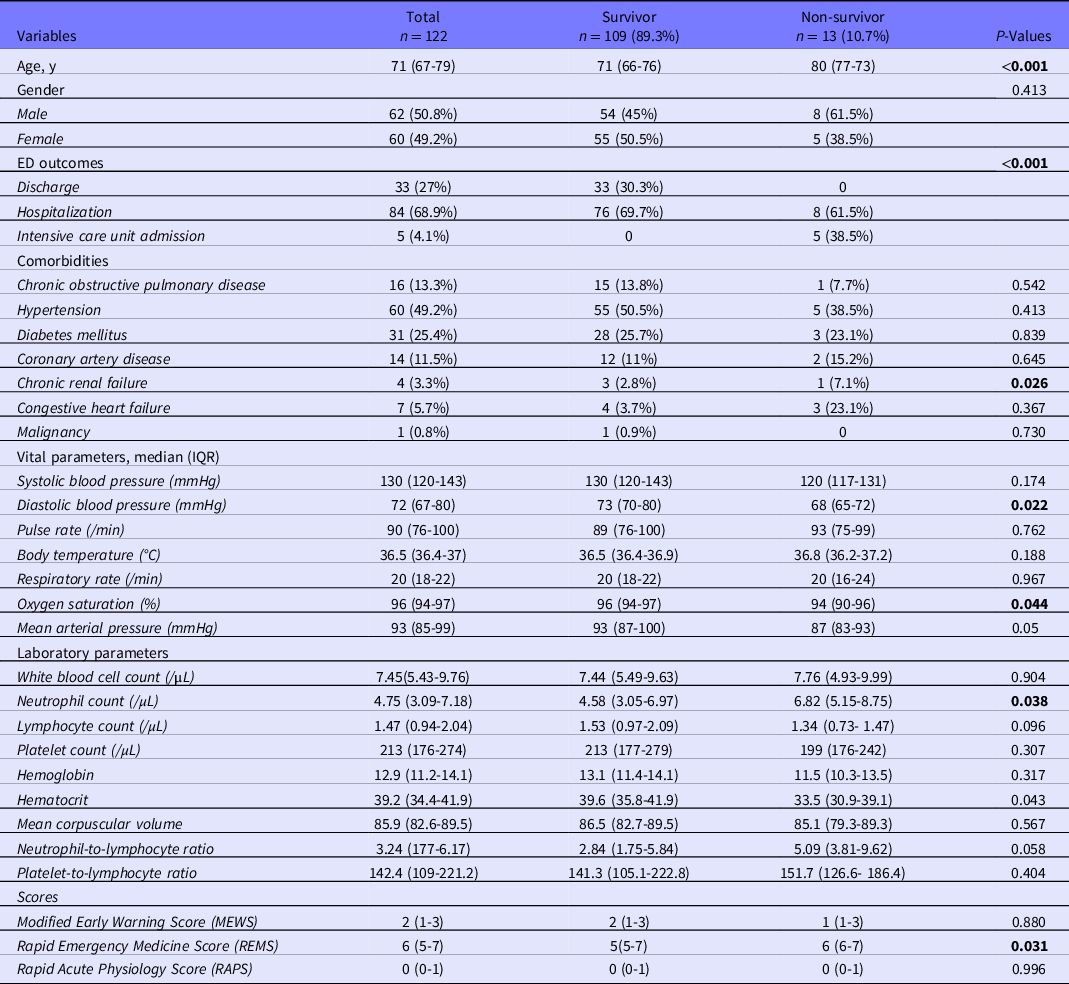
Of the 122 patients included in the study, 62 (50.8%) were male. The median of age of the 122 patients was 71 (25th-75th quartile: 67-79) y. The rate of 30-d mortality was 10.7% for the study. All the patients had a GCS score of 15 and AVPU score of A. The demographic characteristics, clinical outcomes within the first 24 h, comorbidities, symptoms, vital parameters at presentation, initial laboratory findings, MEWS, REMS, RAPS, and mortality data, and the comparison of these data between the survivor and non-survivor groups are shown in Table 1. Significant differences were observed between the survivor and non-survivor groups in terms of age (71 [66-76] vs 80 [77-73] y; P < 0.001), chronic renal failure (3 [2.8%] vs 1 [7.1%]; P = 0.026), diastolic blood pressure (73 [70-80] vs 68 [65-72] mmHg; P = 0.022), oxygen saturation (96 [94-97] vs 94 [90-96]%; P = 0.044), neutrophil count (4.58 [3.05-6.97] vs 6.82 [5.15-8.75] /µL; P = 0.038), and REMS (5 [5-7] vs 6 [6-7]; P = 0.031).
Baseline characteristics of the enrolled patients and comparison of the patient characteristics between the survivor and non-survivor groups

The analysis of the ROC curve was performed to determine the discriminative ability of the 3 scoring systems for 30-d mortality. According to the best Youden’s index, the cutoff (including sensitivity and specificity) and AUC (including 95% confidence interval [CI]) values of the scores are shown in Table 2. There was no statistically significant difference in the AUC value between MEWS and the remaining scores (difference: 0.163; 95% CI: -0.138-0.464; P = 0.288 for REMS and difference: 0.012; 95% CI: -0.322-0.346; P = 0.943 for RAPS; DeLong equality test). The AUC value of REMS was statistically significantly higher than that of RAPS (difference: 0.175; 95% CI: 0.082-0.267; P = 0.0002, DeLong equality test). The odds ratios of MEWS (≥2), RAPS (>2), and REMS (>5) for 30-d mortality were 0.374 (95% CI: 0.089-1.568, P = 0.179), 1.696 (95% CI: 0.090-31.815, P = 0.724), and 1.008 (95% CI: 0.257-3.948, P = 0.991), respectively.
Accuracy of the MEWS, REMS, and RAPS in predicting 30-d all-cause mortality

Abbreviations: AUC, area under the curve; CI, confidence interval; LR, likelihood ratio; MEWS, Modified Early Warning Score; NPV, negative predictive value; PPV, positive predictive value; RAPS, Rapid Acute Physiology Score; REMS: Rapid Emergency Medicine Score.
Discussion
In this study, we compared 3 emergency scoring systems and found these scoring systems not to be useful in predicting 30-d mortality in geriatric patients with SARS-CoV-2 infection. To the best of our knowledge, this is the first study to evaluate geriatric patients presenting to the emergency department with SARS-CoV-2 infection using REMS, RAPS, and MEWS.
In the data analysis, first, non-parametric comparison tests were used to evaluate the relationship between mortality and scoring systems. While no significant relationship was found between RAPS and MEWS and mortality, REMS was significantly higher in the patients in the non-survivor group. As a further analysis, the ROC curves were constructed to evaluate the 3 scoring systems’ ability to distinguish whether a patient survived or died. AUC values of <0.5 were evaluated as no different from random, while those close to 1 were close to the optimum model. Reference Hu, Yao and Qiu4,Reference Hu, Kong and Yao5 Ideally, the AUC value should be greater than 0.8. Reference Hanley and McNeil6 We determined the AUC values of the scores as >0.8, which was unacceptable in the discriminatory power analysis. On the other hand, potentially useful scores tend to have diagnostic odds ratios above 20. Reference Fischer, Bachmann and Jaeschke7 In our study, the odds ratios of the scores were not close to 20, and the odds ratio value of MEWS was below 1. Although there was a correlation between REMS and mortality in the non-parametric tests, when we evaluated the overall statistics, we found that REMS, RAPS, and MEWS were not able to predict mortality in geriatric patients with SARS-CoV-2 infection presenting to ED.
In the literature, there are several studies conducted by many researchers investigating the ability of early warning scores to predict poor outcomes in patients with SARS-CoV-2 infection. Reference Hu, Yao and Qiu4,Reference Hu, Kong and Yao5,Reference Hu, Yao and Qiu8,Reference Martín-Rodríguez, Martín-Conty and Sanz-García9 Covino et al. reported that REMS could predict a 7-d poor outcome in adult patients with SARS-CoV-2 infection, while MEWS did not have this ability. Reference Covino, Sandroni and Santoro10 Hu et al. determined that MEWS was not a good predictor of critical SARS-CoV-2 infection patients due to its low AUC value (0.670). In the subgroup analysis performed in the same study, similar results were found for the patients aged 65 y and older (AUC: 0.705). Reference Hu, Yao and Qiu4 In another study, Hu et al. compared the predictive ability of MEWS, RAPS, and REMS in adult patients with SARS-CoV-2 infection and found the AUC values for the scores to be 0.705, 0.641, and 0.841, respectively. The authors concluded that REMS was a good predictor in these patients. Reference Hu, Kong and Yao5 In a third study, Hu et al. evaluated the predictability of mortality of MEWS and REMS in critically ill adult patients with SARS-CoV-2 infection. Reference Hu, Yao and Qiu8 As a result, they reported that, while only REMS was a good predictor of mortality in the overall cohort, REMS and MEWS were not good predictors in the patients aged 65 and over according to the subgroup analysis. Reference Hu, Yao and Qiu8 Martín-Rodríguez et al. evaluated the predictive ability of RAPS for 2-d mortality in patients with SARS-CoV-2 infection and reported RAPS as a poor predictor with a value of 0.750 AUC. Reference Martín-Rodríguez, Martín-Conty and Sanz-García9 In all of these studies, age was associated with mortality among the patients with SARS-CoV-2 infection. Reference Hu, Yao and Qiu4,Reference Hu, Kong and Yao5,Reference Hu, Yao and Qiu8,Reference Martín-Rodríguez, Martín-Conty and Sanz-García9
A plausible explanation for these results may be that the age component makes REMS successful in predicting mortality and selecting critically ill patients from the general population. The fact that patients in the elderly population have similar risk factors in terms of age may have reduced the predictive ability of the scores.
Limitations
The main limitation of our study was the small size of the study population. At the beginning of the study period, citizens aged 65 and older, as well as those with chronic conditions were not allowed to leave their residence addresses after 9:00 pm. Ten days later, a further curfew was imposed on people aged 65 y and older. This was the most important factor limiting our study population. Another limitation of our study is the single-center design, which reduces the generalizability of the results to other health-care institutions. We recommend multicenter studies in larger populations to confirm our findings and increase their generalizability.
Conclusions
We investigated the predictive value of 3 early warning scores for mortality in geriatric patients with SARS-CoV-2 infection. In light of the obtained results, REMS, RAPS, and MEWS do not seem to be useful in predicting 30-d mortality in geriatric patients with SARS-CoV-2 infection presenting to ED.
Funding statement
We received no financial support for the research, authorship, or publication of this article.
Conflicts of interest
We declare no conflict of interest.
Ethical standards
Ethical approval for the study was obtained from the local ethics committee with the approval number B. 10.1.TKH. 4.34.H.GP.0.01/145. Informed consent forms were signed by patients or legal guardian before the study.