Daily activity rhythms are important features of the adaptation of vertebrates to their environments. Activity patterns follow a circadian rhythm for most mammals and they clearly have adaptive importance, as they allow organisms to anticipate predictable environmental changes (Bartness & Albers Reference BARTNESS, ALBERS, Halle and Stenseth2000). These rhythms result from complex trade-offs among environmental (e.g. season, rainfall), ecological (e.g. predation, competition, social systems), physiological (e.g. energy requirements), and endogenous factors (phylogenetic constraints).
Neotropical marsupials are very diverse in habit, diet and behaviour (Eisenberg Reference EISENBERG1981). Meanwhile, there is little detailed information about the activity patterns of Neotropical marsupials. Most species are regarded as nocturnal, with activity reaching its peak just after sunset and decreasing through the rest of the night (McManus Reference MCMANUS1971, Oliveira-Santos et al. Reference OLIVEIRA-SANTOS, TORTATO and GRAIPEL2008, Streilein Reference STREILEIN, Mares and Genoways1982). However, it is an interesting question to verify whether this general activity pattern is maintained or not in the most atypical Neotropical marsupial, the water opossum Chironectes minimus (Marshall Reference MARSHALL1978). The water opossum is the only semi-aquatic marsupial in the world, and it has a unique morphology (Marshall Reference MARSHALL1978, Nowak Reference NOWAK1991) and ecology (Galliez et al. Reference GALLIEZ, LEITE, QUEIROZ and FERNANDEZ2009) for adaptation to aquatic environments. It is conceivable that the water opossum, due to its peculiar ecology, could depart from the general activity pattern of Neotropical marsupials.
Previous studies have shown that C. minimus lives in the water most of the time, and it prefers rivers with high tree density on the riverbanks (Galliez & Fernandez Reference GALLIEZ and FERNANDEZ2012), where it feeds on fish and crustaceans (Marshall Reference MARSHALL1978). This species seems to present a promiscuous or polygynous mating system (Galliez et al. Reference GALLIEZ, LEITE, QUEIROZ and FERNANDEZ2009), with males about 30% heavier than females (Queiroz Reference QUEIROZ2010), and moving longer distances than females (Galliez et al. Reference GALLIEZ, LEITE, QUEIROZ and FERNANDEZ2009).
We studied the diel activity of C. minimus in Atlantic Forest streams, south-eastern Brazil. We first investigated if the activity pattern of the water opossum follows the same general pattern commonly found in marsupials. Our prediction was that the same unimodal and nocturnal activity pattern would also hold true for the water opossum, because this general pattern in Neotropical marsupials would be strongly constrained by their shared evolutionary history. If this hypothesis was refuted, this would imply that ecological factors linked to the species’ peculiar ecology would prevail over phylogenetic constraints. In a more detailed scale, we tested if activity patterns of the water opossum differed among sexes and seasons. Our prediction was that it would not, because the general pattern of nocturnal activity for Neotropical marsupials seems to hold for both sexes and both seasons. If this second hypothesis was refuted, this would imply that sexual dimorphism and different reproductive strategies (Galliez et al. Reference GALLIEZ, LEITE, QUEIROZ and FERNANDEZ2009, Queiroz Reference QUEIROZ2010) have produced sexual and seasonal differences in the activity patterns of the water opossum.
The study was carried out at the basin of the Águas Claras River (22°30′S, 42°30′W), in Rio de Janeiro State, south-eastern Brazil. The climate is tropical wet and warm, with monthly precipitation (mean ± SD) between 104 ± 50 mm in the dry season (April–September) and 273 ± 74 mm in the wet season (October–March). Mean monthly temperatures vary from 19 °C to 25 °C. Vegetation is submontane rain forest with a mixture of secondary forest.
We carried out five-night trapping sessions monthly, from October 2004 to October 2008, except for November 2004 and March, November and December 2006. For details on trapping methods see Galliez et al. (Reference GALLIEZ, LEITE, QUEIROZ and FERNANDEZ2009). We fitted adult water opossums with radio-collars with activity sensors (SOM-2380A, Wildlife Materials, Murphysboro, USA; or TXE-207C, Telenax, Playa del Carmen, Mexico). The radio-collars weighed about 15 g, corresponding to up to 5% of the animal's body mass. We observed no adverse effects of the radio-collars on the animals. During the night, we monitored animals using the homing-in technique (White & Garrot Reference WHITE and GARROT1990) with a TR-4 receiver and a RA-14k antenna (Telonics, Mesa, USA). In order to minimize autocorrelation, we obtained consecutive fixes of each individual with intervals of at least 1 h. This time was enough for an individual to traverse the whole extension of its home range, 0.8–3.4 km of river channel (Galliez et al. Reference GALLIEZ, LEITE, QUEIROZ and FERNANDEZ2009). We recorded fixes with a GPS Garmin 12 (Olathe, Kansas, USA), using Universal Transverse Mercator (UTM) coordinates.
We considered the beginning of activity as the time when the animal either left its den or became active inside the den, and the end of activity as the time when the animal was located inactive after a complete tracking night. We also obtained diurnal fixes to check for possible diurnal activity and to locate dens. All procedures for capture, handling and tracking of individuals were approved by the Brazilian environmental agency (IBAMA-SISBIO, process 12425-1). Times of local sunrise and sunset were obtained from the records of the National Observatory (Brazilian Ministry of Science and Technology). During the monitoring period, night length (sunset to sunrise) varied between 629 and 794 min. In order to account for these differences, each night was divided into four periods of equal length. We used the number of active and inactive fixes in each quarter of the night only for individuals with at least two fixes in each period.
In order to understand how activity of the water opossum changes through the night and if there are sexual differences, we used a binomial response variable (active, inactive) to model the influence of sex and night period on opossum activity. We constructed Generalized Linear Mixed Models, using binomial distribution of errors (Bolker et al. Reference BOLKER, BROOKS, CLARK, GEANGE, POULSEN, STEVENS and WHITE2008), and we performed a model selection with sex and night period as fixed factors. Individuals were considered as an intercept random factor for all models. We used all additive and interaction combinations of fixed factors to construct the candidate model set. To answer the question about what can influence the length of the activity period, we performed another model selection with Linear Mixed Models (Bolker et al. Reference BOLKER, BROOKS, CLARK, GEANGE, POULSEN, STEVENS and WHITE2008) considering as fixed factors season (dry and wet) and sex (male and female). For this analysis, we considered individuals and night length (min) as intercept random factors. We used all additive and interaction combinations of factors to construct the candidate model set. Models were selected based on the maximum likelihood using the Akaike Information Criterion corrected for small sample size (Burnham & Anderson Reference BURNHAM and ANDERSON2002). We used R environment (version 2.14.0, R Development Core Team, R Foundation for Statistical Computing, Vienna, AT) with the package lme4 (version 0.999375–42) for all statistical analyses.
We obtained 439 fixes of 15 water opossums (11 males and four females), of which 228 (52%) were active fixes and 211 (48%) inactive fixes. All four females monitored were lactating during the tracking period. Water opossums were most active at night, with little crepuscular activity. Out of 53 diurnal fixes, we found 46 individuals inactive in their dens, and seven active fixes in crepuscular periods (c. 30 min before/after sunset or sunrise).
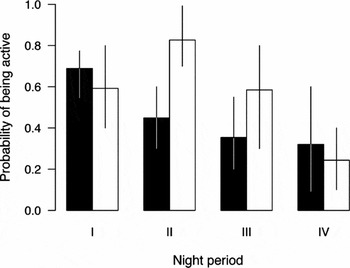
Females were more active in the first period of the night, and males were more active in the second part of the night (Figure 1). Both sexes decreased their activity through the night, but males were always more active than females, except for the first period of the night (Figure 1). The most plausible model to explain the probability of being active included sex, night period and the interaction between these variables. This model was responsible for 0.69 of the evidence weight. The difference from the more plausible to the second-best model (ΔAICc) considering only night period was 2.37.
Probability of being active in the night periods for females (black bars) and males (white bars) of the water opossum Chironectes minimus in the Águas Claras River basin, south-eastern Brazil. For each night, the four periods had equal length independent of night length. Vertical error lines are 95% confidence intervals.

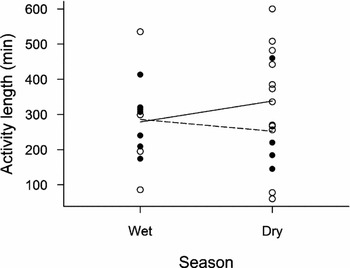
The activity length of males increased in the dry season in relation to the wet season, and for females the pattern was the opposite (Figure 2). The most plausible model to explain the activity length included season, sex and the interaction between sex and season. This model was responsible for 0.98 of the evidence weight, and the ΔAICc to the second-best model was 8.43.
Activity length in dry and wet seasons for males (empty circles) and females (solid circles) of the water opossum Chironectes minimus in the Águas Claras River basin, south-eastern Brazil. Lines represent the predicted values for males (continuous line) and females (dashed line) for the best model selected, which included sex, season and the interaction between these two factors influencing the activity length of the water opossum.

The water opossum followed the general activity pattern of the terrestrial Neotropical marsupials (e.g. Didelphis virginiana, McManus Reference MCMANUS1971, Philander frenata, Didelphis aurita, Didelphis albiventris and Micoureus paraguayanus, Oliveira-Santos et al. Reference OLIVEIRA-SANTOS, TORTATO and GRAIPEL2008, Streilein Reference STREILEIN, Mares and Genoways1982). In the Águas Claras River basin, water opossums are active mostly at night, showing a unimodal pattern, with activity increasing after sunset and decreasing thereafter along the night. These results confirm the observations of Galliez et al. (Reference GALLIEZ, LEITE, QUEIROZ and FERNANDEZ2009) at the same study area. Zetek (Reference ZETEK1930) and Mondolfi & Padilha (Reference MONDOLFI and PADILHA1958) pointed out that water opossums were nocturnal, and only Marshall (Reference MARSHALL1978) recorded occasional diurnal activity, but of captive animals. Most Neotropical terrestrial marsupials studied so far present a nocturnal and unimodal activity pattern with a peak of activity in the first hours after sunset and a gradual decrease of activity through the night (McManus Reference MCMANUS1971, Oliveira-Santos et al. Reference OLIVEIRA-SANTOS, TORTATO and GRAIPEL2008, Streilein Reference STREILEIN, Mares and Genoways1982, Sunquist et al. Reference SUNQUIST, AUSTAD and SUNQUIST1987, Vieira & Baumgarten Reference VIEIRA and BAUMGARTEN1995). The consistent pattern across Neotropical marsupials gives support for the importance of constraints in phylogenetically conservative factors of endogenous circadian rhythms (Kronfeld-Schor & Dayan Reference KRONFELD-SCHOR and DAYAN2003, Roll et al. Reference ROLL, DAYAN and KRONFELD-SCHOR2006).
Regarding our second hypothesis, we found that sex and season also influenced water opossum activity. Although the unimodal, nocturnal activity pattern applies to both sexes, males and females showed differences both in the probability of being active and in activity length. It is well known that sex and breeding condition can influence activity patterns, especially if the species presents sexual dimorphism (Marcelli et al. Reference MARCELLI, FUSILLO and BOITANI2003); this is the case for the water opossum (Queiroz Reference QUEIROZ2010). The interaction between sex and season is a consequence of the breeding seasonality. Breeding activity for the water opossum was reported to begin in the dry season and can go on up to the beginning of the wet season (Queiroz Reference QUEIROZ2010). Males seemed to be more active during the early reproductive season (dry season), a pattern possibly linked to their search for sexual partners at this time of the year. In turn females, with a possible territorial behaviour (Galliez et al. Reference GALLIEZ, LEITE, QUEIROZ and FERNANDEZ2009) and no need to search for partners, were less active. The difference (higher activity of males) was not evident in the wet, mostly non-breeding season (Figure 2), which explains the interaction between the two factors.
In conclusion, we found that sex and season are important determinants of the water opossum activity patterns. However, these influences did not change the overall activity pattern found among Neotropical marsupials. Therefore, similarities in the activity patterns are probably due to phylogenetic constraints and to the absence or weakness of selective pressures modifying the activity of this semi-aquatic marsupial.
ACKNOWLEDGEMENTS
We thank the colleagues at Laboratório de Ecologia e Conservação de Populações for discussions and for their help in fieldwork; C.S. Barros for helping in statistical analysis and comments; C. Amorim for allowing us to work within Águas Claras Botanical Reserve; P. Antunes, M.V. Vieira and G. Medina-Vogel for their suggestions; Associação Mico-Leão Dourado for logistic support; Fundação O Boticário de Proteção à Natureza, Critical Ecosystems Partnership Funding, Idea Wild and CNPq for funding.