On an unadorned stage two lines of performers stand and face each other. One line consists of housed performers, the other of homeless performers. The performers’ bodies are rigid with tension and the space, the distance, between the two lines ‘speaks’ volumes. After several beats of silence, the performers begin to voice their anxieties and feelings about working together:
HOUSED PERFORMER: What if one of them steals my wallet backstage during the show?
HOMELESS PERFORMER: He'll wipe his hand on his jeans after he shakes my hand. Just watch.
HOUSED: Where's my purse?
HOMELESS: She looks at me with contempt.
HOUSED: As long as I don't have to touch them.
HOMELESS: I'm charitable.
HOUSED: I'm open.
HOMELESS: I'm resistant.
HOUSED: I'm confused.Footnote 1
This moment in zAmya Theater Project's 2009 production Housed and Homeless (From the Very Same Cup) opens up the tensions, complex feelings and often-contradictory relationships at play in the real encounters between housed spectators and homeless or formerly homeless performers in community-based plays made by homeless artists. Housed people do not often think of their ‘housed’ condition, or of how being of a ‘fixed abode’ contrasts with the itinerate state of homelessness. Since 2004 the zAmya Theater Project in Minneapolis, Minnesota, USA, has been making shows with the homeless and their housed advocates that seek to address and bridge the distance between the housed and the homeless. As a community-based theatre project, zAmya creates plays through workshops in homeless shelters which are then performed by a mix of homeless and housed performers.Footnote 2
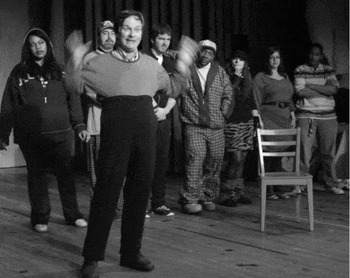
By drawing on an idea of the theatrical event, this article sets out to analyse the interactions between the housed (audiences) and the homeless (performers), in order to understand the theatrical conventions, performance contexts and sociocultural conditions that make it possible to narrow the gap between the housed and homeless. Following Sonja Kuftinec, I view each community-based performance event as an act of what anthropologist Victor Turner termed communitas: a bonding of a temporary community for the practice of a ritual.Footnote 3 My discussion focuses on three performances of zAmya's Housed and Homeless (From the Very Same Cup) that I saw in November 2009. This theatre piece borrows the dramatic structure of A Chorus Line (see Fig. 1) to tell the story of fifteen homeless and housed actors asked to open up about themselves at an audition for a play about homelessness. The play interweaves dramatic testimonials of personal stories with moments of sketch comedy sending up stereotypes of relationships between the homeless and the housed. Each performance was staged at a different site and for a different audience: a matinee for doctors at the County hospital, an evening performance at a suburban college sponsored by three progressive nonprofit organizations, and a performance following Saturday evening Mass at a large suburban Catholic church. In each of these events, homeless and formerly homeless performers came together with housed spectators to create a temporary community. As I participated in these temporary communities, I experienced moments of genuine engagement between the homeless and the housed. Jill Dolan would call these ‘utopian performatives’, ‘a place where people come together, embodied and passionate, to share experiences of meaning making and imagination that can describe or capture fleeting intimations of a better world’.Footnote 4 In the discussion that follows, I attend to zAmya's community-building capacity, viewing their performances as events designed to ‘capture fleeting intimations of a better world’ by theatrically attempting to cross the social divide that exists between the homeless and the housed. I also experienced moments in which the divide between the homeless and the housed could not be crossed. These experiences led me to attend, as well, to the limitations of theatre's attempts to build a community and bridge this social divide.
Housed and Homeless (From the Very Same Cup), Minneapolis, MN, 2009. Courtesy of St Stephen's Human Services.

Audience research
Before turning to theatrical event theory, I feel it is important to note my audience research methodology and relation to the zAmya Theater Project. Researching zAmya's audiences, I occupied the role of participant–observer, conducted informal interviews and kept a log of field notes detailing what I saw and what sense I made of their responses. As Henri Shoenmakers and John Tulloch reflect, ‘Observation, asking questions, interaction with unknown people, are actually the basic methods which one meets in the field of audience and reception studies dealing with real spectators.’Footnote 5 Observing, questioning and interacting with spectators who were not known to me in order to gauge their responses meant that my methodology was qualitative and might, to borrow from ethnographers Yvonna Lincoln and Egon Guba, be summarized as ‘naturalistic inquiry’.Footnote 6 Straightforward and accessible, what this method of ‘naturalistic inquiry’ allowed me to record were some of the individual spectator responses as distinct from the general reaction to the event as a whole.
In terms of my relationship with zAmya, I should note that I am an outsider both to the company and to Minneapolis, though as a community-based theatre practitioner and critic I share the group's interests. As a housed, upper-middle-class white woman in my thirties I am aware of my social privilege relative to homeless communities and am sensitive to how this might colour my perceptions and responses. I cannot pretend to be unbiased. In the five days I spent travelling to and from performances with zAmya's performers, sharing meals with performers and creative team members, conducting formal and informal interviews with company members, and watching performances, I came to care about the ensemble and to believe that the performers gained hope, confidence, communication skills and pleasure through their participation in this programme.
Theatrical events and community building
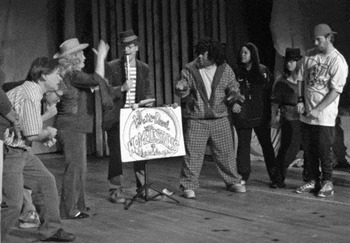
Theatrical event theorist Willmar Sauter discusses the ‘contextual theatricality’ of the theatre event as comprising three parts – ‘artistic’ conventions of communication, ‘organizational’ structures governing the set-up of the encounter itself, and the ‘structural’ social and material conditions of production and reception.Footnote 7 In respect of the three performances that concern me here, the artistic conventions remained more or less fixed. While some elements of zAmya's performance do shift (for example, spatial relationships are adjusted to fit the constraints of different performance spaces, and one performer swaps specific jokes in and out of a stand-up comedy routine at different performances), the fundamental theatrical conventions, dramatic structure, spoken performance text and staging remain constant. The structural context is also fairly constant from performance to performance – most audience members are housed, most performers are homeless or formerly homeless, and the performance is explicitly about the relationship between the two (see Fig. 2).Footnote 8 However, the ‘organizational’ structures do vary from performance to performance: doctors attend ‘grand rounds’ in which the performance is presented during their regular working day as part of an ongoing programme of professional development; suburban spectators see the show in a college theatre as part of a larger programme about homelessness cohosted by three nonprofit organizations; parishioners attend a performance after Saturday evening Mass as part of an ongoing social justice programme.
‘What's the Deal with Homelessness’ from Housed and Homeless (From the Very Same Cup), Minneapolis, MN, 2009. Courtesy of St Stephen's Human Services.

Theatrical event theory draws attention to spectators as active participants. In Peter Eversmann's modelling, the theatrical event places the verb ‘playing’ at the centre of the encounter, describing this shared action as ‘a kind of glue that holds the three elements (actor, character, and audience) together . . . [The audience] ‘plays along’ with what happens onstage’.Footnote 9 Spectators and performers ‘playing’ together is what, I would argue, makes a temporary community possible. Moreover, in community-based theatrical events such as Housed and Homeless (From the Very Same Cup) the relations between performer, character and spectators productively blur the lines between fiction and reality. Performers play characters bearing their own names, telling their own stories, speaking texts developed in workshop sessions and transcribed more or less verbatim by playwright Corey Walton. This occasions what Shulamith Lev-Aladgem describes as an ‘intensified believed-in quality [in community-based theatre], which is stimulated by the absence of distancing processes between performer and character, audience and participants, the personal and the political, and the symbolic and concrete/authentic’.Footnote 10 By way of illustration and to amplify this point, I want to detail the exchange between two of the show's characters/performers, Caroline and Melisa, which takes place about twenty minutes into the show.
Caroline, a white woman in her mid-thirties, tells the story of how she became addicted to opiates. She wears fashionable clothes – layers of jersey knit draping over a corduroy miniskirt, textured tights and chunky boots – and stands alone onstage lit by a simple white light, visible scars giving testimony to the veracity of the story she tells of surviving a fire and becoming hooked on the painkillers she was then prescribed. Melisa, a more conservatively dressed white woman in her mid-thirties, enters from stage right, listening to the end of Caroline's story. ‘Hey, I've got an addiction, too’, Melisa says, as she touches Caroline's arm, giving her support and standing with her in solidarity. Caroline rocks back and forth on her feet as she tells her story of addiction. Melisa speaks her scripted text a little mechanically. The performers comment, unconsciously, on the strangeness of the act of performing publicly. In doing so, they highlight the ‘believed-in quality’ of the community-based theatrical event, emphasizing their status as ‘real’ formerly homeless women. Sonja Kuftinec suggests that the use of amateur, community-based performers functions to ‘familiarize the unfamiliar’.Footnote 11 Amateur performers’ ‘realness’ intensifies communitas, as it encourages audience members to connect emotionally to performers, rather than to fictional characters. The temporary community built is, therefore, for many audience members, with performers, rather than with characters.
The limits of community
However, it must also be recognized that community building has its limits. Audiences may not ‘play along’ with each and every scene. Difficulties can arise, or the sense of community can break down in moments when the ‘believed-in quality’ occasions an affirmation of difference so that relations between spectators and performers come ‘unstuck’. For instance, in the performance of Housed and Homeless (From the Very Same Cup) staged after evening Mass on the church premises (a makeshift platform was set up in a reception room), the audience refused to be drawn into a scene depicting a religious revival service, taking place a little over halfway through the show.
The set-up for this scene begins with Martin, a charismatic, formerly homeless African American comedian, who shouts, ‘We’ bout to have some church up in here!’ The ensemble of twelve performers – most of them formerly or currently homeless – form a line across the platform, stomping their feet and clapping their hands. ‘Can I get an Amen?’ Martin asks, and the ensemble enthusiastically cries out, ‘Amen!’ Rick, a formerly homeless white man in his forties, breaks through the line. He spins in a circle wearing a green and white woven cape, crying out his ‘amens’. He spins faster and faster, his ‘amens’ grow louder and more intense as his cape swings around him. Finally, he drops to one knee, draping the cape over his head. Martin pulls the cape off Rick's head and Rick begins to preach. ‘I call on the Lord! For the Lord saved me!’ Rick testifies, preaching of how he chose to live in a tent away from the anxieties and worries of the world – the stresses of being a single parent, of losing custody of his child, of the guilt of not being a good father and son, of alcohol and drug abuse. The ensemble calls out ‘Amen’, ‘Hallelujah’, ‘Preach, White brother, preach!’, punctuating his sermon with verbal, enthusiastic responses, as if at a prayer revival. ‘It was all meant for good’, Rick concludes, ‘because I met people I can call friends’. So saying, he reaches out his arms as if to embrace the audience in front of him.
Three feet away, the audience of seventy Catholic Church members sat silently in folding chairs, crossing their arms over their bodies and pursing their lips. Preachers, loud music, sermons disrupted by shouting and people making personal testimonies in public – this was not their idea of church. Rather, it was received as different and unfamiliar, if not unwelcome or irreverent (given the service of their own they had just come from). The divide between the homeless and the housed was strengthened rather than crossed. That the company was able to recover from this impasse was due to the episodic structure of the show: moving from testimony to testimony there were other moments where the audience ‘played along’. After the preaching came the testimony of Angie, a Latina homeless woman in her mid-twenties, who shared a quiet, personal story of overcoming an addiction and learning to let others into her life – at which point the audience felt let back into the performance. Arms were uncrossed, lips relaxed, as they leant in and listened attentively to Angie's story.
The contrast between the ‘failed’ response to the religious revival scene and the audience's palpable engagement with Angie's story on the one hand directs us to the way in which the ‘organizational’ set-up risked an infelicitous performer–spectator encounter, given the juxtaposition of religious (Mass) and performance events, and on the other invites further consideration of what conditions the moment in which the audience is able (or not) to ‘play along’.
To be active participants, semiotician Cesare Segre argues that spectators need the space to imagine. ‘Areas not enlarged upon, moments of emptiness, references to events not represented, are entrusted to reconstruction on the part of the spectator’, he writes, as he outlines the ‘active intervention of the receiver’ in the act of theatrical communication.Footnote 12 When housed spectators are faced with homeless performers playing characters bearing their own names (as previously explained) it is up to each spectator to reconstruct the unrepresented ‘texts’ of the performers’ past. Hence layered into the story Angie tells her audience are the stories spectators invent for themselves. Further, within this framework, the performers assume an ‘iconic identity’.Footnote 13 As real homeless people viewed through a theatrical frame, they become signifiers for themselves – that is, the performers refer symbolically to their real meanings in the real world. The narratives performers tell and embody provide points of departure for audience members to coconstruct their own understandings of how each performer experienced or experiences homelessness. Different spectators, from different social classes, holding different beliefs, having their own understandings or experiences of what ‘homelessness’ means to them will fill in the blanks in different ways.
Such acts of imagining or ‘writing’ are not, however, unconstrained but are, as Stanley Fish reminds, conditioned by ‘the makeup of interpretive communities’.Footnote 14 Such communities are defined by Fish as ‘made up [by] those who share interpretive strategies not for reading (in the conventional sense) but for writing texts, for constituting their properties and assigning their intentions’.Footnote 15 The idea of the interpretive community has, arguably, been overused in an attempt to bind any group of people into a discursive unit.Footnote 16 However, each performance of Housed and Homeless (From the Very Same Cup) is performed in a space belonging to an institution (be it a hospital, a college or a church) and attended primarily by audience members belonging to either the institution or (in the case of the college) a pre-existing organization sponsoring the event. Like all groups, these particular groups – doctors employed by the same hospital, members of the same nonprofit organization, and members of the same church – adhere to a set of ‘norms’ or values. They have shared expectations of decorum and appropriate behaviour in given circumstances (as evidenced by the example of the audience's response to the revival scene). Norms can vary widely from group to group and context to context, generating a range of context-appropriate actions, reactions and responses in any given circumstance. In a theatrical event, audience responses are influenced by a sense of group belonging in ways that can variously serve to reinforce the belief systems or values of the group (revival scene) or allow these to be opened up (Angie's story).
Communal cynicism
In the case of Housed and Homeless (From the Very Same Cup) performed for the group of doctors at the County hospital, the response of this particular interpretive community was to discard the performance in favour of their own experiences, their own understandings of treating homeless patients. Much of the County audience consisted of medical residents. The young doctors participated in the performance event during their workday, surrounded by colleagues and supervisors. When sharing their responses to the show with me, or with each other, they revealed a marked degree of cynicism.
For instance, during the talkback session after the performance, I turned to the two young white women in lab coats sitting to my right. ‘It was what I expected’, says one blue-eyed woman with neatly bobbed hair and kitten-heeled loafers. ‘What did you expect?’ I ask. ‘How was it expected?’ ‘Well’, she starts, ‘We see a lot of homeless people here. They come in for treatment. They all tell these stories. And it gets to be, um . . .. It's just expected. It's not that I don't care, it's just . . .’ She sighs. Her friend nods. ‘We hear a lot of these stories.’ She makes a face expressing exasperation.
A few moments later, Melisa comes around and asks the young women I had been talking to what they thought of the performance. The blue-eyed doctor makes a big show of checking her pager and scurrying away before she can answer Melisa. The remaining woman spins her answer differently for Melisa, ‘We see a lot of homeless patients, so these stories really resonate. We recognize them.’
The doctors at County do not need zAmya's performance to authenticate their understandings of homelessness. They have to engage with homeless individuals in the course of their jobs, and the homeless they encounter at the hospital are often in a far worse condition than the clean, sober, punctual, off-book women and men performing in their seminar room. As they participate in the theatrical event, they write in their own experiences of treating the homeless, which distances or numbs them to the tragic stories told during the performance. The performance, in their view, is not teaching them something new and they build a wall of expertise between themselves and the performers in a way that closes down the possibility of communitas.
However, some doctors respond somewhat differently to the performers in one-on-one encounters. Melisa later tells me, ‘After the play, doctors came to me and asked me, “What can I do to not do that to my patients?”’Footnote 17 She says this made her ‘feel like I did good work’. Regardless of what I observed, the doctors made Melisa feel like she made an impact, ‘helping those doctors that want to help people that are addicted to opiates’.Footnote 18 Away from the gaze of their colleagues, their group, these doctors let down their walls of expertise to try to connect to Melisa. In the act of soliciting Melisa's advice, the doctors who engaged with her one-on-one helped her identify how far she had come in her own recovery process, making the performance event as much about her healing as about their learning.
Getting closer?
In contrast to the doctors’ experience, spectators at the college and the church performances disclose in post-performance talkbacks that they have had few personal interactions with homeless people prior to seeing the show. Rather, in their case, an idea of homeless people has been shaped primarily through popular culture and the media. In these talkbacks, the audiences appear fascinated by the stories of the homeless and seek further information about the authenticity of what they have seen. At the college, for instance, they ask the performers if this is their first experience of performing and ask for stories of how the performers got involved with zAmya.Footnote 19 Ryan, one of the housed performers participating in the project, immediately pipes up that he and two other housed comedians in the production heard about it from Martin, whom they knew from the stand-up comedy circuit. The audience applauds politely but with little enthusiasm. What they seem to want to hear are the authentic voices of the homeless.Footnote 20
As the talkback continues they hear from Angie, whose personal narrative in the performance focuses on her decision to get sober. She explains, ‘Maren [the production's director] came to our relapse intervention’, and gestures to include a young, Ojibwa performer named Shawna at ‘our’. Melisa volunteers, ‘My chemical dependency councilor told me’. Martin adds, ‘I was living in a shelter as an aspiring actor/comic and I saw the flyer’. The audience applauds vigorously with each answer.
As part of the theatrical event, the post-show talk helps audiences to get closer to the homeless or to arrive at a more informed understanding about homelessness. It encourages proximity rather than distance, and helps to cross the divide between the homeless and the housed, but at the same time, as a public forum or conversation managed as part of the event, spectators can be near enough to understand but not too near the scary parts. Equally, the question of how near or how far is one that ethnographic researchers of the homeless gesture to in their studies of homeless populations. When Gwendolyn Dordick was ‘hanging out’ at a large bus terminal in New York City, researching her doctoral dissertation on homelessness, she was solicited for a blowjob by an old man and then grabbed by a police officer asking ‘who the hell’ she was and ‘what the hell’ she was doing.Footnote 21 She showed her university ID and described her project, thus utilizing her housed privilege to negotiate a set of uncomfortable circumstances. Sociologist Rob Rosenthal explicitly describes his own defences as he conducts field research. ‘Field Notes, 5/20/83: I never go down [to the Fig Tree] as defenseless as they are. I always have some money, keys, a bike. This keeps me from knowing their life.’Footnote 22
I, too, maintained my distance. My fiancé was anxious I would be spending time alone with homeless people as I conducted interviews. ‘Is it safe?’ he asked on the phone, from 1,200 miles away. I soothed him, ‘The performers focusing on this play and sticking through a rehearsal and performance process have it together enough to show up at rehearsal, learn lines, remember staging, and deal with the logistics of performance. I'm safe.’ Acting on a desire to be near – to learn about the homeless – but not to be too near, researchers and reporters maintain the trappings of distance and safety.
‘From the very same cup’
An all too common response on the part of the housed to the homeless person out on the street holding out a cup for spare change is to avoid eye contact and continue walking. By and large the housed prefer to keep their distance. However, working through the aesthetic distance of the performance frame,Footnote 23Housed and Homeless (From the Very Same Cup) invites audiences to see this response and to change it. When spectators arrive they find a slim slip of orange paper and a tiny pencil on their seats. The paper bears a single question, ‘If homelessness is a symptom, what is the problem?’ During the performance, the audience is asked to write answers to this question on the slip of paper; performers then circulate with paper cups, soliciting spectators to drop answers, rather than loose change, into their cups. This moment rehabilitates the iconic image of a homeless person holding out a paper cup, making the cup a site of active engagement, asking housed audience members to open their minds rather than their wallets, to ‘give’ critical thinking and creative problem solving. This interactive strategy is made safe: contributions are anonymous and no one is put on the spot and at all three performances the response rate is high. Spectators are keen to ‘play along’ and to write themselves into the event as active solution-seekers and when it comes to the talkback on all three occasions at least one audience member asks a variation on the question ‘what can we do to help?’ The performers’ response is to ask for support: ‘listen’, ‘ask us questions’, ‘look us in the eye’.
Although the audience of doctors mostly retreats into a professional medical gaze, the other two audiences – the church audience especially – take these requests for support and for looking quite seriously, and spectators stop and engage in one-on-one discussions with performers. From theatrical presentation and post-show discussion, the evening moves into a social event as most spectators remain to take refreshments (prepared and set up in advance), drinking coffee and lemonade, eating doughnuts, and engaging in one-on-one conversations with the performers. Within this set-up, the housed and homeless get closer together, mixing informally and fairly freely, the hoped-for exchange and dialogue taking place.
This moment of hopefulness is not one that I take to conceal or to belie the very real tensions or difficulties that community-based theatre events such as the Housed and Homeless (From the Very Same Cup) encounter in their attempts to cross the divide between the socially privileged and the disadvantaged. In scholarly support of such endeavours, I would argue the need for further, future research on what participation in a community-based theatre event is doing to spectators and for the research methods this involves; methods that are complicated, at times inadequate and ‘messy’, also need to be looked at. Yet my experience of the church audience was one that came closest to capturing the idea of Dolan's ‘utopian performative’ and a sense of communitas. Dolan writes, ‘Utopian performatives . . . exist as wishes, as desire, crystallizing from our labor to construct a temporary public that constitutes a multiplicity of presence, hoping to be recognized, extended, and shared.’Footnote 24 Desire alone cannot force a connection, but it creates a condition in which such a connection might be possible. In zAmya's attempt to create a space in which it might be possible to ‘stop staring, start seeing’, if only for a fleeting, magical moment, I find hope.