Introduction
The larynx is the most common site of cancer in the head and neck region, accounting for 30–40 per cent of new malignancies diagnosed in this area. 1 It is involved in approximately 2 per cent of total tumours in males and 0.4 per cent in females, and accounts for 1 per cent of deaths linked to cancer.Reference Rodrigo, López, Llorente, Álvarez-Marcos and Suárez 2
Despite numerous studies, both therapeutic and histopathological, no morphological markers are currently available to predict outcome in patients with laryngeal cancer. Cure rates of laryngeal squamous cell carcinoma (SCC) have scarcely improved over the last decades.Reference Starska, Kulig and Łukomski 3
The treatment of patients with locoregional advanced laryngeal cancer includes three basic options: surgery, radiotherapy (RT) and chemotherapy, used individually or combined in different time sequences.Reference Skóra, Nowak-Sadzikowska, Mucha-Małecka, Szyszka-Charewicz, Jakubowicz and Gliński 4 Adjuvant therapies are usually used to treat high-risk patients.
The National Comprehensive Cancer Network identifies several features as adverse prognostic factors, such as advanced tumour and nodal staging, perineural invasion, lymphovascular invasion, close or involved margins, and nodal extracapsular extension.Reference Pfister, Ang, Brizel, Burtness, Cmelak and Colevas 5 Other alternative factors have shown prognostic significance, including ageReference Markou, Goudakos, Triaridis, Konstantinidis, Vital and Nikolaou 6 and tumour differentiation.Reference Morales-Angulo, Val-Bernal, Buelta, Fernandez, García-Castrillo and Rama 7 , Reference Pulkkinen, Klemi, Martikainen and Grénman 8
This study aimed to determine the influence of clinical and histopathological variables, as independent prognostic factors, on survival outcomes of patients with locally advanced laryngeal cancer treated with primary conventional surgery.
Materials and methods
Patient selection
The medical records of consecutive patients with locoregional advanced laryngeal cancer, treated with initial conventional surgical resection and neck dissection, were reviewed. All patients were treated in an oncological referral centre, between 2007 and 2011. Exclusion criteria included previous head and neck RT, unresectable disease or macroscopic incomplete resection, synchronous tumour, and non-SCC tumours.
All surgical specimens were reviewed by pathologists specialised in head and neck pathology. All patients were discussed in multidisciplinary head and neck tumour board meetings to attain surgical and adjuvant therapy recommendations. Ethics committee approval was obtained for this study.
Interventions
Primary surgical resection technique was left to the discretion of the attending head and neck surgeons operating on the patients, with total laryngectomy being the most frequently employed method. Neck dissections were, if possible, functional, sparing the sternocleidomastoid muscle, internal jugular vein and XIth cranial nerve.
Adjuvant RT was recommended for patients with intermediate risk factors, including those with tumour stage T4 disease, nodal stage N2–3 disease, perineural invasion and lymphovascular invasion. Adjuvant chemoradiotherapy was recommended for patients without safe margins and/or with nodal extracapsular extension.
Follow-up appointments with physical examination were carried out every month for the first year, every three months for the second year, every four to six months for the third to fifth year, and annually thereafter.
Data analysis
Data were analysed using the SPSS® for Windows software program, version 20.0. Hypotheses testing was performed using two-tailed tests.
Descriptive statistics were used to characterise the patient population. Recurrence was defined as local, regional, combined local and regional relapse, or distant metastasis.
Survival analysis was conducted to determine overall survival and disease-free survival. For overall survival analysis, time to event was from the date of initial surgical resection until the date of death or the date of last follow up, whichever occurred first. For disease-free survival analysis, time to event was from the end of treatment until local, regional or distant metastases relapse, date of death or date of last clinical follow up, whichever came first.
Clinical and histopathological variables analysed included gender, age (less than 60 years or 60 years or older), tumour location, pharyngeal invasion, pathological tumour classification (T3 or T4), pathological lymph node status (N0–1 or N2–3), adjuvant therapy (none, RT or chemoradiotherapy), margin status (i.e. close or positive (5 mm or less) or safe (more than 5 mm)), presence of nodal extracapsular extension, tumour differentiation, lymphovascular invasion, perineural invasion, histological growth predominant pattern (expansive or infiltrative), invasion depth (less than 1 cm or 1 cm or more), presence of cartilage or soft tissue invasion, and cartilage ossification. Regarding margin status, invasive carcinoma, carcinoma in situ and severe dysplasia were all considered as positive margin evaluation criteria.
Survival probabilities were calculated using the Kaplan–Meier product-limit method. The log-rank test was used to test for differences between groups in terms of survival. Cox proportional hazards modelling was used to analyse potential prognostic factors for overall survival and disease-free survival.Reference Cox 9
Results
Patient and tumour characteristics, and interventions
A total of 168 medical records were reviewed. Thirty-seven patients had previously undergone head and neck RT, five patients had unresectable disease or macroscopic involved margins, and the remaining patients had synchronous or non-SCC tumours. After exclusions, 121 patients were included in the analysis. Of these, 118 were male and 3 were female. Median age was 60 years (range, 40–90 years).
Regarding T stage, 43 and 78 patients were classified pathologically as having T3 and T4 disease, respectively. Forty-two patients had pathologically confirmed N2–3 disease and the remaining had pathologically confirmed N0–1 neck disease. Transglottic tumours were diagnosed in 87 patients, supraglottic neoplasms in 27 patients and glottic tumours in 7 patients; none of the patients had subglottic tumours.
Total laryngectomy was the surgical treatment performed in 113 patients, while the rest underwent conventional partial laryngeal procedures. All patients underwent neck dissection. The type of lymphadenectomy was dependent on the particular clinical situation. Functional neck dissection was performed in 107 patients and the remaining patients underwent modified radical neck dissection. Adjuvant post-operative treatment was carried out in 89 patients; of these, 37 underwent RT and 52 underwent chemoradiotherapy.
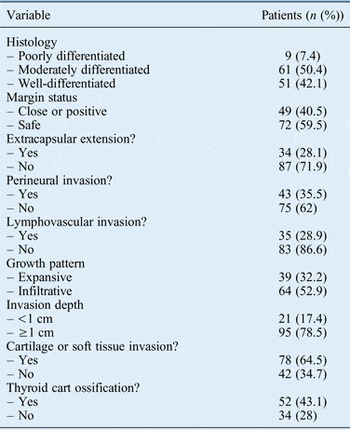
The tumour histopathological characteristics are provided in Table I.
Tumour histopathological characteristics

Median follow-up duration was 44 months (range, 3–93 months). Twenty-seven patients had locoregional recurrence and 14 had distant metastasis.
Disease-free survival and prognostic factors
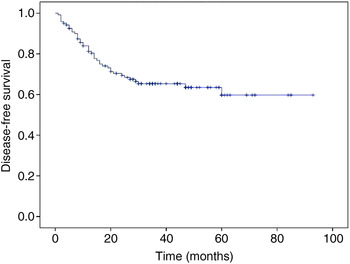
The one-year disease-free survival rate was 81.3 per cent and the three-year disease-free survival rate was 63.5 per cent (Figure 1).
Disease-free survival.

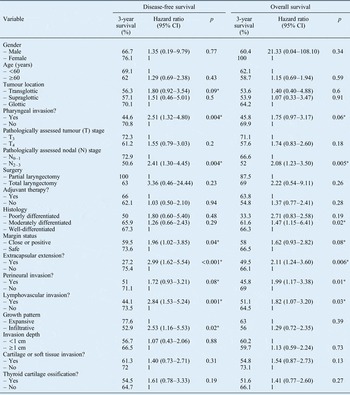
On univariate analysis, several factors were shown to be significant adverse prognostic factors. These were: tumour pharyngeal invasion (p = 0.004), advanced nodal disease (pathologically confirmed N2–3 disease; p = 0.004), close margins (p = 0.04), the presence of extracapsular extension (p < 0.001), lymphovascular invasion (p = 0.001) and an infiltrative growth pattern (p = 0.02). Additionally, transglottic tumours (p = 0.09) and the presence of perineural invasion (p = 0.08) both showed trends towards significance for disease recurrence (Table II).
Comparison of overall and disease-free survival outcomes according to clinical and histopathological variables

*p < 0.1. CI = confidence interval
On Cox multivariate analysis, the presence of extracapsular extension (hazard ratio = 2.91, p < 0.05) and an infiltrative growth pattern (hazard ratio = 2.30, p < 0.05) were found to be independent predictors of poor prognosis.
Overall survival and prognostic factors
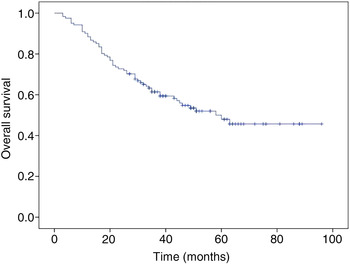
The one-year overall survival rate was 88.3 per cent and the three-year overall survival rate was 61.4 per cent (Figure 2).
Overall survival.
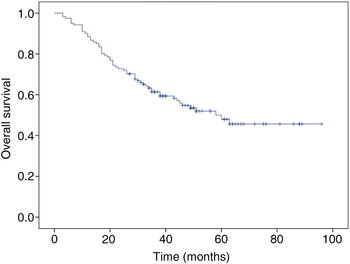
Multiple factors showed significance on univariate analysis: advanced nodal cervical disease (pathologically confirmed N2–3 disease; p = 0.005), moderately differentiated tumours (p = 0.02), extracapsular extension (p = 0.006), perineural invasion (p = 0.01) and lymphovascular invasion (p = 0.03). Additionally, pharyngeal invasion (p = 0.06) and close margins (p = 0.08) showed a trend towards significance for poor prognosis (Table II).
On multivariate analysis, extracapsular extension (hazard ratio = 2.04, p < 0.05) was found to be an independent prognostic factor.
Discussion
Laryngeal SCC is a heterogeneous disease, with tumours of the same pathology and clinical stage having different prognoses.
As stated above, the National Comprehensive Cancer Network guidelines consider several risk factors.Reference Pfister, Ang, Brizel, Burtness, Cmelak and Colevas 5 These pathological factors are associated with an intermediate risk of locoregional recurrence (advanced T stage, advanced N stage, perineural invasion and lymphovascular invasion) or a high risk of recurrence (positive or close resection margins, and nodal extracapsular extension). However, there are cases where these prognostic factors are absent and, thus, recognition of other adverse factors is important to determine optimal therapeutic and surgical approaches.
Most patients in this study were in their sixth or seventh decade of life, and the male-to-female ratio was over 30:1. These findings are consistent with other studies.Reference Skóra, Nowak-Sadzikowska, Mucha-Małecka, Szyszka-Charewicz, Jakubowicz and Gliński 4 , Reference Smee, Katie, Broadley and Williams 10 , Reference Hinerman, Morris, Amdur, Lansford, Werning and Villaret 11 Whether age affects prognosis remains a controversial issue. Ramroth et al. reported that age was the most influential factor that affects the prognosis of patients with newly diagnosed laryngeal cancer.Reference Ramroth, Schoeps, Rudolph, Dyckhoff, Plinkert and Lippert 12 In contrast, Nguyen et al. found that age had no effect on prognosis.Reference Nguyen, Malissard, Théobald, Eschwège, Panis and Bachaud 13 The results of the present study, based on a dichotomic analysis (less than 60 years vs 60 years or older), did not show any significant difference (p > 0.05).
Interestingly, the findings for pathologically assessed T stage did not reach statistical significance, although there were better survival outcomes in the T3 patients compared to T4 patients. Similar results were reported by Rodrigo et al.Reference Rodrigo, López, Llorente, Álvarez-Marcos and Suárez 2 An overly conservative post-operative approach might explain this finding. In contrast, Nguyen-Tan et al. demonstrated a very strong correlation between pathologically assessed T stage and survival rates.Reference Nguyen-Tan, Le, Quivey, Singer, Terris and Goffinet 14
As expected, an advanced pathologically confirmed N stage (N2–3) was correlated with poor survival outcomes on univariate analysis. Nonetheless, the multivariate analysis did not confirm this as an independent prognostic factor.
Our analysis revealed that pharyngeal invasion (44.6 per cent) was a significant factor for disease-free survival at three years (p = 0.004) when compared to those without such invasion (70.8 per cent). However, this factor did not show a correlation on multivariate analysis. Previous studies have revealed similar findings, even in multivariate analyses.Reference Skóra, Nowak-Sadzikowska, Mucha-Małecka, Szyszka-Charewicz, Jakubowicz and Gliński 4 , Reference Kligerman, Olivatto, Lima, Freitas, Soares and Dias 15 Nevertheless, the authors of those studies did not evaluate extracapsular extension. Similar results were obtained for perineural invasion and lymphovascular invasion; these factors showed statistical significance as prognostic factors in univariate analysis, but were not found to be independent predictors.
Statistically, adjuvant therapy did not reveal any advantage in terms of the disease-free and overall survival outcome measures. The lack of statistical significance for adjuvant therapy is probably a result of the selection of more advanced tumours for post-operative adjuvant therapy.
In our case series, the grade of cellular differentiation did not affect disease-free survival, but it was a significant factor for overall survival (66.3 per cent for well-differentiated tumours vs 61.6 per cent for moderately differentiated tumours; p = 0.02). It is likely that poorly differentiated tumours would also be a significant factor when compared to well-differentiated tumours in terms of overall survival analysis (33.3 per cent vs 66.3 per cent, p = 0.19) if that subgroup sample size was bigger (n = 9). In the literature, the results are ambiguous. Starska et al. did not find a significant relationship between the grade of cellular differentiation and survival outcomes.Reference Starska, Kulig and Łukomski 3 However, several other authors have reported significance in this respect.Reference Danic, Maruic, Uzarevic and Milicic 16 – Reference Pera, Moreno and Galindo 18
Surgical resection margins have a very important impact on prognosis.Reference Zhang, Lu, Luo, Chen, Ge and Song 19 The attainment of safe margins is somehow difficult in locally advanced laryngeal tumours. In our study, safe margins were achieved in almost 60 per cent of patients. Cases of close margins (less than 5 mm) and microscopic positive margins were combined, and this has to be taken into consideration. In the univariate analysis, close or positive margins increased the recurrence risk 1.96 fold (p < 0.05), but in the multivariate analysis this was not shown to be an independent prognostic factor.
Lymph node extracapsular extension is a known adverse prognostic factor,Reference Pfister, Ang, Brizel, Burtness, Cmelak and Colevas 5 and is associated with a higher risk of both locoregional recurrence and distant metastasis.Reference Leemans, Tiwari, Nauta, van der Waal and Snow 20 , Reference Maxwell, Ferris, Gooding, Cunningham, Mehta and Kim 21 In agreement with the literature, our results confirmed extracapsular extension as a major independent prognostic factor, both in terms of disease-free survival (p < 0.05) and overall survival (p < 0.05). This signifies a negative impact on recurrence risk and survival. Advanced N stage was not shown to be an independent prognostic factor, probably because its impact on recurrence and survival is mainly related to the higher risk of extracapsular extension in patients.
A relevant finding of this study was the independent relationship between disease-free survival and the tumour's predominant growth pattern, with an infiltrative pattern shown to be a predictor of poor prognosis (hazard ratio = 2.30, p < 0.05). None of the other analysed factors were significant.
This study has several limitations. Its retrospective nature could lead to potential selection bias and confounding because of the non-randomised patient groups. The sample size was small, and some variables that showed a trend towards significance could potentially become significant in a larger sample. Clinical data did not include habits such as tobacco and/or alcohol consumption, thus their impact on prognosis could not be evaluated.
-
• National Comprehensive Cancer Network guidelines consider several features as adverse prognostic factors
-
• These include advanced tumour and nodal stage, perineural and lymphovascular invasion, positive or close resection margins, and nodal extracapsular spread
-
• Use of adjuvant therapies can be controversial
-
• An infiltrative growth pattern was an independent factor for poor prognosis
-
• Prognostic influence of an infiltrative growth pattern is important when choosing post-operative adjuvant therapy
To improve knowledge about the impact of minor histopathological factors on the prognosis of patients with locoregional advanced laryngeal cancer, large-sample, prospective controlled studies, which include clinical and histopathological factors, are needed.
Conclusion
Our results showed that the presence of extracapsular extension and an infiltrative growth pattern were the main prognostic factors in locoregional advanced laryngeal cancer. Several other factors, such as the presence of pharyngeal invasion, pathologically confirmed N2–3 disease, close or microscopic positive margins, perineural invasion, and lymphovascular invasion, also had an impact on prognosis.
The prognostic influence of an infiltrative growth pattern has to be considered when choosing post-operative adjuvant therapy. Prospective controlled studies are needed to confirm the prognostic impact of minor histopathological factors in locoregional advanced laryngeal cancer.
Acknowledgement
The authors would like to acknowledge Dr McDonald Sacay Valledor.