1. Introduction
Music and the arts in general, are the supreme way to exercise human creativity, and they must be initiated as early as possible and continue until the end of one's life. (Xenakis Reference Xenakis1974: 5)
This phrase, taken from an interview by Iannis Xenakis, stresses the importance he attached (in the mid-1970s) to recasting a new pedagogy adapted to the needs inherent in his way of conceiving and composing music. In his mind, this would only be possible if he could develop a new tool capable of reducing cultural barriers related to learning music, and of enabling as many people as possible (of all ages and backgrounds) access to music composition, all while deeply reinstating music as a social activity (Xenakis Reference Xenakis1974). It is also important to remember that Iannis Xenakis had, since the 1950s, the intuition to develop a machine that would allow him to bypass traditional music notation and streamline the exploration of this new way of composing. According to his vision, such an instrument would facilitate, for example, the graphic transcription of glissandi in his work Metastaseis (1954). But it was only in 1977 that the prototype of such a machine hybridising drawing, sound synthesis and music emerged in the research center originally founded by Xenakis in 1966 (EMAMu, renamed in 1972 CEMAMu: Centre d’Études en Mathématiques et Automatiques Musicales): the machine is called UPIC (Unité Polyagogique Informatique du CEMAMu). The ‘agogic’ suffix evokes all parameters specific to the expressiveness of music notation; by appending this to the prefix ‘poly’, Iannis Xenakis opened up the field of the compositional process by making drawing the main vector of music composition (graphically incorporating musical structure, sound, dynamics, envelopes, etc.).
Since its first version – with a large graphic table, an electromagnetic pen and a computer interface – UPIC has enabled composers to visually design all the elements of their works – from the micro to the macro form of the composition – combining, in a single machine, both formal design and sound synthesis. As Xenakis reminds us, the vital organ of UPIC was operational only after many years of research:
In 1966, with professors from the École des Hautes-Études, philosophers and psychologists, we founded the EMAMu, but it was only in 1971, thanks to Leprince-Ringuet, the Gulbenkian Foundation and the CNET, that we created a converter. That is to say, a device connected to a computer that enables a conversion from numbers into various voltages; in other words, into sounds (called a digital to analogue converter). (Xenakis Reference Xenakis1978: 14)
From the moment of the prototype's inception, Iannis Xenakis envisioned the multiple educational possibilities of this tool. With UPIC it is possible to develop a new pedagogical approach towards music composition that will no longer be based on tedious learning, but rather on empirical concepts based on pure experimentation; Xenakis argued that:
Through this machine, a child can draw anything and hear it almost simultaneously. Drawing a house becomes a musical piece. Why can't combinations of shapes have sound equivalences? People can now write music scores by drawing, without any prior training. … Instead of teaching music, which is really boring, people will make music … They will invent much more directly and immediately. (Xenakis Reference Xenakis1977: 17)
2. First workshops around UPIC
Thus, in 1977, the first fully functional UPIC station was born within the CEMAMu, which continued to develop its design between 1968 and 2001. This research also led to subsequent versions of UPIC (UPIC A in 1977, UPIC B in 1982, UPIC C in 1987…) to achieve a PC version in 1991 and a software version in 2001. In order to promote this invention, the CEMAMu made several trips, between 1980 and 1985, to introduce the system in cultural centers in France and around the world, each comprising one- or two-week sessions.
Iannis Xenakis insisted on the absolute necessity of these initiation sessions on UPIC, as he writes in 1982:
Why all these trips?
First of all, to mobilise both the specialists and the general public around the fact that music composition can be done by everyone. … Then, to emphasise to local authorities and government Ministries the intense and profound intellectual energy the public naturally and sustainably liberates when confronted with UPIC.
… In fact, it is a mirror of our individual psychic and mental worlds since it creates an active dialogue between an individual's imagination and her or his critical, decision-making self. Once the local authorities and government ministries understand this universal need, they could find the means to provide its fulfilment. … It is therefore within the perspective of a battle, a crusade against musical illiteracy, that these series of demonstrations take place in cities and towns throughout France and abroad. (Xenakis Reference Xenakis1982: 3)
Here, Xenakis describes the social impact his instrument can have by using strong terms that powerfully single out his project of bringing music composition to as many people as possible and to as diverse publics as possible. In this respect, the first interaction between UPIC and the general public took place in 1980 when the city of Lille and the ARM (Atelier Régional de Musique, directed by Alain Després) welcomed the CEMAMu research team and their machine. For this event, five groups (of young children, dancers, computer specialists, etc.) were each set to task to compose a short piece on the machine. As pointed out by Jacques Lonchampt, in his review for Le Monde:
For Xenakis, these sessions proved the possibilities of his composing machine, which helps develop everyone's strength of imagination. … We can dream of the immense prospects opened up by installing such machines in cultural centers and conservatories throughout France, not only for pedagogical reasons and research, but also for revealing authentic composerly vocations thanks to contemporary tools and concepts. (Lonchampt Reference Lonchampt1980: 1)
This first important encounter inaugurated a steady pace of subsequent UPIC initiation and presentation sessions.Footnote 1 During these first years, multiple pedagogic experiences were deployed around extremely heterogeneous groups of musicians and non-musicians. For example, Alain Després’ team and the ARM worked for a full week with a kindergarten class, inviting them to discover a new manner of listening to and composing music, thanks to the UPIC machine. Angélique Fulin, a teacher in this school remembers:
Four minutes of music! … a piece that required the collaboration of the entire class, a fundamentally new manner of making music was opened up to us, far from any former, allegedly proactive methods… (Fulin Reference Fulin1982: 30)
In yet another register, it is interesting to see what Julio Estrada has to say about a workshop he held in November 1980 during the SIGMA Festival in Bordeaux, with a group of blind people. Even if he has reservations about the machine being adapted to such a situation, he nevertheless observes to what extent the tool can be used intuitively. He cites the example of a UPIC piece written by a young adolescent:
Laurence (16 years old) ‘seeks out’ her way in the tiniest space, tracing long lines very delicately and very slowly. She allows her hand to follow her mind's direction and not her eyes’ … Ignoring any norms a designer would impose upon her- or himself, she followed her intuition, surpassing any geometric rigidity, to discover new paths – lines – that lead from one point to the next, grow closer or farther apart, crossing within a region of encounters. Her drawing seems to indicate a wilful direction, as though the geometric plan (pitch-time) represented a figuration of what that space had never foreseen. (Estrada Reference Estrada1980: 2)
Moreover, in an interview with Henning Lohner (Computer Music Journal), Xenakis insists that UPIC is, for him, the cornerstone of an enhanced idea of music composition and should be offered to all: ‘If anybody is able to use such a machine, it will heighten the awareness of the average person who will then be involved in composition also’ (Xenakis Reference Xenakis1986a: 1).
3. Creation of Les Ateliers UPIC
In 1985, the Music Department of the French Ministry of Culture (under the auspices of Maurice Fleuret, a dedicated advocate of Iannis Xenakis) decided with the composer to create a new not-for-profit association, Les Ateliers UPIC, where Alain Després, appointed director, would be responsible for the systematic presentation, promotion and initiation of UPIC to various sectors of the public. The composer François-Bernard Mâche (a long-time friend of Iannis Xenakis) was in turn appointed president of the association, as he was one of the first to invest in the promotion of the system.Footnote 2 That same year, Mâche, then professor at the University of Strasbourg, with the help his colleague Otto Schneider created the PRIMUS (Polyèdre de Recherche en Informatique Musicale) centre, which hosted one of the first academic programmes in France for becoming a sound technician (the equivalent of Tonmeister) and where electroacoustic composition (including UPIC on a complete system purchased for this intent) was taught.
In the preparatory file for the formation of Les Ateliers UPIC, Alain Després identified three research axes for the association (Després Reference Després1985):
-
• ‘Put UPIC in all hands’: meaning to establish initiation and training sessions around UPIC, both in France and abroad.
-
• ‘Develop educational research around UPIC’: aimed at promoting a contemporary approach to the world of sound by directly involving fields of scientific and musical research.
-
• ‘Prepare the future with an increased number of machines’: as Iannis Xenakis foretold in 1977 when he said, ‘As prices drop … this computer [UPIC] can be generalised. In a short time, it will be very affordable, like when televisions and automobiles were first sold; these highly specialised products are now available to billions of people.’ (Xenakis Reference Xenakis1977)
In a documentary produced internally at Les Ateliers UPIC in 1986, Xenakis extrapolates even further:
With regards to UPIC's future: first and foremost, industrial multiplication of the machine; then, being able to transport UPIC onto PCs, such as the IBM-AT, for example. Then, improving UPIC's ergonomics; then, adding transformation functions able to manage complex numbers (either standard or algebraic transformations with, for example, probability or deterministic functions). Then, adding a camera to capture drawings, as well as the ability to handle colours. All of the above in order to make UPIC available to the world's entire population, so that mankind can manifest its supreme capacity of abstraction, which is its most interesting ability. (Xenakis Reference Xenakis1986b)
Xenakis clearly underlines here the fact that under no circumstances should UPIC be considered a ‘finished’ instrument, but rather that its continued development is, for him, essential. In addition, his intuitions are, not surprisingly, extremely visionary (such as adding a camera for capturing images or the integration of probability functions).
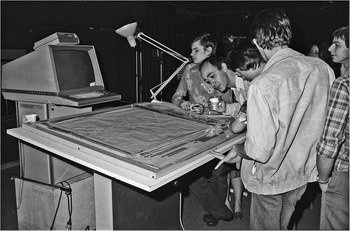
The year Les Ateliers UPIC was founded (1985), the team then in place organised a dozen presentation sessions in France (see Figure 1), each lasting one to three weeks. By entrusting the promotion and dissemination of this invention to this new entity, the CEMAMu was able to actively continue research on the technical development of the UPIC system without bearing the constraint of having to promote it as well to the outside world. A year later, it was technically possible to fully utilise the system in real-time. A training course was organised by the CEMAMu in November 1987 to educate the team of Les Ateliers UPIC in this important technical evolution. This marked the culmination of the continuous improvement over time of the system, emphasising the importance of the real-time prototype begun in 1983:
Thanks to UPIC's computational capabilities, it now allows for real-time interpretation of a score and, moreover, real-time control of all the parameters of sound, in their finest details. For example, when redrawing a waveform while a page is playing, one listens to the global modification it has on the sound, including its interactions with other timbres. … In fact, when the composer's hand draws a UPIC object, it is guided by the eye, but also and above all, by the ear. (Marino, Serra and Raczinski Reference Marino, Serra and Raczinski1993: 265)
Julio Estrada (leaning over the UPIC) in a workshop with a group of young people at the Forum des Halles in Paris during the summer of 1986.

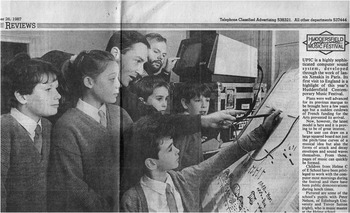
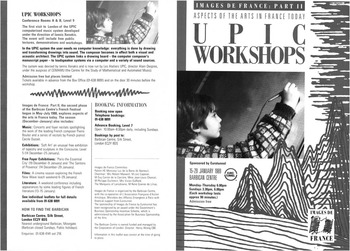
As one journalist of the Huddersfield Daily Examiner reported (Anonymous 1987; see Figure 2), the first encounter between UPIC and England took place in November 1987 during the Huddersfield Contemporary Music Festival. In addition to a series of concerts, the Helme C of E School's students, under the aegis of Peter Nelson and Trevor Sutton, repeatedly used UPIC (the latest version in real-time) by composing short pieces presented to the public at end of the Festival. It was not until January 1989 that London hosted a UPIC workshop, as part of the Barbican Centre's French Festival, offering the public free lectures and workshops around the machine (Anonymous 1989; see Figure 3). At the end of a week there, a programme combining works written on UPIC by recognised composers (such as Exercisme by Bernard Parmegiani, Taurhiphanie by Iannis Xenakis, Tournoiements de spectres by Peter Nelson or The Unthinkable by Richard Barrett) was presented side by side with pieces composed by children, teenagers and students during the workshops.
Peter Nelson and Trevor Sutton during the first UPIC workshop organised in the UK, with students from the Helme C of E School in 1987.

Flyer for the first and free UPIC workshop organised in London in 1989.

Beginning in 1987, Iannis Xenakis called on Les Ateliers UPIC to develop, in parallel with its promotional trips, studio-based activity (production of works) as well as a regular pedagogical offering. Two such composition studios opened their doors in April 1987 at the Parc de la Villette in Paris. The vitality of the centre was so great that, in 1987 alone, Les Ateliers UPIC welcomed composers with aesthetic horizons as diverse as Pierre Bernard, Jean-Claude Eloy, Julio Estrada, James Harley, Alain Lithaud, François-Bernard Mâche and Peter Nelson. Their musical production around UPIC led to a whole series of concerts in Europe, Mexico, Canada and the United States. Public demonstrations and workshops met with huge success, particularly in Mexico, as witnessed by Alain Després:
Never had I experienced such a warm welcome as the one given to us in Mexico. Never have we felt such impatience, such a collectively enthusiastic interest in the [UPIC] system. … A couple of posters and word of mouth were enough for more than one hundred people to sign up immediately. … UPIC had to work twenty hours a day. We had to create three ‘unscheduled sessions’ … accepting up to ten people in each, allowing them to use the system at night. While one person worked on the machine, a next person waited impatiently, his sheet of tracing paper in hand, ready to rush in… (Després Reference Després1988: 2)
In the 1990s, the UPIC system fascinated a whole new generation of composers such as Nicola Cisternino, Gerard Pape, Brigitte Robindoré, Takehito Shimazu and many others. The real-time version by then was fully usable; a screen and a mouse gradually replaced the drawing table and the magnetic pen (from 1991 onwards UPIC operated in Windows). Although these technological developments have changed the handling of UPIC compared to its original system, according to Gerard Pape (the last director to date) it is not at all removed from the primary pedagogical intuition of Iannis Xenakis. In a document addressed to students in residence at Les Ateliers UPIC, Pape underlined that:
Too often, there is a distinction between concept and practice. Thus, composition is usually taught on the basis of technical rules and modes of writing. Our desire is to teach the urgency of thinking for oneself. Students won't find recipes at Les Ateliers UPIC, but tools to develop original thought in their own sound universe. … The technical support of the machine is thus placed in its own dimension, as an object of mediation, multiplier of imagination. (Pape Reference Pape1997: 3)
4. The CIX workshops
At the CIX (Les Ateliers UPIC were renamed the CCMIX (Centre de Création Musicale Iannis Xenakis) in 2000, and finally CIX (Centre Iannis Xenakis) in 2009), since 2009, a sort of revival for UPIC workshops has been initiated, in order to verify to what extent this ‘classical’ software can still be ‘a multiplier of imagination’, and to address what still makes it, in today's context, a pedagogical singularity. In addition, these workshops are proving to be fertile breeding grounds for future developments of the tool, all while respecting Xenakis's above-stated ambitions for it.
The following workshops, around the UPIX (2001, CEMAMu's software version of UPIC) – and hardware version when possible – were organised:
-
• at the Southbank Centre in London during the Ether Festival in April 2011;
-
• at the Université de Rouen in April 2012;
-
• at the ZKM (Zentrum für Kunst und Medientechnologie) in Karlsruhe during the Xenakis symposium (July 2012), and with two school classes there since then.
At the time of writing, other events are to come, in December 2012 in Rouen and in March and April 2013 in Le Havre, while more workshops are likely to be held at the ZKM.
Participants in the most recent workshops held by the CIX have consisted mostly of music students, or amateur and professional musicians. As such, there has been no need to provide the basic bricks of knowledge about pitch or intensity.
5. The UPIC workflow
Hence, the workshops begin by giving the typical succession of actions needed to create a UPIC page of music. For this purpose, one has to create from scratch a minimal set of objects used on the final ‘score’: envelope, amplitude table, waveform, frequency table, page.
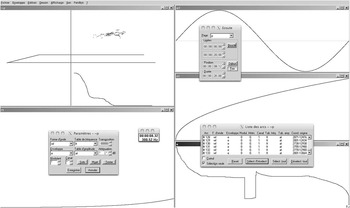
Each time a new object is created, an explanation of its nature and operating mode is given. Noteworthy is the fact that this simple workflow allows us already to address various essential topics in computer music: logarithmic laws, the mapping of values, consistency between frequency and time, distinction between discrete and continuous values. For newcomers, we explain what a ‘page’ is: it is the object with highest synthetical level. A ‘page’ is composed by super-imposing ‘arcs’ – straight or curved lines having a beginning and an end, as functions within time. So an example is created to illustrate the basic drawing operations (Figure 4). A succession of ‘pages’ constitutes a UPIC ‘score’.
Screenshot of UPIX software made during a workshop in 2012.

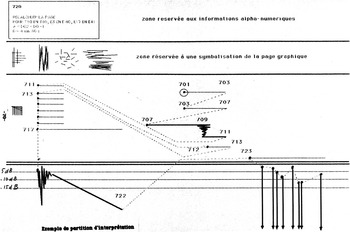
In order to go further into production details, groups of arcs can be selected, either by pointing on them in the page, or with the help of a specialised window. Selecting arcs allows one to assign different parametrical settings to different groups of arcs. One can then explore the effect resulting from the modification of the frequency and amplitude tables, of the envelopes and so on. Also frequency modulation is addressed, a UPIC specificity that offers a substantial exploratory potential, due to its capacity to be used in feedback loops between several arcs. The next interesting feature is the possibility to record musical gestures made when playing a page in real-time. The sequence window that allows this trick can be considered a tool for creating a meta-score. Some attempts to draw meta-scores, such as plain paper scores describing how to play a UPIC page, have been made in the past, for example by Alain Després (see Figure 5). As such UPIC shares the characteristics of a real instrument, allowing also for a certain degree of improvisation.
Alain Després's performance score for a real-time version of UPIC: an example of a meta score.

These workshops are as successful as they were in the 1980s. People attending them discover something they did not know, which tends to show that the idea of drawing sound is not yet mainstream. It proves that UPIC's audience can still be enlarged. Andreas Köhler, music educator at the ZKM, assisted in giving the workshops there. He reported two positive aspects: the first one is a ‘vintage’ sound typology, one that can't be found in more current software. The sonorities resulting from experimentation with UPIX, compared to the dominating aesthetics in commercial software, are more arid, less consensual. The second point Köhler makes is the rigour required by the software from the user. This rigour comes back in the words of Peter Nelson, a long-time Xenakis collaborator who participated in UPIC's early pedagogical activities:
There is no ‘virtual orchestra’ here: the imagination must seize on the possibilities available in the system, whose strengths are a direct access to the intimate details of sound, extreme simplicity of means and great speed of working. In my experience, people find this invigorating rather than forbidding. (Nelson Reference Nelson1997: 38)
Also the original developers of UPIC, as seen above, were quite concerned about this machine being (or becoming) a tool for the democratisation of music. In this regard and concerning classical music and its specific learning scheme, Xenakis writes:
We deprive the individual and society of the immense power of free imagination that music composition offers them. But the technology of the computer and its peripherals make it possible to tear down this iron curtain. The system that allowed the realisation of this breakthrough was UPIC. (Xenakis Reference Xenakis1994: 31)
The British multidisciplinary artists Haswell and Hecker do not hesitate to talk about ‘deterritorialisation’:
With UPIC, Xenakis sought to attain maximum deterritorialisation by using a technology unmediated by theories because based exclusively on elementary acoustics, but allowing the composer, through the graphical interface, sensitively to construct a new habitus, a minimum reterritorialisation (‘just a little order … to protect us from chaos’): a tool that operates not with overcoded conventional points, but with ‘graphisms,’ ‘arcs sonorous.’ It is this twofold goal of maximum deterritorialisation and universal accessibility that Xenakis calls polyagogy. (Haswell and Hecker Reference Haswell and Hecker2007: 122)
6. The avatars of musical representation
The desire for generalisation and for the extension of visual control has its origins undoubtedly in electroacoustic practices. Indeed, the musician can then explore a whole world of details made available to her or him by technology. Henceforth, the capacity for organising sound would become available to a non-musician public, and even to the most general audience: anyone with a home computer. Such new technologies would allow for a novel control of sound phenomenology via a visual access. Then, the question of the tools allowing for the exertion of this control in a rational, limitlessly intelligent fashion comes into play. Imagine this problem solved: the power to compose is then given to everybody! The social openness of the system begins to increase. UPIC gets rid of the solfeggio system, which remains somewhat opaque both to the musically uneducated and to the scientifically oriented objective mind. The UPIC-ian approach can be seen as one of the earliest proposals with this ambition towards democratisation of the compositional process; in other words, via personal computers.
An objection often encountered is that two similar graphical objects can produce very different sounds. This bias (which has the side-effect of requiring good navigation skills through numerous windows) reminds us of the strong potential disagreement between two modes of thought. One mode advocates the use of accurate representations of distinct physical variables, meaning that the sound information is not contained in a single window, but may be composed also of hidden ones. The other mode prefers to manipulate metaphorical symbols, more readable at first glance, using, for example, colour or evocative shapes. This is one of the most difficult challenges for those who want to represent sound in all its diversity. For example, the possibility of drawing waveforms on UPIC directly is a particular case where the pedagogical aspect can be questioned. People have always tended to develop relevant representations of sound. But we should not forget the familiarity between the intellectual impetus that drove music notation and that which gave birth to physics.
Xenakis has talked extensively about this affiliation between music and physics, and about what we owe to Pythagoras and Nicole Oresme. In an article where Xenakis draws a parallel between the evolution of music and mathematics, he cites this important historical fact, dating from AD 1000:
Invention of the bi-dimensional representation of pitches versus time by the use of staves and points (Guido d'Arezzo), three centuries before the coordinates by Oresme and seven centuries before (1635–1637) the superb analytic geometry from Fermat and Descartes. (Xenakis Reference Xenakis1994: 35)
On the other hand, it is easy to represent quantities (such as the frequency and intensity of a sound): there is no problem linking them to the variation of a single sensation, being culturally accepted to decipher the meaning of their graphical functions. However, timbre is a notion much more resilient to simplification; we cannot represent it in terms of ‘plus’ or ‘minus’. Being of a multidimensional nature, it needs an arbitrary decomposition in sound sub-notions (envelope, granularity, harmonicity, noise proportion, etc.). On this specific issue, some may have a more positive view:
The representation of the sound envelope is a simple analogue; the representation of the waveform is of a different order, requiring the abstraction of physical properties: period and regularity as they relate to harmonicity, smoothness as it relates to harmonic content, relative amounts of deviation of the line as they relate to the amplitudes of component partials, and so on. (Nelson Reference Nelson1997: 38)
On the subject of feedback, Henning Lohner adds that:
The point must be stressed that it is the objective of UPIC to have the computer aid your own two hands at drawing, to aid manual construction. With this in mind, automatic sound creation or processing devices (such as rhythm generators and the like) should be considered more as adjuncts to the basic system. (You could construct many of these effects directly on the UPIC, but the UPIC is not optimized for them.) All automatic functions are used principally to aid manual input, and not vice-versa. (Lohner Reference Lohner1986: 49)
All these remarks have a major pedagogical concern in common: the feedback; in other words, the time it takes from a user's physical input (drawing gesture) to a hearable result. We can continue to discuss whether music should be drawn or written, but once the choice has been made towards the former procedure we should try to maximise the link between the software and the real-life drawing experience, with all the accuracy of the cognitive aspects this experience represents for the designer.
If the main goal of a tool is to be closer to any imaginable sound, this means a great openness, and consequently a demanding accuracy of the sound images the user wants to create, as well as a well-informed methodology to obtain them.
We often run out of time to be able to allow the users or workshop participants a real comparison between UPIX and other software. To obtain such feedback, it would be necessary for them to already have some practical experience on HighC, IanniX or MetaSynth, among others. Thomas Baudel, the developer of HighC, may have been the closest follower of UPIC in terms of user experience; its graphic objects can be manipulated in a way that every UPIC user envies. But with HighC (whose development Baudel started in 1998, adding a java user interface in 2006), he did not think it was worth keeping the basic existing aspects that could seem essential to a flawless drawing experience of sound matter. Aspects such as the accuracy of drawing and a real-time sounding possibility according to the position of the pointer, seem however to be a key factor. Developers in a wide range of software technologies focus their preoccupations on user interface feedback. For instance Andrea Agostini and Daniele Ghisi, who created the bach library of externals (which might just be the first convincing integration of a sequencer with music notation inside Max/MSP), say:
There is no deep reason why symbolic processing should not be performed in real-time, the only reason being what we could label a ‘technological anachronism.’ In fact, advanced symbolic computation and musical representation can easily become very costly in terms of processing power, and personal computers could not stand its computational weight until a few years ago. This situation has established a traditional separation that, although still lingering on, is no longer justified, since interactivity is an essential performative aspect of the musical discovery process, allowing any input gesture to immediately affect a given score. (Agostini and Ghisi Reference Agostini and Ghisi2012: 247)
7. Openness and Rigor
Which paradigms forge the philosophical basis of UPIC?
7.1. The question of notation
The Xenakian principle of transdisciplinarity between science and the arts is apparent even in the most basic UPIC-ian choices. UPIC's system of representation is not metaphorical: there is a direct correlation between a physical value and its representation. The efficiency of the symbolic system of traditional music notation cannot for creating a certain type of music be questioned. Yet the choice to revert back to the fundamentals of physical values (pitch, intensity) carries several implications. With UPIC, it is still possible to imagine writing based on discrete scales, but that's not all: the most remarkable aspect is the machine's ability to create a continuum of pitches. It is important to note as well that this choice, anchored in physics, avoids using any signs whose history is founded in aspects of sight-reading, musical modes or instrumental practice. This enables even a musically educated public to realise the limits imposed by its traditional culture and to finally confront the global nature of sound. It is in this sense that science plays the role of describing the customary tools of creation implicated in making music more generally with UPIC.
UPIC's pedagogic ambitions are multiple and, in addition to all that has been said above, the system enables the creator to invent sound worlds well beyond the classic constraints of music-making, while rendering an awareness of the underlying physical science. On the one hand, its scientific utopia is accompanied by a social utopia, as we were reminded above in the original statements of purpose for the machine. One reason behind this is, once again, the manifestation of a scientific approach. Indeed, one's first contact with this tool is accomplished on an equal footing between total novices and experienced musicians, the latter needing only to revise their manner of apprehending musical production. The workshops have shown that an obvious link is established between gesture and composition, as a result of this bias towards physical representation. We can derive from this statement the awareness the original developers had for the accuracy – in space and time – of the interpretation of drawn gestures. The onscreen representation of a hand-made drawing should be faithful, and an immediate aural and visual feedback should be obtained by a user's action, which is largely the case for UPIC.
7.2. A feature comparison
We find that rigour and openness are two words that apply quite well to the philosophy behind UPIC and propose a comparison with other software based on the following observations:
-
• the basic physical values are frequency and intensity;
-
• there is a rapid reaction (or feedback) time between the user's gesture and the resulting sound;
-
• each drawn line (arc) possesses an internal representation, and its parameters can be individually determined;
-
• drawings can be extremely precise; and
-
• the tools for drawing and sound synthesis are fully integrated (do not require any outside dependency or peripherals).
We propose a comparative table (Table 1) of similar existent software at the time of writing.
Comparison of existent software with UPIC as of 2012

In IanniX, software created in 2002 by La Kitchen and still under development, a new possibility has recently been incorporated, that of importing a vector-based image realised in another software (Jacquemin, Coduys and Ranc Reference Jacquemin, Coduys and Ranc2012). This feature, while allowing all the advantages of professional drawing software, does not remove the inconvenience of having to switch to another software. Developers of IanniX have made a deliberate choice of openness in this respect, which is good, but a graphic-oriented designer can be disappointed by the drawing interface. We wonder if it is meant to help drawing, or rather is more focused on the visualisation of algorithmic writings. Eric Wenger's MetaSynth, while proposing a very efficient in-house and pragmatic set of tools for graphic transformation, also does not seem to show any keen interest in an accurate drawing tool. MetaSynth does not function on the paradigm of arcs (a drawn curve that determines an oscillator's frequency that possess its own identity that can be parametered and modified) like UPIC. Rather, it translates each pixel from an image into values (pitch, intensity) in the same manner as a sonogram, with the same precision that the image's definition allows. Furthermore, the maximum frequency definition is limited to one 1024th of an octave. With UPIC, one can decide, for example, that the entire range of a page is a single half-step. A drawing's precision is thus drastically increased, which enables one to write within a very detailed microtonal space.
Among the group of software programs that deal with the graphic representation of sound, we can also cite the following propositions:
-
• AlgoScore (Jonathan Liljedahl, 2008) and OpenTimeLine (Damien Henry, 2009) each propose different ways of graphically presenting sequences that have been previously described algorithmically; the former in a physical manner, the latter in a symbolic manner. The graphic objects themselves are not directly editable in either. These programs do not allow one to draw the sound itself.
-
• In addition to IanniX, several propositions exist to organise and draw sequences interpretable by other software programs via OSC (Open Sound Control): TimelinerSA (vvvv open source group, 2011), ofxTimeline (an add-on by James George for Open Frameworks, 2012), KluppeTimeline (Dieter Kovačič, 2009).
-
• Cecilia (Alexandre Burton and Jean Piché, 2005) proposed an interesting graphic alternative for generating scores for CSound. A more recent version (2011) has been written in Python.
-
• Other software programs utilising images exist, but in a more ‘playful’ register: Singing Fingers (Eric Rosenbaum and Jay Silver, MIT 2011), Artikulator (Mike Rotondo and Luke Iannini, 2011).
-
• In another category we find alternatives based on the manipulation of the spectral representation of Fourier analysis, such as AudioSculpt (IRCAM, 2012), Spear (Michael Klingbeil, 2009), SpectraLayers (Divide Frame, 2012), SonicPhoto (Skytopia, 2012), and Iris (Izotope, 2012).
Concerning UPIC, some important developments can be anticipated, while maintaining a choice between an algorithmic approach and a graphic approach. We suggest:
-
• inclusion of vector-based graphics, which would allow for the elimination of limitations of scale entirely;
-
• inclusion and management of ‘sieves’ (Xenakis Reference Xenakis1992: 268–88);
-
• inclusion of probabilistic drawing (notion introduced by Rodolphe Bourotte in the program ProbaPainter realised with Max/MSP);
-
• inclusion of dynamic stochastic synthesis (GENDY) (Xenakis Reference Xenakis1992: 289–94).
8. Conclusion
To conclude, we can argue that the initial idea of the CIX workshops was to test the interest that can be drawn today, in a pedagogical context, by the discovery of this software whose development ended ten years ago, and to evaluate this enthusiasm compared to what other software can offer. We hope to have demonstrated how the UPIC remains the only tool, over twenty years after its introduction in 1991, which combines a synthesis engine with a drawing tool, allowing for immediate feedback. From an artistic point of view, the UPIC is but one possible approach among a notoriously vast quantity attempting to link sound to image. Let us simply remember that its goal is not to provide a metaphoric representation of sound. Musical thought here precedes any gestures. The UPIC is an extension of traditional music writing in that it broadens our handle on the sound world at large. By proposing a form of prescriptive writing through drawing, it expands the potential pool of composers and proposes an innovative pedagogic approach.
As such, the UPIC explores the concept of ‘scoring physical phenomena’, conferring humans a demiurgic position. UPIC users reclaim the tools of scientific analysis and invert their direction, which was originally stemming from nature towards representation; it now becomes a question of producing a new sound reality from a representation. As the international success of the numerous workshops in schools, cultural centres and conservatories proves, a specific pedagogic challenge is intimately linked to this software's destiny. We believe it is worth pursuing its initial project, which tends towards a greater sense of universality, and should constantly be developed with the most recent technology available.
New tools remain to be created if one has in mind the idea that drawing is an important part of the music composition workflow. Culturally, in 1977, when the first UPIC emerged, society was feeling the first fruits of a drastic evolution of our capabilities to interface humans with machines. The magnitude of the human and hardware investment involved at that time for such a project gives an idea of the significance of the challenge. In this context and as Jean-Baptiste Thiebault so aptly says:
The initial stages of creative design often involve sketching. Electroacoustic composition is no exception to this. Paradoxically, the technologies that enable this form of composition provide little support for the sketching process itself. (Thiebault Reference Thiebault2008: 1)