Introduction
Thanks to its famous waltz composers and rich dance hall tradition, nineteenth-century Vienna was known as the city of dance. Therefore, it should come as no surprise that the Viennese Biedermeier period, together with the later era of ‘the waltz king’ Johann Strauss the younger, have attracted the interest of many music historians. These have depicted nineteenth-century Vienna as a carefree city, with tens of thousands of people dancing in the numerous dance halls, but where dance culture was, at the same time, socially very segregated. While the nobility danced in palaces and salons, the middle- and lower-class people went dancing to public dance halls located in the suburbs.Footnote 1
While the dance culture of Biedermeier Vienna has attracted the interest of numerous scholars, relatively little is known about the earlier dance history of the city of dance. Although Johann Strauss the elder and Joseph Lanner came into the picture only in the 1820s, Viennese dance hall culture actually developed rather earlier. In fact, a major shift had already taken place in the late eighteenth century, when, for the first time, public dance halls were opened for everyone. During the thirty-year period, from 1780 to 1810, the number of Viennese dance halls increased rapidly from 15 to 50. This can be considered as a turning point in Viennese urban music culture; not only because the phenomenon represented the early commercialization of Viennese dance culture, because now many restrictions on dance hall business were abolished and innkeepers hurried to open ballrooms for growing public, but also because it established the basis for Vienna's later reputation as the city of the waltz, as some of the dance halls, made popular by Lanner and the Strauss family, had already been founded during this period.Footnote 2
Moreover, some dance historians, such as Reingard Witzmann, have even stated that the early dance halls in Vienna played a crucial role in the development of the Viennese waltz, as the dance style did not develop in the dance schools or ballrooms of the elite, but in numerous late eighteenth-century public dance halls, attended by all social orders of Vienna.Footnote 3 This view has been echoed in more recent histories, where it seems to be the commonly accepted view that the lack of snobbish hierarchy in Viennese dance culture enabled the Viennese waltz to become one of the first popular social dance forms in the early nineteenth century.Footnote 4
A closer look should be taken at the early developments of the Viennese dance hall culture, however, because although the early dance hall culture formed the basis of the city's later reputation as the city of dance, the assumption that it was democratic is contradicted by the historical evidence that indicates that dance culture in nineteenth-century Vienna was, in fact, socially segregated.
Based on contemporary eyewitness accountsFootnote 5 and advertisements for the Viennese ballrooms, this article argues that social distinctions, rather than disappearing, were reinforced after the commercialization of the ballroom culture at the end of the eighteenth century. Indeed, the sources relating to more than 15 Viennese dance halls reveal that during the period under research, 1780–1814, the Viennese elite was very reluctant to share the social space with the petit bourgeoisie, let alone the lower classes. Thus, it will be argued that the emergence of public dance hall culture did not create a democratic social space. Rather, new ways of showing class distinctions were created during this period when dancing began to be consumed by almost all social classes in Vienna.Footnote 6
Since the focus of the article is on social differentiation in a commerce-based culture, Pierre Bourdieu's ideas on taste form the theoretical background of this study. Bourdieu argues that consumption is one of the most important ways through which social differences are expressed in modern society. Moreover, given that consumption is not only a matter of demand, the production of cultural goods should also be taken into account. According to Bourdieu, the form in which taste is manifested is also dependent upon the ‘system’ of goods that are on offer.Footnote 7 This was the case in Vienna too. As this article will show, social differentiation in the Viennese dance culture was not only a matter of choice, but it depended also on the supply side of the dance culture, that of the dance hall business.
Ballrooms for all classes
Although the very first public dance houses can be dated back to the Middle Ages, the ballroom did not become a central institution in European urban culture before the eighteenth century. While new dance halls were built in many cities during the century, balls were also arranged in inns, opera houses or private homes. In addition, during summer time the urban middle class was to be found dancing in parks as well as in spas and health resorts.Footnote 8 While English dances, quadrilles, minuets and allemandes dominated European dance floors during the first half of the eighteenth century, their dominance was challenged by waltz-like pair dances during the second half of the century.Footnote 9
Despite the fact that from the early eighteenth century on dancing at public dance venues became an increasingly popular leisure activity in almost every social layer in Europe, the rift between the dance halls of the urban elite and those of the lower classes anything but vanished during the period. Even in public outdoor dance places, such as pleasure gardens, social mingling seems to have been just an illusion. For instance, although the aristocracy and middle class were occasionally seen promenading and dancing together in the pleasure gardens of Paris, distinctions still occurred and many contemporaries regarded these parks as political illusion. This was partly because the parks were closely related to other cultural initiatives undertaken by the French crown in order to encourage patriotism and improve its own image.Footnote 10
Neither could pleasure gardens democratize the dance culture of London, where the gardens were also visited by both the aristocracy and middling ranks. This was the case especially in Vauxhall, the most well-known garden in the suburban city. While the cheap entrance fee of the garden attracted even the lower-middle ranks, from the point of view of the aristocracy the place was ideal for auto-voyerism, the practice of seeing others and being seen by them. But again, in order to keep the distance in the shared social space of Vauxhall, the English aristocracy made sure that it did not take part in the vulgarities practised by some members of the lower ranks. Although the aristocracy continued visiting the public gardens until the early nineteenth century, at the same time it arranged private balls, where entrance was, however, restricted to the respectable aristocracy and the highest bourgeoisie.Footnote 11
From the late eighteenth century on, private assembly balls became increasingly popular among the London elite. Unlike public parks, assemblies provided a degree of protected equality and respectability. Therefore, they were considered as a more respectable option for marriageable women and unmarried men.Footnote 12 Besides offering opportunities to meet and arrange marriages between noble families, assemblies protected the aristocracy from the enriched middle ranks. Especially during the two first decades of the nineteenth century, London aristocrats sought to make fashionable circles distinct and impervious to undesirable newcomers not only by formalizing and codifying proper behaviour according to rigid rules of etiquette but also by transferring the locus of sociability from public arenas to private assembly balls and homes.Footnote 13
In Vienna, too, the dance culture of the city reflected the diversity of Viennese social structure. While the cultural life of the highest elite was centred at the court and other inner-city aristocratic venues, the lower classes, in contrast, celebrated at public inns in suburban Vienna, where they lived. This was also the case for the Viennese dance hall culture, which was still only emerging at the century's end.
Despite the political and economic setbacks that followed the Napoleonic wars,Footnote 14 in terms of culture, Vienna was still one of the richest cities in Europe. Therefore, the capital city of the Habsburg monarchy attracted many tourists and other visitors, who commented on the Viennese cultural life in their journals and travel writings. Of course, as dancing was an important part of the Viennese celebration culture, the ballrooms of the city were also commented on by many travellers, whose accounts reveal, among other things, just how diverse the Viennese dance culture actually was.
In 1783, a traveller called Carl Anton noticed that ‘In all kinds of ballrooms for all orders, people gathered at every end and corner of the city and suburbs.’Footnote 15 Another traveller, Joachim Christoph Friedrich Schulz, who visited Vienna in the following decade, stated that in Vienna different social classes danced in different places. According to him, the higher society danced in the court and at private balls, while the rich middle class were to be found dancing at the casinos, spas and picnics, while the lower bourgeoisie danced in Lustörten outside the city and in the city. During Viennese carnival time (Fasching) the lower classes celebrated in the Redoute Hall together with the nobility and other members of the elite; the latter, however, only watched while the lower classes danced.Footnote 16
The variant dancing practices among the different social classes are easy to understand against the background of the social structure of the city. As Vienna was the capital city of the monarchy, the aristocratic elite had dominated there for quite some time. However, the role of Vienna as a rising metropolis of trade and production gave birth, little by little, to a bourgeois class.Footnote 17 As the businessmen and lawyers of Vienna formed an upper bourgeois class in the late eighteenth century, the size of the petit bourgeoisie (klein Bürgerstand) grew rapidly due to pre-industrialization.Footnote 18 Nevertheless, at the time there was still a large group of artisans that cannot be seen as belonging to the bourgeoisie. It has been estimated that approximately one third of all the inhabitants of Vienna were engaged in crafts or trades, either as workers or as their family members.Footnote 19 A fairly homogeneous group of artisans lived mainly in the suburbs, where they had their workshops and shops.Footnote 20 In addition, there was an exceptional number of domestic servants in Vienna. It has been estimated that as much as 15 per cent of the population was in service. Servants, together with the workers and journeymen, were at the bottom of Viennese society.Footnote 21 Characteristically, while the annual incomes of the higher bourgeoisie could have been as much as 2,000 Florin,Footnote 22 workers earned c. 100 and servants only 20 Gulden per year.Footnote 23
For a long time, the dancing of the lower classes was controlled in Vienna. This was because it was thought that public gatherings could contribute to the spreading of infectious diseases as well as create public disturbances among suburban people.Footnote 24 In the late eighteenth century, however, many of the regulations were cancelled. In 1766, Empress Maria Theresa decreed that public balls were permitted to be organized in the city.Footnote 25 Until 1786, dance places were allowed to remain open until midnight on Sundays and holidays, by which time a decree was passed allowing inns to remain open until three o'clock or the whole night, albeit in that case without dance music.Footnote 26 According to Reingard Witzmann, the ballroom reform of 1786 revolutionized the Viennese ballroom culture, because it was after this that innkeepers started to compete for customers. As visitors were allowed to spend the whole night in inns, innkeepers started to invest in decoration and food. In addition, many Viennese inns now began to be converted into ballrooms. The former inns Zur Goldenen Birn and Zum Schwarzen Bock are just two examples. Zur Goldenen Birn in Landstraße No. 63 became popular between 1812 and 1822, when Michael Pamer worked there as a conductor. In the 1820s, Pamer's pupils Joseph Lanner and Johann Strauss were to be found playing in Zum Schwarzen Bock, the inn originally founded already at the beginning of the eighteenth century.Footnote 27
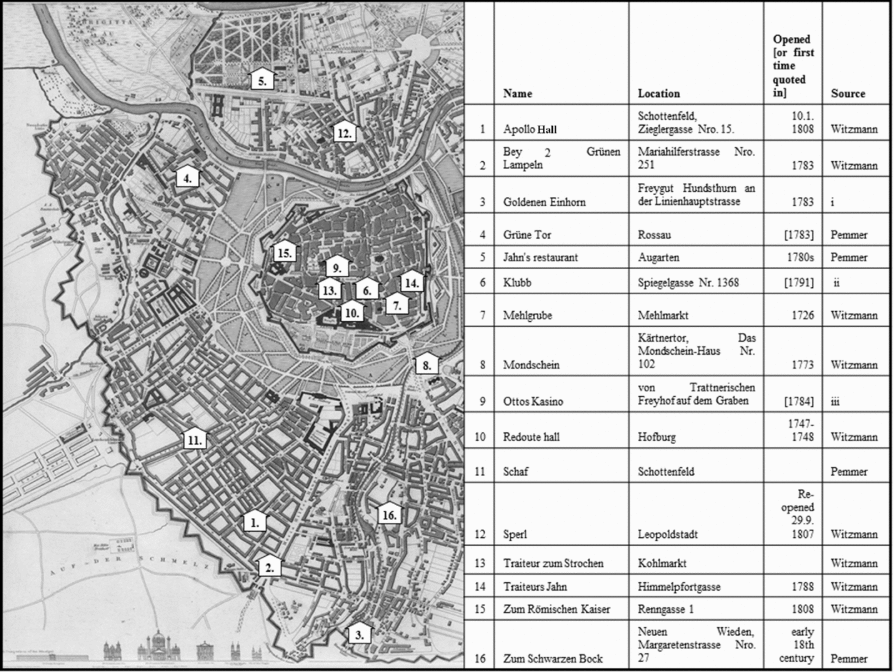
In 1780, a contemporary Viennese chronicler, Christian Löper, estimated that there were 17 dance halls inside the city walls of Vienna and 4 outside.Footnote 28 By the time of the Congress of Vienna (1814–15), almost 50 public ballrooms had been opened, mostly in the suburban city. Figure 1 shows the 16 ballrooms discussed in most detail in this article. As one can see, nearly all of the oldest ballrooms were situated inside the fortifications, while the new ballrooms were generally founded in the suburbs. This is unlikely to have been a coincidence, since in contrast to the densely built inner city, the suburban Vienna expanded and changed constantly during the early nineteenth century.
16 Viennese dance halls, 1780–1814
Source: Based on the city plan drawn by W.B. Clarke and engraved by J. Henshall: Vienna. Wien. Published under the Superintendence of the Society for the Diffusion of Useful Knowledge (London, 1844); information from H. Pemmer, Alt-Wiener Gast- und Vergnügungsstätten; Witzmann, Ländler in Wien, except (i) Wiener Zeitung, 27 Dec. 1783; (ii) Wiener Zeitung, 1 Jan. 1791, 13; (iii) Das Wienerblättchen, 17 Aug. 1784, 158.

At the turn of the century, Vienna consisted of three areas: the old town, the suburbs and the areas outside the glacis (Linnienwall; in the map the outer fortification line). The old town was a densely built city centre, which remained static from the late eighteenth century until the mid-nineteenth century, when the Ringstraße was built. At the turn of the century, c. 52,000–54,000 people lived there inside the inner fortification line, which separated the old town and suburbs. It has been estimated that in the late eighteenth century the majority of the population, c. 60 per cent, lived in the suburbs, 20 per cent lived in the old town and 15 per cent lived outside the city wall.Footnote 29 Since the inhabitants of the city centre were mostly the Viennese nobility and higher bourgeoisie, the first inner-city dance halls were aimed at them. Suburban dance places, for their part, were originally above all venues for the petit bourgeoisie, craftsmen and servants. In the early nineteenth century, however, the situation began to change, as the suburban ballrooms started to attract the nobility as well.
Late eighteenth century: from high to low grade
In 1794, according to a Viennese chronicler, Ignaz de Luca, the Viennese nobility danced in the Redoute Hall and Traiteurs Jahn, ballrooms situated in the inner city.Footnote 30 Until the eighteenth century, the Redoute Hall was the most luxurious Viennese ballroom, home to celebrations of the Viennese nobility and higher bourgeoisie. The original hall in the Hofburg was built during the period of 1747–48, after which it was remodelled many times. The hall consisted of two ballrooms, the kleine Saal and the gro βe Saal, both of which were, at the turn of the century, luxurious and decorated with many chandeliers.Footnote 31
Although the Redoute Hall was initially open to all on payment of an entrance fee, in 1752 admission was restricted to the nobility and the military, because of complaints from the nobility.Footnote 32 According to the ball order of 3 January 1752, only masked balls could be held in the hall, and only the high nobility, knighthood and state and military officers were allowed to dance.Footnote 33 Characteristically, a traveller, Peter Willebrand, who visited the hall in 1769, described how the ballroom offered a good opportunity to meet persons of the highest order.Footnote 34 However, the 1752 regulation was cancelled in 1772, and from then on, other classes, too, could participate in carnival balls held annually in the Redoute Hall. By the late eighteenth century, the Redoute Hall had become the focal point of the Viennese carnival celebrations, which lasted from early January to the end of February.Footnote 35 Since the Middle Ages, the Viennese elite had arranged carnival balls, where the world seemed to be turned upside down as the nobles masked themselves as German peasants.Footnote 36 Despite this, however, social distinctions still mattered. Unlike early modern Italy and nineteenth-century Paris, where the roles of masters and subjects could change during carnival celebrations,Footnote 37 in Vienna the higher and lower classes were not seen celebrating together at the carnival balls. Although the lower classes also attended the carnival at the Redoute, the elite did not, in fact, dance with them.Footnote 38
The bookkeeping of the carnival Redoute balls reveals that in the late eighteenth century the carnival balls were attended annually by more than 10,000 people.Footnote 39 Thus, it is no surprise that some were also people from the bourgeois class. A good account of the social classes that took part in the masked balls organized in the hall can be found in Joachim Perinet's description of masked balls celebrated during the carnival time of 1788. Perinet, a Viennese actor and writer, portrayed, for example, an artist dressed as King Midas, an official wearing the clothes of a tinsmith and a doctor dressed up as a grave digger. There was also a member of the bourgeoisie who dressed as a beggar, and a police officer who wore a Venetian mantel.Footnote 40 Nevertheless, people who considered themselves as belonging to better society were not in favour of common people attending balls. Mozart, for example, who was an enthusiastic dancer,Footnote 41 complained that tickets for the balls were sold to everyone on the streets, even barbers and parlour maids.Footnote 42 Schulz reported that during the Viennese carnivals in 1795 the nobility did not celebrate; they only watched while the middle and bourgeois classes enjoyed themselves.Footnote 43 This was also noticed by a certain Bavarian traveller, who visited Vienna in the early nineteenth century. According to his travel account, the brilliance and richness of both the Viennese nobility and bourgeoisie was visible in the Redoute Hall, but, with the exception of a few nobles, it was mostly the latter who danced. The court did not dance at all.Footnote 44
Just as the Viennese elite preferred not to dance with the lower classes at the carnival Redoute, nor were they pleased when the bourgeoisie started visiting another inner-city ballroom, Mehlgrube, in the 1780s. Until the 1770s, the Mehlgrube, a luxurious and massive baroque building situated in the inner city at the Neue Markt No. 5, once known as a dance place for the nobility, became one of the first bourgeois public dance halls in Vienna.Footnote 45 Upon recognition of the fact that the bourgeoisie dominated the place, the nobility no longer went there. Characteristically, Prince Johann Josef Khevenhüller-Metsch complained in his diary during the carnival time of 1775 that noble men could no longer dance in Mehlgrube, since it had become more of an inn than a proper dance hall after people from the ‘under class’ had started to dance there.Footnote 46 This was also noticed by Perinet, who in 1788 grumbled that ‘Mehlgrube used to be one of the best halls in Vienna, but unfortunately it is no longer a pleasant place.’Footnote 47 According to Eipeldauer Briefe, a monthly Viennese journal which commented on events in Vienna, in 1800 Mehlgrube was filled with bourgeois women.Footnote 48 In 1801, Pichler remarked that Mehlgrube was for the lower and poorer orders, as businessmen and craftsmen danced there. Servants also went to these balls in 1801, but wearing costumes that hid their social status.Footnote 49
Once the lower classes became the dominant group visiting the Redoute Hall and the Mehlgrube, the Viennese elite went dancing to Traiteurs Jahn, a restaurant in the Himmelpfortgasse run by Ignaz Jahn.Footnote 50 Jahn had bought the building on Himmelpfortgasse in 1785, and three years later he opened the restaurant to the public. Balls and private concerts were held there only for selected society until 1807, when Ignaz's son Franz announced that the restaurant would be open to the general public.Footnote 51 In 1801, Pichler had described the hall as very elegant, very finely furnished and lit with cut-glass chandeliers.Footnote 52 According to Pichler, the entrance fee for Traiteurs Jahn was 3–4 Gulden,Footnote 53 thus far too expensive for the lower classes, such as workers with their annual incomes of 100 Gulden, let alone servants who earned only 20 Gulden per year.Footnote 54 The dance hall was already closed in 1809, after which Jahn organized balls in his restaurant in Augarten which became well known during the Congress of Vienna.Footnote 55
Judging by the cost of the entrance tickets, Klubb and Ottos Kasino in the inner city, probably both owned by Philipp Otto, would seem to have been aimed at the lower bourgeoisie and artisans. In 1791, Philipp Otto advertised his ballroom Klubb in Wiener Zeitung by stating that from 6 January public balls would be organized on Sundays and holidays in Klubb in Spiegelgasse No. 1368. Tickets for men cost 40 Kreuzer, whereas for women, only 20 Kreuzer. People wearing servants’ livery were not welcomed.Footnote 56 In 1797, subscription for 21 balls in Ottos Kasino was one Ducat for men and half for women. Tickets for single events cost 40 Kreuzer for men and 20 for women, respectively. Otto's enterprise would appear to have been popular, since it was still open after the Congress.
Together with the ballrooms situated in the city centre, there were dozens of ballrooms in suburban Vienna. Most of the ballrooms were situated in Leopoldstadt and Wieden. In addition, there were many dance venues on Landstrasse. Perinet tells us that suburban dance halls were visited by all kinds of suburban people, with different halls attracting different people: ‘There are now, as known, Mondschein hall for sentimentalists, das Schaaf for housemaids and fools, den schwarzen Bok or Schneider in der Trauer for young jumpers.’Footnote 57
Suburban dance venues such as Joseph Trapp's ballroom, Mondschein and Bey 2 grünen Lampeln were aimed at the suburban bourgeoisie. According to an announcement in Wiener Zeitung in 1785, only respectable persons were invited to Joseph Trapp's private ball in Wienerisch-Neustadt.Footnote 58 Bey 2 grünen Lampeln, opened on Mariahilferstrasse No. 251 in 1783, seems to have been another bourgeois ballroom. On 28 December, 1783, an advertisement was placed in Das Wienerblättchen for a new dance hall Bey 2 grünen Lampeln, open to all but without work uniform: ‘On the 23rd of this month a newly built dance hall will be opened in the inn “Bey 2 grünen Lampeln” in Mariahilferstrasse No. 251, where everyone (livery, and also a cap of maidservant or so called bohemian cap, corsets undressed) can enjoy and amuse themselves with good music.’Footnote 59 Good food and wine were also served there at ‘a good price’. As was announced in another advertisement in 1785, this ‘good price’ was 2 Florins,Footnote 60 suggesting that the place was, in fact, intended for the wealthy bourgeoisie rather than artisans or workers.
Mondschein, which first opened in 1772, was also one of the best suburban ballrooms in the sense that the rich bourgeoisie danced there at the beginning of the 1780s. In 1781, Friedrich Nicolai, German writer and bookseller, praised this suburban ballroom by describing how the rich young bourgeoisie, merchants and lower civil servants danced waltzes there with their wives, daughters and sisters.Footnote 61 However, 25 years later, in 1808, the Mondschein no longer had a good reputation. It was reported that the music and lighting were low grade as were the guests – perhaps even more so.Footnote 62
There were also cheaper ballrooms for suburban craftsmen and servants, such as Grüne Tor, Traiteur zum Strochen and Goldenen Einhorn. According to an announcement from the year 1783, the entrance was free for Grüne Tor.Footnote 63 Goldenen Einhorn, for its part, was advertised as a cheap dance place to which all, except people dressed in servants’ livery, were welcome.Footnote 64 The same welcome was given to Traiteur zum Strochen in Kohlmarkt, where everybody was invited to enjoy good music with the ‘usual exceptions’.Footnote 65 These ‘usual exceptions’ meant, of course, servants. Nevertheless, as noticed by Pichler in 1801, servants were in practice allowed to dance in the public ballrooms provided they were not wearing their livery.Footnote 66
Although the dance hall business was less strictly regulated in late eighteenth-century Vienna, and dance halls for every social strata were founded in the city, dance culture, nevertheless, was not democratic. Dance halls were divided by regulations – only noble persons were allowed to attend certain dance halls – and by entrance fee. For these reasons, a rift remained between the elite and lower classes in Viennese dancing culture. While the elite danced in their own ballrooms situated in the inner city, the lower classes danced mainly in cheaper suburban dance venues. The situation was about to change, however, as many inner-city dance venues lost their popularity among the Viennese aristocracy at the turn of the century. This was, on the one hand, because the lower bourgeoisie, which had grown rapidly in size due to the early stages of industrialization, started visiting some of the dance places of the elite, who, in turn, abandoned these kinds of dance halls as being inappropriate for their social status. On the other hand, at the beginning of the nineteenth century many luxurious dance venues attracting the Viennese nobility were founded in suburban Vienna. Developments of these kinds certainly caused problems for inner-city dance venues, such as Traiteurs Jahn and Mehlgrube, which were now forced to become second-class dance venues or to close.
Early nineteenth century: new suburban playgrounds
At the beginning of the nineteenth century, the popularity of dancing continued unabated in Vienna. On 15 February 1809, an astonished Johann Friedrich Reichardt commented on the Viennese carnival, stating that the love of dancing in Vienna had now intensified to the point of becoming dance mania, as both young and old Viennese could be seen dancing almost daily in public and private balls.Footnote 67 Similarly, a journalist of Paris und London reported in January 1812 that Viennese people were no longer mad only about theatres; now there was also dance mania in the city.Footnote 68 In response to the ‘dance obsession’, many new ballrooms were founded in suburban Vienna during the first decade of the nineteenth century.
It is not a coincidence that new ballrooms emerged in the early nineteenth century. Despite the fact that Vienna was occupied twice during the period and the economy started to recover only after the war, the city grew as its industry grew, creating not only a large group of workers but also a rich and powerful bourgeois class. As pointed out by H.E. Jacob, one of the first Strauss biographers, in the early nineteenth century the beginning of industrialization in Vienna created a rich bourgeois class, which demanded more and better dance halls. The citizens had grown wealthier and needed new playgrounds for their new sense of well-being.Footnote 69 However, not only the bourgeoisie danced in the new ballrooms but also the nobles, who remained rich and powerful in the city.
Although the new ballrooms were expensive, the Viennese bourgeoisie was able to dance there. According to Pezzl, the new suburban ballrooms were visited frequently by the bourgeois class during the first two decades of the century.Footnote 70 A traveller who visited Vienna in 1813 stated that Apollo Hall and Zum Römischen Kaiser, both founded in 1808, were particularly popular dance halls among the bourgeoisie.Footnote 71 In the advertisement for Zum Römischen Kaiser of the year 1809, the ballroom was touted by saying that it had been very popular during the years of 1808 and 1809.Footnote 72 Moreover, in 1816, Wiener Mode-Zeitung reported that during carnival time the dance hall was so full that people had to dance in the dining room and in the passage.Footnote 73 The Apollo Hall, however, was quickly catching up and would soon become the most popular dance hall in the city.
The Apollo Hall was opened in 1808. At the opening in January there were more than 4,000 visitors, although the entrance fee was 25 Gulden. According to the announcement placed in the Wiener Zeitung on 16 January 1808, the Apollo Hall, which had been opened on 10 January for selected people, was now open to everyone. The cover charge for everybody was five Gulden. People wearing inappropriate clothes were not welcomed, nor were people carrying arms or in servants’ livery.Footnote 74 This announcement was signed by Sigmund Wolffsohn, the owner of the Apollo Hall. Probably born in London, he had moved to Vienna, where he made a fortune as a doctor. In order to invest his money in a profit-making business, Wolffsohn opened a dance hall.Footnote 75 The Apollo Hall was a luxurious dance hall, with many rooms and a high-grade restaurant. There were five rooms for dancing, the biggest hall of which was bigger than the Groβe Saal in the Redoute Hall.Footnote 76 The luxurious decorations of the Apollo Hall were noticed by many visitors.Footnote 77 ‘Everything is so beautiful, so new, that taste, art and brilliance are fighting for supremacy’, enthused Joseph Carl Rosenbaum in his diary after visiting the new Apollo Hall.Footnote 78
In Rossenbaum's opinion, however, the Apollo Hall was a megalomaniac project. Since the expenses of the ballroom were enormous and the ballroom was situated in suburban Vienna, he did not believe that it could make a profit.Footnote 79 It is not known how high the expenses of the Apollo Hall really were during its early years. A document relating to the costs of a ball organized there in 1824, preserved in the Wiener Stadt- und Landesbibliothek, reveals that the orchestra and the lighting were the biggest expenses, at 350 and 300 Florins respectively. In addition, a considerable amount of money went into the salaries of cleaners and guardians.Footnote 80 Despite these costs, Wolffsohn believed firmly in the ballroom business. By advertising and arranging coach rides from central Vienna to his ballroom, he believed – wrongly, unfortunately – that his huge investment could make a profit. He not only advertised Apollo Hall in newspapers, but also published a book Bekanntmachung der Ballordnung am Apollo-Saale auf der Mariahilferstraße in der Zieglergasse Nro. 113 in which he announced that Fiakers, horse cabs, could pick people up from the city centre and also from the suburbs, if one wanted to visit the Apollo Hall.Footnote 81
For visitors, too, the Apollo Hall was an expensive venue. Johann Friedrich Reichardt, a German composer and writer who happened to be in Vienna at the time, estimated that visiting the ballroom would cost approximately 20 or 25 Gulden. In addition to the entrance ticket valued at five Gulden, a lot of money went on horse cab and bar services. Nevertheless, despite the high expenses, at the opening of the hall, there were not only noble visitors but members of the bourgeoisie as well, as Reichardt noticed to his surprise. He was even more amazed to see not only bourgeoisie but what he assumed to be peasants, too, dancing in the Apollo Hall the following Sunday. He subsequently learned, however, that this was due to the fact that the people who had helped to build the dance hall were rewarded with free tickets.Footnote 82
Clearly, however, the social distinctions did not disappear, and social space remained divided. Characteristically, there were ballrooms in early nineteenth-century Vienna which were clearly dance places for the bourgeoisie. As already discussed, in the early nineteenth century only lower bourgeoisie were seen dancing in Mehlgrube.Footnote 83 The rich industrial bourgeoisie, for their part, amused themselves in Sperl, which was opened in Leopoldstadt on 29 September 1807. In the following year, the ballroom was praised in a book called Reise der Göttinn der Tanzkunst in den Apollo-Saal und zu den übrigen Faschingslustbarkeiten in Wien, a kind of a contemporary review of the Viennese dance halls. According to its author, music and visitors in Sperl were both high grade, but the nobility did not dance there.Footnote 84 This is reflected in the cheap entrance fee of the ballroom. Although Scherzer, the director of the hall, announced in 1809 that Sperl was open to nobility and respectable persons, its entrance fee, only 48 Kreuzer for men and 24 Kreuzer for women, attracted the Viennese bourgeoisie rather than the nobility.Footnote 85 Even with the great inflation of 1811, when the entrance price rose to three Florins for men and two for women, Sperl was advertised as an affordable dance hall.Footnote 86
Furthermore, by the end of the second decade of the century, the nobility had lost their interest in suburban ballrooms. Now they escaped either into the Redoute Hall or private balls, which were becoming increasingly popular. Characteristically, in 1816, Wiener Mode-Zeitung reported that because neither the court nor the nobility were in the city, the carnival Redoute was not attended by many.Footnote 87 Moreover, a month later the same fashion magazine stated that private balls arranged in private homes had become increasingly popular in the city,Footnote 88 so popular, in fact, that in 1818 the journalist of the magazine could observe that the Viennese elite had almost entirely abandoned public venues and escaped into the balls of closed society, ‘which this time had been numerous as ever’.Footnote 89 Thus, in a similar way to early nineteenth-century London, private balls became increasingly popular among the Viennese elite during the second decade of the century.
The emergence of salon culture of this kind has been seen as the aristocracy's response to strengthening bourgeois culture. While Steven Kale has remarked that the salon was a historically specific expression of the aristocracy's determination to regulate and control the transition from a hereditary to an open elite,Footnote 90 Alice Hanson, for her part, has stated that in Vienna aristocratic salons became refuges, aloof from the society dominated by the middle class.Footnote 91 But in the first place it was, of course, commerce related to music publishing and piano production that enabled private music culture to develop in Biedemeier Vienna.Footnote 92 Thus, again, the supply side of the consumption seems to play a role in determining distinctions between social classes, as Bourdieu has pointed out.
In addition, the decline of the popularity of the public ballrooms can be explained by economic factors. The Apollo Hall, the biggest public dance hall in the whole of Europe, was greatly affected by the depression of 1811. Sigmund Wolffsohn went bankrupt and was forced to sell the contents of his ballroom in 1812. Partly thanks to the profitable time of the Congress of Vienna, Wolffsohn's megalomaniac enterprise survived until 1818, after which it was sold to a businessman called Holfmayer. However, the ballroom business did not recover before the end of the decade, when, on 26 December 1819, Holfmayer reopened the Apollo Hall.Footnote 93 Moreover, Johann Georg Scherzer, the owner of the Sperl Hall, could now invest in his enterprise. In 1819, the new Sperl was advertised in a leaflet, according to which not only the decorations of the dance hall had been renewed but the hall had been enlarged as well.Footnote 94 Sperl remained a popular dance venue until the late nineteenth century, not least because both Johann Strauss the elder and Johann Strauss the younger conducted there. Apollo Hall, for its part, lost its popularity and was finally converted into a candle factory in 1839.Footnote 95
Conclusion: Social distinctions in urban dance hall culture
In Vienna, public dance hall culture emerged for the first time in the late eighteenth century. As many restrictions on dance hall business were abolished during the period, many innkeepers hurried to open ballrooms for the growing public. Consequently, during the thirty-year period (1780–1810), the number of Viennese public dance venues more than tripled, from 15 to 50. Although this formed the basis of Vienna's later reputation as a carefree city of fiddlers and waltz, in social terms, however, early dance hall culture in Vienna was very much regulated and controlled. Despite the fact that all social classes could enjoy dancing in the Viennese public ballrooms for the first time, dance culture was anything but democratic. At the turn of the century, Vienna was a major city with a heterogeneous population, and this diversity of social classes was reflected in the dance hall culture.
The Viennese elite, the nobility and the higher bourgeoisie, was not in favour of dancing with the lower bourgeoisie. In the late eighteenth century, when the first public dance halls opened, the elite danced in the inner-city ballrooms, such as the Mehlgrube and Traiteurs Jahn. However, as soon as the lower bourgeoisie found their way to these dance venues, the elite abandoned them. Moreover, despite the fact that occasionally both the elite and the lower classes attended the same carnival balls, the elite did not, in fact, celebrate with the lower classes. Thus, even in shared social spaces the elite sought to remain separate from the lower classes.
While the nobility and bourgeoisie were dancing in the inner-city ballrooms, the craftsmen, workers and servants danced in cheaper suburban dance venues. However, in the early nineteenth century the situation was about to change. On the one hand, this was because some of the inner-city ballrooms were converted to low-grade dance halls that attracted the lower classes. On the other, this was because at the beginning of the nineteenth century new ballrooms aimed at the rich elite were founded in suburban Vienna. Thus, to some extent the whole situation turned upside-down, as the elite went to celebrate in the suburbs and the lower classes in the inner city.
The new suburban ballrooms were aimed at both the bourgeoisie and the nobility, but, nevertheless, distinctions still occurred. As the Apollo Hall was very expensive, it was visited mainly by the richest bourgeoisie and nobility. The Sperl, for its part, was attended only by the bourgeoisie. Although the new and luxurious ballrooms were open to everyone, in reality the most luxurious of them were not attended by the lower classes, because they were so expensive. In other words, ticket prices also produced a class hierarchy in the Viennese ballrooms in the early nineteenth century. Nevertheless, the luxurious suburban ballrooms lost their glamour by the end of the second decade of the century, after which private dancing parties, in turn, became fashionable among the Viennese elite.
This seems to fit rather well with Bourdieu's theory, which argues that the consumption of culture is one of the most important ways through which social differences between social classes is expressed and that the distinction recognized in all dominant classes takes different forms depending on the state of the production of cultural goods, i.e. dance halls in this context. As we have seen, the Viennese elite adapted quickly the new dancing spaces offered by the dance hall industry. In this way, the Viennese aristocracy was able to distinguish themselves from the bourgeoisie which was rapidly catching up. Therefore, it seems as if the elite was playing cat and mouse with the lower classes in turn-of-the-century Vienna: when the lower classes found their way to the ballrooms of the elite in the late eighteenth century, the latter no longer went dancing there, and correspondingly, when the bourgeois dance halls matched those of the nobility in the early nineteenth century, the nobility began to favour private dancing parties.
But since social distinctions can also be manifested in shared social space, as was the case in the Viennese carnival balls for instance, one needs to ask why the Viennese nobility became increasingly reluctant to attend the same dance halls with the bourgeoisie. As this resembled the situation in London, comparison may help to understand better the case of Vienna. It has been pointed out that private assembly balls became increasingly popular among the London aristocracy in the early nineteenth century, because now the aristocracy wanted to distance and protect themselves from the enriched middle ranks. In other words, public balls were not considered as suitable places for socializing and arranging marriages between noble families, since high entrance fees could no longer prevent the middle class from attending these balls. This might have been the case in socially rigid Vienna, too, where, even with the growing importance of the bourgeoisie, the nobility remained the dominant social class until the end of the century. Thus, even if early nineteenth-century Vienna was a carefree city of waltz, choosing a dancing partner was anything but a slight issue in the city at the time.