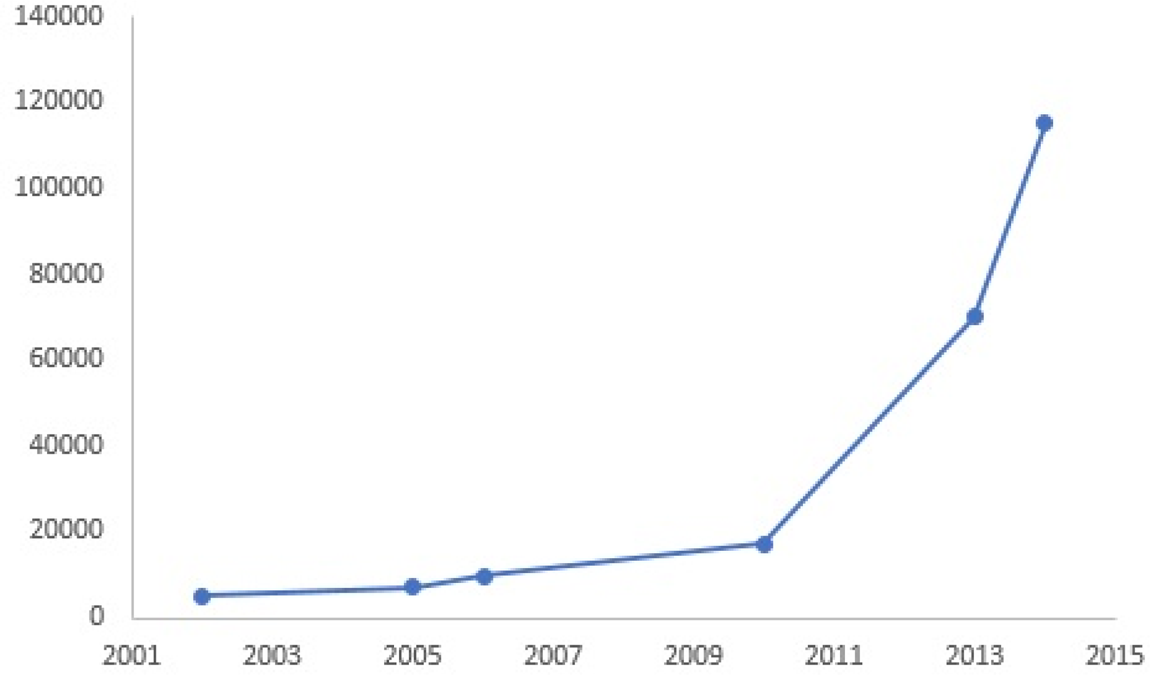
Healthcare disturbance, or yinao 医闹, refers to the disruptive and violent behaviour of patients and their families directed at healthcare personnel and institutes. It includes such actions as blockading hospital entrances, destroying hospital property and attacking doctors or nurses. Yinao incidents were rife throughout China in the 2000s (Figure 1). Healthcare disturbances are not unique to China: the rates of violent incidents targeting healthcare workers (including verbal abuse) in hospital or clinical settings over 12 months range from 9.5 per cent of healthcare workers in the UK to 86.7 per cent of nurses in Turkey.Footnote 1 Studies conducted in Australia, Sweden and the United States during the early 2000s found that workplace violence in healthcare settings was increasing and underreported.Footnote 2 However, even with one-third of all doctors experiencing violent attacks by patients and thousands being injured or killed, the scale, frequency and viciousness of healthcare disturbances in China have shocked the world.Footnote 3
Medical Disputes in China in the 2000s
Source:
Data for 2002, 2005 and 2006 are from Chai Reference Chai2012; data for 2010, 2013 and 2014 are from Liu and Li Reference Liu and Li2018.

How does an authoritarian country like China respond to such incidents, and what are the attitudinal effects of the state response? Much research on contentious politics in China focuses on the origins and dynamics of contentionFootnote 4 or the impact of contention on policy or institutional change.Footnote 5 Although some studies have delved into the state's reactions to collective action or opposition, there is scant knowledge of the policy outcome or effectiveness of the state responses in the Chinese authoritarian setting.Footnote 6 This paper attempts to fill this gap by examining the Chinese state's repression of yinao and the outcome of that repression. On the one hand, the state's repressive or coercive measures to suppress contention might deter direct confrontation or destabilizing activities; on the other hand, state repression and coercion might have unintended consequences such as escalating conflicts and creating further or persistent instability.Footnote 7 The China case is helpful for understanding why state repression fails or succeeds in achieving its intended outcomes, and for revealing the impact of state repression on contention in the authoritarian setting.
Yinao is not limited to localized civil disputes between patients and healthcare personnel or institutes; it is a larger political issue in China for three reasons. First, most Chinese doctors and hospitals are state actors, meaning that disputes with them are essentially disputes with the state. Second, the Chinese party-state, which holds the monopoly on power over most policymaking in the country, considers yinao to be a source of social instability. Thus, state intervention in handling and resolving yinao is common and regarded as necessary. Third, without autonomous civil and social organizations to articulate and advocate interests, discontented patients resort to yinao to resolve medical disputes, express grievances and seek justice, with the expectation that the state will be sympathetic and responsive to their claims. The political nature of yinao means that the state's response to yinao is intrinsically crucial to understanding the state–society relationship in China. The state's strategy for tackling yinao demonstrates how it perceives and manages conflicting interests in the transitional society in order to maintain political order and stability. Citizens, in turn, update their opinions about the state and its agencies based on informative signals from the state responses.
Since the 2000s, the Chinese state has taken several steps to combat yinao, including developing administrative institutions to specifically mediate medical disputes, establishing medical liability insurance to settle medical disputes, and installing police stations in major hospitals. Among these measures, the move to criminalize yinao in the Ninth Amendment to China's Criminal Law in 2015 is considered to be the most stringent and repressive so far. There is, however, very little research on the state response to yinao in general and its criminalization in particular. Nor is it clear how citizens react to these policies and how their reactions shape the motives and possibilities for future healthcare disturbances.
This paper is among the first to empirically examine the state response to yinao and the outcome of that response. I argue that the Chinese state's repression, namely criminalization, of yinao has unintended adverse impacts on doctor–patient relationships. Yinao is a symptom of problematic healthcare provision in China during the reform era. Although a lack of trust in doctors and healthcare-related grievances are widespread, most citizens have no personal experiences or contact with yinao. The criminalization of yinao, by disclosing the severity and pervasiveness of this phenomenon, raises public awareness of healthcare disturbances. In the absence of comprehensive health reforms to effectively eradicate the root causes of yinao, increased public awareness of healthcare problems results in greater suspicion of doctors and hospitals. In this context, healthcare disturbances are likely to continue and increase in China despite state repression.
To support this argument, I utilize multiple sources of data for empirical analysis. First, I tracked the patterns and causes of 373 yinao incidents that occurred between 2000 and 2017 through Chinese media reports. I then took advantage of the panel data from China Family Panel Studies (CFPS) for 2014 and 2016 to apply a difference-in-differences (DID) method to analyse the causal effects of criminalizing yinao on public opinion about healthcare. I find that the criminalization of yinao significantly eroded the public's trust and confidence in doctors and in hospitals’ competence and instead heightened awareness of problems in the healthcare sector and increased public perception of the severity of these problems. Further, I find evidence that suggests the informational role of criminalizing yinao: ceteris paribus, people using the internet as their main source of information tend to have more negative views of doctors and more concerns about the healthcare system.
The China context is characterized by a political setting in which the authoritarian government manages and intervenes in dispute resolution under the shadow of social instability. By studying healthcare disturbances, which can readily escalate into violence and social instability, this paper contributes to two threads of literature on authoritarian politics. The scholarship on contentious politics in China emphasizes the roles played by political opportunity, mobilizing structures, resources and frames when explaining the occurrence of collective actions such as land and labour protests.Footnote 8 This study supplements this literature by investigating a growing but understudied form of contention: yinao. Moreover, by focusing on the state response and evaluating its effectiveness in responding to this particular contention, which can shape the motives and possibilities for future contentious issues, this study adds to the literature on the state's repression, control and management of collective action, opposition and conflict resolution in China.Footnote 9
To elucidate the impacts and effectiveness of the state response to contention, this study puts the emphasis on public opinion. By doing so, it also speaks to the literature on policy feedback effects and public opinion about healthcare.Footnote 10 Extant studies of policy feedback effects tend to focus on patterns and trends of public opinion in democracies,Footnote 11 and as Lawrence Jacobs and Suzanne Mettler note, “much research related to public opinion on medical care, health, and policy tends to be primarily descriptive.”Footnote 12 This study, by examining why and how the state policy of criminalizing yinao impacts the public's attitude towards doctors and hospitals in China, not only traces the trends of public opinion about healthcare but also sheds light on the causes of these trends in a non-democratic setting.
Existing studies of healthcare disturbances in China are concentrated in the field of public health and have mostly focused on the supply side of healthcare, such as hospitals, doctors and nurses encountering violent incidents.Footnote 13 This paper complements this literature by examining the state reaction to healthcare disturbances and its attitudinal effect on the demand side of healthcare (i.e. patients and citizens).
Background: Healthcare Disturbances in China
The causes of yinao in China are multifaceted and can be summarized on micro- and macro-levels. On the micro-level, yinao is often triggered by misunderstanding, miscommunication and, more importantly, a lack of trust between patients and doctors. Decades of economic openness and reforms in China have left their mark on both patients and doctors.Footnote 14 Although the majority of Chinese hospitals remain state owned, government subsidies have declined, from 30 per cent of hospital revenues in the 1970s and approximately 20 per cent in the 1980s to approximately 6 to 7 per cent in the 1990s, and they remained low throughout the 2000s.Footnote 15 Hospitals began to act as profit-seeking enterprises to stay in business.Footnote 16 Available figures show that income from drug sales consistently made up approximately 45 per cent of total hospital revenue from 2004 to 2011.Footnote 17 Doctors have strong incentives to accept drug kickbacks and side payments (“red envelopes”) from patients to compensate for their low salaries.Footnote 18 As healthcare providers receive a fee for administering injections and infusions, which can significantly augment the permitted profit of 15 per cent on medicine, the overuse of such treatments is very common in Chinese hospitals, and large hospitals manufacture intravenous fluids in bulk to generate high profit margins.Footnote 19 Consequently, many patients are suspicious that doctors and hospitals conspire to increase charges for medical care.Footnote 20
Meanwhile, the free healthcare provision of the socialist era has been replaced by a contribution-based social health insurance system in which patients must pay out of pocket. Patients, as consumers, have gradually acquired a stronger sense of entitlement since they are now paying for their own medical services. They demand more explanations as well as better attitudes and more respect from doctors and hospitals.Footnote 21 As a result, conflicts can quickly arise between patients and doctors. In response, many doctors practise defensive medicine – overprescribing diagnostic tests, procedures and drugs to protect themselves in cases of medical disputes with patients.Footnote 22 Similarly, hospitals have increased security patrols and installed security cameras. These escalating security measures have further fuelled the distrust between doctors and patients.Footnote 23
The vicious cycle of distrust–yinao–distrust between Chinese doctors and patients is reinforced by resource misallocation or disorganization in the healthcare system. Chinese public hospitals are categorized into three levels: primary, secondary and tertiary. This categorization of hospitals is not based on the types of medical services supplied by the hospitals but rather the quantity of beds and personnel available as well as the quality of medical services.Footnote 24 The tertiary hospitals, often located in big and provincial capital cities, are equipped with more advanced medical equipment, better facilities and more experienced and well-trained medical professionals. In China, doctors can differ somewhat in the educational training they receive. Some receive full training through a professional medical education programme while others only receive short-term or partial training. Evidence shows that highly educated doctors are more likely to be hired by tertiary hospitals, which in turn fuels a hospital-centred healthcare system in which patients choose large hospitals in order to chase good doctors.Footnote 25 With a severe shortage of gatekeeping family doctors in communities, patients often travel long distances and pay unreasonably high expenses for medical services, even primary care, in tertiary hospitals. Owing to such resource misallocation and disorganization, the demand for and supply of medical services are severely out of kilter. Tertiary hospitals are overcrowded and their doctors are overloaded.Footnote 26 Nevertheless, patients do not seem to be receiving satisfactory care. In 2014, the average patient consultation time was only one and a half minutes – a remarkably short amount of time.Footnote 27
On the macro-level, the prevalence of yinao has its roots in the Chinese political system. First, medical disputes are resolved not through law but through micromanagement by the state.Footnote 28 Hospital officials, judges and health department officials acknowledge that the likelihood of being confronted with a protest or threat is generally the most important factor influencing the resolution of medical disputes, because maintaining social stability is the top priority of the Chinese government.Footnote 29 To avoid any escalation of medical disputes and unrest, the government often pressures hospitals to retreat from their previous positions and pay off discontented patients. In such situations, the powerful hospitals must submit to the government and accommodate the patients’ demands, such as those for greater compensation.Footnote 30 This may encourage some patients to complain even more.
Second, China's legal system is inefficient and ineffective at resolving medical disputes. The legal framework governing these disputes is ambiguous and changing,Footnote 31 and judgments are often made based on political considerations rather than by following the rule of law.Footnote 32 Both patients and doctors view the current legal channel for medical dispute resolution as profoundly unfair.Footnote 33 Moreover, the cost of medical litigation is estimated to be at least 40,000 yuan, which is the approximate annual income of an urban family.Footnote 34 Hence, patients usually take their claims to the streets rather than to the courts.
Third, the Chinese regime's restrictions on the development of NGOs and other autonomous organizations have made it difficult for effective patient advocates to emerge or play a constructive role in dispute resolution. This situation has been made worse by the recent tightening of oversight over civil society and the media.Footnote 35 As such, yinao has become a private remedy and mechanism for individuals to manage conflicts, settle disputes, realize rights and seek justice.Footnote 36
Theoretical Expectations: The Policy Feedback Effect of Criminalizing Yinao
In response to the yinao epidemic of the 2000s, the Chinese state first implemented some administrative measures instead of enacting comprehensive health or social reforms. One measure specifically focuses on building an administrative mechanism to mediate and settle medical disputes.Footnote 37 In 2010, the central government mandated city and county governments to establish the People's Mediation Commission for Medical Disputes. These commissions, sometimes organized under the judiciary, are often headed by the public health administration and are funded by local governments. By 2014, almost all provincial capital and prefectural-level cities in China had established a medical dispute mediation commission, giving 3,396 in total.Footnote 38 If the commissions are intended to provide personnel to mediate and arbitrate medical disputes, the government-sponsored Medical Liability Insurance, to which tertiary and secondary hospitals are encouraged to contribute, provides funds to settle these disputes. By 2013, more than 6,000 hospitals, approximately 60 per cent of tertiary and secondary hospitals, had joined this medical liability insurance programme.Footnote 39 In addition, the public health administration supervised hospitals in establishing procedures, protocols and offices to address medical complaints and minor disputes while reporting and submitting major cases to the mediation commissions.
These administrative measures, put in place before 2014, were intended to provide patients with a formal channel outside of the courts to voice their grievances and make their claims. Nonetheless, as with the litigation option, patients have been reluctant to choose administrative mediation and arbitration to resolve medical disputes because of the high cost, low efficiency and questionable integrity and independence of the institutions.Footnote 40 For the same reasons, the administrative channel has also been ineffective at resolving labour and land disputes.Footnote 41 More importantly, the healthcare system, with its extremely unbalanced demand and supply, was hardly effected by these administrative measures. Distrust between patients and doctors persisted.
Without a clear plan to systematically address these healthcare problems, in 2015 the Chinese state resorted to a coercive and repressive course of action to tackle yinao: criminalizing it. Punishment for yinao was written into the Ninth Amendment to China's Criminal Law. According to Article 290 of the Chinese Criminal Law, healthcare disturbances may be classified as the crime of gathering people to disrupt social order, especially when yinao gangs are gathered to disturb public order to such a serious extent that healthcare order, hospital business operations or scientific research cannot go on, resulting in heavy losses. In these cases, the ringleaders can be sentenced to a fixed-term imprisonment of at least three years, but no more than seven years, while the active participants can be sentenced to a fixed-term imprisonment of up to three years, criminal detention, public surveillance or deprivation of political rights.Footnote 42
The criminalization of yinao is supposed to deter yinao behaviour and thus reduce the number of healthcare disturbances. However, I argue that the criminalization of yinao, as a repressive or coercive measure to curtail violent healthcare-related incidents, not only has little impact on the macro or structural contributing factors of yinao but indeed also increases the distrust between patients and doctors. This is because criminalization reinforces the public's perception that yinao incidents are common; however, it does not address the root causes of yinao. With the public's lack of confidence in the healthcare system being reinforced by criminalizing yinao, all other things being constant, the doctor–patient relationship deteriorates and the public's concern about the healthcare system grows. In these circumstances, healthcare disturbances are unlikely to decrease.
Many Chinese people know that yinao incidents occur but most have incomplete information about the true extent of the disturbances. Views on the prevalence of yinao are formed based on media reports. According to my collection of Chinese media reports on yinao published between 2000 and 2017, only one-third of the incidents lasted more than one day; most incidents ended within hours. The short duration of yinao episodes suggests that most people are unlikely to experience or observe yinao personally; instead, people come to know about it mainly from other sources such as media reports and word-of-mouth. This is corroborated by recent studies about the media's profound role in distributing information about social protests and medical disturbances.Footnote 43
Chinese media reports on yinao are often partial, inaccurate and superficial. The media seek sensationalist effects and rarely investigate cases. Research has shown that the news media extensively use such terms as “doctor–patient relationship crisis” and “medical ethics landslide” in their reports on healthcare disturbances and violence, negatively impacting the public's perception of the current state of doctor–patient relationships.Footnote 44 The media coverage of violence against doctors has led to a decline in the number of Chinese college students choosing medicine majors, especially the disciplines in which physicians and nurses are trained.Footnote 45 Moreover, frequent media accounts of the negligence and indifference of doctors and hospital staff have led to the popular perception that malpractice, often egregious, is common. In fact, according to a recent quantitative study of patterns among 4,561 cases of medical disputes, only 44 per cent of medical disputes actually resulted from cases of medical malpractice,Footnote 46 and some local studies have found this percentage to be as low as 10 per cent.Footnote 47 Furthermore, the mass media like to report medical corruption and disturbances, while valuable legal perspectives, such as legal discourse on how to protect doctors’ rights and ensure compensation for injured doctors, are usually absent from media reports.Footnote 48 As a result, the public tends to have a partial understanding of yinao and holds prejudices against doctors and hospitals.
The reliance on dramatized and personalized media reports of yinao as the main source of information only increases public anxiety about the yinao epidemic. When the government criminalized yinao, it reinforced the idea that violent healthcare incidents were so widespread that the government had decided to apply the most stringent punishments to deter perpetrators. Therefore, although the Chinese government intended to clamp down on such incidents by criminalizing yinao, the policy, under the conditions of incomplete information and lack of comprehensive healthcare reforms, reinforced patient–doctor distrust and exacerbated the public's concerns about the healthcare system.
Thus, I propose the following hypotheses for empirical tests about the policy feedback effects of criminalizing yinao:
Hypothesis 1: The criminalization of yinao negatively impacts public opinion about doctors and hospitals.
Hypothesis 2: The criminalization of yinao raises the public’s perception of the severity of healthcare problems.
Empirical Analysis
The challenge of assessing the policy feedback effect of the state response to yinao is twofold: first, data about yinao incidents and doctor–patient relationships are scant; and second, the state response to yinao might be endogenous to public opinion. To overcome these issues, I collected and utilized data from multiple sources, including media reports and a representative social survey, in order to capture the frequency, distribution and likelihood of yinao. Specifically, I collected detailed information about yinao incidents from media reports to trace the patterns and causes of yinao. I then used insights obtained from the media data to select suitable survey questions and construct variables about public opinion on healthcare for further quantitative study. To address the endogeneity problem, I took advantage of the panel structure of the survey data to design a DID framework to discern the policy feedback effect of criminalizing yinao. I validated the DID estimates using several falsification and robustness tests.
Insights from Media Reports
Through internet searches, I collected media reports on 373 yinao incidents that occurred in China between 2000 and 2017. These incidents cover all Chinese mainland provinces (except Tibet) and provincial-level municipalities. The majority (66 per cent) of incidents happened in tertiary hospitals, which have better quality and more healthcare facilities and personnel. In terms of specific locations, 43 per cent of the incidents occurred in emergency rooms, 29 per cent in outpatient areas and 22 per cent in inpatient areas. Outcomes of 354 incidents were specified in the media reports: 72 per cent resulted in healthcare personnel being injured or killed, and 26 per cent disrupted the operation of the hospitals. Among the 171 incidents in which healthcare personnel were injured or killed, 23 per cent of the victims were healthcare professionals not associated with the perpetrators, such as doctors or nurses who happened to be on site or medical administrators who had intervened to resolve disputes. Overall, the collection of Chinese media reports on yinao confirms that yinao is a widespread and pernicious social problem in China in the 2000s.
The yinao data collected online from media reports are by no means representative of all yinao incidents in China. Reported incidents are selective and tend to involve severe violence, casualties and high-level hospitals. However, the information in media reports constitutes the main knowledge that ordinary Chinese citizens receive about yinao. Since yinao incidents are often transient, many people come to learn about yinao through media reports rather than personal experience or observation. Hence, the content and frequency of yinao incidents depicted in the media and known of by ordinary citizens will help to explain the quantitative analysis results that will be presented later.
A typical yinao incident reported in the media involved a 17-year-old patient in March 2012. Distressed and frustrated by having to undergo multiple visits and unsatisfactory treatments at the First Affiliated Hospital of Harbin Medical University in north-east China, the male patient sought revenge by stabbing three doctors and fatally wounding another, none of whom had actually treated him. An internet survey asked online respondents how they felt about this incident. Of the 6,161 people who responded, over 4,000 indicated that they were “happy,” while 879 were “angry,” 410 were “sad,” and only 258 were “sympathetic.”Footnote 49 The public's lack of trust towards and prejudice against doctors and hospitals are evident in online comments about other yinao news reports.Footnote 50
The insights derived from the media data help to identify the underlying causes of healthcare disturbances in China. According to media reports and prior studies of yinao, patients’ distrust of doctors and hospitals is the most common and direct cause of yinao.Footnote 51 My collection of media reports indicate that 22 of 151 yinao incidents involved organized yinao gangs, suggesting that only a small fraction of yinao incidents had profit-driven and opportunistic motivations. To be clear, patients’ lack of trust and confidence in doctors and hospitals is not a sufficient cause on its own to trigger an yinao incident but, all things being equal, healthcare disturbances are more probable in the low-trust environment.Footnote 52 Based on this insight, an implication can be drawn that if the criminalization of yinao has adverse impacts on public opinion and trust in doctors, hospitals and the healthcare system, healthcare disturbances are unlikely to be reduced with the enactment of this policy.
Quantitative Data and Variables
To test the hypotheses, I use data from the CFPS 2014 and 2016 surveys collected by Peking University's Institute of Social Science Survey. The CFPS drew a national representative sample, using multi-strata and multi-stage sampling methods with probability proportional to size (PPS), from 25 provinces that together house 95 per cent of China's population. There are 19,571 respondents (age >16 years old) from 718 counties/districts in both the 2014 and 2016 surveys, making 39,142 possible observations for analysis.
The dependent variables are respondents’ opinions about the healthcare personnel and system: trust of doctors (trust), views of hospitals’ competence (competence), and perceived severity of the healthcare problem in China (severity). These opinions are drawn from respondents’ answers to the following questions:
(1) How much do you trust doctors?
(2) What do you think of the medical expertise or competence of the medical institute that you usually visit?
(3) How would you rate the severity of the healthcare problem in China?
Respondents’ answers to these questions are recorded on either a ten-point scale (trust, severity) or a five-point scale (competence). I recode the answers into binary dependent variables, with value “1” indicating trust/positive view of doctors and hospitals (i.e. eight to ten on the ten-point scale) and perceived severity of healthcare problems (i.e. four to five on the five-point scale) and value “0” otherwise.
The key independent variables include a dichotomous indicator (hospitalization) of whether the respondent was hospitalized in the previous year owing to illness. In the 2016 survey, 3,359 respondents (12 per cent of valid responses) had hospitalization experiences in the previous year (2015). I assume that hospitalization exposed the respondents more to the policy effects of criminalizing yinao in 2015 because they had first-hand experience and contact with hospitals and medical professionals when the policy was beginning to take effect.
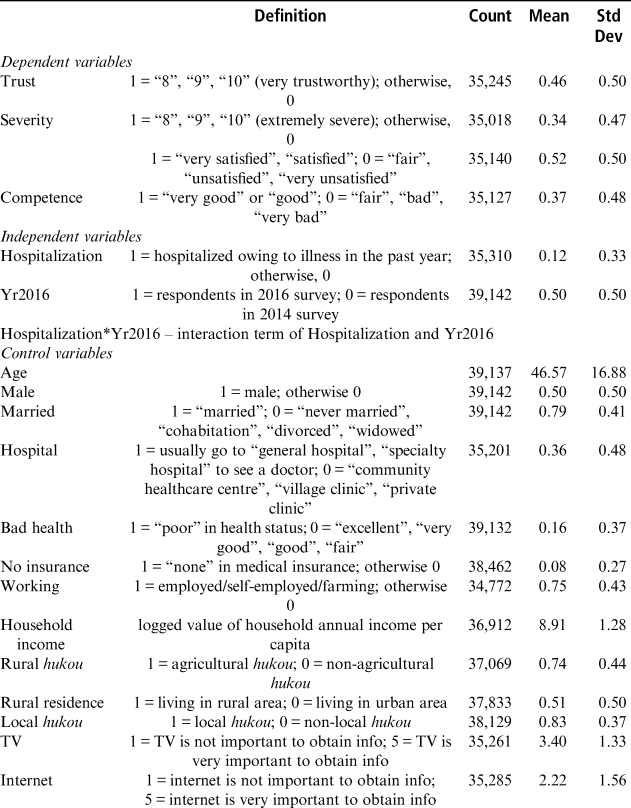
Based on the literature on public opinion about healthcare in China, I also include several demographic, socio-economic and medical-related controls.Footnote 53 These include age, gender, years of education, household annual income per capita, employment status, hukou status, residence area, migration, self-assessed health condition, medical insurance status, type of hospital visited for healthcare, and media use. Table 1 summarizes the measurement and descriptive statistics of all variables.
Variable Definitions and Summary Statistics

Identification
Since the data are drawn from a panel of respondents in the 2014 and 2016 surveys, I employ the DID method to estimate how the experience of hospitalization in 2015 changed respondents’ opinions about healthcare. Specifically, the first difference is the over-time difference that respondents changed their opinions about healthcare from 2014 to 2016; the second difference is the between-group difference that respondents changed their opinions about healthcare owing to hospitalization.
The treatment is the criminalization of yinao in 2015. The 2014 survey was conducted before the treatment, meaning that no respondents were “treated” in the 2014 survey; the 2016 survey was conducted after the treatment, meaning that all of the respondents appear to be “treated” in the 2016 survey. Note that the criminalization of yinao is a national policy which was promulgated in 2015, so in the 2016 survey, no group of respondents was completely isolated from the possible policy effect. However, respondents received the treatment at different levels of intensity depending on whether they had hospitalization experience around the time the policy was implemented. I thus conceptualize the respondents who had experience of hospitalization in 2015 as the “treatment group” because they might experience the treatment more intensely. Conversely, I consider those without hospitalization experience in 2015 to be the “control group.”
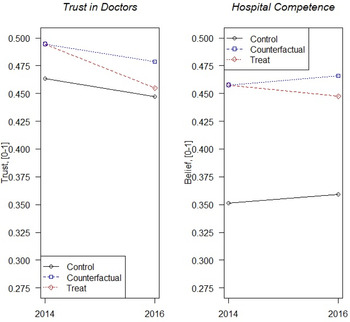
The identification assumption is that in the absence of a hospitalization experience in 2015, average public opinion about healthcare for the control and treatment groups would follow a common (parallel) trend. In other words, the difference between the treatment and control groups in healthcare opinions is constant over time. Figure 2 demonstrates the averages of healthcare opinions for the control and treatment groups from 2014 to 2016, as well as the counterfactual evolution of the average opinion of the treatment group in the absence of treatment. As shown, from 2014 to 2016, both the control and treatment groups’ trust in doctors decreased. In the absence of a hospitalization experience, the respondents in the treatment group should have followed a parallel trend of decreasing trust in doctors. In fact, their trust decreased more than the parallel trend predicted in 2016 and was approximately 0.03 points lower than the counterfactual level (0.45 as opposed to 0.48, p < .10). Regarding confidence in hospitals’ competence, positive views slightly increased for the control group from 2014 to 2016. However, the treatment group's positive views of hospitals’ competence declined in 2016 and was approximately 0.02 points lower than the counterfactual level (0.45 as opposed to 0.47, p < .10). Overall, the description of the attitudinal data provides preliminary evidence that the criminalization of yinao in 2015 corresponded with the deterioration of public trust in doctors and confidence in hospital competence from 2014 to 2016.
Description of the Treatment Effects of Criminalizing yinao on Public Opinion
Notes:
These graphs plot the descriptive patterns of public opinion about healthcare (i.e. trust in doctors, trust in hospital competence) by assigning the respondents to treatment and control groups. The solid line with circles indicates the average opinion among respondents without a hospitalization experience in 2015 (the control group); the dashed line with diamonds indicates the average opinion among respondents with a hospitalization experience in 2015 (the treatment group); and the dotted line with squares indicates the parallel trend of the treatment group.

Model Specification
To formally analyse the treatment effect of criminalizing yinao, the DID can be estimated in the following probit model:
 $$Y_{ict} = \alpha _j + \delta \times ( {Hospitalization_{ijt} \times yr{2016}_{ijt}} ) + \rho \times Hospitalization_{ijt} + \sigma \times yr2016_{ijt} + \mathop \sum \nolimits^ \beta X_{ijt} + \varepsilon _{ijt}$$
In this model, Y ict is a dichotomous measure of respondent i's opinions about healthcare (trust, competence or severity) in county j at time t. Variable yr2016ijt is dummy coded as “1” for respondents surveyed in 2016 and “0” in 2014. Hospitalization ijt is coded as “1” for respondents hospitalized in the previous year and “0” otherwise. The key parameter of interest is the estimate of the interaction term between yr2016ijt and Hospitalization ijt, δ, which captures the treatment effect after accounting for between-group differences (ρ) and over-time differences (σ) in public opinion about healthcare. X ijt is a vector of control variables, including demographic, socio-economic and health factors. I use county fixed effects (α j) to control for the county-specific time-invariant characteristics. I use clustered standard errors at the household level to account for the correlation of respondents’ opinions about healthcare within each household. ɛijt is a random error term.
Empirical Results
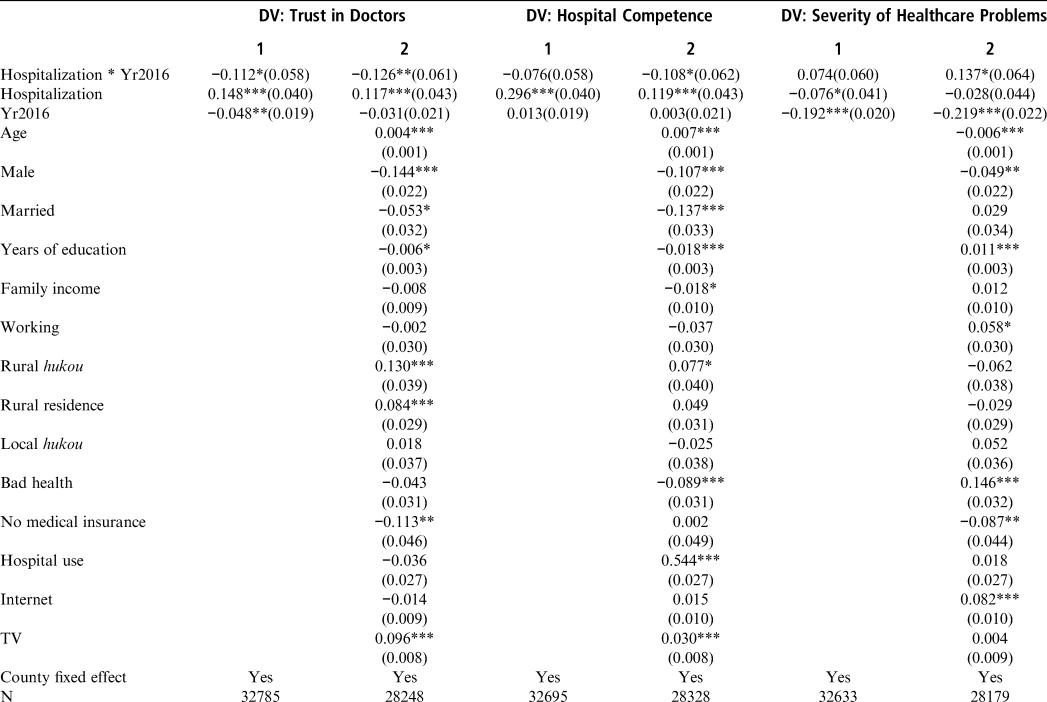
Table 2 reports the analysis results. For each of the three dependent variables, I estimate two models: Model 1 includes the key independent variables only; Model 2 adds all the relevant control variables (hence, it is the preferred specification). The results show that regardless of which dependent variable is used, the estimated treatment effect, δ, is statistically significant when controlling for relevant demographic, socio-economic and medical factors. According to the results from Model 2, the effects of criminalizing yinao on public opinion about healthcare are substantial. Holding everything else constant, the treatment decreases respondents’ trust in doctors and confidence in hospitals’ competence by 13 per cent and 11 per cent, respectively (confirming Hypothesis 1), while it increases respondents’ perceived severity of healthcare problems by 14 per cent (confirming Hypothesis 2). Note that without control variables, the estimated treatment effects on respondents’ perceived severity of healthcare problems and their confidence in hospitals’ competence do not reach statistical significance in Model 1, although the signs of these coefficients are the same as those in Model 2 with control variables. Overall, the DID estimator shows that criminalization of yinao does not improve public opinion about healthcare; conversely, there is strong evidence indicating that criminalizing yinao has significantly decreased the public's trust in doctors.
DID Estimates of the Effects of Criminalizing yinao on Public Opinion about Healthcare

Note:
Clustered standard errors are in parentheses. * p < 0.10, ** p < 0.05, *** p < 0.01.
The coefficients of the control variables shed some light on why the criminalization of yinao had adverse impacts on respondents’ opinions about healthcare. First, the media seem to play a significant role in shaping people's views about doctors, hospitals and the healthcare system in general. Traditional media, such as TV, newspapers and radio, are more easily controlled and censored by the government than new media such as the internet.Footnote 54 In contrast, reports and comments about yinao from new media sources are usually more critical of the state (for example, public hospitals) and state employees (for example, doctors). The coefficients of the media variables show that the more people relied on new media (the internet) to obtain information, the more severe they perceived the healthcare problems to be. In contrast, the more people relied on traditional media (for example, television) to obtain information, the more trust and positive views they had of doctors and hospitals. This finding echoes the informational role of criminalizing yinao: the criminalization of yinao signalled to the public that yinao incidents were severe and rampant. Moreover, because the criminalization was frequently reported by the media, these reports might have increased public awareness and concern about healthcare problems such as medical malpractice and corruption.
Second, consistent with the above results on media use, the coefficient of the education variable indicates that educated respondents tend to have more negative views of healthcare: they are less likely to trust doctors or have confidence in hospital competence; they are more likely to consider healthcare problems to be severe. This might be because educated respondents are more informed about healthcare problems and thus more critical of the healthcare personnel and system. In contrast, rural residents and rural hukou holders seem to hold more favourable views of healthcare: they tend to trust doctors and/or are more likely to have confidence in hospital competence than their urban counterparts.
Third, the coefficients of the health status and age variables indicate that respondents with poor health have significantly more negative views of hospitals and more severe concerns about the healthcare system, while older people have more favourable views of healthcare including trust in doctors and hospital competence. One possible scenario is that people with poor health have higher expectations or greater demands for healthcare (i.e. poor health being a proxy of medical needs). All other things being equal, higher expectations or demands on healthcare lead to more disappointments or frustration and thus more scepticism of hospitals’ competence and more severe concerns about the healthcare system. This result is consistent with the finding of other observational studies on Chinese satisfaction with healthcare that good health is positively associated with healthcare satisfaction.Footnote 55 However, this scenario contradicts the empirical result about age: older people usually also have more demands or higher expectations of healthcare, but their views of healthcare are more favourable. The other scenario is that the people with poor health have experienced ineffective or unsatisfactory medical treatments (i.e. poor health being the medical outcome) and thus hold more negative opinions about healthcare. This scenario is more consistent with the informational role of criminalizing yinao. Future research, using data about respondents’ healthcare utilization and expectations, can further validate these scenarios.
Additional Analyses and Limitations
To test the validity of the causal interpretation and the robustness of the above results, I conduct five additional analyses. First, I use the same panel in the CFPS 2012 and 2014 surveys to directly test the identification (common trend) assumption for the DID estimators. If this assumption holds, the treatment group should follow a common trend with the control group in healthcare opinion from 2012 to 2014 (pre-treatment periods). Appendix Table A1 reports the results of this test.Footnote 56 The coefficient on the treatment variable is not significantly different from zero, supporting the common trend assumption. Therefore, the significant effects found in the DID estimators can adopt a causal interpretation.
Second, I conduct a falsification test using public opinion on non-healthcare issues as the outcome variables. Some might argue that there is nothing special about the treatment and that results simply reflect the general decrease in social trust or the increase in the perceived severity of social problems from 2014 to 2016. Put differently, the significant treatment effects can be found in many other public opinions. To falsify this argument, I perform a test using the DID framework to estimate the treatment effects on respondents’ trust in other people, such as strangers and neighbours, as well as respondents’ perceived severity of other social problems, such as employment, housing and education. If the argument were true, we should find a similar treatment effect on these irrelevant opinions as on the healthcare opinion. Results of this test show that none of the treatment coefficients are statistically significant.Footnote 57
Third, I perform another falsification test using public opinion about hospital facilities as the outcome variable. One could argue that some changes on the supply side of healthcare (for example, fewer hospitals and doctors or less government funding) between 2014 and 2016, rather than the criminalization of yinao in 2015, might cause the depicted change in public opinion about healthcare. If this were true, we should find that public opinion about the infrastructure, facilities or conditions of hospitals significantly changed from 2014 to 2016. To falsify this argument, I replace the dependent variables in the DID analysis with respondents’ satisfaction with the condition of the hospitals that they usually visit. Results of this test indicate that the treatment coefficient is not statistically significant, suggesting that the change in public opinion about healthcare from 2014 to 2016 is unlikely to be attributed to the change on the supply side of healthcare.Footnote 58 This test also provides evidence for the validity of using hospitalization in 2015 as the treatment measure in the DID analysis. Since the criminalization of yinao pertains to individuals’ behaviour or interactions with hospital staff, it is logical that this treatment has no significant effects on individuals’ opinions about hospital facilities or conditions.
Fourth, I conduct a robustness test using a restricted sample. Regarding the mechanism of the treatment effect, some might doubt that the public is aware of the policy. Although this cannot be directly tested owing to a lack of data in the survey, following other studies I use media consumption as a proxy for policy awareness.Footnote 59 I therefore restrict the sample to the respondents with substantial media consumption or exposure (i.e. those who consider media, including the internet, television, newspapers, radio or cellphones an important or very important source of information). My collection of online media reports indicates that the criminalization of yinao was widely covered by the media. A further investigation finds that 105 Chinese newspapers reported on the criminalization of yinao in 2015.Footnote 60 Hence, people with frequent exposure to the media were very likely to be aware of this policy. The results of this robustness test show that estimates of the treatment effects are consistent with those using the full sample.Footnote 61
Finally, I perform another robustness test using the original scale of the dependent variables as well as different regression models. The findings do not change. The results using the continuum dependent variables with different model specifications are summarized in the online Appendix Table A4. According to the ordinary least squares (OLS) regression results (Model 1), criminalizing yinao significantly decreased respondents’ trust in doctors by 0.24 points (p = 0.03) on the ten-point scale and significantly increased respondents’ concerns about the healthcare system by 0.30 points (p = 0.01) on the ten-point scale. According to the marginal effects computed using the ordered probit regression results (Model 2), respondents in the treatment group were 1.9 per cent (p = 0.03) less likely to trust doctors very much (ten on the ten-point scale), and they were 1.6 per cent (p = 0.03) more likely to consider the healthcare problem very severe (ten on the ten-point scale).
Like any observational study aimed at demonstrating causal effects, this study has limitations. A key concern about the DID analysis in this paper is that we cannot completely rule out the possibility that the DID estimator may capture the causal effects of an unidentified confounding factor other than the criminalization of yinao. However, to invalidate the causal interpretation of the attitudinal effect of criminalizing yinao shown in this study, there must be an alternative policy or event that pertains to healthcare and causes public trust in doctors and hospitals to significantly decline while causing the public perception of the severity of healthcare problems to significantly increase. In the chronicle of events compiled by the National Health Commission and the Central Committee of the Chinese Communist Party, no other policy or event in 2015 is found to carry similar theoretical implications for public opinion about healthcare as the criminalization of yinao.Footnote 62 Despite this, it is still possible that the DID results are driven by unobserved confounding factors. My own sense is that this possibility is reasonably small, but it is worthy of future research.
Conclusion
Although violent healthcare disturbances occur in many countries, the frequency, scale and viciousness of yinao in China have shocked the world. In an attempt to deter and contain such violent incidents, the Chinese government has criminalized yinao. However, this criminalization has had an adverse impact on public opinion about healthcare in that it has heightened public awareness of the problem without addressing the root causes thereof. Thus, the doctor–patient relationship has deteriorated and it is likely that the number of yinao incidents will continue to increase.
This study utilizes individual-level panel data from a national representative social survey to provide the first micro-level evidence for the policy feedback effects of the state repression of yinao. The unintended adverse impacts of criminalizing yinao on doctor–patient relationships reveal the limitations of the state's repressive or coercive measures to curb healthcare disturbances and yield implications for social stability and state–society relations in China.
Like other contentious social issues, most notably land and labour disputes, medical disputes are likely to escalate and end in violence. The threat of violence and instability impels the Chinese state to absorb and resolve disputes through legal and bureaucratic channels in which the state has the monopoly on decision making and space for interest representation.Footnote 63 The criminalization of yinao reflects such state efforts to maintain social stability. However, the adverse impact of this criminalization, as revealed in this paper, suggests that the inability of formal institutions (for example, laws, courts, dispute mediation commissions) to resolve social disputes could give rise to more social unrest. The number of healthcare disturbances is unlikely to decrease if the government takes only piecemeal, reactive and repressive actions without comprehensive reforms to address health inequality, inequity and injustice. As an editorial in The Lancet commented after an emergency room physician was fatally stabbed by a patient's son in Beijing on Christmas Eve in 2019, “Healthcare professionals need to be trusted and respected. The best way to enhance trust is to create an effective health system that is credible and respected.”Footnote 64
The inability of the Chinese state to effectively eradicate yinao and its root causes highlights the importance of state capacity and the state's role in socio-economic transitions. The Chinese state's measures to fight yinao reflect both the over- and under-responsiveness of the party-state.Footnote 65 On one hand, the state is “over-responsive” to individual grievances by intervening in dispute mediation and resolution with the hope of maintaining social stability. On the other hand, the state is “under-responsive” in that it is unable or unwilling to make institutional and fundamental changes in interest representation, resource allocation and policymaking to address social grievances fundamentally. The contradictory state responsiveness regarding yinao adds to the debate over whether the Chinese state is a seemingly strong one.Footnote 66 How to overcome the predicament of over- and under-responsiveness to achieve a balance in governance without fundamental regime change remains a significant challenge and, more importantly, a political dilemma for the Chinese authoritarian state.
Supplementary material
To view supplementary material for this article, please visit https://doi.org/10.1017/S0305741020001010.
Conflicts of interest
None.
Biographical note
Xian HUANG is an assistant professor of political science at Rutgers University. Her research focuses on the politics of social inequality and redistribution with a regional focus on China and has appeared in Governance, Social Science Research, Studies of Comparative International Development, China Economic Review and The China Quarterly, among others.